Article Contents:
- What are veneered slat panels and how they differ from others
- Why edges and joints are especially important with veneer
- Where to use veneered slat panels
- TV area and wall behind the TV
- Wall behind the sofa and behind the bed
- Entry Hall
- Home office and workspace
- Country house
- Commercial interior: restaurant, office, showroom
- How to choose the wood shade
- Oak panels: golden and neutral
- Walnut panels: depth and elegance
- Light wood: lightness and airiness
- Dark wood: contrast and strength
- How to match the shade to the floor
- How to match the shade to the furniture
- How to match the shade to the doors
- Which baseboard to choose for veneered slatted panels
- Wooden baseboard: an organic system
- Skirting board matching door color
- Baseboard in floor color
- Tall wooden baseboard as an architectural element
- White baseboard as a contrast
- MDF baseboard for painting
- When not to use a contrasting baseboard
- Veneered panels and architraves: how to create a cohesive door area
- Wooden doors: unified system
- White doors: wooden wall as an accent
- How to design the junction to the doorway
- How to close the ends and edges of veneered slatted panels
- Side end
- Junction to the baseboard
- Junction to the ceiling
- Outside corner
- Inside corner
- Transition to a painted wall
- Veneer, solid wood or MDF for painting: what to choose
- Mistakes when choosing veneered slatted panels imitating wood
- Where to buy veneered slatted panels and skirting boards
- FAQ: Answers to Popular Questions
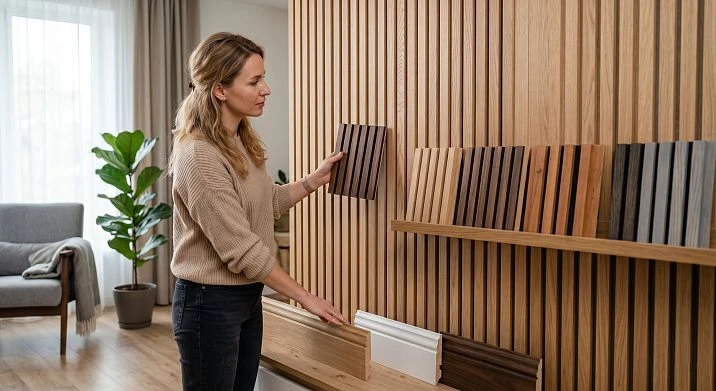
Wood in the interior is not a trend. It is a necessity. A need for warmth, for a material that lives and breathes, for a texture you want to touch. That is why veneered slatted wall panels hold a special place among all wall finishing options: they provide the effect of natural wood in the format of a ready-made, easy-to-install panel system.
But choosing veneered panels is not just about choosing a beautiful picture. It is a system of decisions: which wood shade matches the floor, doors and furniture; which skirting board creates the correct bottom joint; how to close the ends so the wall looks finished from any angle; how to approach the door casing without an unsightly gap. This is exactly what this is about — consistently, in detail, and with specific answers to the questions that arise in every project.
What are veneered slatted panels and how they differ from others
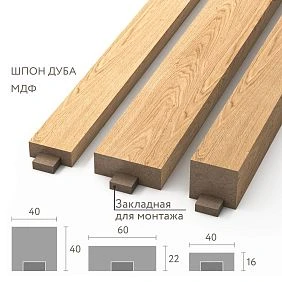
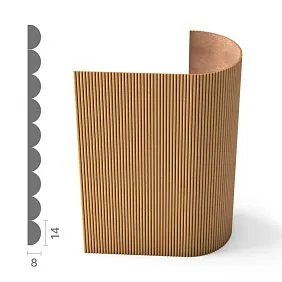
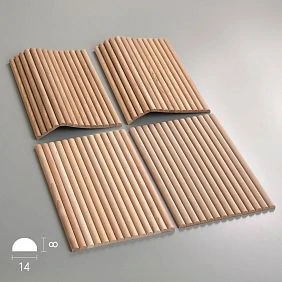
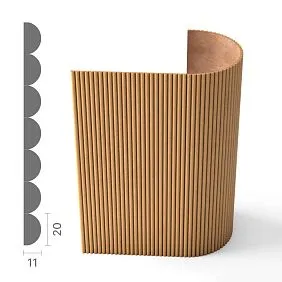
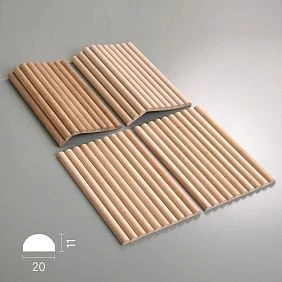
Let's start with the basics. Veneer is a thin slice of natural wood obtained by slicing or peeling. The thickness of decorative veneer is typically 0.6–1.5 mm. This layer is glued onto a supporting base — usually MDF — and coated with a protective varnish or oil. The result is a product with a genuine wood surface, but with a more stable construction and lower cost compared to solid wood.
How do veneered slatted panels differ from solid wood? Solid wood is whole timber throughout the entire thickness of the product. Veneer is a thin natural layer on top of a base. Visually, with properly executed veneering, the difference is minimal: the surface carries the living texture of wood, the natural grain pattern, the tactile feel of wood. Functionally, solid wood is somewhat more stable with humidity fluctuations, but the MDF base of a veneered panel compensates for this with its uniformity and resistance to deformation.
How do veneered panels differ from laminated wood-look panels? This is a fundamental question. Lamination is a film with a photo-printed texture: smooth, cold, visually predictable. Veneer is real wood: with a live grain pattern, micro-relief pores, and tactile warmth on the surface. Upon close inspection, the difference is obvious. Veneered slatted wall panels provide exactly that natural wood effect that no film can replicate.




Why edges and joints are especially important with veneer
A veneered surface looks expensive and natural — until the eye meets an exposed edge. On the edge, there is an MDF base that the veneer does not cover. An uncovered edge immediately reveals the product's construction and destroys the feeling of a premium material. Therefore, when working with veneered panels, it is especially important to plan all edges, joints, and transitions in advance, before installation.
Our factory also produces:

Where to use veneered slatted panels
The logic of using veneered slatted panels largely coincides with other types of slatted panels — but there are nuances dictated specifically by the nature of veneer.
Get Consultation
TV area and wall behind the television
This is a classic area for wood-look slatted panels. Veneered slats create a warm wooden backdrop against which the TV looks not like a foreign object, but like part of a well-designed wall. An important feature of the TV area: mounted equipment, brackets, shelves, and built-in lighting are often installed here. A veneered panel with an MDF base holds fasteners well — significantly better than drywall.
Wall behind the sofa and behind the bed
In the living room and bedroom, veneered slatted panels work as the main warm accent. The wood texture behind the sofa creates a feeling of a well-appointed, cozy space. Behind the bed, it replaces a soft headboard or forms its backdrop, setting a warm, natural character for the bedroom. Veneered panels in the bedroom are especially organic: natural wood at the headboard creates an atmosphere that is difficult to convey with any other material.
Entryway
In the hallway, veneered slatted panels solve several tasks simultaneously: they create the first visual impression of the home, structure the space, and add tactile richness at the entrance. It is important to choose a coating for the hallway that is resistant to wet cleaning: veneer with a lacquer coating or hard oil is easy to wipe down and is not afraid of accidental splashes.
Cabinet and Workspace
A home office with one veneered wooden wall is an image of focus, status, and intellect. Dark oak with a walnut or tobacco tint creates the atmosphere of an executive office. Light oak with clear lacquer brings Scandinavian lightness to the workspace.
Country house
For a country house, veneered slatted panels are an organic continuation of the concept of 'living among natural materials.' Wide panels with a pronounced grain pattern work especially well—they convey a sense of space and connection with nature, which is much harder to achieve in a city apartment.
Commercial interior: restaurant, office, showroom
In commercial spaces, veneer on slatted panels creates an atmosphere of class without declaring it in words. A restaurant with a wooden slatted wall, an office with wooden panels behind the reception desk, a showroom with a warm wooden backdrop—these are solutions that enhance a business's reputation without requiring additional explanations.
How to choose a wood shade
The shade is a key decision when choosing veneered slatted panels. This is where most mistakes are made: people choose based on a photo on a screen and do not consider how the shade of the panels will interact with the floor, furniture, doors, and lighting of a specific room.
Oak panels: golden and neutral
Oak is the most common and versatile option. Its natural shade ranges from light beige to rich honey-golden. Light oak pairs well with white, cream, and gray interior tones. It 'works' in Scandinavian style, modern classics, and eco-interiors. Oak Slat Panel —this is a warm, neutral tone that does not conflict with any color scheme.
Tinted oak in walnut or tobacco takes on a deeper, richer character. This is already a more 'adult' choice—for interiors where you want not just warmth, but also weight and prestige.
Walnut panels: depth and nobility
Walnut is a dark, dense wood with an expressive grain and a rich brown-chocolate hue. Veneered slatted panels in walnut create a sense of status and seriousness in the interior. They are especially good in studies, in TV areas with dark furniture, and in bedrooms with a dark wood headboard. An important condition: dark panels require good lighting, otherwise the space loses volume.
Light wood: lightness and air
Light shades of veneer — ash, maple, light oak without tinting — make the space visually more spacious. This is a choice for small rooms, for bedrooms where you want an atmosphere of peace and freshness. Light wood pairs well with white doors and white baseboards, creating a feeling of Scandinavian purity.
Dark wood: contrast and strength
Dark shades of veneer — stained oak, wenge, dark walnut — are a choice for bold design solutions. They work well on accent walls in large rooms, where a dark surface does not "eat up" the space but creates depth. Dark veneered slatted panels with a wooden baseboard of the same tone create a monumental, solemn lower zone.
How to match the shade to the floor
This is the most important question when choosing veneered panels. Three logics of combination:
Monochrome solution — panels and floor of a similar shade from the same species. Oak on the floor — oak on the wall. The space reads as a single wooden system. Visually monumental, but requires an exact match in tone: close but different shades of the same species can create a feeling of accidental mismatch.
Contrast solution — dark floor and light panels, or vice versa. This is a deliberate contrast that creates layering: the bottom is heavy, the top is light. Works well in tall rooms.
Neutral pairing — floor and panels in different shades, but connected by a single theme wooden skirting board. The baseboard acts as a transitional element that unites two tones without direct comparison.
How to choose a shade for furniture
Wood furniture in the same space as wooden panels requires consistency. The most common mistake is different species without clear logic: light oak on the wall and dark walnut in furniture without a unifying element. Chaotic wood is not "naturalness," it's "bought a mix."
Two working approaches: either a single species (wall, furniture, doors — all oak), or a deliberate contrast with clear zoning (wooden wall — a standalone accent against neutral furniture).
How to choose a shade for doors
Wooden doors next to wooden slatted panels are a dialogue between two wooden surfaces. They should either sound in unison (close shade, same species) or clearly contrast (dark door — light panel). Intermediate states — similar but different shades of the same species — look like a mistake, not a design intent.
If the doors are white, wooden panels create a soft contrast that works in most interior styles. A white trim next to a wooden slatted wall: it's minimalist, modern, and visually neat.
Which baseboard to choose for veneered slatted panels
The baseboard under veneered slatted panels is not just a decorative element. It is the lower boundary of the wooden system, and how it is handled determines whether the wall looks like a cohesive design element or a collection of randomly purchased materials.
Wooden baseboard: an organic system
Wooden baseboard Made from solid oak or beech — the first and most obvious choice for veneered slatted panels. When the veneer on the panels and the solid wood of the baseboard belong to the same species, the bottom joint is perceived as a single whole. The wood smoothly flows from the panel to the baseboard — no break, no mismatch in textures.
If the panels are tinted, the baseboard is tinted in the same tone. If the panels have a clear coating, the baseboard has the same coating. Consistency in the finish is no less important than consistency in the wood species.
Skirting in the color of the doors
When wooden doors and a wooden baseboard are painted or tinted in the same tone, they form a horizontal and vertical framework for the room. The veneered slatted wall within this framework reads as an independent accent, framed by wooden elements. This is a very mature design solution: the room gains structure and clarity, where each element has its place.
Skirting Board in Floor Color
A wooden baseboard close in tone to the floor creates an effect of the flooring "expanding" upward. The lower zone of the wall visually becomes heavier — this gives a feeling of solidity and stability, which is especially appropriate in interiors with high ceilings.
High wooden baseboard as an architectural element
A baseboard with a height of 100, 120, 150 mm is no longer just a wall finish, but a full-fledged architectural element. A high wooden baseboard next to veneered slatted panels creates an image reminiscent of classical architecture: the panels as wooden cladding, the baseboard as a plinth. This solution is appropriate in spacious rooms with ceilings from 2.8 m.
White baseboard as a contrast
A white baseboard next to warm wooden panels is a deliberate contrast. It separates the wooden wall from the floor, creating a clear white line between them. This is a more modern, less "heavy" solution compared to a wooden baseboard. It works well with interiors featuring white doors and white architraves — then the white baseboard is part of a unified neutral frame around the wooden accent.
MDF baseboard for painting
In projects where all finishes outside the wooden wall are done in a neutral color — gray, white, cream — an MDF baseboard for painting may be appropriate. It is painted in the tone of the walls, creating a smooth transition from the wooden panel to the neutral background. The downside is lower resistance to mechanical loads compared to solid wood.
When not to use a contrasting baseboard
A contrasting baseboard — for example, white against dark wood panels — only works when the contrast is intentional and systematic: all baseboards in the apartment are white, all doors are white. If a white baseboard appears only by a wooden wall, while in other areas the baseboard is wooden or a different color, it looks like an accident rather than a design.
Veneered panels and architraves: how to create a cohesive door zone
Architraves are wooden elements that frame a doorway. In a room with veneered slatted wall panels, architraves are in direct proximity to the wooden surface, and this proximity requires a thoughtful approach.
Wooden doors: a unified system
If the doors are wooden, an architrave made of the same wood species creates a unified wooden system with the slatted panels. Wooden casings oak next to a veneered slatted oak wall is an ensemble where each element supports the other. Importantly: architraves and panels do not have to be absolutely identical in tone, but should belong to the same 'family' of shades.
An architrave can be slightly lighter or darker than the panel — this creates a subtle play of depth. But different wood species (oak on the wall and walnut on the architrave) without a clear color logic look like a mistake.
White doors: wooden wall as an accent
White doors with white architraves next to a veneered slatted wall is perhaps the most common and most effective combination in modern residential interiors. The wooden wall reads as a warm natural accent against a backdrop of neutral white elements. No conflict, no competition — just a clear distinction: this is wood, this is neutral.
In this case, the white trim must be clearly brought to the edge of the veneered panel. If the panel protrudes slightly above the wall, the trim is installed over its end: then the white profile covers the cut of the MDF base, and no additional end finishing is required.
How to design the junction with the doorway
Two scenarios — each with its own requirements:
Scenario "trims after panels": panels are installed first, the end goes towards the door frame. Trims are installed on top — and cover the end. This is the cleanest and most reliable option.
Scenario "trims already installed": panels are cut flush with the trim. The joint is closed with a thin wooden strip made of the same material or wooden molding. The strip is tinted to match the panel or trim — depending on which one it is visually "attached" to.
How to close the ends and edges of veneered slatted panels
This block is practical. This is where installation either becomes flawless or reveals compromises.
Side end
The side end of a veneered panel is pure MDF. Veneer is not applied to it during production, and it cannot simply be painted "to look like wood." The only correct way to finish it is with an end strip made of the same type of veneered material, or a profile cut from scraps of the same panel. The strip is glued or attached at the finish; its width must exactly match the thickness of the panel.
Wooden molding from the same oak is another option for the side ends. The narrow trim is attached with finishing nails and tinted to match. The result is a clean vertical line along the edge of the panel wall.
Connection to the baseboard
The bottom end of the panel should extend behind the top edge of the baseboard — with an overlap of at least 5–10 mm. This hides the cut, protects the lower edge of the panel from mechanical damage and moisture that can accumulate near the baseboard. The baseboard is installed after the panels — then its top edge presses against the front surface of the veneered slats, creating a tight joint.
Connection to the ceiling
If the panels reach the ceiling — the top joint is covered wooden molding or with a ceiling cornice made of the same material. If the panels stop below the ceiling — the top end is finished with a horizontal molding, which creates a clear finishing line and completes the slatted paneling.
External corner
The external corner is the most vulnerable point of a veneered panel. The veneer on the corner edge is thin: under mechanical impact, it can peel or chip. A corner profile made of the same wood species protects the corner and creates a clean vertical line. For country houses and commercial spaces where corners regularly receive accidental impacts, a corner profile is a mandatory element.
Internal corner
The internal corner is closed with a corner profile or joined using a 45-degree miter cut. With a proper miter cut, the internal corner is almost invisible — the veneer pattern on both sides creates a natural transition. However, this method requires high precision: the angle must be exactly 90 degrees, and the cut must be perfectly straight.
Transition to a painted wall
When a slat panel borders a plastered or painted wall (e.g., an accent wall only covers part of the room), the transition needs to be finished. Options: a molding along the vertical edge, creating a clear dividing line; or an end cap, flush with the surface of the adjacent wall. An open cut without finishing is a bad option in any case.
Veneer, solid wood, or MDF for painting: what to choose
This is one of the most common questions asked to specialists. Here is an honest comparison.
| Criterion | Veneered panels | Solid wood | MDF for painting |
|---|---|---|---|
| Wood appearance | Natural veneer, living texture | Full solid wood, maximum naturalness | Smooth uniform surface |
| Price | Medium — higher than MDF, lower than solid wood | Highest | Smallest |
| Stability | High (MDF base) | Requires stable microclimate | Very High |
| Repairability | Medium (veneer is harder to restore) | High (can be sanded and refinished) | High (repainting) |
| Warm wood effect | Yes | Maximum | No |
| Painting | Impossible | Tinting and painting | Any color |
| Best choice for | Warm accent + stability | Maximum naturalness | Monochromatic modern interior |
decorative slatted panels with natural veneer occupy an optimal niche: they provide the visual and tactile effect of real wood with a more stable construction and affordable price compared to solid wood. For those who want a wooden wall, but not a wooden wall at any cost — this is a reasonable choice.
MDF slatted panel for painting — is a different story: no wood, but any color and flawless surface geometry. These two options do not compete — they solve different tasks.
When is natural veneer chosen? When the interior is built around the warmth of wood: wooden floor, wooden furniture, wooden doors. When a tactile experience of natural material is desired. When durability is valued, which is provided by properly processed veneer with high-quality varnish or oil.
When is MDF for painting chosen? When the interior is monochrome and the wall color is more important than the texture. When a clean, uniform background is needed. When the budget is limited, but a neat result is required.
When is solid wood chosen? When maximum naturalness and repairability are important. Oak Slat Panel made of solid wood is an investment in a material that can be sanded and recoated after 20 years, giving it a second life.
Mistakes when choosing veneered slat panels for wood
Knowing typical mistakes saves money and nerves — especially when it comes to an expensive material with natural veneer.
-
Choosing a shade only from a photo on the screen — the monitor distorts the color. Order samples and compare them with the floor, doors, and furniture under the natural lighting of your specific room.
-
Not comparing with the floor — even a slight difference in tone temperature (one shade slightly warmer, another slightly cooler) in a monochrome solution creates a feeling of mismatch.
-
Forgetting about the baseboard — ordering and installing panels, only to find that the required baseboard is out of stock or does not match the panel relief in height.
-
Not considering the door color — buying dark veneered panels for a room with white doors without a planned transition, resulting in disharmony instead of contrast.
-
Not covering the ends — leaving an open MDF cut that exposes the structure and ruins the feel of natural wood.
-
Mixing oak, walnut, and other tones without logic — inconsistent wood shades in one space create a sense of chaos.
-
Installing dark veneered panels in a narrow hallway without sufficient lighting — dark wood in a narrow, dark space creates a oppressive effect.
-
Not calculating additional elements — eventually they are bought from different batches, and the veneer shades do not match.
-
Buying panels without trim and architraves — ending up with a situation where a beautiful wall starts and ends with protruding cuts.
Where to buy veneered slatted panels and baseboards
A systematic approach to material selection starts with a single source. When wood-look slatted panelsskirting boards, moldings, architraves, and linear profiles are manufactured to uniform standards from coordinated wood species — interior assembly proceeds without surprises. The skirting board fits against the panel, the molding covers the top edge, the architrave overlaps the side cut. Nothing needs adjustment, nothing mismatches in tone.
The STAVROS catalog offers a complete set for wall finishing with natural wood texture:
-
Rafter panels — including solid oak wood panels and MDF panels for painting, various profiles and slat spacing
-
Oak Slat Panel — natural solid wood with live texture, tinted on request, for warm natural interiors
-
decorative slatted panels — with pronounced relief for accent walls with wood texture
-
Primed MDF slat panel — for painting in any color, for monochrome solutions alongside wooden elements
-
solid wood baseboard — oak and beech, several profiles and heights, for any style and scale of finishing
-
Wooden moldings — for finishing the top edge, joints, and decorative frames around wooden walls
-
Wooden trim — end strips, layouts, filler profiles for all junctions and transitions
-
Wooden casings — to create a unified wooden system from the wall to the doorway
-
Wooden items — a complete line of natural wooden elements for a consistent, systematic interior
Choosing everything from one source means not worrying about matching shades, profiles, and wood species. Everything is produced to uniform standards, and all elements are designed to work together.
STAVROS — production of wooden products from solid natural wood: oak, beech, ash. Precise tolerances, high-quality coatings, a complete line from panels to the last layout. This is the logical starting point when the goal is to create an interior with honest wood texture, not its imitation.
FAQ: Answers to popular questions
What are veneered slat panels?
These are slat panels on an MDF base, the front surface of which is covered with a thin layer of natural veneer — a sliced or peeled cut of real wood. The veneer carries a living texture, natural grain pattern, and tactile feel of wood. It is coated with protective varnish or oil. It differs from laminated panels in that the surface is genuine, not printed.
Which baseboard is suitable for veneered slat panels?
A wooden baseboard made of the same wood species as the veneer is the optimal choice. It creates a unified system at the bottom of the wall. Options include: a baseboard matching the door color (frame effect), matching the floor color (continuation of the floor tone), or a white baseboard as a deliberate contrast. An MDF baseboard for painting is for completely neutral lower zones.
Are veneered panels better than panels for painting?
These are different materials for different tasks. Veneered panels are needed where wood texture and the warmth of natural material are important. Panels for painting are needed where a uniform color without wood texture is required. Neither is better than the other — each solves its own task.
How to choose a veneer shade for the floor?
Order samples and compare them in the natural light of your room. Three working options: a single tone (veneer and floor of the same species), deliberate contrast (light wall — dark floor), a neutral link through a transitional tone baseboard.
How to cover the end of a veneered panel?
With an end strip of veneer of the same species, a narrow wooden trim from the same oak, or bring the panel to a casing that will cover the end. An open MDF cut is an unacceptable option for a finished interior.
Can veneered slatted panels be combined with white doors?
Yes, and this is one of the best combinations in a modern interior. Warm wood on an accent wall — neutral white doors with white casings. The wood reads as a deliberate natural accent against a neutral background.
How to calculate the number of veneered slatted panels?
The width of the wall is divided by the working width of one panel. Add 10–15% margin for trimming to the result. Baseboards, end strips, and moldings are calculated in linear meters separately. Additional profiles — by the number of corners and junctions.
Are veneered slatted panels suitable for a hallway?
Yes. For a hallway, choose panels with a coating resistant to wet cleaning: varnish or hard oil. The MDF base of a veneered panel is resistant to moderate mechanical impact. For hallways, properly finished ends and junctions with door casings are especially important.