Article Contents:
- MN-206 is not seven different legs, but one system
- Confirmed specifications of MN-206
- All seven heights in one table
- Why you cannot assign height based only on furniture name
- First the furniture list, then the cart
- How to calculate quantity for multiple items
- One wood species for the entire collection
- When to choose beech
- When to choose oak
- Test stain before ordering the entire finish
- One metal accent for all furniture
- How to coordinate metal with handles and interior
- Why the tip needs protection during finishing
- MN-206 for cabinet and chest of drawers
- MN-206 for bench and ottoman
- MN-206 for coffee table
- MN-206 for console
- MN-206 for desk
- MN-206 for dining table
- When you don't need to force MN-206 everywhere
- Mounting: one profile does not mean one node
- Why tall supports require separate verification
- Marking without skew
- Recommended base plate FUR-023
- What the base plate provides and what it does not replace
- What to buy together with MN-206
- Unpainted legs as part of custom finishing
- One batch or multiple orders
- How to submit the specification to the manager
- Example of order structure
- How to check an order before payment
- Receiving the kit upon delivery
- How to store seven size groups
- Test assembly of one item
- Checking paired items
- How not to confuse MN-206 with a similar leg
- How not to confuse the kit with a finished structure
- What not to do from scratch if you have a ready-made MN-206
- Scenario for the living room
- Scenario for the study
- Scenario for a commercial interior
- Small batch production scenario
- Typical mistakes of a kit order
- Buying items individually without a common list
- Assuming all seven variants have the same cross-section
- Tying one height to the furniture name
- Mixing beech and oak under one color
- Ordering different metal
- Forgetting the foot pads
- Not checking the fastening
- Using MN-206 on a long table without a frame
- Not marking batches upon receipt
- Start finishing before acceptance
- Paint metal together with wood
- Consider the thrust bearing as a way to correct misalignment
- How many heights does the MN-206 have?
- Is the cross-section the same for all variants?
- Can I choose the height based only on the item name?
- Will MN-206 work for a dresser?
- Can I use MN-206 for a bench?
- Does the tallest MN-206 fit any table?
- What should I choose for an enamel collection?
- When to choose oak?
- Can beech and oak be mixed?
- What metal tip options are available?
- Do I need to choose one metal for all furniture?
- Which foot cap is recommended?
- Is FUR-023 automatically included in the set?
- How do I calculate the number of legs?
- Is a reserve needed?
- How to avoid tone variation?
- Can one mounting template be used?
- How to check the verticality of tall legs?
- Can wood be painted together with the metal tip?
- What to check upon receipt?
- Where to look for other legs if MN-206 is not suitable?

A furniture collection falls apart into individual pieces not when the chest of drawers and table have different sizes. Much more often, unity is lost in details: one nightstand stands on straight supports, a bench on angled ones, a console gets a different metal color, and a coffee table differs in wood species. Each piece individually may look neat, but together they do not form a single system.
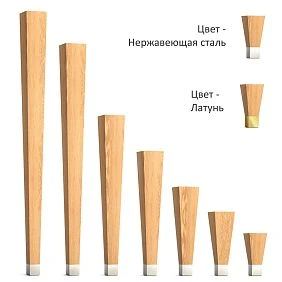
The geometric furniture leg MN-206 allows solving this problem differently. One profile is offered in seven heights — from 120 to 740 mm. This makes it possible to assemble a set for several pieces of furniture, preserving the common silhouette, one wood species, and the same metal accent. But the range of heights does not mean that it is enough to choose a number based on the item's name. For a chest of drawers, bench, coffee table, console, writing or dining table, the height of the support is determined by the entire structure: the body, tabletop, fastening, stability, and expected load.
In the card, you can order a set of MN-206 legs of the required heights. The model is made from beech and oak, and the metal tip is available in brass and stainless steel options. For MN-206, a square foot FUR-023 measuring 25 × 25 mm is recommended. These parameters should be fixed not for one position, but for the entire furniture collection at once.
The correct sequence is as follows: first, compile an inventory of items, then calculate the height and number of supports for each body, after that choose one wood species, a single metal tip option, the future finish, fastening, and glides. Only the completed specification is transferred to the order. This approach helps avoid confusing seven heights, mixing beech with oak, or ending up with a random set of legs instead of a cohesive series.
MN-206 is not seven different legs, but one system
The meaning of MN-206 is revealed not in a single card for a chest or table, but in the repetition of the geometric profile across several items. A low support holds a compact body, a medium one creates a gap under a bench or cabinet, and a tall one becomes part of a console or table. The scale changes, but the character of the line remains recognizable.
This principle is convenient for bedrooms, living rooms, studies, dressing rooms, and commercial interiors. In a bedroom, one shape can be repeated on nightstands, a bench, and a vanity console. In a living room, on a chest, coffee table, and tall console. In a study, on a cabinet, side table, and desk. The buyer does not need to select several similar models and hope they match in angle, edges, and metal accent.
A unified model does not eliminate structural differences. A tall support has a different load arm than a 120 mm leg. A long tabletop may require an apron, frame, central support, or a full underframe. Therefore, MN-206 helps create a visual system, but the engineering scheme of each item must be checked separately.




Confirmed characteristics of MN-206
| Parameter | Confirmed value | What to check in the project |
|---|---|---|
| Model | MN-206 | The article number must be consistently indicated throughout the entire specification |
| Type | Geometric furniture leg | Matching the shape to the style of the bodies and facades |
| Number of heights | 7 | Do not confuse variants during calculation and acceptance |
| Height range | 120–740 mm | Final height of the item, stability, and fastening |
| Cross-section of variant 120 mm | 52 × 30 mm | Separately check the mounting location and fasteners |
| Cross-section of variants 180–740 mm | 60 × 30 mm | Do not automatically transfer the mounting template from variant 120 mm |
| Material | Beech or oak | Uniform wood species and compatibility with future finishing |
| Metal tip | Brass or stainless steel | One option for the entire collection and combination with fittings |
| Named scenarios | Chests of drawers, benches, poufs, coffee tables, writing and dining tables, consoles | Structural suitability of a specific height |
| Recommended footrest | FUR-023, 25 × 25 mm | Quantity, compatibility, and necessity in each project |
The card shows the range and compatible applications, but does not replace a furniture drawing. The article intentionally does not include a universal permissible load, a ready-made fastening scheme, or a promise that a certain height automatically suits a specific item. These parameters depend on the body, number of supports, material, span length, and usage conditions.
Our factory also produces:
All seven heights in one table
| Height A | Size B × G | How to use in the report | What to check specifically |
|---|---|---|---|
| 120 мм | 52 × 30 mm | Separate item with its own mounting section | Landing pad, template, and difference from other sizes |
| 180 мм | 60 × 30 mm | Independent dimension group | Final body height and clearance from the floor |
| 250 мм | 60 × 30 mm | Independent dimension group | Proportion with the body, quantity, and stability |
| 350 мм | 60 × 30 mm | Independent dimension group | Mounting, furniture rigidity, and center of gravity position |
| 450 мм | 60 × 30 mm | Independent dimension group | Relation to seat height, tabletop, or body height |
| 650 мм | 60 × 30 mm | High support requiring separate structural check | Stability, tsarg, frame, additional connections and load |
| 740 мм | 60 × 30 mm | The highest position in the size range | Full diagram of the table or console, fasteners and rigidity |
The most important detail of the table is the difference of the 120 mm variant. It has a size of 52 × 30 mm, while the other heights are 60 × 30 mm. One article number and the same geometric pattern do not mean completely identical mounting geometry. If a craftsman makes one template and transfers it to the entire size range without checking, the low supports may not match the prepared platforms.
Get Consultation
Why you cannot assign height based only on the furniture name
The phrase "legs for a chest of drawers" does not determine the size. One chest of drawers has a tall body and needs a small clearance, another has a compact body that the designer raises higher off the floor. A bench may include a thin seat or a massive upholstered part. A writing desk differs from a dining table in tabletop thickness, frame, and seating requirements.
The final height of the item consists of several values:
- height of the body, seat, or tabletop;
- height of the selected MN-206;
- thickness of the fastening assembly, if it affects the size;
- of the thrust bearing and other lower elements;
- of structural gaps;
- of floor covering features.
Therefore, first set the final height of the furniture, then subtract all parts of the structure, and only then select the nearest confirmed variant MN-206. If the exact size is not in the series, the difference cannot be compensated by random trimming or shimming without a designer's decision.
First the furniture list, then the cart
A complete order starts not with selecting the quantity in the card, but with the item table. In it, each row corresponds to a specific cabinet or group of identical furniture. Such a list helps to see how many legs of each height are required and where parameters repeat.
| Item | Final height | Size MN-206 | Quantity | Species | Metal | Finish | Thrust Bearing | Mounting |
|---|---|---|---|---|---|---|---|---|
| Commode | As per project | After calculation | By design | Beech or oak | One option | Specify | FUR-023, check | Check |
| Bench or pouf | As per project | After calculation | By design | Same species | Same option | Specify | FUR-023, check | Check |
| Coffee table | As per project | After calculation | By design | Same species | Same option | Specify | FUR-023, check | Check |
| Console | As per project | After calculation | By design | Same species | Same option | Specify | FUR-023, check | Check |
| Writing or dining table | As per project | After calculation | By design and calculation | Same species | Same option | Specify | FUR-023, check | Check especially |
The "as designed" fields are not a table flaw. They prevent substituting a furniture calculation with a catalog guess. The buyer or designer fills them after approving the cabinets, and the manager receives an exact list, not a request to "give identical legs for the whole room."
How to calculate the quantity for several items
First, calculate the base number of supports for each item. Some cabinets have four legs; long furniture may require more support points, a central support, or a different structure. The quantity cannot be assigned based solely on a photo. It is determined by the furniture designer.
After calculation, identical items are combined. For example, if two cabinets each have four identical MN-206 legs 120 mm high, one group of eight items can be listed in the specification. If a chest uses the same height but a different metal color, the items cannot be combined: it is a separate configuration.
Then check the reserve. A universal percentage is not needed. For a small home project, a subsequent purchase is possible, while for serial furniture, a remote site, or a transparent finish, a reserve unit may be reasonable. The decision depends on batch size, logistics, the ability to repeat the shade, and the cost of installation downtime.
One species for the entire collection
Beech and oak differ not only in name. Under a transparent or semi-transparent finish, they produce different grain patterns, pore characteristics, and edge perception. Even if the tint is close in color, supports made from different species will not become visually identical.
For a furniture collection, the wood species is fixed before placing the order. You cannot choose beech for cabinets, oak for a table, and then expect that the overall metal color will fully unify the items. Such mixing is only acceptable as a deliberate concept confirmed by samples.
When to choose beech
Beech is often considered for projects with opaque enamel or uniform paint. In this scenario, the collection is tied together by the common color of the bodies and legs, while the MN-206 geometry is read through shape, light, and the metal tip.
However, enamel does not eliminate differences in the base. The technologist must check the preparation, primer, and coating behavior on the wood. If the fronts are made of MDF and the legs are beech, the shared color must be confirmed with a test swatch. The same paint code does not guarantee the same perception on different materials.
When to choose oak
Oak is logical when the project preserves the wood texture. It is suitable for transparent finishes, tints, and combinations with oak fronts, countertops, or other visible details. On a geometric form, the wood grain emphasizes the length and planes of the support.
For a set of multiple heights, it is especially important to order oak items in one batch and indicate that they belong to the same collection. The natural grain cannot be completely identical, but joint delivery facilitates sorting and finishing.
Test swatch before ordering the entire finish
A test swatch is done on material as close as possible to the selected legs. It shows not only the color but also how the coating interacts with the edges, wood texture, and metal tip. The sample is evaluated next to the front and handles.
If the collection includes low and high supports, light falls on them differently. A low MN-206 is in the shadow of the body, while a tall one is almost entirely visible. Therefore, the color is checked not only under bright frontal lighting but also in room conditions.
One metal accent for the entire furniture
Options in brass and stainless steel allow matching the legs with furniture handles, hinges, lights, and other visible details. In a coordinated purchase, the key is not a debate about which metal is more beautiful, but specification discipline: all MN-206 of the same collection must receive the agreed-upon option, unless the designer planned otherwise.
Mixing most often happens technically. In one order line, a brass accent is selected, in another the default value remains, and in a third the parameter is not checked at all. A general list helps to see the error before payment.
How to coordinate metal with handles and interior
The tip is near the floor, while handles are at hand level, so an exact shade match is not always necessary. What matters more is that metals do not create an accidental conflict. A warm brass accent usually supports warm hardware, while stainless steel supports cool and neutral details.
Before ordering, samples or photos are reviewed together. Not only color is considered, but also gloss, surrounding materials, and lighting. The article does not promise a perfect match with hardware from other manufacturers: this can only be confirmed by comparing actual samples.
Why the tip needs protection during finishing
If the wooden part is painted or stained after receipt, the metal tip must be protected according to the workshop's technique. Paint, primer, or stain on metal disrupts the neatness of the line and can change the surface appearance.
The masking method is chosen by the finisher to avoid scratching the metal or leaving adhesive residue. In the specification, it is useful to indicate that the tips must remain in the selected option without contamination from finishing materials.
MN-206 for cabinet and dresser
Low cabinets particularly show the difference of the 120 mm option from the others. Its cross-section of 52 × 30 mm must be considered in the mounting area. If cabinets and dressers use different heights, the craftsman should not automatically transfer one mounting template. Each group needs its own drawing, and for the low support, a separate note in the list.
For a chest of drawers, the body weight, length, and presence of central support are important. Four corner supports may be insufficient for long furniture. MN-206 is selected after determining the entire lower structure, not instead of it. If the body is divided into several sections or contains heavy drawers, the designer checks the position of the supports relative to partitions and load zones.
Visually, a chest of drawers and cabinets can be linked by a single form, even if the heights differ. The main thing is to preserve the wood species, the type of metal tip, and the overall finish character. Then a low cabinet does not look like a reduced copy of the chest of drawers, but is perceived as part of one collection.
MN-206 for a bench and ottoman
The height of a bench consists of the support, frame, base, and upholstered part. A thick seat requires a different leg than a thin one. Additionally, furniture experiences dynamic load when sitting down, so the fastening and rigidity must be calculated separately. Height cannot be assigned based on a single photo or by imitating someone else's product.
The common profile of MN-206 helps link the bench with cabinets and a console, but visual unity should not replace safety. If the selected height or cross-section does not suit the structure, it is better to use a different support for the bench. In a collection, the same wood species, metal color, and geometric character can be preserved, even if the specific model is different.
For an ottoman, the position of the upholstered block is also checked. If the upholstery is visually heavy, a too-thin tall support can disrupt the proportion. A paper or digital mockup is as useful as a structural calculation: it shows whether MN-206 matches the scale of the seat.
MN-206 for a coffee table
A coffee table can be included in a collection at a medium or low height, but the specific number depends on the tabletop and the desired overall height. A thick wooden slab, a thin body, and a glass surface require different solutions. It is important to consider whether there will be an apron, drawer, or decorative frame under the tabletop.
Not only the height is checked, but also the position of the legs relative to the corners, the tabletop overhang, and stability. Metal tips are in the viewing area and must match the rest of the furniture in type. If the table is moved around the room, the foot and floor contact become especially important.
For a pair of tables of different sizes, one leg model can be used, but not necessarily the same height. A low side table and a taller coffee table can maintain a unified style through form and metal, while serving different functions.
MN-206 for console
A console often has a small depth and relatively large height. Therefore, stability becomes key. Wall mounting, an apron, a frame, or another system may be required. Having an MN-206 with a height of 650 or 740 mm does not mean that a thin tabletop can simply be placed on four tall legs.
To find suitable options, you can open the section of wooden legs for a console table, but the final scheme is approved by the designer. In the collection, MN-206 is used where the profile, cross-section, and fastening are truly suitable.
If the console is placed in a walkway, the protrusion of the legs and metal tips is additionally evaluated. The support should not create an inconvenient area for feet or cleaning. For tall furniture, it is useful to make a full-size side template and check the proportion in the room.
MN-206 for desk
A desk must account for the user's seating, tabletop thickness, drawers, and legroom. The leg height does not equal the final table height. If there is a cabinet or apron under the tabletop, their size is subtracted from the total value.
A long tabletop may sag, so supports work together with the frame. It cannot be guaranteed that four MN-206 legs with a height of 740 mm are suitable for any desk. The calculation includes the tabletop material, span, and expected load.
For an office, a single model can connect the desk with a cabinet and an attached console. In this case, the work desk remains structurally independent: its supports can be supplemented with an apron or frame that is not required for a low piece.
MN-206 for dining table
A dining table has higher requirements for stability and seating freedom. The legs should not interfere with chairs and knees, and the lower structure must maintain rigidity under lateral load. The choice of MN-206 is made after developing the under-table or apron system.
You can view in the category Wooden legs for table and compare available solutions. It is worth using MN-206 when its geometry and height are confirmed by calculation, not just matching the collection design.
For an extendable or large table, it is especially important not to transfer the scheme from a console. The transformation mechanism, central support, and load distribution may require a different design. Identical leg shape is only acceptable after checking all usage modes.
When you don't need to force using MN-206 everywhere
A unified style is valuable, but should not become dogma. A separate item may require a different cross-section, different fastening, or a full under-table. Tall furniture may become unstable, and a long tabletop may need additional support.
It is reasonable to abandon MN-206 in a specific position if:
- the required height is not in the size range;
- the cross-section does not fit the mounting platform;
- the design requires a different mounting scheme;
- the design load is not confirmed;
- a long span requires a frame or pedestal;
- the metal tip conflicts with the furniture's purpose;
- an adjustable or folding support is required;
- the tall body does not ensure stability.
The collection will not break if one item gets a different design but retains the wood species, color, and overall geometry. It is much worse to use an unsuitable leg just for visual repetition.
Mounting: one profile does not mean one joint
The mounting method depends on the height, cross-section, body material, and load. The original scheme does not have a confirmed universal fitting that automatically suits all seven options. Therefore, in the order, the leg and the mounting unit need to be separated.
Material how to choose the mounting for furniture legs helps understand the overall logic of the lower node. For MN-206, the master must check the mounting surface, fiber direction, fasteners, absence of play, and serviceability.
The high and low legs may have the same external appearance, but they transfer load to the body differently. Therefore, in the specification, fastening is indicated for each group, not as a single line for the entire order.
Why high supports require separate inspection
As height increases, the lever arm through which lateral force acts on the fastening grows. This does not mean that the high MN-206 is bad; it means that it cannot be evaluated by the rules of a 120 mm leg. The body, frame, and fasteners must work as a single system.
For 650 and 740 mm, verticality, symmetry, rigidity of connections, and furniture behavior on a level surface are checked. If the project involves a table or console, a control sample is assembled first. It allows seeing play, misalignment, and visual proportion before serial installation.
Marking without misalignment
A separate template is created for each item. It marks the position of the legs, profile direction, and fastening points. The 120 mm option receives its own map due to the 52 × 30 mm cross-section. Other sizes are also checked against the actual delivery before drilling.
Marking is done relative to the central axes of the body, not just from the outer edge. For paired cabinets, one template is used so that the supports occupy the same position. After preliminary installation, the furniture is placed on a level surface and checked for rocking.
If the collection is manufactured at multiple production sites, the templates receive the same names and versions. A change in one mounting point must be reflected in the general documentation, otherwise identical items will be assembled according to different schemes.
Recommended foot pad FUR-023
The MN-206 card recommends a square foot pad FUR-023 measuring 25 × 25 mm. It complements the lower part of the support and helps form a complete assembly. However, the necessity and installation method are still checked against the specific furniture and flooring.
In the card, you can buy a square glide FUR-023In the specification, it is counted by the number of supports if it is provided for all items. You cannot order foot pads only by the total number of boxes: you need to check each size group.
What a foot pad provides and what it does not replace
A foot pad can protect the lower part of the leg and contact the floor, but it does not correct incorrect height, misalignment, or weak fastening. It also does not make furniture adjustable if such a function is not confirmed.
Before choosing, it is useful to read, how to choose a foot pad for furniture legs, and then check FUR-023 in relation to MN-206, floor finish, and operating conditions.
On soft and hard surfaces, the contact is perceived differently. Therefore, the decision on the foot pad is made before the final height: even a small lower element is included in the overall size of the furniture.
What to buy together with MN-206
| Position | What it's for | What to Check | Selection route |
|---|---|---|---|
| MN-206 of required heights | Creates a single profile for multiple items | Height, section, quantity, wood type, and metal | View all sizes for MN-206 |
| Square base plates FUR-023 | Complement the recommended lower assembly | Quantity and compatibility 25 × 25 mm | Base plate 25 × 25 mm for MN-206 |
| Fastening | Connects legs to the body | Type, base material, height, and load | Assemble the lower assembly without play |
| Finishing materials | They match legs with bodies by color | Compatibility with beech or oak and a metal tip | How to choose legs for enamel or tinting |
| Other furniture supports | Needed for items where MN-206 is structurally unsuitable | Height, cross-section, attachment, and style | Buy wooden furniture legs |
The "buy together" section does not mean all items are mandatory in every situation. It helps to see the complete lower assembly: leg, attachment, glider, finish, and body. The final configuration is determined by the project.
Unpainted legs as part of custom finishing
MN-206 belongs to the category of unpainted supports, so the buyer can match the wood with facades and countertops. This is convenient for a furniture collection where one color should be repeated on items of different sizes.
In this section, you can view wooden legs for custom finishingBut the lack of a ready-made coating means additional responsibility: the technology of painting, tinting, and protecting metal tips must be determined in advance.
Do not paint each group at different times without a control sample. Differences in coating batch, temperature, application method, and number of layers can create noticeable color variation, especially between paired items.
One batch or multiple orders
For a furniture collection, a single specification is preferable. It does not guarantee absolute identity of natural wood, but it reduces the risk of mixing species, metal options, and size groups. The manager sees the entire project, not several unrelated purchases.
Splitting is acceptable if furniture production proceeds in stages. In that case, an exact copy of the first list must be kept: article number, height, cross-section, species, metal, finish, and order date. Upon repeat purchase, the parameters are rechecked.
If the first batch is already finished, a sample or an exact description of the technology is attached to the repeat order. This does not guarantee an absolute match of natural material, but it helps avoid accidental parameter changes.
How to transfer the specification to the manager
A convenient format is a single table with a separate row for each configuration. If four items use the same MN-206 180 mm beech with a brass-like tip, they can be combined provided the finish and configuration are identical. Different heights or materials are recorded separately.
Add the project name, contact person, and a comment "all items belong to one furniture collection" to the list. This helps draw attention to batch consistency.
Do not limit yourself to a screenshot of the cart. It often does not show the purpose, installation cross-section, or connection to a specific item. The working specification must remain understandable after receiving the goods.
Order structure example
| Item code | Items | MN-206 | Section | Quantity | Species | Tip | Thrust Bearing | Note |
|---|---|---|---|---|---|---|---|---|
| 01 | Two cabinets | 120 мм | 52 × 30 mm | After calculation | Unified | Single option | FUR-023, check | Custom mounting template |
| 02 | Commode | Select by calculation | By selected height | After calculation | Same | The same | FUR-023, check | Check central support |
| 03 | Ottoman | Select by calculation | By selected height | After calculation | Same | The same | FUR-023, check | Check dynamic load |
| 04 | Console | Select by calculation | 60 × 30 mm for heights 180–740 mm | After calculation | Same | The same | FUR-023, check | Check stability and wall mounting |
This is not a ready-made quantity standard, but an example of order discipline. Numbers are entered only after furniture development. The table prevents the error where the 120 mm option is mistakenly considered to have the same cross-section as taller legs.
How to check an order before payment
- Verify the number of items and cabinets.
- Check the final height of each piece of furniture.
- Verify the selected seven possible heights of MN-206.
- Separately check the 120 mm cross-section.
- Fix one type of wood.
- Select a single metal tip option.
- Specify the future finish.
- Check the attachment for each housing type.
- Add FUR-023 where it is specified.
- Verify the quantity of each size group.
- Determine a justified reserve.
- Send the entire list as one file or message.
After this check, you can buy MN-206 of the required heightwithout assembling the basket from memory.
Receiving the kit upon delivery
| What to Check | How to check | Typical mistake |
|---|---|---|
| Article number | Verify MN-206 on all groups | Mixing similar geometric models |
| Height | Arrange items into seven possible groups | High and medium positions end up in the wrong housings |
| Cross-section | Separately check 52 × 30 mm for 120 mm and 60 × 30 mm for the rest | One template applies to all variants |
| Species | Verify beech or oak against the specification | Various materials are discovered after finishing |
| Metal tip | Compare options of the entire batch side by side | Random mixing of brass and stainless steel |
| Quantity | Count separately for each height | Total number is correct, but distribution is wrong |
| Condition | Inspect wood and metal under side lighting | Damage is discovered after painting |
| Floor protectors | Verify FUR-023 and quantity of 25 × 25 mm | Hardware is not ordered for all supports |
Inspection is performed before installation and coating application. Each group is marked with a code from the list. This way, legs for cabinets will not end up with consoles, and tall supports will not mix with other furniture. If different employees accept the items, one person should be responsible for the final verification of the entire collection.
It is useful to place one leg from each group next to each other and photograph the set with labels. Such a photo becomes a visual map of the project. It helps the finisher, assembler, and client understand which heights correspond to which items.
How to store seven size groups
Packages are stored separately and labeled by height, item, wood species, and metal. The inscription "MN-206" is insufficient because all products have the same article number. For the low group, add the note "52 × 30 mm".
Wood and metal tips are protected from impacts and dirt. Storage conditions are coordinated with the finishing technology. Do not remove shipping labels until internal accounting is complete. If the packaging is opened for inspection, restore it so that edges and metal do not come into contact with hard parts.
High legs are stored without bending load. Do not place heavy boxes on them. Groups for different rooms or objects are physically separated, not just recorded in a table.
Control assembly of one item
Before serial installation, it is useful to assemble one control body. On it, check the height, position of supports, fasteners, glides, stability, and appearance of the metal accent. If the template requires adjustment, the error is not repeated on the entire batch.
The control item is compared with the rest of the collection in terms of scale. Sometimes a geometric shape looks appropriate on a dresser but too thin on a massive table. Such a discrepancy is best seen before installing all supports.
After assembly, record the actual final height, distances from edges, fastener position, and the result of checking on a flat surface. This data is transferred to the work card. If the item matches the project, the template receives a "approved" mark.
Checking paired items
Two pedestals, two ottomans, or a pair of consoles must look identical not only in the leg model. Matching offsets, profile rotation, body height, and metal variant are important. Even identical MN-206 will be perceived differently if one is installed closer to the edge.
Paired items are assembled using a single template and checked side by side. If the furniture is intended for different sides of the bed, it is useful to evaluate its mirroring: the external pattern should remain consistent with the viewpoint.
How not to confuse MN-206 with a similar leg
Similar geometry does not guarantee matching heights, cross-sections, and tips. When ordering, provide the full article number MN-206 and a link to the product card. Within the workshop, use the item code and a photo.
If one model is temporarily unavailable, it cannot be automatically replaced with a similar one. Even a slight difference in the edge or metal will disrupt the unified style. The replacement must be approved for the entire relevant group and tested on a furniture mockup.
How not to confuse a set with a finished structure
Legs and glides are not a finished table, ottoman, or console. They do not automatically include a stretcher, fasteners, frame, or calculations. The product card describes usage scenarios but does not guarantee universal compatibility with any body.
The buyer must receive confirmation from the craftsman that the selected MN-206 is suitable in height, cross-section, fastening, and load. Only after this does the set become part of the furniture. This approach is especially important for DIY projects: a ready-made leg simplifies the project but does not eliminate the need for body development.
What you don't need to do from scratch if you have a ready-made MN-206
For an author's collection, it is not necessary to independently cut out seven variants of one geometric leg, search for identical metal tips, and attempt to replicate the profile by hand. The ready-made size range preserves the pattern
Living room scenario
The living room may include a chest of drawers, a coffee table, a console, and a couple of side tables. Here, MN-206 particularly demonstrates scaling: one line repeats on low and high pieces without turning them into literal copies.
On the coffee table, stability and the position of the legs relative to the tabletop overhang are checked. On the console, the wall mount and tall geometry are checked. On the chest of drawers, the central support is checked. All solutions are recorded separately, although the visual parameter remains common.
Office scenario
In the office, MN-206 can combine a desk, a mobile cabinet, a console, and a small table. The desk requires more structural attention because it bears the load from equipment, hands, and storage. The cabinet and console have different conditions.
For the office, it is important to coordinate the metal tip with handles, lights, and equipment. Stainless steel can support a neutral interior, while a brass accent can support a warmer composition. This is a design choice, not a universal rule.
Commercial interior scenario
In a salon, showroom, or hotel space, repeatability is especially noticeable. Several pieces are in the same field of view, so the difference in heights, materials, and metal must be controlled. The specification receives room and zone numbers.
Commercial use can create increased load and frequent furniture movement. Therefore, strength, fastening, and glides are checked separately. The home scheme cannot be transferred without assessing operating conditions.
Small batch production scenario
For a series of several identical dressers or tables, the general list turns into a production document. It specifies the quantity per item, number of items, total sum, and reserve. Each batch undergoes selective inspection of dimensions and appearance.
If the series includes different items, an internal code is added to the article: MN-206-120-DRESSER or MN-206-740-TABLE. Such a code does not replace the product name but prevents confusion in the workshop.
Typical mistakes of a set order
Buying items individually without a general list
Different purchases receive different wood species, metal, or finish. The general table shows the entire collection before ordering and helps to arrange items in one batch.
Assuming that all seven variants have the same cross-section
Height 120 mm has dimensions 52 × 30 mm, the rest — 60 × 30 mm. Mounting templates need to be separated, and the difference highlighted in the specification.
Tying one height to the furniture name
A dresser or table does not set the size automatically. The final height, body, fasteners, and structural calculation are needed.
Mixing beech and oak under one color
The same paint does not always hide differences in the base, and a transparent finish emphasizes them. The wood species is fixed before arranging the basket.
Order different metal
Random mixing of tips is noticeable in one room. The option for brass or stainless steel is specified in each line.
Forget the foot pads
FUR-023 is recommended for MN-206, but it needs to be added and calculated separately. The quantity is checked for each group of supports.
Not checking the fastening
A leg without an agreed node is not ready for installation. This is especially important for high supports and long furniture.
Use MN-206 on a long table without a frame
The length of the tabletop and the load may require an apron, underframe, or additional supports. Four legs are not a universal design.
Do not mark batches upon receipt
Seven heights can easily be confused in the workshop. Each group must have a code, purpose, and cross-section indication.
Start finishing before acceptance
After painting, it's harder to fix material mixing and record the original damage. First, check the entire delivery.
Paint metal together with wood
The tip must be protected according to technology. An accidental layer of paint destroys the metal accent.
Consider the footplate as a way to fix misalignment
FUR-023 does not replace precise marking and secure fastening. The cause of wobbling is eliminated in the design.
Who the idea of one model in seven heights suits
- a private client assembling furniture for one room;
- a designer creating a collection of cabinets, dresser, ottoman, console, and table;
- a furniture workshop that needs a clear specification of several heights;
- for a manufacturer of a small series of furniture;
- for a project requiring a single enamel or tint;
- for an interior where a metal tip should be repeated on different items;
- for a customer who wants to buy furniture legs of the same shape but different scales.
It's better for someone to choose a different path
MN-206 should not be used as a mandatory base if items require fundamentally different constructions or styles. A heavy table may need a massive underframe, folding furniture a mechanism, and adjustable furniture a different support.
If the furniture is already made and the mounting points do not match, replacing all legs may be impractical. In such a case, you can Buy wooden furniture legs look for other shapes and choose a more compatible model.
A different approach is also needed when none of the seven heights provide the required final size. Do not cut the finished profile or add random spacers without a technical solution.
How to buy the MN-206 set at STAVROS
First open the card and view all MN-206 sizesDo not add items to cart immediately: move seven options to the worksheet and keep only those confirmed by the project.
Then confirm:
- piece of furniture;
- height MN-206;
- cross-section 52 × 30 or 60 × 30 mm;
- quantity;
- beech or oak;
- tip for brass or stainless steel;
- future finish;
- mounting;
- FUR-023;
- justified reserve.
The completed specification is sent to the manager as a single document or message. Current prices, availability, and order conditions are checked in the cards. This route helps to buy wooden furniture legs not as separate items, but as a set for one collection.
How to align seven heights with a single facade line
A unified furniture collection is built not only on identical legs. It is important how the bottom line of the cabinets relates to the facades, plinths, and countertops. A low cabinet on MN-206 120 mm can have almost the same visual clearance as a taller chest on a different support if the body of the second item is more massive. Therefore, not only the height of the legs is compared, but the entire composition from the floor to the top plane.
It is useful to create a frontal elevation of the room. It marks the floor, the height of each cabinet, the top line of countertops, and the position of metal tips. Such a diagram shows where the same profile truly unifies the furniture and where the difference in scale becomes too abrupt.
If items stand next to each other, the bottom line is especially important. An accidental difference of a few centimeters can look like an error, even though each height is calculated correctly individually. In this case, the cabinet body, countertop thickness are adjusted, or another approved variant of MN-206 is chosen — but only after checking the structure.
How to work with furniture in different rooms
One collection is sometimes distributed between a bedroom, dressing room, and study. In such a project, the same profile must withstand different lighting conditions. Warm brass-like metal in the bedroom and cool lighting in the study can be perceived differently, even though the product is the same.
Before ordering, a sample is examined in each room or under light with a similar temperature. If the designer still chooses different metal variants for different zones, this is recorded as separate sub-collections. The parameter cannot be left to the assembler's discretion.
How to prepare a finish map
The finish map links each dimensional group to a specific coating. It specifies the wood species, color, degree of transparency, primer, number of layers, and method of protecting the metal tip. Even when all legs are painted the same, such a map is needed for repeatability.
For transparent tinting, the direction of the texture and sorting rules are additionally noted. For opaque enamel, requirements for edge preparation are noted. If the finishing is done by different workshops, one approved sample is provided to each party.
How to check the set after finishing
After the final coating, the legs are again sorted into groups. Check that the heights have not mixed, the markings are preserved, and the metal tips are equally protected. Paired items are compared side by side under side lighting.
Minor natural differences in wood are acceptable, but accidental changes in color or gloss level must be noticed before installation. After installation on different items, comparison becomes more difficult, and correction will require disassembly.
How to organize installation in sequence
Installation begins with a control item, then proceeds to identical groups. First, all cabinets are assembled, followed by the chest of drawers, ottoman, console, and table. This order reduces the risk that legs of one height will be accidentally used in another body.
Only one size group is opened at the workplace at a time. The remaining packages remain labeled. After completion, the item receives a mark in the log: installed, checked, glides added, stability confirmed by the master.
How to create a furniture collection passport
For a large project, a simple passport is useful. It includes the MN-206 card, height table, attachment diagram, item numbers, wood species, metal, finish, glides, and photos of the finished furniture. The document remains with the owner or manufacturer.
The passport facilitates repairs and future purchases. In a few years, you won't have to remember what height was on the console or which metal option was chosen. However, the current parameters of a new delivery are still checked anew.
Why a complete set purchase is organizationally more advantageous
This is not necessarily about a discount: it is not confirmed and should not be promised. The organizational benefit lies elsewhere. A single specification reduces the number of decisions, simplifies acceptance, helps coordinate finishes, and reduces the risk of accidental mixing of goods.
The workshop sees the entire scope of work in advance, the finisher prepares a common sample, and the installer receives clear groups. The buyer controls not individual boxes, but the completed project. It is this manageability that makes the MN-206 complete order commercially reasonable.
Checklist before order transfer
| Control question | Where to record the response | What happens if you skip |
|---|---|---|
| What item is the group intended for? | In the "Item" column | Legs may end up with a different cabinet |
| What is the confirmed final height of the furniture? | In the drawing and specification | The finished item will be higher or lower than the project |
| Which MN-206 option is selected? | In the "Height" column | Seven sizes will be mixed up |
| What is the mounting cross-section? | 52 × 30 or 60 × 30 mm | The mounting template will not match |
| What wood species is needed? | Beech or oak | There will be a difference in texture and finish |
| Which metal tip? | Brass or stainless steel | The collection will receive a randomly mixed metal |
| Is FUR-023 needed? | Fittings as a separate line | There won't be enough support pads for installation |
| Who confirmed the fastening? | In the designer's note | The order will be placed without a finished bottom assembly |
This table is useful as a final filter. If at least one row has no answer, it's too early to move the corresponding group to the cart. It's especially important not to replace an unknown parameter with an assumption. It's better to return the gap to the designer, engineer, or manager before payment.
How to evaluate the result after installing the entire collection
Finished furniture is checked not only individually. Items are placed in their design positions and viewed from the main viewpoints. The character of geometry, clearance height, color of wood and metal tips are compared. The overall style should be noticeable, but different items do not have to have the same height or the same number of supports.
Then each case is functionally checked: pedestals and drawers open without wobbling, the bench is stable, the table has no play, the console is secured according to the design. Visual consistency is accepted only together with structural correctness.
If one item falls out of the series, first determine the cause. Sometimes the problem is not with MN-206, but with a too massive case, different finish, or incorrect position of supports. Do not immediately replace the entire batch: adjustment should be based on comparing the drawing and the actual assembly.
Who is responsible for each order parameter
| Parameter | Who usually confirms | What document is needed |
|---|---|---|
| Final height of the furniture | Designer and engineer | Overall drawing of the item |
| Height of MN-206 | Engineer after calculating the case | Support list |
| Number of legs | Construction set | Lower node diagram |
| Beech or oak | Designer and finisher | Material map |
| Brass or stainless steel | Designer | Visible fittings list |
| Mounting | Furniture designer or master | Installation drawing |
| Finishing | Technologist | Approved color sample |
| Quantity acceptance | Person responsible for assembly | Copy of order and marking card |
This distribution of responsibility does not complicate the purchase, but removes uncertainty. The STAVROS manager helps to arrange a confirmed product configuration, but should not calculate the stability of the table or the number of supports instead of the designer. The designer selects visual parameters, but the fastening is approved by the specialist responsible for the structure.
Which data cannot be left verbal
A verbal decision is easily lost between design, ordering, finishing, and installation. Phrases like "same metal everywhere", "smallest for cabinets", or "tall table legs" are especially dangerous. They are clear to the author at the moment of conversation, but do not contain the exact article, size, and quantity.
All parameters that create a separate product item are recorded in writing: height, cross-section, wood species, tip option, and number of items. The purpose of the item is added as a note. For the 120 mm group, the size 52 × 30 mm must be repeated so that the difference is not lost during data transfer.
After changing the project, the old version of the list is marked as outdated. You cannot keep several tables without a date and revision number in correspondence: a master may open an early version and order the wrong height. The final file should have a clear name, for example "MN-206_specification_approved" with a date.
Final check before sending to production
Before transferring the order to production, it is useful to conduct a short in-person check with the entire team. Seven available heights, selected items, quantity, cross-section, wood species, metal, finish, glides, and the person responsible for fastening should all be on one sheet at the same time. Such a check takes little time but allows you to notice contradictions between the designer's album, furniture drawing, and cart.
Special attention is paid to groups that are visually similar but intended for different items. If two items have the same height but differ in wood species, metal, or finish, they cannot be combined. If the parameters completely match, combination is allowed, but the purpose is still kept in the note. The final version of the list must be signed or otherwise approved by the responsible parties before placing the order.
FAQ: questions about the MN-206 kit
How many heights does the MN-206 have?
Seven options are confirmed: 120, 180, 250, 350, 450, 650, and 740 mm.
Is the cross-section the same for all options?
No. The 120 mm height has a size of 52 × 30 mm, while the options from 180 to 740 mm are 60 × 30 mm.
Can the height be chosen just by the name of the item?
No. You need to consider the cabinet, countertop or seat, fasteners, final height, stability, and expected load.
Is the MN-206 suitable for a chest of drawers?
Chests of drawers are listed among the application scenarios, but the specific height, quantity, and central support are determined by the cabinet design.
Can the MN-206 be used for a bench?
Benches and poufs are indicated in the card, however, the dynamic load and fastening must be calculated separately.
Is the tallest MN-206 suitable for any table?
No. The height of 740 mm does not replace the calculation of the underframe, apron, tabletop, and stability.
What to choose for a collection under enamel?
Beech is often considered, but the final choice and coating technology are confirmed by a test sample.
When to choose oak?
Oak is appropriate when you need to preserve the wood texture or combine legs with oak parts.
Is it possible to mix beech and oak?
Technically possible, but under a transparent finish the difference will be noticeable. For a unified collection, it is better to fix one species.
What metal tip options are available?
Options for brass and stainless steel are confirmed.
Is it necessary to choose one metal for all furniture?
For a cohesive visual solution, one option is usually fixed. Any other combination must be a deliberate design decision.
Which footpad is recommended?
For MN-206, the square FUR-023 size 25 × 25 mm is recommended.
Is FUR-023 automatically included in the kit?
The original diagram confirms the recommendation, but the quantity and configuration need to be checked and added to the order separately.
How to calculate the number of legs?
First, the designer determines the number of supports for each item, then identical configurations are combined into size groups.
Is a reserve needed?
There is no universal percentage. The reserve depends on the project size, logistics, finishing, and the possibility of subsequent repurchase.
How to avoid color mismatch?
Order one species and the entire collection with one specification, inform that the items belong to the same object, and perform finishing simultaneously.
Can I use one mounting template?
For the 120 mm option, a separate template is needed due to the 52 × 30 mm cross-section. Other items are also checked against actual products.
How to check the verticality of tall legs?
After pre-assembly, the furniture is placed on a flat surface, checking axes, symmetry, fastening, and absence of wobbling.
Can I paint wood together with the metal tip?
The metal must be protected according to the finisher's technique to prevent coating from getting on the tip.
What to check upon receipt?
SKU, height, cross-section, quantity, wood species, metal option, wood condition, tips, and FUR-023.
Where to look for other legs if MN-206 is not suitable?
Other options are collected in catalog of solid wood furniture supports.
Conclusion
MN-206 allows you to build a furniture collection on a single geometric profile. Seven heights allow you to connect items of different scales, while beech or oak and two metal tip options help coordinate wood and hardware. But the model's strength is only revealed with a comprehensive approach.
First, you need to compile a list of items, calculate the height and number of supports, separately account for the cross-section of the 120 mm option, choose one wood species, one metal accent, finish, fastening, and FUR-023 glides. The height cannot be assigned based on the furniture name, and tall supports cannot be used without checking stability and the lower structure.
STAVROS allows you to order several MN-206 options with a single specification and supplement them with recommended hardware. Such an order is more convenient than random purchases of individual items: it maintains a unified style, reduces the risk of color mismatch, and helps the workshop correctly distribute the seven size groups. As a result, a chest of drawers, bench, coffee table, console, and table look like part of one collection, although each item remains structurally independent.