








































































Article Contents:
- Geometric furniture leg MN-206: what parameters need to be specified when ordering
- The size range needs to be read in full
- What should be in the specification
- Beech for opaque furniture
- Oak when texture matters
- For enamel and for tinting - different blanks
- The simplest scenario: handles and tips of the same metal direction
- When contrast is still appropriate
- Stainless steel and Taurus handles
- When stainless steel conflicts with warm hardware
- Formula for the finished furniture height
- 120 mm: low furniture and a noticeable cross-section nuance
- 180 and 250 mm: dressers, benches, coffee tables
- 350 and 450 mm: benches, poufs, tall coffee table structures
- 650 and 740 mm: tables and consoles
- Levelness starts with the cabinet body
- Accepting the set before painting
- How FUR-001 works
- How FUR-012 works
- Why the 120-mm MN-206 needs to be checked separately
- Why it is needed if MN-206 already has a metal tip
- Why the 25 × 25 form is important
- What SUPER GLIDE provides
- When not to buy MN-206
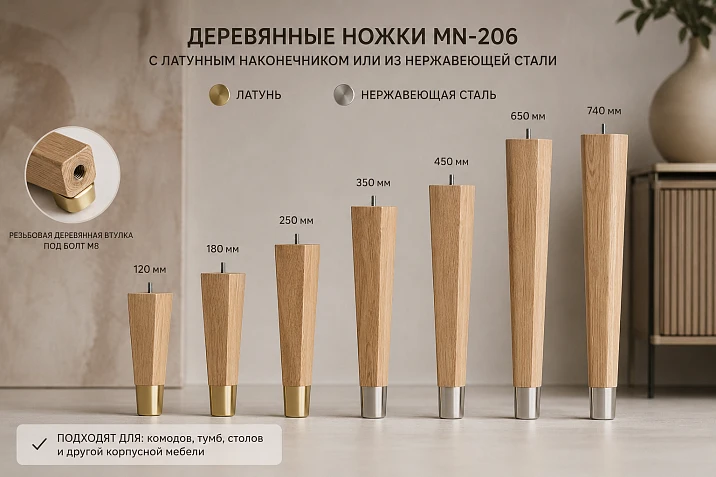
Furniture handles are already selected, facades are approved, the body color is clear—and only then it turns out that the legs also have a noticeable metal part. For the geometric MN-206, the tip can be ordered in two versions: brass or stainless steel. If you choose it independently of the handles, the bottom of the furniture starts to live its own life: warm golden metal on top, cold silver on the bottom, or vice versa. For modern furniture, such a mismatch can sometimes be a deliberate contrast, but more often it looks like the result of two unrelated purchases.
Therefore buy wooden legs MN-206 it is not worth it based on a single parameter of "liking the shape." For each support, you need to simultaneously fix the height, wood species, preparation for finishing, tip metal, top mounting method, and bottom glider. And only after that, count the quantity.
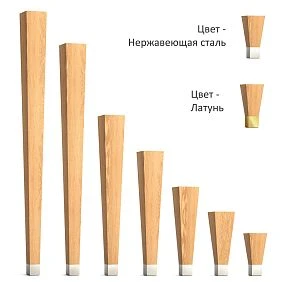
The MN-206 card offers a wide size range: 120, 180, 250, 350, 450, 650, and 740 mm. However, the lowest version at 120 mm has a different cross-section from the others: 120 × 52 × 30 mm, while the variants from 180 to 740 mm are shown as A × 60 × 30 mm. This is an important technical detail: you cannot draw one mounting point for a 740-mm leg and then automatically replace it with a 120-mm one, assuming the geometry of the upper part remains the same.
The metal is also chosen before placing the order. The product table has separate options "Brass Hardware" and "Stainless Steel Hardware." This does not mean that MN-206 becomes a metal leg: the main support remains wooden, made of solid oak or beech, and the metal is used specifically in the decorative tip.
If the handles are already selected, the correct algorithm looks like this:
-
determine the metal of the handles — warm brass or cold steel;
-
decide whether the MN-206 tip should match this metal or deliberately contrast with it;
-
choose the leg height based on the furniture's function, not the photo;
-
check the cross-section of the specific height;
-
choose beech or oak based on the future finish;
-
determine the top mounting — FUR-001 or FUR-012 based on the cabinet construction;
-
include the floor protector FUR-023 in the project;
-
multiply the entire specification by the number of supports;
-
check the final height of the furniture;
-
Only after that place the order.
For most dressers, consoles, benches, and tables, it is safer to stick to one metal language: brass handles → brass tips; stainless steel handles → stainless steel tips. But this is not a rule. If a designer deliberately builds a two-metal composition, it can work — provided that the second metal is repeated in at least one other interior element, and not just on four legs.
Geometric furniture leg MN‑206: what parameters to specify when ordering
MN‑206 is a modern geometric furniture support made of solid wood with a metal tip. The card directly indicates application for dressers, benches, poufs, coffee, dining, and writing tables, consoles. That is, the model is not tied to one type of cabinet, and the size range allows using one design on items of different heights.
The size range should be read in full
| Height A | Section B × G | Material | Tip metal |
|---|---|---|---|
| 120 мм | 52 × 30 mm | Beech / Oak | brass / stainless steel |
| 180 мм | 60 × 30 mm | Beech / Oak | brass / stainless steel |
| 250 мм | 60 × 30 mm | Beech / Oak | brass / stainless steel |
| 350 мм | 60 × 30 mm | Beech / Oak | brass / stainless steel |
| 450 мм | 60 × 30 mm | Beech / Oak | brass / stainless steel |
| 650 мм | 60 × 30 mm | Beech / Oak | brass / stainless steel |
| 740 мм | 60 × 30 mm | Beech / Oak | brass / stainless steel |
Two practical conclusions follow from the table.
First: height is an independent product modification, not a length that the buyer should trim themselves. If you need a chest of drawers on 180-mm legs, it is more reasonable to choose the standard 180 mm than to buy 250 mm and plan arbitrary trimming.
Second: the 120 mm version differs not only in height but also in width B = 52 mm. Therefore, when switching from 120 to 180 mm, not just one vertical dimension changes. The furniture designer needs to re-check the mounting area.
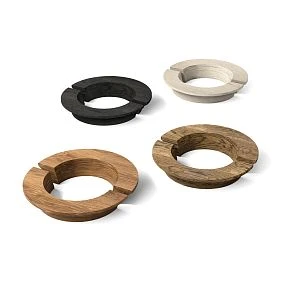
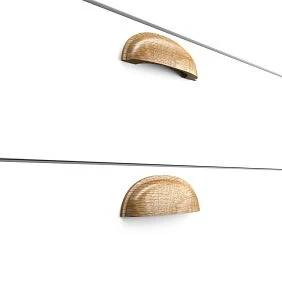
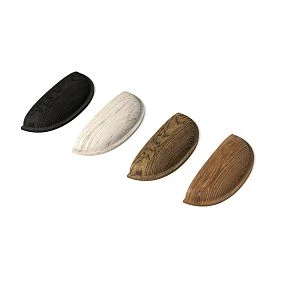
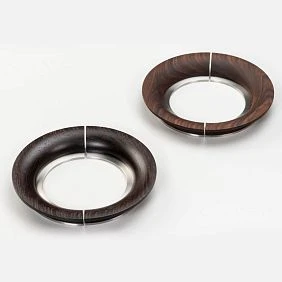
Our factory also produces:
What should be in the specification
Bad line:
MN-206, 4 pieces.
A good line:
MN-206 / 250 × 60 × 30 mm / oak / for tinting / brass tip / 4 pcs. / top mounting FUR-___ / FUR-023 — 4 pcs.
This format eliminates most assembly errors.
Why you cannot choose metal based on a monitor photo
"Brass" and "stainless steel" are fairly clear directions, but the visual perception depends on:
-
gloss;
-
lighting;
-
the adjacent wood;
-
façade colors;
-
light temperatures;
-
handle finishes;
-
the distance between the handle and the leg.
If the handles have already been purchased, the best sample is the handle itself, not a screenshot of the product page. Take it with you to the showroom or photograph it next to a metal sample under the same lighting.
If the handles are also STAVROS, it is easier to verify the match. For example, buy the Taurus HL‑060‑1M furniture handle is available in the “Brass” and “Stainless Steel” finishes; similar metal options are available from Taurus HL‑060‑2M. This allows you to match handles and leg tips in the same direction without having to match them by the random names of different manufacturers.
The number of legs determines the quantity of all accompanying hardware
If a chest of drawers has four MN-206, it is usually considered:
-
4 legs;
-
4 top mounts;
-
4 support feet;
-
4 identical metal tips.
For a six-leg console or a long item, the quantity changes accordingly.
You don't need to buy one FUR-001 "per set of legs" if the hardware card shows the mounting kit for one support. Each connection point is counted separately.
The load on a leg is not equal to the allowable weight of the entire furniture
In the STAVROS FAQ for furniture legs, a vertical load of at least 100 kg per support is stated. This figure cannot be mechanically multiplied by four and written as "the chest of drawers will withstand 400 kg."
The finished structure depends on:
-
the material of the body;
-
fastening zone;
-
leg positions;
-
moment from lateral load;
-
width and depth of furniture;
-
the countertop;
-
assembly quality;
-
dynamic impact.
For heavy furniture, the designer checks not only the leg but the entire lower assembly.
Get Consultation
Wooden legs MN‑206 in beech or oak: what to choose for furniture finishing
The MN‑206 card offers beech and oak. The choice of wood species should be tied to what will remain visible after finishing.
Beech for opaque furniture
STAVROS describes beech as dense, non-porous wood often used under enamel. For MN‑206, this is a logical choice if the furniture body is:
-
white;
-
graphite;
-
black;
-
beige;
-
colored;
-
completely covered with opaque enamel.
In this case, the wood grain is not the main part of the design. The shape of the leg and the metal tip are more prominent.
For example, a matte dark green dresser with brass handles can be assembled on beech MN-206 under the same enamel and with brass tips. The wood visually blends with the body, and the metal becomes an accent.
Oak, when texture matters
Oak has a pronounced texture. If the furniture is finished with oil, stain, translucent varnish, or another system that preserves the wood grain, oak MN-206 can support a tabletop or facades made of oak.
Here, the metal of the tip works alongside two active materials:
wood + metal.
Therefore, the shade of the hardware is especially noticeable.
Oak + brass usually gives a warmer visual effect.
Oak + stainless steel — colder, more graphic.
This is a description of a compositional effect, not a universal style rule.
The leg material does not have to match the body material.
An MDF dresser under enamel can stand on beech or oak legs — if the exterior finish brings them to the desired look.
A veneered body also does not automatically require the same solid wood species. You need to look at:
-
color;
-
texture;
-
transparency of the coating;
-
availability of the required veneer matching;
-
sample.
Different blanks for enamel and for tinting
Card MN-206 allows you to choose the veneer matching quality. According to STAVROS rules:
under enamel — lamellas can be glued without matching by color and texture, because the product is intended for an opaque coating;
under tinting — lamellas are matched by color and texture, because the wood remains visible.
Therefore, you cannot first order "under enamel," and after receiving it decide to leave the oak natural and expect an identical pattern across all four legs.
If the handles are already chosen and the entire composition is thought out, the specification must simultaneously include:
wood species + re-gluing + color of the tip metal.
What matters more: matching the facade or the countertop
For a dresser, the leg is visually closer to the body and handles.
For a table, it is closer to the countertop.
For a console, it depends on the project.
Therefore, there is no single rule "always tint the leg to match the countertop." Make two full-size or digital options:
-
The wood of the leg matches the body;
-
The wood of the leg matches the top.
And compare where the metal tip reads more convincingly.
When to look at other models
If none of the seven heights of MN‑206 gives the correct proportion or the geometric shape is not suitable, it is better to go to the section wooden furniture legs and supports and choose another item, rather than trying to modify MN‑206 for the task.
Brass tip of the MN‑206 furniture leg: when it pairs with handles
Brass metal at the bottom of furniture is more noticeable than it seems in the product photo. On a low dresser or ottoman, the tip is almost at eye level of a seated person; on a console and table, it forms the lower rhythm of the piece. If the handles are already chosen in warm metal, the brass tip usually supports the composition most naturally.
The simplest scenario: handles and tips of the same metal direction
Suppose the dresser fronts have handles with a brass finish. Then four MN-206 with brass tips create a clear vertical connection:
handle → front → body → leg → brass tip.
The metal repeats at the top and bottom, so it looks intentional.
This is especially noticeable if the leg itself is painted in the color of the body: the wooden part visually continues the furniture, and the brass tip rhymes with the handles.
Brass and dark wood
Oak or beech under a dark stain next to brass gives a strong contrast in lightness and temperature. This technique works for:
-
consoles;
-
writing desks;
-
dressers;
-
banquettes;
-
on pedestals.
But if there are many golden elements present at the same time — handles, lamps, mirror trim, furniture legs, sockets, decorative moldings — the metal can start to dominate.
Then the MN‑206 tip is better evaluated in the context of the entire room, rather than a single piece.
Brass and light enamel
White or cream furniture with brass is a more contrasting composition. The tip visually separates the leg from the floor and emphasizes the geometric shape.
For the low MN‑206 120 mm, the metal is close to the body, so it reads as part of the base.
For the tall versions 650 and 740 mm, the tip becomes a more noticeable accent on the long vertical.
Do you need to match the brass shade exactly?
If the handles and legs are made by different brands, the word "brass" does not guarantee the same color. The finish can be:
-
light golden;
-
warm yellow;
-
muted;
-
satin;
-
more mirror-like;
-
aged.
Therefore, for third-party handles, it is better to have a physical sample.
If Taurus HL‑060‑1M or HL‑060‑2M in the brass version are used, at least the direction of the metal within one product system matches by name. But even then, the final visual compatibility is best assessed on real samples, especially if the item is expensive.
Brass tip and other metal in the room
The presence of stainless steel in the interior does not prohibit brass legs.
For example, kitchen appliances can be steel, while furniture hardware in the living room can be brass. These groups are on different objects and do not have to match.
The problem arises when two different metals meet on the same piece of furniture without clear logic.
For example:
-
brass handles;
-
steel tip;
-
black hinges;
-
chrome decorative strip.
Four independent metal accents make the piece look visually random.
When contrast is appropriate
The contrast of "brass handles + steel tips" can be intentional if:
-
stainless steel is repeated in the tabletop or frame;
-
there are noticeable steel light fixtures in the room;
-
Brass is used only as a facade accent;
-
The designer intentionally builds a two-metal scheme.
The main condition is that the second metal must have a repetition.
A lone steel tip against brass hardware is more often perceived as a mismatch rather than a design move.
How to check brass without visualization
Take:
-
one handle;
-
a sample of the facade color;
-
a sample of wood or leg finish;
-
a sample of the floor.
Place them side by side in daylight.
If the brass of the handle and the future tip does not conflict with the wood and the floor, the decision can already be considered thoughtful.
Stainless steel tip: which modern furniture it suits
Stainless steel in MN-206 creates a colder and more neutral accent. It is especially logical where handles, facade profiles, or adjacent hardware already have a silver or steel character.
White furniture and stainless steel
On a white or light gray body, the steel tip looks restrained.
It does not create as strong a color contrast as brass, and it supports well:
-
chrome handles;
-
nickel shades;
-
matte steel;
-
aluminum profile;
-
silver lamps.
If the goal is to make the legs modern but not turn them into the main decorative accent, stainless steel is usually safer.
Black furniture
Black body + stainless steel give a graphic pair. Especially if the handle is also of cold metal.
Here it is important to consider the shine. A mirror-bright tip on a matte black facade reads stronger than a satin one.
If the handle has a matte steel effect and the tip is noticeably shinier, the color matches, but the texture does not.
Light oak and cold metal
The combination of light wood with stainless steel makes furniture visually lighter and more modern.
For a desk or dining table, this can be especially successful if the room already has:
-
metal lamp bases;
-
steel partition profile;
-
silver handles;
-
appliances.
Stainless steel and Taurus handles
Taurus HL‑060‑1M and HL‑060‑2M cards show the “Stainless steel” options. Therefore, for furniture where handles from this series are already selected, the steel tip MN‑206 is an obvious candidate.
An important point: the Taurus handles themselves are wooden handles with a metal coating/element. That is, the composition is built not as “metal handle + wooden leg,” but as a repetition of the pairing:
wood + steel at the top and wood + steel at the bottom.
This makes the set especially cohesive.
When stainless steel conflicts with warm hardware
If the handles are in warm bronze, brass, or golden tones, a steel tip can make the lower part of the furniture feel colder.
This is not always bad, but it requires explanation in the interior.
If there is no other cold metal, it is safer to choose brass.
Steel and minimalism
The geometric shape of MN-206 is modern in itself. The stainless steel tip enhances this quality.
Therefore, for:
-
a minimalist console;
-
a writing desk;
-
a strict dresser;
-
a laconic bench;
-
of a modern coffee table
stainless steel often matches the shape better than decorative warm brass.
But the final decision is still determined by the handles.
How to choose the height of the wooden leg MN‑206 for a dresser, bench, or table
Height is the most functional parameter of MN‑206. The color of the metal can be assessed by eye, but a mistake in height has to be felt every day.
Formula for the finished height of furniture
For items with legs, it is useful to calculate:
Hfinished furniture = Hbody + Hleg + Hupper layer,
if the structure really is assembled that way.
For a table:
Htable = Hleg + Hfastening/under-table assembly + Htabletop.
For a chest of drawers:
Hbase = Hbody + actual mounting height of the leg.
You cannot simply take A = 740 mm and assume the table will be exactly 740 mm high: the tabletop and mounting add their own thickness.
120 mm: low furniture and a noticeable cross-section nuance
MN‑206 120 mm is the lowest modification and the only one in the table with width B = 52 mm.
It is suitable for scenarios where the body should be close to the floor:
-
a dresser;
-
a pedestal;
-
low bench;
-
ottoman;
-
low coffee table.
But "suitable" here means only a typical scenario. Specific furniture is calculated based on the body.
For example, a dresser body 700 mm high + a 120 mm leg gives about 820 mm before accounting for the mounting assembly and top panel. If the designer aimed for 780 mm, such a leg may already be too high.
180 and 250 mm: dressers, benches, coffee tables
These dimensions create a noticeable gap under the furniture.
Advantages:
-
easier to clean;
-
the leg becomes part of the design;
-
the body visually "floats";
-
the metal tip is clearly visible.
For a robot vacuum, not only the nominal leg height matters, but the clear gap under the body. If the body drops below the attachment point or there is an apron, the actual space may be less than A.
350 and 450 mm: benches, poufs, tall coffee table designs
Here you need to calculate seating comfort or tabletop height.
For a bench:
seat height = leg + frame + soft padding.
If you take a 450-mm leg and add 120 mm of frame with a cushion, the seat height becomes about 570 mm — for many scenarios this is too high. This is an example, not a standard; specific furniture is calculated in advance.
650 and 740 mm: tables and consoles
High MN-206 models belong to dining, work, or console furniture.
For a table, the final tabletop height is important.
Example:
-
740 mm leg;
-
30 mm tabletop;
-
installation almost flush.
The result is about 770 mm.
This is already higher than many common dining tables, so you cannot choose 740 mm just because it is a "dining table leg height." The entire structure must be considered.
If 650 mm is used with a thick under-table box, the result can also reach the desired height.
Why handle height indirectly affects the choice of legs
Handles do not determine the structural height, but they affect proportions.
On a low cabinet with a long handle, a leg that is too tall can make the piece look visually elongated.
On a tall console, a small knob and a long leg create a different rhythm.
Therefore, with ready-made handles, it is useful to create a scaled front elevation of the furniture and check:
-
body height;
-
the position of the handles;
-
leg height;
-
the length of the visible metal part;
-
the distance from the floor.
How to choose between two adjacent heights
Suppose the project is torn between 180 and 250 mm.
The difference:
250 − 180 = 70 mm.
These 70 mm are fully included in the final height if the mounting is the same.
Ask four questions:
-
is additional clearance needed under the cabinet;
-
will the furniture not become too tall;
-
will the center of gravity and stability not change;
-
does the proportion of the facade match the length of the leg.
If there are no answers, first make a full-size mockup from a block of wood or cardboard.
How to order a set of wooden legs so that the furniture stands level
The same model does not yet guarantee level furniture if the set is assembled from different heights, different mountings, or if the legs are installed on a cabinet with a skew. For MN‑206, proper purchasing starts with the same specification for all supports of one item.
For one dresser, all legs must be of the same modification
If the cabinet is designed for four MN‑206 180 mm legs, the order must include four identical items:
MN-206 180 × 60 × 30 mm / one material / one re-glue / one tip metal / 4 pcs.
You cannot accidentally mix:
-
180 and 250 mm;
-
beech and oak;
-
brass and stainless steel;
-
different types of re-gluing;
-
different top mounts.
Even if two legs are visually close, furniture geometry requires identical supports.
Why the color of the metal needs to be checked across the entire set
The tips are near the floor and receive light at a different angle than the handles.
If one leg turns out to have a brass tip and the other three have stainless steel ones, the discrepancy will be noticeable.
Therefore, during acceptance, lay out all four supports side by side and compare:
-
metal;
-
height;
-
cross-section;
-
the wood;
-
surface quality.
Evenness starts with the cabinet body
If the bottom plane of the dresser is skewed, four perfect MN-206 legs will replicate that skew.
Before installation, check:
-
body diagonals;
-
levelness of the base;
-
identical thickness of mounting plates;
-
absence of local sagging in particleboard/MDF;
-
position of each mounting point.
Marking along a single baseline
Do not mark each leg independently "from the nearest edge."
For four supports, it is useful to specify:
-
the front baseline;
-
the rear one;
-
the left one;
-
the right;
-
identical indents.
If the body is rectangular, the mounting points form their own rectangle. Its diagonals must match in the design.
Why an equal indent from the edge is not always sufficient
The body may have:
-
protruding facades;
-
base;
-
internal partition;
-
weak zone near the edge;
-
hidden hardware;
-
drawer guides.
Therefore, the beautiful external offset must align with the load-bearing zone inside the cabinet.
Quantity of top hardware
If one leg is attached with one set of FUR‑001 or FUR‑012, four legs require four sets.
For six, cut out six.
It is important to include this in the cart along with the legs.
The floor glide is also counted individually
FUR‑023 is a standalone bottom element.
For four MN-206:
4 × FUR‑023.
Not one set per piece of furniture, but one foot pad per support.
Why a spare fifth leg is usually not needed
MN-206 is not a consumable item.
It makes sense to buy a fifth leg only if:
-
the site is remote;
-
the project is serial;
-
the risk of damage during installation is high;
-
a spare part is needed for a commercial interior;
-
the furniture batch requires a reserve.
For one home dresser, the exact quantity is usually sufficient.
Acceptance of the set before painting
If the legs are ordered unpainted, check before finishing:
-
article number;
-
height;
-
cross-section;
-
wood species;
-
tip metal;
-
quantity;
-
the condition of the wood;
-
set of fittings;
-
FUR‑023.
Do not start painting if there is a grade mismatch. After applying the coating, it is more difficult to resolve the replacement issue.
Furniture leg attachment: FUR‑001 or mounting plate FUR‑012
Card MN‑206 recommends two top hardware options: FUR‑001 and FUR‑012. They use an M8 × 60 stud, but create the connection differently.
| Parameter | FUR‑001 | FUR‑012 |
| Main set | M8 × 60 stud + metal insert M8 × 13 | M8 × 60 stud + round mounting plate d37 mm, M8 |
| Work from the cabinet side | insert installation required | plate is attached to the base |
| What to check | thickness and density of the material under the insert nut | Space for the plate and its fasteners |
| Choice | Based on the body construction | Based on the body construction |
You cannot say: "for a dresser, always FUR‑001", and "for a table, always FUR‑012". The type of furniture does not automatically determine the assembly unit.
How FUR‑001 works
Buy FUR‑001 mounting kit makes sense if the cabinet construction allows creating a threaded fit through the insert nut.
The FUR‑001 card confirms:
-
stud M8 × 60;
-
threaded part 30 mm;
-
metric part 30 mm;
-
metal insert nut M8 × 13;
-
mounting hole for a 10 mm bushing;
-
basting hole for a 6.5 mm stud.
These dimensions cannot be transferred to the housing automatically without checking the material thickness.
If the base is thin, the bushing may not have sufficient working area.
How FUR-012 works
Buy FUR-012 mounting kit should be considered when the design works better through a mounting plate.
The card describes:
-
round plate d37 mm;
-
M8 thread;
-
M8 × 60 stud.
The plate distributes the node over a larger area of the housing.
But it also requires space:
-
the plate must not fall on the edge;
-
the plate fastening must not cross hidden hardware;
-
the base must be strong enough;
-
access for installation must be unobstructed.
Why the 120-mm MN-206 needs to be checked separately
For the 120 mm version, width B = 52 mm, not 60 mm.
This may affect:
-
stud axis position;
-
visual offset from the body edge;
-
access to the mounting plate;
-
proximity of the fastener to the edge of the leg.
You cannot use a single jig made for 60mm versions without checking the 120mm drawing.
What to choose for MDF
A universal answer cannot be given without thickness and construction.
A thick load-bearing insert made of MDF or plywood is one situation.
A thin cabinet wall is another.
If the base material is weak for a threaded insert, the mounting plate may be preferable, but the final choice is made by the furniture designer.
What to choose for an array
An array also does not automatically mean FUR-001.
Need to consider:
-
direction of fibers;
-
the thickness of the part;
-
proximity to the edge;
-
possibility of drilling;
-
maintainability of the node.
What to choose for a table
A table on high MN-206 legs has a higher lateral moment than a low chest of drawers: a long support creates a larger lever arm.
Therefore, mounting at 650 or 740 mm is especially important to calculate based on the body or tabletop.
You cannot assume that the same stud makes any height equally stable.
Why the choice of mounting should be made before painting
If holes are drilled after the final enamel, the risk increases:
-
chipping of the coating;
-
scratches;
-
edge damage;
-
incorrect marking.
It is better to first make an assembly diagram, prepare the holes, perform a test assembly, and then organize the finish according to the workshop technology.
Fittings should not be selected by price
The difference in the cost of fastening kits is less than the cost of repairing a damaged cabinet.
Criterion:
which assembly is structurally correct for the base.
Not:
which is cheaper.
Support pad FUR-023 for geometric wooden leg MN-206
The MN-206 card recommends the square FUR-023. Its size is 25 × 25 × 5 mm.
It is fastened with a self-tapping screw and belongs to the SUPER GLIDE series.
Card FUR-023 confirms a complete universal galvanized self-tapping screw 3.5 × 20 mm.
Why is it needed if MN-206 already has a metal tip?
The metal tip is a decorative part of the leg itself.
FUR-023 is lower contact hardware that works with the floor.
These are two different elements.
You don't need to think that a brass or steel tip automatically replaces a floor glide.
Why the 25 × 25 shape matters
MN-206 has a bottom geometry of G = 30 mm. FUR-023 has a 25 × 25 mm square.
On paper, it fits into the 30-millimeter zone, but final installation is still done according to the actual bottom end and the drawing.
Need to check:
-
the center;
-
absence of protrusion beyond the edge;
-
location of the screw;
-
thickness of the wood;
-
position of the metal tip.
Do not drill through decorative metal at random
If the footrest is installed in the lower assembly next to the metal tip, the exact mounting position must match the MN‑206 design.
The card recommends FUR‑023, but the article should not invent a hidden scheme inside the tip.
Before installation:
-
study the drawing;
-
inspect the actual part;
-
check with the manager where the screw goes;
-
only then drill.
What SUPER GLIDE provides
FUR‑023 is designed for easy movement of furniture without direct contact of the leg with the floor.
This is useful for:
-
dressers;
-
console;
-
coffee table;
-
bench.
But "easy to move" does not mean "drag heavy furniture across a dirty floor."
If a grain of sand gets under the foot, it can still damage the surface.
For parquet and soft lacquer
FUR‑023 has a sliding surface, not felt.
If the floor is particularly sensitive and its manufacturer requires soft felt pads, the floor's recommendation must be taken into account.
The fact that FUR‑023 is recommended for MN‑206 confirms compatibility with the leg, but does not override the specific flooring requirements.
How many FUR‑023 to buy
For four legs:
4 pcs.
For six:
6 pcs.
If one glider is damaged and the others are already worn, it is sometimes more reasonable to replace them as a set to maintain consistent height and sliding.
Why the glider should be included in the total height calculation
FUR‑023 has a height dimension of 5 mm.
The part can work inside an assembly unit, so you cannot automatically add exactly 5 mm to the final furniture without an actual fit.
But in a precise project, the lower hardware cannot be ignored.
What to check before buying wooden furniture legs
Final control is best done not by a single product photo, but by eight specification lines: height, quantity, wood, finish, metal, mounting, floor glide, and connection to handles.
1. Height of each support
Write down the exact modification.
Not:
"MN‑206 medium."
But:
MN‑206 250 × 60 × 30 mm.
If the project changes from 120 to 180 mm, do not forget that the section width B also changes: 52 → 60 mm.
2. Number of legs
The quantity is determined by the furniture design.
Typically:
-
small dresser — 4;
-
bench — 4;
-
coffee table — 4;
-
long console — 4 or more per project;
-
long table — quantity per structural calculation.
The article should not assign six legs based only on tabletop length. The designer considers body rigidity and load placement.
3. Beech or oak
Choose not by price, but by finish.
If the furniture is opaque, beech is often rational.
If the wood grain should remain visible, oak often gives a more expressive pattern.
But in both cases, specify the quality of the re-gluing.
4. Type of future coating
Fix:
Under enamel
or
Under tinting.
If the color is not yet chosen, do not rush to order an expensive set.
A mistake in re-gluing is noticeable after a transparent finish and cannot be fixed by simply changing the varnish.
5. Brass or stainless steel
Place side by side:
-
real handle;
-
a sample of the facade;
-
a sample of the wood;
-
photo of the floor.
Ask:
Does the tip metal continue the handle or contrast with it?
If you cannot explain why you chose a different metal, it is better to match the direction.
6. Top mounting
You need to choose:
-
FUR‑001;
-
FUR‑012;
-
another confirmed designer solution.
Don't order both "just in case" without need. These are not spare options for the same installation, but different components.
7. FUR‑023
Check:
-
quantity;
This example shows why the height catalog is needed for calculation, not for choosing "by a beautiful proportion."
How to check the handle and tip at real scale
The photo of the card shows the product separately. On furniture, metal is perceived through distance.
For a dresser, the distance from the handle to the tip can be 500–800 mm.
For a tall console, it is greater.
If the metal elements are very small and far apart, a slight difference in shade may be acceptable.
If the handles are large and the legs are short, the metals are visually closer — matching becomes more important.
Take a frontal photo of the facade and mark in a graphic editor:
-
handles;
-
legs;
-
tips.
Even a simple mockup helps.
How not to turn 'brass' into overload
Warm metal itself is an accent.
If one dresser already has:
-
large brass handles;
-
decorative brass edging;
-
brass trim on the tabletop;
four noticeable tips may be redundant.
In such a project, steel can be considered as a contrast, but only if it is supported in the interior.
Or choose a different leg without a metal accent.
The commercial task is not to sell MN‑206 at any cost, but to select a support that actually works.
When not to buy MN‑206
Decline or return to the selection if:
-
no height gives the correct final furniture;
-
120 mm is too narrow in the mounting area;
-
180–740 mm is too wide for the cabinet;
-
the handles have metal that cannot be matched;
-
the furniture requires angled legs;
-
a different profile is needed;
-
the floor does not allow the recommended foot;
-
the cabinet construction does not accept FUR‑001/FUR‑012 without reinforcement;
-
the leg is visually too geometric for the project.
In this case, the general section buy wooden legs for furniture is more useful than trying to adapt a specific MN‑206.
Where to view hardware in one list
If additional mounting hardware is needed after calculation, open the section Furniture leg hardware.
However, switching to the general catalog does not replace checking the recommended FUR‑001, FUR‑012, and FUR‑023.
Surface quality before finishing
Before painting or tinting, verify the requirements on the page quality of STAVROS wooden products.
For MN‑206, it is especially important to distinguish in advance:
-
sanding;
-
regluing;
-
finish.
These are three different characteristics.
Payment and delivery
Prices and stock levels in the article are not fixed: product cards are updated.
After approving the entire specification, check the current payment and delivery of the order.
For a set of four or more legs, it is especially important to receive all items at once: a missing single tip or one set of fasteners will stop the assembly of the entire item.
Errors when selecting MN‑206 for already chosen handles
Mistake: choose only the metal color and forget the height.
Why it happens: handles are already purchased, attention is focused on visual matching.
Consequence: the leg matches the metal, but the furniture turns out too tall or too low.
How to prevent: first function and height, then metal.
Mistake: assume all heights are the same in cross-section.
Reason: the card looks like a single product.
Consequence: the mounting plate, designed for B = 60 mm, does not match the 120 mm version with B = 52 mm.
Prevention: use the string for the specific modification.
Error: accidentally mix brass and stainless steel.
Cause: one item was missing in the warehouse, or the set was assembled in parts.
Consequence: one leg differs from the other three.
Prevention: accept the entire set before installation.
Error: choose beech or oak after the color.
Cause: it seems that the enamel will hide everything.
Consequence: when changing the project to a translucent finish, the selected veneer does not meet expectations.
Prevention: fix the finish before ordering.
Error: considering FUR-001 and FUR-012 interchangeable.
Reason: both use M8 × 60.
Consequence: the housing is not prepared for the selected assembly.
Prevention: choose the mounting design based on the material and thickness of the base.
Error: forgetting FUR-023.
Reason: the metal tip seems like an already finished contact with the floor.
Consequence: the lower assembly does not match the recommended configuration.
Prevention: a separate line for the foot cap for each leg.
Error: multiplying 100 kg by the number of supports.
Reason: the FAQ states a load of at least 100 kg per leg.
Consequence: the customer gets a false sense of the calculated load capacity of the furniture.
Prevention: consider the structure as a whole.
Error: ordering 740 mm for a regular table without calculating the tabletop.
Reason: 740 is perceived as the finished table height.
Consequence: the tabletop raises the total even higher.
Prevention: add up all vertical elements.
Error: selecting brass by screen.
Reason: there is no physical sample.
Consequence: handles and tips differ in tone and shine.
Prevention: compare real samples under the same light.
Error: placing a high table on a weak body.
Reason: the leg is sturdy, so the attachment seems secondary.
Consequence: it is not the MN-206 that fails, but the attachment zone of the body.
Prevention: design the embedded part and the mounting assembly.
Frequently asked questions about MN-206, tip metal, and hardware
Can I order MN-206 with a brass tip if the handles are already stainless steel?
Yes, because the card offers both metal options independently of the handles. But this should be a deliberate two-metal decision. If there is no other brass in the furniture, steel handles + brass tips more often look like an inconsistency.
Can I order MN-206 with stainless steel to match brass handles?
Technically yes. Visually, it is better if the stainless steel is repeated elsewhere: in the profile, lamp, countertop, or other hardware.
What heights are available for MN-206?
120, 180, 250, 350, 450, 650, and 740 mm.
Do all heights have the same cross-section?
No. The 120 mm version has dimensions of 120 × 52 × 30 mm. The other standard heights in the current table are shown with a cross-section of 60 × 30 mm.
Can the 120 mm leg be used with the same mounting template as the 250 mm one?
It is not advisable to do this without checking. The 120 mm version has a different width B, so the mounting zone geometry must be verified separately.
What is better for a dresser — 120 or 180 mm?
It depends on the cabinet height, desired clearance, facade proportions, and handle position. The difference between the two options is 60 mm. First, calculate the final height of the dresser.
What should I choose for a coffee table — 250 or 350 mm?
It depends on the tabletop thickness and the target surface height. For a low sofa, a 350 mm leg may be too tall after adding the tabletop. A calculation is needed, not a choice by category.
Can 740 mm be used for a dining table?
You can consider it, but this is not the final table height. The tabletop and mounting assembly add height. With a 30 mm tabletop, the approximate total is already around 770 mm, if there is no recess or other elements. The project needs to be checked.
What to choose for opaque enamel — beech or oak?
Beech is often more rational because its natural texture will be covered anyway. But oak can also be painted. The decision depends on the project and budget.
What to choose for semi-transparent tinting?
Oak is usually more interesting due to its pronounced texture. It is important to choose the quality of lamination "for tinting" rather than "for enamel".
Can I buy oak for enamel and then tint it?
You can physically change the finishing plan, but a blank "for enamel" does not have to have lamellas matched by color and texture. If you want visible wood, this parameter needs to be decided before ordering.
What is the brass tip on MN‑206?
This is a metal decorative part in the lower area of the wooden leg. The main support remains wooden.
Is MN‑206 a metal leg?
No. The card describes it as a solid wood furniture leg with a metal tip.
Is FUR-023 needed if the tip is already metal?
Yes, FUR-023 is separately recommended by card MN-206. It works as a floor glide, meaning it contacts the floor. The tip and the glide are different parts.
What size is FUR-023?
25 × 25 × 5 mm.
Is a self-tapping screw included with FUR-023?
Yes. The card specifies a universal galvanized self-tapping screw 3.5 × 20 mm.
How many FUR-023 are needed for four legs?
Four.
Can FUR-023 be mixed with another floor glide on the same piece of furniture?
Without a structural reason, it's not advisable. Different glides may differ in height and sliding properties.
How does FUR-001 differ from FUR-012?
FUR-001 uses an M8 × 60 stud and a metal insert M8 × 13. FUR-012 uses an M8 × 60 stud and a round mounting plate d37 mm with M8.
Which set is better?
Neither is 'better in general.' FUR-001 requires correct seating of the insert in the base material. FUR-012 requires space and a strong zone for the mounting plate. The choice is made by the designer based on the cabinet.
Can FUR-001 be installed in thin particleboard?
Reliability cannot be guaranteed without checking the thickness and structure of the material. An embedded part or another assembly may be required.
Can FUR-012 be installed directly on a thin facade?
The mounting plate is intended for the load-bearing zone of the base, not for a random decorative panel. The material, thickness, and fasteners need to be checked.
Do I need to buy the top mounting separately?
The MN-206 card shows FUR-001 and FUR-012 in the recommended hardware. It should not be assumed that the selected set is automatically included in each leg unless confirmed by the specific order configuration.
Which metal is better with black facades?
Both can work. Brass gives a warmer contrast, stainless steel is more graphic and cold. Handles and other metals decide.
Which metal is better with white furniture?
Brass makes the accent more decorative, stainless steel makes it more neutral and modern.
Which metal should I choose for Taurus handles?
If Taurus are chosen in the "Brass" version, the first candidate will be the brass tip MN‑206. If Taurus are "Stainless steel", a steel tip is logical. This is not a mandatory rule, but the most direct way to match the set.
Do I need to choose the same material for the handle and the leg?
No. Taurus handles, for example, have their own wood and metal finish options, while MN‑206 is beech/oak. You need to match the overall color and material of the composition, not require the wood species name to match at any cost.
Can MN‑206 be used for a console?
Yes, the card directly includes consoles in the application area. The height and number of supports are still calculated for the specific structure.
Can MN‑206 be used for a bench?
Yes. But the final seat height is made up of the leg, frame, and soft package.
Can MN-206 be used for a pouf?
The card lists poufs among applications. Need to check the base width and mounting method.
Can MN-206 be used for a dining table?
Yes, the card includes dining tables, but the final height, support arrangement, and strength of the top mounting are especially important.
Can a non-standard height be ordered, for example 300 mm?
The standard table shows 250 and 350 mm, but not 300. The STAVROS website states that size changes are possible for bulk orders upon agreement. For a single item, non-standard cannot be promised as a regular option.
Can 350 mm be sawed down to 300 mm?
STAVROS states in the FAQ that the service of sawing/cutting to a custom size is not provided. Additionally, MN-206 has a metal tip at the bottom, so arbitrary trimming may damage the structure and design.
What should I do if the handles are already purchased, but the metal on them is unknown?
Find the product card, receipt, or packaging. If there is no marking, compare with samples of brass and stainless steel in daylight. Do not order tips based only on a photo on your phone.
Can I order all four legs with different metals as a designer effect?
Technically, individual items are available in different variants, but such a set will look intentionally mismatched. For regular furniture, this is rarely justified.
How to check the set after delivery?
Before installation, lay out the legs side by side on a flat surface and verify the marking, height, metal color, material, hardware, and floor glides.
What to do if one leg seems shorter?
First, check the levelness of the surface and the presence of identical glides. Then measure the actual height. Do not compensate for the difference with a random shim until the cause is determined.
Do I need to paint the tip together with the leg?
The metal tip is a separate decorative element. If the wooden part is painted, the metal must be protected from accidental primer and enamel, unless the project provides for its painting.
When to install FUR‑023 — before or after finishing?
It is usually more convenient after the main finishing, so as not to stain the working surface of the foot. The installation markings can be prepared in advance.
What stock should you buy?
For one piece of furniture — the exact number of legs and one set of hardware/foot for each. Stock is only needed in case of a specific project risk.
Summary: the metal of the handles sets the direction, but order MN‑206 is assembled based on six parameters at once
If the handles are already chosen, they indeed provide a convenient starting point for the metal. A brass handle suggests a brass tip; a stainless steel handle suggests a steel one. This is the most direct and clear way to assemble furniture as a single piece.
But buying MN-206 should not be reduced to the phrase "give me the same ones in color."
Before placing an order, you need to determine simultaneously:
height → cross-section → wood species → quality of finger jointing → tip metal → top mounting → floor glide → quantity.
Heights of 120, 180, 250, 350, 450, 650, and 740 mm serve different functional purposes. The 120 mm version has a specific nuance: width B = 52 mm, while taller options are 60 mm. Therefore, the mounting drawing is always tied to a specific modification.
For opaque furniture, beech is often rational; for visible texture, oak is often more expressive. But it is more important to choose the right finger jointing: under enamel or under tinting.
Brass works warmer and more decoratively. Stainless steel is colder and more graphic. If Taurus handles have already been chosen in one of these options, matching the MN-206 tip with them is especially easy.
The top mounting FUR-001 or FUR-012 is chosen based on the cabinet construction, not the furniture name. FUR-023 is added one per leg. If the project is designed for four supports, the entire lower assembly must be identical at all four points.
After that, you can place the order not as a set of beautiful parts, but as a complete engineering and decorative furniture assembly. This approach allows you to buy wooden furniture legs without re-purchasing mountings, mismatched metal, and reworking the cabinet after painting.
-