Article Contents:
- Wooden furniture molding MLD-059 17×10 mm: what profile are we actually buying
- MLD-059 from MDF 17×10×2600 mm
- Beech furniture molding MLD-059 2400 mm
- Oak MLD-059 2400 mm
- Why in a furniture frame the width of 17 mm is most important
- What does the 10 mm protrusion on the finished facade mean
- Overlay frame zone
- Handle base area
- Finger area when opening the facade
- Why the screw hole and the handle's overall dimension are not the same
- If the frame starts 15 mm from the edge
- If the frame starts 20 mm from the edge
- If the frame starts 25 mm from the edge
- How to find the minimum offset at which the 28 mm hole will be outside the frame
- Why you can't simply cut the molding around the handle
- Save the handle and increase the frame indent
- Move the handle inside the central field
- Move the handle outside the frame composition
- Leave part of the facades without molding
- Oak facade with transparent finish
- Already painted MDF
- The old hole will be visible
- The handle has two mounting points
- The new center disrupts the symmetry of adjacent facades
- Center-to-Center Distance
- Size of decorative bases
- Space for fingers
- Opening of the adjacent facade
- Handle inside the frame field
- Handle between the molding and the edge of the door
- Handle on the vertical axis of the facade
- Why the same approach does not suit doors of different widths
- Narrow drawer
- Tall front
- Dishwasher front panel
- Adjacent doors
- Single frame or different proportions
- Cardboard strip 17 mm wide
- Actual offset from the edge
- Actual handle
- Checking opening
- Checking multiple fronts
- Matching an existing color
- Painting the molding separately or together with the facade
- Joint at corners
- What to do with old holes
- Oak texture
- Fiber direction
- Stain and varnish
- Why a real sample is needed
- Why the sum of linear meters is insufficient
- MDF 2600 mm
- Beech and oak 2400 mm
- Short crossbars
- Long verticals
- Offset from cut at 45°
- Allowance for trimming and error
- Beech/oak option 2400 mm
- What changes if the frame is shifted for handles
- Reverse check of the calculation
- Scenario A: frame moves away from handle
- Scenario B: the handle is moved
- Scenario C: a different molding is purchased
- Scenario D: the facade is redone
- How to compare scenarios without made-up prices
- Mistake 1: Only checking the distance to the hole
- Mistake 2: Considering 17 mm as "too small a width for a conflict"
- Mistake 3: Moving the handle before checking old holes
- Mistake 4: Calculating total length without cutting
- Mistake 5: Duplicating one frame for all facades
- Error 6. Buying the entire volume before the trial frame
- Error 7. Assuming that MDF, beech, and oak differ only in price
- Error 8. Ignoring adjacent facades
- What is the size of MLD-059?
- Is MLD-059 suitable for furniture facades?
- Can MLD-059 be glued onto an already finished smooth facade?
- What to do if the handle falls into the molding line?
- Do I need to move the furniture handle if its axis is 28 mm from the edge?
- What indentation should be left from the edge of the facade?
- How to check the molding before ordering?
- What is the width of MLD-059?
- How much does MLD-059 protrude above the facade?
- What to choose — MDF, beech, or oak?
- What is the length of MLD-059 made of MDF?
- What is the length of oak and beech MLD-059?
- How much molding is needed for one door?
- How to calculate MLD-059 for six facades?
- Why doesn't 17 linear meters always mean the same number of planks?
- Can MLD-059 leftovers be used on the short sides of the frame?
- Where to buy furniture molding?
- How to order MLD-059?
- How to check the current price?
- Can I order molding samples first?
- What matters more: matching the molding color or correct handle position?
- Can I make frames only on tall doors and leave drawers smooth?
- Do I need to buy a spare slat?
- Why can't I just drill the handle fastener through MLD-059?
- If the handle already covers the 17 mm strip, is it worth buying MLD-059 only for part of the furniture?
- Do we need to move all handles if the conflict is only on two facades?
- What to do if, after shifting the MLD-059 frame, the central field becomes too narrow?
- Can we first buy one MLD-059 strip and check it on site?
- How to understand that cutting 2600 mm is really more profitable than 2400 mm?
- Do we need to consider the grain direction of oak and beech?
- Can the project price be calculated only by the cost of MLD-059?
- When can the decision on MLD-059 be considered final?
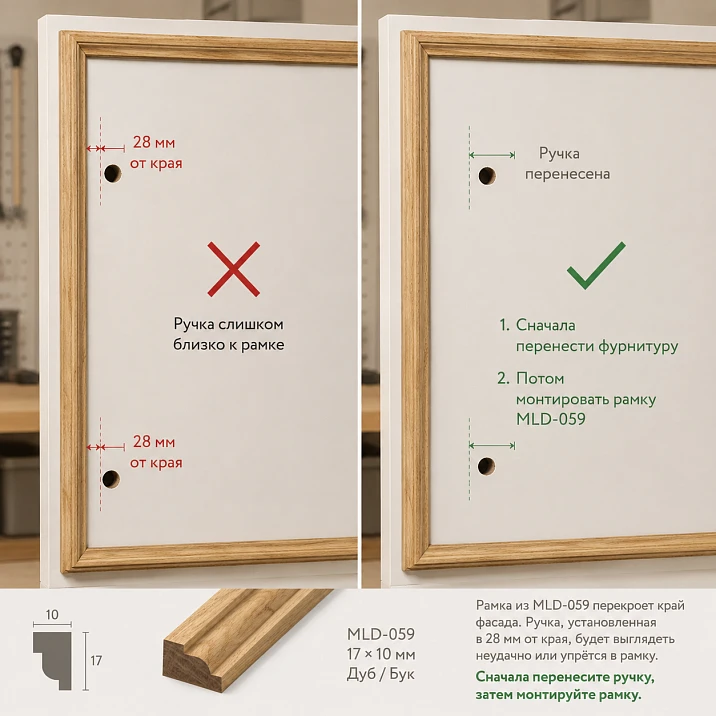
The smooth facades are already manufactured, painted, and installed. The holes for handles are drilled 28 mm from the edge. After that, a new idea appears: add overlay frames to the doors and drawers to give the facade a more pronounced architecture. For this task, a compact wooden furniture molding MLD-059 with a cross-section of 17×10 mm is chosen. In the picture, the solution seems simple: mark a rectangle, cut four pieces, and assemble the frame. But it is the existing hardware that turns the decorative refinement into a geometry problem.
If the outer edge of the frame starts, for example, 20 mm from the facade edge, a strip 17 mm wide occupies a band from 20 to 37 mm. The hole axis at 28 mm falls inside this band. With an offset of 15 mm, the profile will occupy approximately 15–32 mm, and with 25 mm — 25–42 mm. In all three options, the 28 mm point remains in the molding zone. Therefore, ordering a long piece only from a photo of the facade is not allowed: first, you need to mark the actual 17 mm wide band, mark not only the holes but also the full dimensions of the handle base, check space for fingers and the opening of adjacent doors.
The direct answer is this: if the handles are already drilled 28 mm from the edge, MLD-059 should not be purchased for the entire set of facades until a full-size layout of at least one representative of each size is done. The fact that the profile is narrow does not solve the problem. In some projects, it is enough to shift the frame inward. In others, it will be necessary to change the handle position. If the old holes turn out to be visible after the transfer, it is more rational to change the frame proportion, choose a different profile, or abandon the molding on some facades.
Below we will examine exactly this conflict — not "what molding is in general," but what to do when the furniture is already ready, the holes are made, and the decorative frame appeared in the project later.
Wooden furniture molding MLD-059 17×10 mm: what profile we are actually buying
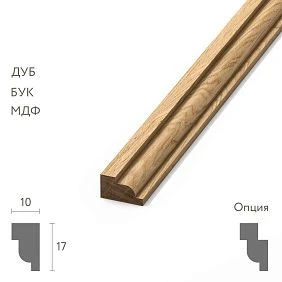
Before calculating, you need to record the parameters of the product itself. For MLD-059, the face width of the profile is 17 mm, and the protrusion relative to the base plane is 10 mm. At the time of re-checking the STAVROS card, three versions are available:
| Material of MLD-059 | Section | Length | Price at the time of check |
|---|---|---|---|
| MDF | 17×10 mm | 2600 мм | 550 ₽ |
| Beech | 17×10 mm | 2400 мм | 1 020 ₽ |
| Oak | 17×10 mm | 2400 мм | 1 350 ₽ |
Price and availability may change, so before payment you need to reopen the product card. For the geometry of the finished facade, something else is more important: in all three main versions, the working width of the profile is 17 mm. It is these 17 mm that need to be applied to the facade as a real strip, not as a single line.
If after the template it becomes clear that the profile is suitable, you can buy wooden molding MLD-059 17×10 mm in a specific material and length.




MLD-059 from MDF 17×10×2600 mm
The MDF version is convenient primarily when the frame needs to be painted with opaque enamel and visually act as a continuation of an already painted facade. The length of 2600 mm allows a different cutting layout than solid wood at 2400 mm: sometimes a difference of just 200 mm lets you fit a set of parts into fewer initial planks.
But length should not become the main argument before checking the hardware. If the handle overlaps the frame strip, an extra 200 mm of the original molding will not solve the problem. First — marking. Then — material. And only then — cutting optimization.
Our factory also produces:
Beech furniture molding MLD-059 2400 mm
Beech has the same geometry of 17×10 mm, but the standard length in the verified card is 2400 mm. For a project with opaque finishing, beech can be considered as a solid wood alternative to MDF, especially if the furniture already has other wooden elements and a single material needs to be maintained.
On the finished facade, an additional question arises: whether the frame will be painted before gluing or after installation. In the case of already completed factory finishing of the facade, this choice must be coordinated with the cabinetmaker and the painter, because decorative intervention should not turn a local refinement into a full repainting of the set of doors.
Get Consultation
Oak MLD-059 2400 mm
Oak makes sense when the natural texture is part of the concept. Then the conflict with the handle becomes even more sensitive: filling an old hole and "hiding" it as unnoticeably as on opaque enamel is often much more difficult. With transparent or semi-transparent finishing, not only the geometry matters, but also the grain pattern, tone, degree of porosity, and how the new frame will look next to the existing facade.
Therefore, for an oak solution, the scenario "first move the handle, then think about how to cover the old holes" is especially dangerous. The sequence should be reversed: first, the method of surface restoration is determined, then the decision to move the hardware is made.
Why the width of 17 mm is most important in a furniture frame
When checking for collision with the handle, the width of 17 mm is more important than the length of the strip and even the material. It determines the actual occupied band on the front plane of the facade.
If the outer edge of the molding runs at a distance R from the edge of the facade, then with a straight layout the occupied zone is approximately equal to:
from R to R + 17 mm.
With R = 20 mm we get 20–37 mm. With R = 30 mm — 30–47 mm. Therefore, the question "does the hole fall on the frame" is solved by ordinary geometry, but both boundaries of the strip must be calculated.
What does a 10 mm protrusion on the finished facade mean
10 mm is no longer a planned, but a spatial characteristic. It affects how the hand approaches the handle, how close the handle base is to the frame, whether the profile creates an inconvenient ledge, and whether it conflicts with the protruding part of the hardware.
Even if the hole is outside the 17 mm strip, the handle base may partially overlap the molding. And if the base does not physically touch it, the hand may lack space for a comfortable grip. Therefore, the check "the screw axis does not fall into the profile — so everything is fine" is insufficient.
Buy furniture molding after installing handles: first, mark two zones on the facade
When a person is looking for where to buy furniture molding, it is easy to jump straight to choosing the wood species, length, and price. For already finished facades, the order is different. Before purchasing, you need to mark two independent zones on the front side: the future frame and the actual handle dimensions.
It is convenient to start with painter's tape or a paper template. On the facade, the outer contour of the frame is marked, then a second line is drawn 17 mm away. This gives a strip of the actual width of MLD-059. After that, not only the center of the hole but the full contour of the hardware is transferred to the facade.
Overlay frame zone
A frame is four strips 17 mm wide. For each, you need to determine the distance from the outer edge of the facade, the outer frame dimension, the inner light opening, the position of the corners, the gap to the handle, and the gap to the adjacent molding if the facade is narrow.
On a wide facade, changing the offset by 10–20 mm is sometimes easy. On a narrow drawer, the same shift can noticeably reduce the inner field and make the composition heavy.
Handle base zone
A furniture handle has not only a hole. The actual dimension may include a base, rosette, standoff, or decorative protrusion. For a pull, two mounting points are connected by a body that occupies space between them. For a knob, there is one hole, but the base can be noticeably wider.
Therefore, on the template, you need to trace the actual base of the handle. If the hardware is already installed, the most accurate method is to take measurements from the specific part or temporarily attach it to a paper layout.
Finger zone when opening the facade
The third zone is not always visible on the drawing: the space where fingers go. It depends on the handle shape, grip method, and how much MLD-059 protrudes above the facade plane.
Suppose a few millimeters remain visually between the handle base and the molding. Geometrically, the parts do not intersect, but when gripping, fingers constantly rub against the protruding frame. Such a joint formally "fits," but it is inconvenient to use.
Why the screw hole and the handle's overall dimension are not the same thing
The 28 mm axis is only one coordinate. It answers the question of where the screw passes. It does not answer the questions of where the decorative base ends, how far the handle body protrudes toward the frame, how much space the hand requires, whether there is a second mounting point, and where the handle shifts relative to the frame corner.
That is why the decision is made not based on a single figure of 28 mm, but on the actual contour.
Example: a handle 28 mm from the edge and MLD-059 with a width of 17 mm
Let's consider the original scenario as a geometric model. 28 mm is a condition of a specific facade, not a recommended distance for furniture handles.
If the frame starts 15 mm from the edge
The outer boundary is 15 mm. The inner boundary with a profile width of 17 mm is 32 mm. The MLD-059 strip: 15–32 mm. The 28 mm axis is inside this strip. This means the mounting hole physically falls into the place where the strip should lie.
If the frame starts 20 mm from the edge
The strip: 20–37 mm. 28 mm is again inside. Moreover, there is too little space left to both edges of the molding to talk about accidental contact: the fastener passes directly through the designed strip.
If the frame starts 25 mm from the edge
The strip: 25–42 mm. The 28 mm point is still inside the profile.
These three examples illustrate a useful rule: a narrow molding does not guarantee that it will pass between the edge of the facade and an already-drilled handle. What matters is not the absolute value of 17 mm, but the combination of two coordinates — the frame inset and the position of the hardware.
How to find the minimum inset at which a 28 mm hole will be outside the frame
There are two fundamental options. The first is to leave the handle between the edge of the facade and the frame. Then the inner boundary of this outer strip must end before the base zone of the handle. A simple comparison with 28 mm is not enough: you need to know half the width of the base or its full contour.
The second is to run the entire frame closer to the center of the facade, so that the handle ends up in the outer field. Then the outer edge of the molding must be located farther from the edge than the handle's overall dimension plus the necessary operational clearance. This clearance cannot be assigned a universal number without a specific handle: it is checked on a full-size template.
Why you can't simply cut the molding around the handle
Technically, a cutout is possible in almost any decorative element, but for a frame composition it is usually a poor starting point. The profile ceases to read as a continuous frame, short ends and complex joints appear near the hardware, and on symmetrical facades such a "detour" becomes especially noticeable.
If the frame has to be interrupted exactly at the handle point, you should first ask: wouldn't it be cheaper and cleaner to change the entire layout scheme.
Buy wooden furniture molding or move the handle
Request buy wooden furniture molding implies that the person is already close to placing an order. But in the situation under consideration, the product is not chosen separately from the furniture. You need to compare four scenarios.
| Scenario | What changes | Main risk | When it makes sense |
|---|---|---|---|
| Keep the handle, shift the frame | frame geometry | proportion deterioration | wide facade, there is room in the central field |
| Move the handle | hardware and holes | visible traces of old fasteners | the surface can be restored to a high quality |
| Choose a different profile | decorative system | a new profile can change the style | MLD-059 doesn't fit, but the frame is needed |
| Remove the frame from part of the facades | set composition | heterogeneity | individual drawers or narrow doors conflict with the hardware |
Keep the handle and increase the frame offset
This is usually the first option worth checking, because it doesn't require drilling new holes. A second frame is built on the facade further from the edge, and they check whether sufficient inner space remains.
The problem occurs on narrow doors. If the facade is, for example, 300 mm wide, each additional inward shift of the frame reduces the central field from both sides at once. The frame may start to look too close to the center, and the corners may conflict with the vertical handle.
Move the handle inside the central field
Sometimes this is aesthetically the cleanest solution: the frame remains in correct proportions, and the hardware is moved to where it doesn't cross the profile. But this option cannot be evaluated without answering the question about old holes.
On painted MDF, local repair is theoretically possible, but color, gloss, and texture matching must be checked with the contractor. On a veneered or solid wood facade, an old hole may remain visible even after quality repair.
Move the handle outside the frame composition
On some tall doors, the handle can be placed in the outer strip between the frame and the edge of the facade. Then it is important to check that the width of this strip is sufficient not only for the handle base but also for a comfortable grip.
On adjacent doors, the position should remain visually coordinated. If one facade allows the external option, while the second, due to its width, only allows the internal one, a new task arises regarding the rhythm of the entire furniture piece.
Leave some facades without molding
This is not automatically a bad solution. For example, tall cabinet doors can get MLD-059 frames, while very low drawers can remain smooth. But such a technique should be a design decision, not a result of an accidental conflict after purchasing the material.
First, you need to sort all the furniture by facade types and decide which ones form a single visual group.
When it is too late to move a furniture handle
The most expensive mistake is to assume that two old holes can always be covered and new ones drilled without consequences. The further the project progresses, the higher the cost of the change. At the stage of an unfinished facade, moving the hardware is one operation. After sanding, primer, enamel, tinting, varnish, and furniture installation, it becomes a chain of works, each of which can leave a visible trace.
Oak facade with transparent finish
On a transparent finish, the surface shows a natural pattern. Any local intervention must be coordinated with the texture and color. Even if the hole is physically filled, the repair site may differ in grain pattern and in how it accepts stain or lacquer.
Therefore, for an oak facade, moving the handle must be confirmed by a finishing specialist before the decision to purchase the frame is made. If the craftsman immediately says that the old holes will remain visible, there is no point in first ordering an oak MLD-059 and then trying to adapt the furniture to an already purchased profile.
Already painted MDF
With opaque enamel, it is easier to hide the repair geometry, but questions of color and gloss remain. The old paint may have already changed shade under the influence of light; a new batch of enamel may differ slightly; local touch-up can be noticeable under side lighting.
If repairing dozens of holes is required for the sake of MLD-059, the cost and risk of the work should be compared with the cost of changing the frame. Sometimes shifting the decorative field by 10–20 mm is economically more reasonable than refinishing an entire set of facades.
The old hole will be visible
Especially unpleasant is the case when the new handle position is shifted only slightly. Then the old point remains next to the new base and is not covered by the hardware.
Before drilling a new hole, it is useful to make a paper mock-up of the future handle and literally check which marks remain exposed. If the old point will be a few millimeters from the new rosette or post, its repair becomes an independent aesthetic task.
The handle has two mounting points
For a pull, moving means not one, but two old holes on each facade. In addition, the center distance is strictly set by the handle itself. If the furniture has many identical facades, a small error in the template will be repeated in series.
With twenty facades, one inaccuracy turns into forty incorrect holes. Therefore, the new position of the bracket is first checked on one test facade or on a full-size mockup, and only then replicated.
The new center disrupts the symmetry of adjacent facades
Handles are rarely perceived individually. The eye reads the horizontal and vertical lines of the entire cabinet or kitchen. If one handle has to be shifted for the sake of a molding, a new position must be established on neighboring doors and drawers, otherwise a locally correct element will disrupt the overall rhythm.
A useful way to check is to take a frontal photo of the entire piece of furniture, then overlay the planned frames and new handle axes on it. Such a sketch does not replace dimensions, but it quickly reveals alignment violations.
Wooden molding MLD-059 and a bracket handle: we check not only the holes
The bracket is the most illustrative example because it has several geometric parameters at once. An error occurs when only the center distance remains in the project, and the handle itself effectively disappears.
Center distance
The center distance determines the position of the two mounting points. If the handle is vertical, both points can be on the same line 28 mm from the edge. Then a frame that falls on this line conflicts with both fasteners at once.
If the handle is horizontal on a drawer, a conflict can arise with the upper or lower part of the frame depending on the installation height. Therefore, for a drawer, both coordinates must be specified: the distance from the side edge and the distance from the top/bottom edge.
Size of decorative bases
Two handles with the same center-to-center distance can have different bases. One has thin posts, the other has wide feet. Therefore, the catalog parameter "96 mm" or "128 mm" by itself does not allow checking compatibility with the frame.
On the actual facade, trace a rectangle or the contour of each support pad. If the base partially lands on MLD-059, the handle may sit crooked or simply look as if it was accidentally placed on the edge of a decorative part.
Finger clearance
MLD-059 protrudes 10 mm above the facade. If the handle is placed too close, the frame may fall into the finger path. This is especially relevant for low-profile brackets and furniture handles that provide little clearance above the facade.
The check is done not with a ruler on a flat surface, but with a real hand on a sample or at least on a temporary mock-up with a strip of similar thickness. Open the facade several times with a habitual motion. If you have to change your grip, the assembly is unsuccessful, even if the millimeters "added up."
Opening the adjacent facade
On paired doors, handles are often close to the central joint. If the frame is shifted to preserve the hardware, one side of the composition may move closer to the central edge, and the other to the outer edge. Open both doors and check whether the frame contacts the adjacent handle or the cabinet body.
On furniture near a wall or side panel, also check the extreme door position. The overlay profile adds volume on the front side and may change the actual gap in a very tight assembly.
MLD-059 on a cabinet door: where to place the handle relative to the frame
On a tall cabinet facade, the space usually allows more options than on a kitchen drawer. But choosing the position "by eye" is still not acceptable.
Handle inside the frame field
This position visually emphasizes the central part of the facade. It can work well on a wide door if the handle is not too close to the inner edge of the molding.
To check this, you need to calculate the inner size of the frame after subtracting two strips of 17 mm and assess the actual position of the handle within the resulting field. If, after shifting the handle, it ends up almost at the inner edge, the visual problem simply moves from the outer side to the inner side.
Handle between the molding and the door edge
This option keeps the central field clean. But the outer strip must be wide enough. If the outer edge of the frame starts 20–25 mm from the edge, there is actually no room for a 28 mm handle—this is exactly what the original case shows.
To check this option, you need to know not only the 28 mm axis but also half the width of the handle base. For example, if the base is 18 mm wide, it takes up 9 mm on each side of the axis. Then its inner boundary is already at 37 mm. With a frame of 20–37 mm, the parts actually meet without any free space. This is just an illustration of the method: actual dimensions are taken from specific hardware.
Handle on the vertical axis of the facade
Central installation can completely eliminate the conflict with the side panel, but it changes the familiar ergonomics of a tall door. On a finished cabinet, such a shift should be evaluated not only by the drawing but also by convenience: whether the user can reach the handle without having to extend their hand too far toward the center every time.
Why the same approach does not suit doors of different widths
If the cabinet consists of facades of 300, 450, and 600 mm, the same frame offset gives different proportions of the inner field. Therefore, first create a family of standard sizes, then check whether a single logic for placing MLD-059 and handles can be maintained.
For furniture with a large number of facades, it is useful to make a table of types: "narrow tall", "wide tall", "low drawer", "medium door". For each type, its own proven indentation and handle position are specified. This approach prevents a situation where one random scheme multiplies across the entire project.
MLD-059 on kitchen facades: why drawers should be counted separately from doors
A kitchen almost always contains several geometric types of facades. The mistake is to choose a successful frame on one door and multiply it across everything.
Narrow drawer
On a facade 150–250 mm high, a frame with four sides can leave a very small central field. If the handle is already close to the top edge, a conflict with the horizontal molding appears even when the side parts of the frame pass freely.
In such a case, it is useful to check not only the full rectangle, but also an alternative composition: for example, frames only on doors, leaving drawers smooth. This may look more convincing than overly compressed frames on every element.
Tall facade
On a tall door, there is more vertical freedom, but the handle is often installed at a constant height relative to the floor or countertop. When transferring, the line with neighboring doors must be preserved.
If, for the sake of a frame, one handle is raised by 40 mm while the neighboring one is left, the discrepancy will be more noticeable than the decorative frame itself. Therefore, the solution is checked on the overall kitchen elevation.
Dishwasher facade
Such a facade is connected to specific equipment and opening mechanism. A decorative change should not be made solely based on appearance. It is necessary to check the recommendations of the kitchen and equipment manufacturer, the method of attaching the facade, and the admissibility of additional decor.
If the furniture manufacturer restricts intervention in such a facade, it is better not to design a decorative frame on it without coordination.
Adjacent doors
Frames on two adjacent facades create a rhythm. If one has a 35 mm offset due to the handle and the other has 20 mm, the difference will be noticeable. Sometimes it's better to change both frames equally than to "save" one.
Unified frame or different proportions
Unification is convenient for production, but it doesn't always give the best look. For a group of tall doors and a group of low drawers, you can use different proportions while maintaining the same MLD-059 profile. The main thing is to decide before ordering the quantity.
Buy wooden molding: first, make a full-size template 17×10 mm
Before Buy wooden molding, it's useful to perform a check costing practically a few sheets of paper and masking tape.
A strip of cardboard 17 mm wide
Cut a strip exactly 17 mm. If you also want to check the volume, use a temporary batten about the thickness of the future protrusion or fold the material to the required thickness. The task is not to imitate the final finish, but to feel the boundary.
Actual offset from the edge
Measure the design values of 15, 20, 25, 30, 35 mm or other values being considered for a specific facade. Don't move the frame chaotically. Label each option and photograph it directly with the handle.
Comparing photos helps to see how the central field changes. However, the final decision is still checked with a ruler: the camera's perspective can visually distort proportions.
Real handle
It is better to check with the hardware that is already installed. If the handle is removable, attach it to the template in the working position. Mark the outer boundaries of the base and the position of the screws.
For a bracket, it is useful to transfer two points and the entire body between them onto the template. For a button, transfer the diameter or the contour of the base.
Check opening
Open the facade fully and grab the handle several times with a usual motion. If your fingers catch the template, the unit needs to be changed, even if the distance seems sufficient in the photo.
Check not only yourself. If the furniture will be used by people of different heights or children, the hand trajectory may differ.
Checking multiple facades
One successful sample does not mean that the entire family is the same. At minimum, check the narrowest facade, the lowest drawer, a tall door, paired adjacent doors, a facade with a different type of handle, and a facade near a wall, side panel, or appliance.
After this, the order list is already based on real types, not on a single beautiful visualization.
Set of samples OMLD-005: when the project is large and you need to compare MLD-059 with other profiles
If MLD-059 conflicts with an already installed handle, the first reaction is often to rework the hardware. But this is not the only path. For a large project, it is cheaper to first compare several real cross-sections.
In the STAVROS catalog there is Buy OMLD-005 molding sample set — a set of real profiles that can be applied to furniture to see the geometry at scale. The current card indicates the size of the set itself as 375×315×125 mm and describes samples 100 mm long made of oak, beech, and MDF.
This approach is especially useful in three situations.
The first is dozens of identical facades. Reworking holes on one sample may be tolerable, but on forty doors it turns into a separate production stage.
The second is expensive transparent finishing. If old holes are hard to hide, it is wiser to spend time finding a different profile than to immediately interfere with a finished surface.
The third is doubt about proportion. Perhaps MLD-059 physically fits after shifting, but the frame ends up too close to the center. Real samples allow checking not only "fits/doesn't fit" but also visual weight.
At the same time, the sample does not replace a drawing. It is needed to confirm the decision after geometric verification.
Buy MDF molding for an already painted facade: the problem of refinishing
When planning buy an MDF molding, the logic is often clear: the existing facade is painted with enamel, so the frame can be made in the same color.
However, finished furniture raises several additional questions.
Matching the existing color
Even with a known paint code, a new paint sample should be compared with the facade under the lighting where the furniture is actually installed. Perception is affected by the age of the coating, the degree of gloss, and the direction of light.
It is better to compare not only in daylight, but also with the room's standard lighting turned on. A slight difference, unnoticeable in the morning, may appear in the evening under warm lighting.
Painting the molding separately or together with the facade
If the molding is painted separately, joint lines remain after installation. If the frame is painted on the facade, the existing surface must be protected and the technology coordinated with the contractor.
There is no universal solution for all paints and adhesive systems. This stage should be determined by the furniture manufacturer or finisher responsible for the specific coating.
Joints at corners
On a frame of four parts, the corners are a visible part of the composition. After painting, they should be perceived as a single geometry. If the cuts are inaccurate, enamel does not correct geometric errors.
For a series of facades, it is useful to first assemble one test frame completely, from cutting to final finishing. This shows not only the color, but also the actual quality of the corners.
What to do with old holes
If the handle is still being moved, it is on painted MDF that there is a chance to restore the surface with an opaque material. But before considering this path simple, you need to get a specific repair plan from the contractor and a test on an inconspicuous sample.
Oak MLD-059 on a finished wooden facade: matching the wood species does not yet mean matching the color
Choosing "oak to oak" seems obvious, but natural wood rarely matches just by the name of the species.
Oak texture
Two parts may have different grain patterns. On a narrow profile of 17 mm, the pattern is perceived linearly and sometimes even more strongly emphasizes the difference with the large field of the facade.
Grain direction
In vertical and horizontal frame elements, the grain runs along the length of each part. At the corners, they meet at 45° or according to another accepted scheme. Before mass cutting, it is useful to assemble one frame and evaluate the pattern.
Stain and varnish
The same composition on different batches of wood can give visually different results. Therefore, a test coating on a real MLD-059 is more useful than a color sample on another species or another part.
Why a real sample is needed
If the finished furniture already has complex finishing, the sample can be applied directly to the facade. This allows a decision to be made before cutting long strips and before irreversible intervention in the handles.
Beech furniture molding MLD-059: when it is more rational than oak
Choosing beech over oak solely by price is not enough. Within the scope of a specific article, the task matters: the frame is placed on finished furniture facades with already installed hardware.
Beech can be rational if an opaque finish is planned and the natural wood grain does not need to remain the main decorative effect. Then there is no point in choosing the material only for its bright texture, which will be covered by enamel anyway.
But if oak parts are already visible in the furniture — tabletop, plinth, handles, decorative strips — a new beech element under a transparent finish may look like a separate material.
The length of both solid versions of MLD-059 at the time of checking is the same — 2400 mm. Therefore, in the beech/oak comparison, cutting does not change. What changes is the cost of the initial strip and the nature of the future finish.
How much MLD-059 to buy for framed facades
After checking the handles, a separate task begins: quantity. It is solved not by the area of the facades, but by the list of segments. If the frame is rectangular and its external dimensions are already approved, the theoretical length of one frame equals:
2 × frame height + 2 × frame width.
But this formula cannot directly determine the number of initial strips of 2400 or 2600 mm. Two layouts with the same 17 linear meters may require a different number of long pieces due to the length of individual verticals.
Why the sum of linear meters is insufficient
Let's imagine two orders of 12 meters each. In the first, pieces of 300–600 mm are mostly needed. They can be tightly packed into 2400-mm strips. In the second, there are many verticals of 2050 mm. After each, a short remainder is left, which is only suitable for some crossbars. The same 12 meters can produce more waste.
Therefore, the correct unit of calculation is not "meters per cabinet," but a list of parts: 4×2030, 8×380, 4×650 and so on.
MDF 2600 mm
The advantage of 2600 mm only shows when part dimensions allow using the extra 200 mm. If a vertical is 2450 mm long, it doesn't fit in 2400 at all, but it fits in 2600. If all parts are shorter than 600 mm, the difference between 2400 and 2600 may have almost no effect on the number of strips.
Beech and oak 2400 mm
For the MLD-059 array, the verified card uses a length of 2400 mm. When designing frames, this means each long vertical must be separately compared against this constraint. If the outer frame height exceeds 2400 mm, a one-piece vertical from a standard strip is no longer possible; then the decorative scheme's construction itself changes, or another solution is chosen.
Short crossbars
Short horizontal parts are the main resource for using leftovers. For example, after a long vertical, 300–500 mm may remain, and this remainder can cover a small drawer's crossbar. Therefore, short elements are better not cut first: the longest parts are placed first, then the leftovers are filled.
Long verticals
Long elements set the minimum number of source strips. If eight verticals of 2000 mm are needed on four doors, almost certainly each will take a separate long piece, unless the remainder can be combined with a second vertical. This is more important than the total footage sum.
Waste from 45° cuts
If frame corners are mitered, the specification must agree on which line the length is defined: outer edge, inner edge, or another reference line. An error here leads to a systematic shift of all parts.
The actual cutting width of the specific equipment is also added to the length. You cannot mechanically use a universal number for all workshops. The cutting map must contain a parameter confirmed by the contractor.
Allowance for selection and error
The percentage of allowance should not be assigned automatically either. For a serial order with a well-tuned cutting process, it can be one value; for complex independent work, it can be another. It is better to form a specific list of parts and add reserve items deliberately: for example, one long strip to replace a damaged element, if justified by the project scale.
Example of calculating MLD-059 for a cabinet with six fronts
Let's take a training example. These are not the dimensions of specific STAVROS furniture, but a model that shows the difference between 2400 and 2600 mm.
There are six fronts:
-
two fronts 450×720 mm;
-
two fronts 450×2100 mm;
-
two fronts 600×350 mm.
Suppose the outer edge of the frame, after checking the handles, is decided to be set 35 mm from all edges. Then the outer dimensions of the frames are:
| Facade type | Front size | Outer frame size | Parts for 1 front |
|---|---|---|---|
| A, middle door | 450×720 | 380×650 | 2×650 + 2×380 |
| B, tall door | 450×2100 | 380×2030 | 2×2030 + 2×380 |
| C, low front | 600×350 | 530×280 | 2×530 + 2×280 |
For two fronts of each type, you need:
-
4 parts of 650 mm;
-
8 parts of 380 mm;
-
4 parts of 2030 mm;
-
4 parts of 530 mm;
-
4 pieces of 280 mm.
Total net length is 17,000 mm, that is, 17 linear meters.
Option beech/oak 2400 mm
For 2400 mm, an approximate layout might look like this:
-
2030 + 280;
-
2030 + 280;
-
2030 + 280;
-
2030 + 280;
-
650 + 650 + 650 + 380;
-
650 + 530 + 530 + 530;
-
530 + 380 + 380 + 380 + 380;
-
380 + 380 + 380.
This requires eight initial planks of 2400 mm.
The example shows the real commercial effect of length: with the same profile of 17×10 mm, the 2600 mm version can reduce the number of initial planks in a specific set of parts. But the conclusion cannot be applied to any cabinet. If the verticals have other dimensions, the advantage may disappear.
What changes if the frame is shifted for handles
If, due to hardware, the offset increases from 35 to 50 mm, the external dimensions of all frames decrease by 30 mm along each coordinate: an additional 15 mm on each side. This means all segments and the cutting map change.
This is why the quantity of MLD-059 cannot be finally calculated until the decision on handles is made. Moving the frame is not just a design change, but a new specification.
Reverse calculation check
It is useful to perform one more check. After the cutting map, the lengths of all actually obtained parts are added up and compared with the list. If the original list had eight parts of 380 mm each, the cutting must have exactly eight of them. Such a simple control protects against an error when one short crossbar accidentally "disappears" between the lines.
The second control is the number of parts on each facade. A typical rectangular frame contains four elements. Six facades give 24 parts. In our example, the list indeed contains 24 items: 4 + 8 + 4 + 4 + 4.
Price of MLD-059: what is cheaper — to change the frame or redo ready-made handles
At the time of checking the card, one MLD-059 cost 550 ₽ in MDF, 1,020 ₽ in beech, and 1,350 ₽ in oak. These prices may change, so they cannot be perceived as a permanent price list.
For the training cabinet above, the theoretical material budget only for the initial strips would be:
-
MDF: 7 × 550 = 3,850 ₽;
-
beech: 8 × 1,020 = 8,160 ₽;
-
oak: 8 × 1,350 = 10,800 ₽.
This is not the full cost of the project. It does not include painting, glue, preparation, installation, delivery, facade repair, re-drilling of holes, and the furniture maker's work.
That is why the economics should be compared by scenarios, not only by the price of one linear product.
Scenario A: the frame moves away from the handle
Costs: a new cutting pattern and possibly a slightly different amount of molding. Plus, the fronts and hardware remain untouched.
This scenario is especially attractive if shifting the frame does not ruin the proportions. Then the change remains almost entirely at the marking stage.
Scenario B: the handle is moved
Costs: dismantling hardware, filling old holes, restoring the finish, marking and drilling new ones. If there are many fronts, the cost of labor may be significantly more important than the difference in the price of the molding itself.
For comparison, there is no need to invent an average repair price. It is enough to ask your cabinetmaker for the cost of the operation on one front and multiply by the quantity. Then add the risk of refinishing and time.
Scenario C: a different molding is purchased
Costs: perhaps another profile costs more, but the need to interfere with finished furniture disappears. For a serial project, it is often worth at least checking samples.
If a narrower or differently profiled element allows keeping all handles, the savings on rework may outweigh the difference in the price of the linear molding itself.
Scenario D: the front is redone
This is an extreme option. It cannot be considered logical just because MLD-059 looked visually appealing. If a decorative frame requires replacing already finished doors, the economic sense of the entire idea needs to be reassessed.
How to compare scenarios without invented prices
Create four columns:
| Cost item | Frame shift | Handle relocation | Different profile | New facade |
|---|---|---|---|---|
| Molding | calculate by cutting | calculate | calculate | calculate |
| repair of holes | No | Yes | Usually not | No |
| Repeated painting | Usually not | Possible | Usually not | yes/as part of the new facade |
| new drilling | No | Yes | No | Yes |
| risk of visible repair | Low | Depends on the finish | Low | Low |
| work duration | Clarify | Clarify | Clarify | Clarify |
After this, the decision becomes transparent. In one project, moving the handles wins, in another — a different profile, in a third — changing the frame.
Errors when ordering MLD-059 for already finished facades
Error 1. Checking only the distance to the hole
Why it occurs: in the drawing, the handle is represented as a point.
Consequence: the hole seems to pass near the frame, but the wide base overlaps the molding.
How to prevent: draw the full contour of the hardware.
Error 2. Considering 17 mm as "too small a width for a conflict"
Why it occurs: the profile is perceived as a thin line.
Consequence: with a 20 mm offset, it occupies the 20–37 mm range and completely overlaps the 28 mm axis.
How to prevent: always build both edges of the profile.
Error 3. Move the handle before checking old holes
Why it occurs: the new position seems obvious.
Consequence: the old hole remains visible or the repair differs in color.
How to prevent: first make a mock-up of the new base and agree on the surface restoration technology.
Error 4. Calculate the total footage without cutting
Why it occurs: 17 meters are perceived as "about seven planks."
Consequence: long verticals do not fit into the remnants, and there is not enough material.
How to prevent: create a map of segments 2400/2600 mm.
Mistake 5. Duplicate one frame for all facades
Why it occurs: there is a desire to unify production.
Consequence: low drawers and narrow doors get poor proportions or a new conflict with handles.
How to prevent: divide furniture into standard sizes.
Mistake 6. Buy the entire volume before a trial frame
Why it occurs: it seems that the dimensions are already known.
Consequence: after assembling the first facade, it turns out that the offset needs to be changed.
How to prevent: make one full-size prototype or at least a temporary template.
Mistake 7. Assume that MDF, beech, and oak differ only in price
Why it occurs: the geometry of the options is the same, and the choice is reduced to price.
Consequence: after purchase, it turns out that transparent or covering finishing requires a different material, and cutting of solid wood and MDF differs due to the length of 2400/2600 mm.
How to prevent: choose the material simultaneously based on finishing and cutting layout.
Error 8. Ignoring adjacent facades
Why it occurs: each facade is designed separately.
Consequence: handles and frames lose common axes, indents differ, and unexpected contacts appear when opening.
How to prevent: check the overall frontal layout of the furniture.
When MLD-059 does NOT need to be purchased yet
It is reasonable to postpone the order if at least one of the conditions is met:
-
handles are already installed, but their actual base has not been measured;
-
only the 28 mm axis is known, but the full contour of the fittings is not drawn;
-
not selected whether the handle will be inside or outside the frame;
-
the facades have several sizes, but the layout is built on only one;
-
not decided how to close old holes when moving;
-
material MLD-059 is not selected yet;
-
no color test done for the existing finish;
-
no cutting map for 2400/2600 mm;
-
the decision is made only based on the visualization;
-
opening and handle positions are not checked on adjacent doors.
Refusing to buy immediately here does not mean refusing MLD-059. This is a normal pause between choosing a profile and confirming compatibility.
There is one more criterion: if after all the layout the frame physically fits, but looks random or breaks the proportions of the facade, it is also too early to buy the profile. Compatibility is not just the absence of intersection. The frame should look like an original part of the design, not like a way to bypass already made holes.
When the wooden furniture molding MLD-059 can already be ordered
The order becomes justified when a control check is completed.
First: each type of facade is measured, not just one sample.
Second: the drawing shows the real axes of the holes.
Third: the full dimensions of the handle bases are applied.
Fourth: the frame is built with a 17 mm strip.
Fifth: the 10 mm profile protrusion is taken into account and the hand grip is checked.
Sixth: adjacent doors are opened and contact of elements is excluded.
Seventh: the frame indents are approved for each standard size.
Eighth: the material has been selected — MDF, beech, or oak.
Ninth: a cutting map has been made for 2600 or 2400 mm.
Tenth: before payment, the current product card has been re-checked.
only after that order furniture molding MLD-059 can already be treated as a specified material, not as an experiment.
How to order MLD-059 for ready-made furniture facades
For communicating with a manager, designer, or cabinetmaker, it is useful to compile a short specification in one line:
MLD-059 / 17×10 mm / MDF 2600 or beech/oak 2400 / quantity ___ / facade dimensions ___ / outer frame offset ___ / handle position ___ / handle type ___ / finish ___ / cutting map ___ / reserve ___.
If the facades differ, it is better to attach a table:
| Facade type | Quantity | Front size | Frame size | Handle position | Conflict | Solution |
|---|---|---|---|---|---|---|
| A | ___ | ___ | ___ | ___ | Yes/No | ___ |
| B | ___ | ___ | ___ | ___ | Yes/No | ___ |
| C | ___ | ___ | ___ | ___ | Yes/No | ___ |
Such a specification immediately separates decorative desire from the production task.
If the order is large, it is useful to attach a cutting map for each original plank to the table. Then the manager sees not just "approximately 20 meters needed," but the specific quantity of 2400 or 2600 mm.
Where to buy furniture molding after checking handles
If the check is complete and MLD-059 fits, the specific profile can be opened via the link buy wooden molding MLD-059 17×10 mm.
If the geometry of MLD-059 does not pass or you want to compare other cross-sections, it is more logical to first open the category buy furniture molding and look at other MLD profiles.
For a project with a covering finish, you can separately compare buy an MDF molding.
For a wider selection of linear molding — Wood and MDF moldings.
Before finishing, it is useful to check materials and quality of wooden moldings и tips for finishing wooden moldingThe conditions for receiving the order are specified separately: delivery conditions for wooden moldings.
Summary: for a 28 mm hole, first mark out, then purchase MLD-059
In the initial situation, the problem is not whether MLD-059 is good or bad. The profile has a clear geometry of 17×10 mm and can be used as a compact frame part. The problem arises because the decision about the frame was made after the facades were manufactured and holes were drilled.
With an external frame offset of 20 mm, the profile occupies the 20–37 mm zone. The handle axis at 28 mm ends up inside it. With offsets of 15 and 25 mm, the conflict also persists. Therefore, "a narrow profile will surely fit" is an incorrect criterion.
The working sequence looks like this:
-
measure the facades;
-
apply a full strip of MLD-059 with a width of 17 mm;
-
trace the actual handle contour;
-
check the space for fingers;
-
check adjacent doors;
-
decide what changes — the frame, the handle, or the profile;
-
choose MDF, beech or oak;
-
compile a list of parts;
-
optimize cutting for 2600/2400 mm;
-
only after that buy long-length material.
It is this sequence that prevents turning decorative finishing of finished furniture into a series of extra holes, repaints, and repeated material orders.
FAQ
What is the size of MLD-059?
The proven profile geometry is 17×10 mm. For MDF, the current card specifies a length of 2600 mm, for beech and oak — 2400 mm. It is the 17 mm width that needs to be transferred to the facade as a real strip when checking for conflicts with the handle.
Is MLD-059 suitable for furniture facades?
Geometrically, the profile can be used for decorative framing of furniture, but specific compatibility needs to be checked on the facade: the door size, handle position, finish, and mounting method are important. In finished furniture, it is especially important not to repeat a general recommendation without full-size layout.
Can MLD-059 be glued onto an already finished smooth facade?
The possibility of mounting depends on the facade material, existing coating, adhesive system, and furniture manufacturer's requirements. Before installation, the technology must be coordinated with the contractor responsible for the surface. This article primarily resolves the geometric conflict rather than prescribing a universal adhesive.
What to do if the handle falls into the molding line?
Check four options: shift the frame, move the handle, choose a different profile, or abandon the frame on a specific facade. The choice should be made after full-size layout marking, because the same handle can behave differently on a wide facade and on a narrow drawer.
Is it necessary to move the furniture handle if its axis is 28 mm from the edge?
Not necessarily. With the offsets under consideration of 15–25 mm, the axis does fall into the MLD-059 strip, but the frame can be reconfigured. The decision to move is made only after checking the handle dimensions and the possibility of restoring old holes.
What offset should be left from the edge of the facade?
There is no universal number. The offset depends on the facade width, handle shape, frame proportions, and neighboring doors. The correct offset is one that simultaneously resolves geometry, ergonomics, and composition.
How to check the molding before ordering?
Make a template strip 17 mm wide, apply it to the facade with painter's tape or cardboard, mark the full handle contour, and open the furniture several times with a normal motion. For large projects, it is useful to check at least one facade of each size type.
What is the width of MLD-059?
17 mm along the front part of the profile. This value cannot be replaced with a conditional line on the drawing: when checking, both edges of the future molding must be visible on the handle.
How much does MLD-059 protrude above the facade?
The cross-section contains a dimension of 10 mm along the second coordinate of the profile. This volume must be taken into account near the handle and when checking the grip. If the handle is low, fingers may touch the frame even without an intersection on the plane.
What to choose — MDF, beech, or oak?
MDF is logical for a project with a covering finish and has a length of 2600 mm. Beech and oak are solid wood at 2400 mm. Oak is especially suitable if a pronounced natural texture is needed; beech may be more rational for a covering finish. The final choice depends on the existing facade, painting method, and cutting plan.
What is the length of MLD-059 made of MDF?
2600 mm in the verified product card. When calculating, it is important not just to multiply the number of strips by 2.6 m, but to check how the actual parts fit into this length.
What is the length of oak and beech MLD-059?
2400 mm in the verified product card. For tall frames, this limitation must be checked before purchase: a solid vertical cannot be longer than the original strip without changing the design.
How much molding is needed for one door?
First, the outer dimensions of the frame are determined. For a rectangular frame, the theoretical sum of parts is equal to 2 × height + 2 × width. But you cannot buy material by a single sum — you need to lay out the parts across the original planks.
How to calculate MLD-059 for six facades?
Make a list of all vertical and horizontal parts, combine identical sizes, and build a cutting map for 2400 or 2600 mm. In the educational example from the article, 17 m of clean parts were successfully laid out into 7 planks of 2600 mm or 8 planks of 2400 mm before accounting for individual technological allowances.
Why do 17 linear meters not always mean the same number of planks?
Because cutting depends on the length of individual parts. A long vertical can leave a remainder that cannot be used for another vertical, even if the total footage mathematically suffices.
Can MLD-059 remnants be used for short frame sides?
Yes, if the remnant has sufficient length considering the actual cut, end quality, and the adopted corner joint scheme. That is why the cutting map is built by parts, and short crosspieces are conveniently placed after long verticals.
Where to buy furniture molding?
Compare MLD profiles in the category buy furniture moldingand the specific MLD-059 is in its product card.
How to order MLD-059?
After checking the facades, prepare a specification: material, length, quantity, frame sizes, handle positions, finish type, and cutting map. Then place the desired option in the MLD-059 card.
How to check the current price?
Open the card right before payment. At the time of writing this article, prices were 550 ₽ for MDF, 1,020 ₽ for beech, and 1,350 ₽ for oak, but the price and availability are as of the check date and may change.
Can I order molding samples first?
Yes. If the project is large or MLD-059 conflicts with the hardware, you can first use Molding samples set OMLD-005 for a real comparison of profiles on the facade.
What is more important: matching the molding color or correct handle position?
These are different levels of checking. First, you need to rule out a physical and ergonomic conflict. After that, the material and finish are checked. A perfectly matched color does not compensate for an uncomfortable handle, and perfect geometry does not guarantee a match in oak or enamel tone.
Can I make frames only on tall doors and leave the drawers smooth?
It is possible if it looks like a deliberate furniture architecture. Such a variant is often better than random frames with broken proportions on low fronts. The solution should be evaluated on the overall elevation.
Do I need to buy a spare strip?
This depends on the number of parts, cutting complexity, material cost, and the contractor's experience. A universal percentage is not needed. It is simpler to calculate a specific reserve after the cutting map: for example, to understand which single mistake leaves the project without the needed long vertical.
Why can't you just drill the handle fastener through MLD-059?
Even if the hole can technically be made, the joint must be assessed by construction and appearance: the handle base may end up on a protruding frame, the profile will be locally loaded, and the composition will no longer be clean. Such a solution cannot be accepted automatically just because drilling is possible.
If the handle already overlaps the 17 mm strip, is there any point in buying MLD-059 only for part of the furniture?
Yes, if different groups of fronts are perceived as separate compositional blocks. For example, frames can be applied to tall wardrobe doors, while low drawers remain smooth. But such a variant needs to be seen on the overall elevation before purchase, so that the absence of the molding looks intentional.
Do all handles need to be moved if the conflict is only on two fronts?
Not necessarily. First, check whether the difference in handle positions will be noticeable in the overall group. If the two fronts are located separately, a local solution may be acceptable. If they are in the same row as the others, the difference in axes may turn out to be visually worse than the conflict itself.
What to do if, after shifting the MLD-059 frame, the central field becomes too narrow?
Do not try to force the solution just for the sake of the chosen profile. Compare a different offset, a different profile, or abandoning the frame on this type of front. The geometric absence of intersection does not mean a successful composition.
Can I first buy one MLD-059 strip and check it on site?
If the order format and availability allow it, a trial real strip gives the most accurate idea of width, protrusion, material, and finish. But even one strip does not eliminate marking: before cutting, you need to know the frame dimensions and the position of the hardware.
How do I know that cutting 2600 mm is really more advantageous than 2400 mm?
Compare two cutting layouts on the same list of parts. If 2600 mm allows combining long verticals with useful short crosspieces and reducing the number of initial strips, there is an advantage. If the parts are short and fit equally well in both lengths, the benefit may be absent.
Do I need to consider the grain direction of oak and beech?
For transparent or semi-transparent finishes, yes, because the direction and pattern of the wood participate in the perception of the frame. Before serial cutting, it is useful to assemble one sample and evaluate the corners, verticals, and horizontals together.
Can the project price be calculated only by the cost of MLD-059?
No. In already finished furniture, sometimes more expensive than the molding itself are reworking holes, restoring the coating, repainting, and installation. Therefore, the full scenario is compared, not just the price of one strip.
When can the decision on MLD-059 be considered final?
When the position of handles, frame indents, material, finish, cutting, and quantity are approved, and opening and hand grip are checked on a real facade. After that, the purchase stops being an experiment and becomes a regular order by specification.