























Article Contents:
- Why upper cabinets are a separate challenge
- The physics of opening a wall-mounted cabinet
- Visual load on the top line
- Kitchen height and user height
- Profile handles for upper cabinets: concise horizontal
- What is a profile for the upper kitchen base
- Why the profile is so good for upper cabinets
- Profile handle: surface-mounted or recessed - which choice
- Profile length: how to choose
- Gola handle for upper cabinets: a kitchen without traditional handles
- What is Gola in the context of kitchen upper cabinets
- Wooden Gola: a natural version of the hidden handle
- Structural requirements for Gola
- Gola and upper cabinet lighting
- Push-button handle for upper kitchen cabinets: precision in miniature
- When a button is the right choice
- Wooden push-button handle: warmth in one detail
- Button placement on the upper facade
- End handle for upper fronts: cleanliness without compromise
- How the end handle works
- End handle in modern kitchens
- Installation of the end handle
- Surface-mounted handle for upper fronts: simplicity in action
- Surface-mounted handle as an alternative to the profile
- Surface-mounted profile handle on upper cabinets
- Which handles don't always work on upper cabinets
- Large brackets with large overhang
- Handles with sharp edges
- Handles that are too long, extending beyond the boundaries of adjacent facades
- Heavy decorative handles
- How to choose handles to match your kitchen style: a practical guide
- Minimalism and High-Tech
- Scandinavian Style
- Neoclassicism
- Coordinating handles for upper and lower cabinets
- Lighting and handles for upper cabinets: practical nuances
- Mistakes to avoid when choosing handles for upper kitchen cabinets
- Place handles in the center of the upper facade
- Choosing Gola handles without understanding the construction
- Not considering the height of the kitchen
- Mixing multiple finishes without logic
- Forgetting about adjacent facades during installation
- Choosing handles only by photo
- Buying handles for upper kitchen cabinets on stavros.ru
- FAQ: answers to popular questions about handles for upper kitchen cabinets
- Which handles are best for upper kitchen cabinets?
- Can you install pull handles on upper cabinets?
- What is better for upper cabinets: profile or Gola?
- Are knob handles suitable for upper cabinets?
- Which handle is more convenient for the upper facade?
- How to coordinate handles of upper and lower cabinets?
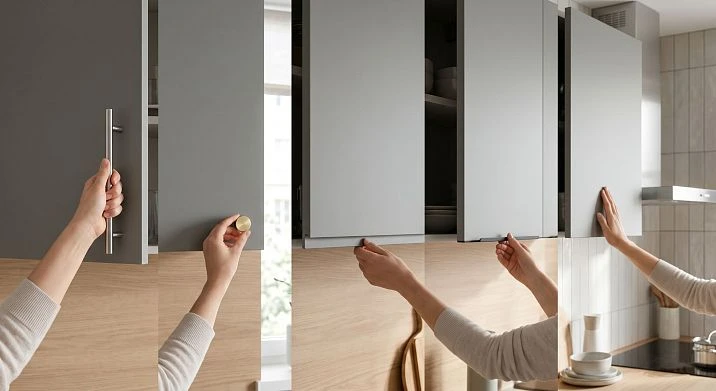
Upper kitchen cabinets are a special zone. They are opened differently than lower ones: the hand reaches up, fingers search for the handle from below or the side, the grip angle is different, the effort is different. And if almost any handle will work for a lower cabinet, Handle for kitchen cabinetthen for an upper cabinet, the choice requires understanding the usage scenario.
Handles for upper kitchen cabinets are primarily profile, edge, Gola, surface-mounted handles, and compact knobs. They solve the problem of convenient grip from below, do not weigh down the upper line of the set, and do not conflict with the hood, lighting, and adjacent facades. Each type follows its own rules — and that is exactly what we will examine in detail.
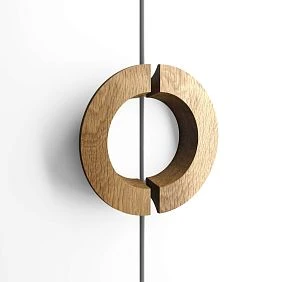
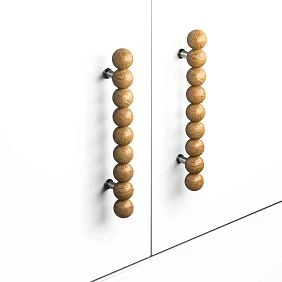
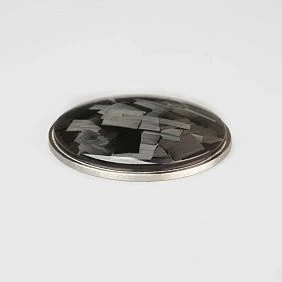
Why upper cabinets are a separate task
The physics of opening a wall-mounted cabinet
Try to mentally reproduce the hand movement when opening an upper kitchen cabinet. The hand rises to shoulder level or slightly higher. The fingers search for a grip point. The direction of effort is downward and toward yourself, not just "toward yourself" as when opening a lower cabinet. This is fundamentally different.
That is why handle for a kitchen cabinet on an upper base should be located in the lower part of the facade — where the hand naturally reaches. A handle in the center of the facade or in its upper part is an ergonomically incorrect solution for a wall-mounted cabinet. The hand reaches downward, so the handle should be at the bottom.
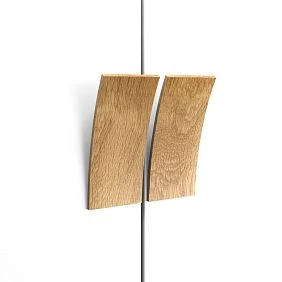
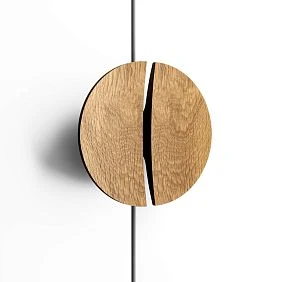
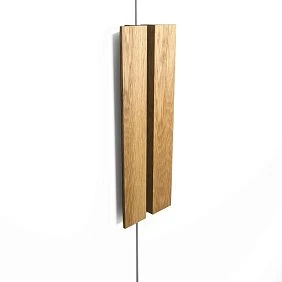
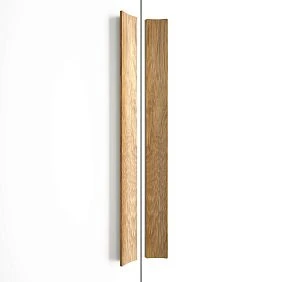
Our factory also produces:
Visual load on the upper line
Upper cabinets are the top horizontal line of the kitchen, visible from any point in the room. Their fronts form the visual "sky" of the set. If these fronts have large, massive, strongly protruding handles, the upper part of the kitchen becomes heavy and overloaded.
This is where profiles, edge handles, and Gola solutions gain their main advantage: they are either completely invisible from the front view or read as a thin line that adds lightness, not weight.
Get Consultation
Kitchen height and user height
Handles for kitchen furniture on upper cabinets should be chosen considering the height at which the fronts are located. Standard kitchen: lower cabinet 850 mm + countertop 40 mm + backsplash 450–550 mm = start of upper cabinets approximately at 1340–1440 mm from the floor. For a person 165–175 cm tall, this is an arm's reach zone.
If the cabinets are located higher or if there are short people in the family, a handle at the bottom of the front is critically important. An edge handle or profile along the bottom edge is not just design, it's accessibility.
Profile handles for upper cabinets: concise horizontal
What is a profile for the upper base of a kitchen
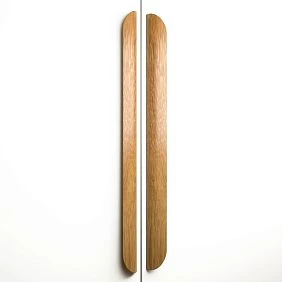
Profile handle for upper base is a long horizontal rail that is installed across the entire width of the front or a significant part of it. The hand grips the rail along its entire length — evenly, without load on one point. The force is distributed, the front opens without warping.
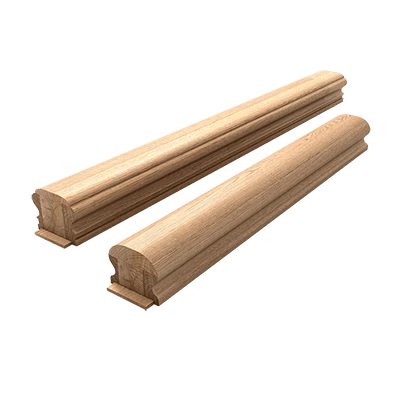
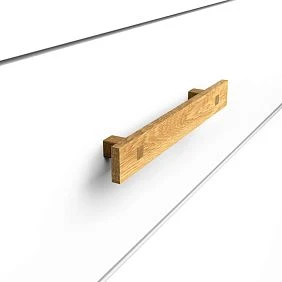
Profile Handle made of solid wood is a wooden rail with a special cross-section. The flat side adjoins the front, and the working side — slightly convex, rounded, or wavy — provides a comfortable grip. The wooden surface under the hand is warm, non-slip, and natural to the touch.
Why the profile is so good for upper cabinets
First, visual logic: profile handle for kitchen creates a horizontal line that repeats the horizontals of the facades themselves. The kitchen gains a clear architectural rhythm: facades + slats = horizontal stripes that make the space wider and calmer.
Second, ergonomics: a long Profile handle for kitchen allows you to open the cabinet by grabbing it at any point. There is no need to precisely hit with your fingers — the slat is always where the hand is.
Third, practicality: a horizontal slat along the bottom edge of the upper facade is the ideal placement from a bottom-grip perspective. The hand rises, fingers go behind the slat from below, movement — down and toward you. Everything works as it should.
Surface-mounted or recessed profile handle: which choice
Surface-mounted profile handle is mounted on top of the facade with bolts — this is simple installation, accessible without professional equipment. The slat protrudes 15–30 mm above the surface, creating a grip.
A recessed profile handle is embedded into a groove along the edge of the facade — the surface remains flush, and grip is achieved via the recess along the edge. This requires milling during facade production. But the result is an extremely clean surface without protruding elements.
Profile surface-mounted handle for facades — a practical choice for most situations. It can be installed on ready-made facades, it's easy to replace, and it doesn't need to be ordered at the same time as the kitchen body.
Profile length: how to choose
The length of the profile handle should be 60–80% of the facade width. For a facade 400 mm wide — a rail of 240–300 mm. For a facade 600 mm — a rail of 360–450 mm. If you want an accent across the entire width — the rail equals the facade width minus 20–30 mm on each side.
A rail that is too short — and it gets lost on a wide facade. Too long — and it goes beyond proportion, creating a feeling of inconsistency.
Gola handle for upper cabinets: a kitchen without traditional handles
What is Gola in the context of kitchen upper cabinets
Gola handle for kitchen — is a system where the handle is not just installed on the facade, but integrated into its construction. A groove or recessed profile runs along the top edge of lower facades or along the bottom edge of upper cabinets. The hand enters this groove from above or below — depending on the location.
In the context of upper cabinets gola handle on upper cabinets installed along the lower horizontal edge of the facade. The hand enters the groove from below, fingers rest on the work surface, and the facade is pulled downward. This is a concealed handle — from the front, the kitchen looks like a single plane without protruding parts.
Gola made of wood: a natural version of the concealed handle
gola handle for kitchen Grace HL-009 made of solid natural wood is an interesting alternative to metal aluminum Gola systems. The wooden version feels warmer to the touch and looks more organic next to wooden facades or facades with wooden elements.
If the entire kitchen is built around natural materials — wood, stone, linen fabrics — the wooden Gola supports this program. A metal Gola in such a context might look out of place, while the wooden one feels like part of the overall material language.
Gola handle with coating Grace HL-009m — the same product with a finish coating: matte black, white, chrome, matte gold. This is a ready-made solution that does not require additional finishing. For a kitchen with painted facades — a coated Gola in matching or contrasting color.
Structural requirements for Gola
This is a crucial point that is often overlooked when choosing: gola handle in the kitchen requires that the cabinet body structure allows placing the groove along the lower edge without compromising rigidity. If the facade is thin (less than 18 mm MDF), milling the groove weakens the lower edge.
Also important: the Gola groove on the upper cabinet must be of sufficient depth and width for a comfortable grip. If the groove is too narrow or shallow, the hand won't fit properly. Recommended parameters: groove depth at least 12 mm, width at least 18 mm.
If the kitchen is already made and the facade design does not include a groove, the classic inset Gola is not available. In that case, the choice is an overlay Gola or a profile rail.
Gola and lighting of upper cabinets
Modern kitchens often include lighting under the upper cabinets — LED strips or built-in fixtures that illuminate the work surface. In this case, the Gola profile along the bottom edge of the upper cabinet falls within the lighting zone: the groove or rail can cast a shadow or, conversely, diffuse the light.
This must be considered during design: how the light is positioned, where the light is directed, whether the rail or groove blocks the light flow. In some cases, the profile rail is specifically placed on the lighting side — then the light is partially diffused through the rail, creating a soft halo under the cabinet.
Button handle for upper kitchen cabinets: precision in miniature
When a button is the right choice
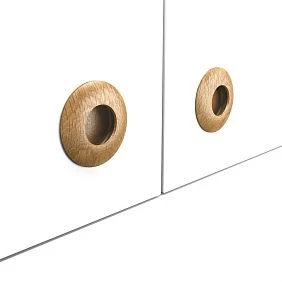
cabinet knob — is a point handle with a single attachment point. It is compact, minimalist, and installs in 5 minutes. On upper kitchen cabinets, a button is suitable in several specific scenarios.
First: narrow facades — up to 300–350 mm wide. On a narrow facade, a long profile rail looks out of place. A button is a precise, proportional choice.
Second: display inserts in upper cabinets with glass doors. Glass facade + wooden or metal Button Handle — a classic and always relevant combination.
Third: kitchens in classic, neoclassical, Provence style, where buttons or small staples are historically accurate hardware.
Fourth: buffet upper sections with hinged doors, where there is no need for a long grip — one point is enough.
Wooden knob handle: warmth in one detail
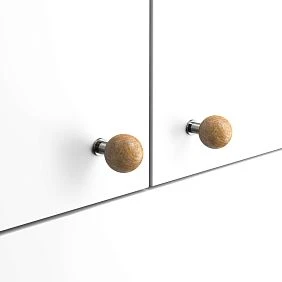
Furniture knob made of solid wood — a small but very expressive detail. Round or rectangular, with rounded or straight edges, with or without coating — it enriches the facade tactilely and visually.
In a Scandinavian-style kitchen: a light facade and an uncoated wooden knob made of light ash or birch — natural unity. In a classic kitchen: a white enameled facade and a knob with a brass or bronze coating — a historically accurate choice.
Handles with Finish in knob format — a ready-made part that can be installed immediately without additional finishing. handles without coating in knob format — for custom projects with individual painting.
Positioning the knob on the upper facade
On upper cabinets Knob handle installed on the lower part of the facade — 50–80 mm from the bottom edge, centered horizontally. This ensures a comfortable grip from below.
The exception is display cabinets with tall glass doors, where the button is installed at a level of 1/3 from the bottom edge of the door. Here, visual proportion is more important: the button should be neither too high nor right at the bottom edge.
Edge pull for upper facades: purity without compromise
How an edge pull works
Edge pull is a handle that is installed not on the front plane of the facade, but on its bottom edge. The hand reaches from below, fingers wrap around the bottom edge, and the facade opens. From the front view — a clean plane without any protruding element.
This is the most minimalist of all handle solutions for the upper kitchen base: the facade looks like an absolutely flat panel. No brackets, strips, or buttons. Only the facade material and — if you look closely — a thin wooden strip along the bottom edge.
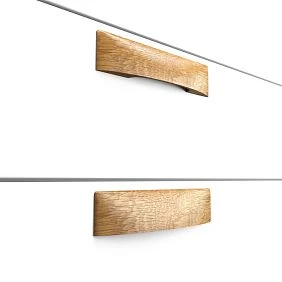
handle on the end of the facade made of wood — is a wooden strip that is glued or attached to the edge. Its thickness is 8–15 mm. This is a small protrusion under the facade, almost invisible in the closed position and easy to feel when opening.
Edge pull in modern kitchens
In modern kitchens in minimalist or high-tech style, the edge pull is one of the main tools. Smooth facades without hardware, straight lines, a single plane — and a wooden edge strip as the only functional detail.
End handle for kitchen made of wood on a painted MDF facade — this is a contrast of materials: synthetic enamel and live wood. The wooden strip can be painted to match the facade (monolith effect) or left in its natural form (material accent).
Installation of the end handle
Wooden end handles are attached in two ways: with glue (if the facade edge is wide enough) or with bolts (if mechanical reliability is needed). For upper cabinets with lightweight facades (MDF 16–18 mm), glue attachment is sufficient.
An important point: the end handle must fit tightly and evenly against the edge — without gaps or misalignments. A thin gap line between the strip and the facade is immediately noticeable from any point in the room.
Overlay handle on upper facades: simplicity in action
Overlay handle as an alternative to a profile
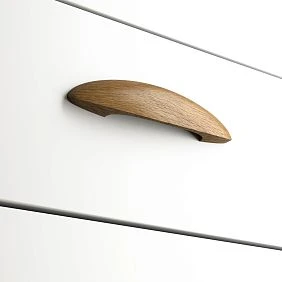
overlay handle for kitchen cabinet front — this is a strip or plate that is attached with bolts on top of the facade. Unlike a profile, an overlay handle can be not only a horizontal strip but also a flat rectangular plate, a wave-shaped profile, or a decorative bar.
On upper cabinets, the overlay handle is installed at the bottom of the facade — just like the profile. The protrusion above the surface is 15–25 mm. The hand grips the protruding part from below.
Furniture overlay handle made of wood — this is the warmest and most natural option for upper cabinets. Especially when the lower facades are equipped with bracket handles or push-to-open mechanisms, and it is necessary to coordinate the upper cabinets with the lower ones.
A surface-mounted handle is the most versatile choice in terms of compatibility: it can be installed on any ready-made facade, without special equipment, without reworking the body.
Surface-mounted profile handle on upper cabinets
Surface-mounted profile handle — a special case of a surface-mounted handle with a profile cross-section. It is installed horizontally along the lower part of the upper facade, creating a characteristic horizontal shadow under the rail.
This shadow is an interesting visual effect. With side lighting or under-cabinet lighting, the rail casts a soft shadow that emphasizes the horizontal line of the facades. This makes the kitchen more voluminous and architecturally rich.
Which handles do not always work on upper cabinets
Large brackets with a big overhang
Massive Bracket Handle with an overhang of 35–50 mm on upper cabinets is a risk of visual overload. A large metal or wooden element protruding 50 mm from the facade plane looks heavy. The upper line of the kitchen becomes fragmented.
If a bracket is a fundamental choice, select compact models with an overhang of no more than 25–30 mm and a length of no more than 96–128 mm. For upper facades, a minimalist bracket is better than a maximalist one.
Handles with sharp edges
Sharp ends, right angles, sharp edges on handles for upper cabinets are unsafe. Hands touch the handle from below, fingers slide along the end. A sharp edge cuts — and this is not a metaphor. Choose handles with a chamfer or rounded ends.
Handles that are too long, extending beyond the boundaries of adjacent cabinet fronts
If upper cabinets are placed side by side, handles should be positioned so as not to interfere with opening the adjacent cabinet front. A horizontal rail that is too long on a narrow cabinet front, protruding beyond its width, creates a mechanical conflict when opening the neighboring door.
Rule: the handle length should not exceed the cabinet front width. The gap from the edge of the cabinet front to the end of the handle should be at least 15 mm on each side.
Heavy decorative handles
Decorative shell handles, brackets with cast decor, ornate models with complex relief — for upper cabinets, these are not a common choice. They are appropriate in classic kitchens with buffet sections, but on wall-mounted cabinets with standard fronts, they create dissonance. A decorative detail requires a decorative cabinet front — otherwise, the handle 'doesn't know' where it ended up.
How to choose a handle to match your kitchen style: a practical guide
| Kitchen style | Recommended handles for upper cabinets |
|---|---|
| Minimalism | Edge, Gola, recessed profile |
| Modern kitchen | Overlay profile, end, overlay, chrome, black |
| Scandinavian | Wooden button, simple bracket, profile, natural wood |
| Neoclassical | Button, small bracket, gold, brass, bronze |
| Classic | Button, bracket, bronze, brass, Handles with Finish |
| Handleless kitchen | Gola, end, recessed profile |
| Loft | Profile, overlay, matte black, metal |
| Eco and biophilic | Wooden profile or overlay without a finish |
Minimalism and High-Tech
The main principle is "less is more." An end handle along the bottom edge of the upper front or a recessed Gola are ideal solutions. The front surface of the kitchen remains completely clean. The only accent is the material and color of the fronts.
If you still need a visible detail — a very thin one Overlay handle matching the facade, almost invisible from a distance. Or a profile with a minimal protrusion — 10–12 mm.
Scandinavian style
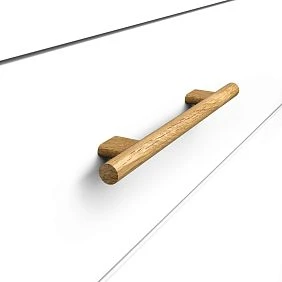
Scandinavian interior is about conciseness, naturalness, and delicacy of details. Furniture knob handle made of light wood, an uncoated wooden profile, a simple bracket without decoration — all of this fits the Scandinavian code.
Black matte or chrome on a Scandinavian kitchen with white facades is a classic neutral choice. A wooden handle on wooden or veneered facades is a natural choice.
Neoclassicism
In neoclassicism, form matters. profile handle for kitchen can be used here on wide and tall cabinets where a clear horizontal accent is needed. Button Handle in brass or matte gold on display sections — a delicate historical reference.
Finish — warm metal: brass, matte gold, bronze. Cold chrome on a neoclassical kitchen looks out of place.
Coordinating handles for upper and lower cabinets
This question is one of the most common when designing a kitchen. Should the handles on the upper and lower cabinets be the same?
There are three approaches:
Complete identity. The same handles on all facades — upper and lower. Creates maximum visual consistency. Works when the chosen model is universal in shape and convenient in both positions.
Same finish, different shape. Upper cabinets — profile or edge handle. Lower cabinets — bracket or surface-mounted handle. But the finish is the same: for example, matte gold everywhere. The shape adapts to the usage scenario, the color remains unified.
Zoning. Upper cabinets — Gola or edge (hidden) handles. Lower cabinets — visible brackets or profile handles. This is a design contrast: the upper part of the kitchen is light and "handleless", the lower part has clear horizontal accents of hardware.
The third approach is increasingly popular in designer kitchens: top — clean, bottom — with character.
Lighting and handles of upper cabinets: practical nuances
Lighting under the upper cabinets is standard today. And when choosing a handle, it is important to consider how it interacts with the light.
A profile or edge handle along the bottom edge of the upper cabinet ends up right next to the light source. Several scenarios:
A wooden rail under the LED strip diffuses and slightly blocks the direct beam, creating soft diffused light on the work surface — this is beneficial.
If gola handle for kitchen or the end strip is located below the level of the LED strip — light passes over the handle and illuminates the work area directly.
If the handle is at the same level as the light source — you need to ensure it does not create unwanted shadows on the backsplash or countertop.
These details should be worked out at the design stage, not after installation.
Mistakes when choosing handles for upper kitchen cabinets
Placing handles in the center of the upper cabinet door
The handle on the upper cabinet should be at the bottom — not in the center, not at the top. The hand reaches up and slightly forward, the natural grip point is the lower third of the door. A handle in the center creates an awkward grip angle for most users.
Choosing Gola without understanding the construction
Gola handle in the traditional recessed version requires that the doors are already prepared for this system — with a milled groove. If the kitchen is already made and the doors are standard — recessed Gola is not available. You need to either choose the surface-mounted version or re-mill the doors.
Not considering the kitchen height
The standard height of wall cabinets is designed for a person 165–175 cm tall. If the kitchen is designed for a different height, this must be considered when choosing the type of handle and its position on the facade. For low installation of upper cabinets, a handle at the bottom is mandatory. For high installation, an edge handle may be required, accessible even with the arm fully extended.
Mixing several coatings without logic
A profile rail in matte black, buttons in gold, brackets in chrome in one kitchen — these are three different metal programs simultaneously. Choose one main coating color kitchen handles and stick to it.
Forgetting about adjacent facades during installation
Two adjacent upper facades that open simultaneously can create a handle conflict. The handle of the right facade hits the handle of the left one when opening. This happens when installing long profile rails. Check the geometry before installation.
Choosing handles only by photo
A photo shows the appearance but does not convey the grip comfort. A wooden rail with a sharpened section may look great in a photo but be uncomfortable for daily use. If possible, evaluate samples in person, touch them, simulate the opening motion.
Buying handles for upper kitchen cabinets at stavros.ru
In the furniture handles stavros.ru presents all main types of handles for upper cabinets:
Profile handles for kitchen — horizontal wooden slats of varying lengths with a profile cross-section. Made of solid wood, for surface mounting.
Gola Grace HL-009 handle — wooden Gola without coating, and Grace HL-009m with coating in several finishes.
handle-buttons made of solid wood — for display sections, small facades, and classic kitchens.
Surface-mounted handles — for mounting on top of ready-made facades without special equipment.
All models are available without a finish — for self-finishing — and some models with a finish in finished colors. Handles for kitchen furniture made of natural wood — with Contact us to confirm shipping to your destination.
FAQ: answers to popular questions about handles for upper kitchen cabinets
Which handles are best for upper kitchen cabinets?
Most often suitable profile handles for kitchen, end handles, Gola handle, Surface-mounted handles and compact handle-buttons. The main thing is that the handle is located at the bottom of the facade and provides a comfortable grip from below.
Can you install pull handles on upper cabinets?
You can, but it's better to choose compact models with a moderate overhang — no more than 25–30 mm. Large brackets visually weigh down the top line of the kitchen. Handles for kitchen furniture bracket-style handles on upper facades work better on a small scale.
What is better for upper cabinets: a profile or Gola?
Profile handle for upper base easier to select, install, and replace. Visible from the front as a horizontal line. gola handle for kitchen provides a more concealed effect — the facade looks handleless. But Gola requires a well-thought-out facade design. If the kitchen is being designed from scratch — Gola. If the facades are already ready — a profile or an overlay handle.
Are knob handles suitable for upper cabinets?
Yes, especially for small facades up to 350 mm wide, display sections, and classic-style kitchens. Furniture knob handle — compact, delicate, easy to install. For wide facades, a knob works worse — here a profile is better.
Which handle is more convenient for an upper facade?
The one located at the bottom of the facade with enough space for finger grip from below. A profile with a 20–25 mm protrusion, Edge pull or Gola with a groove depth of 12 mm — all these options provide a comfortable grip when opening a wall cabinet.
How to coordinate handles for upper and lower cabinets?
Three options: identical handles everywhere, same finish with different shapes (profile on top + bracket on bottom), or zoning (hidden handles on top + prominent handles on bottom). Any of these approaches works if applied consistently. Important: the finish kitchen handles must be coordinated with hinges, legs, and the faucet.
Get Consultation
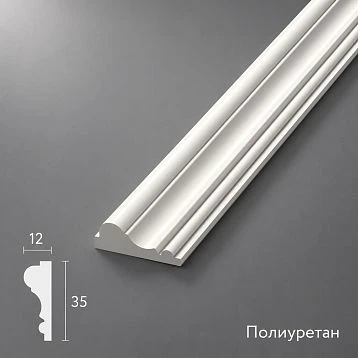
Polyurethane Mold MLDPU-003
from 91.49 $
Wooden Decor N-125
from 21.73 $
Decorative element MLD-2-1.1
from 46.47 $
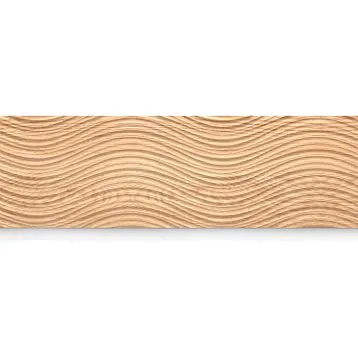
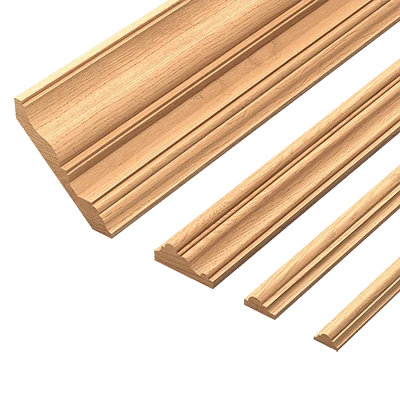
● Universality. The wooden trim K-017 is suitable for any style and room, whether it's a living room, bedroom, office, kitchen, bathroom, or hallway. The wooden trim K-017 can be used for various purposes and tasks, such as framing, cladding, decorating, or zoning. The wooden trim K-017 easily complements other decorative elements, creating a harmonious and cohesive look.
from 19.31 $