Article Contents:
- Why a wardrobe needs a special handle
- Which types of handles are suitable for a wardrobe
- Recessed handle for wardrobe: the main choice for sliding systems
- Technical parameters of a recessed handle for wardrobe
- Profile handle for wardrobe: vertical as a design technique
- Vertical profile handle for wardrobe: geometry and function
- Profile handle for wardrobe for chipboard 16 mm
- End handle for sliding door: maximum facade cleanliness
- End handle for furniture: installation nuances
- Handle for mirrored and glass sliding wardrobe door
- Profile end handle for mirrored door
- Handle for mirrored door without glass drilling
- Handle for sliding interior door: application specifics
- Handle for sliding door: selection features
- Handle for sliding door: grip depth and safety
- Flat surface-mounted handle for sliding door
- Shell handle on sliding wardrobe door: organic in geometric space
- Handles for sliding wardrobe depending on interior style
- Minimalism and High-Tech
- Scandinavian style and eco
- Modern classic and neoclassic
- Loft and Industrial Style
- Comparison table: which type of handle to choose for a sliding wardrobe
- How to choose a handle for a heavy sliding door
- Handle for a folding wardrobe door
- Common mistakes when choosing a handle for a sliding wardrobe
- Installing a handle on a sliding wardrobe: general algorithm
- Wooden handles for a sliding wardrobe: why natural material wins
- FAQ: answers to popular questions about handles for sliding wardrobes
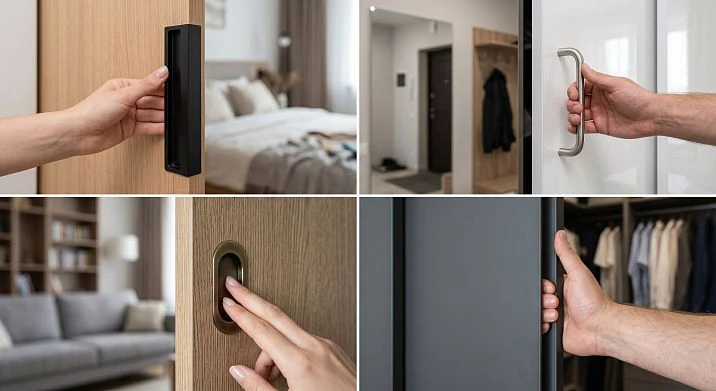
A handle for a sliding wardrobe is not a case where you can pick the first model you like from a catalog. Here, the geometry of the protrusion, the type of installation, compatibility with the door structure, the material of the facade, and even the gap between the panels matter. In this article, we'll cover everything — from types of handles to specific usage scenarios and common mistakes that are best not repeated.
Why a sliding wardrobe needs a special handle
A sliding door moves in one plane or in parallel planes, overlapping itself when opening. This fundamentally distinguishes it from a hinged door, which moves away from the facade. On a sliding door, the handle cannot occupy space in front of the door panel — otherwise it will conflict with the adjacent panel, track, trim, or wall.
That is why for a sliding wardrobe they choose a handle for a sliding wardrobe with minimal or zero protrusion from the facade. This can be a recessed, flush, profile, edge, or flat surface-mounted handle — each option has its own mechanics and application area. Let's review them in order.




What types of handles are suitable for a sliding wardrobe
Before diving into details — a general overview of options that work for sliding doors. This is not a theoretical list, but a practical map of solutions.
Recessed handle — installed in a cutout in the facade body. The protrusion is minimal or zero. Ideal for sliding systems where the gap between panels is small.
Flush handle — a type of recessed handle. It goes completely into the plane of the door, leaving no protrusion. A maximally concealed solution.
Profile Handle — an elongated horizontal or vertical profile, attached along the entire length or part of the door. Small protrusion, comfortable grip along the entire height.
End handle — mounted into the end (side edge) of the door. Completely invisible from the front side.
Flat surface-mounted handle — attached on top of the facade, but has a minimal profile (5–10 mm). Simple installation, but requires consideration of the protrusion relative to adjacent doors.
Shell Handle — recessed handle with a concave recess, grip from below or above. Used less frequently, but is organic on wooden facades.
Long vertical profile — runs along the entire height of the door or most of it. Convenient for tall cabinets, creates a striking design accent.
Our factory also produces:
Recessed handle for sliding wardrobe: the main choice for sliding systems
If you need to formulate a single principle for choosing a handle for a sliding wardrobe, it sounds like this: the less the handle protrudes beyond the plane of the door, the better. And it is Inset handle that best meets this principle.
A recessed handle for a sliding wardrobe is mounted into a pre-prepared seat in the facade: a rectangular or oval cutout of the required depth. The handle fits into this space and is secured from the back side with fasteners from the kit. From the front side, only a neat rectangular or oval cutout is visible — fingers enter it and grip the door from the inside.
What does this provide? A recessed handle for a sliding wardrobe does not protrude beyond the plane of the panel at all (or protrudes no more than 3–5 mm, depending on the design). When the door moves, the adjacent door passes by without any contact. No scratches, no jamming, no mechanical obstructions.
Get Consultation
Technical parameters of a recessed handle for a sliding wardrobe
Before purchasing a flush pull handle for sliding doors, it is important to check several parameters:
-
Facade thickness. Standard wardrobe doors made of chipboard or MDF have a thickness of 16–18 mm. The routing depth for a flush pull handle is usually 12–16 mm — check how much material remains after routing. The minimum allowable remaining thickness is 3–4 mm.
-
Seat size. Rectangular routings are usually made in sizes 100×30 mm, 120×30 mm, 150×30 mm — depending on the handle model. Check the description of the specific model.
-
Handle protrusion beyond the facade. Even a "flush" handle may have a slight rim protrusion of 2–5 mm. This is acceptable for most sliding door systems, but if the gap between doors is minimal — check this parameter in advance.
-
Fastening. Most flush pull handles are secured with bolts from the back side of the facade. Make sure access to the back side is available before starting installation.
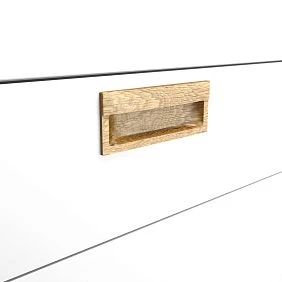
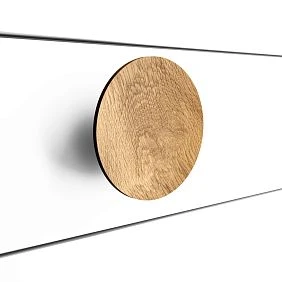
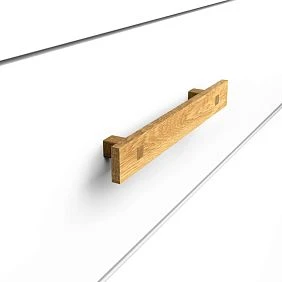
Wooden handle Nova HL-028 from the stavros.ru catalog — buy flush pull handle which can be used for facades made of MDF, veneer, or natural wood. Rectangular geometry, solid oak, a neat grip groove — this is a handle that works in a minimalist interior without unnecessary words.
Profile handle for wardrobe: verticality as a design technique
If a flush pull handle is a point element on the door, then profile handle for cabinet — it's a line. A line that runs along the entire height of the facade or a significant part of it, creating an expressive vertical accent. That's why the profile handle for cabinet is so popular in modern interiors with tall cabinets and ceilings.
The principle of operation is simple: the profile is an elongated rail with an internal groove for gripping. It is attached to the facade at several points (with bolts through the facade) and provides a comfortable grip along its entire length. Fingers enter the groove at the back of the profile — where it stands a few centimeters away from the facade surface.
Vertical profile handle for cabinet: geometry and function
The vertical profile handle for a sliding wardrobe is a modern solution for tall doors from 1.8 to 2.7 m. The long vertical line on the wardrobe door works as an architectural element: it visually stretches the facade upward, making the wardrobe slimmer and taller. At the same time, it provides a comfortable grip at any point — you can open the door by grabbing the profile at the bottom edge, in the middle, or closer to the top.
For a tall sliding wardrobe with doors 2.2–2.7 m, this is especially relevant. A handle installed at a single point in the middle of the door is inconvenient: you have to bend down or reach up. The vertical profile completely eliminates this problem.
Another advantage: the profile distributes the load across several attachment points, which increases reliability under intensive use. For heavy sliding wardrobe doors made of 16–18 mm chipboard with filling — mirror, glass, laminate — this is not just convenience, but a matter of durability.
Profile handle for sliding wardrobe for 16 mm chipboard
Separately, it is worth considering the compatibility of profile handles with specific door materials. The most common option is a door made of 16 mm thick chipboard. For such a door, you need a profile with bolt length designed specifically for 16 mm and with a mounting hole spacing that does not weaken the door panel.
Vertical profile handle for sliding wardrobe 16 mm chipboard is a standard request for which manufacturers produce adapted kits. Pay attention not only to the profile length but also to the package contents: the necessary bolts should be included in the kit.
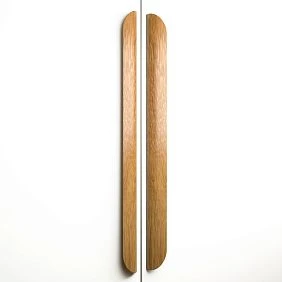
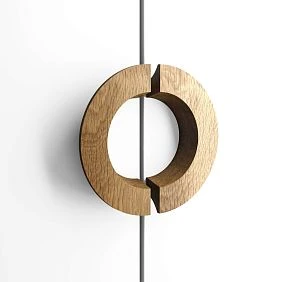
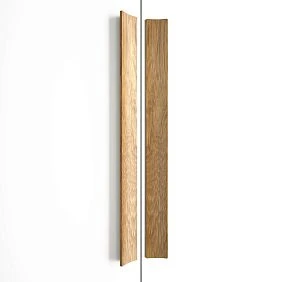
Profile handle for cabinet Made from natural wood — a special option. A wooden profile made of solid oak or ash on a white matte cabinet door is a subtle design technique that adds natural warmth to modern furniture. The wood texture contrasts with the smooth facade, creating an interesting tactile and visual interplay.
Edge handle for sliding door: maximum facade purity
There are situations where even a slight protrusion of the handle in front of the facade is undesirable. A minimalist sliding wardrobe built into a wall-to-wall niche, a sliding door system with minimal gaps, an interior where furniture should "dissolve" into the space — here you need an edge handle for a sliding door.
The edge handle is mounted not on the front plane of the facade, but on its side edge — usually on the left or right, less often on the bottom. A groove or recess of the required shape is milled into the edge, and fingers enter from the side, gripping the door to slide it. From the front side of the facade, there is nothing: no protrusion, no cutout, no visible hardware element.
The result is a completely clean, "hardware-free" facade. The door looks like a monolithic panel that somehow moves along the guides by itself. This is the most concise visual result possible.
Edge handle for furniture: installation nuances
Despite all the obvious advantages, the edge handle for furniture has features that are important to consider.
First of all — the door construction. The edge handle requires that the groove in the edge does not weaken the door panel structure. For standard 16 mm chipboard, this is possible, but the depth and width of the groove must be calculated considering the material's strength. For MDF doors 18–22 mm, it is even more reliable.
The second nuance — accessibility of the edge. In sliding systems with aluminum frame profiles, the door edge may be covered by the profile. In this case, the edge handle is installed either before mounting the frame, or a special cutout in the profile is provided.
The third point is ergonomics. Gripping the end of the door requires getting used to: the hand moves from the side, not from the front. For most people, this is intuitive, but for elderly users or children, this design may be less convenient than a classic front handle.
Furniture mortise handle in an end-mounted design made of solid wood — this is a rare but expressive solution for cabinets in eco-style and boho, where natural materials are present even in the most unexpected details.
Handle for mirrored and glass sliding wardrobe door
A separate and complex topic is handles for doors made of mirror or glass. This is a specific material with special requirements for installing hardware.
Mirror and glass cannot be milled with ordinary tools intended for wood or MDF. Drilling a glass panel requires diamond drills, special equipment, and experience: a careless move — and the expensive mirror will crack. That is why for mirrored sliding wardrobe doors, solutions that do not require drilling the glass itself are more often chosen.
Profile end handle for mirrored door
A profile end handle for a mirrored wardrobe door is the most common solution. The profile is mounted not into the mirror body, but into an aluminum frame that surrounds the mirror panel along the perimeter. The frame takes the fasteners, and the mirror is not damaged.
This approach is especially relevant for sliding systems, where mirrored doors are inserted into standard aluminum profiles — bottom, top, side. The handle is integrated into the side profile of the frame: visually, it looks like a neat groove or protruding element on the end of the door.
Handle for mirrored door without drilling glass
If the mirror is installed without a frame — on clips or special holders — the task of mounting the handle becomes more complicated. In this case, solutions with adhesive fixation or overlay elements covering the edge of the mirror are used.
A handle for a glass door without drilling — a similar story. Here, special clamping systems are used: a metal handle with two plates that clamp the glass panel on both sides and are secured with a bolt. Reliability with proper installation is high, and drilling the glass is not required.
For mirror doors in modern interiors, a Overlay handle with a minimal profile, fixed through the frame, works well. A thin horizontal strip of aluminum or wood on the aluminum profile of the mirror — visually neat and functional.
Handle for a sliding interior door: specifics of application
Sliding doors are not just for cabinets. Interior sliding doors are now actively used in apartments and houses: they save space, create seamless transitions between zones, and allow quick reconfiguration of the space. And they also need the right handle.
A handle for an interior sliding door is always a compromise between functionality and design. On one hand, you need to ensure a comfortable grip: the door is often heavier than a wardrobe door, its travel is longer, and the force required to open it is greater. On the other hand, the handle should not interfere with the door's movement in the guide system.
Handle for a sliding door: selection features
A sliding door is a door that moves sideways parallel to the wall. The handle for a sliding door should be convenient for horizontal movement and should not protrude so much that it catches on the wall or nearby furniture.
For sliding interior doors, two options are most popular: a large recessed handle with a deep groove (provides a secure grip with significant force) and a long profile (allows you to grab the door at any point along its height).
Handle for interior sliding door — a separate subtype. For interior sliding doors that go into a cassette inside the wall, compatibility of the handle with the mechanism is critically important: the handle must not hit the cassette when the door slides into the wall. This requires preliminary study of the design and precise measurements.
Handle for sliding door: grip depth and safety
The handle for a sliding interior door must provide a secure grip even with wet hands — bathroom, kitchen, hallway. Therefore, for wet rooms, choose handles with a textured surface or made of materials with a good coefficient of friction — wood, matte metal, rubber inserts.
A wooden mortise handle made of solid wood for a sliding interior door is an excellent choice in terms of tactile properties. Wood does not slip, is warm to the touch, and is pleasant in everyday use. It is not used in the bathroom, of course, but for the bedroom, living room, or study — it is a first-class option.
Flat surface-mounted handle for sliding door
Among all options of fittings for sliding doors Overlay handle occupies a special place: it is the easiest to install, does not require routing, and is available in the widest range of shapes and finishes. But for a wardrobe, its use requires attention.
The key parameter is the protrusion from the facade. A flat surface-mounted handle with a protrusion of 5–8 mm is quite acceptable for sliding systems with a gap between doors of 15 mm or more. If the gap is smaller, the risk of contact with the adjacent door increases. If the gap is sufficient, a flat surface-mounted handle becomes the optimal choice: quick installation, a wide selection of models, reliable fastening.
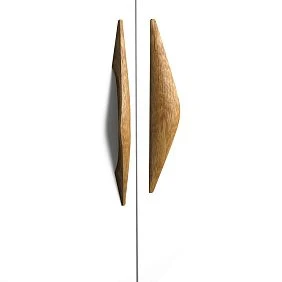
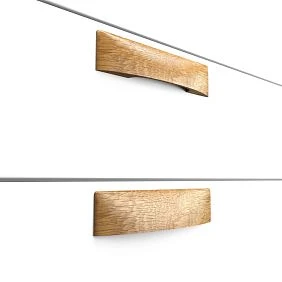
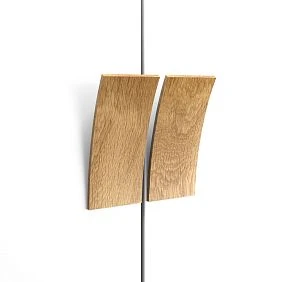
Surface-mounted profile handle Wave HL-006 from the stavros.ru catalog is an example of such a solution made of natural wood. Smooth wave-like profile, natural solid wood texture, thin cross-section — it is mounted on the facade surface, but does not create a bulky protrusion. For a wardrobe with wooden or veneered doors, it is an organic and stylish choice.
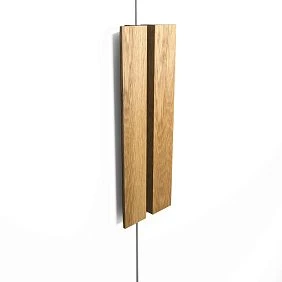
Overlay handle Plane HL-011 — another option with a flat profile. Geometrically strict, laconic shape, thin cross-section. For cabinets in a minimalist interior — a precise fit to the style.
Shell handle on a sliding wardrobe door: organic in a geometric space
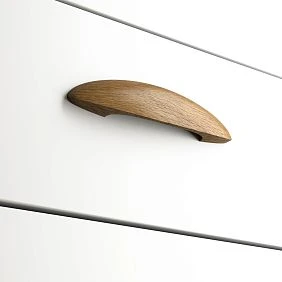
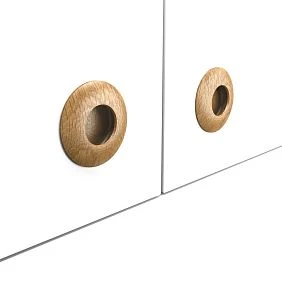
Shell handle Shell HL-024 — is a special case among handles for sliding wardrobes. It belongs to recessed handles with a concave indentation, and when installed in the facade, it creates the same minimal protrusion as a standard recessed handle.
But the shape is different: soft organic lines, a "bowl" for fingers, natural roundness. On a wooden sliding wardrobe facade, it looks like a deliberate design choice — not just "hardware," but a sculptural element.
For a sliding wardrobe in a Scandinavian-style bedroom, a children's room with natural motifs, or an apartment emphasizing natural materials — a shell handle on a wooden facade creates exactly that atmosphere of warmth and organic feel that is difficult to replicate with metal hardware.
An important condition: a shell handle is installed on a sliding wardrobe door only if the thickness and material of the facade allow for precise milling for the mounting seat. For 16 mm chipboard, this is quite feasible; for mirrored or glass doors, it is not applicable.
Handles for sliding wardrobes depending on interior style
Technical parameters determine what works functionally. But the interior style determines what works aesthetically. Let's consider several key scenarios.
Minimalism and High-Tech
For these styles, the following are optimal: a recessed flush handle with rectangular geometry, an edge handle with fully concealed hardware, a vertical aluminum profile with a matte finish. No wooden elements, no decorative forms — only pure geometry and function.
Scandinavian style and eco
A wooden flush handle made of solid wood, a vertical profile made of oak or birch, a shell handle made of natural wood. Natural texture, warm tones, organic shapes. handles without coating made of solid wood allow you to independently choose the color to match the tone of the doors.
Modern Classicism and Neoclassicism
Here, overlay profiles with a more pronounced shape, wooden handles with a delicate relief are possible, Handles with Finish in tones of bronze, antique, or aged metal. The main thing is to maintain balance: the handle should be decorative but not draw too much attention.
Loft and industrial style
Matte black profiles, massive vertical handles with minimal protrusion, metal with a matte finish. For loft-style sliding wardrobes, a vertical black profile on a dark or light silver facade is a strong design technique.
Comparison table: which type of handle to choose for a sliding wardrobe
| Handle option | Protrusion from the facade | Installation requirement | When it fits |
|---|---|---|---|
| Recessed | Minimal (0–5 mm) | Milling in the facade | Sliding doors with small gap, minimalism |
| Flush recessed | Zero | Deep milling | Maximum concealed installation, zero-gap systems |
| Profile | Small (10–20 mm) | Bolt fastening | Tall doors, comfortable grip along the entire height, design accent |
| End | Zero (side) | End milling | Clean facade without any visible elements |
| Flat overlay | Small (5–15 mm) | Two holes in the facade | Sufficient gap between the doors, easy installation |
| Shell Handle | Minimal | Milling for a concave groove | Wooden facades, Scandinavian style, eco |
How to choose a handle for a heavy sliding door
Not every sliding door is light. Doors made of chipboard with a mirror insert or film coating can weigh 15–25 kg. This is a serious load that must be considered when choosing a handle.
For a heavy door, you need a handle with sufficient grip length — at least 80–100 mm vertically or horizontally. A small round recessed handle with a diameter of 35 mm on a 20 kg door is inconvenient and dangerous for the mounting holes. You need either a long vertical profile that provides a grip along the entire height, or a large recessed handle with a wide groove.
The number of mounting points also matters. A profile with three to four mounting points is more reliable than a handle with two bolts when working with a heavy door. The force when sliding the door is distributed more evenly, and the facade deforms less.
The material of the handle for heavy doors is recommended to be durable: stainless steel, anodized aluminum, or solid hardwood (oak, ash, beech). Soft woods and plastic will not withstand years of heavy use.
Handle for a folding cabinet door
Folding doors — "accordion" — occupy an intermediate position between hinged and sliding doors. Their panels fold like an accordion when opened, requiring a pulling force directed at an angle. The handle for a cabinet folding door must provide a comfortable grip specifically for this movement.
For folding doors, small surface-mounted handles or buttons located in the center of the panel closest to the opening are often used. Recessed handles are less common here due to the difficulty of installation on narrow folding panels. End handles are not applicable, as the end of the panel is in motion during opening.
If the folding door is wooden or veneered, a small solid wood surface-mounted handle organically complements the facade material and provides sufficient grip for easy opening.
Common mistakes when choosing a handle for sliding wardrobes
Experience from installing thousands of sliding wardrobe systems shows: most mistakes with handles are made even before installation begins. Here are the main ones.
Installing a protruding bracket. A bracket with a 128 mm center distance and a 35–40 mm arc protrusion is an excellent choice for a hinged cabinet, but for a sliding wardrobe it is a disaster. At the first movement of the door, the bracket will crash into the adjacent panel, leaving scratches or even blocking the movement.
Not checking the gap between doors. Before choosing a handle, it is necessary to measure the distance between the planes of adjacent doors when they are parallel. Only knowing this parameter can you determine the permissible handle protrusion.
Choosing a handle without considering the facade thickness. Sufficient material thickness is required for milling a recessed handle. 16 mm chipboard is the minimum acceptable option for most recessed handles. For thinner panels, specially designed models with a minimal seat depth are needed.
Not accounting for mirror or glass. Mirror and glass inserts are not suitable for standard milling. If the sliding wardrobe door has a mirror, choose a handle with frame mounting or end fastening in advance.
Confusing a handle for a hinged cabinet with a handle for a sliding wardrobe. This sounds trivial, but it happens regularly. Not every handle from the "furniture handles" catalog is suitable for a sliding system. Clarify the purpose when purchasing.
Choosing a short handle for a heavy, tall door. A 96 mm handle on a 2.4 m high door weighing 18 kg is physically uncomfortable. For tall doors, a vertical profile or a long mortise handle is needed.
Not checking the ergonomics of the grip. A beautiful handle in the picture may turn out to be uncomfortable in actual use. Pay attention to the shape of the groove, the angle of finger entry, and the presence of rounded edges along the cutout.
Installing a handle on a sliding wardrobe door: general algorithm
Proper installation of a handle on a sliding door is not difficult if you follow the sequence of steps.
First: remove the door from the tracks or secure it in a stable position. Working with a lying door is more convenient and safer.
Second: mark the installation location. For a vertical profile, mark the axis along the entire height of the door and determine the points for mounting holes. For a mortise handle, mark the center and the outline of the cutout.
Third: perform routing or drilling. For mortise handles, use a router with a template or a chisel. For surface-mounted and profile handles, use a drill of the required diameter strictly perpendicular to the door plane.
Fourth: test fit without final fastening. Ensure the handle is in the correct position and there are no misalignments.
Fifth: final fixation. Tighten the bolts evenly, without overtightening. For wooden doors, excessive force may cause cracking.
Sixth: install the door back into the tracks and check its movement. Ensure the handle does not create obstacles during movement.
Furniture Handles from the stavros.ru catalog are supplied with fasteners and, as a rule, with the required hole diameter and milling depth indicated. This simplifies installation and minimizes the risk of errors.
Wooden handles for sliding wardrobe: why natural material wins
In a world of metal profiles and plastic buttons, a wooden handle for a sliding wardrobe is a statement of position. A position in favor of the natural, the living, the caring.
Wood is warm. Metal chills your hand on a winter morning — wood never does. Wood does not slip — a damp hand securely grips a wooden profile or groove. Wood ages beautifully — metal tarnishes and becomes covered with oxides, wood acquires a noble patina over the years.
For sliding wardrobes in the bedroom, children's room, or dressing room, a wooden handle is not only an aesthetic choice but also daily comfort. Touching a natural material at the very beginning and end of the day is a small detail that contributes to the overall feeling of quality of life.
handles without coating from solid wood in the stavros.ru catalog allow you to process the handle yourself to match the specific color and tone of the facade — with oil, wax, stain, or clear varnish. This makes it possible to achieve an exact color match that is impossible when buying a handle with a factory coating.
FAQ: answers to popular questions about handles for sliding wardrobes
Which handle is best for a sliding wardrobe?
Handles with minimal protrusion are optimal: Inset handle, recessed, end, or profile. For tall doors — a vertical profile. The choice depends on the design of the sliding system, door material, and interior style.
Can I install a regular handle on a sliding wardrobe?
Only if the gap between the doors is sufficient for the handle's arc. A standard handle protrudes 30–40 mm — with a typical gap of 10–15 mm, it will immediately contact the adjacent door. Before installing the handle, be sure to measure the gap.
Recessed or profile handle — which is better for sliding doors?
Depends on the door height. For doors up to 1.8 m, a recessed handle works perfectly. For doors 2.0–2.7 m — Profile handle for cabinet more convenient: it provides a grip at any point along the height and visually elongates the facade.
Which handle to choose for a mirrored sliding wardrobe door?
Solutions that do not require drilling the mirror panel are preferable: a profile mounted into the aluminum door frame, an edge handle in the side profile of the frame. Clamping systems with fixation through the panel should only be used with professional installation.
Is an edge handle suitable for a sliding door?
Yes, it is one of the best solutions in terms of visual cleanliness of the facade. The edge handle is completely hidden from the front side and does not interfere with the movement of the doors. It is important that the door design allows for routing in the edge.
How to choose a handle for a sliding wardrobe made of 16 mm chipboard?
Check the milling depth for the selected handle. For 16 mm chipboard, a depth of no more than 12–13 mm is acceptable. Choose handles that indicate compatibility with a 16 mm facade or a profile handle for a wardrobe cabinet for 16 mm chipboard with the appropriate length of mounting bolts.
Where to buy a handle for a wardrobe made of natural wood?
The catalog on stavros.ru presents Cabinet handles made of solid wood — inset, overlay, profile. Here you can choose a model by installation type, size, and finish type for a specific facade and wardrobe style.
Is the shell handle suitable for a wardrobe door?
Shell Handle suitable for wooden and MDF wardrobe doors provided the facade is thick enough for milling. It is installed in a recessed seat and practically does not protrude beyond the door plane. Suitable for Scandinavian, eco, and natural interior styles.