Article Contents:
- Short answer: NPU-125 can give the window an upper accent if it remains wall decor and does not become part of the Roman shade mechanism
- NPU-125 300 × 78 × 10 mm: what is confirmed and how this accent differs from a sandric
- NPU-125: confirmed characteristics and boundaries of this scenario
- Roman shade mechanism — the first boundary: the decorative zone starts only where the functional one ends
- Paper template 300 × 78 mm: how to see the real scale before ordering
- The window axis matters more than the edge of the slats: where to center a single NPU-125
- Slat panels approach the window from one side: how not to turn the NPU-125 into a random bridge between two styles
- A narrow window and the frontal dimension of the NPU-125: when 300 mm gives the right "crown," and when it looks wider than the opening itself
- Distance from the NPU-125 to the Roman shade: why a universal number does not exist
- Ceiling, cornice, and upper spandrel: when the NPU-125 physically fits but becomes compositionally redundant
- A single NPU-125 instead of a portal: where the minimal accent ends and an unfinished classical system begins
- Why you should not automatically add two side overlays next to a Roman shade
- Color of the NPU-125: matching the wall, slats, Roman shade, or as a separate contrast
- Light and relief 10 mm: a small overlay can look more noticeable than it seems on the card
- When slat panels fit closely to one side of the window
- What to do if NPU-125 in the center of the window overlaps the slat section
- Window opening and Roman shade: NPU-125 should not interfere with not only the fabric but also the sash
- Roman shade maintenance: minimal decor should remain independent of the textile
- Installation on a finished wall: "suitable for walls" does not mean one adhesive for any base
- KUDO HIGH TACK as an accessory product: when a specific adhesive is really needed in the cart
- Roman shade is attached to the wall above the window: the most complex option for NPU-125
- Roman shade installed inside the opening: why NPU-125 has more freedom, but the sash check does not disappear
- If the Roman shade covers only the glass: NPU-125 refers to the wall, not the fabric size
- Width of the smooth field above the window: the overlay needs its own background, not just physical space
- The "Crown" shape and Roman shade: why literal classicism can work in neoclassicism but conflict with minimalism
- Sconces, sensors, air conditioners, and other objects above the window: the decorative field may already be occupied
- The windowsill and furniture below the window also affect the upper decor
- Curtains with patterns, edging, and contrasting fabric: the more active the textile, the quieter the upper relief should be
- What happens if the Roman shade is later replaced with a roller shade or blinds
- Slat wall with backlighting near the window: when NPU-125 should remain almost monochrome
- When it's better not to buy NPU-125: ten reasons to leave the window without a top trim
- Mistakes before buying NPU-125: why they occur and how to check the unit without redoing the wall
- Decision-making table: one NPU-125 300 × 78 × 10 mm or zero
- Practical algorithm before ordering one NPU-125
- Five real scenarios of a narrow window and different commercial outcomes
- What to choose if NPU-125 300 × 78 × 10 mm doesn't fit
- What to buy with NPU-125 and what not to add automatically
- One or more identical windows in the room: NPU-125 should work as a system if reception is repeated
- Two windows side by side and one slat zone between them: why NPU-125 should not create false symmetry
- Cleaning and dust: the 10-millimeter relief above the textile should remain accessible
- Radiator under the window and warm air flows: do not use NPU-125 as a functional part of the window unit
- Minimum scenario budget: NPU-125 should not be compared to a portal without a specific specification
- When it makes sense to keep one NPU-125 even after future wall renovation
- Can the NPU-125 be installed above a motorized Roman shade?
- Will the NPU-125 work if the Roman shade is mounted to the ceiling?
- Can the NPU-125 be placed inside a deep window reveal?
- What to do if there is a hidden cable running above the window?
- Can the NPU-125 be installed above a kitchen window?
- Will the NPU-125 work above a bedroom window with a blackout Roman shade?
- Can the NPU-125 be glued to a painted MDF insert above the window?
- Is the NPU-125 needed if the Roman shade already has a decorative valance or a rigid top rail?
- Can the NPU-125 be used above a window that is almost flush against a side wall?
- What to do if the Roman shade control chain runs near the NPU-125?
- Can the NPU-125 be installed above a Roman shade with side guides?
- Is the NPU-125 suitable for a narrow bay window?
- Can the NPU-125 be positioned above the center of the window if the top edge of the slats is nearby?
- Should the NPU-125 be painted before or after installation?
- Can the NPU-125 be removed without damaging the wall after several years?
- If the window is very narrow, can the NPU-125 be rotated vertically?
- Can the NPU-125 be used above a niche with a Roman shade rather than above an actual window?
- What to do if the window visually appears even narrower after installing the slats?
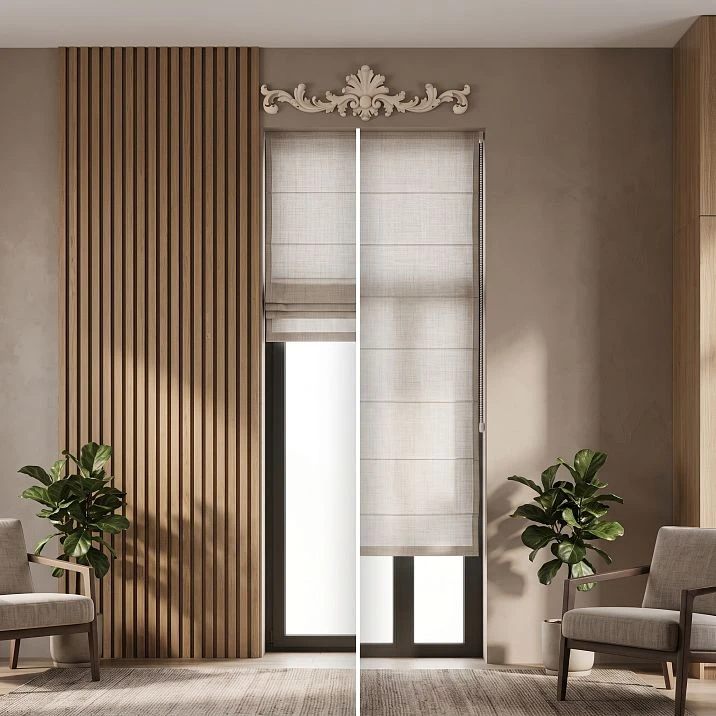
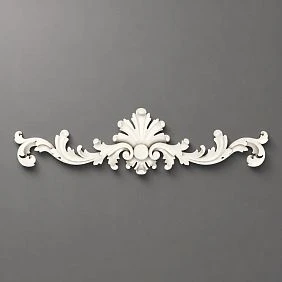
Short answer: the NPU-125 can give the window an upper accent if it remains wall decor and does not become part of the Roman shade mechanism
A narrow window already fulfills its function: the Roman shade covers the light opening, rises, lowers, and requires access for maintenance. The slat panels nearby create their own vertical rhythm. Therefore, the task of the NPU-125 here is very limited — to add one small permanent decorative accent above the window without turning the opening into a classic portal and without interfering with the operation of the fabric.
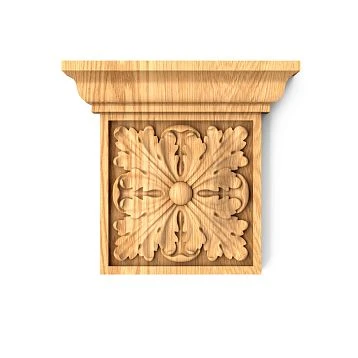
For the article, a specific version of the NPU-125, 300 × 78 × 10 mm, is considered. At the time of verification, the official STAVROS indicates a price of 1,590 ₽ per piece for it; the material is polyurethane. The same card also has a smaller version, 250 × 65 × 9 mm, for 1,290 ₽, but it is not the main subject of this article. The manufacturer classifies the NPU-125 as a decorative overlay, allows its use on walls and painting. In the catalog of shapes, the product is included in the "Crown" group.
The main limitation can be stated right away:
The NPU-125 is attached to a suitable section of the wall, not to the cornice, cassette, strip, or other working part of the Roman shade.
This is important even with a small relief of 10 mm. The shade may need to be:
-
removed for cleaning;
-
detached from the mountings;
-
given access to the chain or other mechanism;
-
have the fabric replaced;
-
have the fasteners tightened;
-
have the cornice or mounting strip dismantled.
If the decorative overlay covers the service access, the solution is no longer minimal: for the sake of one detail, the operation of a functional system becomes more complicated.
Therefore, before purchasing, you need to perform five checks:
-
determine the actual upper limit of the Roman shade mechanism;
-
determine how the shade is removed and in which direction access to the fasteners is required;
-
find a free area on the wall for the front layout of 300 × 78 mm;
-
check the composition with adjacent slat panels;
-
compare the window with one NPU-125 and without it.
If after this the overlay looks like a precise top accent, and access to the shade remains completely independent, you can buy the carved decorative overlay NPU-125 300 × 78 × 10 mm.
If, however, you have to raise the shade, cover the fasteners, shift the window's central number, add side moldings, or "build out" the entire portal for it, it's better to stop: the original purpose of a single overlay is already lost.




NPU-125 300 × 78 × 10 mm: what is confirmed and how this accent differs from the sandrik
Our factory also produces:
NPU-125: confirmed characteristics and boundaries of this scenario
| Parameter | Confirmed value |
|---|---|
| Article number | NPU-125 |
| Type | Carved decorative overlay |
| Material | Polyurethane |
| Main version of the article | 300 × 78 × 10 mm |
| Price of this version at the time of verification | 1,590 ₽/pc. |
| Second version in the card | 250 × 65 × 9 mm, 1,290 ₽/pc. |
| Application | walls, doors, furniture, and decorative compositions |
| Painting | allowed by the manufacturer |
| Form category | "Crown" |
| Average production time for made-to-order items | 3–7 days |
Why NPU-125 is not called a sandrik in the article.
A sandrik is an independent architectural type of upper framing of an opening. In the classical system, it can have a cornice shape, projection, side supports, brackets, and connection with architraves.
NPU-125 is a decorative overlay. In a specific interior, it can be placed above a window to achieve the visual effect of a small "upper sign," but the type of product does not change based on the place of application.
This distinction protects the buyer from incorrect configuration.
If you say:
"let's install a sandrik,"
it's easy to start adding:
-
side trims;
-
pilasters;
-
moldings;
-
brackets;
-
a full upper architecture.
But the original task is completely different:
one NPU-125 above an already finished Roman shade, without a full window portal.
The frontal dimension of 300 × 78 mm must be checked in the card's orientation, not by assigning axes in the order of the digits.
The card shows the size as A × B × C. Without a separate technical breakdown, one cannot pretend that the notation itself automatically proves which letter is the horizontal in any mounting variant.
Therefore, in calculations it is safer to use the wording:
the frontal dimension of the selected version is 300 × 78 mm; the relief is 10 mm.
For the mock-up, the NPU-125 must be oriented as the product is shown in the manufacturer's drawing and 3D model.
If in this standard "crown" orientation the 300-millimeter side runs horizontally, it is this side that is matched with the axis and width of the specific window. Before ordering, this can be easily checked against the product image and the paper template.
The price of 1,590 ₽ makes a trial purchase possible, but does not cancel the mockup.
One NPU-125 costs significantly less than a full window portal, but the point of the article is not that you can "try it and then redo it."
A finished wall next to the rails already requires:
-
marking;
-
installation;
-
painting or another finish;
-
possible surface restoration upon dismantling.
Therefore, even for a single part, it is wiser to first spend time on a template.
Get Consultation
Functional zone of a Roman shade: maintenance, raised fabric, and window opening
The Roman shade mechanism is the first boundary: the decorative zone begins only where the functional one ends
Roman shades are installed in different ways. In one project, the system is mounted above the opening on the wall, in another — inside the reveal, on the sash, ceiling, or a separate cornice. Therefore, a universal distance from the NPU-125 to the fabric cannot be assigned.
Need to investigate the specific mechanism.
What to measure.
Fix:
-
the top point of the cornice/cassette/mounting plate, if present;
-
the system's protrusion from the wall;
-
the location of mounting brackets;
-
the direction of removing the cornice;
-
the travel of the chain or cord;
-
the position of the fabric when fully raised.
Why a raised curtain is more important than a lowered one.
When lowered, there may seem to be a lot of free space above the fabric.
After lifting, the folds gather in the upper zone and visually increase the volume under the overlay.
Therefore, the NPU-125 should be mocked up in at least two states:
-
the curtain is fully lowered;
-
the curtain is fully raised.
If a specific system has an intermediate position that is used most often, it is useful to check that as well.
The decor should not cover the fasteners.
Even if the overlay visually "sits nicely" directly above the cornice, leave the ability to service it without dismantling the molding.
There is no need to invent universal 20, 30, or 50 mm.
For one system, the bracket is removed upward, for another — forward, for a third, access is needed from the side.
The correct offset equals the real service zone of the specific curtain plus compositional breathing room, not a number from abstract advice.
Full-size fitting: template, window axis, narrow opening, and upper spandrel
Paper template 300 × 78 mm: how to see the real scale before ordering
For NPU-125, full-size fitting is especially useful because a narrow window is easily deceived by a catalog photo.
Make not just a rectangle.
The first stage is a sheet or painter's tape 300 × 78 mm.
But a rectangle shows only the overall dimensions.
After that, it is advisable to print or schematically cut out the silhouette of the "crown" to see:
-
the voids of the ornament;
-
the rise of the central part;
-
the extreme decorative zones.
Check 10 mm of volume.
Flat paper does not show a shadow.
Place foam board or spacer pieces about 10 mm thick under the template.
This will make it visible:
-
how far the overlay extends from the wall;
-
how it looks next to a flat Roman shade;
-
whether the shadow begins to visually "hover" over the mechanism.
Look from three points.
Not only directly opposite the window.
Check:
-
the entrance to the room;
-
the main area where a person sits or passes through;
-
a close look near the window.
If the NPU-125 is only readable up close, on a large wall it may be too small.
If it immediately draws attention away from the window and the slats cease to be the main architectural rhythm, the accent is, on the contrary, too strong in contrast or placement.
The window axis matters more than the edge of the slats: where to center one NPU-125
If there are already slat panels near the window, the eye receives two geometries:
-
the vertical grid of slats;
-
the rectangle of the window opening.
The NPU-125 works best when it is clear which of them it belongs to.
In the scenario under consideration, the answer is simple: the overlay belongs to the window and the Roman shade, not to the slat panel.
The center is first searched for in the window area.
Not necessarily by the double-glazed unit.
In different interiors, the visual window area can be determined by:
-
the outer edge of the slopes;
-
the presence of an inner casing;
-
the width of the Roman shade;
-
a separate smooth panel around the opening.
You need to choose one stable axis that a person actually perceives as the center of the window.
Why you shouldn't center the NPU-125 along the remaining smooth wall section.
Suppose the slats come close to the right side of the window, and on the left there is more smooth field.
If the overlay is placed in the center of the remaining free wall, it can noticeably deviate from the window axis.
Then visually it will look like:
-
the curtain — in one center;
-
NPU-125 — in another;
-
the slats — in a third.
For one small detail, this is too complex a system.
Asymmetry is acceptable if it relates to the architecture itself.
Sometimes the window is indeed offset relative to the wall.
Then there is no need to "correct" it with a decorative overlay.
NPU-125 can remain aligned with the window opening axis, even if the entire wall composition is asymmetric.
This often looks more natural than trying to center a small ornament on the middle of the wall.
Slat panels near the window: texture boundary, transition to relief, and backlighting
Slat panels approach the window from one side: how not to turn NPU-125 into a random bridge between two styles
Slats are active on their own.
They create:
-
shadow;
-
vertical;
-
a wooden or painted texture;
-
Repetition.
NPU-125 adds a carved classical motif.
If the window is right on the border of two finishes, the overlay can either tie them together or emphasize the conflict.
A strong scenario is NPU-125 remaining on a smooth field.
The slats end on the side.
Above the window there is a calm painted wall.
Then the role of the elements is read clearly:
-
slats — architectural background on the side;
-
Roman shade — functional textile;
-
NPU-125 — local upper decor.
A riskier scenario — the slats extend directly above the window.
If the top of the opening is also occupied by the slat relief, the overlay may not have a stable flat base.
Two different questions arise:
-
how it looks;
-
where and how to attach it.
It cannot be assumed that lightweight polyurethane automatically allows gluing NPU-125 across deep battens.
Need to check:
-
how much surface actually contacts the back side;
-
where the protrusions are;
-
whether part of the pad is not "hanging" over the recesses;
-
whether the center of the window can be preserved.
Do not cut out battens for a single pad after finished repairs without necessity.
If the batten part is already installed and looks good, creating a separate niche of 300 × 78 mm just for NPU-125 may be a disproportionately complex intervention.
In that case, it's better to:
-
find a smooth area above;
-
refuse the overlay;
-
choose a different local decor in the adjacent field.
If the panels themselves are still being selected.
It is useful to plan the window area in advance and only then buy slat panels for walls for interior finishing.
This way, the batten border won't need to be adjusted after the Roman shade and NPU-125 appear.
A narrow window and the frontal dimension of NPU-125: when 300 mm gives the right "crown," and when it looks wider than the opening itself
This article deliberately does not turn into a choice between 250 and 300 mm. The main product scenario is 300 × 78 × 10 mm.
But the 300-millimeter overlay still needs to be correlated with the window.
If the window is visually significantly wider than 300 mm.
NPU-125 works as a compact central sign.
This is the basic idea.
It does not try to cover the entire opening and therefore does not become a sandrik.
If the window is close in width to the frontal dimension of the overlay.
The accent becomes more architectural.
The edges of the NPU-125 can almost coincide with the perceived edges of the window.
Then it is especially important that:
-
the central axis coincides;
-
the ornament does not look like an accidentally short top trim;
-
there remains an independent service zone between the overlay and the Roman shade.
If the overlay is visually wider than the narrow window.
This is not automatically prohibited.
In classic style, the top decor can extend beyond the conventional width of the opening.
But without side casings, such an extension should look intentional.
Check the layout.
If you get the feeling:
"there's a top, but for some reason no sides,"
NPU-125 starts to imitate an unfinished portal.
Then it's better to abandon this size or the top ornament altogether.
Do not calculate the "ideal proportion" using a made-up coefficient.
There is no universal rule that the overlap should be:
-
1/3 of the window width;
-
40%;
-
100 mm narrower than the curtain.
In this task, real visual boundaries apply.
Distance from NPU-125 to the Roman shade: why a universal number does not exist
The temptation to give a ready-made number is very strong:
"leave 50 mm."
But such a recommendation may be technically incorrect.
Service clearance.
The first layer of distance is determined by how the mechanism is mounted.
Visual gap.
The second layer is needed so that the NPU-125 doesn't look glued to the curtain rod.
Light gap.
If there is light from above or from the side, a small distance can merge the shadow of the overlay with the shadow of the mechanism into one heavy spot.
What to do instead of a universal number.
On a paper mockup, make three positions:
-
closer to the curtain;
-
medium;
-
above.
For each:
-
raise the curtain;
-
lower it;
-
try to remove or open access to the mounting;
-
look from the main point of the room.
Choose the lowest position that maintains technical access and doesn't look cramped.
This is more practical than any pre-planned number.
Ceiling, cornice, and upper spandrel: when the NPU-125 physically fits but becomes compositionally redundant
For narrow windows, the upper field is often small.
Especially if:
-
ceiling 2.5–2.7 m;
-
window is high;
-
Roman shade is mounted above the opening;
-
There is already a ceiling cornice around the perimeter.
Three objects in a short vertical line.
From bottom to top, there may be:
-
Roman shade mechanism;
-
NPU-125;
-
Ceiling cornice.
If the distances between them are close, the top of the wall turns into a dense strip of reliefs.
The overlay should not be "pinched" between the shade and the cornice.
Even a frontal height of about 78 mm can be visually noticeable on a small wall section.
Add to this 10 mm of relief and a shadow.
When it is better to refuse.
If, after complying with service access, the NPU-125 does not have its own calm space up to the ceiling decor.
In that case, 0 NPU-125 is stronger than trying to fill the last free centimeters.
When there is no ceiling cornice.
Then the overlay has more freedom.
It can become the only classic element of the upper zone.
But you need to check whether it looks stylistically isolated against a fully modern interior.
One overlay without a portal: how to preserve the local character of the decor
One NPU-125 instead of a portal: where the minimal accent ends and an unfinished classic system begins
The main idea of this article is not saving at any cost, but a different scale of architectural intervention.
A full window portal organizes the entire opening:
-
the top;
-
side parts;
-
sometimes low;
-
connection with slopes;
-
sometimes a separate cornice element.
One NPU-125 does only one thing:
creates a local upper accent.
When this minimalism is convincing.
If the interior already mixes modern and classical language.
For example:
-
modern Roman shade;
-
calm smooth wall;
-
slats;
-
one small carved detail.
Then NPU-125 is read not as an "unfinished portal," but as a decorative sign above the window.
When there is a feeling of missing side panels.
The risk is higher if:
-
the window already has classic slopes;
-
there are heavy moldings nearby;
-
NPU-125 is painted in a contrasting color;
-
its width is almost equal to the width of the opening;
-
the composition is very symmetrical and formal.
Then the eye may expect a continuation:
-
down;
-
on the sides;
-
in the form of architraves.
If after the layout there is a desire to "add at least one more element on each side," the original concept is already changing.
Control question.
Look at the option with one NPU-125 and ask:
does it look like a finished standalone ornament?
If yes, the task is solved.
If not and you want to extend the framing, it's better to decide right away whether the interior needs a full portal, rather than buying one overlay as an intermediate step.
Why you shouldn't automatically add two side overlays next to a Roman shade
After installing the top "crown," there is often a desire to balance it with side decor.
This is a weak automatic response.
Side elements change the type of composition.
One NPU-125 is a local sign.
Three trims around the window already create a semblance of a frame system.
New requirements begin to be imposed on them:
-
identical axes;
-
symmetry;
-
distances to slopes;
-
connection with the windowsill;
-
relations with slats.
Slat panels already provide a lateral vertical rhythm.
If one side of the window adjoins slats, additional side trims may create competition:
-
slats — vertical;
-
Side decor — another vertical;
-
The curtain is its own rectangle.
One element is easier to leave secondary.
This is especially important on a narrow window.
A small opening gets overloaded with ornament faster than a large panoramic window.
Commercial conclusion.
There is no need to add extra details to NPU-125 just for the sake of a "complete set."
First, one overlay is checked.
If that is not enough, the task is revised entirely.
Color, light, and textiles: how not to make NPU-125 louder than the window itself
NPU-125 color: matching the wall, slats, Roman shade, or as a separate contrast
Color determines visual loudness more than a small 10 mm relief.
In the color of the wall.
The calmest scenario.
NPU-125 reads:
-
through shadow;
-
through shape;
-
under side lighting.
This option is especially useful if the slats are already contrasting or have an active wood texture.
Plus — the overlay resembles a separate "emblem" less.
In the color of the slats.
A connection is possible between the classic ornament and the slatted part.
But one should not imitate wood texture on polyurethane just for the sake of literal matching.
It is enough:
-
of a close tone;
-
of the overall temperature;
-
of similar saturation.
To match the color of the Roman shade fabric.
The solution is riskier.
The curtain is replaceable textile.
In a few years, the fabric may change, but the NPU-125 will remain.
Therefore, rigidly tying the overlay color to the current fabric reduces the interior's flexibility.
Contrast NPU-125.
White on a dark wall, black on a light one, metallic — a strong option.
For a narrow window, it quickly becomes the main object.
This only makes sense if:
-
the window itself should be the accent;
-
the slats are calm;
-
the curtain mechanism is visually clean;
-
there are no other contrasting details nearby.
Why the "golden crown" is especially dangerous.
The "Crown" shape already has a classic association.
Metallic enhances its literalness.
In a modern interior with slats, this can create a theatrical effect that wasn't in the original task.
Therefore, metallic is only tested after a calm monochrome mockup.
Light and 10 mm relief: a small overlay can look more prominent than it seems on the card.
In a frontal photo, 10 mm appears as a shallow depth.
On the wall, light creates a shadow.
Top light.
If the ceiling light is in front of the window, the shadow forms under the ornament.
The central part of the 'crown' becomes more voluminous.
Side light.
If the window is near the slats and there is a side sconce or track, the shadow can become asymmetrical.
This is not necessarily bad: the relief comes alive.
But on a narrow wall, an asymmetric shadow can visually shift the overlay relative to the window axis.
Natural light from the window itself.
During the day, light comes from below/in front relative to the overlay.
The shape may read weaker than in the evening.
Therefore, one daytime mockup is insufficient.
Check at least two modes.
-
daytime;
-
evening.
If the NPU-125 looks delicate during the day but turns into the main heavy ornament at night, it's better to change the color or position before installation.
When the slat panels come close to one side of the window
This is one of the most interesting scenarios in the article.
Suppose:
-
to the left of the window there is a smooth wall;
-
to the right the slats start immediately.
Then the window is already visually asymmetrical.
The overlay does not need to be automatically shifted away from the slats.
If NPU-125 relates to the window, its center is kept along the window axis.
Otherwise, there is a feeling that the decor is "afraid" of the slats.
But you need to check the free space of the extreme points of the ornament.
If one edge of NPU-125 almost touches the slat surface, two effects are possible:
-
neat connection;
-
random touch of two reliefs.
Random touch is weaker than a clean break.
If the edge of the crown almost reaches the rail but has no meaningful joint with it, it is better:
-
reduce decorative activity;
-
change the position;
-
choose another option.
Cannot assign a universal offset from the battens.
Battens can be:
-
wide;
-
narrow;
-
deep;
-
flat;
-
contrasting;
-
monochrome.
Therefore, work is done based on the actual layout.
What to do if the NPU-125 in the center of the window overlaps the batten section
This is already a borderline case.
Option 1. Leave the overlay only on the smooth wall, but shift it.
More often weak.
Because the connection with the window is lost.
Option 2. Partially bring the NPU-125 onto the rails.
Requires separate verification of the base.
If the back surface of the overlay does not get even contact, installation becomes more complicated.
Option 3. Choose a smaller element or a different motif.
Here it may make sense to move to the category of decorative overlays of the "Crown" shape and compare other options.
Option 4. Decline.
Sometimes the asymmetry of the window and the slats is already expressive enough.
Then one additional "crown" only complicates the assembly.
Window opening and Roman shade: NPU-125 should not interfere not only with the fabric but also with the sash.
Even if the Roman shade is mounted above the opening, the window remains functional.
What to check.
-
whether the sash opens fully;
-
whether the handle does not hit anything;
-
whether access to the top of the frame is required;
-
whether the curtain can be removed together with the mounting plate;
-
whether the top zone is used for ventilation/maintenance.
The tilt mode is especially important.
On some windows, the top of the sash goes into the room.
If the decorative trim is positioned too low and protrudes by 10 mm, it must not fall into the trajectory.
Simple check.
Before installation, place the volume template and:
-
fully open the window;
-
switch the sash to available modes;
-
raise the curtain;
-
remove it as is done during maintenance.
If at least one action requires removing the template, the location is chosen incorrectly.
Roman shade maintenance: minimal decor should remain independent of the textile
A Roman shade is chosen partly because it is compact.
But compactness does not mean no maintenance.
Over time, the following may be needed:
-
remove the fabric;
-
clean;
-
replace the chain;
-
tighten the mounting;
-
replace the mechanism;
-
change the fabric.
NPU-125 must "survive" the curtain replacement.
A strong composition remains logical even if:
-
the fabric has become lighter;
-
the curtain has become denser;
-
the cornice was replaced with a similar system.
If the overlay depends on the specific model of the cornice.
For example, it sits flush along the top contour.
Then when replacing the mechanism, the new one may not fit.
Independent wall decor is more flexible.
The meaning of NPU-125 is architectural.
The meaning of a Roman shade is functional and textile.
The less they physically depend on each other, the longer the interior lasts.
Installation of NPU-125: wall base and selection of adhesive system
Installation on a finished wall: "suitable for walls" does not mean one adhesive for any base
The NPU-125 card confirms wall application, but the actual wall above the window may be finished differently:
-
paint;
-
decorative plaster;
-
MDF panel;
-
drywall with finish;
-
wallpaper;
-
other covering.
The mounting compound is chosen not only for polyurethane, but also for the base.
Painted wall.
You need to make sure that the paint itself holds firmly.
Strong glue does not save a weak finish: if the coating peels off from the base, the overlay can go with it.
Wallpaper.
A polyurethane part is usually not advisable to consider securely attached just because the glue sticks to the front surface of the wallpaper.
You need to determine in advance the technology of the specific installation and the possibility of preparing the base.
Decorative plaster.
If the texture is deep, the back side of the NPU-125 gets less uniform contact.
The panel next to the rails.
If the smooth window area is made as a separate furniture/wall panel, you need to check:
-
material;
-
finish;
-
rigidity;
-
the possibility of dismantling this panel in the future.
Don't turn the choice of glue into an automatic purchase.
On the NPU-125 card, the related products currently list KUDO HIGH TACK 280 ml, and on the separate card for this glue, STAVROS shows a price of 990 ₽ at the time of checking.
This is a useful reference, but not proof of universal compatibility with any wall finish.
First, the base is checked, then you can buy materials for installing moldings.
KUDO HIGH TACK as a related product: when a specific glue is actually needed in the cart
STAVROS lists KUDO HIGH TACK in the related products block of the NPU-125 card. The separate card describes it as an adhesive for construction and decorative elements.
This makes a link to a specific product logical, but it needs to be used correctly.
What to check before purchasing.
-
wall type;
-
surface preparation;
-
NPU-125 finish;
-
painting requirements;
-
application conditions;
-
the ability to temporarily fix the overlay before it sets.
Why one NPU-125 does not require a calculation of "16 linear meters."
The KUDO card reports consumption of up to 16 linear meters in one line, but NPU-125 is a local overlay, not a linear molding.
Therefore, transferring the consumption of linear installation to a single carved part as an exact standard is not possible.
When to buy KUDO together with NPU-125.
If, after checking the base, this particular mounting compound is selected and the technology matches the object, it is possible Buy KUDO High Tack adhesive.
If the base is non-standard, first you need to select a mounting system, rather than adding adhesive based on the principle 'it is shown next to the product'.
A Roman shade is attached to the wall above the window: the most complex option for NPU-125
If the Roman shade's cornice is already mounted on the wall directly above the opening, it occupies the same vertical zone where you want to add an overlay.
First, measure the actual envelope of the shade.
Not just the cornice body.
The envelope includes:
-
fasteners;
-
a protrusion;
-
the removal zone;
-
the folds of the raised fabric;
-
the chain/control, if it runs nearby.
NPU-125 must be located above this envelope.
And at the same time have its own visual field.
If after this it almost touches the ceiling cornice, the solution loses its meaning.
What the mockup can show.
Three possible outcomes:
-
the overlay gets a clean zone and looks natural;
-
the overlay technically fits, but is visually cramped;
-
there is not enough space even for safe curtain maintenance.
The second outcome cannot automatically be considered "suitable."
Compositional tightness is a real reason to refuse the purchase.
Roman blind installed inside the opening: why NPU-125 gets more freedom, but the sash check does not disappear
If the mechanism is inside the slope or directly on the frame, a clean wall may remain above the opening.
For NPU-125, this is a more favorable scenario.
Pros.
-
less competition with the cornice;
-
visually easier to connect the overlay with the window axis;
-
easier to leave an air gap.
But the window still opens.
Need to check the sash.
Especially if:
-
it is tall;
-
a folding mode is used;
-
NPU-125 is planned very low above the upper slope.
Do not press the overlay against the slope for the sake of "architecturality".
If NPU-125 touches the top line of the opening almost without air, it starts to look like a fragment of a casing/sandric.
This may bring back an unwanted feeling of an unfinished portal.
If the Roman shade covers only the glass: NPU-125 refers to the wall, not the fabric size.
When mounted on the sash, the shade may be noticeably narrower than the window opening.
Then NPU-125 cannot be centered only on the fabric.
Three possible axes.
-
glass axis;
-
sash axis;
-
axis of the entire opening.
For a wall-mounted overlay, the architectural axis of the window is often more important than the width of the textile panel.
Why this needs to be seen in the mockup.
If the window consists of multiple sashes, a small Roman shade may be offset relative to the entire opening.
NPU-125 above it, centered only on the fabric, will look like decor for a specific panel rather than the entire window.
This is acceptable only if that is the intended design.
Width of the smooth field above the window: the overlay needs its own background, not just physical space.
Even if the front dimension of 300 × 78 mm fits between:
-
the rails;
-
a corner;
-
the cabinet,
this is not enough.
The field around the ornament helps to read the shape.
The carved "crown" has:
-
a central rise;
-
side endings;
-
voids.
If its edge almost touches another texture, part of the form is visually lost.
Too large a field also changes the decision.
On a huge wall, a small NPU-125 may look random.
Then the question arises: is this product needed at all as an independent accent, or does the wall require a different scale of composition.
Do not solve the problem with a large number of NPU-125.
If one overlay seems small, it does not mean that above the window you need:
-
three;
-
five;
-
repeat along the rails.
The original task is one top accent.
If the size does not match the architecture, it is better to choose another element.
The "Crown" shape and Roman shade: why literal classics can work in neoclassicism but conflict with minimalism
The STAVROS filter classifies NPU-125 as the "Crown" shape.
This does not mean a literal heraldic crown, but the product's plasticity has a classic top character.
Neoclassicism.
The most natural scenario.
The Roman shade gives a modern
Not the theoretical fold height, but the actual one:
-
fully raise the shade;
-
measure the upper occupied zone;
-
mark it on the wall;
-
Place the NPU-125 on top of this scheme.
What can happen.
-
The overlay remains separate;
-
The folds almost touch visually;
-
The top of the window becomes too heavy.
Do not raise the NPU-125 indefinitely.
If the overlay has to be moved higher and higher for the folds, it may lose its connection with the window.
Then it is better to abandon it than to get a "crown" floating under the ceiling.
Adjacent objects around the window: light fixtures, furniture, and the lower part of the composition
Sconces, sensors, air conditioners, and other objects above the window: the decorative field may already be occupied
Above the narrow window is sometimes located:
-
wall sconce;
-
sensor;
-
control unit;
-
ventilation grille;
-
indoor air conditioner unit nearby;
-
ceiling curtain;
-
Cornice.
Functional objects have priority.
NPU-125 must not:
-
obstruct access;
-
cover the grille;
-
hinder maintenance;
-
reduce the useful space around the equipment.
The lamp can be a decorative competitor.
Even if the sconce is not technically in the way, it already creates an upper accent.
Adding a "crown" gives two centers.
Control shot.
Take a photo of the entire wall.
If the eye already sees first:
-
slats;
-
a window;
-
sconce,
NPU-125 becomes the fourth active object.
This is a good moment to stop.
The windowsill and furniture under the window also affect the upper decor.
It seems that the NPU-125 is located high up, and the furniture below is not related to it.
But the eye perceives the entire window unit as a whole.
Tall radiator cover.
Adds another decorative grid.
Slats + cover + carved overlay can create too many repetitions.
Table under the window.
Forms a strong horizontal line.
The NPU-125 can support the central axis if the table is also centered.
Low console.
Almost architecturally connects the window into a vertical block.
In that case, one top overlay can look especially logical.
Asymmetric furniture.
If a tall cabinet is nearby, the center of the window visually shifts.
NPU-125 is better checked not on an empty wall, but after placing furniture.
Curtains with patterns, piping, and contrasting fabric: the more active the textile, the quieter the top molding should be.
A Roman shade can be:
-
solid-colored;
-
with geometric patterns;
-
with floral patterns;
-
with contrasting piping;
-
with decorative trim.
Solid fabric.
The simplest background.
NPU-125 can get a bit more expressiveness.
Geometric pattern.
Already generating graphics.
It's better to work carefully with a carved "crown."
Floral ornament.
This is another decorative language.
A carved floral/classical motif on top may cause redundancy.
Contrasting edge.
Highlights the window rectangle.
NPU-125 is better not to make equally contrasting automatically.
Practical conclusion.
The mockup should be viewed with the real fabric, not with a temporary white placeholder.
What happens if a Roman shade is later changed to a roller shade or blinds
Wall decor lasts longer than textiles.
Therefore, a strong solution should outlast a system change.
Roller shade.
It may have a different top box.
If the NPU-125 is too close to an existing cornice, the new box won't fit.
Blinds.
The top mechanism may be taller or bulkier.
Complete removal of the shade.
The window will remain with one overlay.
Need to check if it still looks logical.
Therefore, the independent position is stronger.
If the NPU-125 has its own field on the wall and is not visually 'attached' to a specific mechanism, future changes are easier.
Slat wall with backlighting near the window: when the NPU-125 should remain almost monochrome
The illuminated slats already create:
-
light strips;
-
deep shadows;
-
evening accent.
The NPU-125 with contrasting coloring may become a competing object.
Side light from the slats.
If the LED is at the boundary of the panels, light can fall on the carved trim from the side.
10 mm of relief will get a noticeable shadow.
This can be a plus.
The monochrome NPU-125 comes alive without a separate color.
And a minus.
If the edge of the ornament is very close to the light line, the shadow becomes sharp and visually connects two objects that should be independent.
Check.
In the evening, turn off the general light and leave only the slat backlighting.
If the NPU-125 turns into an unintentionally dramatic element, change:
-
distance;
-
color;
-
position;
-
or abandon it.
When to abandon NPU-125: limitations and errors before installation
When it's better not to buy NPU-125: ten reasons to leave the window without the top overlay
1. The Roman shade almost touches the ceiling.
After saving the service zone for NPU-125, no own field remains.
2. There is a ceiling cornice and the top of the partition is already overloaded.
Three reliefs in a short vertical create crampedness.
3. The overlay covers the curtain attachment.
Function is more important than decor.
4. The window opens into the NPU-125 zone.
Even rare contact is a poor installation scenario.
5. 300 × 78 mm extend onto deep slats.
If there is no stable base, there is no need to solve the compositional task with complex installation.
6. The slat panel is already the main accent of the wall.
An additional "crown" does not add independent value.
7. The curtain itself is decorative.
The pattern, edging, texture, and complex color already create a sufficient top node.
8. There is a sconce or another strong object above the window.
NPU-125 becomes the third center.
9. The interior is strictly minimalist.
The carved shape looks like a random quote.
10. The version without NPU-125 looks better.
That is a sufficient argument.
You don't need to buy a part just because it's relatively inexpensive and physically fits.
Mistakes before buying NPU-125: why they occur and how to check the unit without redoing the wall
Mistake: measuring only the window and not measuring the curtain mechanism.
Why it occurs: it seems that the decor relates to the opening.
Consequence: NPU-125 ends up in the curtain rod's service zone.
Check: mark out not only the window, but also the actual envelope of the raised curtain.
Solution: first the functional zone, then the decorative one.
Error: center the overlay on the free wall, not on the window.
Why it occurs: the slats make the smooth part asymmetrical.
Consequence: the "crown" visually moves away from the Roman shade.
Check: draw the central axis of the window zone.
Solution: attach NPU-125 to the window.
Error: glue NPU-125 directly to the cornice of a Roman shade.
Why it occurs: want to reduce the empty gap.
Consequence: the decor becomes part of the removable mechanism, complicating maintenance and replacement.
Check: try to remove the shade with a volumetric mockup in place.
Solution: attach the overlay only to a verified wall base.
Error: consider 10 mm as "almost flat."
Why it occurs: the depth is small.
Consequence: in side light, the shadow unexpectedly enhances the decor.
Check: volumetric template in the evening.
Solution: adjust the color or position.
Error: placing the overlay directly on the deep slatted relief.
Why it occurs: it seems that polyurethane is light.
Consequence: insufficient contact area and visually fragmented background.
Check: apply the back plane to the actual slat profile.
Solution: smooth base or another scenario.
Error: automatically buying side elements.
Why it occurs: the top decor is perceived as the start of the portal.
Consequence: a minimal accent turns into a complex framing.
Check: look at the layout for a week with only one NPU-125.
Solution: add elements only under a new separate task.
Error: choose color based on a catalog photo.
Why it occurs: white polyurethane seems neutral.
Consequence: on a specific wall it is too contrasting or cold.
Check: paint sample next to the slats and fabric.
Solution: assert on the object.
Error: do not account for future replacement of the Roman shade.
Why it occurs: the current mechanism seems permanent.
Consequence: the new cornice does not fit under the overlay.
Check: leave an independent zone.
Solution: do not tie the NPU-125 to the exact contour of the cornice.
From mockup to purchase: decision table, algorithm, and five different scenarios
Decision table: one NPU-125 300 × 78 × 10 mm or zero
| Condition | What it shows | Solution |
| There is a free wall above the mechanism | the overlay gets a separate zone | continue |
| The curtain fastener is covered by an overlay | service disrupted | 0 or higher |
| Layout 300 × 78 mm remains on a smooth field | The scale fits | continue |
| Layout extends onto the slats | base/composition become complicated | another option |
| The NPU-125 axis coincides with the window zone | the connection is clear | continue |
| For a nice look, you have to shift it from the window axis | The slats affect the decor too much | reconsider |
| 10 mm doesn't interfere with the sash | Physical compatibility exists | continue |
| The raised blind visually 'bumps' into the trim | the top is overloaded | increase the field or 0 |
| The ceiling cornice is far away and does not compete | there is air | continue |
| The sconce/sensor already occupy the top | too many objects | 0 or another place |
| The monochrome NPU-125 looks complete | the local accent works | 1 pc. |
| I want to add side pieces to "complete" it | one overlay doesn't solve the problem | design the portal separately |
| Without NPU-125 the window looks cleaner | additional decor is not needed | 0 |
Practical algorithm before ordering one NPU-125
-
Record that the main scenario is NPU-125 300 × 78 × 10 mm.
-
Check the current price of the selected version.
-
Take a photo of the entire window along with the rails and ceiling.
-
Determine the mounting type of the Roman shade.
-
Fully raise the curtain.
-
Mark the top envelope of fabric and mechanism.
-
Understand how the cornice/cassette/mounting plate is removed.
-
Check the opening of the sash.
-
Conduct a visual axis of the window area.
-
Make a template 300 × 78 mm.
-
Verify orientation against the drawing and 3D model of NPU-125.
-
Add 10 mm of volume to the mockup.
-
Place the mockup along the window axis.
-
Check the edges relative to the slat panels.
-
Turn on evening light and backlighting of the slats, if available.
-
Compare NPU-125 in the color of the wall and a more contrasting option.
-
Check the window with the curtain lowered and raised.
-
Perform service removal/access to the curtain with the mock-up.
-
Compare the photo with NPU-125 and without it.
-
Only after this, buy 1 piece or choose 0.
Five real narrow-window scenarios and different commercial results
Scenario 1. Curtain inside the opening, above the window a clean smooth wall, slats only on the sides.
The NPU-125 has:
-
a separate base;
-
a free top field;
-
a clear axis.
Result: main scenario of the article. One NPU-125 300 × 78 × 10 mm makes sense after layout.
Scenario 2. The curtain is mounted high on the wall, with a ceiling cornice directly above.
Physically, the overlay fits, but it ends up sandwiched between two systems.
Result: 0 NPU-125. The absence of decor preserves air.
Scenario 3. The slats extend almost to the middle above the window.
In the center, NPU-125 partially falls on the deep relief.
The shift ruins the axis.
Result: do not complicate installation. Compare another smaller decor or abandon it.
Scenario 4. The window is narrow, the Roman shade is solid-colored, the interior is modern classic.
The slats are warm, the wall is light.
NPU-125 is painted in the wall color and is only visible through the shadow.
Result: 1 piece — a good local accent without a portal.
Scenario 5. Roman shade with an active botanical pattern, next to it backlit slats.
The textile and the wall already provide several decorative layers.
NPU-125 makes the top of the window too thematic.
Result: 0. It's better not to turn money into another conflicting object.
What to choose if NPU-125 300 × 78 × 10 mm is not suitable
Rejecting a specific version does not mean that the window must necessarily be left without any decor at all.
But the alternative is chosen because of failure.
Too large frontal dimension.
You can check the smaller NPU-125 250 × 65 × 9 mm.
The "Crown" shape itself is not suitable.
Go to section polyurethane decorative overlays or in the filter overlays of the "Crown" shape and choose a different character of the element.
The problem is the lack of space.
A different ornament may not help.
If the curtain service area and ceiling cornice already occupy the entire top, refuse more strongly.
A full window architecture is needed.
Then the problem cannot be solved with just one overlay.
It needs to be designed separately:
-
pediment;
-
trim;
-
moldings;
-
side elements.
This is a different budget and a different user scenario.
Cart and budget of the minimal solution
The minimal scenario is good because it is easy to specify and just as easy to stop if the layout fails validation. Here, there is no need to assemble a "window kit" from several random items. First, one NPU-125 is approved, then only the truly necessary mounting components and finish. Any additional item must answer a new technical or compositional question, not appear just because there is more decor in the catalog next to the overlay.
What to buy together with NPU-125 and what not to add automatically
The basic cart for a successful scenario is very short:
1 × NPU-125 300 × 78 × 10 mm.
Next — only what is confirmed by the object.
Mounting composition.
After checking the wall.
Materials for the finish.
If the overlay is stained.
KUDO HIGH TACK.
Only if it is selected for a specific base and technology.
Which is not needed automatically.
-
side overlays;
-
a molding frame;
-
pediment;
-
pilasters;
-
second NPU-125;
-
decor on slats;
-
second glue "in reserve".
The minimal scenario remains minimal only when the cart does not start growing without a new feature.
If there are several windows: repetition, symmetry, and different installation conditions
One or several identical windows in a room: NPU-125 must work as a system if the pattern repeats
The topic discusses one narrow window, but in a real room there may be two or three.
Then the solution changes.
If the windows are identical.
One NPU-125 only above one of them may look random.
You need to understand why the decor appears exactly there:
-
this is the main window;
-
next to it is a slatted accent zone;
-
the other window belongs to another wall;
-
only here is there enough space.
If there is no reason, it is better to either repeat the technique systematically or not use it.
If the windows are of different sizes.
The same NPU-125 may look different above each one.
You don't need to automatically buy one for all windows.
The main 300-millimeter option can:
-
work well on a narrow opening;
-
get lost over the wide one;
-
conflict with another curtain.
If the Roman shades are different.
For example, one window has internal mounting, another — wall-mounted.
Service zones differ.
Even the same decorative logic must undergo a technical check separately.
Commercial conclusion.
In the article, the base result remains 1 × NPU-125 for the verified node.
You can replicate the solution to other windows only after a re-fit.
Two windows side by side and one slat zone between them: why NPU-125 should not create false symmetry
A special case — two narrow windows.
Slats are located between them or on one side.
Two identical "crowns".
Can create strong classical symmetry.
This is appropriate if:
-
the windows are truly equal;
-
the roman shades are identical;
-
the distances to the ceiling match;
-
the interior supports the rhythm.
One NPU-125 above one window.
May be stronger if only one window is part of an accent composition with slats.
Do not align the overlays with each other at the cost of losing the window axis.
If the windows are at different heights or the piers differ, attempting to place the NPU-125 on one horizontal line may shift them relative to the openings.
First, local alignment with each window, then the overall view of the wall.
Operation and future interior changes
Cleaning and dust: the 10-millimeter relief above the textile must remain accessible
The carved overlay has more recesses than a smooth painted wall.
Over time, dust accumulates on the upper edges.
Why the space above a Roman shade requires attention.
The textile is located directly below.
With careless dry cleaning, dust may fall onto the fabric.
Do not place NPU-125 where it is impossible to reach.
If from above:
-
deep ceiling cornice;
-
very narrow gap;
-
decorative niche,
Cleaning becomes more difficult.
Access to the decor is another argument for having your own free field.
The overlay must be sufficiently separated from adjacent elements to:
-
wipe the relief;
-
not touch the fabric;
-
not damage the edge of the slats.
The finish affects maintenance.
Complex textures or highly contrasting coatings may show dust more.
This is not a reason to give up NPU-125, but another parameter for choosing a color.
Radiator under the window and warm air flows: do not use NPU-125 as a functional part of the window unit.
A radiator is often located under the window.
It affects air movement and the Roman shade, but the NPU-125 is positioned significantly higher and remains wall decor.
What really needs to be checked.
Not "will the cover hold the radiator" in an abstract sense, but:
-
whether there is a separate high-temperature source nearby;
-
whether equipment runs directly behind the installation spot;
-
whether an accessible zone for maintenance is needed.
You cannot attribute functions to the NPU-125.
It does not:
-
hold the shade;
-
covers the fastener;
-
serves as a ventilation grille;
-
is the cornice.
The more precisely the functions are separated, the lower the risk of incorrect installation.
Budget of the minimal scenario: NPU-125 should not be compared with a portal without a specific specification
At the time of checking:
-
NPU-125 300 × 78 × 10 mm — 1,590 ₽;
-
KUDO HIGH TACK 280 ml — 990 ₽, if it is the one chosen for the base.
A simple sum of two product items:
1 590 + 990 = 2 580 ₽.
But this is not the price of the finished installation.
It does not automatically include:
-
wall preparation;
-
paint;
-
work;
-
delivery;
-
restoration of the coating;
-
other materials.
Why don't we compare with the 'portal price'?
A full portal can consist of completely different products.
Without a specific project, it's impossible to honestly write:
'NPU-125 is ten times cheaper than a sandrik and platbands.'
That would be fabricated savings.
What can be said for sure.
One NPU-125 is one product item with a known price.
A full portal is a different configuration.
Therefore, the commercial choice begins with the question:
is a portal as an architectural system even needed?
If not, there is no need to compare its cost with a single overlay.
When it makes sense to keep one NPU-125 even after future wall repairs
Decor is successful not only when it suits today's photograph.
It should have some autonomy.
Repainting the wall.
NPU-125 can be included in a new color scenario within an appropriate finishing technology.
Replacing slat panels.
If the overlay is on a separate smooth field and relates to the window, its compositional role can be preserved.
Changing the Roman shade.
As already discussed above, the independent position allows changing the textile.
When the solution is too rigid.
If NPU-125:
-
concerns the slats;
-
sits flush above the cornice;
-
painted exactly to match the fabric;
-
tied to a specific ceiling profile,
any future replacement destroys the entire assembly.
Conclusion.
The minimal composition should be not only small in the number of parts, but also minimally dependent on adjacent replaceable elements.
What is useful to take from general materials about molding, slat panels, and Roman shades — and what they do not solve
STAVROS already has a comprehensive article about wall molding. In it, Roman shades are mentioned as textiles that pair well with restrained neoclassicism.
There are separate materials on combining slat panels and polyurethane decor, which examine the general conflict between two relief systems.
There are articles about pediments above windows.
But these materials answer broader questions:
-
what types of molding to use;
-
how to combine styles;
-
how to build a full upper framing;
-
how to connect slats and polyurethane in the interior.
Here the user question is already:
Is it possible to add exactly one NPU-125 above a narrow window after installing a Roman shade without triggering the chain of “sandrik — architraves — pilasters — portal”?
After this article, a person should be able to perform specific actions:
-
measure the service zone of the shade;
-
make a template;
-
check the axis;
-
check the slats;
-
check the sash;
-
choose the color;
-
choose 1 or 0;
-
form the minimum cart.
That is why the material should not turn into yet another general overview of window moldings.
Final decision tree
Does the window need an additional upper decorative accent at all?
No → 0 NPU-125.
Yes → continue.
Is there a separate free field on the wall above the roman shade mechanism?
No → 0 or another scenario.
Yes → continue.
Can the shade be removed and serviced without dismantling the NPU-125 mockup?
No → change the location or 0.
Yes → continue.
Does the sash operate fully?
No → change the location or 0.
Yes → continue.
Does the 300 × 78 mm mockup in card orientation remain compositionally connected to the window?
No → different size/decor or 0.
Yes → continue.
Does it not fit problematically onto the slatted relief?
No → different base or 0.
Yes → continue.
Does 10 mm of volume not make the top too heavy in evening light?
No → change color/position.
Yes → continue.
Does one NPU-125 look complete without side elements?
No → design a portal separately or abandon it.
Yes → order 1 piece.
Final recommendation: one overlay should fully solve the task, otherwise the minimal scenario ceases to be minimal
NPU-125 300 × 78 × 10 mm makes sense above a Roman shade if it works as a standalone wall-mounted top accent.
A strong final node looks like this:
-
the Roman shade remains fully serviceable;
-
the window opens freely;
-
the NPU-125 is on a stable, smooth base;
-
its axis relates to the window;
-
the slat panels remain a separate adjacent system;
-
one overlay looks finished;
-
the color does not turn it into too loud a "crown";
-
the ceiling cornice and light do not pinch the top.
If all these conditions are met, 1 × NPU-125 300 × 78 × 10 mm for 1,590 ₽ is a clear commercial purchase.
If achieving a beautiful result requires adding side pieces, moving the curtain mechanism, hiding fasteners, or dealing with rails, it's better not to stretch the original idea. You need either a different overlay, a full window framing project, or 0 decorative molding above this window.
FAQ
Can NPU-125 be installed above a motorized Roman shade?
It can be considered, but you need to account not only for the mechanism housing, but also the cable, power supply, service access, and possible motor removal. The overlay must not cover the technical part. If the motor is serviced from above, the free zone may need to be larger than with a manual system.
Will NPU-125 work if the Roman shade is mounted to the ceiling?
In that case, the wall area above the window may not contain the mechanism at all, but the ceiling cornice itself and the shade removal trajectory still need to be checked. NPU-125 remains a wall-mounted piece and must not interfere with the ceiling mount or its removal.
Can NPU-125 be placed inside a deep window reveal?
That's a different scenario. You need to check the depth of the reveal, side walls, sash opening, and light and shadow. The 300 × 78 × 10 mm overlay may visually appear too large for the inner plane of the reveal. The main article covers the exterior wall above the opening.
What to do if there is a hidden cable running above the window?
Before drilling or any other mechanical intervention, the location of hidden utilities must be clarified. If installation is done only with adhesive, this does not negate the need to understand what is in the wall, especially if maintenance of the shade or electric drive is planned nearby.
Can NPU-125 be installed above a window in the kitchen?
The room itself does not prohibit such a scenario, but the specific zone must be considered: steam, grease, proximity to the cooking surface, frequency of cleaning. If the window is near an active work zone, a carved relief will require more regular maintenance than a smooth wall.
Will the NPU-125 fit above the window in the bedroom with a blackout Roman shade?
Yes, if the thick fabric in the raised position does not reduce the service field. Blackout fabric can gather more voluminously than light linen, so the layout must be checked with the actual shade, not from a photo of an empty window.
Can the NPU-125 be glued onto a painted MDF insert above the window?
The possibility depends on the MDF coating and the chosen mounting compound. The panel itself may be rigid, but adhesion is determined by the finish. Before permanent installation, a compatibility check is needed, especially if the panel is removable or has a paint or varnish coating.
Is the NPU-125 needed if the Roman shade already has a decorative valance or a rigid top bar?
More often, the risk of overload increases. Such a top detail already performs a decorative function. The NPU-125 may become a second top accent. Compare two options: only the decorative bar of the shade and the bar plus the overlay. If no new knowledge appears, it is better to remove the extra layer.
Can the NPU-125 be used above a window that almost touches the side wall?
Only after checking the asymmetry. If one edge of the overlay ends up almost at the corner, and on the other side there is a large field, centering on the window may look cramped. Shifting the NPU-125 away from the corner and losing the axis is also not always correct. A full-size template is especially useful here.
What to do if the control chain of the Roman shade runs near the NPU-125?
Check the free play of the chain in all positions. It should not catch on the relief, the edge of the overlay, or a protruding decorative element. If the chain runs along the side, it is better not to expand NPU-125 compositionally in that direction with additional details.
Can NPU-125 be installed above a Roman shade with side guides?
Yes, if the top overlay does not interfere with the guide mounts and the removal of the entire system. The side guides themselves create a more architectural contour around the window, so a single "crown" may more strongly resemble the start of a portal. This needs to be assessed visually.
Is NPU-125 suitable for a narrow bay window?
Each plane of the bay window should be considered separately. If the window is on a sloped or angled wall, the frontal view changes. NPU-125 may visually shift due to perspective. Before purchasing, it is worth making a mock-up on the specific plane, rather than transferring a decision from a regular straight window.
Can NPU-125 be positioned above the center of the window if the top edge of the slats is nearby?
Yes, if the reason for the shift is clear and the connection to the window is maintained. But if the overlay has to be raised only for alignment with the slats, and a large empty gap appears between it and the shade, it is better to check whether it has become wall decor instead of window decor.
Should NPU-125 be painted before or after installation?
This depends on the chosen finish and installation system. Some tasks are more convenient to do with pre-painting, others require touch-up after fixing. The main thing is to determine the technology in advance so as not to stain the Roman shade and not to worsen the quality of the joint with the wall.
Can NPU-125 be removed without damaging the wall after several years?
The result depends on the adhesive, the base, and the finish. Adhesive mounting is usually considered permanent, so you should not expect a residue-free removal. If the interior is planned to be changed frequently, this should be taken into account before purchase.
If the window is very narrow, can the NPU-125 be rotated vertically?
Rotation cannot be automatically considered equivalent. The "Crown" shape has a directional composition. The main scenario uses the orientation shown by the manufacturer. A vertical rotation creates a different motif and should be evaluated as a separate design decision.
Can the NPU-125 be used above a niche with a Roman shade, rather than above a real window?
If the shade covers the niche, the maintenance logic remains the same, but the architectural connection with the window disappears. Then the NPU-125 becomes a niche decoration. The axis, function, and style need to be re-checked, not just the ready-made scheme transferred.
What to do if, after installing the slats, the window visually appears even narrower?
The slats enhance the vertical and can change the perception of proportions. The NPU-125 can provide a slight horizontal top accent, but should not be used as a "width corrector" without a mockup. If the 300-mm version truly improves the balance, that is a good argument; if it looks attached from above, it is better to leave the window without it.