Article Contents:
- Short answer: CPU.VRS-059 is needed not when the smooth half of the wall seems empty, but when it truly requires an independent vertical decorative system
- CPU.VRS-059: what exactly the customer buys and what scale the finished system has
- 46,170 ₽ is the price of the system, not just the amount of polyurethane
- The set creates a separate architectural zone
- The scale should be viewed from the distance of the room
- CPU.VRS-059 set versus individual overlays: you should compare not the price of one product, but the degree of project freedom
- Where the kit is stronger
- Option A. Slat panels + smooth field without molding
- Decision table: CPU.VRS-059, individual overlays, or an empty wall
- How to make a decision if you like both CPU.VRS-059 and individual overlays
- When CPU.VRS-059 is better not to buy for this wall
- Ordering for a project: why the production time of 3–7 days does not cancel wall preparation before purchase
- Final decision tree
- Can CPU.VRS-059 be used if the smooth part of the wall is already painted?
- Do I need to pre-assemble CPU.VRS-059 entirely on the floor?
- Can I order CPU.VRS-059 and shorten it in height?
- Is CPU.VRS-059 suitable for a wall with a stretch ceiling?
- Can CPU.VRS-059 be mounted on the wall next to a window?
- What to do if the smooth part of the wall is several times wider than CPU.VRS-059?
- Can CPU.VRS-059 be placed not in the center of the smooth part?
- Is an additional molding needed around CPU.VRS-059?
- Can CPU.VRS-059 be painted after installation?
- What is better next to dark slats — white CPU.VRS-059 or one matching the wall color?
- Can CPU.VRS-059 be used on a wall with decorative plaster?
- Does CPU.VRS-059 make sense if only a small painting hangs on the smooth part?
- What to do if CPU.VRS-059 is liked, but installation after renovation seems too complicated?
- Can the kit be purchased first and then decide where to place it?
- Is a backup CPU.VRS-059 needed?
- Can only part of the CPU.VRS-059 components be used?
- Is CPU.VRS-059 suitable for a rented apartment?
- Can CPU.VRS-059 be installed on a full-wall furniture panel?
- How to know when individual overlays are turning into a more complex project than CPU.VRS-059?
- Can CPU.VRS-059 be placed next to a slat wall in a wood color?
- What matters more when choosing: the price of 46,170 ₽ or the wall size?
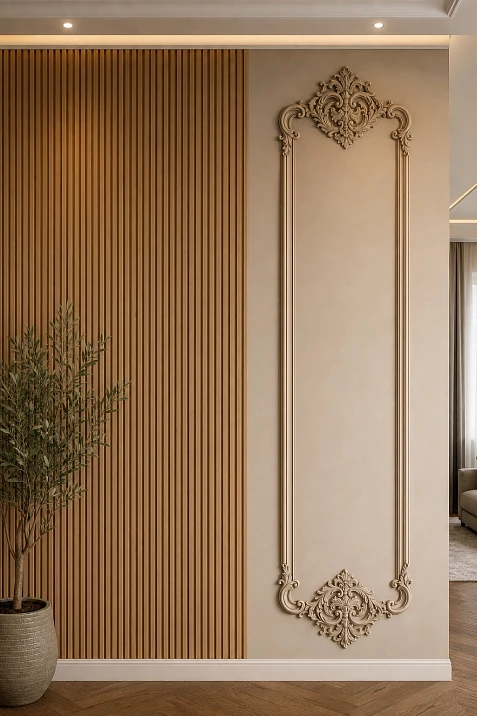
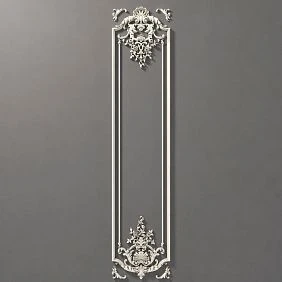
Short answer: CPU.VRS-059 is needed not when the smooth half of the wall seems empty, but when it truly requires an independent vertical decorative system
If one part of the wall is already finished with slats, the second part does not automatically have to get molding. The smooth field can be a deliberately needed pause: it separates the active vertical rhythm of the slats from furniture, light, and the rest of the interior. Therefore, the question "what to fill the empty half with?" is asked too early.
For CPU.VRS-059, the right question is different:
Does the second part of the wall need a full vertical composition with a pre-defined ornament system, or is one or two local elements — or even a clean plane — sufficient for the project?
At the time of verification, the official STAVROS indicates for CPU.VRS-059 a size of 441 × 2040 × 22 mm, polyurethane material, and a price of 46,170 ₽ per set. The product card further clarifies that the set is supplied uncut and unglued, elements with moldings come with extended shoulders for cutting to the required size, and moldings come with extra allowance. This is fundamental: the buyer receives not a monolithic panel of 441 × 2040 mm that just needs to be glued, but a set of parts with a pre-designed composition that needs to be fitted and assembled on site.
Therefore, CPU.VRS-059 should be chosen when several conditions are met simultaneously:
-
the smooth field is large enough for a composition of this scale;
-
the height and width of the selected area do not conflict with furniture, baseboards, switches, outlets, and lighting fixtures;
-
the vertical stucco system does not clash with the vertical rhythm of the slats but creates a second meaningful zone;
-
the client needs a cohesive compositional logic rather than the freedom to scatter individual overlays;
-
the installer can mark, trim, and assemble the set on site;
-
the option with CPU.VRS-059 looks better than the same smooth wall without decor.
If, after full-scale marking, the wall truly needs such a second decorative center, it is possible to buy a set of stucco decor CPU.VRS-059.
If a 2040-millimeter composition fills almost the entire free field, intersects with furniture, or turns the wall into a competition of two rhythms, it is better to switch to individual decorative elements made of polyurethane or leave the smooth part without stucco molding.




CPU.VRS-059: what exactly the customer buys and what scale the finished system has
CPU.VRS-059 is a set, not a single decorative overlay: what exactly changes for the buyer.
It is a mistake to describe CPU.VRS-059 as an "overlay 441 × 2040 mm". This is not one cast element of that size.
The STAVROS product card directly calls the item a set and warns that it is supplied uncut and unglued. For practical selection, this means four things.
The dimensions of the finished composition do not equal the size of the transport "slab".
The final system occupies the stated dimensions on the wall, but before installation it exists as a set of individual components. This means that in the project, not only the decorative result must be considered, but also:
-
marking;
-
cut;
-
joining;
-
assembly sequence;
-
work area along the wall;
-
control of overall geometry.
Allowance on moldings is part of the technology, not a size error.
If moldings come with allowance, they cannot be immediately compared to the final dimension as finished pieces. The allowance is needed for fitting.
That is why attempting to "check the set with a tape measure on each delivered part" without understanding the scheme can give a false impression that the elements are longer than they should be.
Extended element arms provide cutting freedom but require precision.
This is an important difference from buying a single fixed-size overlay.
A separate overlay is usually positioned as a ready-made local relief.
CPU.VRS-059 requires creating a complete assembly of several parts so that:
-
axes aligned;
-
molding extensions reached the design position;
-
joints did not shift;
-
the overall vertical did not "drift."
Our factory also produces:

46,170 ₽ — the price of the system, not just the amount of polyurethane
When comparing with individual overlays, it cannot be honestly said that the set is "cheaper" or "more expensive" than a custom assembly without a list of specific alternatives.
A separate composition may consist of:
-
one overlay;
-
two;
-
moldings;
-
from the central decor;
-
from several angles;
-
from a non-standard frame.
Therefore, the price of CPU.VRS-059 is known, while the price of the alternative appears only after your own specification.
It is precisely for this reason that the article compares solution principles rather than inventing fictitious savings.
Why 441 × 2040 × 22 mm cannot be assessed as the size of a small wall accent.
CPU.VRS-059 belongs to the vertical decorative group STAVROS. In the orientation shown by the manufacturer, the dimension 441 × 2040 × 22 mm forms an elongated composition almost as tall as a full human height.
This is a completely different scale than that of overlays 50–300 mm.
Get Consultation
The set creates a separate architectural zone
A small overlay can work as:
-
accent;
-
the center;
-
angle;
-
local ornament.
CPU.VRS-059 is perceived closer to a finished vertical wall system.
When slats are already installed from floor to almost ceiling, two complete systems appear on one plane:
-
linear slatted;
-
ornamental molded.
If there is no compositional hierarchy between them, the wall becomes too saturated.
22 mm affect chiaroscuro.
The depth of the system is less than its frontal scale, but with side light the relief gets its own shadow.
On adjacent slats, the shadow is already created by vertical differences.
Therefore, you need to check not only the frontal rectangle, but also the volume.
The scale should be viewed from the distance of the room
441 × 2040 mm cannot be assessed while standing 50 cm from the wall.
At least three viewing points:
-
entrance to the room;
-
main living area;
-
close passage past the wall.
Up close, the set can look very expressive. From a distance, it should still be perceived as a cohesive vertical composition, not as a collection of small details.
Full-size try-on: how to check CPU.VRS-059 on a specific smooth part of the wall
Full-size layout 441 × 2040 mm: the most useful test before ordering for 46,170 ₽.
Buying such a set from a catalog photo is risky. Its real scale is easiest to check on the wall.
Step 1. Find the actual smooth area.
Measure not the entire second half of the wall, but the real free space between:
-
the edge of the slat panels;
-
a corner;
-
a door;
-
furniture;
-
baseboard;
-
the ceiling;
-
switches;
-
with sockets;
-
the sconce.
Step 2. According to the product drawing, transfer the standard vertical orientation.
On the wall, mark the outer dimensions of 441 × 2040 mm with painter's tape in the orientation corresponding to the product card and drawing CPU.VRS-059.
The main goal of this test is to see the real scale of the composition.
Step 3. Do not consider the rectangle itself as the exact outline of the ornament.
The dimension shows the limits of the system.
Inside it, there are:
-
voids;
-
moldings;
-
ornamental details;
-
transitions.
Therefore, after the rectangle, it is useful to add a printout or a schematic silhouette of the actual design.
Step 4. Look not only at "fits / doesn't fit."
You need to answer:
-
whether there is air left around the composition;
-
whether it is pressed against the slatted part;
-
whether it looks like a narrow vertical strip on a too large smooth wall;
-
whether it takes up all the visual pause;
-
whether the furniture ends up right on the ornament.
Step 5. Add a conditional clearance of 22 mm.
For a close pass, you can use foam board or spacer pads.
This will show:
-
shadow;
-
a protrusion;
-
proximity to furniture;
-
depth relative to the rails.
A smooth field around the CPU.VRS-059 is more important than the fact that the set physically fits.
If the free zone is 500 mm wide and the front dimension of the composition is 441 mm, that does not mean the solution is successful.
Physical placement and compositional placement are different things.
Why "it fits" is not enough.
If a very narrow strip of wall remains after installation, the set starts to look cramped.
Visually, this can produce an effect:
-
of a panel that is too narrow;
-
of a randomly chosen size;
-
of decor that was 'squeezed' into the remaining wall space.
Air is needed on both sides.
There is no universal standard offset.
You don't need to invent mandatory 100, 150, or 200 mm.
The offset depends on:
-
of the total wall width;
-
of the slat section width;
-
furniture;
-
doors;
-
of the room's scale.
It is precisely the proportion of the field that is being checked.
An empty strip between the battens and the molding can be useful.
It is not necessary to place CPU.VRS-059 flush against the edge of the batten panels.
A small section of bare wall can separate:
-
the rhythm of the battens;
-
a vertical molding composition.
This way, each system gets its own zone.
Ceiling height: why 2040 mm cannot be considered separately from the baseboard, cornice, and furniture.
A vertical composition about two meters high requires checking the entire axis.
Baseboard.
If the bottom edge of the set visually collides with the baseboard, you need to understand:
-
does the composition start above;
-
should the molding visually connect with the lower architecture;
-
does an accidental narrow gap occur.
Ceiling and cornice.
In a room with a low ceiling of 2040 mm, they can occupy a very large portion of the wall.
In a tall room, the same set may, on the contrary, need meaningful vertical positioning.
Console, sofa, dresser.
If furniture covers the lower part of CPU.VRS-059, the buyer loses part of the pre-defined system.
This is a fundamental difference from individual overlays: they can only be placed in the free upper zone.
You cannot simply "raise the set higher".
The shift affects the entire composition.
Before it, you need to check:
-
distance to ceiling;
-
center of the wall;
-
the ratio with the rails;
-
the furniture level;
-
Light.
CPU.VRS-059, individual elements, or a blank wall: three different principles of solution
The CPU.VRS-059 set versus individual overlays: you should compare not the price of one product, but the degree of freedom of the project
These two approaches have different logic.
CPU.VRS-059 is chosen when the client wants to get one pre-assembled vertical composition according to the design.
Individual overlays are chosen when the following matters more:
-
adapting to a specific field;
-
go around furniture;
-
leave sockets and switches in the free zone;
-
reduce decorative density;
-
create asymmetry;
-
use only one local ornament.
Where the set is stronger
CPU.VRS-059 already has a compositional system.
The buyer does not need to decide on their own:
-
which central element to take;
-
how to connect it with moldings;
-
where to end the branch;
-
how many decorative details are needed;
-
how to assemble a visually complete vertical line.
This is especially useful if the task sounds like:
“On the smooth half of the wall, one full decorative zone is needed.”
Where individual elements are stronger.
Individual assembly wins if the wall itself dictates non-standard geometry.
For example:
-
narrow field;
-
low furniture;
-
wall sconce in the center;
-
socket;
-
a doorway;
-
asymmetric boundary of the slats.
In that case, a pre-defined system may require too many compromises.
Where an empty wall is stronger than both options.
If the slat section is already:
-
saturated;
-
dark;
-
with backlighting;
-
takes up half of the large wall,
the second smooth half may be a necessary visual pause.
Then buying any additional decor worsens the composition.
Three options for one wall: slats + empty space, slats + CPU.VRS-059, slats + individual elements.
Before ordering, it is useful to make three identical photos or collages.
Option A. Slat panels + smooth field without molding
We check whether the wall really looks unfinished.
Sometimes after furniture, lighting, and textiles, the feeling of "emptiness" disappears.
Advantages:
-
maximum visual air;
-
the slats remain the only relief;
-
less risk of style conflict;
-
easier to change furniture.
There is only one downside: if the smooth field really looks like a random leftover, it may lack a compositional center.
Option B. Slat panels + CPU.VRS-059.
A second full vertical system appears.
This option works if the wall needs a deliberate two-part composition:
-
left/right — slats;
-
next to them — a molded vertical accent.
It's important that both parts are not equally loud.
Option C. Slat panels + separate overlays.
This is an intermediate solution.
Decor appears on a smooth field, but it doesn't occupy an almost two-meter vertical.
Suitable if:
-
a small accent point is needed;
-
you want to leave more of the wall empty;
-
furniture changes the lower geometry;
-
The full CPU.VRS-059 looks too monumental.
How to choose.
Don't ask which option is "richer."
Compare:
-
which one better maintains the room's scale;
-
which one leaves more air;
-
which one conflicts less with the slats;
-
which one works better with the furniture;
-
which one is easier to maintain and replace.
How CPU.VRS-059 should interact with the slatted part of the wall
What to check between CPU.VRS-059 and the edge of the slat panels.
The boundary between two decorative systems is especially important.
If the set is placed too close to the rails, it feels like two different reliefs are trying to continue each other.
If too far, the smooth field between them may look random.
First, define the boundary of the rail zone.
It is important to understand how the panels end:
-
with a flat end;
-
with a decorative trim;
-
a corner;
-
the molding;
-
with a transition to paint.
This is an existing architectural line.
CPU.VRS-059 should not mask it.
Then determine the axis of the molding composition.
The set has its own vertical line.
It can be:
-
in the center of the smooth part;
-
tied to the furniture;
-
tied to the common axis of the wall.
Only then evaluate the gap.
Don't start with the number "let's leave 100 mm."
First axes and functions, then the actual interval.
If the border itself is decorative.
For example, the slatted part already ends with an expressive profile.
Then CPU.VRS-059 may turn out to be the third system:
-
slats;
-
transitional profile;
-
stucco panel.
In that case, a simple smooth zone may be stronger.
Furniture, electricals, doors, and other objects: what can break a finished composition
Sockets, switches, and thermostats: when CPU.VRS-059 loses to individual elements.
On large smooth fields, there is rarely a completely empty engineering zone.
It may contain:
-
sockets;
-
switches;
-
thermostat;
-
control panel;
-
sensor;
-
output for a sconce.
Why is the kit sensitive to such objects.
CPU.VRS-059 has a predefined structure.
If an engineering point falls:
-
on the molding;
-
on the ornament;
-
on the central axis,
you have to change either the position of the entire composition or the engineering element.
Individual overlays give more freedom.
They can be placed:
-
higher;
-
below;
-
on the one hand;
-
around the existing point.
But you don't need to "cut out" the set around the socket without a project.
This can destroy:
-
ornament;
-
molding connection;
-
Symmetry.
If CPU.VRS-059 cannot be placed without conflicting with engineering systems, this is a strong argument to choose a different system.
Furniture in front of the wall: the full set must work with the real, not conditionally empty, plane.
The smooth half of the wall is often intended for furniture.
This could be:
-
sofa;
-
an armchair;
-
console;
-
a dresser;
-
dining table;
-
bed;
-
TV stand.
You cannot mock up CPU.VRS-059 without furniture.
An almost two-meter composition can look perfect on an empty wall and lose its lower part after installing a dresser.
Furniture can change the visual center.
For example, a console 1200 mm wide creates a horizontal line.
CPU.VRS-059 — a narrow vertical line.
If the axes are not connected, the wall looks random.
When a set is especially appropriate.
If the furniture:
-
low;
-
calm;
-
does not cover a significant part of the composition;
-
leaves space for verticals.
When individual elements are better.
If the furniture is tall or asymmetrical.
Then you can choose local decor only for the free zone.
Lights and backlighting: 22 mm of relief can become the main object in the evening.
Slat panels often receive:
-
vertical LED backlighting;
-
wall sconce;
-
light from a ceiling track.
CPU.VRS-059 also reacts to light.
Side light enhances the molding.
With side direction, the relief becomes more noticeable.
If the slats are already illuminated.
Two light accents may appear on one wall.
This is not always bad, but hierarchy is required.
There is no need to automatically illuminate CPU.VRS-059 separately.
First, check the existing light.
Sometimes an additional spot turns a finished vertical into an overly theatrical panel.
An evening mockup is mandatory.
The 441 × 2040 mm strip on the wall must be checked at minimum:
-
in daylight;
-
under the main evening light;
-
with decorative lighting of the slats.
A ready-made compositional system does not mean ready-made installation.
Why CPU.VRS-059 should not be bought just because the kit "solves everything at once."
The full set is convenient because the composition is already defined.
But this does not mean that it is universal.
The kit solves the compositional task.
It does not automatically solve:
-
the specific wall color;
-
furniture position;
-
engineering points;
-
room scale;
-
conflict with the slats;
-
Mounting base.
Some details require more design work, but they give more freedom.
That is their advantage.
The point of a full set.
It is especially strong when:
-
the field is close in logic to the intended vertical composition;
-
the client likes this particular ornament;
-
installation can be done as a single unit.
Wrong reason.
"I don't want to pick individual elements, so we'll take the set, even if it doesn't fit properly."
This turns the convenience of choice into a problem of installation.
Uncut and unglued kit: what needs to be prepared before installation begins.
The card directly warns about the delivery condition.
This should be perceived not as a drawback, but as an installation condition.
Before unpacking, the markings should already be on the wall.
You should not start designing the composition after receiving the parts.
It is necessary to determine in advance:
-
axis;
-
the top;
-
bottom;
-
boundaries;
-
adjacent slats;
-
furniture;
-
engineering points.
Cutting requires a workspace.
Moldings and extended shoulders must be fitted.
This means that space is needed nearby for:
-
measurements;
-
marking;
-
cut;
-
dry fitting.
Do not glue the first element without checking the entire chain.
It's better to first lay out the composition:
-
on the floor;
-
on a large table;
-
on the wall in a dry fitting.
This way you can see how the pieces fit together.
The allowance cannot be destroyed in advance.
If the molding is cut too short, the allowance stops performing its function.
Correct logic is to fit sequentially from a verified base.
The overall dimension of the finished composition and the installation allowance are two different values that must not be mixed.
This is one of the main practical points of the article.
Finished overall dimension.
441 × 2040 × 22 mm is the characteristic of the assembled solution according to the card.
Installation allowance.
These are additional lengths on individual components that exist before trimming.
What follows from this.
You can't say:
"I have exactly 2040 mm along the wall, so all supplied parts must be exactly that length."
The supply is arranged differently.
Work area.
For installation, it is desirable to have the ability to:
-
attach the part;
-
mark the cut;
-
remove;
-
trim;
-
return.
If there are already installed cabinets or furniture on both sides, the process becomes more complicated.
Why this is important when compared to individual overlays.
A single overlay often does not require such a number of operations.
Therefore, CPU.VRS-059 is a more systematic solution not only visually, but also technologically.
When individual overlays are objectively better than CPU.VRS-059.
The full set loses not because it is worse as a product, but because the project may have different geometry.
A field with non-standard proportions.
If the area is smooth:
-
very wide and low;
-
narrow and tall;
-
divided by a door;
-
has a slanted section,
the elongated vertical of CPU.VRS-059 may poorly align with the architecture.
Tall furniture.
If the lower half of the wall is covered:
-
with a cabinet;
-
with a chest of drawers;
-
console;
-
with a sofa with a high back,
part of the finished composition will be constantly hidden.
Engineering points in the center.
Moving a switch or thermostat just for the sake of molding is not always reasonable.
Asymmetry is needed.
CPU.VRS-059 sets its own system. If the interior is deliberately asymmetrical, individual elements are easier to subordinate to furniture and light.
A very calm accent is needed.
One local decorative element can provide enough relief without turning the smooth part of the wall into a second accent surface.
There needs to be the ability to change the composition later.
Individual elements are easier to replace partially.
A full vertical set is more strongly tied to the overall architecture of the wall.
When CPU.VRS-059 is stronger than a self-assembly of individual parts.
There are also opposite situations.
The client wants a finished vertical system.
Not a set of disparate decorations, but a ready-made compositional idea.
The wall is really large.
Small overlays on a large free field look random.
CPU.VRS-059 immediately sets a large scale.
Furniture does not interfere.
If the smooth zone remains open almost the entire height, the vertical set opens up better.
The project leans toward classic or modern classic.
A solid stucco composition looks more natural than several random local elements.
Installation is performed by a trained specialist.
Then trimming and assembly are not a surprise.
A predictable composition is needed.
When selecting independently, there is a risk:
-
buying elements with different plasticity;
-
incorrectly connect the moldings;
-
overloading the wall;
-
get too many small centers.
CPU.VRS-059 reduces precisely compositional uncertainty.
When it is better to leave the smooth half of the wall without stucco altogether.
This option should be compared on equal terms.
The slatted part is already a strong accent.
If it occupies half the wall and has:
-
expressive wood texture;
-
contrast color;
-
lighting;
-
large vertical spacing,
the other half may be needed as a background.
Large furniture will appear on the smooth part.
A dresser, painting, TV, or mirror will create the composition on their own.
There are many other decorative elements in the room.
Cornices, moldings, textiles, lighting, and furniture already provide enough complexity.
CPU.VRS-059 has to be "explained."
If the argument sounds only like:
"an empty wall shouldn't be empty,"
this is not enough.
A layout without decor looks calmer.
This is the strongest criterion.
A free surface is not a renovation mistake.
Sometimes it is this very element that makes the neighboring slats more expressive.
Interior scenarios and durability of the solution
Three types of spaces where CPU.VRS-059 behaves differently.
A living room with one large accent wall.
If the slats occupy the TV zone and the smooth half remains free, CPU.VRS-059 can create a second focal point.
But if the TV is already large and the slats are active, the molding system can create three competing objects:
-
screen;
-
slats;
-
The ornament.
Bedroom.
A vertical composition can work well next to a soft headboard or on a free side part of the wall.
But you need to check:
-
bedside lighting;
-
switches;
-
nightstands;
-
the height of the headboard.
A hallway or a wide entryway.
CPU.VRS-059 can be a noticeable architectural feature.
But a narrow wall section between a door and a corner is another scenario where a custom system is often more flexible.
These examples differ not in room names, but in which new variable changes the solution.
Proportion of the smooth section: when 441 mm feels narrow, and when it feels natural.
In the standard vertical orientation, CPU.VRS-059 has a relatively narrow frontal width relative to its height.
This creates a slender composition.
On a narrow wall section.
It can look almost like an architectural insert.
But free space around it is required.
On a very wide wall.
441 mm may turn out to be too small a share of the smooth surface.
Then the question arises:
-
center the set;
-
attach to furniture;
-
add a second system;
-
abandon it in favor of a larger composition.
There is no need to visually stretch CPU.VRS-059 with additional moldings without a project.
If the set seems too narrow, it does not mean that side frames should automatically be added to it.
This changes the original product scenario.
What to compare.
Make three mockups:
-
CPU.VRS-059 centered on the smooth field;
-
CPU.VRS-059 along the furniture axis;
-
smooth wall without it.
If none of the options with the set looks convincing, the size/type of composition is not suitable.
Full vertical next to vertical slats: how to avoid the effect of "two equally loud columns".
Both the slats and CPU.VRS-059 draw the eye upward.
This similarity can help or hinder.
Good scenario.
The slats have a frequent linear rhythm, while the molding has a calmer ornamental one.
A clean field remains between them.
Bad scenario.
Both parts:
-
contrasting;
-
highlighted;
-
have equal visual weight;
-
start and end at the same height.
The wall becomes too symmetrical and heavy.
One rhythm should be dominant.
For example:
-
slats are the main material;
-
CPU.VRS-059 — light monochrome accent.
Or vice versa:
-
the slats are calm;
-
The molding receives a more expressive finish.
Do not intensify both parts simultaneously.
If the slats are dark and illuminated, the gold CPU.VRS-059 will almost certainly sharply increase decorative density.
Color of CPU.VRS-059: matching the wall, matching the slats, or contrasting.
In the color of the smooth wall.
The calmest approach.
The relief is read through chiaroscuro.
Suitable if:
-
the slats are already active;
-
the set is large;
-
no second color system is desired.
Matching the slats.
Allows connecting two halves of the wall.
But the polyurethane relief remains a separate material. There is no need to imitate wood texture literally.
Contrast.
White on a dark wall, dark on a light one, metallic — strong solutions.
For CPU.VRS-059, the scale makes them especially noticeable.
Why a monochrome mockup is needed first.
If even in the wall color the composition is too active, contrast will only amplify the problem.
If monochrome looks too quiet, then it makes sense to test a second color.
Installation sequence: how not to lose the geometry of a large set.
The card confirms delivery without cutting or gluing, so the order of work matters.
1. Prepare the base.
The wall must be ready for the selected mounting system.
You cannot assume that any finish automatically fits.
2. Transfer the common axis.
First, the verticality of the entire composition is checked.
3. Lay out the elements.
It is useful to do a dry layout.
4. Identify elements that require trimming.
Do not cut everything at once based on one assumed number.
5. Fit them sequentially.
After each change, check the overall geometry.
6. Only then proceed to permanent fastening.
The specific mounting compound is selected based on the substrate.
After confirmation, you can open Mounting and finishing materials.
The wall substrate: paint, plaster, furniture panel, and other surfaces require different checks.
CPU.VRS-059 can be found on:
-
a painted wall;
-
decorative plaster;
-
MDF;
-
a smooth panel;
-
stone;
-
other finishing.
Painted wall.
It is important how firmly the paint itself holds.
Decorative plaster.
The relief of the base may interfere with a tight fit.
Panel.
Need to check:
-
material;
-
finish;
-
removability;
-
possible maintenance.
Stone or tile.
Do not automatically transfer the technology from porous plaster.
Conclusion.
The property of polyurethane does not replace checking the base.
Errors when choosing CPU.VRS-059: cause, consequence, and method of verification
Error 1. Considering the kit as a ready-made monolithic slab.
Why it occurs: the card has one final size.
Consequence: the buyer underestimates assembly and fitting.
Check: read the delivery description before ordering.
How to avoid: plan installation in advance as assembly of a kit.
Error 2. Looking only at the width.
Why it occurs: a smooth section seems sufficient.
Consequence: the height of 2040 mm conflicts with furniture, ceiling, or lighting.
Check: full layout.
Error 3. Placing flush against the rails.
Why it occurs: there is a desire to "link" two systems.
Consequence: the reliefs start to argue.
Check: compare options with a clean gap.
Error 4. Ignore the molding allowance.
Why it occurs: ready-made segments are expected.
Consequence: parts are trimmed without the required sequence.
Check: verify the diagram and lay out the set.
Error 5. Buy the entire set for tall furniture.
Why it occurs: a beautiful catalog shows an open wall.
Consequence: a significant part of the composition is hidden.
Check: mockup with real furniture.
Error 6. Considering individual overlays as necessarily a "cheap alternative."
Why it occurs: they are smaller.
Consequence: solutions with different purposes are compared.
Check: first, create a specific alternative specification.
Error 7. Filling emptiness for the sake of emptiness itself.
Why it occurs: a smooth field is perceived as unfinished.
Consequence: the visual pause disappears.
Check: final interior layout without molding.
From fitting to ordering: selection table, algorithm, and boundary outcomes
Decision-making table: CPU.VRS-059, individual overlays, or empty wall
| Condition | CPU.VRS-059 | Individual elements | Without stucco molding | ||||||||||||||||||||||||||||||||||||||||||||||||
|---|---|---|---|---|---|---|---|---|---|---|---|---|---|---|---|---|---|---|---|---|---|---|---|---|---|---|---|---|---|---|---|---|---|---|---|---|---|---|---|---|---|---|---|---|---|---|---|---|---|---|---|
| Need one solid vertical composition | strong option | possible, but require design work | weaker than the task | ||||||||||||||||||||||||||||||||||||||||||||||||
| Smooth field of non-standard shape | may be inconvenient |
strong option
< Here individual overlays gain an advantage. Commercial result: first individual decor, not CPU.VRS-059. Scenario 3. Slats are dark, backlit, and occupy the visual center. The smooth part of the wall remains light and empty. CPU.VRS-059 fits there. But its appearance creates a second major relief. Commercial result: the option without molding may be stronger than both decorative solutions. These scenarios change not the numbers, but the very outcome of the purchase. Budget, order, and configuration: how to calculate CPU.VRS-059 without fictitious savingsA set for 46,170 ₽: how to calculate the economics without false comparison with individual overlays. The price of CPU.VRS-059 is known: 46,170 ₽ at the time of verification. The price of an individual composition is unknown until specific elements are selected. Therefore, the honest budget algorithm is as follows. For CPU.VRS-059. Let's calculate:
For an individual system. First, we compile the specification:
For an empty wall. Additional molding budget — 0 ₽, if the finish is already ready. Why you can't compare “46,170 ₽ against one overlay”. Because one overlay solves a different task. Correct comparison only appears between:
Installation after completed renovation: when CPU.VRS-059 can be added, and when intervention is already too extensive. The topic assumes that the slats have already taken up part of the wall. That is, the renovation may be almost complete. What to check in the finished finish.
An uncut kit requires real installation work. This is not a decorative sticker. The finished interior will feature:
If the room is already fully furnished. You need to provide:
When individual overlays are more convenient. If the client wants minimal intervention after repairs. When CPU.VRS-059 is still justified. If a large vertical composition is exactly the missing part of the project and the owner is ready for a full installation stage. Future furniture rearrangement: the full set makes the wall less neutral. Large vertical decor ties the wall to a specific composition. Today. For example, there is a low console in front of it. In a few years. May appear:
CPU.VRS-059 will remain in its place. Individual elements are more flexible. They are easier to:
An empty wall is the most flexible. It allows almost any rearrangement. When rigidity is not a problem. If the room's architecture is designed for the long term and the wall is a permanent accent. Neoclassicism, modern classicism, and minimalism: CPU.VRS-059 should not change the room's style alone. CPU.VRS-059 is an expressive ornamental system. Neoclassicism. The most natural context. Especially if there are already:
Modern Classic. The set can be made calmer:
Minimalism. The risk is higher. If there is no other carved decor in the entire room, CPU.VRS-059 becomes the only classical gesture. This can be a conscious eclecticism. But if it is added only because the wall is empty, the stylistic connection is weak. Japandi and natural interiors. Slats are especially natural here. A large ornamental set needs to be checked very carefully. Sometimes a single local element or the complete absence of molding preserves the character better. Individual overlays should not turn into a chaotic set of "what I liked in the catalog." Choosing an alternative to CPU.VRS-059 also requires discipline. Mistake of self-assembly. The buyer chooses:
Together they may lack a common plasticity. First, define the compositional task. For example:
Only then look for elements. Fewer types is better. One overlay plus one molding is often more convincing than four different ornaments. Use the category as a tool, not as a basket. If CPU.VRS-059 is not suitable, you can Buy Polyurethane Molded Decoration after your own layout and specification. If the slats reach the ceiling, but CPU.VRS-059 ends earlier: this is not necessarily an error. The slatted part of the wall often runs from the baseboard to the ceiling. CPU.VRS-059 has its own final dimension. Therefore, two adjacent verticals may end at different levels. When this is normal. If the smooth part is perceived as a separate plane and the set has a free field at the top and bottom. Then it looks like a panel within the wall. When a problem arises. If the top of CPU.VRS-059 almost coincides with the ceiling, but a random narrow gap remains. Or if the bottom almost touches the baseboard. There is no need to stretch the set to the ceiling without a design reason. Moldings come with extra allowance for fitting, but this does not mean that the composition can be arbitrarily changed to any size without checking. If a fundamentally different height is required, it is better to clarify the permissible assembly scheme or move to a custom composition. The visual task is more important than the alignment of lines. Slats can form the architecture of the entire height, while CPU.VRS-059 is a separate decorative panel. They don't have to start and end the same way. If the slat section ends at the middle of the wall, CPU.VRS-059 cannot be used as a "compensation" for the area. Sometimes slats occupy only a local field:
The smooth part is much larger. There is a temptation to place CPU.VRS-059 just to fill the second half. This is weak logic. The amount of area does not determine the amount of decor. What needs to be found. Each part must have a function:
If there is no function. CPU.VRS-059 becomes a visual counterbalance "by area" rather than meaningful architecture. Check. Hide the stucco in the layout. If the wall without it is simply asymmetrical but interesting, the problem may be absent. Wall with a door on the smooth half: when the set is no longer a cohesive solution. The doorway sharply changes the geometry. If the door is nearby but outside the CPU.VRS-059 field. The composition is possible. Need to check:
If the door divides the smooth part in half. A full vertical system may lose its own zone. If the door is hidden. CPU.VRS-059 should not accidentally reveal the position of a hidden door if the project does not want this. If you want to transfer part of the kit to the door. This is already a separate installation task. Wall elements cannot be automatically considered suitable for a moving panel without verification. Alternative. In complex door geometry, individual panels and moldings are usually easier to adapt. A mirror, painting, or TV on a smooth section: CPU.VRS-059 must either coexist with the main object or yield to it. A large object on a smooth wall already creates a focal point. Mirror. A vertical mirror can directly compete with CPU.VRS-059 in shape. Two elongated objects next to each other look like a pair only if their axes and scales are aligned. Painting. If the artwork is large and colorful, the molding set can become an unnecessary framing system nearby. the television. The screen is a strong black rectangle. On the adjacent slatted section, it is often already the central object. What to do. Do not try to "balance" the screen with decor just because the other side is empty. First, look at the overall view of the room. Baseboard, flooring, and the bottom point of the composition: why the bottom of CPU.VRS-059 cannot be designed last. The lower part of the wall is often the most cluttered:
Baseboard as a separate horizontal line. If it is tall and expressive, CPU.VRS-059 must either visually respect it or have a clear connection. Too small a gap. May look like an assembly error. Too large random gap. The panel may "hang" without connection to the rest of the architecture. There is no universal number. Checked compositionally. The second half of the wall as a "visual pause": how to prove that emptiness actually works. The word "empty" is often perceived negatively. But in design, an empty surface can serve a specific function. Boundary test. Look at the transition: slats → smooth wall. If it already looks finished, adding CPU.VRS-059 should bring new value, not just reduce emptiness. Furniture test. After installing furniture, the smooth part may no longer be empty. Light test. The shadow from a curtain, lamp, or window already creates a pattern. Photo test. Shoot the wall with a wide-angle frame. Sometimes up close the field seems empty, but at room scale it provides the necessary balance. How to decide if you like both CPU.VRS-059 and individual overlaysAesthetic sympathy doesn't help when both options are beautiful. Then the solution needs to be translated into criteria.
After the table, the question becomes specific:
What to buy after trying on: a commercial route without extra items in the cart. If CPU.VRS-059 wins. A specific set is ordered by card. No need to automatically add a few more overlays around it. If individual elements win. First, a list is formed:
After that, you can Buy Polyurethane Molded Decoration. If the problem is in the slat zone itself. When panels are still being selected or the boundary can be changed, it is useful to look slatted panels for walls and re-set the proportion of the two parts of the wall. If a wider polyurethane trim system is needed. Cornices, moldings, baseboards, and other elements are located in the section polyurethane products. If an empty wall won. Not buying molding is a complete result. What to tell the installer before unpacking CPU.VRS-059: a short project card instead of on-site installationCPU.VRS-059 has an important feature: the final look is created on site from uncut and unglued parts. Therefore, the verbal phrase "place in the center of the smooth part" is not enough. The more expensive the finished finish and the closer the slats, furniture, and electricals are, the more useful it is to fix a simple project card in advance. It should include not decorative wishes in general terms, but verifiable parameters:
Such a card does not replace the working documentation of a complex project. It solves a more practical task: not allowing the installation itself to become a design stage. If the contractor sees CPU.VRS-059 for the first time only after unpacking, they are forced to simultaneously decide where the center is, what to trim first, and how to bypass adjacent elements. An error at an early stage can affect the entire vertical. If the following are approved before installation:
then the molding allowance is used precisely for fitting, not for finding the composition. It is also useful to photograph the dry layout before permanent fastening. If doubt arises after installing one part, the photo helps to verify the original scheme and not continue the error down the chain. For a separate small overlay, such a level of preparation is sometimes excessive. For CPU.VRS-059, it is justified by the scale and the method of delivery. How is this task different from the general choice of a "full set of moldings for an accent wall"?STAVROS already has a large article on how to assemble a set for an accent wall and order moldings online. Its task is broader:
Here the task is already. The user is considering one specific CPU.VRS-059 and one specific wall geometry: there is already a slatted section nearby, and the smooth part remains free. From this, questions arise that are not in the general guide:
If you need the general logic of accent wall configuration, it is useful to read it separately. This page should lead to a decision specifically on CPU.VRS-059. Its separate value also lies in the fact that the ready-made set here is not abstractly opposed to "buying in bulk." Three really different user actions are compared: buy one CPU.VRS-059 for the current 46,170 ₽, design an individual set of separate elements, or add nothing to the smooth part of the wall. Therefore, the article's conclusion can be used directly before the cart, not just as inspiration. When to abandon CPU.VRS-059 and choose a simpler scenarioWhen CPU.VRS-059 is better not to buy for this wallThe list of reasons can be formulated quite strictly. It is worth not buying the full set for this wall if:
The last point is more important than all the previous ones. CPU.VRS-059 does not have to be used just because it physically fits and is liked in the catalog. Order for a project: why a production time of 3–7 days does not cancel wall preparation before purchaseThe CPU.VRS-059 card at the time of review indicates an average production time of 3–7 days for custom orders. This is useful information for the buyer, but it cannot be perceived as the timeline for the entire project. Before placing an order, it is advisable to complete:
After receiving the kit, the following will remain:
Why you shouldn't order "just to get it moving" while the layout isn't ready. CPU.VRS-059 costs 46,170 ₽. If two days after ordering it turns out that the switch falls into the ornament or the cabinet blocks the lower part, the production timeline won't solve the compositional problem. The correct sequence. Layout → decision → order → acceptance → dry layout → trimming → installation. Acceptance of the set: what to check before the first molding is cut. Since parts require fitting, after the first cut it's impossible to restore the original length. Therefore, before trimming, it's useful to do a regular acceptance check. Verify the article number. CPU.VRS-059 should not be confused with neighboring sets in the series. Check the configuration against the documentation. Do not determine the number of parts only from a photo of the finished composition. Inspect the relief. Before final processing, it is easier to notice:
Lay out the parts. Understand which elements belong to:
Only after this, trim. So installation starts with a confirmed system, not with guesses. One CPU.VRS-059 on the wall or repeating two sets: why doubling should not be an automatic alternative. If the smooth part of the wall is very wide, the idea of placing two sets may arise. This is already a different task. Two vertical CPU.VRS-059 create a rhythm. It can be appropriate on:
Near the slat panels, the risk is higher. The result will be:
That's already three zones. The price also doubles. Two sets at the current price — 92,340 ₽ for the products alone. But the main question is still compositional, not financial. For the topic of this article, the base scenario is one set. If one looks too narrow for the field, another system is compared first, rather than automatically buying a second. Repair and future repainting: how rigidly CPU.VRS-059 ties the smooth part of the wall. A full vertical set becomes a permanent architectural detail. When repainting. Monochrome decor can be included in a new color scheme if the finish technology allows it. When changing furniture. The composition remains on the same axis. When repairing engineering systems. If hidden utilities run behind the panel or a new outlet appears, the decor may complicate access. Individual overlays are more flexible. There are fewer of them, and more free space remains. An empty wall is the most flexible. Therefore, for a room where the interior changes often, a full set should be chosen especially consciously. Five real outcomes after a full-size mockup. Outcome 1. The set fits and gets air. The slats remain the main material, CPU.VRS-059 is the second calm vertical. Solution: order the set. Outcome 2. The set fits, but almost completely fills the smooth zone. Physically everything works, visually — too dense. Solution: individual elements or an empty wall. Outcome 3. The lower part is covered by furniture. The main ornament loses its integrity. Solution: individual composition above the furniture. Outcome 4. The switch falls into the system. Moving the electrical wiring is not justified. Solution: separate overlays or a different axis. Outcome 5. CPU.VRS-059 looks beautiful, but the version without it is stronger. The smooth half gives the wall a pause. Solution: do not buy molding for this plane. Final decision treeDoes the smooth part of the wall need a separate large vertical system? No → blank wall or local overlay. Yes → continue. Do you like the specific composition CPU.VRS-059, not just the idea of stucco molding? No → separate elements. Yes → continue. Does the full-size layout 441 × 2040 mm get a free field? No → different scale/system. Yes → continue. Do furniture and engineering points not break the composition? No → separate elements. Yes → continue. Does the 22 mm relief and light not make the second half of the wall too active? No → monochrome/other system/0. Yes → continue. Is the installer ready for an unmitered and unglued kit with fitting? No → first solve the technology. Yes → continue. Is the CPU.VRS-059 version better than the one without it? No → 0. Yes → you can order the set. Final recommendationCPU.VRS-059 should be considered not as a large "overlay," but as a set of polyurethane molded decor that forms an independent vertical composition measuring 441 × 2040 × 22 mm. Its current price at the time of checking is 46,170 ₽. The product card directly warns:
Therefore, the purchase is justified when two conditions coincide:
If at least one condition is missing, individual decorative elements provide more freedom. And if the smooth half of the wall already serves as a visual pause, the option without any molding at all may be the strongest. Before the final order, it is useful to leave a full-size mockup on the wall for at least a few regular lighting scenarios and view it together with the actual furniture. If, over time, the composition still feels like a necessary part of the architecture, rather than a new object you want to examine separately from the room, the decision is stable. For a set costing 46,170 ₽, such a simple test is especially justified. FAQCan CPU.VRS-059 be used if the smooth part of the wall is already painted?Yes, but the finished paint does not eliminate the need to check the substrate. You need to ensure that the finish holds firmly, allows the chosen mounting compound, and does not require destructive preparation. If the coating is expensive or complex, it is better to test the technique on a separate sample before permanent installation. Is it necessary to pre-assemble CPU.VRS-059 entirely on the floor?A full dry layout is useful if the room and part dimensions allow it. It helps understand the relative position of elements before cutting. However, the final geometry still needs to be checked against the wall, because its axis, baseboard, ceiling, and junctions determine the actual position. Can CPU.VRS-059 be ordered and shortened in height?The card indicates a margin and adjustment of individual moldings, but this does not mean the composition can be scaled without limits to any height. If a significant change in the final dimension is required, you need to verify the set diagram and the admissibility of such modification before ordering. Is CPU.VRS-059 suitable for a wall with a stretch ceiling?The type of ceiling itself does not determine compatibility. What matters more is how much free space remains to the ceiling line, whether there is a cornice, shadow profile, lighting, and how the top of the composition will look. Installation should not affect the ceiling system without a separate need. Can CPU.VRS-059 be placed on a wall next to a window?It can be considered if the set has its own free space and does not conflict with the slope, curtain, cornice, radiator, or fabric movement. It is especially important to check side light: the 22 mm relief near a window may produce a more pronounced shadow during the day. What to do if the smooth part of the wall is several times wider than CPU.VRS-059?Do not automatically add a second set or a wide frame. First, check the alignment with furniture, the overall axis of the wall, and the adjacent slat zone. If a single CPU.VRS-059 looks like a random narrow strip, it is better to consider a different composition or leave the space free. Can CPU.VRS-059 be placed off-center on the smooth part?Yes, if the offset has a clear reason: the axis of furniture, a console, a light fixture, or an architectural pier. A random offset 'to avoid a socket' often looks worse. In such a case, a custom assembly from individual parts usually provides more freedom. Is an additional molding needed around CPU.VRS-059?Not automatically. The set already has its own decorative system. An external frame adds another layer. It is justified only if the entire wall or interior is built on a frame architecture and the mockup shows that the new contour truly improves the composition. Can CPU.VRS-059 be painted after installation?The final order depends on the chosen finishing system and installation technology. For a complex composition, it is often more convenient to plan in advance which surfaces are painted before assembly and which after joining. You cannot choose the sequence just for convenience if it worsens the quality of the joints. What looks better next to dark slats — white CPU.VRS-059 or one matching the wall color?There is no universal answer. A white set becomes a strong graphic object. A monochrome option reads through the relief and is usually calmer. For a wall where the slats are already contrasting or illuminated, the first option to check is the one matching the smooth surface color. Can CPU.VRS-059 be used on a wall with decorative plaster?It can be considered, but you need to check the texture and strength of the base. Highly textured plaster may impair the fit of the parts, and a weak finish may come off along with the adhesive. The installation technology is chosen based on the specific coating, not just the material of the decor itself. Does CPU.VRS-059 make sense if only a small painting hangs on the smooth part?It depends on the hierarchy. The painting and the set may compete for the center. If the artwork should be the main element, a large molding system nearby may interfere. If the painting is small and secondary, CPU.VRS-059 can shape the wall's architecture, but this needs to be checked in the overall view. What to do if you like CPU.VRS-059, but installation after renovation seems too complicated?Compare the effect with one or two separate overlays. Perhaps the interior needs not a full vertical system, but only a small relief. If it is CPU.VRS-059 that makes the wall cohesive, the complexity of installation should be accepted as part of this specific solution. Can I first buy the set and then decide where to place it?For such a product, this is a bad sequence. The dimensions are large, the composition requires fitting, and the price is significant. First, there should be a specific wall, full-size marking, and furniture check. Buying "just in case" increases the risk that a suitable space won't be found. Is a spare CPU.VRS-059 needed?There is no universal recommendation to buy a second set as a spare. For one residential interior, this is usually excessive. In a commercial project, the decision may depend on repeatability, logistics, and future repairs. The reserve is calculated based on real risk, not on a "just in case" percentage. Can I use only part of the CPU.VRS-059 components?Technically, individual elements exist as components of the set, but the buyer pays for the whole system. If it is known in advance that a significant part of the composition is not needed, it is economically and compositionally more logical to assemble a custom variant from individual items rather than buying the full set for partial use. Is CPU.VRS-059 suitable for a rented apartment?If the interior must easily return to its original state, a large adhesive composition may be too rigid an intervention. In rentals, mobile or minimal decor is often more convenient. But if the owner has approved permanent finishing, the task becomes a standard interior one. Can CPU.VRS-059 be installed on a full-wall furniture panel?You need to separately check the panel material, its mounting, possible deformation, and the need for dismantling. If the panel is a removable service part, a large stucco set may complicate maintenance. The wall scheme should not be automatically transferred to a furniture structure. How to understand that individual overlays are already turning into a more complex project than CPU.VRS-059?If for an individual composition you have to select many different SKUs, calculate several frames, connect different ornaments, and solve dozens of joints, the advantage of freedom decreases. In such a situation, the ready-made compositional logic of CPU.VRS-059 may be more rational. Can CPU.VRS-059 be placed next to a slat wall in a wood color?You can make a finish close in tone if it matches the painting system. But you shouldn't try to literally imitate wood texture on a polyurethane ornament. Often it's enough to match the warmth and saturation of the color, keeping the material visually honest. What matters more when choosing: the price of 46,170 RUB or the wall size?First, geometry and composition. If CPU.VRS-059 doesn't fit in scale or conflicts with furniture, the price no longer matters. The budget is compared only among solutions that have passed visual and technical checks. |