Article Contents:
- When one strip really solves the problem, and when the arithmetic of 2000 − 1800 is not enough
- What is KPU-123 and why the 100 mm width changes the character of a furniture facade
- 100 mm is no longer a thin line
- The 4 mm dimension is important for operation
- Why the product is suitable specifically for furniture
- Why you cannot cover the gap between the doors
- How to take a facade map
- The main mistake is counting the carcass instead of the facades
- Cutting losses cannot be assigned as one universal figure
- What is pattern matching loss
- Full-size layout is better than approximate calculation
- Two leaves
- Three facades
- Four facades
- Central position
- Shift upward
- Shift down
- How to solve without subjective dispute
- In the color of the cabinet
- Half a tone darker or lighter
- Contrasting belt
- Do we need to try to repeat the color of the slats
- It is better to leave the cabinet smooth if there is already enough decor
- A thin molding is better if only a graphic line is needed
- Small overlaps are better if a continuous line is not needed
- Trim of a different width is better if 100 mm does not fit the proportion
- A full frame is already a different project
- If the slats are very contrasting
- If the slats are close in tone to the wall
- If the slats end above the cabinet
- If the width of the cabinet and the slat field differ
- Checking from a distance is more important than a close-up photo
- First, find the main axis of the furniture
- Then apply to the axis not the edge, but a characteristic section of the pattern
- What to do at the inter-facade gap
- How to design the outer edges of the composition
- Do not trim the decorative strip in width just to make it lighter
- Before cutting, it is useful to do a "dry numbering"
- The decision boundary is not "200 mm", but zero in the remainder formula
- The second strip may be needed partially, but it is sold as a whole
- What to do before installation
- Why independent facades are better to decorate one by one
- Do not mask poorly adjusted facades with a decorative belt
- When one plank can be considered a rational purchase
- When a second plank is not a "spare" but part of the project
- Why it is better to resolve the issue before placing an order
- Step 1. Do not buy based on the overall body width
- Step 2. Mark all independent moving parts
- Step 3. Make a template strip 100 mm wide
- Step 4. Select the vertical position
- Step 5. Determine the final length of each fragment
- Step 6. Lay out these dimensions along a length of 2000 mm
- Step 7. Check the ornament
- Step 8. Get the actual remainder
- Step 9. Separately check the side panels and additional strips
- Step 10. Check the mounting base
- Step 11. Form the cart
- Mistake 1. Ordering a single strip only using the formula 2000 > 1800
- Error 2. Passing one piece through two doors
- Error 3. Cutting from left to right without pre-centering the pattern
- Error 4. Considering 100 mm as "thin decor"
- Error 5. Choosing glue without considering the furniture coating
- Error 6. Decorating poorly adjusted doors
- Error 7. Buying two strips without calculation "just in case"
- Can you first cut KPU-123 and then choose the pattern placement on the facades?
- Do you need to leave KPU-123 on the cabinet if the TV is replaced with a model of a different diagonal?
- Can the remainder of KPU-123 be used on the inside of the door?
- What to do if one door after installing KPU-123 becomes visually heavier than the neighboring ones?
- Can trim be installed after mounting the TV and all electronics?
- Is it necessary to buy a spare strip if the installation is done not by a professional, but by the apartment owner themselves?
- Can KPU-123 be shortened to 1800 mm with a single cut if the facade looks like a single line, but there are several doors inside?
- What is more important when cutting: equal length of fragments or equal position of the pattern?
- Can KPU-123 be installed vertically on the facade instead of a horizontal strip?
- What to do if the width of the cabinet after adjustment turned out to be not 1800, but slightly less?
When one strip really solves the task, and when the arithmetic of 2000 − 1800 is not enough
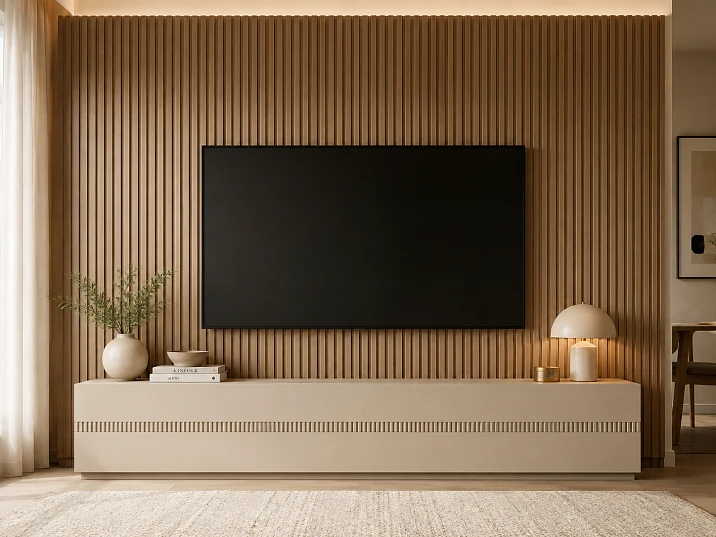
A slatted TV wall already sets a strong vertical rhythm, the TV forms a large dark plane, and a long floating cabinet below often remains the calmest element of the composition. If its facade is smooth, without handles, milling, or pronounced texture, it may look too neutral against the active wall. Replacing the entire cabinet for this is not necessary. One way to make the furniture more complex, rather than adding another layer of decor to the wall, is to run a wide decorative belt of polyurethane across the facade.
In the task at hand, a specific product is chosen — decorative trim KPU-123. Its nominal length is 2000 mm, and the total width of the cabinet facade line is 1800 mm. The first calculation is elementary:
2000 − 1800 = 200 mm.
By the net length, one strip is enough, leaving a gross margin of 200 mm. But this is not yet the answer to the question "how much to buy." It is only valid for the simplest scenario: when the decorative line can indeed be obtained from a single strip without significant losses for pattern alignment and without additional sections on the sides or frame elements.
Furniture has a feature that a regular wall does not: a facade 1800 mm wide is not necessarily a single physical piece. It can consist of two drop-down flaps, three hinged or sliding fronts, four sections, or a combination of drawers and doors. If adjacent fronts open independently, they cannot be joined with one continuous piece of KPU-123. The strip will have to be divided along the opening lines, and the decorative pattern should, where possible, be coordinated between the individual fragments.
Therefore, the correct preliminary conclusion is as follows:
For one decorative line 1800 mm long, one strip of KPU-123, 2000 mm long, is geometrically sufficient. But the final quantity is determined by the layout of the fronts, the width of the cuts, end trimming, and how much material will have to be sacrificed for the proper positioning of the ornament.
This is especially important because of the price. At the time of preparing this material, one strip of KPU-123 costs 11,770 ₽. If one is enough, the product part of the order starts at 11,770 ₽. If, due to cutting, you have to take two, the cost of the linear molding alone becomes 23,540 ₽. The difference is too noticeable to order a second strip "just in case," but also too large to discover a shortage only after the first one has been cut.
Before purchasing, you need to take not just one measurement of 1800 mm, but create a facade map: the total width, the width of each opening section, the location of gaps, the working height of the decorative belt, and the places where the pattern should end. After that, the decision "1 or 2" becomes calculated, not intuitive.




What is KPU-123 and why the 100 mm width changes the character of a furniture facade
KPU-123 is precisely decorative polyurethane molding. It should not be called a molding just because it is a long piece, and certainly should not be substituted with the term "overlay" or "baguette." In the STAVROS catalog, the product is in the polyurethane molding section and is intended, among other things, for decorating furniture facades.
Current product parameters:
| Parameter | KPU-123 |
|---|---|
| Product type | decorative linear molding |
| Material | Polyurethane |
| Dimension A | 100 мм |
| Dimension C | 4 мм |
| Length L | 2000 мм |
| Price per 1 pc. | 11 770 ₽ |
| Minimum order | From 1 pcs. |
| Average production time for made-to-order items | 3–7 days |
| Main application in this article | Decorative belt on furniture facade |
Buy decorative molding KPU-123 made of polyurethane can be done with one strip — the minimum batch starts from one piece. This makes accurate calculation especially important: there is no need to automatically include a second part if the cutting of the first one actually covers the task.
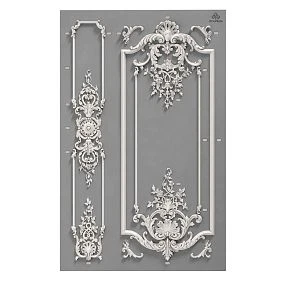
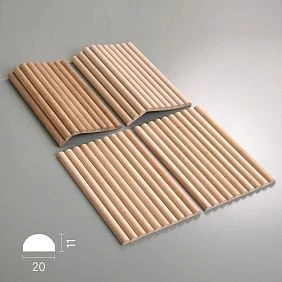
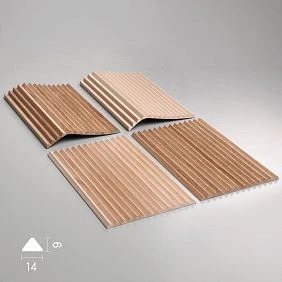
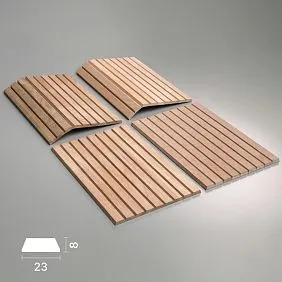
Our factory also produces:
100 mm is no longer a thin line
The transverse dimension of 100 mm is no less important than the length. On a furniture facade, this is a noticeable decorative strip. A thin molding can work as a contour or frame and be perceived almost graphically. A strip about 100 mm wide occupies its own area and already forms an ornamental belt.
This is especially noticeable on a low hanging TV cabinet. If the facade height is, for example, relatively small, a 100 mm strip can occupy a significant share of its visible height. Therefore, its position cannot be chosen only by the principle of "glue it in the center." First, you need to make a template 100 mm wide along the real length of the cabinet — at least from paper, masking tape, or a strip of cardboard — and see how much calm flat surface remains above and below.
Get Consultation
The 4 mm dimension is important for operation
The card sets size C = 4 mm. For an interior composition, this means that the decorative belt does not turn into a heavy protruding overlay of great depth, but at the same time remains a separate physical layer on the facade. This must be taken into account near adjacent doors, ends, handles, push-to-open zones, and protruding elements of the body.
Before installation, it is worth checking not only the front view, but also the side angle. On a hanging TV cabinet, the ends are clearly visible when entering the room. Even a small addition of thickness can be noticeable if KPU-123 ends exactly at the outer edge of the facade. Sometimes it is better to end the decorative strip before the edge, leaving equal margins on the left and right, than to run it "from edge to edge" just for maximum length.
Why the product is suitable specifically for furniture
The manufacturer explicitly lists furniture facades among the application areas of KPU-123. This is fundamental: the new article does not transfer wall decor to furniture by guesswork. Here, a product is selected that is allowed to be used at the object scale.
For those who want to compare this option with other products in the same group, the logical next step is the section Polyurethane trim. There, it makes sense to look for an alternative if the 100-millimeter strip of KPU-123 turns out to be too wide after a full-size trial, or the ornament itself does not fit the geometry of the cabinet.
First, determine the cabinet's construction: one front plane and three doors require different cutting
The total width of 1800 mm by itself does not indicate the number of facades. To cut KPU-123, you first need to understand which lines on the cabinet are the actual boundaries of movable parts.
Let's consider four common constructions.
| Cabinet facade construction 1800 mm | Can KPU-123 be left as one physical piece | What happens to the calculation |
| One fixed decorative panel | Yes, if there are no structural obstacles | The simplest scenario: one line up to 1800 mm |
| Two independently opening leaves | No | At least two separate fragments are needed |
| Three fronts/drawers | No | Three independent fragments with pattern matching are needed |
| Four fronts | No | The number of cuts and the risk of losses when matching the ornament increase |
Why the gap between the leaves cannot be overlapped
The facade gap is not a decorative line that can be "hidden." It ensures independent opening of parts. If you glue one continuous rigid fragment directly to two doors, the decorative strip will physically connect them. At the first opening, one part will pull the other, or the element will tear off, crack at the gap, or damage the facade coating.
Therefore, a visually continuous strip is made from several physical parts. They are positioned at the same height and end at the facade boundaries so that when the cabinet is closed, the pattern is perceived as unified, but each door retains its independence.
How to take facade measurements
Before calculating, write down:
-
the total visible width of the cabinet;
-
the width of each facade separately;
-
the width and position of inter-facade gaps;
-
which parts open independently;
-
whether there are flip-up facades, drawers, or hinged doors;
-
where the handles or push-to-open zones are located;
-
are there rounded edges, chamfers, cutouts, decorative borders;
-
should the ornament run only along the front or also extend to the side panels.
With three identical fronts, the total line of 1800 mm does not mean you simply cut three pieces of 600 mm each. The actual width of each furniture front may be smaller due to technological gaps, and the ornament may require a slight shift in the cutting point. Therefore, cutting is done not according to the "cabinet math," but according to the actually measured width of each piece.
The main mistake is measuring the cabinet body instead of the fronts
The cabinet body may have a nominal 1800 mm, but the outer fronts may be recessed, protruding, have a radius, or not reach the side panels. If you cut KPU-123 to the cabinet size, the decorative line may extend beyond the front plane or, conversely, end up shorter than needed.
For this task, what matters is not the furniture size from the specification, but the visible front geometry after assembly and adjustment of all doors. First, the fronts are aligned, gaps are adjusted, and only then are measurements taken for the decoration.
Calculating one strip: what the 200 mm allowance actually consists of
The clean length of the strip is 2000 mm. The design length of the decorative line is 1800 mm. The gross allowance is 200 mm. To understand whether it remains after cutting, it is convenient to calculate not the "remaining by eye," but the length budget.
Let us denote:
-
L = 2000 mm — length of KPU-123;
-
F — total length of all finished fragments on the fronts;
-
K — total losses due to cuts;
-
T — total end trimming to obtain clean ends;
-
O — material that must be removed for a convenient position of the pattern;
-
R — actual remainder.
Then:
R = L − F − K − T − O
For one plank, the condition is simple:
F + K + T + O ≤ 2000 mm.
In the cabinet under consideration, if the total finished length of the fragments is indeed 1800 mm, then for all other losses there remains:
2000 − 1800 = 200 mm.
These 200 mm are not an "extra piece that will definitely remain." This is the overall reserve of the project.
Cut losses cannot be assigned a single universal number
The width of the cut depends on the tool and the blade. In one workshop, the actual cut will be one thing; with a different tool, it will be another. Therefore, instead of an artificial standard, before cutting, you need to measure the actual width of the cut on a test material or clarify it with the craftsman.
If the plank is divided into three parts, the number of working cuts and the cutting sequence are determined by whether factory ends are used, whether the start of the plank needs to be pre-aligned, and whether a technological tail must be left. You cannot simply multiply the conditional "3 mm" by the number of doors and declare the result universal.
In practice, something else is more important: with a 200 mm reserve, ordinary losses directly from sawing are rarely the only factor that forces you to buy a second plank. Much more dangerous is the shift of the ornament.
What is the loss on pattern matching
Suppose the first fragment starts beautifully with a certain part of the pattern and ends at a logical point. The next facade should continue the composition. If after the first cut the remaining pattern starts unsuccessfully—for example, in the middle of a large motif—the second fragment sometimes has to start not from the first millimeter of the remainder, but further along the plank. This segment becomes a technological loss O.
That is why it is impossible to promise in advance that one plank will always cover three or four facades. You need to see the pattern repeat along the entire two-meter length and make the layout before the first cut.
Full-size layout is better than approximate calculation
The most reliable way is not to start with the saw. First:
-
lay out the KPU-123 face up;
-
mark on it the lengths of the actual facade fragments;
-
draw the lines of inter-facade gaps;
-
estimate where each line falls in the drawing;
-
if necessary, shift the entire set relative to the beginning of the plank;
-
recalculate the remainder after the shift;
-
only then decide on the second plank.
If after such a layout all fragments fit within 2000 mm, taking into account the actual cut and end trimming, purchasing one plank is justified. If a beautiful continuation of the pattern requires losses greater than the available reserve, a second KPU-123 is needed not because of the cabinet's length, but because of composition requirements.
Two, three, and four doors: how to preserve the pattern without linking the facades to each other
The task becomes more complex not because there are more parts as such. The nature of the pattern changes. A person perceives one long decorative band as a single horizontal line. If it is broken by inter-facade gaps, the eye still tries to connect adjacent parts. Therefore, any random jumps in the motif become more noticeable.
Two leaves
With two facades, the task is usually the simplest. There is one central gap, and two decorative fragments can be built as the left and right parts of a single composition. Before cutting, it is useful to check where the visual center of the ornament should be — exactly on the cabinet's axis or inside each door separately.
These are two different solutions.
Common center of the cabinet. The pattern is perceived as a single ribbon divided by a technological gap. Suitable when the two doors are identical and the entire cabinet should look like a single piece.
The center of each panel. Each facade becomes an independent decorative field. This may require more material, because two identically centered fragments cannot always be cut consecutively from a single continuous strip without losing the pattern.
This is where the real possibility of a second strip arises: not because more than 1800 mm is needed in total, but because the buyer wants two compositionally identical fragments, which require repeating sections of the ornament.
Three facades
With three sections, the role of the central one must first be determined. If all three are identical, a single continuous strip with neat breaks at the gaps is logical. If the central panel is wider or serves as the visual axis of the TV zone, the pattern should first be placed on it, and only then extended to the right and left.
This changes the cutting order. A mistake is to first cut the outer fragment because its size is already known, and then try to "fit" the central motif into the remainder. For ornamental molding, it is wiser to reserve the most important compositional section first, rather than the leftmost furniture element.
Four facades
With four sections, the number of boundaries increases, as does the likelihood that one of the cuts will land on an unfavorable part of the pattern. But this still does not automatically mean purchasing two strips. If the KPU-123 ornament allows sequential division, a single two-meter piece may remain sufficient.
A second strip becomes justified when additional requirements appear:
-
each facade must have an identically centered motif;
-
the outer sections must be mirror-matched;
-
the ornament cannot be visually cut off at selected points;
-
part of the first plank has to be excluded due to a defect, cutting error, or unfavorable position of the motif;
-
in addition to the front, the side panels are decorated;
-
instead of one belt, several separate strips are designed.
The main rule for any layout: first we draw a map of all fragments on one plank, then we cut. After the first incorrect cut, the two-meter length ceases to be a unified system, and fixing it may cost a second piece for 11,770 ₽.
Where to place a 100 mm wide strip: in the center of the facade, higher or lower
Once the quantity question is resolved, a second practical task appears: where exactly to place KPU-123. Against the background of a slatted TV wall, the decorative belt should work on the cabinet, not compete with the TV and vertical slats.
There is no universal height. It depends on the height of the facade, the position of the cabinet relative to the floor, the thickness of the countertop, the presence of handles, and which part of the furniture most often falls into the field of view of a seated person.
Central position
A belt along the horizontal axis of the facade gives the calmest and most symmetrical solution. It works well on a flat cabinet without handles, when KPU-123 should become the main and only decorative element of the front.
But the center is not an automatic norm. On a very low facade, a 100-millimeter strip can visually divide the plane into two too narrow zones. On a high facade, on the contrary, the exact center sometimes looks too static.
Shift upward
The belt closer to the top of the cabinet visually connects with the countertop and TV. This position often seems more "architectural": the decor works as an upper frieze of the furniture, while the lower part remains calm.
Before installation, check that it does not intersect with handles, recesses, opening mechanisms, and areas where a person grips with their hand. Even if the strip itself is thin in profile, constant hand contact with the relief is undesirable in terms of convenience and preservation of the paint.
Shift downward
The lower position can visually weigh down the cabinet and bring the ornament closer to the floor line. It is appropriate less often, but sometimes helps if the top of the facade is already occupied by a horizontal gap, handle, or another structural element.
How to decide without subjective debate
Make three full-size strips 100 mm wide from paper or painter's tape:
-
in the center;
-
above the center;
-
below center.
Look at the cabinet not only from a distance of one meter, but also from the main TV viewing point. Then stand at the entrance to the room and from the side. A position that looks good only from a frontal view may add unnecessary horizontal heaviness from another angle.
It is important to evaluate the entire set at once: slatted wall + TV + cabinet + future strip, not the KPU-123 photo separately. If the vertical slats are already very contrasting, a wide ornamental belt should be calm in color. If the slats are close to the wall color and provide only texture, KPU-123 can take on a more noticeable role.
Paint KPU-123 in the color of the cabinet or make it contrasting
A 100 mm wide strip is large enough for the color to significantly change its visual weight. The same relief in the color of the facade and in contrasting trim is perceived almost as two different solutions.
In the color of the cabinet
Monochrome painting is the safest way to combine a classic or ornamental relief with a modern slatted TV wall. When the colors match, the decor is read mainly through light and shadow. The cabinet remains a solid piece, but its front plane ceases to be flat.
This option is especially useful if the wall itself is already active: pronounced slat texture, contrast of wood and backing, a large TV, backlighting. Adding another color to the lower part of the composition is not necessary.
Half a tone darker or lighter
A slight difference can be used if you need to show the ornament more strongly without turning it into a separate strip. But this option requires a real paint sample next to the facade: the color on the sample and on the finished cabinet may differ due to gloss and lighting.
Contrasting band
Contrast works the strongest and is therefore more dangerous. If KPU-123 differs sharply from the facade, its 100 mm width turns into an independent horizontal strip. It begins to compete with the bottom edge of the TV, the countertop, the backlighting, and furniture lines.
This approach is justified when the interior is initially built on graphics and contrasts. If the task is merely to "make a smooth cabinet more interesting," the monochrome option is usually easier to verify and simpler to integrate.
Do you need to try to match the color of the slats?
Not necessarily. The slat wall and the cabinet facade are in different planes and serve different functions. Trying to literally match the wood color of the slat on the polyurethane ornament may visually connect the elements, but it can also create a sense of a random applied strip.
First, you need to decide what should be the main focus: the texture of the wall or the furniture decor. If the main accent is already behind the TV, it is reasonable to subordinate KPU-123 to the facade. If the wall is neutral and the cabinet is intended as a separate expressive piece, a more active finish can be considered.
For the overall logic of furniture styling, it is useful to review the overview material slat furniture panels and polyurethane furniture decor. It considers furniture more broadly, but here the task remains narrow: to calculate and correctly place a specific KPU-123 on an already installed cabinet.
When KPU-123 against the background of slats will be redundant and what to choose instead
A commercially useful article should answer not only "how to buy" but also "when not to buy." KPU-123 with a width of 100 mm is a noticeable element. It is not suitable for every TV zone just because it fits arithmetically on the facade.
It is better to leave the cabinet smooth if there is already enough decor
It is reasonable to refuse KPU-123 if several active elements are present simultaneously:
-
contrasting slat panels behind the TV;
-
decorative lighting;
-
textured countertop;
-
prominent handles;
-
stone or bright veneer on the facades;
-
large decor along the edges of the TV zone;
-
complex geometry of the cabinet itself.
In such a situation, a smooth cabinet can serve a useful role as a visual pause. Trying to "definitely add something" will worsen the hierarchy.
A thin molding is better if only a graphic line is needed
If after a 100 mm wide pattern KPU-123 seems heavy, but you still want to complicate the facade, a logical alternative is buy polyurethane moldings and assemble a thinner line or frame.
Moldings and trim solve different tasks. KPU-123 gives a noticeable ornamental strip. A thin molding works more as a contour, plane division, or frame. On a low cabinet, the second option may be more proportional.
Small overlays are better if a continuous line is not needed
If a smooth facade seems empty, but a horizontal band conflicts with the slatted wall, you can go to the section Polyurethane decorative appliques and choose local accents. Then there is no need to run the pattern across the full width of 1800 mm and align it on multiple doors.
Trim of a different width is better if 100 mm does not work proportionally
KPU-123 does not need to be "squeezed" into the facade just because you liked its pattern. If the paper template shows that the strip takes up too much of the door height, look for another Polyurethane trim with a more suitable scale.
A full frame is already a different project
If instead of one horizontal strip you want to outline each door around the perimeter, the calculation changes fundamentally. You need to count two horizontals and two verticals for each facade, corner joints, cuts, and pattern matching. In this scenario, one two-meter KPU-123 for a 1800 mm cabinet will almost certainly not be enough, but the exact quantity is determined by a separate specification.
That is why you should not imperceptibly turn the original task of "one belt" into "full furniture decor". For the current scenario, it is enough to compare three solutions:
| Solution | Visual effect | Material consumption | When to choose |
| Leave a smooth facade | Maximally calm | 0 | The wall is already saturated |
| One horizontal strip KPU-123 | Pronounced ornamental accent | 1 plank, if cutting allows | Need one strong belt on the cabinet |
| Thin molding/local overlays | Lighter decor | Depends on the scheme | KPU-123 seems too large |
How does horizontal KPU-123 interact with vertical slats behind the TV
In this context, slat panels are not a surface for mounting KPU-123, but a background that already exists and affects the perception of the furniture. This is an important distinction. If you try to repeat the same vertical rhythm on the cabinet as on the wall, the lower part of the TV zone may become too fragmented. Horizontal slats work differently: they cross the vertical logic of the wall and thereby visually separate the furniture from the finish.
This can be a plus. Vertical slats pull the composition upward, while a long floating cabinet is naturally elongated horizontally. One ornamental band emphasizes this difference and helps the cabinet look like a standalone piece rather than an extension of the slat cladding.
But the effect depends on several conditions.
If the slats are very contrasting
Dark wood on a light background or light slats on an almost black substrate already create a strong pattern. Against such a background, a contrastingly colored KPU-123 may add a second competing rhythm. In this case, it is worth first trying a monochrome version—a strip in the color of the facade. The relief will remain, but the color will not fragment the TV zone even more.
If the slats are close in tone to the wall
When the panel is read mainly through light and shadow rather than color contrast, the cabinet can afford a more active ornament. However, the solution is still checked from the main TV viewing point. A detail that looks impressive from a distance of 70 cm turns into a general stripe from the sofa three to four meters away. Therefore, it is important to evaluate not only the fine carving but also the strength of the entire 100-millimeter band.
If the slats end above the cabinet
Sometimes the slat panel does not extend to the floor: a smooth strip of wall remains between its lower edge and the cabinet. Then KPU-123 gets additional "breathing room" and can read more calmly. If the slats visually come close to the countertop or extend behind the cabinet, the horizontal decor is directly in front of the active rhythm and becomes more noticeable.
If the width of the cabinet and the slat field differ
There is no need to automatically stretch KPU-123 to the edges of the cabinet just because the furniture itself is 1800 mm wide. If the slat composition behind the TV is narrower, you can check a variant where the decorative band relates not to the entire cabinet but to the central zone. But this already changes the original length F and must be fixed before cutting.
The reverse situation: the slat field is wider than the cabinet. Then the strip from edge to edge of the furniture facade emphasizes that the cabinet is an independent object within a broader wall composition. This is often more logical than trying to fit the length of the furniture decor to the boundaries of the wall panel.
Checking from a distance is more important than a close-up photo
For the TV zone, there are at least three significant viewpoints:
-
the sofa or armchair from which the TV is watched;
-
the entrance to the room;
-
the side passage next to the cabinet.
From the sofa, the overall horizontal line and contrast matter. From the entrance, the connection with the slat wall is visible. From the side, the protrusion of the decor, the quality of the ends, and how well the strip lies in the same plane on adjacent facades are noticeable.
Therefore, it is better to photograph the mockup from these three points. The photos allow you to compare options more calmly than repeatedly moving the paper strip and trying to remember the impression.
How to center the ornament and design the edges when the molding is cut into several facades
The consumption of KPU-123 depends not only on millimeters. Ornamental molding has its own composition. Even if the pattern repeats, it cannot be considered a neutral texture like a plain strip. In a long line, large and small sections of the motif are visible, so the choice of the starting point affects the entire facade.
First, find the main axis of the furniture
A TV stand usually has one of three possible axes:
-
the geometric center of the body;
-
center of the TV;
-
the center of the central facade or niche.
In a perfectly symmetrical TV area, these axes coincide. But on a real object, the TV may be shifted, the stand may be longer than the slat panel, and one furniture section may be wider than the others. Therefore, before cutting, you need to choose what exactly is the main center of the decorative composition.
If the original idea is to make the stand a single piece, the center of the furniture itself is usually more logical. If the TV and the stand are specially assembled into a single axial composition, you can check their common center. You cannot choose the axis after the first part of KPU-123 has already been cut.
Then apply to the axis not the edge, but a characteristic section of the pattern
On the plank, find a section that visually suits the center: the symmetry axis of the motif, the middle of a repeating element, or a calm point between two large details. After that, lay out the facade dimensions to the right and left.
This approach immediately shows how much material is lost at the edges. If, for a beautiful center, you have to leave unused, for example, long initial and final sections, the gross allowance of 200 mm may disappear even before accounting for cuts.
What to do with the inter-facade gap
You cannot try to cover the gap with a decorative element. The task is different: to make sure that when the furniture is closed, the eye continues the pattern through a small pause.
Three things are checked:
-
both parts are strictly at the same height;
-
the ends approach the gap with the same offset relative to the edges of the doors;
-
the pattern does not create a feeling that on one side a large element is cut off, and on the other a completely different motif begins.
If a beautiful continuation is impossible, sometimes it is better to consciously make each facade independent: center the ornament separately on the doors, rather than imitate one continuous strip. This may increase consumption, but the visual logic becomes clear.
How to design the outer edges of the composition
The edge of the plinth is a separate point. You can bring KPU-123 almost to the edge of the facade, or you can leave a side margin. There is no nominal mandatory offset: it is determined by the actual geometry and pattern.
Leaving a margin is useful if:
-
the facade has a rounded end;
-
there is a side wall of a different color nearby;
-
the KPU-123 pattern ends poorly when cut exactly at the edge;
-
from a side angle, the open end of the decor looks too noticeable.
Before cutting, mark both edges with painter's tape. If a margin of 20, 30, or 50 mm looks better, this is not an "unused facade" but a deliberate compositional technique. However, it must be included in the actual length F: the line will no longer be 1800 mm.
You cannot trim the decorative strip in width just to make it lighter
The original cross-sectional dimension of KPU-123 is 100 mm. If the template shows that this is too much, the correct action is to choose a different trim or molding. Longitudinal cutting of the ornamental strip may disrupt the pattern and alter the factory geometry. Without separate technical confirmation from the manufacturer, this method cannot be considered a standard solution.
Before sawing, it is useful to do a "dry numbering"
Assign a number to each future fragment: L1, C1, R1, or F1–F4. Transfer the number to the reverse side after cutting. At the same time, mark the top/bottom and the direction of the pattern if it matters. This is a simple operation, but it protects against a situation where two similar pieces are swapped, and the continuation of the ornament no longer matches.
After cutting, first assemble all fragments dry on the facades or on the floor with the same gaps as the furniture. Only after this check proceed to the glue.
Decision matrix "one or two slats" for a 1800 mm facade
To avoid returning to the same question in each section, the decision can be reduced to a single table. It does not replace the ornament layout, but shows which specific factor moves the project from one slat to two.
| Project condition | 1 slat KPU-123 | 2 slats KPU-123 | What to check before ordering |
| One 1800 mm line without division | Usually sufficient | Not required without an additional reason | Finished ends and pattern position |
| 2 facades, the pattern can be continued sequentially | Maybe that's enough | Only needed with large centering loss | One central gap and motif layout |
| 3–4 facades, the pattern runs as one continuous strip | Maybe that's enough | Needed if total losses exceed 200 mm | All cut lines on the full pattern |
| Each facade must have the same centered motif | Often becomes harder to fit within limits | Probability is higher | Motif repeat on the strip |
| The front and sides are decorated | Depends on the total length | Possible | Total length of all surfaces |
| Two horizontal strips are needed | Not enough for two lines of 1800 mm | Minimum two, further according to cutting | Full length of both belts |
| A frame is needed on each facade | Not enough for the entire cabinet | The quantity is calculated separately | Perimeters of facades and corner cuts |
The most useful conclusion from the table: the number of doors by itself does not determine the quantity of KPU-123. Two strips appear when the actual material consumption with technological and ornamental losses exceeds 2000 mm, or when the project requires repeating sections that cannot be obtained from one continuous strip.
The decision boundary is not "200 mm", but zero in the remainder formula
After the full layout, R is calculated. For now:
R ≥ 0, one strip physically fits the project.
if:
R < 0, the first strip does not cover all fragments.
But even a positive R needs to be evaluated qualitatively. A remainder of 5–10 mm does not provide a normal technological reserve for marking errors and finishing work. If the project fits literally "tightly", it is better to re-measure the facades and coordinate the cutting with the craftsman before purchasing. This does not mean automatically taking a second piece; it means the calculation should be more accurate.
The second strip may be needed partially, but it is sold as a whole
If the first one is missing, for example, only one short fragment, the product is still purchased as a whole two-meter strip. Therefore, before moving to two pieces, it is useful to check an alternative layout: a different ornament center, a different order of fragments, a slight change in side margins. Sometimes this is enough to bring the project back within the 2000 mm limit without worsening the composition.
But optimization should not turn into an attempt to save one strip at any cost. If for this reason the central pattern becomes random, the outer facades lose symmetry, or the re
What to do before installation
-
Determine the material and coating of the facade. Not just a "white cabinet," but specifically painted MDF, film, veneer, etc.
-
Check the adhesive manufacturer's recommendations for both materials.
-
Perform a test on an inconspicuous area or a technological sample, if possible.
-
Check adhesion after full curing, not after a few minutes.
-
Mark the entire composition with painter's tape before applying adhesive to KPU-123.
-
Remove the facades if the furniture manufacturer allows it and it makes precise horizontal installation easier.
If mounting material is required, it is chosen not by the "strongest" principle, but by compatibility with polyurethane and the furniture coating. In the STAVROS section Polyurethane moldings you can refer to official recommendations for finishing and installation, but responsibility for compatibility with a specific furniture facade remains a separate check.
Why independent facades are better to decorate one by one
If the cabinet consists of several doors, it is convenient to remove them, lay them out on a flat surface while maintaining the actual gaps, and align the KPU-123 fragments as a single line. After fixing the decor, each facade is returned to its place and the overall pattern is checked again.
This reduces the risk that one door will be 2–3 mm higher than another along the decorative strip. For ordinary furniture, such a difference may be barely noticeable, but a long horizontal line of 1800 mm immediately highlights even a slight misalignment.
Do not mask poorly adjusted facades with a decorative belt
If the doors are already at different heights, the inter-facade gaps are uneven, or one door is sagging, first adjust the furniture. KPU-123 will not fix the geometry—on the contrary, the long ornamental line will make the misalignment more noticeable.
Cost: when a second strip is justified, and when it is expensive insurance without a reason
At a price of 11,770 ₽ for one KPU-123, the quantity has a direct impact on the budget.
| Package contents | Quantity of KPU-123 | Cost of linear footage |
| Basic option | 1 pc. | 11 770 ₽ |
| Second strip due to cutting/symmetry | 2 pcs. | 23 540 ₽ |
Prices are indicated according to the current product card at the time of preparing the material and may change. Before placing an order, they should be checked directly in the card.
When one strip can be considered a rational purchase
One KPU-123 is a justified order if all conditions are met:
-
the total finished length of fragments does not exceed the available length considering all losses;
-
the placement of the ornament suits each facade;
-
two or more identically centered motifs that cannot be obtained sequentially are not required;
-
the decor runs only along the front;
-
the project does not include a second belt, frames, or side panels;
-
a full layout is made before cutting.
When the second plank is not a "spare" but part of the project
Two KPU-123 should be included if the second piece solves a specific problem:
-
allows obtaining symmetrical sections of the pattern;
-
provides identical centering on multiple facades;
-
covers additional side panels;
-
needed for the second horizontal strip;
-
the first plank does not accommodate the actual cutting layout after end trimming and pattern alignment.
Buying a second plank just because "200 mm seems like a small margin" is weak logic. First, measure the actual losses. Conversely, relying on a single piece just because 2000 is greater than 1800 is also a mistake.
Why it's better to resolve the issue before placing the order
If after the first cut it turns out that the second symmetrical fragment can no longer be obtained, you will have to order another plank. This means additional waiting, possible separate delivery, and a halt in installation. Therefore, professional layout saves not only material but also time.
After checking all dimensions, you can order KPU-123 100 × 4 × 2000 mm in the quantity confirmed by the cutting layout.
Practical algorithm before ordering: from a 1800 mm cabinet to a ready-made specification
To avoid turning the choice into an abstract "like/dislike," follow the sequence from furniture to product.
Step 1. Do not buy based on the overall body width
Measure exactly the front area where the KPU-123 will run. Record the width of each door, drawer, or panel.
Step 2. Mark all independent moving parts
Each opening leaf gets its own fragment. One physical piece cannot be carried across the working inter-facade gap.
Step 3. Make a template strip 100 mm wide
Apply it to the facade at the intended height. Look not only at the cabinet itself, but also at the TV, slats, countertop, and floor line.
Step 4. Choose the position by height
Check at least the central and upper options. The lower one is needed if the facade design makes the first two inconvenient.
Step 5. Determine the final length of each fragment
Do not round to "about 600". Write down the actual dimensions after adjusting the facades.
Step 6. Lay out these dimensions along a length of 2000 mm
On paper or in a graphic diagram, mark all fragments sequentially. Add actual losses for the cut and final end trimming.
Step 7. Check the pattern
If the design cannot be beautifully divided along the obtained lines, shift the layout. Calculate how much length this shift consumed.
Step 8. Get the actual remainder
Use the formula:
R = 2000 − F − K − T − O.
If R remains non-negative and all pattern sections are acceptable, one plank is enough. If not, a second one is needed.
Step 9. Separately check the side panels and additional strips
Any decor extending beyond one front line is added to the specification separately. You cannot silently "take from the remainder" until its length is confirmed.
Step 10. Check the mounting base
Clarify the facade material, its coating, and compatibility with the adhesive. Do not start installation on an uncleaned or poorly adhering surface.
Step 11. Form the cart
For the basic scenario:
-
1 × KPU-123, if the cutting layout passed;
-
compatible mounting compound;
-
materials for preparation and finishing, if required by the selected painting scheme.
For complex cutting:
-
2 × KPU-123, if the second plank is confirmed by an ornamental or geometric layout;
-
the same mounting and finishing materials.
If KPU-123 does not fit the scale after the template, it is better to change the product before purchase rather than try to fix the proportions with color or width trimming.
Typical mistakes: where material is lost and why the result looks worse than the sketch
Mistake 1. Ordering a single plank only using the formula 2000 > 1800
Why it happens: the buyer only calculates the total length.
Consequence: after dividing by facades, it turns out that the pattern cannot be aligned or the finishing allowance is exhausted.
Check: cutting map of all fragments on one two-meter strip.
How to avoid: take K, T, and O into account before ordering.
Mistake 2. Running one piece through two doors
Why it happens: the desire to maintain a continuous pattern.
Consequence: the facades stop opening independently; the decor or furniture covering gets damaged.
Check: open each door on the sketch and see if KPU-123 crosses the movement line.
How to avoid: separate the decor along the boundaries of moving parts.
Mistake 3. Cutting from left to right without pre-centering the pattern
Why it occurs: the facade dimensions are known, so it seems logical to cut the parts immediately.
Consequence: the central section or a symmetrical pair gets random parts of the motif.
Check: first mark the compositionally main facade and the position of the pattern on it.
How to avoid: lay out the ornament from the main visual axis, not from the first edge.
Mistake 4. Considering 100 mm as "thin decor"
Why it occurs: in the catalog, the product looks more compact than on a real cabinet.
Consequence: the strip takes up too large a share of the facade height and conflicts with the slats.
Check: a full-size template 100 mm wide.
How to avoid: evaluate the three positions of the strip before purchasing.
Mistake 5. Choosing glue without considering the furniture covering
Why it occurs: polyurethane is known, but the facade material is not specified.
Consequence: weak adhesion, damage to the finish layer, or marks after removal.
Check: covering passport + glue manufacturer's requirements + test.
How to avoid: select the system "KPU-123 — glue — specific facade" as a single unit.
Mistake 6. Decorating poorly adjusted doors
Why it occurs: a long strip is used to visually align the facade.
Consequence: KPU-123 emphasizes the steps between the doors.
Check: apply a long painter's tape along the future decor axis.
How to avoid: first adjust the hinges and gaps, then install.
Mistake 7. Buying two slats without calculation "for peace of mind"
Why it happens: fear of ruining expensive material.
Consequence: an extra 11,770 ₽ is frozen in the remainder, which may not be needed.
Check: full cutting plan and assessment of the actual complexity of the ornament.
How to avoid: the second slat must cover a specific measurable need.
Result: how many KPU-123 to buy for a 1800 mm cabinet
For the original task, the answer does not reduce to a single number without checking the facade design.
If a cabinet with one front decorative line of total length 1800 mm stands in front of the slatted TV wall, and the KPU-123 pattern allows obtaining all necessary fragments sequentially, one slat of 2000 mm length is sufficient. The gross reserve is 200 mm, and from it the cuts, final edge trimming, and possible shift of the layout along the ornament are paid for.
If the cabinet consists of several independently opening facades, KPU-123 can still be made from one slat — but already as several separate fragments. The mere presence of two, three, or four doors does not automatically mean two slats. The decision depends on whether all fragments fit together with technological losses and whether the pattern can be properly continued.
Two strips are needed when the first one does not fit the actual cutting layout, or the project requires repeating/symmetrical ornament sections, additional side panels, a second band, or another arrangement that increases material consumption.
If, after a full-size template, a 100 mm wide strip turns out to be too busy next to slat panels, it is better not to buy KPU-123 "because the length has already been calculated." For a lighter solution, you can look at Polyurethane decorative appliques or buy polyurethane moldings.
If the scale fits, the facades are adjusted, and one strip fits the cutting layout, the order remains extremely specific: 1 × KPU-123 100 × 4 × 2000 mm plus compatible materials for installation and the chosen finish. Buying a second one is not for safety's sake, but only after a calculation that shows why it is needed.
FAQ
Can you first cut KPU-123 and then adjust the placement of the pattern on the facades?
It is better to do the opposite. First, lay out the ornament relative to all facades and mark the cutting lines. After the first cut, the ability to shift the entire composition along the two-meter strip will be lost.
Should KPU-123 be left on the media console if the TV is replaced with a model of a different diagonal size?
Yes, if the decor is tied to the geometry of the furniture itself, not to the width of the TV. Before designing, it is more useful to align the band with the facades and the overall axis of the console. If the pattern is currently centered specifically relative to a particular TV, future equipment replacement should be considered in advance.
Can the leftover KPU-123 be used on the inside of a door?
Technically, the possibility depends on the available space, the opening mechanism, and the purpose of the specific leftover. But decoratively, this is already a separate project: the inner surface works at a different angle, and the added thickness must not interfere with hinges, shelves, and closing. You should not plan interior decor just to use up the leftover.
What to do if one door becomes visually heavier than the neighboring ones after installing KPU-123?
First, check whether the fragments are positioned identically in height and relative to the edges of the facades. If the geometry matches, the cause may lie in the ornament distribution itself: one section turned out to have a denser area of the pattern. This is another argument in favor of pre-laying out the entire strip before cutting.
Can the trim be installed after the TV and all electronics have been set up?
Yes, but the work area must allow safe removal and laying out of the facades, using tools and glue without risking the screen and equipment. If the TV interferes with precise marking or cutting, it is better to protect it or temporarily clear the work area.
Is it necessary to buy a spare strip if the installation is done not by a professional but by the apartment owner themselves?
The mere fact of self-installation is not sufficient reason to purchase a second KPU-123. It is much more rational to do a full-size layout, practice on inexpensive test material, check the tools, and only then determine the risk. A second strip is justified if the calculation or the chosen ornament pattern truly requires it.
Can the KPU-123 be shortened to 1800 mm with a single cut if the facade looks like a single line but has several doors inside?
No, if these are indeed independently opening facades. Externally, they may form a single line, but each decorative section must move together with its own door. The nominal length of the entire composition and the physical construction of the decor are different things.
What is more important during cutting: equal length of fragments or equal position of the motif?
The length is determined by the actual width of the facades and is a mandatory geometric condition. The motif position is optimized within these dimensions. You cannot change the length of a decorative fragment so that it extends into the inter-facade gap, just for the sake of a beautiful pattern continuation.
Can the KPU-123 be installed vertically on the facade instead of a horizontal strip?
The product is a decorative molding element, but the specific orientation in the furniture composition needs to be checked with a full-size mockup and according to the product's pattern. This article calculates specifically the horizontal line along a 1800 mm cabinet; the vertical scheme changes the quantity, the length of fragments, and the visual interaction with the vertical slats of the wall.
What to do if the width of the cabinet after adjustment turned out to be not 1800, but slightly less?
You need to recalculate the actual total length of the decorative fragments, rather than continue using the original 1800 mm. Reducing the total length increases the gross reserve, but does not cancel the check of the pattern, cuts, and end trimming.