Article Contents:
- What exactly is NPU-098 and why its format suits this task
- Why a vertical slat wall sometimes really needs a horizontal counterbalance
- Why NPU-098 is better placed on a smooth insert rather than over the pronounced relief of the slats
- Where to center the 500-millimeter overlay: by the console, by the smooth field, or by the entire wall
- How much smooth field is needed around NPU-098: it is more useful to count free space rather than the percentage of the wall
- How to correlate NPU-098 with the console width so that the overlay does not look like a random small ornament
- At what height to check NPU-098 and why a universal distance from the countertop cannot be assigned
- Why in this composition you can do without a molding frame
- How to check NPU-098 with a full-size template before purchasing
- Color of NPU-098: matching the smooth insert, matching the slats, or as a separate accent
- Matching the smooth insert
- In a close tone to the slats
- Contrast color
- If there is a large mirror
- If there are two sconces
- If there is a painting
- If there is nothing above the console
- If there are switches or outlets nearby
- Scenario 2. Insert 650–700 mm, above the console there is already a mirror with an active frame
- Scenario 3. Large wall, long console, wide insert 1400–1600 mm, and a large horizontal painting
- Mistake 1. Buying just because 500 mm physically fits
- Mistake 2. Centering along the entire wall with an offset console
- Mistake 3. Adding moldings after an unsuccessful fitting of the NPU-098
- Mistake 4. Ignoring evening light
- Mistake 5. Trying to cover the slats themselves with an overlay without checking the base
- Mistake 6. Using decor as a mask for a technical problem
- Can the NPU-098 be turned vertically if the composition changes later?
- Is a second NPU-098 needed on the adjacent wall to "repeat the motif"?
- Can the NPU-098 be placed above the console without a mirror and sconces?
- What to do if the smooth insert is painted with dark matte paint?
- Can the overlay be placed not strictly in the center, but closer to the slatted field?
- Will the NPU-098 suit a very narrow console?
- Should the horizontal line of the NPU-098 be continued with a molding to the right and left?
- Can I buy the overlay first and make the smooth insert for it later?
- What is more important — matching the color of the NPU-098 with the slats or with the smooth wall?
- Can the NPU-098 be used if the console is later replaced?
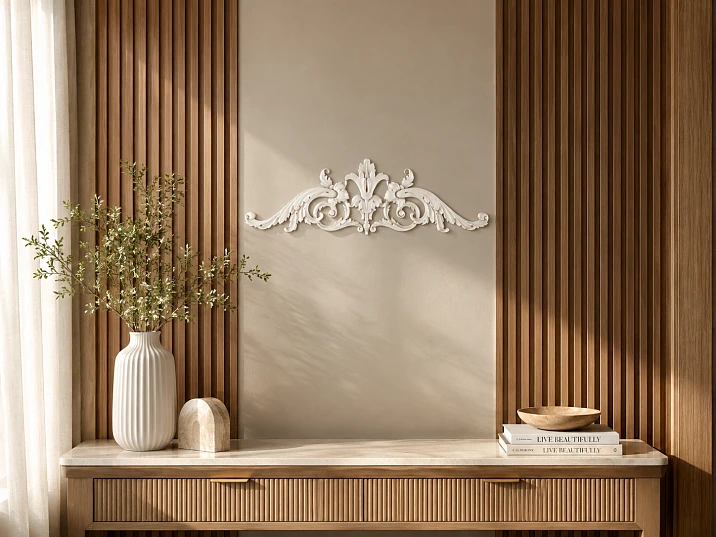
Vertical slats behind the console can work too actively. If they run from the floor upward in a continuous rhythm, and the console itself is narrow and elongated, the eye begins to move along the wall almost only vertically. As a result, the composition appears taller, stiffer, and narrower than desired. Adding another vertical detail to such an area is pointless: it will repeat an existing vector. Therefore, the idea of placing one horizontally elongated decorative overlay on the smooth insert looks logical.
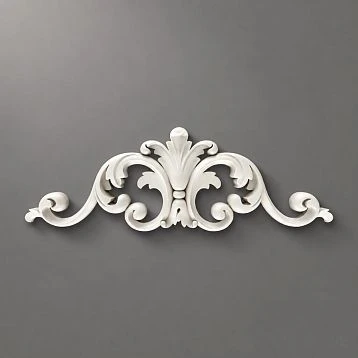
For this task, it is appropriate to consider NPU-098 — a horizontal decorative trim made of polyurethane, sized 500 × 155 × 15 mm. At the time of verification, the price of the product in the STAVROS listing is 5,130 ₽ per piece. This is a standalone element, not linear molding or trim: it does not need to be stretched across the full width of the wall, joined from multiple strips, or necessarily enclosed in a rectangular frame.
The direct answer: one NPU-098 can work on a smooth insert behind the console without a molding frame if it has a clear compositional purpose — to stop or balance an overly strong vertical rhythm of the slats. However, the mere fact that the trim has a horizontal format does not automatically make it a successful solution. Before ordering, three things need to be checked: whether there is enough calm, smooth space around the product, which axis to center it on, and whether the new relief will conflict with the mirror, wall sconce, painting, lamp, or the console itself.
First, do not buy the product "by picture." Cut out a rectangular template of 500 × 155 mm from paper or cardboard, mark the approximate product thickness of 15 mm, and hold it against the actual wall. Look at the composition from the room entrance, from the sofa or armchair, from the adjacent area, and directly in front of the console. If the horizontal accent truly ties the wall together rather than looking like a randomly glued ornament, then it makes sense to buy the polyurethane decorative molding NPU-098. If, after the template, it turns out that the smooth insert works well on its own, then declining the purchase would be a more sensible decision than adding decor just to fill an empty space.
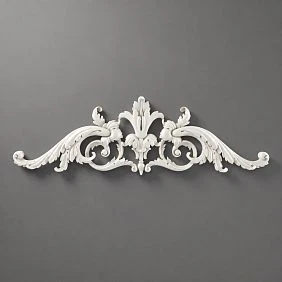
What exactly NPU-098 is and why its format suits this task
In this article, NPU-098 should be called precisely: a decorative polyurethane trim. Not molding, not cornice, not linear molding, and not a "panel." This precision matters not only terminologically. The type of product determines how it participates in the composition.
Molding builds a line and usually requires continuation: it forms a frame, band, border, or boundary. Linear molding works through length. A slat panel sets a repeating rhythm. NPU-098 acts differently: it is a local ornamental object with its own center and complete form. Therefore, it can be perceived as a single decorative accent on a calm background.
Current parameters of the selected option:
| Parameter | NPU-098 |
|---|---|
| Type | Decorative overlay |
| Material | Polyurethane |
| Size A × B × C | 500 × 155 × 15 mm |
| Orientation in the composition under consideration | Horizontal |
| Price per 1 pc. | 5 130 ₽ |
| Quantity for the article scenario | 1 pc. |
| Average production time for made-to-order items | 3–7 days |
For geometric calculations, there is an important confirmation here: in the product card, size A is specified as 500 mm, B — 155 mm, C — 15 mm, and the NPU-098 itself is in the category of horizontal polyurethane overlays. Therefore, in the orientation under consideration, we can speak of 500 mm horizontally, 155 mm in height, and 15 mm in thickness, without substituting unknown axes with guesses.
But size alone does not answer the question "will it fit." Five hundred millimeters can be an expressive center on a smooth insert 800–1000 mm wide and look like a cramped element on a field of 560–600 mm. The same 500 mm can correlate well with a console 900 mm wide and get lost on a long console of 1600 mm. Therefore, the article should not be reduced to a single rule of proportions.
If the NPU-098 turns out to be too large or too ornamental for your field, the correct next step is not to stretch the composition with moldings just to justify an already chosen product. It is better to return to the section and Buy Polyurethane Molded Decoration of a different scale or leave the smooth insert without decor altogether.




Why a vertical slat wall sometimes really needs a horizontal counterbalance
Vertical rhythm in itself is not a problem. It makes the wall look assembled, emphasizes height, creates a play of light and shadow, and works well on accent surfaces. The problem arises when there are too many vertical directions in a particular composition.
Imagine a wall behind a console. Slat panels run from floor to ceiling. The console itself has thin, tall legs. Nearby are a vertical mirror and two elongated sconces. Against such a background, even a beautiful set of objects can begin to be perceived as several parallel "arrows" pointing upward. The eye does not get a horizontal stop.
The horizontal overlay changes not the geometry of the wall, but the direction of reading. It creates a short transverse pause. This is especially useful when the console itself forms a horizontal line of the countertop, but this line is low and does not visually connect the upper part of the composition. NPU-098 can repeat the horizontality of the console higher, at the level of the smooth insert, thereby creating a second horizontal layer.
It is important not to confuse "counterbalance" with "struggle." If you make the new decor too large, contrasting, or complex, it will start to argue with the slats. The goal is not to defeat the vertical rhythm, but to give it support. The verticals remain the background and architectural texture, while the horizontal overlay becomes a local stopping point.
This should be checked not against a single wall fragment, but against the room. If the vertical slatted plane is already balanced by a long console, a low pouf, a horizontal painting, or a wide mirror, NPU-098 may be redundant. If almost all major lines go upward, the horizontal ornament more often has a clear function.
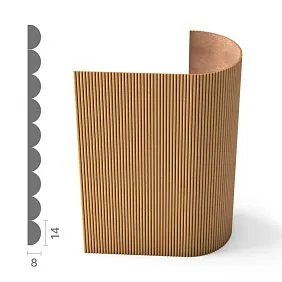
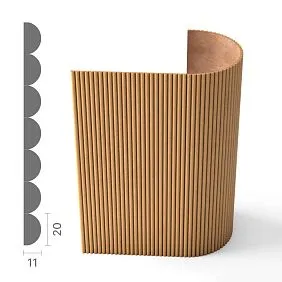
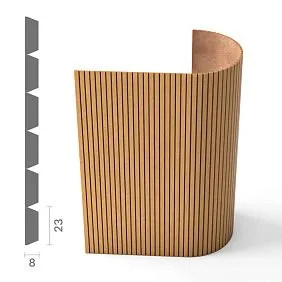
In the STAVROS catalog, vertical slatted panels are described as a solution that visually elongates the plane. Therefore, the very idea of compensating for this effect with another direction is not artificial. However, compensation can be achieved not only with molding. Sometimes a horizontal mirror, painting, long lamp, or the furniture itself is enough. NPU-098 is worth buying only when a relief decorative layer is specifically needed.
If the slatted part of the wall is still being designed rather than installed, it is reasonable to first determine its width, material, and spacing. For this, you can buy wall slat panels after choosing the overall composition, rather than fitting the smooth insert to an already preferred overlay.
Our factory also produces:
Why NPU-098 is better placed on a smooth insert rather than over the pronounced relief of the slats
The strongest argument for a smooth insert is not ease of installation, but readability of the form. The carved overlay has its own relief. The slatted surface is also relief. If you layer one active rhythm onto another, the contours begin to compete.
On a smooth background, the opposite happens. The plane becomes visual "air" around the ornament. The shadows from the relief of NPU-098 are read in full, the side parts are not lost in the vertical grooves, and the horizontal shape is perceived as a single object.
There is also a practical reason. The tight fit of the decorative overlay must be assessed against the actual base. On a smooth prepared surface, it is easier to see if there are differences, dirt, unstable paint, or local unevenness. On a deeply relief slatted wall, the contact area is noticeably more complex and may depend on the specific profile of the slats. It is impossible to universally promise the installation of one overlay on top of any slatted system.
Therefore, in the article under consideration, the smooth insert is not an "empty space that needs to be filled with something," but a special transition zone between two textures. It solves four tasks at once:
-
stops the continuous vertical rhythm;
-
gives the overlay a calm background;
-
allows precise centering;
-
simplifies visual control of the joint and paint finish.
A common mistake is making the insert exactly the size of the decor. For example, a 520 × 175 mm field for a 500 × 155 mm product. Technically it "fits," but visually the smooth base turns into a backing plate rather than part of the wall. The overlay needs breathing room.
Another imbalance is too large an empty plane where the product gets lost. Therefore, the smooth insert is designed not on the principle of "the bigger, the better," but in relation to the console, mirror, and the width of adjacent slat fields.
If the main slat cladding has not been purchased yet, it is convenient to first assemble a scaled sketch of the wall and only then order slat panels for the wall of the required width. Then the smooth zone will be a deliberate architectural element, not a random leftover after cutting.
Get Consultation
Where to center a 500-millimeter overlay: on the console, on the smooth field, or on the entire wall
This is the main compositional question of the article. On a real wall, three centers rarely coincide at once:
-
the geometric center of the entire wall;
-
the center of the smooth insert;
-
the center of the console.
Sometimes a fourth axis is added — the center of a mirror or a painting.
There is no need to try to "average" all these points. First, determine which object is the main one. In the article's scenario, this is usually the console composition, not the entire wall. Therefore, priority is more often given to the axis of the console and the items above it.
Suppose the wall is 3600 mm wide. On the right and left there are slatted panels of different widths, and the smooth insert between them is offset relative to the center of the room. The console is deliberately placed in the center of the insert. If the NPU-098 is aligned with the geometric center of the entire wall, it will shift relative to the furniture and look like a marking error. Here, it is more correct to center it on the console.
Another scenario: the console is temporary and may be replaced, while the smooth insert is created as a permanent architectural part of the wall. Then it is wiser to work from the center of the insert itself. The overlay will remain correctly positioned even after changing the furniture.
The third option is an absolutely symmetrical wall, where the smooth field, console, mirror, and architectural center coincide. Here, the question is resolved: all axes are the same.
A useful practical test: place vertical painter's tape along the three possible centers and apply the NPU-098 template. Do not move the furniture during the test. Take three photos from the same point. In the images, it is easier to see which offset looks intentional and which looks random.
Do not center the overlay on the nearest seam between panels if that seam has no compositional significance. The technical installation grid and the visual axis of the furniture are different systems.
If you need to choose a priority, use this order:
permanent architecture → main furniture piece → large wall object → secondary details.
That is, a stationary smooth insert is more important than a temporary vase, a console is more important than small decor on the countertop, a mirror is more important than a table lamp. This hierarchy protects the wall from accidental shifts.
How much smooth field is needed around NPU-098: it is more useful to calculate free space rather than the percentage of the wall
There is no universal "correct percentage" for a decorative overlay. But you can calculate the actual fields around a 500-millimeter element and assess whether it has enough calm background.
If the overlay is centered on a smooth insert, the side field is calculated as follows:
(insert width − 500 mm) / 2.
Examples:
| Smooth insert width | Left free field | Right free field | What to check |
| 600 мм | 50 мм | 50 мм | the decor may seem cramped; a real template is needed |
| 700 мм | 100 мм | 100 мм | a separate background is already emerging, but the pattern of the adjacent slats matters |
| 800 мм | 150 мм | 150 мм | a calm reserve for most neutral compositions |
| 900 мм | 200 мм | 200 мм | the overlay reads as a local center, the insert remains visible |
| 1100 мм | 300 мм | 300 мм | it will be necessary to check whether NPU-098 does not look too small |
| 1300 мм | 400 мм | 400 мм | the ornament may get lost, especially next to large furniture |
This table is not a norm. It is needed so that a person stops reasoning in terms of "there seems to be enough space" and sees real numbers.
The vertical field is considered separately. The height of NPU-098 is 155 mm. It is necessary to check the distance to the console countertop, mirror, bottom line of the painting, sconces, and any switches. If a narrow random gap remains between the ornament and the adjacent object, it is this gap that can ruin the composition more than a lack of side field.
Example. A smooth insert 900 mm wide, console — 1000 mm. The overlay centered leaves 200 mm of smooth field on each side, and the console is 500 mm wider than the overlay, meaning it protrudes conditionally another 250 mm relative to its edges. This is normal logic: the decor does not have to match the width of the furniture. It can be a central sign above a wider horizontal base.
But if the insert is only 600 mm, 50 mm will remain on each side. Then the boundaries of the smooth zone themselves begin to work as a frame. In such a situation, the absence of moldings does not save from the "framed" feeling: it is created by too tight a field. A possible solution is to widen the smooth insert or choose a different decor.
How to correlate NPU-098 with the width of the console so that the overlay does not look like a random small ornament
Five hundred millimeters is a noticeable size, but perception depends on the furniture. A console 700 mm wide and a console 1400 mm wide give two completely different scales.
If the console is narrow, NPU-098 can almost match its width. Then the composition comes together as cohesive and dense. This works well for a small entryway or compact zone, but requires control of side margins: too-close matches can make the wall look like a furniture facade.
With a medium-format console — roughly around 900–1100 mm — a 500-millimeter overlay is more often read as a central decorative accent. A difference in scale appears between the edges of the furniture and the decor, but the axis remains shared.
On a very long console, a single NPU-098 can start to look small. However, it does not automatically follow that you should buy two overlays. Two identical pieces would create a different rhythm and change the theme of the composition. First, check whether the mirror, lighting, or the length of the tabletop itself sets the horizontality. Perhaps on long furniture, a single central ornament works precisely as a focal point.
It is useful to compare not only widths, but also the visual mass of objects. A heavy classic console with carved legs, a stone top, and a large mirror requires one level of decorative richness. A light modern console on a thin metal frame requires another. The same NPU-098 in the first case may seem calm, in the second — very active.
Therefore, do not use the formula "the overlay should be 50% of the console width" as a rule. It is too crude. It is more correct to do four checks:
-
whether the central axis matches;
-
does NPU-098 seem wider than visually light furniture;
-
does it get lost over a very long console;
-
does a feeling of a furniture pediment appear instead of wall decor.
The template resolves these questions faster than any abstract proportion. If the console is planned to be replaced in a year or two, it is better to evaluate NPU-098 relative to the permanent smooth insert and the wall architecture, not only relative to the current furniture.
At what height to check NPU-098 and why you can't assign a universal distance from the countertop
For wall decor, people like to give ready-made numbers: "hang it 20 cm above the furniture," "center at eye level." For a specific scene with a console, such rules are unreliable.
The height depends on what is already in the composition. If there is a mirror above the console, NPU-098 can be placed below it, above it, or in a separate smooth zone between the slatted fields. If there are sconces, you need to account for their light spots and the height of the shades. If the console is used as a work surface, tall items may stand on it that block low-placed decor.
It is practically more useful to define three horizontal boundaries:
-
the top line of the console;
-
the bottom edge of the large wall object above it;
-
the free zone between them.
The overlay should be placed not at a "specified height," but within this free zone so that a readable background is preserved around it.
If there is no mirror or painting above, you can focus on the overall center of the composition above the console. But it also needs to be checked in the actual room. From the entry point, an overlay raised too high can detach from the furniture and become a separate fragment of the wall. Too low — it can visually "sit" on items on the countertop.
A separate check is needed while sitting. In a living room or kitchen-living room, a person often sees the console not standing in front of it, but from the sofa. An overlay that looks perfect from the height of a standing person at a distance of one meter may be blocked by decor on the console from the sofa or fall into the line of a lamp.
Therefore, the full-size template needs to be photographed from at least two working points: the entrance/passage and the main long-stay area. This is not a design formality, but a way to verify actual usage.
If the console is in a narrow corridor, add a third angle — a view along the wall. From this direction, it is especially clear how much the 15-millimeter relief protrudes from the plane and whether the decor seems too massive in a tight passage.
Why you can skip the molding frame in this composition
A molding frame is useful when you need to organize a large smooth surface, create architectural division, connect several elements, or emphasize classical symmetry. But it has a side effect: the frame itself becomes another system of lines.
On a wall that already has active vertical slats, adding a rectangular frame around NPU-098 creates at least four new boundaries: top, bottom, and two verticals. As a result, the task of "giving the vertical rhythm a horizontal pause" can turn into a new grid.
One horizontal overlay works more softly. It adds a single accent without additional vertical posts. The smooth insert remains free, and it is the free space that helps the ornament read clearly.
Skipping the molding is especially logical if:
-
the smooth insert itself has clear boundaries;
-
the slatted fields already serve as lateral architectural framing;
-
there is a mirror or painting on the wall;
-
the console has an expressive design;
-
the interior should not go into a full-fledged classic panel system.
But there are situations where a frame is still more useful. For example, a smooth field is huge and blurred, an overlay gets lost in it, and the existing room architecture is built on molding panels. Then a single NPU-098 may look unfinished.
In such a situation, first decide whether a separate frame system is needed at all. If yes, choose it deliberately from the general catalog, where you can You can buy ready-made stucco matching the Baroque style. Calculate the quantity: linear meters of cornices and moldings, number of rosettes, pilasters, consoles, corner elements. Add a ten to fifteen percent allowance for trimming. of different types, rather than adding a random molding after a single overlay has already failed.
It is important to distinguish two reasons for the appearance of a frame. The first is that the frame is truly part of the wall architecture. The second is that it is used to "save" an overlay that seems random without framing. In the second case, the problem is usually not the absence of molding, but the wrong scale, axis, or place for the NPU-098 itself.
How to check NPU-098 with a full-size template before purchasing
The template is the main tool of this article. It is needed not because 500 × 155 mm is hard to imagine. It allows you to see the product in the scale of the real wall, furniture, and neighboring details.
Make a 500 × 155 mm rectangle from cardboard, thick paper, or painter's tape. If you want to assess the relief more accurately, you can add a strip of foam board about 15 mm thick along the central zone, but do not try to reproduce the ornament — the template's task is in scale and position.
Then work step by step.
-
Mark the vertical axis of the console with painter's tape.
-
Separately mark the center of the smooth insert.
-
Apply the template first along the console axis.
-
Photograph the wall from the main entry point.
-
Move the template to the center of the smooth field and photograph again.
-
Check the distances to the edges of the slats.
-
Check the height relative to the countertop.
-
If there is a mirror, sconce, or painting, assess the gaps between them and the template.
-
Place on the console the items that are usually there: a lamp, a vase, books, a tray.
-
Look at the composition in the evening under working lighting.
The last point is important. The product thickness of 15 mm affects the character of the shadow cast by its relief pattern. Side lighting can make NPU-098 significantly more active than it appears in diffuse daylight. A pattern without relief will not fully show this, but it can be slightly bent away from the wall to estimate the approximate shadow.
Do not use a single frame as proof. A phone with a wide-angle lens distorts proportions at the edge of the frame. Look with your eyes from a real distance, and use photos for comparing options.
If after two or three positions everything looks doubtful, that is already a useful result. There is no need to look for a fourth and fifth position just because you liked the product. Sometimes the best conclusion is to leave the insert empty.
Another useful test is to remove the pattern for a day and then return it to the chosen spot. After a short break, it is easier to understand whether the wall really missed this horizontal accent or whether the eye simply got used to the new object during a long fitting session.
Color of NPU-098: matching the smooth insert, matching the slats, or as a separate accent
Color can make the overlay almost an architectural part of the wall or turn it into an independent decorative object. Therefore, the choice of color cannot be left to the end as "we'll just paint it."
In the color of the smooth insert
This is the calmest option. The relief is read through light and shadow, not through color contrast. This approach is especially useful if the slatted fields already have an expressive wood texture or a contrasting tone.
The advantage is that a horizontal pause appears, but the wall is not divided into another color layer. The disadvantage is that under soft frontal lighting, the relief may read more weakly.
In a close tone to the slats
This option combines two different materials. For example, the slats are warm wood-toned, the smooth insert is light, and NPU-098 is painted in a close complex brown-beige tone. Then the overlay seems to carry the color of the slats into the center of the smooth plane.
The risk is imitation. If polyurethane is visually passed off as natural wood without sufficient convincingness, the contrast of textures becomes more noticeable. It is better to perceive the color match as a unifying technique, not as an attempt to fake the material.
Contrast color
The most demanding option. A dark overlay on a light field or a light one on a saturated wall increases the visual mass of the product. The size remains 500 × 155 mm, but it will be perceived as larger.
Contrast is justified if NPU-098 is meant to become the main focal point. If the task is only to slightly break up the verticals, contrast may be excessive.
Before painting, it is useful to make a color mockup: cut out the same template and paint it with a paint sample. This will provide more information than selecting a color from a small fan deck.
The color of the slats and the color of the overlay do not need to be brought to a literal match. Sometimes the overall temperature of the shade works better: warm wood plus warm gray-beige polyurethane, rather than an attempt to exactly replicate the oak pattern with paint.
How NPU-098 interacts with the mirror, sconces, and painting
The main danger in the console area is not a lack of decor, but an excess of focal points. The console itself is already an object. Above it, a mirror often appears. On the sides—sconces. On the surface—lamps, vases, sculptures. If NPU-098 is added without hierarchy, the wall turns into a catalog of beautiful things.
If there is a large mirror
First, determine whether the mirror is the main element. If it is large and has an expressive frame, NPU-098 may become a competitor. Especially if the ornament is complex.
A calmer option is to position the overlay so that it supports the lower or upper horizontal of the mirror, but does not try to become a second "pediment." Enough smooth wall should remain between the relief elements.
If there are two sconces
Two sconces already create symmetry. NPU-098 can work as a central bridge between them. But you need to consider not only the lamp housings, but also the light cones. Side light enhances the shadows of the relief, and the ornament may turn out to be much more active in the evening.
If there is a painting
A painting often creates a horizontal line by itself. If its format is elongated, the decorative overlay may duplicate an already solved task. In this case, it is better to check the option without NPU-098.
If there is nothing above the console
This is the most free scenario. The overlay can become the only wall accent and does not need a frame or a mirror. But this is exactly where scale is especially important: on a large empty wall, 500 mm may turn out to be too small a size.
If there are switches or sockets nearby
These elements cannot be considered "invisible." On a smooth field, they are read especially clearly. If NPU-098 is perfectly centered, but a switch remains near one of its edges, the composition may become accidentally asymmetrical. Before installation, such technical points need to be included in the layout, not ignored.
When one large horizontal overlay is better than a set of small elements
A few small overlays create rhythm. One NPU-098 creates a center. These are two different principles.
In a slat wall, rhythm is already present—it comes from the vertical slats. Therefore, adding another series of repeating small details to a smooth insert is often unnecessary. They would start creating a second rhythm that would need to be coordinated with the spacing of the slats, furniture, and lighting fixtures.
One NPU-098 is useful when you need to:
-
create a single stopping point;
-
emphasize the center of a console composition;
-
keep a free smooth field;
-
avoid turning the wall into an ornamental grid;
-
avoid additional molding geometry.
A set of small elements may be better if the smooth insert is very long and is itself intended as a frieze, if there is already a repeating decorative motif in the room, or if a single center does not match the wall's architecture.
But do not buy multiple items just for the sake of "filling." First, you need to determine the principle—center or rhythm. In this article's scenario, the principle of a single horizontal center is chosen, so the cart consists of one NPU-098 for 5,130 ₽.
If after the template it is clear that one detail is not enough, this does not mean that you should automatically order a second NPU-098. Perhaps the very theme of the composition was chosen incorrectly and it is better to consider horizontal polyurethane overlays a different scale or shape.
How light changes the perception of a relief with a depth of 15 mm
On a flat sketch, NPU-098 is a contour of 500 × 155 mm. In reality, the product thickness of 15 mm also affects the perception and the nature of the cast shadow.
With uniform frontal light, the relief looks calmer. The shadow hides close to the pattern, and the overlay can be perceived almost as thin plastic on the wall.
With side light from a sconce or window, the shadow stretches. Individual curls become more contrasting, and the entire element visually "heavier." Therefore, the same overlay can be perceived differently during the day and in the evening.
With top directional light, the upper edges become bright, and the lower ones go into shadow. This reveals the depth well, but can enhance the classical character of the ornament.
In a slat composition, light already actively works on the vertical grooves. If the sconce is on the side, the walls already receive one pronounced chiaroscuro pattern. NPU-098 adds a second one. You need to check whether these shadows combine into a beautiful hierarchy or create too active a surface.
The practical test is simple: in the evening, secure the template, and temporarily place a small object about 15 mm thick nearby. See how noticeable the shadow from the side source becomes. Exact copying of the ornament is not required — what matters is understanding the strength of the contrast.
If the light makes the composition overloaded, one of the simplest ways to reduce activity is to paint the overlay in the color of the smooth field. The relief will remain, but the color contrast will disappear.
Separately check the natural light from the window. In the morning and evening, the direction of shadows may change. For a wall opposite a large window, the difference is often smaller; for a wall perpendicular to the window, it is more noticeable.
Installation on an already finished smooth insert: what to check before applying glue
If the wall is already finished, the main risk is not the size, but the condition of the finish layer. The overlay is glued not to an abstract "wall," but to a specific paint, plaster, putty, or other coating. Therefore, you cannot promise the same result on any base.
Before installation, check:
-
the finish layer is not peeling;
-
there is no dust, wax, silicone, or greasy marks on the surface;
-
the plane does not have a noticeable bulge in the center;
-
the paint is strong enough and compatible with the chosen mounting compound;
-
there are no elements behind the decorative area that cannot be covered;
-
the future color of the product is coordinated with the color of the wall.
At the stage of choosing a composition, you should not be guided only by the phrase "glue for moldings." In the STAVROS catalog, there are separate materials for installing stucco decor, but the specific composition should be selected based on the material of the overlay, the base, operating conditions, and the requirements of the glue card.
If the smooth insert was painted long ago, it is useful to first do a small adhesion test in an inconspicuous place. Weak old paint can peel off along with the adhesive layer even if the glue itself is good.
It is not worth installing NPU-098 until dusty work on the adjacent slatted wall is completed. The carved relief is harder to clean from construction dust than a smooth surface. It is more logical to finish trimming and finishing the panels, clean the room, and then do the final marking of the overlay.
After installation, it is important to maintain access to adjacent switches, sockets, hidden inspections, and mirror mounts. The decor should not become an obstacle to maintenance.
If the smooth insert is made of a separate sheet material rather than the same wall, also check its own rigidity. The decorative overlay should not be used as a means to "pull together" or stabilize a movable insert. The base is first brought to a normal state, then the decor is installed.
Before final fixation, it is useful to transfer the template outline with very light marking and check the horizontal level again. NPU-098 has a pronounced elongated shape, so even a slight tilt is more noticeable than with a round rosette or compact overlay.
What to do if the smooth insert already exists, but its boundaries do not match the console
This is a common situation in a finished interior. The slatted panels were installed earlier, the console was bought later, and its center shifted relative to the insert.
Here, you cannot automatically choose one of the axes. You need to understand what is more noticeable.
If the offset is small and the console is mobile, it is often more reasonable to move the furniture slightly, preserving the architectural center of the smooth insert. This is easier than gluing NPU-098 with an offset and fixing randomness for years.
If the console is tied to outlets, a mirror, a passage, or other furniture and cannot be moved, priority may shift to the furniture. Then the overlay can be centered on the console, but you need to check how it will be positioned relative to the edges of the insert. Different side margins should look intentional, not like a roulette error.
If the offset is large, a single central decor often only highlights the problem. Then three options are possible:
-
leave the smooth insert empty;
-
change the composition with wall objects;
-
reassemble the boundaries of the slat field.
The last option is expensive and not always justified. Therefore, the template is especially valuable in an already finished renovation: it shows whether it is worth introducing a new center at all.
Never try to "fix" an axial conflict with a slight rotation of the overlay. NPU-098 is a horizontal composition. A tilt of a few degrees will be perceived as crooked installation, not as designer asymmetry.
If the project is initially built on deliberate asymmetry, it should read on a large scale: for example, the slat field only on the right, the console shifted to the left, and NPU-098 supports exactly the furniture group. In this case, unequal margins are acceptable because they have a reason. Random 20–30 mm offsets without other architectural support look much worse than a large but clearly intentional asymmetry.
What matters more: the rhythm of the slats, the ornament of NPU-098, or the console itself
A good wall has a hierarchy. If all three components try to become the main object, the composition quickly becomes overloaded.
The slatted surface is strong through repetition. Even a neutral color does not make it "invisible": vertical shadows and a regular rhythm are constantly perceived. NPU-098 is strong through ornament and local relief. The console is strong through objectness—it protrudes from the wall, has a tabletop, legs, decor, and functional use.
Before purchasing NPU-098, it is useful to ask one question: what should a person notice first upon entering the room?
If the answer is a console with art objects, the wall should be a support. Then NPU-098 is better painted calmly and not raised too high.
If the answer is a decorative wall composition, and the console is secondary, the overlay can be more expressive, but the slatted fields should not compete with it in color and excessively frequent rhythm.
If the answer is the slatted panels themselves as the main material, NPU-098 is needed only as a small horizontal pause. In this case, a contrasting color is especially dangerous.
The hierarchy can be checked in a simple way: squint or take a photo of the wall at a reduced size. Small details will disappear, leaving large masses. If in the reduced view the eye jumps between three equally active zones, the composition is overloaded. If
Scenario 2. Insert 650–700 mm, there is already a mirror with an active frame above the console
On the sides of NPU-098, approximately 75–100 mm remains. The ornament begins to almost fill the smooth field, and the mirror adds another relief object.
This is a borderline case. The layout is especially important here. Perhaps it is better to leave the insert without an overlay or choose a calmer element of a smaller format.
If the mirror is small and very simple, NPU-098 can still work. But if the mirror frame is carved, gilded, or contrasting, the second ornament more often creates competition. Adding molding in such a situation will almost certainly increase overload.
Scenario 3. Large wall, long console, wide insert 1400–1600 mm, and a large horizontal painting
Against such a background, NPU-098 may get lost, and the horizontal task is already solved by the painting. Buying one overlay does not add a new useful layer.
In this scenario, declining NPU-098 is a normal commercial conclusion. Not every empty surface requires molding.
If the painting will be replaced seasonally and sometimes the wall remains empty, you can check the pattern again. But buying a permanent relief only for the period without a painting is not always rational.
These three cases differ not only in the number of millimeters. In the first, a new center appears, in the second, a conflict of reliefs arises, in the third, the task is already solved by another object. That is why they are more useful than ten identical examples with different insert widths.
When it is better not to buy NPU-098 at all
A commercial article should be able to stop a purchase. This is especially important for NPU-098: the product is noticeable, ornamental, and costs 5,130 ₽. If it does not solve a specific task, another object without a function will appear on the wall.
Refuse the purchase if:
-
the smooth insert is too narrow and the decor almost touches its borders;
-
Above the console there is already an expressive horizontal mirror or painting;
-
Next to it are several sconces, an active frame, and lots of decor;
-
The slat rhythm doesn't actually seem excessive when viewed from the room;
-
The console is so light and minimalist that the classic ornament becomes the main accidental accent;
-
The center of the smooth field and the center of the furniture diverge significantly;
-
There is no space on the wall for a free background around 500 × 155 mm;
-
After the evening check, the shadows from NPU-098 and the slats become too active;
-
You want to buy the product only because it's "empty."
An empty smooth field can be more useful than molding. It creates a pause between the texture of the slats and the furniture. In an interior, such air is a full compositional resource.
If NPU-098 doesn't pass the test, there's no need to save it with moldings, a second overlay, gilding, or complex painting. It's simpler to choose another element or add nothing.
There is another sign where it's better to postpone the purchase: if the slat wall itself still seems unfinished. Until the ends, baseboard, top junction, or panel painting are resolved, it's too early to evaluate the decorative overlay. First finish the main architecture, then add the accent.
How much the solution costs and what is actually included in the budget
The basic basket of this article is very simple:
1 × NPU-098 = 5 130 ₽.
But this is not the full cost of the finished result. The project may include:
-
mounting compound;
-
primer or local base preparation;
-
paint for the overlay;
-
painting materials;
-
master's work, if installation is not done independently;
-
local restoration of the wall covering after marking or fittings.
The cost of these works cannot be assigned in advance in the article: it depends on the base, region, wall condition, and chosen finish.
If the slatted cladding itself is also planned to be changed in parallel, the budget becomes different. Then the panels and their installation are calculated first, and NPU-098 is left as the final decorative solution. For this, it is more logical to first buy slat panels for walls for interior finishing after calculating the area and format of the wall, and order the overlay after the exact width of the smooth insert is known.
Buying NPU-098 in advance, while the insert boundaries are still floating on the drawing, is risky. The product itself will not change, but its surroundings may become narrower, wider, or shift relative to the console.
If the renovation is almost finished, it makes sense to immediately check consumables as well, so as not to delay installation due to a lack of compatible glue or paint. But there is no need to buy the mounting compound before understanding the base: painted plaster, an MDF insert, and other surfaces may have different requirements.
Practical algorithm before ordering a single NPU-098
Below is a sequence that allows you to make a decision without complex visualization.
-
Measure the entire wall. Record its width and height, not just the size of the free fragment.
-
Measure the slatted fields. Record their exact boundaries.
-
Measure the smooth insert. Width and height are needed separately.
-
Mark the console axis. Not "approximately," but according to the actual middle of the countertop.
-
Mark the axis of the smooth insert. It may not align with the furniture.
-
Compare these axes. If they do not match, decide in advance which one is more important.
-
Make a template 500 × 155 mm. Not a reduced image, but a full-size mockup.
-
Place it without a molding frame. The original idea of the article is checked first.
-
Calculate the side margins. For the centered option, use the formula
(insert width − 500) / 2. -
Check the vertical gaps to the console, mirror, sconce, and painting.
-
Place real items on the console that will be used daily.
-
Look at the wall from the entrance. This is the first point of perception.
-
Look from the seating area. For a living room, this is often more important than a direct view.
-
Turn on the evening light. Evaluate the shadows of the slats and the future overlay.
-
Compare three options: without decor, with NPU-098 in the wall color, with a contrasting pattern.
-
Check the base and compatibility of the future mounting compound.
-
Decide whether one overlay is really needed. Do not automatically move to two elements.
-
Only after this can you order NPU-098 500 × 155 × 15 mm.
This algorithm protects against two mistakes at once: buying by size without compositional verification and buying by a beautiful photo without checking the real wall.
For a complex project, it is useful to save dimensions and photos in one file or note. If the decision is discussed by a designer, client, and installer, everyone should have the same version of the axis and height, otherwise the overlay can easily be placed according to different ideas of the "center."
What to do if NPU-098 is liked, but exactly 500 × 155 mm does not fit
There is no need to change the wall for the sake of the product. If the mockup shows that 500 mm is too much or, conversely, too little, the problem is not in the interior.
First, determine what exactly does not fit.
If the width is too large, look for a smaller horizontal overlay with similar plasticity. If the problem is the 155 mm height, a thinner ornament is needed. If the 15 mm thickness does not fit, look for a flatter part. If the pattern seems too classic, change not the size, but the character of the ornament.
In the section horizontal polyurethane trims Various products are presented, and they should be compared not by the principle of "cheaper/more expensive," but by the parameter that the template failed.
If it turns out that the problem is not in the overlay, but in the slat wall itself — for example, the vertical rhythm is too frequent, the color is too contrasting, or the slat field is too wide — one ornament will not completely fix the architecture. In such a case, it is more useful to first understand how to choose slat panels for wall finishing, and only then return to the stucco decor.
There is also a third option: NPU-098 fits in size, but not in style. Then there is no need to try to "modernize" it with just gray paint. Color does affect perception, but it does not negate the character of the carved pattern. If the interior is fundamentally minimalist and all expressiveness is built on pure geometry, a more laconic overlay may be more honest.
Typical mistakes: why they occur and how to check them before installation
Mistake 1. Buying only because 500 mm physically fits
The reason is simple: a person measures the free width and considers the task solved. The consequence is that the overlay ends up squeezed between the slats or, conversely, gets lost in a huge field.
Check: calculate the side margins and apply a full-size template. A way to avoid it is to evaluate not just "fits/doesn't fit," but the relationship of the object to the background.
Mistake 2. Centering across the entire wall with an offset console
Arises from the desire to make it "geometrically correct." As a result, the decor turns out to be unrelated to the furniture. Check — mark two axes with painter's tape. The mistake can be avoided by designating the main center of the composition in advance.
Mistake 3. Adding moldings after an unsuccessful fitting of NPU-098
The reason is the desire to keep the chosen product at any cost. The consequence — instead of one horizontal accent, a heavy frame system appears. Check — look at why exactly the overlay does not work. If the problem is in scale or axis, the molding will not fix it.
Mistake 4. Ignoring evening light
During the day, the relief seems calm; in the evening, side sconces make it sharply contrasting. Check — template and shadow test under working lighting. It can be avoided before installation by changing the color or abandoning the decor.
Mistake 5. Trying to cover the slats themselves with an overlay without checking the base
The reason is the desire not to make a smooth insert. The consequence — a conflict of two reliefs and potentially complex joining. Check — assess the real contact area and a visual mockup. In this article, the basic scenario is deliberately built on a smooth field.
Mistake 6. Using decor as a mask for a technical problem
NPU-098 should not hide a crack, a moving joint, a bad panel edge, or a base defect that requires repair. If the surface is unstable, fix the base first. Decor is a finish, not a repair patch.
Result: one NPU-098 is needed not to fill a void, but to change the direction of the composition
In this article, NPU-098 has a very specific role. It does not cover a joint, does not finish the end of a slat panel, does not replace a molding, and is not a mandatory addition to a console. Its task is to create one horizontal relief accent where a slat wall looks excessively vertical.
For the selected product, key parameters are known: 500 × 155 × 15 mm, polyurethane, 5,130 ₽ per single overlay. But the purchase decision is not made based on these numbers alone. You need to see how 500 mm works within a real smooth insert, whether the center aligns with the console, whether there is enough free background, whether the ornament conflicts with the mirror and sconces, and whether the horizontal task is already solved by the furniture or artwork itself.
If the template shows that the overlay brings the composition together, one NPU-098 is enough — there is no need to specifically add a molding frame. If without a frame it looks like a random fragment, that is not a reason to automatically build a frame. First, it is worth acknowledging that the specific SKU may not suit this wall.
It is precisely this approach that makes the purchase meaningful: first the task and the mockup, then the product. In a good interior, stucco does not fill empty space. It changes the structure of perception exactly where it is truly needed.
FAQ
Can NPU-098 be turned vertically if the composition changes later?
For this article, the product is considered in a confirmed horizontal category, and it is the horizontal orientation that solves the task of counterbalancing vertical slats. If the project requires a vertical element, it is better to choose an overlay that is initially designed and shown by the manufacturer for such an orientation, rather than changing the meaning of an already selected element without verification.
Is a second NPU-098 needed on the adjacent wall for a "motif repeat"?
Not necessarily. A repeat is justified if the adjacent wall is part of one visual composition and truly needs the same accent. Buying a second piece just for room symmetry is not worth it. First, make a second paper template and check both walls simultaneously.
Can NPU-098 be placed above a console without a mirror and sconces?
Yes, this scenario is simpler in terms of hierarchy. The overlay becomes the only wall accent. But on a large empty wall, be sure to check the scale: 500 × 155 mm may turn out to be too small relative to the entire plane.
What to do if the smooth insert is painted with dark matte paint?
First, check the condition of the coating and the adhesion of the future mounting compound. Compositionally, a dark background will enhance the chiaroscuro of the relief, especially under side lighting. Color NPU-098 is better tested on a template: tone-on-tone will give a calmer effect, while a light contrast will make the element significantly more noticeable.
Can the overlay be placed not strictly in the center, but closer to the slat field?
Only with a deliberate asymmetric composition. If the offset is explained by a neighboring mirror, sconce, furniture edge, or another strong axis, it can look intentional. An offset of a few centimeters without reason is usually perceived as a marking error.
Will NPU-098 suit a very narrow console?
It needs to be compared using a template. If the console is significantly narrower than 500 mm and visually lightweight, the overlay may start to dominate. In that case, it is useful to check a smaller horizontal piece rather than trying to compensate the difference with color.
Should the horizontal line of NPU-098 be continued with molding to the right and left?
No, not automatically. That would be a different composition — a frieze or a frame system. The point of the article is precisely a local, independent accent. Continuing with molding is justified only if the wall architecture itself requires an extended line.
Can I buy the overlay first and make the smooth insert for it later?
Technically possible, but design-wise this is the reverse order. It is better to first determine the boundaries of the insert and the furniture axes, then check the 500 × 155 mm template, and only then buy the product. Otherwise, there is a risk of designing the entire wall around a single item.
What matters more — matching the color of NPU-098 with the slats or with the smooth wall?
It depends on the role. If a calm relief is needed, it makes more sense to match the color of the smooth wall. If materials need to be tied together, the color can be brought closer to the slats. There is no strict rule; the decision is verified on a color mockup and under real lighting.
Can NPU-098 be used if the console is later replaced?
Yes, if the overlay is centered on the permanent architectural axis of the smooth insert, not just on the current furniture. If the entire logic relies on the width and center of a specific console, the composition will need to be rechecked when it is replaced.