










































































Article Contents:
- Why do you need a slatted partition: functions it performs
- Where to use a wooden slatted partition: overview by zones
- Kitchen-living room
- Hallway and corridor
- Bedroom
- Living room and TV area
- Office and work area
- Staircase area
- Studio apartment
- Which slats to choose for a partition: material, wood species, treatment
- Solid wood slats
- Oak: heavy, hard, irreplaceable
- Beech: precise geometry, fine texture
- Pine: affordable, but with nuances
- Slats for painting versus for tinting
- Finishing treatment of slats
- How to choose the cross-section of slats for a partition
- Cross-section parameters and their influence
- Structure height and cross-section requirements
- Square or rectangular cross-section
- Spacing between slats: how to calculate and what to consider
- Three spacing ranges
- How spacing relates to slat width
- Opening width and number of slats
- Wooden slatted partition in different interior styles
- Modern interior and minimalism
- Scandinavian Style
- Classic interior and neoclassicism
- Country house with wooden interior
- Studio apartment
- How to combine a slatted partition with other interior elements
- Slats and wooden baseboards
- Slats and wooden moldings
- Slats and wooden cornice
- Slats and classic furniture
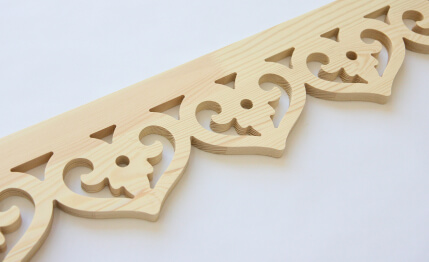
- Slats and carved decor
- Slats and furniture handles
- Structural solutions: how slatted partitions are mounted
- Floor-to-ceiling mounting
- Wall mounting
- Freestanding partition
- Errors in selecting and installing a slatted partition
- Slats that are too thin for a tall structure
- Too frequent step in a small room
- Raw or unstable material
- Different wood shades in one structure
- Lack of connection with baseboards and doors
- Attempting to build a functional barrier from decorative slats
- Additional possibilities: what else can be done with slats
- Practical tips before buying: what to clarify
- FAQ: answers to popular questions about slatted partitions
- What slats are needed for a slatted partition?
- What spacing should be between the slats?
- What type of wood is best for a slatted partition?
- Can a slatted partition be used in a small apartment?
- How to treat the slats for a partition?
- Where to buy wooden slats for a partition?
- How Much Does a Wooden Slat Partition Cost?
- About the Company STAVROS
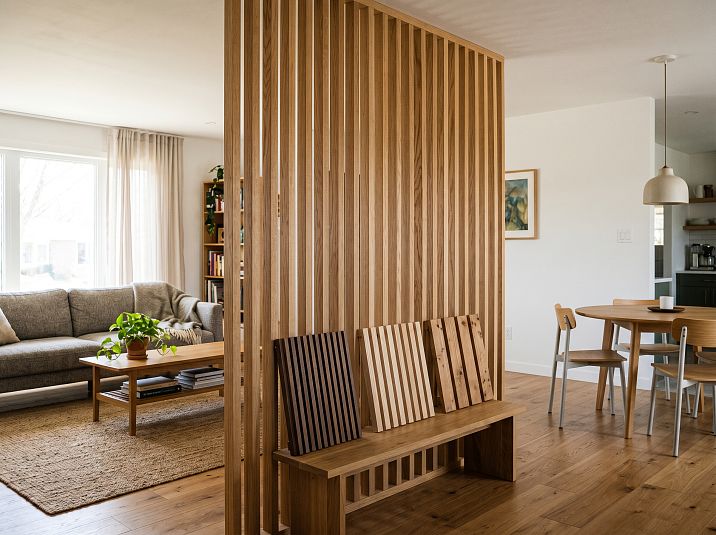
Modern interiors have long ceased to be just a set of walls and furniture. It is a living, thoughtful environment where each element performs several functions at once: divides space, creates mood, works for aesthetics and convenience simultaneously. And in this environment, a wooden slatted partition is one of the smartest and most expressive techniques.
Why smart? Because it solves the zoning problem without walling the room into a solid wall. It lets light through, creates a visual connection between zones, and at the same time marks the boundary — tactfully but convincingly. It is an architectural element, decor, and functional structure all in one.
Wooden slatted partition — not a trendy fad of recent years, but a proven principle that works in a wide variety of interiors: from a minimalist studio to a classic living room with high ceilings. But for it to work properly, you need to know how to choose it. And that's exactly what this article will cover—in detail, honestly, and with specific guidelines.


Why do you need a slatted partition at all: the functions it performs
Before talking about choosing slats, sections, and spacing, it's worth understanding why a slatted partition appears in a specific project. Because the task determines the design—and the design determines the material.
Zoning without losing light. This is the main reason why a partition made of wooden slats wins over a solid wall. The slats divide the space but do not block the flow of natural light. This is critical for apartments with only one light side, for studios, and for kitchen-living rooms where it's important not to turn the kitchen area into a dark corner.
Visual accent. Vertical wooden slats create an expressive graphic rhythm—what is called a 'play of verticals.' This rhythm organizes the space, gives it an architectural character, and makes the room more interesting even if the zoning function is not the main one.
Acoustic barrier. A slatted partition does not provide soundproofing in the full sense, but it reduces the direct sound flow between zones—for example, between the kitchen and a workspace. It's a soft barrier, not an insulating wall.
Decorative element. Finally, simply beauty. Wooden boards in interior — it's a warm, natural texture that softens any interior, adds life to it, and gives a sense of handcraftedness.




Where to use a wooden slatted partition: an overview by zones
The answer to the question 'where?' helps determine 'which one?' Different zones dictate different requirements for the design.
Our factory also produces:


Kitchen-living room
This is the most popular place for a slatted partition in a city apartment. The task is to separate the food preparation and relaxation zones while maintaining the feeling of a single space.
Two parameters are important here: the height of the partition and the spacing between the slats. Full height from floor to ceiling creates a clear boundary. A partition up to 1.8–2.0 m provides a softer, semi-transparent separation. The spacing depends on how enclosed the kitchen should be: if privacy is needed while cooking, the spacing is made denser.
Get Consultation
Hallway and corridor
Slatted partition in the hallway — this is the boundary between the entry area and the living room, home office, or bedroom. Here the structure must be sturdy: the hallway is an area of active movement, with possible accidental impacts and loads.
Often in the hallway, the partition also serves a decorative function: it hides coat racks, shoe cabinets, or utility areas, while the slats create a beautiful facade. In this case, the slats should be dense enough to conceal what is behind them.
Bedroom
A slatted partition in the bedroom — typically for zoning the bed from the work area, dressing room, or bathroom. Here the privacy requirements are higher: the spacing between slats should be minimal if the partition separates the sleeping area.
Often the partition in the bedroom serves as a headboard for the bed — a decorative wall behind it. In this option, the slats are mounted on a small section of the wall, creating an accent zone.
Living room and TV zone
Slats behind the sofa are one of the popular decorative techniques. Here the partition does not so much divide as it creates a "back" for the sofa, framing the relaxation area as an independent space within a large room.
Slats are also used as a background for the TV zone: they create a warm wooden backdrop for the screen and equipment, eliminating the need to hang the TV on a bare white wall.
Office and work area
In a workspace, a slatted partition creates a psychological boundary — important for concentration. This is especially relevant in apartments where the work area is combined with the living room or bedroom.
Staircase area
In country houses and duplex apartments, slats are often used instead of balusters and stair railings. This is a modern alternative to classic handrails: vertical slats along the entire height of the flight create a rhythmic, lightweight screen. Important: in this case, slats must meet strength and safety requirements — the distance between them should not exceed 100 mm (especially if there are children in the house), and the fastening must withstand lateral loads.
Studio apartment
A studio is the ideal context for a slatted partition. There is no opportunity to install a solid wall without losing the sense of spaciousness. Slats solve the problem elegantly: they define zones, give each its own character, and do not fragment the space.
Which slats to choose for a partition: material, wood species, treatment
The question 'what from?' is no less important than 'what size?'. The material determines durability, appearance, finishing options, and how the slats will age over the years.
Solid wood slats
solid wood millwork — the best choice for an interior partition. Solid wood is geometrically stable when properly dried, accepts any finish well (oil, varnish, stain, paint), does not delaminate, and does not deform under normal operating conditions.
Solid wood slats are real wood in every sense of the word: with a living texture, an individual grain pattern, and a warm natural tone that no imitation material can fully reproduce.
Oak: heavy, hard, indispensable
Oak is the first choice for partitions that require strength and durability. This is especially relevant for stair railings, partitions in hallways, and structures with great height (floor-to-ceiling over 2.5 m).
Oak slats are hard and not prone to bending even over significant lengths. Oak texture is expressive, with a characteristic large pattern that looks especially beautiful when treated with oil or clear varnish.
Oak takes stains well: from light natural to rich dark walnut. When treated in gray or cool tones (so-called "smoked oak"), the slats acquire a modern, restrained look — ideal for minimalist or Scandinavian interiors.
Beech: precise geometry, fine texture
Beech is a more uniform material with a fine, dense texture. Beech slats provide ideal geometry: sharp edges, smooth surface, stable dimensions. This is important for partitions where slats stand in a line and any deviation from correct geometry will be noticeable.
Beech takes opaque paints well: white, gray, black — for partitions under paint, this is one of the best options. The natural color of beech is a warm pinkish-cream, quite neutral.
Pine: affordable, but with nuances
Pine is the most affordable wood species for slats. Easy to work with, takes paint well. But pine has two limitations: it is soft (easily scratched) and prone to resin exudation, which requires additional surface treatment before finishing.
For partitions in areas with low mechanical load (decorative partition behind a sofa, partition in a bedroom), pine is quite suitable. For stair railings and hallways, it is better to choose harder wood species.
Slats for painting versus for staining
This is a key question when choosing material. If the slats are planned to be painted in an opaque color (white, gray, black, colored) — the wood texture is not important, the uniformity of the surface is. Here, beech and properly prepared pine work well.
If you plan a tinting that preserves the texture (oil, transparent stain, varnish without coverage) — choose a species with a beautiful natural pattern: oak, ash, walnut. The texture will be the main decorative element.
Finishing treatment of slats
How to treat slats for a partition is a separate important question:
-
Oil — protects the wood, maintains a matte surface, does not create a film. Tactilely — the most natural feel. Requires periodic renewal (every 2–5 years depending on intensity of use)
-
Oil-wax — a more durable coating than pure oil. Gives a slight satin sheen
-
Varnish (matte or satin) — the most durable coating for areas with mechanical load. Clear varnish preserves the visibility of the texture
-
Enamel or acrylic paint — for opaque color. Completely hides the texture, gives an even color
-
Stain + varnish — stain gives the desired shade, varnish fixes and protects
Important point: slats should be treated before installation — all edges, all surfaces. After installation, the ends and lower parts of the slats hidden by fasteners will remain untreated, which can lead to uneven aging of the material.
How to choose the cross-section of slats for a partition
The cross-section is the width and thickness of the slat in a transverse cut. It determines the visual weight of the partition and its structural reliability.
Cross-section parameters and their impact
| Section | Visual effect | Application |
|---|---|---|
| 20 × 20 mm | Very lightweight, airy structure | Decorative screens, low-load zones |
| Lightweight, well-readable | Studios, bedrooms, areas behind the sofa | Studios, bedrooms, areas behind the sofa |
| 40 × 40 mm | Balanced | Universal solution for most cases |
| 40 × 60 mm | More massive, rectangular | Kitchen-living room, hallway, zoning with function |
| 50 × 50 mm | Expressive, "weighty" | Spacious living rooms, country houses |
| 60 × 80 mm and larger | Monumental | Large spaces, staircases, formal areas |
Structure height and cross-section requirements
The higher the partition, the larger the cross-section of the slats should be — that's physics. A long, thin slat bends under its own weight and under any lateral load. This is not only unaesthetic but also potentially unsafe.
Practical guidelines:
-
Height up to 2.4 m → cross-section from 30 × 30 mm
-
Height from 2.4 to 3.0 m → cross-section from 40 × 40 mm
-
Height from 3.0 m → cross-section from 50 × 50 mm or rectangular profile 40 × 60 mm and larger
For heights over 2.4 m, slats are typically attached not only to the floor and ceiling but also to an intermediate horizontal crossbar — this prevents vertical bending.
Square or rectangular cross-section
A square cross-section (40 × 40, 50 × 50) creates a consistent visual rhythm when viewed from the side and front. This is a neutral, versatile option.
A rectangular cross-section (30 × 50, 40 × 70) creates a different visual effect depending on how the slat is oriented. If the wide side faces forward, the partition looks flatter and more "screen-like." If the wide side faces sideways, the slats appear thin, and the space between them seems deeper.
For decorative partitions in modern interiors, slats with a rectangular cross-section are often used, placed not parallel to the wall but at a slight angle — this creates a lively, changing optical effect as you move.
Spacing between slats: how to calculate and what to consider
The distance between slats is a parameter that determines the density of the partition, its degree of "transparency," and the visual weight of the structure.
Three spacing ranges
Dense spacing (up to 50 mm between slats) — the partition significantly blocks the view. Light passes through, but what is behind the partition is not clearly readable. Suitable when real privacy is needed: a dressing area behind slats, a kitchen hidden from the living room, a workspace.
Medium spacing (50–100 mm) — a balance between transparency and enclosure. The partition marks a boundary but does not create a solid barrier. Light passes freely. Zones are visually connected but separated. The most versatile option.
Wide spacing (over 100 mm) — a partition that marks a zone rather than encloses it. More decorative than functional. Good for accent wall design, areas behind a sofa, or TV zones.
How spacing relates to slat width
The visual perception of the partition is determined by the ratio of slat width to the distance between slats. If the slat width is 40 mm and the spacing is 40 mm — a 1:1 ratio, the partition looks rhythmic and strict. If the slat is 30 mm and the spacing is 90 mm — a 1:3 ratio, the partition looks light and airy.
For modern and minimalist interiors, a 1:2 or 1:3 ratio (slat thinner than gap) works well. For classic interiors — 1:1 or 1:1.5 (slat and gap roughly equal).
Opening width and number of slats
Before calculating the spacing, fix the width of the opening that the partition will occupy. Then — simple arithmetic:
Number of slats = (opening width) ÷ (slat width + spacing)
With an opening width of 1200 mm, a slat of 40 mm, and a spacing of 60 mm: 1200 ÷ (40 + 60) = 12 slats.
The final spacing is adjusted: the remaining millimeters are distributed evenly between the slats so that the outer slats are positioned symmetrically relative to the center.
Wooden slat partition in different interior styles
Slats do not belong to any single style — they fit organically into completely different contexts. But in each context, the choice of material, cross-section, and spacing will be different.
Modern interior and minimalism
In a minimalist interior, slats are graphics. Clear vertical lines, equal spacing, a uniform surface — everything works for strictness and rhythm. Material: oak in natural oil or in a "smoky" tint. Cross-section: 30 × 50 or 40 × 40. Spacing: medium, 60–80 mm.
No decorations, no ornament, no decorative details — only slats and the space between them. This is the language of minimalism.
Scandinavian style
In a Scandinavian interior, slats made of light wood (ash, birch, light beech) create a warm accent in a neutral white-gray-linen space. Cross-section — small, 20 × 30 or 30 × 40. Spacing — medium or sparse. Finish — matte oil or transparent wax.
Scandinavian aesthetics do not tolerate heavy, monumental structures. Here, slats should be light, almost weightless.
Classic interior and neoclassicism
Can a slat partition be incorporated into a classic interior? Not only can it — it should, if done correctly. In a classic context, slats take the form of wooden pilasters or colonnades: a wider cross-section (50 × 50 or 60 × 60), profiled ends, tinted to walnut or cherry.
Such wooden room partition in a classic interior should echo wooden skirting boards, moldings the overall wooden tone of the space. Then it is perceived as an architectural element, not as an alien insert.
Country house with wooden interior
In a country house with exposed wooden beams, plank floors, and timber walls, slats become a continuation of the house's architectural language. Here, massive slats of oak or pine in natural or slightly tinted form are appropriate.
The texture should not be perfect — live knots, slight variations in grain width, tool marks (with hand planing) only add character. These are not defects — they are the natural honesty of the material.
Studio apartment
A studio requires maximum functionality with minimal loss of space. A slatted partition for a studio apartment is an optimal choice: light cross-section (30 × 30 or 40 × 40), medium or wide spacing, painted to match the walls or in a neutral color that does not visually 'eat up' space.
If the studio has a dark floor, the slats should be light. If the walls are white, slats in natural wood create a warm contrast.
How to combine a slatted partition with other interior elements
Slats are not an independent object; they always exist in context. And it is the consistency with this context that determines whether the partition will look like an organic part of the interior or like a random structure.
Slats and wooden baseboards
Wooden Skirting Boards With a pronounced profile, the slats and partition should be matched in tone and, preferably, in wood species. If the baseboard is oak with oil finish, the slats should also be oak with oil finish. If the baseboard is white, the slats should be either white or in a neutral warm tone.
The junction of the slat with the baseboard at the bottom point is an important structural and aesthetic detail. The slat should either sit on the baseboard (if the installation allows such a fit) or go behind it — but in no case should it cut off the baseboard at the point of contact.
Slats and wooden moldings
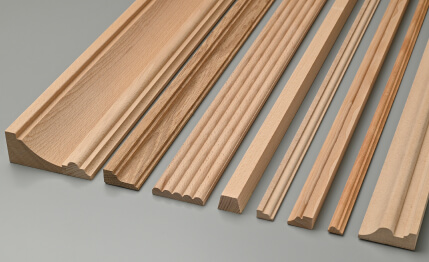
If the interior has Wooden moldings — decorative profiles on walls, ceilings, or doorways — the partition slats fit into their system. The horizontal crossbar of the partition (the top beam to which the slats are attached) can be made from the same profile as the wall moldings. This creates a sense of a unified architectural concept.
Slats and wooden cornice
wooden cornice at the top of the partition — this is a professional technique that completes the structure and visually integrates it into the room's architecture. The cornice hides the top attachment of the slats, adds profile, and makes the partition look like an architectural element rather than a DIY structure.
This is especially relevant in classic and neoclassical interiors: the cornice above the partition echoes the cornices above windows and doors.
Slats and classic furniture
Classic Furniture with wooden details — sofas with wooden armrests, consoles, display cabinets — requires the slatted partition to have a coordinated tone and style. The slats should be from the same wood family as the furniture details.
Contrast is acceptable — for example, light slats with dark furniture — but it must be intentional, not accidental. Accidental contrast always looks like a mistake.
Slats and carved decor
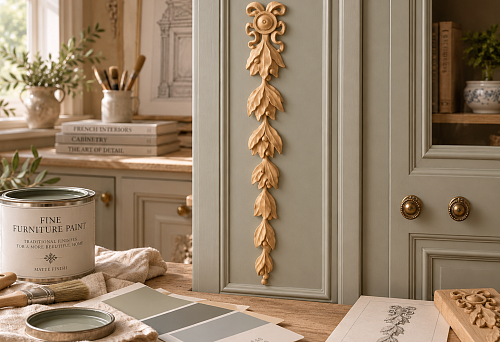
Carved wooden decoration — applied rosettes, cartouches, corner elements — can be used to decorate the top and bottom crossbars of the partition. This is a classic technique for interiors with rich decor: the slats remain simple, while the decor is concentrated in the structural elements.
This approach allows combining the simplicity of the slats themselves with the expressiveness of the framing.
Slats and furniture handles
A small but important nuance: if the slats adjoin cabinets, display cases, or other furniture with handles, the material and tone wooden furniture handles must be coordinated with the slats. This is a minute detail noticed only by those who look closely — but it is precisely such details that create the feeling of a high-quality interior.
Structural solutions: how slatted partitions are attached
Slats can be installed in several ways — the choice depends on the structure, height, load, and type of ceilings.
Floor-to-ceiling attachment
The most common option. The slats are attached to horizontal beams or metal profiles fixed to the floor and ceiling. The top and bottom beams are load-bearing elements to which the slats are fastened with screws, dowels, or into grooves.
For heights over 2.4 m, an intermediate horizontal crossbar is added at a height of approximately 1.2–1.5 m — it prevents the slats from bending under lateral load.
Attachment to walls
If the partition adjoins one or two load-bearing walls, the side posts are attached to the walls using anchor bolts or dowels. This significantly increases the rigidity of the structure.
Freestanding partition
A partition without attachment to walls — either due to the weight of the lower base (a box with filler) or due to the spread between the floor and ceiling. This is a mobile option: such a partition can be moved or removed without leaving marks on the finish.
Freestanding structures are suitable for lightweight decorative partitions made of thin slats — not for functional enclosures.
Mistakes when choosing and installing a slatted partition
Experience shows: most mistakes are related not to technical complexity, but to underestimating the physics of the material and the scale of the task.
Slats that are too thin for a tall structure
This is the first and most common mistake. A slat with a cross-section of 20 × 20 mm at a height of 2.8 m is an unstable, sagging structure. When touched, the slats "play"; under lateral load, they deflect. It looks untidy and feels unreliable.
Too frequent spacing in a small room
A dense partition in a small space creates a cage effect. It visually fragments an already small area, blocks light, and makes the room feel even smaller. In small rooms, use only sparse or medium spacing.
Raw or unstable material
Undried wood is a source of major problems. After installation, it deforms: the slats "warp," they bend, twist, and change size. The result is a skewed, uneven structure that will need to be completely redone.
For interior work, only kiln-dried wood with a moisture content of 8–12% is used. Wooden trim from the catalog undergoes proper preparation — this guarantees stability after installation.
Different wood shades in one structure
Slats purchased from different batches may have a subtle difference in shade or texture that is not noticeable at first glance. After installation and drying of the finish, this difference becomes obvious. This is especially critical when tinting: the same stain on two different batches of oak yields different results.
Purchase all material for the partition from one batch. If a long length is needed, specify when ordering that all slats must come from the same raw material block.
Lack of connection with baseboards and doors
The most "invisible" yet most noticeable mistake. Slats in "natural oak" color, baseboards in dark walnut, doors in white — three different stories in one space. Slats, baseboards, and doors should belong to the same tonal family — not identical, but coordinated.
Attempting to build a functional barrier from decorative slats
For stair railings, balconies, children's rooms — slats must withstand standard lateral loads (at least 1 kN/m horizontally). Decorative thin slats are not designed for these tasks. Here, more robust elements with appropriate cross-sections and fastening systems are needed.
Additional possibilities: what else can be done with slats
A slatted partition is just one option for using wooden slats in an interior. The same material, the same system — and completely different tasks.
Accent wall. Slats are mounted on the wall — not as a partition, but as a wooden "carpet" on one surface. This is an accent wall behind the bed, behind the sofa, or on the TV zone wall.
Ceiling structure. Slats are suspended horizontally from the ceiling — creating a wooden "lattice" ceiling or a decorative area above the dining table, above the bed, or above the bathtub.
Decorative panels. Slats form modular panels that are attached to the wall — this is a quick way to change the character of a zone without construction work.
All these options are implemented from the same material — high-quality solid wood moldings with proper treatment.
Practical tips before buying: what to clarify
Before buying slats for a partition, go through the following checklist:
-
Measure the opening (width and height) with an accuracy of 5 mm — the number of slats and step calculation depend on this
-
Determine the type of mounting — to the floor and ceiling, to walls, freestanding structure
-
Choose the wood species — considering load, desired texture, and type of finish
-
Determine the cross-section — considering the partition height and visual effect
-
Calculate the step — based on the required density and slat/gap ratio
-
Coordinate the tone with wooden interior elements: baseboards, doors, furniture
-
Order with a 10–15% margin — to compensate for waste during cutting and trimming
FAQ: answers to popular questions about slat partitions
What slats are needed for a slatted partition?
For interior partitions, solid wood slats with a cross-section from 30 × 30 to 60 × 60 mm are used, depending on the structure's height and load. For partitions over 2.4 m high, a cross-section of at least 40 × 40 mm is recommended.
What spacing should be between the slats?
It all depends on the task. For a partition with real privacy — 30–50 mm between slats. For decorative zoning — 60–100 mm. For an accent screen — 100–150 mm. The spacing is also chosen based on aesthetics: the ratio of slat width to gap creates a visual rhythm.
What type of wood is best for a slatted partition?
For high-traffic areas (hallway, staircase) — oak or beech. For decorative partitions in the living room or bedroom — oak, ash, pine. For partitions to be painted — beech or well-prepared pine.
Can a slatted partition be used in a small apartment?
Yes. But with conditions: light tone of slats, light cross-section (30 × 30 or 30 × 40), sparse or medium spacing. The partition should not block the light flow and should not 'eat up' the space.
How to treat the slats for the partition?
Slats are treated before installation — all edges and surfaces. For areas with normal use: oil or oil-wax. For high-traffic areas: varnish (matte or satin). For painting: primer + enamel or acrylic paint.
Where to buy wooden slats for the partition?
In the solid wood moldings slats and profiles for interior structures are presented. Also — Moldings, Baseboards и Crown Molding to complete the structure.
How much does a wooden slatted partition cost?
The cost depends on the type of wood, the cross-section of the slats, the height and width of the structure, the type of finish, and the complexity of installation. Check current prices in the catalog and when placing an order.
About the company STAVROS
A proper wooden partition is not just construction. It's about choosing the material, understanding proportions, and consistency with the rest of the interior. And all this requires high-quality raw materials from which the final result is made.
STAVROS produces and supplies wooden moldings, slats, and solid wood profiles for interior structures. In the catalog wooden trim — slats from different species with proper kiln drying, ready for finishing and installation. Next — Moldings, Baseboards, Crown Molding и Carved Decor — everything you need to make the partition part of a cohesive interior, not a separate structure.
In the section wooden products you can select all the elements to create a wooden interior in any style — from a minimalist studio to a classic living room with high ceilings.
Start with the STAVROS catalog — and choose a material that will last for decades.