Article Contents:
- One article number, two depths, and three length options
- A millimeter on paper and a millimeter on a painted facade are not the same thing
- Where this millimeter is located and why the direction of the bevel matters
- When mixing MDF and solid wood within one frame is especially risky
- Closed rectangular frame
- One long continuous line
- Adjacent facades of the same kitchen or wardrobe
- Glossy enamel
- Side Lighting
- Profile output flush with adjacent part
- New independent frame
- Different wall panel
- Separate piece of furniture
- Entire new contour from a single material
- Compensation confirmed by test assembly
- Difference turned into intentional relief
- Example with a tall door
- Example with a furniture frame 700 × 400 mm
- Example with two identical frames
- Caliper
- Straight ruler or straightedge
- Side Lighting
- A paper strip about a millimeter thick
- Physical sample
- A separate facade within the same wall
- A facade on an adjacent wall
- Furniture in another room
- A standalone dresser
- Door panel and furniture facade
- Missing one short horizontal piece inside the MDF frame
- Missing the entire frame on a new facade
- Missing a vertical piece 2500 mm long
- Order the same number of slats
- Unfold the beveled profile
- Make control only from the front
- Check the sample without finish
- Use glue as a calibration shim
- Place a random material underneath
- Grind down the array from the top
- Do not specify the facade number
- Combine old and new batches without marking
- Order oak for a clear finish to white MDF
- Cannot compare adjacent facades
- Cannot record replacement ban
- Buy short planks without cutting map
- Schedule installation before trial assembly
- Find the source document
- Measure the physical sample
- Check the frame condition
- Create a position map
- Choose a strategy
- Record the full configuration
- Check the cart and invoice
- Approve the control sample
- Only after this pay for the batch
- Will beech MLD-063 give a difference of exactly 1 mm relative to MDF?
- Can MDF and beech be mixed in one frame?
- Can MDF and oak be mixed?
- Why is the article number the same, but the size different?
- What is the size of MLD-063 made of MDF?
- What is the size of MLD-063 made of beech?
- What is the size of MLD-063 made of oak?
- Can the 2500 mm side be covered with a single beech plank?
- Will enamel hide a 1 mm difference?
- Can profiles be leveled with primer?
- Can a 1 mm thick material be placed under MDF?
- Can beech be sanded down to 8 mm?
- Can beech be used on a separate new facade?
- Can oak be used on a separate cabinet?
- What is better for covering enamel?
- What should I choose for a clear finish?
- How to check the difference before ordering the entire batch?
- Is it necessary to order one test plank?
- Can MDF and solid wood be joined at a 45° angle?
- Why is the length of the plank important?
- How to write MLD-063 in the specification?
- Is it enough to write "MLD-063, MDF"?
- How to prohibit material replacement?
- What to do if the manager has already replaced MDF with beech in the invoice?
- Where can I see the price of MLD-063?
- Can I order MLD-063 for a door frame?
- How to calculate the quantity for the frame?
- Is a reserve needed when reordering?
- Can solid wood be placed only on the bottom side of the frame?
- What will be more noticeable: the difference in material or the difference in height?
- How to make the final decision?
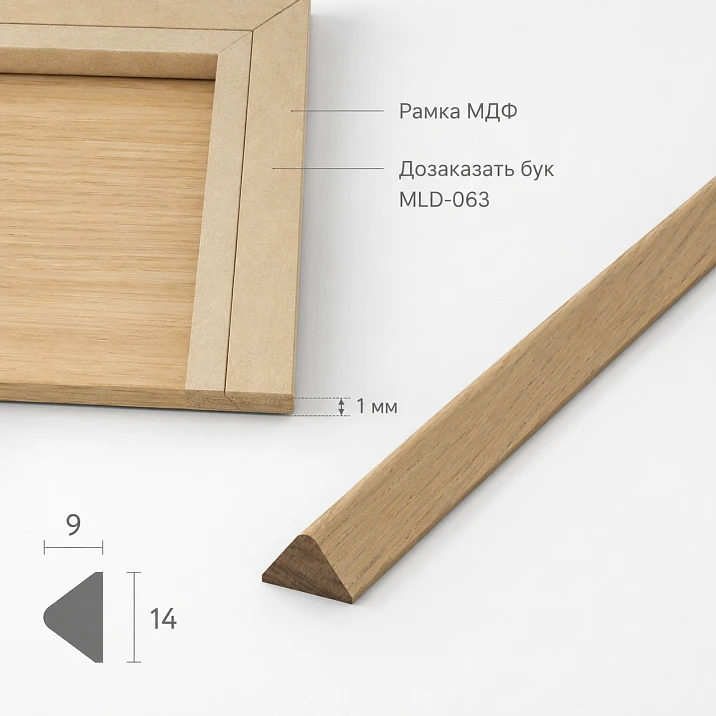
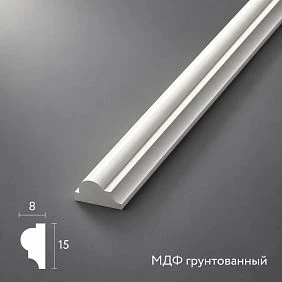
Half of the furniture fronts are already ready. The doors have a thin beveled MLD-063 made of MDF with a cross-section of 14 × 8 mm, corners are mitered, frames are primed or painted, and there is not enough profile for the remaining fronts. The reorder offers the same article number in beech or oak. The name matches, and the face width also remains 14 mm. It seems that the material can be replaced without consequences. But solid wood has a different depth: 14 × 9 mm. One millimeter is exactly where the finished frame should look like a single plane.
If you fix MDF 8 mm thick and solid wood 9 mm thick on one flat base without compensation, the wooden strip may protrude by approximately 1 mm. This is a conclusion from the profile dimensions, not a promise of an exact result after installation. The actual step depends on the base, adhesive layer, primer, enamel, sanding, bevel direction, joint position, and real tolerances of specific parts. On a matte surface, the difference sometimes looks softer; under side light and on glossy enamel, even a small difference can draw a frame with a thin shadow line.
Therefore, the question is not: "Can MDF and beech be combined at all?" Materials can be used in one project when they perform different tasks or form independent contours. The problem begins when a new material is wanted to be invisibly continued inside an already started frame, relying only on the matching article number. MLD-063 in MDF and MLD-063 in beech or oak are similar in pattern and identical in face height A, but not identical in size C and available length.
Short recommendation: do not mix MDF 14 × 8 mm and solid wood 14 × 9 mm inside one closed frame without a sample and test assembly. For a reorder, first determine the material of the first batch, measure the actual depth of the already installed profile, check the direction of the beveled edge, and decide whether the entire new contour can be made from one material. After such a check, you can buy molding MLD-063 in the required configuration, rather than just adding several strips with the same number to the request.
One article number, two depths, and three length options
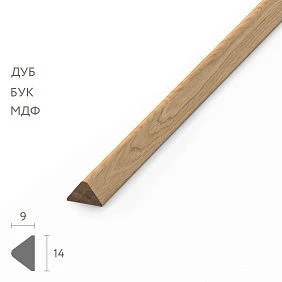
MLD-063 retains the overall shape and face width of 14 mm, but the card separates configurations by material. MDF has a cross-section of 14 × 8 mm and a length of 2600 mm. Beech and oak have a cross-section of 14 × 9 mm and are offered in lengths of 1000 or 2400 mm. Already from this table, it is clear why the line "MLD-063 — 6 pcs." is not suitable for a reorder.
| Material MLD-063 | Size A × C | Confirmed length L | What changes when reordering |
|---|---|---|---|
| MDF | 14 × 8 mm | 2600 мм | Matches the original profile if the first batch was also made of MDF |
| Beech | 14 × 9 mm | 1000 or 2400 mm | Depth increases by 1 mm, length and finish type change |
| Oak | 14 × 9 mm | 1000 or 2400 mm | Depth increases by 1 mm, texture may remain visible with a transparent finish |
Parameter A determines the size of the visible line along the facade plane. It equals 14 mm for all variants. Therefore, when viewed strictly from the front, the new strip may seem suitable: the contour has the same width, corners can be marked using the previous template, and the inner field of the frame barely changes.
Parameter C shows the depth, i.e., the profile's protrusion above the base. This is where the difference appears: 8 mm for MDF versus 9 mm for beech and oak. If two materials lie side by side, their top points may not be in the same plane. A step occurs at the joint, and a different shadow appears along the new section.
Parameter L determines not only delivery and cutting convenience. MDF with a length of 2600 mm allows covering a side up to 2.6 m with one strip, considering the actual cutting map. For solid wood, the full-size option is limited to 2400 mm, and the short one is 1000 mm. If the first vertical was made of solid MDF 2600 mm, replacing it with beech of the same full length is impossible without a new solution for the joint or a change in design.
Matching the article number indicates profile kinship but does not cancel the chosen modification. In the specification, MLD-063 must be accompanied by the material, full size A × C × L, sanding quality, finish, and quantity. Otherwise, the manager sees the model number but does not understand which specific strip needs to be replicated.




A millimeter on paper and a millimeter on a painted facade are not the same thing
One millimeter seems like a quantity that is easy to hide with paint. On a ruler, it is almost imperceptible. On a furniture frame, the situation is different: the difference repeats along the entire length of the strip and acts as a continuous boundary of light and shadow.
Imagine a facade where three sides of the frame are made of MDF 14 × 8 mm, and the fourth is made of beech 14 × 9 mm. The front width around the perimeter matches, but one side protrudes higher. Under frontal diffused light, the difference may not be noticeable. Once you turn on side lighting, open the door at an angle, or run your palm over the corner, the transition becomes tangible.
The difference is especially noticeable in five situations:
-
on glossy enamel, which emphasizes the unevenness of reflection;
-
with side light from a window, wall lamp, or linear lighting;
-
on a long continuous side, where the shadow runs without interruption;
-
at the corner joint, where ends of different depths are difficult to align into a single plane;
-
next to a neighboring facade from the original batch, when two frames are compared simultaneously.
Matte enamel scatters light and sometimes softens the step, but does not eliminate the geometry. Primer and paint add a layer to both parts. If the coatings are applied equally, the original difference in depth does not have to disappear. A thicker layer on MDF could theoretically bring the surfaces closer, but you cannot build an order on a random difference in the thickness of the paint coating. The finish is applied for color and protection, not as a guaranteed calibration shim.
Sanding after installation is also not an automatic answer. MLD-063 has a beveled shape. By removing material from the higher wooden strip, the craftsman changes not only the depth, but also the geometry of the front plane, the sharpness of the edge, and the width of the light highlight. If 1 mm is sanded off unevenly, the new section will differ not by a step, but by the shape of the profile.
That is why the wording must be careful: the difference between C = 8 and C = 9 mm creates the precondition for an approximately millimeter protrusion on the common flat base. The real result is verified with a physical sample, not with a promise that the enamel will hide everything.
Our factory also produces:
Where is this millimeter located and why the direction of the bevel matters
MLD-063 — beveled profile. It works not like a rectangular strip with the same plane across its entire width, but like a thin inclined line. The position of the high and low sides affects where the shadow falls and how the frame is perceived relative to the center of the facade.
If in the first batch the bevel is directed inward of the frame, the new section must repeat the orientation. Rotating the strip changes the chiaroscuro even with the same material. When combining MDF and solid wood, the error intensifies: one side may differ in both direction and depth.
Before reordering, photograph the installed profile from the side. On the drawing or in the list, indicate:
-
which edge faces the inner field;
-
where the high side is;
-
where the low side is;
-
how the molding fits into the corner cut;
-
on which facade and in which position the strip is missing.
You can't limit yourself to the note "bevel as before." The new batch may not have the first sample in front of them, and a strictly frontal photo doesn't show the relief. It's better to attach a side photo, a drawing fragment, and a physical offcut of the original MDF, if it's been preserved.
When rotating the frame on an adjacent facade, the orientation also needs checking. The same bevel can be directed toward the center of each door or uniformly across the entire group of facades. These are different compositions. A reorder must replicate the approved system, not just the profile number.
Get Consultation
When mixing MDF and solid wood within a single frame is especially risky
Not every combination of materials is equally noticeable. The risk becomes maximal when the eye expects continuity.
Closed rectangular frame
The four sides form a single contour. Any difference in depth is reflected in the corners and along the long lines. If one side is made of solid wood and three are MDF, the eye compares them automatically.
In such a case, it's better to reorder the original MDF or replace the entire contour, rather than inserting a single wooden strip. Even careful compensation requires a test assembly.
One long continuous line
A horizontal band on a cabinet or a vertical line on a wall panel reads as a single piece. A material joint in the middle creates a local transition in depth and can change the shade after finishing.
A transition at eye level and in the side-lighting zone is especially undesirable. If you separate the materials with a constructive pause, seam, or a separate field, the difference becomes intentional. A hidden joint without such separation is risky.
Adjacent facades of the same kitchen or wardrobe
Even if MDF and beech do not meet within the same frame, two adjacent facades can show different depths. Handles, gaps, and identical enamel enhance the comparison. One millimeter along C can change the shadow around the perimeter.
In the kitchen, this is especially noticeable with built-in lighting and glossy facades. In the wardrobe, it is noticeable with a long line of identical doors. For a group perceived as a single panel, it is better to keep one material and one geometry.
Glossy enamel
Gloss reflects the straight lines of the room. In an area with a difference, the reflection breaks. Even if the color matches completely, the surface shows the difference through the glare.
Matte or deep matte finish is less demanding on reflection, but does not eliminate the step. Gloss only makes it more obvious.
Side lighting
Light along the facade turns a millimeter into a narrow shadow. The longer the area and the closer the source to the plane, the more noticeable the relief. Before ordering, it is useful to check the frame not only under general ceiling light, but also with a portable lamp directed from the side.
Aligning the profile flush with the adjacent part
If MLD-063 must match the height of the overlay, panel, molding, or insert edge, increasing C from 8 to 9 mm disrupts the joint. Here the issue is not only aesthetic: the connection changes.
When replacing MDF with beech or oak may be acceptable
A categorical prohibition would also be inaccurate. There are situations where new material can be used without attempting to blend in as part of the old contour.
New independent frame
If the next facade is designed as a separate closed contour and does not touch the MDF frame, the entire new contour can be made of beech or oak. The difference in depth will remain, but it will be distributed evenly across all four sides.
Such a solution is still checked next to finished facades. On a group of identical doors, 1 mm may read as a difference in series. On a standalone cabinet or other piece of furniture, the risk is lower.
Another wall panel
New material can be used on a standalone panel separated by a corner, a wall section, a doorway, or another architectural break. The eye does not require a full match between two frames that are not in the same field of view.
Separate piece of furniture
A dresser and a wardrobe can have the same MLD-063 but different profile depths if each piece is perceived separately. In this case, it is more important to match the color, scale, and overall style.
Entire new contour from one material
If only one short MDF strip is already glued on an unfinished facade, it is sometimes wiser to remove it before finishing and make the entire frame from solid wood. The possibility of removal depends on the substrate and the adhesive. The decision is made by the cabinetmaker after assessing the risk of damaging the facade.
Compensation confirmed by control assembly
A professional workshop can develop a backing, choose a fit, or calibrate the assembly so that the face surfaces align. But this must be a real technological solution with a sample, not a phrase like "we'll put something thin underneath."
The difference is turned into a deliberate relief
Sometimes a new frame is designed as a more protruding second level. Then 1 mm becomes part of the composition. But this option is no longer an unnoticeable replacement of MDF with beech. This is a design change that needs to be shown on the drawing and approved.
The basic principle: mixing is acceptable where materials do not have to look like one continuous piece, or where the difference is pre-compensated and verified.
Why a thin backing is not a universal solution
The logic seems simple: place a 1 mm backing under 8 mm MDF or choose a thicker glue layer to bring it level with 9 mm solid wood. In practice, this method creates new variables.
The backing must:
-
have stable thickness along the entire length;
-
not compress;
-
securely connect to the facade and molding;
-
not extend beyond the edge;
-
not show through after painting;
-
not disrupt corner joints;
-
maintain flatness over a long section.
If the backing is used only under one side of the frame, the corners require a transition between two levels. If it goes under the entire old MDF contour, you essentially have to redo the already installed frame.
A thick layer of adhesive is even less predictable. It can shrink, squeeze out, spread unevenly, and change height along the length. Mounting compound is chosen for fixation, not for precise calibration of a millimeter level, unless the manufacturer and technology explicitly provide for such a task.
Professional compensation is possible, but it is designed for a specific substrate. Before paying for beech or oak, ask the craftsman to show a sample: a piece of MDF 14 × 8 mm, new solid wood 14 × 9 mm, the selected backing, adhesive, and finish. The sample shows whether the flatness is maintained after drying.
Can one millimeter be removed from the back of the solid wood
Theoretically, a workshop can calibrate a wooden strip. Practically, it cannot be promised in advance that MLD-063 made of beech or oak can simply be run through a machine to get an exact copy of MDF 14 × 8 mm.
Need to check:
-
does the safe profile thickness remain;
-
does the beveled geometry not change;
-
is straightness preserved;
-
is the face edge not damaged;
-
can the entire length be processed evenly;
-
what will the surface look like after sanding;
-
will the operation affect the miter cut.
If material is removed from the back plane, the face shape theoretically preserves better than when sanding from the top. But accuracy depends on the equipment and the condition of each slat. Such refinement should not be assumed in a regular order without approval.
Additionally, calibration does not resolve the difference in length. The solid wood remains 1000 or 2400 mm, whereas the original MDF could be 2600 mm. For the long side, a joint or different cutting pattern will be required.
Therefore, ordering beech with the idea "we'll sand off a millimeter on site" is risky. First, the craftsman confirms the operation on a sample, then the material is included in the specification with a separate note about the refinement.
Length 2600 mm vs 2400 and 1000 mm: a special order may not cover the side entirely
The difference in C attracts the main attention, but length sometimes becomes an even stricter constraint.
MDF MLD-063 has a length of 2600 mm. Beech and oak are offered in lengths of 1000 or 2400 mm. If the finished side of the frame has a final length of 2450 mm, one solid profile of 2400 mm is no longer suitable, even though the product name matches. A joint, a change in frame dimensions, or a return to MDF 2600 mm will be needed.
Example with a tall door
Suppose the vertical section after cutting should be 2480 mm. For MDF 2600 mm, 120 mm remains for end trimming and fitting. For solid wood 2400 mm, 80 mm is missing even before cutting. Assembling the vertical from a 2400 mm piece and a short insert is technically possible not in every project and is visually undesirable.
Example with a furniture frame 700 × 400 mm
The perimeter based on conditional straight dimensions is:
2 × 700 + 2 × 400 = 2200 mm.
One solid wood strip of 2400 mm theoretically covers the total length, but the actual cutting layout depends on angles, workpiece length, saw kerf width, and the ability to place four parts sequentially. It cannot be assumed that 200 mm of remainder is always sufficient. For MDF 2600 mm, the margin is larger, but the angled cutting layout still needs to be drawn.
Example with two identical frames
Two frames 700 × 400 mm require approximately 4400 mm without allowance. You can take two solid wood planks of 2400 mm each or two MDF planks of 2600 mm each, but the distribution of parts across the blanks will differ. Short lengths of 1000 mm may be convenient for horizontals if the cutting map reduces waste.
An additional order is not just a number of planks. You need to specify the length of each blank and attach a cutting map. This is especially important when the material changes: the number of planks sufficient for MDF 2600 mm may not match the number of beech or oak planks of 2400/1000 mm.
Full specification MLD-063 for MDF
If the first batch was made of MDF, a safe repeat order looks like this:
MLD-063
material — MDF
size A × C × L — 14 × 8 × 2600 mm
sanding quality — "Prestige"
preparation — for enamel
quantity — ___ pcs.
bevel direction — according to the sample of the first batch
purpose — additional order for frames No. ___
replacement with beech or oak without written approval is not allowed.
The last line protects the order from hidden substitution. It does not mean that the array is worse. It means that for a specific node, repetition of already applied geometry is required.
It is useful to add the number of the original order or a photo of the label. If a scrap remains, it is passed as a sample. A physical fragment shows thickness, bevel, and preparation more accurately than a general article number.
The quantity is calculated according to the cutting map. In the document, it is better to specify not only the number of strips, but also the lengths of future parts: for example, four verticals of 720 mm, four horizontals of 420 mm. Then the manager and the master see why the length of 2600 mm is chosen and what margin is included.
Full specification MLD-063 for beech or oak
If a new independent contour is decided to be made from solid wood, the line should look different:
MLD-063
material — beech
size A × C × L — 14 × 9 × 2400 mm
sanding quality — "Prestige"
finish — according to the approved project
quantity — ___ pcs.
bevel direction — per drawing
purpose — new independent frame on facade No. ___
mixing with MLD-063 from MDF within one contour is not provided.
For oak, the material changes and, if necessary, the transparent finish scenario:
MLD-063
material — oak
size A × C × L — 14 × 9 × 2400 mm
sanding quality — "Prestige"
finish — per agreed tint or other approved finish
quantity — ___ pcs.
If short parts are needed, a length of 1000 mm can be selected, but it must also be recorded. The wording "beech, any length" creates a risk of inefficient cutting or shortage of a solid blank.
In the card, you can buy molding MLD-063 from the required material, but the final cart must reflect the full modification, not just the article number.
Control assembly: a small sample answers more accurately than a long correspondence
Before paying for the entire batch, a fragment of 200–300 mm can be assembled. On one flat base, the original MDF 14 × 8 mm and the proposed beech or oak 14 × 9 mm are fixed. The same bevel orientation, the same mounting compound, and the same finishing system as in the project are used.
Checking the sample:
-
strictly from the front;
-
from the side;
-
with the palm over the transition;
-
under diffused light;
-
under a side lamp;
-
after primer;
-
after final painting;
-
next to the handle or adjacent profile.
The goal is not to prove that a millimeter is necessarily visible. The goal is to understand whether it is visible in your specific assembly. Sometimes the material is divided by an angle or decorative seam, and the transition does not interfere. Sometimes the step appears already on the untreated sample and becomes stronger after glossy enamel.
If compensation is planned, the sample must include it. You cannot test parts without a backing and then send a different assembly to production. The final fragment is signed and kept until the work is completed.
For selecting the adhesive, primer, and finishing compounds, you can Buy materials for installation and finishingbut the specific composition is agreed upon with the base, MLD-063 material, and the chosen finish. One composition should not be considered universal for MDF, beech, oak, and any facade coating.
Straight ruler, caliper, and light: how to check an already installed frame
Before reordering, it is useful to measure not only the data from the old invoice, but also the actual frame.
Caliper
If a free piece of MDF is preserved, measure C in several places. One measurement is not enough: primer, paint, or local sanding can change the actual value.
On an installed profile, measurement is more difficult because the tool must rest on the base. Do not scratch the finished enamel. For an expensive facade, it is better to entrust the measurement to a specialist.
Straight ruler or straightedge
Place the straight edge across the frame and base. The light gap helps to see how much the profile protrudes. If comparing two adjacent frames, the straightedge can be applied to their top points.
Side lighting
Direct light almost parallel to the facade. This technique reveals steps, waves in the adhesive layer, and uneven corners. Inspection should be done from the side where natural light enters the room.
Paper strip about one millimeter thick
It can help visualize the magnitude of the difference, but it does not replace the actual profile. Paper compresses, does not replicate the bevel, and does not show the finish.
Physical sample
The most reliable method is to apply a real 14 × 9 mm strip to the installed 14 × 8 mm frame on the same facade. Before purchasing the batch, you can order or receive a small sample if such an option is confirmed at checkout.
Why color does not guarantee material compatibility
Sometimes the decision is made like this: "We're painting everything with the same enamel anyway, so MDF and beech will become identical." By color, they can indeed become closer if the finishing system and preparation are coordinated. The question remains regarding geometry and surface behavior.
MDF provides a homogeneous base without a natural grain pattern. Beech and oak are solid wood that requires its own preparation. Under opaque enamel, material differences may be hidden, but the joint, edge, primer absorption, and micro-relief require control.
Under a transparent finish, the mixing becomes more noticeable: MDF and solid wood cannot look like a single natural wood line. If the original MDF frame is painted with an opaque coating, and the new oak is to be tinted, this is no longer a material replacement but a deliberate contrasting project.
Oak is especially appropriate where texture is preserved. Beech can be painted and used in a wood system. But within a single inconspicuous frame, the material is chosen not by abstract advantages, but by its ability to replicate the existing joint.
If the project transitions to natural wood, it is better Buy solid wood molding for the entire new group of elements: moldings, casings, battens, or other related parts. Then the depth and finish are designed as a unified system, rather than being adjusted to a randomly remaining MDF piece.
When MDF remains the most accurate choice for a reorder
MDF does not become less valuable because the buyer was offered beech. For repeating an already completed frame, the material from the first batch is often the safest option.
MLD-063 made of MDF is especially logical when:
-
the frame has already been started with this material;
-
a depth of 8 mm is needed;
-
a length of 2600 mm is required;
-
all furniture is painted with opaque enamel;
-
profiles must look the same on adjacent facades;
-
there is no possibility to perform control calibration of solid wood;
-
the difference is unacceptable;
-
the installation date does not allow reworking components.
In the catalog you can buy MDF moldings for the painted system, maintaining a unified material logic of the furniture. But even here, you need to check the specific article, cross-section, and length: the category combines different profiles, not guaranteeing that any molding will replace MLD-063.
If the original configuration is temporarily unavailable or not available in the required quantity, do not agree to an automatic replacement. Ask to record the wait, an alternative deadline, or a technically confirmed option.
When beech or oak gives the project more than a simple MDF replacement
Solid wood makes sense not as a forced substitute, but as part of a new concept.
Beech is suitable for frames that will be painted and are part of the wooden parts system. Oak is chosen when visible texture and tinted finish matter. Both MLD-063 options have a depth of 9 mm and lengths of 1000/2400 mm, so the new project is immediately built around these parameters.
Good scenarios:
-
a separate oak frame on the facade with a transparent finish;
-
a new beech portal under enamel;
-
a standalone wall panel;
-
a series of new facades fully made of solid wood;
-
decorative insert on a separate piece of furniture;
-
a project where a 9-millimeter relief is aligned with adjacent parts.
A bad scenario is buying one oak plank just because MDF wasn't enough for the last corner of a finished white frame. Here, the advantages of oak are not revealed, and the difference in depth creates a problem.
Adjacent facades: individual frames also need to be compared
The recommendation "the entire new contour from one material" solves the internal joint, but does not always solve the appearance of the furniture group.
Suppose four kitchen facades are already finished with MDF 14 × 8 mm. The fifth and sixth are made of beech 14 × 9 mm, painted in the same color. Each new frame is even within itself. However, next to the first group, it protrudes one millimeter more. Under a long light strip, the new pair may read as a different batch.
Before deciding, place a test facade next to the finished one. Look not at the individual frame, but at the row:
-
whether the shadows match;
-
whether the corners look the same;
-
whether the distance from the profile to the handle changes;
-
doesn't the new frame seem heavier;
-
does the gloss match;
-
is the transition visible from a normal viewing point.
If the difference is noticeable, there are three honest solutions:
-
order additional MDF;
-
rework the entire visible group into an array;
-
separate the new group structurally or compositionally.
Trying to pretend there is no difference usually leads to an argument after installation.
A separate facade, a separate room, and a separate object: boundaries of acceptable replacement
The more elements are separated by space, the less the eye compares profile depth.
Separate facade within one wall
The risk remains high, especially with equal door sizes.
Facade on the adjacent wall
Comparison is weaker, but side light can emphasize the difference. A sample is needed.
Furniture in another room
The material can be changed more freely if the finish and geometry are consistent with the new item. MLD-063 from solid wood becomes an independent choice.
Freestanding dresser
Even in the same room, the dresser can have a more pronounced frame if the design supports the difference. One millimeter does not have to be an error when the item does not literally copy the cabinet.
Door panel and furniture facade
The same article can be used on different bases with different depths without requiring an absolute match. The main thing is not to mix variants within a node that should look continuous.
Corner joint: why 45 degrees won't hide different depths
On a frame, planks are usually joined at an angle. If one has C = 8 mm and the other C = 9 mm, their end faces differ. Even with a precise cut, the front line may meet, but the top surface may form a step.
A craftsman might try:
-
shift one plank;
-
change the glue layer;
-
remove material from the back;
-
sand the front part;
-
fill the transition with primer.
Each method affects geometry and requires a sample. You cannot promise that a regular 45° cut will automatically equalize the depth.
It is especially difficult to join materials in a noticeable top corner. The bottom corner sometimes receives less direct light, but that is not a reason for hidden substitution. The specification must be equally precise for all sides.
Long straight joint: why it is worse than a constructive break
If the profile is not long enough, the idea arises to add a short segment from another material. A straight joint of MDF and beech within one line has several risks at once:
-
different depth;
-
different end-grain structure;
-
possible difference after priming;
-
shadow line;
-
change in seam behavior;
-
visibility under side light.
It is much safer to place the transition where the composition is already interrupted: at a corner, pilaster, central overlay, doorway, or separate field. But moving the joint must match the design.
For MLD-063 with a length of 2600 mm from MDF and 2400/1000 mm from solid wood, the cutting plan must account for where the connections will be. You cannot simply sum up the total footage.
A unified finishing schedule does not mean identical profile thicknesses
When furniture frames, door trims, and the lower room molding are painted in one color, it is better to consolidate the materials into a common specification. Along with MLD-063, you can also select buy wooden skirting board solid wood or choose a corresponding MDF solution, but the same color does not eliminate the need to separately check the thickness of each profile.
In the general schedule, for each item specify:
-
article number;
-
product type;
-
material;
-
width;
-
depth;
-
length;
-
quantity;
-
finishing;
-
installation location;
-
junctions.
This helps avoid transferring erroneous logic from one element to another. Baseboard, casing, and furniture molding may share a color, but they do not have to be the same thickness. It is important that differences are intentional in the design, not accidental.
What to buy together with MLD-063 for a safe reorder
A reorder is not just about missing strips. Often you need a sample, installation materials, and elements of the overall finish.
| What to add or check | Why | When especially needed | Commercial transition |
|---|---|---|---|
| MLD-063 in the source material | Repeat the geometry of the first batch | When continuing one frame | buy molding MLD-063 |
| Other wooden moldings | Find a profile for a new independent frame | If MLD-063 does not fit in depth or length | buy wooden moldings |
| MDF molding | Keep the opaque paintable system | When the first batch is made of MDF | buy MDF moldings |
| Solid wood molding | Assemble a new group from beech or oak | For a standalone wooden contour | Buy solid wood molding |
| Adhesive, primer, and finishing materials | Produce a control sample and installation | With any change of material | Buy materials for installation and finishing |
| Wooden skirting board | Coordinate the bottom trim with the molding | For comprehensive room finishing | buy wooden skirting board |
The table does not mean that every reorder needs to include all categories. It helps verify the completeness of the project. If only one original MDF strip is needed, extra solid wood is not required. If a new oak composition is started, it is useful to coordinate related elements right away to avoid repeating the issue with the next reorder.
How to distinguish MLD-063 from a "similar molding" without the full article number
A customer may bring a photo and ask for a thin beveled molding of 14 mm. That is not enough. Similar profiles differ in depth, bevel shape, length, and material.
For accurate identification, you need:
-
article number MLD-063;
-
A = 14 mm;
-
C = 8 or 9 mm;
-
L = 1000, 2400, or 2600 mm;
-
material;
-
sanding quality;
-
cross-section photo;
-
installation direction.
Even another profile with a width of 14 mm does not have to match the bevel. And MLD-063 with the same article number does not have to match in depth if a different material is selected.
The phrase "molding as last time" only works if you have the previous order number and a confirmed configuration. Otherwise, the manager will have to guess.
Practical scenarios: what to do in a specific situation
One short horizontal piece is missing inside the MDF frame
The best solution is to order an additional MLD-063 made of MDF 14 × 8 × 2600 mm, or check the possibility of getting the original configuration in a different quantity. Buying a beech piece 14 × 9 mm creates a risk of a step in two corners.
Even if you need a part only 300 mm long, a short 1000 mm piece of solid wood does not automatically become the best option. Saving on length does not compensate for the difference in depth.
The entire frame is missing on the new facade
There are two options. The first is to continue with MDF so that the new door matches the finished group. The second is to make the entire new contour from beech or oak and compare the test facade next to the others.
There is no need to mix materials within the new rectangle. If solid wood is chosen, all four sides are made from solid wood of the same configuration.
A vertical piece of 2500 mm is missing
Solid wood of 2400 mm does not cover the section with a single blank. MDF of 2600 mm fits the available length. If the material is changed, a joint must be designed or the frame size adjusted. Hiding this fact in the line "
Order the same number of slats
Different lengths change the cutting plan and waste.
Rotate the beveled profile
Even if the depth matches, the frame gets a different light and shadow effect.
Perform control only from the front
The difference appears on the side and under oblique light.
Check the sample without finish
After glossy enamel, the difference may become more noticeable.
Use glue as a calibration shim
The layer thickness is unstable.
Place a random material underneath
The backing may sag, protrude, or show along the edge.
Grind down the array from the top
The bevel shape and front line change.
Do not specify the facade number
The part goes into the wrong circuit.
Combine old and new batches without marking
Materials get mixed during assembly.
Order oak with a clear finish to match white MDF
The result becomes contrasting, although an unnoticeable replacement was expected.
Cannot compare adjacent facades
Each new frame is straight, but the whole group looks uneven.
Cannot set a replacement ban
The manager saves the article number and changes the material, considering the items as analogs.
Buy short planks without a cutting map
There are not enough segments for whole sides.
Assign installation before the trial assembly.
The error has to be corrected in the finished furniture.
When MLD-063 really suits the customer.
MLD-063 should be chosen if a thin beveled line 14 mm wide is needed for a furniture facade, door frame, wall panel, or decorative insert. It is convenient for small doors, drawers, chests, cabinets, and frequent repeating contours.
But for a reorder, this definition is not enough. What becomes suitable is not an abstract MLD-063, but a specific configuration:
- MDF 14 × 8 × 2600 mm;
- beech 14 × 9 × 1000 mm;
- beech 14 × 9 × 2400 mm;
- oak 14 × 9 × 1000 mm;
- oak 14 × 9 × 2400 mm.
If the first batch is known, repeat it. If a new independent contour begins, the material is selected anew and checked next to the finished furniture.
When it is better to choose a different profile or reassemble the frame
Another option is needed if:
- depth of 9 mm is unacceptable;
- length of 2400 mm is not enough;
- MDF 2600 mm is unavailable, and a joint is prohibited;
- the beveled shape does not match the original;
- the profile should be wider or more expressive;
- the new material cannot be finished to match the color of the existing furniture;
- The control sample shows a noticeable step;
- Compensation is too complex or unreliable;
- The adjacent group of facades requires full identity.
Instead of a random replacement, you can go to the catalog and buy wooden moldings after comparing other sections. However, a new article number means reworking the entire frame, not inserting a single strip into the old contour.
How to place an additional order for STAVROS without hidden replacement
Find the original document
Retrieve the invoice, delivery note, specification, or card of the first batch. You need the material, section, and length.
Measure the physical sample
If you have a leftover piece, check A and C. Do not rely only on memory.
Clarify the condition of the frame
Are the strips already glued, primed, painted, or just laid out? The earlier the shortage is detected, the more correction options there are.
Create a position map
Specify facade numbers and frame sides. Separately mark areas that should continue the old material.
Choose a strategy
- repeat MDF;
- make the entire new contour from solid wood;
- rework the group;
- develop compensation according to the sample.
Record the full configuration
SKU, material, A × C × L, sanding, finish, quantity, bevel direction, and prohibition of unauthorized replacement.
Check the cart and invoice
The material and length should be visible in the position name. If the document only shows MLD-063, ask for a breakdown.
Approve the reference sample
When switching from MDF to beech or oak, first check one unit.
Only after that pay for the batch
Price matters, but the cost of reworking finished facades is usually more sensitive than the difference between materials. A commercially reasonable order is one that fits geometrically, not just one that is available faster.
Checklist before paying for MLD-063
-
Material of the first batch confirmed.
-
Dimension A = 14 mm checked.
-
Dimension C = 8 or 9 mm checked.
-
Length specified as 1000, 2400, or 2600 mm.
-
A trim or section photo has been saved.
-
The bevel direction matches.
-
The facade number and frame side are known.
-
It is clear whether the material will occur within a single contour.
-
Side lighting has been checked.
-
Matte or glossy finish has been taken into account.
-
Cutting map has been created.
-
The array length is sufficient for whole sides.
-
Compensation has been confirmed by a sample, if needed.
-
The material is recorded in the specification.
-
Unauthorized replacement is prohibited by a separate line.
-
Quantity recalculated considering the length of workpieces.
-
Mounting materials are matched to the base.
-
The new frame is aligned with adjacent facades.
-
The final cart matches the specification.
Frequently asked questions about MLD-063 made of MDF, beech, and oak
Will beech MLD-063 provide a step of exactly 1 mm relative to MDF?
By nominal size C, the difference is 1 mm: 9 mm for beech versus 8 mm for MDF. The actual step after installation depends on the base, adhesive, finish, sanding, and tolerances, so it is checked with a sample.
Can MDF and beech be mixed in one frame?
Without a test assembly, this is risky. For a closed frame, it is safer to use one material and one depth along the entire contour.
Can MDF and oak be mixed?
The technical issue is the same: MLD-063 oak has a depth of 9 mm, MDF — 8 mm. With a transparent finish, a noticeable difference in materials is added.
Why is the article number the same, but the size differs?
The article number combines the model and profile shape, but the specific modification depends on the material. Therefore, MLD-063 should be ordered with the full cross-section and length.
What is the size of MLD-063 made of MDF?
14 × 8 mm, length 2600 mm.
What is the size of MLD-063 made of beech?
14 × 9 mm, length 1000 or 2400 mm.
What is the size of MLD-063 made of oak?
14 × 9 mm, length 1000 or 2400 mm.
Can a 2500 mm side be covered with one beech plank?
The confirmed full-length of solid wood is 2400 mm, so one plank is not enough. A different cutting, a joint, or MDF 2600 mm is needed.
Will enamel hide a 1 mm difference?
The color may become the same, but the geometric difference does not have to disappear. Under side light and on gloss, it may remain noticeable.
Can profiles be leveled with primer?
You cannot rely on primer as precise calibration along the entire length. A control sample after full finishing is required first.
Can a 1 mm thick material be placed under MDF?
Only as a professionally designed and tested assembly. A random backing may sag, protrude beyond the edge, or disrupt corners.
Can beech be sanded down to 8 mm?
The possibility depends on the equipment and profile geometry. The operation must be confirmed by a craftsman on a sample; it cannot be considered simple in advance.
Can beech be used on a separate new facade?
Yes, if the entire new contour is made of beech and the result is compared with neighboring doors. On a single group, 1 mm may still be visible.
Can oak be used on a separate cabinet?
Yes, a separate piece of furniture allows for an independent material system. The size of 14 × 9 mm and the finish need to be considered from the start.
What is better for an opaque enamel?
If the original batch is made of MDF 14 × 8 mm, it is logical to repeat MDF for an accurate reorder. Beech can also be painted, but it has a different depth.
What should I choose for a transparent finish?
Solid oak or beech, if the project is designed for visible wood. MDF is not a substitute for natural texture.
How to check the difference before ordering the entire batch?
Assemble a small fragment from the original MDF and the new solid wood on the same base, with the same glue and finish. Inspect it from the front, side, and under side lighting.
Is it necessary to order one test plank?
For a complex reorder, this may be reasonable if timelines and conditions allow. The main thing is to check the exact chosen material, cross-section, and length.
Can MDF and solid wood be joined at a 45° angle?
Connection is possible only after a technical check, but the difference in depth creates a step in the corner. A regular miter cut alone does not eliminate it.
Why is the length of the plank important?
MDF is 2600 mm, solid wood is 1000 or 2400 mm. The length determines the possibility of making a side without a joint and affects the number of blanks.
How to write MLD-063 in the specification?
Specify the article number, material, A × C × L, sanding, finish, quantity, bevel direction, and installation location.
Is it enough to write "MLD-063, MDF"?
No. Add the size 14 × 8 × 2600 mm and the remaining order parameters.
How to prohibit material substitution?
Write in: "Replacement of MDF with beech or oak without written approval is not allowed."
What to do if the manager has already replaced MDF with beech in the invoice?
Do not pay until the node has been verified. Ask to split the configurations and return the original material or agree on a technical solution.
Where can I see the price of MLD-063?
The current cost of a specific configuration is checked in the product card after selecting the material and length. Do not transfer the price of one modification to another.
Can I order MLD-063 for a door frame?
Yes, the profile is used for door panels and decorative frames. You need to check the scale, length, depth, and direction of the bevel.
How do I calculate the quantity for a frame?
Compile the dimensions of all sides, add the technological allowance according to the cutting map, and distribute the parts across blanks of 1000, 2400, or 2600 mm in length. Simply dividing the total perimeter by the length of the plank does not always account for corners and offcuts.
Is an allowance needed when reordering?
The allowance is determined by the cutting map and the number of joints. A universal percentage without frame dimensions can result in either a shortage or extra planks.
Can I install solid wood only on the bottom side of the frame?
Physically possible, but the 9 mm depth may differ from the three sides of 8 mm MDF. Without a sample, such a decision is not recommended.
What will be more noticeable: the difference in material or the difference in height?
Under enamel, the main risk becomes geometry and light-and-shadow. Under a transparent finish, both the height difference and the material difference are noticeable.
How to make the final decision?
Compare the original specification, actual cross-section, side length, finish, and reference sample. If at least one parameter is not confirmed, it is safer not to mix materials within the same contour.
One millimeter cannot be approved with the word "analog"
MLD-063 made of MDF, beech, and oak maintains the same face width of 14 mm, so the options appear related. But for a reorder, parameter C becomes decisive. For MDF it is 8 mm, for solid wood it is 9 mm. On a common flat base, this creates a precondition for an approximately one-millimeter protrusion that may appear at corners, under side lighting, and on glossy enamel.
If the frame has already been started from MDF, the most direct path is to repeat MLD-063 14 × 8 × 2600 mm. Beech or oak is reasonably chosen for a new independent frame, a separate panel, or an entire new group of facades. Within one contour, materials are mixed only after a test assembly and confirmed compensation.
Before payment, check the material of the first batch, actual depth, length of missing sides, bevel orientation, finish, and cutting plan. The invoice should not have the line "MLD-063 — 6 pcs." but the full configuration with material and size. If preserving geometry is critical, add a prohibition on unapproved substitution.
STAVROS company offers MLD-063 in MDF, beech, and oak variants, as well as related categories of moldings and finishing materials. This makes it possible not to substitute one configuration for another by eye, but to assemble an accurate order. First, decide whether the new strip should continue the old frame or start an independent contour, then check A, C, and L — and only then proceed to purchase.