Article Contents:
- The entry "R-020, 60 mm" is incomplete even before sending it to the supplier
- Why shortening is especially dangerous when ordering a batch
- Size A is not always the width on the wall
- Size C must not be lost from the request
- Parameters A, B, and C are checked against the drawing
- Formula for useful width
- Example calculation
- Why you can't place the thread edge on the chamfer
- How to measure the useful field on a finished pilaster
- Example for vertical installation
- Example for the compact version
- Why equal fields are more important than the general impression of "roughly centered"
- Vertical orientation
- Horizontal Orientation
- Rotation to save space
- Paired pilasters
- How to make templates
- How to attach
- What to evaluate
- Why the screen deceives
- 60 × 38 × 8 mm — for a small field and a calm accent
- 77 × 49 × 10 mm — an intermediate option for a moderate scale
- 93 × 59 × 12 mm — an expressive center for a noticeable pilaster
- 110 × 70 × 14 mm — a large acanthus accent
- Adjacent molding
- Side view
- Door
- Furniture
- Finishing
- Dust and care
- Pilaster
- Door casing
- Stair column
- Wall panel and boiserie
- Furniture front
- Ceiling composition
- What to check in the photo
- What to check on DWG
- Why direction matters on a door portal
- Why direction matters in a repeat
- Beech for a smooth painted relief
- Oak for visible texture
- Mixing breeds
- The material repeats in each row
- "Standard"
- "Prestige"
- Why a large model requires a separate assessment
- One batch — one sanding category
- The sample should replicate the real geometry
- Compact and large variants look different in the same color
- Materials are selected after deciding on the stone type
- Back side and edges
- With a round rosette
- With a square rosette
- With an overlay
- With a capital
- With central decor of the furniture facade
- With an electrical socket
- Paired pilasters
- Door series
- Wall Panels
- Staircase posts
- Furniture
- Reserve
- Why you cannot combine sizes in one line
- Orientation refers to the place, not just the product
- Packaging labeling
- What not to write
- What to add for a complex project
- The development shows the front
- The base is already painted
- The base is not yet finished
- Pilaster made of a different wood species
- Mistake 1. Only 60 mm was recorded
- Mistake 2. The 77 mm size was called the width
- Mistake 3. Measured the pilaster from edge to edge
- Error 4. Chose a model that mathematically fits without fields
- Error 5. Rotated the socket 90 degrees for installation
- Error 6. Applied different orientation on paired pilasters
- Error 7. Centered based on the visual mass of the sheet
- Error 8. Did not account for depth
- Error 9. Matched the color on a flat sample
- Error 10. Mixed beech and oak
- Error 11. Took "Prestige" as a finished coating
- Error 12. Ordered multiple sizes in one line
- Error 13. Distributed sockets across rooms without codes
- Error 14. Did not check the space next to the base
- Error 15. Did not check the space next to the capital
- Error 16. Placed a large rosette on a narrow trim
- Error 17. Placed a compact R-020 on a massive column
- Error 18. Did not account for the furniture handle
- Error 19. Did not check the door opening
- Error 20. Used R-020 as a replacement for the capital
- Error 21. Assumed classical styling means automatic compatibility
- Error 22. Acceptance was carried out after painting
- Error 23. Ordered the reserve in a different size
- Error 24. The installation height was determined from an uneven floor
- Error 25. Ordered from memory after a long break
- What is the smallest size of R-020?
- R-020 square?
- What sizes are available?
- What does the first digit mean?
- How much width does R-020 take up on a vertical pilaster?
- Can R-020 be rotated horizontally?
- Why can't you rely only on a photo?
- How to measure a pilaster?
- What is useful width?
- How to calculate side margins?
- What size would fit a pilaster 60 mm wide?
- Can a rosette be installed on flutes?
- How to choose between 60 × 38 and 77 × 49 mm?
- When to choose 93 × 59 × 12 mm?
- When is 110 × 70 × 14 mm suitable?
- What is R-020 made of?
- What to choose for enamel?
- What to choose for tinting?
- What does "Standard" mean?
- What does 'Prestige' mean?
- Can I order one socket for a trial?
- Where can I see other models?
- Where can I see classic sockets?
- Is R-020 suitable for boiserie?
- Can R-020 be used on a door?
- Is R-020 suitable for a stair post?
- Can R-020 be installed on a furniture front?
- Can R-020 be used on a ceiling?
- Do I need to match the rosette to a pilaster of the same wood species?
- How to determine the installation height?
- How to place R-020 on two paired pilasters?
- Do I need to mirror the ornament?
- What to do if the rosette fits but the margins are very small?
- Can R-020 be trimmed in width?
- What margin should I order?
- How to calculate the quantity for a portal?
- How to calculate the quantity for a wall panel?
- How to specify R-020 in the specification?
- Where can I find the price for R-020?
- Can I order R-020 for enamel coating?
- What glue is needed?
- Can it be mounted on an already painted pilaster?
- When should a test paint-out be done?
- Why does a large size look darker?
- What to check upon receipt?
- When can installation begin?
- How to order the entire set as one shipment?
- Why is a size of 60 mm insufficient for ordering?
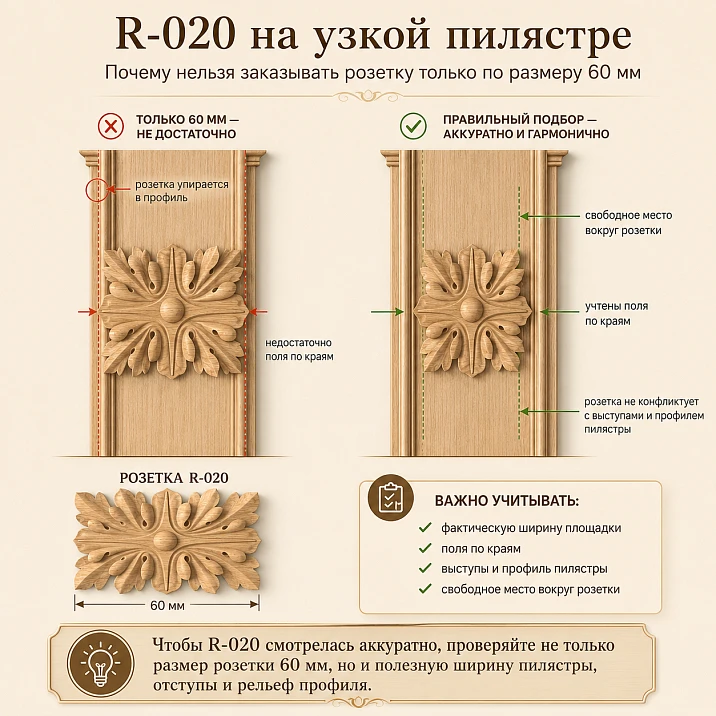
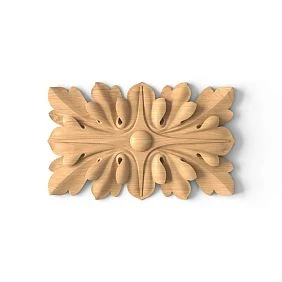
In the specification, a short line appears: "R-020, 60 mm, beech, 8 pcs." It looks accurate enough. The article is specified, the size is recorded, and the material and quantity are present. But such a request already contains an error: the wooden decorative rosette R-020 is not square and cannot be described by a single number. The most compact option has full dimensions of 60 × 38 × 8 mm. The first number only indicates one dimension. It says nothing about the second side of the rectangle, the depth of the relief, the orientation of the acanthus leaf, or the actual space the piece will occupy on a narrow pilaster.
Due to the abbreviated notation, the purchaser may present the element as a 60 × 60 mm square, the designer may rotate it with the long side across the pilaster, and the installer may position the ornament differently than on the approved layout. Eight identical parts suddenly turn into eight different solutions: on one pilaster the rosette is vertical, on another horizontal, the side fields differ, and the 8 mm protrusion conflicts with the adjacent molding. The error does not start at installation. It occurs earlier — at the moment when the full dimensional line is replaced by a single digit.
R-020 is produced in four versions: 60 × 38 × 8, 77 × 49 × 10, 93 × 59 × 12, and 110 × 70 × 14 mm. All variants retain rectangular geometry and a classic acanthus leaf ornament, but work differently on a pilaster, casing, stair post, wall panel, furniture facade, or door. The larger the model, the greater not only the face area but also the depth. Therefore, the question "which R-020 size to order" cannot be decided by the first digit or by a general photo of the collection.
Before buy wooden rosette R-020, you need to determine the useful base width, choose the orientation, build four full-size templates, check the side fields, match the depth with the adjacent decor, and only then choose beech or oak, "Standard" or "Prestige". This order seems longer than the notation "R-020, 60 mm", but it brings to the site exactly the element that fits, faces the right direction, and repeats identically throughout the entire batch.
The notation "R-020, 60 mm" is incomplete even before sending to the supplier
One digit is convenient in conversation. You can say: "Let's take the sixtieth rosette" and understand which variant is meant. In a working document, such an abbreviation is dangerous. The specification must remain understandable to a person who did not participate in the discussion: the manager, the picker, production, the finisher, and the installer.
Incorrect line:
R-020, 60 mm, beech, 8 pcs.
Correct line:
Wooden carved rosette R-020, 60 × 38 × 8 mm, beech, sanding quality "Prestige", 8 pcs.; orientation of the acanthus ornament and axis position — according to the approved pilaster layout.
The first entry leaves at least five questions:
-
60 mm — length, width, or diameter?
-
Is the element square, round, or rectangular?
-
What is the second side?
-
How far does the socket protrude above the base?
-
How should it be oriented?
The second line does not determine the mounting method — it depends on the base and the project — but it eliminates confusion with dimensions and preparation options.




Why shortening is especially dangerous when ordering a batch
One sample can be held against the pilaster and the error is immediately visible. In a batch of eight, twelve, or twenty pieces, the incorrect size repeats across the entire object. If the rosettes are already painted or tinted, replacement affects not only the product but also the finishing timeline, shade matching, and reinstallation.
The batch must be uniform in four respects:
-
full size A × B × C;
-
wood species;
-
sanding quality;
-
orientation on a specific base.
Even the same R-020 can look different if one part is rotated 90 degrees. Therefore, in the pilaster list, it is useful to mark the top of the ornament with an arrow or attach a diagram.
Our factory also produces:

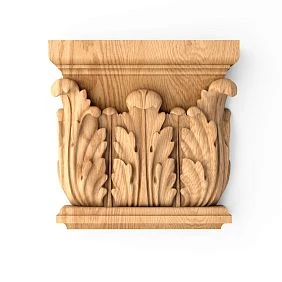
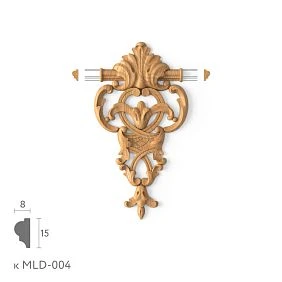
R-020 is a rectangular rosette, not a square with a size of 60 mm
The word "rosette" often evokes an image of round or square symmetrical decor. R-020 is arranged differently. All four variants are rectangular: one face is longer than the other. This affects placement, orientation, and composition.
| Option | Full size A × B × C | Difference of sides A − B | Depth | What to check first |
|---|---|---|---|---|
| Compact | 60 × 38 × 8 mm | 22 мм | 8 мм | Does the 38 mm side fit within the useful width? |
| Small | 77 × 49 × 10 mm | 28 мм | 10 мм | Does the element not extend onto the chamfer or fluting? |
| Medium | 93 × 59 × 12 mm | 34 мм | 12 мм | Are the side margins equal? |
| Large | 110 × 70 × 14 mm | 40 мм | 14 мм | Does the socket not become wider than the pilaster body? |
The table shows why you cannot select by A alone. In a narrow vertical zone, side B is more often critical if the long side is oriented vertically. For the smallest R-020, this is 38 mm; for the largest, it is 70 mm. The difference is almost twofold. When rotated horizontally, the critical dimension becomes A — from 60 to 110 mm.
Get Consultation
Dimension A is not always the width on the wall
If R-020 is installed with the long side vertical, A describes the height, and B describes the occupied width. After a 90-degree rotation, the roles are swapped. Therefore, the phrase “a socket 60 mm wide” may be incorrect even for the compact version: the actual width in the chosen orientation can be 38 mm or 60 mm.
Size C cannot be lost from the order
The depth increases from 8 to 14 mm. Six millimeters of difference seem small while the rosette is viewed only from the front. On a narrow pilaster, side lighting emphasizes the protrusion. Next to a thin molding, a large model may appear significantly more massive. On a door or furniture, the depth affects the distance to the handle, adjacent panel, and wall when opening.
Parameters A, B, and C are checked against the drawing
The full dimension string is confirmed by the card, but the direction of specific dimension lines needs to be viewed on the DWG. Before placing an order, it is useful to download drawing R-020 and check dimensions A, B, and C on the front and side views. From a single photo, it is impossible to reliably determine the rear plane, maximum protrusion, and ornament direction.
The useful width of the pilaster is less than its overall size
The buyer measures the pilaster from edge to edge and gets, for example, 80 mm. It seems that R-020 110 × 70 × 14 mm will fit: with vertical orientation, its width is 70 mm, so there are still 10 mm left. But the overall width of the pilaster is not always equal to the flat area on which the rosette can be placed.
Part of the surface may be occupied by:
-
side profiles;
-
chamfers;
-
flutes;
-
protruding edges;
-
applied moldings;
-
already installed decor;
-
transition to base or capital;
-
mounting fields;
-
roundings;
-
base irregularities.
The rosette is placed not on the nominal width, but on the useful flat field.
Formula of useful width
For a preliminary check, you can use:
Useful width = total width of the pilaster − occupied zones on the left − occupied zones on the right.
Occupied zones are determined by the actual profile. They may include chamfers, flutes, and protruding edges. There is no universal value.
Calculation example
Let the total width of the pilaster be 90 mm. On the left and right, there are profiled sections of 12 mm each. The useful field:
90 − 12 − 12 = 66 mm.
For vertical orientation:
-
R-020 60 × 38 × 8 mm occupies 38 mm in width;
-
77 × 49 × 10 mm occupies 49 mm;
-
93 × 59 × 12 mm occupies 59 mm;
-
110 × 70 × 14 mm requires 70 mm and does not fit into the 66 mm field.
This is a conditional example showing the method. The actual dimensions of the pilaster and the boundaries of the flat zone are taken from the object or drawing.
Why the thread edge cannot be placed on the chamfer
Physically, the part can overlap a small inclined section. But the fit will change: part of the back side will be without full support, the side field will become visually uneven, and the shadow will emphasize the misalignment. The possibility of such a joint needs to be designed separately, not accepted as a way to "gain" a few millimeters.
How to measure the useful field on a finished pilaster
-
Mark the left and right boundaries of the flat plane.
-
Measure the distance between them at the top, center, and bottom.
-
Check for narrowing near the capital or base.
-
Mark the pilaster axis.
-
Apply template R-020.
-
Compare the fields on both sides.
-
Take a photo of the variant from the main angle.
If the width varies with height, the socket is checked specifically at the intended installation point.
Symmetry on a narrow pilaster is calculated based on the second side of the rectangle.
After choosing the orientation, you need to calculate the side margins. For vertical placement, take dimension B. For horizontal, take A.
Formula:
Side margin = (usable width − width of R-020 in the chosen orientation) ÷ 2.
Example for vertical installation
Usable pilaster width is 66 mm. R-020 93 × 59 × 12 mm is selected. The part width is 59 mm.
(66 − 59) ÷ 2 = 3.5 mm.
Mathematically, the element fits. But margins of 3.5 mm may look too tight, and the mounting scheme may require a different distance. The number is not a recommendation. It shows how little free space remains.
Example for the compact version
The same pilaster 66 mm and R-020 60 × 38 × 8 mm:
(66 − 38) ÷ 2 = 14 mm.
The margins become more noticeable. The composition gets more "air," but the rosette itself may seem small. The choice is made based on the layout, not just the formula.
Why equal margins matter more than the general impression of "roughly centered"
On one pilaster, a shift of a few millimeters may go unnoticed. On a pair, it becomes a difference. If the left margin is 11 mm and the right is 17 mm, the ornament looks shifted. On the adjacent pilaster, the installer may repeat the shift in the opposite direction, and the symmetry of the portal will fall apart.
The center is marked instrumentally. You cannot rely only on the edges of the acanthus leaf: the relief may be visually uneven, and the geometric axis is determined by the drawing.
Long side vertical or horizontal: two different looks of the same R-020
A rectangular rosette can be mentally rotated 90 degrees, but the possibility and correctness of such a rotation are confirmed by the photo and DWG. The acanthus ornament has a direction. It cannot be turned arbitrarily just to make the part fit.
Vertical orientation
The long side A runs along the pilaster. This option supports the vertical, visually elongates the narrow panel, and requires width B.
It is suitable for checking on:
-
pilasters;
-
door casings;
-
stair posts;
-
narrow furniture stiles;
-
vertical wall panels.
But the final direction of the acanthus leaf is taken from the product image and drawing.
Horizontal orientation
The long side A goes across. The rosette becomes wider and lower. On a narrow pilaster, such a rotation may immediately exclude large sizes, but on a frieze, the top part of a door, or a horizontal panel, it can look natural.
Rotation to save space
Sometimes the installer suggests rotating the socket because it doesn't fit in one position. This is only acceptable after checking the ornament and the project. If the leaves get the wrong direction, a formal installation doesn't save the composition.
Paired pilasters
On two identical elements, the orientation must be either the same or mirrored, if provided by the pattern. The decision is recorded on the layout. A single label "R-020 — 2 pcs." is not enough.
Four paper templates provide more benefit than one beautiful visualization
Before purchasing, prepare full-size rectangles:
-
60 × 38 mm;
-
77 × 49 mm;
-
93 × 59 mm;
-
110 × 70 mm.
On each one, write the full size and depth. To check the projection, you can glue a strip of cardboard 8, 10, 12, or 14 mm high to the side.
How to make templates
Use thick paper, cardboard, or thin sheet material. It is important to maintain real dimensions, not an approximate scale. Mark:
-
geometric center;
-
long and short sides;
-
intended top of the ornament;
-
variant number;
-
depth;
-
pilaster axis line.
How to apply
First, attach the smallest template to the axis. Then sequentially replace it with the next ones. Take photos strictly from the front and at an angle. A side view will show how the relief changes.
What to evaluate
-
does the rectangle fit on a flat field;
-
are the equal side margins maintained;
-
does the edge not approach the fluting;
-
does the scale correspond to the pilaster;
-
does the small model not look random;
-
does the large one not become cramped;
-
how the element is connected to the base, capital, and moldings;
-
is the rosette visible from the usual viewpoint.
Why the screen deceives
In the visualization, a detail can be unintentionally stretched or reduced. A paper rectangle does not show the carving, but it honestly shows the area. If even a 110 × 70 mm outline looks cramped, a real deep relief will certainly not become easier.
Four sizes of R-020: not a "better — worse" ladder, but four scales
You cannot consider 60 × 38 × 8 mm "basic" and 110 × 70 × 14 mm "improved." Each option solves its own task.
60 × 38 × 8 mm — for a small field and a calm accent
The compact R-020 requires less usable width and protrudes only 8 mm. It is worth checking on a narrow trim, a small pilaster, a furniture post, or a repeating series of small panels.
Advantages:
-
easier to place on a limited field;
-
more free background remains;
-
the relief protrudes less;
-
easier to repeat many times without overload.
Limitations:
-
may get lost on a wide pilaster;
-
from a distance, the ornament reads weaker;
-
looks too small in a large wall panel;
-
may seem random next to massive moldings.
After checking the template, you can order R-020 with dimensions of 60 × 38 mm, also specifying a depth of 8 mm.
77 × 49 × 10 mm — an intermediate option for a moderate scale
The small size takes up more area but maintains a relatively small projection. It is suitable for testing on medium-width pilasters, casings, and furniture facades, where a compact model gets lost, and 93 × 59 mm becomes too tight.
Advantages:
-
more noticeable than the 60-millimeter option;
-
the depth of 10 mm remains moderate;
-
the rectangular shape supports vertical elements well;
-
can work in a repeating rhythm.
Limitations:
-
still requires calculation of the useful width;
-
on a large portal it may look insufficiently expressive;
-
horizontal rotation requires 77 mm of free space;
-
you cannot simply write "77 mm" in the estimate.
93 × 59 × 12 mm — an expressive center for a prominent pilaster
The medium option already provides a fairly large acanthus motif. It is considered for wall panels, door portals, stair posts, and furniture facades with sufficient free space.
Advantages:
-
the ornament is readable from a greater distance;
-
suitable as a standalone accent;
-
a depth of 12 mm creates a noticeable shadow;
-
works well on medium-scale vertical panels.
Limitations:
-
the short side of 59 mm excludes very narrow planes;
-
may look heavy next to a thin profile;
-
requires precise centering;
-
on paired pilasters, any misalignment is noticeable.
The customer can buy R-020 size 93 × 59 mm after checking the full size of 93 × 59 × 12 mm.
110 × 70 × 14 mm — a large acanthus accent
The largest R-020 occupies a noticeable area and protrudes 14 mm. It requires a wide flat zone and a sufficiently large surrounding: a powerful pilaster, a wide vertical panel, a stair post, or a large furniture facade.
Advantages:
-
confidently readable from a distance;
-
supports a large architecture;
-
creates deep chiaroscuro;
-
can become a central detail of the portal.
Limitations:
-
requires at least 70 mm on the short side when installed vertically, before accounting for margins;
-
may extend onto the bevel or flutes;
-
the 14 mm relief needs to be coordinated with adjacent details;
-
looks cramped on a small surface.
Depth from 8 to 14 mm changes not only the shadow
The buyer more often chooses the size based on the face contour. But C grows together with A and B. The difference between 8 and 14 mm affects several practical issues.
Adjacent molding
If a profile runs nearby, compare their maximum protrusion. The socket may be slightly higher, lie in the same plane, or protrude noticeably. Any option should look deliberate.
Side view
On a pilaster near a passage, the detail is visible from the side. A large R-020 creates a stronger shadow. On a narrow element, this enhances the sense of mass.
Door
When installing on a door, consider the movement of the panel, the distance to the wall, trim, stop, and furniture. The article does not specify an allowable gap but requires checking the actual trajectory.
Furniture
A deep socket should not interfere with the handle, adjacent door, or drawer. It is especially important to check facades that open toward each other.
Finishing
In recesses, tinting and enamel appear darker. The deeper the relief, the stronger the chiaroscuro. A test coat is needed on the chosen size, not on an arbitrary flat sample.
Dust and care
Complex relief requires careful maintenance. Specific products depend on the coating. You cannot transfer the cleaning method for untreated wood to a painted or tinted surface.
Pilaster, trim, column, and panel: one article works differently
R-020 allows several application scenarios, but the size cannot be automatically transferred from one surface to another. A compact rosette, successfully placed on a door casing, can get lost on a stair newel. A large model suitable for a wall panel may turn out to be wider than the usable part of a narrow pilaster.
Pilaster
On a pilaster, the usable width and vertical axis are especially important. If there are flutes or profiles along the edges, the short side of R-020 must fit between them. The ornament is linked to the capital, base, and other vertical details.
For a buyer who is just forming a portal or wall composition, it is useful to first select a pilaster for R-020, and then build the overall drawing. You cannot choose a pilaster only by its nominal width: its central field may turn out to be significantly narrower.
Door casing
The casing is often narrower than the pilaster and has profiled edges. Every millimeter matters on it. Check not only the width, but also the position of joints, proximity to the corner of the doorway, and the direction of the pattern.
If a full portal is needed, you can order R-020 for the door casing after checking the panel, framing, and top decor. The rosette must be part of one vertical system, not a separate icon at a random height.
Stair post
The R-020 on the post is viewed from several sides and heights. A compact model can work well on a narrow plane, while a large one can work on a massive starting element. But the rosette remains a decorative overlay and does not replace the structural part of the staircase.
Before order R-020 for stair post decoration, you need to determine the front face, mounting height, connection to the handrail, and repetition on other posts.
Wall panel and boiserie
In boiserie, the rosette can be placed on a vertical slat, in the center of a frame, or on a pilaster between sections. There is more free space here, but the rhythm of the entire wall is more important. One too-large R-020 disrupts the repetition, while one too-small looks random.
The section with examples helps choose R-020 for a vertical panel and see how carved details interact with moldings and pilasters. The dimensions of your project should still be checked on the layout.
Furniture facade
On a cabinet, dresser, or built-in bookcase, consider handles, hinges, panel lines, and adjacent doors. The 14 mm protrusion may be noticeable in a passage or interfere with opening. A small rosette is simpler in geometry, but on a wide facade it may get lost.
Ceiling composition
The card allows application on the ceiling. In this case, the rectangular format and the direction of the acanthus leaf are assessed from below. The scale depends on the height of the room, the distance to the cornice, and neighboring elements. The method of attachment and requirements for the base are determined by the project.
The acanthus leaf sets a direction that cannot be changed for convenience
R-020 belongs to classical decor. The ornament in the form of an acanthus leaf has a top, a bottom, and a character of movement. Even when the geometric rectangle allows rotation, the pattern may lose its meaning.
What to check in the photo
-
where the tip of the leaf is directed;
-
where the base of the motif is located;
-
whether the ornament is symmetrical relative to the vertical axis;
-
whether the perception changes when rotated;
-
which side is intended as the top.
What to check in DWG
The drawing shows not only the outline, but also the axis. If the orientation marking is missing or unclear, the solution is clarified before ordering the batch.
Why direction matters on a door portal
The leaves on the left and right pilasters should belong to the same composition. If one element is directed upward and the other sideways, the portal looks assembled from random parts.
Why direction matters in repetition
On the wall panel, row R-020 forms a rhythm. One inverted rosette is more noticeable than a slight shade difference. Therefore, packages and positions are marked before installation.
For a stylistically consistent selection, you can buy a classic wooden rosette and compare other models with acanthus ornament. Belonging to the same collection helps by style, but does not eliminate checking dimensions.
Beech or oak: the wood species is chosen for the entire visible group
R-020 is produced in beech and oak. The choice of material is related to the future finishing, adjacent parts, and the scale of the batch.
Beech for smooth painted relief
Beech is often considered under opaque enamel. The color unites the rosette with the pilaster, molding, or door leaf. The chiaroscuro of the acanthus ornament comes to the forefront.
But the phrase "under enamel" does not mean the part is ready for any coating. You need to choose a primer, paint, application method, and backside treatment according to the approved technology.
Oak for visible texture
Oak is appropriate when the wood grain is preserved under tinting, oil, or another approved system. On the large R-020 110 × 70 × 14 mm, the texture is especially noticeable because the area and depth are greater.
The customer can find out the price of R-020 in oak for the selected size and sanding quality. The cost of a batch depends not only on the wood species but also on quantity, finish, and delivery.
Mixing wood species
If the rosette is oak and the pilaster is beech, a transparent finish will highlight the difference. Under opaque enamel, materials may also require different preparation. Mixing is only possible as a deliberate decision by a technologist, not as a way to cover a shortage of one item.
The material is repeated in each line
In the general specification, they write:
-
pilaster — oak;
-
R-020 — oak;
-
molding — oak;
-
capital — oak;
-
base — oak.
A general note "all decor oak" is weaker than line-by-line entries: during procurement, a separate line may be replaced or copied without the header.
"Standard" or "Prestige": size does not replace preparation quality
For R-020, two sanding options are confirmed. They are not a color and do not indicate a finished surface.
"Standard"
This option can be chosen if the workshop plans further preparation. The exact scope of work is checked against the card and sample. Pay special attention to the inner recesses of the acanthus leaf.
"Prestige"
This option involves more detailed preparation of the carved relief. It is useful for parts that are viewed up close: door trims, furniture, and pilasters in high-traffic areas.
Why a large model requires separate evaluation
On R-020 110 × 70 × 14 mm, side transitions and deep areas catch light more strongly. Even if a compact sample satisfies the customer, the large size should be evaluated separately.
One batch — one grinding category
On paired pilasters, differences in preparation may appear after tinting. All identical rosettes should be ordered in one configuration. If part is already manufactured, the new delivery is compared with the sample.
Enamel, tinting, and oil: first a sample, then a batch
Finishing changes the perception of size. Light enamel softens the relief, contrasting color emphasizes the rectangular contour, dark tinting enhances depth.
The test must replicate the actual geometry
A flat piece of wood shows color but not how the coating behaves in carving. For R-020, a sample with recesses, edges, and protrusions is needed.
Compact and large versions look different in the same color
For a model with a depth of 8 mm, shadows are softer. For a 14 mm model, the same composition and lighting create darker recesses. Therefore, it cannot be claimed that a color approved on a small rosette automatically gives the same visual result on a large one.
Materials are selected after the decision on wood species
In the category you can order materials for beech staining or select a composition for an oak part. The applicability of a specific material to the chosen location and coating is checked separately.
Back side and ends
Even if the face carving appears to be the main object, the finishing system may require treatment of other surfaces. The order depends on the technology and the substrate.
What to buy together with R-020
A separate rosette rarely forms a complete portal or panel. The full set depends on the project.
| Position | Why it's needed | What to check before ordering |
| R-020 of the selected size | Main acanthus accent | Full A × B × C, orientation, material |
| Pilaster or column | Base of the vertical composition | Useful width, flat field, height |
| Moldings | Form frames and transitions | Profile, depth, distance to R-020 |
| Capital and base | Complete the pilaster | Scale and distance to the rosette |
| Door casings | Frame a door or window | Width and location of R-020 |
| Stair post | Base in the railing | Front face and structural design |
| Finishing materials | Create color and protect wood | Beech or oak, test stain |
| Installation materials | Fix the decor according to the project | Base, coating, and technology |
| Drawing or layout | Coordinates the batch | Axes, heights, orientation, item numbers |
| Delivery | Ensures receipt of the set | Thread packaging and size marking |
In the general category, you can order rosettes for pilasters and furniture and compare models by shape, style, and sizes. R-020 is chosen when a rectangular acanthus motif is needed.
How not to confuse R-020 with similar decorative elements
With a round rosette
The round model does not have two different front sides. R-020 is rectangular and requires an orientation decision.
With a square rosette
The square allows a 90-degree rotation without changing the outer contour. For R-020, width and height swap places.
With an overlay
In catalogs, the words "rosette" and "overlay" may be used for similar types of decor, but the specific purpose is determined by the card and shape. Do not transfer dimensions and installation from another article.
With a capital
The capital completes the pilaster from above and has its own mounting geometry. R-020 is installed as a decorative accent on the surface and does not replace the capital.
With central decor of a furniture facade
R-020 can be used on furniture, but its rectangular shape and depth require checking handles and opening. Not every central overlay solves the same task.
With an electrical socket
The search query "buy wooden rosettes" is ambiguous. For R-020, always add clarifications: decorative, carved, for pilaster, wall panel, or furniture.
How many R-020 to order: count surfaces, not rooms
The quantity depends on the number of specific installation locations.
Paired pilasters
One portal with two pilasters usually requires two rosettes, if the project provides for one on each. But a pilaster may have several tiers, so the quantity is taken from the layout.
Door series
Count each side and each panel. The decor may be only on the side of the main room or repeated on both sides.
Wall panels
The number of sections is not always equal to the number of rosettes. The main panel may get a large R-020, side ones compact, and some frames may remain without a carved center.
Staircase posts
Only those edges and pillars where the rosette is intended are counted. If an element is visible from two sides, this does not automatically mean installing two pieces.
Furniture
For a cabinet with four doors, four rosettes are possible, two on the central doors, or one on the common panel. The quantity is determined by the composition, not by the number of facades.
Reserve
Reserve is added after approving the exact size. You cannot order a spare "60 mm" until it is decided that we are talking about 60 × 38 × 8 mm. An additional piece must have a purpose: a sample, a repair item, or a replacement in case of damage.
The batch sheet protects against mixing four standard sizes
If the project uses multiple sizes, each item is assigned a code.
| Code | Location | Size | Orientation | Material | Quantity |
| R1 | Pilasters of the main portal | 93 × 59 × 12 mm | Vertical | Oak | 2 |
| R2 | Door platbands | 60 × 38 × 8 mm | According to the drawing | Beech | 6 |
| R3 | Central wall panel | 110 × 70 × 14 mm | By layout | Oak | 1 |
The example shows the filling principle, not a ready-made set. Real values are taken from the project.
Why sizes cannot be combined in one line
The entry "R-020 of different sizes — 9 pcs." does not inform production how many of each part are needed. Each variant is a separate line.
Orientation refers to the location, not just the product
The same R-020 can be shown in different positions on different surfaces, if confirmed by the project. Therefore, the development number is indicated next to the size.
Packaging marking
It is useful to write the item code and location on the box: "R1 — portal, 2 pcs." The installer should not choose the size from memory.
Correct specification for R-020
Full line for the medium version:
Wooden carved rosette R-020, 93 × 59 × 12 mm, oak, "Prestige" sanding quality, quantity 8 pcs.; orientation and axis position — according to the approved pilaster development.
For the compact version:
Wooden carved rosette R-020, 60 × 38 × 8 mm, beech, "Standard" sanding quality, quantity 4 pcs.; installation location — door trims D-01 and D-02, orientation per drawing.
What not to write
-
R-020, 60 mm;
-
small rosette R-020;
-
large acanthus rosette;
-
R-020 for pilaster without size;
-
oak rosette, 8 pcs.;
-
R-020 as in the picture;
-
rectangular rosette 93 mm.
What to add for a complex project
-
drawing number;
-
installation height mark;
-
axis position;
-
ornament direction;
-
pilaster number;
-
the type of finish;
-
sample number;
-
set of accompanying parts.
Price R-020: compare configurations, not a single number
The cost depends on the selected size, material, sanding, and quantity. Therefore, a request like "R-020 price" should be clarified with the full configuration.
The comparison should look like this:
-
R-020 60 × 38 × 8 mm, beech, "Standard", quantity;
-
R-020 93 × 59 × 12 mm, oak, "Prestige", quantity;
-
finishing materials;
-
accompanying pilasters or moldings;
-
Delivery.
The price of the socket itself does not equal the budget of the portal or wall panel. If a large model requires a wider pilaster, the entire set changes.
Designing is especially useful for a narrow and profiled pilaster
When the surface is flat and wide, a paper template often gives a clear answer. A complex pilaster with flutes, chamfers, a capital, and several overlays requires a full development.
You can order the R-020 layout on the pilaster and provide:
-
overall pilaster size;
-
useful width;
-
photograph;
-
profile drawing;
-
position of the base and capital;
-
selected sizes R-020;
-
material;
-
finishing;
-
number of identical elements;
-
main view.
The sweep shows the front
Installation starts not with glue, but with the axis
In the scheme there is a category where you can buy mounting glue for a wooden rosette. But the choice of composition and method of fixation depends on the base, covering, size, position, and project. The article does not prescribe a universal glue, fastener, or consumption.
Before installation, you need to:
-
confirm size R-020;
-
determine the top of the ornament;
-
mark the geometric axis of the pilaster;
-
check the installation height;
-
attach the part without fixing;
-
compare the side margins;
-
assess the depth from the side;
-
verify the paired pilaster;
-
check material compatibility;
-
only after this proceed to the approved mounting technology.
The base is already painted
The coating can affect adhesion. Not every enamel or varnish can be considered a suitable mounting base. Compatibility is checked according to the technical requirements of the selected materials.
The base is not yet finished
You can assemble the decor before the finish, but the deep relief and the junction with the pilaster need to be painted evenly. The order of work is coordinated with the finisher.
Pilaster made of a different wood species
Even under the same enamel, beech and oak may require different preparation. Installation and finishing must take both materials into account.
Mistakes due to which R-020 does not fit or looks upside down
Mistake 1. Only 60 mm was recorded
The rectangle was mistaken for a square.
How to fix: specify 60 × 38 × 8 mm in full.
Error 2. A size of 77 mm was called the width
After vertical installation, the actual width was 49 mm.
How to fix: first determine the orientation.
Error 3. Measured the pilaster from edge to edge
Chamfers and flutes reduced the flat field.
How to fix: calculate the usable width.
Error 4. Chose a model that mathematically fits without margins
The edge of the carving ended up flush against the profile.
How to fix: evaluate the remainder on both sides on a template.
Error 5. Rotated the rosette 90 degrees for fitting
The acanthus leaf received the wrong direction.
How to fix: check the photo and DWG.
Error 6. Different orientation was applied on paired pilasters.
The portal lost symmetry.
How to fix: attach a single layout with top marking.
Error 7. Centered by the visual mass of the leaf.
The geometric axis shifted.
How to fix: use the drawing axis.
Error 8. Depth was not taken into account.
R-020 110 × 70 × 14 mm turned out to be too protruding next to a thin molding.
How to fix: build a side section.
Error 9. The color was agreed on a flat sample
In the recesses, the shade became darker.
How to fix: test application on a carved fragment of the selected size.
Error 10. Mixed beech and oak
The tinting emphasized the difference in texture.
How to fix: choose one wood species for the visible group or agree on technological mixing.
Error 11. "Prestige" was mistaken for a finished coating
Finishing materials were not included in the order.
How to fix: separate sanding and finishing.
Error 12. Ordered several sizes in one line
The quantity by sizes turned out to be unclear.
How to fix: a separate item for each A × B × C.
Error 13. Sockets were distributed among rooms without codes
On the site, 93 × 59 mm was installed instead of 77 × 49 mm.
How to fix: mark packages and surfaces.
Error 14. Did not check the space near the base
The lower decor turned out to be too close.
How to fix: build the entire pilaster from base to capital.
Error 15. Did not check the space near the capital
The top ornament visually collided with R-020.
How to fix: evaluate vertical margins.
Error 16. A large rosette was placed on a narrow trim.
The edge extended onto the profile.
How to fix: use a full-scale template.
Error 17. A compact R-020 was placed on a massive column.
It got lost and looked random.
How to fix: compare all four sizes on the common facade.
Error 18. The furniture handle was not taken into account.
The deep relief interfered with the grip.
How to fix: apply fittings to the layout.
Error 19. Did not check door opening
The socket moved closer to the wall or trim.
How to fix: simulate the movement of the panel.
Error 20. Used R-020 as a replacement for the capital
Part assignments got mixed up.
How to fix: assemble the set by functions.
Error 21. Assumed classical style means automatic compatibility
The socket matched the ornament but not the scale.
How to fix: check shape and dimensions separately.
Error 22. Acceptance was carried out after painting.
The dimensional error was discovered too late.
How to fix: measure before finishing.
Error 23. The reserve was ordered with a different size.
The spare could not replace the damaged part.
How to fix: the reserve fully replicates the working position.
Error 24. The installation height was determined from an uneven floor.
The paired sockets ended up at different levels.
How to fix: use a single design elevation.
Error 25. Ordered from memory after a long break.
Instead of 93 × 59 × 12 mm, a similar option was chosen.
How to fix: repeat the full string in all documents.
Who the compact R-020 suits
The size 60 × 38 × 8 mm is worth checking when:
-
the useful width of the pilaster is small;
-
the decor is repeated many times;
-
there are rich moldings nearby;
-
the surface is examined closely;
-
a small protrusion is required;
-
the rosette is installed on a narrow casing;
-
The furniture facade has a handle nearby;
-
Large patterns look cramped;
-
Need to leave more free space;
-
The accent should be restrained.
Compactness does not guarantee fit. Even 38 mm on the short side needs to be matched with a flat area.
Who will suit the size 77 × 49 × 10 mm
This option is useful if 60 × 38 mm gets lost, but 93 × 59 mm is already too large. It provides an intermediate scale for trims, furniture, and medium-width pilasters.
Check it when:
-
the useful field confidently accepts 49 mm;
-
a noticeable but not large ornament is needed;
-
depth of 10 mm aligns with the profile;
-
the composition repeats in a series;
-
side margins remain equal.
Who will fit the size 93 × 59 × 12 mm
Medium R-020 is considered for noticeable verticals, door portals, and panels. It can already work as a standalone accent.
It is chosen for testing when:
-
useful width is greater than 59 mm including margins;
-
the pilaster is tall enough;
-
adjacent decor has a comparable scale;
-
the rosette should be readable from several meters;
-
A depth of 12 mm does not interfere with operation.
Who the large R-020 suits
The size 110 × 70 × 14 mm requires a spacious surface. It is appropriate on a massive pilaster, large column, wide panel, or large furniture facade.
The large option is worth considering if:
-
the useful width confidently exceeds 70 mm;
-
there is a visual field around it;
-
the 14 mm relief is consistent with the profiles;
-
the acanthus leaf should be visible from afar;
-
the composition is not overloaded with other carved details;
-
the base and mounting are calculated;
-
The full-size template looks proportional.
When R-020 is not suitable
Another socket needs to be chosen if:
-
the rectangular shape conflicts with the composition;
-
even 60 × 38 mm is wider than the usable area;
-
a round or square center is required;
-
the acanthus ornament does not match the style;
-
the depth interferes with the door or furniture;
-
the correct orientation cannot be determined;
-
the base is too profiled;
-
mounting technology not confirmed;
-
the required species is not in the project;
-
the frame requires a different scale.
In the category you can select a rectangular carved rosette among other models, without trying to trim or rotate the unsuitable R-020.
Ready sequence of actions before purchase
-
Determine the specific installation location.
-
Measure the total width of the base.
-
Highlight the useful flat field.
-
Find the axis.
-
Download DWG R-020.
-
Check the direction of the acanthus leaf.
-
Make templates 60 × 38, 77 × 49, 93 × 59, and 110 × 70 mm.
-
Attach each in its actual position.
-
Calculate the side margins.
-
Compare depths of 8, 10, 12, and 14 mm.
-
Check moldings, chamfers, and flutes.
-
choose beech or oak
-
Choose "Standard" or "Prestige".
-
Coordinate the finish on the sample.
-
Calculate the quantity by surfaces.
-
Add a reserve only for the selected size.
-
Create separate specification lines.
-
Check the invoice.
-
Order the batch as a single delivery.
-
Perform acceptance and dry layout before installation.
After that, you can order the R-020 kit for pilasters without abbreviations or ambiguous words.
Frequently asked questions about the wooden carved rosette R-020
What is the smallest size of R-020?
60 × 38 × 8 mm. The notation “60 mm” is incomplete because it does not show the other side and depth.
R-020 square?
No. All four versions are rectangular.
What sizes are available?
60 × 38 × 8, 77 × 49 × 10, 93 × 59 × 12, and 110 × 70 × 14 mm.
What does the first digit mean?
It refers to one dimension A. The direction of the dimension line is checked against the drawing. When installed vertically, the first digit may describe height rather than width.
What width does R-020 occupy on a vertical pilaster?
If the long side is placed vertically, the cross dimension is 38, 49, 59, or 70 mm depending on the version. The orientation of the ornament needs to be confirmed.
Can R-020 be rotated horizontally?
Only if such a position matches the pattern and the project. Rotation changes the occupied width.
Why can't you rely only on a photo?
Photos do not always convey scale, depth, and the back plane. For accurate selection, a DWG and template are needed.
How to measure a pilaster?
First, measure the total width, then exclude chamfers, flutes, side profiles, and other occupied areas. Compare the resulting flat field with R-020.
What is the useful width?
This is the actual flat area where a socket can be placed. It is often smaller than the nominal width of the pilaster.
How to calculate the side margins?
Subtract the transverse dimension of R-020 from the useful width and divide the remainder by two. The result shows the symmetrical margins, but their visual sufficiency is assessed using a template.
What size will fit a pilaster with a width of 60 mm?
One total width is not enough. You need to know the useful flat area. If it is less than 60 mm, large options may not fit. Even a compact model is checked against the 38 mm side and the margins.
Can a socket be installed on flutes?
Such a node cannot be accepted automatically. The back side must have confirmed contact. It is better to place the element on the calculated flat area.
How to choose between 60 × 38 and 77 × 49 mm?
Compare both templates on the pilaster. The first leaves more background, the second is more noticeable. Additionally, check the depth of 8 and 10 mm.
When to choose 93 × 59 × 12 mm?
When the medium model fits with equal margins and matches the scale of the pilaster, door, panel, or column.
When is 110 × 70 × 14 mm suitable?
On a wide surface where free margin remains and the deep relief does not conflict with adjacent decor.
What is R-020 made of?
Beech and oak are available.
What to choose for enamel?
Beech is often considered for opaque painting. But the technology must be coordinated for the entire visible group.
What to choose for tinting?
Oak is suitable for preserving a pronounced texture. The color is checked on a carved sample.
What does "Standard" mean?
This is a sanding quality option, not a finished coating.
What does "Prestige" mean?
More detailed preparation of the carved relief. The finish is still chosen separately.
Can I order one rosette for a sample?
Current ordering conditions should be checked in the product card or with a manager. For a large batch, a preliminary sample is especially useful.
Where can I see other models?
You can open the section wooden rosettes — catalog and prices and compare shapes, sizes, and style.
Where can I see classic rosettes?
In the filter, you can explore classic rosettes made of oak and beech.
Is R-020 suitable for boiserie?
Yes, the card allows use on wall panels. The size is chosen according to the frame, vertical field, and overall rhythm of the wall.
Can R-020 be used on a door?
Yes, after checking the trim or panel, depth, opening, and handle position.
Is R-020 suitable for a stair post?
Yes, as a decorative overlay on a suitable face. It does not replace the structural function of the post.
Can R-020 be installed on a furniture facade?
Yes, after checking the facade dimensions, handle, hinges, adjacent doors, and depth.
Can R-020 be used on a ceiling?
Such use is listed among the options. A base design, orientation, and suitable mounting method are required.
Should the socket be matched to a pilaster of the same wood species?
For transparent finishes, this is the most direct path to texture unity. Mixing species is coordinated separately.
How to determine the installation height?
Based on the full pilaster layout. The base, capital, moldings, and other overlays are considered. There is no universal mark.
How to place R-020 on two paired pilasters?
Use one design mark, identical axes, and confirmed orientation. Check both surfaces simultaneously.
Should the ornament be mirrored?
Only if the pattern and design require it. You cannot change the direction on your own.
What to do if the socket fits but the margins are very small?
Compare a smaller size or a different model. Physical fit does not guarantee good composition.
Can R-020 be trimmed in width?
The possibility of modifying a carved product must be coordinated with the manufacturer. Trimming may destroy the acanthus motif and symmetry.
What stock should be ordered?
After the size is approved. The spare part must fully match A × B × C, material, sanding, and finish of the working item.
How to calculate the quantity for a portal?
Based on the layout: the number of pilasters, the number of rosettes on each side, and possible decor of the top part. Do not use the rule "two per door" without a project.
How to calculate the quantity for a wall panel?
Count the sections where R-020 is actually provided. Main and secondary panels may have different rosette sizes.
How to record R-020 in the specification?
Specify the article number, full A × B × C, beech or oak, "Standard" or "Prestige", quantity, orientation, and layout number.
Where can I find the price of R-020?
In the card of the selected size. The request must contain the full configuration, otherwise the comparison will be incomplete.
Can I order R-020 under enamel?
The finish option and preparation need to be checked in the card of the specific configuration and coordinated with the overall system.
What glue is needed?
The composition depends on the base, wood, coating, and design node. The article does not specify a universal adhesive.
Can it be mounted on an already painted pilaster?
The possibility depends on the compatibility of the coating and the mounting material. The check is carried out before ordering the batch.
When to do a test paint?
After selecting the wood species and exact size, but before finishing the entire batch.
Why does a large size look darker?
A depth of 14 mm creates stronger shadows than 8 mm. The same composition can be perceived differently on different sizes.
What to check upon receipt?
Full size, material, grinding quality, quantity, thread integrity, and batch marking.
When can installation begin?
After acceptance, dry layout, confirmation of the axis, orientation, and fastening technology.
How to order the entire set as one delivery?
First, create a specification of sockets, pilasters, and finishing materials, then purchase the wooden decor set as one delivery..
Why is the 60 mm size insufficient for ordering?
Because the actual part has dimensions of 60 × 38 × 8 mm. Without the second side and depth, you cannot verify the fit, orientation, and protrusion.
Checklist for the designer, purchaser, and installer
The same order goes through several specialists, and each looks at R-020 from their own perspective. The designer is responsible for scale and orientation, the purchaser for precise modification, the finisher for the surface, and the installer for the position on the base. To ensure information is not lost between stages, it is useful to attach a short checklist to the specification.
The designer notes the full size, axis, installation height, and direction of the acanthus leaf. The purchaser transfers A × B × C without abbreviation, repeats the wood species and sanding quality. The finisher receives an approved color sample specifically on the selected size. The installer checks the item code, places the part without fixing, and verifies two side margins.
If the project has changed, the previous sheet cannot be corrected verbally. A new version with a date is issued. This is especially important when replacing 60 × 38 × 8 mm with 77 × 49 × 10 mm: externally the change seems small, but the useful width, depth, and margins become different.
Before launching a batch, ask four control questions:
-
Are all three dimensions fully recorded?
-
Does the orientation match on all identical surfaces?
-
Is the depth checked near the molding, handle, or wall?
-
Is the quantity tied to specific pilasters, doors, or panels?
If at least one answer is negative, the order is not yet ready to be sent to production or installation. Such a pause costs less than replacing an already finished batch.
One digit describes an article worse than one paper template
R-020 cannot be purchased as an abstract "60 mm rosette." It is a rectangular carved wooden part with three significant dimensions. The smallest option is 60 × 38 × 8 mm, followed by 77 × 49 × 10, 93 × 59 × 12, and 110 × 70 × 14 mm. For a narrow pilaster, the critical factor is not the first digit, but the useful base width, the transverse dimension in the chosen orientation, the side margins, and the depth.
Before ordering, measure the flat part of the pilaster, mark the axis, apply four templates, check the direction of the acanthus leaf, and compare the relief with adjacent moldings. After that, choose beech or oak, "Standard" or "Prestige", agree on the finish, and record each execution on a separate line.
STAVROS company allows you to go through this path consistently: select card R-020, compare wooden rosettes, open the classic collection, choose pilasters, view solutions for boiserie, doors, and stair newels, get DWG, order design, add materials for installation and finishing, and arrange delivery. This order protects against a simple but expensive mistake: the word "60 mm" no longer substitutes for the full rectangular size, and each R-020 occupies a precisely calculated place in the composition.