










































































Article Contents:
- Can molding be used in a children's room
- Why a children's room needs neat ceiling decor
- Which elements are suitable for a children's room ceiling
- Ceiling Cornice
- Ceiling Moldings
- Ceiling rosette
- Ready-made set of ceiling decor
- CPU-P5: main set for a children's room without pomposity
- How to choose ceiling decor according to the child's age
- Baby's room
- Schoolchild's room
- Teenager's room
- How to choose decor based on the size of a children's room
- Small children's room up to 12 m²
- Children's room 14–18 m²
- Spacious children's room or teenager's room from 20 m²
- How to choose decor based on ceiling height
- Ceiling 2.6 m
- Ceiling 2.7–2.8 m
- Ceiling from 3 m
- How to combine molding, spotlights, and night lighting
- How to paint molding in a children's room
- How to combine ceiling decor with walls in a children's room
- Mistakes when choosing molding for a children's room
- Mistake 1. Making the children's room too 'adult'
- Mistake 2. Using too active a pattern
- Mistake 3. Creating a bright color contrast on the ceiling
- Mistake 4. Not considering the light
- Mistake 5. Choosing decor "for 2–3 years"
- Where to buy ceiling decor for a children's room STAVROS
- FAQ: answers to popular questions about ceiling decor for a children's room
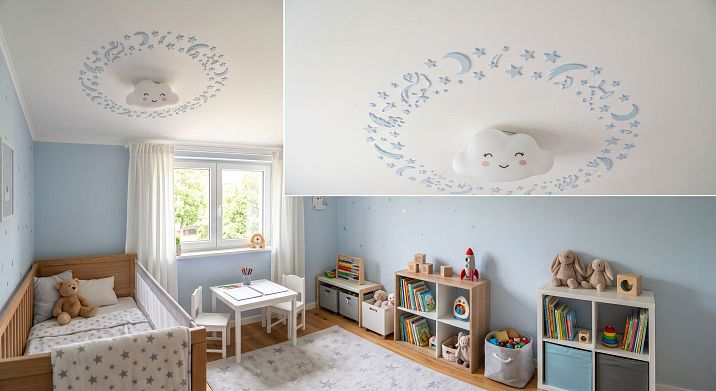
When it comes to a children's room, every parent asks themselves the same question: won't the stucco be too adult, too heavy, too risky? The answer is no, if you approach the choice thoughtfully.Ceiling decor for a children's roommade of polyurethane is not the plaster bas-reliefs of the last century or a fragile ornament that crumbles with vibration. It is a lightweight, reliably mounted material that creates a classic, calm ceiling — the one that will remain appropriate both in five and ten years, when posters on the walls have changed twice and furniture has been rearranged three times.
The main principle is simple:stucco on the ceiling in a children's roomshould be a background, not the center of attention. Ceiling decor in a children's room is an architectural foundation that works quietly, creating a sense of quality and completeness of the space without interfering with the child's life, play, and growth.



Can stucco molding be used in a children's room?
The question is natural — and it's good that it arises. Because the answer depends on what kind of stucco molding and how exactly it is used.
Heavy formal decor with multi-level coffered ceilings and baroque curls — no, not for a children's room. Butsafe stucco molding for a children's roommade of polyurethane is a different story. Polyurethane is lightweight: the density of the material is many times lower than gypsum, the weight of one linear meter of cornice or molding is measured in grams, not kilograms. This means that even with mechanical impact on the adhesive joint, the element will not "fall" with destructive force.
Several fundamental conditions for safe use:
-
Installation height. All ceiling decor is located at a height of 2.5 m and above — out of the zone of physical contact with a child of any age.
-
Reliable adhesive. Installation with special acrylic glue or liquid nails provides adhesion resistant to vibrations, temperature changes, and accidental impacts on the wall.
-
Coating. After painting, the surface of polyurethane stucco molding becomes smooth, without sharp edges and protruding elements — exactly what is important in a children's room.
-
Scale. Light ceiling decor for a children's room — not a monumental ornament, but calm geometry: a cornice, a neat frame, a small rosette for a light fixture.
Polyurethane stucco for a children's room — a safe, non-toxic, hypoallergenic material. After installation and painting, it becomes part of the ceiling surface and does not release any substances. Can stucco be used in a children's room? Yes — and there are simply no arguments against it with the right choice.




Why a children's room needs neat ceiling decor
There is one detail that many overlook when decorating a children's room: a child looks at the ceiling. Not briefly, but for a long time. Lying in bed before sleep, after waking up, during illness, in moments of thought. The ceiling is something that enters a child's visual experience daily, throughout childhood.
An empty, unfinished ceiling is a ceiling that says nothing. An overloaded ornamental ceiling is visual noise that disturbs rather than soothes. Neat stucco in a children's room, made from calm moldings and a soft center, creates a sense of order and coziness — without aggression, without variegation, without a "children's cartoon on the ceiling."
A children's room changes quickly. Wallpaper with bunnies is replaced by posters of idols. A canopy bed turns into a high bed with a shelf. A play mat gives way to a desk. But the architectural ceiling does not change — and that is its main value. Ceiling stucco in a children's room for growth is an investment in an interior that does not become outdated along with children's hobbies.
Molding decor set CPU-P5STAVROS is exactly that solution: intimate, without pomposity, with soft classical geometry that works as an architectural backdrop for posters, bookshelves, and the child's personal accents. CPU-P5 is described as a system for a bedroom, children's room, and cozy living spaces — classics without pomposity that remain relevant as the child grows.
Calm ceiling decor for a children's room is not a compromise, but a conscious choice. It says: "The foundation has been created here. The rest is your space."
Our factory also produces:



Which elements are suitable for a ceiling in a children's room
Get Consultation
Ceiling cornice
Polyurethane Crown MoldingSTAVROS is the first and most versatile element for a children's room. The cornice completes the transition from wall to ceiling, creates a clear horizontal line, and makes the room feel put together. This is important even in a small children's room: without a cornice, the ceiling and walls "get lost" in each other, and the room looks unfinished.
A ceiling cornice for a children's room is selected based on the room's height:
-
with a ceiling of 2.5–2.6 m — a profile of 50–70 mm, a calm relief, monochrome painting;
-
with a ceiling of 2.7–2.8 m — a profile of 70–90 mm, can be with a more expressive but not heavy profile;
-
with a ceiling of 3 m or more — a cornice of 90–110 mm, if the room's scale allows.
A children's room with a ceiling cornice is immediately a different level: the space gains architectural completeness, and the walls and ceiling cease to feel like a "box." It's better to paint the cornice for a children's room in the same tone as the wall or ceiling — then it works as a quiet architectural accent, not as a decorative element vying for attention.
Ceiling moldings
Moldings made of polyurethaneIn a children's room, it's a tool of soft geometry. A molding frame on the ceiling in a children's room creates a "frame" for the central light fixture, highlights the area above the bed, or marks the central axis of the room. This is not a strict architectural command, as in an office, but a soft structuring of space.
Moldings on the ceiling above the bed in a children's room are one of the best application scenarios. A frame made of a calm molding 30–40 mm wide creates a "sleeping place" — a visually highlighted area that the child perceives as "their own space." This also works psychologically: the frame above the bed creates a feeling of security and completeness.
Ceiling frame in a children's room:
-
in a small children's room of 10–12 m² — one frame in the center or above the bed;
-
in a children's room of 14–18 m² — a frame in the center + a cornice around the perimeter;
-
In a spacious room of 20 m² or more, the frame can be double or combined with a central accent.
It is better to buy moldings for the ceiling in a children's room from the same series as the cornice — then the profiles will be coordinated in proportions.
Ceiling rosette
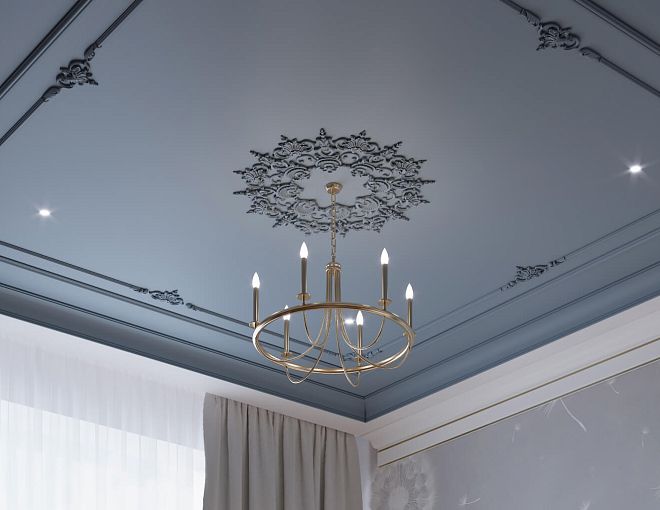
Polyurethane ceiling rosettesThey are appropriate in a children's room if the room has a central chandelier or pendant light. Ceiling decor around the light fixture in a children's room is a neat accent that makes the lighting device part of the architectural concept, not just a "bulb in the middle of the ceiling."
The ceiling rosette for a chandelier in a children's room should be small and calm in shape. A diameter of 150–250 mm is the optimal range for a children's room. Larger and more lush rosettes are best left for the living room or study. In a children's room, it is important that the central decor does not look like an "adult hall" but fits organically into the scale of the room.
An important detail: if recessed lights are used in the children's room instead of a chandelier, a rosette is not needed. But a central decorative accent — a molding circle or a small central decoration — can still become a visual "anchor" of the ceiling composition.
Ready-made ceiling decor set
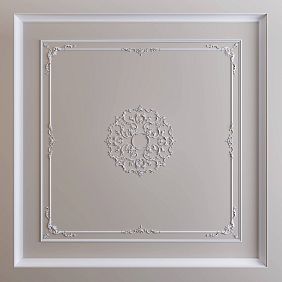
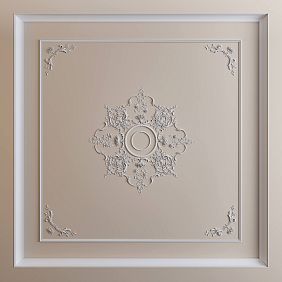
Ready-made set of ceiling decor for a children's roomis the safest way to avoid mistakes with proportions. A set of stucco for the ceiling of a children's room in the form of a ready-made CPU kit contains all coordinated elements: cornice, corner overlays, molding field contours, central accent. There is no need to select profiles from different series and guess whether they will look good together.
A set of ceiling decor for a children's room is selected based on two parameters: ceiling height and room area. All other parameters — scale of profiles, size of corner overlays, diameter of the central element — are already optimized by the manufacturer. For a children's room, it is better to choose not the most saturated kit of the CPU series, but a chamber version — CPU-P5 as the main one, CPU-P1 as a stricter alternative for a teenager.
CPU-P5: the main set for a children's room without pomposity
If you go through the entire CPU STAVROS line from the perspective of use in a children's room, CPU-P5 wins without hesitation. This is a chamber, calm system — eight types of products without complex multi-level corner groups, without heavy ornament, without pretension to grandeur.
WhyMolding decor set CPU-P5— the top choice for a children's room:
-
Scale. The 3200 × 3200 mm zone is proportional for a room of 18–25 m² with a ceiling height of 2.6 m. The system does not overload the space — it creates a light ceiling frame that reads as a classic architectural element.
-
Lightness of relief. CPU-P5 is designed for calm living spaces: bedrooms, children's rooms, cozy relaxation rooms. The profiles lack aggressive ornamental saturation.
-
Safety after installation. All elements are mounted on the ceiling at a height of 2.5 m or more, securely fixed with glue. After painting, the surface is smooth, without sharp edges or protruding parts.
-
Durability. CPU-P5 is a "classic without pomposity" that never goes out of style. When the child grows up and wants to change the children's room into a teenager's room — the ceiling won't need to be replaced. It will remain appropriate at any age.
-
Compatibility with lighting. CPU-P5 works well with both a central chandelier and a group of spotlights. The central decorative element — a rosette or molding circle — serves as a visual "anchor" for accent lighting, creating the feeling of a unified light center.
CPU-P5 for a children's room is not "adult decor in a child's room," but precisely the scale and character that suits a space where the child is the main focus, not the ceiling.
How to choose ceiling decor based on the child's age
Baby's room
A room for a baby up to 4–5 years old is all about maximum calm. Here, every detail that can affect sleep, a sense of safety, and the atmosphere matters. Ceiling decor for a baby's room should be quiet: a light cornice, a soft frame without complex relief, no active ornamentation.
Stucco molding on the ceiling in a baby's room:
-
only light tones — milky, warm white, light beige;
-
no color contrast — decor in the tone of the ceiling or slightly lighter;
-
cornice 50–70 mm — maximum;
-
you can get by with just a cornice and a neat rosette for a night light.
Calm ceiling decor for a baby's nursery is literally 'unnoticeable completeness.' The space looks high-quality and neat, but no element disturbs the eye.
Schoolchild's room
When a child goes to school, the room begins to change: a desk, bookshelves, and a backpack on a hook appear. The space becomes more functional. Ceiling decor for a schoolchild's room can be slightly more pronounced: a molding frame above the bed, a cornice of a slightly larger profile, a central rosette for a chandelier.
Stucco molding for a schoolchild's room is a good opportunity to add a sense of 'maturity' to the interior, which children at this age really appreciate. A frame on the ceiling above the desk creates a concentration zone — a visual 'frame' for studying.
Ceiling decor above the desk in a children's room: if the desk is against the wall, it is better to place the molding frame in the center of the room, not just above the desk — then the ceiling system will work for the entire room, not just one zone.
Teenager's room
A teenager is a whole different story. Everything changes quickly and radically here: hobbies, wall colors, posters, furniture. In this context, the ceiling should be as neutral as possible — an architectural backdrop that doesn't "argue" with any new solution.
Molding for a teenager's room is classic without pomposity. A neutral ceiling system that looks equally good with black band posters, light gray Scandinavian furniture, and bright pop-art accents. The ceiling simply exists — beautiful, finished, unobtrusive.
Teenager's room with molding: CPU-P5 or CPU-P1 (for a stricter teenage room) — both options work. CPU-P5 gives a slightly warmer and cozier system, CPU-P1 is more architecturally strict.
Ceiling decor for a teenager's room "to grow into" — something that won't need to be changed during renovations. Walls repainted — ceiling remains. Furniture replaced — ceiling remains. That's the power of a neutral architectural solution.
How to choose decor by children's room size
Small children's room up to 12 m²
A small children's room is the most demanding format. You can't overload the ceiling here: every extra decorative element "eats up" height and creates a feeling of crampedness. Ceiling decor for a small children's room is minimalism in the good sense.
Ceiling decor in a small children's room:
-
cornice around the perimeter — the only mandatory element;
-
without a frame or with a very thin molding frame 20–25 mm;
-
a small socket for a night light;
-
painting — strictly matching the ceiling color.
Stucco on the ceiling in a small children's room: if the ceiling height is 2.5–2.6 m and the area does not exceed 10–12 m² — limit yourself to a cornice. That's enough. The cornice already makes the room complete, and therefore — high-quality.
Children's room 14–18 m²
A children's room with an area of 14–18 m² is a standard format for a city apartment. Here you can use a more complete ceiling system: cornice + molding frame in the center + a small socket.
Stucco for a children's room of 16 m² with a ceiling of 2.7 m: CPU-P5 in this scenario is the optimal choice. The system creates a complete ceiling composition without overload. The 3200 × 3200 mm zone is proportional to a room of this size — the decor is visible, readable, but not overwhelming.
Ceiling decor for a children's room of 14 m²: with a ceiling of 2.6 m, you can consider CPU-P5 with monochrome painting. With a ceiling of 2.7 m — CPU-P5 or CPU-P1 depending on the desired character of the interior.
Spacious children's room or teenager's room from 20 m²
A large children's or teenager's room is already a space where the ceiling can be more expressive. Ceiling decor for a spacious children's room allows for a more saturated system.
Stucco decor set CPU-P1for a children's room from 20 m²: with a ceiling height of 2.7–2.8 m, the system looks proportional and creates a more architecturally strict ceiling — just what is needed for a teenager's room or a children's room in neoclassical style.
Molding decor set CPU-P3for a large children's room: this is an option only for truly spacious rooms — from 25 m² with a ceiling of at least 2.7 m. CPU-P3 provides a more expressive ceiling center, which is appropriate in a large teenager's room, a children's living room, or a room with separate study and play areas.
Which decor set is suitable for a teenager's room: for an area of 18–22 m² — CPU-P5 or CPU-P1; for an area of 22–25 m² — CPU-P1 or CPU-P3. The guideline is the scale of the room and the ceiling height.
How to choose decor based on ceiling height
Ceiling 2.6 m
A 2.6 m ceiling in a children's room is a challenge, but not a limitation. At this height, it is important to follow three conditions: a light scale of decor, monochrome painting, and the absence of heavy overhanging profiles.
Ceiling decor in a children's room with 2.6 m height: CPU-P5 is the right guideline. At a height of 2.6 m and a room of 18–25 m², the system creates a light, proportional ceiling scheme. Cornice no more than 70 mm, thin moldings, calm relief.
Which decor to choose for a children's room with a 2.6 m ceiling: only monochrome painting. No contrast of 'white stucco on a colored ceiling' at this height — it will visually lower the ceiling and create discomfort. Stucco in the color of the ceiling creates architectural relief, not color stress.
Ceiling 2.7–2.8 m
The 'gold standard' for children's rooms. At this height, you can freely use CPU-P5 or CPU-P1 depending on the room size and the desired character of the interior.
Ceiling decor for a children's room with 2.7 m height: CPU-P5 for an area of 16–22 m² is optimal. CPU-P1 for a children's room with an area of 20 m² is also a good option if a slightly stricter architectural system is needed.
Light ceiling decor in a children's room with 2.7 m height: it is important not to fall into 'under-decor' out of fear of overload. At a height of 2.7 m, a cornice + frame + rosette create the right system — it will look exactly as intended, without tightness and without 'emptiness'.
Ceiling from 3 m
A high ceiling in a children's room is a luxury that needs to be used correctly. At a height of 3 m or more, you can use more expressive decor: a cornice of 100–130 mm, corner accents CPU-P3, a central rosette for a large light fixture.
Ceiling decor in a children's room with high ceilings: CPU-P3 for areas from 22–25 m² and heights from 2.9–3 m is a valid choice. But even here, there's no need to go for CPU-P4 or CPU-P6: a children's room should remain cozy, not formal.
Stucco for a children's room with a 3-meter ceiling: at this height, a more pronounced color contrast is acceptable — light stucco on a slightly darker ceiling. But only if the area allows and the interior is not overloaded.
How to combine stucco, spotlights, and night lighting
A question almost all parents ask: what is better for a children's room — a chandelier or spotlights? The short answer: both work well with ceiling decor — with the right approach.
Option 1: central chandelier + rosette.
A classic scenario. The ceiling rosette fixes the light center, creating a decorative accent around the chandelier. Suitable for a children's room with one central light fixture — a nightlight-chandelier, a children's pendant lamp, a small lampshade.
Option 2: spotlights without a center + ceiling frame.
If there is no central chandelier in the children's room — spots are used along the perimeter of the frame or along the bed. Ceiling decor in a children's room with spotlights is designed so that the frame 'frames' the group of spots. This looks organized and beautiful.
Option 3: spots + LED lighting behind the cornice.
One of the coziest scenarios for a children's room. A cornice with a recess for an LED strip allows creating a soft contour lighting along the perimeter of the ceiling. Stucco in a children's room and night lighting work together: a warm, quiet strip provides soft, diffused light — an ideal night mode for a child.
Ceiling stucco with LED lighting in a children's room: the STAVROS cornice with a sufficient profile allows hiding the LED strip in a niche. The light does not hit the eyes, creating an even, soft contour — this is both architecturally beautiful and physiologically correct for a child's sleep.
Important: in a children's room, lighting should be multi-level. Bright task light above the desk, soft diffused light for play, night mode for sleep. Ceiling decor with a well-organized lighting scheme helps create all these scenarios in one room.
How to paint stucco in a children's room
Color is as important a parameter as shape and scale. And in a children's room, the color of stucco follows special rules.
Stucco matching the ceiling color is the safest and most versatile choice. A monochrome white or milky ceiling with white stucco is a "quiet classic" that creates a sense of space, lightness, and quality. The decor is perceived through the play of shadows in side lighting, without creating color tension.
Stucco in a light children's room: milky, warm white, cream — shades that work with blue wallpaper, pink wallpaper, and neutral gray ones. They do not conflict with any color.
Stucco in a white children's room: a classic solution for a white-themed children's room. If the ceiling is white and the walls are white, the stucco becomes almost invisible in direct light, but in evening lighting it "appears" and creates a beautiful play of shadows.
Moldings on the ceiling in a light children's room: a warm white molding on a cream ceiling is one of the best combinations for a children's room. No contrast, only soft relief.
In a baby's room, strictly monochrome painting without contrasts. In a schoolchild's room, a very slight tonal contrast is acceptable, for example, moldings slightly cooler than the ceiling. In a teenager's room, if there is a desire to make the ceiling more distinctive, color can be used, but without sharp transitions: stucco can be white on a light gray ceiling, for instance.
A children's room without pomposity with stucco is always about color restraint. Architecture works through form and relief, not through color contrast.
How to combine ceiling decor with walls in a children's room
Ceiling stucco in a children's room is part of the system. It works better when the walls and ceiling "speak" the same decorative language.
How to properly decorate a children's room with stucco:
-
Moldings on walls + ceiling frame. A children's room with moldings on the walls and ceiling is a classic interior where the entire space is architecturally organized. Wall panels behind the bed + a ceiling frame in the center is a strong, restrained solution.
-
Bed area. A molding panel on the wall behind the bed + a cornice on the ceiling above the bed area = an "architectural nest" for the child's sleep. This technique works for both a toddler and a teenager.
-
Work area. Stucco in a children's room with a desk: it's better not to overload the wall above the desk — leave space for shelves, boards, posters. The ceiling above the work area is just a cornice and a frame in the center of the room, without additional accents directly above the desk.
-
Wardrobe and stucco. Stucco in a children's room with a wardrobe: if the wardrobe is built-in with an upper mezzanine, the cornice on the ceiling continues the horizontal line of the mezzanine. This creates an architectural continuity of "wardrobe-ceiling," characteristic of well-designed interiors.
Polyurethane wall decorSTAVROS — molding frames, panels, corner overlays — creates a wall system that supports the ceiling system. This is a unified language of forms that makes the children's room interior truly high-quality.
Polyurethane moldingson the walls of the children's room: small decorative overlays, corner elements, pilasters above the bed — all this complements the ceiling system and creates a cohesive classic look.
If the walls are bright, the ceiling is made as calm as possible: only a cornice in tone or a set in monochrome paint. If the walls are neutral, the ceiling system can be slightly more pronounced and become the main architectural accent of the children's room.
Practice:installation of polyurethane molding — the final stage of renovation after painting or wallpapering walls.installing polyurethane molding is done with PVA glue or acrylic glue, joints are puttied and sanded. The entire cycle for a children's room is 1 day with a careful approach.
Mistakes when choosing stucco for a children's room
Mistake 1. Making the children's room too "adult"
Heavy corner groups, coffered frames, massive cornices 130–150 mm — all this is appropriate in a formal living room or executive office. In a children's room, this creates dissonance: the child feels uncomfortable in a "hall", they need coziness.
Mistake 2. Using too active an ornament
Lush ornament on the ceiling of a children's room visually presses down, especially if the ceiling is low. In a children's room, light relief and calm geometry work — not baroque, but soft classic.
Mistake 3. Making a bright color contrast on the ceiling
Contrasting stucco (for example, white on a blue ceiling) quickly gets boring and interferes with falling asleep. The ceiling is what the child sees before sleep. It should soothe, not excite.
Error 4. Not considering lighting
A child's room needs different lighting scenarios: active for play, working for study, soft for evening, night for sleep. If during the installation of molding you don't plan space for LED backlighting or the correct placement of spots — it can't be fixed later without rework.
Error 5. Choosing decor 'for 2–3 years'
Thematic 'children's' molding with rockets or bunnies is a temporary bet that will lose in a year. It's better to make the ceiling in a child's room architectural and neutral: this is an 'investment for growth' that will remain relevant at any age.
Where to buy ceiling decor for a child's room STAVROS
The STAVROS catalog offers a full selection of ready-made setsof ceiling decor for a child's room — CPU systems made of polyurethane, designed for different room formats and tasks. For most children's rooms, the main recommendation will beMolding decor set CPU-P5: a chamber system without pomp, created for the bedroom, child's room, and cozy living spaces.
For a more strict teenage room or a child's room in neoclassicism, it will suitStucco decor set CPU-P1 — a compact system for rooms from 20 m² with a ceiling height of 2.7–2.8 m. For a large children's room or a teenager's room with an area of 22–25 m², considerMolding decor set CPU-P3 — a universal system with a striking central accent.
Additionally, in the catalogpolyurethane products for interior you can select individualPolyurethane Crown Molding, Moldings, ceiling rosettesandWall Decor, to create a unified architectural system for the children's room.
If you are considering related articles in the cluster, it is also useful to study the material aboutceiling decor for the bedroom, ondecor for polyurethane ceilings, onmolding for ceilings 2.6–2.8 m and about choosingready-made set of stucco decor for the ceiling.
STAVROS — Russian manufacturerpolyurethane molding decorationfor residential and commercial interiors. Ready-made sets of the CPU series, cornices, moldings, rosettes, and wall decor are designed for use in various types of rooms — from the hallway to the executive office, from the living room to the children's room. STAVROS produces products that are installed without construction work, can be painted in any color, and last for decades. The entire range is presented in the online catalog — with technical specifications, installation diagrams, and application recommendations.
FAQ: answers to popular questions about ceiling decor for the children's room
Can stucco be used in a children's room?
Yes, provided the right choice: light scale, reliable installation with glue, smooth surface after painting, calm geometry without active ornament. Polyurethane stucco is non-toxic, hypoallergenic, and located at a height inaccessible to a child.
Which STAVROS set is best for a children's room?
For most children's rooms — CPU-P5: a chamber system without pomposity for the bedroom, children's room, and teenager's room. For a strict teenager's room or a children's room in neoclassical style — CPU-P1. For a large children's room from 22–25 m² — CPU-P3.
Is ceiling stucco safe for a children's room?
Yes. With proper installation using acrylic glue, all elements are securely fixed to the ceiling. After painting, the surface is smooth, without sharp edges. Polyurethane is a non-toxic, lightweight material that poses no risk when used in residential spaces.
What is better for a children's room: a chandelier or recessed spotlights?
Both options are appropriate. A central chandelier with a socket is a classic solution. Recessed spots with soft LED backlighting behind the cornice are a convenient modern scenario that creates several lighting modes: daytime, evening, nighttime.
How to make stucco molding in a children's room that grows with the child?
Choose neutral classic decor — calm moldings, a cornice matching the ceiling tone, a light rosette. Do not make a thematic or bright ceiling that will become outdated along with children's hobbies. The architectural ceiling will remain relevant even when the child changes furniture, wallpaper, and posters three times.
What color of stucco molding to choose for a children's room?
In a children's room, monochrome painting works best — stucco molding in the same tone as the ceiling or slightly lighter. Milky, warm white, cream are universal shades. Contrast painting is only acceptable in a spacious teenager's room with sufficient ceiling height.
Are wall moldings necessary if stucco molding is only on the ceiling?
Not necessary, but recommended. Wall moldings support the ceiling system and create a unified architectural language. The combination works especially beautifully: a frame on the wall behind the bed + a ceiling frame in the center of the room + a cornice around the perimeter.