Article Contents:
- Where to buy a ceiling medallion in Novosibirsk and what to find out before placing an order
- Why exposed wiring changes the usual choice of a socket for a chandelier
- Apartment baseline data: what to measure and what not to assume
- How to combine two drawings: the cable route and the modular ornament
- A numerical example: what the outer dimension tells you and what it doesn't
- Three selection scenarios: route to the side, intersection with decor, and a closed junction
- CRPU-070: a compact composition of 24 elements with an external route
- RPU.VRS-001: eight large overlays and the gaps between them
- CRPU-069: how to check 64 elements against an existing route
- CRPU-068: why increasing the composition can make the task more complex
- Comparison matrix: product specifications and questions about the installation diagram
- Can cable be hidden under polyurethane moulding
- Chandelier cup and central hub: why a separate drawing is needed here
- If the wire crosses the pattern: how to choose a solution without redoing the entire ceiling
- How to integrate a visible electrical box with the interior
- How much does it cost to buy a ceiling socket in Novosibirsk: four separate estimates
- Order specification: what to pass to STAVROS and the electrician
- Delivery of ceiling sockets to Novosibirsk and the region
- Eight mistakes that turn a purchase into a redo
- Frequently asked questions about ceiling sockets for exposed wiring
- Can I buy a ceiling socket and leave the visible cable as is?
- Which model is better for a 5.6 × 4.8 m apartment?
- Do I have to order a paper mounting template?
- Can I leave the junction box behind the open center of the socket?
- Which is cheaper: CRPU-070 or RPU.VRS-001?
- Can I trim a polyurethane scroll if it hits the box?
- If the difference between CRPU-069 and RPU.VRS-001 is only one millimeter, why compare both?
- Do I need to buy ceiling moldings together with the socket?
- Can delivery be arranged not to Novosibirsk itself, but to Berdsk or Iskitim?
- When is it better to abandon a ceiling socket altogether?

In the living room of a Novosibirsk apartment, the renovation is already complete: the concrete ceiling is painted, the chandelier hangs in the center, and power is supplied to it along an exposed run from the wall. The owner wants to add a polyurethane ceiling socket but does not want to chase the ceiling slab or remove a working light fixture for the sake of a new decorative solution. At first glance the task is simple: choose an ornament and glue it around the cup. In practice, the choice begins with a different question: where the cable runs, which electrical connections must remain accessible, and which areas of the ceiling can be occupied by molded decor.
A polyurethane composition is not a cable channel, a junction box, or part of the chandelier mounting. Existing connections cannot be hidden under its parts by default, and a beautiful gap between the overlays does not yet mean a permitted location for an electrical run. Therefore, the decision to buy arises only after comparing two layouts: the existing wiring and the layout of the selected socket. If they intersect, the way out may be a different article, an agreed electrical solution, or abandoning the additional decor. There is no need to modify the electrical wiring for the sake of the molding, and one should not do so.
Let us examine an apartment with an area of 26.88 m² and four real STAVROS composite sockets: CRPU-070, RPU.VRS-001, CRPU-069, and CRPU-068. We will compare not only their price and size, but also which documents are needed for safe combination with an exposed run. All room dimensions below are for training purposes; the actual boundaries and permitted installation methods are determined by the specific site and the conclusion of an electrical installation specialist.
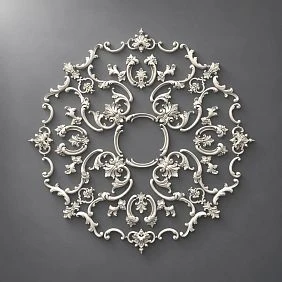
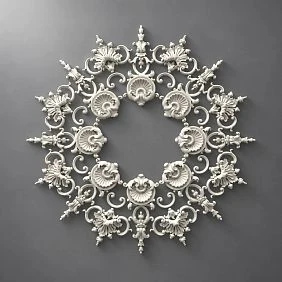
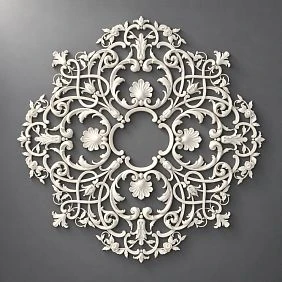
Where to buy a ceiling socket in Novosibirsk and what to find out before placing an order
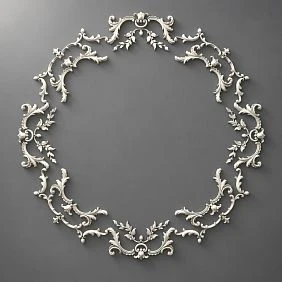
In the section Polyurethane ceiling rosettes ready-made composite STAVROS compositions are presented. What matters to the buyer is specifically the main product code. For example, CRPU-070 is not one solid ceiling plate, but a set of overlays that assemble into a single composition. An individual NPU element from its composition cannot be taken as the complete set: the image on the card of a separate part shows neither the full ornament nor the distances between adjacent modules.
The query "buy a ceiling medallion in Novosibirsk" usually leads to comparing shape and price. In the apartment under consideration, the sequence should be different: first photograph the ceiling with the entire exposed run, mark the positions of the chandelier and possible junction boxes, then request the installation drawing of the chosen composition from the seller. If a paper template is offered with the product, separately ask whether it is included in the price or purchased additionally. Only after that can the ease of installation and the cost of the order be assessed.
It is useful to split the purchase into two independent outcomes. The first is the decorative set itself: its product code, material, number of modules, price, drawing and delivery terms. The second is the technical solution for the existing lighting: whether access to the connections is preserved, where the chandelier is mounted, and whether the overlays interfere with the electrical fittings. The decorative sales manager can confirm the nomenclature and completeness of the set, but is not obliged to authorize changes to the apartment's power supply scheme. This conclusion falls within the competence of the electrical installation organization.
If under the word Moldings the buyer understands any ceiling decor at all, the task should immediately be narrowed to specific polyurethane medallions, rather than adding moldings and additional overlays to the estimate. Avoiding unnecessary elements is especially justified when there is already a visible engineering line on the ceiling: the more decorative modules, the more points of mutual coordination. The purchase can be arranged with delivery across the Novosibirsk region; local availability, lead time and final transportation are best confirmed at the time of ordering.




Why exposed wiring changes the usual choice of a medallion for a chandelier
When the luminaire's power supply is hidden within the building structure and installed according to an approved scheme, the buyer usually sees only the cable exit point and the chandelier canopy. With exposed installation, another architectural object becomes visible — the entire run. It may run across the ceiling in an electrical conduit, a protective pipe, or in another way provided for by the project and the requirements for this installation. These options differ in external dimensions, fastening rules, accessibility, and whether they allow proximity to decorative trim.
The main mistake is to treat the cable as just a thin line on the ceiling. Even a narrow conduit has height, fastenings, turns and serviceable parts. The distance to it is assessed not only from the conventional axis of the wire, but to the actual outer contour. At the same time, electrical connections and branch points must not become inaccessible behind non-removable overlays. Clause 2.1.23 of the PUE requires that the places of connection and branching of wires and cables be accessible for inspection and repair. The specific way of fulfilling this requirement on site is determined by a specialist, taking into account the applicable rules.
This check cannot be replaced by the assumption: "There is empty space in the center of the medallion, so the box can be hidden under the chandelier." The center of the ornament, the chandelier canopy and the electrical assembly perform different functions. The canopy may cover only the parts provided for by the luminaire's design, while maintenance issues and the permissible location of connections are resolved in accordance with the equipment documentation. The adhesive layer under the stucco must not become a means of securing the cable or covering the cover of an electrical installation product.
There is another reason not to buy by outer diameter. A composite medallion forms a pattern of spaced modules: between them remain unpainted or painted fragments of the main ceiling. Two models of the same width can have completely different patterns around the section where the cable already runs. However, the location of a module away from the wire does not mean that the electrical installation scheme is automatically permissible: first the very method of routing and maintenance is confirmed. Only after that do the gaps between the parts become an argument for the decorative choice.
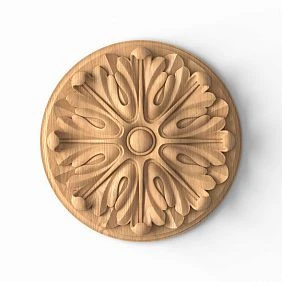
Our factory also produces:






Apartment baseline data: what to measure and what must not be assumed
For the calculation example, let us take a living room of 5.6 × 4.8 m, a ceiling height of 3.05 m, and a painted concrete base. The pendant chandelier is located at the geometric center. The cable runs from the wall in an exposed manner to the central light fixture, and its external route is already secured and in use. The owner does not plan to replace the entire ceiling finish. The room area equals 5.6 × 4.8 = 26.88 m², but this value hardly helps determine whether the outlet is compatible with the wiring.
For a truly useful survey, eight different pieces of information are recorded in a single table:
| What to measure or obtain | Why this is needed when choosing |
|---|---|
| Center of the actual chandelier mounting point | Align the ornament to the real axis rather than the assumed one |
| The full line of the exposed route | See all turns, boxes and approach points |
| External width and protrusion of the box or pipe | Check for physical conflicts with the terrain and installation areas |
| Joints, branches and their covers | Do not block access for maintenance |
| Size of the chandelier cup and mounting assembly | Check the central area of the selected ornament |
| Actual ceiling base | Agree on the polyurethane mounting technology |
| Layout drawing for each CRPU/RPU model | Check the position of each element, not just the overall size |
| Instructions for the light fixture and electrical system | Establish technical constraints that cannot be obtained from the stucco catalog |
The distinction between observation and inference matters. It is useful for the owner to photograph the route, note the dimensions, and provide drawings to the contractor. But you should not disassemble connections, loosen fasteners, or test unknown wiring while it is energized. If the type of box, the condition of the cable, or the purpose of a section is unclear, the specification should state so: "An inspection by an electrical installation organization is required." This is more honest and more economical than buying a socket in the hope of resolving unknown problems at height during installation.
For this room, it is convenient to take the coordinates of the chandelier center as the origin of a conventional system. The X axis should point from one long wall to the opposite one, and the Y axis across the room. The cable path can be marked on the plan with a polyline, and each electrical node with a separate symbol. The exact shape of the polyline does not matter as long as its real dimensions are not plotted. It shows why an ordinary angled photograph of the ceiling does not replace measurement: perspective hides the distances between the trims, the box, and the cup.
Get Consultation
How to combine two drawings: the cable route and the modular ornament
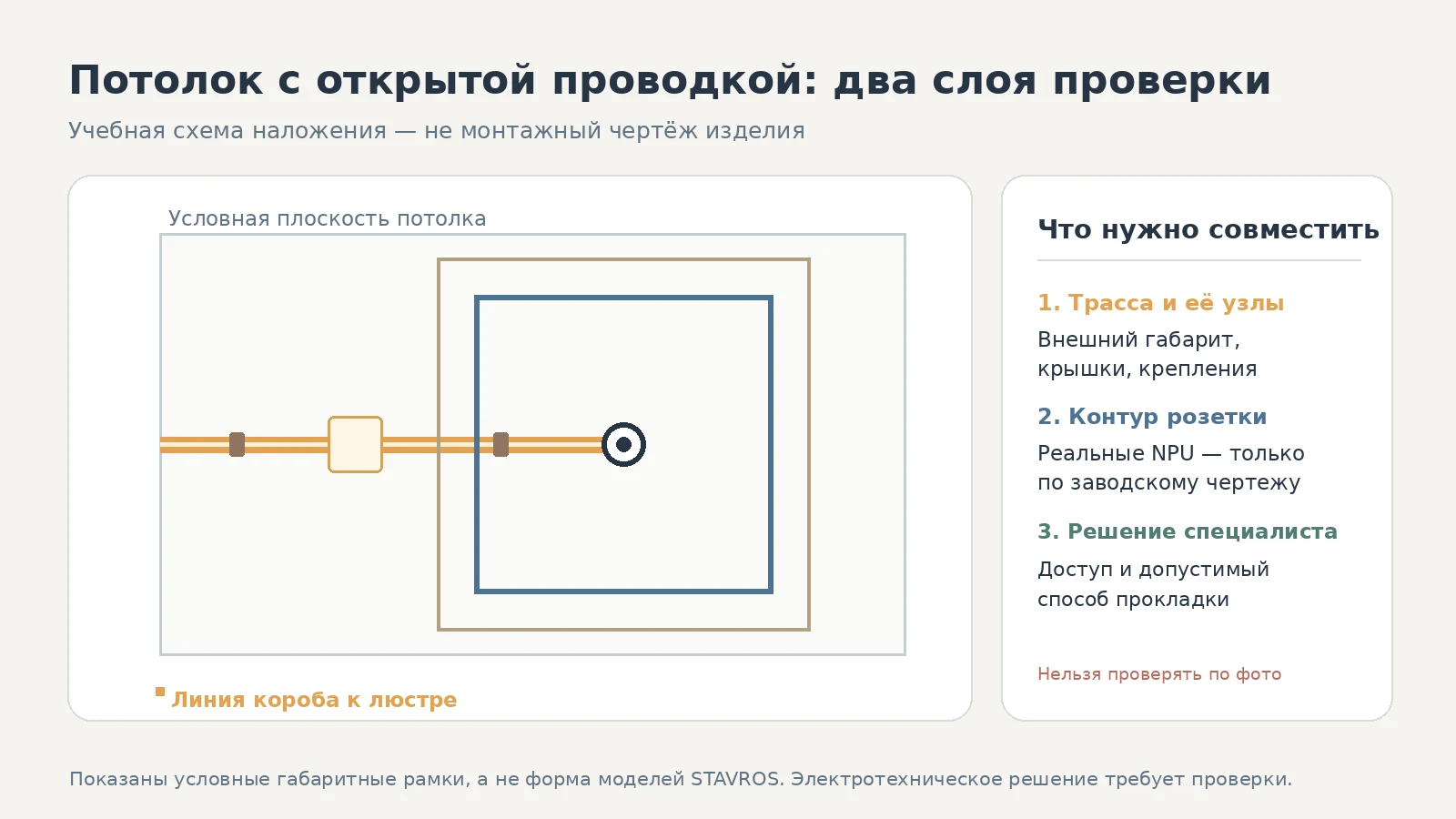
A working comparison begins not with installation but with two transparent layers on a single ceiling plan. The first shows only the existing electrical installation: the axes of the box or conduit, the outer contour with fasteners, the covers, the junction boxes, and the chandelier cup. The second layer contains the actual layout of all the elements of the future socket. It is important to use the manufacturer's installation diagram, not a generic round image from a search engine. The outer dimensions of the product card define the boundary of the composition but do not replace the contours of the individual trims.
The scale of both plans must be the same. If the drawing of the decorative set is in millimeters, the dimensions of the ceiling equipment are also converted to millimeters. Do not try to determine them from an image on a screen: there, objects may appear equal in width even though one trim is only 8 mm high and another module protrudes by 18 mm. A separate top projection cannot be used to assess possible contact with the box in height; such places will also require a cross-section.
After combining, three types of zones are marked. Green conditional zone — decorative elements do not overlap existing electrical equipment, and the installation method and access have been confirmed by a specialist. Yellow zone — the overlays are close to the cable trunking or cup, but without cutting it is impossible to determine whether they interfere with operation. Red zone — the element covers an electrical cover, crosses a fastener, or requires an unapproved modification of existing wiring. The color names are intended for project discussion and are not a certificate of technical safety.
It is more convenient to organize the verification procedure as follows:
- Mark the actual suspension point of the chandelier on the plan without shifting it for the sake of ornament symmetry.
- Tie the outer line of the cable trunking to the walls and ceiling axes, adding its height.
- Mark all connection and service nodes with separate outline areas.
- Obtain from STAVROS the installation drawing of the selected socket with the exact module layout.
- Overlay both drawings at the same scale; mark every zone of possible contact.
- Check where the cover of the electrical product must remain removable and how it opens.
- Agree the identified intersections with the electrician and choose a model that does not require prohibited intervention.
This approach works both for the compact CRPU-070 and for a composition of 64 parts. Its value lies not in the complexity of the drawings, but in the fact that before payment the buyer gets a clear answer: whether additional technical work is needed, whether the wiring can stay in its current place, and whether an already purchased socket will have to be abandoned. If the seller has sent only a perspective drawing, it is worth requesting a flat installation diagram: connections and fasteners cannot be verified from an artistic rendering.
Numerical example: what the outer dimension tells you and what it does not
Suppose the route runs in a straight line from the wall to the geometric center of the room. For a simplified estimate, mentally extend the last part of this line to the chandelier cup. If the socket is also centered, the boundary of its conventional square footprint on this axis is located at a distance of half the side from the center. This gives four values: 382.5 mm for CRPU-070, 455.5 mm for RPU.VRS-001, 455 mm for CRPU-069 and 662.5 mm for CRPU-068.
| Model | Outer size, mm | Half the footprint from the center, mm | What follows from the calculation |
|---|---|---|---|
| CRPU-070 | 765 × 765 | 382,5 | The route approaching the center enters the overall bounding square |
| RPU.VRS-001 | 911 × 911 | 455,5 | A layout plan for eight modules is needed |
| CRPU-069 | 910 × 910 | 455 | A detailed diagram of 64 modules is needed |
| CRPU-068 | 1325 × 1325 | 662,5 | The visually occupied zone is potentially larger |
This calculation does not meanthat the cable will necessarily come into contact with the polyurethane part. The overall frame includes the voids between elements. And the converse is also true: the absence of a cover exactly on the line does not automatically permit cable routing without the designated method of protection, fastening, and access. The numerical table shows the scope of the required verification rather than ranking products by electrical safety.
To see where a real drawing matters, let us imagine a conventional trunking 20 mm wide and an overlay whose edge is 12 mm from its longitudinal axis. When these contours are placed in the same plane, half the trunking width is 10 mm; the nominal lateral gap is only 2 мм to the outer edge. But even such an arithmetically positive number does not confirm the suitability of the solution: fasteners, the cover, ceiling unevenness, and possible maintenance may require completely different free space. Neither 2, nor 20, nor 50 mm is a universal standard here.
Another example: the junction box is located 320 mm from the center of the chandelier. It falls within the nominal footprint of all four models, but this does not prove that each specific overlay covers it. Answering requires the box's location on the plan, the dimensions of its cover, and the factory layout of the products. Even if all overlays avoid the box, its cover must still be able to open and be serviced without damaging the decorative finish. If space is insufficient, the choice of socket cannot be separated from adjusting the technical design.
Three selection scenarios: route to the side, intersection with decor, and a covered assembly
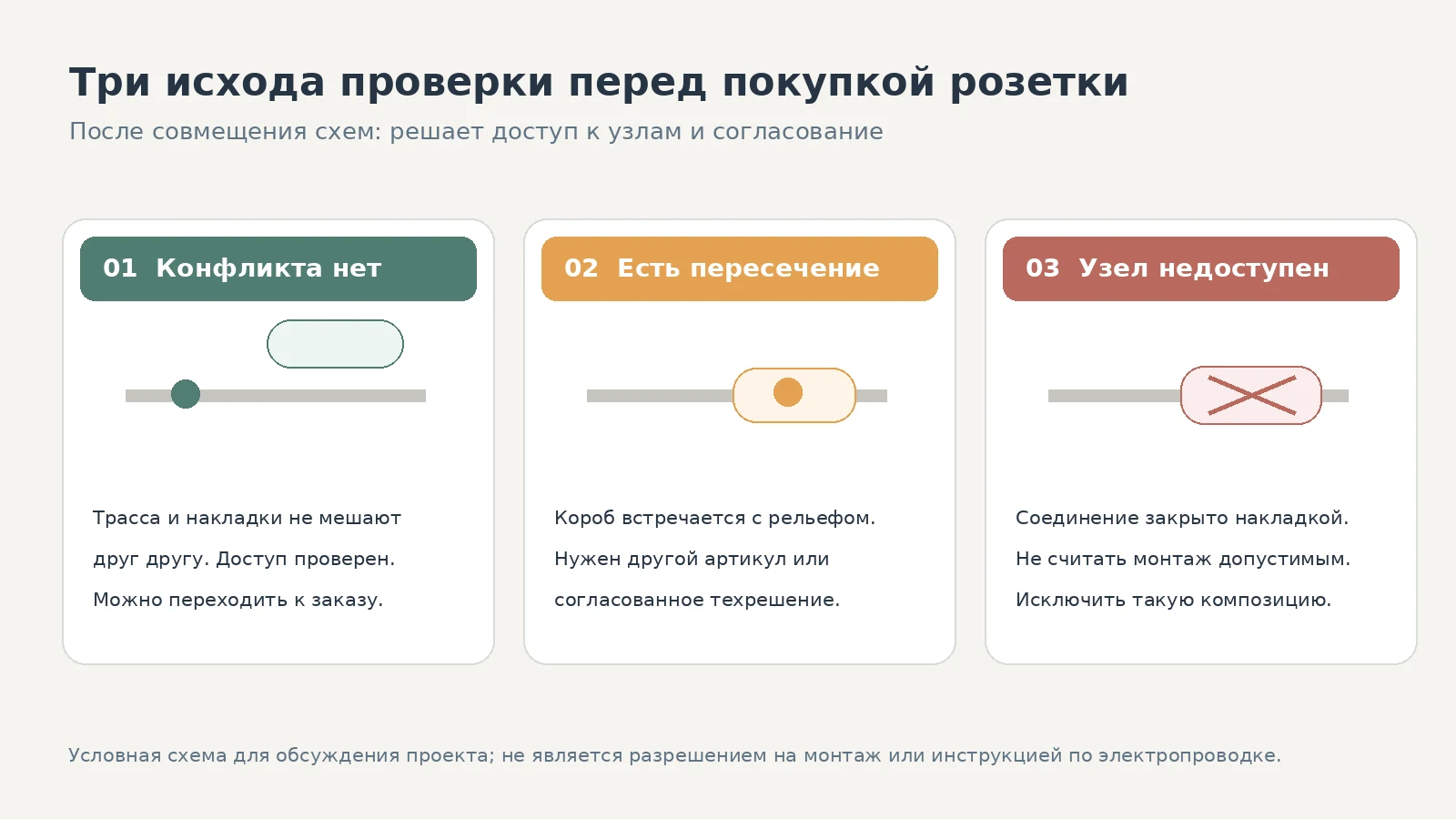
To make a decision, it is useful to immediately separate three situations that may look almost identical from the outside. In the first, the cable line approaches the chandelier, and the decorative overlays of the selected model are located away from it. The second looks more complicated: the route crosses the pattern, but the connections are accessible, and a permissible option for modifying the electrical solution could theoretically exist. In the third, the junction box, a serviceable cover, or fastening elements would end up under non-removable relief. This is no longer a matter of taste.
Scenario A — no visible conflict. The electrical installation specialist confirms that the existing surface wiring is permissible, and after overlaying the installation drawing it turns out that the socket does not cover the fastenings and serviceable devices. The buyer then selects a composition based on scale, pattern, and budget. At the same time, individual holes or slots in the part for the cable do not appear on their own: the factory layout must be preserved in the agreed form.
Scenario B — there is an intersection. For example, the electrical box falls on the molded scroll of model CRPU-069. The buyer should not ask the finisher to simply trim the scroll, fill the box with putty, or raise the part on a layer of adhesive. The correct subject for discussion is whether, according to a documented decision by the electrical installation organization, operability and access can be maintained, or whether it is more reasonable to choose a different item. A decision to modify the route is not a free service when purchasing a socket and should be assessed in a separate estimate.
Scenario C — a serviceable assembly is covered. If opening the box requires tearing off a glued decorative overlay, the technical solution cannot be considered confirmed. If it is impossible to shift the boundaries of the ornament without changing the factory pattern, it is easier to reject such a model. Saving money by choosing an “almost suitable” composition can result in redoing the entire ceiling, and that is unprofitable even with a relatively inexpensive set.
| Ceiling situation | What to record in the project | Product decision |
|---|---|---|
| No contact and access confirmed | Item code and approved layout | Order can be placed after checking other conditions |
| Overlay outline crosses the box or line | Intersection point and electrician's conclusion | Pause the purchase until resolved |
| Box or connection is hidden under a non-removable part | Inaccessible unit and required maintenance method | Exclude an unsuitable layout |
| Purpose of the route section unknown | Inspection required | Do not draw conclusions from a photograph |
Such a matrix is especially convenient when communicating with contractors. It does not state that polyurethane by itself makes the wiring safe or unsafe. It separates information about the decorative product from issues for which an electrical installation specialist is responsible. As a result, a beautiful ceiling remains the goal of the project, but not a reason to alter technical connections without verification.
CRPU-070: a compact composition of 24 elements with an external route
Model Ceiling rosette CRPU-070 has a catalogue dimension of 765 × 765 × 18 mm, is made of polyurethane and is offered at 35,680 ₽ according to a verified product page as of 3 November 2026. According to the manufacturer's description, the composition contains 24 overlays of three types and forms a star-shaped pattern. For a room of 5.6 × 4.8 m, this is the most compact of the four options under consideration in terms of external width.
This choice has a clear consumer rationale: the finisher needs to coordinate a relatively small total area with the electrical plan. But compactness must not be turned into a promise of problem-free integration with exposed cable. If the route enters the centre of the room along one ray of the ornament, a conflict may arise even with the smallest composition. That is why, in the request to the manager, it is necessary to specify not only the dimensions of the chandelier but also the direction from which the wiring approaches.
It is useful to check three zones in advance: the outer row of modules, the cable path to the central cup and the area under the cup itself. Since the overlays are supplied as separate elements, their exact placement depends on the installation drawing. If the seller offers a paper template, the buyer should clarify which specific item it is intended for. The presence of the common name “CPU” in the description does not replace confirmation of conformity with a specific scheme.
In the estimate for this model, the main purchase at 35,680 ₽, the installation template if required, the adhesive system according to the manufacturer's recommendations, preparation of the painted ceiling, finishing of joints and the cost of labour should be recorded separately. The electrical inspection should not be mixed with the installation of the stucco moulding: in the absence of a pre-agreed solution, it will be required regardless of the chosen item. Comparison with other models is correct only after this separation of costs.
CRPU-070 is suitable as the first candidate for verificationif visual lightness is to be preserved in the interior. However, it cannot be called compatible with a specific route in advance: a module map and technical approval are needed for a final decision.
RPU.VRS-001: eight large overlays and the gaps between them
Ceiling rosette RPU.VRS-001 is designed for dimensions of 911 × 911 × 18 mm. This is a polyurethane set priced at 67,360 ₽ according to the manufacturer's product page as of November 3, 2026. Unlike CRPU-070, it uses eight large elements of two types: four NPU-507 and four NPU-508. For a reader who sees a cable box on the ceiling, this modularity may seem convenient: there are sections of the main ceiling between the parts.
However, the open gaps have only a decorative meaning until the electrical wiring requirements are confirmed. Each gap cannot be considered a permissible channel for cable. It may be too narrow for the outer conduit body or inaccessible for maintenance and cleaning. Even where there is no visible overlay, its location may require fasteners, a mounting pad, or preservation of an opening cover. Therefore, the real check begins with the outline of each NPU-507 and NPU-508, not with a photo of the assembled ring.
From an acceptance standpoint, this set has the advantage of a transparent bill of materials: four parts of one type and four of another are checked. But the number of elements alone does not guarantee lower installation labor. Large overlays may require especially careful marking and support until the specified fastening technology sets. The back surface and the actual substrate need to be checked, rather than assuming that eight parts install faster than sixty-four.
There is also the question of color. If the cable channel remains visible, a large ornament is best assessed under the room's real lighting: its shadows may emphasize the route line or may visually compete with it. This is not an electrical criterion. The actual relative arrangement of elements and equipment is still established by the working plan, after which the designer chooses the finish. For RPU.VRS-001, it is especially useful to request a scaled layout and confirm the position of each of the eight overlays relative to the light fixture cup.
CRPU-069: how to verify 64 elements against an existing route
Size CRPU-069 — 910 × 910 × 15 mm, price — 62,560 ₽. According to STAVROS, the composition combines 64 polyurethane parts of 15 types. Some components have paired L and R designations, so not only the total count but also the orientation relative to the ceiling axes matters. It is precisely with such a dense rosette that a buyer can easily make a mistake: in the drawing the open center looks clear, but the peripheral zone contains numerous scrolls, leaves, and floral accents.
With exposed wiring, CRPU-069 must be assessed at two scales. On the general plan, first check where the conventional 910 mm square falls relative to the conduit. Then move on to the layout of individual modules and determine which elements are close to the active run. If the line approaches from the left, that does not mean you can "omit the left part" and keep the product as a factory socket. The modified composition may lose its symmetry and, more importantly, such an unauthorized edit does not resolve the issue of correct electrical line execution.
The manufacturer offers a paper installation template for CRPU-069 separately. In a project with an already finished ceiling, it is especially useful: using the drawing and template, you can identify conflicts with the cable conduit in advance, assess the placement of adjacent parts, and avoid accidentally swapping sides during assembly. However, the template is not an electrical engineering document. It is responsible for the geometry of the decorative set, not for the accessibility of the junction box.
For comparison with RPU.VRS-001, the difference in external width is just one millimeter: 910 versus 911 mm. The difference in the number and configuration of overlays, however, is enormous. Neither the identical dimensions nor the open center allow choosing a winner without a drawing. If the conduit runs through the gap between the sixty-four parts, the solution still requires confirmation of correct routing. And if it ends up under a peripheral overlay, the buyer must discuss another model or an agreed technical adjustment before payment.
The buyer's estimate for CRPU-069 starts at 62,560 ₽ for the main set. Added to this are the cost of the paper template if needed, materials, surface preparation, the labor-intensive layout of numerous parts, final painting, and delivery. The complexity of the ornament should not be turned into a fictitious percentage surcharge: the installer calculates the work based on a specific bill of quantities and the conditions of the site.
CRPU-068: why enlarging the composition can complicate the task
У CRPU-068 external dimensions 1325 × 1325 × 18 mm, the catalog shows a price of 50,480 ₽. The manufacturer describes it as an oval in visual pattern, modular composition within a square footprint. The list specifies 12 types of elements and states 72 parts. However, the available itemized bill of materials shows a discrepancy: the sum of the listed quantities is 68 pieces. Before final ordering, a corrected or updated complete bill of materials must be obtained from STAVROS, rather than independently assuming the four missing positions.
For a room with visible cable, enlarging the socket does not always help. The outer frame of CRPU-068 extends 662.5 mm from the center in each direction along the chosen axis. Compared with CRPU-070, that is 280 mm further. If the run goes from the wall through the ceiling center, it falls within a longer section of the overall zone. This is only a preliminary geometric assessment: the actual oval groups of overlays may leave free fragments. But these are exactly what will need to be checked in detail against the drawing, not against the overall price of the set.
There is also a compositional side. On a ceiling with exposed conduit, a large floral ornament can make the engineering line more noticeable: the eye will compare the smooth scrolls with the straight strip of wiring. Such a result is not a product defect, but it is useful to see it in a sketch before purchase. If the designer wants to keep the exposed run as part of the interior, they should not simultaneously try to hide it under polyurethane parts without a suitable technique. It is better to honestly show two distinct elements — the engineering one and the decorative one — with an agreed placement.
The CRPU-068 is useful as a reference option for spacious rooms, but in a training apartment it does not automatically gain preference because of its size. If installation requires reworking existing connections, the project cost may depend not on the price of 50,480 ₽ but on separately agreed electrical work and ceiling restoration. In that case, a smaller socket with a smaller coordination zone may prove more sensible. The purchase of a large set should be arranged after obtaining working drawings and clarifying the 72/68 specification.
Comparison matrix: product specifications and questions about the installation diagram
The different prices reflect the cost of the decorative sets offered, not a difference in their electrical safety. The table contains only confirmed product specifications. The last column shows an individual check that cannot be replaced by a reference to the catalog.
| Product | Size, mm | Contents as described | Price, ₽ | What to check first |
|---|---|---|---|---|
| CRPU-070 | 765 × 765 × 18 | 24 parts, 3 types | 35 680 | Route approach through the rays of the star pattern |
| RPU.VRS-001 | 911 × 911 × 18 | 8 parts, 2 types | 67 360 | Actual position of the large NPU-507 and NPU-508 |
| CRPU-069 | 910 × 910 × 15 | 64 parts, 15 types | 62 560 | Peripheral L/R parts and box location |
| CRPU-068 | 1325 × 1325 × 18 | 72 declared, the list gives 68 | 50 480 | Overlap of the enlarged composition and clarification of the contents |
This comparison alone cannot determine a suitable model. The conclusion is reached by overlaying the socket drawing onto the agreed electrical device plan and checking the actual ceiling base. The "approved for installation" line in the custom specification is filled in only after the relevant conclusion, not after viewing the product page in a store.
A useful clarifying check is not to confuse the central decor with an extended ceiling set. If only an accent around the chandelier is needed, an additional molding frame may increase the work area without practical benefit. In the catalog ceiling decor is presented more broadly, but complex existing wiring is a reason to limit yourself to the elements that are actually needed, rather than buying a whole system for the sake of one photo of a finished interior.
Can cable be hidden under polyurethane molding?
This question cannot be resolved based only on the appearance of the cable and the rigidity of the polyurethane. A decorative material does not become an electrical product just because there is enough space under it. A cable duct, conduit, and other permitted installation methods have their own conditions for mounting, protection, maintenance, and compatibility with the base. A molded overlay has a different purpose: to create relief and preserve the finish. If these tasks are combined without a design, you can simultaneously worsen access to connections and damage the decorative set during the first repair.
Particular attention is required where an exposed run enters a ceiling light fixture. Visually, it seems that the chandelier cup already conceals the electrical part. But one must not assume without verification that the cup is a universal junction box or a permitted location for all connections. Which connections are allowed inside the assembly of the selected fixture and how their maintenance is ensured are determined by the datasheet and the electrical design. Not all cups have the same construction, volume, and method of removal.
Therefore, it is reasonable to separate three questions before choosing an ornament. First: does a connection or branch exist at all in the area under consideration? Second: how was it made and where is access provided? Third: does the installation of the molding affect this access? A negative answer to the third question is insufficient if the first two are unknown. During renovation, old wiring whose purpose is no longer obvious from its appearance is often retained; at such a site, an electrician is invited before the finishing work.
In an article about buying a decorative product, there is no need to give instructions on how to reroute a cable, unpack boxes, or change connections. A clear criterion is far more useful to the reader: if the safety of the existing circuit and the accessibility of the connection points have not been confirmed, the choice of socket remains provisional. Do not cover the joint with glue, close the cover with a non-removable overlay, or cut arbitrary grooves in the ornament. An attempt to save on coordination turns the purchase of a beautiful item into a source of extra work.
If the technical solution allows a neat exposed run next to the molding, this is not an aesthetic compromise by default. On the contrary, the emphasized straight lines of the cable duct and the symmetry of the ornament can look intentional. The main thing is not to present such a design as a technical approval: stability, electrical safety, access, and installation methods are determined separately, taking into account applicable requirements and equipment documentation.
The chandelier cup and the central junction: why a separate drawing is needed here
Even when the entire external run is visible, the point where the cable enters the fixture often remains unclear. At the center of the ceiling, at least three different tasks intersect: the chandelier's own mounting, its electrical connection, and the finishing of the base with a decorative socket. A finished fixture may have a metal cup, a mounting bracket, a hanging hook, or another standard device. None of these options can be replaced with a polyurethane overlay. The load of the fixture is borne by the base and fasteners intended for it, not by the molded ornament.
Before purchasing, it is necessary to determine the outer diameter of the cup, its height, the mounting method, the position of the cable entry, and how to access the connections. The central part of some decorative compositions is open, but the geometry of this area does not equal the size of the chandelier cup. In a photograph it may seem that everything will fit, whereas the mounting junction protrudes to the side or requires space for removal. Such an obstacle is identified only from drawings or during a professional on-site inspection.
The reasoning "the cup will cover everything, so the electrical box will become invisible" is especially dangerous. An element hidden from view is not necessarily accessible for inspection and repair. The electrician must confirm which parts of the fixture are removable by design, where the connections are located, and whether access will be preserved after the decorative finishing. If removing the cup requires dismantling glued parts of the socket, the design of the center must be reconsidered already at the stage of choosing the SKU.
For a design specification, it is convenient to make a miniature section drawing: the ceiling plane, the thickness of the selected socket, the height of the duct at the approach point, the position of the cup, and the mounting junction. There is no need to depict the electrical circuit on it; it is enough to mark the dimensions and functional boundaries. At this stage, two specialists are involved: the electrician checks the electrical part, and the finisher checks the feasibility of installing polyurethane parts on the specific base. Their conclusions complement each other but are not interchangeable.
If the wire runs through the pattern: how to choose a solution without redoing the entire ceiling
Suppose that in the chosen model the external cable run crosses an acanthus scroll. Three reasonable scenarios are possible. The first is to compare other ready-made SKUs without changing the existing electrical layout. The second is to obtain a separate technical proposal from a specialist contractor for rerouting the run, if such a solution is permitted and genuinely necessary. The third is to keep the ceiling without a socket if the cost and risk of intervention prove disproportionate to the decorative effect.
When comparing ready-made models, you cannot rely on the number of elements alone. CRPU-069 has 64 parts, while RPU.VRS-001 has only eight; however, a large overlay can cross an important zone just as several small ones can. The external dimensions of these models are almost identical. The choice depends on the actual layout, the width of the trunking and the maintenance capabilities confirmed by documents. Before paying for an order, it is worth asking the manager to send an installation drawing for both models and showing the contractor the two options on a single plan.
If an electrical adjustment is proposed, it is important not to mistake a verbal “we'll move it a couple of centimetres” for a finished solution. Changing the method of laying, installing a box or positioning connections may affect the existing finishes and the property's documents. All necessary operations, materials, responsibility and the possibility of subsequent access must be agreed professionally. After that, the decorative set is chosen to suit an already defined and permissible run. The reverse order — first the expensive moulding, then finding a way to adapt the wiring to it — is economically and technically unsound.
If the decorative ornament is not suitable, this does not mean that the appearance of the room will inevitably suffer. You can keep a neat chandelier with a visible electrical feed, choose more restrained lighting, or order finishing work later, during a full renovation. It is more useful for the buyer to see honest alternatives in advance than to receive a recommendation to buy an unsuitable socket and then pay to fix the ceiling.
How to combine a visible electrical trunking with the interior
Exposed wiring does not have to look temporary. With a neat installation provided for by the design, the trunking can support the axes of the ceiling, follow the straight lines of the furniture or emphasise the modern part of the interior. The moulded socket is responsible for a different layer of decoration — the relief centre beneath the chandelier. There is no need to combine them into a single structure. It is precisely this separation of functions that allows you to achieve an interior that remains convenient to operate.
There are three artistic techniques that do not affect the technical layout. The first is to keep the ceiling colour calm and make the decorative centre light so that it does not compete with the line of the trunking. The second is to use contrast meaningfully: a strict visible run and a soft plant ornament can create an expressive combination if their axes are aligned. The third is to assess the future shadow from the chandelier and overlays under evening lighting. A lighting plan sometimes reveals a visual problem that is invisible during the day, even before purchasing begins.
None of these solutions involves painting, gluing or masking electrical equipment contrary to its instructions. If a change to the colour of the cable channel itself is planned, the materials and the permissibility of such finishing should be clarified with its manufacturer or an electrician. Decorative overlays are also painted according to their own technology, without applying finishing compounds to connections or serviceable covers. The beauty of the project must not reduce maintainability.
How much does it cost to buy a ceiling socket in Novosibirsk: four separate estimates
To make the comparison fair, first establish the confirmed catalogue price of the product itself, while all additional work is kept as separate line items. In the project under consideration, four prices refer to verified STAVROS product pages as of 3 November 2026. They are not an offer with a guaranteed validity period: before payment, the price, configuration and availability must be rechecked.
| Purchase option | Socket price, ₽ | What can increase the total |
|---|---|---|
| CRPU-070 | 35 680 | Mounting template, centre preparation, finishing |
| CRPU-068 | 50 480 | Clarification of configuration, complex layout, additional work |
| CRPU-069 | 62 560 | Paper template, assembly of 64 elements, painting |
| RPU.VRS-001 | 67 360 | Marking out eight large overlays, base, finish |
In the working schedule, the confirmed costs of ceiling preparation, the necessary adhesive and finishing materials, installation, painting and transport should be added to any line. If the route requires a survey or a technically permissible modification, this part is drawn up as a separate section of the electrical estimate. Neither the size of the socket nor the number of modules allows the cost of the work to be calculated in good faith without data from a specific installation team. Therefore, the article contains no invented rates per square metre or percentages of the product price.
For comparison, it is important to understand the difference between saving on a product and saving on the whole project. Suppose one set is cheaper than another, but its pattern crosses a cable trunking and requires the solution to be reworked. Then the actual budget may become larger, even if the product price is low. The reverse is also possible: a more expensive socket may be more convenient in shape for the agreed layout and require no additional decorative work. This is hypothetical logic, not a statement about the technical suitability of a specific model.
When calculating an order for a single chandelier, you cannot automatically add a whole ceiling set CPU-P, numerous moldings and trims "for completeness". Extra parts placed in one order will increase costs and create new points to check relative to exposed electrical installation. If the task is limited to finishing one central unit, it is enough to choose one suitable factory composition. For a buyer who wants Buy molding in an apartment with renovation already completed, a precise technical specification is more valuable than an expanded product range.
Order specification: what to pass to STAVROS and the electrician
A useful specification consists not of a chat thread like "I liked this socket", but of specific lines against which the delivery can be checked. For the product, state the main article number CRPU/RPU, material, size, number of components, price check date, whether a mounting template is needed, a link to the product page and the agreed drawing. Separately note the layout of the chandelier, conduits, pipes and service points. For CRPU-068, additionally request confirmation of the disputed number of modules so that a discrepancy found in the catalog is not carried over into the actual order.
On the electrical side, you need markings of places where decor must not be installed, as well as a clear final status: the layout is suitable without changes; a separate agreed solution is required; installation of the composition under consideration is not permitted. You should not ask the seller of decorative products for a conclusion on the operability of the wiring. Likewise, the electrician is not obliged to determine the factory completeness of several dozen polyurethane trims.
The specification should include a "Who confirms" column. The seller confirms the cost and composition of the product. The installation drawing confirms the position of the decorative modules. The electrical installation specialist confirms the possibility of installation next to the electrical route. The decorative works contractor confirms the quality of the base and the finishing sequence. Such a division of responsibility prevents a situation where each participant assumes that the others have already checked the complex area.
It is useful to attach to the request a plan at a single scale and several photos of the existing ceiling from a general angle and close up. When the manager sees not only the selected article number but also the actual route, it is easier for them to explain which mounting template and which additional documents are needed. At the same time, photos do not replace confirmed dimensions, and the technical part should not be agreed exclusively in a verbal conversation.
Delivery of ceiling sockets to Novosibirsk and the region
After technical approval, the usual purchasing questions remain: availability of the required article number, completeness, packaging and delivery. On the page payment and delivery STAVROS the methods of placing and transporting an order are described. Before payment, you need to obtain a quote specifically for your address: Novosibirsk, Berdsk, Iskitim or another settlement in the region should not automatically have the same rate or delivery time.
For a composite socket, not only the number of packages is checked, but also the module list. These are two different operations. If the carrier handed over two packages out of two, this confirms the number of packages but does not prove that all NPUs are inside. Upon receipt, it is reasonable to inspect the packaging for external damage and act according to the carrier's documents if problems are found. A detailed breakdown of winter storage and acceptance is already provided in a separate STAVROS article on checking sockets after winter deliveryhere it is only important not to schedule installation before verifying completeness.
Particular attention is paid to verifying the main SKU, the sides of mirrored parts, the quantity of identical overlays, and whether the installation template is included. CRPU-070 and CRPU-069 are not interchangeable due to differences in dimensions and ornament. One should not assume that any part with a similar NPU number fits in place of another. If the order contains the disputed CRPU-068 configuration, the agreed list is attached to the documents before shipment.
Eight mistakes that turn a purchase into rework
- Ordering from a single interior photo. The photo shows the ornament layout, but not the wiring type or access to connections. Even an expensive set may be unsuitable for a specific ceiling. Before payment, a route plan and a working layout are needed.
- Substituting the external dimensions for the actual parts map. The size 910 × 910 mm says nothing about the position of each of the 64 CRPU-069 modules. Without an installation drawing, it cannot be claimed that the cable will pass between the overlays.
- The assumption that a chandelier cup will solve any electrical problem. The standard cup does not replace a technical check of connection points and access. Its design is compared against the project and the luminaire instructions.
- Attempting to close the box lid with non-removable molding. This may prevent normal inspection and repair. Instead of such a solution, a different decorative contour is chosen or electrical installation changes are agreed upon.
- Moving the cable for symmetry without a separate project. Even a short shift is not just a finishing operation. Its necessity and the permissible method of execution are determined by an electrical installation specialist.
- Buying individual NPUs instead of a factory-made socket. Composite sets are selected by the finished article number, not by similar curls. CRPU-069 has mirrored positions that cannot be arbitrarily replaced with a same-type part.
- Ignoring the entire project cost. The product price does not automatically include the template, installation, painting, base correction, transportation, and possible work on the existing electrical line.
- Assigning installers before the scheme is approved. When the box is discovered under the ornament on installation day, the crew is left with either stopping work or proposing a risky improvisation. Verification must precede the installation schedule.
These mistakes share a single cause: a decorative purchase is being finalized before the existing ceiling has been surveyed. If the layout is obtained first and access to serviceable components is confirmed, choosing from the catalog becomes an ordinary commercial task. The buyer understands in advance where the money will go and why a particular option is ruled out.
Frequently asked questions about ceiling sockets with exposed wiring
Can I buy a ceiling socket and leave the visible cable as is?
Yes, this option can be considered if the existing routing is done correctly, decorative elements do not interfere with servicing, and specialists have confirmed the compatibility of the solutions. Keeping the line in view should not be confused with permission to cover it with polyurethane overlays. Before purchase, a working plan for both circuits is provided.
Which model is best for an apartment measuring 5.6 × 4.8 m?
By size, CRPU-070 is the most compact of those compared. But even for it, the cable path to the center, the cup, and the module pattern will need to be checked. The room area does not allow choosing a technically suitable socket without data on the wiring itself. The visual proportion is assessed after engineering conflicts have been ruled out.
Is it mandatory to order a paper installation template?
Whether it is needed depends on the selected product and the requirements of the installation crew. For CRPU-069, the manufacturer offers the template separately. With an existing exposed run, precise layout is especially useful, but a paper template does not confirm electrical safety and does not replace the electrician's design. Check whether the template is included with the main item code.
Can the junction box be left behind the open center of the socket?
An open space by itself does not provide such permission. It is necessary to check whether access to the box for inspection and repair is preserved, how it is closed, and whether the chandelier cup or adjacent elements interfere with this. The final decision depends on the equipment documentation and applicable requirements.
Which is cheaper: CRPU-070 or RPU.VRS-001?
The price of the CRPU-070 product is 35,680 ₽, and RPU.VRS-001 is 67,360 ₽ according to the catalog on the date of verification. The difference is 31,680 ₽ for the decorative sets themselves. The full order cost depends on additional materials, installation documents, and agreed-upon work. Therefore, for budgeting, not only the catalog line items but also both final estimates are compared.
Can a polyurethane scroll be trimmed if it runs into the box?
Such a decision should not be made independently. Changing the factory composition may affect the appearance and quality of fastening, and the electrical conflict does not disappear automatically after trimming. It is more reasonable to first check another model or obtain an agreed-upon solution for the route; decorative changes are discussed with the supplier and the installation organization.
If the difference between CRPU-069 and RPU.VRS-001 is only one millimeter, why compare both?
Because the first model consists of 64 parts of 15 types, while the second consists of eight elements of two types. They have a different distribution of decorative modules within an almost identical outer frame. The cable path and the location of serviceable boxes are compared specifically with the actual parts, not with a single square line.
Do ceiling moldings need to be purchased together with the socket?
No, this is not a mandatory part of the order. If the design provides only a central composition for the chandelier, an additional perimeter of moldings may be excessive. On a ceiling with exposed wiring, each new decorative section will require additional verification in relation to the electrical route and the mounting base.
Is it possible to arrange delivery not to Novosibirsk itself, but to Berdsk or Iskitim?
Contact us to confirm shipping to your destination. is offered by the company, but the exact availability, carrier, rate and timeframe for a specific address must be confirmed at checkout. Do not rely on the standard timeframe given for a different city or set. Before dispatch, it is useful to confirm the number of packages and the agreed packing list.
When is it better to forgo a ceiling socket altogether?
When the chosen decor blocks the required access to connections, interferes with the standard installation of the chandelier, or requires an unacceptable modification of the existing electrical circuit. Declining an unsuitable purchase is a normal outcome of sound design. In that case, you can keep a neat ceiling with a visible technical line or consider the decor later during a scheduled renovation.
Summary: which ceiling socket to order for exposed cable
Four real options are available for Novosibirsk: the compact CRPU-070, the richly detailed CRPU-069, the large RPU.VRS-001 with eight modules, and the extended CRPU-068. All of them can be included in a preliminary comparison, but none is deemed compatible with a specific exposed wiring solely on the basis of dimensions or a photograph. The catalog price is an important part of the purchase, not confirmation of installation safety.
Before paying, the buyer needs a diagram of the existing line, data on the central cup, information about the connections to be serviced, the installation drawing of the decorative set, and the agreed result of comparing them. If there is no conflict, all that remains is to choose the pattern and place the order. If there is a conflict, the engineering issue is resolved first or a different composition is chosen. If servicing becomes impossible, the unsuitable socket is excluded.
The main practical rule is simple: polyurethane molding should decorate the ceiling, not replace the electrical structure. This approach helps you buy exactly the set that can be used in an already renovated apartment without unnecessary risk and without the cost of subsequently correcting mistakes.