










































































Article Contents:
- What is included in ceiling molding
- How ceiling stucco differs from wall stucco
- How to choose a ceiling cornice
- Ceiling Height
- Room width
- Interior style
- Smooth or figured profile
- Cornice for backlighting
- Cornice for painting
- Ceiling rosette for chandelier
- How to Choose the Diameter of a Rosette
- Simple or ornamental rosette
- Rosette, cornice, and chandelier in the same style
- Moldings for the ceiling
- Frames on the ceiling
- Ceiling zoning
- Moldings in the bedroom
- Moldings in the study
- Molding installation technique
- Ceiling stucco for different rooms
- Living Room
- Bedroom
- Office
- Hall and Foyer
- Kitchen-living room
- Restaurant and hotel
- Beauty salon
- How to choose stucco to match the style
- Classic
- Neoclassicism
- Modern classicism
- Art Deco
- Minimalism with a thin profile
- Why polyurethane is convenient for the ceiling
- Mistakes when choosing ceiling moldings
- Where to buy ceiling stucco
- About the company
- FAQ - answers to popular questions
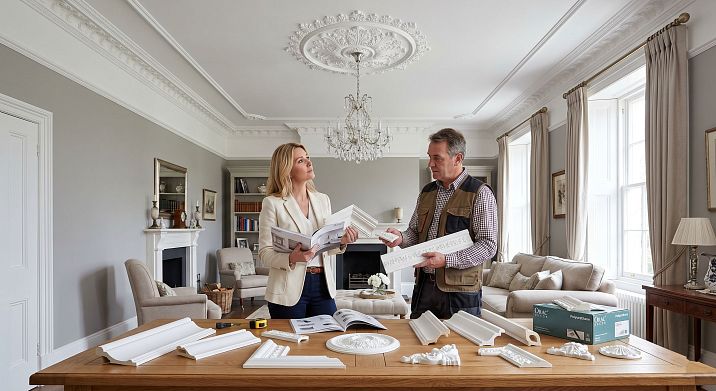
The ceiling is not just a floor above your head. It is the fifth wall, most often underestimated, left bare and faceless, while it is precisely this that sets the height of the space, brings the entire interior together, and forms the first impression of the room. Properly selected Ceiling molding turns an ordinary apartment into an architecturally complete statement. But it is important to understand here: choosing one cornice or one rosette is not enough. Ceiling decor works as a system — a set of interconnected elements, each of which enhances the other.
This article is not about ideas and inspiration. It is a practical guide to selecting and matching a set of polyurethane ceiling stucco: cornice, chandelier rosette, moldings, corner elements, and decorative trim. Read carefully — by the end, you will know exactly what to buy and how not to make a mistake with the sizes.


What is included in ceiling molding
Before going shopping, it's important to understand the composition of a ceiling kit. Many people only buy a cornice, then add a rosette from another collection, and take moldings from a third series altogether. As a result, the ceiling looks like a set of random elements rather than a cohesive composition. To prevent this, you need to understand what a complete set consists of. ceiling molding.
A ceiling cornice is the main profile that is mounted along the perimeter of the ceiling at the junction of the wall and the floor. It covers the transition, adds volume to the upper zone, visually raises the ceiling, and sets the style of the entire kit.
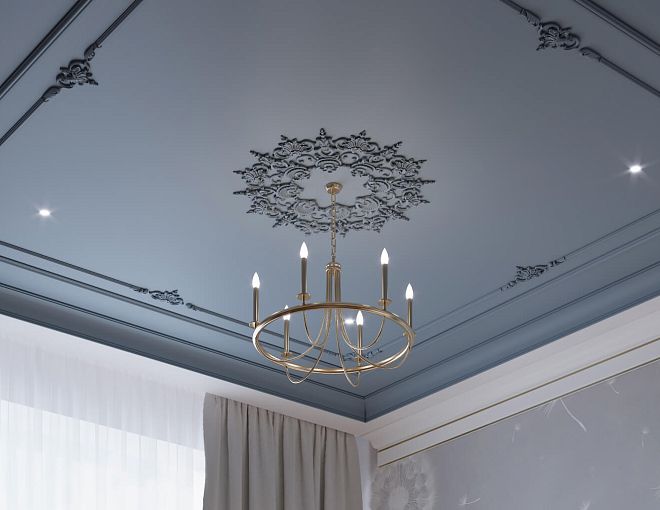
A ceiling rosette is the central element of a ceiling composition, installed under a chandelier or spot light. The rosette frames the lighting area, hides fasteners and wires, and gives the ceiling architectural significance.
Ceiling moldings are linear decorative profiles used to create rectangular or shaped frames on the ceiling plane, zone the space, design central medallions, or frame the cornice from below.
Decorative corners are corner inserts that cover the joints of moldings and cornices in external and internal corners of the room. It is the corners that determine the neatness and professional look of the entire structure.
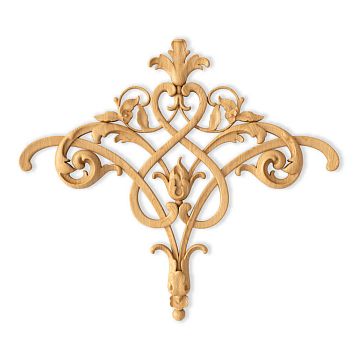
Central and overlay elements are non-standard shaped rosettes, medallions, cartouches, diamonds, and other overlay figures that complement the central zone of the ceiling and place accents in the right places.
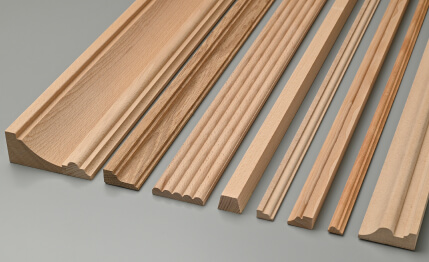
Linear profiles are long profiles of various cross-sections, supplied by linear meters. Polyurethane trim used to create frames, borders, edgings along the perimeter, and dividing strips on the ceiling surface.
Wall-to-ceiling transition elements are ceiling baseboards, coves, and cornice profiles that provide a smooth or sharp transition between vertical and horizontal planes. They are indispensable where the ceiling does not perfectly meet the walls.
This entire set is not a designer's whim. It is sound architectural logic, where each element plays its role in the overall decorative system.




How ceiling molding differs from wall molding
The question seems simple at first glance, but this is exactly where most people make their first mistake when choosing. Wall decor and ceiling decor are different tools with different tasks, even though they may look similar on the outside.
Ceiling molding works with the upper zone of the interior. It handles three fundamental things: it decorates the transition between wall and ceiling, creates a vertical illusion (visually lifts or structures the ceiling plane), and frames the lighting area. This is functional decor that, when chosen correctly, makes a room taller, lighter, and more expensive.
Wall molding, on the other hand, works with vertical planes: it creates frames, panels, niches, and frames mirrors, doors, and columns. It adds depth and texture to walls, setting the rhythm of the room horizontally.
Another fundamental difference is the load requirements. molded decoration made of polyurethane For the ceiling, it must be as light as possible to avoid putting excessive strain on the adhesive bond. Polyurethane is ideal here: with high decorative quality, it weighs several times less than plaster. This is why polyurethane ceiling molding has long become the preferred choice in modern projects.
The profile of a ceiling cornice typically has a special shape: it attaches to two planes at once—the wall and the ceiling—and is designed for corner installation. Wall molding attaches only to the vertical surface. Using one instead of the other results in unevenly seated decor that looks unprofessional.
The conclusion is simple: for the ceiling, you need to choose ceiling decor specifically designed for this task.
Our factory also produces:




How to choose a ceiling cornice
A cornice is not just a strip. It is an architectural gesture that defines the character of the entire room. A cornice that is too massive in a small space presses down and compresses the room. One that is too thin on a high ceiling gets lost and looks accidental. Choosing a cornice requires precise calculation and an understanding of several key parameters.
Get Consultation
Ceiling height
This is the first thing to measure. There is a simple rule: the lower the ceiling, the narrower the cornice should be.
-
Ceilings up to 2.5 m — cornice with an overhang of 5–7 cm, with a smooth or low-relief profile.
-
Ceilings 2.7–3.0 m — cornice with an overhang of 7–12 cm, moderate ornamentation is acceptable.
-
Ceilings above 3.0 m — wide cornices with an overhang of 12–20 cm, rich relief, complex profiles.
The most common mistake is choosing a cornice "with a reserve," thinking that a large profile looks richer. On a low ceiling, this works exactly the opposite: the cornice visually descends from above, presses down, and destroys the sense of height.
Room width
In a narrow room 3–4 meters wide, a wide cornice will visually "eat up" space. Here, a thin fillet or a laconic profile with clear geometry is optimal. In spacious halls of 20 square meters or more, you can already afford a multi-tiered cornice or a cornice with lighting.
Interior style
-
Classic, neoclassical — figured cornice with ionic, meander, acanthus, or floral ornament.
-
Modern classic — cornice with a smooth profile, without aggressive ornamentation, with clear rods.
-
Art Deco — geometric cornice, strict stepped profiles, minimal vegetation.
-
Minimalism, Scandinavian — thin fillet with a simple profile, emphasis on line, not relief.
Smooth or shaped profile
A smooth cornice profile is modern, laconic, and convenient for painting. It suits most neutral interiors and does not require a complex ornamental context. A shaped profile is a higher decorative statement that requires a corresponding continuation in the interior: stucco inserts, moldings, and a rosette in the same ornamental style.
Cornice with backlight
A separate category is a cornice with a hidden niche for an LED strip. This profile is installed slightly above the ceiling level and creates the effect of a floating ceiling with soft diffused lighting. This is one of the most popular techniques in modern classic and neoclassical styles. Moldings made of polyurethane with a cavity for backlighting allow combining decor and functional light architecture in one element.
Cornice for painting
If you plan to paint the ceiling stucco in the color of the ceiling or walls, choose a polyurethane cornice with a dense fine-porous structure that holds paint well. Polyurethane is excellent for painting with acrylic and latex compounds, retains the clarity of the relief, and does not absorb excess paint into the porous structure. This is a fundamental advantage over polystyrene foam, which often loses the clarity of the ornament under paint.
Ceiling rosette for a chandelier
A ceiling rosette is an element without which a ceiling with a chandelier looks unfinished. It performs three functions simultaneously: decorative (frames the central area of the ceiling), structural (hides fasteners, wires, and the hole in the ceiling), and compositional (serves as the visual center of the ceiling decor).
How to choose the rosette diameter
There is a basic rule: the diameter of the rosette should be equal to or slightly exceed the diameter of the chandelier. If the chandelier occupies 40 cm in plan, a rosette with a diameter of 30 cm will look skimpy and random. The optimal ratio is a rosette equal to the diameter of the chandelier or 10–15% larger.
For small chandeliers and spotlights with a diameter of 20–40 cm, rosettes of 25–45 cm are suitable. For large chandeliers in formal halls and living rooms with ceilings above 3 m, rosettes can reach 80–100 cm or more — this is already an element that becomes an independent architectural center.
Simple or ornamental rosette
The choice between a smooth and an ornamental rosette is again a matter of style and context.
A simple smooth rosette with clear concentric rings suits modern classic, minimalism, and Scandinavian style. It does not draw attention and delicately marks the center of the ceiling.
An ornamental rosette with acanthus, volutes, floral motifs, or Baroque curls is a choice for classic and neoclassical interiors, where the entire ceiling set carries a rich decorative charge. It is important that the rosette's ornament echoes the cornice's ornament: identical leaves, similar relief, and a unified plastic culture.
Rosette, cornice, and chandelier in one style
Experienced designers know: the rosette, cornice, and chandelier should form a single axis. The chandelier is the physical center, the rosette is its architectural frame, and the cornice is the perimeter background. All three elements must be proportionate to each other and work in a unified stylistic key.
If you are choosing stucco for a chandelier in a living room or bedroom, start with the chandelier: determine its diameter, style, and weight — and then select the rosette to match it. Then the rosette sets the reference for the cornice and moldings. This is how a systematic approach to ceiling decor works.
Get acquainted with decorative elements made of polyurethane in the STAVROS catalog — it features both laconic rosettes for modern interiors and rich ornamental central elements for classic and neoclassical projects.
Ceiling moldings
Moldings are decorative profiles that transform a flat ceiling into an architectural surface. They are used to create frames dividing the ceiling into zones, rectangular coffers, central medallions, accent strips, and figured outlines around the chandelier.
Ceiling frames
One of the most popular techniques in neoclassicism and modern classicism is creating rectangular frames from moldings on the ceiling plane. This visually increases the height, adds "layering" to the ceiling, and creates a sense of architectural complexity even in a standard apartment.
For frames, thin flat Moldings made of polyurethane profiles 2–5 cm wide are used. They are mounted 15–30 cm from the cornice and form inner rectangles, inside which there may be a clean ceiling painted in a slightly different shade, or a central decorative element.
Ceiling zoning
In open-plan kitchen-living rooms or large halls, moldings help divide the ceiling space into zones — a dining area, a sofa area, an entryway area. Each zone gets its own ceiling "frame," creating a sense of structured space without erecting partitions.
Moldings in the bedroom
In the bedroom, ceiling moldings work differently: they create a focal zone above the bed — framing the space above the headboard, making it visually weighty and architecturally significant. This is a simple technique that sharply elevates the interior level.
Moldings in the study
In the study, classic moldings add strictness and solidity. Rectangular frames that repeat the contours of furniture create a sense of order, thoughtfulness, and status of the space. It is this kind of ceiling that makes a study a study, not just a room with a desk.
Molding installation technique
To create rectangular frames, moldings are cut at a 45-degree angle at the joints. Using decorative elements made of polyurethane in the form of corner inserts significantly simplifies this process: instead of manual trimming, the corner is closed with a ready-made decorative bracket, which ensures perfect geometry without special tools.
Ceiling stucco for different rooms
Living Room
The living room is the main room that requires the most complete ceiling set. A wide cornice with a rich profile, a large ornamental rosette for the central chandelier, moldings with frames across the entire ceiling plane, and, with a height of 3 m or more, multi-tiered decor with an additional belt of moldings under the cornice are appropriate here.
Bedroom
In the bedroom, the logic is different: less pomp, more coziness. A thin elegant cornice, a small rosette for a chandelier or a group of sconces, molding frames only above the bed — this is enough to make the bedroom look expensive and calm. Heavy decor in the bedroom creates visual noise and interferes with the feeling of rest.
Office
A strict cornice with a geometric profile, without floral ornament. A rosette — as needed. Moldings with rectangular frames — mandatory. Color scheme: stucco in the color of the ceiling, at most two or three shades lighter than the walls.
Hall and Entrance
In the hallway, ceiling stucco serves the function of a 'first impression.' Even a small cornice in the entryway immediately signals to the guest: everything here is thought out. Thin profiles are suitable for narrow hallways, while richer decor with overlay elements is suitable for spacious halls.
Kitchen-living room
Open-plan layouts require zoning. Ceiling moldings visually separate the kitchen area from the living room area without any structural tricks. The cornice can run as a continuous contour around the entire perimeter, while the moldings divide the space from within into functional zones.
Restaurant and hotel
In commercial real estate, ceiling stucco has an additional function — creating an atmosphere and a sense of premium class. Classic-format restaurants, hotels with an emphasis on interior design, lobbies, and conference halls — everywhere Polyurethane Ceiling Moldings it is a standard designer tool. Polyurethane is indispensable here: it accurately reproduces complex classical profiles, is not afraid of humidity, and does not require complex maintenance.
Beauty salon
For beauty salons, where the aesthetics of every detail are important, ceiling stucco adds a feeling of coziness, uniqueness, and non-template design. Thin moldings with a neutral profile, a small rosette above the work area — this is enough to create a 'luxurious atmosphere'.
How to choose stucco molding to match the style
Classic
A classic interior features a rich ornamental cornice with acanthus, ionic, or egg-and-dart motifs, a wide rosette with developed floral ornamentation, moldings with figured profiles, and mandatory frames on the ceiling. All elements work in a system, ornaments echo each other, and the scale is consistent.
Neoclassicism
Neoclassicism is a restrained classic with simplified ornamentation. A cornice with ionic or meander patterns, but without excessive detailing. The rosette is of medium complexity. Moldings are clear, with a thin profile. Color is white or cream to match the ceiling. Polyurethane ceiling decoration In neoclassicism, it is a restrained aristocratic solution where every detail is in place, but nothing screams.
Modern classic
Modern classic is a synthesis. Classic forms plus modern materials and neutral color palette. A cornice with a pull without ornament or with a geometric relief, a rosette with concentric rings, thin moldings. It is in this style that ceiling stucco works most universally.
Art Deco
Art Deco — geometry, contrast, conciseness. A cornice with a stepped profile, a rosette with a radial or concentric ornament, moldings with sharp edges. Color is often contrasting — white stucco on a dark ceiling or a gold ceiling accent.
Minimalism with a thin profile
For minimalist interiors, only one type of ceiling stucco is suitable — the thinnest cove with a profile height of 3–5 cm, without any ornament. It covers the transition between wall and ceiling, adds a clear line, and disappears from perception, leaving the space clean and concise.
Why polyurethane is convenient for the ceiling
Polyurethane is a material that was created specifically for this application. Its physical and decorative properties perfectly meet the requirements of ceiling installation, and this is no coincidence.
Light weight. Ceiling moldings are glued to a horizontal surface, meaning gravity works against the fastening. This is why the weight of the decor is critically important. Polyurethane weighs 3–5 times less than plaster with a similar profile, ensuring reliable long-term fastening without the risk of delamination.
Precise geometry. Polyurethane profiles are manufactured using injection molding, which ensures perfect dimensional accuracy. Cornices have no geometric deviations, joints are neat, and frames made of moldings are even.
Easy installation. molded decoration made of polyurethane It is glued with a special adhesive without primer or additional anchors. A 2-meter long cornice can be installed by one person in 10–15 minutes.
Painting. Polyurethane stucco for painting is one of the most popular requests. The material accepts acrylic and latex paints perfectly, preserves the relief of the ornament, and does not absorb paint into its structure. After painting, the stucco looks like a monolithic part of the ceiling.
Wide selection of profiles. The catalog polyurethane products from STAVROS features profiles from the thinnest fillets to wide multi-tiered cornices with rich ornamentation — for any style, ceiling height, and interior scale.
Moisture resistance. Unlike plaster, polyurethane is not afraid of humidity. This makes it applicable not only in living rooms but also in kitchens, bathrooms, and commercial spaces with high air humidity.
Mistakes when choosing ceiling stucco
There are no small details here. Each of the listed mistakes can ruin the entire interior — and, importantly, each of them occurs regularly even in expensive projects.
Too large a cornice for a low ceiling. A cornice with a 15 cm projection on a 2.5 m high ceiling is a disaster. It literally looms over the room, destroying the height and creating a feeling of crampedness. Watch the proportions.
A small rosette under a large chandelier. A 20 cm diameter rosette under a 60 cm chandelier looks like a random detail, not a thoughtful architectural accent. The ratio of the rosette to the chandelier is a fundamental layout issue.
Mixing different ornaments. A cornice with acanthus and a rosette with a geometric pattern in the same interior is a stylistic conflict. All elements of the set must be from the same ornamental family.
Buying elements without an overall plan. First, you need a ceiling plan with dimensions, the chandelier axis, and the layout of frames and cornice. Only then — order. Otherwise, the elements won't match in linear footage, there won't be enough corners, or the rosette will be off-center.
Not calculating linear meters. Cornices and moldings are sold by linear meters. The room perimeter, plus frames inside the ceiling, plus a 10% reserve for joints and trimming — all this needs to be calculated in advance. Running out of linear footage mid-installation is one of the most frustrating renovation mistakes.
Forgetting about corners and joints. Corner elements, decorative inserts for external and internal corners — these are not optional details. Without them, cornice joints look unfinished and amateurish.
Not accounting for lighting. If the project includes hidden lighting, the cornice must be chosen with a niche for an LED strip. Installing a regular cornice and then trying to integrate lighting means redoing everything from scratch.
Choosing ceiling decor separately from walls and doors. Ceiling stucco is part of the overall interior system. The cornice on the ceiling, moldings on the walls, door framing — everything must work in a unified stylistic and ornamental key. That's why, for comprehensive design, experienced designers order all decorative elements from a single manufacturer.
Where to buy ceiling stucco
Once the understanding of the set composition is established, the main question arises — where to buy polyurethane ceiling stucco that meets professional quality standards?
The answer for those who understand the difference between decor and "stickers from a hardware hypermarket" is obvious — from a specialized manufacturer with a full range of ceiling linear moldings, moldings, and overlay elements.
The STAVROS catalog features all categories of ceiling decor:
-
Polyurethane Items — a complete section including cornices, rosettes, moldings, and decorative elements for ceilings.
-
moldings, cornices, and baseboards — a section with profiles for creating frames, borders, and ceiling transitions.
-
Polyurethane trim — decorative linear profiles for flexible and precise ceiling decoration of any area.
-
Decorative elements and overlays — rosettes, central medallions, applied cartouches, corner and transition elements.
-
The entire STAVROS catalog — for those who want to place a comprehensive order covering all interior zones — ceiling, walls, and furniture decor.
Important note: STAVROS works with professional designers and site supervisors, ensuring consistent availability of SKUs, precise dimensions, and high relief reproducibility. This is critical when you need to order additional linear elements or purchase components a few weeks after the initial order.
About the Company
STAVROS is a Russian company specializing in the production and supply of decorative polyurethane products for interiors and facades. The assortment includes a full range of ceiling and wall decor: cornices, moldings, rosettes, baseboards, linear elements, applied details, and facade stucco. All products are made from European two-component polyurethane, featuring precise geometry, high relief detail, and readiness for painting. STAVROS provides delivery across Russia, offers advice on selection and configuration, and works with private clients, designers, and contracting organizations.
FAQ — answers to popular questions
What is included in ceiling molding?
A complete ceiling molding set includes a ceiling cornice, a chandelier rosette, moldings for frames and zoning, decorative corner elements, central overlays, and linear profiles. Each element performs its own architectural role in the overall decorative system.
How to choose a polyurethane ceiling cornice?
Focus on ceiling height, room width, and interior style. For ceilings up to 2.7 m — a cornice with an overhang of up to 10 cm. For tall rooms — wider and richer. A smooth profile is for modern classic and minimalism, a figured one is for classic and neoclassical.
Is a chandelier rosette necessary?
A chandelier rosette is necessary in classic, neoclassical, and modern classic interiors. It frames the lighting area, hides the mounting hardware, and creates a visual center on the ceiling. In minimalist spaces, it can be omitted.
What size ceiling rosette to choose?
The diameter of the rosette should be equal to or 10–15% larger than the diameter of the chandelier. For small chandeliers — a rosette of 25–45 cm. For large formal chandeliers in high halls — up to 80–100 cm.
Is ceiling molding suitable for low ceilings?
Yes, with the right profile selection. On a low ceiling, use thin, laconic cornices with an overhang of up to 7 cm and a smooth profile. Heavy ornamental cornices are categorically unsuitable for low ceilings.
Can polyurethane molding be painted?
Yes. Polyurethane molding accepts acrylic and latex paints well, preserves the relief of the ornament, and does not absorb excess paint. This is one of the key advantages of the material.
How does ceiling molding differ from wall molding?
Ceiling stucco is designed for corner installation (wall + ceiling), has a lightweight profile to minimize load on the adhesive joint, and performs specific tasks: it frames the transition, lighting area, and visually raises the ceiling.
Which moldings are suitable for the ceiling?
For the ceiling, flat and low-relief moldings 2–6 cm wide are used. They create frames, divide the ceiling plane, and form decorative coffers. Choose moldings from the same series as the cornice and rosette.
How to assemble a set of ceiling stucco in one style?
Start with the cornice — it sets the ornamental theme. Then select a rosette with a matching motif. Choose neutral moldings or those from the same series. All elements should be made of the same material and, preferably, from the same manufacturer.
Where to buy polyurethane ceiling stucco?
In the Stavros catalog — stavros.ru/products/. Full range of cornices, rosettes, moldings, linear elements, and overlay components made of European two-component polyurethane with delivery across Russia.