








































































Article Contents:
- Wooden rosette R-059: facts that really influence the decision
- First choose the final look of the dresser, and only then the method of closing the holes
- Damage map: divide the old handle location into three zones
- When putty is a real repair, and R-059 is a decorative redesign
- Why local putty can be more difficult precisely on an already finished facade
- Two technological routes: what will have to be done in each case
- Route 1 — restore a smooth facade
- Route 2 — make R-059 a new decorative element
- Beech or oak for updating a dresser: decide through the finish, not the wood species name
- "Standard" and "Prestige": where the buyer saves money, and where they get less hand finishing
- What "under enamel" means in a real renovation project
- If the dresser is not repainted, the match or intentional contrast of the finish becomes decisive
- Why R‑059 should not be painted "later, somehow" after gluing
- A new handle and wooden rosette: decorative repair should not create a functional problem
- One dresser, one system: the number of R-059 is counted by composition, not by the number of damages
- Level 1 — preserve the existing finish almost unchanged
- Level 2 — repair and partially repaint individual facades
- Level 3 — completely redo the dresser
- Why the same flower doesn't have to sit on every box of the same size
- Mistake 1. Assuming a rosette is a faster repair by default
- Mistake 2. Comparing only material costs
- Mistake 3. Leaving "under enamel" without checking and expecting a beautiful natural texture
- Mistake 4. Choosing oak just because the dresser looks "oak-like"
- Mistake 5. Gluing over old paint without checking its durability
- Mistake 6. Making one rosette on a random drawer
- Error 7. Increase size to 80 mm without checking proportions
- Error 8. Consider wood automatically compatible with any dresser coating
- Practical scenario 1: solid wood dresser will be completely repainted
- Practical scenario 2: dresser color is preserved, but a dark circle remains around the handle
- Practical scenario 3: hole is offset by 8 mm from center
- Practical scenario 4: two points from a pull handle are spaced 40 mm apart
- Practical scenario 5: four identical drawers, but only one is damaged
- Practical scenario 6: natural oak accent is required on a painted dresser
- Practical scenario 7: new handle must remain in geometric center
- What to tell the manager when ordering R‑059
- Does R‑059 really replace putty?
- What to choose if you want a completely smooth facade?
- Can R‑059 be used just because local paint is hard to match?
- Will 40 mm cover two holes?
- Why is a paper square of 40 × 40 mm not enough?
- When to choose 80 × 80 mm?
- What is better for enamel — beech or oak?
- Can it be left "under enamel" without opaque painting?
- What to choose — "Standard" or "Prestige"?
- Can R-059 be glued onto an already painted facade?
- Do I need to use TYTAN Classic Fix specifically for R-059 40 mm?
- Can R-059 be made with a handle?
- Can it be drilled for a handle screw?
- How many pieces should I order for a dresser?
- Do I need to buy a spare part?
- Where can I buy the wooden decorative rosette R-059?

After removing the old handles, the dresser owner faces not one, but two different repair projects. The first is to return the facade to the smoothest possible plane: restore the hole, level the area, re-prepare the finish, and make the old mounting spot no longer visible. The second is to abandon the idea of "erasing" the trace of alteration and turn that point into a new decorative motif. The wooden rosette R‑059 40 × 40 mm belongs to the second option.
Therefore, the question "rosette or putty" cannot be solved with a ruler alone. Even if R‑059 physically covers the hole, it may be the wrong choice for a smooth modern facade. Conversely, local restoration may be technically feasible, but after it, you'll have to match the color, gloss, and texture of the old finish, whereas a deliberate carved accent better suits updated classic furniture.
Buy the wooden rosette R‑059 40 × 40 mm makes sense when four conditions are met simultaneously: the base around the old mounting remains sturdy; the entire visible defect fits under the actual contour of the decor; the new flower can be placed along the correct axis of the facade; the carved piece matches the future look of the dresser. If at least one condition is not met, regular repair is needed first, and sometimes R‑059 isn't needed at all.
Choosing a technology for updating wooden or painted furniture cannot be reduced solely to the question "do the holes fit within 40 mm." You need to consider what will happen to the finish, how noticeable local putty is, why choose beech or oak, what preparation "under enamel" means, when a full repaint makes decorative masking pointless, and why a small wooden flower cannot automatically be turned into a base for a new handle.
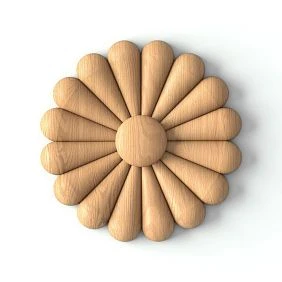
Wooden rosette R‑059: facts that really influence the decision
In the STAVROS R‑059 card, it is called a wooden rosette and described as a simple universal flower in a classic style. The manufacturer directly specifies furniture scenarios: facades, cabinets, nightstands, dressers, and drawers. For our task, this is more important than general discussions about decor: use on a furniture surface is confirmed by the card itself.
For the modification in question, dimensions of 40 × 40 × 6 mm are specified. The visible table also includes a variant of 80 × 80 × 12 mm. Materials are beech and oak. Sanding quality is "Standard" and "Prestige." In the selected position 40 × 40 × 6 mm checked, beech, "Standard," and re-gluing quality "under enamel" were displayed.
| Parameter | Confirmed value |
|---|---|
| Article number | R‑059 |
| Type | wooden carved rosette |
| Main size in the article | 40 × 40 × 6 mm |
| Another visible size | 80 × 80 × 12 mm |
| Materials | Beech, oak |
| Sanding | "Standard", "Prestige" |
| Shape | universal classic flower |
| Furniture Application | facades, cabinets, nightstands, dressers, drawers |
| Selected configuration during checkout | Beech, "Standard", under enamel |
| Price and availability | checked in the product card before ordering |
Price and stock availability are not fixed in the article. For selection, they are secondary compared to geometry and finish, and the values themselves change.
The most useful characteristic for repair is not just 40 mm, but the third number: 6 mm. R‑059 does not restore the original surface, but adds a new relief. This immediately distinguishes it from putty. After repair with putty, the goal is to get a smooth facade again. After installing R‑059, the goal is to get a deliberately decorative facade.




First, choose the final look of the dresser, and only then the method of closing the holes.
Before measuring the old mounting, answer the question that is usually skipped: what should the facade become after the repair?
If the answer is "as if the handle was never here," your basic path starts with restoring the surface. You need to assess the facade material, hole depth, coating damage, and the possibility of locally matching the finish. A decorative overlay is not needed in this logic, because it leaves a visible trace of intervention — albeit a beautiful one.
If the answer is "I want to update a classic dresser and add a carved motif," R‑059 becomes an independent design element. Then the old hole only determines whether the new decoration can be combined with the existing geometry.
If the answer is "I don't care, as long as the hole is not visible," the solution is not yet formed. It is in this situation that people most often buy unsuitable decor. First, make two mockups: a photo of a smooth restored facade and a photo with a paper square 40 × 40 mm in place of R‑059. Compare not the masking methods, but the two final images of the furniture.
This step sharply reduces the risk of a wrong purchase. The rosette wins not because it is "simpler than putty," but because the decorative result is needed on its own.
Our factory also produces:

Damage map: divide the old handle area into three zones
To understand whether decor can replace cosmetic repair, it is convenient not to measure one "hole," but to draw a damage map.
Zone A — the hole or holes themselves. These are the points where the fasteners passed.
Zone B — the visible trace around the mounting. This includes pressed-in coating, darkening, wear, a mark from the handle base, and a small chip in the finish.
Zone C — structurally damaged base. A crack, loose wood, a broken-out fragment, peeled veneer, or other defect that cannot be considered merely cosmetic.
R‑059 can cover zones A and B if they truly fall under the actual contour of the rosette. But the presence of zone C changes the order of work: first, the strength of the base is restored. The decorative piece should not be used as a lid over an area that continues to deteriorate.
This approach is more useful than the formula "a 5 mm hole — a 40 mm rosette will definitely fit." For example, the drilling itself may have a diameter of only 4–5 mm, while the circle from the metal base of the old handle is 28 mm. For appearance, the working defect will be precisely the 28-millimeter zone B.
If there is a chip nearby extending another 6 mm to the side, that is what is taken into account. The rosette should hide not the theoretical mounting point, but everything the eye will see after installation.
Get Consultation
When putty is a real repair, and R‑059 is a decorative redesign
The word "instead of" in the article's topic can easily be understood too literally. It seems as if a wooden rosette and putty are two interchangeable materials for one operation. This is not the case.
Putty or other repair compound participates in restoring the surface geometry. After it, the area is sanded, primed, and finished depending on the facade material and the chosen coating system. A good result strives to disappear visually.
R‑059 remains visible. It does not try to become part of the original plane. It is purchased for a new relief and ornament. Therefore, a decorative rosette can eliminate the need for perfect local cosmetic masking only if there is no damage underneath that requires repair regardless of appearance.
This is especially important for old facades. If the hole is clean and stable, and around it there is only a trace from the handle, covered by the rosette, a decorative approach can be discussed. If the wood is broken out, the edges are loose, or new fasteners must pass through a weakened area, full restoration still remains part of the project.
The result is a simple rule: R‑059 can replace the task of "making the repair site unnoticeable," but not the task of "restoring a damaged base."
Why local puttying can be more difficult precisely on an already finished facade
With an old dresser, the problem is usually not physically filling the hole. It's harder to restore the local area to the same visual appearance as the surrounding surface.
After filling the defect, there remain stages of leveling and finishing. If the facade is to be completely repainted, this is not so critical: the entire element receives a new overall coating system. If the dresser is to be kept in its existing color, local repair faces the challenge of matching the shade, gloss level, and surface character.
Even a well-matched color can differ due to aging of the original coating or differences in the substrate. This does not mean that putty is 'always visible.' Such a claim would be incorrect. It means something else: the quality of local restoration depends not only on filling the hole, but also on the ability to restore the entire finish layer so that the transition is not noticeable.
R-059 addresses exactly this part of the task if it is planned as intentional decor. Instead of trying to make the area invisible, a new visible accent is created. But then another job appears—selecting the material, treatment, color, position, and rhythm of rosettes across the entire dresser.
In other words, the choice is not between 'difficult' and 'easy,' but between two different sets of work.
Two technological routes: what will need to be done in each case
For comparison, it's useful to outline not materials, but the sequence of actions.
Route 1—restore a smooth facade
-
remove old hardware;
-
assess the strength of the base;
-
restore the hole and chips using an appropriate method;
-
level the area;
-
prepare it for finishing;
-
restore the primer, color, gloss, and protective coating to the extent required by the specific facade;
-
mark out the new handle;
-
Install the hardware.
Route 2 — make R-059 a new decorative element
-
remove old hardware;
-
check for any structural damage;
-
measure the entire visible area A + B;
-
mark the correct center of the decorative composition;
-
check template R-059;
-
determine the material and finishing option;
-
design the position of the new handle;
-
finish and secure the rosette using the appropriate technology;
-
install the hardware after completing the necessary technological stages.
The second path does not have to be shorter. Its advantage is a different result: instead of locally "erasing" the trace, a new furniture element appears.
40 × 40 mm is a dimension, not a promise to cover any defect up to 40 mm
The overall dimension R-059 is needed for the first filter. It helps to understand whether the damage fits into a conditional 40 × 40 mm square and whether such a scale suits the facade itself.
But the rosette has the shape of a flower, so the square does not equal the actual area of wood. If the defect is near the edge or between the petals, it may remain visible even though its coordinates are formally within the 40-millimeter dimension.
Before ordering, make two templates. The first is a simple 40 × 40 mm square. It quickly shows the scale. The second is a contour based on the drawing or the actual part. It is needed for the final check of coverage.
For a single clean hole in the center, this check is simple. For two old holes, it is useful to measure the center distance S and the diameter of the damaged zone d. The rough total span is S + d. If the two centers are 32 mm apart and the visible diameter of each zone is about 4 mm, the total span is approximately 36 mm. It fits within the dimensions, but there is little margin left for the shaped contour.
If S = 40 mm and d = 4 mm, the span is already about 44 mm. The small R-059 cannot cover both extreme points simultaneously. There is no need to buy it "on trial" without another reason: the geometry already shows the limitation.
Why 6 mm depth matters specifically in comparison with putty
After putty repair, the surface should return to the plane of the facade. With R-059, the 6 mm depth remains part of the result.
Six millimeters is a small relief compared to many large decorative elements, but it is still a real protrusion. It creates a shadow, changes the tactility of the facade, and requires checking near the handle. If fingers pass through this zone when opening, the paper mockup should account not only for the contour but also for the future volume.
On a tall classic drawer, 6 mm can provide a delicate accent. On a very narrow facade, the same relief is perceived more strongly. If the flower is located near a frame or other decor, not only the width but also the height of the reliefs are compared.
This is another criterion for choosing the technology. A buyer who only wants to hide the hole and does not want to change the tactile or visual relief is more likely to belong to the plane restoration route.
R-059 40 × 40 × 6 mm and 80 × 80 × 12 mm: these are not "a small and a large patch"
In the R-059 card, a second size is visible — 80 × 80 × 12 mm. During repair, it is easy to reason like this: if 40 mm does not cover the defect, take 80 mm. Such a choice is too mechanical.
Not only the area increases. The width and height double, and the depth changes from 6 to 12 mm. This is a different scale of decorative solution. On a low drawer, an 80-millimeter flower can take up a large part of the central field. It will become one of the main elements of the facade, not a compact masking of the old mounting.
Example: facade height 120 mm. R‑059 40 mm occupies one third of the height. When centered, approximately 40 mm remains from the nominal dimension to the top and bottom edges. R‑059 80 mm occupies two thirds of the facade and leaves 20 mm. Both sizes physically fit, but their visual purpose is completely different.
On a facade 240 mm high, the proportions change: 80 mm is now only one third of the height. Therefore, the size is chosen not by the principle "the bigger, the more reliably the trace will be hidden," but by two independent checks:
-
whether the damage is covered;
-
whether the ornament matches the scale of the facade.
If 40 mm is insufficient and 80 mm is visually excessive, this is a strong argument in favor of regular hole restoration or a different rosette model. The catalog can buy wooden carved rosettes offer other sizes and shapes, but they also need to be chosen based on the project, not just by the area of coverage.
What changes because R‑059 is made of wood
The comparison with putty is especially interesting precisely because R‑059 is not a polyurethane or plastic part, but a wooden carved rosette. The material affects preparation, finishing, and the visual character of the facade.
Wood allows the decor to become part of a wooden furniture system. On a dresser with visible texture, this makes it possible to tie the flower to the wood species and finish. On a painted facade, the material is hidden under enamel, but remains important in terms of preparation and sanding.
The card offers beech and oak. STAVROS characterizes beech as dense, non-porous wood, often used under enamel, and oak as dense, porous wood with a more pronounced texture. But this cannot lead to the simplified conclusion "beech only for painting, oak only for staining." The actual decision depends on the specific lamination configuration and the planned coating.
To repair a dresser, it's useful to first determine whether you want to see the wood at all. If the entire front and rosette will be covered with opaque enamel, the natural grain becomes secondary. If the decor should look like natural wood, the preparation parameters for a transparent finish need to be clarified before ordering.
The material changes the very nature of the solution: R‑059 is a wooden furniture decor instead of restoring a smooth surface. Therefore, after a geometric check, you need to evaluate the finish, the wood, and whether the repair trace should disappear or turn into a new visible element.
Beech or oak for updating a dresser: decide through the finish, not through the species name
If the dresser is made of oak, the intuitive desire to buy an oak rosette is understandable. But matching species names does not guarantee the same appearance after finishing. The wood may differ in grain, tone, and how the coating is perceived.
For opaque enamel, the main task is to achieve a uniform color and relief. Beech is logical in such a project, especially if the chosen configuration is initially specified as "under enamel."
For a transparent or semi-transparent finish, what matters to the buyer is not just "beech or oak," but also the quality of the lamination. On the 40 × 40 × 6 mm position checked, the card showed "under enamel." Therefore, you cannot promise that a specific blank will be visually uniform under a clear varnish just because it is oak.
If the goal is to emphasize the natural texture, ask the manager a direct question before ordering: which R‑059 configuration is suitable for the planned transparent or semi-transparent finish? Such a question is more useful than drawing conclusions on your own from a product photo.
If the dresser will be completely repainted, the species question becomes simpler. Then the compatibility of the entire finishing system and the quality of surface preparation are more important.
"Standard" and "Prestige": where the buyer saves money, and where they get less hand finishing
The R‑059 card has two levels of sanding. According to STAVROS, "Standard" is machine sanding, "Prestige" is detailed hand sanding, where the product does not require the same additional finishing.
For a flat strip or a simple part, additional sanding is relatively predictable. For a small flower, the work is more complex: petals, height transitions, and recesses need to be processed so as not to "wash away" the pattern.
If the finishing is done by a professional workshop, the "Standard" option can be rational: the craftsman controls the final sanding according to their own primer and enamel system. If a person repairs a dresser independently and wants to reduce the amount of manual preparation of fine relief, "Prestige" may be more convenient.
This does not mean that "Prestige" is already painted or fully ready for installation without considering the project. It is specifically about the quality of sanding. Primer, enamel, varnish, and other finishing materials remain a separate technological system.
Before choosing, it is useful to open the page sanding quality of wooden decor and match the level of preparation with your capabilities. For one rosette, the difference in labor intensity may seem small, but on a dresser with five or six identical drawers, it multiplies by the number of parts.
What "under enamel" means in a real renovation project
In the selected configuration, the card displays the quality of gluing "under enamel." This is not a decorative color or a finished coating. STAVROS explains that with such preparation, lamellas are glued without mandatory matching by color and texture, because the blank is designed for an opaque coating.
For a dresser that will be painted, this is logical. The buyer does not need to achieve a beautiful match of natural patterns of different wood sections — the enamel covers them.
But for the idea "I'll leave the rosette natural because the wood itself is beautiful," this parameter becomes critical. A blank "under enamel" cannot automatically be considered chosen for a transparent finish. If a natural wood look is needed, the configuration should be clarified in advance.
This nuance is exactly what distinguishes the wooden R‑059 from an ordinary decorative plug. What is purchased is not only the 40 × 40 mm shape, but also a blank that must go through a specific finishing cycle.
A full repaint of the dresser changes the meaning of purchasing R-059
If the dresser is still fully disassembled and repainted, the argument that "the rosette will help avoid dealing with putty" becomes weaker. The holes and facades still undergo preparation, and the local area is not the only place of intervention.
In such a project, R-059 should be evaluated almost exclusively as a design detail. Do you like the new rhythm? Does the flower suit the facade profile? Should it be repeated on each drawer? Will the carved motif be superfluous after a modern paint finish?
Imagine a dresser with four identical facades. All old handles are removed, the holes need to be prepared, and then the furniture is painted with an opaque enamel. If after the R-059 mockup the composition becomes more expressive, four identical rosettes can be part of the new project. If the facade looks better without them, covering the holes with decor just to reduce a few repair operations is not rational.
A full repaint also simplifies the problem of visual matching between old and new finishes: the entire facade gets a common finish. But the need to properly prepare the wood and the existing surface remains.
If the dresser is not repainted, the decisive factor becomes the match or intentional contrast of the finish
A completely different situation is a good old dresser whose color you want to preserve. The holes from the handles spoil the facades, but repainting the entire piece of furniture is not planned.
Here, the putty route has a difficult part: the local restoration must be done so carefully that it does not stand out on the old finish. This may require precise matching of color and gloss.
A wooden rosette has a different strategy. It can be painted in a close tone, or, conversely, become intentionally contrasting. In the first case, you need to achieve similarity with the existing finish. In the second, the difference ceases to be a defect and becomes part of the design.
Contrast is especially useful to check on a mockup. Paint the paper template with an approximate color of the future decor and temporarily attach it to the facade. The decision of "a dark flower on a light dresser" or "a light rosette on dark wood" should be evaluated as a composition, not as a way to hide a hole.
If the buyer wants the most discreet intervention, a contrasting carved motif is, of course, not suitable. Then you need to return to plane restoration.
Why R‑059 should not be painted "later somehow" after gluing
A small relief has side edges and recesses. After installation, access to them may be worse, especially if a handle or decorative frame is nearby. Therefore, finishing should be planned before fixing.
There are three practical schemes.
Finish the rosette separately, then glue it. Convenient for a contrasting color and for projects where the facade is already finished. It is important not to contaminate the adhesive surface with an incompatible coating if the chosen composition requires a different base.
Secure the prepared rosette and paint it together with the facade. Suitable for a full repaint when the decor should visually "grow into" the overall surface.
Do it in a combined way: prepare the relief in advance, then perform the general finish after installation. This path is chosen by the craftsman based on the material system.
On the STAVROS page Advice on finishing and installation there is a sequence for preparing and painting decor. It should be checked against the instructions of specific primers and coatings.
The base of the dresser is more important than it seems: solid wood, veneer, MDF, and old coating require different levels of care
R‑059 itself is made of wood, but the dresser facade may be different. The buyer often says "wooden dresser," although under the finish there may be solid wood, veneer on a board, MDF, or a combined structure.
For choosing a repair method, this is important. You cannot sand a thick solid wood panel and a thin decorative veneer with the same aggressiveness. You cannot assume that any old paint is a solid base for adhesive. You cannot automatically choose one compound just because the socket is wooden.
If the facade material is unknown, inspect the inner side, edges, and places of old holes. These often make it easier to understand the construction. For expensive or valuable furniture, it is better to avoid experimenting with an unknown coating and consult a specialist.
The very presence of an old hole also provides information. If the base around the drilling is loose and crumbles, decorative masking without repair is ruled out. If the edge is clean and stable, the task is closer to cosmetic.
Marking for R-059 starts not from the old hole, but from the new center of the composition.
Putty repair allows you to completely detach from the old mounting: the hole disappears, and the new handle can be designed from scratch. With the decorative approach, there is a temptation to simply place R-059 where the old point is.
This is correct only in one case—if the old hole already aligns with the required axis.
For a rectangular facade, the geometric center is calculated using the formulas:
X = W / 2 and Y = H / 2.
For example, a facade of 600 × 180 mm has its center at 300 × 90 mm. If the old hole is at X = 292 mm, it is shifted 8 mm to the left. Gluing the flower over the hole means preserving the old error and making it more noticeable.
It is more correct to place the R-059 template according to the new center and check whether the old defect remains under the actual contour. If it is covered, the decorative rosette helps both hide the trace and restore symmetry. If it is not covered, the hole is repaired first.
On a chest of drawers with several drawers, this is especially important. The flowers create a vertical rhythm, so each center must follow the overall system, not local defects from previous installation.
A new handle and a wooden rosette: decorative repair should not create a functional problem
After choosing R-059, the question remains of how to open the drawer now. If the chest of drawers uses a system without a visible handle, it's simple: the rosette can remain purely decorative. If new hardware is needed, it must be designed simultaneously with the flower.
At STAVROS you can choose furniture hardware and then make a paper mock-up of the handle along with the rosette template.
Options may vary: a handle below the flower, a handle above, two handles on the sides of a wide front. But the main principle is one—the grip zone should not turn into a conflict of reliefs.
Separately, one should consider the idea of running the new handle's screw through the center of R-059. The product card confirms decorative use, but does not confirm that the rosette is designed as a load-bearing backing for a handle. Drilling the product and transferring constant load through it without consulting a craftsman or manufacturer cannot be considered a standard recommendation.
If the new handle must be placed exactly where the old one was, it is often simpler to first restore the base and install the hardware independently of the decor.
One chest of drawers—one system: the number of R-059 is determined by the composition, not by the number of damages
Suppose a chest of drawers has four identical drawers. On three, the holes are almost unnoticeable, but on one, there is a large dark mark around the handle. Buying one rosette only for the problematic drawer is technically possible, but visually it will look random if the decor is not repeated anywhere else.
The quantity of R-059 is determined by the new design. If the scheme "one central rosette for each identical facade" is chosen, four are needed. If the lower wide drawer receives two symmetrical pieces, and the upper ones one each, it is calculated according to this scheme.
At the same time, there is no universal rule of "always taking one spare." The spare depends on the finishing method and the skill of the craftsman. If a complex DIY color or patina is planned, a separate technological sample may be useful. If the craftsman works according to a proven system, the decision is different.
Before ordering, it is better to draw the entire dresser, not just one drawer. Such a simple step simultaneously determines the quantity, checks the rhythm, and shows whether the decor is becoming too much.
How to check the color and finish of R-059 before gluing it to the old facade
On an already finished dresser, a finishing error can be more noticeable than the old hole itself. Therefore, it is better to perform the color test before the entire set of rosettes ends up on the facades.
The most reliable household method is to make a separate sample. The ideal option is to use the same wood and the same sequence of primer, paint, patina, or varnish planned for R-059. If there is no separate wooden blank, a test rosette can be considered a technological sample, but the need for such a spare is determined in advance.
Check not only the color "head-on." Old furniture coating changes depending on lighting. The same shade may look close in daylight and noticeably different in the evening under a warm lamp. Therefore, the sample is applied to the facade under the conditions in which the dresser actually stands in the room.
There are four parameters that are useful to compare separately:
-
main tone;
-
degree of gloss — matte, semi-matte, glossy surface;
-
Texture character — smooth enamel or readable wood;
-
Relief contrast — shadows in the recesses of R‑059 make the color visually darker than on a flat sample.
The last point is often underestimated. Even if a flat swatch matches the facade, a carved flower may appear deeper in tone due to its own geometry. Therefore, the final test is best done on a three-dimensional part or a maximally similar relief.
If an exact match to the old color cannot be achieved, there are two honest solutions. The first is to abandon the rosette and perform professional local restoration. The second is to make the difference intentional: choose a contrasting but coordinated color with the handles, legs, or other trim. A semi-random "almost matched" often looks worse than a deliberate contrast.
Before gluing, place the finished sample on the facade using a temporary method that does not damage the finish, and evaluate it from a normal distance. This is especially useful if R‑059 is repeated on several drawers: one flower may look neutral, but a vertical row of five elements may already be too active.
Three levels of intervention: local repair, partial repaint, and full redesign of the dresser
The choice between R‑059 and putty greatly depends on how deeply you are willing to intervene in the furniture.
Level 1 — preserve the existing finish almost unchanged
Task: remove the old handles, minimally affect the facade, and preserve its current color. Here, local restoration is difficult primarily due to finish matching. R‑059 can be useful if it covers a cosmetic defect and the new wooden motif truly suits the dresser.
But this level requires the strictest color verification of the new part. The old varnish or enamel already has its own age, gloss, and micro-relief. The new flower should not look like a fresh random sticker.
Level 2 — repair and partially repaint individual facades
For example, only two drawers out of five are damaged. They can be removed, restored, and refinished. In such a situation, R‑059 no longer necessarily saves the repair: part of the surface still undergoes preparation.
However, this creates an opportunity to make the sockets part of a new composition on these facades specifically — but only if the asymmetry is justified by the design. If two decorated drawers among three smooth ones look random, it is better to either extend the system to the entire dresser or abandon the decor.
Level 3 — completely redo the dresser
All facades are removed, old holes are repaired, handles are replaced, and new painting is done. Here, R‑059 ceases to be a way to hide the old mounting. It becomes a regular design option: needed — we add it, not needed — we leave the surface smooth.
This level of intervention usually provides more freedom in placement. The new socket does not have to be placed where the screw used to be. The old hole can be restored, and the flower can be positioned according to the new facade architecture.
This classification helps avoid overestimating the "repair" function of R‑059. The deeper the furniture rework, the less important the socket's ability to physically cover the old point becomes, and the more important its decorative value becomes.
Project working map: how to check R‑059 across the entire dresser at once, not just on one drawer
Before ordering, it is useful to create a simple table for each facade. It turns scattered measurements into a project and is especially useful for old furniture where holes may be asymmetrical.
| Facade | Facade size | Defect area | Axis offset | Does R-059 40 mm cover it? | New handle | Solution |
| Top 1 | Measure | Measure | Measure | Yes/No | Type and position | Select after layout |
| Top 2 | Measure | Measure | Measure | Yes/No | Type and position | Select after layout |
| Medium | Measure | Measure | Measure | Yes/No | Type and position | Select after layout |
| Lower | Measure | Measure | Measure | Yes/No | Type and position | Select after layout |
In the "defect zone" column, record not only the hole diameter, but the maximum width and height of the entire visible damage. In the "axis offset" column, it is useful to record the difference between the center of the old mounting and the new correct center of the decor.
After filling in the table, scenarios become visible that cannot be understood from a single photo. For example, on three facades, R-059 40 mm covers the mark without offset, but on the fourth it does not. Then you need to decide whether to restore one problematic drawer and use identical flowers on all four, or abandon the series altogether.
Another option: on the two upper facades, the 40-millimeter flower is visually too large, while on the lower ones it is appropriate. This is already a question of composition, not repair. Perhaps the same model should not be repeated on every drawer.
The work card also helps when ordering. After it, the quantity, selected size, intended finish, and position of new hardware are known. The buyer does not try to make these decisions one by one after receiving each part.
For a complex dresser, you can add two more columns: "material/finish" and "sample needed." Such a document is useful even when handing off work to a craftsman: it immediately shows which fronts require restoration and which allow a purely decorative solution.
Why the same flower does not have to be on every drawer of the same size
Repetition creates order, but literal repetition does not always give the best result. A dresser may have small top drawers, one wide central drawer, and deep bottom ones. The same 40-millimeter motif on all surfaces will have different visual weight.
If the old handles are positioned identically, there is a temptation to use R-059 at every point. But the history of old hardware should not automatically dictate the new composition. In a full redesign, old holes can be repaired and the system built anew.
For example, two small top drawers can be left with only new handles, while the central wide front gets one wooden rosette as an accent. Such a solution is acceptable only if the damage to the top drawers is repaired and the difference looks intentional.
The reverse scheme is also possible: a series of small R-059 forms a vertical rhythm on identical fronts, while the large bottom drawer remains without a flower if there is already an expressive handle or other decor.
Practical takeaway: the number of rosettes cannot be determined by the number of old holes. First, a new appearance is designed, then each unnecessary
Wooden R-059 and polyurethane RPU-070: why the same problem does not mean the same repair method
For holes from old handles, you may also encounter polyurethane decorative rosettes, such as RPU-070. But you cannot automatically transfer a solution from one material to another. For R-059, the main question begins where the simple overlap check ends: the wooden part must align with the wood species, sanding, surface preparation, and the entire furniture finishing system.
R-059 measuring 40 × 40 × 6 mm makes sense to consider when the buyer wants exactly a wooden carved accent and is ready to include it in the finishing cycle of the dresser. In such a project, one has to decide whether opaque enamel is needed, whether the natural texture will be visible, and how similarly the old facade and new wood will behave after priming and painting.
Polyurethane decor and a wooden rosette can externally solve a similar task—covering traces of old fasteners—but the material imposes different constraints. For R-059, the choice between beech and oak, "Standard" and "Prestige," as well as preparation "for enamel," has direct practical significance. Therefore, after the 40 × 40 mm template, a second question must be asked: does this facade need a wooden element specifically, or is it better to restore a smooth surface with putty and subsequent finishing?
This approach is also useful for a full repaint. If the entire dresser will still be restored to a flat surface, R-059 does not have to appear just because a handle was once located here. It is added only when a wooden flower improves the new composition of the furniture.
How to choose glue: material R‑059 does not cancel the condition of the old facade
In the STAVROS catalog there is assembly glue for wooden decor TYTAN Prof. Classic Fix. Its card indicates compatibility with wood and its derivatives. But from this one cannot conclude that for R‑059 40 mm on any dresser it is exactly what is needed.
On the STAVROS advice page, the choice of composition depends on several conditions: whether the decor is small or large, whether the surface is unpainted or already primed/painted, and what the element itself is made of. For small unpainted decor made of solid wood on an unpainted base, the table specifies PVA Kleiberit 303.0 D3, and for small decor on a primed or painted surface — another option. TYTAN Classic Fix in this table is used primarily in other combinations, including large decor.
Therefore, the correct sequence is this: first determine what is on the facade; then decide what condition the rosette itself will be in at the time of installation; after that, choose the composition according to the manufacturer's recommendations and the glue instructions.
If a specific project truly fits TYTAN Classic Fix, the product card indicates an operating temperature from +10 to +30 °C, a working time of 10–15 minutes, and full curing in 72 hours. But these figures should not be mechanically transferred to another glue.
The commercial link is useful as a material option for installation, not as a universal assignment for any R‑059.
Comparison table: what to choose depending on the condition of the facade
| Condition after removing the handle | R‑059 | Restoring the flatness |
| One clean hole in the center, the facade is solid | suitable if new decor is needed | Suitable |
| The coating trace is wider than the hole, but fits under the flower | may be a convenient decorative solution | will require restoration of the finish |
| Two holes extend beyond the actual 40 mm contour | 40 mm size is not suitable | preferably either a different decor is needed |
| Crack, looseness, broken-out base | Does not replace repair | base restoration is mandatory |
| The dresser is completely repainted | choose only for the design | logical basic path |
| The old color is preserved, local finish matching is difficult | can turn a problem point into a deliberate accent | local restoration is possible |
| Modern smooth facade without carving | usually unnecessary | Preferred |
| Classic facade with existing decor | can support the system | also possible |
| The new handle should be positioned at the same point | separate verification of the mounting is required | Usually simpler |
| The customer wants natural visible wood | verification of the material and quality of the lamination is required | depends on the original facade |
The table shows that R‑059 is not “better than putty” in general. It wins in a specific type of project: when a cosmetic defect can be covered, and a new wooden accent is needed compositionally.
When you don't need to buy R‑059 even with perfect hole coverage
The first case is when the facade must remain smooth. The technical ability to cover the point with a flower does not change the design task.
The second is when the dresser is completely repainted, and a decorative motif is not needed. Then the hole can still be restored as part of the general preparation, and the separate purchase becomes an unnecessary element.
The third is when R‑059 has to be shifted from the axis to hide the old point. Such masking moves the defect from the technical plane to the visual one.
Fourth — the base is damaged. The rosette should not hide a crack or loose area without repair.
Fifth — the new handle conflicts with the relief or requires drilling through decor without a confirmed design.
Sixth — 40 mm is too little, but 80 mm is already too much for the facade. In this case, it is better to switch to the catalog of other models or return the surface to flat with regular repair.
Seventh — this concerns valuable antique furniture, where any irreversible intervention should be assessed by a restoration specialist. Modern decorative installation should not be automatically applied to an item whose value depends on the preservation of the original.
Mistakes specifically in choosing "wooden rosette or putty"
Mistake 1. Considering the rosette a faster repair by default
If you need to select the material, finish, placement, and then repeat the decor on several drawers, the decorative path may not be shorter. It is chosen for the result, not for the promise of "no repair."
Mistake 2. Comparing only the cost of materials
You cannot compare a small package of putty and one rosette without accounting for labor. A smooth repair has preparation and finish restoration. R‑059 has fitting, relief finishing, marking, installation, and composition across the entire dresser. The decision is made based on the full project.
Mistake 3. Leaving "under enamel" without checking and expecting a beautiful natural texture
Preparation "under enamel" is designed for an opaque finish. If a natural look is needed, the configuration is specified in advance.
Mistake 4. Choosing oak just because the dresser looks "oak-like"
Wood imitation, veneer, solid wood, and painted surface are different bases. The material of the rosette is chosen based on the actual finish, not visual association.
Mistake 5. Gluing over old paint without checking its strength
Even suitable glue won't help if the layer underneath is peeling off on its own. Weak coating needs to be removed or restored according to the technology.
Mistake 6. Making one rosette on a random drawer
If the facades form a unified system, a decorative "patch" in only one place reveals the repair history. First, design the entire dresser.
Mistake 7. Increasing the size to 80 mm without checking the proportion
The technical defect disappears, but a visually heavy element appears. The size needs to be checked against the facade at full scale.
Mistake 8. Assuming wood is automatically compatible with any dresser coating
The material of the socket itself does not indicate that the old varnish, enamel, film, or veneer is ready for the chosen adhesive and finish. The substrate is checked separately.
Practical scenarios: when the wooden R-059 wins, and when plane repair is better
Practical scenario 1: a solid wood dresser will be completely repainted
Old handles have been removed. Each drawer retains one clean hole. The owner still plans to fully sand and paint the fronts with new enamel.
In this situation, R-059 is not needed as a way to 'avoid puttying.' Surface preparation is still performed. The purchase is justified only if the new project truly requires carved rosettes.
Two mockups are made. On the first, the fronts are smooth and receive new handles. On the second, an R-059 40 mm is placed in the center of each drawer. If the second option better matches the style of the legs, profiles, and handles, the rosettes become part of the redesign. If not, the holes are rationally restored along with the rest of the preparation.
Practical scenario 2: the dresser's color is preserved, but a dark circle remains around the handle
The dresser is not to be repainted. The hole itself is small, but a circle about 26 mm in diameter is visible around it. The substrate is sturdy.
Here, local smooth repair would require not only filling the hole but also restoring the appearance of the area. R-059 40 mm may be an interesting alternative if the actual contour covers the entire trace and the wooden rosette suits the design.
The key question is the finish of the rosette itself. It can be attempted to match the existing tone or made deliberately contrasting. In both cases, a sample or mockup is needed first. If matching the old color is impossible and the contrast is not appealing, it is better to consult a restoration specialist rather than glue on random decor.
Practical scenario 3: the hole is offset 8 mm from the center
The facade is 600 mm wide. The correct axis runs along X = 300 mm, the old hole is at X = 292 mm.
If R-059 is placed over the old hole, the new decorative axis will be crooked. If placed in the center, the hole will be offset inside the contour. A template check shows whether it is hidden or not.
If it is hidden, R-059 simultaneously solves the cosmetic and compositional task. If the edge is visible, the hole is repaired first. There is no need to shift the rosette for a single defect.
Practical scenario 4: two points from a pull handle are spaced 40 mm apart
The diameter of each damaged area is about 4 mm. The total span is approximately 44 mm. The size of the small R-059 is 40 mm.
Here, arithmetic already shows that one 40-millimeter rosette will not cover both extreme points. There is no point in building complex arguments about style: the size constraint is addressed first.
You can repair both holes, consider the 80-millimeter option if the facade scale is suitable, or choose a different model. But increasing the decor solely for masking should be done very carefully.
Practical scenario 5: four identical drawers, but only one is damaged
On three facades, the old holes are barely visible; on one, there is a coating chip around the handle. One R-059 will cover it, but it will create a single rosette on one drawer.
If the overall style of the dresser does not allow for such asymmetry, it is better to either restore one facade or create a new system of identical rosettes on all four. Buying a single piece just because it covers a defect is an example of a technically correct but design-weak solution.
Practical scenario 6: a natural oak accent is required on a painted dresser
The owner wants to keep the facades under enamel but add contrasting oak rosettes with visible texture.
Here, you cannot automatically order the selected configuration "under enamel" and expect a perfect clear finish. You need to clarify which R-059 preparation is suitable for tinting or clear coating and how the oak will look after the chosen finish.
This scenario shows why the material of the wooden rosette makes the article standalone: the problem is no longer whether it covers the hole, but how to combine new wood with the existing furniture finish.
Practical scenario 7: the new handle must remain in the geometric center
The old knob handle was centered. The new handle must also be there. The buyer wants to place R-059 around it and use the rosette as a decorative backing.
Such a composition is only possible after a separate structural solution. You cannot automatically drill R-059 and assume it is designed to bear the handle's load. If the manufacturer or craftsman does not confirm the scheme, it is safer to separate functions: the handle attaches to the restored facade, and the rosette is placed separately or not used at all.
What to check before ordering: final decision sheet
Before purchasing R-059, answer the following questions:
-
Is a visible carved accent needed on the facade, even if the hole is mentally removed?
-
Is the base around the old mounting strong?
-
What is the size of the entire zone A + B, not just the drilling?
-
Does it fall under the actual contour R-059 40 mm?
-
Does the correct center of the decor coincide with the place where the defect is still covered?
-
Does the new handle remain, and where will it be positioned?
-
Is a 6 mm relief suitable ergonomically?
-
Do you need beech or oak considering the finish?
-
Is the selected "under enamel" preparation suitable for the project?
-
Is machine sanding "Standard" sufficient, or is "Prestige" more convenient?
-
Will the dresser be completely repainted, or will the old color be preserved?
-
Which glue is suitable for the actual condition of the facade?
-
How many sockets are needed for the entire composition?
-
Wouldn't it be better in this specific case to restore a smooth surface?
If answers are formed, the order becomes predictable. If half of the questions remain open, it's too early to buy decor.
What should be communicated to the manager when ordering R-059
In the request, it's better to specify not only the article number. Size, material, grinding quality, intended finish, and quantity are needed.
For this article, the basic formulation might look like this: R-059, 40 × 40 × 6 mm, required material, selected grinding quality, project — furniture facade of a chest of drawers after removing old handles. If a transparent finish is needed, a suitable re-gluing is specified separately. If drilling of the part for the handle is intended, this scenario must be agreed upon before purchase.
Price, availability, and current lead time are checked in the product card immediately before placing the order.
Frequently asked questions about R-059 instead of putty
Does R-059 really replace putty?
Only in a cosmetic sense and not always. If the base is solid and the old defect just needs to be hidden under new decor, you can skip perfect restoration of the visible surface. If the wood is damaged, repair remains mandatory.
What to choose if you want a completely smooth facade?
Restoration of the hole and finish surface. R-059 adds a 6-millimeter relief and therefore contradicts the goal of a smooth surface.
Can R-059 be used just because local paint is hard to match?
This path can be considered if the carved element truly fits the design. If the flower looks random, the difficulty of matching paint alone does not make it a good solution.
Will 40 mm cover two holes?
It depends on the center distance and the total damaged area. With two identical points, a rough span can be estimated as S + d, but the actual contour of the rosette is finally checked.
Why is a 40 × 40 mm paper square not enough?
Because R‑059 is a flower, not a solid square plate. The square shows the overall size but does not guarantee that the edge of the defect will not fall between the petals.
When to choose 80 × 80 mm?
When 40 mm is technically insufficient and the facade can handle a larger relief. The size 80 × 80 × 12 mm is a different scale, not just an enlarged masking.
What is better for enamel — beech or oak?
Both materials are presented in the card, but the choice depends on the project. For opaque painting, beech is often rational, but the specific configuration and preparation need to be verified when ordering.
Can it be left "for enamel" without opaque painting?
Such a blank should not be automatically chosen for a transparent finish, since the lamellas may not be matched by color and texture. If visible wood is needed, specify a different preparation option.
What to choose — "Standard" or "Prestige"?
"Standard" is machine sanding, "Prestige" is more detailed hand sanding. The choice depends on who will finish the relief before finishing and how many such elements are in the project.
Can R-059 be glued onto an already painted facade?
The possibility depends on the strength of the existing coating and the compatibility of the adhesive. First, the substrate is checked, then the composition is selected according to the manufacturer's recommendations.
Is it necessary to use TYTAN Classic Fix specifically for R-059 40 mm?
There is no universal rule. STAVROS separates recommendations by decor size and surface condition. TYTAN is one of the mounting materials, but the specific composition is selected based on your substrate.
Can R-059 be made into a handle?
The card confirms the decorative purpose. Using the rosette as an element that constantly bears the load from opening, without separate structural confirmation, is not recommended.
Can it be drilled for a handle screw?
Only after structural approval. A carved rosette cannot automatically be considered a load-bearing spacer.
How many pieces should be ordered for a dresser?
Based on composition, not on the number of problem holes. If four identical drawers should have one common system, usually the same design for all four is considered.
Do I need to buy a spare part?
There is no universal requirement. A separate rosette can be useful as a sample for complex DIY finishing, but the decision depends on the project.
Where to buy the wooden decorative rosette R-059?
After checking the geometry, finish, and composition, the model is ordered from the STAVROS product card. If R-059 does not fit in size or pattern, it is better to go to the carved wooden rosettes section and choose another option.
In summary: R-059 is justified not as a "patch for a hole," but as a deliberate replacement of invisible repair with wooden decor.
After removing the handles, there are two honest paths. The first is to return the facade to a smooth surface and make the repair trace as invisible as possible. The second is to acknowledge the alteration site as a new part of the design and install a carved wooden rosette.
R-059 40 × 40 × 6 mm fits the second path. It is especially interesting where the defect is cosmetic, the old facade does not need local repainting, the classic flower matches the furniture, and the new relief can be repeated on all necessary drawers. In this case, the buyer gets not masking for the sake of masking, but a new decorative element.
If the dresser is completely repainted, the facade should remain minimalist, the holes are too widely spaced, the base is damaged, or the new handle conflicts with the rosette, regular restoration may be more appropriate.
Before ordering, three groups of parameters need to be checked. Repair: base strength and the size of the entire defect. Compositional: center, 40 mm scale, rhythm across multiple drawers, and the new handle. Finishing: beech or oak, "Standard" or "Prestige", preparation for enamel, and compatibility with the existing coating.
Only after this check does it make sense to buy a specific R‑059. Then the wooden flower truly solves the task of updating the dresser, rather than turning the old hole into a new, more noticeable mistake.