Article Contents:
- Decorative bracket KRPU-033 157, 203 or 236 mm: which size to order for a 1200 mm shelf
- KRPU-033 157×70×31×29 mm
- KRPU-033 203×90×41×38 mm
- KRPU-033 236×105×47×44 mm
- Why you cannot write "203 mm is optimal for 1200 mm"
- Why this separation needs to be written directly in the order
- Why three decorative elements do not become load-bearing by quantity
- What remains operational after KRPU installation
- When the question of load-bearing capacity is not needed at all
- An error is especially likely after visually successful installation
- Correct Sequence
- Why the central KRPU is visually useful
- Why two brackets create a different image
- Why four create a different rhythm
- Universal formula for three axes
- Why the formula is more useful than the ready-made number 150
- Adjacent trim
- Cabinet
- Cornice
- Hidden metal fastener
- Shelf end
- Wall finish
- Leftmost element
- Central
- Right
- Clear gap between left and center
- From decorative body to shelf end
- Why this is more useful than 930 mm of free space
- Visual effect
- Visual effect
- What this shows
- Template for small
- Template for medium
- How to place
- Why exactly three templates of the same size are needed
- From what distance to view
- What to photograph
- Why
- Three large elements in width
- Why it can still be heavy
- When 236 mm can be successful
- Erroneous logic
- Option 203+203+203
- Option 157+203+157
- Testing and inspection
- What to be sure to check
- Three small
- Three large
- Difference between small and medium set
- Between medium and large
- Between small and large
- Why the medium size cannot be justified only by a "compromise price"
- Why this is important
- Why you cannot choose a product only by the word "bracket"
- KRPU-033 in our article
- Structural scenario
- Why KR-071 should not be automatically substituted for KRPU-033
- When KR-071 becomes relevant
- What cannot be transferred back to KRPU
- Paper template
- Volumetric template
- Set three
- Take a photo
- Why the bottom view is misleading
- Thin shelf
- Thick shelf
- Why the article does not assign a "correct ratio"
- What to photograph
- What to Check
- But not to make this a load-bearing console calculation
- Scenario A — central KRPU coincides with the line
- Scenario B — the line passes directly through the carved relief
- What to change first
- When the center cannot simply be shifted
- Option 1. Maintain strict symmetry
- Option 2. Switch to two brackets
- Option 3. Change the width of the shelf's visual field
- What not to do
- Why
- Therefore
- Why "just mounting adhesive" is not enough
- The correct test
- Risks
- The correct principle
- Flush
- A small shadow gap
- Why 2, 3, or 5 mm cannot be assigned universally
- KRPU in the color of the wall
- KRPU in shelf color
- Contrasting KRPU
- What is dangerous
- Correct Sequence
- They don't have to be the same
- Can be connected through
- Why polyurethane + wood is a normal combination
- Central axis 600 mm
- If items are asymmetrical
- What not to do
- What to check with the template in the evening
- When an average size of 203 mm may turn out to be too active
- Possible solution
- Check
- Why the article doesn't provide a universal minimum gap
- Possibly
- Why
- Why a mixed cart can look plausible
- Checksum for three 203
- Why
- The shelf is not yet finally secured
- It is unknown what it is held on by
- The shelf is sagging
- The buyer wants to replace KRPU with hidden metal
- The size is selected based on the photo
- There is no central axis
- The edge offsets are set only "by eye for aesthetics"
- The wall will still be repainted or milled
- Finish not selected
- Error 1. Considering KRPU-033 load-bearing just because it is called a bracket
- Error 2. Removing hidden metal fasteners after installing decor
- Error 3. Calculating the "load on three KRUs" without manufacturer data
- Error 4. Choosing 203 mm as "average and therefore correct"
- Error 5. Considering 150 mm as a mandatory edge offset
- Error 6. Not placing the central KRPU at 600 mm in a symmetrical layout
- Error 7. Measuring edge axes from the wall, not from the shelf
- Error 8. Move only one outer KRPU because of the cabinet
- Error 9. Check only one template
- Error 10. Look only from below at a distance of 30 cm
- Error 11. Ignore the shelf thickness
- Error 12. Choose by shelf depth as a load-bearing rule
- Error 13. Drill the wall blindly
- Error 14. Press KRPU against the shelf as a spacer
- Error 15. Use random glue
- Error 16. Paint one bracket separately, the rest later
- Error 17. Mix sizes in the cart
- Mistake 18. Make the central one 203, side ones 157 only to save money
- Mistake 19. Buy three 236, because "bigger looks more expensive"
- Mistake 20. Buy three 157 only for the price
- Mistake 21. Not checking the backlight
- Mistake 22. Ignoring items and furniture under the shelf
- Mistake 23. Gluing decor to a wall that will soon be repainted
- Mistake 24. Considering decorative KRPU as "insurance" for a bad shelf
- Visual effect
- Conclusion
- Possibly
- What disappears
- When it is stronger
- What changes visually
- But
- Option
- What to do
- What to Check
- Why the central axis is the simplest
- Why the outer axes need to be confirmed after the template
- What should match
- Measure from the bottom plane of the shelf
- Or from a separate common horizontal line
- Why this is more accurate
- From the front
- On the left
- On the right
- From the main point of the room
- Under artificial light
- Two 203
- Three 203
- Four 203
- Difference three → four
- Why you don't need to add a fourth "since it's not expensive compared to repairs"
- Do you need to make a common template
- What to double-check
- For 10 shelves
- Why a serial order requires a reference shelf
- Why the last one
- When axis alignment is useful
- When alignment is not needed
- What is primary
- Correct order
- Why shifting the central element is the last resort
- What to find out before installation
- If access is not needed
- If needed
- Bad scenario
- Good scenario
- Check from three points
- What to look for
- Why this is better than deciding by millimeters
- High
- Low
- Practical conclusion
- If E=120
- If E=180
- What this gives to the project
- What They Don't Provide
- What to do when the load changes
- What happens to KRPU
- Why this is important for the future owner
- What sizes are available for KRPU-033?
- What size is considered for the shelf 1200×260 mm?
- Why was 203 mm chosen?
- How much does KRPU-033 203 mm cost?
- How much do three cost?
- How much do three KRPU-033 157 mm cost?
- How much do three 236 mm cost?
- Can three KRPU-033 be placed under the shelf?
- Where should the central one be placed?
- What axes are obtained with extreme offsets of 150 mm?
- What is the distance between the axes?
- What is the clear gap between KRPU with a width of 90 mm in this scheme?
- How much remains from the extreme KRPU to the end face?
- Is it mandatory to leave 150 mm?
- Can KRPU-033 be used as a load-bearing support?
- Is it necessary to remove hidden metal after installing KRPU?
- Can three KRPUs be considered insurance for hidden fasteners?
- How does a decorative bracket differ from a structural one?
- Which wooden bracket can be considered for a structural task?
- Can a central KRPU be larger than the side ones?
- Why not install four?
- Which KRPU is better — 157 or 203?
- Can KRPU-033 be painted?
- Paint it to match the wall or shelf color?
- Can a contrasting color be used?
- Can it be mounted with glue?
- Do I need to drill into the wall?
- What to do if the shelf is wobbly?
- Do I need to consider lighting?
- Where can I see other polyurethane brackets?
- Where to buy a wooden structural bracket?
- Where to order KRPU-033?
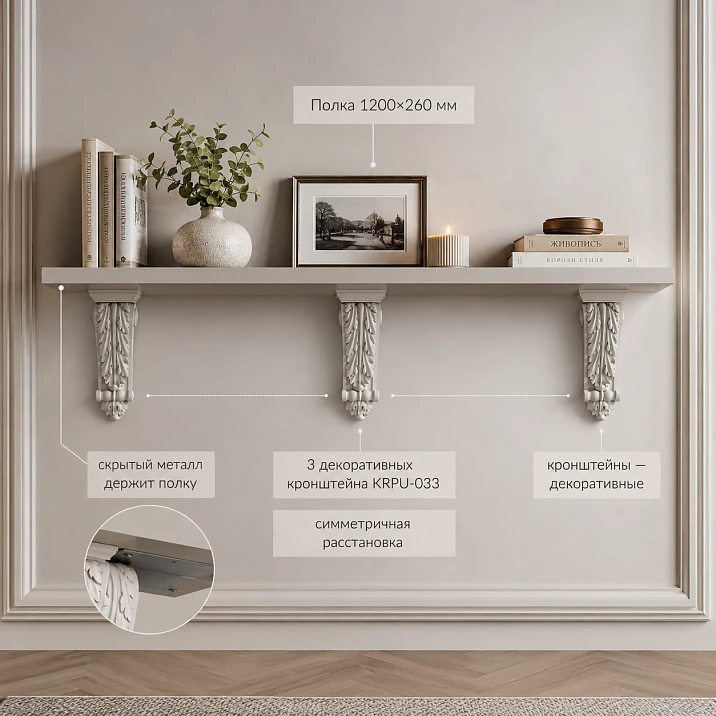
This shelf has a useful feature: three future brackets are not needed at all for it to hang.
The 1200×260 mm shelf is already secured on a hidden metal system, operates normally, and does not require redesigning the structure. KRPU-033 is needed for another reason: a classic or neoclassical shelf without visible supports can sometimes seem visually "detached" from the wall. Three carved elements beneath it can restore the familiar architectural logic—left support, central accent, and right support—without interfering with the already calculated hidden fastening.
This limitation needs to be noted before purchasing:
the hidden metal continues to support the shelf; KRPU-033 is added as a decorative polyurethane bracket.
You cannot buy three KRPU-033 units, remove the existing metal, and declare the decorative elements as the new load-bearing system. This model's card has no confirmed calculated load capacity for such a replacement, and the task of the article itself does not require changing the structure.
For a shelf 1200 mm long, the middle KRPU-033 203×90×41×38 mm is chosen. This is not the "correct size by load," but a candidate by scale. Before ordering, it should be compared with paper or volumetric templates against the 157 and 236 mm options.
If we preliminarily assume an equal offset of the outer bracket axis of 150 mm from each end, we get:
-
left axis—150 mm;
-
central—600 mm;
-
right—1050 mm.
Between adjacent axes:
600 − 150 = 450 mm
and:
1050 − 600 = 450 mm.
This results in perfect symmetry.
But 150 mm is an example of construction, not a universal mounting standard. On a real wall, the extreme axes need to be checked against hidden fasteners, the thickness of the shelf itself, adjacent cabinets, trim, cornice, and the visual scale of KRPU-033.
At the time of verification, the card confirms three dimensions:
| KRPU-033 | Dimension A×B×C×D | Material | Price at the time of check |
|---|---|---|---|
| Small | 157×70×31×29 mm | Polyurethane | 2 540 ₽ |
| Medium | 203×90×41×38 mm | Polyurethane | 4 960 ₽ |
| Large | 236×105×47×44 mm | Polyurethane | 6 940 ₽ |
Average production time for custom orders is 3–7 days.
Three selected 203 mm items cost:
4 960 × 3 = 14 880 ₽.
If the templates confirm scale and symmetry, you can first look at the general catalog, where Buy moldings grouped by type, and then buy KRPU-033 203×90×41×38 mm specifically as a decorative finish for an already mounted shelf.
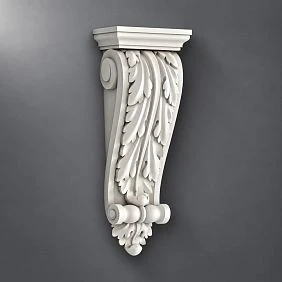
Decorative bracket KRPU-033 157, 203, or 236 mm: which size to order for a 1200 mm shelf
All three options belong to the same item, but create a different visual scale.




KRPU-033 157×70×31×29 mm
The most compact of the confirmed options.
On a 1200 mm shelf, three elements with width B=70 mm occupy along the front line:
3 × 70 = 210 mm.
From the shelf length remains:
1200 − 210 = 990 mm
of space outside the brackets' own front widths.
This does not mean that the free gaps will be 330 mm each: the result depends on the offsets of the outer axes and the actual geometry of the elements. But the number shows the overall scale — the small variant leaves a lot of "air."
It is stronger if:
-
the shelf itself is thin and light;
-
there is little classic decor nearby;
-
the room height is small;
-
KRPU should only slightly hint at the supporting form;
-
Large relief overloads the wall.
Our factory also produces:
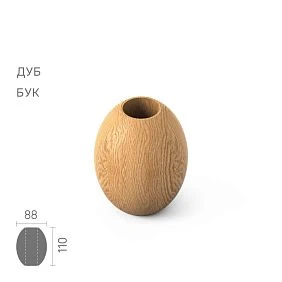
KRPU-033 203×90×41×38 mm
The medium version is chosen for the main theme.
The three elements have a total frontal width of:
3 × 90 = 270 mm.
remains:
1200 − 270 = 930 mm
of space outside the decorative bodies themselves.
By the proportion of B to the shelf length, one element occupies:
90 / 1200 × 100 = 7.5% of the length.
Three — 22.5% total across the width of the material, if counting only B without gaps.
This scale is already read as an architectural system, but it does not yet turn the bottom of the shelf into a continuous molded strip.
Get Consultation
KRPU-033 236×105×47×44 mm
The largest confirmed version.
Three elements:
3 × 105 = 315 mm.
remains:
1200 − 315 = 885 mm.
Difference relative to the 203-millimeter version in the width of one element:
105 − 90 = 15 mm.
For three:
45 mm of additional frontal mass.
By height A:
236 − 203 = 33 mm.
In a real room, these 33 mm can noticeably change the feel of the shelf.
Why can't you write "203 mm is optimal for 1200 mm"
Because the card does not establish such a rule, and the interior proportion depends on the surroundings.
A shelf 1200×260 mm can be located:
-
on a high wall of 3.5 m;
-
in a room with a massive cornice;
-
between two tall cabinets;
-
in a small niche;
-
above the fireplace area;
-
above the console.
The same shelf length does not make the visual scale the same.
Therefore, 203 mm is a justified candidate that needs to be confirmed with a template.
Polyurethane bracket KRPU-033 and hidden metal: why decorative molding cannot be replaced with load-bearing fastening
This is the main technical section of the article.
In the original situation, the shelf is already held by hidden metal.
This means the structural scheme is complete before the appearance of KRPU-033.
It can be written as follows:
wall → hidden metal fastener → shelf.
After decorative finishing:
wall → hidden metal fastener → shelf
Pros:
KRPU-033 → visual design of the lower zone.
Why this separation should be written directly in the order
The word "bracket" is often automatically perceived as a support.
The buyer or installer may decide:
since there are now three brackets under the shelf, hidden fasteners are no longer needed.
This is a dangerous logical substitution.
KRPU-033 in the article does not receive:
-
calculated load;
-
allowable shelf weight;
-
requirements for spacing as a load-bearing support;
-
functions of safety fastening.
Why three decorative elements do not become load-bearing by quantity
If one KRPU-033 is not declared as a structural support in a specific project, adding a second and third does not automatically create a confirmed load-bearing system.
Formula:
"three pieces means they will hold three times more"
is not applicable here.
What remains functional after KRPU installation
Everything on which the shelf was already supported:
-
metal anchors;
-
studs;
-
hidden brackets;
-
another existing calculated system.
The specific type of metal fastener is not specified in the scenario, so the article does not invent its design.
When load-bearing capacity is not needed at all
If the shelf:
-
is already hanging;
-
does not wobble;
-
the design is accepted;
-
the load does not change;
-
KRPU are added only for decoration.
Then there is no need to "recalculate the shelf for polyurethane" again.
Why can't hidden metal fasteners be removed after installing KRPU-033
Decorative finishing does not change the original load-bearing scheme.
Let's imagine that the hidden fasteners were designed for:
-
the weight of the shelf itself;
-
items;
-
lateral loads;
-
moment from the 260 mm overhang.
If they are removed, all this work must transfer to the new joint.
But KRPU-033 in our scenario was not calculated for this.
The error is especially likely after a visually successful installation.
Three carved elements look like traditional corbels.
The eye "believes" they hold the shelf.
But the visible position and the actual load transfer are different things.
Correct sequence
-
check that the hidden system works;
-
leave it unchanged;
-
choose the decorative scale of KRPU;
-
place them independently of the structural function;
-
mount them so as not to damage the existing fastening.
When KRPU-033 cannot be added at all before the structure is checked
If the shelf:
-
is loose;
-
sagged;
-
has cracks;
-
fasteners are pulling out;
-
it is unclear what it is attached to.
In this case, the structural problem is solved first.
A decorative bracket should not hide a defect.
KRPU-033 203 mm under a 1200 mm shelf: why three elements provide a convenient compositional scheme
Three points create a natural structure:
left → center → right.
For a 1200 mm long shelf, the central axis is at:
1200 / 2 = 600 mm.
This point is objective.
After it, you need to choose the symmetrical position of the outer elements.
Why the central KRPU is visually useful
It:
-
emphasizes the middle;
-
connects the two edges;
-
supports the classic composition;
-
removes the feeling of a long empty span.
Why two brackets give a different look
Two elements work as:
left + right support.
The center remains free.
This is calmer and more modern.
Why four — a different rhythm
Four elements already require three equal intervals or a different grid.
They can:
-
divide 1200 mm;
-
create a furniture cornice feel;
-
make the decor too frequent.
But you cannot declare three universally better than four. For another room, four templates may look stronger.
Three KRPU-033 under a 1200 mm shelf: how to calculate the left, central, and right axis
First, the full length is set:
L = 1200 mm.
Center:
C = 600 mm.
Next, the decorative offset of the extreme axis E from the end is entered.
In the example:
E = 150 mm.
Then the axes:
-
X1 = 150;
-
X2 = 600;
-
X3 = 1200 − 150 = 1050 mm.
We check the intervals:
600 − 150 = 450 mm.
1050 − 600 = 450 mm.
Symmetry confirmed.
Universal formula for three axes
If the shelf length is L and the edge offset is E:
X1 = E
X2 = L / 2
X3 = L − E
Distances between axes:
S = L/2 − E.
For L=1200 and E=150:
S=450 mm.
Why the formula is more useful than the ready number 150
It allows you to recalculate the composition.
For example, E=120 mm:
axes:
120 / 600 / 1080.
Intervals:
480 and 480 mm.
E=180:
180 / 600 / 1020.
Intervals:
420 and 420.
In all cases, the system remains symmetrical.
Why the 150 mm indent is an example, not a mandatory mounting dimension
The number 150 mm is chosen for a clear calculation.
But before fixing, you need to check the actual object.
Adjacent trim
If there is a door portal on the right nearby, the outermost KRPU may end up too close to it.
Wardrobe
Tall furniture nearby can visually "eat up" one edge.
Cornice
A large ceiling profile may require a more massive lower composition.
Hidden metal fastener
The decorative element should not obstruct access to an existing node if it is serviceable.
Shelf end face
A KRPU with a width of 90 mm cannot be positioned along the axis so close to the edge that half of the decorative body visually extends beyond the shelf.
Wall finish
A molding, panel, or other vertical element can provide a stronger base than a flat 150 mm.
KRPU-033 with width B=90 mm: how much free space will remain between three elements
For the selected version 203×90×41×38 mm, the frontal width B is 90 mm.
If the axes are placed at 150 / 600 / 1050 mm, you can estimate not only the distance between centers, but also the clear gaps between decorative bodies.
Half the width of one KRPU:
90 / 2 = 45 mm.
Leftmost element
Its axis is at 150 mm.
Left face of the nominal envelope:
150 − 45 = 105 mm from the end.
Right:
150 + 45 = 195 mm.
Central
Axis 600.
Envelope:
555–645 mm.
Right
Axis 1050.
Envelope:
1005–1095 mm.
Clear gap between left and central
555 − 195 = 360 mm.
Between central and right:
1005 − 645 = 360 mm.
From decorative body to shelf end
Left:
105 mm.
on the right:
1200 − 1095 = 105 mm.
We get a very clear visual system:
105 mm field → 90 mm KRPU → 360 mm clearance → 90 mm KRPU → 360 mm → 90 mm → 105 mm.
It is this symmetry, not the abstract "three pieces," that makes the scheme convincing.
Why this is more useful than the number 930 mm of free space
930 mm is the total remainder after subtracting three widths.
But it does not show the distribution.
The layout across the faces shows the real rhythm.
What changes if the edge offset is made 120 mm
axes:
120 / 600 / 1080.
KRPU dimensions:
-
75–165;
-
555–645;
-
1035–1125.
Gap between left and center:
555 − 165 = 390 mm.
Between center and right:
1035 − 645 = 390 mm.
Extreme margins:
75 mm.
Visual effect
Brackets closer to the ends.
Middle gaps are wider.
The shelf looks more "stretched" at the edges.
What changes with a 180 mm offset
axes:
180 / 600 / 1020.
Dimensions:
-
135–225;
-
555–645;
-
975–1065.
Clearances:
555 − 225 = 330 mm.
975 − 645 = 330 mm.
Extreme margins:
135 mm.
Visual effect
A group of three elements gathers more strongly toward the center.
The edges of the shelf look freer.
What this shows
Three options 120 / 150 / 180 mm are all mathematically symmetrical.
The choice between them is compositional.
Therefore, the article does not turn 150 mm into a standard.
KRPU-033 157 or 203 mm: make two templates before ordering
It's hard to gauge the size on a monitor.
Better to make physical silhouettes.
Small template
157×70 mm.
Medium template
203×90 mm.
You can also make a third one, 236×105 mm, if the large version is seriously considered.
How to place
Under the shelf on the wall along three axes.
First:
-
three 157;
-
then three 203;
-
then three 236.
Why exactly three templates of the same size
One KRPU does not show the overall rhythm.
Three 203 mm can look good, although one 203 on the wall seems too large.
Conversely: one 236 looks expressive, but three turn the bottom of the shelf into a heavy decorative row.
From what distance to view
Minimum:
-
next to;
-
2–3 meters;
-
from the main point of the room.
What to photograph
Frontally.
Side view.
General interior.
How to make a 3D model of KRPU-033 without buying it
Flat template shows A×B.
But the 203-mm version also has C=41 and D=38 mm.
This means the actual depth/shape of the profile according to the card.
No need to try to reproduce the exact thread, but you can make a conditional 3D block of the corresponding maximum depth.
Why
Check:
-
how much KRPU protrudes from the wall;
-
whether it interferes with items on the shelf;
-
whether it conflicts with the cabinet door nearby;
-
how strong the shadow is.
When KRPU-033 236 mm may already be too active for a 1200 mm shelf
The wording "may be" is fundamental.
There is no rule:
236 mm is always too large for 1200.
Need to check the proportion.
Three large elements across the width
3 × 105 = 315 mm.
With axis 150 / 600 / 1050 half of B:
52.5 mm.
Left dimension:
97,5–202,5.
Central:
547,5–652,5.
Right:
997,5–1102,5.
Clearances:
547.5 − 202.5 = 345 mm.
Edges:
97.5 mm.
That is, even the large version physically fits quite comfortably.
Why it can still be heavy
The main change is not only in B, but also in A:
236 mm versus 203.
A taller carved element appears under the shelf.
If the shelf itself is thin and the interior is light, the vertical scale of the brackets begins to dominate.
When 236 mm can be successful
-
high ceilings;
-
massive shelf;
-
large classic cornice;
-
fireplace zone;
-
heavy cabinets on the sides;
-
large stucco molding on the walls.
Why you cannot choose KRPU-033 based on a shelf depth of 260 mm as a load-bearing overhang
The shelf has a depth of 260 mm.
KRPU-033 has a C/D dimension, but this does not mean that the decorative element should "support" the entire depth.
Erroneous logic
"Shelf 260 is deep, the bracket should be almost 260."
This rule applies to other structural tasks and requires calculation.
In our article, KRPU does not support the shelf.
Therefore, the overhang is chosen based on visual proportion and the actual installation location.
Three identical KRPU-033 or a larger central one: two different design scenarios
Main scenario:
203 + 203 + 203.
It provides calm repetition.
But you can check an alternative:
157 + 203 + 157.
Option 203+203+203
Advantages:
-
same rhythm;
-
easier to order;
-
easier to paint;
-
same shadow;
-
no hierarchy between supports.
Option 157+203+157
The center is reinforced.
The edges become lighter.
What could go wrong
One ornament in two scales side by side may look not like hierarchy, but like randomly mixed sizes.
What to be sure to check
Three paper templates at once.
Don't choose a scheme based on price arithmetic.
Cost of three decorative brackets KRPU-033 203 mm
Price of medium size:
4,960 ₽/pc.
Three:
14 880 ₽.
Three small
2 540 × 3 = 7 620 ₽.
Three large
6 940 × 3 = 20 820 ₽.
Difference between small and medium set
14 880 − 7 620 = 7 260 ₽.
Between medium and large
20 820 − 14 880 = 5 940 ₽.
Between small and large
20 820 − 7 620 = 13 200 ₽.
Why average size cannot be justified only by a "compromise price"
Price follows size.
The choice should go:
layout → scale → price, and not the other way around.
The cost of the mixed scheme 157+203+157
2 × 2 540 + 4 960 =
5 080 + 4 960 = 10 040 ₽.
This is by:
14 880 − 10 040 = 4 840 ₽
is cheaper than three identical 203s.
But savings are not a reason to mix sizes.
If the layout shows that the center wins — the scheme is strong.
If not — it is just a cheaper but visually random combination.
Polyurethane molding price: what is included in the product amount and what is not
If the user compares Polyurethane molding price, the cost of three KRPU is only one part of the project.
Separately, the following may appear:
-
surface preparation;
-
the coloring;
-
glue;
-
installation;
-
wall restoration during dismantling;
-
templates/master's work.
Why this is important
Decorative KRPU are added after the already completed shelf structure.
Do not include hidden metal in their cost if it already exists.
Buy a polyurethane bracket or choose a structural wooden bracket: what is needed for an already mounted and a new shelf
Here lies the most important product fork.
If the shelf is already securely attached to hidden metal, you can buy polyurethane bracket precisely as a decorative finish.
If the shelf does not yet have a reliable support system and the buyer is looking for an element that will physically bear the load, the task is different.
You need to look at:
-
structural brackets;
-
metal fastener;
-
wooden supports for which the load-bearing function is directly intended;
-
calculation of the wall and anchors.
Why you cannot choose a product only by the word "bracket"
In the store, under this word, you will find products with different functions.
One is a decorative console.
Other — structural element.
Category name does not replace the description of a specific SKU.
KRPU-033 in our article
Function:
decorative.
Structural scenario
If a physical new support is needed, you can Buy a wooden bracket after checking the specific model, wall base, shelf depth, and load.
Wooden bracket KR-071 as an example of a structural product, but not the second main product of the article
KR-071 is useful here as a contrast in function.
The manufacturer describes it as a structural wooden bracket that can perform a load-bearing function. The design specifies:
-
tenon-and-groove joint;
-
glued joint;
-
two concealed mounting holes to the wall;
-
decorative caps.
This is a fundamentally different class of task.
Why KR-071 should not be automatically installed instead of KRPU-033
The shelf from the article is already mounted on hidden metal.
It does not need a new support system just because the decorative option does not bear load.
When KR-071 becomes relevant
If the user says:
"I'm only designing a new shelf and want the visible wooden brackets to actually participate in the structure."
Then you need to move to a separate calculation.
What cannot be transferred back to KRPU
The presence of a structural function in KR-071 does not mean that the polyurethane KRPU-033, similar in silhouette, gets the same properties.
Already painted shelf and KRPU-033: how to check the actual size before purchase
Since the shelf is already mounted, the buyer has an advantage — you can check the scale right on site.
Paper template
For the 203-millimeter one:
203×90 mm in the main frontal dimension.
Volumetric template
Add a conditional depth according to the card parameters.
Set three
Along the calculated axes.
Take a photo
Not only from below.
Need to look from normal eye height.
Why the view from below is misleading
Up close, the bracket appears larger.
From 3–4 meters, its scale is perceived differently.
Thickness of the shelf itself: why it needs to be compared with the height of KRPU-033
The original topic specifies a depth of 260 mm, but does not specify the shelf thickness.
This is an important missing parameter.
Thin shelf
For example, a visually lightweight slab.
KRPU 203 mm may seem like a massive classic base.
Thick shelf
Large profile or box.
203 mm may feel more natural.
Why the article does not prescribe a "correct ratio"
There is no such confirmed standard.
Need to compare with a template.
KRPU-033 and shelf depth 260 mm: how to check the side view
The front view is responsible for the rhythm of the three elements.
Side view — for the proportion of the console to the shelf overhang.
What to photograph
-
edge of the shelf;
-
a wall;
-
KRPU template;
-
items on the shelf.
What to check
Doesn't the decorative element seem:
-
too short;
-
too deep;
-
accidentally pressed against the wall.
But don't make this a calculation of the console's load-bearing capacity.
This check is only visual.
How to place the central KRPU if a panel seam or molding runs along the wall
The center of the shelf is objectively at 600 mm.
But there may be a vertical architectural line on the wall, for example:
-
panel joint;
-
molding;
-
decorative insert;
-
stone seam.
Scenario A — the central KRPU coincides with the line
This may look neat.
Scenario B — the line runs directly through the carved relief
This may be undesirable.
What to change first
Not necessarily the center of the shelf itself.
Allowed:
-
change the background finish;
-
choose a different KRPU size;
-
abandon the central element.
When the center cannot simply be shifted
If the task is precisely symmetry of 3 elements.
Shifting the central bracket will destroy equal intervals.
What to do if one edge of the shelf butts against a cabinet
Suppose:
-
a tall cabinet on the right;
-
an open wall on the left.
Symmetrical axes 150/600/1050 are mathematically ideal, but the right KRPU appears visually cramped.
Option 1. Maintain strict symmetry
If classic composition matters more.
Option 2. Switch to two brackets
Left and right according to the new grid.
Option 3. Change the width of the shelf's visual field
For example, perceive the part near the cabinet as built-in.
What not to do
Shift only the right KRPU by 30–50 mm and leave the others as they were.
This results in near symmetry — often worse than explicit asymmetry.
What to do if the shelf is between two architraves
Then it is better to check the extreme axes not only relative to the ends of the shelf, but also relative to the door verticals.
Why
KRPU become part of a larger architectural grid.
If one is 40 mm from the trim, and the second is 160 mm from the other, the eye notices this earlier than the 150/600/1050 axes.
Decorative bracket and hidden metal: do not drill the wall blindly
Hidden fasteners already exist.
This means that behind the shelf or in the wall there may be:
-
metal studs;
-
plates;
-
anchors;
-
possible engineering communications.
Therefore
You cannot choose the point of mechanical fastening of the KRPU and drill only according to the decorative markings.
Before any drilling, you need to know:
-
the actual layout of existing fasteners;
-
wall material;
-
the absence of electrical wiring/communications at the point.
If KRPU is installed using the adhesive method, the specific composition and base preparation must still be compatible with polyurethane and the wall finish.
Can KRPU-033 be attached only with adhesive
The article should not prescribe a universal mounting system without the manufacturer's instructions for the specific composition and base.
Need to check:
-
wall material;
-
paint;
-
plaster;
-
polyurethane;
-
the weight of the decorative element;
-
contact area.
Why "just mounting adhesive" is not enough
Different compositions have different compatibility.
Correct test
Check the technical data sheet of the selected adhesive and, if the finish is sensitive, perform an adhesion test on a sample.
Why decorative KRPU should not press against the shelf as a structural spacer
Sometimes an installer wants to push the element from below so that it "helps hold" it.
This changes the task.
Risks
-
KRPU receives unintended load;
-
pressure is transferred to the wall finish;
-
squeaking/deformation occurs;
-
with temperature changes, the shelf presses on the decor.
Correct principle
The decorative element visually adjoins the shelf according to the design, but is not used as a homemade load-bearing strut.
Gap between the top of KRPU and the shelf: leave it or bring it flush
This depends on the architectural solution and the actual shape of the product.
Flush
The bracket looks like a real traditional support.
Small shadow gap
It more honestly shows the decorative function and can simplify installation.
Why can't 2, 3, or 5 mm be assigned universally
There is no such confirmed size.
A mock-up decides better.
KRPU-033 under an already painted shelf: color matching the wall, matching the shelf, or contrasting
After choosing the size and coordinates, the finishing remains.
Since the shelf is already installed and KRPU is added later, the color can either dissolve the decorative brackets or make them separate architectural accents.
KRPU in the wall color
The brackets are perceived as part of the architecture.
The shelf remains an independent object.
Advantages:
-
the carving is read through light and shadow;
-
three elements fragment the shelf less;
-
easy to support the existing wall composition.
This works especially well if the wall is light and the shelf is contrasting.
KRPU in shelf color
Visually, the effect of a single console system is created.
Although structurally the shelf is held by hidden metal, the eye perceives:
shelf + three brackets = one composition.
This is a strong option for classic furniture and built-in niches.
Contrasting KRPU
For example:
-
dark brackets on a light wall;
-
light ones on a saturated one;
-
metallized decor.
The three elements become an independent rhythm.
What is dangerous
If the shelf itself:
-
has a carved edge;
-
is under a large cornice;
-
is surrounded by active stucco molding,
contrasting KRPU can overload the wall.
Why three KRPU need to be painted in one cycle
Even with one color, polyurethane relief strongly depends on:
-
the primer;
-
layer thicknesses;
-
the method of application;
-
the degree of gloss.
If one bracket is painted separately, it may look slightly darker or glossier.
On three identically positioned elements, the difference is noticeable.
Correct sequence
-
get three identical KRPU;
-
check the size and surface;
-
mark the positions;
-
make a test paintout;
-
process the entire set with one technology.
Where to do a test coat
If there is a spare element or a test sample of polyurethane — on it.
If not, use an inconspicuous area only within the technology of the specific coating.
The article does not recommend painting a "piece at the back" universally, because the surface and preparation may differ.
Why the color of the wall and the color of KRPU may look different even with the same code
A flat wall and carved polyurethane reflect light differently.
KRPU has:
-
recesses;
-
protrusions;
-
shadowed areas;
-
side edges.
Therefore, the same enamel does not make it visually flat.
This is not a defect.
It is the relief that creates decorative value.
KRPU-033 and wooden baseboard: how to connect the upper and lower horizontals of the room
If the interior is classic, the upper shelf and the lower baseboard are often perceived as parts of one architectural system.
If necessary, you can to buy wooden baseboard and coordinate it with KRPU not by material, but by visual language.
They don't have to be made identical
-
color;
-
material;
-
profile.
They can be connected through
-
warm/cold shade;
-
degree of matteness;
-
general classical plasticity;
-
repeat the proportion.
Why polyurethane + wood is a normal combination
Materials perform different functions.
The baseboard can be wooden or MDF.
KRPU is polyurethane decor.
In the finished interior, they are connected not by the same chemical base, but by design.
Why you don't need to buy a wooden baseboard just for the sake of "linking" the interior
If the room already has a suitable baseboard, changing it for new brackets is pointless.
Adjacent product is needed only if the lower line of the room is still being designed.
How to check three KRPUs relative to items on the shelf
The decorative bracket is located at the bottom, but its rhythm interacts with items above.
For example, on the shelf there are:
-
vase;
-
books;
-
a light fixture;
-
frames.
Central axis 600 mm
If a large central vase constantly stands on top, the KRPU under it will strengthen the composition.
If items are asymmetrical
Strict three brackets can, on the contrary, stabilize the bottom.
What not to do
Do not shift brackets under each item.
Items change, the architectural grid should remain stable.
If LED strip lighting runs under the shelf
KRPU can:
-
fall into the light beam;
-
create deep shadows;
-
block the light line.
What to check with the template in the evening
-
the shadow of each bracket;
-
symmetry;
-
whether three overly dark spots appear.
When the average size of 203 mm may turn out to be too active
If the LED is installed close to the wall and shines directly on the thread.
Possible solution
Compare 157 mm.
Do not change the hidden load-bearing fastener.
If the shelf is above the work desk
The KRPU height becomes even more important.
The lower part of the bracket may enter the visual or physical space of a person.
Check
-
height from the tabletop;
-
a monitor;
-
opening the laptop lid;
-
desk lamp.
Why the article does not provide a universal minimum clearance
The shelf height and the furniture beneath it are unknown.
If the shelf is above the headboard of the bed
The decor must be checked relative to a person's head, but the structural safety of the shelf is still ensured by the existing load-bearing system.
KRPU is not used as an additional "safety net."
If the shelf is above a door opening
Three brackets may conflict with the trim.
Then the 150 mm offset needs to be recalculated relative to the opening.
Possibly
-
two outer ones closer to the ends;
-
smaller size 157;
-
only two KRPU.
If the edge of the shelf is rounded
The axis of the outermost bracket cannot be assigned only from the bounding rectangle.
You need to select the real visual point where the straight section ends.
If the shelf has a decorative overhang
For example, the hidden load-bearing part is narrower, while the decorative tabletop is longer.
It is more logical to tie KRPU marking to the visible shelf if the task is compositional.
But you still need to check where the hidden metal is before installation.
If the shelf itself is not centered on the wall
The central KRPU is placed at the center of the shelf, not necessarily at the center of the wall.
Why
<
Online purchase: why you need to check the size in the cart, not just the article number
If buy stucco in an online store, cards of different sizes of the same KRPU may be inside one product.
In the cart, it is important to see exactly:
203×90×41×38 mm — 3 pcs.
Not:
-
157 — 1;
-
203 — 1;
-
236 — 1.
Why a mixed cart may look plausible
The article number is KRPU-033 everywhere.
The price is different, but the user may decide that this is a discount or a different configuration.
Checksum for three 203
At the time of checking:
14 880 ₽.
If the total product amount of three KRPUs differs noticeably, you need to re-check the lines.
Online store of polyurethane stucco molding: when to first choose a category, and when an exact SKU
If the model has not been selected yet, Online store for polyurethane ornamentation useful for comparison.
If an approved KRPU-033 203 mm already exists, returning to the broad category before payment is not necessary.
Why
The broad catalog helps with selection.
The card helps with ordering.
These are different stages.
Buy polyurethane molding in an online store: what to record in the project passport
If the user plans buy polyurethane molding in an online store for several rooms, for this shelf you need to save:
-
KRPU-033;
-
203×90×41×38;
-
quantity 3;
-
price as of date;
-
axes;
-
color;
-
template photos.
So in a year you won't have to remember again why you chose the medium size.
When not to buy KRPU-033 yet
The shelf is not yet finally secured
If it's only "roughly hanging," first finish the structure.
It's unknown what it's attached to
You can't drill or glue decor near a hidden system you know nothing about.
The shelf is sagging
First, the repair.
The customer wants to replace KRPU hidden metal
This is a different, unconfirmed scenario.
The size is selected based on the photo
First 157/203/236 to scale.
No central axis
Three elements cannot be arranged fairly.
Edge margins are assigned only "as looks nice by eye"
At least the coordinates need to be fixed.
The wall will still be repainted or milled
Installation of decorative polyurethane may be premature.
Finish not selected
If KRPU has already been painted with the wrong compound, correction is more expensive.
When three KRPU-033 203 mm units can already be purchased
-
The shelf is structurally stable.
-
The concealed support system remains.
-
The 203 mm size has been verified with three templates.
-
The central axis is 600 mm.
-
The outer axes are approved.
-
No conflict with adjacent elements.
-
Installation does not cross hidden fasteners.
-
Color/finish selected.
-
The wall base is suitable for the selected mounting system.
-
the price and delivery time are confirmed.
Errors in ordering and installing KRPU-033
Error 1. Considering KRPU-033 load-bearing just because it is called a bracket
Reason: the usual function of metal/wooden consoles.
Consequence: dismantling of working hidden fasteners.
How to prevent: in the specification, directly write "decorative".
Error 2. Removing hidden metal fasteners after installing the decor
Consequence: the load-bearing scheme of the shelf becomes unpredictable.
Error 3. Calculating the "load on three KRPUs" without manufacturer data
Such a calculation creates false precision.
Error 4. Choosing 203 mm as "average and therefore correct"
The size is confirmed by the mockup.
Error 5. Considering 150 mm as a mandatory edge offset
This is an example.
Error 6. Not placing the central KRPU at 600 mm in a symmetrical layout
The three elements start to visually "drift."
Error 7. Measuring the outer axes from the wall, not from the shelf
If the shelf is shifted, the composition breaks.
Error 8. Move only one outer KRPU because of the cabinet.
It turns out almost symmetry.
Better to reassemble the whole scheme.
Error 9. Check only one template
One 203 mm does not show the rhythm of three.
Error 10. Look only from below at a distance of 30 cm
The bracket seems bigger than in the room.
Error 11. Ignore the shelf thickness
203 mm can be visually heavy for a very thin shelf.
Error 12. Choose by shelf depth as a load-bearing rule
KRPU is decorative here.
Mistake 13. Drilling the wall blindly
There is already hidden metal behind it, and there may be utilities.
Mistake 14. Pressing KRPU against the shelf as a spacer
The decor receives unintended load.
Mistake 15. Using random glue
The compound may be incompatible with polyurethane or wall paint.
Mistake 16. Painting one bracket separately, the rest later
The gloss and shade diverge.
Mistake 17. Mixing sizes in the cart
One SKU creates a false sense of sameness.
Mistake 18. Making the center 203 and the sides 157 just to save money
A mixed scheme must be confirmed by design.
Mistake 19. Buying three 236s because "bigger looks more expensive"
On a 1200 mm shelf, they can overload the bottom.
Mistake 20. Buying three 157s just for the price
Small elements can get lost in a large interior.
Mistake 21. Not checking the lighting
The carving creates unwanted shadows.
Mistake 22. Ignoring items and furniture under the shelf
KRPU may enter the work area.
Error 23. Glue decor to a wall that will soon be repainted
Subsequent repairs become more complicated.
Error 24. Consider decorative KRPU as "insurance" for a bad shelf
A structural defect must be repaired structurally.
Edge case: shelf is longer — 1600 mm, but want to keep three KRPUs
Center:
800 mm.
If keeping the edge offset of 150:
axes:
150 / 800 / 1450.
Intervals:
650 and 650 mm.
Visual effect
The three elements diverge significantly.
May be required:
-
four;
-
larger size;
-
different indent.
Conclusion
The 150–600–1050 scheme does not scale by simply adding length.
Boundary scenario: shelf shorter — 900 mm
Center:
If E=150:
axes:
150 / 450 / 750.
Intervals:
300 mm.
For B=90 clear gaps:
300 − 90 = 210 mm between adjacent dimensions in a symmetric model.
Three 203 mm may look denser.
Possibly
157 mm is better.
Boundary scenario: shelf 1200 mm, but only two KRPU desired
Then the composition can be built, for example, on equal extreme indents.
If the axes are 200 mm from the ends:
200 and 1000.
Center-to-center:
800 mm.
What disappears
Central accent.
When this is stronger
-
a more modern interior;
-
the shelf itself is light;
-
there are already many objects under it.
Boundary scenario: want four KRPU
If four elements should be uniform, you need to choose a new grid.
For example, conditionally axes:
150 / 450 / 750 / 1050.
Spacings of 300 mm.
But this scheme no longer has one central element.
What changes visually
Instead of:
edge–center–edge
It turns out:
regular row.
This is a different composition.
Boundary scenario: the central bracket must align with the decorative wall rosette
If the outlet is centered on the shelf, it can serve as a strong vertical axis.
But
Check that there isn't too much decor in one spot.
Edge case: a TV passes under the shelf
The central KRPU may end up above the screen and create an unnecessary visual focal point.
Option
Compare two brackets instead of three.
Edge case: shelf above a fireplace
Three KRPUs can support the classic rhythm of the portal.
But the spacing is better tied to the width of the fireplace, not just the 1200 mm shelf.
Edge case: one edge of the shelf is covered by a curtain
Physically, KRPU remains, but visually one edge element disappears.
Then three can be perceived as two.
What to do
Look at the curtain in its normal position.
Edge case: the wall is uneven
The polyurethane decorative piece must fit against the actual base.
If the wall is heavily warped, do not force KRPU against it so that it deforms or tears off the paint.
First, prepare the base.
Edge case: the shelf has a hidden metal bracket right in the area of the future KRPU
The decorative element may cover a service point.
What to check
Is it ever necessary to tighten or remove the hidden fastener?
If yes, KRPU should not make it unavailable without planned dismantling of the decor.
Checklist of three KRPU-033 before installation
Before fixing, it is useful to consolidate all decisions into one table.
| Parameter | Left | Center | Right |
|---|---|---|---|
| SKU | KRPU-033 | KRPU-033 | KRPU-033 |
| Size | 203×90×41×38 | 203×90×41×38 | 203×90×41×38 |
| X axis | ___ | 600 мм | ___ |
| Preliminary X | 150 | 600 | 1050 |
| Color | ___ | ___ | ___ |
| Wall checked | Yes/No | Yes/No | Yes/No |
| Hidden fasteners do not intersect | Yes/No | Yes/No | Yes/No |
| Mounting system | ___ | ___ | ___ |
Why the central axis is the simplest
With a shelf of 1200 mm:
600 mm — geometric center.
Why extreme axes need to be confirmed after the template
Their position depends on the visual offset.
What should match
-
size;
-
color;
-
level;
-
orientation;
-
top attachment line.
How to check the level of three brackets without relying on an uneven floor
Do not mark from the floor.
The floor may have a slope.
For KRPU under the shelf, the best base is the shelf itself.
Measure from the bottom plane of the shelf
If the top of the KRPU must be adjacent to it.
Or from a separate common horizontal line
If there is a shadow gap.
Why this is more accurate
All three decorative elements belong to the same shelf.
If the shelf itself is installed with a slight slope
First, determine whether the slope of the structure is acceptable.
Do not align the KRPU separately in a way that visually emphasizes the shelf's error even more.
If the shelf is structurally installed incorrectly, it is corrected first.
How to check three KRPU after dry installation
Use temporary templates/safe fixation.
From the front
Axes and rhythm.
From the left
Depth and abutment.
On the right
Symmetry.
From the main point of the room
Main scale assessment.
Under artificial light
Shadows.
Why a photo with a grid helps spot the mistake
In the photo, you can draw vertical lines through:
-
the left axis;
-
the center;
-
right.
And a horizontal line along the tops.
If the composition is "drifting," it's visible before editing.
If three KRPUs look too small after the mockup
Procedure:
-
compare 236 mm;
-
check that the outer margins aren't too large;
-
possibly reduce E;
-
look at the overall interior again.
Do not automatically switch to four elements.
If three 203s look too heavy
Check:
-
three 157;
-
two 203s;
-
157+203+157.
Each option solves a different composition.
How to calculate the cost after changing the quantity
Two 203s
2 × 4 960 = 9 920 ₽.
Three 203s
14 880 ₽.
Four 203s
4 × 4 960 = 19 840 ₽.
Difference three → four
4 960 ₽.
That is, the price of one additional element equals the price of changing the rhythm.
Why you don't need to add a fourth "since it's not expensive relative to the repair"
It should have a compositional function.
For two identical shelves: how many KRPU to order
If each has three identical 203s:
3 × 2 = 6 pcs.
Cost:
6 × 4 960 = 29 760 ₽.
Do we need to make a common template
Yes.
One approved scheme can be repeated.
What to double-check
Shelves may have slight differences in actual position.
Serial project: N shelves with three KRPU each
Quantity:
3N.
Cost at the current price of the average size:
14 880 × N.
For 10 shelves
30 KRPU.
Item total:
148 800 ₽.
Why a serial order requires a reference shelf
A 20 mm offset error will repeat 10 times.
First, one control composition.
What to store in the interior passport after installation
-
KRPU-033;
-
size 203×90×41×38;
-
quantity;
-
color;
-
axes;
-
photo;
-
type of mounting system;
-
indication that hidden metal remains load-bearing.
Why the latter
So that a future repairman does not dismantle the working fasteners upon seeing the decorative consoles.
Should the three decorative KRPU-033 align on the axes with the hidden metal fasteners?
There is no universal requirement that a decorative element must be located directly under a load-bearing stud or metal console.
In our task, these are two independent systems:
-
the hidden metal distributes the load;
-
KRPU forms the visible composition.
When axis alignment is useful
If the structural fasteners are arranged symmetrically and their axes are close to 150 / 600 / 1050 mm, alignment can simplify the visual explanation of the shelf.
The eye sees support where there is actually a load-bearing element inside the wall.
This is beautiful and logical.
When a match is not needed
The hidden system could have been calculated on a completely different grid.
For example:
-
two power nodes;
-
four anchors;
-
metal rail;
-
solid hidden console.
Trying to rearrange three KRPUs to these points is pointless.
What is primary
The load-bearing scheme does not change.
The decorative grid adapts only within limits where it does not interfere with the structure and service.
What to do if the central axis of the KRPU falls directly on a hidden metal node
This is not a problem in itself.
The problem arises if the chosen method of installing KRPU requires:
-
to drill;
-
screwing in fasteners;
-
cutting through the wall
exactly where metal is already present.
Correct order
-
obtain a diagram of hidden fasteners;
-
determine the depth and position;
-
choose a safe method for mounting the decorative element;
-
if necessary, adjust the KRPU installation without altering the geometry of the composition itself.
Why shifting the central element is the last resort
The 600 mm center is a strong architectural axis.
If it is shifted only for the convenience of one mounting hole, visual symmetry will deteriorate.
It is better to first look for another safe way to secure the decor.
Service access to hidden metal: decorative brackets should not make the shelf non-repairable
The shelf works fine today.
But in years to come, it may be necessary:
-
tightening;
-
dismantling;
-
repainting the wall;
-
replacing the shelf itself.
If KRPU completely blocks access to the service points of the hidden fastening system and is glued permanently without a planned removal method, routine maintenance becomes more difficult.
What to find out before installation
Does the hidden system have:
-
visible screws from below;
-
a removable cover;
-
access through the end;
-
mounting points behind the future KRPU.
If access is not needed
Installation is simpler.
If needed
KRPU should be positioned or installed so that future service is possible.
Why a decorative bracket cannot be used as a "mask" for poorly positioned fasteners
If metal screws are visible under the shelf, you want to cover them with KRPU.
Sometimes this is acceptable as a decorative task.
But first you need to check that the screws are not service screws.
Bad scenario
The bracket covers the head of the fastener.
In a year, the shelf will need to be removed.
The decor has to be broken.
Good scenario
The service point remains accessible or a neat dismantling is provided.
Shelf 1200×260 mm and three KRPU: how to check the proportion by room depth, not just by the facade
The frontal view shows symmetry.
But a person rarely looks at the shelf strictly from the center.
From a side angle, the outermost KRPU may appear larger than the central one due to perspective.
Check from three points
-
straight on;
-
45° left;
-
45° right.
What to look for
If the side element visually "sticks" to the end, E=150 may be too small.
If the edge seems empty, E can be reduced.
Why this is better than deciding by millimeters
The interior perspective is not visible in the linear calculation.
How does the installation height of the shelf affect the choice of 157/203/236 mm
The same KRPU 203 is perceived differently:
-
at eye level;
-
high under the ceiling;
-
low above the table.
High
Fine relief visually diminishes.
236 may look calmer than up close.
Low
203 or 236 seem larger and require more space.
Practical conclusion
The template should be placed at the actual height, not held in your hands in front of you.
How to check the decorative rhythm through empty intervals, not the brackets themselves
Often a designer looks only at three carved elements.
It is more useful to look at four empty fields:
-
left edge;
-
two internal gaps;
-
right edge.
For the scheme 150/600/1050 and B=90:
-
edge fields ≈105 mm;
-
internal ones ≈360 mm.
This rhythm reads as:
short — long — long — short.
It is this that creates a calm symmetry.
If E=120
Margins:
-
outer ≈75 mm;
-
inner ≈390 mm.
The rhythm becomes more stretched.
If E=180
-
outer ≈135 mm;
-
inner ≈330 mm.
The group is more strongly gathered toward the center.
This is a convenient way to choose E without "like/dislike" discussions.
Which option should be checked first for a classic 1200 mm shelf?
If there are no other constraints, the 150/600/1050 layout is a good first mock-up because:
-
the center is precise;
-
the intervals are equal;
-
the edge margins are not too narrow;
-
B=90 remains with clear breathing room.
But the final decision still belongs to the real interior.
Why three decorative brackets do not require three new load points
This is another common confusion.
The number of visible elements does not have to match the number of structural nodes.
You can have:
-
two hidden load-bearing brackets and three decorative KRPU;
-
four hidden anchors and three KRPU;
-
a solid metal console and three KRPU.
What this gives the project
The decorative rhythm can be built more freely without compromising the engineering.
What it does not give
The right to ignore the location of hidden metal when drilling.
If the load on the shelf increases after KRPU installation
Decorative design does not change the allowable load of the existing shelf.
For example, today it holds books and decor, but later the owner wants to place:
-
a heavy collection;
-
the acoustics;
-
a stone object;
-
a large television component.
One cannot reason:
"Now there are three brackets at the bottom, so the safety margin has increased."
KRPU-033 is not involved in the calculated force scheme in this article.
What to do when the load changes
Re-evaluate the existing hidden metal specifically:
-
mounting type;
-
wall base;
-
shelf depth 260 mm;
-
structure condition;
-
new mass and distribution of objects.
If the hidden system is not designed for the new scenario, a specialist reinforces it with an appropriate structural solution.
What happens to KRPU
They remain in their decorative positions.
They do not need to be automatically:
-
repositioned under a heavy object;
-
add a fourth one;
-
pressed tighter against the shelf.
Why this matters for the future owner
In a few years, the visual appearance of the three "supports" may create a false impression that the shelf physically rests on them.
Therefore, in the interior passport, it is useful to leave a simple note:
"The shelf is carried by hidden metal fasteners; KRPU-033 are decorative."
This single line prevents erroneous use better than any assumptions based on appearance.
FAQ
What sizes are available for KRPU-033?
In the confirmed card: 157×70×31×29, 203×90×41×38, and 236×105×47×44 mm.
What size is considered for a shelf of 1200×260 mm?
The main scenario of the article is 203×90×41×38 mm.
Why is 203 mm chosen specifically?
As a medium-scale candidate. The choice is confirmed by three templates on a real shelf, not by load-bearing capacity.
How much does KRPU-033 203 mm cost?
At the time of checking — 4,960 ₽ per piece.
How much do three cost?
14 880 ₽.
How much do three KRPU-033 157 mm cost?
7 620 ₽.
How much do three 236 mm cost?
20 820 ₽.
Can three KRPU-033 be placed under a shelf?
Yes, if they are used as a decorative composition and physically fit the wall.
Where should the central one be placed?
With a length of 1200 mm, the geometric center is 600 mm from either end.
What axes are obtained with extreme offsets of 150 mm?
150 / 600 / 1050 mm.
What is the distance between the axes?
450 mm each.
What is the clear gap between KRPU 90 mm wide with this layout?
About 360 mm between adjacent dimensions.
How much remains from the outermost KRPU to the end face?
With an axis of 150 and B=90 — about 105 mm according to the conditional overall rectangle.
Is it mandatory to leave 150 mm?
No. This is an example that shows the method of constructing symmetry.
Can KRPU-033 be used as a load-bearing support?
In this article — no. The shelf is already supported by a separate hidden metal fastener, and KRPU is used as decor.
Is it necessary to remove the hidden metal after installing KRPU?
No. The original load-bearing system remains operational.
Can three KRPU be considered insurance for hidden fasteners?
No. This would require a confirmed structural function and calculation.
How does a decorative bracket differ from a structural one?
A decorative one solves a visual task. A structural bracket must have a confirmed fastening system and application in the load scheme.
Which wooden bracket can be considered for a structural task?
For example, KR-071 is described by the manufacturer as structural, but a specific new shelf still requires calculation of the base and fasteners.
Can a central KRPU be larger than the side ones?
You can check the 157+203+157 scheme. It is not automatically better and requires a mock-up.
Why not install four?
It's possible. But four create a regular row instead of a left-center-right scheme.
Which KRPU is better — 157 or 203?
It depends on the scale of the room, the thickness of the shelf, and the surrounding decor.
Can KRPU-033 be painted?
Polyurethane decor can be included in the finishing scheme, but the specific primer and paint need to be checked for compatibility.
Paint it in the color of the wall or the shelf?
Both options are possible. In the wall color, KRPU is more architectural; in the shelf color, it more strongly creates the illusion of a unified console system.
Can a contrasting color be used?
Yes, if three elements do not overload the interior.
Can it be mounted with glue?
The mounting system depends on the base and the specific adhesive. It is not possible to universally prescribe a single composition.
Do you need to drill the wall?
Not necessarily. If mechanical fastening is still required by the mounting system, you cannot drill blindly near hidden metal and utilities.
What to do if the shelf is wobbly?
First, repair the load-bearing system. KRPU should not mask a structural defect.
Do you need to consider lighting?
Yes. The carved profile can create strong shadows.
Where can I see other polyurethane brackets?
In the category of polyurethane brackets STAVROS.
Where to buy a wooden structural bracket?
In the category of solid wood brackets after checking the specific model and load.
Where to order KRPU-033?
In the KRPU-033 card after confirming the size and quantity.
Final algorithm for ordering three KRPU-033
-
Make sure the shelf is already securely held on the hidden metal.
-
Do not change the existing support system.
-
Measure the actual length of the shelf.
-
Confirm 1200 mm.
-
Measure the depth and thickness.
-
Mark the central axis at 600 mm.
-
Make three KRPU templates of 157 mm.
-
Make three templates of 203 mm.
-
If necessary — 236 mm.
-
Compare with 2–3 meters.
-
Choose 203 mm if it wins.
-
Assign a preliminary edge offset E.
-
Check E=150 mm as a start.
-
Get axes 150/600/1050.
-
Check clear openings.
-
Compare E=120 and 180 if in doubt.
-
Check adjacent trims.
-
Check the cabinets.
-
Check the backlighting.
-
Check the hidden fasteners.
-
Do not drill into unknown areas.
-
Choose a color.
-
Make a test paint out.
-
Check the mounting system.
-
Compile the specification.
-
Check the size in the cart.
-
Check the quantity 3.
-
Check the price.
-
Confirm the 3–7 day timeframe according to the current product card.
-
Get three identical items.
-
Check them before painting.
-
Process in one cycle.
-
Perform a dry fit.
-
Check the axes.
-
Install the left element.
-
Check the overall level.
-
Install the center one.
-
Check symmetry.
-
Install the right one.
-
Photograph the finished shelf.
-
Save in the passport the note: KRPU — decorative, hidden metal — load-bearing.
Conclusion
For a shelf 1200×260 mm, which is already securely fixed to a hidden metal system, three KRPU-033 can be used as a purely decorative architectural finish.
Main version of the article:
3 × KRPU-033 203×90×41×38 mm.
The current price for one is 4,960 ₽, for three — 14,880 ₽.
The main condition: the decorative polyurethane bracket does not replace the existing load-bearing fastener. The metal remains the working system of the shelf. KRPU adds the visual form of a traditional console.
For symmetry of a 1200 mm shelf, the central axis is at 600 mm. If we take a preliminary edge offset of 150 mm, we get the axes:
150 / 600 / 1050 mm.
The center-to-center distances are the same:
450 and 450 mm.
With B=90 mm, the clear gaps between the dimensions are about 360 mm, and from the outer decorative bodies to the ends there remains about 105 mm. This scheme looks logical on paper, but 150 mm is not a standard: it needs to be checked with three real templates in the room.
Before purchasing, compare 157, 203 and, if necessary, 236 mm. The small set costs 7,620 ₽, the medium — 14,880 ₽, the large — 20,820 ₽. The price does not choose the scale for the interior.
If the shelf does not yet have a reliable load-bearing system, the task changes. Then structural fasteners or a suitable wooden bracket with a confirmed function are needed, not an attempt to make KRPU-033 hold the shelf. The manufacturer, for example, separately describes KR-071 as a structural wooden bracket with a tongue-and-groove joint and mounting holes. This is a different class of product.
Correct sequence:
existing hidden metal → shelf check → three templates → size selection → central axis → outer axes → wall and hidden fastener check → finish → installation → acceptance.
After the 203 mm size and three axes are confirmed on the actual shelf, you can order the decorative bracket KRPU-033 in a quantity of three pieces — specifically as a decorative element that does not alter the already calculated load-bearing structure.