Article Contents:
- In which cases is an elongated overlay really better than a round ceiling rose
- Situation 1. The table is the main center of the composition, not the center of the room
- Situation 2. The light fixture is pendant and itself has a longitudinal composition
- Situation 3. Need to soften the offset of the suspension point without feeling like a mistake
- Situation 4. A more modern composition is required than a classic ceiling rose
- Situation 5. There are already longitudinal lines on the ceiling that you want to support
- When a round ceiling rose is still better and why it is worth honestly admitting this before purchasing
- 1. The lamp works as a single central point
- 2. The room is close to symmetrical, and the table is positioned almost in the center
- 3. The lamp has a classic chandelier shape
- 4. Need to hide the technical node around the outlet
- 5. The table is round or oval and does not require a long axis
- 1. Table length and width
- 2. Actual position of the pendant lamp
- 3. Size and shape of the ceiling cup of the luminaire
- 4. Presence of mounting hardware and access to it
- 5. Distance to walls, cornices, ventilation grilles, and other ceiling elements
- 6. Ceiling height
- 7. Ceiling type
- The first reason is to check the scale from the actual viewpoint
- The second reason is to understand how the overlay relates to the luminaire's ceiling cup
- The third reason is to check the orientation along the table
- The fourth reason is to see whether a feeling of a random fragment appears
- How to properly do this test
- Scheme 1. The luminaire and the overlay have a common compositional center
- Scheme 2. The overlay works as a background for an elongated cup or linear base
- Scheme 3. The luminaire is an independent element, and the NPU-165 only supports the table axis
- Single pendant
- Group of pendants in a row
- Luminaire on a longitudinal ceiling rail
- Compact chandelier with multiple arms or shades
- 1. Does the overlay connect the ceiling with the table
- 2. Does the decor draw attention too far upward
- 3. Does the overlay's shape support the table's length
- 4. Does the overlay conflict with adjacent lines
- 5. Does the node become too decorative for the overall style
- 6. Does the overlay have visual work both during the day and in the evening
- Ceiling around 2.5–2.6 m
- Ceiling around 2.7–2.9 m
- Ceiling 3 m and above
- Painting in the ceiling color
- Soft contrast
- Accent painting
- Modern classicism
- Neoclassicism
- Modern Interior
- Art Deco and eclecticism
- Minimalism
- Protection of an already installed luminaire
- The intersection of decorative idea and everyday convenience
- Test painting
- Sequence of Actions
- Successful scenario
- Borderline scenario
- Unsuccessful scenario
- 1. The light fixture itself already forms a strong composition
- 2. The ceiling is already saturated with other elements
- 3. The interior is too minimalist
- 4. The table is small, and the pendant is compact
- 5. There is no technical possibility to correctly install the product
- Mistake 1. Trying to make a full-fledged socket out of the overlay
- Mistake 2. Estimating the size only by the number 570 mm
- Mistake 3. Ignoring the shape of the lamp cup
- Mistake 4. Gluing the overlay without a template
- Mistake 5. Not considering the room style
- Mistake 6. Making the ceiling accent too active
- Mistake 7. Forgetting about service access to the lamp
- Can NPU-165 be installed if there are two small pendant lights hanging above the table instead of one?
- Will NPU-165 fit a round dining table?
- Can NPU-165 be used if the ceiling is stretch?
- What to do if NPU-165 seems suitable in theory but feels too decorative?
- Can NPU-165 be placed not exactly in the center of the light fixture, but slightly offset?
- If the light fixture is very expressive, is NPU-165 needed at all?
- Can NPU-165 be chosen instead of a socket just because it is 'more modern'?
- What to do if, after the template, it became clear that the idea of an elongated accent is correct, but the size or pattern is not satisfactory?
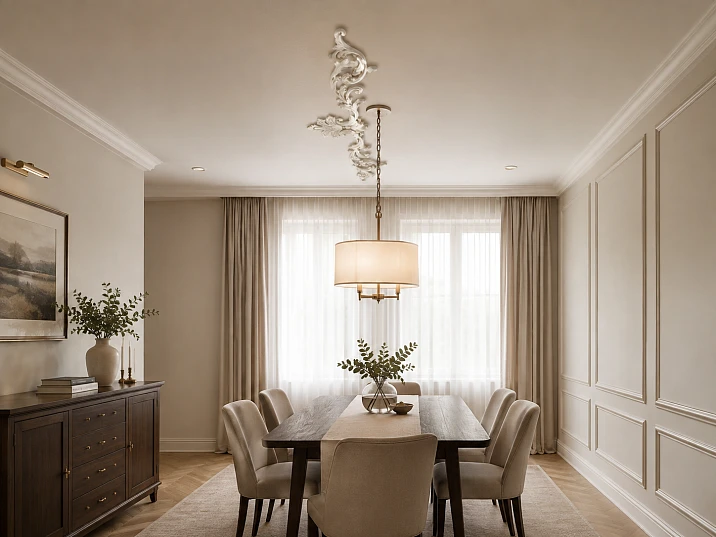
When a pendant light is brought out not to the geometric center of the room, but directly above the dining table, the ceiling begins to work not according to the classic scheme "center of the room = center of decor." The room has one axis, the table has another, and it is the second one that becomes the main one in daily perception. A person sits at the table, walks past the kitchen, looks at the composition from the living room area, and sees not an abstract ceiling, but a specific node: the table, the light fixture, and the part of the ceiling that unites them.
In such a situation, a round ceiling rosette is not always the best solution. It works well where you need to emphasize a point center: one outlet, one chandelier, one radial composition. But if the light fixture is deliberately shifted toward the table, round decor often begins to conflict with the logic of the layout. It seems to tell the eye: "here is the center of the whole room," although in reality the design accent is above the dining group. Because of this, the interior may lose its cohesion: the table lives on one axis, the light fixture on the same one, and the rosette tries to impose a third coordinate system.
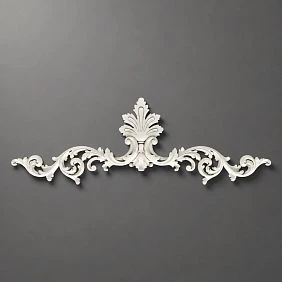
This is exactly where it makes sense to consider not a rosette, but an elongated decorative overlay. NPU-165 is a carved decorative overlay made of polyurethane, not a ceiling rosette. The model has two sizes, but for this article one specific option is important: 570 × 190 × 16 mm, priced at 6,580 ₽ per piece. The product card allows the use of the item on ceilings, walls, and accent areas, so the question is not whether NPU-165 can be glued to the ceiling in principle, but whether this particular elongated format suits the axis of the dining table.
The short answer is: yes, NPU-165 570 × 190 × 16 mm can be considered instead of a round rosette if the light fixture is shifted toward the table and you need not a radial "room center," but a longitudinal ceiling accent along the tabletop axis. But you cannot buy the overlay just because it is elongated. First, you need to check three things: composition, installation technique, and the actual operation of the node with the light fixture. NPU-165 does not have to frame the light fixture's canopy the way a rosette does. However, it should not interfere with access to the mounting, conflict with the canopy, look accidentally small against the background of the table, or, conversely, turn a light dining area into an overloaded ceiling fragment.
Below, we will break down this question the way it really needs to be before purchasing: not in the format of a catalog description, but in the format of practical choice. We will look at which interiors justify an elongated overlay, what sizes and distances need to be checked, how to apply the 570 × 190 mm template, when a round rosette is better, when it is better to abandon additional decor altogether, and what to buy next if NPU-165 turns out not to be your option.
What exactly is NPU-165 and why it is not a one-to-one replacement for a rosette
You need to start with a correct understanding of the product itself. NPU-165 is a carved overlay, not a ceiling rosette. This is important not only by name, but also by the mechanics of use.
A ceiling rosette historically works around the suspension point. Its logic is radial. It concentrates attention in the center and, as a rule, is somehow connected to the base of the chandelier or pendant. Even if the rosette is several times larger than the light fixture's canopy, it still reads as the surroundings of the center.
NPU-165 is arranged differently. It is an elongated decorative element with a pronounced longitudinal axis. In the size 570 × 190 × 16 mm, it is already large enough to be perceived not as a small ornamental fragment, but as an independent ceiling accent. At the same time, it does not require the electrical point to be located in the geometric center of the entire ceiling. On the contrary, it can support a local zone—for example, a dining group in a kitchen-living room.
Three practical conclusions immediately follow from this.
First, the NPU-165 does not have to be centered around the cup of a pendant light. The light can be positioned at the center of the plate, slightly closer to its central fragment, or work together with it as part of a common composition. This provides more freedom than a classic round ceiling rose.
Second, the plate does not automatically hide all technical components. While a round rose is often expected to cover the wiring, mounting cup, or the area around the outlet, the NPU-165 should be evaluated differently. It can be purely a decorative accent, and you still see the technical suspension cup separately.
Third, the plate is more dependent on spatial orientation. For a rose, the round shape is inherently neutral: rotate it by 10–15 degrees, and visually almost nothing changes. For an elongated plate, the longitudinal axis is crucial. If the product is installed along the table, it works as a support for the tabletop's length. If placed across, the logic breaks, and the interior starts to look as if the decor accidentally ended up on the ceiling.
Therefore, the correct way to frame the question is not "can the NPU-165 be used instead of a rose?" but "can a specific elongated NPU-165 plate better support the longitudinal axis of a dining table than a round rose supports the center of the room?" This is precisely the essence of the choice.




In which cases is an elongated plate truly better than a round ceiling rose
The very idea of replacing a rose with an elongated plate is not always justified. There are scenarios where a rose remains a logical and strong solution, and there are scenarios where the NPU-165 looks smarter and more natural.
Our factory also produces:
Situation 1. The table is the main center of the composition, not the center of the room
This is the most obvious and most common case. For example, a kitchen-living room has a rectangular layout, the lounge area is shifted to one side, the kitchen to the other, and the dining group occupies an intermediate position. The pendant light is positioned not along the room's axis, but clearly along the table's axis, because that is how it is needed in real life.
If a round rose is placed in such an interior, it almost always makes one gesture: it emphasizes a point. But a table is not a point; it is a length. It is perceived longitudinally, especially if the table is rectangular: 1400, 1600, 1800, or 2000 mm. An elongated decor here is more understandable. It visually speaks to the table in the same language: not "center," but "axis."
Get Consultation
Situation 2. The pendant light itself has a longitudinal composition
If above the table hangs not a small single pendant, but a linear suspension, a group of several pendants on a common bar, or an elongated designer light fixture, a round ceiling rose can look like an element of a different system. The light is elongated, the table is elongated, but the decor suddenly becomes round. This is not always a mistake, but it is often a stylistic mismatch.
NPU-165 in such a junction can connect the ceiling and the light much more organically. Especially if the light's canopy is elongated or if the pendants are arranged in a row.
Situation 3. Need to soften the offset of the suspension point without feeling like a "mistake"
Sometimes an offset chandelier or pendant is perceived by guests as if it was accidentally installed not in the center of the room. In reality, this is not a mistake, but a conscious decision, but the interior does not always immediately explain this.
An elongated canopy can visually justify the offset. It shows that the decor is subordinated not to the center of the room, but to the table area. The room stops looking "asymmetrical by mistake" and starts looking "consciously zoned".
Situation 4. A more modern composition is required than a classic ceiling rose
A round ceiling rose is a strong, but historically very recognizable technique. In classic, neoclassical, American classic, and certain Art Deco variations, this is appropriate. But if the interior is modern, with clean lines, minimalist furniture, and a calm ceiling, a too traditional ceiling rose can sometimes make the junction overly formal.
NPU-165 gives a different character. It remains decorative, but compositionally it is perceived as less "ceremonial". It is easier to integrate into a modern kitchen-living room, where an accent is needed, but a solemn palace scheme is not.
Situation 5. There are already longitudinal lines on the ceiling that you want to support
Suppose the room has a parquet direction, a seam between zones, a long table, linear lighting, or architectural lines that run along the room. Then the elongated cover plate becomes not a solitary decorative gesture, but part of a more general geometry. This is another argument in favor of the NPU-165.
When a round socket is still better and why it's worth honestly admitting this before purchasing
A commercial article is useless if it tries to prove at any cost that a specific product suits everyone. In the case of the NPU-165, this approach is especially dangerous because the problem here is not technical, but compositional. The cover plate may be of high quality, but the solution may be unsuccessful.
A round socket will more often be better in five cases.
1. The light fixture works as a single central point
If a single neat pendant with a small canopy hangs above the table, and the table itself is almost square, the visual logic of a radial accent may be quite appropriate. Especially if the room is small and the table area does not require longitudinal emphasis.
2. The room is close to symmetrical, and the table is positioned almost in the center
Then a round socket does not conflict with the overall geometry, but rather supports it. An elongated cover plate in such a scenario may turn out to be a more controversial move, because it will emphasize a direction that the interior may not need at all.
3. The light fixture has a classic chandelier shape
If it is a crystal chandelier, a horn chandelier, or a composition that itself calls for a round socket, an elongated cover plate may look formally possible, but stylistically unconvincing. Here the question is not about the size of the product, but about the language of the interior.
4. Need to hide the technical node around the outlet
The outlet is more often used where you want to visually hide an imperfect joint, installation spot, extra technical mark after renovation, or a not-so-neat wire exit. NPU-165 is not an automatic masking cover. If the main task is exactly that, the ceiling outlet category is usually more practical.
5. The table is round or oval and does not require a long axis
If the dining table is round, an elongated ceiling decor often starts to conflict not with the room, but with the table itself. For a round table, circular or softly radial compositions work better. An oval table gives more freedom, but even there you need to look very carefully at the shape of the light fixture.
The practical conclusion here is simple: NPU-165 is not a universal replacement for an outlet, but an alternative tool for a different type of ceiling composition. If your task needs a center, it's better to look at an outlet. If you need an axial accent above the table, NPU-165 becomes a strong candidate.
NPU-165 specifications 570 × 190 × 16 mm, which are really important for this task
For our topic, there is no point in analyzing both versions of the product. In the article, we deliberately focus on the large version of NPU-165.
| Parameter | Relevance to the article |
|---|---|
| Product type | Carved decorative overlay |
| Model | NPU-165 |
| Size | 570 × 190 × 16 mm |
| Material | Polyurethane |
| Price | 6,580 ₽ per 1 pc. |
| Production time on order | On average 3–7 days |
| Basic application by card | Ceilings, walls, accent zones |
In this task, it is especially important not all parameters at once, but their connection with the interior.
570 mm is the length that makes the overlay cease to be a small decorative insert and begin to be perceived as a full-fledged axial accent. For a table 1800 mm long, this is not an attempt to repeat the entire length of the tabletop, but a way to set an expressive ceiling focus in its central part.
190 mm is the transverse dimension that determines how massive the overlay will look on the ceiling. Too narrow decor would get lost above the table; too wide could start to compete with the lampshades, cornices, or neighboring lines. 190 mm is already a noticeable width, so a full-size template is mandatory.
16 mm is the thickness of the relief. This affects not only the visibility of the pattern, but also the shadow. On the ceiling, the relief is read through light and shadow, not as on a wall at eye level. With a low ceiling or too active suspension, the expressiveness of the relief must be assessed in advance.
Polyurethane as a material in this case is important not because it is a "good material in general," but because it allows the use of a decorative overlay on the ceiling without excessive load on the base and with the possibility of painting in the desired color. But even this characteristic does not cancel the main thing: NPU-165 is bought not for the material, but for the correct composition above the table.
How to understand that 570 mm really supports the axis of the table, and does not look like a random spot
The most common mistake when choosing ceiling decor above a table is evaluating the product only by numbers. A person sees "570 mm" and thinks either "little" or "much," without correlating this size with a specific viewing scene.
In a real interior, NPU-165 should solve not an abstract task of decorating the ceiling, but a specific task of assembling the "table + lamp + ceiling" node. Therefore, you need to look at the proportion relative to the table, the lamp, and the viewing distance.
Below is an approximate table for a rectangular table when the NPU-165 is deployed with its long side along the tabletop.
| Table length | How the 570 mm overlay reads | Preliminary assessment |
| 1200–1400 mm | The overlay occupies a noticeable part of the table length, the accent looks quite active | Often suitable if the light fixture is not too large |
| 1600 мм | The balance is usually good: the decor reads as a central longitudinal accent | One of the most successful scenarios |
| 1800 мм | The overlay does not repeat the table, but marks its axis and center of composition | A very workable option |
| 2000–2200 mm | The decor remains appropriate, but the light fixture and overall composition should not be too small | Careful fitting is needed |
| 2400 mm and more | NPU-165 may be too local compared to a long table | Better to check alternatives or a more complex composition |
This is not a rule with strict boundaries, but a guideline. For one interior, a 2000 mm table and NPU-165 will be an ideal combination, but for another, it may be too small. Not only the tabletop length matters, but also:
-
table width;
-
shape of legs and visual mass of furniture;
-
ceiling height;
-
size of the lamp;
-
length of suspensions;
-
distance to nearest walls and kitchen cabinets;
-
overall decorative richness of the room.
Therefore, the right question is not "does 570 mm fit a 1800 mm table?" but "does 570 mm create a convincing ceiling accent in this specific dining area?"
If you see an elongated element and your eye naturally groups it with the table into a single composition, the idea works. If the overlay hangs as if separate from the light fixture and separate from the table, the size may be formally acceptable, but compositionally weak.
What needs to be measured before ordering: not just the table, but the entire light fixture assembly.
Before purchasing the NPU-165, you need to go through a short but mandatory list of measurements. It protects not against a mathematical error, but against poor composition and inconvenient installation.
1. Table length and width
This is the base. If the table has a size, for example, 1800 × 900 mm, you already understand that the NPU-165 does not try to replace the entire ceiling frieze in length, but works as a central accent. If the table is much shorter, the effect will be different; if much longer, also.
2. Actual position of the pendant light
It is important not only to know that the light hangs "above the table," but also to understand where it is located relative to the center of the tabletop:
-
exactly at the center of the table;
-
slightly shifted towards the kitchen;
-
slightly shifted towards the living room;
-
centered along the length, but not along the width;
-
is located above the middle of a group of two small tables.
NPU-165 helps with deliberate shifting, but does not correct a chaotic placement of the suspension point.
3. Size and shape of the ceiling cup of the luminaire
This is fundamental. One pendant has a compact and almost unnoticeable cup. Another has a long metal bar. A third has a group of pendants on a common base. It is this detail that determines whether NPU-165 will work as independent decor, as a background for the cup, or as an element that conflicts with the cup.
4. Presence of fasteners and access to them
The overlay cannot be glued in such a way that later removing the luminaire would require destroying the composition. If fasteners, connections, or service access require space, it must be left.
5. Distance to walls, cornices, ventilation grilles, and other ceiling elements
Sometimes the overlay itself fits in size, but the composition falls apart due to neighboring elements. If a ceiling cornice, recessed track, ventilation grille, air conditioner diffuser, or a row of spotlights runs nearby, the NPU-165 can no longer be evaluated in isolation.
6. Ceiling height
The lower the ceiling, the more careful you need to be with relief. The 16 mm size itself is not catastrophic, but with low height and a massive suspension, any ceiling decor starts to read more actively.
7. Ceiling type
This is one of the most underestimated points. If the base is solid and suitable for mounting decorative elements, the task is simpler. If you have a stretch ceiling, the issue becomes technically more complex: the decorative element cannot be considered as a regular sticker "anywhere." In such a situation, you need to plan in advance a solution with a mounting plate, rigid base, and safe installation. If there is no such solution, the article about composition will no longer help — first you need to close the technical part.
Full-size template 570 × 190 mm: the most useful test before purchasing
The best way to avoid a mistake is to make a full-size template. Not a reduced printout, not a mental eye-level assessment, but a full-size blank of 570 × 190 mm made of paper, cardboard, or several glued sheets.
This step seems simple, but it is precisely what most often separates a successful purchase from decorative disappointment. For the NPU-165, a template is needed for four reasons.
The first reason is to check the scale from the real viewpoint
Looking at ceiling decor from bottom to top and looking at a product photo in the listing are two different things. The template allows you to see how active the overlay will be when you stand at the kitchen, sit at the table, or enter the room.
The second reason is to understand how the overlay relates to the lamp cup.
Sometimes everything seems logical on paper, but when trying it on, it turns out that the lamp cup is too small for such decor, too large, or is at an unfortunate point relative to the central motif of the overlay.
The third reason is to check the orientation along the table.
NPU-165 has a pronounced longitudinality. By applying the template, it is easy to understand how much it should be oriented along the tabletop. Sometimes on the plan it seems that everything is obvious, but in a real room it turns out that the interior is slightly "rotated" relative to the walls, and the exact axis needs to be caught more carefully.
The fourth reason is to see whether a feeling of a random fragment appears.
This is perhaps the main compositional test. It happens that an elongated overlay is beautiful on its own, the lamp is beautiful on its own, the table is beautiful on its own, but together they do not create a cohesive impression. The template allows you to detect this without purchasing.
How to do this test correctly
-
Cut out a rectangular template of 570 × 190 mm.
-
Mark the center and the approximate location of the lamp cup on it.
-
Temporarily secure the template with masking tape.
-
Look at it:
-
from the entrance to the room;
-
from the kitchen side;
-
from the sofa or living room area;
-
sitting at the table.
-
-
Check the template in daylight and evening lighting.
-
Compare two scenarios: with and without the template.
If with the template the ceiling looks more composed, the light fixture is explained better, and the axis of the table reads more convincingly — this is a strong argument in favor of NPU-165. If there is almost no difference or the decor starts to distract from the furniture and light, it is better not to buy the product just for the sake of decor itself.
How to position NPU-165 relative to the light fixture
One of the most important questions is where exactly the overlay will be relative to the pendant light. There is no one universal scheme here, because light fixtures can be very different. But there are several working logics.
Scheme 1. The light fixture and the overlay have a common compositional center
This is the most understandable option. The center of the overlay coincides with the compositional center of the luminaire, and the long axis of the product runs along the table. This approach works well when there is one luminaire or when several shades are combined into a symmetrical common structure.
The advantage of the scheme is that it is quickly read. The disadvantage is that you need to make sure that the cup or base of the luminaire does not overlap the expressive part of the ornament.
Scheme 2. The overlay works as a background for an elongated cup or linear base
If the pendant has a long ceiling base, the NPU-165 can be positioned under it as a decorative reinforcement. Then it is important that the decor does not look too small relative to the luminaire's bar. Roughly speaking, if the base is longer and more massive than the overlay, then the very idea of an elongated ornamental accent loses its meaning.
Scheme 3. The luminaire is an independent element, and the NPU-165 only supports the axis of the table
Sometimes the composition works better when the overlay does not try to argue with the hardware. For example, the luminaire's cup is small and almost unnoticeable, and the main image is created by the row of shades itself. In such a case, the NPU-165 can be not a "frame for the suspension point" but a ceiling accent on the same axis.
Which option is the best? The one where the NPU-165 does not look like a random decorative addition to the luminaire, and the luminaire, in turn, does not look randomly hung against the background of the overlay.
The influence of the shape of the luminaire itself: single pendant, group of shades, linear model
The same size of the overlay behaves differently with different types of luminaires. This needs to be taken into account in advance.
Single pendant
If you have a single pendant on a single suspension, NPU-165 can work very elegantly if the table is rectangular and the interior does not require a classic central ceiling rose. But in this case, it is important that the pendant is not so tiny that the whole composition starts to look unbalanced against the backdrop of the mounting plate.
A group of pendants in a row
This is one of the most suitable scenarios for an elongated mounting plate. The row of pendants itself sets the length and axis, and NPU-165 supports it on the ceiling. This works especially well in a modern kitchen-living room.
A light fixture on a longitudinal ceiling rail
Here you need to be especially careful. If the rail is large, technically noticeable, and already forms ceiling graphics on its own, the mounting plate can either beautifully complement it or make the junction overloaded. Only a template and an honest visual mock-up can decide.
A compact chandelier with several arms or shades
Such a light fixture more often asks for a ceiling rose than a longitudinal mounting plate. NPU-165 is possible, but you will have to look very carefully at the style. If the interior leans toward modern classic, a round ceiling rose is usually more understandable.
How to evaluate the composition not by the ceiling separately, but by the entire dining area
Often decor is evaluated too locally: if you like the mounting plate on the ceiling, it means it fits. But the ceiling accent above the table does not exist separately from the furniture, chairs, walkways, and neighboring zones.
You need to evaluate by at least six criteria.
1. Does the overlay connect the ceiling to the table?
If you see a meaningful vertical connection "decor — light fixture — table," the composition is assembled. If the overlay lives separately from the tabletop, the task is not solved.
2. Does the decor draw attention too far upward?
Above the dining table, ceiling decor should work for the atmosphere of the zone, not pull all attention to itself. If a person enters the room and first sees only the ornament, not the overall composition of the dining group, the accent is likely too active.
3. Does the shape of the overlay support the length of the table?
This is exactly the main advantage of NPU-165. If the long side of the product helps the table "come together" rather than fragment it, the choice is justified.
4. Does the overlay conflict with neighboring lines?
For example, there may be a kitchen island nearby, the direction of ceiling slats, a finish joint, track lighting, or a cornice. NPU-165 should either support the geometry or be independent enough not to argue with it.
5. Does the node become too decorative for the overall style?
For some interiors — especially very minimalist ones — even one expressive overlay can be superfluous. This is not a product flaw, but a question of the degree of decorativeness.
6. Does the overlay have visual appeal both during the day and in the evening?
During the day, the relief reads softer; in the evening, it is stronger due to directional light. If in the evening the product starts to cast too harsh a shadow or, conversely, almost disappears, it is worth considering whether this type of decor is really needed.
Technical question: can the overlay cover the cup, mounting hardware, or service access?
Here you need to be especially practical. People often get carried away with the composition and forget that any pendant light is not just a beautiful object, but also an electrical unit that sometimes needs maintenance.
NPU-165 should not interfere with:
-
the mounting of the light fixture;
-
access to connections, if provided;
-
removal of the cup or decorative cover;
-
dismantling or replacement of the suspension;
-
maintenance of the ceiling surface around the unit, if required.
This article should not promise a universal scheme for overlapping the cup, because there are too many lamp designs. But there is one general rule: if installing the NPU-165 requires complicating access to the lamp, the composition needs to be reconsidered.
Sometimes it is more correct to leave the plate as a decorative background, and the lamp cup as a separately readable element. Sometimes it is better to go entirely into a ceiling rosette if the main task is not the table axis, but neat finishing of the mounting point. Sometimes it is better to refuse additional decor and leave a clean ceiling if the lamp itself is already expressive enough.
One NPU-165 or a more complex composition is needed
For the given topic, the purchase logic is usually simple: one NPU-165 plate 570 × 190 × 16 mm. But it is important to understand when one detail is truly enough, and when the interior asks for something more.
One NPU-165 is usually enough if:
-
the table is in a relatively compact dining area;
-
the lamp is single or a group of pendants is gathered around one axis;
-
the ceiling itself is calm;
-
you need to mark an accent, not build a whole ceiling system.
One plate may be insufficient if:
-
the table is very long and is the central object of a large space;
-
there are already other decorative lines nearby, and one overlay looks detached;
-
the lamp is large, complex, and requires a more cohesive composition;
-
the interior as a whole leans not toward a point accent, but toward structured ceiling decor.
But there is an important caveat here. If a person started with the question "will one NPU-165 work instead of a round ceiling rosette," you shouldn't immediately drag them into a complex system of multiple elements. First, you need to honestly answer the original task. In most household scenarios, either one NPU-165 works, or it's better to choose a ceiling rosette, or it's better to leave the ceiling without additional decor altogether. This is more useful than artificially complicating the project.
Example with a kitchen-living room 4 m wide and a table 1800 × 900 mm
Let's take a typical scenario that you described as a commercial example.
Initial Data:
-
room width is 4 m;
-
dining table is 1800 × 900 mm;
-
the pendant lamp is located exactly above the table;
-
the table and the lamp are not in the center of the room;
-
one NPU-165 overlay 570 × 190 × 16 mm is considered.
What is important not to miss here.
First, a table 1800 mm long already has a pronounced longitudinal axis. The ceiling accent above it logically should support not the center of the room, but precisely this axis.
Second, the room width of 4 m means there is noticeable space around the dining area. A round rosette may begin to visually draw the eye toward the abstract center of the room, which in real life is not the semantic center.
Third, 570 mm is not a length that tries to "repeat" the table, but a length that marks its compositional middle. For a table of 1800 mm, this looks quite reasonable: the overlay is large enough to be read, but not so long as to imitate a ceiling panel or cornice.
Fourth, you need to look at the lamp itself. If it is a single medium-sized pendant or a group of three small shades, NPU-165 may well work as an axial accent. If it is a miniature pendant with a tiny cup, you need to check whether the overlay might be too "ceremonial" for it.
The conclusion for this example is usually this: for a table of 1800 × 900 mm in a kitchen-living room 4 m wide, NPU-165 570 × 190 mm more often looks more appropriate than a round rosette if the task is to emphasize precisely the dining axis. But the final decision is still made by the template on the ceiling, not by bare arithmetic.
Influence of ceiling height and room scale
The same overlay in rooms with different ceiling heights can be perceived differently. This does not mean that NPU-165 is strictly tied to a certain height, but checking the scale is mandatory.
Ceiling around 2.5–2.6 m
In a low room, any ceiling relief reads more actively. If the light fixture already takes up noticeable volume and the dining area is small, the overlay may seem more decorative than desired. Here, it's especially important to view the template in the evening with the light on.
Ceiling around 2.7–2.9 m
This is perhaps one of the most comfortable ranges for such a technique. The relief still reads but doesn't overwhelm. The NPU-165 can work quite expressively, especially in a combined kitchen-living room.
Ceiling 3 m and above
In a spacious room, a decorative accent on the ceiling is often needed even more, because without it, the table area can visually 'fall apart.' But here another question arises: whether a single overlay might be too local for a large volume. Sometimes yes, sometimes no—it depends on the table size, the light fixture, and the overall style.
Practical conclusion: ceiling height does not prohibit the NPU-165, but it changes the strength of its visual impact. The lower the ceiling, the more cautious you need to be about decorative activity. The higher the ceiling, the more carefully you need to check whether one overlay is enough for the room's scale.
Color and finish: whether to paint the NPU-165 to match the ceiling or highlight it
The polyurethane overlay has another important advantage: it can be painted. But this is exactly where people often make a stylistic mistake—they argue about color before deciding whether the overlay itself is needed.
The logic should be reversed. First, you need to understand whether the shape and size work, then choose the color scenario.
Painting to match the ceiling
This is the safest option. The overlay remains visible through its relief and shadow, but does not turn into a separate large object on the ceiling. For a modern kitchen-living room, this is often the best path.
This scenario is especially good if:
-
the interior is calm;
-
the dining area should look put together, but not too formal;
-
the light fixture itself is already noticeable;
-
you don't want competition between decor and furniture.
Soft contrast
Sometimes the overlay is painted a shade darker or lighter than the ceiling to make the relief read slightly stronger. This is a more active solution. It can work in neoclassicism, eclecticism, or interiors where decorativeness is a conscious part of the image.
Accent painting
Theoretically possible, but in a dining table scenario it requires great caution. If the ceiling decor is highlighted too sharply, it can begin to dominate the entire area. In most cases, for NPU-165 above the table, an accent color is not the first solution.
To put it briefly, for an elongated overlay above an offset light fixture, painting it to match the ceiling or in a very close shade most often works best. Then the accent is created by form and relief rather than by a spot of color.
How NPU-165 behaves in different interior styles
The same overlay can be compositionally correct but stylistically questionable. For ceiling decor above a table this is especially important, because the dining area is usually in the most visible place: it can be seen from the kitchen, from the living room, and often directly from the entrance.
Modern Classic
This is one of the most favorable scenarios for NPU-165. Modern classics usually allow decorativeness but do not require heavy historical symmetry. If the dining group is offset from the center of the room, an elongated overlay helps bring the composition together without a sense of museum-like solemnity. In such an interior, painting in the ceiling color or a close shade works especially well.
Neoclassicism
Here NPU-165 is also appropriate if the furniture itself and the light fixture support soft decorativeness. But in neoclassicism you already need to look more carefully at whether a ceiling rose is still called for at the junction. If the light fixture has a traditional shape and the entire dining group is built on symmetry, a ceiling rose may prove stronger. If, however, the space is complex in plan and the center of the room does not coincide with the center of the dining area, an elongated overlay often wins.
Modern interior
In a modern interior, NPU-165 can work very well, but only under one condition: the decor must not look like a random quotation from someone else's style. If the kitchen is laconic, the fronts are smooth, the furniture is graphic, and the pendant light is elongated or arranged in a line, the overlay can become exactly the element that adds character without destroying the modern image. Here, overly contrasting paint finishes and excessive patina are especially dangerous.
Art Deco and Eclecticism
For these directions, an elongated overlay often turns out to be even more interesting than a ceiling rose, because it carries decorative drama in itself. But the demands on balance are also higher: the furniture, light fixture, and finish must be expressive enough that the ceiling element does not look out of place. If the entire area is already saturated with metal, texture, gloss, and complex geometry, NPU-165 must be dosed very carefully.
Minimalism
This is where the risk is especially high. If the interior is built on an almost complete absence of decorative accents, even a single carved overlay can look not like a subtle gesture but like a stylistic exception without support. This does not mean an automatic “no,” but it does mean that the solution needs to be tested more strictly than in classical and mixed interiors.
The practical rule is simple: the cleaner and stricter the interior, the more NPU-165 must be justified by composition rather than by the very fact of being decorative. If the interior is itself decorative, the overlay fits in more easily. If the interior is a
Protection of an already installed luminaire
If the luminaire is mounted, its preservation must be taken into account during work. In everyday reality, this means not just "being careful," but understanding in advance whether the luminaire will need to be temporarily removed, whether it can be done without dismantling, and whether the finish of the cup and suspensions will be damaged.
The junction of decorative idea and convenience of life
Very often, it is on the finished object that it turns out that the table is periodically extended, the shades are adjusted in height, the cup needs to be removed for maintenance, and the ceiling is periodically repainted. If the overlay is mounted in a way that complicates normal use, its decorative value drops sharply.
Test painting
If the product is planned to be painted, it is reasonable to test the shade in advance on a sample or at least on a hidden area. On the ceiling, the color and degree of matteness often look different than on a wall or on a small swatch in hand.
Sequence of Actions
For a finished room, it is useful to follow this order:
-
check the composition again with a template;
-
determine the final axis of the table and the luminaire;
-
understand whether temporary dismantling of the luminaire is needed;
-
prepare the base;
-
perform a "dry" fitting of the overlay;
-
only after that proceed to installation and painting.
This section is needed not for the installation instructions as such, but because most mistakes with NPU-165 occur precisely in an already finished interior. People underestimate how much one inaccurate reference point can ruin the entire meaning of the longitudinal composition.
Three characteristic scenarios: when the result turns out successful, borderline, and unsuccessful
Sometimes it is easier to make a choice not by general principles, but by typical situations.
Successful scenario
A table of 1600–1800 mm, a pendant light with an elongated or axial composition, an open but not overly huge room, a calm ceiling, and an interior that allows for delicate decorativeness. The 570 × 190 mm template on the ceiling looks like a natural extension of the dining area. In such a case, NPU-165 is almost always justified: it assembles the node, does not mask a fabricated center of the room, and does not require complex ceiling architecture.
Borderline scenario
The table is long but very light visually; the light is small; the ceiling is low; nearby there are track lighting and a cornice. In this case, NPU-165 can either save the composition or make it overloaded. The decision depends on how confidently the overlay holds on the template and whether it draws attention upward too much. This is a scenario where a decision cannot be made without a trial fitting and evaluation from several points.
Unsuccessful scenario
The table is small, the pendant is miniature, the interior is almost minimalist, and the very idea of the overlay appeared only because "one wants to somehow decorate the ceiling." Here, NPU-165 will almost certainly look superfluous. In such a situation, it is better either to switch to a much more delicate solution or to keep the ceiling clean. Buying for the sake of buying a decorative element rarely gives a good result.
The point of these scenarios is to separate real compositional tasks from the emotional desire to "add decor." NPU-165 is strong where it explains space. Where it merely decorates an already clear node, its usefulness may be questionable.
When NPU-165 is not needed at all, even if the idea seems beautiful
This is one of the most useful sections because it helps avoid buying unnecessary decor.
1. The light fixture itself already forms a strong composition
Sometimes there is an expressive designer light fixture hanging above the table that fully holds the zone. In such a case, an additional overlay does not strengthen the composition but only adds a second dominant element.
2. The ceiling is already saturated with other elements
Track lighting, cornices, beams, slatted inserts, multiple lighting zones — all of this can make even a single decorative overlay unnecessary. Not because it is bad, but because the ceiling no longer needs an additional accent.
3. The interior is too minimalist
If the logic of the space is built on clean surfaces, invisible seams, and an almost complete rejection of classic decor, NPU-165 may stylistically stand out. Sometimes people try to "add a bit of character" and end up with an alien element.
4. The table is small, and the pendant is compact
In a small kitchen, where the table is a conventional 1200 × 700 mm and the pendant is very minimalist, a large overlay of 570 × 190 mm may simply be too noticeable. In such a case, either a different model is needed, or the decor is not necessary.
5. There is no technical possibility to correctly install the product
If the ceiling is stretch and no embedded elements are provided, if the light fixture requires constant access to the mounting point, if the base is not ready for installation, the compositional discussion loses its meaning. First, the technical aspects are resolved, then the decor.
An honest commercial conclusion: sometimes the best purchase is to refuse to buy the NPU-165 in favor of a clean ceiling or a ceiling rosette from the right category. This does not diminish the value of the product, but on the contrary, helps to use it where it truly works.
Purchase calculation and practical budget
For this topic, the arithmetic is extremely simple. If you are considering one large NPU-165, the budget for the product itself is:
1 × 6 580 ₽ = 6 580 ₽.
But the buyer must understand that expenses may not be limited to this. Depending on the situation, the following may additionally be needed:
-
mounting adhesive for polyurethane decor;
-
materials for surface preparation;
-
paint, if the product will be painted;
-
master's work, if installation is not done independently;
-
refinement of the suspension unit, if the ceiling or lamp requires it.
That is why the article should help make a decision before ordering. The point is not to convince a person to spend 6,580 ₽ on beautiful decor, but to determine whether this purchase will give the desired result in a specific dining area.
What is better: NPU-165, a ceiling rosette, or a different type of decor altogether
When a person is in doubt, it is useful not only to praise one option, but also to break down the choice by scenarios.
| Scenario | What is more often better suited |
| The lamp is shifted towards a rectangular table, a longitudinal accent is needed | NPU-165 or another elongated overlay |
| An accent around a single suspension point is needed | Ceiling rosette |
| Need to hide the outlet area and finish the cup | Ceiling rosette |
| Linear light fixture or a group of pendants in a row | NPU-165 often looks more convincing |
| The ceiling is already very busy | Sometimes it's better to skip additional decor |
| The interior is classic, the chandelier is central | A rosette is usually more logical |
| The interior is modern, the dining area is shifted | An elongated overlay is usually more interesting |
If after trying NPU-165 you realize that the idea of an elongated accent is correct, but the specific pattern or scale doesn't work, the logical next step is to look at other polyurethane decorative overlays. If you see that the interior calls for a center and radiality, you need to honestly move to the category of ceiling rosettes.
Common mistakes when choosing NPU-165 above the table
Mistake 1. Trying to make a full-fledged socket out of a trim plate
These are different types of products. NPU-165 is not required to cover or frame the mounting point the same way a socket does. If that is the requirement, you have chosen the wrong product category.
Mistake 2. Evaluating size only by the number 570 mm
570 mm does not say 'fits' or 'does not fit' by itself. Everything depends on the table, the lamp, the ceiling height, and the scale of the room.
Mistake 3. Ignoring the shape of the lamp cup
Even a beautiful decor can conflict with an unattractive or overly large cup. The assembly must be considered as a whole.
Mistake 4. Gluing the trim plate without a template
This is the most common and most annoying mistake. Ceiling decor is almost always misjudged if a full-scale mock-up is not done.
Mistake 5. Not considering the room's style
An elongated trim plate may compositionally fit, but stylistically fall out of an ascetic interior. This is a separate check.
Mistake 6. Making the ceiling accent too active
If the light fixture, table, chairs, textiles, and the ceiling decor itself all demand attention at the same time, the area quickly becomes visually heavy.
Mistake 7. Forgetting about service access to the light fixture
A beautiful composition should not make maintenance difficult. If you have to destroy the decor to replace the light fixture, the scheme is poorly chosen.
Practical algorithm before purchasing NPU-165
To avoid getting lost between "like" and "dislike," it is more convenient to act step by step.
-
Define the task. Do you need a longitudinal accent along the table axis or a classic design of the suspension point?
-
Check the product type. NPU-165 is a cover plate, not a socket. If this already does not match the task, it is better to move to another category right away.
-
Measure the table. Record the length and width.
-
Record the position of the light fixture. Check how much it is actually subordinated to the axis of the dining area.
-
Measure the cup or the base of the lamp. Understand how it will interact with the decor.
-
Evaluate the adjacent ceiling elements. Cornices, tracks, recessed lighting, ventilation — everything matters.
-
Make a template 570 × 190 mm. This is a mandatory step.
-
Do a visual fitting. Look at the template from different points and under different lighting.
-
Check the technical part. Make sure the overlay does not interfere with the mounting and maintenance of the lamp.
-
Decide on the color. Only after the shape and size suit you.
-
Compare with the alternative. Mentally place a round rosette in this spot or leave the ceiling clean.
-
Only after this, buy. If the NPU-165 gives a better result, then the order will be deliberate.
Who this scenario suits best
Using the NPU-165 instead of a round rosette is especially suitable for:
-
for owners of kitchen-living rooms where the dining group is offset from the center of the room;
-
for those with a rectangular table and an elongated or linear pendant light;
-
for lovers of neoclassicism, modern classicism, and calm eclecticism;
-
for those who want to support the table area with a delicate but noticeable ceiling accent;
-
for those who do not want the decor to impose a fictitious geometric center on the room.
This scenario is less suitable:
-
for owners of round tables and radially arranged compositions;
-
for those who need specifically decorative masking of the suspension point;
-
for interiors with very strict minimalism;
-
for spaces where the ceiling is already overloaded with architectural and lighting elements;
-
cases where it is technically impossible to correctly mount the overlay near the suspension.
Bottom line: when it makes sense to buy NPU-165 570 × 190 × 16 mm
If the pendant light is not located in the center of the room, but deliberately above the dining table, a round ceiling rosette does not necessarily have to be the only solution. In this scenario, the carved decorative overlay NPU-165 570 × 190 × 16 mm may be a more logical choice, because it works not as a radial center, but as an elongated axial accent supporting the dining group.
The purchase is justified if several conditions are met simultaneously:
-
the table is rectangular and has a pronounced length;
-
the light is truly subordinate to the axis of the table;
-
the elongated decor better brings the composition together than a round rosette;
-
the overlay does not conflict with the cup, mounting, and maintenance of the light;
-
the 570 × 190 mm template looks convincing on the ceiling;
-
the overall interior style allows for a decorative ceiling accent.
If it turns out that you actually want to emphasize only the suspension point, hide the mounting assembly, or support a classic central chandelier, it is wiser to switch to a polyurethane ceiling rosette. If the ceiling is already expressive, perhaps the best choice is to add nothing.
Therefore, the correct commercial conclusion is this: the NPU-165 570 × 190 × 16 mm is worth buying not instead of a rosette in general, but instead of a rosette in that specific scenario where the interior needs a longitudinal axis above the table, rather than a fictitious center of the room. Before ordering, be sure to make a full-size template and check the composition together with the light fixture. If the test is passed, one overlay for 6,580 ₽ is a clear, specific, and justified purchase.
FAQ
Can the NPU-165 be installed if there are not one but two small pendants hanging above the table?
Yes, it can, if the two pendants are perceived as a single composition along the table's axis. In this case, the overlay should support not each pendant individually, but the entire dining area as a whole. It is especially useful to check with a template whether the NPU-165 looks too small or, on the contrary, too active in relation to the pair of light fixtures.
Will the NPU-165 suit a round dining table?
Sometimes it is possible, but this is already a less obvious scenario. A round table usually pairs better with a circular or softly radial composition, so a ceiling rosette often turns out to be a more natural solution. The NPU-165 should only be tried after a fitting, if the light fixture and the entire interior clearly lean toward a longitudinal accent.
Can the NPU-165 be used if the ceiling is a stretch ceiling?
Only after a separate technical check. For a stretch ceiling, not only the composition matters, but also the presence of a rigid base, an embedded element, and a correct installation method near the light fixture assembly. If such preparation is absent, the overlay cannot be considered as ordinary decor that is simply glued anywhere.
What to do if the NPU-165 fits in theory but seems too decorative?
First, try evaluating it in the color of the ceiling. Often the problem is not in the shape itself, but in the expectation of a too contrasting or too active result. If even after this the product looks heavy, it is worth moving to the category of other decorative overlays or abandoning ceiling decor altogether in favor of a clean plane.
Can the NPU-165 be placed not strictly in the center of the luminaire, but slightly offset?
Theoretically, yes, if it is justified by the overall composition and does not look like a mistake. But such solutions are much more complex than axial installation. For a residential interior, a scheme where the plate supports exactly the axis of the table and luminaire is safer and clearer, rather than creating additional tension due to offset.
If the luminaire is very expressive, is the NPU-165 needed at all?
Not always. If the pendant itself already forms a complete image and confidently holds the dining area, an additional plate may be unnecessary. In such a case, the best result often comes from rejecting decor, not adding it.
Can the NPU-165 be chosen instead of a socket just because it is "more modern"?
That is not enough. The modernity of the form alone does not guarantee a good result. The elongated format needs to actually help the axis of the table, not just be a beautiful abstract idea. If the composition does not come together, the argument "it is modern" will not save the interior.
What to do if, after the template, it becomes clear that the idea of an elongated accent is correct, but the size or pattern is not satisfactory?
In this case, it is logical to go to the section of decorative polyurethane plates and choose another option that solves the same compositional task. That is, you do not abandon the idea of an axial accent itself, but change the specific model.