
























Article Contents:
- What are NPU-471L and NPU-471R
- First, decide whether the wall really needs another decorative layer
- How to correctly measure the free space between the headboard and the sconces
- Formula for a quick preliminary check
- What changes if you rotate the overlay
- Why L and R are better to lay out simultaneously
- How to make a 135 × 85 mm template before purchasing
- The paper rectangle does not show the plant pattern
- Where to place the pads relative to the sconce
- Why you should not place the pad flush against the sconce
- How to account for the light pattern of the sconce
- Depth of 8 mm: is it a lot or a little near the sconce
- Where should the pair be relative to the top edge of the headboard
- Why the distance to the center of the bed is more important than the distance to the corner of the room
- NPU-471L on the left, NPU-471R on the right: basic layout
- Is it necessary to always direct the branches toward the headboard
- When 135 mm is a suitable size
- When the overlay formally fits, but it's not worth buying
- When NPU-471L/R may turn out to be too small
- One overlay on each side or two
- How to tell if the wall is overloaded
- Checking using the photo method
- If the sconces are asymmetrical relative to the bed
- If the headboard itself is asymmetrical
- What to do if one sconce is closer to the headboard
- Overlays without moldings: when that's enough
- When adding a molding frame still makes sense
- NPU-471L/R inside an existing molding panel
- How to measure the field inside the molding
- Painting to match the wall
- Contrast coloring: why it makes it easier to overload the wall
- Patination and light from a wall sconce
- Why it's better to choose the color of the overlays together with the wall sconce
- Are decorative sockets needed next to NPU-471L/R
- Mistake: buy first, measure later
- Mistake: measuring only one side of the bed
- Mistake: taking the distance to the center of the wall sconce
- Mistake: forgetting about the second overlay when calculating the price
- Error: setting two identical sides
- Error: relying on photo dimensions
- Error: attaching decor before the final position of the bed
- Error: assuming identical sconces are automatically at the same height
- Can overlays be placed above the sconces
- Can overlays be placed below the sconces
- What to do if there is a switch nearby
- If one side is occupied by a switch and the other is free
- Two bedrooms
- Six hotel rooms
- Ten identical rooms
- If the numbers are mirrored
- When to buy one NPU-471L or one NPU-471R
- How to check the composition before final order
- Where to buy decorative polyurethane overlays
- What to put in the cart for a typical wall with two sconces
- When it's better not to buy a pair of NPU-471L/R
- When a pair is especially appropriate
- Quick decision tree before purchasing
- Practical example: 190 mm free
- Practical example: 145 mm free
- Practical example: 240 mm on the left, 195 mm on the right
- Practical example: sconces already inside the molding frames
- If the headboard is the full width of the wall
- If the headboard is low
- If the headboard is high
- If the sconces are very decorative
- If the sconces are minimalist
- Key decision before ordering
- FAQ
- What is the size of NPU-471L and NPU-471R?
- How much does a pair of NPU-471L/R cost?
- Do NPU-471L and NPU-471R have to be purchased together?
- How much free space is needed between the headboard and the sconce?
- If there is 190 mm between the headboard and the sconces, will NPU-471 fit?
- And what if only 145 mm is free?
- How to make a template for NPU-471 before ordering?
- Why are two templates needed?
- Can NPU-471L/R be placed inside a molding frame?
- Is it mandatory to add moldings around the overlays?
- Can the overlays be painted to match the wall color?
- Can NPU-471L/R be patinated?
- Which overlay is placed to the left of the bed?
- Can the floral pattern be turned outward from the bed?
- Is it necessary to install two NPU-471 units on each side?
- What to do if the sconces are installed asymmetrically?
- Can the overlay be installed next to the sconce switch?
- When is it better to avoid NPU-471L/R?
- Where to buy NPU-471L?
- Where to buy NPU-471R?
- Where to see other decorative polyurethane trims?
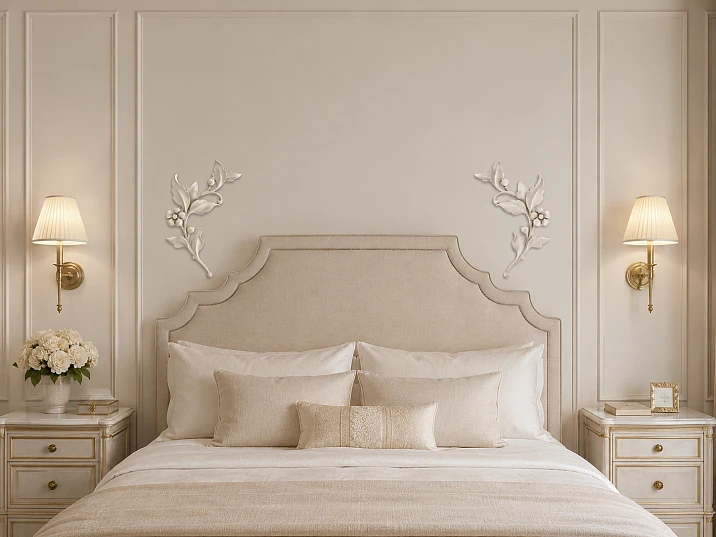
If the bed is already in place, the headboard determines the center of the wall, and two sconces are mounted symmetrically on the sides, adding stucco decor should be done much more carefully than on an empty wall. There are already three strong elements here: the headboard itself and two lights. The floral overlays should complement this composition, not create two additional independent focal points.
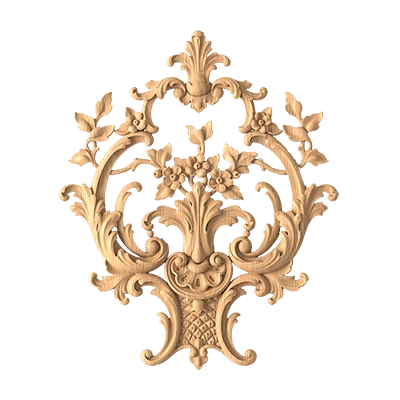
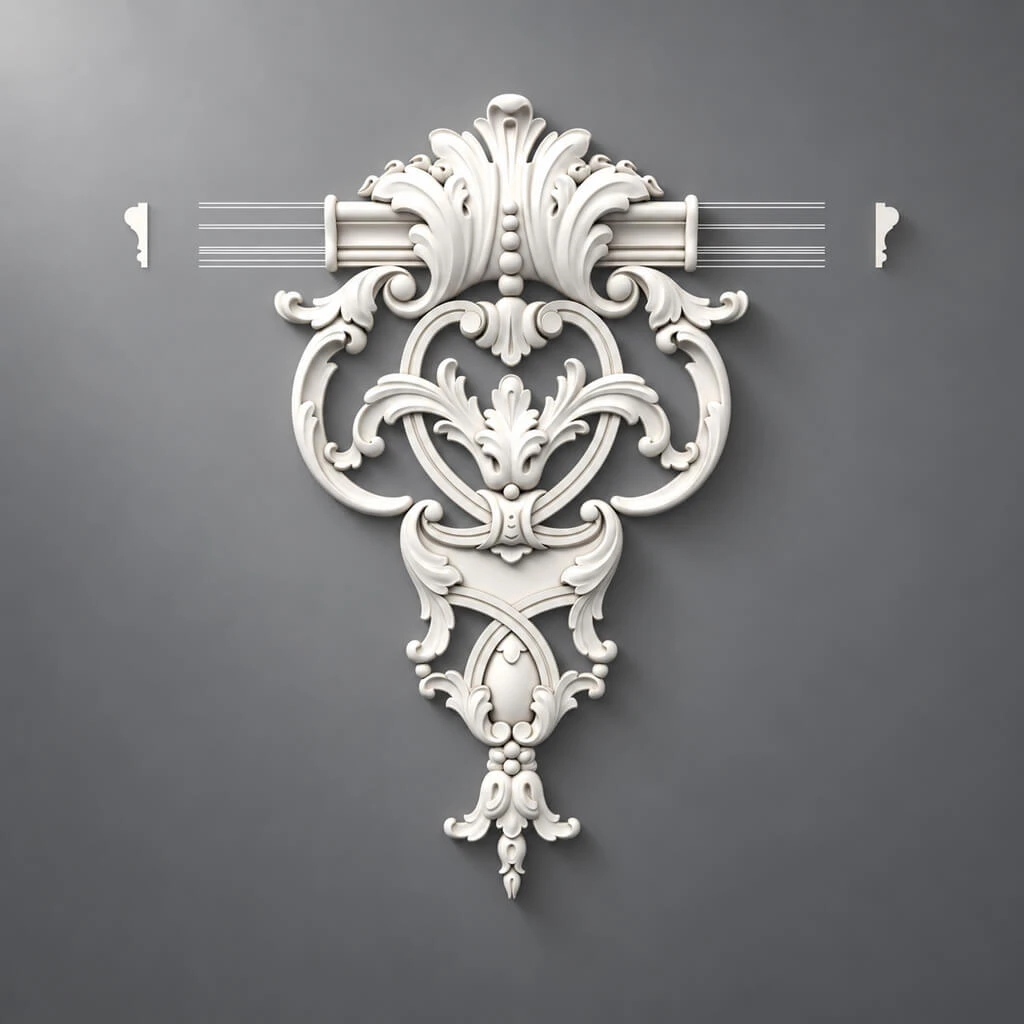
For such a task, you can use a mirror pair of decorative polyurethane overlays: left NPU-471L и right NPU-471R. The size of each piece is 135 × 85 × 8 mm. The price at the time of checking is 980 ₽ per trim, so a mirror pair costs 1,960 ₽ excluding glue, surface preparation, and finishing.
For selection, the number 135 mm is especially important here. That is 13.5 cm of actual wall space. If there is 190 mm free between the edge of the headboard and the sconce, the overlay theoretically fits: after placing a 135 mm long piece, 55 mm will remain. But these 55 mm still need to be distributed between the headboard and the lamp. If the free strip is only 145 mm, after subtracting 135 mm, only 10 mm remains. Formally, the piece fits, but the composition becomes so tight that buying the pair without a trial fitting is risky.
Therefore, the decision should be made not based on a product photo or the overall width of the bedroom. What is needed is an actual measurement of the area between the specific headboard and the specific sconce, and then a 135 × 85 mm template at 1:1 scale.
What are NPU-471L and NPU-471R
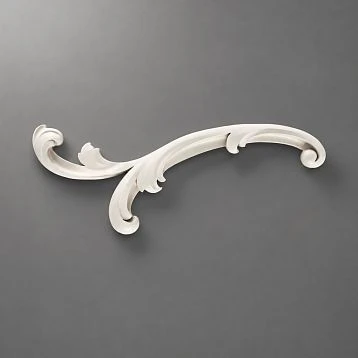
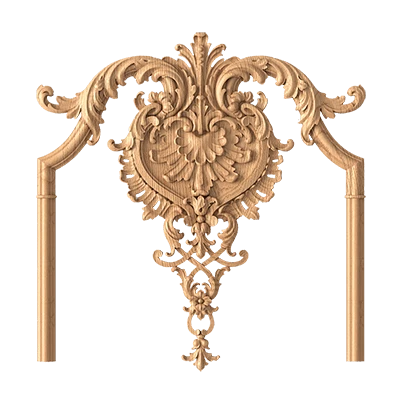
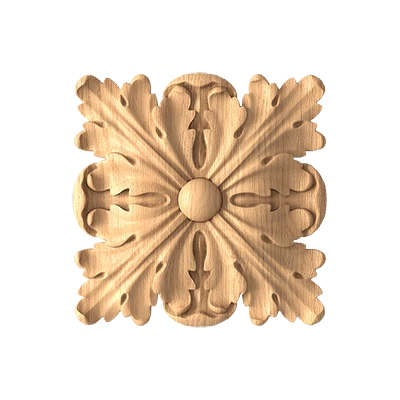
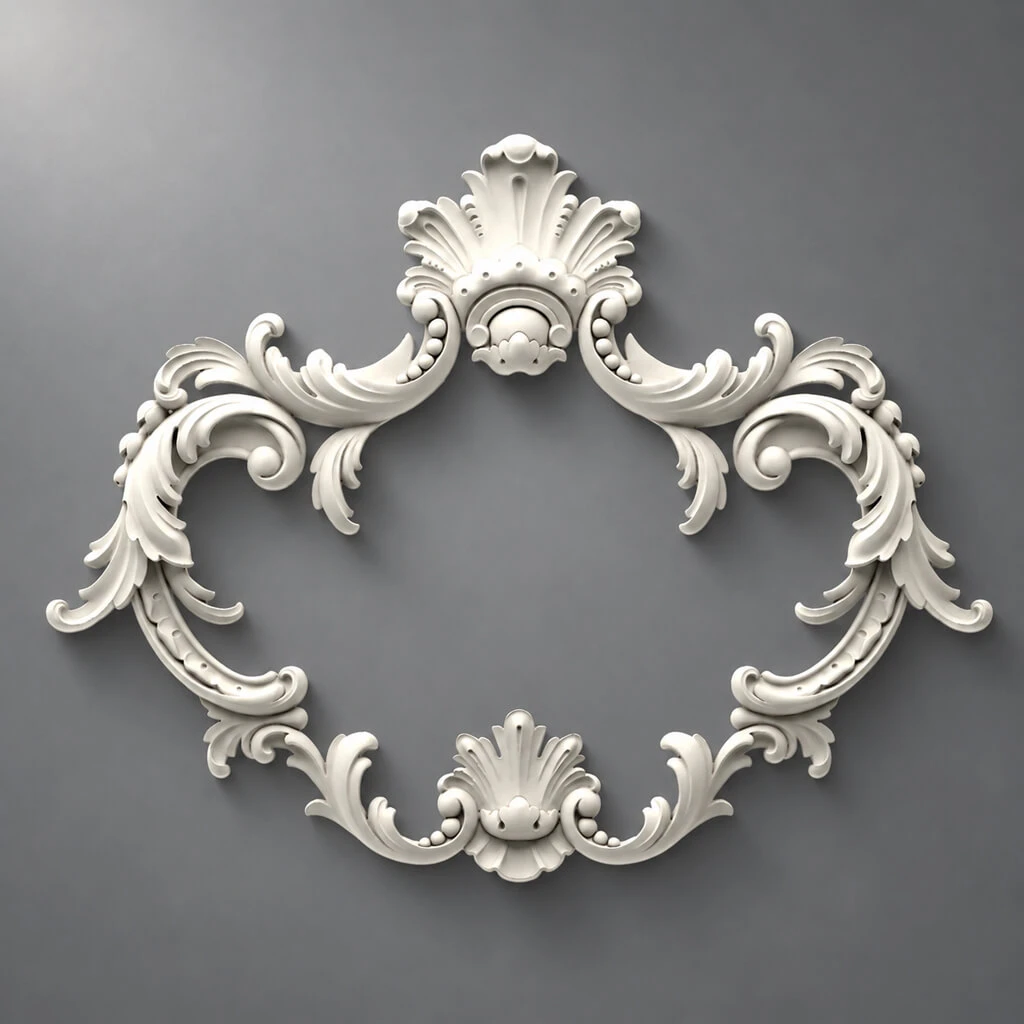
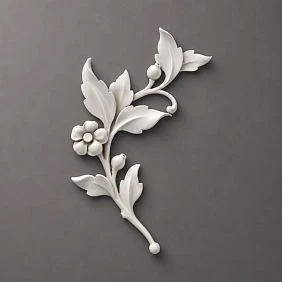
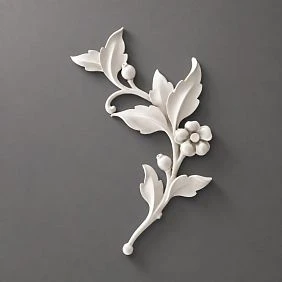
NPU-471L and NPU-471R are two separate decorative polyurethane overlays with a mirror-organized floral ornament.
This is fundamental for ordering. The designation NPU-471L/R should not be perceived as a single article with a single product card.
The left piece has its own product card:
buy the left decorative overlay NPU-471L
On the right:
buy the right decorative overlay NPU-471R
The characteristics of the pair are identical in dimensions:
| Parameter | NPU-471L | NPU-471R |
|---|---|---|
| Type | Decorative overlay | Decorative overlay |
| Material | Polyurethane | Polyurethane |
| Size | 135 × 85 × 8 mm | 135 × 85 × 8 mm |
| Price at time of check | 980 ₽ | 980 ₽ |
| Cost of mirror pair | 1 960 ₽ |
NPU-471L is described by the manufacturer as polyurethane decor with detailed leaves and petals; the surface is suitable for painting and patinating. In the current catalog, both models have a price of 980 ₽ and the same size of 135 × 85 × 8 mm.
In the context of the wall at the bed, this means that you need to choose a composition of two mirror elements at once if the space on both sides of the headboard is the same.
But the word "paired" does not mean that NPU-471L and NPU-471R must be used together in absolutely any situation. If on one side of the bed there is a window, a tall wardrobe, or the wall ends, and the decorative field exists only on the other side, a single overlay can be a meaningful solution. It's just that this will already be an asymmetric composition that needs to be evaluated separately.

First, decide whether the wall really needs another decorative layer
The headboard and sconces already create the wall structure.
Suppose the bed has a high soft backrest, the sconces have large lampshades, and there are molding frames behind the headboard. In such an interior, adding two more floral overlays can make the central part of the bedroom too saturated.
In another room, the headboard is simple and smooth, the sconces are small, and between them there are two large empty strips of painted wall. There, NPU-471L/R can just tie the furniture and lighting into one decorative composition.
Before purchasing, it is useful to ask not the question "do the overlays fit," but two questions:
is there really a visually empty field;
is it necessary to fill it with carved decor, or is an empty wall useful for the composition.
These are different things.
Physically free 200 mm of wall does not yet mean that something must be glued there.
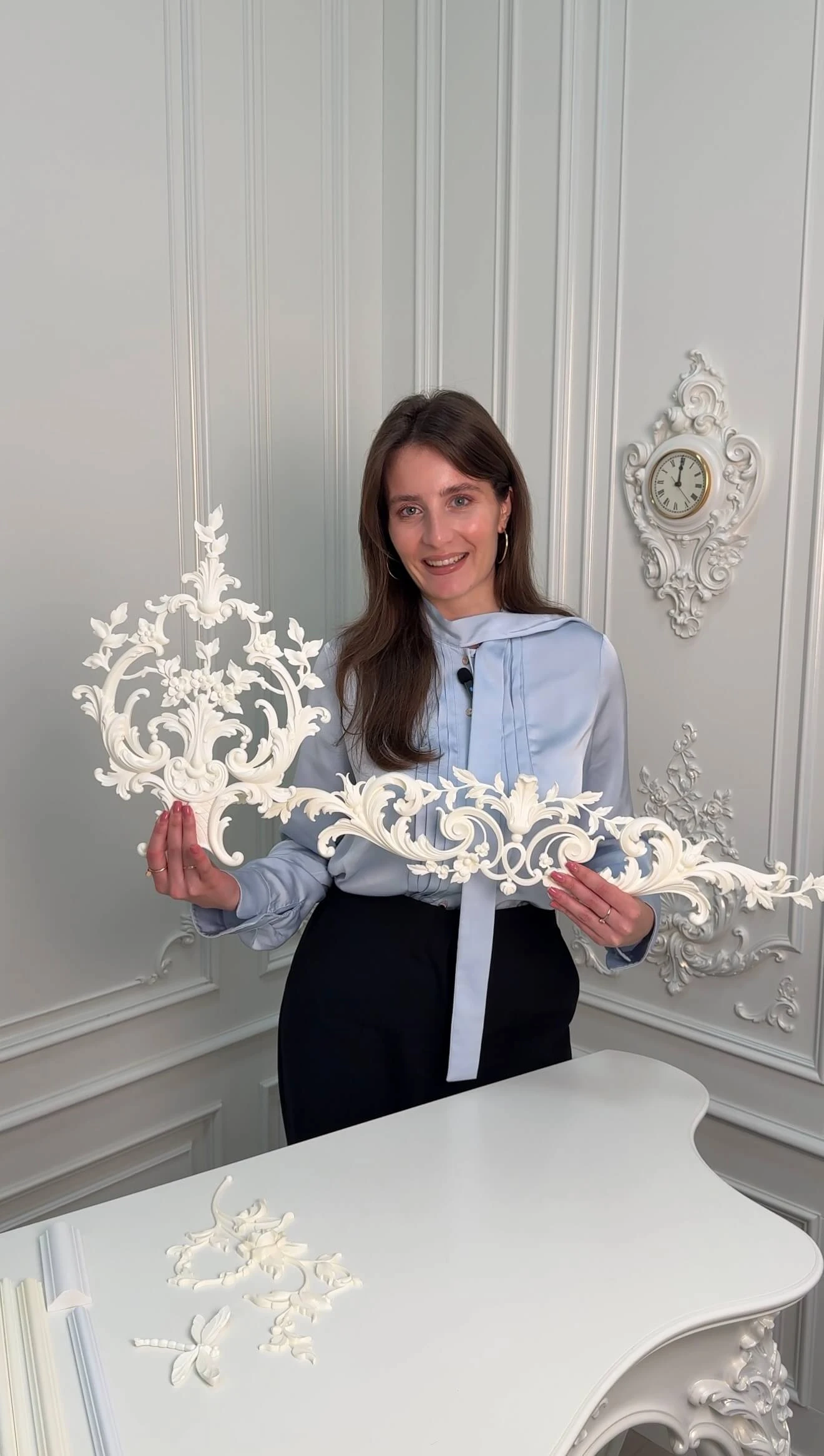
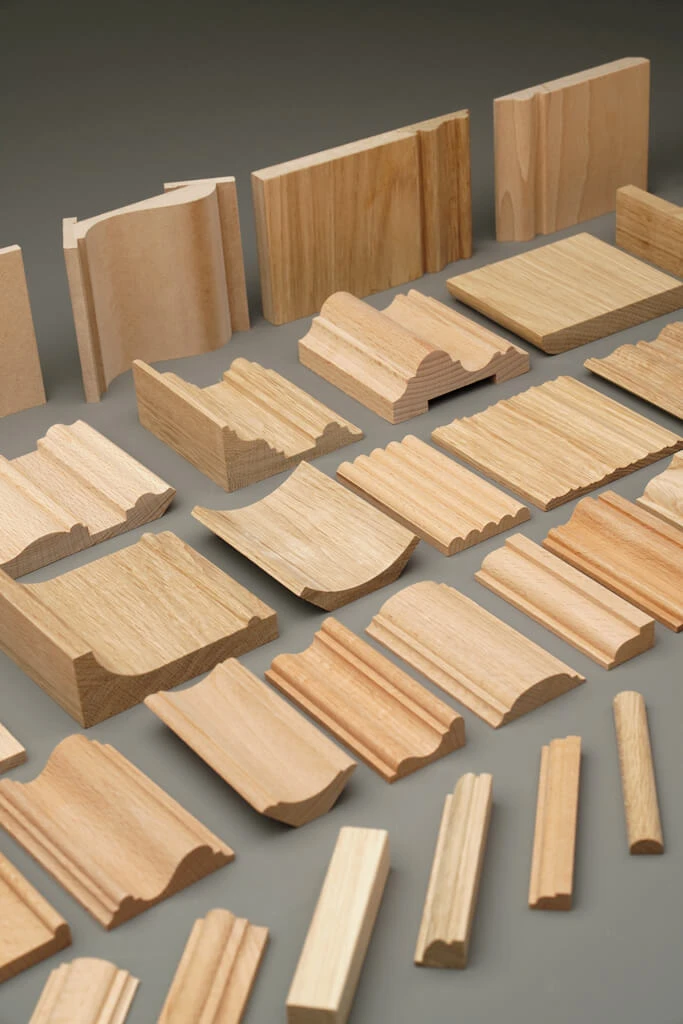
Our factory also produces:

How to correctly measure the free space between the headboard and the sconces
The most common mistake is to measure the distance from the center of the sconce to the edge of the headboard.
This is not enough for placing NPU-471L/R.
A real free strip of wall is needed.
The measurement is taken between the two nearest visual or physical boundaries:
the edge of the headboard and the nearest part of the sconce body.
If the sconce has a wide shade that extends beyond the mounting cup, you cannot rely solely on the cup. From the frontal viewpoint, the composition is limited by the visible body of the sconce.
Let's imagine:
From the edge of the headboard to the nearest edge of the sconce — 210 mm.
The overlay in the chosen orientation occupies 135 mm along this direction.
Free remainder:
210 − 135 = 75 mm.
These 75 mm can be distributed between the two gaps.
With symmetrical installation:
75 / 2 = 37.5 mm.
That is, between the overlay and the headboard there will be approximately 37.5 mm, and the same amount will remain to the sconce.
This is already a specific layout that can be drawn with painter's tape.
But 37.5 mm is not a universal standard. For one light fixture, such a visual gap may look normal, for another — too tight. You need to consider the size of the shade, its shape, the placement of light, and the manufacturer's requirements for access and maintenance.
Get Consultation
Formula for a quick preliminary check
If the NPU-471 is placed with its long side along the free space, use:
free space − 135 mm = remainder
If you want to place the plate roughly in the center of the free area:
remainder / 2 = approximate gap on each side
Examples:
| Free field | After installation, 135 mm remains | When dividing equally |
|---|---|---|
| 250 мм | 115 мм | 57.5 mm |
| 220 мм | 85 мм | 42.5 mm |
| 200 мм | 65 мм | 32.5 mm |
| 190 мм | 55 мм | 27.5 mm |
| 180 мм | 45 мм | 22.5 mm |
| 160 мм | 25 мм | 12.5 mm |
| 145 мм | 10 мм | 5 мм |
The last two lines particularly well show the difference between the concepts of "fits" and "looks good."
With 145 mm of space, a 135 mm overlay physically fits. But in fact, it takes up almost the entire field.
Therefore, buying decor based only on the criterion "135 is less than 145" is not worth it.
What changes if you rotate the overlay
The overall rectangle of NPU-471L/R is 135 × 85 mm.
If the chosen composition allows a different orientation, the horizontal occupied width may be determined by the 85 mm dimension, with 135 mm going vertically.
For example, 160 mm remains between the headboard and the sconce.
In the position where the 135 mm dimension works along this gap:
160 − 135 = 25 mm.
There is very little space left.
If the actual pattern and the design allow a position where 85 mm fits along the free strip:
160 − 85 = 75 mm.
This results in a completely different scale.
But rotating an element just to make it fit is wrong. First, you need to assess the direction of the plant pattern and the connection between the left and right pieces.
Symmetry is especially noticeable in a bedroom. If the left overlay is turned one way and the right one accidentally another, the pair ceases to be perceived as a pair.
Why it's better to lay out L and R at the same time
If you first attach the NPU-471L on the left, and then mark the NPU-471R on the right a few days later, it's easy to get small differences in height, distance from the headboard, or alignment with the sconces.
On an empty wall, 10 mm is sometimes almost unnoticeable.
On both sides of the bed, the brain constantly compares the two parts of the composition relative to the central axis of the headboard. Therefore, an error is detected faster.
It's better to first mark:
center of the bed;
the top line of the headboard;
the centers of both sconces;
the position of the left overlay;
the position of the right overlay.
And only after that proceed to the final fixation.
With identical lamps and a symmetrical bed position, the pair NPU-471L/R should usually be perceived as mirror images.
How to make a template 135 × 85 mm before purchasing
No product is needed for a preliminary fitting.
Take thick paper or thin cardboard and cut out two rectangles:
135 × 85 mm.
Why two, not one?
Because the main goal of this article is to evaluate the pair relative to two sconces. One paper rectangle will show whether the product fits physically, but it will not show what will happen to the entire wall after two accents of the same scale appear.
Secure the templates with painter's tape.
Do not examine the wall only from a distance of 30–50 cm. Step back to where the bed is usually visible when entering the room.
Then take a photo.
After that, remove the templates and take a second shot from the same point.
Comparing two photos answers the main question better than examining an enlarged product image: has the wall with decor become more cohesive or just more saturated?
The paper rectangle does not show the floral pattern.
A simple template has a limitation.
It shows the area but does not show the openwork and direction of the actual overlay.
NPU-471L/R are not solid rectangular plaques. The actual botanical shape is visually lighter than its overall rectangle.
Therefore, a 135 × 85 mm template is useful for checking the maximum occupied space, but it may seem heavier than the actual decor.
You can improve the fitting.
Print an image of the product at approximately 1:1 scale, if possible to check the print size, and cut it out along the approximate outline. For a preliminary decision, this is often enough.
The main thing is not to scale the image automatically to fit the entire sheet. The control size should remain 135 × 85 mm.
Where to place the overlays relative to the sconces
There are several fundamentally different schemes.
First: the overlay is located between the headboard and the sconce.
Then the sconce remains an external element of the composition, and the floral branch connects the lamp to the bed.
Second: the sconce is positioned closer to the headboard, and the overlay is placed on the outer side of the lamp.
Then the decorative composition visually extends beyond the bed.
Third: the overlays are located above the sconces and form an independent upper level.
These schemes cannot be considered interchangeable. They change the width and height of the entire composition in different ways.
For the scenario where narrow empty wall sections remain on the sides of the headboard, placement between the headboard and the sconces is usually checked first. This is the most direct way to fill a specific free area without expanding the composition further to the sides.
Why you shouldn't place the overlay flush against the sconce
A wall light has not only a visible decorative function.
It may need to be removed for maintenance, component replacement, mounting repair, or work on the electrical part. The specific design depends on the model.
Therefore, the decorative cover must not be positioned so that it overlaps the mounting cup, fastening elements, or obstructs the access to the lamp intended by the manufacturer.
There is no universal mandatory gap in millimeters for any sconce model here.
That's why the formula "leave 20 mm and everything is correct" would be bad advice.
You need to look at the instructions for the specific lamp and its actual design.
If the trim comes almost flush with the housing, it's better to do an additional check before gluing.
How to account for the sconce's light pattern
There is another reason not to bring plant decor close to the light fixture without a test fit: the shadow.
The NPU-471L/R relief has a depth of up to 8 mm. With side or directional light, the leaves and flower create their own chiaroscuro.
This can be an advantage. A solid-color overlay painted together with the wall becomes noticeable precisely in the evening when the sconce is turned on.
But another effect is also possible. If the lamp produces a very directional beam upward, downward, or to the sides, the shadow from the decor can turn out stronger than expected.
Therefore, it is useful to check the final position not only during the day.
Temporarily attach a template or a test piece, turn on both sconces, and look at the wall in the usual evening mode.
Depth of 8 mm: is it a lot or a little near a sconce
Eight millimeters is less than a centimeter.
Therefore, compared to most bulky wall lamps, the NPU-471L/R remain a fairly shallow decor. But the relative scale depends on the wall.
If the sconce has a very thin flat base and a minimalist body, the floral relief can visually seem active.
If the lamp is large, with a pronounced shade or decorative hardware, an overlay 8 mm deep, on the contrary, will be perceived more calmly.
Here, the absolute figure of 8 mm is less important than the relationship of three objects:
headboard → overlay → sconce.
The most voluminous part doesn't have to be the most decorative, but neighboring elements should look connected.
Where should the pair be located relative to the top edge of the headboard
It is not necessary to place the NPU-471L/R strictly at the center of the sconce's height.
There are three useful lines from which you can build the layout:
top of the headboard;
the center of the sconce;
visible central part of the floral decor.
If the headboard is tall and the sconces are placed slightly above it, the plates can be checked in the gap between these levels.
If the sconces are approximately at the level of the upper third of the headboard, placing the NPU-471L/R too high can detach the decor from the furniture.
The most practical way is not to look for a universal height from the floor, but to build the composition based on existing objects.
The height of the bed, mattress, and headboard varies between different models. Therefore, a rule like "the plate should be at a height of 1400 mm" is meaningless for this task.
Why the distance to the center of the bed matters more than the distance to the corner of the room
The wall at the headboard is perceived relative to the bed.
If the bed is not positioned at the geometric center of the entire wall, but the sconces are installed symmetrically relative to the headboard, decorative overlays should also be tied to this central axis first.
Otherwise, a strange situation may arise:
the bed and sconces form one symmetry, while the stucco tries to align with the architecture of the entire wall.
This is especially noticeable in a bedroom, since the headboard is usually the main object of the composition.
The exception is a complex architectural layout with panels or moldings, where the bed is deliberately integrated into a larger system.
NPU-471L on the left, NPU-471R on the right: basic layout
For a regular symmetrical wall, it is logical to consider the initial layout as:
NPU-471L — to the left of the bed center;
NPU-471R — to the right.
This allows the products to be perceived as a mirror pair.
But before installation, it is still worth comparing their actual images or the parts themselves in the chosen orientation. In a plant ornament, the direction of branches can significantly affect the impression.
In one composition, you want the movement of the ornament to be directed toward the center of the bed.
In another, you want the branches to visually open outward.
The L/R article numbers provide mirror shapes, but the artistic direction is chosen by the entire layout.
Therefore, first lay out both elements simultaneously, and then fix them.
Is it necessary to always direct the branches toward the headboard?
There is no universal rule.
If the ornament is directed inward, the two overlays can visually gather the composition toward the center of the bed.
If the movement is turned outward, the central zone becomes freer, and the decor works as a transition from the headboard to the sconces.
Which option is better depends on the shape of the headboard itself.
For a soft backrest with a pronounced central axis, inward orientation can enhance symmetry.
For a wide, massive headboard, it is sometimes more useful not to add another gesture toward the center, but to let the decor open outward.
Here, a photo of the entire wall is especially helpful, rather than analyzing one overlay separately.
When 135 mm is a suitable size
The size 135 × 85 mm is especially interesting for areas where a full large stucco composition would be excessive.
For example, 230 mm remains between the headboard and the sconce.
When oriented with a length of 135 mm along the free section:
230 − 135 = 95 mm.
If the remainder is distributed evenly:
95 / 2 = 47.5 mm.
This results in enough free space so that the element does not visually touch either the furniture or the light fixture.
Another example — 200 mm:
200 − 135 = 65 mm;
32.5 mm on each side with conditional central placement.
Here the composition is already denser, but it still allows evaluating several positions.
At 170 mm:
170 − 135 = 35 mm;
17.5 mm on each side.
This layout definitely needs to be seen on the wall. The overlay takes up a significant portion of the space.
When the overlay formally fits, but you shouldn't buy it
Suppose the free space is 142 mm.
The size of the overlay along the required axis is 135 mm.
Only remains:
142 − 135 = 7 mm.
Math answers: the product fits.
But in essence, it will take up almost the entire gap.
Moreover, the actual shape of the bra can expand toward the overlay above or below the measurement point. This will create a visual conflict that wasn't visible from a single horizontal tape measure line.
In such a situation, it's better to consider:
a different orientation;
smaller decor;
placement in a different location;
complete rejection of additional stucco molding.
Expert choice sometimes lies precisely in not buying a product that fits the catalog size.
When NPU-471L/R may turn out to be too small
The opposite problem arises on a large wall.
Let's imagine a wide headboard, with 500 mm of free space left from it to each sconce.
A plate 135 mm long will occupy only a small part of this area.
This does not mean that it will necessarily get lost. The floral relief can work as a delicate accent.
But if the task is to noticeably fill a large empty wall, one small pair may not achieve the expected result.
Before buying, you need to understand what you want:
a small decorative detail;
or a full-fledged stucco composition.
In the second case, it is more logical to look at a wider Wall Decor, rather than automatically placing two or three NPU-471 on each side.
One overlay on each side or two
Standard symmetrical layout:
1 × NPU-471L + 1 × NPU-471R.
It creates two accents.
If you add two overlays on each side, you get four points of floral ornament. This is not "a little more of the same." The rhythm of the wall changes fundamentally.
Four overlays can work if:
the free fields are very large;
the composition is built on several levels;
The decor is integrated into large molding panels.
But if two NPU-471 seem too small, first you need to check a larger element, rather than automatically doubling the quantity.
How to tell if the wall is overloaded
There is a simple way to assess decorative saturation.
Count the existing independent focal points in the headboard area.
For example:
a tall shaped headboard;
two decorative sconces;
two paintings;
molding frame;
a contrasting wall;
two floral appliqués.
If each object has a pronounced shape, texture, or color, the problem may not be in the incorrect positioning of the NPU-471L/R. There may simply be too many of them in this composition.
Conversely, on a solid-color wall with a simple rectangular headboard and minimalist sconces, two small floral details can provide the right level of relief.
It is more useful to assess the number of decorative events than to follow the abstract rule that a classic interior loves a lot of molding.
Photo verification method
This method is especially useful in the bedroom.
Install paper templates.
Place a regular bedspread and pillows on the bed that will be used after the renovation.
Turn on the sconces.
Take a photo from the entrance to the room.
Then take a second shot without the templates.
Sometimes a large headboard, which during measurements was perceived simply as a rectangle, turns out to be so active in fabric, quilting, or shape in the photo that additional floral elements are no longer needed.
And conversely: from a distance, empty strips near sconces can look much more noticeable than during installation.
If the sconces are asymmetrical relative to the bed
Real bedrooms are not always perfect.
On one side there may be a door, outlet, switch, window, or a limitation on electrical wiring. As a result, the lights are not installed absolutely mirror-symmetrically.
In such a situation, you cannot automatically attach the NPU-471L/R at an equal distance from the edges of the sconce and consider the task solved.
You need to choose which symmetry to preserve.
Options:
Orient the decor relative to the headboard;
orient each overlay relative to its own sconce;
abandon the paired scheme.
If the deviation of the lights is noticeable, the ideal mirror symmetry of the molding sometimes only emphasizes the problem.
Then the absence of overlays may look calmer.
If the headboard itself is asymmetrical
Such models are rarer, but they completely change the logic.
For example, the headboard continues to one side with a soft wall panel or connects to a bedside table.
Then using L and R as a strict mirror pair does not have to be the best solution.
One decorative overlay can be considered in a free field if it supports the asymmetric architecture of the furniture.
But this scheme should look deliberate. The random absence of the second detail is perceived differently than a composition initially built on asymmetry.
What to do if one sconce is located closer to the headboard
For example:
left free 230 mm;
on the right — 175 mm.
Identical overlays of 135 mm physically fit in both fields.
on the left remains:
230 − 135 = 95 mm.
on the right:
175 − 135 = 40 mm.
If you center each overlay in its own field, there will be approximately 47.5 mm on the left around it and 20 mm on the right.
The wall will become asymmetric not only in terms of sconces, but also in the amount of free space around the decor.
Before ordering, you need to decide whether this effect is acceptable.
Sometimes it's easier to slightly change the position of one overlay.
Sometimes it's better to skip a pair.
Overlays without moldings: when that's enough
NPU-471L/R do not require a mandatory molding frame just to exist on the wall as a decorative accent.
If the task is specifically to fill small fields between the sconces and the headboard, additional rectangles of moldings can make the wall much heavier.
Scheme:
headboard → NPU-471L/R → sconces
can be complete on its own.
Especially if all the stucco is painted in the color of the wall.
In this case, the relief is noticeable primarily under side lighting, while the composition itself remains calm.
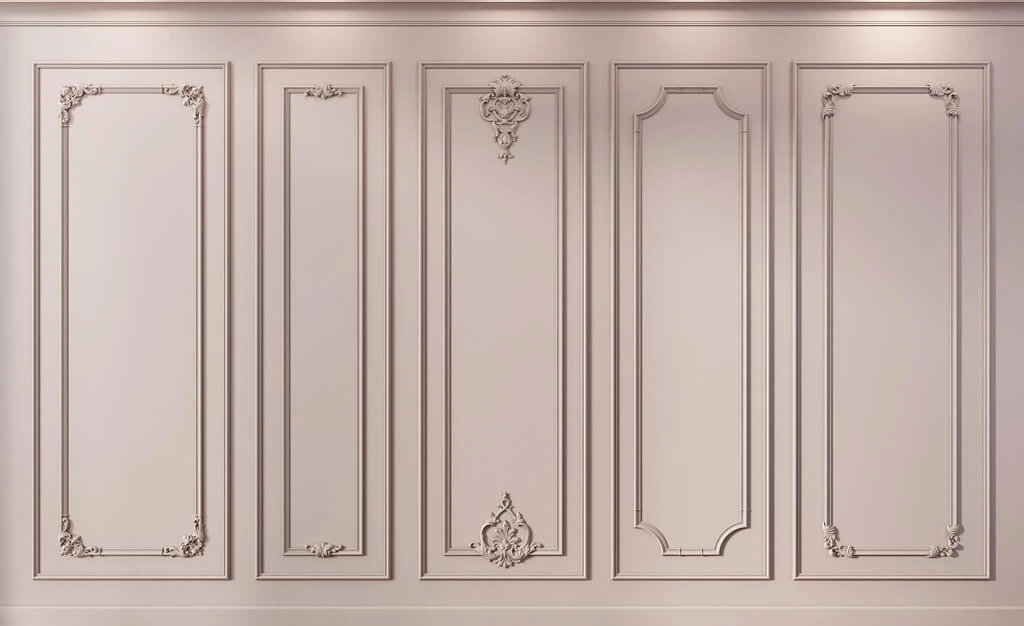
When adding a molding frame still makes sense
If the wall is very tall or the headboard occupies only its lower part, small NPU-471L/R may seem detached from the architecture.
Then the molding can unite the sconces, floral decor, and headboard into one large field.
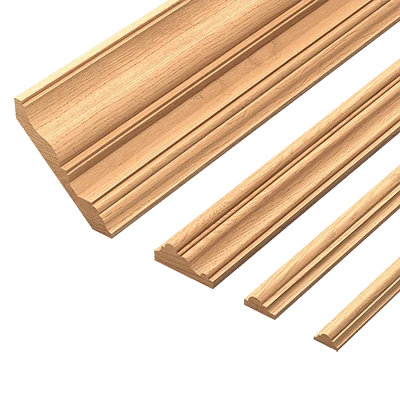
If such a system is only being designed, profiles can be selected in the section buy polyurethane moldings.
But if there are no moldings on the wall currently, don't add them solely to "fit in" two panels somewhere.
First, check a simple scheme without a frame.
NPU-471L/R inside an existing molding panel
This is another good scenario.
Suppose three rectangular fields are made behind the headboard:
wide central;
narrow left;
a narrow right one.
The sconces are located inside the side panels.
NPU-471L/R can also be placed inside these fields, but then the free space needs to be measured not only relative to the headboard and the sconce.
Another boundary appears — the molding.
The overlay should not look squeezed between the sconce and the frame.
Therefore, the actual working space is determined by the narrowest section between all adjacent elements.
How to measure the field inside the molding
Suppose:
from the inner edge of the molding to the edge of the sconce — 210 mm.
The NPU-471 takes up 135 mm.
remains:
210 − 135 = 75 mm.
With a conditionally central position within this interval — 37.5 mm on each side.
But if on the other side of the overlay there is also the edge of the headboard, you need to calculate not just one segment, but the actual space between all objects.
For a complex wall, it is useful to draw a simple plan in millimeters.
Not a design project. A simple rectangle of the panel with four dimensions often prevents mistakes better than a long description.
Painting to match the wall
For a wall with a sconce, this is one of the safest ways to add plant decor.
When NPU-471L/R are painted the same color as the wall, they do not create new color spots.
The decor becomes noticeable through the relief.
During the day, in diffused lighting, it may look quite calm.
In the evening, light from the sconce enhances shadows in the leaf and flower pattern.
As a result, the same composition looks more restrained during the day and more expressive after turning on the lighting.
For a bedroom, this is often more useful than a harsh color contrast.
Contrast painting: why it is easier to overload a wall with it
Let's imagine a dark green wall, a light headboard, and brass sconces.
If the NPU-471L/R is also made golden or white, two more contrasting objects will appear near the bed.
The size of each plate is only 135 × 85 mm, but the contrast significantly increases its visual weight.
Therefore, checking the size with a paper white template on a dark wall also needs to be done carefully: such a template may seem more active than the actual plate if the latter is painted tone-on-tone.
Conversely, if a light contrasting decor is planned, a simple outline of 135 × 85 mm is even useful—it shows approximately the maximum visibility.
Patination and light from sconces
The surface of the NPU-471L is suitable for painting and patination. For a plant relief, patina can additionally highlight leaves, recesses, and the floral pattern.
But near sconces, such an effect needs to be dosed.
The lighting itself already creates shadows.
If, on top of this, the recesses are strongly emphasized with the finish, the small plate becomes significantly more active.
Therefore, for a wall where light fixtures are an important part of the design, it is useful to first test a plain, single-color paint.
Patination makes sense to add if the interior truly requires a more pronounced classical decor.
Why it's better to choose the color of overlays together with the sconce
The combination of "white stucco + gold sconce" is far from the only option.
You can paint the overlays:
in the color of the wall;
in the color of the moldings;
in a shade close to the headboard;
contrastingly.
But it is not necessary to literally repeat the metal of the light fixture.
If the sconces have golden fittings, and each NPU-471 leaf also becomes bright gold, two small decorative fields may start competing with the lamps themselves.
The more active the sconces, the calmer the molding can be.
Are decorative rosettes needed next to NPU-471L/R
If NPU-471L/R are already placed on the sides of the headboard, adding carved rosettes requires a separate base.
A rosette can work in the center above the bed, but then a third molding accent appears.
In a large classical composition, this may be appropriate.
In an ordinary bedroom, it is often better to first finish the wall with one pair of overlays and see the result.
If a central element is still needed, options are collected in the section buy carved polyurethane rosettes.
Buying a socket just so that the "composition is complete" is not required.
Mistake: buy first, measure later
The price of one NPU-471 is 980 ₽.
An error with one pair is 1,960 ₽ of the cost of the pads themselves.
If decor is bought for several rooms, the total quickly adds up.
Checking with a paper template takes a few minutes and allows you to see a scale problem in advance.
For a product article, this is the main practical conclusion: first measure, then order.
Mistake: measuring only one side of the bed
Even if the bedroom looks symmetrical, you need to measure both sides.
For example:
left 205 mm;
right 188 mm.
The difference is only 17 mm, but after installing the parts:
left will have 70 mm of free space;
on the right — 53 mm.
If you distribute it evenly, you get 35 mm on the left and 26.5 mm on the right.
This may already be noticeable in a photo of the wall.
Therefore, measuring one side and then multiplying the result by two is a bad habit.
Mistake: taking the distance to the center of the sconce
Suppose from the edge of the headboard to the center of the sconce is 260 mm.
The buyer concludes: 135 mm fits with a huge margin.
But the lampshade itself is 150 mm wide and protrudes 75 mm from the center toward the headboard.
Real free space:
260 − 75 = 185 mm.
Now that's a completely different result.
You need to measure up to the nearest visible or physical boundary of the lamp in the area where the plate is placed.
Error: forgetting about the second trim when calculating the price
NPU-471L and NPU-471R are two separate SKUs.
If a symmetrical pair is needed, the order must include:
1 × NPU-471L
и
1 × NPU-471R.
Cost:
980 + 980 = 1 960 ₽.
This is simple arithmetic, but in the catalog the buyer works with two product cards, so when placing an order it's better to check both items separately.
Error: installing two identical sides
For a mirror composition, buying two panels of the same size is not enough.
NPU-471L and NPU-471R have mirror orientation.
Two left or two right pieces will create a different movement in the plant pattern.
If the project is deliberately asymmetrical, this can be an artistic decision.
For a regular symmetrical wall at the bed, the initial set is L + R.
Error: relying on photo dimensions
On the product page, a small overlay takes up a significant part of the image, otherwise it's impossible to show the relief.
On the wall, 135 mm is 13.5 cm.
It's useful to simply hold a tape measure against the wall and look at that length.
85 mm is 8.5 cm.
Depth is 8 mm.
After such a conversion of millimeters to real scale, it becomes much easier to understand what decor is being discussed.
Mistake: attaching decor before the final position of the bed
If the bed can still be moved by 40–50 mm, marking relative to the temporary position of the headboard is unreliable.
This especially applies to freestanding beds, which may end up in a slightly different place after cleaning or baseboard installation.
Before installing NPU-471L/R, it is better to fix the final position of the bed and check its central axis relative to the wall sconces.
Otherwise, it turns out that the decor is symmetrical to the wall, but the bed is no longer.
Mistake: assuming that identical sconces are automatically at the same height
Before marking the molding, check the height of the two lights with a level or laser.
If one sconce is installed a few millimeters higher, attaching each overlay to its own sconce may repeat this error.
After this, the four objects — two sconces and two overlays — form a noticeably uneven rhythm.
Sometimes it is more reasonable to first determine a single horizontal line for NPU-471L/R relative to the headboard.
Can the overlays be placed above the sconces
You can check this option if there is too little space between the headboard and the sconces, and a large empty field remains above the lights.
But the composition changes.
Instead of a horizontal connection:
overlay → sconce → bed
a vertical one appears:
sconce → overlay.
For a tall room, this can be interesting.
For a bedroom with a low ceiling, upper decor sometimes makes the wall look even more saturated.
Therefore, this option should be considered as a separate scheme, not as a fallback way to "squeeze in" already purchased items.
Can overlays be placed under sconces?
Technically, such placement is also possible if the free space exists exactly there.
But you need to consider bedside tables, switches, and items that will be placed on the furniture.
If the floral backplate ends up almost at the level of the table lamp shade, a tall vase, or decor on the nightstand, another layer of overlaps arises.
In a bedroom, the lower part of the wall is usually more occupied than the upper part.
Therefore, under the sconce, it is especially useful to evaluate not the empty room after renovation, but the real usage scenario.
What to do if there is a switch nearby
The sconce switch is often located directly near the bed.
It is a functional object and must remain accessible.
If the free space of 200 mm on the plan looks suitable, but there is a switch inside it, those 200 mm cannot be considered a continuous zone for decor.
Need to measure the sections separately:
from the headboard to the switch;
from the switch to the sconce;
above and below it.
Sometimes the NPU-471L/R should be raised.
Sometimes a floral overlay becomes redundant in such a narrow field.
Don't build relief around the switch just to maintain symmetry.
If one side is occupied by the switch and the other is free
This is a typical edge case.
On the left, NPU-471L fits perfectly.
The NPU-471R case conflicts with the switch.
There are several solutions:
abandon both overlays;
change the height of the entire pair;
create a deliberately asymmetrical composition;
use a different decor.
The worst option is to install one piece perfectly and squeeze the second one in.
Two bedrooms
If both rooms have the same composition:
2 × NPU-471L;
2 × NPU-471R.
Four items in total.
Cost:
4 × 980 = 3 920 ₽.
But the same bed size does not guarantee the same amount of free wall space.
Before a serial order, each room still needs to be measured.
Six hotel rooms
For a hotel, aparthotel, or guesthouse, serial production is especially useful.
If each of the six rooms uses one mirrored pair:
6 × NPU-471L;
6 × NPU-471R.
Total:
12 overlays.
Cost:
12 × 980 = 11 760 ₽.
Here it is especially useful to first fully furnish one reference room.
After checking distances, color, and evening light, the composition can be transferred to the other rooms provided the layout is identical.
Ten identical rooms
With one pair in the room:
10 × 2 = 20 plates.
Cost:
20 × 980 = 19 600 ₽.
At such a volume, an error in size becomes commercially noticeable.
If after purchasing it turns out that 135 mm is too much for the area near the wall lamp, the problem will repeat in all ten rooms.
Therefore, the scheme "one test room → check → serial order" is more reasonable here than buying twenty pieces from one drawing.
If the rooms are mirrored
In hotels, some rooms may have a mirrored layout.
This does not change the number of NPU-471L/R when using a full pair in each room: you still need one L and one R.
But if some rooms use only one plate due to a wall, window, or cabinet, the number of left and right SKUs needs to be counted separately.
For example:
6 rooms with a full pair;
2 rooms with only the left plate.
Then the order:
NPU-471L: 6 + 2 = 8 pcs.
NPU-471R: 6 pcs.
Total 14 parts.
Cost:
14 × 980 = 13 720 ₽.
Such calculations are better done based on the room plan, rather than automatically ordering an equal number of L and R.
When to buy one NPU-471L or one NPU-471R
A single plate is justified if the composition is initially asymmetrical.
For example:
on one side of the bed there is a window;
on the other — a solid free wall;
a sconce is installed only on one side;
the headboard is connected to a furniture panel;
the decor is used not near the bed, but on a separate section of the wall.
But if two identical sconces are already placed symmetrically, one panel between them almost always requires a convincing reason.
Otherwise, a person perceives the absence of the second element as incompleteness.
How to check the composition before final order
A convenient sequence looks like this.
First, measure both free fields independently.
Then mark rectangles of 135 × 85 mm on the wall.
Check both mirrored positions simultaneously.
Make sure the overlays do not cover the functional parts of the sconce and do not obstruct access to it.
Look at the wall during the day.
Turn on the sconce and evaluate the evening light and shadow.
Photograph the composition from a distance.
Only after this make a decision about the purchase.
This is much more reliable than choosing based on a single beautiful interior image.
Where to buy decorative polyurethane overlays
If the size 135 × 85 × 8 mm is suitable, for the mirrored layout you need to create two separate items.
buy the left decorative overlay NPU-471L.
buy the right decorative overlay NPU-471R.
If this pair does not fit in scale, other Polyurethane decorative appliques can be compared by size and ornament character.
A wider range for wall decoration is collected in the section buy wall decor.
If the project includes different types of stucco decor, you can view the general section You can buy ready-made stucco matching the Baroque style. Calculate the quantity: linear meters of cornices and moldings, number of rosettes, pilasters, consoles, corner elements. Add a ten to fifteen percent allowance for trimming..
What to put in the basket for a typical wall with two sconces
If the composition is symmetrical and one overlay is installed between the headboard and each sconce:
1 × NPU-471L
1 × NPU-471R
Cost of the pair at the time of checking:
1 960 ₽.
Additional overlays do not need to be purchased "in reserve for symmetry."
If the template shows that one pair is enough, four pieces will only increase the decorative density of the wall.
If one overlay seems too small, first compare it with another decor size, rather than automatically ordering two identical ones for each side.
When it is better not to buy the NPU-471L/R pair
You should refuse the purchase or at least continue trying it on if:
the free field is almost equal to 135 mm;
the overlay overlaps or visually touches the sconce body;
the decor obstructs access to the lamp;
the switch is located in the same zone;
the headboard itself has an active carved or quilted pattern;
the wall is already filled with moldings, paintings, and other decor;
the fields on the left and right are completely different in size;
paper templates make the wall heavier.
These are not product defects.
It's just that a specific wall may not need another decorative layer.
When a pair is especially appropriate
NPU-471L/R makes sense to consider if there are noticeable but not huge empty fields on both sides of the headboard; the sconces themselves do not completely fill them; a small plant motif is needed; a mirror composition is required; a large overlay would be too heavy.
The size of 135 × 85 × 8 mm allows you to check everything in advance without a complex project.
If two paper templates of this size look natural on the wall, most of the scale question is already resolved.
Quick decision tree before purchasing
Are there two identical sconces?
Yes.
Do the bed and sconces form a symmetrical composition?
Yes.
Is there a free space between the headboard and each sconce?
Yes.
Measure each one separately.
Is there clearly more than 135 mm free along the required axis?
Yes.
Make two templates of 135 × 85 mm.
After fitting, is there visually sufficient space around the decor?
Yes.
Turn on the sconces.
Don't shadows and light make the wall too saturated?
No.
Then the base order:
1 × NPU-471L + 1 × NPU-471R.
If at any stage the answer is negative, don't try to keep that particular pair at all costs. You can change the placement, orientation, choose a different size, or leave the wall without additional molding.
Practical example: 190 mm free
From the edge of the headboard to the sconce — 190 mm.
NPU-471 occupies 135 mm along the selected axis.
190 − 135 = 55 mm.
When centered in the field:
55 / 2 = 27.5 mm.
That gives roughly 27.5 mm of air on each side.
Now you need to check not the arithmetic, but the actual composition.
If the sconce is small and the backplate is painted to match the wall color, the layout can look quite airy.
If the light fixture is large and the decor is contrasting, these 27.5 mm may be perceived as too small a gap.
Therefore, the formula result is a basis for a trial fit, not an automatic approval for installation.
Practical example: 145 mm free
145 − 135 = 10 mm.
If dividing in half:
5 mm each.
This calculation clearly shows a situation where the product mathematically fits, but spatially almost certainly requires a different solution.
Instead of buying a pair, you can check rotating the item, a different type of decor, or leave the field empty.
Practical example: 240 mm on the left, 195 mm on the right
Left:
240 − 135 = 105 mm.
52.5 mm each when centered.
on the right:
195 − 135 = 60 mm.
30 mm each.
Both items fit, but the surroundings will be different.
If the headboard and sconces are visually symmetrical, it is desirable to compensate for this difference by positioning the overlays themselves or first understand the reason for the different field sizes.
Practical example: sconce already inside molding frames
Suppose each sconce is in a narrow rectangular panel.
From the headboard to the inner line of the molding — 310 mm.
The sconce takes up part of this width.
After installing the light fixture, 205 mm of free space remains.
For NPU-471:
205 − 135 = 70 mm.
Here, you need to distribute the space not just between the overlay and the sconce, but among three objects:
the headboard;
the decorative overlay;
the sconce or molding, depending on its position.
It is more convenient to first assemble such a composition entirely with painter's tape.
If the headboard is the full width of the wall
Sometimes a soft panel or wooden headboard extends past the nightstands almost from corner to corner.
Then there may be no free painted area between the headboard and the sconces at all.
There is no need to glue NPU-471L/R over soft upholstery just because the theme suggests decor near the bed.
This is a different scenario with different requirements for the surface and installation.
For the article and the purchase in question, the important case is when the fixtures still have a suitable rigid wall surface.
If the headboard is low
A low backrest leaves a large space above.
Here it may turn out that it is better to place the NPU-471L/R not strictly between the side edges of the headboard and the sconces, but higher, linking them with the upper part of the light composition.
This option requires a separate template.
The advantage of a low headboard is more freedom.
Disadvantage — small details are easier to lose on a large empty surface.
Therefore, 135 × 85 mm must definitely be viewed from a distance.
If the headboard is high
A high headboard already occupies a significant part of the wall.
Sconces often end up directly near its side edges.
In this situation, the NPU-471L/R are suitable only if there is actually free space.
There is no need to try to place a floral branch in a narrow strip of 140–150 mm just to add molding.
At a tall headboard, its own mass already creates a decorative center of the room.
If the sconces are very decorative
Crystal, intricate metal branches, fabric lampshades, and large glass shades can themselves serve as wall decor.
Then the floral molding nearby should be especially calm.
You can use painting in the color of the wall.
You can increase the distance.
You can refuse the NPU-471L/R.
The mistake here is not in the incompatibility of specific styles, but in too many elements of equal visual strength.
If the sconces are minimalist
A simple cylinder, sphere, or small geometric lamp leaves much more space for floral ornament.
In this case, the NPU-471L/R can become a decorative part of the wall, while the sconce retains its functional and graphic character.
The contrast of 'simple geometry of the light fixture + floral stucco' can be more interesting than trying to match two equally complex ornaments.
But the combination still needs to be checked in color.
The main decision before ordering
Don't just ask:
"Do 135 mm fit between the headboard and the sconce?"
The correct sequence of questions is different:
How much free space is actually there?
How does the pair look from both sides at once?
What remains around each panel after subtracting 135 mm?
Does the decor obstruct access to the bra?
How does it look with the light on?
Is this additional ornament even necessary?
If after such a check the pair really makes the wall more cohesive, the set is clear: NPU-471L on the left and NPU-471R from the right.
For one bedroom with a symmetrical layout, one mirror pair costing 1,960 RUB at the time of check is enough.
FAQ
What is the size of NPU-471L and NPU-471R?
The size of each decorative overlay is 135 × 85 × 8 mm. For trying on the wall, it is useful to convert this to centimeters: 13.5 × 8.5 cm, relief depth — 0.8 cm.
How much does the NPU-471L/R pair cost?
The price of one pad at the time of check is 980 ₽. NPU-471L + NPU-471R cost 1,960 ₽ excluding materials for installation and finishing.
Is it necessary to buy NPU-471L and NPU-471R together?
For a symmetrical wall with two identical sconces, a mirrored pair is usually used. In a deliberately asymmetrical composition, one piece can be used separately.
How much free space is needed between the headboard and the sconces?
There is no universal mandatory value. To start, compare the actual field with the pad size of 135 × 85 mm, then check the remainder and actual position with a paper template. Also, the access to the sconce provided by the design must be maintained.
If there is 190 mm between the headboard and the sconce, will NPU-471 fit?
By size, 135 mm — yes. There will be 55 mm of total free space left. With conditional centering, that is 27.5 mm on each side. But the final decision should be made based on the actual light fixture and template.
And if only 145 mm is free?
After placing 135 mm, only 10 mm will remain. Formally, the pad fits, but the composition will be very tight. For such a field, it is worth checking a different orientation or choosing another solution.
How to make a template for NPU-471 before ordering?
Cut out two rectangles measuring 135 × 85 mm and secure them with painter's tape on both sides of the headboard. Two templates are needed to evaluate the entire mirror composition at once.
Why are two templates needed?
One overlay may look small and neat, but two identical pieces simultaneously noticeably increase the decorative richness of the wall. You need to evaluate the pair.
Can NPU-471L/R be placed inside a molding frame?
Yes, if there is enough free space inside the panel for the overlay, sconce, and visual gaps. In this case, you also need to consider the inner edge of the molding.
Is it necessary to add moldings around the overlays?
No. The NPU-471L/R can be considered as standalone wall accents. If the wall is already compositionally complete with the bed and sconces, an additional frame may be unnecessary.
Can the overlays be painted in the wall color?
Yes. A solid color finish allows the relief to appear calmer, and the light from the sconces will reveal the pattern through shadows.
Can the NPU-471L/R be patinated?
The surface of NPU-471L is designed, among other things, for painting and patination. But near sconces, patina combined with directional lighting can make the relief significantly more active, so the effect should be evaluated in advance.
Which overlay is placed to the left of the bed?
For the basic mirror scheme, NPU-471L is considered on the left, and NPU-471R on the right. Before gluing, both parts should be laid out simultaneously and the direction of the floral pattern should be checked.
Can the botanical pattern be turned outward from the bed?
Compositionally, different directions of the mirror pair can be compared. The inward orientation gathers the decor more strongly toward the center of the bed, while the outward orientation visually opens the composition to the sides. The choice should be made based on the shape of the headboard and the sconces.
Is it necessary to install two NPU-471 on each side?
Not automatically. First, check one pair. If it seems too small, it is worth comparing with larger wall decor rather than immediately doubling the number of elements.
What to do if the sconces are installed asymmetrically?
Measure the left and right fields separately. If the differences are noticeable, templates will help decide whether the paired composition can be preserved or whether strict mirror symmetry should be abandoned.
Can the overlay be installed next to the sconce switch?
Only if the switch remains fully accessible and the composition does not look cramped. The free field with a built-in switch cannot be considered a solid zone of 135 mm.
When is it better to refuse NPU-471L/R?
If the trims almost touch the sconces or headboard, interfere with lamp maintenance, conflict with switches, or the wall is already saturated with moldings, paintings, and an active headboard, an empty field may look better than additional stucco molding.
Where to buy NPU-471L?
The left decorative trim NPU-471L can be ordered separately on its product page.
Where to buy NPU-471R?
The right decorative overlay NPU-471R also needs to be added to the cart as a separate item.
Where can I see other decorative overlays made of polyurethane?
If the size or pattern of NPU-471L/R is not suitable, options are collected in the section Buy decorative polyurethane overlays.