Article Contents:
- Buying PLT-007 skirting board wholesale: why identical 97×22×2600 mm items cannot be combined into one line
- Which PLT-007 versions actually need to be distinguished
- Why identical dimensions increase rather than reduce the risk of mixing up items
- First the room map, then the PLT-007 quantity
- How to create a “room → PLT-007 version” matrix
- Why you cannot simply write “bathrooms — moisture-resistant, rooms — standard”
- How to count standard MDF separately
- How to count moisture-resistant PLT-007 as a separate batch
- Why you can't order 500 PLT-007 and distribute the material in the warehouse later
- What a correct specification line should look like
- Coding two profiles with identical geometry
- How to label bundles for wholesale delivery
- Should the material be separated before delivery to the site
- How to receive a batch of PLT-007
- Why a general reserve of 5–10% is dangerous here
- How to calculate the reserve for each zone
- What to do with leftover standard PLT-007
- How to split one delivery by floors and installation phases
- How to place a reorder without mistakes
- What to give the STAVROS manager for a wholesale batch calculation
- Practical example: one PLT-007 batch for a multi-zone project
- Mistakes that turn a mixed PLT-007 batch into mismatched stock
- When complex batch splitting is not required
- How to organize a PLT-007 wholesale purchase without unnecessary bureaucracy
- Buy PLT-007 skirting board wholesale after the final reconciliation

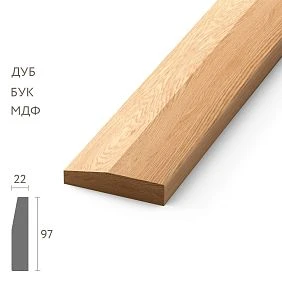
With a PLT-007 wholesale purchase, the main difficulty arises not from the profile dimensions, but from the fact that a single SKU may be required on a project in several versions at once. For standard MDF and moisture-resistant MDF, the geometry is the same: 97×22 mm, strip length — 2600 mm. If the specification leaves a single line “PLT-007 MDF — 420 pcs.”, there is not enough information. From such an entry it is impossible to understand how many strips should be produced in the standard version, how many in the moisture-resistant one, and where each part of the batch should go.
For a small room, an imprecise entry may end with a few swapped packages. On a project with buildings, floors, dozens of rooms, and several installation phases, the mistake becomes systemic. Profiles with identical geometry arrive at the warehouse, are moved between floors, opened by installers, and the leftovers are returned to the common stack. After that, restoring the original split is much harder than forming the order correctly before production.
Therefore, buying PLT-007 skirting board wholesale for a large project means ordering not an abstract quantity of a single SKU, but laying out the requirement in advance into separate material versions, zones, volumes, reserves, and picking groups.
The working logic is as follows: first, a room map is created, then each area is assigned the approved PLT-007 specification, after which standard MDF and moisture-resistant MDF are calculated separately, a reserve is created separately, and at the delivery stage each package receives a label that allows it to be identified without opening it.
This approach is especially important for PLT-007, because visually identical strip length does not help distinguish between the two MDF specifications.
PLT-007 skirting board wholesale: why identical 97×22×2600 mm items cannot be combined into one line
A conditional specification line such as “PLT-007 — 500 pcs.” is convenient only at the very first stage of volume estimation. For ordering, it is too coarse. Even the entry “PLT-007 MDF — 500 pcs.” does not solve the problem if the project includes both standard and moisture-resistant MDF.
A correct purchasing item must answer at least four questions: which SKU is being ordered, what material it must be made from, what length is required, and which kitting group the quantity belongs to.
For PLT-007 this is especially critical. Standard MDF and moisture-resistant MDF share the same cross-section of 97×22 mm and length of 2600 mm. Therefore, an entry based only on SKU and size still remains ambiguous.
Let's compare two formulations.
| Insufficient entry | Working entry |
|---|---|
| PLT-007 — 280 pcs. | PLT-007 / MDF / 97×22×2600 mm / zone A / 210 pcs. |
| PLT-007 MDF — 280 pcs. | PLT-007 / Moisture-resistant MDF / 97×22×2600 mm / Zone B / 70 pcs. |
In the second option, the purchaser, production, warehouse, and installation work with two specific items. In the first, all participants are forced to additionally find out what is hidden inside the total figure.
The problem gets worse if the order passes through several documents. For example, the designer compiles a room list, the estimator transfers the total square footage into the budget, the purchaser converts it into the number of planks, the supplier's manager receives the order, and then the warehouse divides the received batch among several buildings. If at one of these stages the material attribute disappears, further down the chain it can no longer be restored only from the designation PLT-007.
Therefore, the main principle is simple: a matching item code does not mean a matching purchasing item.
The general item code shows the profile type. The material and finish clarify which specific variant of this profile should go to a specific area of the site.
For wholesale supply, it is better to immediately count two items as independent, even if they are subsequently produced and delivered by one vehicle. This approach allows you to separately see the quantity, reserve, balance, and reorder for each finish.




Which PLT-007 finishes really need to be distinguished
In the configuration under consideration, PLT-007 is used in four material variants:
| Execution | Cross-section and length |
|---|---|
| MDF | 97×22×2600 mm |
| Moisture-resistant MDF | 97×22×2600 mm |
| Beech | 97×22×2400 mm |
| Oak | 97×22×2400 mm |
For the buyer, there are two distinct reasons to separate the line items.
The first is material. Standard MDF and moisture-resistant MDF cannot be combined into a single line just because the finished profiles share the same geometry.
The second is length. The beech and oak options are 2400 mm long, whereas the two MDF versions are 2600 mm. If both MDF and solid wood are used on a project at the same time, the total calculation in linear meters cannot be mechanically converted into a single number of planks.
For example, a project requires 240 linear meters of PLT-007. That figure alone says nothing about the number of pieces. If all 240 m are made from MDF with a length of 2600 mm, the theoretical minimum is 93 planks: 240 ÷ 2.6 = 92.31, rounded up. If the same 240 m are in oak with a length of 2400 mm, a minimum of 100 planks will be required.
But even such a calculation is not yet an order. It does not account for the actual dimensions of the sections, cutting, angles, visible joints, process waste, and reserve.
If materials are mixed, the situation becomes even more complicated. Suppose 150 m are standard MDF, 50 m are moisture-resistant, 25 m are oak, and 15 m are beech. Each group is calculated separately first, and only then can the quantities be consolidated into an overall budget or delivery schedule.
The same profile now has several independent material flows. They can be ordered from a single building materials supplier, delivered in one truck, and even stored in one room, but in accounting they must not become a single depersonalized line item.
The most dangerous phrase in work correspondence is “we’ll sort out the material later.” If the project already knows where a specific version is required, separating the line items is cheaper and easier before ordering, not after the long-length material arrives on site.
Our factory also produces:







Why identical size increases rather than reduces the risk of mixing up items
At first glance, identical sizes should simplify purchasing. One profile, one cross-section, one length — fewer SKUs. In practice, for a mixed batch the opposite happens.
When two items differ in size, the error is often spotted immediately. A 2400 mm strip doesn't match a 2600 mm strip; another profile differs in height or thickness. Even with weak labeling, the warehouse can notice that the packages are different.
If both items are labeled as PLT-007, have a cross-section of 97×22 mm and a length of 2600 mm, there is no geometric feature for quick identification. This means the entire control system depends on whether the material information is preserved on the packaging, in the delivery note, in the warehouse bin, and in the installation request.
Let's imagine a project with three buildings. In building No. 1, standard MDF is used on most floors, but on the first floor the design specifies a different version. In building No. 2, the ratio is reversed. Building No. 3 is installed a month later.
If all the strips are unloaded into a single stack labeled only "PLT-007", the likelihood of mixing increases sharply during the very first issue. The installer asks for 18 PLT-007 strips. The storekeeper sees several identical packages. If the material attribute is only in the internal delivery note or was lost after opening the pack, physical logistics starts working against the project.
That is why identical sizes require stricter identification, not less strict.
Good labeling answers the question without additional calls or opening the project documentation:
PLT-007 / MDF / 97×22×2600 / building 2 / floor 4 / zone A / 12 pcs.
Or:
PLT-007 / moisture-resistant MDF / 97×22×2600 / building 2 / floor 1 / zone B / 8 pcs.
Such a label is longer, but it reduces the risk of an erroneous issue.
Short designation PLT007-MDF-V it can be used as an internal code, but it must complement the full description rather than replace it. A new warehouse employee is not required to remember the decoding of every project abbreviation.
Get Consultation
First the room map, then the quantity of PLT-007
A common mistake is to start purchasing from the total linear meters. The estimate shows, for example, 1280 linear m of skirting board, after which the purchaser immediately tries to determine the number of strips and the percentage of reserve.
For a mixed order of PLT-007, the sequence should be reversed.
First, the object is divided into rooms and zones where the finish has already been approved by the project. Only after that are the meters combined within identical groups.
This does not mean that the material should be assigned according to an everyday principle: “a dry room — regular MDF, a wet room — moisture-resistant.” Such a rule is too crude. The decision depends on the project, the base structure, the specified finish, the operating conditions, and the approved material. The name of the room by itself is not a sufficient basis for independently changing the finish.
The map can be built on several levels: building, section, floor, room, specific wall area. The more complex the object, the more useful it is to choose in advance the level at which the material actually differs.
If the entire fourth floor of building A uses the same finish, it is not necessary to split it into a hundred separate purchasing lines. But if there are two project groups on the floor, they must remain separate.
Suppose the list contains 96 rooms. After classification, it turns out:
standard MDF — 71 rooms;
moisture-resistant MDF — 17 rooms;
oak — 5 rooms;
beech — 3 rooms.
The number of rooms says nothing about the square footage yet, but it already shows four separate procurement streams.
Next, the installation areas are recorded for each room. Areas where PLT-007 is not installed are excluded from the perimeter, the necessary returns and short segments are added, and then the net length is obtained.
Only after that can the square footage be summed within each material group.
This order makes the purchase verifiable. If the total seems suspicious, you can go back not to the abstract figure of “856 meters,” but to the specific rooms it came from.
For large deliveries, this is one of the main ways to avoid a situation where the final arithmetic is formally correct, but the material is distributed incorrectly between zones.
How to create a "room → PLT-007 finish" matrix
The central working document for a mixed batch becomes not an ordinary list of SKUs, but a distribution matrix.
The minimum structure can look like this:
| Body | Floor | Room | Zone code | PLT-007 finish | Net area | Planks | Reserve | Finish |
|---|---|---|---|---|---|---|---|---|
| А | 2 | 201 | A-MDF | MDF | 18.4 m | ___ | ___ | As per project |
| А | 2 | 202 | A-MDF | MDF | 21.7 m | ___ | ___ | As per project |
| А | 1 | 108 | B-MDF-V | Moisture-resistant MDF | 12.6 m | ___ | ___ | As per project |
| Б | 3 | 315 | C-OAK | Oak | 16.2 m | ___ | ___ | As per project |
The purpose of the table is to link the project geography of the site with the product nomenclature.
If the "finish" column is removed from it, there will be a risk of mixing. If the room or zone code is removed, after delivery it will be unclear where a specific quantity belongs. If only linear meters are left without the number of planks, the warehouse will not be able to quickly verify the shipment.
The matrix is also useful when adjusting a project. Suppose that before ordering, three rooms are moved from one group to another. There is no need to recalculate the entire project manually. The rows for those rooms change, after which the totals for the two corresponding groups are recalculated.
That is why it is better to store the source data in detail and form the order in aggregate.
The detailed schedule answers the question “where did the figure come from.” The summary specification answers the question “what exactly should be ordered.”
If procurement is handled by the general contractor and interior finishing is performed by different subcontractors, the matrix becomes even more important. Each party must use the same version of the distribution. Otherwise, the supplier receives one total, the warehouse another, and the installers rely on a third file.
When there is a significant number of items, it makes sense to record the number or date of the current revision of the schedule. This reduces the risk that an additional order will be placed using an outdated table.
Why can't we simply write “bathrooms — moisture-resistant, rooms — standard”
Such a rule seems logical, but it can create a new error instead of eliminating the old one.
First, the name of a room does not describe the actual operating conditions. In different projects, rooms with the same name may have different finishes, substrates, cleaning methods, junctions, and finishing requirements.
Second, a moisture-resistant version should not automatically be perceived as a universal material for any area associated with water. The term “moisture-resistant” does not mean that design requirements, the finishing method, or conditions of direct contact with moisture can be ignored.
Third, the purchaser must not independently change the approved material based on their own simplified classifier. Their task is to correctly implement the agreed specification.
Therefore, zoning is based not on everyday logic, but on a design attribute.
In the schedule, it is better to write not “wet room,” but the specific approved version:
PLT-007 / moisture-resistant MDF.
Then, after the file is handed over to another employee, there is no need to reinterpret what the author of the table meant by “wet area.”
The same logic applies to standard MDF. It should not be automatically allocated to all rooms that do not fall into the conditional wet category. First, a list of approved zones is needed, then the purchasing calculation.
Changes during construction are especially dangerous. For example, a room was designed in one group, but during the work the wall finish or the purpose of the area changed. If the working schedule PLT-007 is not updated, the delivery will correspond to the old solution.
Therefore, the material and quantity should be tied not to the room name as such, but to the latest approved version of the project.
This allows the purchaser to be responsible for their part of the process: to order the correct nomenclature in the correct quantity, without turning purchasing into independent design.
How to calculate standard MDF separately
After allocating the rooms, you can move on to the quantity.
The first level of calculation is the net length. Only the sections where standard PLT-007 should actually be installed are added up.
Suppose that after processing the schedule, 562.8 linear m of standard MDF was obtained.
If you simply divide the linear meters by the strip length of 2.6 m, we get:
562,8 ÷ 2,6 = 216,46.
The theoretical minimum is 217 strips.
This figure is useful as a check, but ordering exactly 217 units is risky. It assumes near-perfect use of every centimeter.
Suppose a real room needs sections of 1.45 m and 1.45 m. Their total length is 2.9 m. By total linear meters, this is slightly more than one plank, but it is impossible to get two 1450 mm pieces from one 2600 mm plank. For this specific pair, two planks will be needed, and the leftovers may only be useful elsewhere.
Therefore, after total linear meters, a second level is needed — cutting.
On a serial project, there is no need to create an individual map for every short section if the rooms repeat. It is much more efficient to define standard schemes.
For example, on one floor there are 12 identical rooms. Each one requires:
a 2450 mm section;
a 2050 mm section;
two 1180 mm sections;
a 760 mm section.
Knowing the repeatability, you can check which parts can actually be combined within a 2600 mm plank, which require a separate blank, and which leftovers can carry over to the next room.
After cutting, it turns out, for example, that the theoretical 217 planks are insufficient and the working requirement is 224.
Only after this is the reserve added.
If the project and the internal procurement system define a 5% reserve, it must be calculated from the working requirement of the specific execution:
224 × 1,05 = 235,2.
Rounding up gives 236 planks of standard PLT-007 made of MDF.
It is important not to perceive 5% as a universal norm. The percentage depends on the cutting structure, the project stage, the complexity of the rooms, and the accepted reservation system. In one case, a smaller stock will be sufficient; in another, even 10% will not fix a poorly constructed cutting map.
The practical sequence is always the same: clean linear meters → real cutting → number of whole planks → reserve.
How to calculate moisture-resistant PLT-007 as a separate batch
For moisture-resistant MDF, the same calculation is performed, but it cannot be turned into an arithmetic remainder.
The incorrect scheme looks like this: first the total volume of PLT-007 was calculated, then the quantity of standard MDF was determined, and everything remaining was automatically recorded as moisture-resistant.
This approach works only with a perfect initial bill of materials and hides distribution errors.
It is more correct to obtain a separate list of rooms where moisture-resistant execution is approved, calculate their sections independently, and form a separate total.
Suppose the net footage is 148.6 m.
148,6 ÷ 2,6 = 57,15.
Theoretically, a minimum of 58 planks is required.
Next, the cutting layout is checked. If most rooms contain short sections, the mathematical requirement may remain close to the minimum. If there are many long pieces that cannot be combined, the quantity will increase.
Suppose the working map yields 61 planks.
With an agreed reserve of 8%:
61 × 1,08 = 65,88.
66 planks are required for the order.
Specifically 66 moisture-resistant ones, not 66 of any PLT-007.
This distinction must be preserved in all documents.
If it later turns out that three planks are missing in the moisture-resistant execution zone, the availability of ten free planks of regular MDF does not mean the shortage is automatically covered. From the standpoint of total footage, the warehouse may have a surplus. From the standpoint of project completion with the required material, there is still a shortage.
This is how the principle of separate reservation works: each material group has its own balance.
This is especially useful for the purchaser during phased installation. You can see that for standard MDF the remaining stock is 18 planks, while for moisture-resistant MDF it is only two. This means the possible reorder is determined not by the total figure of 20, but by the state of the specific item.
When ordering through building material suppliers this detail also reduces the number of clarifying approvals: the manager receives not the total volume of a single SKU, but a ready-made distribution.
Why you cannot order 500 PLT-007 and distribute the material in the warehouse later
The idea seems convenient: fix the total quantity, and distribute standard and moisture-resistant MDF after delivery. In practice, the supplier cannot produce “500 undefined planks.” The quantity of each variant must be known before the order is formed.
If the project's requirement is 380 standard and 120 moisture-resistant planks, exactly that ratio must go into the request.
The entry “500 PLT-007, material to be specified” moves a critically important decision to the next stage and creates several risks.
The first is a mismatch between production and actual demand. Even if the total volume of 500 is fulfilled, with a 400/100 ratio the project will be short 20 planks of one variant and will have 20 extra of the other.
The second is an error in budgeting and planning. A consolidated line hides the order structure. Any change to a single material group becomes invisible.
The third is an incorrect reserve. If the total of 500 panels already includes a reserve, it is impossible to tell which finish it belongs to.
The fourth is a violation of phased completion. The first construction phase may need predominantly moisture-resistant MDF, while the next may need standard MDF. The total volume does not show whether a specific phase is ready for installation.
Therefore, a consolidated figure is acceptable only for a management report: “total PLT-007 — 500 pcs.” For production and delivery, it must be broken down:
PLT-007 / MDF / 97×22×2600 — 380 pcs.
PLT-007 / moisture-resistant MDF / 97×22×2600 — 120 pcs.
If beech and oak are present, separate lines with a length of 2400 mm appear.
This is the difference between budget aggregation and a procurement specification. The former helps to see the overall scale; the latter must unambiguously describe what needs to be manufactured and delivered.
What a correct specification line should look like
A good specification should not require verbal clarification from its author.
For PLT-007, the working line can be built according to the following logic:
item code → material → size → finish → zone → quantity → note.
For example:
PLT-007 / MDF / 97×22×2600 mm / finish per project / building A, floors 2–5 / 236 pcs.
Separately:
PLT-007 / moisture-resistant MDF / 97×22×2600 mm / finish per project / building A, floor 1 / 66 pcs.
If part of the order is made in oak:
PLT-007 / oak / 97×22×2400 mm / finish per project / reception area / 34 pcs.
In this format, a matching item code is no longer a problem. The differences are visible directly in the line.
It is not advisable to shorten the description to PLT007-1, PLT007-2if the decoding exists only in a separate file. Internal codes are convenient for filtering, labels, and the warehouse system, but the primary specification must remain understandable to a human.
The finish parameter should also be recorded separately if it affects the order. Two identical profiles made of the same material intended for different finishing solutions may require separate accounting.
If the finish is not yet finalized, it is better to explicitly mark it as an open question rather than silently leaving the field blank. An empty cell may be perceived as “the parameter is not important,” even though the decision has not actually been made yet.
It is also useful to keep two quantity columns: working requirement and total to order. Then the reserve does not get lost within the overall figure.
For example:
| Execution | Working requirement | Reserve | To order |
|---|---|---|---|
| PLT-007 MDF | 224 pcs. | 12 pcs. | 236 pcs. |
| PLT-007 moisture-resistant MDF | 61 pcs. | 5 pcs. | 66 pcs. |
This format makes it easy to quickly understand how much material is actually required for installation and how much has been added as a reserve.
Coding of two profiles with identical geometry
On a large site, long descriptions are inconvenient for daily logistics. An internal code is useful here.
For example:
PLT007-MDF — standard MDF;
PLT007-MDF-V — moisture-resistant MDF;
PLT007-OAK — oak;
PLT007-BEECH — beech.
The code does not change the official product designation. PLT-007 remains the product SKU. The additional part is needed only for site management.
Codes are especially useful when a zone is attached to them:
A-PLT007-MDF;
B-PLT007-MDF-V;
C-PLT007-OAK.
Then a single short identifier can be used in the table, on the label, and in the installation request.
But the abbreviation must be standardized before deliveries begin.
A bad situation arises when the designer writes MDF-W, the purchaser — MDF-V, the warehouse — VL, and the installer receives the designation “green.” Formally, everyone is talking about the same item, but the system ceases to be unambiguous.
An internal code makes sense only when it is the only one.
Another mistake is to use the code instead of a full description in contractual or order documents. A new abbreviation may be understood within the team, but the supplier needs to receive a proper product specification.
Therefore, in the specification it is acceptable to write:
Project code: B-PLT007-MDF-V
and nearby:
PLT-007 / moisture-resistant MDF / 97×22×2600 mm.
Both designations may also appear simultaneously on the packaging label.
This redundancy is useful. The warehouse operates by the short code, and when in doubt, the employee immediately sees the full breakdown.
How to label bundles for wholesale supply
Labeling must preserve the distinctions specified in the specification.
If only PLT-007remains on the label, all the previous work of separating regular and moisture-resistant MDF loses a significant part of its meaning.
For a mixed batch, it is desirable to see the following on the packaging:
PLT-007 / moisture-resistant MDF / 97×22×2600 / B-MDF-V / building A / floor 1 / 10 pcs.
If the material is distributed not by floors but by batches, the corresponding picking group is indicated instead of the floor.
It is especially important to avoid labels such as "standard" and "moisture-resistant" without an article number. A separate pack may be clear at the time of shipment, but after being moved to a common warehouse, the context will be lost.
The labeling must work autonomously.
Suppose that two weeks after delivery, the packaging is found in a different warehouse zone. The tag itself should make it clear what is inside and for which group the material is intended.
If a pack is opened and some of the planks remain, the information must also not disappear. In practice, this means that leftovers need re-labeling or the original tag must be kept together with the material.
It is precisely opened packs that often become a source of mis-sorting. A whole pack is well labeled, six items are taken from it, the remaining four are placed nearby, and the label stays on the removed packaging. A week later, four planks of identical size can no longer be confidently assigned to one of two MDF groups without additional checking.
If the project purchases construction materials wholesale for large batches, it is reasonable to agree on the labeling system before shipment. Labeling dozens of kits at production is easier than manually sorting all the long-length material after unloading.
Should the material be separated before delivery to the site?
If PLT-007 is used on one small site and stored in two physical zones, separation can be organized already at the customer's warehouse. For a large project, it is more advantageous to perform a significant part of the picking earlier.
Let us imagine a delivery for four buildings. The truck contains 700 planks of standard MDF and 180 moisture-resistant. If all the material is unloaded at a single point without preliminary separation, the site receives 880 units of long-length material that must be recounted, identified, and distributed again.
If the supplier has pre-grouped items by building, the recipient only needs to check the ready-made sets.
For example:
Building A — 210 MDF + 60 moisture-resistant;
Building B — 180 + 45;
Building C — 165 + 40;
Building D — 145 + 35.
The overall total is the same, but logistics are significantly simpler.
Pre-assembly is especially useful if the buildings have separate warehouses or different installation dates.
However, splitting an order too finely is not always rational either. Packing each room separately at the factory may be excessive if the site has a proper floor-level warehouse and repeating rooms.
You need to choose a packing unit at which the risk of mixing is already controlled, but the number of individual packs still remains manageable.
At a hotel property, this could be a floor or a block of rooms. In a residential complex — a building and a section. In an office project — a floor or a leased block.
The selection principle is simple: the material should be separated to the point where different versions should no longer be found in the same unidentified stack.
How to receive a PLT-007 batch
Acceptance of a mixed batch does not begin with checking the total quantity.
If the delivery note states “PLT-007 — 420 pcs.” and 420 planks actually arrived, this still does not prove that the delivery is correct.
Each version must be verified separately.
For example, the order is:
315 pcs. MDF;
85 pcs. moisture-resistant MDF;
12 pcs. oak;
8 pcs. beech.
The total quantity is 420.
In reality, 325 standard and 75 moisture-resistant units may arrive. The grand total is again 420, but the delivery does not match the specification.
Therefore, control is performed at the lower level of detail.
The next stage is labeling. The employee verifies that the designation on the packaging matches the documents and that the kitting group exists in the current bill of materials.
Then it makes sense to selectively compare the labeling with the actual contents of the package, especially if the batches are visually difficult to distinguish.
The number of items in the packs is checked separately. The error of 'one pack = one fixed quantity' is dangerous if the contents may vary.
For staged deliveries, it is useful to keep a cumulative balance. For example, according to the contract, 236 standard strips should arrive; the first delivery contains 120, the second 80. Until the final delivery, the remaining balance on the order is 36.
Exactly the same balance is kept for the moisture-resistant version.
If accounting is based only on the overall PLT-007, a false impression may arise that the delivery is complete. The total quantity has already arrived, but one material item has still not been delivered.
Acceptance is completed not after confirming the quantity of long-length items in the warehouse, but after confirming that the quantity of each version matches the order and can be identified further along the chain.
Why a general reserve of 5–10% is dangerous here
The phrase “add 7% for the entire skirting board” is convenient for a preliminary budget, but it is poorly suited to a mixed batch.
Suppose:
standard MDF — working requirement 500 planks;
moisture-resistant MDF — 50 planks.
Total volume — 550.
If you add a general reserve of 7%, you get:
550 × 1,07 = 588,5.
Let's round up to 589 planks. The reserve is 39 pieces.
But which ones exactly?
If all 39 additional items turn out to be standard MDF, the reserve exists in the overall figure, but for the moisture-resistant zone the stock is zero.
And the reverse situation: 20 extra moisture-resistant planks do not compensate for a shortage of 20 standard ones if substitution between materials is not approved.
Therefore, the reserve is a property of a specific line item.
Even the same percentage is calculated separately.
For example:
500 standard × 1.07 = 535;
50 moisture-resistant × 1.07 = 53.5, i.e. 54.
The total is 589, as in the first example. But now it is clear that the order includes 535 standard and 54 moisture-resistant.
It is even more correct not to start with a percentage, but first to check the causes of possible losses. If the main problem is complex cutting, the required additional quantity should already appear at the cutting map stage. After that, the reserve protects against damage and unforeseen situations rather than masking inefficient geometry.
For a serial project, the reserve percentage may also differ between groups. For example, one zone consists of long straight sections and repeated rooms, while another consists of a large number of short walls and individual units. Their likelihood of inconvenient leftovers is different.
Therefore, a single percentage is acceptable as a management simplification, but the procurement list must store a separate reserve for each PLT-007 variant.
How to calculate the reserve for each zone
The working matrix may contain a separate reserve not only by material, but also by picking zone.
Example:
| Zone | Rooms | Execution | Net area | Cutting planks | Reserve | Total | Marking |
|---|---|---|---|---|---|---|---|
| А | bedrooms, offices | PLT-007 MDF | 562.8 m | 224 | 12 | 236 | A-MDF |
| Б | areas with approved moisture-resistant finish | PLT-007 moisture-resistant MDF | 148.6 m | 61 | 5 | 66 | B-MDF-V |
| В | solid wood area | PLT-007 oak | 72.4 m | 32 | 3 | 35 | C-OAK |
| Г | solid wood area | PLT-007 beech | 38.6 m | 18 | 2 | 20 | G-BEECH |
The figures in the table are an example of a calculation methodology, not a ready-made norm for another project.
In a real project, the reserve is determined after analyzing the cutting plan and installation organization.
It is useful to separate three different concepts.
The first is technological consumption, which already arises from the actual cutting plan. If 100 m of clean installed length requires 108 m of source profile to produce the necessary parts, those 8 m cannot be called a reserve. They are already part of the working requirement.
The second is an installation reserve for damage, an incorrect cut, or a local size change.
The third is an operational remainder, if the customer deliberately wants to keep some material after project handover.
If all three quantities are combined into a faceless “10% on top,” it is impossible to understand the structure of the order.
For PLT-007, it makes sense to keep at least the working requirement and the additional reserve separate. Then, when the budget is reduced, it is clear which part they are trying to remove.
If you remove the strips required due to the actual cutting plan, the installation simply will not come together. If you reduce the operational remainder, the main installation may not suffer.
These are different decisions.
What to do with the leftovers of standard PLT-007
After completing part of the work, the leftover standard MDF should not be automatically returned to the general category "PLT-007".
The material still belongs to a specific finish.
The first question is in which other zones of the project this standard MDF is approved. If such zones exist, the leftover can be taken into account when planning the next stages.
For example, after building A, 14 whole PLT-007 MDF planks remain. In building B, the working requirement is 180 pieces. If the material and finish match, the order for the next batch can be reduced taking into account the confirmed leftover.
But for this, it is necessary to make sure that the leftover is actually whole and suitable for use. The entry "14 pcs." should not include a set of offcuts that formally add up to several meters in total but do not fit the actual part lengths.
Therefore, leftovers should be divided at least into whole planks and usable cut pieces.
A whole plank retains maximum versatility. A 900 mm cut piece will only be useful where a part no longer than the available size is required, taking into account end processing and the specific assembly.
An urgent reorder appears, although the cause was not an initial shortage of material but unaccounted redistribution.
Therefore, any movement between project groups must change the leftovers of both groups.
For a large project, a simple notation is convenient:
date → from → to → execution → quantity → basis.
You don't have to create a complex information system. Even a neat movement log is significantly better than verbal agreements.
How to split one delivery by floors and installation phases
Wholesale purchasing does not mean that the entire volume must be physically delivered to the site at once.
If installation proceeds in phases, it makes sense to synchronize the delivery of PLT-007 with the actual readiness of the premises.
Let's consider a six-floor project. Total requirement:
420 planks of regular MDF;
96 moisture-resistant.
You can order the entire volume under one contract, but split the shipment:
the first phase — floors 1–2;
second — floors 3–4;
the third — floors 5–6 plus the agreed residual reserve.
The main thing is to maintain the material separation within each phase.
You cannot write “first delivery — 170 PLT-007.” You need to specify how many of them are standard MDF and how many are moisture-resistant.
A phased approach offers several advantages. The site warehouse is not overloaded with long-length material, the number of movements is reduced, the material spends less time between other construction works, and possible project changes do not affect the already produced full volume.
But such a scheme requires version discipline.
If the bill of materials changed between the first and second phase, the next delivery must be calculated according to the new revision, rather than automatically repeating the original distribution.
It is also useful not to split the reserve mechanically. Part of the installation reserve can be supplied with each phase, and part can be held until the end of the project. The decision depends on how quickly additional production is possible and how great the risk of work stoppage is.
If the site is remote and a small shortfall will lead to expensive separate delivery, the reserve at each phase may be more important. If production is nearby and a reorder is possible without disrupting the schedule, the strategy may be different.
In any case, splitting deliveries does not change the main rule: standard and moisture-resistant PLT-007 remain separate items at each stage.
How to place a reorder without mistakes
A reorder is the moment when the initially tidy system often breaks down.
The site runs out of material, and the foreman sends a message: "We need 18 more PLT-007." The article number makes it clear which profile is needed, but that is not enough.
A correct reorder must repeat the essential parameters of the original item:
PLT-007 / moisture-resistant MDF / 97×22×2600 mm / finish ___ / zone B / 18 pcs.
If the first delivery had a separate finish code or an approved sample, it must also be linked to the request.
It is especially important to keep the history of the original order. A few months later, a new batch is processed by a different employee, and the verbal information about the first delivery is already lost.
Therefore, for each item it is useful to have the original specification, order number, material, finish, and, if necessary, a photo or reference sample code.
Before reordering, you also need to check the cause of the shortage.
If the material ran out due to an error in the original calculation, the quantity is determined by the remaining unfinished work. If the cause was damage, you need to understand whether there is a risk of it happening again. If the geometry of the rooms has changed, the specific zone is recalculated.
Simply repeating the previous reserve is not always correct.
For example, a project is short six moisture-resistant planks to complete the last section. Ordering another 6 + 10% would formally give 7 items. But if all the remaining pieces are long and each nearly takes up a full plank, seven or more will indeed be needed. And if several short sections are required, six may be enough.
A reorder is a small standalone calculation, not a percentage of the original batch.
What to pass to the STAVROS manager for calculating a wholesale batch
The more accurate the initial request, the fewer decisions have to be made after the order is launched.
For PLT-007, it is enough to prepare one clear set of data.
It must specify the item code itself, the required material finishes, the quantity for each finish, the dimensions if the order includes both MDF and solid wood at the same time, finishing requirements, distribution by kitting groups, the delivery schedule, and labeling requirements.
If the quantity has not yet been finally calculated, it is better to pass the linear meters for each zone and the room structure than to give a single approximate figure.
For example, the request "about 800 meters of PLT-007 are needed" is suitable for a preliminary discussion, but not for a final order.
It is more useful:
PLT-007 MDF 97×22×2600 — net linear meters 612 m, quantity calculation required based on the provided schedule;
PLT-007 moisture-resistant MDF 97×22×2600 — net length 154 m;
delivery breakdown — cases A and B;
marking — according to the attached matrix;
finish — according to the approved specification.
If the customer is looking for where buy building materials wholesale for the entire project, the same logic is useful not only for skirting. Any finishing material with the same name but different versions must be separated even before it enters the general warehouse list.
This is especially noticeable for long-length trim: after labels are removed, similar items are easily mixed up, and the error is discovered only at the wall.
The earlier the procurement specification turns from a general list of goods into a complete project kit model, the fewer manual decisions warehouse staff and installers have to make.
Practical example: one batch of PLT-007 for a project with several zones
Let's consider a hypothetical project to link calculation, reserve, and logistics into a single scheme.
The project has four groups.
Zone A — standard rooms with approved PLT-007 in standard MDF.
Zone B — areas for which a moisture-resistant MDF finish is approved by the project.
Zone C — executive rooms with oak.
Zone D — individual rooms with beech.
After measuring and excluding areas without skirting, we obtained:
zone A — 562.8 m;
zone B — 148.6 m;
zone C — 72.4 m;
zone D — 38.6 m.
If you count only by total length, the sum comes to 822.4 m PLT-007.
For budgeting, this figure is useful. For ordering, it is not.
Standard MDF and moisture-resistant MDF have a length of 2600 mm, oak and beech — 2400 mm. In addition, each zone has its own cutting map.
After cutting, the working values are:
zone A — 224 planks;
zone B — 61 planks;
zone C — 32 planks;
zone D — 18 planks.
After adding the agreed reserve:
zone A — 236;
zone B — 66;
zone C — 35;
zone D — 20.
Final batch — 357 planks.
But the phrase "order 357 PLT-007" will again destroy all useful detail.
A correct order consists of four lines.
| Code | Execution | Size | Working quantity | Reserve | To order |
|---|---|---|---|---|---|
| A-MDF | PLT-007 MDF | 97×22×2600 mm | 224 | 12 | 236 |
| B-MDF-V | PLT-007 moisture-resistant MDF | 97×22×2600 mm | 61 | 5 | 66 |
| C-OAK | PLT-007 oak | 97×22×2400 mm | 32 | 3 | 35 |
| G-BEECH | PLT-007 beech | 97×22×2400 mm | 18 | 2 | 20 |
The delivery can then be split into stages.
For example, zone A is installed in two phases: 120 planks in the first delivery and 116 in the second. Zone B is needed entirely in the first stage. Oak and beech arrive by the time the corresponding rooms are ready.
In the documents, the first shipment may look like this:
A-MDF — 120 pcs.;
B-MDF-V — 66 pcs.
Second:
A-MDF — 116 pcs.;
C-OAK — 35 pcs.;
D-BEECH — 20 pcs.
The total volume has not changed, but at each stage it is clear which material and how much should be on site.
If after the first phase eight whole A-MDF planks remain, the second requirement is adjusted taking into account the actual remaining balance. But the eight remaining planks are not simply recorded as “PLT-007 balance,” otherwise during the next recalculation they could accidentally be counted toward another group.
Thus one simple table links calculation, production, warehouse, and installation.
Errors that cause mixed batch PLT-007 to turn into a sorting mismatch
The most dangerous error is losing material in the item name. At first the line looks correct: PLT-007 / moisture-resistant MDF. Then in the estimate it is shortened to PLT-007, because the size is the same. After transferring to the purchase request, it is no longer possible to understand which part of the quantity belonged to which finish.
The next error is the combined reserve. The site buys an additional 30 "PLT-007" planks "for stock" but does not record the material. At the moment of shortage, it turns out that the entire free balance belongs to a different group.
The third problem is labeling only the outer packaging. After opening the pack, individual planks lose their identification and go into the common stack.
The fourth is verbal redistribution between zones. The installer takes several planks from a neighboring picking group because they look suitable. The movement is not reflected in the list. The next crew encounters an unexpected shortage.
The fifth is recalculation in total linear meters without taking into account the plank length and the actual cutting plan. It is especially dangerous to combine MDF 2600 mm and solid wood 2400 mm in one arithmetic.
The sixth is using a reserve percentage instead of a cutting plan. If the parts do not fit well into the original length, the additional percentage does not automatically correct the error.
The seventh is reordering only by SKU. The wording "20 more PLT-007" returns the entire system to the original ambiguity.
The eighth is different internal codes among different participants. For one employee V means moisture-resistant, for another it means a finish variant. Such a code does not help but creates an additional source of errors.
The ninth is the absence of version control for the list. The purchaser uses a file created a week ago, although some rooms have already been switched to a different finish.
The tenth is an attempt to compensate for a shortage of one material with a surplus of another without an agreed-upon decision.
All the listed errors share a common cause: the connection between the physical plank and its specific purpose on the project disappears.
Therefore, prevention is built not on additional control at the end, but on preserving the identity of the item from specification to installation.
When complex batch separation is not required
Not every PLT-007 order needs a multi-level matrix, floor codes, and dozens of picking groups.
If a project uses only one PLT-007 variant, the volume is small, the material arrives in a single batch, and is installed immediately by one crew, a complex system would be excessive.
For example, 24 standard MDF planks are required for one room. In this case, an accurate product line and a standard quantity check are sufficient.
There is no need to create artificial logistical complexity where there is no risk of mixing.
But the criterion is not the order value or the number of square meters of the building. What matters is the structure of the nomenclature and the movement of material.
Even a relatively small order may require separation if it simultaneously contains standard and moisture-resistant MDF, and the delivery is distributed across several installation zones.
And conversely, a large batch of a single material for repeating rooms can be managed quite simply.
It is worth complicating the system when at least one real risk of losing identification appears: two versions of the same SKU, different lengths, different finishes, multiple cabinets, staggered delivery dates, multiple contractors, or a shared warehouse.
The purpose of the matrix and labeling is not to increase the number of documents. They should eliminate future manual sorting.
If project logistics already uses its own system of QR codes, warehouse cells, or picking lists, there is no need to create a parallel scheme for PLT-007. It is better to integrate the material attribute into the existing system.
The main thing is that standard and moisture-resistant MDF cannot be lost within a common designation.
How to organize wholesale purchasing of PLT-007 without unnecessary bureaucracy
A strong purchasing system is distinguished not by the number of tables, but by the fact that each action is performed once and information is not lost further down the chain.
For PLT-007, one source catalog of versions, one up-to-date room matrix, and one consolidated order specification are sufficient.
The catalog records which variants are actually used on the project:
PLT007-MDF;
PLT007-MDF-V;
PLT007-OAK;
PLT007-BEECH.
The matrix shows where they are applied.
The summary specification aggregates the quantity for production and shipment.
All other documents should preferably be generated from this data rather than retyped manually.
It is manual copying that most often creates discrepancies. One table lists 236 planks, another 232, the email to the manager says 230, while the warehouse is expecting 240.
If a unified system is not yet possible, at least one file should be designated as the master. Changes are entered there first, after which the derived documents are updated.
When working with supply of construction materials this approach noticeably simplifies approvals. The manager no longer has to repeatedly clarify whether moisture-resistant MDF is included in the total figure, and the customer can verify the calculation before the batch is launched.
It is also useful to establish a simple prohibition: a line item PLT-007 without a specified material is not used in order documents at all.
It can exist only as a summary heading or analytical group.
This small rule eliminates a significant portion of the risk of mixing up materials even before production.
Buy PLT-007 skirting board wholesale after final verification
It makes sense to place the final order once the total linear meters have become a verifiable structure.
Standard and moisture-resistant MDF must have separate quantities. Beech and oak require separate lines with a length of 2400 mm. If the project is divided by buildings or phases, the distribution must be determined before shipments are formed.
Before ordering, it is useful to compare the four levels of data once again.
The first is the project: where each version should be used.
The second is the calculation: how many whole strips are required after actual cutting.
The third is the reserve: how many additional items belong specifically to this material group.
The fourth is logistics: where and when the batch must arrive.
If all four levels are aligned, the identical geometry of PLT-007 ceases to be a source of risk.
You can order floor skirting board wholesale without creating an anonymous stock of profile on the project. You can split the delivery by buildings. You can separately see the remaining stock of standard and moisture-resistant MDF. You can place a reorder so that a new manager immediately understands the original configuration.
For the wholesale batch PLT-007, the main unit of accounting is not just an SKU and not a total linear meter.
The working unit looks like this:
SKU + material + size + finish + zone + quantity.
It is this combination that must pass without loss through the specification, order, labeling, acceptance, warehouse, and installation.
Then the entry “PLT-007 MDF” does not turn into an undefined mass of identical planks, but remains a manageable part of the project’s complete set.
If you need wholesale skirting boards from the manufacturer for a large series of rooms, it makes sense to first complete the zonal schedule and only then fix the final volume. This order allows you not to buy extra “just in case” and at the same time not to leave critical versions without their own reserve.
If necessary, together with PLT-007 you can form a broader order for materials in bulk, but it is better to preserve the rules for identifying a specific profile. The larger the overall delivery, the more dangerous it is to hope that positions that look identical will be sorted out directly on site.
A correctly formed wholesale order for PLT-007 should make it possible to get an answer to any practical question without re-analyzing the project: how much regular MDF was ordered, how much moisture-resistant, where each group is used, what reserve it has, what has already been delivered, what remains in the warehouse, and which version must be specified for a reorder.
If these answers are available before the batch is launched, the risk of mixing up items becomes manageable. If they are trying to get them after unloading several hundred planks identical in geometry, the project is already solving a problem that could have been eliminated at the specification stage.