




























Article Contents:
- Wires near the floor: why it's a problem and how it occurs
- Which wires most often need to be hidden near the floor
- MDF baseboard with cable channel: what it is and how it works
- Baseboard construction with cable channel
- When a baseboard with a cable channel is the right choice
- When a regular MDF baseboard without a cable channel is the best choice
- How to choose the height of an MDF baseboard: breakdown by situation
- Low baseboard: 40–60 mm
- Universal height: 80–100 mm
- High baseboard: 120–150 mm and more
- How to match baseboard height with doors and furniture
- How to choose the color of MDF baseboard
- White MDF baseboard: a classic that never goes out of style
- MDF baseboard for painting: maximum flexibility
- Baseboard in wall color
- Baseboard in floor color
- Skirting board matching door color
- Contrasting skirting board
- How to attach MDF baseboard: two methods and all the nuances
- First method: installation on clips
- Second method: installation on liquid nails or mounting adhesive
- What to do with minor wall irregularities
- Corners, joints, and ends: the most difficult part of baseboard installation
- Inside corner
- External corner
- Lengthwise joint
- End at the doorway
- Extension profile and molding for additional decoration
- Table: choosing MDF skirting board height by room type
- Where skirting board with cable channel is especially useful
- TV area in the living room
- Study and home office
- Children's room
- Bedroom with lighting
- Kitchen-living room
- Hallway with router
- MDF skirting board vs wooden skirting board: what to choose
- MDF skirting board: pros and cons
- Wooden skirting board: pros and cons
- Mistakes when choosing and installing MDF skirting board with cable channel
- MDF skirting board and adjacent elements: lower horizon system
- What to buy for a neat bottom wall edge
- FAQ: answers to important questions
- About the Company STAVROS
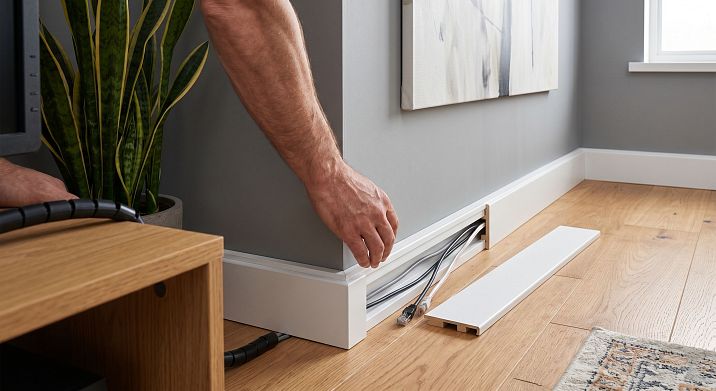
Wires on the floor are not a technical issue. It's an aesthetic one. You can do an expensive renovation, choose good furniture, pick the right lighting — and all of that will be ruined by one gray cable running along the baseboard on the floor. It creates a feeling of "unfinished," "temporary," "done haphazardly."
MDF Skirting Board — it's not just a decorative strip near the floor. In the modern sense, it's a functional finishing element that simultaneously covers the bottom joint of the wall and the flooring, protects the wall from mechanical damage, and — with the right choice — hides wires. When Baseboard MDF chosen correctly, the cables behind it simply cease to exist: neither a glance, nor dust, nor a child will find them.
This article provides a comprehensive breakdown: when a baseboard with a cable channel is needed, how to choose the right height, color, and mounting method, how to handle corners and joints, and what mistakes to avoid. No fluff — only specific and proven solutions.




Wires on the floor: why it's a problem and how it arises
The situation is familiar to almost everyone. The renovation is done: walls painted, floor laid, furniture arranged. And then it turns out that the TV cable needs to run three meters along the baseboard from the wall to the TV. Or the router is in the corner, with two patch cords stretching from it to the desk. Or the home theater in the living room requires a wire to the amplifier, and it lies unattractively along the sofa.
The wires weren't hidden in the wall during renovation — for various reasons: not planned in advance, equipment added later, furniture rearranged. This is a common situation. The question is how to deal with it.




Which wires most often need to be hidden near the floor
Practice shows that several types of cables accumulate near the floor:
-
Internet cable (twisted pair, patch cord) — the most common "troublemaker."
-
TV cable (coaxial) from the antenna output or tuner to the television.
-
Wires from acoustic systems to the amplifier.
-
Lighting cable — from the power supply to the LED strip in the cabinet, behind the sofa, or under the bed.
-
Workstation wires: from the monitor, laptop, desk lamp to the power strip.
-
Router cable, Smart TV set-top box, gaming console.
-
Temporary wiring added after renovation completion.
Each of these cables does not exceed 6–8 mm in diameter. Most are 4–6 mm. With a properly selected MDF baseboard with cable channel all of them are placed neatly and securely.
Our factory also produces:




MDF baseboard with cable channel: what it is and how it works
A skirting board with a cable channel is a profile that has a cavity behind the front panel. The cable is laid into this cavity, the cover is closed, and the wires disappear. Only the decorative surface of the skirting board is visible from the outside.
Get Consultation
Skirting board construction with cable channel
Typical design: a clip base is attached to the wall (with dowels or glue). A decorative front panel snaps onto the clip. Between the wall and the front panel, there is a channel 15–25 mm wide and 10–15 mm deep. Cables are placed in this channel.
The advantage of such a system is the accessibility of the wiring. If you need to add a cable or replace an old one, the front panel can be removed without tools and without damaging the wall. This fundamentally distinguishes it from wiring embedded in a groove: here, access is always open.
When a skirting board with a cable channel is the right choice
Several specific situations where it is indispensable:
The sockets are located far from the equipment. The TV is on one wall, the antenna socket and internet socket are on another. Running the wire over the floor is unsightly. Chiseling the wall after renovation is expensive and messy. MDF Skirting Board with a cable channel neatly runs the cable along the perimeter of the room to the desired point.
Wiring is added after renovation. You bought new speakers, moved the router to a new location, added a desk — and now you need to run a cable without breaking the wall. A skirting board with a channel is the only neat solution without dismantling.
A clean wall appearance is important. In modern interiors with minimalist or classic walls, any surface-mounted cable channel looks alien. MDF floor skirting board with cable channel keeps the wall surface untouched.
TV zone with multiple devices. TV, set-top box, game console, soundbar — each has its own cable. They all need to reach the outlets or the TV cabinet. A baseboard with a wide channel can easily accommodate four to five cables at once.
When a regular MDF baseboard without a cable channel is the best choice
Honesty is the foundation of trust. And it's important to say it straight: a baseboard with a cable channel is not always necessary.
If all wires are initially hidden in the wall — MDF Skirting Board without a channel will be thinner, more neat in profile, and will offer a greater choice in shape, height, and decorative finish.
If there are few wires and they are already neatly tucked into a corrugated tube behind the furniture — it's better to choose a baseboard based on aesthetic criteria: height, profile, color, and style. The cable channel function here only thickens the baseboard and narrows the range of design solutions.
Choose Baseboard MDF with a cable channel only when it is truly needed — not "just in case."
How to choose the height of an MDF baseboard: a breakdown by situations
The height of the baseboard is the first and main parameter after function. It determines the visual weight of the lower part of the wall.
Low baseboard: 40–60 mm
A minimal baseboard for modern and minimalist interiors. It is almost invisible — a quiet, delicate element. Used in rooms with low ceilings (up to 2.6 m) to avoid weighing down the lower zone. The cable channel at this height has minimal capacity: a maximum of one or two thin wires.
Universal height: 80–100 mm
The most popular range. MDF Skirting Board A height of 80–100 mm is suitable for most apartments with ceilings of 2.7–3.0 m. It is noticeable enough to create a lower architectural horizon without dominating. At a height of 80–100 mm, the cable channel accommodates three to five standard cables. More details about what sizes of MDF baseboards are available, can be found in a separate article.
High baseboard: 120–150 mm and more
For rooms with high ceilings — from 3 meters. A high baseboard creates a sense of monumentality and "expensiveness" in the interior. It makes the lower horizontal line of the wall pronounced and significant. At this height, the cable channel can be wide — accommodating five to eight cables.
How to match the baseboard height with doors and furniture
Three rules for choosing height:
The door rule. The baseboard height should not exceed the door casing height. If the casing is thin, the baseboard should not be too massive — they will compete. Ideal: baseboard 20–30% lower than the casing in height.
The furniture rule. The baseboard should not be visible behind furniture placed flush against the wall. Otherwise, there will be an unsightly gap between the furniture and the wall. If the furniture has a plinth, the baseboard height should not exceed the plinth height.
The ceiling rule. In a room with a low ceiling (up to 2.6 m), a tall baseboard "cuts off" space from below. Maximum — 80 mm, better 60 mm.
How to choose the color of an MDF baseboard
The color of the baseboard is not a decorative whim. It is a functional solution that determines how the lower part of the wall fits into the overall interior.
White MDF baseboard: a classic that never goes out of style
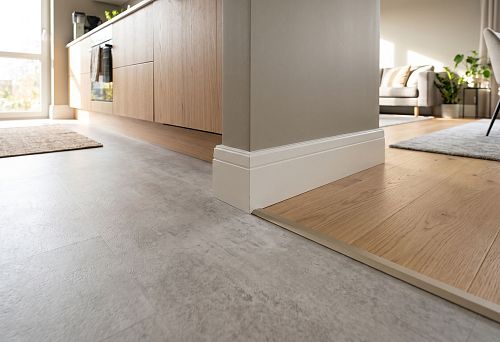
White MDF Skirting Board — the most common solution. White is neutral: it does not clash with any wall color or any floor color. With white doors and white casings, a white baseboard creates a unified white system that discreetly holds the space.
White baseboard works in Scandinavian, modern, classic, and transitional interiors. It visually "lengthens" the room along the perimeter.
MDF baseboard for painting: maximum flexibility
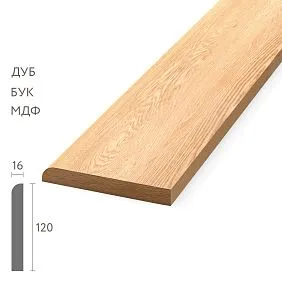
— is a horizontal element that frames the room at the bottom of the walls where the wall meets the floor. Skirting boards perform several functions: they hide the technological gap between the wall and floor covering (necessary for thermal expansion), protect the lower part of the wall from mechanical damage, create visual completion, and may conceal wiring. — primed, without a finish coat. You paint it in any desired shade after installation. Want it to match the wall color — paint it the wall color. Want a contrasting accent — paint it a dark or colored tone.
This is a solution for those who don't want to commit to a ready-made color. It's especially relevant for non-standard walls — bright, saturated, or multi-toned.
Baseboard in wall color
A baseboard painted in the same tone as the wall visually 'disappears'. The floor appears higher, the walls appear higher. This is a technique for small rooms and spaces with non-standard wall colors. It is achieved through a paintable baseboard.
Skirting Board in Floor Color
Often found in interiors with wooden or laminate flooring. A wood-look baseboard — an MDF skirting board with a wood finish is in imitation oak veneer — connects the floor and wall through a common tone. The bottom line of the wall appears to be a continuation of the floor.
Skirting in the color of the doors
Dark oak doors + oak-look baseboard + Wooden baseboard or MDF in an oak tone — a unified wooden system. This gives the most 'expensive' feel in an interior: when vertical and horizontal wooden elements are in the same tone.
Contrasting baseboard
A dark baseboard on light walls — a deliberate accent. The bottom line becomes graphically pronounced. This is a design technique: the room gets a 'foundation' that is visible from afar. It works well in Scandinavian and modern interiors with white walls and dark floors.
How to install MDF baseboard: two methods and all the nuances
Installation is where many make mistakes. Especially when cables are planned to be placed inside the baseboard.
Method one: clip-on installation
Clip-on installation is the standard for baseboards with cable channels. The principle is simple: clips are attached to the wall along the entire length of the baseboard at intervals of 40–60 cm, then the decorative front panel snaps onto them.
Advantages of clip-on installation when working with cables:
-
Access to cables at any time — the panel can be removed without tools.
-
The wire is laid before closing the panel — convenient, without unnecessary manipulations.
-
Clips hold the panel evenly along its entire length — no sagging.
Important requirement: clips must be securely attached to the wall — with dowels, not just glue. Wires inside add extra load to the clip if the cable is accidentally pulled.
More details on fastening methods — in the article How to install MDF skirting board.
Method two: installation with liquid nails or construction adhesive
Adhesive installation — for baseboards without cable channels, when cables are already laid and no further access is needed. Adhesive is applied to the back of the baseboard, the baseboard is pressed against the wall and held until it sets.
Advantages: no visible fasteners, faster installation. Disadvantages: the baseboard cannot be removed without risk of damaging the wall and the baseboard itself. If the wire needs to be replaced, the baseboard must be completely dismantled.
The conclusion is simple: if cable laying is planned, use only clips. If there are no cables and never will be, glue can be used.
What to do with minor wall unevenness
An uneven wall is a common case. A baseboard pressed against a wavy wall repeats these waves and looks unattractive. Solution: mounting glue or sealant is applied at points of deviation, filling the gaps. For minor unevenness, the clip method is supplemented with glue at points where the wall protrudes.
For significant unevenness (more than 5 mm), it is better to level the base with gypsum putty along the bottom line of the wall before installing the baseboard.
Corners, joints, and ends: the most difficult part of baseboard installation
Straight sections of baseboard are easy to install. The difficulty lies in corners, joints, and ends. This is where the installer's skill—or lack thereof—is visible.
Internal corner
Where the wall turns inward (a typical room corner), the baseboard needs to be cut. Two options:
45-degree miter cut. Both parts of the baseboard are cut at 45° in mirror directions and joined at the corner. With a precise cut, it creates a perfectly clean corner without gaps. With the slightest error, there will be a gap or overlap. Requires a miter box or miter saw.
Butt joint method. One part of the baseboard goes to the corner, the second is cut with a butt end. A straight end line is visible. Less elegant, but simpler and more reliable on uneven walls. More details in the article corners of wooden baseboard.
External corner
Where the wall protrudes (column, pier, rectangular projection) — the baseboard needs to be wrapped around the external corner. Here, the cut is also at 45°, but in the opposite direction. Or — Wooden corner UG-001, which covers the external end and creates a neat decorative element.
Corner piece on the external corner of the baseboard — especially convenient for cable channel baseboards: it hides the place where the wire "exits" one section of the baseboard and enters another at the corner.
Lengthwise joint
Standard baseboard length is 2.5 or 3 meters. In long hallways or large rooms, a joint will be required. Rule: the joint is made at a 45° angle (beveled end) so that if it expands due to temperature and humidity, no visible gap forms. With a straight end, any expansion is immediately noticeable.
With a cable channel baseboard, the joint is where you need to plan the cable transition from one section to another. The cable should lie freely, without tension at the joint.
End at the doorway
Where the baseboard ends at a doorway — an open end. It should be even (perpendicular cut), and if necessary, closed with an end cap. If there is a trim next to the opening, the baseboard fits flush against the trim.
With a cable channel baseboard — where the wire exits the baseboard to a socket or appliance — the end opens and the cable comes out. This place requires neat finishing: either through a special outlet element or through a neat cut in the profile.
Additional profile and molding for extra decoration
Where the baseboard meets a non-standard element — a niche, a protrusion, a transition to another material — wood trim items и wooden molding they solve the problem. A molding along the horizontal line above the baseboard creates an additional horizontal accent. Linear moldings — for non-standard joints.
Table: selection of MDF baseboard height by room type
| Room | Ceiling | Recommended height | Cable channel |
|---|---|---|---|
| Studio apartment | up to 2.7 m | 60–80 mm | optional |
| Standard apartment | 2.7–3.0 m | 80–100 mm | if wires are present |
| Apartment with high ceiling | 3.0–3.5 m | 100–120 mm | if wires are present |
| House with high ceilings | from 3.5 m | 120–150 mm | if wires are present |
| Hallway, entrance hall | Any | 80–100 mm | rarely needed |
| TV zone, office | 2.7–3.0 m | 80–120 mm | Recommended |
Where a baseboard with a cable channel is especially useful
Let's break down specific areas where this feature is most in demand.
TV zone in the living room
A TV on the wall or on a stand. Nearby — a set-top box, receiver, soundbar. Each of them gives one or two cables. A baseboard with a cable channel neatly routes all these wires from the outlet to the stand. Viewers see the screen, hear the sound — and don't see a single wire. This is not an exaggeration. This is what MDF Skirting Board with a channel does literally.
Home office and study
Monitor, system unit, laptop, printer, desk lamp, chargers — and all their wires converge to a power strip. In a study, neatness is especially critical: wires on the floor are annoying, interfere with cleaning, and create a sense of chaos. buy MDF skirting board with a wide channel under the workspace is an investment in order on a daily basis.
Children's room
In a children's room, wires near the floor are not only unsightly but also unsafe. Children pull everything they see. A hidden cable channel in the baseboard removes wires from the reach zone and from sight. Bonus: behind a closed baseboard, the wire doesn't collect dust — this is especially important in a children's room.
Bedroom with backlight
LED strip under the bed, tape in the headboard, nightlights — each has its own wire. Wires are especially out of place in the bedroom: here you need silence and cleanliness in everything. Baseboard MDF with a cable channel along the wall where the bed stands, hides all of this in one place.
Kitchen-living room
In open-plan layouts — router, TV, kitchen appliances, island lighting — all produce cables that need to go somewhere. A baseboard with a channel around the perimeter of the kitchen-living room is the neatest solution for an open space where "messiness" is visible from everywhere.
Hallway with router
The hallway often serves as a place for the router. Patch cords run from it to the bedroom, living room, and study. A baseboard with a cable channel along the hallway easily hides this "spider web" of wires. The cables spread out into rooms under the baseboard — and emerge at the right points through neat cutouts.
MDF baseboard vs wooden baseboard: what to choose
There is no clear answer here. There is context.
MDF baseboard: pros and cons
Advantages:
-
Cheaper than natural wood.
-
Does not deform with changes in humidity (critical for kitchen and bathroom).
-
Easily painted in any shade.
-
Wide selection of profiles — from strict to decorative.
-
Functional if it has a cable channel.
Disadvantages:
-
Does not have a natural wood texture.
-
When imitating wood, it is less convincing than natural material.
-
Requires moisture protection on the ends.
Wooden baseboard: pros and cons
Advantages:
-
Natural texture and warmth of wood.
-
Pairs perfectly with wooden floors and wooden doors.
-
Can be processed: sawing, milling, size adjustment.
-
Durable with proper treatment.
Disadvantages:
-
More expensive than MDF.
-
Sensitive to humidity — deforms with fluctuations.
-
Cable channel in natural wooden baseboard is rare.
Rule of thumb: if a cable channel is needed — MDF Skirting Board. If wires are hidden in the wall and naturalness is important — Wooden baseboard.
Mistakes when choosing and installing MDF baseboard with cable channel
This is where the experience is concentrated, for which many pay with rework.
Choosing a baseboard that is too low for multiple cables. If you need to run three or four cables, and the selected baseboard has a channel height of 10 mm — they simply won't fit or will lie twisted. Calculate: standard coaxial cable is 6–7 mm in diameter, twisted pair is 5–6 mm. For three cables, a channel height of at least 20 mm is needed.
Not checking the cable thickness in advance. Some coaxial cables have a diameter of 10 mm or more. Make sure the channel width in the baseboard allows for laying a specific type of cable.
Running the wire at the location of a future fastener. When using clip mounting, clips are spaced 40–60 cm apart. In these places, the channel is narrowed. The wire should pass easily next to the clip — not pinched, not bent.
Forgetting about corners. On external corners, the cable bends sharply. A sharp bend risks damaging the cable, especially coaxial cable, which does not like sharp angles. The bend angle should be smooth — with a radius of at least 5 cm.
Not coordinating the baseboard with doors and architraves. The height and color of the baseboard should be chosen considering the doors. Especially for entrance groups, where the doorway and baseboard are in direct line of sight.
Choosing the baseboard color separately from the floor and wall. The baseboard is a connecting element between the wall and floor. Its color should be chosen keeping both of these elements in mind simultaneously.
Gluing the baseboard without access to the cable. If the wiring needs to be changed or added, a glued baseboard is nearly impossible to remove without damage. For cable applications, use only clips.
Not planning the cable exit. The cable must come out somewhere — to a socket, TV, or extension cord. The exit point needs to be planned in advance: a neat cut in the profile or a special element. A random cut with a knife looks ugly and is always visible.
MDF baseboard and adjacent elements: the lower horizon system
MDF Skirting Board — central, but not the only element of the lower horizon. Several other profiles work around it.
Wooden corner UG-001 — for external corners of the baseboard. Where the baseboard goes around a wall protrusion, the corner piece covers the external end and creates a neat corner transition.
wooden molding — for a decorative horizontal line above the baseboard. The horizontal molding along the top line of the baseboard creates a second horizontal accent — at a level of 100–120 mm from the floor.
Wooden slat RK-001 — for extensions and non-standard transitions. Where the baseboard meets another material or a non-standard element — the batten as an extension strip covers the transition.
wood trim items — for everything non-standard: corner niches, complex junctions, specific nodes.
molding MLD-019 — for accent horizontal framing in classic and transitional interiors.
When all these elements are in the same tone and the same style key — the lower horizon of the room looks like a single architectural detail, rather than a set of random profiles.
What to buy for a neat lower wall contour
Final list — a complete set for systematic work with the lower horizontal of the room.
MDF Skirting Board — the base. With a cable channel if there are wires, without for a purely decorative task.
solid wood baseboard — for natural wooden systems without a cable channel.
Wooden corner UG-001 — for external corners of the baseboard.
wooden molding — for decorative horizontal accents above the baseboard.
Wooden decorative moldings MLD-019 — for profile framing in classic interiors.
Wooden slat RK-001 — for additions and non-standard transitions.
Decorative wooden slat — for shaped decorative additions.
wood trim items — for any non-standard nodes, complex junctions, and corner transitions.
FAQ: answers to important questions
Is there MDF baseboard with a cable channel?
Yes, this is a whole category of floor baseboards. A profile with a cable channel has a cavity behind the front panel for laying cables. The front panel snaps onto clips and is easily removed when you need to add or replace a wire.
Can a wire be hidden behind an MDF baseboard?
Yes. If MDF Skirting Board installed on clips, wires are laid in the cable channel before closing the front panel. With regular adhesive installation, the wire is placed behind the baseboard before it is fixed, but access after closing will be limited.
What height of MDF skirting board should I choose?
For standard apartments with ceilings of 2.7–3.0 m — 80–100 mm. For rooms with high ceilings from 3 meters — 100–120 mm. For minimalist interiors and low ceilings — 60–80 mm. More details in the article. MDF baseboard sizes.
What is better: MDF baseboard with glue or clips?
With clips — if there will be cables inside or if dismantling may be necessary. With glue — if there are no cables, the surface is flat, and long-term installation without maintenance is needed. With a cable channel — only clips.
How to finish the corner of an MDF baseboard?
Internal corner — cut at 45° or butt joint. External corner — cut at 45° or Wooden corner UG-001. The corner piece is easier to install and more reliable with uneven walls.
Which baseboard to choose for painting?
— is a horizontal element that frames the room at the bottom of the walls where the wall meets the floor. Skirting boards perform several functions: they hide the technological gap between the wall and floor covering (necessary for thermal expansion), protect the lower part of the wall from mechanical damage, create visual completion, and may conceal wiring. — a primed profile without a finish coating. It is installed, then painted in the desired shade together with the wall or separately. This is the most flexible solution for non-standard color schemes.
Can MDF baseboard be used in a TV area?
Yes, and right there MDF Skirting Board with a cable channel is the most in demand. The TV area is the source of the maximum number of cables: HDMI, power cable, antenna cable, internet — all of them can be hidden in the baseboard.
How to choose an MDF baseboard for doors and floor?
Dark oak doors — baseboard in oak tone. White doors — white baseboard. If the floor is light and the doors are white, you can choose a baseboard in the wall tone for a 'disappearing' effect. If the floor and doors are in the same tone — a baseboard in that tone unites all wooden elements into a single system.
About the company STAVROS
The lower horizon of the room is what is always visible. Every day. With every glance along the wall. A sloppy baseboard with a protruding cable is not a trifle. It is a basic characteristic of how truly the space is made.
STAVROS produces wooden finishing materials for those who want results, not compromise. MDF Skirting Board и Wooden baseboard, Wooden corner pieces, Moldings, rails и Trimming Items — the complete set for systematic finishing of the lower horizon of any space.
STAVROS — when the wires are hidden, and the baseboard is exactly as it should be.