











































































Article Contents:
- How to choose floor skirting for a room: where to start
- Why different rooms need different skirting boards
- Which floor skirting to choose for different rooms
- Baseboard for the bedroom
- Skirting for living room
- Skirting for children's room
- Skirting for hallway
- Kitchen skirting board
- Baseboard for study
- Materials for floor skirting: what suits living rooms
- MDF skirting for room
- Wooden skirting board for the room
- Polyurethane and polystyrene skirting board
- How to choose the height of a skirting board for a specific room
- Low skirting board (40–55 mm)
- Medium height (60–80 mm)
- High skirting board (80–150 mm)
- How to match skirting board height with doors and furniture
- Skirting board profile for the room: what looks better
- Straight Profile
- Flat profile
- Classical profile with a roundover
- High decorative profile
- How to choose a skirting board color for the room
- White skirting board for the room
- Matching the wall color
- Matching the floor color
- Contrasting skirting board
- Which skirting board to choose for the flooring in a room
- For laminate flooring in a room
- For quartz vinyl
- For parquet flooring in a room
- For engineered board
- For linoleum
- For tiles
- MDF or wooden skirting board: which is better for a room
- How to buy a floor skirting board for a room without mistakes
- What STAVROS offers for floor skirting boards in a room
- FAQ: answers to popular questions about floor skirting boards for a room

A good renovation is not just smooth walls and a beautiful floor. It's the finale. That final detail that either puts a period or leaves a feeling of incompleteness. The floor skirting board for a room is exactly that detail. Small in size, but huge in its impact on the perception of space.
The floor is laid. The walls are painted. The furniture is arranged. And suddenly — a narrow gap between the wall and the flooring, a barely visible expansion gap, an uneven joint. All you need is the right skirting board. But 'right' is not the first one you come across in a hardware store. It's the one that matches the room: its size, style, flooring, ceiling height, lighting character.
That's exactly what this article is about. Not about baseboards in general—but aboutfloor baseboards for a roomin your specific space. We'll break down each scenario.
Choose a baseboard for your room in the STAVROS catalog:
-
MDF skirting board for a room— universal white and paintable
-
Wooden skirting board for a room— for parquet, engineered wood, natural interiors
-
All floor skirting boards— full assortment for any room


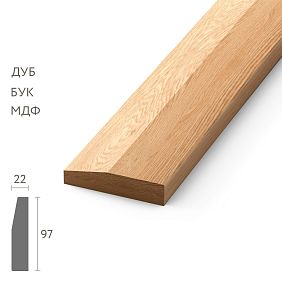


How to choose floor baseboards for a room: where to start
Before going to the catalog, it's worth answering a few questions. They take two minutes but save weeks of doubt and money on redoing.
What's on the floor? Laminate, quartz vinyl, parquet, engineered board, tile, linoleum — each flooring type has its own requirements for the skirting board. Not so much aesthetic as technical: base height, material, behavior under humidity.
What's the ceiling height? Up to 2.6 m — narrow profile. 2.6–3 m — standard. Above 3 m — tall, if the interior is classic. In modern minimalism, even with high ceilings, a compact straight profile is appropriate.
What's the interior style? Minimalism, Scandinavian, Japanese — straight or flatMDF Skirting BoardIn white or primed for painting. Classic, neoclassical —Wooden baseboard with soft relief or tall MDF.
What's the color of the walls and doors? The skirting board is not an isolated element. It lives within a system: wall, trim, door, furniture. A unified color logic is key to making a room look designed, not assembled piecemeal.




Why different rooms need different skirting boards
This is not a marketing claim. It's physics and visual logic.
Different loads. In the hallway, the skirting board gets daily hits from shoes, gets brushed by bags, and contacts outdoor moisture. In the bedroom, it lives in quiet and peace. The requirements for wear resistance are fundamentally different.
Different humidity. Kitchen and hallway are zones with variable humidity. A wooden skirting board here, without additional protection, will swell at the joints.MDF Skirting Boardwith closed enamel orPolyurethane skirting board— the right choice for such areas.
Different visual scenarios. The living room is a representative space where the skirting board can be more expressive. The bedroom is an intimate zone where the skirting board should support quietness, not compete with other elements.
Different area and proportions. In a small children's room of 12 sq. m, a high 100 mm skirting board visually eats up the wall height. A compact 55–60 mm one is the right choice.
Our factory also produces:


Which floor skirting board to choose for different rooms
Get Consultation
Baseboard for the bedroom
The bedroom is a space for restoration. Here, the logic of choosing a skirting board follows the atmosphere: nothing extra, nothing flashy, nothing that would distract the eye.
If the floor is parquet or engineered board made of oak, beech, walnut —Wooden skirting board for a roomin the same tint creates a sense of a single living material. The natural texture of the floor in the bedroom works as a quiet warm background.
If the floor is laminate or quartz vinyl —MDF skirting board for the bedroom60–70 mm in white or matching the wall color. In a light bedroom with white walls, a white baseboard 'dissolves'—exactly what is needed.
Baseboard height in the bedroom: for ceilings 2.6–2.8 m — 60–75 mm. Straight or flat profile — without relief, without accents.
Baseboard color for the bedroom:
-
White — universal, neutral, calm
-
Matching the wall color — the baseboard 'recedes', the space looks cohesive
-
Matching the floor covering — the floor visually expands
-
Paintable skirting boardIn dusty pink, gray-green, warm beige — for custom bedrooms with a pronounced color scheme
Baseboard for the living room
The living room is the most public room in the apartment. Guests are received here, and the first impression of the home is formed here. That is why the requirements for the baseboard in the living room are the highest—both in terms of quality and visual design.
In a living room with ceiling heights from 2.8 m, a tallWooden baseboard80–100 mm for oak parquet — an architectural element that completes the lower zone and sets the scale of the entire space. This is the level of professional design.
In a modern living room with quartz vinyl and white walls —Straight MDF skirting board70–80 mm in white. A clean horizontal line. No relief, no unnecessary shadow. The space breathes.
An additional designer move for the living room: walls finished withplank panelssolid wood, and a baseboard at the bottom made from the same species — a unified wooden system from the floor to the middle of the wall. Professional, organic, looks expensive.
Baseboard for a children's room
A children's room is a zone of increased load and reduced attention to decor for the sake of functionality and safety.
The baseboard in a children's room should be:
-
Durable — no polystyrene that crumbles from a toy impact
-
Smooth — without sharp edges, without deep grooves where dust accumulates
-
Easy to clean — just a damp cloth, and it's spotless
-
Neutral in color — white, light gray, pastel
Buy MDF skirting board for a child's room60–70 mm with factory white enamel — the optimal solution. If desired, it can be repainted when the child grows up and the interior changes.
Height: 60–70 mm for ceilings up to 2.8 m. Profile: straight or with a soft chamfer. Nothing sharp, nothing fragile.
Skirting board for the hallway
The hallway is the most heavily used room in the house. Daily traffic, outdoor shoes, wet umbrellas, impacts from bags and children's bicycles against the wall. The skirting board in the hallway lives in extreme conditions.
The requirements here are clear: durability, resistance to cleaning chemicals, minimal moisture absorption.
MDF skirting board for the hallwaywith factory coating — a practical choice. The sealed enamel does not absorb moisture, wipes clean easily, and retains its color for years. A height of 70–80 mm ensures reliable coverage of the expansion gap under any flooring.
For an entryway with tile or porcelain stoneware — polyurethane baseboard 50–60 mm: moisture resistance, easy installation, neat white outline.
Important nuance: the joint between the baseboard and the wall and floor in the entryway should be sealed with caulk. Water during cleaning should not penetrate under the baseboard.
Kitchen skirting
The kitchen is a special zone. Here, the baseboard encounters grease vapors, water splashes, spilled liquids, and regular wet cleaning. Decorative appeal gives way to practicality.
MDF floor baseboard for the kitchen in white or light enamel — the optimal choice. A smooth surface without texture is easy to clean. Height 60–70 mm.
For kitchens with tile or quartz vinyl — properly join the baseboard to the flooring with caulk: this will prevent water from getting under the baseboard during cleaning.
Wooden baseboard in the kitchen — only with reliable multi-layer varnish or oil coating. Without protection — risk of swelling near the sink and during cleaning.
Skirting board for a study
The office — a workspace that requires order, strictness, and a professional appearance. Here, the baseboard should be neat, restrained, and match the overall character of the room.
If the study has dark oak parquet and wooden furniture —buy a wooden skirting board for the studyto match the same tint. This is a unified design language: oak desk, oak floor, oak skirting board.
For a study with laminate or vinyl flooring —Straight MDF skirting board70 mm in white or gray-white. Strict geometry, no decoration.
Materials for floor skirting boards: what suits living rooms
MDF skirting board for a room
MDF Skirting Board— is the most common choice for living rooms, and there are solid reasons for this.
The first — geometric stability. MDF is pressed under pressure, does not react to seasonal humidity changes. In an apartment with air conditioning in summer and radiators in winter, it maintains a straight line year after year without gaps or deformations at the joints.
The second — painting.MDF skirting board for painting for the room— is the ability to paint the skirting board in any color according to the RAL or NCS system. Pure white wall, warm gray, dusty blue, anthracite — without limitations. The paint applies without stains, evenly, in two coats.
Third — practicality of installation. Does not require acclimatization, installed immediately, cuts without special tools.
White MDF skirting board for the roomwith factory coating — the best-selling format. Suitable for any floor covering and any style.
Wooden skirting board for the room
Wooden floor skirting board for the room— is a different class, a different story. Not better and not worse than MDF, but — different.
The living texture of wood under clear varnish imitates nothing. It's oak — so it's oak. It's beech — so it's beech. Under oblique light, the fibers play, the surface breathes with organic warmth. No synthetic material can replicate this sensation.
Buy wooden skirting board for the roomwith parquet flooring made from the same wood species — is to create a space where materials converse with each other. Not compete — precisely converse.
Wooden skirting boards allow for restoration: sanding and repainting after 10–15 years. With proper care — they last 25–30 years without replacement.
Polyurethane and polystyrene skirting boards
Polyurethane Baseboards— a specialized option. They are not afraid of water. Lightweight. Installed with adhesive. Hold white color well in factory enamel. Application area: bathroom, toilet, wet kitchen zone.
In dry living rooms, polyurethane skirting boards are a compromise. Over time, slight yellowing and loss of geometry are possible. For bedrooms, living rooms, children's rooms — MDF or solid wood is better.
How to choose the height of the skirting board for a specific room
Height is the most common source of errors when choosing a skirting board. Bought 40 mm — doesn't cover the gap. Bought 120 mm — overwhelms the room.
Low skirting board (40–55 mm)
For small rooms up to 14 sq. m with ceilings 2.4–2.6 m. Suitable for quartz vinyl and thin laminate — sufficient. Creates a feeling of lightness and airiness.Narrow MDF skirting board50 mm in white — a neat, quiet bottom line.
Medium height (60–80 mm)
Universal format for most apartments. For laminate 8–12 mm, engineered wood, quartz vinyl — covers the gap with a margin.MDF skirting board for a room70 mm — the most popular height. Works with ceilings 2.6–3 m in any style.
High baseboard (80–150 mm)
For spacious rooms with ceilings from 3 m. In a classic interior with parquet —Wooden baseboard100 mm forms the lower architectural belt. This is not just a baseboard — it's a design element that sets the scale of the entire room.
How to correlate baseboard height with doors and furniture
Door casing usually has a width of 70–80 mm. A baseboard taller than the casing looks unnatural. A baseboard lower is normal. Standard recommendation: baseboard height = casing width or slightly less.
If the baseboard and casing are the same material and color (for example, both —MDF for Paintingin white) — it's a unified system that looks professional.
Baseboard profile for a room: what looks better
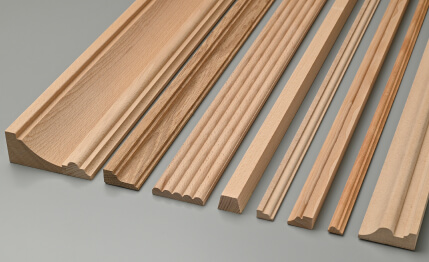
Profile is the cross-sectional shape of the baseboard. It's the profile that determines the character: strict or soft, classic or modern.
Straight profile
Vertical front face without bevels or recesses. The language of modern interior.Straight skirting board for a roomIn white or dark color — an absolutely neutral solution that fits any style from Scandinavian to loft.
Flat profile
Minimal projection thickness from the wall. The skirting board fits as tightly as possible.Flat skirting board for a room— for rooms with furniture against walls and for interiors where visual inconspicuousness of the lower boundary is important.
Classical profile with a round
Soft cove, bevel, or shaped cross-section.Wooden skirting board with a classical profilefor a living room with parquet — a lower decorative belt that completes a classical interior organically.
High decorative profile
In rooms with ceilings of 3 m and above, a high skirting board of 100–150 mm with an architectural cross-section becomes an independent design element.Wooden skirting board for the living room100 mm oak under varnish is the level of the project, not just finishing.
How to choose the color of the skirting board for the room
Color is a strategy. There are four working schemes, and each creates a certain effect.
White skirting board for the room
White is a universal and the most popular choice.White skirting board for the roomBuying it is a one-time solution to settle the color issue once and for all. It works with any wall color, any covering, in any style.
In a dark room with dark walls, a white baseboard creates a light stroke near the floor — the space 'breathes'. In a light room — a neutral border that doesn't demand attention.
Matching the wall color
A baseboard matching the wall color disappears. The floor-to-wall transition becomes seamless. Visually, the wall 'descends' onto the floor, making the space feel taller. Especially effective in small rooms.
Paintable baseboard for a room allows you to achieve the exact wall shade — no approximations, no mismatches.
Matching the floor color
The baseboard blends into the flooring. The floor visually 'grows' — rises toward the wall. A good technique for small rooms: the space appears larger.
Wooden skirting board for a room matching the parquet — a unified wooden plane from the flooring to the wall.
Contrasting baseboard
A dark baseboard on a light floor or a light one on a dark floor — a deliberate visual stroke. A lower graphic line that shapes the room's rhythm.— is a horizontal element that frames the room at the bottom of the walls where the wall meets the floor. Skirting boards perform several functions: they hide the technological gap between the wall and floor covering (necessary for thermal expansion), protect the lower part of the wall from mechanical damage, create visual completion, and may conceal wiring. in anthracite or dark graphite under light quartz vinyl — a professional designer move. Bold, modern, memorable.
Which baseboard to choose for the flooring in a room
For laminate flooring in a room
Laminate is installed using a floating method with an expansion gap of 8–15 mm.Skirting board for a room with laminate— MDF 65–80 mm, installation only to the wall. The skirting board must not press the laminate against the wall: the flooring should be able to 'breathe' freely with temperature changes.
For quartz vinyl
Quartz vinyl expands minimally. Gap 5–8 mm. A compact profile of 50–65 mm is suitable.MDF skirting board for a room— in white or paintable — is optimal.
For parquet in a room
Solid wood parquet — large expansion gap up to 20 mm. Requires a baseboard height from 75 mm.Wooden skirting board for a room— from the same wood species — a unified natural environment.Buy solid wood skirting board— for parquet — a proper investment in the long-term appearance of the interior.
For engineered wood
Gap 8–12 mm.Wooden baseboardunder the top layer of engineered board wood orMDF for Paintingin a tint matching the color of the coating.
For linoleum
Linoleum is a practical flooring. Here, it is justifiedMDF Skirting Boardin white 60–70 mm. Wooden is an excess that is not justified either visually or financially.
For tile
In the bathroom and toilet —Polyurethane skirting board. In the living room or hallway with porcelain tile —MDF Skirting Boardin white or a dark tone matching the color of the tile.
MDF or wooden skirting board: which is better for a room
This is the most common question. We answer specifically.
| Parameter | MDF skirting board | Wooden skirting board |
|---|---|---|
| Appearance | Neat, even | Live texture, organic |
| For painting | Ideally | Good (after priming) |
| Stability | High | Requires acclimatization |
| Restoration | No (replacement if damaged) | Yes (sanding and repainting) |
| Price | Below | Higher |
| Under parquet | Good | Excellent |
| Moisture resistance | Medium (with closed coating) | Medium (needs lacquer/oil) |
Conclusion for an apartment: with laminate, quartz vinyl, and linoleum —MDF Skirting BoardFor parquet, solid wood, engineered board —Wooden baseboardIn a white modern interior — MDF. In natural wood — solid wood.
How to buy floor skirting for a room without mistakes
Use this checklist before placing an order.
-
Room type — bedroom, living room, hallway: each has its own requirements for wear resistance and moisture resistance
-
Floor covering — determines the minimum skirting height and material requirements
-
Ceiling height — determines the maximum appropriate profile height
-
Interior style — classic, minimalism, Scandinavian: determines the profile type
-
Wall and door color — determines the skirting color strategy
-
Profile type — straight, flat, classic: make sure the profile matches the style
-
Surface finish — factory enamel, ready for painting, varnish, or oil
-
Trim allowance — +10–15% of room perimeter for corner cutting
-
Accessories — internal and external corners, end caps, transition profiles
-
Installation method — liquid nails to wall (not to flooring!)
What STAVROS offers for floor skirting in a room
For those looking for buy baseboards for a room— a ready, precise, and beautiful solution — STAVROS offers a full range for any scenario.
MDF Skirting Board— straight and classic profiles in white factory enamel, ready for installation. For bedroom, living room, nursery, hallway.
— is a horizontal element that frames the room at the bottom of the walls where the wall meets the floor. Skirting boards perform several functions: they hide the technological gap between the wall and floor covering (necessary for thermal expansion), protect the lower part of the wall from mechanical damage, create visual completion, and may conceal wiring.— primed surface for painting in any RAL system color. For those who want exact color matching to the interior.
solid wood baseboard— profiles made of oak and beech for rooms with parquet and engineered board. For clear varnish, oil, white enamel. Restorable, durable, natural.
polyurethane baseboards— for wet areas: kitchen, bathroom, hallway with outdoor traffic.
When besides the baseboard, the walls also need to be addressed —slatted panels for wallsa unified system is created from the same material: floor — baseboard — panels — ceiling.
FAQ: answers to popular questions about floor baseboards for a room
Which baseboard is best for a room?
Depends on the flooring and style. 70 mm white MDF is a universal choice for most rooms with laminate or quartz vinyl. Oak or beech wood is for rooms with parquet and a natural interior.
Which baseboard to choose for a bedroom?
In a bedroom with parquet —Wooden baseboard65–75 mm matching the same wood species. In a bedroom with laminate or quartz vinyl —65–70 mm MDFin white or a pastel tone.
Which skirting board to choose for the living room?
For a modern living room — straightMDF 70–80 mm. For a classic one with parquet —wooden 80–100 mm with a classic profile.
Which skirting board to choose for the hallway?
MDF 70–80 mm with factory enamel orpolyurethane with tiles. The main requirement is resistance to cleaning moisture and mechanical loads.
MDF or wooden skirting board — what to choose for a room?
MDF — for laminate, quartz vinyl, painting in any color. Wood — for parquet, natural interior, long-term use with restoration.
What color of baseboard to choose for a room?
White — universal. Matching the wall color — the baseboard "disappears." Matching the floor tone — the floor expands. Contrasting dark — a modern accent.
Is a white baseboard in a room a good idea?
Excellent.A white MDF baseboard creates visual continuity with white door casings, white ceiling cornices, and white window frames. When all architectural details are executed in the same color, they form a unified system, a spatial framework that connects disparate elements — floor, walls, ceiling, furniture — into an integral composition. This technique is fundamental to Scandinavian design, where white architectural decor creates a light shell within which the most diverse colors and textures can coexist.Works with any wall and floor color, in any style. It is the safest and simultaneously professional choice.
What height of baseboard to choose for a room?
Up to 2.6 m ceilings — 55–65 mm. 2.6–3 m — 65–80 mm. From 3 m in a classic interior — 80–150 mm.
What baseboard is best for laminate in a room?
MDF 65–80 mmStable, covers the expansion gap, mounts to the wall—not to the laminate.
Which baseboard profile looks modern in a room?
Straight or flat without relief.Straight MDF for painting.Or with white factory enamel—the most modern format.
Can one baseboard be used in all rooms of an apartment?
Yes, and it's the correct approach. A uniform material, height, and color of baseboard in all rooms creates visual cohesion of space when moving from one room to another.
How to calculate the amount of baseboard for a room?
Perimeter of the room in linear meters minus the width of door openings plus 10–15% reserve for cutting corners and joints. Standard strip length is 2.5 m.
Are accessories needed for the baseboard?
Yes. Internal and external corners, end caps, connectors — they should be the same color and profile as the main baseboard.
A baseboard for a room is a detail that is not intentionally seen. But it is always felt. Properly chosen, it completes a room as if it were designed by an architect. An improper one leaves a feeling of something unfinished, random.
STAVROS Company is floor baseboard for a room made from natural materials: MDF, solid oak and beech, solutions For painting in any color. Production in Russia, real samples for selection, a range for any interior — from a modern studio apartment to a classic country living room. STAVROS — where the final detail becomes part of your space's character.