








































Article Contents:
- What polyurethane foam is and why it is called foam rubber
- Polyurethane base and cellular structure
- Is polyurethane foam the same as foam rubber?
- What characteristics are needed for rigid stucco
- Why you cannot apply the properties of cheap foam plastic to all polystyrene
- What is better for simple finishing
- What is better for complex ornament
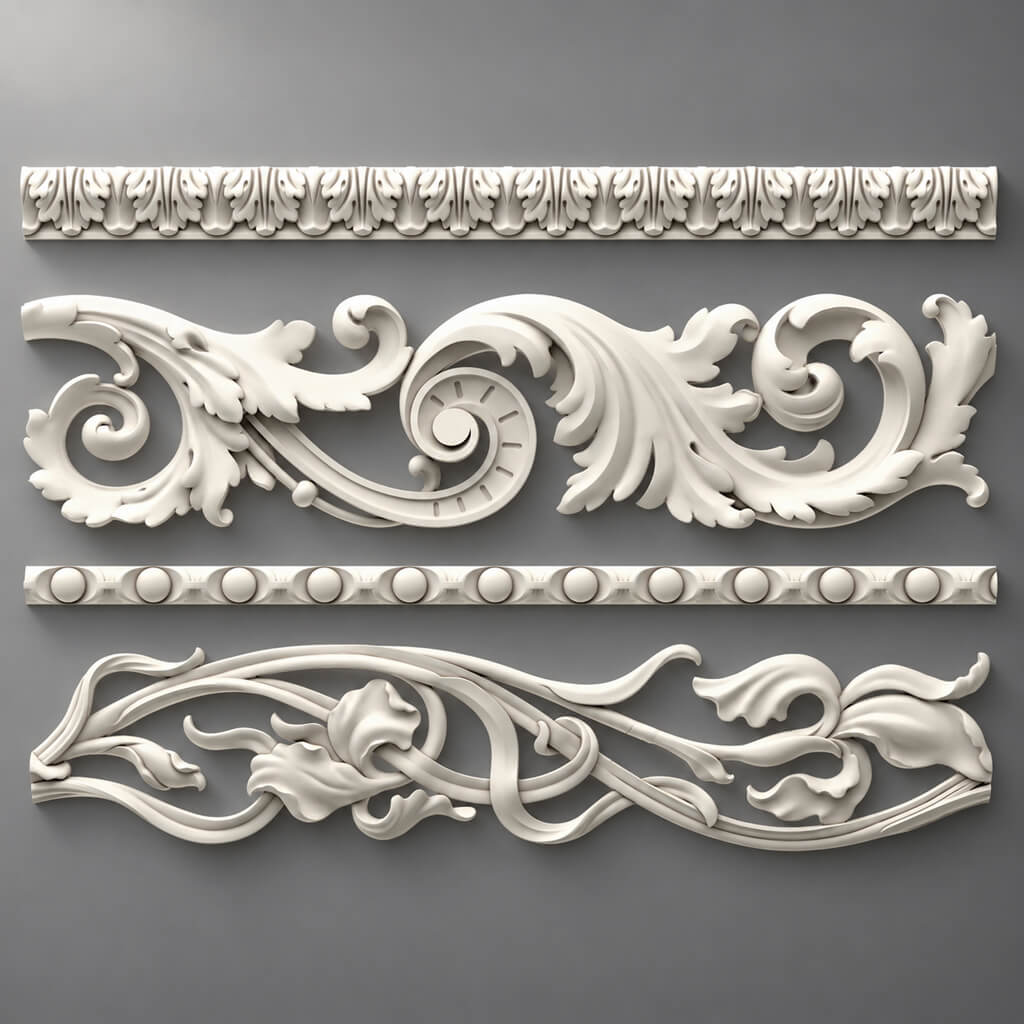
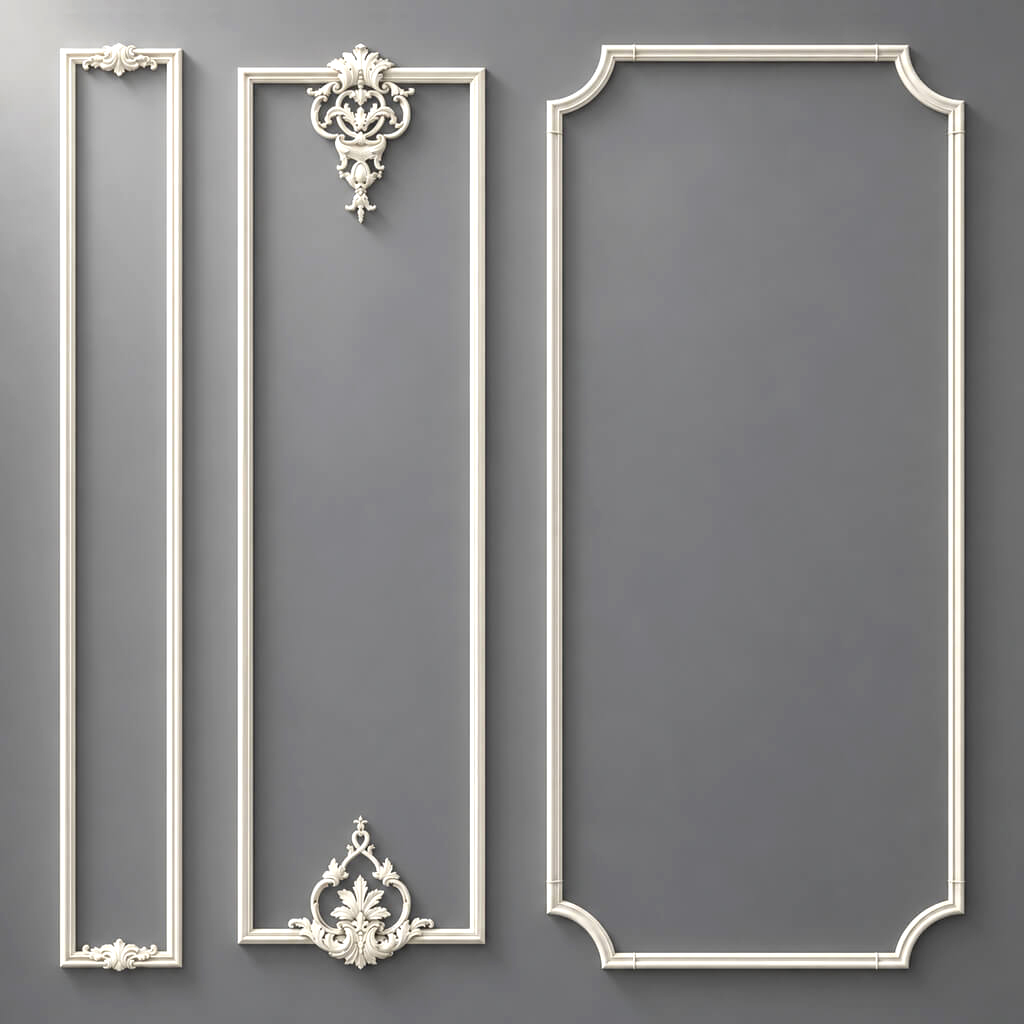
- Slim molding MLDPU-001
- MLDPU-002 profile for frames
- Wide MLDPU-003
- Corner and center pieces
- Option one: a single simple line
- Option two: a frame with a pronounced profile
- Option three: a frame with corners and center accents
- Example: three frames measuring 1200 × 1400 mm
- What changes with corner overlays
- Is polyurethane foam the same as foam rubber?
- How is polyurethane foam different from foam rubber?
- Is there such a thing as rigid polyurethane foam?
- What is the difference between polyurethane and polyurethane foam?
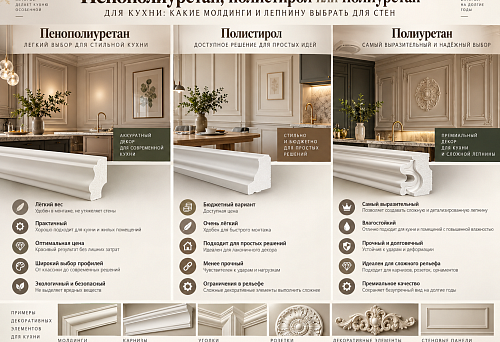
- How does polyurethane foam differ from polystyrene?
- Are decorative moldings made of polyurethane foam?
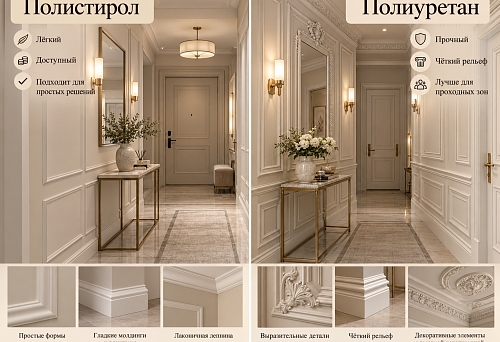
- Which is better for wall moldings — polyurethane or polystyrene?
- Which STAVROS moldings should I choose for decorative frames?
- Which overlays are compatible with MLDPU-002?
- Where to buy polyurethane molding?
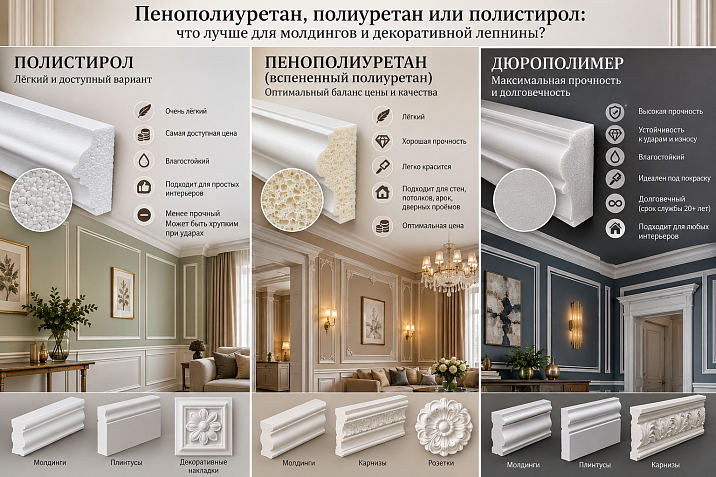
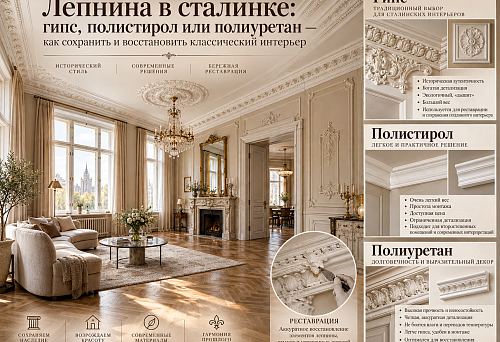
A buyer choosing a molding for a wall sees three names: polyurethane, polyurethane foam, and polystyrene. The last one is relatively clear — it is a different polymer. But the first two names raise a question: if polyurethane foam is associated with soft foam rubber, why are rigid decorative parts made from it?
The reason is that polyurethane foam is not a synonym for foam rubber and not a separate polymer from polyurethane. It is the name for a polyurethane material with a cellular structure. It can be soft, elastic, semi-rigid, and rigid. For architectural decor, special rigid formulations exist that can hold the profile shape and reproduce complex relief. Ordinary foam rubber is indeed not suitable for this task.
When purchasing, however, it is not enough to see the word “polyurethane” on the packaging. You need to check the intended purpose of the finished product, its dimensions, geometry, compatibility with decorative overlays, and installation recommendations. For example, the STAVROS catalog presents Polyurethane moldings — moldings, overlays, and elements for wall compositions. The product pages specify a polyurethane base; the exact type of internal structure of each item cannot be determined from the name alone.


What is polyurethane foam and why is it called foam rubber

Polyurethane base and cellular structure
Polyurethanes are a large group of synthetic polymer materials. They are produced using components that undergo a chemical reaction with each other to form a polyurethane structure. By varying the composition of the components and the manufacturing technology, the manufacturer can obtain an elastic coating, a dense molded material, a soft foam, or a rigid foam.
Foam is distinguished by the presence of cells: the material contains numerous small cavities. These arise during the foaming of the mixture. The cells may be predominantly open or closed, and their size, distribution, and proportion of the volume vary. That is precisely why the expression "foamed polyurethane" still says nothing about the suitability of a particular blank for stucco work.
The technical distinction is confirmed by the description of flexible polyurethane foam from the industry manufacturers' association and by the data from the manufacturer of molding materials on rigid polyurethane foams for cast parts. These are different applications within the same material family.
A small cell structure does not in itself mean that the finished face surface will be porous. Some molded products may develop a denser outer layer, while others require additional surface preparation. How smooth the part will turn out and whether it can be painted without defects is determined by the characteristics of that specific product.
Our factory also produces:



Is polyurethane foam the same as foam rubber or not?
In everyday speech, foam rubber refers to flexible elastic polyurethane foam, which compresses under load and then recovers its shape. It is used in furniture cushions, mattresses, and upholstery. This is one of the varieties of polyurethane foam, not a definition for the entire group.
Rigid polyurethane foam is intended for different tasks. It should not behave like sofa filling: it is valued for maintaining geometry, its relatively low weight for a given structure, and its moldability. Such materials are used, in particular, for thermal insulation and certain types of architectural decor. At the same time, thermal insulation foam and a molding compound for a decorative overlay are not interchangeable products.
Imagine two parts of the same size: a soft furniture seat block and a rigid decorative ornament. Both products may belong to the polyurethane foam family, but they have different compositions, production methods, surface characteristics and permissible loads. Comparing them by name alone is meaningless.
Get Consultation
What characteristics are needed for rigid stucco
For a decorative part, not only density matters, but also flexural strength, impact resistance, dimensional stability, the quality of the front surface and behavior during processing. High density without a suitable formulation does not guarantee the strength of a thin protrusion of the ornament. A lighter, properly designed element, on the contrary, can meet the requirements of its task.
If a seller claims that a molding is "strong because it is polyurethane foam," ask for the data sheet, instructions, or at least the manufacturer's data on the product's intended use. A wall needs a decorative profile, not an arbitrary piece of construction foam with a similar name.
Polyurethane foam and polyurethane: what is the difference
Here we are not comparing two independent chemical families, but rather the general name of a polymer and one variant of its structure. Polyurethane can be either foamed or unfoamed; quite rigid or elastic. Polyurethane foam necessarily has a cellular structure, but it does not have to be soft.
For a practical choice, it is better to separate several questions. First, what polymer is the part made of? Second, what is its structure? Third, what characteristics are achieved in the finished product? And fourth, what load and surface is it intended for?
The example of a wall molding is illustrative. Even if two profiles look equally white and smooth, one may have a dense structure and the other a cellular core. On a wall, both can serve as a decorative line when properly designed. But their properties and limitations cannot be determined from a photo of the front side.
In the product listings for STAVROS polyurethane products, the wording "two-component polyurethane" appears. It indicates the type of material used and the method of obtaining it from components, but by itself it is not a data-sheet confirmation of the absence or presence of cells in each product. If necessary, exact figures should be clarified with the manufacturer.
For the buyer, this is more useful than arguing about the term. If a straight thin contour is needed, first check the cross-section, length and cut quality. If a three-dimensional stucco composition is required, additionally evaluate the relief, the dimensions of the overlays and the ability to assemble a coordinated system.
How polyurethane differs from polystyrene
Polystyrene is a standalone polymer base. It is used to produce both lightweight foamed parts and dense decorative profiles. It would be a mistake to compare only soft foam rubber with a single type of polystyrene molding: such a comparison says nothing about architectural stucco.
| Criterion | Polyurethane | Polystyrene |
|---|---|---|
| Polymer base | Polyurethane | Polystyrene |
| Structure | Cellular, with properties per formulation | Can be foamed or dense |
| Rigidity | From soft to high | Depends on the product type and technology |
| Decorative profiles | Special rigid molded products are possible | Ready-made profiles of varying densities are available |
| Complex terrain | Possible with a suitable molding system | Capabilities depend on the technology and product range |
| Painting | According to the instructions for the specific product | According to the instructions for the specific product |
| Impact resistance | Cannot be determined by name alone | Cannot be determined by name alone |
| Price | Depends on the composition, shape, and product | Depends on the composition, shape, and product |
Why the properties of cheap foam plastic cannot be applied to all polystyrene
A lightweight foamed polystyrene cornice may noticeably yield to a dense profile when accidentally pressed. But this is not proof that all polystyrene is fragile. Impact-resistant polystyrene moldings are manufactured using different technologies and can be a good solution for simple straight sections.
Likewise, the presence of the word "foam" does not diminish a rigid polyurethane part. Compare finished products of similar purpose, similar cross-section, and surface quality, not extreme examples from different product groups.
Which is better for simple finishing
If you need to run a single horizontal line along a wall, a suitable polystyrene profile can handle the job without a complex molding system. What matters here is straightness, available length, clean joints, adhesive compatibility with the substrate, and suitable paintability. A decorative overlay is optional.
For the same task, the following are suitable Polyurethane moldings STAVROS. They are worth considering if a specific cross-section matters or if you plan to extend the line later with other pieces in the same design.
What is better for a complex ornament
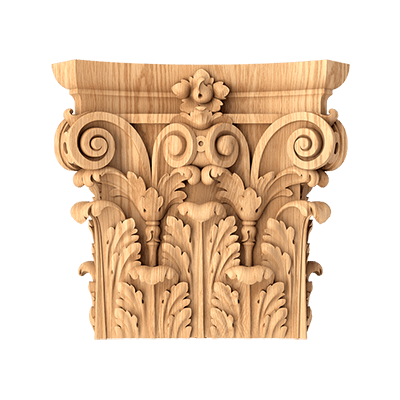
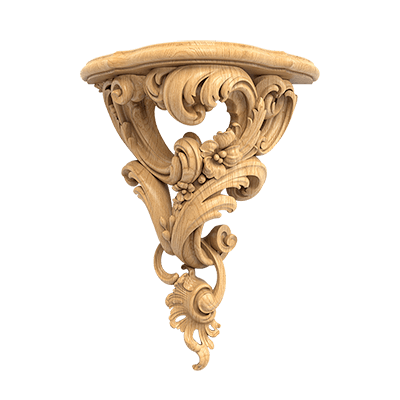
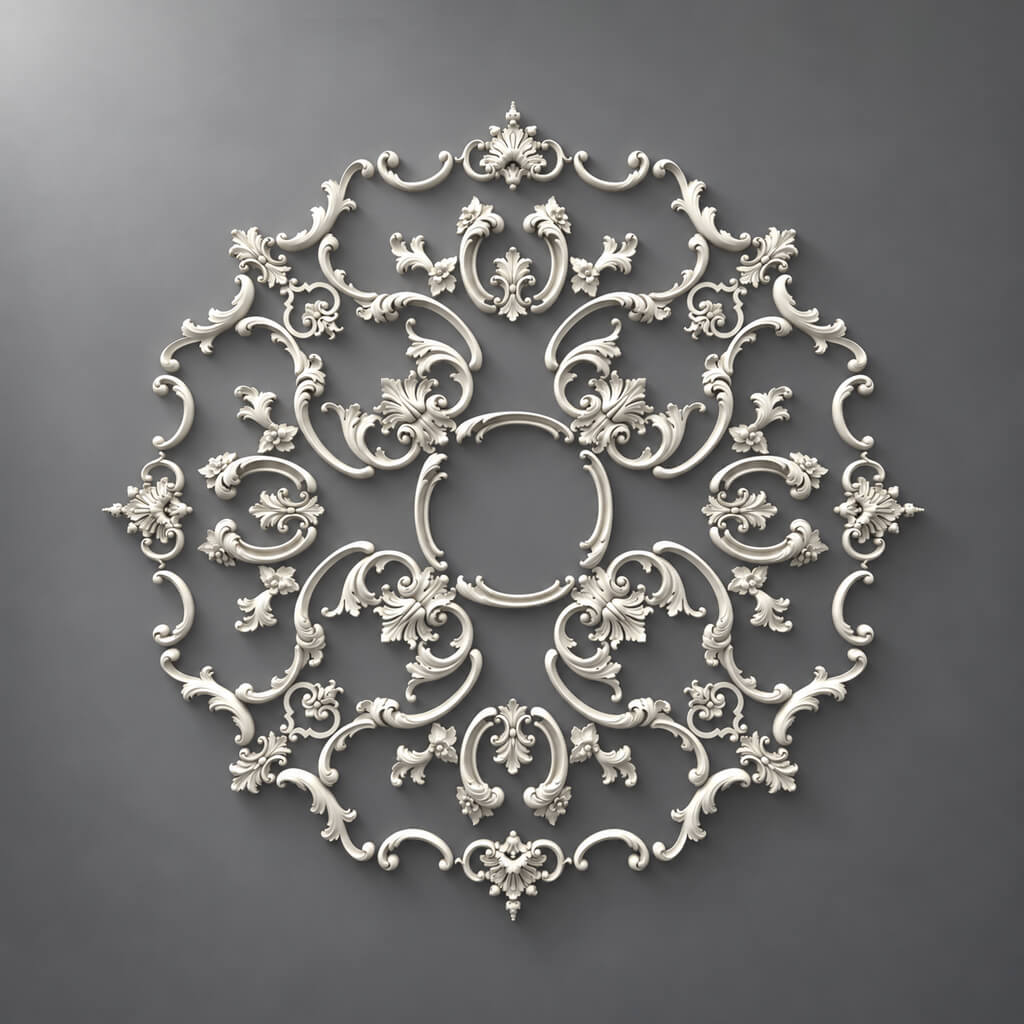
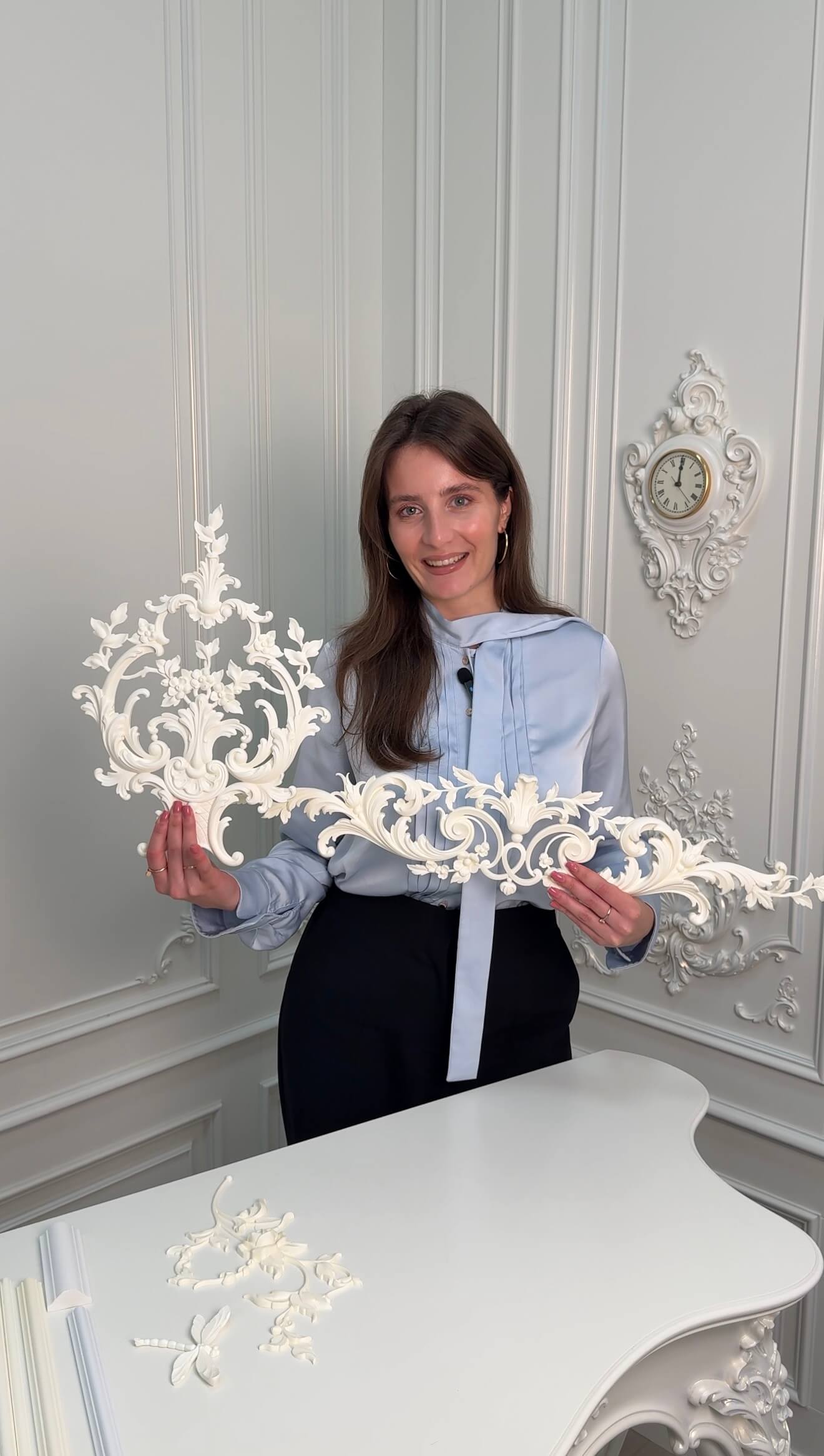
The range of ready-made forms matters here. A wide sheet garland, a central cartouche, or a relief corner place different demands on a product than a smooth molding. The deeper the ornament and the thinner its protruding parts, the more carefully you should check the production, the actual geometry, and the installation method.
STAVROS's advantage in this case is concrete: the company offers not only straight polyurethane profiles but also molded decoration made of polyurethane, which can be used to complement architectural lines on the wall. This is an advantage of the range and of coordinated solutions, not proof of the absolute superiority of any polyurethane over any polystyrene.
How to choose a molding: task first, material second
In practice, people often start with the question "which polymer is better," even though another parameter turns out to be decisive. For example, a small wall section needs a profile about 10 mm wide: it can be placed next to the casing without creating a heavy double frame. On a wide wall, such a contour sometimes gets lost; a 22 or 35 mm profile gives a more pronounced shadow.
The correct selection sequence looks like this:
- Determine where the decor is located: on the wall, on a furniture facade, near a door, on the ceiling, or in an area of incidental contact.
- Set the purpose: a straight line, a frame, a central accent, or an intricate ornament.
- Measure the available space and choose a reasonable width and profile projection.
- Check whether ready-made corner and center elements are needed and whether they are compatible with the selected molding.
- Compare the price of the entire composition with alternatives, including cutting, adhesive, painting, and labor.
- Before ordering, confirm the actual material and installation documentation.
Not every surface needs stucco. If the wall is narrow, cluttered with door casings, or furniture overlaps the future frame, additional appliqués can worsen the composition. Sometimes a single neatly painted profile is enough, and sometimes it is worth forgoing even that.
Which STAVROS products are suitable for wall stucco
The catalog allows you to assemble both thin geometric lines and more voluminous frames. Below are the dimensions of specific models as specified by the manufacturer. The material in the product cards is polyurethane; the table does not establish which variety by internal structure each model belongs to.
| STAVROS product | Size, mm | What to consider it for |
|---|---|---|
| MLDPU-001 | 10 × 6 × 2600 | Slim contours, narrow frames and furniture fronts |
| MLDPU-002 | 22 × 11 × 2600 | Main profile of a classic wall frame |
| MLDPU-003 | 35 × 12 × 2600 | A more expressive architectural division of the wall |
| MLDPU-2U-1.1 | 210 × 210 × 18 | Corner ornament of the 002 series |
| MLDPU-2-2.1 | 235 × 237 × 21 | Central ornament of the 002 series |
| NPU-316 | 28 × 200 × 6 | Vertical plant motif on a flat surface |
Slim moulding MLDPU-001
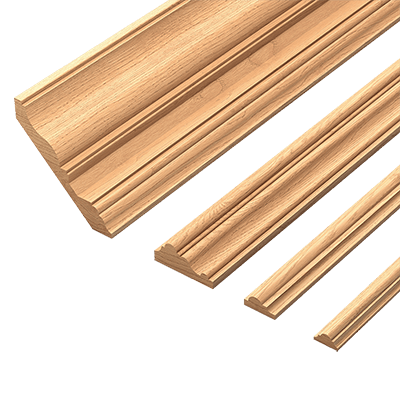
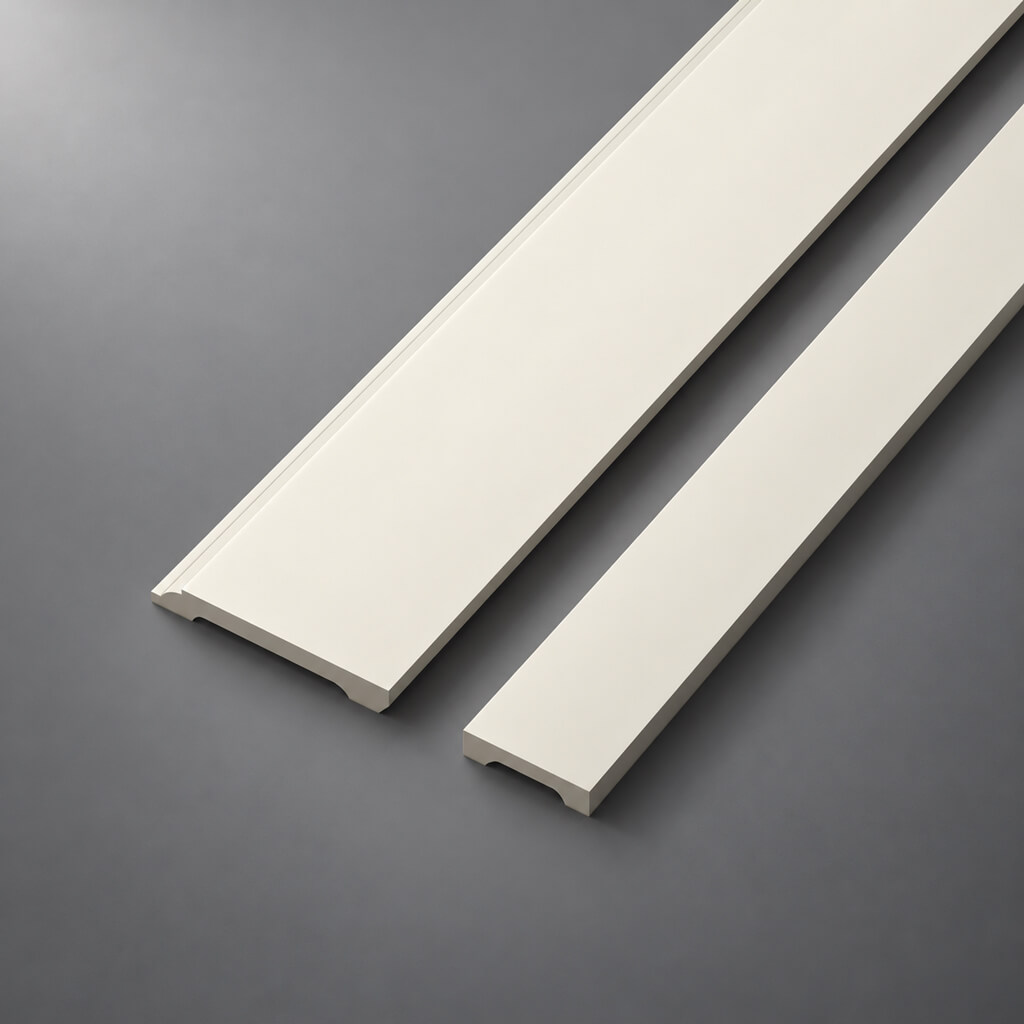
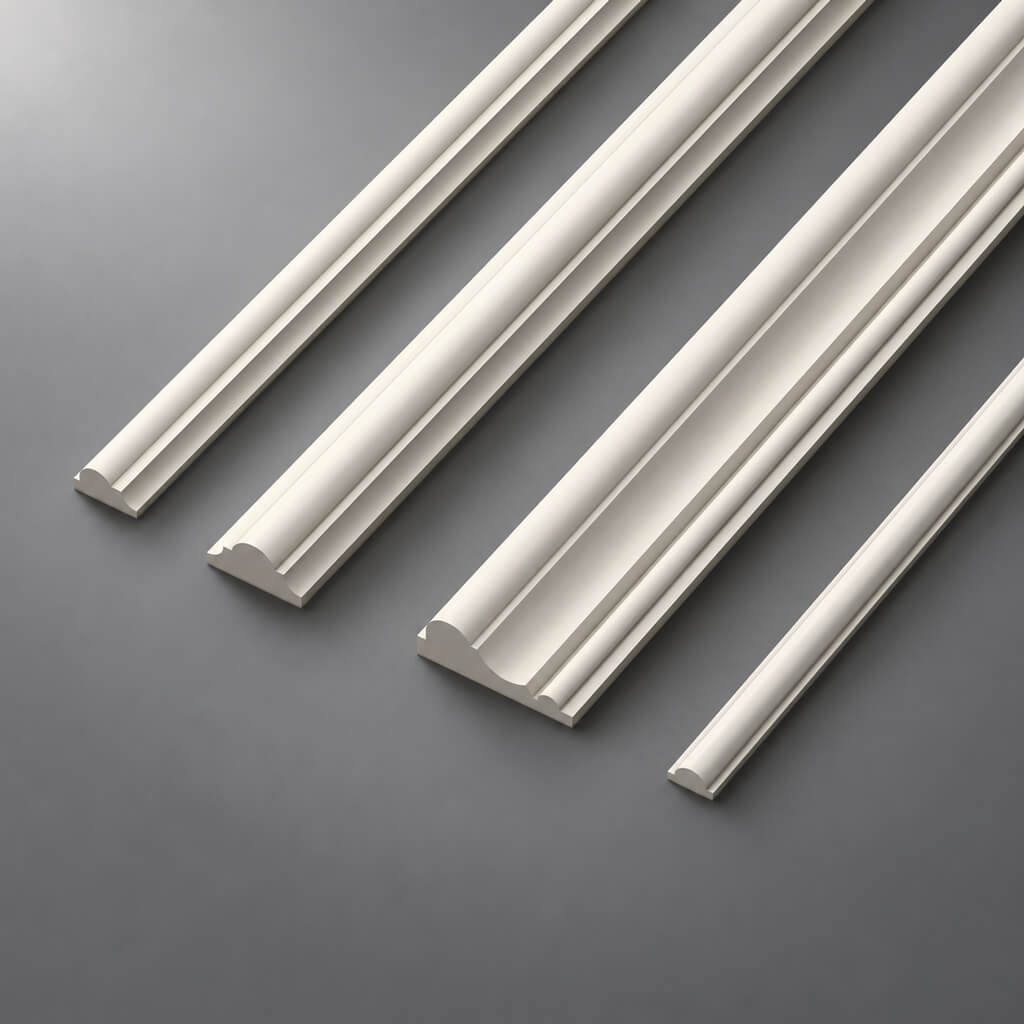
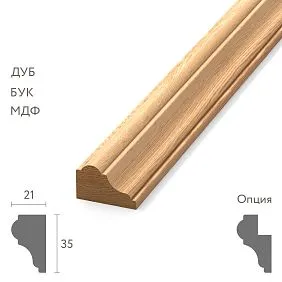
For a minimalist finish, the following is suitable polyurethane molding MLDPU-001. Its 10 × 6 mm cross-section allows you to outline a small decorative field without taking up much space. For example, if there are wall sections about 250 mm wide on the sides of a doorway, a large relief frame will compete with the casing. A thin line usually looks calmer.
MLDPU-002 profile for frames
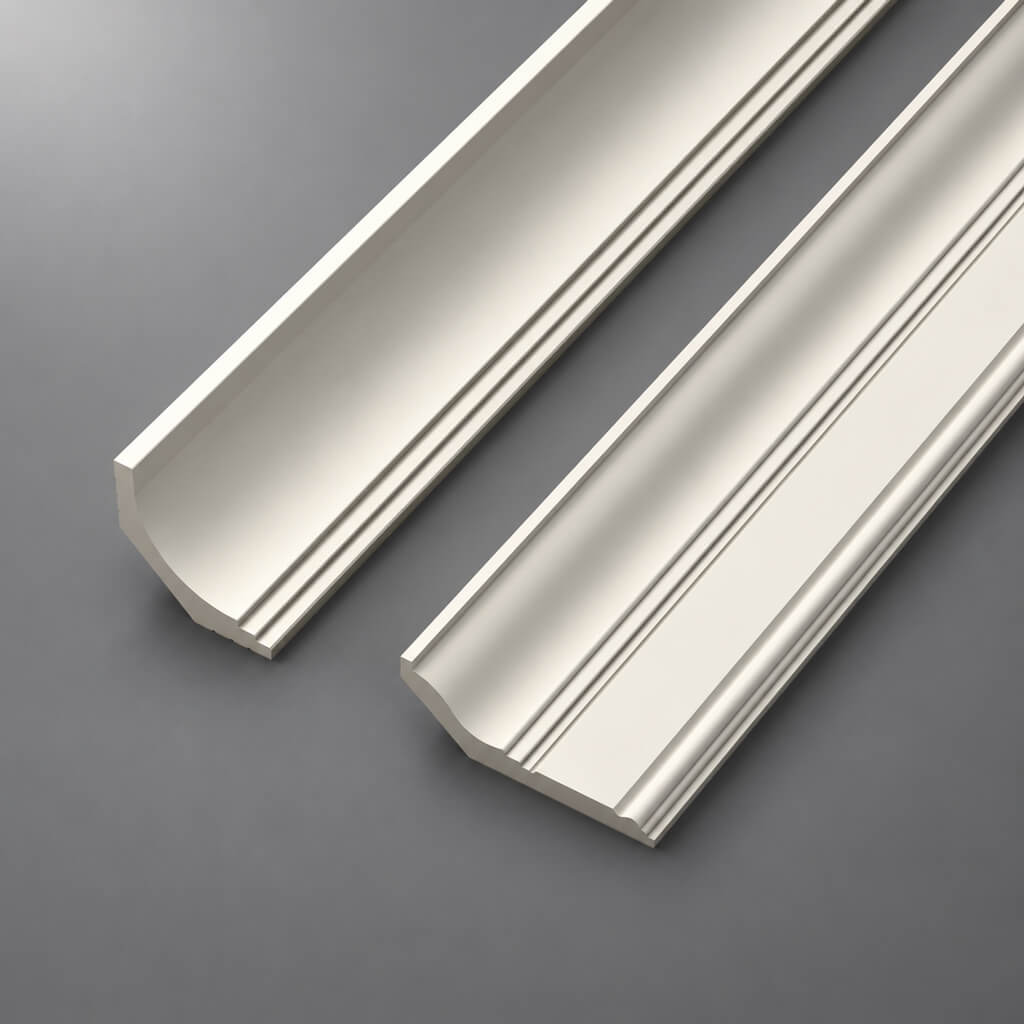
Polyurethane molding MLDPU-002 has a cross-section of 22 × 11 mm. Its stepped geometry creates more pronounced light and shadow, especially when lit from the side. It has specially designed decorative additions; therefore it is suitable when the task goes beyond a simple outline.
If a composition is planned across several walls, repeating the same profile helps to tie the interior areas together. However, the same product does not necessarily have to be used everywhere: a narrow wall section may require a smaller frame or no central overlays.
Wide MLDPU-003
Decorative molding MLDPU-003 has a width of 35 mm and a projection of 12 mm. On a large surface, such a cross-section creates a more noticeable architectural pattern than a thin glazing bead. In a small room, it is worth holding it against the wall before buying the entire batch: a profile that looks good on a separate sample may turn out to be overly prominent next to a low door and narrow wall sections.
Corner and central pieces
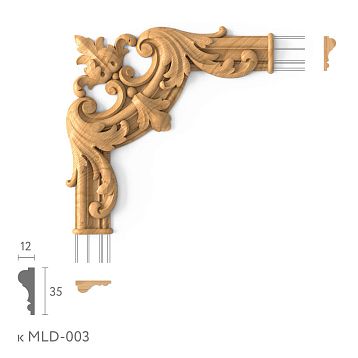
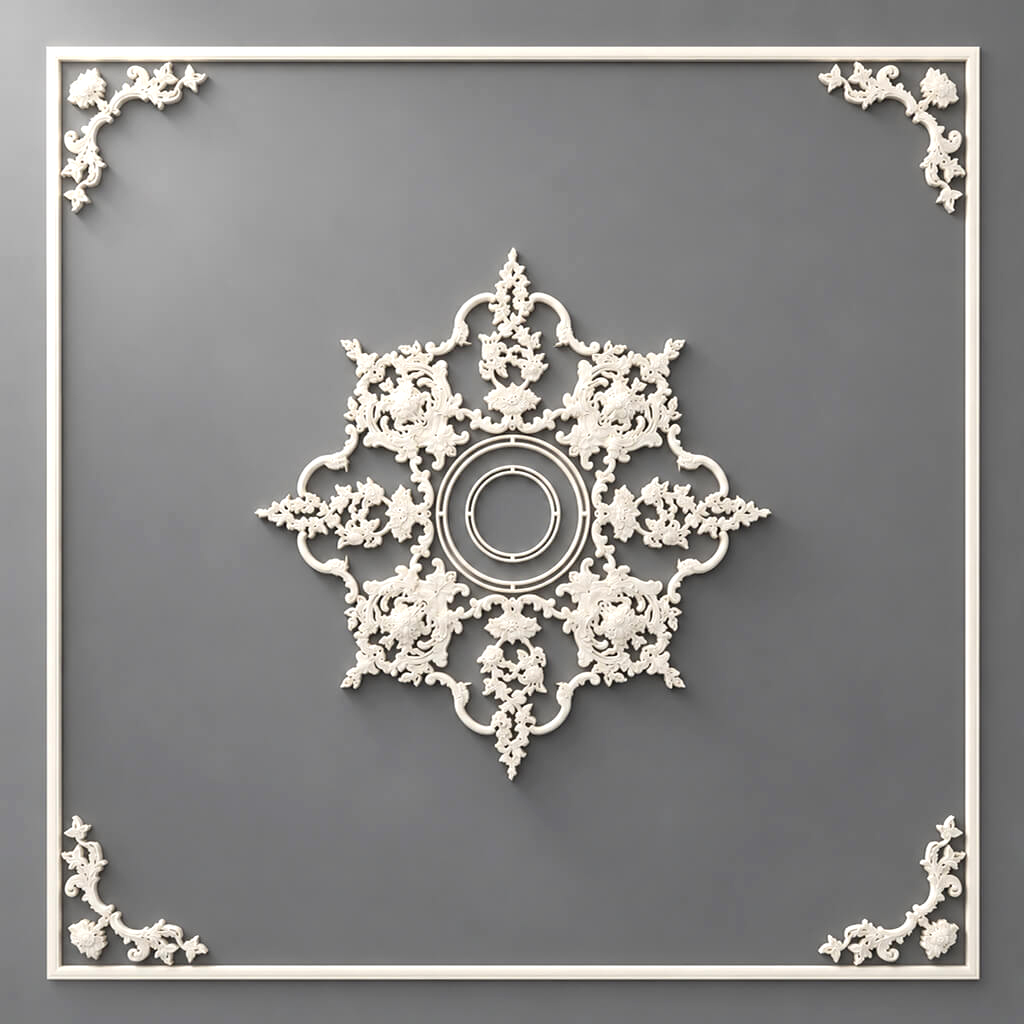
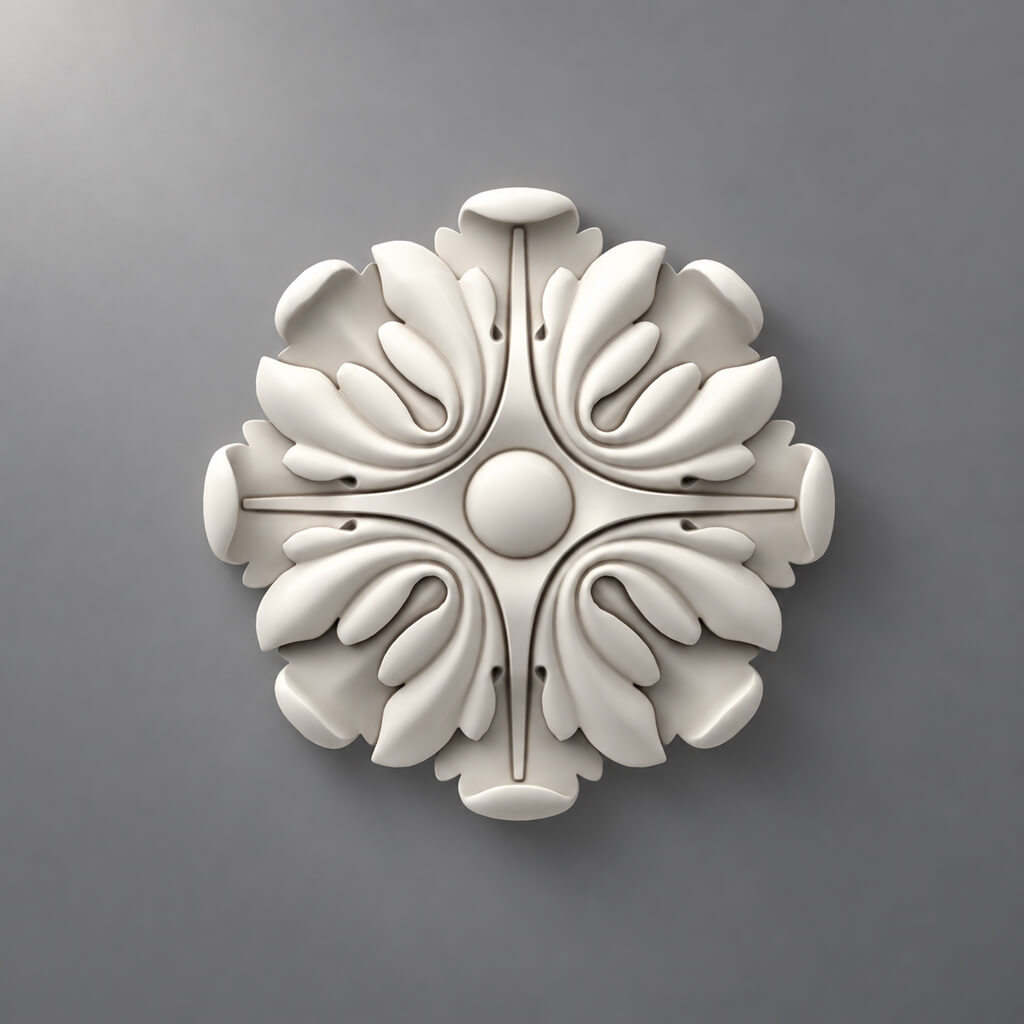
The series 002 system includes corner stucco MLDPU-2U-1.1 measuring 210 × 210 × 18 mm and central stucco MLDPU-2-2.1 measuring 235 × 237 × 21 mm. They are designed for the corresponding moulding and allow individual decorative frame components to be finished.
They cannot be considered universal end caps for any profile. Even if two mouldings are similar in width, the shape of the relief, the projection and the joint location may differ. Before cutting, download the drawing of the specific overlay, determine the actual connection points and do a test fit.
For a small vertical ornament, you can separately use the NPU-316 overlay measuring 28 × 200 × 6 mm. This is a standalone flat accent, not an automatically compatible corner element of any moulding system.
Three wall design options: from a line to a stucco composition
Option one: a single simple line
Imagine a smooth painted wall 3.5 m wide. You need to emphasize the horizontal transition between two shades or delimit a small area. You can install a single thin polystyrene moulding if its characteristics match the installation location. There is no practical reason to overpay for a complex ornament that is not used here.
An alternative is the polyurethane MLDPU-001. Its small cross-section works precisely as a line, not as a standalone stucco detail. For such a design, the buyer needs an accurate length calculation, joining if necessary, and careful painting.
Option two: a frame with a pronounced profile
On a wall 3.2 m wide, you can place two identical rectangular frames, provided this does not conflict with furniture and doorways. MLDPU-002 suits the character of the relief: it has stepped transitions that make the frame noticeable even when painted in the wall color.
Here the outer contour matters more than the material in an abstract sense. A frame that is too narrow with a large profile looks compressed. One that is too wide on a small wall can create the impression of random marking. First determine the actual dimensions of the frames along the axis or the chosen cut line, then try on the profile, and only after that calculate the order.
Option three: a frame with corners and central accents
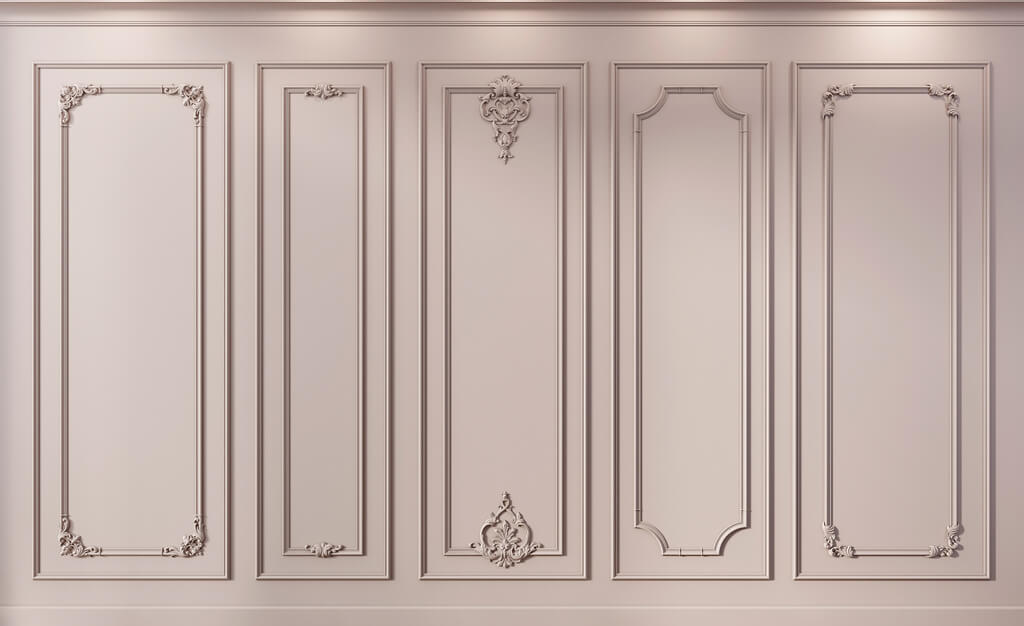
For a spacious hall, you can assemble a composition from MLDPU-002, compatible corner and central overlays. The straight line sets the structure, the corners emphasize the boundaries, and the central piece completes the ornamental program. The result is an architectural treatment that cannot be described by the price of a single linear meter.
But not every frame can withstand four large corner pieces of 210 mm each and a central element about 235 mm wide. If the side is small, the sections of straight profile between the overlays may become too short. Check the drawing before ordering. For a compact panel, it is sometimes better to leave ordinary mitered joints and place one overlay separately above the frame.
It is precisely the availability of coordinated components that makes decor for polyurethane moldings in demand in projects with elaborate stucco work. However, consistency does not eliminate the need to measure the wall and check the scale.
How to calculate moldings and get the number of strips right
The total footage shows only the lower limit of consumption. A strip has a specific length, and each side of the frame must come out solid or have a joint provided for in advance. Extra joints are especially noticeable on a painted profile with pronounced relief.
Example: three frames measuring 1200 × 1400 mm
Suppose three frames are planned for the wall. The dimensions given here are conventionally measured along the profile cutting line; this refers to straight joints without separate decorative corners. Each frame requires two pieces of 1200 mm and two of 1400 mm.
The perimeter of one frame: 2 × (1200 + 1400) = 5200 mm. For three frames — 15,600 mm. The MLDPU-002 strip is 2600 mm long. Dividing 15,600 / 2600 gives six strips. But this is only a calculation based on total length, and without allowance for saw kerf losses.
Seamless cutting will require nine strips. Six separate strips will go to the six 1400 mm pieces: next to each of them, a 1200 mm segment will no longer fit given the kerf width. Another three strips will yield two 1200 mm pieces each. The kerf width and actual allowances must be confirmed with the installer.
| Segment group | Quantity | How to arrange on 2600 mm strips |
|---|---|---|
| 1400 мм | 6 | One piece from each of the 6 strips |
| 1200 мм | 6 | Two pieces from each of the 3 strips |
| TOTAL | 12 pieces | 9 planks |
If intermediate joints are permitted, another scheme for using offcuts can be developed, but their position must be coordinated with the profile pattern and the finish coating. Saving material at the cost of noticeable breaks on the central wall is not always reasonable.
What changes with corner overlays
When using MLDPU-2U-1.1, straight sections end not at the geometric apex of a conventional miter cut, but near the decorative corner. The central overlay MLDPU-2-2.1 can also replace part of a straight line. Therefore, the previous nine strips cannot be automatically carried over into the estimate for frames with corner ornament.
First, determine from the manufacturer's drawings the abutment points of each element, then obtain the lengths of all straight segments and build a new cutting map. Count the overlays separately by piece. Their overall width is not always equal to the length of the section that should be subtracted from the molding line: the actual geometry of the joint is what matters.
What makes up the cost of decorative moulding
As of 22 October 2026, the verified STAVROS product listings show prices per single 2600 mm strip: MLDPU-001 — 1740 ₽, MLDPU-002 — 5460 ₽, MLDPU-003 — 7580 ₽. Accordingly, the approximate price per linear metre is about 669 ₽, 2100 ₽ and 2915 ₽. These are product prices, not prices for a finished installation; they must be checked before placing an order.
For the example above of three frames made from MLDPU-002, nine strips cost 9 × 5460 = 49 140 ₽. Packaging, delivery, adhesive, joint finishing materials, primer or paint, and labour may also be required. The MLDPU-002 listing separately mentions a charge for protective transport backing on small orders; this must not be quietly included in the price of the profile itself.
If you plan to decorate one frame with four MLDPU-2U-1.1 elements at 4490 ₽ each, the decorative corners will add 17 960 ₽. One central element MLDPU-2-2.1 costs 5350 ₽. But this is not a final estimate: after the overlays are installed, the straight profiles must be recalculated, and the number of decorative elements determined from the project.
For a standard straight run, a cheaper profile may make more economic sense. For a composition with ornaments, comparing materials by price per metre alone is no longer possible: the cost is largely determined by the artistic detail and the number of elements. Buyers searching for “Buy moldings” can start with the general catalogue, then select the required product group and check the exact item codes.
Installation: what depends on the product, not the material name
A decorative strip is held in place not “by polyurethane” but by an adhesive bond with a specific surface. If the plaster is flaking or the paint is not firmly bonded to the wall, the profile material will not fix the problem. The substrate must be dry, sound, free of dust and prepared in accordance with the adhesive manufacturer's recommendations.
For polystyrene and polyurethane products, you cannot automatically specify a single universal adhesive. Some solvents may damage certain polymer materials or coatings. Check the compatibility of the formulation with the decorative product and the substrate. If the manufacturer recommends a specific installation system, follow its instructions and curing conditions.
Cutting accuracy is especially important for stepped mouldings. On a simple smooth profile, a slight offset is less noticeable than on a piece with several relief lines. Before applying adhesive, do a dry fit, lay out the cut pieces in installation order and mark the front face.
Relief overlays are installed after checking axes and symmetry. They must not be bent to follow a curved surface unless such use is confirmed by technical documentation. A standard rigid profile should not be considered flexible merely because it is made of polyurethane.
Painting is carried out with a compatible material system. An excessively thick layer can fill fine veins of a plant ornament, and an unsuitable primer can impair paint adhesion. It is useful to first paint a small sample and check the result under the same lighting that will be present in the room.
Strength, moisture and safety: where the limits lie
The words "rigid", "dense" and "impact-resistant" denote different characteristics. A rigid part bends poorly, but this does not mean that its thin ends are resistant to impact. High density also does not eliminate a weak point in a narrow relief protrusion. For a passage corridor, it is better to choose not only a suitable material but also a profile that does not protrude much into the zone of accidental contact.
Moisture affects the entire structure: the decor itself, the adhesive layer, the paint and the wall base. Even if a polymer overlay does not swell like wood, installation on damp plaster may prove unreliable. For a bathroom or kitchen, additionally check the suitability of the entire coating system.
A separate limitation concerns temperature and fire. Neither rigid polyurethane foam nor polystyrene profile may be declared non-combustible or suitable for finishing an operating fireplace without documentation for the specific product and design solution. Decorative moulding is not fire protection. Do not place ordinary interior polymer elements near heat sources solely on the basis of external resemblance to gypsum.
Service life should also not be promised as a universal figure. It is determined by the composition and construction of the product, the base, installation, and the lighting and maintenance regime. If after several years only the paint is damaged, local preparation and repainting are sometimes sufficient; if the profile itself is coming away, the cause of the bond failure is first determined.
Eight mistakes when choosing polyurethane foam and decorative mouldings
1. Considering any polyurethane foam to be foam rubber. Because of this, the buyer rejects all cellular materials as unsuitable for decor. It is necessary to distinguish between soft and rigid compositions and to look at the finished product, not at the household name.
2. Imagining polyurethane foam as a polymer separate from polyurethane. Such a division creates a false choice between related materials. Check the formulation and structure if they are fundamental to the project.
3. Comparing soft foam with dense polystyrene molding. This results in an unequal comparison from the outset. Choose products with the same purpose and a similar cross-section, and evaluate their technical characteristics.
4. Buying molding based on a photo alone. On screen, a 10 mm glazing bead and a 35 mm architectural profile can look equally large. Check the drawing and place a sample against the actual wall.
5. Joining overlays from different series without checking. A color match does not guarantee matching relief and joint height. Use the manufacturer's compatibility information.
6. Calculating an order by simply dividing the total length by the length of one strip. Cutting produces short offcuts that cannot replace the long continuous sides of the frame. Create a cutting plan that accounts for the saw kerf.
7. Gluing onto a weak surface or with an unsuitable adhesive. In this case, the entire decorative line will peel off, regardless of its material. Check the substrate and the installation adhesive instructions.
8. Painting fine ornament with a thick coat. Small details become indistinct, and correcting it requires labor-intensive surface treatment. Choose a suitable coating and do a test paint.
Frequently asked questions
Our factory also produces:
Is polyurethane foam the same as foam rubber or not?
Foam rubber is the common name for soft, elastic polyurethane foam. But polyurethane foams can also be rigid. Therefore, it is correct to say that foam rubber belongs to polyurethane foams, but it is incorrect to consider any polyurethane foam to be foam rubber. For molding, you need to look at the rigidity, geometry, and purpose of the product.
What is the difference between polyurethane foam and foam rubber?
The general name of the group of cellular polyurethanes is being compared with one of its soft variants. Foam rubber is designed primarily for elastic compression. Rigid polyurethane foam is created for other tasks — for example, for molded parts or insulation. Specific characteristics depend on the formulation and production technology.
Is there rigid polyurethane foam?
Yes. Rigid polyurethane foams are widely used in industry, including in the manufacture of certain molded parts. Rigidity does not mean that all formulations have the same strength, and it does not prove that any rigid foam is suitable for interior moldings. A decorative product requires an appropriate surface and manufacturing technology.
What is the difference between polyurethane and polyurethane foam?
Polyurethane is a family of polymer materials; polyurethane foam is a variety of it with a cellular structure. Polyurethane can be foamed or unfoamed. In catalogs of finished decor, only the word "polyurethane" may be indicated; from that alone, it is impossible to reliably determine the internal structure of a specific profile.
How does polyurethane foam differ from polystyrene?
Primarily in the polymer base. Polyurethane foam consists of a polyurethane material with cells, while polystyrene is a different polymer, which can also be produced in dense and foamed forms. When choosing a molding, it is better to compare comparable finished products by dimensions, surface quality, and instructions for use.
Are decorative moldings made from polyurethane foam?
Yes, in global practice, special rigid polyurethane foams are used for architectural decorative elements. However, this does not make it possible, without a technical data sheet, to call any molding labeled "polyurethane" polyurethane foam. In the product pages for specific STAVROS models, the material is listed as polyurethane.
Which is better for wall moldings — polyurethane or polystyrene?
For a simple straight line, a quality profile made of either material will work if it meets the project conditions. If a composition of moldings, relief corners, and center appliqués is needed, it is advisable to consider ready-made STAVROS polyurethane systems. Their advantage here is the range of coordinated parts.
Which STAVROS moldings should I choose for decorative frames?
MLDPU-001 with a cross-section of 10 × 6 mm is suitable for a thin outline, MLDPU-002 measuring 22 × 11 mm for a classic frame, and MLDPU-003 measuring 35 × 12 mm for a more pronounced relief. The length of the listed strips is 2600 mm. The size is chosen based on the proportions of the wall and the specific layout plan.
Which overlays are compatible with MLDPU-002?
For the 002 series, the manufacturer offers, in particular, corner elements MLDPU-2U-1.1 and central decor MLDPU-2-2.1. Their actual placement must be coordinated with the frame drawing. The compatible elements are part of the decorative system, but this does not mean they will fit a frame of any size.
Where to buy polyurethane molding?
At STAVROS you can find polyurethane moldings, overlays and additional elements in separate product categories. To place an order, it is best to prepare wall dimensions, a frame layout and a list of item codes in advance. If you specifically need relief decor, start with the overlays category, and when choosing geometric lines, start with the product pages for the appropriate moldings.
Which material to choose in the end
The material name helps identify the product group, but it does not replace a technical specification. Polyurethane foam is not necessarily soft: there are rigid molded compounds used for architectural details. Foam rubber is merely a familiar household example of a soft variety. Polyurethane and polyurethane foam should not be set against each other as two different polymers, and polystyrene should not be judged by the properties of one cheap foam plastic.
For a simple decorative line, a quality polystyrene profile may be sufficient. For a wall composition with a pronounced profile, three-dimensional corners and central ornaments, it is worth considering a polyurethane molding STAVROS and select compatible elements based on the drawings. Do not try to guess the internal structure from a photo or name: if necessary, request technical information from the manufacturer. This is exactly the selection procedure that allows you to achieve the desired decorative result without unnecessary purchases and unfounded promises.