










































































Article Contents:
- What is polyurethane ornament: form, function and meaning
- Types of ornaments in STAVROS: pattern dictionary
- Acanthus: the king of ornamental stucco
- Floral ornament: smooth organic forms
- Flower ornament: elegance and tenderness
- Shells: Baroque and Rococo
- Irises and Art Nouveau: living lines
- Geometric ornament: Neoclassicism and Art Deco
- Which STAVROS products feature ornamentation: a complete breakdown by type
- Decorative overlays: an independent ornamental accent
- Ornamented moldings: a continuous ornamental band
- Ornamented cornices: an architectural frieze under the ceiling
- Ornamented ceiling plinth: modest but noticeable
- Ornamented decor for moldings: the key to completing the frame
- Ornamented rosettes: the central ceiling accent
- Ornament and style: a precise matrix of correspondences
- Where to apply ornamental decor: precise interior zones
- Accent wall and the area above the sofa
- TV zone: decor without overload
- Piers between windows
- Ceiling: cornice, rosette, frieze
- Door and arch openings
- Furniture facades and doors
- How to choose the size of ornamental decor: proportion analytics
- Overlay ornamental elements
- Ornamental molding for frame
- Cornice with ornament
- Rosette with ornament
- Central, corner, vertical, horizontal ornament: application practice
- Central ornament
- Corner ornament
- Vertical ornament
- Horizontal ornament
- Typical mistakes when choosing an ornament: what not to do
- Where to buy STAVROS polyurethane ornament: catalog navigation
- FAQ: answers to popular questions about polyurethane ornament

There are details that need no explanation. You enter a room — and immediately feel that something is special here. Not the color. Not the furniture. Not the lighting. It's the pattern on the wall: a delicate acanthus leaf on the cornice, a floral branch above the doorway, an elegant shell in the center of a molding frame. It is Polyurethane ornament that turns stucco from a technical finishing detail into an architectural statement. It sets the style — not by hint, but by direct artistic language.
In STAVROS ornamental Moldings presented in several formats: decorative overlays with patterns, moldings with ornamental profiles, cornices with bas-relief friezes, rosettes with floral motifs, and decor for moldings — corner and center inserts with relief. All these elements form a single ornamental system where each detail finds its place. This article is a practical guide on how to choose exactly what you need from this variety: by style, size, application area, and the logic of the ornamental pattern.


What is polyurethane ornament: form, function, and meaning
Before moving on to selection, it is important to understand how ornamental stucco fundamentally differs from smooth profiles — and why this difference matters not only from an aesthetic but also from a practical point of view.
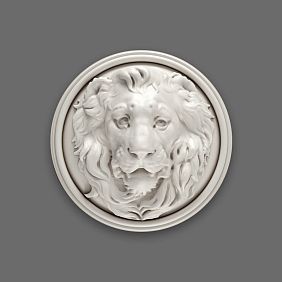
A smooth molding or cornice without ornament is a line. It does its job: structures the space, marks transitions, creates a frame. But it is neutral: it does not speak of style, does not carry an ornamental statement, does not create an atmosphere. An ornamental element is already content. The pattern on the surface of the stucco directly indicates the stylistic affiliation of the interior: acanthus — classic and Empire, shells — Baroque and Rococo, iris and smooth floral branches — Art Nouveau, strict geometric frieze — Neoclassicism and Art Deco.
Polyurethane ornament comes in several structural types:
Independent decorative overlays. These are separate relief elements that are attached directly to the surface of a wall, furniture, door, or arch opening. They can be symmetrical or asymmetrical, large accent pieces or small inserts. The main section in STAVROS is Polyurethane decorative appliques.
Ornament as part of a linear element. A molding, cornice, or baseboard with a relief ornament is a linear element with a decorative pattern inscribed into the profile body. It repeats along the entire length of the linear element and creates a continuous ornamental band. It is precisely such products — moldings and cornices with ornament — that are used to create friezes, cornice lines with patterns, and baseboards with an ornamental band.
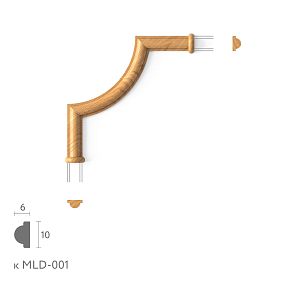
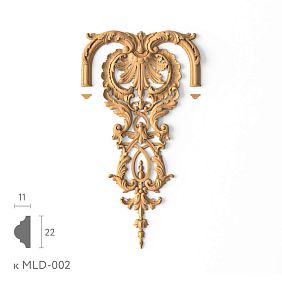
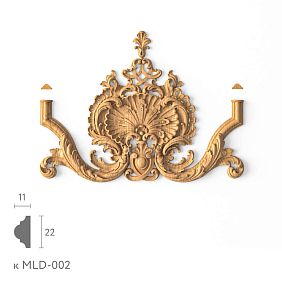
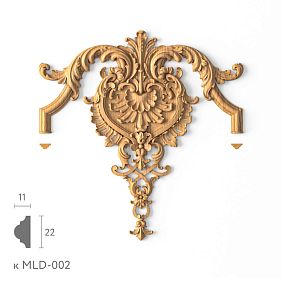
Decor for moldings. Corner and center inserts with relief are ornamental accents at the junction points of moldings: in the corners of frames, in the centers of horizontal lines, at the intersections of vertical and horizontal elements. Decor for Molding from ornamental inserts completes the frame composition, turning it from a geometric outline into a decorative object.
Ceiling rosettes with ornament. Polyurethane Rosettes with plant, floral, and ornamental motifs are central accent elements of the ceiling. The rosette combines the geometric shape of a circle with an ornamental pattern: leaves, petals, curls, shells — depending on the stylistic direction.
All these formats complement each other and form a complete ornamental system of interior decor.




Types of ornaments in STAVROS: dictionary of patterns
The STAVROS catalog covers several main ornamental types. Understanding their differences means being able to read the language of classical and modern stucco decor.
Our factory also produces:

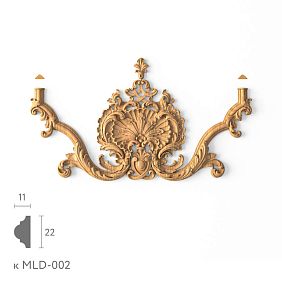
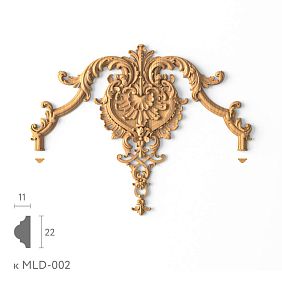
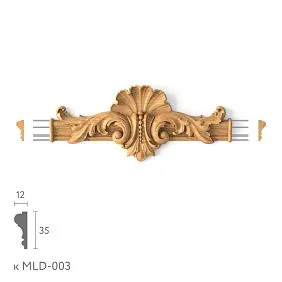
Acanthus: the king of ornamental stucco
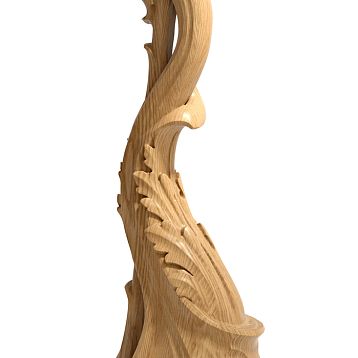
The acanthus leaf is one of the most recognizable ornamental motifs in the history of architectural decor. Acanthus leaves with characteristic rounded lobes and sharp tips have been reproduced in stucco for millennia: Greek capitals, Roman friezes, Renaissance coffers, Baroque cornices — this motif is present everywhere.
In a modern interior, decorative Moldings with acanthus is appropriate in classical, neoclassical, and Empire-style solutions. Acanthus looks good on cornices, pilaster capitals, central overlays, and ornamental rosettes. It is perceived as a sign of architectural erudition — using it appropriately without overloading the space means understanding the historical logic of decor.
The size range of acanthus overlays in STAVROS is from small 8–12 centimeter inserts to large 30–50 centimeter ornamental panels for formal areas.
Get Consultation
Floral ornament: smooth organic forms
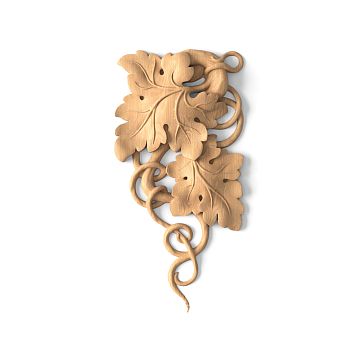
Floral ornament is a general term for decor based on natural forms: leaves, stems, branches, shoots. Unlike strict acanthus, floral ornament can be more free in composition: asymmetrical, smoothly flowing, with intertwined elements.
Polyurethane floral ornament is used in a wide range of interior styles — from strict neoclassicism to warm Provencal. It looks organic on living room walls, in bedroom decor, on study moldings, and in ornamental friezes of the hall. Its advantage is versatility: a well-executed floral pattern does not look archaic and does not compete with modern interior solutions.
In formats of stucco decor for walls, floral ornament is most often present in vertical overlay elements — imitating branches or shoots that stretch upward along the wall surface, creating a sense of living natural energy in the interior.
Floral ornament: elegance and tenderness
Floral pattern in stucco is acanthus transformed into something softer and more feminine. Roses, tulips, lilies, irises, poppies — depending on which floral motif underlies the ornament, its stylistic affiliation changes.
Polyurethane floral ornament is most organic in interiors where a soft, warm atmosphere already exists: bedroom, dressing room, boudoir, cozy living room with a cream or powder palette. It creates a mood — and that is its main function. Floral decor should not be overloaded: one or two accent elements with a floral pattern work better than a continuous frieze with a small ornament around the entire perimeter.
Among STAVROS elements, the floral motif is represented in decorative overlays — often in the form of symmetrical baskets, garlands, or individual floral accents.
Shells: Baroque and Rococo
The shell is one of the key ornamental symbols of Baroque and Rococo. Its fan-shaped form with concentric ribs is reproduced in stucco as a central accent motif: above an arch, in a niche, in the center of a ceiling rosette, at the top of a mirror frame.
Shell ornament is suitable for interiors featuring gold, mirrors, velvet, and marble. In a modern context, it can be used selectively — as the only ornamental accent against a backdrop of restrained smooth decor. A single shell element in the center of a fireplace or above a doorway reads as a deliberate reference to a historical style, rather than as clutter.
Irises and Art Nouveau: Living Lines
The iris is a key ornamental motif of the Art Nouveau style. Smooth elongated leaves and the characteristic flower with curved petals are reproduced in stucco as applied elements and ornamental inserts for moldings. They are completely incompatible with geometric lofts or Scandinavian minimalism — but in an interior with warm wooden surfaces, soft furniture lines, and a rich color palette, they create a unique atmosphere.
Decor with iris and plant branch motifs is used in horizontal friezes under the ceiling, in decorative panels, and in applied elements for doorways. This is ornamental stucco that must be applied with a precise understanding of the stylistic context — it does not tolerate arbitrary use.
Geometric Ornament: Neoclassicism and Art Deco
Strict geometric patterns in moldings — meander, dentils, beads, stepped profiles — are the ornamental language of Neoclassicism and Art Deco. They do not appeal to natural forms but are built on mathematical precision: rhythm, repetition, symmetry.
In a modern interior, geometric ornament made of polyurethane looks contemporary and restrained. It is appropriate in cornices and moldings of apartments with ceilings from 2.7 m, in offices and meeting areas, in interiors with dark saturated walls, against which a white geometric frieze creates a powerful graphic contrast.
Which STAVROS Products Carry Ornament: Full Breakdown by Type
Understanding the ornamental vocabulary is the first step. The second is to understand in which constructive format this ornament exists in the STAVROS catalog and what exactly to use in each specific situation.
Decorative overlays: an independent ornamental accent
This is the main format of ornamental moldings from polyurethane in STAVROS. Decorative overlays are individual relief elements that are attached to any flat surface: wall, ceiling, furniture facade, door leaf, slope, niche, column.
Overlays are:
-
Symmetrical — with a central axis of symmetry, for use in paired areas and in the center of a wall composition
-
Asymmetrical — a free organic form that creates the feeling of living decor
-
Vertical — elongated elements for piers and pilasters
-
Horizontal — stretched in width, for friezes and belts above the baseboard or under the cornice
-
Square and rectangular — for filling frame fields inside molding frames
The size range of overlays is from 8 cm to 60+ cm in the larger dimension. The relief is from 1.5 to 4–5 cm depending on the scale and detail of the ornament.
The overlays are glued with mounting adhesive without drilling. After installation and puttying of the joints, they look like a relief part of the wall, not like a glued element — provided the surface is properly prepared and the finish coating is carefully applied.
Moldings with ornament: continuous ornamental tape
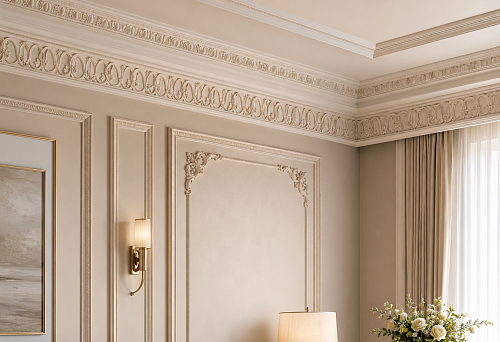
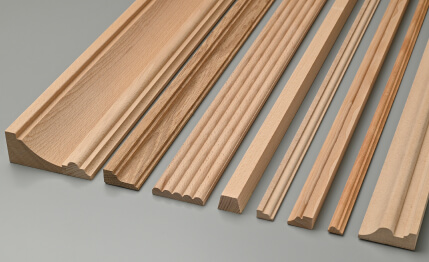
Moldings made of polyurethane with a relief ornament create a repeating decorative pattern along their line. This is especially expressive in wall frames, where an ornamental molding turns a simple rectangular outline into a rich decorative frame.
The width of an ornamental molding is generally greater than that of a smooth one: the pattern requires space. The range is from 3 to 12–15 cm. The wider the molding with ornament, the larger the permissible pattern, and the higher the room in which it is appropriate.
An important rule: an ornamental molding on short segments (less than 40–50 cm) works worse than on extended sections — the pattern does not have time to "unfold" and reads as a cut-off fragment.
Cornices with ornament: architectural frieze under the ceiling
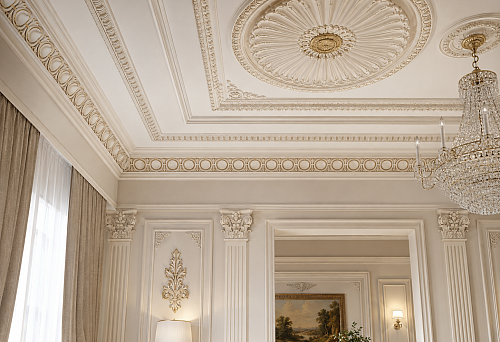
Polyurethane Crown Molding with an ornamental frieze is one of the most expressive elements of a classic interior. A cornice with a floral, acanthus, or geometric pattern around the entire perimeter of the ceiling creates a sense of architectural completion of the space that cannot be achieved by any other means.
The ornament on the cornice can be located:
-
On the frieze — the horizontal part between the shelf and the lower profile
-
On the entire visible surface of the cornice — a fully relief profile with ornament
-
Only on the lower part — an ornamental shelf with a smooth top
When choosing a cornice with an ornament, it is especially important to consider the ceiling height: with a ceiling of 2.5 m, an ornamental cornice 20+ cm wide will visually "press" the space. With a ceiling of 3 m or more, a wide ornamental cornice, on the contrary, fills the space that would otherwise remain empty.
Ceiling plinth with ornament: modest but noticeable
A polyurethane ceiling plinth with an ornament is a lighter alternative to a full cornice. Small in width, but with an ornamental pattern, it adds decorative richness to the interior without overloading the space.
A ceiling plinth with an ornament is appropriate in rooms with moderate ceiling heights (2.5–2.8 m), where a full classic cornice would look too heavy. An ornamental plinth gives the same stylistic signal as a cornice, but in a lighter and more modest execution.
Decor for moldings with ornament: the key to a complete frame
Decor for Molding — these are ornamental inserts for connection points: corners of frames, centers of horizontal spans, places where moldings intersect. It is they that turn a frame made of moldings from a geometric outline into a decorative architectural detail.
Corner inserts with ornament are selected based on the width of the molding used: the insert must exactly cover the corner joint and harmonize with the molding profile in depth and pattern character.
Central inserts are installed in the middle of horizontal spans of the frame (especially on wide walls) and on cornice lines — as rhythmic ornamental accents.
Ornamental rosettes: the central accent of the ceiling
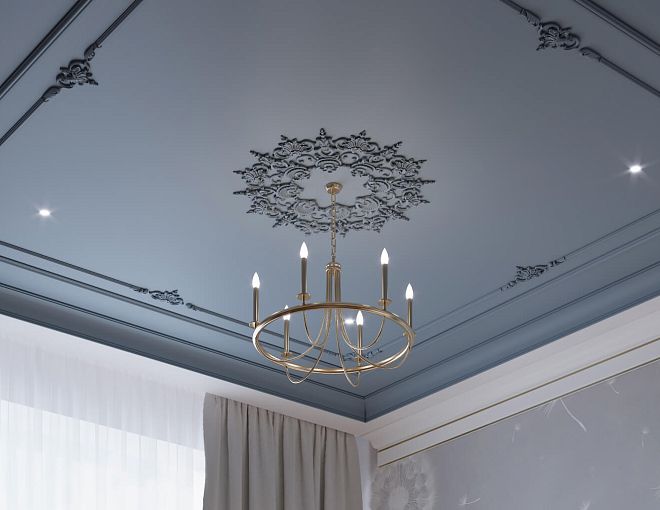
Polyurethane Rosettes With floral, botanical, and classical ornamentation — these are the central decorative elements of the ceiling. In the rosette, the ornament is organized on the principle of radial symmetry: the pattern radiates from the center to the periphery along radii, creating a sense of unfolding and movement.
Ornamental rosettes for classic interiors include acanthus leaves, petals, scrolls, and botanical branches. For neoclassicism, more restrained rosettes with geometric ornamentation or moderate botanical patterns are characteristic. For Baroque — maximally rich, with several concentric ornamental bands.
Ornament and style: a precise matrix of correspondences
This is not just a matter of taste. An incorrectly chosen ornament destroys the stylistic logic of the interior as surely as the wrong color or disproportionate furniture. Use this table as a guide.
| Interior style | Ornament | Recommended elements |
|---|---|---|
| Classic | Acanthus, botanical, symmetrical garlands | Ornamented cornices, rosettes, overlays |
| Empire | Strict wreaths, laurel branches, vertical ornament | Moldings with pattern, vertical overlays |
| Baroque / Versailles | Shells, scrolls, rich botanical | Large overlays, sockets, wide cornices |
| Rococo | Asymmetrical botanical, shells, flowers | Overlays, decor for moldings |
| Modern | Irises, smooth branches, floral | Moldings with botanical ornament, overlays |
| Neoclassical | Moderate acanthus, geometric frieze | Ceiling plinth with ornament, moldings |
| Provence | Floral, field motifs | Floral overlays, decor for moldings |
| Modern Classic | Ornament matching the wall color | Any type, monochrome coloring |
| Art Deco | Geometric, strict rhythm | Moldings with geometric pattern |
Key rule: one style — one ornamental vocabulary. Acanthus, shells, and irises in one room are three different styles that will not coexist without conflict.
Where to apply ornamental decor: precise zones of the interior
Ornamental Decorative stucco works in specific, functionally justified zones. Arbitrary placement of ornaments is a path to visual chaos.
Accent wall and area above the sofa
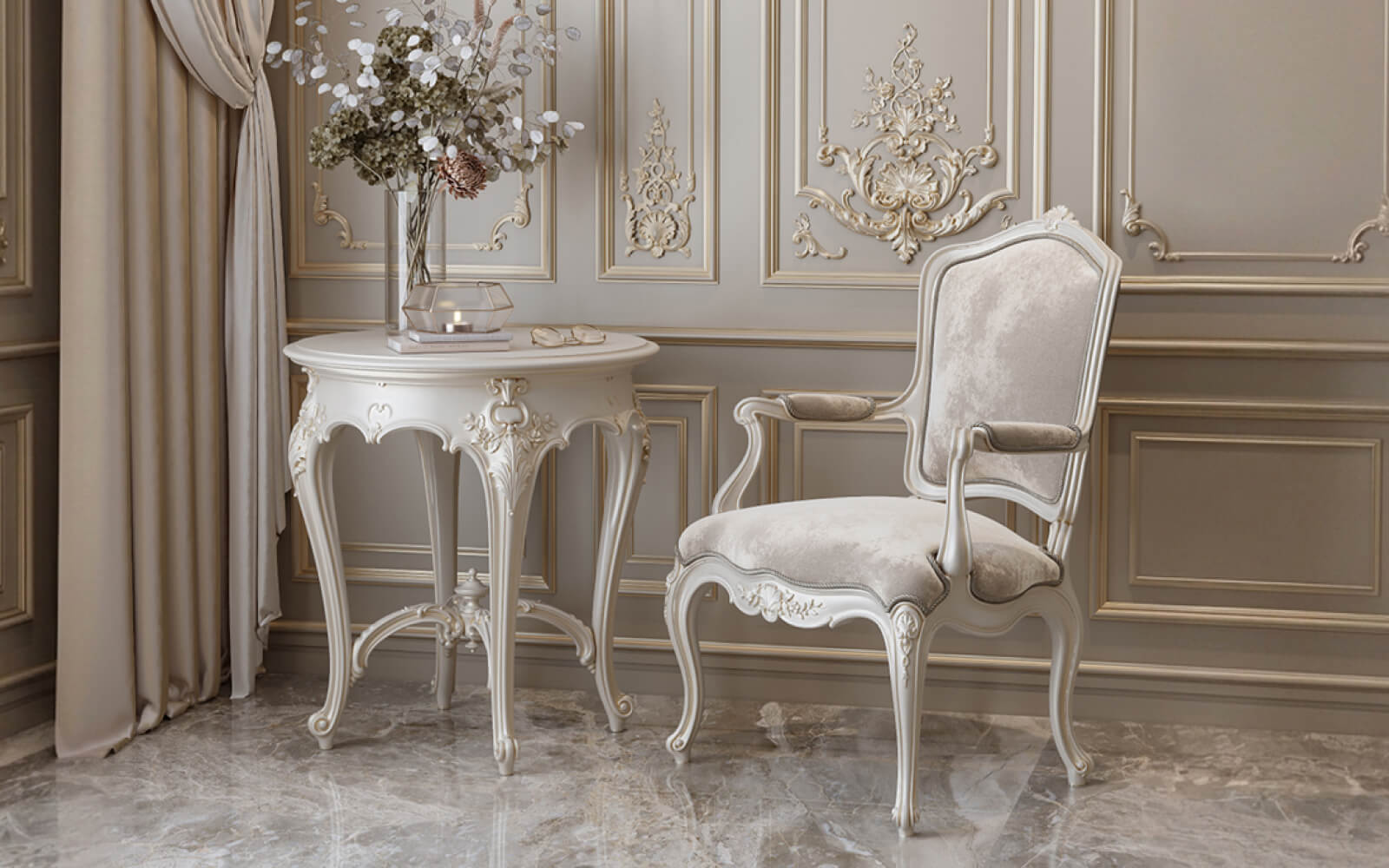
The horizontal area above the sofa is one of the main ornamental opportunities in the living room. Here you can place a frame of moldings with ornamental corner inserts, complemented by a large central overlay in the middle. The frame, including the ornamental molding and decorative inserts, creates the effect of an architectural panel — expensive and meaningful.
For this zone, scale is important: the frame should be no narrower and no wider than the sofa, and positioned 15–20 cm above its backrest.
TV zone: decor without overload
The television wall is a complex ornamental task because the TV itself is a visual dominant. Ornamental decor here should create a framing, not compete with the screen. The optimal solution: a thin molding with a moderate geometric or floral pattern around the perimeter of the zone, a central overlay under the TV — not above it.
Polyurethane wall decor in this zone, it should be restrained and not heavy: the TV wall is a functional use zone, not a formal decor area.
Piers between windows
Vertical piers between windows are an ideal place for a vertical ornamental accent. A vertical overlay with a floral or acanthus pattern, installed symmetrically in the center of the pier, turns a technically challenging area (narrow, illuminated by side light) into a decorative interior detail.
The height of the vertical overlay should be no more than 60–70% of the wall height in the pier area. The width should be no more than 30–35% of the pier width.
Ceiling: cornice, rosette, frieze
Ceiling decor with ornament consists of three levels:
-
Cornice around the perimeter — a continuous ornamental strip covering the corner of the wall and ceiling
-
Frieze — an additional ornamental band on the ceiling, parallel to the cornice, at a distance of 40–60 cm from the wall
-
Rosette — the central ornamental accent in the chandelier area
All three elements work in a hierarchy: the cornice is the base, the rosette is the top. The frieze is used only when the ceiling height is from 2.9 m.
Door and arch openings
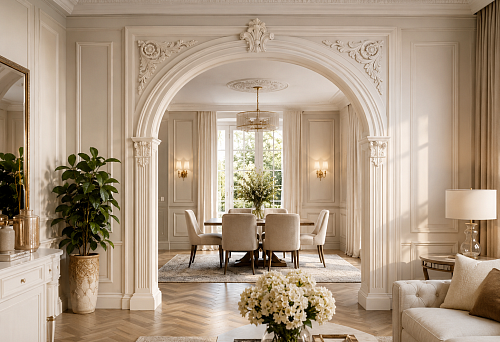
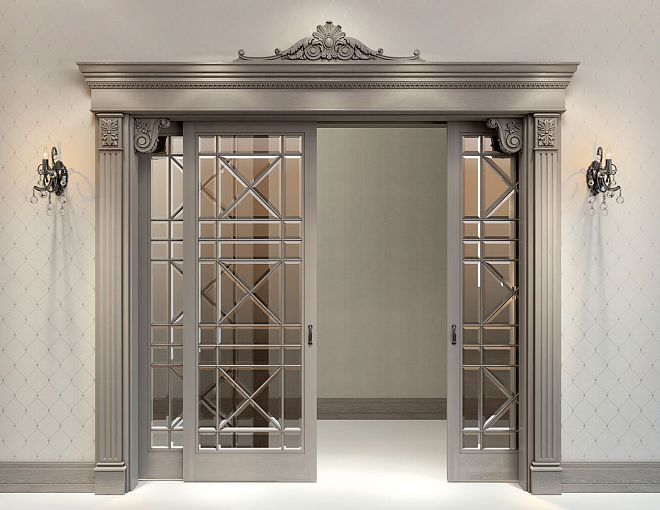
Ornamental overlays above the door opening are a traditional technique of classical architecture. The central overlay above the keystone, the side symmetrical elements at the arch's "springing point", the ornamental molding along the contour — all this turns an ordinary opening into an architectural accent. The logic of designing arch openings is described in detail in a separate article — the article about polyurethane stucco for arches.
Furniture facades and doors
molded decoration made of polyurethane in the format of ornamental overlays — one of the most economical ways to update furniture without replacing it. Ornamental overlays glued to flat cabinet doors give them character and style. For furniture facades, small and medium-sized overlays (12–25 cm) with a moderate relief — no more than 1–2 cm — are used, otherwise the overlay will look massive when the door is opened.
How to choose the size of ornamental decor: proportion analysis
Size is not a question of "bigger/smaller". It is the mathematics of space, in which each parameter is connected to another.
Overlay ornamental elements
-
For a wall height of 2.5–2.8 m: overlays 15–30 cm high, width proportional
-
For a wall height of 2.8–3.5 m: overlays 25–50 cm high
-
For a grand hall with ceilings from 3.5 m: overlays from 50 cm and larger
-
Distance from the edge of the overlay to the nearest molding or corner: at least 1.5 times the size of the overlay itself
Ornamental molding for a frame
-
Molding width: 1/8–1/12 of the frame height
-
For a frame height of 100 cm → molding width 8–12 cm
-
For a frame height of 60 cm → molding width 5–7 cm
-
Ornamental molding always appears slightly wider than a smooth one of the same size — keep this in mind when choosing
Ornamental cornice
-
With a ceiling of 2.5 m → cornice width no more than 10–12 cm
-
With a ceiling of 2.8 m → cornice width 12–16 cm
-
With a ceiling of 3 m or more → cornice width 16–22 cm
-
With a ceiling of 3.5 m or more → cornice width 22 cm and more
Ornamental rosette
-
Rosette diameter: 1/5–1/6 of the smaller side of the ceiling
-
The rosette should be 1.5–2 times larger than the diameter of the chandelier shade
-
Ornament relief: with a ceiling of 2.5 m — moderate, 1.5–3 cm; with a ceiling of 3 m or more — deep, 3–5+ cm
Allowance for trimming when ordering ornamental moldings — 15%, when ordering overlays — 2–3 additional pieces to the calculated quantity.
Central, corner, vertical, horizontal ornament: application practice
Central ornament
The central ornament is the focal point of a decorative composition. It is placed strictly at the geometric center of a given area: in the middle of an accent wall, above a bed, above a console, in the center of a ceiling, or at the center of a furniture facade.
The central ornamental element should always be larger than adjacent details. If there are vertical overlays 30 cm high on the sides, the central overlay should be at least 35–40 cm high. This creates visual hierarchy and holds the gaze at the desired point.
Corner ornament
Corner ornamental inserts are the most inconspicuous yet one of the most important elements of a decorative system. Rule: the corner insert must exactly match the profile of the molding in width and height. If the molding is 5 cm wide, the corner insert should be 5×5 cm or slightly larger (5.5×5.5 cm) to cover the joint but not extend beyond the molding strip.
An ornamental corner insert can be strictly geometric, ornamental with a floral motif, or in the form of a small rosette. All three options are appropriate, provided the ornamental type matches the type of ornament on the molding itself.
Vertical ornament
Vertical ornamental elements—overlays imitating shoots, stems, branches, or vertical ornamental cartouches—work on piers, pilasters, and furniture facades. Their main function is visual elongation of space: the vertical form 'pulls' the gaze upward, which is especially valuable in rooms with low ceilings.
Vertical polyurethane ornamental overlays are installed strictly vertically using a level: even a slight tilt will be visible and disrupt geometric precision.
Horizontal ornament
A horizontal ornamental belt — a frieze, ornamental molding at the upper third of the wall, a patterned ceiling cornice — creates a horizontal rhythm in the space. This is one of the most effective techniques for long corridors and elongated rooms: the horizontal ornamental strip visually "calms" and structures an extended surface.
Horizontal ornament works especially well when its ornamental pattern has a directional rhythm — like a running meander or a repeating leaf motif. This rhythm creates a sense of movement along the wall, giving long rooms life and dynamism.
Typical mistakes when choosing an ornament: what not to do
Even high-quality ornamental elements can yield the wrong result if the basic selection principles are violated.
Ornament without style reference. This is the most common mistake. A beautiful element on its own does not mean it will suit your interior. Before choosing an ornament, define the style direction — and only then look for a suitable pattern.
Mixing incompatible ornaments. Acanthus, shells, irises, and a geometric meander in one room — that's four styles at once. They don't create eclecticism — they create chaos. Choose one ornamental type for each room.
Ornament too large in a low room. A large ornamental overlay with a ceiling height of 2.5 m will "press" the space. The scale of the ornament should be proportional to the scale of the room.
Ornament too small on a large wall. A small overlay on a spacious wall gets lost and looks accidental. On a large surface, you need either a large accent element or a well-thought-out system of several elements in the right rhythm.
Ornamental decor on "active" walls. A wall with bright wallpaper, photographs, or paintings is already an occupied surface. Adding ornamental overlays to it means overloading the area excessively. Ornamental stucco works best on plain painted surfaces.
Contrasting ornament without a design task. A white ornament on a dark wall is a powerful technique, but only if it is intended as the main accent. If there are other bright elements nearby (a large painting, lighting, furniture), the contrasting ornament will compete for attention rather than enhance the image.
Where to buy STAVROS polyurethane ornament: catalog navigation
Ornamental Polyurethane Decor STAVROS is concentrated in several key sections of the catalog. Here is direct navigation for each task.
For central and side ornamental overlays, relief inserts for walls, furniture, and openings — go to the section polyurethane decorative overlays. Here are concentrated polyurethane ornaments in the widest assortment: from small corner accents to large ornamental panels with acanthus, plant motifs, and floral patterns.
For corner and central ornamental inserts in molding frames — section decoration for moldings. Here are collected all types of inserts: geometric, ornamental, plant.
For polyurethane cornices with ornament, moldings with pattern, and baseboards with ornamental band — section moldings, cornices, and baseboardsHere you will find both cornices with floral patterns and moldings with geometric designs, as well as ceiling plinths with moderate ornamentation.
For ornamental rosettes with floral, botanical, and classic designs — section polyurethane rosettes.
To explore the full range and select elements that unify the ornament of arches, walls, and ceilings into a cohesive system — main section polyurethane products.
Want buy polyurethane ornament with delivery across Russia — use the section filters to choose by ornament type (floral, acanthus, botanical, shells, irises) and by size. This will speed up your search and help you select elements from the same style line.
FAQ: answers to popular questions about polyurethane ornament
What is polyurethane ornament?
This is a relief decorative pattern in stucco: overlay elements with acanthus, botanical motifs, floral designs, shells, irises — as well as moldings, cornices, and plinths with ornamental profiles. It is used for decorating walls, ceilings, furniture, and openings.
How does ornamental stucco differ from smooth profiles?
Smooth profiles structure the space, while ornament defines the style. A molding without a pattern is style-neutral; a molding with acanthus is classic, with iris is Art Nouveau, with geometric meander is Art Deco.
Can I buy polyurethane ornament for self-installation?
Yes. All polyurethane ornamental overlays are mounted with mounting glue without drilling. Professional skills are not needed — you need a flat surface, glue, putty for joints, and paint.
Which ornaments are suitable for a classic interior?
Acanthus, symmetrical floral garlands, laurel branches, shells, floral motifs with roses and lilies. All these ornaments are presented in the section polyurethane molding decoration.
How to choose an ornament for the Art Nouveau style?
Look for elements with smooth lines and natural motifs: irises, stems, asymmetrical floral branches. Avoid strict symmetry and geometric patterns.
Can ornamental stucco be painted the color of the wall?
Yes. Monochrome painting of ornamental decor is a modern and sophisticated technique. The surface is primed, then coated with acrylic paint in the wall color. The ornament becomes a textural accent, not a color one.
How to properly choose the size of an applied ornament?
Base it on the ceiling height and the scale of the application area. For ceilings 2.5–2.7 m — overlays 15–25 cm high. For ceilings from 3 m — 30–50 cm. The ornamental element should not occupy more than 1/3 of the surface on which it is installed.
Where can I see the full range of STAVROS ornaments?
In the section polyurethane decorative overlays with filters by ornament type, size, and application. Related sections — Decor for Molding, moldings and cornices with ornament, Outlets.