










































































Article Contents:
- STAVROS polyurethane stucco and stucco decor
- Why polyurethane is the best material for stucco decor today
- What's included in the STAVROS stucco catalog: a complete overview of the assortment
- Moldings, cornices, and baseboards: the foundation of a stucco set
- Polyurethane wall decor
- Polyurethane Ceiling Moldings
- Polyurethane stucco decor: overlays and ornaments
- Polyurethane rosettes: accents that work
- Decor for moldings: details that complete the look
- Stucco for every room: where and what to use
- Stucco for the living room: a complete set
- Stucco for the bedroom: restraint as a principle
- Stucco for the hallway and foyer: first and foremost impression
- Stucco for the bathroom: moisture resistance as a priority
- Stucco for the study: status and concentration
- Stucco for furniture and doors: renewal without replacement
- How to choose the size: precise proportions for each zone
- Styles of stucco decor: how to choose and not make a mistake
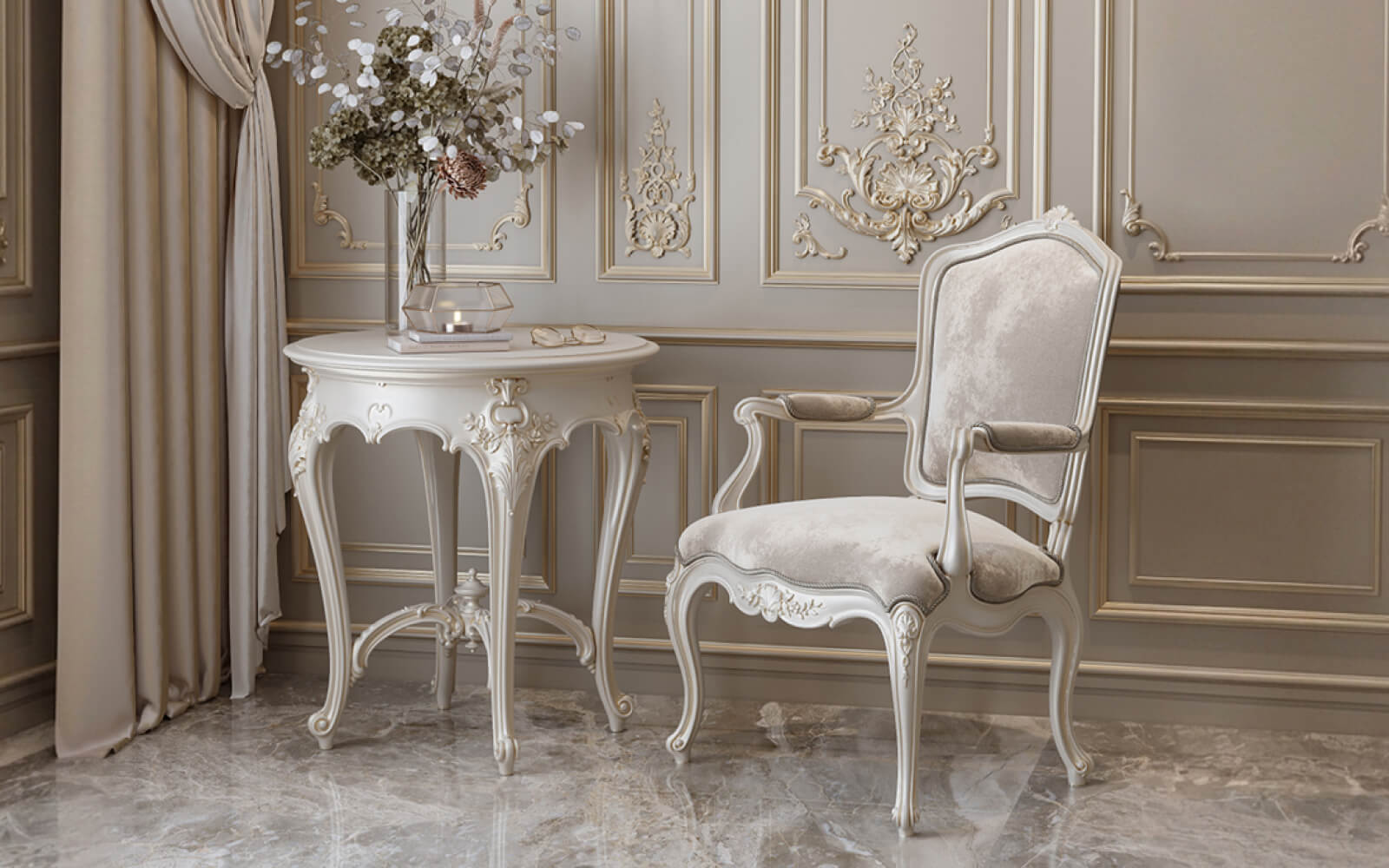
- Classic: the order system and richness of forms
- Neoclassicism: architectural precision without overload
- Modern interior and Japandi: geometry without ornament
- Baroque and Versailles: scale and palace grandeur
- Stucco molding for painting: color as a decor enhancer
- How to correctly calculate and order stucco molding: practical tips
- Interior and facade stucco molding: what's the difference
- What to buy with stucco molding: related products and materials
- FAQ: Answers to Popular Questions About Polyurethane Molding
- About the Company STAVROS


Polyurethane stucco molding and STAVROS decorative stucco
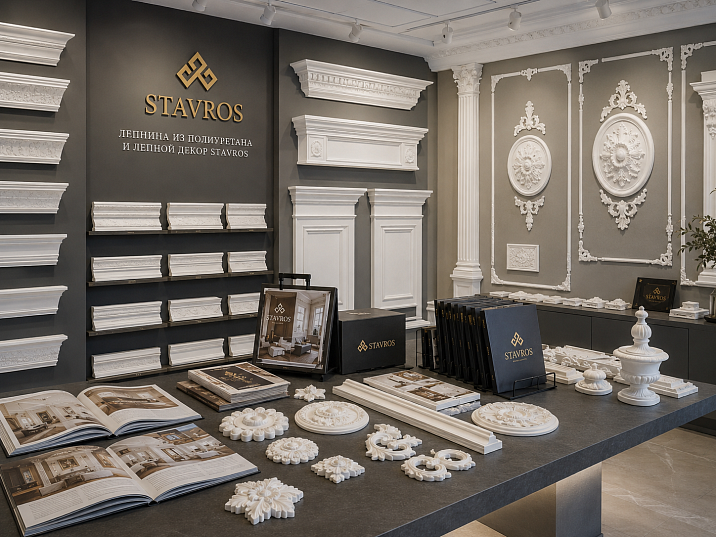
Moldings — it's not just wall and ceiling decoration. It's an architectural language through which an interior speaks about itself. Molding, cornice, rosette, applied ornament — each of these elements carries meaning: it structures space, sets rhythm, defines style, and turns an ordinary room into a complete, thoughtful, living space. Polyurethane stucco molding has made this language universally accessible: now decor that was once a privilege of palaces and grand halls is available for apartments, country houses, offices, and even hallways. The STAVROS catalog contains everything needed for a complete stucco set: from basic cornices and baseboards to exquisite ornamental overlays and ready-made style collections.




Why polyurethane is the best material for stucco decoration today
Before moving on to the assortment, it's worth answering a question that almost every buyer asks: what makes polyurethane stucco molding better than gypsum? And why change something that has worked for centuries?
The answer is straightforward and honest. Gypsum stucco molding is beautiful. It has history, weight, and dignity. But it is heavy, fragile, requires professional installation, does not forgive mounting mistakes, and literally crumbles if handled incorrectly. It is difficult to transport, and cutting it without special equipment is nearly impossible. It cracks at the slightest impact. In humidity, it swells and crumbles. This is a material that only lives in the hands of a master.
Polyurethane decorative molding is a different story. It:
-
weighs 5–8 times less than plaster of a similar profile
-
cut with a regular utility knife or hacksaw at any angle
-
is not afraid of humidity, temperature changes, or condensation
-
accepts any paint: acrylic, alkyd, oil-based, metallic
-
is installed with glue without drilling, dowels, or reinforcement
-
does not crumble during transportation or accidental impacts during renovation
-
reproduces complex reliefs with an accuracy of 0.1 mm
That is why Relief Decoration polyurethane has taken a leading position in the market of interior and facade design. This is not a compromise — it is technological progress that preserved aesthetics and eliminated practical drawbacks.
Our factory also produces:




What is included in the STAVROS molding catalog: a complete overview of the assortment
The STAVROS catalog is not just a list of article numbers. It is a well-thought-out product system where each section performs a specific function in an interior set. Let's break it down in detail.
Get Consultation
Moldings, cornices, and baseboards: the foundation of a stucco set
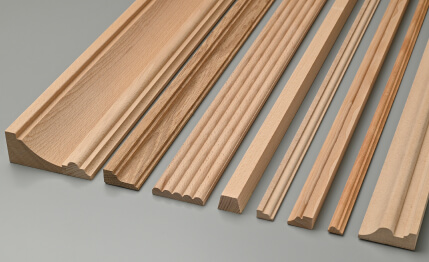
Moldings made of polyurethane — this is the structural foundation of any stucco interior. Without moldings, everything else turns into a set of random elements that do not form a system. It is moldings that set the geometry: they divide walls into zones, create frame fields, mark horizontal lines at different levels, and form the ceiling contour.
The section of moldings, cornices, and baseboards offers a wide selection of profiles: from thin 20-millimeter moldings for laconic modern interiors to wide 18-centimeter cornices for grand halls and high rooms. Each profile has precisely calibrated proportions that harmonize with the scale of the space.
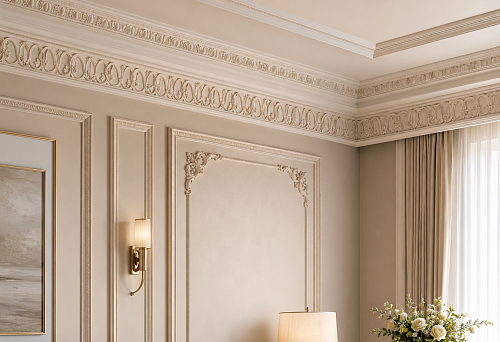
Cornices are the most noticeable element of linear trim. They cover the corner joint between the wall and ceiling, creating a smooth transition between the two planes. Depending on the interior style, cornices can be strict and straight (for modern and neoclassical decor) or ornamental, with profile patterns of leaves, waves, braids, and geometric motifs (for classic and baroque styles).
Baseboards complete the vertical rhythmic division of the wall from below. A polyurethane baseboard from the same style line as the cornice creates a visual "frame" for the entire room — the space gains a completeness that cannot be achieved without this detail. Polyurethane Baseboards are presented in the section with a full listing of profiles and sizes.
Moldings for wall frames are a separate category. They are thinner and more elegant than cornices, designed to create horizontal and vertical frame fields on walls. A properly chosen molding for a frame follows the rule of proportion: the height of the frame should be at least 8–10 times the width of the molding. If the molding is 4 cm wide, the frame should be at least 32–40 cm high.
Polyurethane wall decor
Polyurethane wall decor — this is the second most important level of the stucco set. Here are collected elements that transform a wall from a uniform plane into an architecturally expressive surface.
Wall stucco decor includes several groups of products:
Panels and frame fields — horizontally and vertically structured compositions of moldings with corner and central decorative inserts. They create a sense of architectural depth even on a perfectly flat wall.
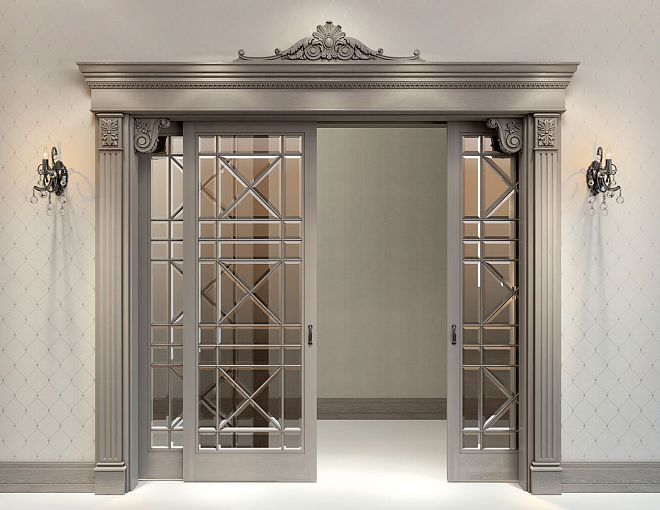
Pilasters — vertical decorative elements that imitate columns. They are installed along walls, near doorways, and in niches. Ideal for rooms with ceilings from 2.8 m: they visually lift the space and set a grand scale.
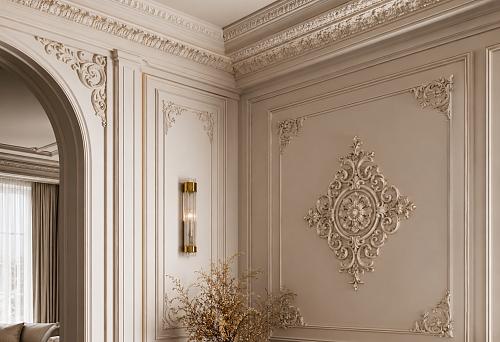
Overlay ornaments — point decorative accents for filling frame fields, decorating the centers of piers, creating accent zones above furniture, near mirrors, and in niches.
Ready-made style collections — the wall decor section features the Neoclassic, Japandi, and Versailles collections, where elements are already coordinated in style and scale. This is the optimal solution for those who want a cohesive result without lengthy individual selection.
Polyurethane wall stucco is not just about aesthetics. It is a functional tool for space zoning: using wall decor, you can visually separate the living and dining areas, mark an accent zone behind the headboard in the bedroom, or create a grand axis in the hallway.
Polyurethane ceiling molding
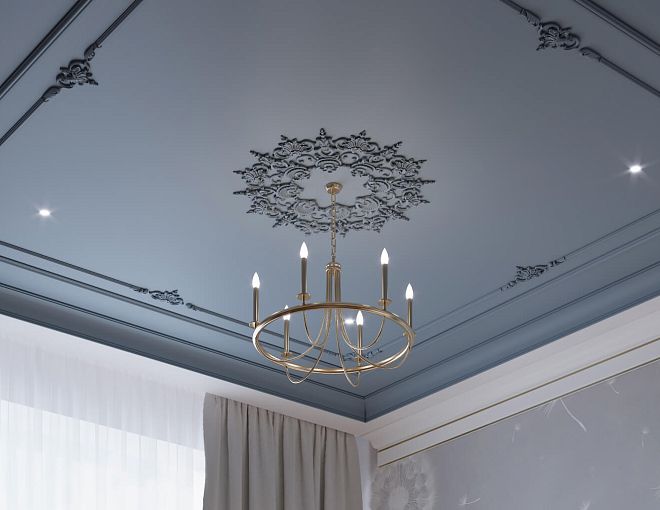
The ceiling is a surface that is seen immediately and completely. That is why it Polyurethane Ceiling Moldings is one of the most significant elements of a stucco set. Even one correctly chosen element — a cornice around the perimeter or a ceiling rosette under the chandelier — can radically change the perception of the entire room.
The ceiling decor section includes:
Ceiling rosettes — central accent elements of the ceiling. Diameter from 15 to 100+ cm. They are installed in the chandelier area or as an independent decorative accent in the center of the ceiling. The most important rule: the rosette should be noticeably larger than the chandelier shade — at least 1.5 times in diameter.
Ceiling cornices and moldings are elements for creating a ceiling contour, additional frame fields on the ceiling, and decorative cassettes.
Corner ceiling elements are special parts for finishing the joints of the cornice in the corners of the room. They eliminate the need for precise 45-degree miter cuts and give the cornice line a finished look.
The principle "the ceiling is always visible" works both ways: good ceiling decor elevates the perception of the entire interior, while a poorly chosen one catches the eye with its inappropriateness. Therefore, the selection of ceiling decor must be approached with particular care, focusing on the room height, chandelier size, and the stylistic direction of the entire interior.
Polyurethane stucco decor: overlays and ornaments
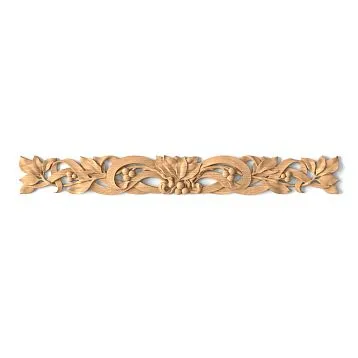
molded decoration made of polyurethane in the form of overlay elements — this is the broadest and most diverse group of the assortment. It includes ornamental overlays, bas-relief panels, geometric inserts, medallions, decorative rosettes, and acanthus elements in a wide range of scales.
Applied polyurethane decor is used for:
-
enriching flat wall surfaces in places where linear molding is impossible or impractical
-
decorating door panels — creating the illusion of a paneled door with stucco inserts
-
decorating furniture facades — cabinets, dressers, nightstands, library shelving
-
creating accent zones above the fireplace, in niches, near arched openings
-
decoration of slopes, columns, pilasters and any other architectural objects that need visual enrichment
Overlay elements are glued without drilling — using assembly or acrylic adhesive. After drying, they can be painted any color and, with proper painting, are visually almost indistinguishable from plaster stucco. The full range and sizes are in the product cards of the section.
Polyurethane rosettes: accents that work
Polyurethane Rosettes — is a separate category that deserves special attention. A rosette is an architectural accent that focuses the eye and sets the central point of the composition.
In the STAVROS catalog, rosettes are presented in a wide range of diameters and styles: from classic ornamental ones with acanthus leaves and scrolls to modern geometric ones with clean lines and minimal relief. Each type is designed for a specific interior scenario and room scale.
Key parameters for choosing a rosette:
-
Diameter in relation to ceiling area (rule: no more than 10% of ceiling area)
-
Match with chandelier size (rosette 1.5–2 times larger than the lampshade)
-
Relief depth according to viewing distance (the higher the ceiling, the deeper the relief should be)
-
Stylistic consistency with moldings and cornices in the same room
Molding decor: details that complete the look
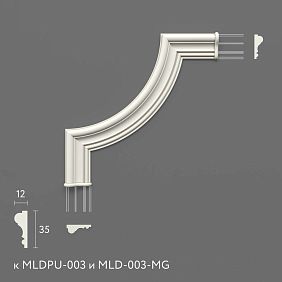
Decor for Molding — these are corner inserts, central rosettes for frames, decorative inserts on straight sections of molding, and finishing elements. It is this section that transforms frame fields from a simple rectangle of molding into a complete decorative structure.
Without corner inserts, a molding frame looks technically made but unfinished. A corner insert is a small but essential element: it hides the joint, adds an ornamental accent, and gives the frame architectural character. Depending on the style, inserts can be strict geometric (for neoclassicism and modern interiors) or ornamental with floral and classical motifs (for classic and baroque styles).
Stucco for each room: where and what to use
A skilled person Relief Decoration — this is always a contextual decision. What is appropriate in a formal living room may be excessive in a bedroom. What looks organic in a hall with high ceilings will seem heavy in a compact entryway. Let's examine each scenario in detail.
Stucco for the living room: a complete set
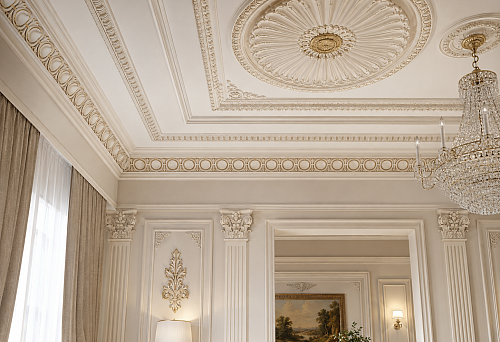
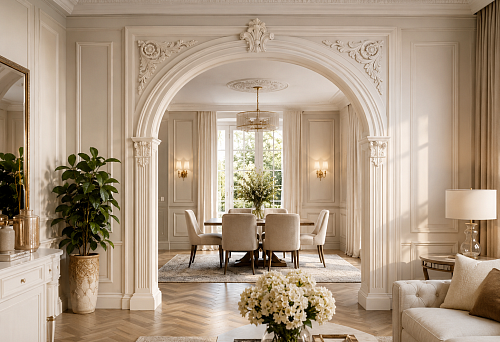
The living room is the main room of the house, and here stucco decor is justified in its fullest volume. A standard scheme for a living room in a classic or neoclassical style: a cornice around the perimeter of the ceiling with corner elements → a ceiling rosette under the chandelier → wall frame fields made of molding on the main walls → pilasters at the formal wall or doorways → decorative overlays as accents.
For a living room with ceilings of 2.7–3 m, optimal proportions are: a cornice width of 10–14 cm, a rosette diameter of 55–75 cm, and molding for frames with a width of 4–6 cm. With ceiling heights from 3 m, the scale of all elements increases by 20–30%.
Stucco for the bedroom: restraint as a principle
The bedroom is a space for rest and recovery. Here, stucco decor should work to create a calm, cozy background, not dominate the interior. The principle of the bedroom: a thin profile, moderate relief, minimal ornamentation.
Optimal scheme for a bedroom: a lightweight cornice along the perimeter → a small socket for a spot light or a small chandelier → a decorative frame made of thin molding behind the headboard. Everything in the color of the wall or one shade lighter. No large Baroque elements, no excess of ornamentation.
Stucco for a bedroom painted to match the wall color is one of the most exquisite modern techniques: the decor dissolves into the surface, creating a textural rather than a color accent. A monochrome wall with stucco relief looks expensive, modern, and calm.
Stucco for the hallway and foyer: the first and main impression
The hallway and foyer are the first things a guest sees. Here, stucco decor serves a representative function: it literally 'greets' a person and sets the tone for the entire home. Vertical moldings and pilasters visually raise the ceiling, door frame decor creates a sense of a grand entrance, and stucco around a mirror turns an ordinary item into an accent element of the interior.
An important rule for the hallway: the decorative system should be connected to the decor of adjacent rooms — the living room, study, or staircase. If the living room has a cornice and moldings, then in the hallway they should be of the same profile or similar in proportions. This creates a sense of spatial integrity rather than a set of unrelated zones.
Stucco for the bathroom: moisture resistance as a priority
The bathroom is a room with constant high humidity, temperature fluctuations, and condensation. This is where polyurethane shows one of its main advantages over plaster: it is completely moisture-resistant and does not deteriorate in high-humidity conditions.
Stucco for the bathroom is primarily a cornice along the ceiling, a molding frame around the mirror, and decorative inserts near niches. No heavy volumetric decor: in a small bathroom space, it would be overwhelming. A thin profile, clear geometry, and painting with moisture-resistant paint are enough to create a beautiful, elegant interior.
Stucco for the study: status and concentration
The study is a workspace where decor should create an atmosphere of business focus. Here, strict panel fields on the lower part of the walls, a wide geometric molding without ornamentation, a massive cornice, and decoration of bookshelves with decorative overlays are appropriate.
The stucco molding in the study is especially striking against the rich dark walls: white or golden stucco decor on a deep green, blue, or anthracite background creates a graphic, aristocratic contrast that is unmistakable.
Stucco for furniture and doors: renewal without replacement
One of the most cost-effective scenarios for using polyurethane decor is updating furniture and doors without replacing them. Flat door panels with glued-on overlay elements turn into paneled doors with stucco inserts. Boring cabinets with inserted ornamental overlays gain character and style.
For these tasks, elements from the overlay section are used polyurethane molding decoration: lightweight, precise, adhesive without drilling or special equipment.
How to choose the size: precise proportions for each zone
Size is a key parameter when choosing stucco decor. A beautiful element in the wrong scale ruins an interior just as much as poor-quality material. Use the following guidelines when placing your order.
| Element | Parameter | Guideline |
|---|---|---|
| Cornice | Width | 3–5% of ceiling height |
| Baseboard | Width | 20–30% narrower than the cornice |
| Molding for frames | Width | 1/10 of the frame height |
| Ceiling rosette | Diameter | 1/6–1/5 of the smaller ceiling dimension |
| Rosette vs chandelier | Proportion | Rosette is 1.5–2 times larger than the lampshade |
| Overlay on the facade | Area | 50–70% of the facade area |
| Pilaster | Height | No more than 2/3 of the wall height |
The distance between frames on walls is at least the width of the molding, otherwise the wall looks "sewn up". The distance from the baseboard to the lower horizontal of the wall frame is 10–15 cm. Symmetry of frame fields relative to windows and doors is mandatory: frames should be centered on wall planes, not mechanically dividing the wall into equal parts.
Styles of stucco decor: how to choose and not make a mistake
The style of stucco is not a matter of taste. It is a functional requirement of a specific interior direction. Mixing incompatible style elements means getting visual chaos instead of decor.
Classic: order system and richness of forms
Classic Relief Decoration is built on the order system: cornice, frieze, moldings, pilasters, capitals, rosettes. Ornamental motifs — acanthus leaves, egg-and-dart, bead-and-reel, stepped profiles. Classic requires ceilings from 2.8 m and spacious rooms.
Mistakes in classic decor: elements that are too small (lost from a distance), mixing with modern moldings, lack of symmetry.
Neoclassical: architectural precision without overload
Neoclassical decor is the most popular in modern residential interiors. Thin moldings with a moderate profile, calm frame fields, small rosettes without heavy ornamentation. The style works in any room size, including apartments with 2.5 m ceilings.
The advantage of neoclassicism is its versatility: it is organic with white walls, dark walls, and a neutral pastel palette.
Modern interior and Japandi: geometry without ornament
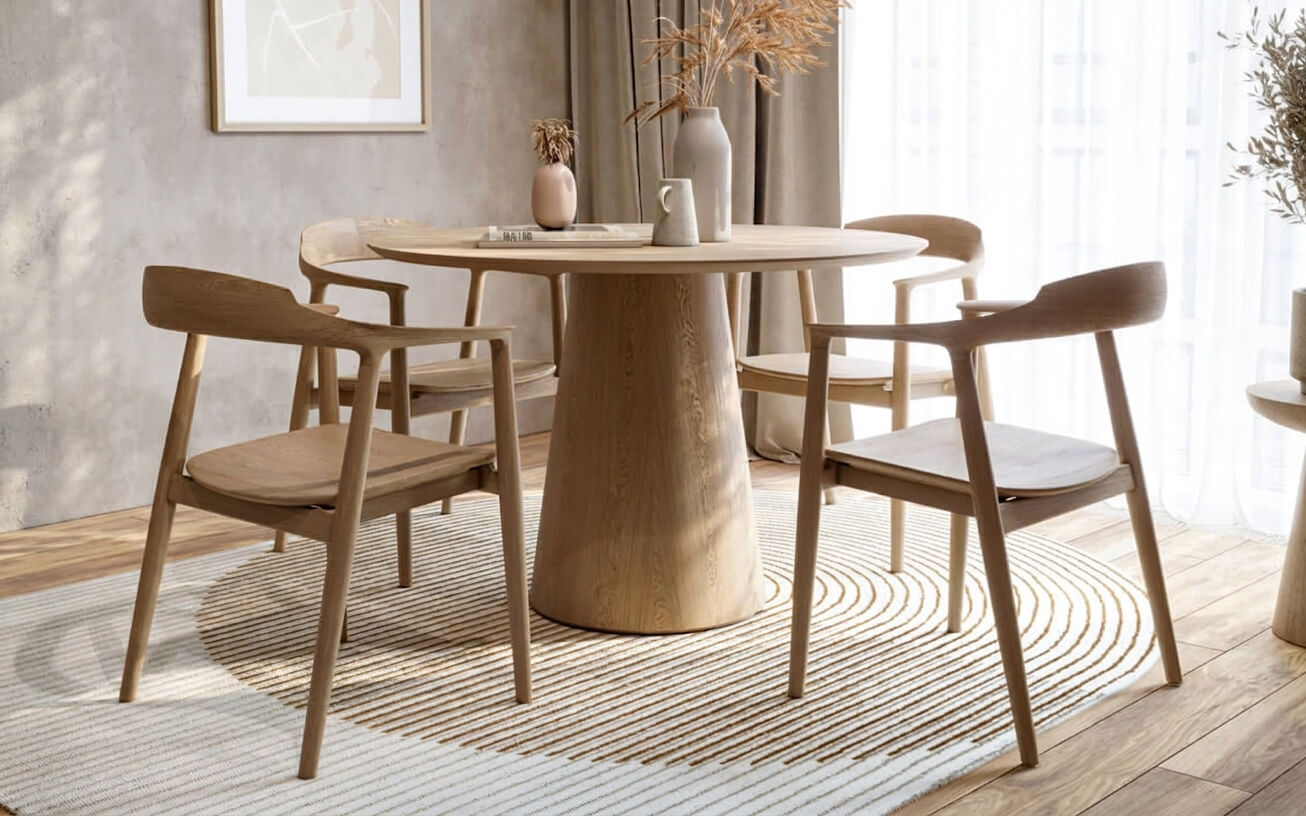
Stucco in a modern interior is exclusively geometry. Straight-line moldings without relief ornament, thin horizontal lines, smooth frames in the color of the walls. Japandi adds softness to this: slightly rounded corners, horizontal divisions, calm monochrome.
These styles do not require deep relief or ornamental overlays. The principle of "less is more" applies here: one thin molding of the right width is worth more than three disparate elements glued chaotically.
Baroque and Versailles: scale and palatial grandeur
This is a style for bold decisions. Large relief, heavy cornices with ornament, ornamental overlays with curls and bas-relief medallions, vertical panels the full height of the wall. Requires rooms with ceilings from 3 m and an area of 25–30 sq. m. In a small space, it is used selectively — as a single accent.
Stucco for painting: color as a decor enhancer
One of the main advantages of polyurethane stucco decor is the ability to paint it any color. This opens up scenarios unavailable for most other finishing materials.
White stucco on colored walls is a classic contrast technique. White molding on a deep blue, green, or anthracite background creates a graphic, refined effect. Works in living rooms, studies, libraries.
Stucco in the color of the walls — a monochrome approach. The decor dissolves into the surface, working as a textural rather than a color accent. Modern, restrained, aristocratic. Works especially well with pastel and neutral shades.
Stucco under enamel — the glossy surface of moldings and rosettes on matte walls creates a play of light reflections, especially effective under artificial lighting.
Gold and silver tinting — for classical and baroque interiors. Applied with special decorative pastes or brush gilding. Used selectively — on rosettes, cornice details, central accent overlays.
The technology of surface preparation and paint application is described in detail in the article installation of polyurethane molding.
How to correctly calculate and order stucco molding: practical tips
Calculation errors are the most painful part of any order. Buy too little — you'll have to reorder, and the new batch may not match the tone after painting. Buy too much — unnecessary expenses. Use the following scheme.
Cornices and baseboards. Measure the perimeter of all walls in the room. Add 10–15% for cutting at corners. Calculate the number of linear meters with a reserve.
Moldings for frames. Determine the number, location, and dimensions of the planned frames. Calculate the perimeter of each frame, multiply by the number of frames, add 15% reserve. Corner inserts are counted separately: 4 pieces for each rectangular frame.
Rosettes and overlays. Counted individually. The diameter of the rosette is selected according to the proportion table (see section above).
Installation materials. Selected depending on the type of surface. Details — in the article what to glue polyurethane molding with.
Before installation, be sure to check: all surfaces are puttied and leveled. Stucco molding does not hide wall irregularities — it emphasizes them. Install on a prepared surface.
Interior and facade stucco molding: what's the difference
The STAVROS catalog includes both interior and facade polyurethane products. There are fundamental differences between them that are important to consider when choosing.
Interior stucco molding is designed for indoor use. The depth of relief and detailing here is higher because the viewing distance is shorter. Elements are oriented for close-up perception, under artificial and natural lighting. Dimensions are more compact — the interior requires precision of scale.
Facade stucco molding is designed for outdoor use. It is made from special polyurethane with increased resistance to UV radiation, temperature fluctuations, and precipitation. The relief here is coarser and larger — the elements are designed to be perceived from a distance of 3–5 meters. The scale is significantly larger than that of interior counterparts.
When ordering, always clarify the purpose of the element — interior or facade. Using facade products indoors is technically possible but aesthetically impractical: their scale and relief character are not suitable for interior perception.
What to buy with stucco molding: related products and materials
A proper order from a stucco molding store always includes a set: the products themselves plus installation and finishing materials. Here is what you need to plan in advance:
Installation adhesive. For polyurethane stucco molding, acrylic installation adhesive, special polyurethane adhesive, or solvent-free liquid nails are suitable. The choice depends on the surface type and weight of the elements.
Primer. Before installation, the surface is primed for better adhesive bonding. This is especially important for painted surfaces and dense plasters.
Putty or filler. For sealing joints between elements and the surface after installation. Acrylic or finishing putty is recommended.
Paint. Acrylic, alkyd, or enamel depending on the desired effect and room.
Spare products. Always 10–15% above the calculated quantity for trimming and unforeseen situations.
All technical installation details and tool list — in the article installation of polyurethane molding.
FAQ: answers to popular questions about polyurethane molding
What is included in the concept of "stucco molding"?
Stucco molding is a general term for all decorative architectural elements of a relief nature: moldings, cornices, baseboards, rosettes, overlays, pilasters, capitals, brackets, and friezes. In interior design, it is a decoration system that structures space and creates architectural expressiveness.
How does polyurethane stucco differ from gypsum stucco?
Polyurethane stucco is 5–8 times lighter than gypsum, is not afraid of moisture, does not crack with temperature changes, can be cut with a knife without special equipment, and is mounted with glue without drilling. At the same time, the precision of relief reproduction in polyurethane is not inferior to gypsum, and in some cases surpasses it.
Which stucco to choose for walls?
For walls, moldings for creating frame fields, pilasters for vertical accentuation, applied ornaments for filling fields, and ready-made style collections are suitable. All of this is collected in the section . Clear lines, created using modern technologies, emphasize the strict aesthetics of the room. Each decorative element harmoniously fits into the overall concept, creating a sense of order and thoughtfulness..
Which stucco to choose for the ceiling?
For the ceiling, you need: a cornice around the perimeter, a ceiling rosette for the chandelier, and corner elements for joining the cornice. All of this is in the section of polyurethane ceiling moldings.
Can polyurethane molding be painted?
Yes. Polyurethane accepts any paint: acrylic, alkyd, oil, metallic. The surface is primed beforehand. Painting is done with a brush or sprayer.
What elements are needed for stucco decoration of a room?
Minimum set: cornice around the ceiling perimeter + baseboard + ceiling rosette. Full set: cornice + baseboard + rosette + wall frames from moldings + corner inserts + decorative accents.
What to buy together with stucco?
Mounting glue, primer, putty for joints, and paint. Also, corner inserts for molding joints (4 pieces per frame). Technical details are in the article what to glue polyurethane molding with.
How to choose moldings, cornices, and rosettes in one style?
Choose elements from one style line of the catalog or from a ready-made collection (Neoclassical, Japandi, Versailles). If selecting individually, focus on matching the profile pattern, relief depth, and scale.
Where to buy STAVROS stucco?
Full catalog polyurethane molding decoration available on the STAVROS website with delivery across Russia.
How to choose stucco according to room size?
Use the proportion table from the "How to choose size" section above. Key parameters: ceiling height determines the width of the cornice, ceiling area determines the diameter of the rosette, frame height determines the allowable width of the molding.
About the company STAVROS
STAVROS is a leading Russian online store stucco decoration made of polyurethane with a full catalog of products for interior and facade. The company works with private customers, professional designers, and architects across Russia, offering a wide range of moldings, cornices, baseboards, rosettes, overlays, pilasters, and ready-made style collections. Each product is made from high-quality European standard polyurethane, accurately reproduces the specified relief, and is designed for long-term use without loss of appearance. The STAVROS catalog has everything needed to create a complete stucco set of any complexity — from a minimalist accent in a modern interior to a grand palace-scale decor.