










































































Article Contents:
- What is Empire stucco: style, language and logic of decor
- Principles of Empire decor: five unbreakable rules
- STAVROS Empire collection: what is included in the system
- Decorative Empire overlays: central ornamental accents
- Polyurethane rosettes in Empire style: ceiling monument
- Polyurethane moldings in Empire style: lines, rhythm and belts
- Polyurethane capitals: architectural scale in details
- Moldings and cornices for Empire interior: frames and upper belt
- Molding decor: completing Empire frames
- Empire decor by interior zones: detailed breakdown
- Walls: symmetry, frames, and accent overlays
- Ceiling: rosette, cornice, and decorative band
- Doorway: capitals, moldings, and overlays
- Fireplace area: grand Empire accent
- Furniture facades: Empire without overload
- Commercial interior: Empire as a language of status
- Standard Empire decor sets from STAVROS
- Minimal Empire set
- Wall Empire Set
- Ceiling Empire Set
- Architectural Empire Set
- How to Choose the Size of Empire Decor: The Logic of Proportions
- Overlays and medallions
- Recessed Outlets
- Molding and Cornice
- Capitals
- Mistakes When Choosing Empire Stucco
- Where to Buy Empire Style Stucco STAVROS: Catalog Navigation
- FAQ: Answers to the Most Common Questions About Empire Stucco
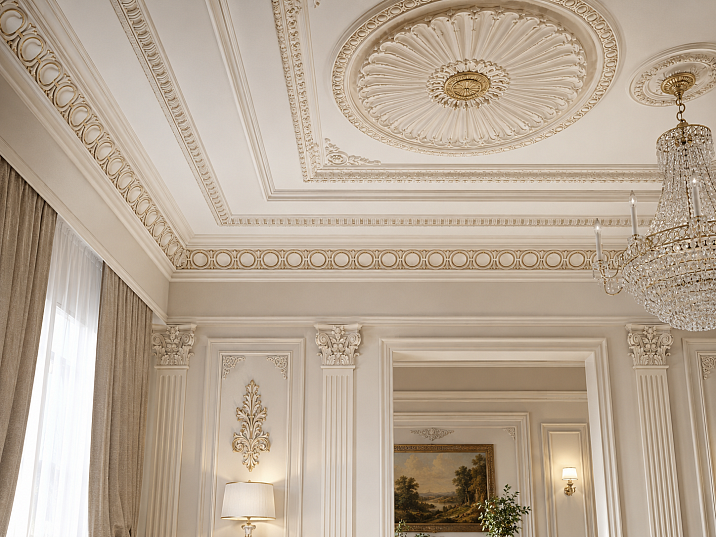
There are styles that never age. Empire is one of them. Not because it is "fashionable" or "trendy" — these words do not apply to it. Empire stands above fashion. It appeals to the eternal: to the imperial grandeur of Rome and Greece, to the triumph of symmetry and rhythm, to monumental beauty that needs no justification. And that is why Moldings in the Empire style it returns again and again to modern interiors — with the same inevitability with which classicism returns to architecture after every "avant-garde" period.
If you choose molding for an Empire style interior means you have already made a strategic choice in favor of an interior that will look dignified in twenty years just as it does today. At STAVROS, we have everything for this: overlays with laurel wreaths and medallions, rosettes with antique motifs, strict moldings, capitals for pilasters, and moldings for creating monumental wall compositions. Let's figure out how to compose a precise, stylistically flawless solution from this arsenal.




What is Empire stucco: style, language, and logic of decor
Before choosing specific products, it is important to understand what Empire decor consists of as a system. Empire is not a set of individual beautiful details. It is a language with its own grammar, vocabulary, and rules.
The Empire style emerged in the early 19th century as an architectural expression of the imperial ambitions of Napoleonic France. Its source is Ancient Rome and Greece: the order system, monumentality, strict symmetry, military and triumphal motifs. Laurel wreaths, eagles, bundles of arrows, torches, medallions with profiles, antique masks — all this is the Empire ornamental vocabulary.
In Russia, Empire acquired special significance: St. Petersburg classicism, Stalinist architecture (the so-called Soviet or Stalinist Empire) — both phenomena relied on this tradition. That is why Empire stucco in Russia is perceived not as exotic, but as something inherently 'native': the grand halls of Stalinist buildings, the lobbies of pre-war metro stations, the facades of ministries — all this is familiar to everyone.




Principles of Empire decor: five unbreakable rules
Symmetry is a law, not a wish. In Empire, there are no random asymmetries, no 'living' disorder of Art Nouveau, no free flow of forms. Every ornamental element must have a pair: left — right, top — bottom. The central axis of a wall or ceiling rosette is sacred.
Monumentality of scale. Empire decor loves large patterns. Small stucco in the Empire style looks out of place, like an opera singer in a conversational scene. Overlays should be substantial, relief deep, moldings wide and confident.
Antique motifs as the main ornamental vocabulary. Laurel wreaths, acanthus, meander, palmettes, medallions, torches, ionic, strict vertical elements — this is Empire decor. A random floral pattern or Art Nouveau vegetation is already a different style.
White color or monochrome palette. Empire is not afraid of contrast: white stucco on a painted wall is a standard solution. But even more often, Empire uses monochrome white: stucco in the color of the wall, which works as relief, not color.
Strict rhythm and repeatability. Empire molding is not an ornament that flows freely. It is a mathematical ribbon: a clear repetition step, even relief, perfect horizontality. Any violation of rhythm destroys the Empire atmosphere.
Our factory also produces:



STAVROS Empire collection: what is included in the system
In the STAVROS catalog Collection of neoclassicism — is a thematic selection of elements inspired by ancient architecture and classical European Empire. The collection includes several types of products, each of which performs a specific architectural role in the interior.
Let's examine each group in detail.
Get Consultation
Empire decorative overlays: central ornamental accents
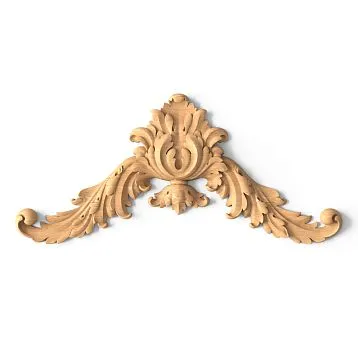
Polyurethane decorative appliques in Empire execution — these are relief elements with laurel wreaths, medallions, palmettes, cartouches, rosettes, and symmetrical antique ornaments. They are installed in the centers of wall panels, above doorways, on fireplace portals, in niches, and on furniture facades.
The main feature of Empire overlays is large scale and high relief. An overlay with a laurel wreath 30–40 cm in diameter with a relief of 3–4 cm on a white wall is a powerful architectural accent visible from any point in the room. This is exactly what is needed in Empire: not a subtle hint, but a monumental statement.
Types of overlays in Empire style:
-
Medallions are round or oval relief elements with a profile, mask, or ornamental motif inside. They are installed symmetrically above doors, in niches, or as paired accents on an accent wall.
-
Laurel wreaths are a classic Empire style symbol. A round frame of laurel leaves and berries can be a standalone decorative accent or a frame for a medallion.
-
Palmette motifs are fan-shaped palm leaf designs, horizontal or vertical. They are used as corner inserts in molding frames or as standalone decorative accents.
-
Cartouches are decorative "shields" with ornamentation, often with scrolls along the edge. One of the key Empire style motifs.
-
Symmetrical branches are paired branches with acanthus or laurel leaves diverging from the center. They are used as horizontal accents above doors and fireplaces.
Polyurethane rosettes in Empire style: ceiling monument
polyurethane rosettes In Empire style, these are central ceiling decorative elements with an ornament organized on the principle of radial symmetry. An Empire rosette should be substantial: large, with deep relief, and a clearly readable pattern.
Main types of rosettes for an Empire interior:
-
Rosettes with concentric bands of acanthus leaves
-
Rosettes with palmettes on the outer ring and laurel motifs inside
-
Sockets with medallion inserts and geometric framing
-
Strict sockets with ionic, meander, and geometric ornament — for Stalinist Empire style
The size of the socket in an Empire interior is crucial. With a ceiling of 2.8 m, the socket should be at least 40–50 cm in diameter: a smaller one will simply get lost. In formal halls with ceilings of 3.5 m and higher, a socket with a diameter of 70–90 cm or more is the norm.
Socket relief: with a ceiling of 2.7–3 m — 3–4 cm. With a ceiling of 3.5 m or more — 4–6 cm and above.
Polyurethane moldings in Empire style: lines, rhythm, and belts
Polyurethane trim — one of the main tools for creating Empire decor. Linear elements with ionic, meander, palmettes, and strict plant ornament create decorative belts that structure the space horizontally.
In an Empire interior, moldings are used:
-
As a cornice decorative belt under the ceiling
-
As a horizontal frieze at the level of the upper third of the wall (at a height of 2/3 from floor to ceiling)
-
As framing for the upper part of wall panels
-
As an ornamental accent above doorways
-
As a decorative belt in niches and alcoves
Empire-style molding is characterized by a strict, rhythmic ornament. Meander is an ideal Empire motif for molding: its mathematical precision and continuous rhythm perfectly match the Empire aesthetic. Ionic and palmettes are next in the hierarchy of Empire molding motifs.
The width of an Empire-style molding belt depends on ceiling height: with a ceiling of 2.8–3 m, the optimal molding is 8–14 cm. With a ceiling of 3.5 m or higher, it is 14–20 cm. Narrow molding looks insubstantial in an Empire interior.
Polyurethane capitals: architectural scale in details
Polyurethane capitals — these are the crowning elements of columns and pilasters. In interior Empire style, the capital plays a key architectural role: it completes the vertical element (column, pilaster, corner post) and creates a visual "cap" that is perceived as an architectural endpoint at the end of a vertical line.
Capitals characteristic of the Empire style:
-
Ionic — with volutes (scrolls) on the sides, strict, mathematically precise
-
Corinthian — with lush acanthus leaves, more decorative
-
Doric — the strictest, with minimal relief, for Soviet Empire style
In modern residential interiors, capitals are used:
-
On pilasters in halls and living rooms
-
On decorative columns in doorways
-
On corner vertical accents
-
In fireplace areas with pilaster framing
Installation of a capital requires precise alignment with the column or pilaster body. Polyurethane capitals from the STAVROS catalog are lightweight, do not require reinforced fasteners, and are mounted with assembly adhesive and additional fixation.
Moldings and cornices for an Empire-style interior: frames and upper belt
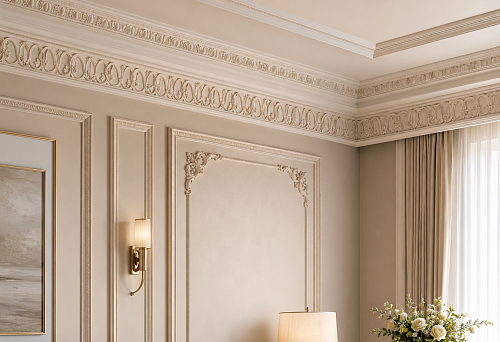
Moldings made of polyurethane and cornices in an Empire-style interior create a strict frame system: wall panels with clear rectangular outlines, a cornice belt with ornamentation under the ceiling, horizontal wall divisions.
For Empire style, the width of the molding is important: a thin elegant profile, suitable for neoclassicism or Provence, looks uncertain in Empire. A molding for an Empire frame is a serious profile 8–14 cm wide with moderate relief: shelves, quarters, cymas — clear architectural details.
A cornice for an Empire-style interior is wide, strict, with an ornamental frieze. Ionic, meander, acanthus — for the frieze. A clear shelf and lower profile are mandatory. Width of an Empire cornice: with a ceiling of 2.8 m — 14–18 cm; with a ceiling of 3.5 m — 20–28 cm.
Decor for moldings: finishing Empire frames
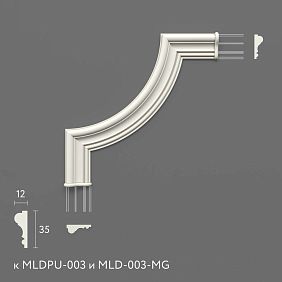
Decor for Molding in the Empire context — corner and central inserts with antique motifs, installed at the junction points of molding frames. In Empire style, corner inserts should be ornamental, not just geometric: a rosette, medallion, palmette, or cartouche in the corner of the frame — a small accent element that reinforces the Empire character of the entire wall composition.
Empire decor by interior zones: precise breakdown
Now — practice. Let's break down how to apply Empire-style stucco in each specific zone of the room.
Walls: symmetry, frames, and accent overlays
An Empire wall is not just a painted surface with stucco placed randomly. It is an organized architectural plane with a clear vertical and horizontal structure.
Classic solution for an Empire wall:
-
Cornice around the perimeter of the room (under the ceiling)
-
Horizontal linear belt at 2/3 of the wall height
-
Wall panels — rectangular fields between the linear belt and baseboard, framed with molding frames
-
Central decorative overlays inside frames: medallion, wreath, palmette
-
Corner inserts at molding connection points
This system creates a full Empire-style wall decor — strict, symmetrical, architecturally convincing.
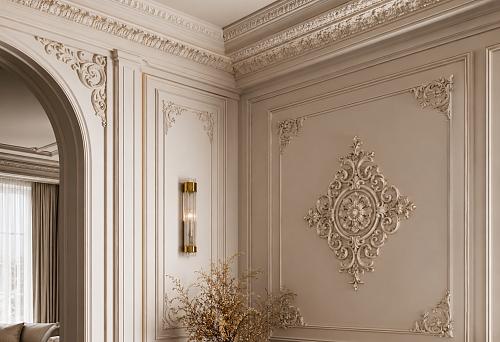
For walls in Empire decor, it is important to follow the rule: the overlay inside the frame must be symmetrical on both axes and occupy no more than 40–50% of the frame area. An overly large overlay in the frame loses space around it and looks cramped.
Stucco Polyurethane wall decor in the Empire style harmoniously combines with rich dark colors: burgundy, deep blue, olive, anthracite — white stucco on a dark background creates that Empire contrast which is immediately read as style.
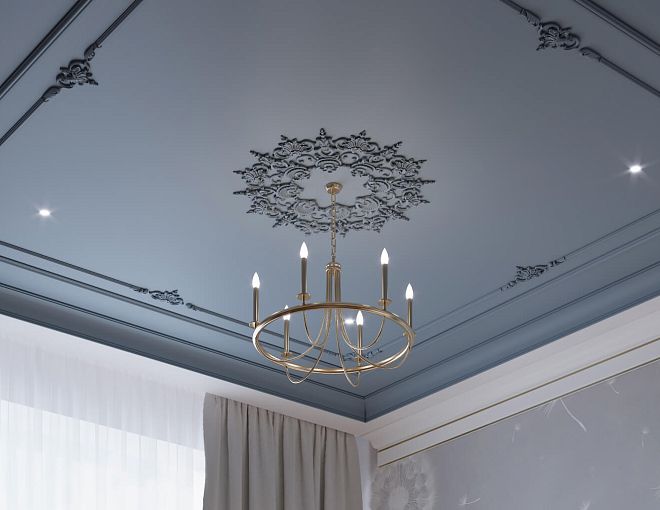
Ceiling: rosette, cornice, and decorative band
Ceiling decor in an Empire interior is built on the principle of hierarchy:
-
First level: cornice around the perimeter with Ionic or meander pattern
-
Second level (with ceiling height from 3 m): additional decorative band parallel to the cornice, at a distance of 40–60 cm from it
-
Third level: socket in the center of the ceiling
Decor for polyurethane ceilings in the Empire style version — it is a strict, monumental system where every element works to enhance the overall architectural character. The rosette should be large and substantial. The cornice — wide and ornamental. The additional band (if used) — proportionate.
Doorway: capitals, moldings, and overlays
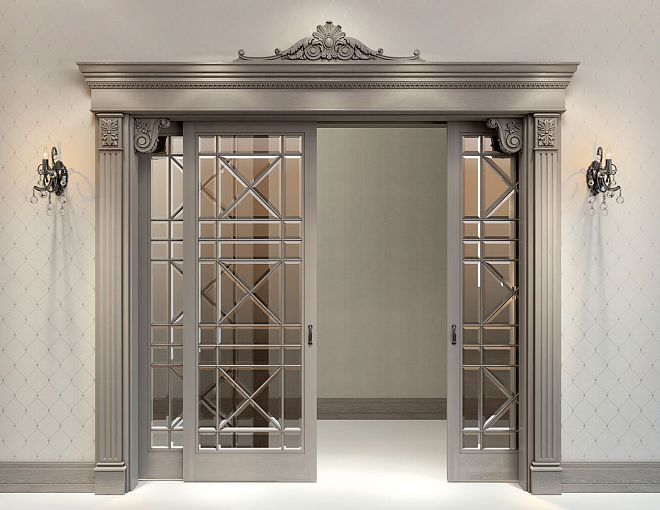
A doorway in an Empire interior is a full-fledged architectural object. The door does not just "open" — it is integrated into the decorative system.
Standard Empire treatment of a doorway:
-
Vertical pilasters on the sides with capitals at the top
-
Horizontal molding above the opening
-
Central overlay (medallion or cartouche) above the lintel
-
Corner decorative accents at the transition points from vertical to horizontal
For openings with a width from 90 cm to 1.2 m, the optimal size of the pilaster strip is 8–12 cm. The capital is Ionic or Corinthian. The horizontal molding above the opening repeats the ornamental type of the cornice or is a simplified version of it.
Fireplace zone: a grand Empire-style accent
The fireplace is the traditional center of an Empire-style interior. The fireplace portal with stucco decoration in the Empire style is the strongest decorative statement in the room.
The Empire-style fireplace zone is characterized by:
-
Pilasters with capitals on the sides of the firebox
-
Large central overlay above the lintel (medallion with an antique mask, laurel wreath, cartouche)
-
Molding belt along the upper perimeter of the portal
-
Symmetrical side accents — paired overlays with laurel branches
Proportions of an Empire fireplace portal: the width of the portal corresponds to the width of the firebox plus 40–60 cm on each side. The height is one and a half to two times the width.
Furniture facades: Empire style without overload
Empire decor on furniture is applied selectively, not continuously. A small overlay with a medallion or laurel wreath (10–15 cm in diameter) on cabinet or chest doors is enough to "read" the style. Do not overload furniture facades with large relief elements: furniture loses functionality and starts to look like a theatrical set.
Relief of the overlay for a furniture facade: no more than 1–1.5 cm. A deeper relief will interfere with opening drawers and cabinets.
Commercial interior: Empire style as a language of status
In commercial spaces — banks, notary offices, restaurants, hotels — Empire decor serves as a visual marker of status. An Empire-style interior tells the visitor: this is serious, this is history, this is tradition. This is a very specific communicative message that works flawlessly.
Commercial spaces are characterized by:
-
Large symmetrical compositions on accent walls
-
Cornice belts with monumental ornament
-
Columns or pilasters with capitals in entrance areas
-
Rosettes in meeting rooms and executive offices
Standard sets of Empire decor STAVROS
In practice, choosing Empire-style stucco is easiest to structure through standard sets: minimal, wall, ceiling, and architectural. These are not rigid schemes, but guidelines for understanding the scale of the task.
Minimal Empire set
Task: add an Empire accent to a regular interior without major renovation.
Includes:
-
One or two moldings to create a small frame on an accent wall
-
Central overlay with an Empire motif (laurel wreath, medallion) inside the frame
-
Socket or decorative element on the ceiling in the chandelier area
This set changes the room's atmosphere without radical intervention in the interior. The cost and labor of installation are minimal. The effect is tangible.
Wall Empire-style set
Task: create a full Empire-style decorative system on one or more walls.
Includes:
-
Moldings for two or three frame panels on an accent wall
-
Central overlays inside frames (medallions, wreaths)
-
Corner decorative inserts at molding connection points
-
Horizontal trim along the upper border of the frame area
-
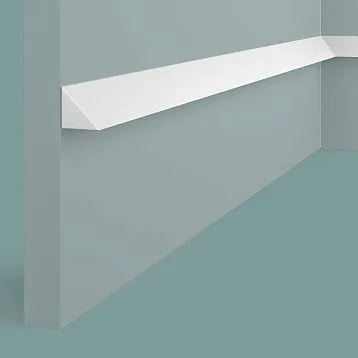
Baseboard coordinated with moldings in style register
The wall set requires careful measurement and planning: frame fields must be strictly symmetrical relative to the center of the wall, distances from the frame edge to the corner and to the ceiling must be the same on both sides.
Ceiling Empire set
Task: design the ceiling in a full Empire style.
Includes:
-
Cornice around the perimeter with Ionic or meander pattern (for ceilings from 2.8 m)
-
Additional linear molding parallel to the cornice (for ceilings from 3 m)
-
Rosette in the center (diameter — 1/5 of the smaller ceiling dimension, but not less than 40 cm)
-
Corner decorative accents at the cornice joints
The ceiling set completely changes the perception of height: a properly selected cornice visually 'raises' the ceiling, and a large rosette creates a sense of monumentality in the space.
Architectural Empire set
Task: create a full Empire interior with architectural accents.
Includes:
-
Capitals on pilasters or decorative columns (hall, living room)
-
Large decorative overlays on accent walls
-
Full cornice system (cornice + additional band)
-
Deep-relief rosette
-
Wall frame panels with corner decor
-
Decorative design of doorways with moldings and overlays
-
Baseboard with ornamental band
An architectural set is no longer just "adding decor" but creating a new interior. It requires a design project or at least careful planning on paper before installation.
How to choose the size of Empire decor: the logic of proportions
Empire style does not forgive scale errors. Too small decor looks uncertain. Too large looks theatrical and heavy. Correct proportions are the foundation.
Appliqués and medallions
For a room of 20–30 sq. m with a ceiling of 2.7–3 m:
-
Central overlay on accent wall: 30–50 cm on the larger dimension
-
Corner or side overlays (pair): 15–25 cm
-
Relief: 2–4 cm
For a grand hall with an area of 40 sq m and a ceiling of 3.5 m or higher:
-
Central overlay: 50–80 cm or more
-
Side elements: 25–40 cm
-
Relief: 4–6 cm
Rosettes
-
Ceiling 2.7 m, room 20 sq m → rosette diameter 40–50 cm
-
Ceiling 3 m, room 30 sq m → rosette 50–65 cm
-
Ceiling 3.5 m, room 40 sq m → rosette 65–80 cm
-
Ceiling from 4 m, hall 50+ sq m → socket from 80 cm
Linear molding and cornice
With a ceiling of 2.7 m → cornice width 12–16 cm, linear molding belt 8–12 cm.
With a ceiling of 3–3.5 m → cornice 16–22 cm, linear molding belt 12–16 cm.
With a ceiling of 3.5 m and above → cornice 22–28 cm, linear molding belt 16–20 cm.
Capitals
The size of the capital should match the size of the column or pilaster. Standard rule: diameter (or width) of capital = diameter (width) of column × 1.2–1.3. The capital is slightly wider than the column shaft — this creates a visual "opening" at the top point.
Mistakes when choosing Empire style stucco
Even good elements can produce an incorrect result. Here is what most often goes wrong.
Violation of symmetry. One applique on the wall without a pair, frames of different widths on the same wall, a rosette shifted from the center — all this destroys the Empire aesthetic. Empire requires absolute symmetry.
Small decor in a large space. A small applique on a spacious wall gets lost and looks random. In Empire style, there is no place for "delicate" details — monumental scale works here.
Mixing Empire style with incompatible styles. An Empire rosette and overlays combined with loft-style furniture, smooth white walls, and exposed pipes create conflict, not eclecticism. Empire requires an appropriate context.
Using ornaments from a foreign style vocabulary. Floral Art Nouveau, asymmetrical branches, high-tech geometry — none of these are Empire ornaments. Stick to the Empire vocabulary: laurel wreaths, medallions, Ionic, meander, acanthus, palmettes.
Too deep relief in a low room. A relief of 5–6 cm with a ceiling height of 2.5 m creates a feeling of heaviness and pressure. The depth of the relief should match the scale of the room.
Lack of system. Three elements from three different style sets are not Empire decor. It is chaos. All elements must belong to one style line and work as a unified system.
Where to buy Empire-style stucco STAVROS: catalog navigation
To create a full-fledged Empire interior, all necessary elements are available in the STAVROS catalog.
If you are looking for buy empire decor — start with the thematic section of the Empire collection, where elements are united by style logic and coordinated with each other in ornamental language.
To select central ornamental overlays with laurel wreaths, medallions, and antique motifs, the section polyurethane molding decoration. Here the main assortment of relief elements is concentrated with filtering by size and ornamental type.
For rosettes with acanthus leaves, concentric ornamental bands, and palmettes — section polyurethane sockets. Choose by diameter and relief depth.
For Ionic, Corinthian, and Doric capitals — section polyurethane capitals. Capitals of various sizes for pilasters and decorative columns are presented here.
For strict ornamental moldings with meander, egg-and-dart, and Empire-style bands — section polyurethane molding. This is the main linear material for creating decorative bands and horizontal divisions.
For cornices and moldings with a classic profile — section moldings, cornices, and baseboards.
For corner and central ornamental inserts in molding frames — section decoration for moldings.
The full range of products for an Empire-style interior — in the main section polyurethane products.
Want You can buy ready-made stucco matching the Baroque style. Calculate the quantity: linear meters of cornices and moldings, number of rosettes, pilasters, consoles, corner elements. Add a ten to fifteen percent allowance for trimming. in the Empire style with delivery across Russia — use filtering by style section and product type. All elements are made of dense polyurethane, lightweight, moisture-resistant, installed without special tools, and after painting are indistinguishable from plaster stucco.
FAQ: answers to the most frequent questions about Empire stucco
How does Empire decor differ from classic stucco?
Empire is stricter, more monumental, more symmetrical. Classic allows for plant motifs and floral patterns. Empire primarily uses an antique ornamental vocabulary: laurel wreaths, medallions, ionic, meander, palmettes. Empire tends toward imperial grandeur, classic toward a warmer decorative richness.
Can an Empire interior be made in an apartment with a 2.5 m ceiling?
Yes, but with caveats. The scale of decor should be reduced: narrow moldings, moderate cornice, small overlays. Monumental Stalinist Empire requires high ceilings—but a lightweight Empire decor works in standard apartments.
What color for Empire stucco?
The classic option is white stucco on a white ceiling and upper walls, white on dark or richly colored accent walls. Monochrome painting (stucco in the color of the wall) is acceptable. Gold—for formal areas and fireplaces, in moderation.
Is a design project needed for Empire decor?
For a minimal set—not necessary. For an architectural set with capitals, pilasters, and a full wall system—highly desirable. Empire does not tolerate random decisions: symmetry, proportionality, and consistency of all elements are required.
How to understand if two elements from the catalog are compatible?
Follow the style guide: if both elements belong to the Empire collection or the same ornamental type (both with Ionic or both with acanthus), they are compatible. Mixing ornamental types requires design awareness.
Is it difficult to install Empire polyurethane decor?
No. Polyurethane products are installed with mounting adhesive without drilling. Rosettes — with adhesive and additional fasteners. Capitals — with adhesive and fixation until set. After installation, joints are puttied, the surface is primed and painted.
How not to overdo it with Empire decor?
Rule: one main accent in each zone. In the living room — one rosette and one central overlay on the accent wall. In the hall — capitals and a molding belt. Everywhere — symmetry. Empire is not about overload, but monumentality. The difference lies in scale and symmetry, not in the number of elements.