Article Contents:
- Why leftovers of wooden trim cannot be considered ordinary construction waste
- Which leftovers need to be separated after installation
- Whole unused trim
- Full-length items without packaging
- Long usable leftovers after cutting
- Short technological leftovers
- Parts with finished cuts
- Damaged elements
- Irrecoverable waste
- Three practical levels of value
- When a local remnant should be returned to the project's general reserve
- How to keep the remnant bank from turning into a dump
- After a project change, first check the remaining stock for reuse
- Remaining stock must be transferable between floors and zones
- When transferring remaining stock between rooms is justified
- There is no universal percentage for the repair reserve
- After installation is completed, usable material must receive a final status
- Installers must not be forced to use every short offcut
- Expensive decorative trim requires stricter tracking
- A construction material supplier can help calculate an additional batch more accurately
- When the supplier cannot solve the task for the site
- Checking the full-length stock
- Checking long offcuts
- Checking the reserve
- Wooden skirting board: offcuts are especially useful on short wall sections
- Where saving becomes unreasonable
- Wooden moulding: the length of the leftover alone does not show its value
- Wooden cornice: the usefulness of the leftover depends on angles and line continuity
- Full-length material without packaging requires re-identification
- Parts with finished cuts are stored separately
- A damaged element does not always turn completely into waste
- A useful leftover must have a physical storage location
- Building materials at wholesale prices: a cheap reorder is still unnecessary if the material is already on site
- Practical scenario: the total balance is large, but the required lengths are not available
- Practical scenario: the balance after a project change becomes free stock
- Practical scenario: a balance with a finished cut cannot be counted as regular linear meters
- Practical scenario: different crews create hidden stock
- Practical scenario: short remnants can be used without compromising quality
- Practical scenario: a short remnant should not be used
- Wholesale sale of building materials: the free balance must be separated from the reserve
- The actual balance is best counted by pieces and lengths at the same time
- Remnants should be tracked by condition, not just by length
- Building materials wholesale: every remnant must have a process owner
- 1. Treating any offcut as waste
- 2. Storing only total linear meters
- 3. Not labeling remnants after cutting
- 4. Mixing different batches without checking
- 5. Not separating whole pieces from offcuts
- 6. Mixing pre-cut parts with straight remnants
- 7. Do not take condition into account
- 8. Leave leftovers with the crew after closing the zone
- 9. Place a reorder without checking the stock bank
- 10. Use the operational reserve for regular installation
- 11. Use all short leftovers at any cost
- How to organize weekly stock control without unnecessary bureaucracy
- What to record when closing a room
- How to determine which leftovers to keep until the end of the project
- How to hand over the stock bank to the next installation phase
- How to link the stock bank with the cutting map of the next zone
- How to avoid creating unnecessary joints when using the remnant bank
- How to account for free material after canceling a placement or queue
- How to work when the remnant matches by SKU but differs in shade
- How to work with remnants after dismantling a temporarily installed element
- How to close the remnant bank after construction completion
- How to hand over operational remnants after project completion
- When it is more profitable to keep a remnant, and when to free up the warehouse
- Construction stock and operational reserve must not be mixed in one figure
- How to close remnants if part of the material must be returned to the supplier or customer
- How to tell that the stock accounting system is actually working
- Before reordering, it is useful to record the stock date
- Should every short offcut be accounted for?
- Can stock be tracked in meters only?
- When should stock be returned from the floor to the main warehouse?
- Can material from another batch be used?
- Should the operational reserve be used to avoid reordering?
- What to do with stock that has one damaged end?
- How do you know if a reorder is needed?
- Should leftovers be kept after construction is finished?
- Who should be responsible for the leftover stock bank?
- Can all leftovers be used for maximum savings?

Wooden trim has been ordered according to the project specification sheet, delivered to the site, and distributed among floors and rooms. Installation has been underway for several weeks. At the central warehouse everything looks simple: some of the goods have been issued, some are still in packaging. But inside the installation zones the picture is much more complex.
In one room, two whole skirting boards remain. In another, there is a 1150 mm molding after cutting. The third crew has three cornices with cuts already made. In the utility room, a box of short offcuts has been collected. Several full-length items are left untouched because they are considered a reserve. Some of the material also remains after a project change and formally no longer belongs to the original zone.
If all this is not taken into account, the site starts to see only two numbers: how much was purchased and how much remains at the central warehouse. The real usable fund between them disappears. That is why wholesale trade in building materials on a large site does not end with delivery: the economic result also depends on what happens to the material after the first cut.
Work sequence:
ISSUE TO INSTALLATION → CUTTING → SEPARATE WHOLE ITEMS → SEPARATE USABLE LEFTOVERS → RECORD LENGTHS → CHECK CONDITION → RETURN USABLE ITEMS TO THE COMMON FUND → USE IN SUBSEQUENT ZONES → SEPARATE THE OPERATIONAL RESERVE → BEFORE REORDERING, CHECK THE ENTIRE ACTUAL FUND OF THE SITE → ORDER ONLY THE REAL DEFICIT.
Main principle:
LEFTOVER IN LINEAR METERS ≠ A FUND USABLE FOR INSTALLATION.
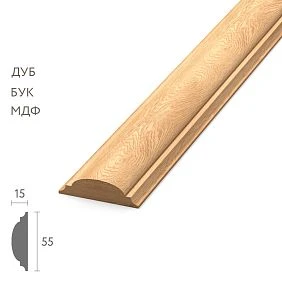
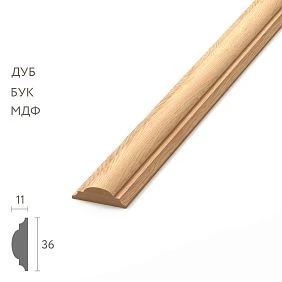
Why wooden trim remnants cannot be considered ordinary construction waste
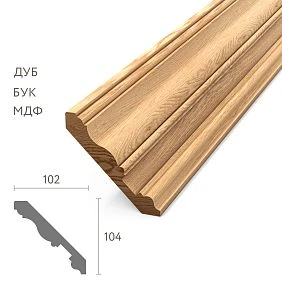
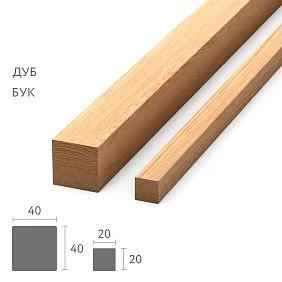
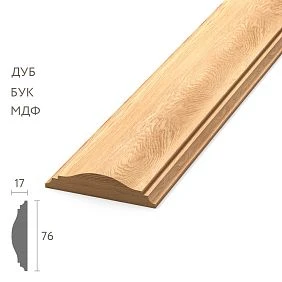
Skirting boards, mouldings, cornices, architraves, battens and picture rails are long-length products. After installation, they almost inevitably leave remnants of varying lengths. But the value of these remnants is not the same.
A 250 mm offcut may not fit any visible section. A 900–1200 mm remnant can cover a short wall pier, a door area, part of a frame or a local repair. A full-length strip left over after a design change retains almost all of its original value.
That is why the approach of “cut it — throw away everything left over” works especially poorly with decorative solid wood. On a large project, small losses are repeated hundreds of times and turn into a noticeable volume of material.
A rational approach does not mean using any piece at any cost. It means first classifying the remnant, and only then deciding: use it, keep it, return it to the common stock or write it off.




Which remnants should be separated after installation
For practical accounting, it is useful to distinguish several categories.
Whole unused trim
Full-length products in factory or site packaging. This is the most valuable remnant: it can be redistributed between zones or kept in reserve.
Full-length products without packaging
Geometrically they are complete, but before reissuing, the article number, material, finish, and surface condition need to be checked.
Long usable offcuts after cutting
Pieces that can be used on actual short sections. Their value is determined not by the fact of length itself, but by their suitability for future segments.
Short process offcuts
Small pieces whose use is limited. Some may be useful for samples, finish matching, or very short sections, but keeping all of them indiscriminately is not advisable.
Parts with pre-cut angles
They must not be mixed with ordinary straight offcuts. The angle, orientation, and length are already tied to a specific joint.
Damaged elements
Chips, deformation, contamination, or damaged finish may limit reuse. The usable part can sometimes be cut off, but this needs to be assessed separately.
Irrecoverable waste
Material that truly cannot be used in a project, repair, or as a sample.
Our factory also produces:




Why you cannot track stock only in linear meters
Imagine two warehouses of stock for the same profile. Each has a total of 4 meters.
Option A: two pieces of 2000 mm.
Option B: eight pieces of 500 mm.
Formally, both stocks equal four linear meters. But if the project needs two sections of 1800 mm, Option A covers the need almost entirely, while Option B does not work at all.
Therefore, usable stock is described with at least the following:
SKU + MATERIAL + FINISH + LENGTH OF EACH PIECE + QUANTITY + CONDITION.
For some products, the batch, grain direction, or an already-made cut are additionally important.
Get Consultation
The minimum usable length cannot be set as a single number for the entire object
There is no universal rule that "anything shorter than 600 mm should be thrown away." Usefulness depends on which actual sections still need to be installed.
For one project, a 700 mm offcut can cover:
- a short wall section;
- the area between the door and the furniture;
- the lower part of a decorative portal;
- a repair insert.
In another project, all feature walls require long continuous elements, and the same offcut has almost no installation value.
Therefore, for each SKU it is useful to define the working threshold not "off the top of your head," but based on the remaining segments and typical repair scenarios.
Three practical value levels
| Category | Meaning | What to do |
|---|---|---|
| Full-length material | Covers a standard project section | Return to the general stock or reserve |
| Useful remainder | Covers known short segments | Account for by length and store separately |
| Low usefulness | No real use case | Do not clutter the warehouse |
The leftover must be labeled immediately after cutting
The cheapest point of tracking is the moment when the installer still knows which plank the leftover came from. After two days, two similar moldings without labeling may become indistinguishable.
On a usable leftover or on a group of identical leftovers, the following must be preserved:
- article number;
- wood species or material;
- finish;
- length;
- zone of origin;
- batch, if necessary;
- condition.
A complex digital system is not needed here. A large, readable label, tag, or container card often solves the task better than a separate digital code on each offcut.
Remnants from different batches must not be automatically combined
Even the same article number does not always mean full interchangeability within a species zone. For solid wood, there may be differences:
- in natural shade;
- in grain pattern;
- in tinting;
- priming;
- finish coating;
- surface condition;
- age or storage conditions.
If two remnants are to be installed next to each other, they must be visually checked. This is especially important for tinted wood, natural oak, and other finishes where the natural variability of the material is noticeable.
For hidden areas or areas far apart from each other, the requirements for visual matching may be looser, but the decision must still be a conscious one.
The remnant inventory shows the material actually available
| Article | Origin zone | Source length | Remainder | Condition | Can be used | Purpose |
|---|---|---|---|---|---|---|
| PLT-A | 204 | 2400 мм | 1150 мм | Good | Yes | Short wall section |
| PLT-A | 207 | 2400 мм | 420 мм | Good | Limited | Repair sample |
| MLD-B | 315 | 2200 мм | 1680 мм | Good | Yes | next frame |
This inventory is not needed for accounting purposes. It answers a practical question: what usable stock physically exists at the site right now.
For supply, the link between the statement and future work areas is especially important. A leftover without a known usage scenario should not automatically be considered a full-fledged replacement for new material.
When a local leftover needs to be returned to the site's common reserve
While a room or installation area is not yet finished, a small stock near the crew makes sense. It is needed so they don't have to go to the central warehouse for every single strip. But after the area is closed, usable material should not remain "with the crew" indefinitely.
Working logic:
AREA COMPLETED → LEFTOVER RECALCULATED → USABLE RETURNED TO COMMON FUND → DAMAGED SEPARATED → RESERVE RECORDED.
Otherwise, several hidden warehouses appear on the site. The central warehouse shows a shortage, even though the material is physically lying on floors, in utility rooms, and installation rooms.
The "leftover bank" helps use usable offcuts systematically
On a large site, it is useful to allocate a separate storage area for usable offcuts. This is not a waste warehouse, but a managed fund of material that can still be used.
It is best to separate it by:
- SKU;
- material;
- finish;
- length;
- condition;
- batches, if necessary.
Such a bank is especially useful in hotels, office complexes, residential projects, and other facilities with repeating rooms. There, short standard sections repeat many times, and the leftover that was not used on one floor can perfectly cover another.
How not to turn a leftover bank into a dump
You don't need to keep everything. If a piece has no clear use case, is damaged, or is too short for the project, it shouldn't take up space just because it 'might come in handy'.
A leftover bank only works when its contents are:
- identified;
- measured;
- searchable;
- physically separated from waste;
- regularly used or reviewed.
wholesale purchase of building materials: before reordering, first check the leftovers
The installer reports: “we are 18 meters of profile short.” This does not yet mean that 18 new meters need to be purchased.
First, check:
- full-length remnants of the same SKU;
- operational and installation reserve;
- material from completed rooms;
- long usable offcuts;
- items freed up after a project change;
- material from other installation crews;
- returns not yet received into the central warehouse.
Only after this does the actual shortage appear.
Before making an additional purchase, we calculate the real requirement not only in meters
The management formula is simple in essence:
REQUIREMENT FOR REMAINING WORKS − SUITABLE STOCK ON SITE − CONFIRMED RESERVE = ACTUAL DEFICIT.
But you need to count by actual lengths. Twenty meters of short offcuts won't help if you need four continuous sections of 2400 mm.
Therefore, before reordering, two structures are compared:
| What is required | What is available in the remnants | Solution |
|---|---|---|
| 4 × 2400 mm | 8 × 500 mm | Does not cover the requirement |
| 3 × 900 mm | 2 × 1200 mm + 1 × 950 mm | Requirement fulfilled |
| 2 × 1800 mm | 2 × 2000 mm | Requirement fulfilled with cutting |
That is why wholesale purchase of building materials after the start of installation, it must be based on the segment list and actual stock, not just the total remaining in linear meters.
After a project change, we first check the remaining materials for reuse
A wall was removed, an opening was relocated, the profile was replaced, or some rooms were excluded. Material that was already allocated to the old area should not automatically become "excess".
First check:
- whether it can be used in other rooms;
- whether the SKU matches;
- whether the finish matches;
- whether the lengths are suitable;
- whether it is needed as an operational reserve;
- whether the next phase with the same profile is planned.
Only after this does the remainder receive its final status.
Remainders must be transferable between floors and zones
A shortage arose on the fifth floor. After installation was completed on the third floor, several fully usable elements of the same profile remained. If each floor keeps only its own local records, the purchaser will see the shortage and open a new order.
A centralized pool allows checking the available remainder across the entire site first.
Before moving between zones, check:
- exact article number;
- the material;
- finish;
- length;
- condition;
- purpose;
- absence of allocation to another zone's reserve.
When transferring a remainder between rooms is justified
The mere fact that the SKU matches does not yet mean that the material can be taken from one zone to another.
Transfer is justified if:
- the SKU matches;
- material matches;
- the finish is comparable;
- the length is suitable;
- the item is not damaged;
- the remainder is not an operational reserve;
- the new use does not impair visual quality;
- the redistribution is reflected in the records.
If the material visually differs in tone, especially in adjacent visible areas, it is better not to use it just to save money.
The repair reserve must be kept separate from the free stock balance
Not all usable material should be used up down to the last plank. After handover to the facility, local repairs may be needed, replacement of a damaged section, restoration after dismantling furniture or engineering equipment.
Full-length elements of complex or rare profiles are especially valuable.
The operational reserve differs from the free stock balance in that it:
- is deliberately allocated for future repairs;
- is not included in regular issuance;
- has a clear SKU and finish;
- has a known storage location;
- is handed over to operations together with the facility.
There is no universal percentage for the repair reserve
You shouldn't write "always keep 5%" or "10% is enough for any project." The reserve size depends on:
- scale of the object;
- the number of identical rooms;
- the complexity of the profile;
- the possibility of re-production;
- finishes;
- the uniqueness of the batch;
- the likelihood of local damage;
- the service life;
- the future availability of the product.
For a mass-produced standard profile, the reserve may be smaller than for a custom-made molding with complex tinting.
After installation is complete, usable material should receive a final status
By the end of the work, it's best to divide the leftovers into clear categories:
- OPERATIONAL RESERVE — hand over to the facility owner;
- FREE BALANCE — can be used on the next phase;
- USEFUL OFF-CUTS — keep for local repairs;
- RETURN / REDISTRIBUTION — if provided for;
- WASTE — genuinely unusable material.
This way, the project doesn't finish construction with dozens of unnamed bundles and boxes.
materials in bulk: cutting and remnants should be considered together
Before starting the next zone, it's useful to first check the existing remnant bank.
If a 850 mm section is required, there's no point in automatically cutting a new 2400 mm plank when there's a usable 1000 mm remnant in reserve.
But remnants should be used in a planned way. Trying to "use up everything with short pieces" can increase the number of joints and worsen the visual result.
Correct priority:
INSTALLATION QUALITY → EFFICIENT CUTTING → REUSE OF SUITABLE OFF-CUTS.
Installers must not be forced to use every short off-cut
Material savings must not lead to:
- unnecessary joints;
- disruption of the wood grain pattern;
- noticeable tone transitions;
- deterioration of frame geometry;
- untidy short inserts;
- reduced quality of the visible finish.
If a new long element gives a significantly better result, its use is justified. The remainder can be left for another, less demanding area.
deliveries of construction materials: supply must see movement after issuance
For supply, indicators are not enough:
ORDERED / DELIVERED / PAID.
After installation begins, more are needed:
ISSUED / INSTALLED / REMAINING INTACT / USEFUL OFF-CUTS / RESERVE / DAMAGED / ADDITIONAL REQUIRED.
Then the next purchase relies on the real state of the site, not only on the movement of the central warehouse.
With several installation crews, a single site fund is needed
If there are several crews, each naturally creates a small local stock. Without centralized return, these stocks become invisible to each other.
Working scheme:
CREW → LOCAL REMAINDER → ZONE COMPLETION → RETURN TO CENTRAL FUND → REISSUE.
At the same time, there is no need to take material away from the crew every evening. It is important to close out the local remaining balance after completing a specific zone or stage.
Expensive decorative trim requires stricter tracking
The more expensive the profile and the more difficult it is to reproduce, the higher the cost of losing usable remnants.
This especially applies to:
- solid wood;
- custom tinting;
- non-standard profiles;
- large project batches;
- rare finishes;
- items with long reproduction lead times.
For such products, it makes sense to account not only for whole planks, but also for quality long offcuts that are actually suitable for repairs or subsequent zones.
building materials supplier can help calculate the additional batch more accurately
If, after inspecting the site, a shortage indeed remains, it is useful to provide the supplier not only with the phrase "we need another 20 meters."
It is better to put together:
- the original specification;
- the volume already received;
- the quantity actually installed;
- available stock;
- operational reserve;
- the remaining requirement by zone;
- the required segment lengths.
Then the additional batch is calculated based on the actual shortage, rather than on the rough difference of "project minus warehouse."
When the supplier cannot solve the task for the site
The supplier does not know which offcuts the crews actually have and which rooms are already closed if the site does not pass on this information. Therefore, internal material accounting is needed first, and only then can the order be adjusted.
Practical example: why a remaining balance of 340 m does not mean that no more needs to be purchased
Initially, 1,200 linear meters of several types of trim were ordered for the site.
After the first phase:
- 680 m has actually been installed;
- 210 m remains as full-length material;
- 96 m is in long usable offcuts;
- 34 m has been allocated to the operational reserve;
- 180 m has gone into short, damaged, or technologically unusable offcuts.
For the remaining project zones, another 410 m is needed.
At first glance, one might calculate:
410 − 210 − 96 − 34 = 70 m.
And conclude that the additional order is 70 m.
But this arithmetic alone is not enough.
We check the full-length stock
Of the 210 m of full-length material, 48 m belong to another SKU that is not needed in the remaining queue. Another 24 m are reserved for another species zone.
Actually available for the current requirement:
210 − 48 − 24 = 138 m.
We check the long remnants
Of the 96 m of usable offcuts:
- 40 m consist of pieces 1200–1800 mm and are suitable for short wall sections;
- 31 m — pieces 600–900 mm, of limited use;
- 25 m — too short for the remaining project segments.
This means not all 96 m can be counted as a full stock.
Checking the reserve
The 34 m of operational reserve should not be automatically spent on regular installation. If the site decides to keep it after handover, this volume is not deducted from the reorder calculation.
The final shortfall depends on the specific segment map, not on a single total number.
This example shows why building materials wholesale after installation begins, you need to calculate through the structure of physical lengths and assignments.
Wooden skirting board: offcuts are especially useful on short wall sections
У wooden baseboard short sections are often found near doors, furniture, columns and niches.
Therefore, a 900–1200 mm offcut can have high practical value even when it is useless for a long wall.
It is useful to compile a list of typical short segments for the project in advance. Then the installer will not cut a new plank for an 850 mm section if there is a suitable 950 mm piece in the offcut stock.
Where saving becomes unreasonable
If a short offcut requires an additional visible joint in the centre of the wall, saving one plank may worsen the result. For long straight walls, quality remains the priority.
Wooden moulding: the length of an offcut alone does not show its value
for wooden molding the dimensions of frames and portals are especially important.
A 1100 mm offcut may be perfect for one vertical side of a frame and useless for another composition.
In the moulding offcut inventory, it is useful to store:
- length;
- article number;
- finish;
- availability of a pre-made angled cut;
- orientation, if the profile or finish requires it;
- intended reuse.
Extra care must be taken with pieces where a cut for a specific angle has already been made. They are not equivalent to a straight cut of the same length.
Wooden cornice: the usefulness of the leftover depends on the angles and continuity of the line
У wooden cornice short inserts may be more visually noticeable than with a skirting board.
Before reuse, assess:
- the length of the straight section;
- presence of internal and external corners;
- the position of the joints;
- matching finish;
- possibility of using the leftover in a less visible area.
A linear meter of cornice made up of several short pieces may have low practical value even if the material is in good condition.
supply of construction materials: whole returns must be accepted back as inventory stock
After the premises are closed, the crew may return several whole items. They should not simply appear in a corner of the warehouse.
When returning, the following are checked:
- article number;
- the material;
- length;
- finishing;
- the surface condition;
- quantity;
- purpose — free stock or reserve.
After that, the whole items become visible to procurement again and can be used in the next queue.
Full-length material without packaging requires re-identification
If the factory packaging has been removed, a strip cannot be considered identified just because it looks like the one next to it.
Need to confirm:
- profile;
- article number;
- the material;
- finish;
- commercial length.
If identification is doubtful, such material is temporarily separated from free stock until verification.
Parts with finished cuts are stored separately
A leftover piece with an already completed 45° or other angle cut can be very useful, but only in a suitable joint.
It is advisable to indicate on the marking:
- length along the long and short side, if this is important;
- left or right element;
- type of angle;
- source zone;
- SKU.
Mixing such parts with straight offcuts creates a false sense of available linear meters.
A damaged element does not always turn entirely into waste
If one end of the strip is damaged, the remaining part may be suitable for a short section.
For example, in a 2400 mm product, the last 180 mm are damaged. After removing the defective zone, a quality segment of about 2200 mm remains.
Such a remainder should be re-measured and entered into the inventory as a new available length.
But if the finish is damaged across the entire surface, the geometry is compromised, or there is warping, keeping the material just for the nominal meters is not advisable.
A usable remainder must have a physical storage location
The inventory is useless if the entry “MLD-A — 1200 mm — 3 pcs.” exists, but no one can find these pieces.
For a remainder bank, simple addressing is sufficient:
- storage zone;
- shelf;
- container or section;
- SKU.
For example:
Remainder bank / rack O-03 / MLD-A / lengths 900–1500 mm.
The inventory should show free and reserved remainder separately
Physically, there are 60 m of PLT-A on site. But:
- 20 m is already allocated to floor 4;
- 12 m — operational reserve;
- 8 m — quarantine after damage;
- 20 m — actually free.
The buyer should not consider all 60 m available for a new zone.
Therefore, it is useful to distinguish:
PHYSICAL STOCK
и
AVAILABLE STOCK.
building materials at wholesale prices: a cheap reorder is still unnecessary if the material is already on site
The price of a new item should not be the only criterion for the decision. Even if an additional batch can be bought at a good price, an unnecessary order creates:
- frozen stock after construction;
- additional logistics;
- storage location;
- risk of batch mixing;
- excess operational reserve volume.
First, use the reasonably available stock at the site without compromising installation quality.
Practical scenario: the profile ran out on the floor, but there is no shortage at the site
The crew on the fifth floor reports: PLT-A has run out, 12 more planks are needed. The central warehouse shows only four.
Before placing a replenishment order, procurement checks:
- third floor — after closing the corridor, 5 intact PLT-A remain;
- fourth floor — 3 intact items are with the crew;
- remnant bank — 6 offcuts of 1100–1500 mm;
- operational reserve — 4 full-length elements that were decided not to be used.
For the fifth floor, the following are needed:
- 6 long sections of 2200–2350 mm;
- 4 short sections up to 1200 mm;
- several small wall segments.
Whole leftovers from the third and fourth floors cover the long sections, and the leftover bank covers part of the short ones. The actual additional order turns out to be significantly smaller than the crew's initial request.
This is exactly the scenario that shows why materials supplier it should receive from the site an already verified actual shortage, rather than an initial assessment of "it ran out on the floor."
Practical scenario: the total remaining stock is large, but the required lengths are not available
The inventory list shows 28 m of MLD-A. At first glance, this is enough for the remaining 22 m of work.
But the stock structure:
- 12 × 600 mm;
- 8 × 800 mm;
- 4 × 1200 mm;
- 2 × 2000 mm.
But the project requires:
- 6 verticals of 2100 mm each;
- 4 horizontals of 1800 mm each;
- several short inserts.
In terms of meters, there is enough material, but in terms of segments, there is not. So an additional order is still needed.
Such a check protects against the opposite mistake: not only against unnecessary purchasing, but also against the false confidence that "the remaining stock is large, so we'll cover everything."
Practical scenario: the remaining stock after a project change becomes free inventory
In room 312, the decorative portal was removed from the project. 10 MLD-B planks had already been allocated for it. In neighboring rooms, the same profile is still needed.
The wrong scenario is to leave these 10 planks within the room 312 set and at the same time order MLD-B for the next floor.
Correct:
- remove the link to room 312;
- check the condition;
- transfer to free inventory;
- compare with the needs of other zones;
- only after that calculate the deficit.
This way, a project change does not automatically create a new warehouse tail.
Practical scenario: leftover stock with a pre-made cut cannot be counted as regular linear meterage
After installing the frames, four elements of 950 mm remained. Two of them have a left cut, two have a right cut.
In the general report, you can see 3.8 m of usable moulding. But for a new straight section of 1800 mm, these leftovers are not suitable.
Therefore, parts with a cut are stored as a separate category and described by orientation.
Practical scenario: different crews create hidden reserves
Three installation crews are working on the site. Each keeps a small reserve with them after issue.
After a month:
- crew A stores 8 whole planks;
- crew B — 5;
- crew C — 4;
- The central warehouse shows 0.
In fact, there are 17 whole elements at the site. Without returning local leftovers, procurement sees a false zero.
After the installation zone is closed, the local stock should either be returned to the common reserve or remain assigned to a specific next task.
Practical scenario: short leftovers can be used without compromising quality
On the next floor there are ten sections of 700–850 mm between doorways and furniture. The leftover bank has accumulated:
- 4 × 920 mm;
- 3 × 1000 mm;
- 5 × 1150 mm.
This is the ideal case for reuse. Each section can be covered with a single piece without an additional visible joint.
Here, savings do not conflict with quality.
Practical scenario: a short offcut does not need to be used
There are two pieces of 1050 mm in stock, while the feature wall requires 1950 mm.
Technically, two offcuts can be joined in the middle. But if the project calls for one continuous line, such a joint will worsen the appearance.
In this case, it is wiser to use a new solid plank and keep the offcuts for future short sections.
Rationality is not maximum consumption of offcuts, but minimizing losses without reducing quality.
wholesale sale of construction materials: the free offcut must be separated from the reserve
Suppose the warehouse physically has 100 m of one profile.
- 55 m — free offcut;
- 20 m — allocated to queue 3;
- 15 m — operational reserve;
- 10 m — quarantine.
Only 55 m are available for the new task. If the purchaser simply sees "100 m in stock," they risk reallocating someone else's or a blocked fund.
Therefore, the remaining balance must have not only a quantity but also an assignment status.
wholesale sale of building materials: when closing the queue, the material balance must be reconciled
After completing a floor or zone, it is useful to check:
ISSUED = INSTALLED + FULL RETURNS + USEFUL REMAINDERS + CONFIRMED LOSSES + TRANSFERS TO OTHER ZONES.
This formula does not require perfect accounting accuracy down to the millimeter. It is needed so that large unexplained discrepancies do not turn into a new order.
If 100 planks were issued but only 82 are documented as explained, the remaining 18 must be found or their actual use established before the next purchase.
The actual remaining balance is best counted in pieces and lengths at the same time
Pieces help manage the physical warehouse. Lengths are needed for comparison with future segments.
For example:
| SKU | Full-length items | Long remnants | Short remnants | Reserve |
|---|---|---|---|---|
| PLT-A | 8 × 2400 mm | 3 × 1500 mm | 6 × 500–800 mm | 4 × 2400 mm |
| MLD-A | 3 × 2400 mm | 5 × 900–1300 mm | 8 × 300–600 mm | 2 × 2400 mm |
This way, supply sees not just “PLT-A — 26.7 m,” but a structure it can work with.
Remnants must be accounted for by condition, not just by length
Two 1200 mm offcuts can have different value:
- the first is clean, straight, undamaged;
- the second has a chip, contamination, and damaged finish.
If both are recorded simply as "1200 mm", the inventory overstates the available stock.
Simple conditions:
- USABLE;
- LIMITED USE;
- NEEDS INSPECTION;
- UNUSABLE.
Before reordering, a quick inventory check is needed, not a full warehouse rewrite
There is no need to recount the entire facility each time. Only the following are checked:
- SKUs that are in shortage;
- related zones;
- stock balance bank;
- local crew funds;
- operational reserve — only to confirm its availability, not necessarily to spend it;
- free balance after completed zones.
Such targeted inventory is usually faster than a full recount and provides enough data for a decision.
construction material wholesale: the balance must have a process owner
If no one is responsible for usable remnants, they will almost inevitably disappear across the site.
The responsible party may be:
- storekeeper;
- procurement specialist;
- site foreman;
- procurement;
- another designated party.
What matters is not the job title, but having a clear function:
ACCEPT RETURN → IDENTIFY → MEASURE → PLACE → SHOW IN THE LEDGER → ISSUE AGAIN.
20 typical mistakes in tracking remnants and offcuts
1. Treating any offcut as waste
Why it happens: after cutting, the material is perceived as used. Consequence: usable long remnants are thrown away. How to prevent it: immediately separate waste from useful remnants.
2. Storing only the total linear meters
Reason: meters are convenient to sum up. Consequence: it is unclear which segments can actually be closed. Prevention: record the lengths of individual pieces.
3. Do not label the remainder after cutting
Reason: the installer currently remembers the article number. Consequence: after a few days the profile becomes unidentifiable. Prevention: label immediately.
4. Mixing different batches without checking
Reason: the article number is the same. Consequence: a noticeable difference in shade or finish appears. Prevention: visual check before adjacent installation.
5. Do not separate whole products from offcuts
Reason: everything is stored as “remnants.” Consequence: the full-size stock is lost among short pieces. Prevention: separate storage zones.
6. Mixing parts with finished cuts and straight remnants
Reason: the length is similar. Consequence: the actual useful stock is overstated. Prevention: separate category by orientation and angle.
7. Do not take condition into account
Cause: the table has sufficient length. Consequence: damaged material is considered available. Prevention: status of each group.
8. Leaving leftovers with the crew after closing the zone
Cause: no one initiated the return. Consequence: the central warehouse shows a false shortage. Prevention: return after zone completion.
9. Placing a reorder without checking the stock bank
Cause: zero at the central warehouse. Consequence: an extra batch. Prevention: targeted inventory before ordering.
10. Using the operational reserve for regular installation
Cause: the material is physically available. Consequence: after handover, the reserve is gone. Prevention: separate status and issuance control.
11. Using all short leftovers at any cost
Cause: the desire for maximum savings. Consequence
How to organize weekly stock control without unnecessary bureaucracy
On a long project, there is no point in recalculating every strip daily. Regular reconciliation by critical SKUs and completed zones is sufficient.
Weekly control may include:
- finished products in the central warehouse;
- finished products held by crews;
- bank of long offcuts;
- operational reserve;
- quarantine;
- items for which a reorder is planned;
- zones completed during the week.
If there is no risk of shortage for an item, it does not need to be recalculated as frequently as a critical profile before the next queue.
What to record when closing a room
For a typical room, a short entry is sufficient:
- ISSUED;
- installed;
- returned intact;
- transferred to the balance bank;
- written off as confirmed waste;
- unexplained difference — if any.
This entry is needed primarily to control major discrepancies, not to measure every last wood shaving.
How to determine which leftovers to keep until the end of the project
Keeping everything indiscriminately is not cost-effective. At each stage, it helps to ask three questions:
- Is there a real upcoming section where this leftover fits?
- Does it have value as a repair reserve or a sample?
- Is the space occupied and the accounting time worth its potential benefit?
An 800 mm offcut of rare tinted moulding can be more valuable than several metres of cheap mass-produced profile if re-manufacturing is difficult.
Therefore, the storage criterion depends not only on length, but also on replacement cost, uniqueness and future use.
How to hand over the leftover stock to the next installation phase
Before starting a new floor, it is useful not just to tell the crew "there are offcuts in the warehouse", but to hand over a short selection for the required SKUs.
For example:
| SKU | Available leftovers | Where it can be used |
|---|---|---|
| PLT-A | 2 × 1500; 3 × 1100; 4 × 900 mm | Wall sections, areas by doors |
| MLD-A | 4 × 1200; 2 × 950 mm | Frame verticals |
| KZ-A | 1 × 1800 mm | Short corridor section |
Then the installer sees not an abstract warehouse, but a specific set that can be used in cutting.
How to link the remnant bank with the cutting map of the next zone
The strongest effect appears when existing remnants are taken into account before cutting new strips.
Sequence:
LIST OF NEW SEGMENTS → CHECK REMNANT BANK → RESERVE SUITABLE OFF-CUTS → ONLY THEN CUT NEW STRIPS.
For example, a new zone requires segments of 820, 930, 1450, and 2280 mm. The bank already has 950 and 1500 mm. These two segments are covered without opening new items. For 2280 mm, a full-length strip is needed.
This way, remnants become part of planning, rather than random material "if the installer remembers."
How to avoid creating unnecessary joints when using the remnant bank
If the required section is 2100 mm, and the stock has 1200 + 900 mm, the length matches arithmetically. But that does not yet mean they should be joined.
Before making such a decision, check:
- wall visibility;
- allowable number of joints;
- wood grain;
- furniture position;
- project requirements;
- availability of a single-piece plank.
If the joint will be noticeable, it is better to keep two remnants for short zones and use a single-piece element.
How to account for free material after a room or phase is cancelled
Sometimes an entire batch for a specific zone becomes free not because of cutting, but because of a project change.
For example, the finishing of five offices has been cancelled. 40 whole PLT-A planks remain in stock.
Their status should change:
WAS: ASSIGNED TO ROOMS → NOW: FREE STOCK.
After that, they can be used in other areas or taken into account before reordering.
How to proceed if the remaining stock matches by SKU but differs in shade
In natural wood and tinted finishes, visual compatibility is especially important.
If the remaining stock is used for a separate room, a slight difference may go unnoticed. If it needs to be inserted into an already installed long wall, the difference may be critical.
In this case, the following solutions are possible:
- use the remaining stock in another area;
- keep it as a repair reserve;
- make a control comparison on site;
- do not mix batches within one visible section.
Savings must not degrade visual quality.
How to handle leftovers after dismantling a temporarily installed element
Sometimes the profile is already installed but then dismantled due to a project change. Such material cannot automatically be considered new.
Checked:
- the surface condition;
- fastening marks;
- deformation;
- residues of glue;
- condition of the finish;
- actual length after dismantling.
Some may return to the usable stock, some only to repair samples, and some to waste.
How to close the leftover stock bank after construction is completed
When the main installation work is finished, the leftover stock bank should not be left as is, but sorted through.
Final procedure:
- separate the full-length reserve;
- select usable repair offcuts;
- remove unidentified and unsuitable material;
- compile an operational reserve schedule;
- record the storage location;
- hand over to the facility owner.
This is how a construction stock bank becomes a clear operational kit.
Calculation example: how to turn a project shortfall into a real reorder
After closing two phases, the project shows that 156 more PLT-A planks with a commercial length of 2400 mm are required to complete the facility. If you look only at the project schedule, the answer seems obvious: order 156 pieces.
But the site already has:
- 22 whole planks in the central warehouse;
- 9 whole planks after the third floor was closed;
- 6 whole planks with the crew that is finishing the work;
- 11 long offcuts from 1300 to 1900 mm;
- 18 short offcuts from 500 to 900 mm;
- 8 whole planks of the operational reserve, which it was decided not to use.
First, we count the whole available stock:
22 + 9 + 6 = 37 whole planks.
The 8 operational ones are not included in this calculation.
The project requirement remains:
156 − 37 = 119 whole planks before accounting for usable offcuts.
Then we check the list of future segments. Of these, 7 sections are 1200–1800 mm long, and another 6 sections are 600–850 mm. This means some of the existing offcuts can be used without additional joints.
After matching, it turns out:
- 7 long offcuts fully cover seven medium segments;
- 6 short offcuts are suitable for six short sections;
- the remaining offcuts are not suitable in length or finish.
Thus, 13 future segments do not require new full-length items. But you cannot simply subtract “13 planks” from 119 without cutting: some new whole planks will still produce offcuts that will cover part of the following segments.
Therefore, the final additional order is determined after the updated cutting map. Suppose it shows a need for another 108 new planks. Then the project orders 108, not the original 156.
The difference is 48 full-size items. It arose not because of a price change, but thanks to accounting for the existing material and sensible cutting.
How to hand over remaining operating materials after project completion
When construction installation is complete, the remaining stock should no longer serve as the construction site's working warehouse. It needs to be turned into a clear maintenance kit.
For each group to be retained, specify:
- article number;
- the material;
- finish;
- lengths;
- quantity;
- application areas;
- storage location.
For example:
| SKU | What was handed over | Quantity | Purpose | Storage location |
|---|---|---|---|---|
| PLT-A | Full-length 2400 mm | 8 pcs. | Floor repairs 2–5 | Warehouse E-01 |
| MLD-A | 1200–1500 mm | 5 pcs. | Frame repairs | Rack R-03 |
| KZ-A | Full-length 2000 mm | 3 pcs. | Restaurant | Warehouse E-01 |
Short unidentified pieces without real repair value are not included in the operational kit.
So after handover, the owner receives not a box of "leftovers after renovation," but a real reserve that can be found and used.
When it is more advantageous to keep a leftover, and when to free up storage space
Storage also has a cost: space, labeling, search time, and responsibility. Therefore, a rare useful leftover should not be evaluated only by the price of the original material.
It is especially reasonable to keep if:
- the profile is custom;
- the finish is complex;
- reproduction takes a long time;
- there are many identical zones on the site;
- there are clear repair segments;
- the remainder is long enough for real use.
It makes sense to free up the warehouse if the offcuts are too short, unidentified, damaged, or if the project has no realistic scenario for using them.
This way the stock bank remains a working tool, not a collection of materials kept "just in case."
Construction stock and operational reserve must not be combined into a single figure
During installation, the project needs a working stock: material for unforeseen cutting, local adjustments, damage, and changes to assemblies. After completion of work, the task changes. Part of the stock becomes surplus for construction, while part is deliberately retained for future operation.
Therefore, a single line "reserve — 30 m" is too crude. It is more useful to separate:
- installation stock — can be used until completion of work;
- operational reserve — retained after handover;
- free remainder — has no assigned purpose and can be redistributed.
For example, physically there are 18 whole PLT-A units in the warehouse. Of these, 6 are needed as installation stock for the last phase, 8 are approved as a future repair reserve, and 4 are truly free. For the current shortage, all 18 cannot be used automatically.
How to close out remaining stock if part of the material must be returned to the supplier or customer
On some projects, the contractual scheme may provide for the return of unused material, transfer of the remainder to the customer, relocation to another site, or another procedure. In that case, a stock bank is still needed until a decision is made: first the material is identified and recounted, then its further fate is determined.
Before physical relocation, it is useful to record:
- SKU;
- the material;
- length;
- quantity;
- condition;
- which project it was released from;
- where it is being transferred to.
This protects against a situation where the “extra” planks have disappeared from the site but are still considered available in the records.
How to tell that the stock accounting system is actually working
The measure of success is not the number of rows in the table. The system works if, before a new order, the team can quickly answer four questions:
- What is physically present on the site?
- Which of this is actually available?
- Which lengths fit the remaining segments?
- How much volume remains to be purchased after that?
Additional indicators:
- full-length items are not lost by the crews;
- usable offcuts are used in the following zones;
- the operational reserve is not consumed accidentally;
- short useless scraps do not clutter the warehouse;
- unexplained discrepancies are noticed before a reorder is opened.
If answering the simple question “how much PLT-A is actually available?” requires calling three crews and walking five floors, the accounting has not yet become manageable.
Before reordering, it is useful to record the balance date
The balance on a construction site changes daily. A figure obtained on Monday morning may be outdated by Friday after material has been issued for a new floor. Therefore, it is better to tie the calculation of an additional purchase to a specific reference date.
For example:
PLT-A / free balance as of 13.09 — 37 whole units + 11 usable offcuts.
After this point, new issues for the critical SKU are either temporarily restricted or immediately reflected in the calculation. This does not turn the warehouse into a "frozen" system, but it prevents ordering an additional batch based on figures that have already changed.
This is especially useful when several days pass between the internal decision to reorder and the actual placement of the order. Before sending it to the supplier, the final line must be checked once more.
For particularly expensive or rare profiles, it is useful to additionally keep one signed reference offcut, even if its length is no longer suitable for normal installation. Such a sample helps confirm the shape, material, and finish during repairs several years later. It must be stored separately from the working balance bank so that installers do not use the reference piece as an ordinary offcut. This once again shows that the value of a leftover is not determined by length alone: a short fragment may be useless for the current wall, but very valuable for future identification and reordering.
Final algorithm for tracking wooden trim leftovers
RECEIVED MATERIAL → ISSUED FOR INSTALLATION → PERFORMED CUTTING → SEPARATED WHOLE UNITS → SEPARATED USABLE LONG LEFTOVERS → LABELED → RECORDED LENGTHS AND CONDITION → RETURNED TO THE COMMON FUND → ACCOUNTED FOR WHEN CUTTING THE NEXT AREAS → BEFORE REORDERING, CHECKED THE ENTIRE SITE FUND → ORDERED ONLY THE ACTUAL SHORTAGE → AFTER INSTALLATION, SEPARATED THE OPERATIONAL RESERVE → HANDED IT OVER TO OPERATIONS.
- Assign a person responsible for leftovers.
- Define material categories.
- Label the usable remainder immediately after cutting.
- Record the length of each valuable offcut.
- Do not mix different SKUs.
- Check batches and finishes before using them together.
- Store parts with finished cuts separately.
- Check the usable portion of a damaged item.
- Return intact items after closing the area.
- Create a bank of usable remainders.
- Specify physical storage locations.
- Separate the free stock from the reserve.
- Before a new zone, check the balance bank.
- Do not create unnecessary joints just to save.
- After changing the project, transfer the freed-up material to the common fund.
- Collect local leftovers from several crews.
- Before reordering, conduct a targeted inventory.
- Calculate demand by segments, not only by meters.
- Reconcile the material balance of the completed phase.
- Do not use the operational reserve without a decision.
- After construction, form the final repair stock.
Bottom line: savings are generated not only in the purchase price
When the site purchases construction materials wholesale, the final cost of the project depends not only on the agreement with the supplier. A significant portion of expenses is determined by how rationally the material is distributed, cut, returned, stored, and reused on site.
A whole plank left after a room is closed is not trash. A 1200 mm offcut is not just "half a stick" if there is an 1100 mm section ahead. But a box of unidentified pieces without a product code or length is also not a real reserve.
Working formula:
REAL FUND = FULL-LENGTH FREE MATERIAL + USABLE REMAINDERS THAT MATCH FUTURE SEGMENTS.
And only after comparing this fund with the remaining project demand does a justified volume for additional purchasing emerge.
Frequently asked questions
Should every short offcut be accounted for?
No. Offcuts that have real installation or repair value are accounted for. Very short technological waste should not clutter the system.
Can remainders be tracked only in meters?
Not enough. For long-length trim, it is important to know the specific lengths, because the same total meterage can have different usability.
When should a remainder be returned from the floor to the main warehouse?
After the zone is completed, if the material is not assigned to the nearest specific task. This makes it visible to the entire site.
Can material from a different batch be used?
Sometimes yes, but the article number, material, finish, and visual match need to be checked. Requirements are especially strict for adjacent visible areas.
Should the operational reserve be used to avoid a reorder?
Not automatically. If the project has decided to keep the reserve for future repairs, it is not considered ordinary free stock.
What should be done with a remnant that has one damaged end?
Check whether a usable length remains after removing the damaged part. The suitable part can be added to the remnant bank.
How can you tell whether a reorder is needed?
First, compare the remaining project segments with whole free material and suitable remnants. Only the actual shortage in suitable lengths needs to be ordered.
Should remnants be kept after construction is completed?
It makes sense to transfer full-length products and part of the identified usable offcuts as a repair reserve. Useless and unidentified leftovers do not need to be stored indefinitely.
Who should be responsible for the leftover stock?
The specific role depends on the project organization. It is important to have one clear owner of the process of return, identification, and reissue.
Can all leftovers be used for maximum savings?
No. If reuse increases the number of visible joints, worsens the pattern or finish, priority remains with installation quality.