Article Contents:
- One architectural system does not have to mean one invoice
- Why the payer should not determine the material
- Why the same SKU can appear in multiple estimates
- What makes a specification truly unified
- Why you cannot first create three estimates and then add them up
- Why overall cutting optimization can reduce the order
- You need to divide whole product units, not abstract meters
- Why whole items are easier to control
- When the payment owner is assigned to the entire zone
- When the payment owner is assigned line by line
- The person responsible for placing the order and the payer are different roles
- The total amount of money does not prove the correctness of the technical distribution
- A wooden skirting board between two budgets
- Why you cannot create “PLT-A-A” and “PLT-A-B”
- The budget code exists separately from the product SKU
- Construction material wholesale: one configuration, multiple budget codes
- Why the reserve cannot be calculated separately for each estimate
- The operational reserve must have a payment owner
- One truck — multiple invoices: the receiver needs a consolidated packing list
- What the consolidated packing list should contain
- Multiple invoices do not replace the installation schedule
- Why paying one estimate does not mean the entire project is ready
- What to do with an already paid document from an old revision
- Any technical change first goes through a single document
- How to process additional work
- Why an additional estimate easily creates a duplicate order
- How to handle a cancelled estimate
- Project cancellation and payer change are different events
- How to automate the check in a regular spreadsheet
- How to find double financing
- How to find an unclosed budget
- What the correct status looks like
- Can one SKU be split across multiple invoices
- What to pass to the STAVROS manager
- Wooden cornice: one long line should not be split along accounting boundaries
- If one company pays only for delivery or finishing
- How to account for a project-wide discount
- How to account for shared packaging
- Why packaging should remain a shared technical line
- How to coordinate multiple delivery addresses
- How to work with multiple delivery batches
- How to split payment without splitting the production batch
- When financial separation is better done by zones
- When financial separation by zones doesn't work
- How to work with the "additional work" budget
- How not to lose the actual specification after several changes
- How to reconcile installation after several budgets
- How to close a project after the last delivery
- How to check a single invoice if it contains several SKUs
- How to check several invoices at once
- Why a single invoice can be correct while the whole set is incorrect
- How to record actual usage without rewriting SKUs
- How to handle returns of unused material
- How to avoid a double reorder by two participants
- When the financial matrix needs to be frozen
- Why the financial allocation version also matters
- How to organize approval without dozens of emails
- How to account for responsibility for an error
- When it is better not to split a technical purchase too deeply by invoices
- When separate invoices, on the contrary, are useful
- Why the "done" status should be set line by line
- How to link a budget code to a zone without making them the same concept
- How to proceed if the invoice has already been issued but the allocation has changed
- How to account for material already produced but not yet shipped
- How to account for a partially used shared reserve
- How to avoid the dispute "we paid, so it's ours"
- How to prepare a package for internal approval
- When financial separation can be considered closed
- When multiple payers do not require a separate accounting line
- When financial splitting becomes dangerous for technical quality
- Final checklist before launch
- Practical example: four payers and a shared balance
- Practical example: one payer paid for old material
- Can one SKU be assigned multiple payers?
- Do you need to create a separate SKU for each estimate?
- Who should pay for the shared reserve?
- Can the reserve be calculated separately for each zone?
- What should be done if one invoice has already been paid under the old revision?
- Should a separate delivery be arranged for each invoice?
- What should be done if no one is currently paying for part of the quantity?
- How can you tell that the financial allocation is ready?
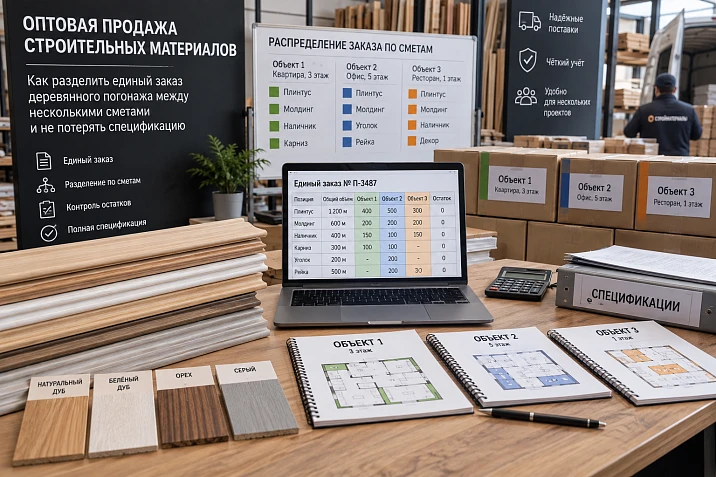
A single wooden trim system has been approved for a hotel complex: 320 m of skirting board, 210 m of moulding, and 90 m of cornice. Technically, this is one project: the same profiles, materials, stock lengths, finish, cutting plan, and reserve. But the system is paid for by several parties. The investor funds the guest rooms, the operator funds the restaurant, the general contractor funds the common areas, additional works are covered by a separate estimate, and the operational stock remains in the building owner's budget.
This is exactly where a separate B2B challenge arises. Financially, the order needs to be split, but technically it must not be turned into five independent specifications. If each party starts calculating its own portion separately, you will end up with different versions of the same SKU, a duplicated reserve, different stock lengths, inconsistent rounding rules, and invoices issued under different revisions of the project.
Therefore wholesale sale of construction materials For a complex project, it must start from a single technical source: a unified specification for the project. From it, the financial distribution is then formed — who pays for which part, under which contract, budget, and account.
PROJECT → UNIFIED TECHNICAL SPECIFICATION → MASTER CUTTING PLAN AND RESERVE → FINAL QUANTITY → DISTRIBUTION ACROSS BUDGETS → INVOICES → PAYMENT → DELIVERY → INSTALLATION
For each line item, the main control must be performed:
quantity in the unified specification = sum of quantities across all estimates, payers, and separate reserves.
If the equality does not hold, the commercial documents are not yet ready for issuance.




One architectural system does not have to mean one account
Complex project financing is normal. A single project may have multiple legal entities, contracts, and budget codes. This is a commercial structure, not a reason to change the technical configuration of the product.
First, the following are fixed:
- article number;
- the material;
- size;
- product length;
- finish;
- quantity;
- area of application;
- installation and operational reserve.
And only then are the following added to these lines:
- payer;
- contract;
- budget code;
- estimate number;
- invoice;
- payment status.
This is how money is layered onto the technical structure of the project, rather than restructuring it.
Why the payer should not determine the material
If oak has been approved in the project, a change of payer is not a technical basis for replacing it with beech. Such a replacement must go through as a project change and only then enter the financial allocation.
Why the same SKU can appear in multiple estimates
A single PLT-A can be used in guest rooms, the corridor, and the lobby. The only difference is whose budget pays for the quantity in each zone. The technical SKU remains the same.




A single specification is the only technical source
Before the financial split, one active schedule is created, for example:
PGO-OBJECT / REVISION 06
All invoices and additional commercial documents are generated from it.
| Code | Article | Material | Length | Finish | Quantity | Zone | Revision |
|---|---|---|---|---|---|---|---|
| P01 | PLT-A | Oak | 2400 | F01 | 140 | Object | 06 |
| M01 | MLD-A | Oak | 2400 | F01 | 96 | Object | 06 |
| K01 | KZ-A | Oak | 2400 | F01 | 38 | Object | 06 |
You cannot allow a situation where invoice A is generated from revision 04, invoice B from revision 05, and invoice C from revision 06. Even if each document looks logical on its own, together they stop describing a single project.
What makes a specification truly single
Not the file name, but a controlled version: one current revision, a clear date, the person responsible for issuing it, and a ban on using outdated lines for new commercial documents.
Our factory also produces:







Why you can't first create three estimates and then add them together
If each participant calculates their part separately, different methodologies emerge. One party deducts doors, the other doesn't; one adds a 5% reserve, the other 10%; one calculates lengths in 2400 mm units, the other works only in meters; one uses the latest layout, the other the old one.
After adding them together, the result is no longer a single specification but the sum of three independent calculations.
CORRECT: SINGLE SPECIFICATION → financial allocation
INCORRECT: ESTIMATE A + ESTIMATE B + ESTIMATE C → attempt to reconstruct the overall order
Get Consultation
Construction materials wholesale: calculate the project as a whole first
When building materials wholesale relate to long-length linear mouldings, overall calculation is especially important. Only at the level of the entire project can you properly optimize product lengths, cutting maps, usable offcuts, long feature sections, and reserve.
If budgets are calculated in isolation, the remainder of one budget is formally not used by the second, even though physically it is the same SKU and the same project. The result is extra lengths, extra reserve, and more waste.
Why overall cutting can reduce the order
The remaining 800 mm from the restaurant zone can cover a short segment of the hall. If calculated separately, both budgets will order an additional full length. A unified cutting plan sees the possibility of using the remainder before the financial division.
The financial boundary does not always coincide with the cutting plan
Let's imagine a strip 2400 mm long. From it, 1600 mm is obtained for the restaurant and 800 mm for the public hall. Physically, this is one product. Financially, the sections belong to different budgets.
You cannot require each payer to "buy their own length" because the supplier ships a whole commercial length. The project must choose a rule: assign the entire length to one budget, allocate the cost by an internal rule, or pay for the common technological stock separately.
The specific accounting scheme is determined by the project participants. The technical principle is unchanged: first the physical cutting, then the financial allocation.
You need to divide whole commercial units, not abstract meters
The entry "PLT-A — 18.4 m" is insufficient for purchasing. The supplier ships whole products of a specific commercial length. If a 2400 mm strip is used, 18.4 m translates into a specific number of lengths. Only after that can you decide how many of them each budget pays for.
| Article | Total length | Product length | Total lengths | Budget A | Budget B |
|---|---|---|---|---|---|
| PLT-A | 18.4 m | 2400 мм | 8 | 5 | 3 |
If the funding in the original estimate is specified as 10.2 m for A and 8.2 m for B, this does not yet mean five and three lengths. This distribution appears only after the overall cutting plan.
Why whole items are easier to control
It is precisely whole planks that can be counted at shipment, accepted at the site, reserved for a zone, and then reconciled with the remaining stock. Linear meters remain a control value, but they do not replace product units.
Assign a payment owner
For each purchasing line or group, it is specified whose budget pays for the quantity.
For example:
PLT-A / 18 pcs. / payer: Company A
Or:
PLT-A / 10 pcs. / Company A
PLT-A / 8 pcs. / Company B
This is not a technical characteristic of the product, but a financial attribute.
When the payment owner is assigned to the entire zone
If the entire room inventory is paid for by one participant, it is convenient to assign them to all lines of this zone at once. But the specification still stores the actual SKUs, materials, and quantities.
When the payment owner is assigned line by line
If one zone is funded from several budget lines, the allocation is handled line by line. For example, the main skirting board is paid for by the investor, while the maintenance reserve is paid for by the owner.
The person responsible for placing the order and the payer are different roles
| Role | Question |
|---|---|
| Responsible for placing the order | Who sends the technically approved order to the supplier? |
| Payer / budget owner | Whose budget pays for a specific part? |
One purchaser can handle one technical communication with the supplier, while there will be four invoices. This is often technically safer: one active revision, one SKU structure, one cutting map, and a single reconciliation.
But this is not a mandatory model for all projects. The contractual and accounting structure may require different arrangements. The main thing is not to confuse responsibility for the technical order with the source of payment.
Wholesale building materials: building a financial distribution matrix
When the project decides wholesale building materials to pay with several budgets, a separate matrix is created.
| Article | Total | Company A | Company B | Company C | Reserve | Inspection |
|---|---|---|---|---|---|---|
| PLT-A | 120 | 60 | 40 | 16 | 4 | 120 |
| MLD-A | 88 | 48 | 30 | 8 | 2 | 88 |
| KZ-A | 32 | 20 | 8 | 2 | 2 | 32 |
In each row:
total amount = sum of all budget parts.
If it doesn't add up, it's too early to issue the invoice.
The total amount of money does not prove the correctness of the technical distribution
A single order costs conditionally 1,000,000 rubles. Three invoices — 400,000, 350,000, and 250,000. The total is also a million. But this does not prove that the technical lines are distributed correctly.
Inside there may be:
- one molding counted twice;
- cornice missing entirely;
- baseboard listed in a different material;
- reserve included in two estimates;
- different product lengths combined into one line.
Therefore, not only the total cost is verified, but also every line of the technical specification.
Wooden baseboard between two budgets
Suppose one Wooden baseboard is used on the entire floor. The rooms are paid for by budget A, the corridor by budget B.
One configuration remains in the unified specification:
PLT-A / oak / 2400 / F01
And in the financial allocation:
ROOMS → A
CORRIDOR → B
A product does not change just because the payer has changed.
Why you cannot create “PLT-A-A” and “PLT-A-B”
Such an artificial code creates the impression that these are different items. As a result, the warehouse stops understanding the real SKU, the supplier receives the customer's internal names, reordering becomes more complicated, and the as-built schedule becomes cluttered with artificial line items.
The budget code exists separately from the product SKU
Example:
SKU: PLT-006
Budget code: ROOMS
Or:
SKU: PLT-006
Budget code: LOBBY
| Article | Material | Length | Quantity | Budget code |
|---|---|---|---|---|
| PLT-A | Oak | 2400 | 60 | Numbers |
| PLT-A | Oak | 2400 | 24 | Lobby |
| PLT-A | Oak | 2400 | 12 | Reserve |
In the supply, these lines may be technically merged if the material, length, and finish are identical. In finance, they remain separate.
Construction material in bulk: one configuration, multiple budget codes
If construction material wholesale technically identical, the financial breakdown should not create artificial differences. Correct structure: one SKU → one technical configuration → multiple financial purpose lines.
This is especially useful during receiving and in the warehouse: the employee sees the actual product, not the accounting version of its name.
The reserve is first calculated at the level of the entire project
The reserve is one of the most common causes of double financing. If each estimate separately adds 5%, the project receives several local buffers. But the overall cutting plan can use leftovers between financial zones, so the actual reserve requirement may be lower.
TOTAL CUTTING PLAN → TOTAL INSTALLATION RESERVE → TOTAL OPERATIONAL RESERVE → budget allocation for each reserve
Why the reserve cannot be calculated separately for each estimate
The leftover from the restaurant wall can physically cover a short hallway segment. If the budgets work separately, both will order an extra length. A unified reserve accounts for the overall cutting plan, usable leftovers, and real installation risks.
The operational reserve must have a payment owner
The reserve cannot be left without a budget just because it does not belong to a specific room. For example:
OPERATIONAL RESERVE / payment owner: building owner
Then the stock does not dissolve between the restaurant, room, and lobby estimates.
Bulk materials: financial splitting should not automatically fragment delivery
If materials in bulk are paid by several invoices, this does not mean that separate trucks are needed.
First, the project determines physically rational logistics: one delivery or several queues, one unloading point or several, shared packaging or separation by zones. Only then is the transport cost allocated across budgets.
The accounting boundary may be completely invisible to the driver and the receiver. What matters to them is knowing exactly what physically arrived.
One truck — multiple invoices: the receiver needs a consolidated packing list
A single truck may arrive at the site containing goods covered by several commercial documents at once. The receiver first and foremost needs the overall technical picture:
- PLT-A — 96 pcs.;
- MLD-A — 72 pcs.;
- KZ-A — 28 pcs.
And within this structure, invoices A, B, and C may exist.
If the receiver works only from individual invoices, there is a risk of counting the same package twice, missing an overall shortage, or accepting two different materials as a single line item.
What the consolidated packing list should contain
- article number;
- the material;
- commercial length;
- finish;
- total quantity;
- number of packages;
- if necessary — a breakdown by zones;
- link to the current version of the specification.
Several invoices do not replace the installation list
| Document | The main question |
|---|---|
| Invoice / delivery note | Who pays and for what? |
| Single specification | What does the site technically need? |
| Packing list | What physically arrived? |
| Installation list | Where should this be installed? |
Mixing document functions leads to errors. The delivery note should not dictate the installation zone if the technical specification says otherwise.
The payer, purchaser, recipient, and installer may be different parties
For each financial part, it is useful to define four roles:
- payer — a legal entity or budget;
- procurement contact — who manages the order with the supplier;
- recipient — who physically receives the delivery;
- installation responsible — to whom the material is handed over next.
The phrase “Company B is responsible for the restaurant” is not precise enough: Company B may pay, but the general contractor receives the material, and a separate crew performs the installation.
What happens with partial payment
For example, budget A is paid, budget B is still being approved, budget C is paid. This does not mean that the entire project is commercially ready.
| Status | Meaning |
|---|---|
| Technically approved | The line exists in the current specification |
| Invoice issued | Commercial document issued |
| Paid | Payment confirmed according to the accepted process |
| Approved for launch | Supplier confirmed production/shipment launch |
These are four different stages.
Why paying for one estimate does not mean the entire project is ready
The skirting from estimate A and the moulding from estimate B may be paid for, while the cornice from estimate C has not yet been approved. Before a partial launch, you need to check whether these items can be produced and shipped separately, and whether this will disrupt completeness, shade consistency, or logistics.
The specification version must be stated in every invoice
Every commercial document must contain a reference to the technical revision, for example:
Technical basis: PGO-OBJECT / REVISION 08
If revision 09 has been issued, old unpaid documents cannot be paid automatically. They must be checked for compliance with the new version.
What to do with an already paid document from an old revision
First, the technical difference is determined: whether the item code, material, length, finish, or quantity has changed. After that, the commercial difference is processed in an agreed manner. You cannot quietly correct only one estimate and leave the overall specification unchanged.
How to work after a project change
MLD-A has changed. You cannot manually edit four estimates independently.
Correct sequence:
- issue a new revision of the unified specification;
- record the technical change;
- recalculate the total cutting layout and reserve;
- build the financial difference;
- update only the affected accounts and budgets.
| Payer | MLD-A Change |
|---|---|
| Company A | −4 pcs. |
| Company B | +2 pcs. |
| Company B | 0 |
The overall technical total changes only once — in the single specification.
Any technical change first goes through the single document
We cannot allow the scenario where "the restaurant changed the molding only in its own estimate." Otherwise, the restaurant is already operating under a different technical system.
Sequence:
change request → technical review → new revision → financial difference.
If only the payer changes, a new technical revision is not needed. If the product itself or the quantity changes, it is needed.
How to process additional works
Additional works often get a separate estimate. But if the same SKU appears in them, it is first added to the single specification as a new volume.
For example:
MLD-A / +14 pcs. / additional work / office
Only after that is the quantity assigned to the additional budget.
Why an additional estimate easily creates a duplicate order
The general specification already includes 14 MLD-A for the office. A new estimator re-measures the room and adds 14 MLD-A again. Without reconciliation with the unified schedule, the total becomes 28.
Before adding a line, the question is needed:
is this a new quantity or an existing quantity with a new payment owner?
How to handle a cancelled estimate
Company B no longer funds the restaurant. This does not mean the restaurant no longer needs a curtain rod.
If the technical volume remains, the line receives the status:
technical need exists / a new payment owner is required.
An item is removed from the unified specification only if the project volume itself is cancelled.
Project cancellation and payer change are different events
| Event | Technical action | Financial action |
|---|---|---|
| Zone cancelled | Quantity is reduced in the specification | Estimate is reduced |
| Payer changed | Quantity remains | A new payment owner is assigned |
VOLUME CHANGED → we update the technical specification
PAYER CHANGED → we update the financial allocation
Buy construction materials wholesale: final check before payment
Before buy construction materials wholesale across multiple invoices, each document undergoes the same check.
- Does the specification revision match?
- Does the item code exist in the current document?
- Does the material match?
- Does the product length match?
- Does the finish match?
- Does the quantity refer specifically to this budget code?
- Is the reserve not duplicated?
- Does the sum of all financial parts match the unified quantity line by line?
Main mathematical check: the distribution sum equals the total specification
For each row:
Quantity per specification = A + B + C + reserve + other budgets.
| Article | Unified quantity | А | Б | В | Reserve | Total | Difference |
|---|---|---|---|---|---|---|---|
| PLT-A | 120 | 60 | 40 | 16 | 4 | 120 | 0 |
| MLD-A | 88 | 48 | 30 | 8 | 2 | 88 | 0 |
| KZ-A | 32 | 20 | 8 | 2 | 2 | 32 | 0 |
It is important to check the lines themselves, not just the overall total of the entire order.
How to automate the check in a regular spreadsheet
Even without programming, the following columns are enough:
- total quantity;
- budget A;
- budget B;
- budget C;
- reserve;
- distribution total;
- difference;
- the status.
Formula:
Difference = total quantity − distribution total.
0 → APPROVED
not 0 → CHECK
It is useful to flag rows separately where the quantity exists but the payer is missing.
How to find double financing
Unified specification:
MLD-A = 50 pcs.
Financial allocation:
- Company A = 30;
- Company B = 30.
Total 60. Difference:
50 − 60 = −10.
Funding is allocated for 10 more items than actually required.
Checking typical causes:
- one zone is duplicated;
- the reserve was included in both estimates;
- additional work was counted twice;
- the old version is used.
How to find an unclosed budget
Unified specification:
KZ-A = 24 pcs.
Distribution:
- Company A = 12;
- Company B = 8.
Total 20.
24 − 20 = +4.
Four items are technically required but are not yet assigned to a budget.
Status:
UNASSIGNED BUDGET — 4 PCS.
This does not mean that the item is not needed. It means that before launching the order, the payer must be determined.
Procurement gap and financing gap are different problems
Procurement gap — the technical need exists, but no one places an order with the supplier.
Financing gap — the technical order has been created, but part of the quantity is not yet assigned to a budget.
In the new model, these states must not be mixed. If an object needs 24 curtain rods, but four of them have not yet received a payment owner, the technical need remains 24. Removing four units from a single specification for the sake of a neat financial table creates a hidden shortage.
What the correct status looks like
KZ-A / 24 pcs. / technically approved / 20 financed / 4 unassigned
This way the problem is visible and is not masked by changing the project quantity.
Can one SKU be split across several invoices
Within the project specification, the quantity of one SKU can be distributed across several budgets. But the specific possibility of issuing several invoices, delivery notes, recipients, and contracts must be agreed with the seller and the accounting departments of the participants.
The article does not promise a universal accounting scheme on behalf of STAVROS. Its task is to preserve the technical integrity of the order regardless of how the documents are commercially processed.
What to send to the STAVROS manager
For a complex order, it is more useful to send:
- one current technical specification;
- a separate financial allocation matrix;
- payer details according to the agreed scheme;
- delivery address or addresses;
- receiver's contact;
- current revision number;
- separate packaging and zoning requirements, if agreed.
A weak option is four independent product lists, where identical items are written in different words and under different revisions.
Wooden moulding: a single revision is especially important for repeating frames
wooden molding often used in series — dozens of identical frames in rooms, corridors or public areas.
If one payer calculates the frame using revision 06, and another using revision 08, the following may differ:
- frame size;
- number of repeats;
- number of lengths;
- remainders;
- reserve;
- joint pattern.
The difference in one frame is multiplied across the entire series. Therefore, financial allocation is done only after the total quantity is approved.
Wooden cornice: one long line should not be divided along an accounting boundary
wooden cornice may run along the boundary of two functional zones that are funded by different participants.
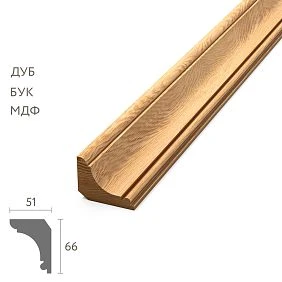
Physically, the cornice must preserve the overall logic of product lengths and joints. If the calculation is divided exactly along the budget boundary, an extra joint may appear where the architecture does not intend one.
Therefore, the entire line is designed first, whole lengths are calculated, and only then are these lengths or their cost distributed financially.
How to handle adjustments for a single estimate
Suppose Company B reduces its budget after approval. You cannot simply delete lines from its invoice and consider the work done.
Need to check:
- has the technical requirement itself decreased;
- is the quantity being transferred to another payer;
- is the total order to the supplier changing;
- has the goods already been produced;
- has a reserve already been allocated;
- is a new revision of the specification needed.
Only after this is the commercial document adjusted.
If one company pays only for delivery or finishing
Not all budgets are required to pay for the product itself. A separate participant may finance delivery, external painting, packaging, installation, or an operational reserve.
Such expenses are best kept as separate financial lines without changing the number of product SKUs.
| Financial line | Does it affect the product quantity? |
|---|---|
| PLT-A / 60 pcs. | Yes |
| Delivery | No |
| Painting preparation | No |
| Packaging | No |
| Installation | No |
This protects the quantity table from financial services that are not additional line items.
How to account for a general project discount
A general discount should not change the technical quantity.
Financially, it can be distributed:
- in proportion to the cost of each part;
- under a separate agreement;
- to a single payer;
- in another agreed manner.
But the single specification remains unchanged. Otherwise, the commercial term will start changing the technical composition of the project.
How to account for shared packaging
A rigid frame, pallet, or other packaging unit may serve items belonging to several payers. There is no need to physically create several less efficient packages just for accounting division, unless this is required by the contract.
First, the safe packaging for the shipment is determined. Then its cost is distributed among the budgets.
Why packaging should remain a shared technical line
The receiver sees one physical unit. If the accounting documents split the package into three parts, this should not prevent understanding that physically one frame arrived with specific contents.
How to coordinate multiple delivery addresses
If the financial structure matches multiple physical addresses, a "delivery point" field is added to the consolidated statement.
| Article | Quantity | Payer | Address |
|---|---|---|---|
| PLT-A | 60 | Company A | Object 1 |
| PLT-A | 24 | Company B | Object 1 |
| PLT-A | 12 | Owner | Reserve warehouse |
The SKU remains the same. Only the route of part of the quantity changes.
How to work with multiple delivery queues
A large site may receive material not in a single truck, but in several queues. In that case, the financial allocation must also be linked to the queue.
| Article | Total | Queue 1 | Queue 2 | Queue 3 |
|---|---|---|---|---|
| PLT-A | 120 | 40 | 50 | 30 |
| MLD-A | 88 | 30 | 30 | 28 |
But the overall total is checked first, and only then each queue. Otherwise, the same financial portion could accidentally end up in two deliveries.
How to split payment without splitting the production batch
Sometimes, for the visual result, it is important to manufacture the entire oak trim in a single production batch or a close cycle. Several invoices should not automatically mean several separate production runs.
Before the commercial split, it is useful to ask the supplier:
- whether a single production run can be preserved;
- whether separate documents can be issued without physically splitting production;
- how the finished products will be labeled;
- how the delivery and packaging will be organized.
This is especially important for natural wood and clear finishes, where the visual consistency of the batch may matter more than accounting independence.
When financial separation is better done by zones
A zonal scheme is clear when each payer is responsible for a functionally separate part:
- guest room inventory;
- restaurant;
- lobby;
- back-of-house areas.
Then the budget code can be linked to a zone, while the technical item codes within it are preserved.
When financial separation by zones does not work
If a single run is used between two zones, the total reserve is stored separately, or one batch serves the entire facility, rigid zoning can artificially inflate the order.
In such cases, some of the shared items are moved to a separate budget code:
- shared cutting;
- installation reserve;
- operational reserve;
- shared delivery;
- shared packaging.
How to work with the "additional work" budget
Additional work should contain only new scope or a confirmed reallocation. You cannot simply copy the full set of a room.
For each new line, a useful field is:
change type: NEW QUANTITY / FUNDING TRANSFER / REPLACEMENT
This immediately shows why the item appeared.
How to keep the actual specification intact after several changes
After three additional estimates and two payer changes, the working picture can become complicated. That is why a single specification should store not only the current total but also the origin of each change.
| Line | Current quantity | Source of change | Revision |
|---|---|---|---|
| MLD-A | 96 | Main project + additional work 02 | 09 |
| KZ-A | 38 | Main project − cancellation of zone C | 09 |
This helps explain the total without reading all the old invoices.
How to perform reconciliation after actual delivery
After unloading, five states are compared:
- what is technically planned;
- what is financially allocated;
- what is paid;
- what is actually shipped;
- what is actually received.
SPECIFICATION → FINANCIAL ALLOCATION → INVOICES → PAYMENT → DELIVERY → ACCEPTANCE → INSTALLATION → RESERVE
If everything on the invoice is paid, but less actually arrived, this is no longer a financial allocation problem, but a delivery execution problem. The documents should make it possible to quickly see the transition from one stage to the next.
How to reconcile installation after several budgets
The installation crew does not need to know who paid for each strip. It needs a technical schedule by zones.
Therefore, after acceptance, financial codes may remain in accounting, while issuance is based on:
- SKU;
- material;
- length;
- zone;
- quantity;
- reserve status.
This is an important boundary: financial allocation helps pay for procurement, but it should not complicate installation communication.
How to close a project after the last delivery
After installation, a final reconciliation is useful:
| Indicator | What to Check |
|---|---|
| Single specification | Final actual revision |
| Financial allocation | All quantities have a payment owner |
| Supply | All paid and ordered items have been received |
| Installation | Actually used quantity |
| Remains | Installation and operational reserves are separated |
Only after this can we confidently say that the financial division has not destroyed the technical history of the object.
How to verify a single invoice if it contains multiple item codes
An invoice should not be checked only by the total amount or project name. For each document, it is useful to perform a line-by-line reconciliation with the current specification.
| Check | What we compare | Result |
|---|---|---|
| Article number | Invoice ↔ specification | Matches / check |
| Material | Invoice ↔ specification | Matches / check |
| Length | Invoice ↔ specification | Matches / check |
| Quantity | Invoice ↔ budget code | Matches / check |
| Revision | Invoice ↔ active project | Current / outdated |
If at least one line does not match, the document is returned for clarification before payment.
How to check multiple invoices at once
After checking each invoice separately, the entire set is verified.
Sequence:
- collect all active invoices;
- group lines by actual SKU;
- add up the quantities;
- compare with the unified specification;
- check the reserve;
- find lines without funding;
- find lines with overspending.
It is this second level that finds errors that are invisible within a single document.
Why one invoice can be correct, but the entire set — incorrect
Invoice A contains 30 MLD-A — all correct. Invoice B contains another 30 MLD-A — also logical for its zone. But the unified
How to record actual usage without rewriting item codes
Instead of changing the product code, a “actual zone” field is added.
| Article | Payer | Planned zone | Actual zone | Quantity |
|---|---|---|---|---|
| PLT-A | Company A | Numbers | Numbers | 58 |
| PLT-A | Company A | Numbers | Lobby | 2 |
Thus the technical identity remains unchanged, while the financial movement can be explained.
How to handle returns of unused material
After installation, some items may remain. You need to decide which budget the return or remainder belongs to.
Checked:
- who paid for the item;
- whether it was partially used;
- whether it belongs to the installation reserve;
- whether it transfers to the operational reserve;
- whether a return to the supplier is possible under the terms of the deal;
- whether internal financial reallocation is needed.
You cannot automatically write off the remainder to the budget of the room where it is physically located.
How to account for a reorder after a split purchase
If a supplementary order is needed during installation, the unified specification and actual remaining stock are checked first, not the original estimate of a specific payer.
Algorithm:
- establish the technical requirement;
- check the total available remaining stock;
- check the reserve;
- determine whether this is a new quantity;
- assign the payment owner;
- issue a commercial document.
This way, a supplementary order does not duplicate material that has already been paid for but not yet used.
How to avoid duplicate supplementary orders by two participants
If the restaurant and the general contractor both see a shortage of MLD-A, they may independently order 10 units each. Therefore, the right to place a technical supplementary order must be centralized.
There may be several payers, but the technical request for a new volume must go through a single control point.
When the financial matrix needs to be frozen
Before payment or launching supply, it is useful to establish a control version of the financial distribution.
For example:
FINANCIAL DISTRIBUTION / VERSION 04 / BASIS: SPECIFICATION 09
After that, any change goes through as a new version, not an unnoticed cell edit.
Why the financial distribution version is also important
Even with a single technical revision, payers may change. If the old and new matrices exist simultaneously, accounting may use an outdated breakdown.
The link must be explicit:
SPECIFICATION 09 → FINANCIAL VERSION 04
How to organize approval without dozens of emails
Instead of a chain of messages like "move two bars," "who to pay the reserve to," "which version is current now," it is more useful to use a single table with the fields:
- technical revision;
- article number;
- total quantity;
- budget codes;
- payers;
- distribution total;
- difference;
- account status;
- payment status;
- comment.
Letters remain for decisions, while the table is for the current state.
How to account for responsibility for an error
If one payer paid for an old revision, it is important to understand not only the financial but also the process-related cause.
It's useful to check:
- whether a new revision was issued;
- was it communicated to all participants;
- whether the old documents were marked as superseded;
- who had the authority to issue the invoice;
- who verified it before payment.
This reduces the risk of repeating the same mistake on the next queue.
When it is better not to split a technical purchase too deeply across invoices
If financial splitting creates dozens of micro-invoices for one or two whips, the administrative complexity may outweigh the benefit.
The project should consider larger financial packages if:
- one SKU constantly crosses zones;
- stock is actively redistributed;
- total delivery;
- total reserve;
- payers are ready for internal cost allocation.
But the decision depends on contracts and accounting policies.
When separate accounts, on the contrary, are useful
Separation is convenient if:
- the zones are independent;
- they have different legal owners;
- different payment terms;
- different delivery addresses;
- different launch queues;
- technical quantities are already determined by a single calculation.
That is, the problem is not the multiple invoices themselves. The problem arises when they start replacing the technical specification.
Control matrix before issuing commercial documents
Before the invoices go out to payers, it is useful to assemble a single control matrix. It does not replace the specification and invoices, but links them together.
| Line | Revision | Product | Total quantity | Allocated | Not allocated | Status |
|---|---|---|---|---|---|---|
| P01 | 09 | PLT-A | 120 | 120 | 0 | done |
| M01 | 09 | MLD-A | 88 | 84 | 4 | Check budget |
| K01 | 09 | KZ-A | 32 | 34 | −2 | Check duplicate |
Such a table simultaneously reveals two opposite defects: underfunding and double funding. And both are detected before payment.
Why the 'done' status should be set line by line
If 95% of the order is allocated correctly, that doesn't yet mean all invoices can be issued. A single line with a minus or plus may relate to a critical curtain track or reserve. A document's readiness is determined not by the average quality of the table, but by the absence of unresolved discrepancies.
How to link a budget code to a zone without making them one concept
A budget code often coincides with a functional zone: 'rooms', 'lobby', 'restaurant'. This is convenient as long as the project structure is simple. But over time, one budget may fund several zones, and one zone may be funded by several budgets.
Therefore, it is better to store two separate fields:
- zone — where the item will be installed;
- budget code — which financial source pays for it.
This way, transferring funding doesn't force changes to the installation map, and a layout change doesn't rewrite the accounting code.
What to do if the invoice has already been issued but the allocation has changed
An invoice is not a technical source of truth. If, after it was issued, the project redistributed part of the quantity among payers, the financial matrix is updated first, then the commercial documents are adjusted in an agreed manner.
The single specification should not be changed if the technical requirement remains the same.
Example:
| Condition | Company A | Company B | Total |
|---|---|---|---|
| Before change | 60 | 40 | 100 |
| After change | 50 | 50 | 100 |
The technical total — 100 — has not changed. This means the project did not issue a new requirement, but only redistributed funding.
How to account for material already produced but not yet shipped
A financial change may occur after production has started. Then it is especially important not to confuse “who pays” with “what has already been manufactured.”
The register benefits from separate statuses:
- technically approved;
- placed with the supplier;
- in production;
- ready for shipment;
- shipped.
If the payment owner changes at the "in production" stage, the technical order does not need to be canceled automatically. The commercial side is agreed upon first, because the physical goods already exist or are in production.
How to account for a partially used shared reserve
A shared installation reserve may be paid for by one owner but actually used in different areas. After installation, it is useful to keep a record of usage.
| Reserve | Initial | Used in rooms | Used in lobby | Remaining |
|---|---|---|---|---|
| PLT-A | 12 | 3 | 2 | 7 |
This makes it possible to understand how much stock actually became operational reserve and whether it needs to be replenished before handing over the site.
How to avoid the dispute “we paid for it, so it's ours”
On a multi-budget project, financial ownership does not always mean physical isolation of the goods. If a single length after general cutting is used in several zones, an attempt to rigidly assign each remainder to the payer can undermine overall optimization.
Therefore, before purchasing, it is useful to agree on a rule:
- which items belong to a specific zone;
- which items are considered a common technological pool;
- how usable remainders are accounted for;
- who owns the unused reserve after installation.
This way, financial entitlement does not prevent the rational use of the same SKU across the entire site.
How to prepare a package for internal approval
Before paying for a large batch, it is convenient to assemble five documents or views:
- current technical specification;
- cutting and reserves map;
- financial allocation matrix;
- set of commercial documents;
- control report “allocation = specification”.
If all five are consistent with each other, the risk that different participants pay for different versions of the project is sharply reduced.
When financial allocation can be considered closed
Not at the moment when all invoices are paid. Financial allocation is closed when:
- all technical demand is allocated;
- no double financing;
- all invoices are linked to a single active revision;
- actual delivery is matched against the order;
- the general reserve has an owner;
- balances after installation are identified;
- no open changes.
This is already full-fledged procurement lifecycle control, not just an accounting total.
Role matrix: who approves what
Many errors arise not from the math, but because participants assume someone else should make the decision. It helps to separate responsibilities in advance.
| Role | Responsible for | Must not change independently |
|---|---|---|
| Designer | Technical configuration and zones | Payer without approval |
| Assembler | Consolidation of specification and quantity | Item number for financial reason |
| Buyer | Placement of approved order | Project configuration |
| Financial coordinator | Allocation by budgets | Technical quantity without project |
| Receiver | Actual quantity and condition | Commercial distribution |
Such a matrix is especially useful when one person combines several roles: the functions still remain different.
When several payers do not require a separate accounting line item
If the order is very small, the technical configuration is simple, there is no reserve, and the payers divide only the total cost within their own accounting, a complex matrix may be unnecessary. One specification and one internal distribution rule are enough.
The full process is especially justified when there are several SKUs, different zones, a shared reserve, phased deliveries, additional work, or the likelihood of project changes.
When financial division becomes dangerous for technical quality
There are several signals:
- each budget maintains its own list of SKUs;
- different estimates use different lengths of the same profile;
- reserve is added independently;
- invoices do not contain the project revision;
- supplier receives several conflicting letters;
- receiver does not have a consolidated statement;
- additional orders are placed by different participants.
If two or three signs are present simultaneously, it is better to return the project to a single technical control point before the next order.
Final checklist before launch
| Question | Yes / no |
|---|---|
| Is there one current technical revision? | … |
| Are final quantities calculated in whole items? | … |
| Is the reserve calculated once? | … |
| Does every line have a budget code assigned? | … |
| Does every budget have a payer assigned? | … |
| Does the allocated amount match the specification line by line? | … |
| Do the invoices contain the current revision? | … |
| Has the master packing list been prepared? | … |
| Are the recipient and delivery address defined? | … |
| Is there no undefined budget? | … |
If even one critical answer is "no", the problem must be clear before payment, not after the truck arrives.
The minimum set of fields without which it is dangerous to split an order
Even if the project does not use a complex procurement management system, a few mandatory fields are enough for a sustainable scheme. The single technical specification must include the line code, actual SKU, material, commercial length, finish, total quantity, zone, and revision. In the financial matrix, the budget code, payer, allocated quantity, and payment status are added to the same line.
The key is not to move financial attributes inside the SKU and not to store technical attributes only in the invoice. Then any participant can take line P01 and reconstruct the entire path: what this product is, how much of it the project needs, which version is current, who pays for each part, and what volume is not yet covered by funding.
If the table does not allow answering these questions without reading the correspondence, the system depends too much on the participants' memory.
18 mistakes when splitting a single purchase
- Count each estimate separately. Different methodologies and reserves arise.
- Use different revisions. Invoices describe different versions of the object.
- Create artificial SKUs for payers. The real product code is lost.
- Do not use a separate budget code. Financial ownership is mixed with the product.
- Count the reserve in each estimate. The total order becomes inflated.
- Split only linear meters. The number of whole lengths is unclear.
- Split the cost without reconciling SKUs. The money adds up, the specification does not.
- Check only the total amount. Missing and duplicate lines remain.
- Not assign an owner for payment. Part of the technical scope remains without a budget.
- Confuse the payer with the person responsible for the order. Several participants duplicate communication.
- Make several deliveries only because of several invoices. Finance breaks logistics.
- Accept material only by invoices. The overall technical picture is lost.
- Change an item within one estimate. One zone starts living by a different specification.
- Do not update documents after a new revision. Part of the order is paid according to the old version.
- Remove an item from the specification because of a change of payer. The technical need disappears only on paper.
- Duplicate the SKU in additional works. One scope is ordered twice.
- Leave part of the specification without funding. A hidden shortage appears before delivery.
- Cannot verify the distribution total line by line. The main mathematical control is missing.
Practical example: three budgets and one skirting board
The site needs 120 lengths of PLT-A. After the overall cutting plan and reserve, the distribution came out as:
| Purpose | Quantity | Payer |
|---|---|---|
| Numbers | 60 | Company A |
| Corridors | 36 | Company B |
| Lobby | 16 | Company B |
| General installation reserve | 4 | Company A |
| operational reserve | 4 | Owner |
| TOTAL | 120 | — |
If Company B later refuses to fund the corridors, the quantity 36 is not automatically deleted. It receives the status "new payment owner required" until the project confirms cancellation of the zone itself.
Practical example: four payers and a shared remainder
After cutting MLD-A, 12 short usable offcuts are produced. They are suitable for frames in several zones. If each budget counts only its own lengths in advance, these offcuts are not used jointly.
More correctly:
- calculate the entire MLD-A;
- optimize stock balances;
- obtain the final quantity of whips;
- only then allocate the stems and the overall financial reserve.
This is precisely why the financial matrix appears after technical optimization.
Practical example: one payer paid for the old material
Revision 07 specified MLD-A in beech. Revision 08 replaced it with oak. Company A received a new invoice, Company B managed to pay the old one.
You cannot simply accept two different deliveries and "sort it out later."
You need to:
- establish technical revision 08 as the current one;
- determine the status of the paid old order;
- approve the commercial adjustment;
- prevent the old configuration from entering installation without a separate decision.
Final algorithm: one technical order, multiple payers
1. PROJECT
↓
2. UNIFIED TECHNICAL SPECIFICATION
↓
3. COMMON CUTTING PLAN
↓
4. COMMON INSTALLATION AND OPERATIONAL RESERVE
↓
5. FINAL QUANTITY OF WHOLE PRODUCTS
↓
6. BUDGET CODES
↓
7. PAYMENT OWNERS
↓
8. FINANCIAL ALLOCATION
↓
9. VERIFICATION: DISTRIBUTION TOTAL = SINGLE SPECIFICATION
↓
10. INVOICES
↓
11. PAYMENT STATUSES
↓
12. APPROVED PRODUCTION / SHIPMENT LAUNCH
↓
13. MASTER PACKING LIST
↓
14. ACCEPTANCE
↓
15. INSTALLATION BY TECHNICAL ZONES
↓
16. ACTUAL RECONCILIATION AND RESERVE
Frequently Asked Questions
Can multiple payers be assigned to a single SKU?
Yes, within the project matrix, the quantity of a single SKU can be distributed across multiple budgets. The specific scheme for the commercial processing of invoices must be agreed with the seller and the accounting departments of the parties.
Do I need to create a separate SKU for each estimate?
No. The financial code is stored separately. The product SKU must correspond to the actual item.
Who should pay for the shared reserve?
This is decided by the project. The key is to first calculate the reserve once at the level of the entire facility, and then assign a specific payment owner to it.
Can the reserve be calculated separately for each zone?
Local risks can be analyzed, but the final order is best checked at the level of the overall cutting plan. Otherwise, leftovers between zones are not used and the total reserve may end up overstated.
What should be done if one invoice has already been paid under the old version?
Record the technical difference, determine the status of the old order, and agree on a commercial adjustment. Do not allow the old configuration to go into installation automatically.
Should a separate delivery be arranged for each invoice?
Not necessarily. Physical logistics and financial processing are different tasks. The possibility of combined delivery is agreed with the supplier and contracts.
What should be done if part of the quantity is not yet paid for by anyone?
Do not remove it from the technical specification if the project requirement remains. Mark it as a quantity without an assigned budget and resolve funding before the order is launched.
How can you tell that the financial allocation is ready?
For each line, the sum of all payers, reserves, and special budgets must match the quantity in the current technical specification.
Control rule before launch: if for any line you cannot immediately show the current revision, the actual SKU, the final quantity, the payment owner, and the place of this item in the overall order, the line is not yet ready for commercial release. Such a short test helps detect not only an arithmetic error, but also a gap between the project, the estimate, and the actual procurement before it turns into an extra invoice or missing material.
Conclusion: financial separation should not create multiple technical projects
A large interior project may have a complex financial architecture: several legal entities, contracts, budget codes, and separate estimates. This is normal. The error begins when each financial participant independently recalculates the technical part of the wooden trim.
The project must have one current specification. It records the actual SKUs, materials, commercial lengths, finishes, cutting, reserve, and the final quantity of whole products. Only after that is the quantity distributed among the payers.
This way, the financial structure answers the question “who pays” but does not change the answer to the question “what exactly does the project need.”
A line-by-line check of “the sum of all financial parts = the quantity in the specification” quickly reveals double funding, an unfunded budget, duplicate additional works, and lost items. The specification version in each invoice protects against outdated revisions. A separate budget code helps avoid inventing artificial SKUs. The shared reserve is not multiplied across each estimate.
That is why a complex procurement must follow the chain: unified technical calculation → financial allocation → commercial documents. If this order is observed, multiple payers do not destroy the unity of the project, and wholesale sales of building materials remain manageable even with multiple contracts, invoices, and budgets.