Article Contents:
- First, a short answer: when it makes sense to consider NPU-117
- What exactly NPU-117 is and why it cannot be judged only by a photo
- Measure not the entire bench, but the clean decorative field
- Size 200 × 394 mm: first, determine the orientation in a specific composition
- Scenario 1. On the facade, the element occupies 200 mm in width and 394 mm in height
- Scenario 2. The element is rotated, and on the facade it occupies 394 mm in width and 200 mm in height
- Simple option
- More accurate option
- What to check with the template
- One overlay is logical if
- Two overlays are more logical if
- When two overlays create a problem
- Leave one accent
- Add a molding frame
- Use two overlays
- Choose a different overlay
- When one overlay is better
- When is the best time for molding
- When neither molding nor NPU-117 is needed
- Overlay in the color of the facade
- Slight tonal difference
- Strong contrast
- If the facade is still to be painted
- If the banquette is already fully painted
- If the overlay is contrasting
- Mistake 1. Looking only at the overall width of the furniture
- Mistake 2. Not checking the orientation
- Mistake 3. Buying almost flush when planting
- Mistake 4. Ignoring the 11 mm thickness
- Mistake 5. Placing decor at the point of constant foot impact
- Mistake 6. Adding a second overlay just because the facade is long
- Mistake 7. Starting installation without a template
- Step 1. Determine the actual surface
- Step 2. Mark prohibited zones
- Step 3. Take actual dimensions of NPU-117
- Step 4. Verify orientation with the drawing and pattern
- Step 5. Check the physical placement
- Step 6. Make a 1:1 template
- Step 7. Assess the view from the room
- Step 8. Sit on the bench
- Step 9. If the facade opens, open it
- Step 10. Determine the color
- Step 11. Compare the alternative
- Step 12. Only now place your order
- Panel smaller than required size
- NPU-117 is too active
- A different format is required
- Need several repeating accents
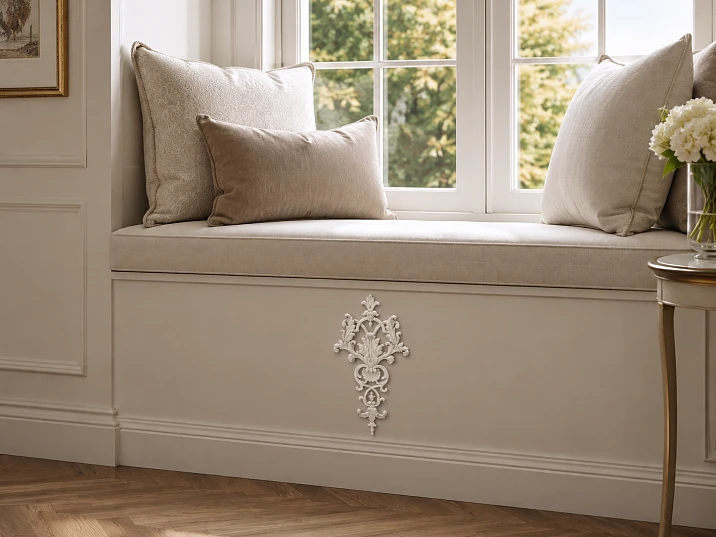
A built-in bench under a window can be fully finished from a structural standpoint and still look as if the cabinetmaker missed the final step. The seat is already made, cushions are chosen, side panels neatly meet the walls, the lower base is painted — but the large smooth face panel under the seat remains empty.
Reworking finished furniture for a single decorative task is not always reasonable. A new routed front would require disassembly, part fabrication, refitting, and painting. A molding frame is also not "one simple part": you need to select a profile, calculate four segments, carefully make corner joints, and maintain equal offsets.
There is a third path — use a single standalone decorative element.
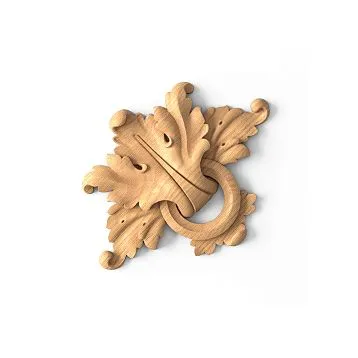
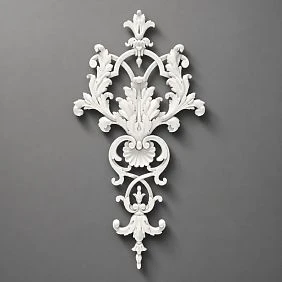
For such a scenario, you can consider the carved overlay NPU-117At the time of inspection, the STAVROS card indicates dimensions of 200 × 394 × 11 mm, polyurethane material, and a price of 4,190 ₽ per piece. The manufacturer classifies the product as decorative overlays for furniture facades, door panels, and wall panels, specifying adhesive mounting and the possibility of subsequent painting.
But these characteristics do not yet mean that NPU-117 automatically fits any bench.
Such a purchase has three separate checks:
-
whether the overlay physically fits on the free field of the panel;
-
does its scale look normal relative to the entire bench;
-
won't the protruding relief end up where shoes, heels, knees, or objects constantly hit it.
These are the checks that need to be done before ordering. For NPU-117 this is especially significant due to the size of 200 × 394 mm: we are not dealing with a small furniture rosette that can be placed in almost any free spot, but a fairly large ornamental element.
First, a short answer: when it makes sense to consider NPU-117
NPU-117 is suitable for a window bench not because the card says "for furniture," but when several conditions align.
A good initial scenario looks like this:
-
the bench is already made;
-
its lower part is covered by a large solid panel;
-
the panel has enough free space;
-
there are no handles, grilles, ventilation openings, or frequently opened sections in the place of the future decor;
-
the central zone is not subject to constant impacts;
-
a relief depth of 11 mm does not interfere with operation;
-
one large ornament matches the scale of the furniture;
-
before installation, the size was checked with a full-size template.
If at least a few points are not met, it is better to first look at other Polyurethane decorative appliques, rather than trying to adapt the NPU-117 at any cost.
Particular caution should be exercised with low panels. With a product size of 200 × 394 mm, one of its sides takes up almost 400 mm. For a furniture base with a height of about 350–400 mm, this is already a fundamental limitation.
Therefore, the first measurement before purchasing is not the length of the entire bench.
First, you need to determine the size of the actual free decorative field.




What exactly is the NPU-117 and why it cannot be evaluated only from a photo
NPU-117 is not a molding or a linear profile. It is a ready-made, standalone carved overlay.
The difference is practical.
Molding is purchased as a linear material: it is cut to the required length, a frame is formed from several segments, and corners are joined. The final size of the composition is largely determined by the buyer.
The overlay has a different logic. Its pattern, proportions, and outer contour are already defined. You cannot 'shorten the composition' as freely as molding without interfering with the product's design. Therefore, you first choose a place for the existing size of the overlay, rather than calculating the overlay for any arbitrary field.
For NPU-117, the manufacturer specifies:
| Parameter | Value |
|---|---|
| Article number | NPU-117 |
| Type | Carved decorative overlay |
| Material | Polyurethane |
| Size A × B × C | 200 × 394 × 11 mm |
| Price at time of check | 4,190 ₽/pc. |
| Main installation method | mounting on an adhesive base |
| Paintability | Provided |
| Application | furniture facades, doors, wall panels, interior accent zones |
These parameters are confirmed by the current product card.
The most underestimated characteristic here is 11 mm.
In a diagram or photo, the buyer primarily perceives the ornament and outer contour. In real furniture, a third dimension appears: the overlay protrudes in front of the facade plane. For a fixed panel, this can be an advantage—side light better reveals the relief. For a leg area or a frequently opened door, the same 11 mm becomes an operational factor.
Therefore, NPU-117 should be evaluated not as a picture glued onto the facade, but as a physical three-dimensional object.
Our factory also produces:
Measure not the entire bench, but the pure decorative field
Suppose a built-in bench has a width of 1500 mm. This alone does not mean that an overlay with a width of 200 or 394 mm will fit it.
Within the total width, there may be:
-
two side posts;
-
base;
-
top rail;
-
technological gaps;
-
separate doors;
-
drawers;
-
ventilation grille;
-
handles;
-
joints of several facades.
A different size is needed — a rectangle of free surface, inside which decor can actually be placed.
For example, a bench has external dimensions of 1400 × 470 mm, but the lower panel is limited from above by a 60 mm wide apron, from below by a 70 mm plinth, and at the edges by 80 mm posts.
Then the decorative surface will be significantly smaller than the overall silhouette of the furniture.
It is this rectangle that needs to be transferred to paper or at least written down separately:
width of the free field × height of the free field.
In addition to dimensions, several other objects need to be checked.
Run your palm over the panel and imagine the future product on it. Does the knee of a sitting person not pass here? Do children not put their feet on the lower part of the facade? Is a pouf not pushed up to the bench? Does a cabinet door not open nearby? Does a removable ventilation grille not pass along this plane?
This check takes a few minutes, but it is more useful than a dozen photos of beautiful interiors.
Get Consultation
Size 200 × 394 mm: first, we determine the orientation on the specific composition
Product dimensions are specified by the manufacturer as A × B × C = 200 × 394 × 11 mm.
Before final marking, it is better to check the product drawing and determine which side of the ornament should go horizontally in your chosen option. This is especially important for carved decor: technically, the item can sometimes be rotated, but the artistic direction of the pattern also changes when rotated.
Therefore, for NPU-117, it is reasonable to consider two fitting scenarios.
Scenario 1. On the facade, the element occupies 200 mm in width and 394 mm in height
This is the most demanding scheme for the panel height.
For a bench, a large horizontal width and relatively small height are typical. Therefore, the overlay may have a huge margin on the left and right, but at the same time barely fit between the top and bottom edges of the facade.
Scenario 2. The element is rotated, and on the facade it occupies 394 mm in width and 200 mm in height
Geometrically, the task becomes much simpler: almost 400 mm is required horizontally, but about 200 mm is enough in height.
But this position cannot be chosen solely because 'it fits better this way.' First, you should look at the full-size silhouette and make sure that the direction of the ornament after rotation looks meaningful.
That is why the best selection tool is a template, not a formula.
A formula answers the question "does it fit?"
A template answers two at once: "does it fit?" and "does it look normal?"
If 394 mm is for height: which panels fit by geometry
Let's consider a stricter case where 394 mm of free height is required for the selected NPU-117 position.
Here you can quickly see the applicability boundary.
| Panel free field | Remainder relative to 394 mm in height | Practical conclusion |
|---|---|---|
| 700 × 300 mm | −94 mm | does not fit |
| 900 × 350 mm | −44 mm | does not fit |
| 1000 × 380 mm | −14 mm | does not fit |
| 1200 × 400 mm | 6 мм | fits geometrically with almost no margin |
| 1200 × 420 mm | 26 мм | 13 mm each at top and bottom with precise centering |
| 1400 × 450 mm | 56 мм | a noticeable free field appears |
| 1600 × 500 mm | 106 мм | 53 mm on top and bottom |
This table shows an important thing.
The phrase “a panel 1200 mm wide is large, the overlay will fit exactly” may be erroneous. If 394 mm vertically is required for the selected orientation, the limiting dimension is not the 1200 mm width, but the height of 400–420 mm.
Moreover, a formal match of dimensions does not yet guarantee a good result.
If the free height of the panel is 400 mm, after placing an element 394 mm high, only 6 mm remains. With perfect centering, that is 3 mm on top and bottom.
Technically, the rectangles do not intersect.
Visually, the overlay appears almost squeezed between the boundaries.
In addition, real furniture panels rarely need to be measured only by the outer edge. The facade may have a bevel, rounding, joint, shadow gap, or an area that you do not want to cover with decor.
Therefore, buying "flush" is a bad scenario. A template is mandatory in such a situation.
Panel 1200 × 420 mm: why this example is more useful than estimating "big or small"
Let's take a specific blank front panel of 1200 × 420 mm.
If in the chosen orientation the overlay occupies:
200 mm in width × 394 mm in height, we get:
horizontally:
1200 − 200 = 1000 mm;
With precise centering:
500 mm on the left and right.
Vertically:
420 − 394 = 26 mm;
When centering:
13 mm on the top and bottom.
Here a characteristic situation arises: the element seems relatively compact in width, but in height it almost fills the entire field.
This is no longer a small "rosette in the center." The ornament becomes a vertical central accent of the entire lower base.
This option can look convincing if the panel is specifically intended as one large decorative field. But the solution becomes less obvious if there is a pronounced furniture profile, groove, or plinth above and below: the visual distance to these lines may turn out to be too small.
Now let's rotate the same rectangle for fitting.
If a placement of 394 mm horizontally × 200 mm vertically is compositionally acceptable, the calculation changes:
horizontally:
1200 − 394 = 806 mm, that is, approximately 403 mm on each side;
Vertically:
420 − 200 = 220 mm, that is, 110 mm at the top and bottom.
Geometrically, the second option is much freer.
But the final decision cannot be made based on arithmetic. Rotating a rectangle is not the same as rotating an ornament.
Therefore, for a 1200 × 420 mm panel, both versions of the actual silhouette should be tried, not two empty rectangles.
How to make an NPU-117 template 1:1 before ordering
If a buyer doubts whether they need one item costing several thousand rubles, the cheapest verification tool is paper or cardboard.
You don't need to have design skills.
Simple option
Glue several sheets of paper together and cut out a rectangle 200 × 394 mm.
Mark on it:
-
vertical axis;
-
horizontal axis;
-
the top;
-
bottom;
-
the approximate outer silhouette of the product.
Attach the template to the panel with masking tape.
First look at it up close, then step back to where the bench is usually visible: to the room door, to the bed, to the sofa, to the passage.
More accurate option
Use the NPU-117 image as a basis for a full-size printout or transfer the general outline manually.
Why is this better than a rectangle?
Because the carved overlay does not fill the entire 200 × 394 mm with a solid mass. Inside the overall rectangle, there are recesses, openwork, and variations in the pattern's width. The eye perceives not a mathematical frame, but the outline of the ornament.
A rectangular sheet answers well the question of physical compatibility.
The contour template shows the real scale much more accurately.
What to check with the template
Don't limit yourself to the question of "does it fit."
Evaluate:
-
distance from the overlay to the top edge;
-
distance to the baseboard;
-
free margins on the left and right;
-
alignment with the central axis of the window;
-
position relative to the seams between facades;
-
intersection with handles;
-
position relative to the legs of a seated person;
-
visibility of the relief from the main points of the room;
-
horizontal and vertical variants, if both are compositionally acceptable.
Leave the template on the facade at least for the duration of normal room use. Sometimes a solution that seems striking for the first thirty seconds begins to be perceived as too active after a while.
The center of the banquette and the center of the panel are not always the same point
The simplest way to position a single overlay is to draw two axes of the free decorative field and align them with the center of the element.
But built-in furniture can have circumstances where mechanical centering produces a strange result.
Imagine a banquette between two walls. To the right, a tall cabinet adjoins it; to the left, an open wall section remains. The geometric center of the panel stays the same, but the entire composition of the room visually gains additional mass on the right.
Or there are two sashes of different widths under the window. The geometric center of the banquette does not coincide with the vertical line of the mullion.
Or the lower base consists of two doors, but a single continuous cushion lies on top.
Before gluing, you need to decide relative to what the viewer should read the overlay:
-
the entire banquette;
-
a specific fixed panel;
-
windows;
-
a separate furniture section;
-
the central axis of the room.
For a single decorative element, the safest reference is usually the center of the plane to which the element truly belongs.
If the NPU-117 is installed on one large fixed panel, it is logical to first center it relative to that panel.
If the panel itself is offset relative to the window, trying to artificially "tie" the overlay to the window can make the furniture look visually crooked.
That is why the marking is done on the actual facade, not from a project photo.
How much free margin should remain around the overlay
There is no universal number like "must be 50 mm" or "at least a third of the width" for any furniture.
The ornament can be visually light or dense. The facade can have rounded edges, a profiled frame, or a completely smooth surface. Finally, two panels of the same size will be perceived differently in a room with a height of 2.5 and 3.5 meters.
But a practical principle exists:
the closer the overlay approaches the boundaries of the facade, the less it is perceived as a separate accent and the more it begins to look like part of the filling of the entire field.
This is not bad in itself.
The problem arises when the character of the composition was chosen randomly.
If you want a small central detail, a clear free base should be visible around it.
If you want a panel almost completely filled with ornament, small margins can be intentional.
Therefore, instead of trying to find a magic number, ask yourself:
what role should the NPU-117 play — a separate medallion or the main pattern of the panel?
For a very low facade with a 394 mm height orientation, the NPU-117 almost inevitably becomes the main pattern of the entire plane.
For a tall panel with plenty of space above and below, it reads more independently.
This difference is easier to see with a template than to describe in words.
One NPU-117 or two: not only the length of the bench decides
When the facade is long, there is a temptation to reason simply:
“1200 mm — one overlay, 1800 mm — two.”
Such a rule is too rough.
The quantity depends on the furniture's division.
One overlay is logical if
the lower base is a single solid panel, and the entire banquette is perceived as one piece.
One central element emphasizes this unity.
A single accent works especially well where there is one large window or a single niche above.
Two overlays are more logical if
the panel is already visually divided into two equal parts.
For example:
-
two identical doors;
-
two symmetrical solid fields;
-
two vertical furniture partitions;
-
the window has two clearly readable symmetrical sections, and the furniture repeats this rhythm.
Then each NPU-117 can belong to its own field.
When two overlays create a problem
If the facade is completely smooth and continuous, two identical large pieces automatically form a new rhythm. The viewer begins to expect a constructive separation between them.
If it is absent, the composition can look artificial.
That is why the question of "one or two" cannot be resolved simply by purchasing a second piece.
First, the entire rhythm of the facade must be built on templates.
For two identical elements, make two paper mock-ups. This is more important than moving one template alternately: the eye must see both decorative centers simultaneously.
What to do if one overlay seems small on a long facade
Suppose the panel has a width of 1600–1800 mm. One element about 200 mm wide in a vertical orientation leaves large side margins.
The first impulse is to add a second NPU-117.
But this is only one of the options.
There are four fundamentally different solutions.
Leave one accent
A large amount of free surface is not a mistake.
If the overlay has an expressive relief and is placed exactly on the central axis, the empty space around it can enhance its significance.
This works especially well when the banquette itself is painted in a calm color and there are no more handles or panels on the facade.
Add a frame from molding
In this case, NPU-117 remains the central accent, while the thin profile organizes a large empty field.
This is a different composition and different labor costs, but sometimes it solves exactly the scale problem.
Moldings made of polyurethane They are suitable for building linear frames, while NPU-117 acts as an independent ornamental detail. The catalog indeed separates these products by function: moldings are linear profiles, while overlays are individual decorative elements.
Use two overlays
Suitable if there is logic of two independent fields.
Choose a different overlay
If the original task is specifically "need large decor almost the full length of the facade," NPU-117 may simply not match the task in its form.
This is a normal result of the fitting.
The goal of selection is not to prove that the liked item fits, but to promptly reject it if the scale is wrong.
When NPU-117 is, on the contrary, too large
The problem of a large decorative element manifests most quickly on low furniture.
Let's imagine a free panel with a height of 350 mm.
If the selected NPU-117 orientation requires 394 mm, the task ends immediately: the part does not fit.
Do not:
-
filing the edges of the product just to fit the size;
-
extending the relief onto the adjacent plane;
-
partially hiding the overlay under the apron;
-
reducing the decorative field with other parts;
-
buying the product "and then we'll figure something out."
The correct next step is to open the category and choose a smaller model.
Even if the element physically fits with a different rotation, the second question remains: does such a direction of the pattern correspond to the original composition.
There is another less obvious case.
Suppose a panel 420 mm high and an element 394 mm high do fit. But on the facade, only small margins remain at the top and bottom. If a massive plinth and a wide upper trim run nearby, the relief may visually merge with them into one heavy spot.
That is, fitting and matching in scale are two different check results.
A blank panel is the best scenario for such an overlay.
For NPU-117, the scenario stated in this article is the most clear: a large fixed front panel.
Why?
Because the decorative element in this case does not participate in the furniture mechanics.
It does not need to:
-
pass near the handle;
-
move together with the guides;
-
withstand constant contact when opening;
-
leave room for fingers;
-
consider the adjacent facade when opening;
-
hide technological gaps.
This is a fundamental advantage.
On a blank panel, you can work primarily with proportions.
Nevertheless, "blank" does not mean "non-functional." If the panel is directly under the seat, legs may touch it. Therefore, after geometry, the contact area is checked.
And here the thickness factor of NPU-117 appears — 11 mm.
The flat surface of furniture ceases to be flat after installation. The ornament begins to protrude toward the seated person.
For the central protected part of a large base, this may be acceptable.
For the bottom edge or the place of constant impacts — no longer.
In the existing STAVROS guide for window sill benches, it is separately recommended not to use polyurethane decor in the zone of constant foot impact and to move it above such a level.
Why the solution becomes more complex on a drawer
Externally, the drawer also looks like a rectangular furniture front, so the idea of transferring the NPU-117 to it seems natural.
But the operating conditions differ.
The drawer moves regularly. The user approaches the front closely, reaches for the handle, and sometimes leans on the surface with the other hand.
If the overlay itself takes up most of the front panel, you need to check:
-
where the handle is;
-
whether the handle crosses the relief;
-
whether there is enough space for the hand;
-
whether the protruding decor is used instead of a handle;
-
whether it conflicts with neighboring drawers;
-
whether the front becomes visually overloaded.
It is especially bad to combine a large overlay with a handle that must end up right in its center, if the ornament does not provide a calm area for it.
In such cases, it is better to choose a composition for a specific door rather than try to transfer a solution from a solid panel.
If the bench already has convenient pull-out drawers, completely redoing their fronts just for NPU-117 contradicts the original idea of the article — to update ready-made furniture with minimal intervention.
Therefore, the criterion for drawers is stricter: if the overlay interferes with the grip or requires moving the hardware, it is more rational to keep the existing front or choose a smaller item.
On a storage door, you need to check the movement trajectory
A hinged door is simpler than a drawer in terms of the front surface, but it has another check.
Open the facade completely.
Look at what is nearby:
-
adjacent door;
-
side wall;
-
base;
-
protruding windowsill;
-
furniture support;
-
niche wall.
The added 11 mm of relief may be irrelevant for a freely positioned door but critical where gaps are already minimal.
Besides mechanics, there is the question of usage.
If the door is opened once every few months to access seasonal items, the relief is practically not involved in daily life.
If what is stored inside is used every day, constant contact raises the requirements for the placement of the overlay.
Therefore, the same NPU-117 on facades of the same size can be reasonable in one project and inconvenient in another.
Dimensions do not tell how the furniture is used.
This should be checked by the owner before installation.
How to check the leg zone without complex ergonomic calculations
There is no need to try to find a universal height above which any decorative elements are automatically safe.
People of different heights sit differently. The bench can be deep or narrow, with a thick cushion or without one.
It is easier to conduct a real test.
Sit on the bench as you normally do.
Place your feet in several natural positions:
-
directly in front of you;
-
slightly under the seat;
-
one leg over the other;
-
heels closer to the baseboard.
Have a second person temporarily hold the NPU-117 template at the intended spot or mark its boundaries with painter's tape.
If shoes regularly cross the lower part of the future decor, the spot is poorly chosen.
This is especially important in an entryway, children's room, or a pass-through room.
For a calm bedroom, where the bench is used occasionally and people sit on it in house shoes or without them, the load is different.
This approach is more useful than the general characteristic "polyurethane is durable."
The material is indeed intended for interior decor, and the manufacturer specifies its resistance to deformation and the possibility of use on furniture facades. But the decorative overlay still should not turn into a protective bumper for furniture.
If a radiator is located under the bench, the decor cannot be considered separately from ventilation.
A window bench has a special technical scenario: there may be a heating device under the seat.
In this case, the beauty of the blind panel is secondary to the normal operation of the structure.
If the following are already provided in front of the radiator:
-
the grid;
-
perforation;
-
ventilation openings;
-
open gaps,
the overlay should not cover them.
If the panel is completely solid, and there is indeed a working radiator behind it, the ventilation issue should be resolved before decorative finishing.
The existing STAVROS article about the window sill bench also separately warns that the radiator's location under the window must be taken into account in the design.
This is an important example of when NPU-117 should not determine the project.
First, the furniture performs its function.
Then the free surface is used for decoration.
If there is no radiator or it is located elsewhere, this block can simply be excluded from your practical check.
NPU-117 or a molding frame: these are not two options for the same thing
A person with a smooth facade often chooses between two approaches:
one decorative overlay or rectangular frame made of molding.
Comparing them only by price is wrong, because the result is fundamentally different.
| Solution | What changes on the facade | Main task |
|---|---|---|
| One NPU-117 | a central ornamental accent appears | revive a smooth field with a single detail |
| Frame made of molding | an architectural contour appears | create the effect of a panel or paneling |
| Frame + overlay | a complex classical composition is formed | maximally decorative design |
| Leave smooth | a clean flat surface is preserved | minimalism, calm background |
When one overlay is better
If you don't want to trim four elements, build corners, and completely change the facade geometry.
This is the most straightforward scenario of the article: there was a large smooth rectangle — one central relief appeared.
When molding is better
If the facade's problem is not the lack of ornament, but that a large surface is not structured in any way.
Molding can organize the entire perimeter.
When neither molding nor NPU-117 is needed
If the furniture itself is already surrounded by active decor: complex wall frames, carved side panels, expressive cushions, textured curtains.
An empty front panel is sometimes useful precisely as a pause.
Adding an element just because "there is free space left" is not mandatory.
Why NPU-117 should not be turned into an artificial panel
A paneled facade is built on architectural logic: there is a frame and an inner field.
A single overlay works differently.
It does not have to depict a structure that does not exist.
Therefore, one should not try to convince the viewer with NPU-117 that a smooth MDF panel has suddenly become a classic paneled facade.
It is better to perceive it as an applied decorative accent.
This gives more freedom:
-
there is no need to precisely match the dimensions of adjacent panels;
-
there is no need to put a frame around each detail;
-
most of the smooth surface can be preserved;
-
modern simple furniture geometry can be combined with a more classic ornament.
This technique is especially useful when the bench is already made and the task is not to reconstruct the furniture, but to make targeted refinements.
The STAVROS catalog separately describes polyurethane furniture overlays as a way to change the appearance of existing furniture without completely replacing the body.
How color changes the perception of size NPU-117
The same overlay 200 × 394 mm can look completely different on the same panel depending on the paint color.
Overlay in the color of the facade
The safest option if you need the effect of an integrated relief.
For example, the entire banquette is painted in warm white or gray-beige. After installation, NPU-117 gets the same shade.
From a distance, the solid furniture surface is read first, and then light and shadow reveal the ornament.
This solution is especially useful for a large overlay: a single color reduces visual fragmentation.
A slight tonal difference
You can highlight the relief more delicately: change the degree of gloss, use light patination, or a very close shade.
A preliminary test is important here. A subtle difference can look deeper and more interesting, but should not turn the facade into a contrasting poster.
Strong contrast
For example, a dark overlay on a light facade.
In this case, the geometric size of the product begins to be perceived much more actively.
If NPU-117 already almost fills the height of the panel, a strong color contrast can make the composition heavy.
Therefore, contrast is not a way to "better show a beautiful thing," but a separate design solution.
Before painting, it is useful to test it on a paper template of the corresponding color.
Should the overlay be painted before or after gluing?
The NPU-117 card indicates the possibility of painting.
But the finishing sequence depends on the condition of the banquette itself.
If the facade is still to be painted
It is convenient to consider the overlay and the panel as a single future surface.
First, a dry fitting and marking are performed, then installation, after which the composition is finished according to the chosen material system.
This makes it easier to achieve a unified color perception.
If the banquette is already fully painted
The main task is not to ruin the existing finish.
Do not start work by applying adhesive.
First, check the compatibility of the selected mounting compound with:
-
polyurethane;
-
the existing paint coating on the facade.
If the surface is smooth and painted, the preparation technology depends on the specific coating and the chosen adhesive. Here, the manufacturer's instructions for the mounting compound are more important than universal advice from the internet.
If the overlay will be contrasting
It is often easier to pre-paint it with convenient access to the entire relief, but the bonding area and the order of final touch-up still need to be coordinated with the materials used.
There is one practical principle:
first, test the materials on an inconspicuous area or sample, then proceed with the final installation.
How to mark the center without the risk of gluing the overlay crookedly
Carved ornament is especially sensitive to a slight tilt.
On a perfectly smooth facade, even a few millimeters of difference between the left and right edges can become noticeable, because there are no other lines nearby to distract the eye.
Therefore, do not mark the position "by eye".
For one central NPU-117, the order is simple.
-
Measure the width of the free panel specifically.
-
Mark its middle at the top and bottom.
-
Draw a light vertical axis in a removable way.
-
Similarly, determine the horizontal axis if centering by height is also required.
-
Transfer the axes to the paper template.
-
Align the markings.
-
Check the view from a distance.
-
Only after this, transfer the position of the actual product.
Why the template first?
Because the mathematically perfect center is not always the best visual position.
If a handle, seam, or structural line runs near the ornament, a slight compositional adjustment may be needed.
Such changes need to be seen before installation.
Why can't you mark only by the extreme protrusions of the ornament?
The carved overlay has a complex outer contour.
If you try to orient only by one petal, curl, or protruding point, you can easily get a false sense of the center.
It is more correct to use:
-
overall dimensions;
-
the axis of the product itself;
-
a large central part of the composition.
П
You cannot use the NPU-117 itself as a handle
The relief detail naturally provokes touch.
Especially if it is installed on an opening door.
But a decorative overlay and a furniture handle perform different functions.
Even if a particular curl is convenient to grip with fingers, it should not be turned into a permanent point of force application.
If the facade opens, it should have a normal opening system:
- a separate handle;
- profile;
- push mechanism;
- another variant provided by the design.
This is another argument in favor of using the NPU-117 on a blank front panel, where the decorative part remains just decoration.
When one large overlay is better than many small details
A large smooth surface often provokes the opposite mistake — it starts to be filled.
First, the central overlay.
Then four small corners.
Then the molding.
Then two more rosettes.
As a result, the initial advantage of the finished laconic banquette disappears.
One NPU-117 is interesting precisely because it can work independently.
If after trying it on it already creates a sufficient focal point, there is no need to add decor just to fill the remaining centimeters.
A good test is simple:
cover the other intended elements and look only at the banquette with one pattern.
If the composition already reads as complete, the task is solved.
There is no obligation to use the entire available range of decorative details on one facade.
When the frame around NPU-117 really helps
There is a reverse scenario.
The panel is so large that a single overlay seems isolated.
For example, a tall and very long base of built-in furniture continues from wall to wall. A small central relief visually "hangs" in the void.
Then you can consider a molding frame.
It is important to understand the sequence:
first, the frame is defined as the structure of the field, then NPU-117 as an accent within it.
Not the other way around.
If you simply add four profiles around an already glued overlay, it may turn out that the inner field is cramped or its proportions are not related to the ornament.
Therefore, a complex composition also needs to be first assembled with painter's tape.
The tape will mark the lines of the future molding, the paper template — NPU-117.
In a few minutes, you will see the entire facade before purchasing additional materials.
When it is better to leave a smooth panel without decoration altogether
A commercially useful choice sometimes ends with refusing the purchase.
NPU-117 is not needed if the empty panel already performs an important function in the composition.
For example:
- The walls around the window are covered with intricate stucco molding;
- there is a carved cabinet nearby;
- the pillows have an active pattern;
- the bench itself is painted in a striking color;
- the window is covered with heavy drapes;
- the facade is divided by noticeable shadow seams;
- the space is small and the large number of details makes it visually cramped.
In such circumstances, a smooth base is not "unfinished furniture," but a calm surface.
Try on the template and then remove it.
If without the overlay the furniture looks lighter and more cohesive, that is sufficient reason not to buy anything.
Decor should solve a problem, not create an obligation to continue decorating.
Seven mistakes when choosing NPU-117 for a bench
Mistake 1. Looking only at the overall width of the furniture
"A bench is 1500 mm, so a 394 mm overlay is small."
This is an incorrect way to frame the task.
You need to measure the free space and check both axes.
Mistake 2. Not checking the orientation
Technical dimensions by themselves do not answer the question of how the pattern should be oriented in a specific composition.
Cross-check the drawing and the mockup.
Mistake 3. Buying when the fit is almost flush
If only a few millimeters remain between the item and the boundaries in the chosen position, the actual composition may end up too cramped.
Mistake 4. Ignoring the 11 mm thickness
On the screen, the overlay looks almost two-dimensional.
On furniture, it protrudes in front of the plane.
Mistake 5. Placing decor in a spot where it constantly gets kicked
Especially on a low base.
STAVROS recommendations for window sill benches specifically warn against polyurethane decor in such an area.
Mistake 6. Adding a second overlay just because the facade is long
The quantity should match the furniture's division.
Error 7. Starting installation without a template
For a product with a fixed size of 200 × 394 mm, a paper mock-up is practically free compared to an error after gluing.
Practical algorithm before purchase: from tape measure to cart
If you remove all design considerations, the decision can be made using the following sequence.
Step 1. Determine the actual surface
Not the size of the entire banquette, but the clean field of the future decor.
Write down:
W — width of the free field.
H — height of the free field.
Step 2. Mark prohibited zones
Handles, ventilation, door edges, places of constant contact.
Step 3. Take the actual dimensions of NPU-117
200 × 394 × 11 mm.
Step 4. Verify the orientation against the drawing and figure
Do not automatically assign 394 mm as width or height.
Step 5. Check the physical placement
The overlay must fit entirely within the allowable field.
Step 6. Make a 1:1 template
Better to make two: rectangular and contour.
Step 7. Assess the view from the room
Not just from a distance of 30 cm.
Step 8. Sit on the bench
Check the legs, knees, and shoes.
Step 9. If the facade opens, open it
Check the handles and trajectory.
Step 10. Determine the color
In the color of the facade or as a separate decorative accent.
Step 11. Compare the alternative
One NPU-117, a smaller overlay, two overlays, molding, or no additional decor.
Step 12. Only now place the order
If all previous checks have passed successfully, you can buy the carved overlay NPU-117 in the selected quantity.
When to buy exactly one NPU-117
One piece is a logical order if:
- there is one panel;
- there is one decorative center;
- the template looks convincing;
- a second element is not needed for the symmetry of the structure;
- duplication on the adjacent section is not planned.
The product card shows the price per piece, and STAVROS indicates the possibility of delivery from one item.
That is why for a finished banquette, the scenario of one overlay is commercially convenient: there is no need to purchase a set of several ornamental parts just for one facade.
But the quantity still needs to be determined on the mockup.
If a month after installing the first overlay it turns out that the composition clearly lacks a second one, a repeat order is possible. It is much more unpleasant to buy two at once and after trying them on discover that one central element looked better.
When instead of NPU-117 it is wiser to browse the entire furniture decor catalog
Rejecting a specific item does not mean rejecting the idea itself.
View others Polyurethane appliqués is worth it in four situations.
Panel smaller than required size
The most obvious reason.
NPU-117 is too active
A smaller or calmer pattern is needed.
A different format is required
For example, a wide horizontal element instead of an elongated composition.
Several repeating accents are needed.
For three or four narrow sections, a large NPU-117 may be less convenient than a series of smaller identical parts.
Choosing within a category is more useful than trying to make one item handle any task.
Where to buy furniture decor if not only a bench is being styled.
If the task is broader than a single overlay — for example, simultaneously styling a built-in wardrobe, wall panels, and a window seat — it is more convenient to first look at the general section. moldings from polyurethane.
It features different types of decorative items, not just NPU-117.
This is important for a complex interior.
The same furniture task may require:
- an overlay as a central accent;
- molding as a contour;
- trim for a horizontal line;
- another stucco element for the adjacent panel.
The standalone NPU-117 is good precisely when you don't need to turn one simple refinement into a large kit.
Is it worth paying 4,190 ₽ for one overlay instead of redoing the facade?
At the time of verification, the price of NPU-117 is 4,190 ₽ per piece.
This amount should be compared not with the "zero cost" of the existing smooth facade, but with an alternative way to achieve the desired decorative result.
If the option without NPU-117 involves:
- manufacturing a new facade;
- milling;
- repainting;
- dismantling;
- installation;
- adjusting the fittings,
then one ready-made decorative piece can be a rational way to change the appearance of an existing panel.
If the bench looks complete without it, 4,190 ₽ is an extra expense that can be avoided.
Such an assessment is more honest than the advertising claim "the overlay is always beneficial."
It is only beneficial when it solves a real problem cheaper or more simply than an alternative that suits you.
In summary: NPU-117 should be chosen not by the beauty of the product, but by its place on a real bench.
The carved overlay NPU-117 can turn a completely smooth front panel of a window bench into an expressive furniture facade without making a new panel and without a mandatory frame of four moldings.
But this solution does not work automatically.
The size of 200 × 394 × 11 mm is large enough to require a full fitting.
For a low panel, one of the sides, 394 mm, may be a critical parameter. For a long banquette, on the contrary, the question arises whether one element is enough. The 11 mm thickness requires a separate check of the leg area and any moving fronts.
Therefore, the correct sequence is simple:
measure the free space → check the orientation → make a 1:1 template → check the scale → check the operation → compare alternatives → buy.
If the NPU-117 looks natural on the panel after such a check, does not interfere with using the banquette, and truly replaces a more complex modification, one overlay becomes a logical completion of the finished furniture.
If the template shows the opposite, there is no need to adapt the banquette to the product you like.
Choose another decorative overlay — or keep the smooth front.
This is the normal result of a smart choice.
FAQ
Can the NPU-117 be installed on a panel with a height of 380 mm?
If the chosen orientation requires 394 mm in height, no: the part physically lacks 14 mm of space.
You should only rotate the overlay just to make it fit after checking the direction of the ornament against the drawing and the full-size template.
If the rotation is compositionally unsuitable, it is wiser to choose a decorative element of smaller height.
What to do if the panel has a height of exactly 400 mm?
In the variant where NPU-117 occupies 394 mm vertically, only 6 mm of total clearance remains.
This is formal geometric compatibility, but not a guarantee of a good appearance.
Make an exact template and assess the real boundaries of the facade, bevels, joints, and the top/bottom framing.
For most situations, purchasing without such a fitting would be an unjustified risk.
Can NPU-117 be rotated 90 degrees?
Physically, the possibility of placing the 200 × 394 mm dimension in another direction is checked, but the artistic acceptability of the rotation must be assessed based on the pattern of the product itself and its drawing.
One should not assume that a decorative ornament necessarily looks equally good in any orientation.
Make a layout of both positions.
Should the NPU-117 be placed strictly in the center of the window?
Not necessarily.
If the overlay is installed on a single blind furniture panel, the main reference is usually the geometry of that panel.
The center of the window should be used as an additional visual line, not as a mandatory mounting point.
If the axes of the window and the furniture noticeably do not align, compare both options on the template.
Can the NPU-117 be used on a removable panel?
The fact that it is removable does not prohibit the decorative element.
But after installation, access to the fixation points must be preserved, and the panel must be safely removable without using the overlay's relief as a handle.
If the panel is regularly removed for equipment maintenance, a large protruding decor may make operation less convenient.
Will the NPU-117 be suitable for a bench in the hallway?
Physically, the application on the furniture facade corresponds to the purpose specified by the manufacturer.
However, the hallway is a harsher operating zone than the bedroom: shoes, bags, and other items more often come into contact with the lower part of the furniture.
Therefore, first you need to check the actual impact zone. If the overlay ends up exactly there, it is better to move it or choose another solution.
Can NPU-117 be glued onto already painted MDF?
The possibility depends not only on the overlay material, but also on the specific paint coating and the chosen mounting adhesive.
The manufacturer specifies the adhesive installation method for NPU-117.
For a finished painted facade, a compound compatible with both polyurethane and the existing substrate should be used, and surface preparation should be performed according to its instructions.
Is it necessary to add molding around NPU-117?
No.
The point of the solution in question is precisely that a single carved overlay can work as an independent central element.
A molding frame is only needed if you need to organize the entire large facade field or support existing classic paneling.
You should not automatically add a frame.
Can two NPU-117 be placed side by side?
Two pieces can be considered if the facade compositionally consists of two independent fields.
On one solid panel, first make two full-size templates and look at them simultaneously.
If the elements create artificial fragmentation of the surface, one overlay or another model will be better.
What is better for a 1600 mm wide panel — one or two overlays?
The width of the panel alone is not enough for a decision.
You need to know its height, division, window location, presence of doors, and the overall rhythm of the furniture.
If it is one continuous blank surface, one central accent can be stronger than two.
If the facade is structurally divided in half, two overlays can support that structure.
Can the overlay be placed closer to the top edge so that it is not kicked by feet?
Yes, shifting relative to the mathematical center can be considered if it solves an operational task and does not disrupt the composition.
But such a solution must be checked with a template.
A noticeably raised overlay should look intentionally positioned above the center, not accidentally glued crookedly.
How to care for a relief overlay on a banquette?
The main difference from a smooth facade is the presence of recesses where dust is more noticeable.
For regular maintenance, it is usually enough to carefully remove dirt using a gentle method suitable for the finish coating used.
If the overlay is painted together with the furniture, primarily follow the requirements for that paint or varnish.
Do not use aggressive agents without checking their compatibility with the finish.
Can the NPU-117 be removed after gluing and repositioned?
You should not expect a simple, traceless dismantling.
After a full adhesive installation, attempting to remove the decorative element can damage both the overlay and the facade finish.
That is why the position is first checked with a paper mockup, and the actual part is dry-fitted several times.
Is NPU-117 needed if the banquette already has beautiful furniture handles?
Not necessarily.
The handles themselves can form a decorative rhythm.
If you add a large carved ornament, the two accents will start to compete.
Place a paper template between the existing handles and look at the facade as a whole. If the composition becomes overloaded, leave the furniture as is.
Where to buy NPU-117?
Current product card carved overlay NPU-117 is in the STAVROS catalog.
At the time of verification, the dimensions are 200 × 394 × 11 mm, the material is polyurethane, and the price is 4,190 ₽ per piece.
If after trying it on this model turns out to be too large or does not fit the proportions, you should go to the section polyurethane decorative overlays and choose a different size.