
























Article Contents:
- KPU-064 — when trim works as standalone decor
- Key characteristics of KPU-064
- What to choose: one carved strip, a molding, or several overlays
- Practical rule of the free field
- Central vertical strip
- Two strips on a wide canvas
- A strip instead of a frame
- A vertical line next to a doorway
- A strip between two wall panels
- A horizontal ornamental band
- A cabinet with smooth doors
- A dresser and horizontal application
- The side of a cabinet or nightstand
- Furniture handle and carved ornament should not compete
- A full-scale mockup saves more time than choosing from a photo
- Useful calculation scheme
- The reserve should not be random
- Do not start cutting until dry layout is done
- First, the position
- Then, the base
- And only then, fixation
- What makes sense to look at nearby
- KPU-064 — linear product
- Molding is primarily a profile and a line
- Situation 1. A smooth door looks too empty
- Situation 2. You want molding on the wall, but classic frames are boring
- Situation 3. The wardrobe is too plain, but you don't want to change the fronts
- Situation 4. You need a horizontal ornament above the furniture
- Situation 5. You already have moldings, but the composition looks too calm
- Situation 6. You need to decorate several identical doors
- Situation 7. There is leftover after trimming
- Buying only based on a large photo
- Ignoring the length of specific sections
- Automatic center mounting
- Too many KPU-064 on one small surface
- Combination with all types of decor simultaneously
- Lack of dry fitting
- Unverified base
- Attempt to cover a technical problem with decor
- Poorly thought-out ornament joint
- Purchase exactly by arithmetic linear meters
- Placement too close to the handle
- Order before final marking
- KPU-064 is worth considering if:
- It's better to look at another decor if:
- The first level is the surface itself
- The second level is adjacent lines
- The third level is the rest of the ornament
- Verticality
- Horizontal
- Repeat
- Surface dimensions
- Planned position
- Number of sections
- Length of each strip
- Possibility to use leftovers
- Adjacent elements
- Base
- Finishing
- Related materials
- Can KPU-064 be used with only one strip?
- What size of KPU-064 is listed in the product card?
- How much does carved molding KPU-064 cost?
- Will KPU-064 fit a regular smooth door?
- Is it necessary to install two strips symmetrically?
- Can KPU-064 be installed horizontally?
- How to calculate the quantity of KPU-064?
- Can leftovers after trimming be used?
- How is KPU-064 different from molding?
- How is molding different from a separate decorative overlay?
- Can KPU-064 be combined with moldings?
- Do I need to add decor for moldings to KPU-064?
- What is more important before installation: dimensions or pattern?
- Do I need to choose the color in advance?
- Can the trim be glued onto an already painted surface?
- Will KPU-064 fit a small furniture facade?
- Can KPU-064 be installed on several cabinet doors?
- Is a reserve needed when calculating?
- Can two KPU-064 pieces be joined on a long wall?
- Where can I buy carved polyurethane trim KPU-064?
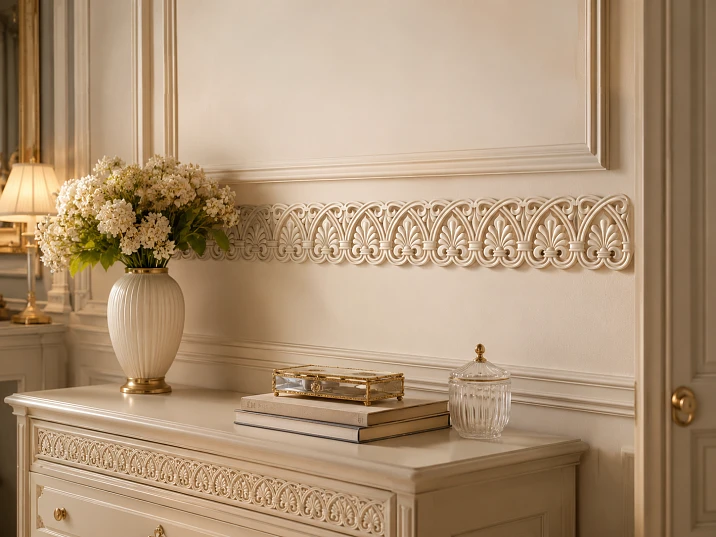
Sometimes an interior really needs polyurethane molding, but it doesn't need a complex stucco composition at all. You don't want to assemble a frame from several profiles, arrange individual overlays, match corners, search for a central element, and then worry that the decor turned out too busy. You need one clear detail — expressive, rhythmic, large enough to be noticed, but capable of working on its own.
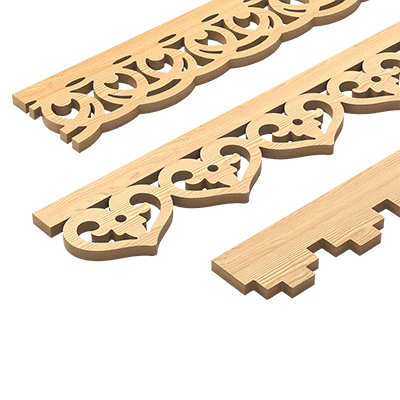
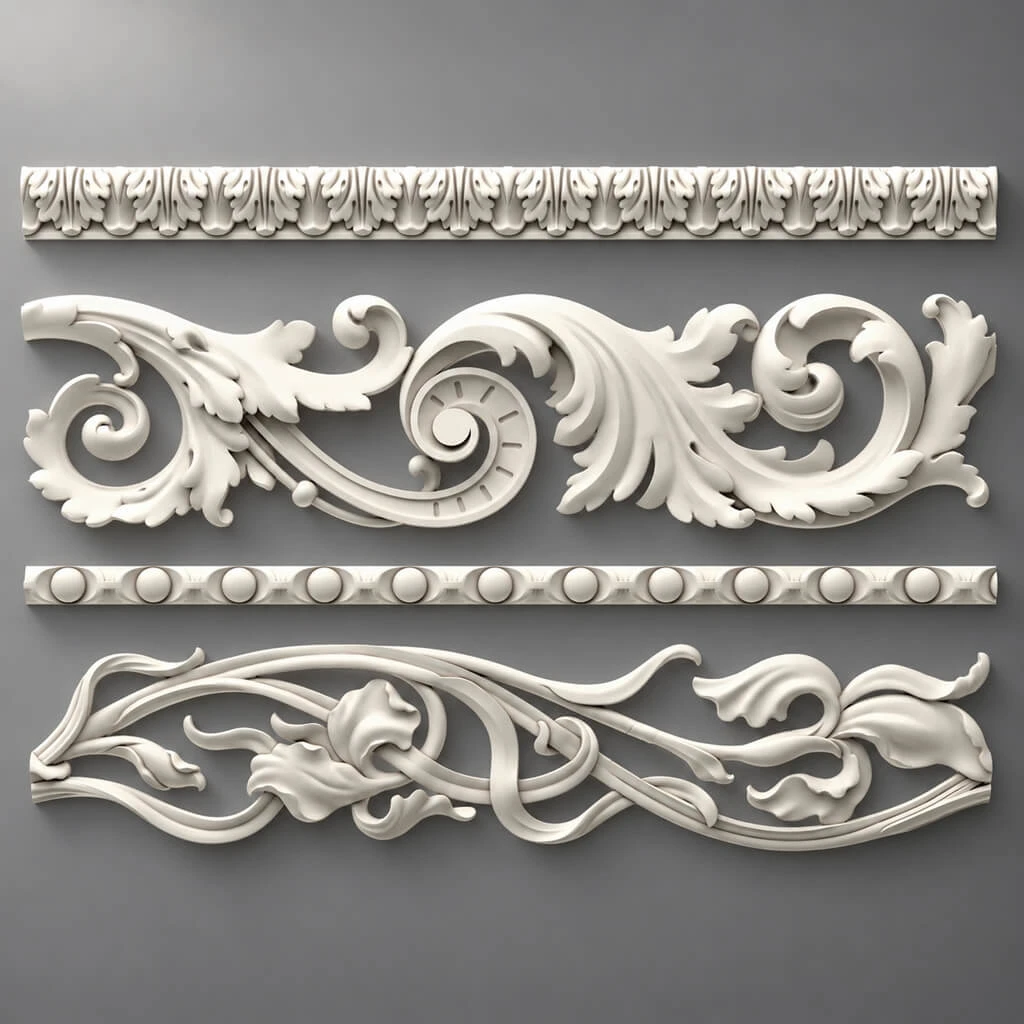
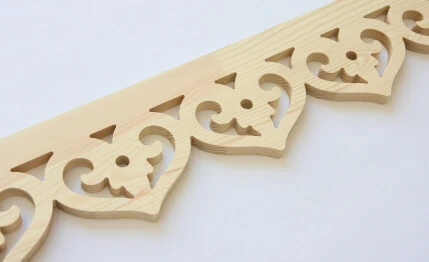
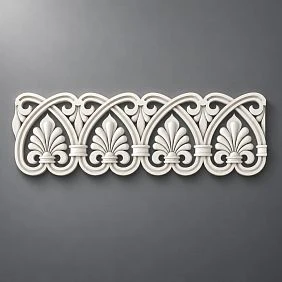
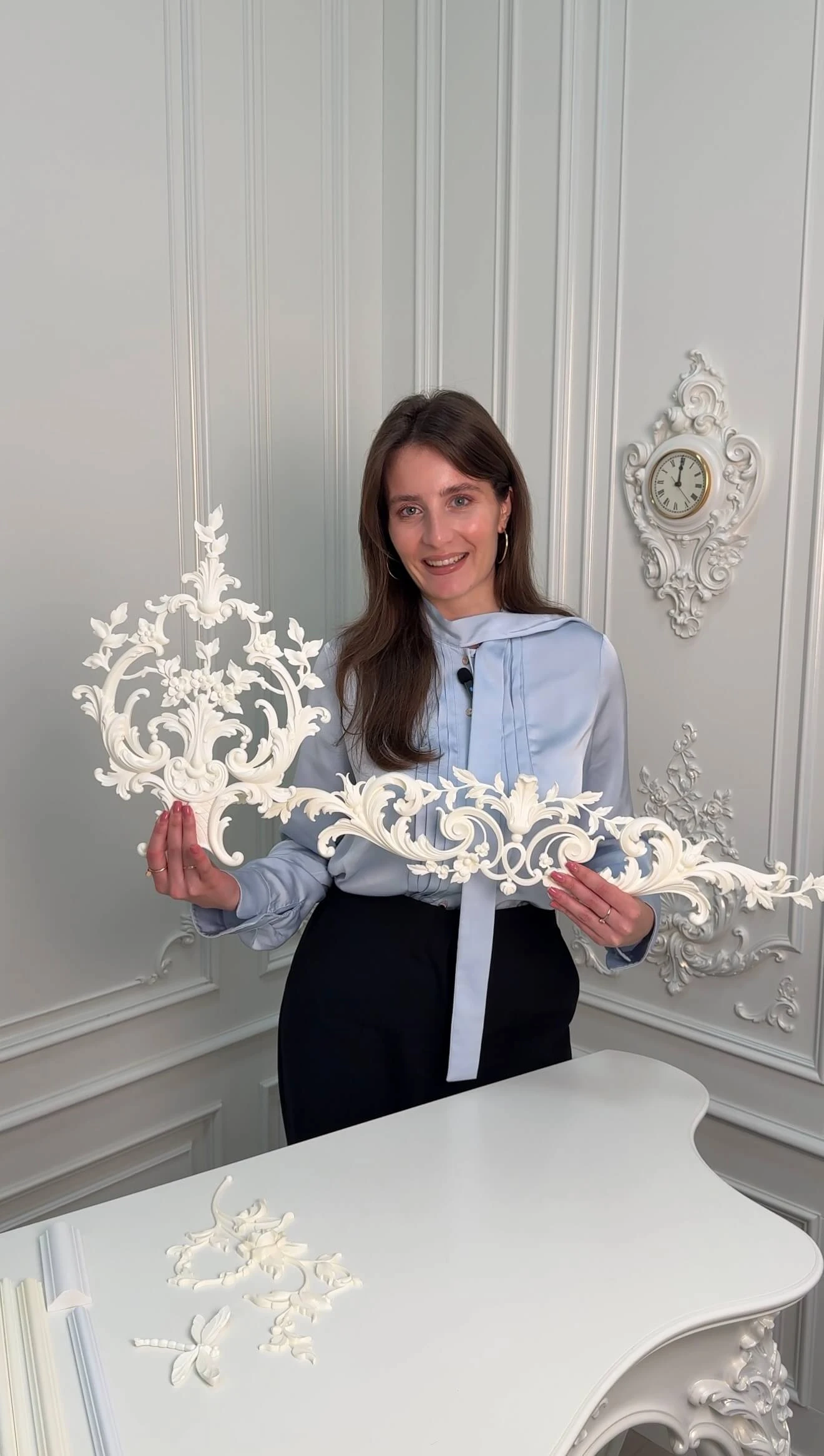
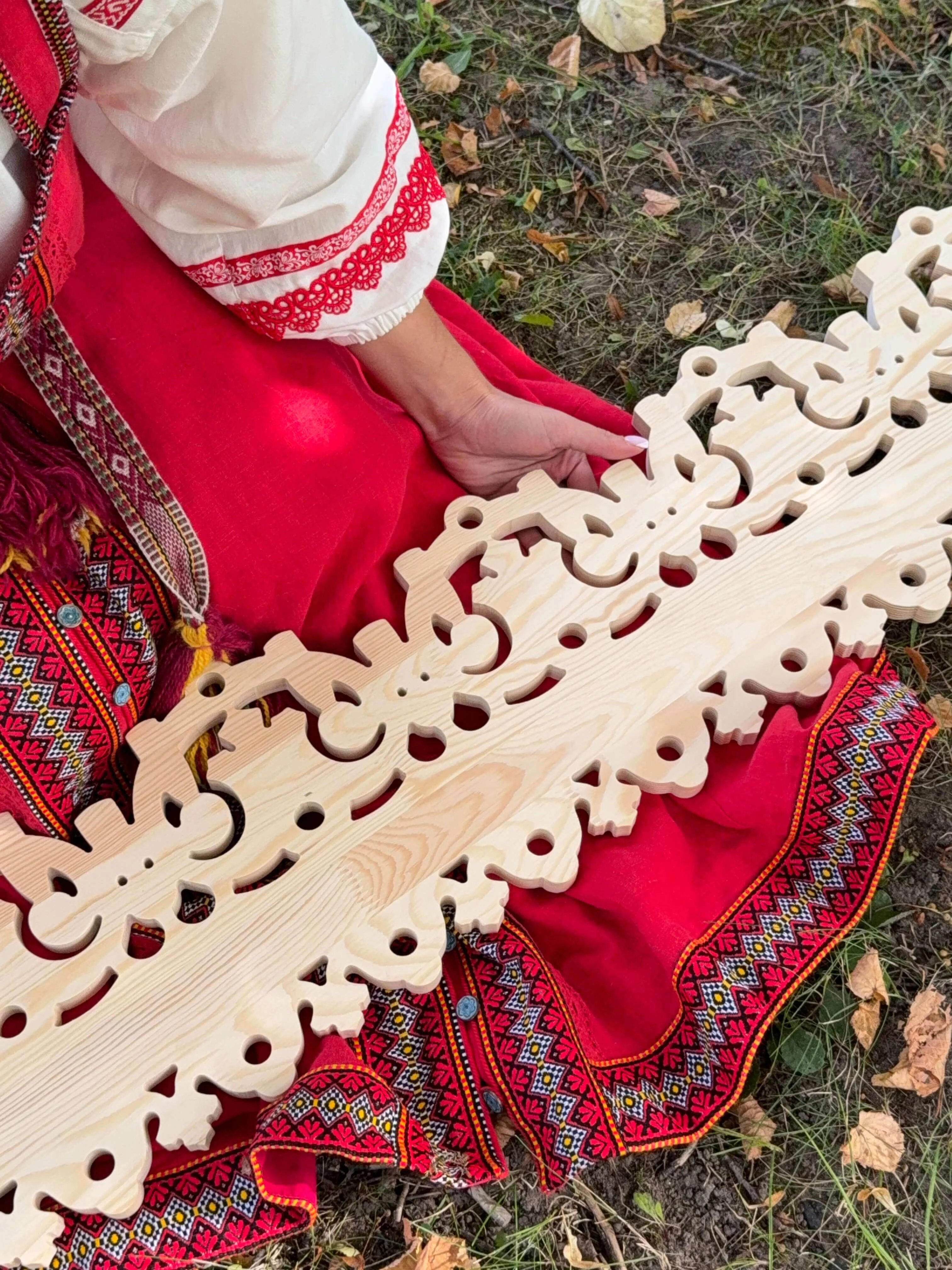
It is in this scenario that the carved molding KPU-064 made of polyurethane is interesting. It is not a small overlay that has to be repeated at regular intervals, nor an ordinary smooth line. The ornament extends along the entire piece, so the molding can be perceived as a ready-made decorative strip. It is convenient to consider it for a door leaf, wall, furniture front, cabinet side, decorative panel, or another flat surface where what is needed is not a scattering of ornaments but a single well-readable motif.
The main idea here is simple: don't complicate the decor where expressiveness can be achieved with a single line. The molding, 100 mm wide, is already noticeable in the composition, and the 2000 mm length allows working with a large vertical or horizontal section without breaking the pattern into many small elements. At the same time, the 8 mm depth preserves the relief without turning the strip into a massive architectural structure.
If the task is broader than a single product and you are just deciding which decor suits the interior, it is useful to first You can buy ready-made stucco matching the Baroque style. Calculate the quantity: linear meters of cornices and moldings, number of rosettes, pilasters, consoles, corner elements. Add a ten to fifteen percent allowance for trimming. not literally "blindly," but after comparing different types of elements: moldings, trims, overlays, and other stucco decor. And when what is needed is precisely a continuous ornamental line, the choice can be narrowed down to decorative polyurethane molding.
KPU-064 is interesting precisely because it allows you to abandon the usual logic of "the more details, the richer the decoration." Sometimes one well-chosen carved strip looks more convincing than five randomly assembled ornaments.
KPU-064 — when molding works as standalone decor
Molding is often perceived exclusively as an auxiliary linear element: something for an edge, frame, or repeating border. For a carved model, such a view is too narrow. The ornamental surface itself becomes the visual content.
KPU-064 has three parameters that are especially important for the future composition: width 100 mm, depth 8 mm, and length 2000 mm. These numbers should be read not only as technical specifications.
A width of 100 mm means we are not dealing with a barely noticeable strip. On a furniture facade, it can occupy a significant part of the free field, on a door it can form a vertical axis, and on a wall it can become a full-fledged ornamental belt. Therefore, KPU-064 should not be chosen on the principle of "liked the pattern — we'll stick it somewhere." First, you need to understand whether there is enough free space around it.
A length of 2000 mm sets a different nature of work. This is already an element designed for extended decoration. It makes sense to use it where the pattern can be allowed to develop along the surface. On a short section, most of the advantage of a long molding simply disappears: the piece will have to be significantly shortened, and the ornament may lose its intended rhythm.
A depth of 8 mm is important when working with furniture and doors. Even a relatively small relief requires checking everything nearby: handles, edges of the panel, adjacent leaf, trim, decorative profile. Particular attention should be paid to moving structures. A beautiful ornament should not interfere with opening a door or furniture.
If the dimensions of a specific surface are already known, you can immediately buy carved molding KPU-064 made of polyurethane and before placing the order, double-check the parameters against your project.
Main characteristics of KPU-064
| Parameter | KPU-064 | What this means for the buyer |
|---|---|---|
| Product type | Carved decorative molding | The ornament develops along the piece and is suitable for a linear composition |
| Article number | KPU-064 | The article number makes it convenient to check the desired model before ordering |
| Material | Polyurethane | The product belongs to the line of polyurethane stucco decor |
| Width | 100 мм | The strip is noticeable, so it needs enough free space around it. |
| Depth | 8 мм | Before installing on a door or furniture, check the protrusion relative to adjacent parts. |
| Length | 2000 мм | Convenient for extended vertical or horizontal decor. |
| Main scenarios | Doors, walls, furniture, interior finishing. | One SKU can be considered for different flat surfaces. |
| Price at the time of material preparation | 13,500 ₽ per 1 piece. | The current price should be checked in the product card before purchase. |
| Product card | KPU-064 made of polyurethane. | Here you need to verify the current price and parameters before ordering. |
This table immediately shows the main point: KPU-064 should be considered not as a small additional ornament, but as a fairly large decorative strip. Hence a different approach to design. First, the location for the line is determined, then its scale relative to the surface, and only after that the quantity is calculated.
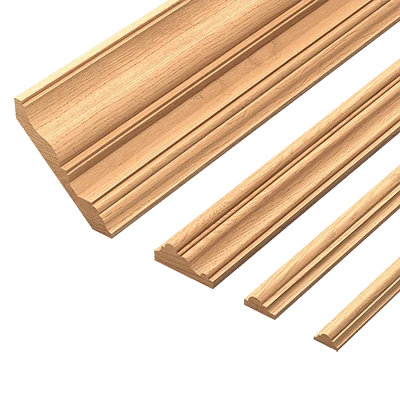
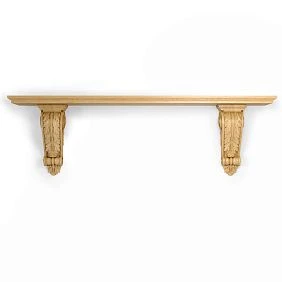
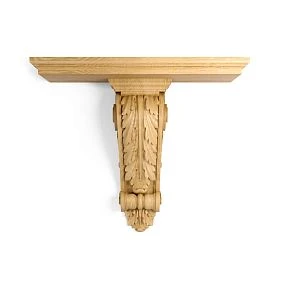
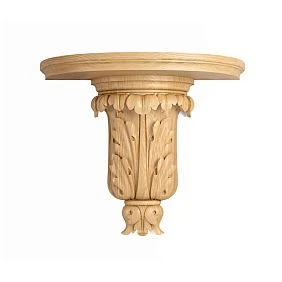
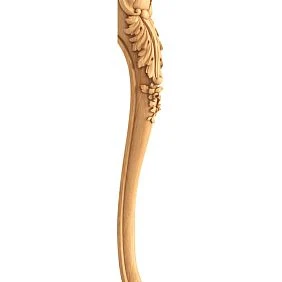
Our factory also produces:
Why one carved strip is sometimes better than a complex stucco composition
Complex stucco is attractive when the architecture of the room itself requires a multi-level composition. A large wall, high ceiling, portal, front door, or furniture with large panels can accommodate several elements at once. But there is no need to transfer the same logic to every surface.
Imagine a smooth interior door. You can assemble a frame from molding on it, add corner decor, place a top overlay, a bottom overlay, and another central element. Technically, this is possible. But a small panel quickly becomes visually overloaded. Each detail begins to argue with its neighbor.
Another path is a single vertical ornamental strip. It does not try to turn the door into an architectural portal. It simply sets an axis and rhythm.
The situation on the wall is similar. If the interior is already saturated with furniture, textiles, lighting fixtures, and art objects, another complex frame composition may be superfluous. One carved belt can support the classic character of the room without creating a second focal point.
On furniture, the advantage becomes even more obvious. The facade of a wardrobe or chest of drawers has limited area. Here it is especially important to understand scale: extra overlays quickly reduce the free field and make the facade fragmented. One carved line allows you to keep a significant part of the plane calm.
That is why the expression "one strip instead of a composition" is not an advertising simplification. It is a real design principle: the more active the ornament itself, the fewer additional elements may be needed around it.
At the same time, KPU-064 does not cancel other types of decor. If the interior needs a calmer geometric structure, you can buy polyurethane moldings and build frames or outlines. If a frame already exists but lacks individual decorative accents, it makes sense to buying polyurethane molding decor. KPU-064 solves a different task: it provides a long continuous ornament.
Get Consultation
What to choose: one carved strip, molding, or several overlays
| Solution | When it looks convincing | Main advantage | What to check in advance |
|---|---|---|---|
| KPU-064 with one strip | Need a noticeable vertical or horizontal ornament | The composition turns out to be cohesive without many separate details | Are the surface width and free section length sufficient |
| Several KPU-064 strips | Need a repeating rhythm on a large wall or several facades | You can combine different surfaces with a single motif | Equal intervals, pattern direction, number of whole elements |
| Smooth or profiled moldings | Need a frame, geometry, surface division | The line is calmer and more easily follows the architecture | Frame size, corners, symmetry |
| Individual decorative elements | Need a local accent at a specific point | Can emphasize the center, corner, or a separate zone | Ratio of overlay size to free field |
| Molding plus separate decor | Need a more complex classical composition | More options for multi-part design | Compatibility of multiple parts by scale and pattern |
There is no universal winner. The question is always the same: what effect are you aiming for on a specific surface? If the task is formulated as "I want one expressive carved motif without assembling a frame from five types of parts," KPU-064 fits it much more precisely than a random set of overlays.
First measure the free field, not the door or wall itself
One of the most common mistakes when choosing stucco decor starts even before the purchase. A person measures the entire door, the entire wall, or the entire side of a cabinet and thinks that is enough.
But KPU-064 is not installed "on the door in general." It occupies a specific free field.
On a door, there may be a trim at the top, a handle on the side, and a panel, glass insert, or existing relief in the leaf. On furniture, the free space is limited by handles, facade joints, milling, the hinge side, and the cabinet edge. On a wall, sockets, switches, trims, baseboards, cornices, furniture, and lights interfere.
Therefore, you need to measure the area that can actually be given to the decor.
For a vertical strip, it is useful to record four values:
-
available height;
-
available width;
-
distance from the intended strip to the nearest protruding elements;
-
position of the visual axis of the surface.
The last point is often underestimated. If a decorative strip is to run along the center of a door leaf, knowing the overall width of the door is not enough. You need to determine exactly the center of the visible part. It may not coincide with the geometric center of the entire structure due to the trim, handle, or adjacent panel.
On a furniture facade, the situation is even more interesting. Suppose the width of a cabinet door allows for KPU-064. This does not mean the strip must be placed in the center. If a large handle is nearby, it is sometimes better to shift the decorative axis or even abandon combining two active elements on one small surface.
For a wall, it is useful to first apply the intended strip with painter's tape about 100 mm wide. Such a simple mockup shows the scale much more honestly than a product photo on a screen. You will immediately see whether the strip seems too wide, whether there is enough space around it, and whether it conflicts with furniture.
Practical rule of free space
Do not try to make KPU-064 fill the entire available surface. The ornament reads better when there is a calm background around it.
If there is practically no free space and the strip ends up squeezed between two other elements, the problem is usually not the size of the molding itself. The problem is that there is no room on that surface for another visual layer.
In such a situation, it is better to consider calmer options Moldings made of polyurethane or move the carved molding to another plane.
KPU-064 on the door: a vertical axis instead of an overloaded portal
A door leaf is one of the most straightforward scenarios for long carved molding. The door's shape is already vertical, so a long ornamental line supports the existing proportions rather than conflicting with them.
But scale is especially important here.
KPU-064 has a length of 2000 mm. You cannot simply see this number and decide: "so, it fits any door." First, you measure exactly the section you want to decorate. The strip can start below the top edge and end above the bottom edge; it can occupy the central part; it can be used as a fragment. The result depends on the composition.
Central vertical strip
The most straightforward option is to run KPU-064 along the central axis of a solid, smooth door leaf.
This technique works especially well when the door seems too empty, but you do not want to do a full molding layout. The ornament becomes the main decorative element, and the smooth surface around it acts as a background.
Before ordering, check:
-
where the actual center of the door leaf is;
-
does the strip fall into the handle zone;
-
is there enough distance from the relief to the trim;
-
will the lower part constantly get hit by shoes, bags, or objects;
-
does the existing finish allow preparing the surface for the chosen installation method.
Separately, look at the opening side. For a regular swing door, an 8 mm protrusion may seem small, but compatibility is determined not by the number itself, but by the specific geometry of the panel and frame. If there is a limiter nearby, tight contact with the wall, or another door, this should be checked before installation.
Two strips on a wide panel
On a wide door or double-leaf structure, you may sometimes want to repeat the ornament. Here, it is important not to turn the repetition into a coincidence.
If two strips are used symmetrically, the distances from the edges should be meaningful. It is better to mark both axes in advance and look at the door as a whole from several meters away. Up close, the eye sees the carving, but from afar, only the overall geometry. An error in symmetry will be more noticeable than the ornament itself.
On a double-leaf door, the gap between the panels must be taken into account. The pattern should not be built as if two movable leaves were one fixed panel. Each part of the structure must open normally and maintain visual independence.
Strip instead of a frame
If an ordinary door seems too simple, the first thought is often to make a classic molding frame. This is a good option, but not the only one.
The frame accentuates the perimeter of the inner field. KPU-064, on the contrary, emphasizes the direction. Therefore, the effect is different: the door is perceived as more elongated, and the ornament as more compact.
For an interior where there are already framed panels on walls or furniture, this can be an advantage. It is not necessary to repeat frames literally on every surface. A vertical carved line will support the decorative language but introduce different plasticity.
If you need exactly this scenario, you can in advance view and buy KPU-064, having checked the length and width of the strip against the dimensions of the free field of the door.
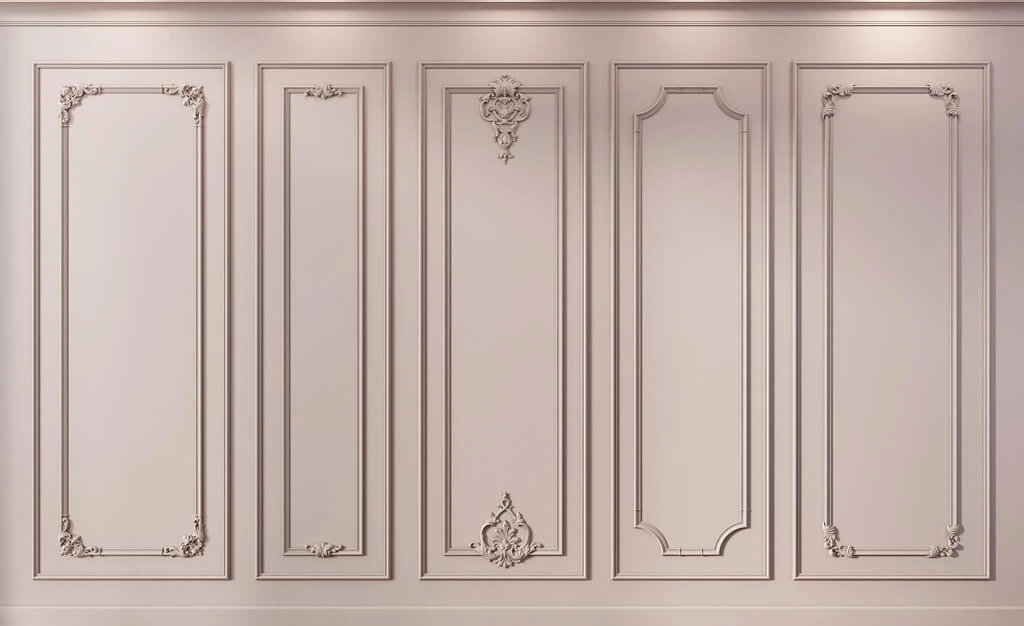
Carved molding on the wall: not another frame, but an independent architectural line
On the wall, KPU-064 has more freedom. Here, the size of the facade is not so strictly limited, and the decorative strip can be used vertically, horizontally, or repeated at certain intervals.
But freedom does not mean that the strip should be placed anywhere.
Vertical line next to the doorway
One of the most logical options is a vertical carved accent on a free section of the wall next to the door. It can support the height of the opening without turning into a full-fledged casing.
This option is especially interesting when the door frame itself is already finished and you don't want to add another profile to it. The molding is placed not as a structural extension of the casing, but as a separate decorative rhythm of the wall.
Here it is important to leave sufficient distance between the two elements. If the carved strip almost touches the casing, they visually begin to be perceived as mistakenly joined parts. If the distance is deliberate, both elements are read separately.
A strip between two wall panels
If the wall is already divided into large smooth zones, KPU-064 can become a decorative divider. But it should not be perceived as a technical profile for closing any seam. Its strong point is the ornament.
If you need to specifically hide a construction joint, first assess the technical task. And when the base is prepared and the line needs to be decoratively emphasized, the carved molding becomes an aesthetic tool.
For complex wall compositions, it is useful to compare KPU-064 with calmer linear elements. In the catalog you can buy decorative polyurethane molding of different patterns and understand whether you need rich carving or a more restrained rhythm.
Horizontal ornamental belt
KPU-064 does not have to be used vertically. On a long free section of wall, a horizontal strip can work as a decorative belt.
Here the question of joints arises: the length of one piece is 2000 mm. If the section is longer, several elements will be required. Therefore, the placement of connections needs to be planned before ordering.
The best result is achieved not when the joint is "hidden somewhere," but when the overall layout is calculated in advance. Sometimes it is wiser to start the composition not from the very corner of the room, but from the visual axis of the wall and distribute the trims along the edges. Then the central area turns out neater.
On the wall, the scale of the 100 mm width is also especially noticeable. Before purchasing, it is useful to make a paper or tape template of the actual width and look at it from the usual point of entry into the room. This quickly shows whether the decor will be a delicate accent or turn into one of the main lines of the interior.
On furniture, KPU-064 requires even more precise calculation
A furniture facade is smaller than a wall and a door, so every centimeter here is more noticeable.
It is precisely on furniture that you cannot choose carved decor only based on a beautiful large photo. The product image shows the pattern but says almost nothing about its scale relative to your door.
Imagine a facade 400 mm wide. A strip 100 mm wide will take up a quarter of its width. On a facade 800 mm wide, the same piece will be perceived much more calmly. The KPU-064 itself has not changed — the proportion has changed.
Cabinet with smooth doors
On tall smooth cabinet doors, a long vertical strip looks logical due to the matching directions. But if the cabinet has multiple doors, you need to decide whether the decor will be repeated on each door.
Repetition across all facades creates a strong rhythm. This may be justified for large symmetrical furniture, but on a small cabinet, many identical carved strips can make the facade too busy.
Sometimes it is more interesting to decorate only the central doors or one compositionally important part. The decision should come from the entire piece of furniture, not from the desire to use the maximum amount of decor.
Chest of drawers and horizontal application
A chest of drawers has a different geometry. Here, a long vertical element is not always obvious, but a horizontal strip can support the length of the facade or body.
However, you cannot automatically transfer the trim across the boundaries of several drawers. Each movable facade must remain independent. If the pattern crosses the gaps, the slightest shift of the drawers will be noticeable.
A solution looks much calmer when the carved element is placed on a solid, stationary part of the furniture or on one sufficiently large facade.
Side of a wardrobe or cabinet
The side wall of furniture often remains empty, especially if the body is visible from the side when entering the room. Here, decorative trim can be more interesting than trying to complicate the front facades.
This is a good example of why decor does not necessarily have to be placed on the most obvious surface. If the front is already saturated with handles, milling, and panels, additional carving may be unnecessary. On a calm side, it, on the contrary, gets space.
Furniture handle and carved ornament should not compete
A handle is a functional element that a person sees and touches daily. KPU-064 is decorative. If both are located nearby, there should be enough visual and physical space between them.
Before ordering, open the door the way you will use it every day. Run your hand toward the handle. Check whether the relief falls within the grip zone. Inspect adjacent facades.
This simple trial often matters more than a long discussion of style.
Width 100 mm: when it is an advantage, and when it is a signal to choose a different decor
What makes KPU-064 interesting? It reads well. But the same property requires caution.
A width of 100 mm makes the ornament noticeable. On a large surface, this is a plus: the pattern does not get lost. On a small facade, the same width may prove excessive.
Therefore, it is useful to assess not only the absolute size of the detail, but also its proportion relative to the decorated field.
If the free width of the surface is 1000 mm, the strip occupies roughly a tenth. If the field is only 300 mm, it is already a third. The visual effect will be completely different.
There is no universal percentage that guarantees a good result. Ornaments differ in density, and there may be handles, frames, panels, and adjacent elements around. But the principle of comparison itself is very useful: the detail must be seen in the scale of the surface.
A full-scale mock-up saves more time than choosing from a photograph
Take paper or masking tape 100 mm wide and mark the intended position of the strip. To estimate the length, you can draw a line at 2000 mm or at the part that is planned to be left after trimming.
After that:
-
step back to the usual viewing distance;
-
photograph the entire surface;
-
look at the mockup under daylight and artificial lighting;
-
check it together with furniture and other items;
-
make sure the pattern is not too close to the edges.
Such a test says nothing about the beauty of the carving itself, but it very accurately answers the question of scale.
If 100 mm looks too active, do not try to "fix" it with a lot of surrounding decor. Better go back to the section polyurethane molding and compare other options.
Carved moldings and interior style: not only classics
Ornamental stucco automatically evokes an association with a classic interior. This is natural, but too straightforward.
The decorative effect depends not only on the pattern of the detail, but also on the quantity, placement, surrounding geometry, and finish.
In a classic space, KPU-064 can be part of a richer system. It can be combined with architectural lines, frames, and individual decorative elements.
In a neoclassical interior, the opposite principle often works: a historically recognizable ornament is placed on a relatively calm modern surface. One strip here is more interesting than a complex composition precisely because of its restraint.
In an eclectic space, a carved line can become a deliberate contrast next to minimalist furniture. But contrast requires discipline. If you add active wallpaper, complex handles, several types of stucco, and carved moldings at the same time, the idea will stop being readable.
Even in a modern interior, a decorative element does not have to look alien. Much depends on how it is integrated into the surface. If the strip is painted in the tone of the wall or facade, the relief and play of light come to the forefront, not the color contrast.
Hence the practical conclusion: choose not the "style of the product," but the role of the product in a specific interior.
It can be the main ornament, a secondary line, or part of a complex system. But it does not need to perform all three functions at the same time.
Paint to match the base or highlight: first decide what should be visible
Before final finishing, it is useful to ask yourself a simple question: should a person first see the pattern or first see the contrasting strip?
If KPU-064 and the base have a similar color, the ornament is perceived through light and shadow. Such a composition usually looks calmer. It works well for a wall or furniture facade where you want to add depth without a new bright color.
A contrasting solution is much more active. In it, the strip itself is read first, then the pattern inside it. This can be appropriate on a large calm surface, but requires particularly precise placement.
It is a mistake to first buy decor, install it, and leave the color question for later. The finish affects the perception of scale. A dark contrasting strip 100 mm wide will appear visually heavier than the same detail painted together with the wall.
If you plan to combine carved molding with other linear elements, it is convenient to look in advance Moldings made of polyurethane and decide whether all details should have the same finish or whether an intentional contrast is needed between them.
The main thing is not to mix several solutions without a reason. One strip white, another gold, a frame in the wall color, a separate overlay contrasting — such a scheme requires a very strong project. For most interiors, a more cohesive system looks more convincing.
How to calculate the quantity of KPU-064 and not discover a shortage on installation day
The 2000 mm size seems simple for calculation, but counting only the total length is not enough.
Suppose four vertical fields of 1700 mm each need to be finished. The total length is 6800 mm. If you simply divide it by 2000 mm, you get 3.4, that is, mathematically four pieces.
But such math may be incorrect for cutting.
From one piece 2000 mm long, you cannot get two strips of 1700 mm. Each field will require a separate whole plank. So, the actual order is four KPU-064.
Now another example: you need four segments of 900 mm each. The total length is 3600 mm. From one product 2000 mm long, you can get two such segments, if the pattern, trimming, and specific layout allow it. Then two pieces theoretically cover the task.
The difference shows the main principle: linear material is calculated not only by linear meters, but also by the cutting of each individual plank.
Useful calculation scheme
First, make a table of all sections.
| Section | Required length | Number of identical sections | How it is planned to be cut |
|---|---|---|---|
| Door 1 | 1750 мм | 1 | From a separate plank |
| Door 2 | 1750 мм | 1 | From a separate plank |
| Cabinet side panel | 1200 мм | 1 | Check possibility to use the remainder |
| Wall insert | 1950 мм | 1 | Almost intact strip |
After that, lay out the necessary segments on parts 2000 mm long the same way parts are laid out when cutting material.
But ornamental molding has one more limitation: the pattern.
Theoretically, the remainder may fit in length, but visually it may not. For example, if two adjacent strips must start with the same pattern fragment, a random remainder can disrupt the symmetry.
Therefore, before the final calculation, you need to look at the KPU-064 pattern itself and decide whether synchronization of the motif on several parts is important.
The allowance should not be random
Buying one extra strip "just in case" is sometimes reasonable, and sometimes unjustified. It all depends on the layout.
It's better to ask three questions:
-
Are there long sections that require an almost full piece?
-
Can the leftovers be used on other surfaces?
-
How critical is the pattern match between adjacent strips?
After this, the quantity becomes a consequence of the project, not an approximate estimate.
Joints: the place where a long ornament most often reveals poor installation planning
If the section is shorter than 2000 mm, the task is relatively simple: the piece is trimmed to the design length. If the surface is longer, a joint occurs.
On a smooth molding, a small joint can sometimes be easily incorporated into the overall line. On carved trim, not only the seam matters, but also the continuation of the pattern.
Therefore, one cannot approach joining two pieces as if connecting two featureless strips.
Before cutting, place the elements side by side and look at:
-
how the pattern continues;
-
where it is visually calmer to place the joint;
-
whether it is necessary to synchronize the same fragment of the design;
-
whether the seam falls on the most noticeable central point;
-
whether the joints can be distributed symmetrically.
On a long wall, it is sometimes more advantageous to make the central section solid and move the joints closer to less noticeable areas. In another composition, on the contrary, a symmetrical central seam may be logical. The decision depends on the pattern and the entire layout.
Do not start cutting until you have done a dry layout
This is one of those cases where a few minutes of preparation can save an expensive piece.
Lay out KPU-064 without final fixing. Mark the boundaries with a pencil or painter's tape. Compare several placement options. Only then determine the cutting lines.
Particular care must be taken when the exact calculated quantity is purchased without a spare part. An error on the first element can disrupt the cutting of the entire set.
Installation begins not with adhesive, but with checking the base and position
The trim itself may be chosen correctly, but the result will still be untidy if the surface is not prepared or the line is installed with a deviation.
For a long ornamental piece, even a slight error in direction is noticeable. On a two-meter vertical, the eye easily reads the tilt relative to the door edge, furniture facade, or wall corner.
Therefore, marking is more important than speed.
First, the position
Draw the axis of the future strip or mark both edges. For a wall, it is convenient to use a level. For a door and furniture, you can rely on the geometry of the facade itself, but first make sure that its edges really provide the desired visual axis.
Do not rush to use the edge of the surface as the only reference. Old doors, furniture, and walls are not always geometrically perfect. Sometimes the visually level position differs slightly from the mathematical one.
Then the base
The surface must match the chosen adhesive system and be prepared for a reliable bond. If the door or furniture is already painted, special attention should be paid to checking the compatibility of the base, the existing coating, and the mounting compound.
One should not proceed from the principle "if the glue is strong, it will stick everything." The weak point may not be the glue, but an old layer of paint that will come off along with the decor.
To select auxiliary compounds, you can look Mounting and finishing materials. The specific glue should be chosen taking into account the material of the decor and the base.
And only then fixation
Before applying the glue, it is useful to do a full dry fitting, especially if there will be several strips on the surface.
Check:
-
ornament direction;
-
the same height of the beginning and end;
-
intervals;
-
position relative to handles and other details;
-
joints;
-
trimmed edges.
A long carved element does not forgive "on-the-fly" installation. The more decisions are made before the glue, the calmer the final installation goes.
What to buy together with KPU-064, and what to add only when truly necessary
The most common mistake in decorative finishing is thinking that an expressive element must necessarily be accompanied by several more expressive elements.
Not necessarily.
If KPU-064 is purchased specifically as a single carved strip instead of a complex composition, the first accessory should not be another ornament, but everything required for the neat implementation of the chosen scheme.
These may be mounting materials. Sometimes — a calm molding. In another composition — separate decor for a frame on an adjacent wall. But the set is determined by the interior.
What makes sense to look at nearby
| What to add | Why | When it is really needed | Where to look |
|---|---|---|---|
| Trim of the same purpose | For several identical strips or a large composition | When decorating multiple doors, facades, or a long wall | decorative polyurethane molding |
| Moldings | For a calm frame or geometric line next to a carved ornament | When a single strip requires architectural surroundings | buy polyurethane moldings |
| Decor for moldings | For individual accents in the frame composition | When KPU-064 is used in only one zone, and the adjacent one is framed | buying polyurethane molding decor |
| Installation and finishing materials | For fixing and preparing the finish | In almost any DIY installation after compatibility check | Mounting and finishing materials |
| Other elements of stucco decor | For a project where one strip is intentionally not enough | Only after evaluating the entire composition | Polyurethane moldings |
The point of the table is not to increase the shopping list. On the contrary, it helps avoid buying unnecessary items.
If one carved strip already solves the task, there is no need to artificially build a complex system around it. If, after a test fit, the wall truly looks unfinished, then you can move on to moldings or individual decorative elements.
How not to confuse KPU-064 with a regular molding or a separate overlay
In the photo, different types of stucco decor may seem similar: all white, relief, designed to decorate a surface. But their purpose is different.
KPU-064 — molding strips
Its logic is a continuous ornament. The pattern develops along the element. Therefore, it is naturally used as a strip, belt, vertical, or repeating linear motif.
Molding is primarily a profile and a line
Molding is more often chosen when you need to outline a frame, divide a surface, emphasize a border, or build a geometric
Practical selection: seven situations and a solution for each
Situation 1. A smooth door looks too empty
If the door is flat, without panels or large decorative elements, KPU-064 can be considered as one central vertical strip.
First, make a template 100 mm wide. Check its position relative to the handle and edges. If the scale looks convincing, measure the required length.
Do not add a frame automatically. Look at the door first with only one strip. Perhaps that is already enough.
Situation 2. You want molding on the wall, but classic frames are boring.
Instead of several rectangles, you can use one or more vertical ornamental lines.
This solution is especially interesting on piers, in the area between doors, or on a free wall next to furniture.
If the surface is large, first determine the rhythm. Two or three strips should form a system, not just stand at random distances from each other.
Situation 3. The cabinet is too simple, but you don't want to change the fronts.
Assess the width of each door and the position of the handles.
If KPU-064 takes up too much of a narrow front, don't force it to fit. Perhaps it's better to decorate one wide central door or the side panel of the cabinet.
If the fronts are large enough, repeating vertical strips can unify the entire cabinet.
Situation 4. A horizontal ornament is needed above the furniture.
On the wall above a console, dresser, or other furniture, KPU-064 can be considered as a horizontal belt.
Here, the length of the composition relative to the furniture is first determined. It is not necessary to make the decorative line exactly equal to the width of the item. But the difference should look deliberate.
If more than 2000 mm is required, design the joint in advance.
Situation 5. There are already moldings, but the composition looks too calm
It is not necessary to change the entire layout.
KPU-064 can be used as a separate rich accent on another plane — for example, on a door or furniture facade. Then smooth or profiled moldings remain the architectural background, and carved trim adds ornament.
This is often more interesting than inserting a complex pattern inside each frame.
Situation 6. Need to design several identical doors
Here, the main thing is to standardize the placement.
Make one template: starting height, ending height, distance from the edge or central axis. After a trial door, transfer the scheme to the remaining panels.
Calculate the quantity of KPU-064 based on cutting, not just total length.
Situation 7. There is a leftover after trimming
Don't rush to find a place where you must glue it.
A leftover is useful only when it fits the new composition in length and pattern. A small random fragment of a large ornament can look like a scrap, not like intended decor.
Sometimes the best way to use a leftover is to save it for possible repairs or future work, rather than overloading the interior.
Mistakes that make expensive decor look random
Buying only based on a large photo
The product photo shows the pattern, but the 100 mm width is barely noticeable.
The solution is simple: a full-scale mockup before purchasing.
Ignoring the length of specific sections
The phrase "I need about six meters" doesn't provide a proper calculation.
Six meters can consist of three sections of 2000 mm or six of 1000 mm. The number of whole planks and the cutting pattern will differ.
Automatic center mounting
Center is not a sacred rule.
If a handle, furniture, or surface architecture shifts the visual balance, a geometrically central position can look worse than a deliberate offset.
First, look at the composition as a whole.
Too many KPU-064 on one small surface
A beautiful ornament does not become twice as beautiful by doubling the quantity.
If two strips leave a tiny free field between them, it is worth checking the option with one.
Combination with all types of decor at the same time
Molding, carved strip, overlay, rosette, corner element, contrasting paint — all of these can be appropriate individually.
But using everything at once requires a serious project. For a regular door or a small facade, such a set more often destroys the hierarchy.
Lack of dry fitting
Especially dangerous with several identical elements.
While the adhesive is not applied, the position is easy to change. After fixation, the cost of a mistake increases.
Unverified substrate
Even a correctly chosen mounting material does not compensate for a weak or peeling coating.
An already painted door, wall, or furniture should be assessed specifically as a substrate for mounting.
Attempt to cover a technical problem with decor
KPU-064 is decorative molding. It should not become a way to hide a serious unevenness, a damaged edge, or a movable joint without first solving the underlying problem.
First, the substrate is brought to a normal condition, then decorated.
Ill-considered pattern joint
On a long wall, the connection of two carved parts may be more noticeable than expected.
Lay out the elements and check the pattern continuation before cutting.
Purchasing exactly by arithmetic linear meters
Calculating without a cutting layout can result in an insufficient quantity.
Each long segment needs to be "placed" into a specific two-meter plank.
Placement too close to the handle
Physical compatibility is no less important than visual compatibility.
Check the hand movement and the opening of the facade.
Ordering before final layout marking
The correct sequence is the reverse: surface → dimensions → layout → arrangement → quantity → order.
It is this that reduces the risk of overpaying and rework.
When KPU-064 is truly suitable, and when it's better to choose another option
A good product doesn't have the task of 'fitting everyone.' The more precisely you understand the limitations, the better the result.
KPU-064 is worth considering if:
- you need one prominent ornamental strip;
- there is a sufficiently large and calm surface;
- you want to avoid a complex composition of many details;
- a vertical or horizontal decorative rhythm is required;
- a smooth door is being decorated;
- there is a large furniture facade or side panel;
- an expressive line on the wall is needed;
- the project allows a width of 100 mm;
- you can plan in advance the cutting of an element 2000 mm long;
- enough free background remains around the strip.
It is better to look at another decor if:
- the free field is very narrow;
- a thin, almost invisible line is required;
- the main task is to assemble a rectangular frame;
- only a small local center needs to be decorated;
- the surface is highly curved, and the possibility of such installation for the selected part is not confirmed;
- there are too many protruding functional elements nearby;
- the decor interferes with opening;
- it is intended to cover a serious construction defect with it instead of repairing the base.
In the latter case, choosing a different element does not mean that KPU-064 is bad. It's just a different task.
For a framed composition, it is better to choose polyurethane moldings. For a separate accent, it is worth exploring other decorative polyurethane elements. And for a long ornamental motif, we return to trim.
How to assemble an interior around a single stripe without losing the idea
The interest of KPU-064 lies precisely in its independence. Therefore, after choosing the stripe, you shouldn't immediately look for ways to fill all the space around it.
Start with three levels.
The first level is the surface itself.
The door, wall, or furniture should remain readable.
If the decorative stripe completely suppresses the shape of the object, the scale is chosen poorly or there is too little free space around it.
The second level is the adjacent lines.
These are door edges, furniture fronts, cabinet verticals, cornice, baseboard, moldings.
KPU-064 should either support this geometry or deliberately contrast with it. A random angle or unclear offset rarely looks convincing.
The third level is the rest of the ornament.
Only after the first two levels do you decide whether additional carved elements are needed.
If so, it's better to choose one repeating principle. For example, a botanical motif repeats on the door and one piece of furniture. It doesn't have to be carried over to every wall.
This way the interior gains cohesion but doesn't become a catalog of decorative elements.
One model — three different visual effects
It's interesting that the same KPU-064 can look completely different depending on its placement.
Vertical
A vertical stripe emphasizes height and direction. Therefore, it's natural on a door, cabinet, wall section, or tall panel.
The eye moves along the ornament from bottom to top or top to bottom.
Horizontal
A horizontal installation more strongly connects objects or zones across their width. It suits a decorative band on the wall, a wide furniture surface, or an extended panel.
Here, the joints are especially important if the composition's width exceeds 2000 mm.
Repeat
Several identical strips create a rhythm. At this moment, KPU-064 ceases to be a single accent and becomes a system.
The more repetitions, the calmer the intervals and background should be. Otherwise, the repetition turns into visual noise.
Of these three options, there is no "correct" one. The correct one becomes the one that matches the geometry of your object.
How to use KPU-064 on multiple items in one room
Let's imagine a bedroom: the entrance door, a wardrobe, a dresser, and the wall behind the headboard.
Technically, carved molding can be attempted to be used everywhere. Design-wise, it's not necessary.
It is much more expressive to choose two connected places. For example:
- one vertical on the door;
- a repeat of the same motif on the central panel of the wardrobe.
The dresser and the wall remain calmer in this case.
Another option:
- a horizontal band on the wall;
- a subtle repeat on a wide furniture surface.
This creates a recognizable connection, but the interior retains its hierarchy.
If the pattern is repeated on every door, every facade, and every wall, the eye stops understanding what is primary. The design turns into background.
This is an important principle when working with any decorative molding: repetition should create a system, not fill emptiness.
Molding for commercial interiors: repeatability matters more than a one-off effect
In a cafe, salon, office, hotel, or showroom, a decorative element is evaluated somewhat differently.
A private interior can be built around a single unique accent. In a commercial space, repeatability is often required: several doors, identical panels, a long corridor, a series of furniture facades.
Here, KPU-064 is interesting because one model allows creating a unified ornamental rhythm. However, the design requirements increase.
It is necessary to determine in advance:
- the same installation height;
- the direction of the pattern;
- the position of the joints;
- Cutting;
- the number of elements;
- stock;
- the installation sequence.
Even a small mistake, repeated on ten doors, turns into a system of errors.
Therefore, with a large volume, it is especially useful to first make one complete sample. Not a small piece on the table, but a full-fledged fragment: a door, panel, or facade. After evaluating the result, the scheme is transferred to the remaining surfaces.
What to check before placing an order for KPU-064
By the time of purchase, you should have not a feeling of "it seems it will fit," but a short set of specific data.
Surface dimensions
Record the actual width and height of the free field.
Planned position
Center, offset, horizontal, or vertical.
Number of sections
Not the total area of the room, but the number of specific strips.
Length of each strip
This is the basis of cutting.
Ability to use leftovers
It directly affects the number of whole products.
Adjacent elements
Handles, architraves, facades, sockets, switches, skirting boards, cornices.
Substrate
A wall, painted surface, furniture facade, or door requires inspection before installation.
Finishing
It is better to decide on the color and overall style of the finish before installation.
Related materials
It is better to select mounting compounds and everything needed for surface preparation at the same time, rather than after the decor is delivered.
After such a check, you can proceed to the product card and order KPU-064 measuring 100 × 8 × 2000 mm, after verifying the current price and parameters before adding the item to the cart.
How to buy polyurethane molding without accidentally selecting random parts
It is most convenient to go from the task to the category, rather than the other way around.
If you only know so far that you want to add relief decor, check out the general section where you can choose and buy polyurethane molding.
If it's already clear that you need a long ornament, go to the section of decorative polyurethane trim.
If the task is specific — one expressive strip 100 mm wide and 2000 mm long — open the product page for carved trim KPU-064.
If after the mockup it becomes clear that the carved strip is too active and only a calm frame is needed, move on to polyurethane moldings.
This sequence avoids the most unpleasant situation: when you first buy a beautiful element, and only then start looking for a surface to attach it to.
Answers to Popular Questions
Can KPU-064 be used as a single strip?
Yes. This is one of the most interesting application scenarios for KPU-064. The carved molding can be used as a standalone vertical or horizontal ornamental line without the mandatory addition of frames and separate overlays.
Before purchasing, you only need to check the scale. The width of KPU-064 is 100 mm, so on a small facade such a strip will be a noticeable element, not a thin decorative line.
What size is specified for KPU-064 in the product card?
For the option in question, the size is 100 × 8 × 2000 mm: width 100 mm, depth 8 mm, and length 2000 mm.
Before ordering, the parameters and current price should be re-checked directly in the KPU-064 product card.
How much does the carved molding KPU-064 cost?
At the time of preparing the article, the price of the option in question is 13,500 ₽ per 1 piece.
The price refers to the current offer at the time of verification, so before purchasing it is better to rely on the current value in the product card.
Will KPU-064 fit a regular smooth door?
May be suitable if there is enough free space on the surface for a strip 100 mm wide and the relief does not conflict with the handle, trim, frame, or adjacent surfaces.
The most useful test is to make a full-size mock-up of the strip before ordering. It will immediately become clear on the door how large the ornament looks.
Is it necessary to install two strips symmetrically?
No. A single strip can be a complete composition.
The second one is needed only when the geometry of the door, wall, or furniture requires it. It is not worth adding it solely for symmetry if the surface becomes overloaded afterward.
Can KPU-064 be installed horizontally?
Yes, if the horizontal position matches your composition.
For example, carved molding can be considered for an ornamental belt on a wall or a large furniture surface. If the section length exceeds 2000 mm, you will need to plan in advance the joining of several pieces and the continuation of the pattern.
How to calculate the quantity of KPU-064?
First, write down the length of each individual section, then break these segments down into planks 2000 mm long.
Simply dividing the total length by two meters is not enough. For example, four strips of 1700 mm each would require four separate two-meter elements, even though the total length is only 6800 mm.
Can offcuts from trimming be used?
Yes, if the offcut matches another part of the project in length and pattern.
But you don't need to use every scrap at any cost. A short fragment of a large ornament in a random spot on furniture or a wall can look like leftover material rather than a deliberate detail.
How is KPU-064 different from molding?
KPU-064 is carved trim designed for an extended ornamental motif.
Molding is more often chosen for frames, borders, and geometric lines. If the main task is to build rectangular or square frames, it's better to first looking at polyurethane moldings.
How does trim differ from a separate decorative overlay?
Trim creates a long line, while a separate overlay works locally—in the center, corner, top part of a facade, or another specific point.
Therefore, KPU-064 is more convenient when a continuous ornament is needed without assembling a strip from many small elements.
Can KPU-064 be combined with moldings?
Yes, if each element has a clear role.
For example, a molding can form a calm frame on the wall, while KPU-064 can be the only rich carved strip on the door. They don't have to be directly connected in one small composition.
Is it necessary to add decor for moldings to KPU-064?
No. This is not a required part of the purchase at all.
Decor for polyurethane moldings It makes sense to look at it when a frame composition is additionally created in the interior and it really requires separate decorative accents.
What is more important before installation: dimensions or pattern?
Both parameters are needed.
Dimensions are responsible for the physical fit of KPU-064 on the surface. The pattern determines the visual continuation of the ornament, especially if multiple pieces are used or a joint is required.
Is it necessary to choose the color in advance?
Better yes.
Color affects the visual scale. KPU-064, painted together with the wall or facade, will be perceived primarily as relief. A contrasting stripe will become much more active. Therefore, it is advisable to make the finishing decision at the mockup stage.
Can the trim be glued onto an already painted surface?
The possibility of installation depends on the condition of the coating and the compatibility of the selected mounting compound with the substrate.
You need to check how firmly the existing finish holds. If the paint is peeling, strong adhesive will not solve the problem: the decorative stripe may come off together with the weak layer of coating.
To select auxiliary compounds, you can look Mounting and finishing materials.
Will KPU-064 suit a small furniture facade?
Not always.
A width of 100 mm on a small facade may take up too large a share of the surface. First, make a full-size mockup. If the ornament visually overwhelms the facade, it is better to choose a more compact decor or move KPU-064 to a larger surface.
Can KPU-064 be installed on several cabinet doors?
Yes, if each door has sufficient area and the repetition truly supports the composition.
Before ordering, it is worth deciding whether the stripes will be placed on all facades or only on the central ones. Sometimes limited repetition looks more expressive than total coverage.
Is a reserve needed when calculating?
It is determined by the cutting scheme.
If each section is almost equal to the length of a whole plank, the possibilities for using leftovers are minimal. If many short fragments are needed, one element can yield several pieces. First create the cutting layout, and only then determine the reserve.
Can two KPU-064 be joined on a long wall?
If the length of the composition exceeds 2000 mm, several elements will have to be joined.
The main question is not just the seam itself, but also the pattern. Before cutting, lay the planks side by side and choose a joint position where the continuation of the ornament looks most neat.
Where to buy carved polyurethane molding KPU-064?
The model is presented in the STAVROS catalog. You can buy carved molding KPU-064 made of polyurethane directly through the product card, after checking the current price and specifications.
If you need to first compare KPU-064 with other options, it is more convenient to open category of decorative polyurethane moldings.
From empty surface to finished solution: when one strip is truly enough
KPU-064 has a very clear strength: it allows you to build an interior not from the number of details, but from the power of a single line.
On a door, such a line can replace a complex framed layout. On a wall, it can become a standalone vertical or horizontal ornament. On furniture, it can change the character of a smooth facade without the need to fill it with many separate overlays.
But the result is determined not by the mere fact of purchasing molding. First, you need to see the real scale of 100 × 8 × 2000 mm on your surface, calculate the free field, check the position relative to handles and other details, plan the cutting layout, and only then decide on the quantity.
It is equally important to stop in time. If one strip already makes the door expressive, a second may be unnecessary. If KPU-064 has become the main ornament of the wall, there is no need to surround it with several types of overlays. If the furniture has gained the desired character after one vertical line, there is no reason to fill the remaining facades with carving.
It is this approach that turns decorative polyurethane molding from a set of beautiful details into a working interior tool.
In the STAVROS catalog, you can start with the general section and choose polyurethane molding, compare carved and decorative moldingsand for the scenario in question, immediately order KPU-064 measuring 100 × 8 × 2000 mm.
Before ordering, there are four things left to check: the size of the free field, the position of the strip, the cutting along the length, and compatibility with neighboring elements. If they align, a complex stucco composition may indeed turn out to be unnecessary. One correctly placed carved strip will look not like a simplification, but like a deliberate decision.