Article Contents:
- What NPU-043 is and why the 500 mm size is interesting for the box
- First measure the height of the front panel, not the length of the entire box
- Why you cannot rely only on the extreme points of the ornament
- Check the template not only up close
- A rectangular template is only the first test
- The fabric itself is the main decor
- The top of the room is already saturated
- The box is intentionally designed as an invisible technical line
- The panel is too low
- If the problem is height, the gain is small
- If the problem is horizontal scale, the difference is more noticeable
- Panel height
- Viewing distance
- Other wall elements
- Also check what is inside the box
- Solid curtains
- Curtains with a distinct pattern
- Two symmetrical drapes
- Asymmetrical curtain
- NPU-043 in the color of the front panel
- Contrasting decor
- Do not choose a finishing method without considering the actual base
- 1. Determine the selected axis
- 2. Mark the middle of the NPU-043 itself
- 3. Do a dry fit
- 4. Check the horizontal level
- 5. Only after this, choose the mounting compound
- Step 6. Add a depth check
- Step 7. Check the maintenance
- Step 8. Compare alternatives
- Step 9. Choose the color
- Step 10. Only now place the order
- Mistake 1. Choosing decor based on the box length and forgetting about the height
- Mistake 2. Centering relative to the edge of the structure that the viewer doesn't even notice
- Mistake 3. Checking only the front dimension
- Mistake 4. Installing decor on the serviceable part
- Mistake 5. Considering an empty side field a drawback
- Mistake 6. Using a contrasting color before checking the scale
- Error 7. Buying based on a product photo without scale
- Can you buy just one NPU-043 instead of a set?
- Do you need to order two identical overlays for a very long box?
- What to do if the box is longer than three meters?
- Can NPU-043 be used if the curtains are already installed?
- Is it necessary to add other decorative elements on the sides?
- Which version of NPU-043 is better for a small room — 424 or 500 mm?
- Can you rely on the price of 6,220 ₽ when preparing a cost estimate?
- Will NPU-043 fit a panel exactly 139 mm high?
- What should you check if the box runs the full width of the wall, but the window is narrower?
- Can the overlay interfere with the backlighting?
- Can you first glue the overlay on and then decide whether a contrasting color is needed?
- Is NPU-043 a decor piece for the cornice itself?
- Can NPU-043 be placed not above the window, but on another decorative panel?
- When is it best to finally abandon NPU-043?
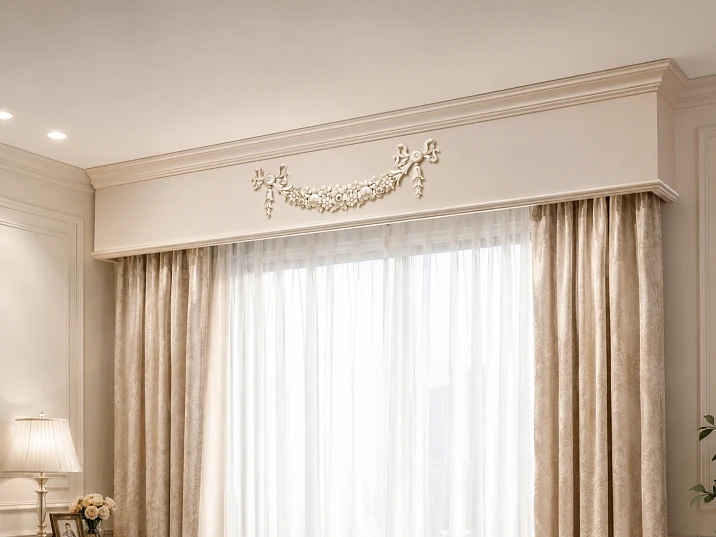
The curtain box is already made. The cornice is hidden, the fabric comes out of a neat ceiling niche, and the front panel is smooth and painted along with the interior. Technically, everything is solved correctly, but after installing the curtains, another problem becomes noticeable: the long smooth strip above the window looks too empty.
Covering all two or three meters with an ornament is not necessary. If the interior needs one distinct focal point, you can consider a different principle: instead of continuing the decor along the entire box, place a single horizontal carved overlay NPU-043 on its front panel.
For this scenario, the NPU-043 variant sized 500 × 139 × 20 mm is especially interesting. The current STAVROS product card presents two size options: 424 × 130 × 20 mm for 4,980 ₽ and 500 × 139 × 20 mm for 6,220 ₽. The material of both is polyurethane. The product drawing separately confirms the orientation of the dimensions: A is the horizontal dimension, B is the vertical, and C is the depth. For the larger variant, these are 500, 139, and 20 mm respectively.
This is important because for a curtain box, you cannot choose an overlay based only on its length. First, you need to understand whether the 139-millimeter vertical dimension fits on the front panel, then check the 20-millimeter depth, and only after that assess whether 500 mm is enough for a composition 1.8, 2.4, or 3 meters long.
NPU-043 remains a decorative overlay. It is not a curtain rod, does not hold a profile, and does not replace a hidden niche structure. This article discusses a specific interior technique: using the overlay on a blank decorative front surface of an existing curtain box.
What is NPU-043 and why the 500 mm size is interesting for the box
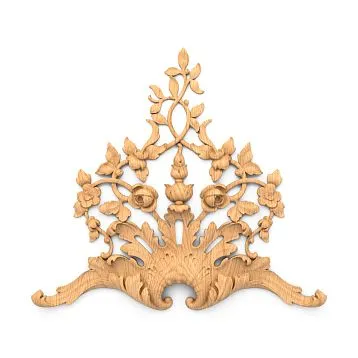
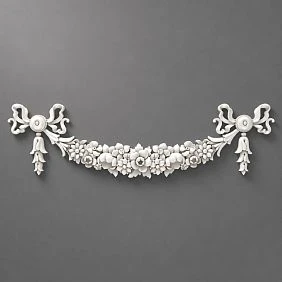
NPU-043 has an elongated horizontal composition. In the center there is a rich floral ornament, and at the edges the pattern rises higher and forms a symmetrical finish. Therefore, the piece is perceived not as a short fragment of a continuous molding, but as an independent composition with a pronounced central axis.
This is what makes it interesting for a long flat panel.
If you use linear carved trim, another task arises: you need to determine the total length, think through joints, the beginning and end of the ornament, and sometimes adjust the repeat. With a single NPU-043, the logic is simpler: find the right place for a single decorative accent and make sure there is enough free surface around it.
The card presents two options:
| Option NPU-043 | Horizontal dimension A | Vertical dimension B | Depth C | Price at the time of preparation |
|---|---|---|---|---|
| Compact | 424 мм | 130 мм | 20 мм | 4 980 ₽ |
| Large | 500 мм | 139 мм | 20 мм | 6 220 ₽ |
For the front panel of a long curtain box, the 500 mm option is more interesting primarily due to its scale. It is 76 mm wider than the compact version, while the height difference is only 9 mm.
This is an important difference. A buyer who lacks horizontal expressiveness gains noticeably more from switching from 424 to 500 mm than a buyer trying to solve a height shortage.
For example, if the front panel has a height of 180 mm:
-
for the NPU-043 with a height of 139 mm, 41 mm of total free space remains;
-
for the version with a height of 130 mm — 50 mm.
The difference in the top and bottom margins will be only 4.5 mm on each side. Therefore, switching to the smaller NPU-043 hardly saves a very low box. However, on a long panel, reducing the horizontal size from 500 to 424 mm is already more noticeable.
This is a good example of why a product should not be chosen based on a single number in the listing.




First, measure the height of the front panel, not the length of the entire box
With a box length of 2.4 meters, the eye almost automatically catches the numbers "2400 mm" and "500 mm". It seems that the main question is whether the overlay is too short relative to the entire structure.
But in practice, the first constraint is not the length, but the height of the surface on which the decor must fit.
For the large NPU-043, the vertical dimension B is 139 mm.
If the overlay is centered by height, the geometric field above and below can be preliminarily estimated by the formula:
(front panel height − 139 mm) / 2
We get:
| Front panel height | Free after placing NPU-043 | Theoretical field above | Theoretical field below |
|---|---|---|---|
| 160 мм | 21 мм | 10.5 mm | 10.5 mm |
| 180 мм | 41 мм | 20.5 mm | 20.5 mm |
| 200 мм | 61 мм | 30.5 mm | 30.5 mm |
| 220 мм | 81 мм | 40.5 mm | 40.5 mm |
| 250 мм | 111 мм | 55.5 mm | 55.5 mm |
| 300 мм | 161 мм | 80.5 mm | 80.5 mm |
This is not a table with a universal answer of "can/cannot." It shows the geometric clearance.
With a 160 mm panel, the element physically fits within the dimensions, but the air gap around it becomes very small. You need to pay especially close attention to the panel's shape, the proximity of the top and bottom edges, and the overall scale of the interior.
At 180 mm, there remains 20.5 mm at the top and bottom. This option is already easier to visualize, but the ornament still occupies most of the height.
At 220–250 mm, much more free surface appears around it, and the overlay is perceived more strongly as a separate decorative composition.
Our factory also produces:
Why you cannot rely only on the extreme points of the ornament
NPU-043 is not a solid rectangle of 500 × 139 mm. It is a shaped composition with voids and varying heights in different sections. The size 500 × 139 mm describes its overall dimensions.
Therefore, a paper rectangle of 500 × 139 mm slightly exaggerates the visually occupied area, but for a preliminary check it is useful precisely for its strictness: if even the bounding rectangle looks cramped on the box, the actual product also requires careful fitting.
And conversely, a large empty field around a rectangular template means that there is geometric margin, but it does not yet prove that a specific ornament will be visually large enough.
Geometry and visual perception are two different checks.
Get Consultation
What happens on a box with a length of 1.8, 2.4, and 3 meters
After checking the height, you can move on to the horizontal.
Since on drawing A it indeed corresponds to the horizontal dimension, for the selected NPU-043 you can use the confirmed 500 mm in calculating the side margins.
If the overlay is placed strictly in the center of the panel, the margin on each side is calculated as follows:
(length of the front panel − 500 mm) / 2
Instead of several identical calculations, it is more convenient to look at the range at once:
| Length of the front panel | Width of NPU-043 | Free on both sides together | Left field | Right field | Overlay share of panel length |
|---|---|---|---|---|---|
| 1 800 mm | 500 мм | 1 300 mm | 650 мм | 650 мм | 27,8% |
| 2,000 mm | 500 мм | 1 500 mm | 750 мм | 750 мм | 25% |
| 2,400 mm | 500 мм | 1 900 mm | 950 мм | 950 мм | 20,8% |
| 2 600 mm | 500 мм | 2 100 mm | 1 050 mm | 1 050 mm | 19,2% |
| 3,000 mm | 500 мм | 2,500 mm | 1 250 mm | 1 250 mm | 16,7% |
On a short box of 1.8 m, one NPU-043 takes up more than a quarter of the length. Here it works quite confidently as the main decorative object.
At 2.4 m around it, almost a meter of smooth surface appears on each side. The effect changes: the ornament no longer tries to fill the box, but becomes a central accent on a long, calm background.
On a three-meter panel, one detail takes up only a sixth of the total length. This does not mean it is automatically too small. But here it is especially important to understand the artistic task. If a concise single center is needed, such a scale can be justified. If the decor is expected to fill a significant part of the box, one detail may no longer be enough.
That is why the question "is NPU-043 suitable for a 3-meter box?" cannot be answered in one word.
The right question is different:
Do you want to decorate the entire length or just mark the compositional center?
For the first task, it makes more sense to compare linear footage or a system of several elements. For the second, a single NPU-043 retains its meaning.
Do not confuse the center of the box with the center of the composition
The simplest layout looks like this:
-
measure the length of the panel;
-
divide it in half;
-
draw a vertical central axis;
-
align this axis with the center of the overlay.
In a symmetrical window area, this is often sufficient.
But a real interior can be more complex. The center of the face panel, the center of the window opening, the center of the curtains, and the visual center of the wall sometimes do not coincide.
For example, the box may run from wall to wall, while the window occupies only part of that length. Or the face panel may cover not one opening, but a common curtain niche for two windows. In such a situation, mechanically dividing the entire panel in half does not yet guarantee a correct composition.
Before marking, determine what exactly the decorative center should relate to.
| Situation | Which axis is usually more important for checking |
|---|---|
| The box is located only above one symmetrical window | Center of the box and window opening |
| The niche runs from wall to wall, the window is in the center | Center of the wall and window |
| The box is longer than the window unit itself | Center of the curtain composition |
| Two identical windows are united by a common niche | Common axis of the entire window group |
| Next to the window there is a large wardrobe, portal, or other visually heavy architecture | Need to check the entire wall, not just the geometry of the box |
There is a useful practical trick: after drawing the axis, take a photo of the wall strictly from the front. In the photo, asymmetry is often more visible than while working under the ceiling.
If the geometric center of the panel and the visual center of the window composition diverge, do not immediately glue the overlay. First, compare both positions with a template.
Make a template 500 × 139 mm before purchasing
For such a product, a template provides more information than trying to estimate the size from a photo on a screen.
The simplest option is to cut out a rectangle of 500 × 139 mm from paper, cardboard, or another lightweight material and temporarily attach it to the intended location.
The template does not show the ornament, but it answers several questions at once:
-
is the overlay not too small relative to the length of the box;
-
is there enough height for it;
-
how wide will the empty side margins remain;
-
whether it is worth lowering or raising the decorative center;
-
whether a large detail is needed on this panel at all.
Check the template not only up close
A curtain box is almost never viewed from a distance of 30–50 cm. It is above eye level, and the composition is perceived together with the window, curtains, and a significant part of the wall.
Therefore, first look at the template from the window, then step back to where the room is most often perceived as a whole: to the door, sofa, or opposite wall.
It is useful to take three photos:
-
a general view of the entire wall;
-
the window with curtains and the box;
-
a closer shot of the decor itself.
If in the general view the 500-millimeter template almost disappears, the problem is not solved by moving a few centimeters. The issue of scale needs to be addressed: either consciously leave one small accent or move to a different composition.
If the template starts to draw the eye to itself and compete with the fabric, perhaps a smooth panel was better or a smaller 424 mm version is needed.
The rectangular template is only the first test
It has a limitation: the real NPU-043 has an openwork figured contour, so it will look lighter than a solid sheet of the same size.
The product image shows an elongated floral composition with gaps and higher edge zones.
Therefore, it is better to make the final decision based on more than one rectangle. After checking the dimensions, you can display a photo of the product at the required scale, attach a printout, or create a simple outline mockup.
The goal is not to create a perfect copy. You need to see the ratio of 500 mm of decor to the actual box, not to the phone screen.
A paper template does not check the most important third dimension
For NPU-043, dimension C is 20 mm. In the technical image, C is shown as the overall depth of the product.
On the wall, such depth is usually perceived differently than on the front panel of a curtain niche. Here, in front of the decor or directly behind its lower edge, curtains may move, and there may be a profile, a technical gap, lighting, or a removable part of the box.
Therefore, a single frontal template is not enough.
To check the depth, you can make a simple mockup about 20 mm thick and place it at the point where the decor is intended. This will allow you to see how far the element will protrude forward relative to the plane of the box.
Do not assign a universal "safe gap" in millimeters without checking the specific structure. Different systems of cornices, profiles, and boxes are arranged differently.
What is needed is not an abstract standard, but answers to specific questions:
-
which part moves next to the overlay;
-
how close the fabric runs to the front panel;
-
whether this part of the box opens;
-
whether the panel will need to be removed for maintenance;
-
whether a light line is nearby;
-
whether the decorative relief will intrude into the working space of another element.
If any of these questions cannot be answered, it is better to postpone the purchase until the structure is inspected.
Where exactly the overlay should be positioned in height
It is not necessary to automatically place the NPU-043 exactly in the middle of the panel height.
Mathematical centering is a good starting option, but the interior is perceived not by a ruler.
The position is influenced by:
-
bottom edge of the box;
-
ceiling line;
-
upper part of the curtains;
-
pattern of the overlay itself;
-
room height;
-
adjacent ceiling molding.
NPU-043 has a complex silhouette: the outer motifs rise above the central floral part, and the lower contour is also uneven in height.
Therefore, after geometric centering, it makes sense to do two more test fittings — slightly higher and slightly lower. There is no need to pre-assign an offset of 10, 20, or 30 mm as a rule. This is determined directly on the panel.
The main thing is to maintain a sufficient actual gap to its borders and not try to fix a bad proportion with excessive offset.
If with a panel height of 160–180 mm the overlay has to be almost pressed against one edge for the composition to "work," perhaps the problem is not in the position, but in the size of the decorative field itself.
Why one overlay can look more convincing than decor along the entire length
A long decorative strip and a single central element solve different tasks.
Linear decor emphasizes the length of the box. The eye reads the horizontal line.
A single NPU-043, on the contrary, breaks this length with one event. The empty plane on the left and right becomes part of the composition.
This is especially useful when the room already has many lines:
-
ceiling cornice;
-
top of the cabinet;
-
horizontal molding;
-
edge of the wall panel;
-
long cabinet;
-
the curtain box line itself.
Adding another continuous decorative strip is not always necessary. Sometimes the interior benefits more from a single center.
However, "one element" does not automatically mean "better." The choice depends on the task.
| Solution | What emphasizes | When to consider | Main risk |
|---|---|---|---|
| Smooth box | Clean architecture and fabric | In a calm modern interior | The panel may look too technical |
| One NPU-043 | Center and symmetry | When one decorative accent is needed | On a very long panel, it may appear visually small |
| Several separate details | Rhythm and a more complex composition | When one overlay is lost | Easy to overload the top of the window |
| Carved molding along the length | Horizontal of the box | When a continuous ornament is needed | Need to think through the length, joints, and endings |
The point of the article is that there is no mandatory rule that a long box must be decorated along its entire length.
When one NPU-043 is really enough
A single overlay is especially logical if several conditions are met simultaneously.
First, the window has a readable central axis. Then symmetrical decor does not look like a randomly shifted fragment.
Second, the front panel is tall enough. This is not only about the physical placement of 139 mm, but also about the free surface around it.
Third, the interior does not require a continuous ornament. The overlay should be perceived precisely as a medallion-like horizontal accent.
Fourth, the viewing distance allows the relief to be read. On a very high or extremely long wall, 500 mm may appear more modest than in the product photo.
Fifth, there is already enough architecture around. If the window is complemented by curtains, a ceiling cornice, moldings, or symmetrical furniture, one accent can complete the composition without further complication.
The main criterion here is not the amount of decor, but its function.
If after installing one piece it becomes clear where the center of the window area is and why this plane is decorative at all, the task is solved.
When it is better to choose carved trim along the entire length
There is also the opposite situation.
Let's imagine a long box that itself is part of the classical architecture of the room: it continues through several windows, is connected to tall wall panels, and should look like a full-fledged frieze.
Then a single 500-millimeter overlay may appear as a separate small object on a huge surface.
In such a scenario, it is more logical to look not at one central detail, but at the system.
Before choosing the molding, you need to determine:
-
the length of the decorated area;
-
where joints are acceptable;
-
how the ornament ends at the edges;
-
whether symmetry relative to the center is needed;
-
whether the pattern should continue onto adjacent surfaces.
If your task requires a long profile specifically, you can separately look at buy polyurethane moldings.
This is a different purchasing scenario. You should not turn NPU-043 into a replacement for molding just because both products relate to decorative finishing.
When it is better to leave the box smooth
A product should have not only a reason to buy, but also a clear reason to refuse the purchase.
NPU-043 is not needed if the smooth front panel already fulfills its role and additional ornamentation disrupts the composition.
This is more often noticeable in a few cases.
The fabric itself is the main decor.
If the curtains have an active texture, a large pattern, a complex lambrequin, or noticeable trim, an additional relief composition directly above them can compete with the textiles.
The upper part of the room is already saturated.
A ceiling cornice, rosette, complex lighting, moldings, and other decorative elements can create a sufficiently expressive upper tier even without an overlay.
The box is intentionally designed as an invisible technical line.
Sometimes the point of a hidden cornice is precisely to remove the structure from view as much as possible. In this case, turning it into a separate decorative object contradicts the original task.
The panel is too low.
The phrase "139 mm fits into 150 mm" is mathematically correct, but in practice only 11 mm remains around the product, that is, 5.5 mm on each side with precise centering. For large decorative shapes, this is a completely different situation than a panel with a height of 220 or 250 mm.
Buying only because the dimensions formally fit is a poor criterion.
424 or 500 mm: when the smaller NPU-043 turns out to be more reasonable
The main focus of this article remains the NPU-043 with dimensions of 500 × 139 × 20 mm, but ignoring the second option would be wrong. The product also has a variant of 424 × 130 × 20 mm.
The difference:
-
horizontally — 76 mm;
-
vertically — 9 mm;
-
in depth — none;
-
in price at the time of preparing the material — 1,240 RUB.
What follows from this?
If the problem is height, the gain is small
With a panel height of 180 mm:
-
for the 139 mm variant, 20.5 mm remains at the top and bottom;
-
for the 130 mm variant, 25 mm remains.
That gives only 4.5 mm of extra margin on each side.
If the larger version seems too tall, the smaller one still needs to be tried on. It doesn't turn a low panel into a spacious one.
If the issue is horizontal scale, the difference is more noticeable
On a 2400 mm box:
-
with NPU-043 500 mm, 950 mm remains on each side;
-
with NPU-043 424 mm, 988 mm remains.
Each side margin increases by 38 mm.
The number seems small, but the overlay itself becomes 15.2% shorter relative to the 500-millimeter variant. At a large distance, this may already be noticeable.
Therefore, it is reasonable to consider 424 mm not as "the same part for a narrow panel," but primarily as a more compact visual center.
How to understand whether one NPU-043 is too small on a three-meter box
On a 3000 mm panel, the overlay occupies 16.7% of the total length. This is already a fairly local accent.
But the percentage itself does not provide an artistic verdict.
Three more factors need to be checked.
Panel height
On a tall front surface, the decor may seem smaller, even if the length of the box does not change.
Viewing distance
The farther the main viewing point is, the calmer the perception of small relief details becomes, and the greater the role of the overall silhouette.
Other wall elements
If a wide window opening with a pair of symmetrical curtains is located under the overlay, the compositional center is supported by the fabric. If the box runs through almost the entire empty wall, one small detail may remain isolated.
Therefore, for a three-meter box, a photo with a full-size template is especially useful.
Do not try to compensate for insufficient scale with random small overlays on the edges. If one NPU-043 is objectively not enough, it is better to immediately compare finished alternatives: one center, a full composition of several items, or linear decor.
Depth 20 mm: check the curtain trajectory before installation
Frontally, NPU-043 can fit perfectly into the panel, but that is not enough.
Size C is 20 mm.
After installation, the product occupies space in front of the front plane of the box. This is where a practical check arises that is easy to neglect when buying from a photo.
Close and open the curtains completely. Look at where the fabric actually passes relative to the panel.
Pay special attention to checking:
-
fabric gathering when curtains are fully open;
-
movement of the upper part of the panel;
-
runners and protruding elements of the system;
-
area near the center where NPU-043 is intended;
-
position of the fabric with slight deviation from the draft.
Do not assume that "20 mm is not much." In one design, there may be a large clearance between the decorative panel and the curtains, in another — almost none.
Also check what is inside the box
If the front panel is fixed, the task is simpler.
If it is removable, hinged, or opens access to the cornice, the overlay may affect ease of maintenance.
Before installation, you need to understand:
-
whether the entire panel is removable as a whole;
-
whether its edge runs near the ceiling;
-
where does it shift during dismantling;
-
can it be removed together with the overlay;
-
will the decor cover the fasteners or the technological seam.
This check is more important than the decorative effect. A beautiful element should not turn maintenance of a hidden cornice into disassembling the finish.
If the box has backlighting
Backlighting changes the perception of relief more than it seems.
Side or top light creates shadows between the floral elements of NPU-043 and makes the surface visually deeper. But the article cannot automatically recommend installing the overlay next to any LED system: the location of the light source, profile, diffuser, and wiring is unique for each box.
Two things are checked.
The first is physical compatibility. The decor must not block access to the light profile, diffuser, or removable part of the structure.
The second is the light pattern. A source that is too close can create sharp local shadows, making the lower part of the ornament look heavier than expected.
This can be easily tested before gluing: temporarily fix the layout at the desired point and turn on all standard lighting scenarios.
It is advisable to evaluate the daytime view and the evening view separately.
NPU-043 should be a decoration of the box, not an attempt to pass it off as a cornice.
The search phrase "decoration for curtain rod" is clear in meaning: a person is looking for a decoration for the upper part of the window area.
But here it is better to be precise with terminology.
NPU-043 is not a cornice for moving curtains, nor a part on which fabric is hung. In the solution under consideration, it is installed on a decorative front panel that visually hides or decorates the area of the hidden cornice.
This distinction is also important when talking to a designer or installer.
Instead of the phrase:
"glue the overlay onto the cornice"
it is better to say:
Install NPU-043 in the center of the fixed face panel of the curtain box.
This makes it immediately clear which surface the work relates to and what exactly needs to be checked before installation.
How to combine the NPU-043 relief with curtains
The overlay has an active decorative pattern. Therefore, it is better to evaluate it not separately, but together with the fabric.
Solid-color curtains
On a calm fabric, the relief above the window is more noticeable. Here, NPU-043 can become the main small decorative center of the entire window area.
Curtains with a pronounced pattern
The more complex the textile, the more carefully you need to add a second ornament directly above it.
Compare not only the color, but also the density of the pattern. If both the fabric and the overlay require attention at the same time, the composition may become overloaded.
Two symmetrical drapes
This is a natural environment for the central decor: vertical masses of fabric already create two sides of the composition, and NPU-043 can mark the upper axis between them.
Asymmetric curtain
If the fabric is constantly gathered on only one side, a mathematically centered overlay is sometimes perceived as less natural. In such an interior, the template is especially important: evaluate the wall in its usual state, not only when the curtains are fully closed.
Do you need to support NPU-043 with additional overlays
Not necessarily.
One of the main mistakes of such a project is to first choose a single NPU-043, and then start "adding balance":
another small element on the right and left, two more corners, another strip at the bottom.
As a result, the original idea of a single accent disappears.
Additional decor makes sense only if it solves a separate compositional task.
For example, a large wall may require not one center, but a full rhythm. Then it is better to design the entire system at once, rather than gradually filling the emptiness with random items.
If, after trying one NPU-043, the box already looks complete, the free space around it is not a drawback. It helps to read the ornament itself.
Paint to match the box color or highlight with contrast
There are two fundamentally different results here.
NPU-043 in the color of the front panel
This is the most subdued approach.
The form is read through its own relief and shadows, not through a different color. Visually, the overlay becomes more a part of the box's architecture.
This approach is especially useful if the interior already has enough active materials and the decor should work quietly.
Contrast decor
Contrast makes the 500-millimeter piece more noticeable and visually increases its role.
But along with this, the cost of any mistake in scale and centering increases. What read softly in monochrome painting can become the main object of the wall with contrast.
Therefore, first you need to approve the composition itself, and only then decide on the color issue.
Do not choose a finishing method without considering the actual base
The front panel may have different coatings. The priming, adhesive, and final painting system must be compatible with both the polyurethane product and the specific surface of the box.
In the NPU-043 card, the material is confirmed as polyurethane.
But this is not enough to choose a mounting system without knowing the base.
If the box is already painted, a test on an inconspicuous area or a separate sample is especially useful: it allows checking adhesion and the appearance of the finish before final installation of the decor.
It is better to start installation not with glue, but with control marking.
After the size and position are approved, it is worth transferring the composition to the panel as simply as possible.
1. Determine the selected axis.
Not automatically the center of the panel, but exactly the axis you approved after fitting.
2. Mark the middle of the NPU-043 itself.
For symmetrical placement, the center of the part must coincide with the vertical axis of the composition.
3. Do a dry fit
Place the item without glue.
Check:
-
top gap;
-
bottom gap;
-
position relative to curtains;
-
distance to adjacent decor;
-
view from the opposite side of the room.
4. Check the horizontal level
The shaped overlay has no long continuous straight edge, so relying only on the lower silhouette is inconvenient. It's better to transfer control points in advance according to the drawing or dimensions.
5. Only after this choose the mounting compound
It must match the polyurethane decor and the actual panel base.
Don't turn gluing into an experiment on an already finished surface.
The panel surface must be ready for decor
Even perfect marking won't compensate for a poor base.
Check for:
-
dust;
-
peeling coating;
-
noticeable curvature;
-
protruding fasteners;
-
joints that may move;
-
areas that open during maintenance.
Pay special attention to flatness. With complex relief, the eye is usually focused on the front side, so the gap between the back of the product and the curved panel is easy to notice only at the last moment.
If the surface is problematic, first solve the base, then the decor.
Why it's worth trying on the overlay with curtains already installed
When the box is made before the textiles, it is often evaluated as a separate structure.
After the curtains appear, the proportions change.
The fabric adds:
-
vertical lines;
-
color;
-
volume;
-
shadows;
-
visual weight on both sides of the window.
An overlay that seemed large on an empty wall may turn out to be quite calm after installing heavy drapes.
The reverse situation is also possible: after the appearance of complex textiles, additional relief becomes unnecessary.
Therefore, if the renovation allows choosing the order, it is useful to do the final decorative fitting when the main volumes of the window area are already clear.
If the curtains are not yet made, use at least a fabric sample and a visualization of their future volume.
How to avoid making the box visually heavier
The higher the decorative element is placed, the more important its relation to the lower edge of the box.
If a large overlay takes up almost the entire height of the panel, the front part may seem more massive.
There are several ways to avoid this without replacing the product:
-
leave enough empty surface around;
-
use painting in the color of the box;
-
do not add a second decorative horizontal line directly under NPU-043;
-
do not duplicate the same motif with small details in the corners;
-
evaluate the composition from a normal viewing point.
But if the panel itself is too low, these techniques do not replace the correct size.
Geometric lack of space cannot be corrected with color.
One element and the cost question
For the article scenario, one large NPU-043 is required.
At the time of verification, the 500 × 139 × 20 mm option was listed at 6,220 ₽ per piece. The second size option, 424 × 130 × 20 mm, costs 4,980 ₽.
This allows you to estimate in advance the cost of just the decorative part.
But you should not compare it with the “linear molding along the entire length” solution with the single phrase “it’s cheaper.” For a fair comparison, you need to know:
-
the specific selected linear molding;
-
its price;
-
required quantity;
-
remainder after cutting;
-
number of connections;
-
cost of installation and finishing.
Without this data, the claim of savings would be an assumption.
The advantage of one overlay here is different and quite measurable: for the composition in question, one independent decorative element is needed, not covering the entire length of the box.
The STAVROS card also states that products are shipped from a single piece, so the scenario of purchasing a single NPU-043 does not require assembling a set just to meet the minimum batch.
ГStep 6. Add depth check
Simulate a 20-millimeter dimension in front of the panel plane.
Open and close the curtains.
Step 7. Check maintenance
Make sure the panel does not require regular removal or that the installed overlay does not interfere with dismantling.
Step 8. Compare alternatives
Place four solutions side by side:
- smooth box;
- one NPU-043;
- several separate elements;
- continuous linear decor.
Step 9. Choose a color
First size and location, then finish.
Step 10. Only now place your order
If all checks are passed, you can order NPU-043 500 × 139 × 20 mm.
Errors that are especially noticeable on a long front panel
Error 1. Choosing decor by the length of the box and forgetting about the height
A 2.4-meter box seems large, so a 500-millimeter overlay is perceived as compact.
But if the front panel itself has a height of 150–160 mm, it is the vertical dimension that becomes the constraint.
How to avoid: first write down not the length, but a pair of dimensions — length × height.
Error 2. Centering relative to the edge of the structure that the viewer does not even notice
The technical box may be longer than the window or extend toward the wall.
Consequence: a perfectly measured overlay visually appears shifted.
How to avoid: before marking, determine the main axis of the window composition.
Error 3. Check only the frontal dimension
A rectangle of 500 × 139 mm on paper fits — the purchase seems safe.
But the actual part has a dimension of C 20 mm.
How to avoid: separately simulate the depth and check the movement of the curtains.
Error 4. Install decor on a serviced part
After this, access to the cornice may require working with an already finished decorative panel.
How to avoid: find out in advance which parts of the box are removable and where the technical connections are located.
Error 5. Consider an empty side field a drawback
After installing one overlay, large smooth areas remain, and the desire to fill them appears.
Consequence: the idea of one accent turns into a random set of details.
How to avoid: first evaluate the finished composition from a distance, not from under the ceiling.
Mistake 6. Using a contrasting color before checking the scale
Contrast sharply enhances the role of decor.
Consequence: an element that looked delicate in the panel color becomes disproportionately active.
How to avoid: approve the size and position on a neutral template, then choose the finish.
Mistake 7. Buying based on a product photo without scale
A close-up shot of an item says almost nothing about how 500 mm will look on a box 2.5–3 m long.
How to avoid: only a full-size fitting.
Quick decision table
| Check | What to consider a normal result | When you need to stop |
| Height | Around the 139 mm dimension, there remains a meaningful free field | The part barely physically fits |
| Length | 500 mm reads as a deliberate center | The overlay disappears on the common wall |
| Center | Coincides with the chosen composition axis | The geometric center appears visually shifted |
| Depth | The 20-millimeter dimension does not interfere with anything | There is a conflict with curtains or maintenance |
| Color | Supports the interior | The contrast makes the top of the window excessively heavy |
| Quantity | One element is enough for the idea | The emptiness has to be saved by random additional details |
| Installation | The surface is stable and accessible | The overlay covers the removable unit |
| Alternative | One NPU-043 better solves a specific task | Molding, a smaller overlay, or a smooth box look more convincing |
What NPU-043 ultimately gives on the curtain box
The strong point of this solution is not that a 500-millimeter overlay can "cover" two or three meters of a smooth panel. It shouldn't do that.
It has a different function: to create a single decorative center on a long horizontal plane.
With a 1800 mm box, 650 mm remains on each side around the NPU-043. With 2400 mm, it's 950 mm on each side. With 3000 mm, it's 1250 mm on each side. These empty fields are part of the composition, not automatically a flaw.
The vertical dimension requires a separate check. With a panel height of 180 mm, only 20.5 mm remains above and below the 139 mm dimension, whereas on a 250 mm panel, there is already 55.5 mm on each side.
And finally, one must not forget the third dimension: the total depth of the product per the drawing is 20 mm. This is why a proper fitting consists of two mockups: a frontal one of 500 × 139 mm and a depth check.
If after these tests one piece truly assembles the window composition, there is no need to turn the entire box into a continuous ornament.
And if the test shows that 500 mm is too little, 139 mm is too much in height, or the relief interferes with the structure, the right decision is not to convince yourself to buy it, but to choose a different option.
FAQ
Can you buy just one NPU-043 instead of a set?
Yes. The information on the STAVROS product page indicates that items can be shipped from a single piece. For a scenario with a single central accent, this is fundamental: you don't need to buy several identical elements just because of a minimum quantity.
Do you need to order two identical overlays for a very long box?
Not necessarily. Two pieces create a different composition — a rhythmic one, not a central one. If you want to use two NPU-043s, first define two independent axes, for example for two windows. Simply spreading two overlays across the edges of one empty panel to fill space is not the same as using one meaningful center.
What to do if the cornice is longer than three meters?
First, check the 500-millimeter template against the overall photo of the wall. The longer the surface, the smaller the share of a single NPU-043. But there is no strict length after which a single overlay is "prohibited": it all depends on whether you need a small central accent or a fully filled decorative band.
Can NPU-043 be used if curtains are already installed?
This even makes it easier to assess proportions, because the real volume and color of the fabric are visible. However, before installation, it is necessary to check access to the panel and ensure that working near finished textiles does not pose a risk of damaging them. If necessary, the fabric should be protected or removed during installation.
Is it mandatory to add other decorative elements on the sides?
No. For the concept of this article, free side sections are needed deliberately. Additional elements should only be added when a different, more complex composition is being designed.
Which version of NPU-043 is better for a small room — 424 or 500 mm?
The room area alone is not sufficient for making a choice. More important are the length and height of the specific face panel, the viewing distance, and the size of the window composition. Full-size templates of 424 × 130 and 500 × 139 mm will provide a much more useful answer than an abstract rule based on square meters.
Can I rely on the price of 6,220 ₽ when preparing an estimate?
This is the price of the large version 500 × 139 × 20 mm, as indicated in the product card at the time of material review. Before placing the final order, it is better to check the price again directly in the product card, since commercial terms may change.
Will the NPU-043 fit a panel exactly 139 mm high?
In terms of dimensions, the product height is also 139 mm, meaning no free space will remain by calculation. For the considered idea of a separate decorative accent, this option cannot be automatically considered suitable just because of the mathematical size match. Real mounting gaps and a visual trial are needed.
What should be checked if the box runs the full width of the wall, but the window is narrower?
Do not automatically align the overlay to the center of the entire box. Compare the center of the wall, window, and curtain composition. Make two template positions and photograph the entire wall frontally. Choose the axis that organizes the visible architecture, not the hidden technical structure.
Can the overlay interfere with the lighting?
It can, if it is in the area of the light profile, diffuser, wiring, or their maintenance. The mere presence of lighting does not prohibit the use of decor. A check of the specific box cross-section and a trial with a 20 mm deep mock-up is required.
Can the overlay be glued first, and then decide whether a contrasting color is needed?
The position itself should be approved before gluing. Color can indeed be considered as a separate stage, but painting should not be used as a way to fix an erroneous scale or offset. If 500 × 139 mm do not work in the composition, the finish coating will not change the geometry.
Is NPU-043 a decoration of the cornice itself?
No. In the described scenario, it refers to a decorative front panel of the curtain box. NPU-043 does not replace the profile, guide, or any other functional part along which curtains move. It is useful to maintain this terminological distinction in the installer's brief as well.
Can NPU-043 be installed not above the window, but on another decorative panel?
The product card classifies NPU-043 as polyurethane decor, and the installation on a solid curtain box offered here is a separate design scenario that needs to be checked against the specific surface. If the task has changed, the base, orientation, size, load on the composition, and mounting method are re-evaluated.
When is it best to completely abandon NPU-043?
If after a full-size trial fitting you simultaneously have to reduce the visual role of the element, move it from the logical center, accept insufficient height, or risk access to the cornice, the problem is no longer solved with "slightly different markings." In such a case, it is wiser to leave the box smooth or choose a different type of decor.
Conclusion
NPU-043, measuring 500 × 139 × 20 mm, is interesting for a curtain box specifically as one standalone horizontal carved overlay, not as an attempt to replace the entire length of the panel with ornament. The dimensions and their orientation are confirmed by the product card and technical image: 500 mm horizontally, 139 mm vertically, and 20 mm in depth. At the time of preparing the material, the price for this item is listed as 6,220 ₽.
Three checks are needed before purchasing.
The first is height. Calculate the actual free space around 139 mm.
The second is scale. Make a template of 500 × 139 mm and look at it not right by the window, but from a normal viewing point.
The third is depth. Simulate 20 mm in front of the face plane and make sure the decor does not interfere with fabric, lighting, removable parts, or maintenance of the hidden cornice.
If after these checks one NPU-043 clearly marks the center and does not require additional details "to fill the void," the idea works exactly as intended: one large carved overlay instead of decor along the entire length.
After checking the dimensions and layout, you can order NPU-043 500 × 139 × 20 mm.