Article Contents:
- Five sizes of N-034 form a family, not a set of random variants
- The ornament enlarges in three directions at once
- Proportions preserve the recognizability of the pattern
- What is subtracted from the facade size
- The free field formula helps not to forget the limitations
- The rectangle answers the question "will it fit"
- The contour answers the question "what it will look like"
- The thickness is simulated with a separate spacer
- Two sizes for a compact font
- Three sizes for furniture of different scales
- Four or five sizes for a serial project
- One N-034 over two doors
- One overlay on each door leaf
- One overlay on the central wide door
- Overlay on the upper fixed frieze
- Overlay on one wide drawer
- Must not cross the boundaries of two drawers
- Low relief is easier to incorporate into everyday furniture
- Medium relief forms a noticeable central accent
- Large relief needs space
- A side drawing is mandatory for complex furniture
- Do not mechanically align overlays with the floor
- Repeat the principle, not the millimeters
- Overlay above the handle
- Handle inside the ornament
- Two handles on a double-door cabinet
- N-034 should be deliberately placed inside or above the frame
- Frame overlap cannot be assigned from a photo
- The frame defines a visual offset
- Remove the plane map
- A radius facade is not equal to a flat one
- Beech for covering enamel
- Oak for transparent and tinted finishes
- Do not mix wood species to save on small parts
- When considering "Standard"
- When "Prestige" is convenient
- Do not mix qualities in one visible series without a reason
- What a single application provides
- Mark the purpose before furniture production
- Each row must have a photo or a drawing fragment
- The solution status must be visible
- Width check
- Height check
- Depth check
- Two elements create a rhythm of the leaves
- One large piece unites the body more strongly
- The choice depends on the architecture, not the amount of wood
- Mounting adhesive is chosen based on the pair of materials
- Adhesive does not fix uneven seating
- Additional fasteners are not assigned blindly. Patina requires a unified direction of work.
- Patina requires a unified direction of work.
- Finish before installation
- Finishing after installation
- Combined scheme
- A double-door cabinet doubles the line only when both doors are decorated.
- Paired nightstands also require two overlays.
- The reserve is not expressed as a random percentage.
- Only the external width of the body has changed.
- The handle has changed.
- The frame has changed
- The cabinet has become three-door
- A common cornice has appeared
- Product lines
- Project lines
- Example of a completed list
- Check the quantity
- Check the dimensions
- Compare the pattern and condition
- Sort by tone
- Restore labeling
- Do not transfer the size without a re-fit
- Bedroom with a tall wardrobe and two nightstands
- Living room with a sideboard, dresser, and console
- Kitchen set with many narrow doors
- Commercial interior
- Restoration of existing furniture
- Mistake 1. Same N-034 on all items
- Mistake 2. Selection based on external body width
- Mistake 3. Checking only length A
- Mistake 4. One overlay for two opening doors
- Mistake 5. Random mixing of beech and oak
- Mistake 6. Different sanding qualities
- Mistake 7. Buying glue without testing
- Mistake 8. Finishing without a reference
- Mistake 9. Lack of marking
- Error 10. Order before handle approval
- Error 11. Using all five sizes just for the sake of it
- Error 12. Waiting for a ready-made set
- Rule of two adjacent templates
- First exclude technical conflict, then evaluate beauty
- Lighting can change the perception of scale
- Facade color affects visual weight
- Viewing distance changes the rating
- Do I need to order one size of N-034 for the entire set?
- What sizes of N-034 are available?
- What size is suitable for a nightstand?
- What size should I choose for a tall cabinet?
- Can I install one N-034 on two doors?
- Do I need to use all five sizes?
- How does the free field differ from the facade width?
- Why do I need to check size C?
- Can I order beech for the nightstands and oak for the wardrobe?
- What to choose for enamel — beech or oak?
- What should I choose for tinting with a visible texture?
- What is the difference between "Standard" and "Prestige"?
- Is glue included in order N-034?
- Can I glue the overlay onto painted MDF?
- Can I drill N-034 for mounting?
- How many overlays are needed for two nightstands?
- Do I need a spare overlay?
- Can N-034 be installed after the furniture is fully assembled?
- Do I need to make templates for all five sizes?
- Can N-034 be reduced by trimming?
- How to calculate the quantity for a cabinet?
- What to check before payment?
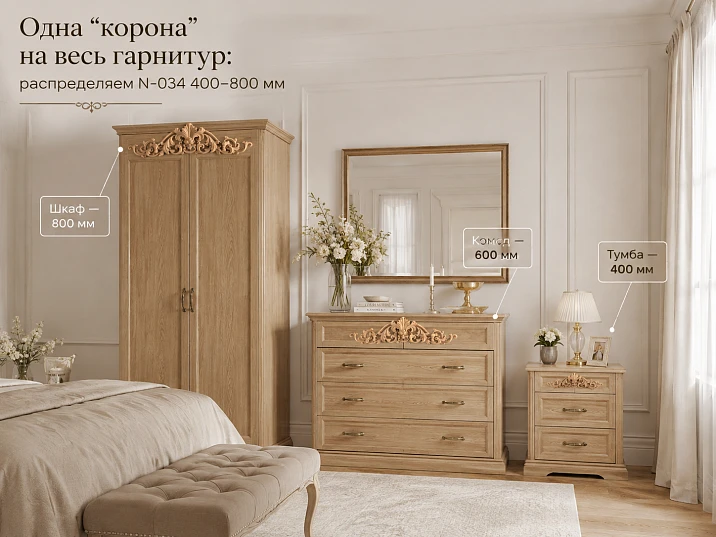
The wardrobe, dresser, two bedside tables, and console are designed as one furniture collection. They share the same color, facade profile, handles, and finishing character. To complete the composition, one carved ornament was chosen — N-034. In the photo, it looks like an expressive wooden "crown" that you want to repeat on each piece. This is where the mistake occurs: the same pattern does not require the same size.
If you install an N-034 with a length of 800 mm on a tall, wide cabinet, the overlay can support the scale of the furniture. On a small nightstand, the same option will take up almost all the free space, come close to the handle, frame, and edges of the facade, and the deep relief will start to look heavy. The reverse situation is no better: a compact N-034 with a length of 400 mm works neatly on a nightstand, but on a large double-door it can get lost and turn into a random detail.
Therefore, a buyer who has decided to buy a carved overlay N-034, needs not just one line in the cart, but a specification of the entire furniture set. In it, for each facade, the free decorative field, the location of handles, moldings, and panels, the selected overlay size, material, sanding quality, and quantity are indicated. Only this way will one ornament truly unify the furniture, rather than make each piece argue with its neighbor.
The short answer can be formulated right away: for a wardrobe, dresser, nightstand, and console, you should not automatically order the same N-034. The model is available in five proportionally scaled versions from 400 to 800 mm. They are distributed across the actual free fields of the facades using full-size templates. One pattern is preserved, and the scale changes along with the furniture.
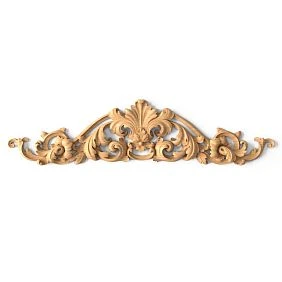
The five sizes of N-034 form a family, not a set of random options
N-034 is convenient for a furniture set precisely because the ornament is repeated in five scales. The buyer does not have to look for a similar small overlay for a nightstand and a separate large model for a wardrobe. The pattern remains recognizable, only the dimensions change.
| N-034 version | Size A × B × C, mm | Change relative to 400 mm | Preliminary role in the furniture set |
|---|---|---|---|
| Compact | 400 × 99 × 17 | Base size | Pedestals, small doors, narrow consoles |
| Small medium | 500 × 124 × 21 | Length increased by 100 mm | Dressers, consoles, medium fronts |
| Average | 600 × 149 × 25 | Length increased by 200 mm | Wide dressers, large doors |
| Large | 700 × 174 × 29 | Length increased by 300 mm | Tall cabinets, wide central panels |
| Maximum | 800 × 199 × 33 | Length twice the base | Large cabinets, sideboards, representative fronts |
The last column is not a universal instruction. A cabinet may have narrow doors, while a chest may have a wide solid front. The final decision is made based on the drawing and template, not the furniture name. The table only shows the logic of scale: the larger the free field, the larger the option that can be considered.




The ornament increases in three directions at once
When moving from 400 to 800 mm, not only the length doubles. Size B grows from 99 to 199 mm, and C from 17 to 33 mm. Therefore, the large "crown" does not resemble a thin stretched copy. It becomes taller and deeper, casts a shadow more actively, and protrudes more strongly above the facade.
This is fundamental for a furniture project. An overlay of 800 × 199 × 33 mm requires significantly more decorative field than one might assume from a single length of 800 mm. It must not only fit between the side edges but also avoid touching the molding frame, handle, adjacent door, cornice, drawer, or shelf when opened.
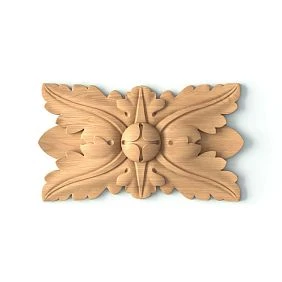
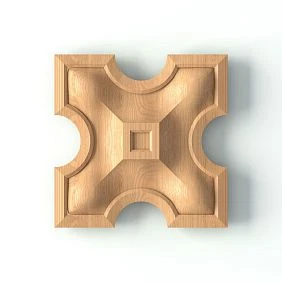
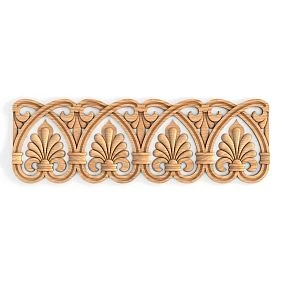
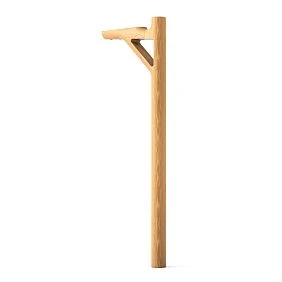
Our factory also produces:
The proportions preserve the recognizability of the pattern
From the dimension rows, it is clear that the ratio of B to A remains approximately the same — about a quarter of the length. Depth C is approximately four percent of the length. These are not installation standards, but a useful observation: five variants are indeed perceived as one ornament in different scales.
This is precisely why N-034 can connect furniture of different sizes. On the chest, the viewer recognizes the same motif seen on the cabinet, but does not feel that the large detail was forcibly reduced by free space or that the small one was lost on a huge door.
Get Consultation
The external width of the furniture says nothing about the size of the overlay
The buyer often writes down: cabinet — 1800 mm, dresser — 1400 mm, nightstand — 500 mm. Then chooses N-034 by percentage of the total width of the item. Such a calculation is too rough.
The overlay is installed not on an abstract body dimension, but on a specific surface. A cabinet 1800 mm wide may have three doors of 580 mm each, wide stiles, and a top cornice. A dresser 1400 mm may have one solid top drawer, three narrow fronts, or a framed composition with a central field of only 720 mm. A nightstand 500 mm wide may be almost entirely occupied by a handle and frame.
Therefore, for N-034, the free decorative field is measured — the area where the overlay can be placed without conflicting with the structure and other parts.
What is subtracted from the facade size
From the total width of the door or drawer, the following are excluded:
-
side frames and moldings;
-
paneled bevels;
-
handles and their bases;
-
technological gaps;
-
areas near hinges and mechanisms;
-
zones overlapped by adjacent leaves;
-
protruding locks, overlays, and decorative profiles;
-
places where the relief would hinder opening.
The same calculation is performed for height. The upper "crown" can occupy only part of the facade above the handle. If the decorative field has a width of 620 mm and a height of 145 mm, the option 600 × 149 × 25 mm already requires verification: in length it almost fits, but in height it exceeds the boundary. The problem cannot be solved with just one number, 600.
The free field formula helps not to forget the constraints
For a rectangular area, a simple scheme can be used:
Wfree = Wfacade − Lleft − Lright − Zleft − Zright,
where Wсв is the free width, Wф is the facade width, Lл and Lп are the occupied areas on the left and right, Zл and Zп are the selected visual indents.
By height:
Hсв = Hф − Tв − Tн − R − Zв − Zн,
where Hсв is the free height, Hф is the facade height, Tв and Tн are the occupied zones at the top and bottom, R is the handle zone, Zв and Zн are the free indents.
The formulas do not assign size N-034 automatically. They help to honestly determine the field within which five templates are compared.
Full-size templates solve more than an image on the screen
The product card shows the shape and dimension lines, but the monitor does not convey the real scale. An 800 mm overlay on the screen may look almost the same as 400 mm if the photos are automatically adjusted to the same frame.
Before ordering, five paper or cardboard templates are made:
-
400 × 99 mm;
-
500 × 124 mm;
-
600 × 149 mm;
-
700 × 174 mm;
-
800 × 199 mm.
The rectangle shows the external dimension. For a more accurate fitting, the outline is transferred from the actual drawing. It can be obtained by downloading the technical materials and STAVROS drawings and checking which file corresponds to the required size line.
The rectangle answers the question "will it fit"
The simplest template is needed already at the first stage. It is applied to the facade and checked:
-
does the part extend beyond the frame;
-
does air remain around the ornament;
-
does it not intersect with the handle;
-
does it not overlap the door joint;
-
does it not approach the edge of the drawer;
-
is the central axis preserved.
If the rectangle does not fit, an exact carved contour will not fix the situation. You need to take a smaller size or change the composition.
The contour answers the question "what it will look like"
The carved overlay does not fill the entire rectangle evenly. It has peaks, curls, gaps, and areas of varying density. The contour template shows where the facade remains visible and how the ornament interacts with the frame.
Two overlays of the same total length can be perceived differently due to the density of the pattern. In the task under consideration, variants of the same article are compared, so the character of the ornament is preserved. However, an exact fitting is still needed: the larger variant has more powerful plasticity and depth.
The thickness is simulated with a separate spacer
The paper shows only the front. To check C = 17–33 mm, add a strip of cardboard or foam of the required thickness to the template and look from the side. This is especially useful near the handle, protruding frame, adjacent door, and dresser top.
In a frontal photo, 33 mm may seem insignificant. In a side view, it is already a voluminous detail. If the handle is directly under the overlay, fingers may hit the relief. If two doors open toward each other, protruding elements must not collide.
One pattern does not mean you need to use all five sizes
The 400–800 mm ruler gives a choice but does not oblige you to distribute every size row across the set. Sometimes three scales are enough: 400 mm for cabinets, 600 mm for a dresser, and 800 mm for a wardrobe. The console can repeat 600 mm or remain without an overlay if its front is too narrow.
The main criterion is not variety for variety's sake, but a clear hierarchy.
Two sizes for a compact set
If the collection consists of a wardrobe, a dresser, and two cabinets without very wide fronts, you can use:
-
500 or 600 mm on the wardrobe and dresser;
-
400 mm on the cabinets.
This set economically supports the overall motif. The difference is noticeable but does not turn each item into a separate decorative theme.
Three sizes for furniture of different scales
For a large wardrobe, wide dresser, console, and nightstands, it makes sense to check:
-
700 or 800 mm on the main wardrobe;
-
500 or 600 mm on the dresser;
-
400 or 500 mm on nightstands and the console.
Here, a stepped system emerges. The largest overlay marks the main item, the medium one ties the composition together, and the compact one repeats the motif on small furniture.
Four or five sizes for a series project
All five variations may be needed by furniture manufacturing that produces a collection with a large number of cabinets: display case, sideboard, wardrobe, bed, dresser, console, nightstands, wall cabinets. But even in a series, each size must have a fixed role. Otherwise, the order becomes more complicated, and the visual logic remains unclear.
Tall wardrobe: one large accent or two separate overlays
A cabinet is the most complex piece of the set, because its external dimensions often do not match the layout of the facades. You need to decide whether the doors are perceived as a single plane or as independent panels.
One N-034 over two doors
A large overlay of 700 or 800 mm can be considered a common "crown" if it is installed on a fixed upper frieze, cornice board, or another solid part of the body. Then the ornament truly unites the two doors.
You cannot glue one wooden piece to two opening doors at the same time. The joint between the doors must work freely. Even if the overlay does not completely cover the gap, its protruding parts may collide or visually tear apart when opened.
One overlay on each door
If the decor is placed directly on the doors, each panel is counted separately. For two facades 600 mm wide, two N-034 pieces 400 or 500 mm long may fit, but the choice depends on the frame and height.
Two overlays are placed mirror-symmetrically relative to the common axis of the cabinet. Their own centers coincide with the centers of the doors, and the distance to the middle gap is made equal. As a result, the ornament repeats but does not cross the movable joint.
One overlay on the central wide door
In a three-door cabinet, the central facade may be wider than the side ones. Then a large N-034 becomes the main accent, and the side doors are left without decor or supplemented with smaller elements from the same system. This solution requires a mockup of the entire cabinet: a single "crown" should not look randomly glued to one door.
A dresser: the width of the body is deceptive due to the division into drawers
The dresser seems like a natural place for N-034 with a length of 500–600 mm. But the front can consist of several drawers, and each moves independently.
Overlay on the upper fixed frieze
This is a convenient scenario. The ornament is placed under the tabletop on a separate strip and does not interfere with the drawers. The size is chosen based on the free width of the frieze and its height. The 600 × 149 × 25 mm option will require not only 600 mm horizontally, but also sufficient height.
Overlay on one wide drawer
If the upper front is solid, N-034 can be placed in the center above or around the handle. You need to check how fingers reach the hardware, whether the relief causes discomfort, and whether it overloads the upper part.
You cannot cross the boundaries of two drawers
One overlay should not connect two independently sliding fronts. The decor will crack, tear off, or block movement. If the composition must continue vertically, separate elements are used on each drawer with a pre-calculated pattern, but N-034 should not be cut for this without a special project.
Nightstand: compact size also needs to be tried on
N-034 400 × 99 × 17 mm is the smallest option, but on a nightstand it may turn out to be large. For example, a front width of 450 mm leaves only 25 mm of total margin in length, that is, about 12.5 mm per side before accounting for the frame. Such a fit looks tight and almost certainly conflicts with the edges.
For a nightstand, three checks are important:
-
real free field;
-
handle position;
-
distance to the countertop and floor.
If 400 mm does not fit with sufficient visual breathing room, there is no need to force the cabinet to participate in the ornamental system at any cost. The unity of the collection will be supported by the material, color, handles, legs, and profiles. The absence of N-034 on the smallest piece sometimes looks better than an oversized "crown."
Console: a long piece can emphasize the horizontal
A console often has a wide but low apron or drawer front. N-034 with a length of 500–600 mm can emphasize the horizontal, but its height of 124–149 mm may be critical.
If the free zone is narrow, it is better to check 400 × 99 × 17 mm. It will preserve the pattern and not come close to the bottom edge. If the console is massive and has a high central frieze, the 500 or 600 mm option looks more convincing.
A console is often viewed from the side, so the depth of the relief is especially noticeable. The overlay is evaluated not only from the center of the room, but also from the entrance, from the passage, and next to the furniture.
Depth of 17–33 mm changes the chiaroscuro and interaction with the handle
In discussions about overlays, length is more often discussed, although size C affects furniture no less. The most compact N-034 has a depth of 17 mm, while the maximum one has 33 mm. The difference is almost twofold. On the facade, this means a different shadow, a different side silhouette, and a different distance to the hand.
A small relief is easier to incorporate into everyday furniture
The 400 × 99 × 17 mm option protrudes less. It is easier to place on a nightstand, small drawer, or narrow console. But the word "easier" does not mean "without checking." A handle with a short reach, located close to the ornament, can still turn out to be uncomfortable.
Medium relief forms a noticeable central accent
The 500–600 mm versions have a depth of 21–25 mm. They are already perceived as an independent sculptural detail. On a dresser or console, such an N-034 is noticeable under side lighting, but it does not yet require the scale of a huge wardrobe.
Large relief needs space
The N-034 700 × 174 × 29 mm and 800 × 199 × 33 mm protrude significantly. They are better viewed on a wide stationary field, upper frieze, or large door. On a small facade, the depth begins to compete with the handle and frame even when the length formally fits.
A side drawing is mandatory for complex furniture
If there is a cornice above the overlay, a handle below, and another door opens nearby, a frontal mockup is not enough. A side section with three planes is made:
-
facade surface;
-
maximum protrusion of N-034;
-
protrusion of the handle, molding, or adjacent part.
At the cross-section, gaps are checked when opening. Particular attention is paid to corner cabinets, doors next to the wall, and drawers under a protruding countertop.
A central axis unifies the set better than equal length.
When all overlays are the same size, the buyer feels that unity is guaranteed. In reality, a unified placement principle works more effectively.
Each item is assigned its own central axis:
-
for a single-door cabinet — the center of the door;
-
for a double-door cabinet — the center of each door or the center of the fixed frieze;
-
for a dresser — the center of the solid front or the body;
-
for a nightstand — the center of the door or drawer;
-
for a console — the center of the main decorative field.
Then they decide at what height the conditional ornamental line runs. Overlays of different sizes can be placed at a comparable fraction of the height: for example, in the upper third of the front. Then the set reads as a series, although the absolute distances differ.
Do not mechanically align the overlays with the floor
A wardrobe, dresser, and nightstand have different heights. If you place the centers of all N-034 at the same level from the floor, the ornament on the wardrobe will be too low, and on the nightstand — almost at the countertop. A common line is only useful for items of similar height or for a specially designed interior composition.
Repeat the principle, not the millimeters
A good series can use the rule: "the overlay is centered in the upper free field above the handle." On each item, the field is different, but the logic is the same. This looks more natural than identical 120 mm from the top edge with different facades.
How the handle affects the choice of N-034
The handle is not a minor addition that can be considered after the decor. It defines the point of contact, the movement of the hand, and the center of the composition.
Overlay above the handle
The clearest scheme: N-034 is positioned centered above the handle. You need to check the vertical gap between the bottom point of the thread and the top point of the hardware. The gap should be not only visible but also comfortable for fingers.
If the handle is long and horizontal, it itself forms a strong line. A too-large N-034 above it will create two competing horizontals. Sometimes it is better to choose a smaller size or replace the handle with a calmer one.
Handle inside the ornament
Such a solution is possible only after an accurate drawing. You cannot drill a carved overlay or facade through it blindly. You need to know whether a flat area remains, whether the hole destroys the pattern, whether the thickness is suitable, and whether the length of the mounting screw is sufficient.
In the base article, it is safer to assume separate placement: N-034 is a decorative element, the handle is functional. Combining them requires a separate engineering check.
Two handles on a double-door cabinet
If each door has a vertical handle near the central joint, place two N-034s higher or lower so they do not gather into a tight group at the middle. Paper templates allow you to see whether the 400-millimeter version is needed instead of the 500-millimeter one.
The molding frame reduces the field more than it seems
A classic facade often already has a perimeter frame. The outer width of the door may be 700 mm, but after subtracting two moldings and internal indents, the free field shrinks to 520–560 mm.
N-034 must be placed inside or above the frame deliberately
There are three different compositions:
-
the overlay is completely inside the frame;
-
the overlay partially overlaps the profile;
-
The overlay sits above the frame on a separate frieze.
The first option is simpler for mass-produced furniture. The second requires checking actual cross-sections: the back side of N-034 does not have to mirror the molding. The third turns the overlay into a completion of the cabinet body, not a door decoration.
The frame overlap cannot be assigned from a photograph.
Even if it seems the curl will sit nicely on the molding, a gap may remain between the parts. Before ordering, a cross-section is made and, if necessary, a trial assembly of one door front.
The frame sets the visual offset.
An overlay almost touching the inner edge of the molding looks cramped. Too large an empty area can also weaken the composition. There is no universal percentage: the density of the ornament, the height of the field, and the finish color change perception. A full-size template remains more reliable than an abstract formula.
A panel, bevel, and curved surface require separate verification.
The free field cannot be considered flat just because it is in the center of the door. The panel may have bevels, a level difference, or a slight radius.
N-034 must rest on a prepared surface without rocking. If part of the base falls on a bevel, the adhesive contact decreases, and a gap appears between the wood and the door front. Filling it with a thick layer of glue without a confirmed technology is not allowed.
Take a map of the planes.
On the facade drawing, the following are marked:
-
the flat central part;
-
the start of the bevel;
-
the depth of the panel;
-
the frame profile;
-
possible level differences;
-
mounting holes.
Template N-034 is applied only to a flat area, or a special backing is designed. The possibility of individual refinement is clarified before ordering, not before installation.
A radius facade is not equal to a flat one
A wooden overlay has its own rigid geometry. It cannot be automatically glued onto a convex or concave door. It is necessary to check the radius match or provide a different construction.
Beech or oak: a single species matters more than size
Card N-034 offers beech and oak. For one set, it is reasonable to choose a single species for all overlays, unless the project is based on intentional contrast.
Beech for opaque enamel
Beech is often considered when carved decor will be painted in the color of the facade. Under dense enamel, expressive texture is not the main goal, but surface preparation and cleanliness of the relief are important.
If the cabinet, dresser, and nightstands are painted with one system, all N-034 items should be included in the common finishing process. Color "by one number" does not yet guarantee a uniform appearance if facades and overlays are primed and painted in different places, with different material batches, or with different gloss levels.
Oak for transparent and tinted finishes
Oak is chosen when the wood grain should be visible. On relief, tinting emphasizes recesses, and oil or varnish reveals the structure. Size affects the amount of visible wood: N-034 at 800 mm becomes a noticeable standalone accent, so differences in shades between multiple pieces are especially important.
It is useful to lay out all overlays for the set before finishing, distribute them among items, and approve the order. Natural wood does not have to be absolutely uniform in tone.
Do not mix species to save on small parts
Sometimes large overlays are ordered in oak, and small ones in beech, expecting to even everything out with tinting. The result may differ in texture and absorption. For a furniture collection, this is more noticeable than a slight difference in size.
If a uniform natural look is required, the material is fixed in one line throughout the entire specification. If opaque enamel is planned, mixing species must still be technologically justified by the finisher.
"Standard" or "Prestige" for the series of overlays
N-034 is available with "Standard" and "Prestige" sanding quality. The choice must be made for the entire set, not randomly based on the availability of individual sizes.
On the page about product preparation, you can compare the sanding quality of "Standard" and "Prestige". For the article, the practical conclusion is important: a higher degree of surface readiness reduces the amount of manual finishing, especially in complex relief, but does not replace the entire finishing process.
When considering "Standard"
"Standard" may suit a workshop that has its own sanding area and plans full preparation of all parts. Time must be allocated for finishing recesses, edges, and transitions.
For one or two items, manual work seems small. For a series of ten or twenty N-034, it becomes a separate production operation. Therefore, not only the price of the item is compared, but also labor costs.
When "Prestige" is convenient
"Prestige" is reasonable to consider when a higher degree of preparation before finishing is required, complex relief must be neat, and manual finishing is limited. The final technology still depends on the coating.
Do not mix qualities in one visible series without a reason
If some overlays are "Standard" and some are "Prestige", after uneven manual preparation differences may appear on edges and in recesses. Formally, the pattern is the same, but the quality of light and coating differs. The list must contain the selected quality opposite each size.
One batch helps maintain material and production logic
You can order two overlays for cabinets first, then one for a dresser a month later, and two for a wardrobe even later. But for a complete set, it is more convenient to place a combined order after all templates are approved.
What a single request gives
In one request it is easier:
-
to fix the wood species;
-
to choose one sanding quality;
-
to specify the purpose of each size;
-
to check the quantity;
-
Coordinate the finishing;
-
Distribute elements after acceptance;
-
Arrange one delivery;
-
Avoid forgotten facades.
A single batch does not mean that natural parts will become identical. It only simplifies control and allows viewing the entire set at once.
Mark the purpose before furniture production
In the specification, it is not enough to write “N-034 — 8 pcs.” It is better to specify:
-
800 mm — upper frieze of the cabinet;
-
500 mm — two cabinet doors;
-
600 mm — dresser;
-
400 mm — two cabinets;
-
500 mm — console.
Then when one item changes, it is clear which line requires recalculation.
Facade list: main document for distribution N-034
First, not furniture items are listed, but specific planes on which decor is considered.
| Facade code | Item | Facade size | Free field | Handle and frame | Templates for fitting | Selected N-034 | Quantity |
| Sh-1 | Left wardrobe door | Specify | Specify | Specify | 400 / 500 | After fitting | 1 |
| Sh-2 | Right wardrobe door | Specify | Specify | Specify | 400 / 500 | After fitting | 1 |
| Sh-F | Top wardrobe frieze | Specify | Specify | No handle | 700 / 800 | After fitting | 1 |
| K-1 | Top dresser front | Specify | Specify | Specify | 500 / 600 | After fitting | 1 |
| T-1 | Left pedestal | Specify | Specify | Specify | 400 | After fitting | 1 |
| T-2 | Right pedestal | Specify | Specify | Specify | 400 | After fitting | 1 |
| KS-1 | Console | Specify | Specify | Specify | 400 / 500 | After fitting | 1 |
This table does not impose seven overlays. Possibly, after the layout, the cabinet frieze will remain the only decor on it, and the door elements will be removed. The list is needed so that the decision is deliberate.
Each row must have a photo or a drawing fragment
The word "dresser" says nothing about the division of facades. An image with dimensions, axis, and handle zone is attached to the row. For serial production, a designation on the engineering drawing is sufficient.
The decision status must be visible
Convenient statuses:
-
"not measured";
-
template prepared
-
fitting completed
-
size approved
-
included in order
-
accepted
-
sent for finishing
-
assembled
This way, the overlays are not lost between the designer, purchaser, and furniture maker.
Example of size distribution without turning the example into a rule
Suppose the set includes a tall double-door wardrobe with a fixed frieze, a chest of drawers with one wide top drawer, two bedside tables, and a console.
After measurements, the following free fields were obtained:
-
wardrobe frieze — 920 × 245 mm;
-
dresser top facade — 720 × 180 mm;
-
cabinet facade — 470 × 145 mm;
-
console facade — 610 × 160 mm.
By dimensions, you can try:
-
for wardrobe — 700 × 174 × 29 or 800 × 199 × 33 mm;
-
for dresser — 500 × 124 × 21 or 600 × 149 × 25 mm;
-
for cabinets — 400 × 99 × 17 mm;
-
for console — 400 × 99 × 17 or 500 × 124 × 21 mm.
After a paper fitting, the designer can choose 800, 600, 400, and 500 mm respectively. The set uses four out of five sizes. The 700 mm version remains unused — and that's fine.
Width check
For a 920 mm frieze, an 800 mm overlay leaves 120 mm, i.e., nominally 60 mm on each side. For a 720 mm chest, a 600 mm overlay also leaves 120 mm. Different absolute sizes create the same side offset — this can support the series.
Height check
A 245 mm frieze and N-034 at 199 mm high leave 46 mm in total. A 180 mm chest and a 149 mm overlay leave 31 mm. Here the offsets already differ. It's necessary to assess whether the cabinet looks tighter vertically, despite the same horizontal logic.
Depth check
33 mm on a frieze without a handle is more acceptable than 25 mm on a drawer. On the chest, the handle grip and the tabletop overhang are checked.
When a large N-034 is better replaced with two smaller ones
A large facade doesn't always require a maximum overlay. On a wide double-door cabinet, one N-034 at 800 mm may be inconvenient if there's no fixed frieze. Then two separate pieces of 400 or 500 mm are used — one per door.
Two elements give a rhythm to the doors
Each overlay follows the door's construction. The cabinet opens normally, the central gap remains free, and the pattern repeats symmetrically.
One large piece unifies the body more strongly
If there is a fixed base, 800 mm creates a single crown. It is perceived as the completion of the entire cabinet, not just two doors.
The choice depends on the architecture, not the amount of wood
It cannot be claimed that one large overlay is always richer, and two small ones are simpler. On framed doors, repeating two elements may be more precise. The solution is tested on the entire facade.
How not to confuse N-034 with a decor set
N-034 is a separate carved overlay of the chosen size, material, and sanding quality. One product item does not mean a ready-made set for a cabinet, dresser, or nightstands.
The "bought with this product" blocks show neighboring products but do not confirm that they are automatically included in the set or fit every facade. Glue, finishing materials, moldings, handles, and additional overlays are ordered separately after checking the project.
For a buyer who is still choosing the shape and scale, it is useful to open catalog of decorative overlays for furniture. There, N-034 is compared with other central, corner, and crown-shaped models. But after approving one ornament, it is not worth replacing individual sizes with random similar products: it is precisely the proportional N-034 family that holds the pattern of the furniture set together.
What to buy together with N-034 so that the set doesn't stop at the fitting stage
After the dimensions are approved, the buyer must decide how the overlays will be prepared, secured, and finished. The full order does not have to include all possible materials, but each item must either be added or deliberately excluded.
| Position | Why it's needed | When inspection is mandatory | Where the error occurs |
| N-034 of selected sizes | Main carved decor | For each facade | Order one size for the entire set |
| Construction adhesive | Fixation on a prepared base | For a specific facade and coating | Buy any glue without checking compatibility |
| Additional fasteners | Insurance or technological fixation | If provided by the project | Self-tapping screw damages the thread or goes through |
| Primer and sanding materials | Preparation before painting | For beech, sanding quality, and enamel system | Finish is applied to unprepared surface |
| Stain, oil, or varnish | Transparent oak finish | While preserving texture | Color is chosen without a test patch |
| Brushes and consumables | Work in relief recesses | With manual finishing | Flows remain in the grooves |
| Paper templates and drawings | Checking scale and mounting axis | Before ordering and marking | Size is selected by screen |
| Protective packaging and labeling | Separating parts by items | For a series of different sizes | Overlays are swapped |
| Delivery in one batch | Receiving the entire set together | For a headset with a single assembly time | The furniture is ready, but some decor is still on the way |
В in the section of materials for installation and finishing adhesives, brushes, oils, and related items are presented. Product availability in the category does not imply automatic compatibility with any facade. You need to know the base material, coating type, weight, and contact area of the specific N-034.
Mounting adhesive is selected based on the pair of materials
The phrase "glue wood to furniture" is too general. The facade can be made of solid wood, MDF under primer, painted MDF, veneer, laminated board, or another material. The surface can be matte, glossy, porous, and almost non-absorbent.
Before buy TYTAN Prof. Classic Fix mounting adhesive, check the composition instructions and conduct a test on samples. The adhesive card indicates use for wood and a number of other materials, but final suitability depends on the specific facade system.
Adhesive does not fix uneven fit
If the back side of the overlay falls on a panel bevel, a thick layer of the compound should not turn into a homemade backing. You need to ensure proper contact area or change the placement.
Additional fasteners are not assigned blindlyPatina requires a unified direction of work
If patina is removed from protrusions and left in recesses, the craftsman must repeat one character on all overlays. Otherwise, small details will turn out sharp, and large ones will be blurred. An approved standard is useful for a series.
Paint before installation or after mounting on the facade
Both approaches have limitations.
Finishing before installation
Advantages:
-
access to side edges is open;
-
easier to paint recesses;
-
the facade does not need protection;
-
the entire series can be processed simultaneously;
-
easier to compare shades.
Risks:
-
the coating is damaged during fitting and fixation;
-
glue may get onto the finished surface;
-
after mechanical fastening, local correction will be required;
-
the joint between the overlay and the facade will remain noticeable.
Finishing after installation
Advantages:
-
the overlay and the facade are painted as a single composition;
-
it is easier to hide local fitting;
-
color and gloss are applied in one cycle.
Risks:
-
it is difficult to paint narrow gaps;
-
the glue must be fully prepared for coating;
-
access to the side areas is limited;
-
If the finish is damaged, the entire facade suffers.
Combined scheme
The overlay is prepared and primed separately, then installed, the joint is locally finished, and a general topcoat is applied. The technology must be confirmed by the finisher. The article cannot prescribe a single system for all paints and substrates.
The quantity of N-034 is calculated by facades, not by furniture items.
One cabinet may require one, two, or three overlays. A dresser may do without them or get decor on each drawer. Therefore, the formula is simple:
Qtotal = Q400 + Q500 + Q600 + Q700 + Q800,
where each Q is the number of approved installation points of the corresponding size.
For example:
-
N-034 800 mm — 1 pc. per cabinet frieze;
-
N-034 600 mm — 1 pc. per dresser;
-
N-034 500 mm — 1 pc. per console;
-
N-034 400 mm — 2 pcs. for cabinets.
Total:
Qtotal = 2 + 1 + 1 + 0 + 1 = 5 pcs.
The order of addends can be written by increasing sizes to make counting easier to verify.
A double-door cabinet doubles the line only when both doors are decorated.
If N-034 500 mm is installed on each door, the list must show 2 pcs. You cannot write "cabinet — one model" because the buyer might order one part.
Paired cabinets also require two overlays.
Even if the cabinets look identical and are sold as a pair, N-034 remains a separate product unit. For two fronts, two parts are needed.
The reserve is not expressed as a random percentage.
For five overlays, a 10% reserve equals half a part, which cannot be purchased. An additional N-034 is ordered as a whole unit and only when there is an objective risk:
-
serial painting without the possibility of quick repetition;
-
removed object;
-
complex mechanical refinement;
-
restoration project;
-
long production pause;
-
future repair;
-
critical opening deadline for the facility.
For a private headset with simple adhesive installation, a spare overlay may not be needed. The decision is tied to the cost of risk, not the usual percentage.
Recalculation of the bill of quantities after furniture changes
The furniture project changes: the handle is moved, the frame is made wider, the dresser gets another drawer, the wardrobe is divided into three doors. After each change, the dimensions of N-034 need to be rechecked.
Only the external width of the cabinet has changed
This does not yet mean that the overlay should become larger. First, the free field is recalculated. The extra millimeters could have gone into the posts or the new profile.
The handle has changed
Even with the same front, the new handle may have a larger base or projection. The vertical gap and grip comfort are checked.
The frame has changed
A wide molding reduces the field. N-034 600 mm may give way to a 500 mm option, although the overall size of the dresser remains the same.
The wardrobe has become three-door
One large overlay across the entire body may remain only on the fixed frieze. For the doors, a new symmetrical layout will be needed.
A common cornice has appeared
The cornice can become a new place for N-034 700 or 800 mm. Then the decor from the doors can be removed, making the composition calmer.
How to compile a specification for an order
The final specification should separate product parameters from design parameters.
Product lines
For each item, specify:
-
article number N-034;
-
size A × B × C;
-
material: beech or oak;
-
grinding quality: "Standard" or "Prestige";
-
quantity;
-
current price and availability — check in the product card before payment.
Design lines
Separately record:
-
furniture item code;
-
facade code;
-
installation location;
-
central axis;
-
distance to the handle;
-
facade type;
-
selected finish;
-
installation system;
-
need for a sample or trial assembly;
-
marking after acceptance.
Example of a completed list
| Article number | Size, mm | Material | Sanding | Quantity | Purpose |
| N-034 | 400 × 99 × 17 | Beech | Prestige | 2 | Bedside tables |
| N-034 | 500 × 124 × 21 | Beech | Prestige | 1 | Console |
| N-034 | 600 × 149 × 25 | Beech | Prestige | 1 | Commode |
| N-034 | 800 × 199 × 33 | Beech | Prestige | 1 | Fixed cabinet frieze |
The entire set is beech and one quality of sanding. The 700 mm version is not ordered because there is no approved facade for it.
What to check in the invoice before payment
The invoice is checked line by line, not by the total amount.
Checklist:
-
all five possible sizes are not mixed up with each other;
-
each row has the correct A × B × C;
-
The material matches throughout the entire set;
-
"Standard" and "Prestige" are not mixed randomly;
-
The quantity corresponds to the facades;
-
Installation materials are listed as separate items;
-
Finishing is not considered included without confirmation;
-
The address and delivery method are specified;
-
The deadlines have been verified for the entire batch;
-
The drawings are saved in the version used for the fitting.
It is especially easy to confuse 500 and 600 mm if only the article number N-034 is visible in the invoice without the full size. Therefore, the dimensions must be written next to each line.
Acceptance of the batch before painting and installation
The received overlays are laid out according to the list on a clean surface. There is no need to immediately give the boxes to the painter.
Check the quantity
First, count the parts of each size. The total number may match, but the distribution may not. For example, instead of two 400-millimeter and one 500-millimeter, one 400 and two 500 arrived.
Check the dimensions
The size lines are checked against the order. For a complex facade, it is useful to attach a template and the overlay itself.
Compare the pattern and condition
Check the integrity of thin sections, edges, and protrusions. Damage in deep carving is better detected before priming.
Sort by tone
Oak parts are evaluated side by side under neutral lighting. After that, each is assigned a place: cabinet, dresser, nightstand, console.
Return the marking
On the packaging or a reversible tag, indicate the facade code. Do not apply an inscription to a visible surface or use material that will affect the finish.
A trial assembly of one facade is more useful than fixing the entire cabinet set.
If N-034 is used for the first time, it is reasonable to complete one control facade before starting the entire series.
For the trial assembly, choose not the simplest but a typical unit: for example, a dresser facade with a frame and handle. On it, check:
-
the exact position;
-
the adhesive system;
-
temporary fixation;
-
primer behavior;
-
relief painting;
-
gap to the handle;
-
working time;
-
joint quality;
-
packaging of the finished part.
After acceptance of the prototype facade, the technology becomes the standard for other items.
Do not transfer the size without re-fitting
Even if N-034 600 mm looks great on a dresser, it does not prove that 600 mm suits a wardrobe. The trial assembly confirms the technology, but does not cancel the templates.
Practical scenarios for N-034 distribution
Bedroom with a tall wardrobe and two nightstands
The main item is the wardrobe. On its fixed top frieze, 700 or 800 mm is checked. On the nightstands — 400 mm. The dresser, if present, gets 500 or 600 mm. This rhythm is built from large to small.
Living room with a sideboard, dresser, and console
The sideboard can get 700 mm, the dresser — 600 mm, the console — 500 mm. If all three items are wide, 400 mm can be omitted. The hierarchy becomes soft, without a sharp jump.
Set with many narrow doors
Large N-034 does not fit on individual doors. Then 400 mm is used on selected doors, and the overall crown of 700–800 mm is transferred to the fixed cornice. If there is no cornice, it is better to limit to one scale of 400 mm than to overlap the joints.
Commercial interior
In the reception, office, or showroom, the main cabinet or display case can carry an 800-mm overlay, while auxiliary furniture can be 500–600 mm. It is important to assess the viewing distance in advance: a large ornament should be readable from the overall space, not just up close.
Restoration of existing furniture
First, check the surface, old coating, damage, and the possibility of adhesion. N-034 does not have to cover all defects. If a crack extends beyond the contour or the base is unstable, facade repair is required before decorating.
Who benefits from a system of one ornament in different scales
The approach is useful when:
-
furniture is designed as a collection;
-
items differ noticeably in size;
-
a repeat of a recognizable motif is needed;
-
facades have sufficient free space;
-
the client is ready to make templates;
-
the material and finish are coordinated;
-
The quantity is recorded for each plane.
The system is not suitable without modification when:
-
all facades are very narrow;
-
handles occupy the center;
-
doors are radius;
-
the overlay must cross movable joints;
-
furniture is located in a wet or hot zone without confirmed coating;
-
finishing is already completed and not checked for adhesion;
-
the buyer wants to order one size "by eye."
Mistakes that destroy the unity of the kitchen set
Error 1. Same N-034 on all items
The drawing matches, but the scale becomes random. On the cabinet the decor is tight, on the wardrobe it is weak.
Error 2. Selection by external body width
Frames, doors, and handles reduce the actual field. The overlay does not fit inside the facade.
Error 3. Checking only length A
Dimensions B and C also grow. The part may pass in width but not fit in height or depth.
Error 4. One overlay on two opening doors
The carved element overlaps the movable joint and interferes with operation.
Error 5. Random mixing of beech and oak
After transparent finishing, the series looks inconsistent.
Error 6. Different sanding qualities
Some parts require more manual finishing, and the final relief may differ.
Error 7. Buying glue without testing
The composition does not match the facade coating or contact area.
Error 8. Finishing without a reference sample
White color, patina, or tinting differ between batches and items.
Error 9. Lack of marking
Overlays are swapped after painting, even though they were distributed by tone.
Error 10. Ordering before approving handles
New hardware takes up part of the field and forces a size change.
Error 11. Using all five sizes for the sake of it
The set turns into a demonstration kit. Sizes should solve real problems.
Error 12. Expecting a ready-made set
One position N-034 does not include overlays for the entire set, glue, fasteners, and finishing.
How to place an order for STAVROS without missing lines
First complete the facade list. Then open the N-034 card and add each size line in the approved quantity. Do not replace 500 mm with 600 mm just because one option is available faster: that is a project change.
After the main product, add confirmed installation and finishing materials. For a complex collection, you can order a design project for the furniture composition and provide the dimensions of all items, photos of facades, drawings, color, and handles.
Delivery terms and transport calculation are checked on the page where you can order wooden decor with delivery. For the series, it is important to get all dimensions by one finishing stage so that the furniture is not assembled in parts.
A wide selection of related elements is available in the section where you can to buy carved wooden decor. This link is useful for moldings, rosettes, legs, and other details, but it does not mean that any adjacent product automatically matches N-034. The system is assembled according to the project.
Size selection matrix by decorative field type
When preliminary measurements are collected, it is useful to narrow the decision down to a few checks. The matrix does not assign a size automatically, but it helps to eliminate clearly tight or weak options before making an exact template.
| Situation on the facade | Where to start fitting | What to check as a second step | When to switch to a different size |
| Narrow cabinet door | N-034 400 mm | Height 99 mm, depth 17 mm, and handle | If the side margins are too small |
| Middle dresser drawer | N-034 400 or 500 mm | Free space inside the frame | If the ornament is lost or crowds the hardware |
| Wide dresser front | N-034 500 or 600 mm | Height 124–149 mm and drawer movement | If the relief interferes with the grip |
| Separate wardrobe door | N-034 400–600 mm | Central axis of the door leaf | If the overlay approaches the joint |
| Fixed cabinet frieze | N-034 700 or 800 mm | Height of the frieze and side protrusion | If the crown looks squeezed |
| Wide console | N-034 400–600 mm | Height of the rail and side view | If the depth competes with the countertop |
| General furniture portal | N-034 700–800 mm | Connection with cornice and posts | If the element does not have a solid base |
The matrix shows why the phrase "take 800 mm for the cabinet" remains too rough. The fixed upper frieze and a separate narrow door belong to the same cabinet, but require different solutions. Similarly, a wide dresser may have three small drawers, on which one large overlay is not applicable.
Rule of two adjacent templates
For each free field, it is better to try two adjacent sizes. If the calculation suggests 600 mm, check 500 or 700 mm nearby. The contrast helps to see which option truly supports the scale.
One template gives no choice. The buyer sees that it fits and takes this as proof of the correct proportion. Two templates show the difference: one may look cautious, another — cramped, and the third intermediate one becomes obvious.
First exclude the technical conflict, then evaluate the beauty
The sequence must be strict:
-
the overlay fits into the free field;
-
does not cross movable joints;
-
does not interfere with the handle;
-
has a sufficient flat contact area;
-
does not collide with adjacent parts;
-
only after this is the visual proportion assessed.
A beautiful template that blocks the door is not suitable. A technically convenient but too small option should not be approved automatically either. The size is chosen where structural acceptability coincides with expressiveness.
Control of unity after installing the first overlay
Even a precise specification requires verification on real furniture. After installing the first N-034, do not immediately mount the entire batch. The control facade is evaluated in the conditions where the kitchen unit will be placed.
Lighting can change the perception of scale
Side light enhances the depth of 29–33 mm and makes a large crown heavier. Soft diffused light, on the contrary, reduces the contrast of the relief. If the furniture is installed near a window or a directional light fixture, the sample is viewed with that scenario turned on.
The color of the facade affects the visual weight
An overlay in the color of a dark facade may seem denser due to deep shadows. Light matte enamel softens the relief. Contrasting trim increases visibility even for the smallest 400 mm version.
Viewing distance changes the assessment
At a distance of one meter, the viewer sees details of leaves and curls. From the opposite side of the room, the overall silhouette is perceived. A large wardrobe is assessed from the passage and the center of the room, a nightstand — from the height of a normal gaze near the bed, a dresser — from the main entry point.
After a control installation, the remaining lines of the list can be adjusted while the overlays are not yet painted and secured. Perhaps N-034 600 mm on the dresser will seem too active, and it will be replaced with 500 mm. Such an adjustment is cheaper than dismantling a finished series.
FAQ: questions about N-034 for wardrobe, dresser, and nightstand
Do I need to order one size of N-034 for the entire set?
No. One ornament can and often is reasonably used in different sizes. The choice depends on the free field of each facade.
What sizes of N-034 are available?
Five versions are confirmed: 400 × 99 × 17, 500 × 124 × 21, 600 × 149 × 25, 700 × 174 × 29, and 800 × 199 × 33 mm.
What size will fit for a cabinet?
Usually, 400 mm is checked first, but it doesn't fit every cabinet. You need to measure the free field taking into account the frame and handle.
What size should be chosen for a tall cabinet?
For a large fixed frieze, you can try 700 or 800 mm. For individual doors, smaller overlays are often needed, one per door.
Can one N-034 be installed on two doors?
You should not attach one solid overlay to two movable doors at the same time. For a common crown, a fixed frieze or a separate structure is needed.
Is it necessary to use all five sizes?
No. The set may require two, three, or four scales. An unused size is not a gap in the composition.
How does the free field differ from the width of the facade?
The free field remains after subtracting frames, handles, panels, technological zones, and visual indents.
Why do you need to check the size of C?
C shows the depth of the relief. It affects light and shadow, the side view, the grip of the handle, and the opening of adjacent parts.
Can I order beech for the cabinets and oak for the wardrobe?
Only if there is an intentional design contrast. For a uniform transparent finish, it is better to choose one wood species.
What to choose under enamel — beech or oak?
Beech is often considered if the texture will be completely covered, but the final choice is related to furniture manufacturing technology. The entire series must be prepared identically.
What should I choose for tinting with a visible texture?
Oak allows the texture to be noticeable, but the shade and finish are checked with a test stain.
What is the difference between "Standard" and "Prestige"?
These are options for the quality of preparation and sanding. The exact content should be verified on the quality page and labor costs should be considered before finishing.
Is glue included in order N-034?
There is no reason to consider assembly glue as part of a single product item. It is added separately after checking the base.
Can the overlay be glued onto painted MDF?
The possibility depends on the paint, surface preparation, and adhesive. A compatibility test and proven technology are required.
Can N-034 be drilled for mounting?
The location and method of mechanical fastening must be determined by the cabinetmaker based on the drawing, facade thickness, and thread shape. Drilling at random is not allowed.
How many overlays are needed for two cabinets?
If the decor is intended for each cabinet, two separate N-034 of the selected size are needed.
This is not a mandatory manufacturer rule, but for a large series, trial painting, complex installation, and future restoration, a spare is useful. One extra part allows you to test the coating without risking the working composition. For a project of ten or more elements, the customer may plan for a larger reserve if a repeat order later would be difficult. The decision is made consciously and included separately in the specification.
Not always. A spare is ordered when the cost of repeat delivery is high, rework is complex, production is serial, or the deadline is critical.
Can N-034 be installed after full assembly of the furniture?
Yes, if there is access, the surface is prepared, and installation does not damage the finished finish. However, fitting and marking are better done earlier.
Is it necessary to make templates for all five sizes?
For a set of different scales, this is useful. At minimum, templates are made for the two or three options between which a choice is made for each facade.
Can N-034 be reduced by trimming?
You cannot change the carved contour yourself without a separate project. Trimming disrupts the ornament and edges, so it is better to choose a ready-made size.
How to calculate the quantity for a cabinet?
You need to calculate by installation locations: frieze, left door, right door, and other surfaces. One cabinet does not equal one overlay.
What should I check before payment?
Size A × B × C, material, sanding quality, quantity of each line, mounting materials, finish, timelines, and delivery.
One pattern, different scales, one specification — the STAVROS solution
N-034 can indeed become the "crown" of the entire furniture collection, but you need to repeat the ornament, not a single length. Five versions from 400 × 99 × 17 to 800 × 199 × 33 mm allow you to connect cabinets, consoles, dressers, and wardrobes without losing proportions.
Before ordering, measure the free field of each facade, mark handles, frames, and movable joints, make full-size templates, check the front and side views. Then choose a single wood species, one sanding quality, and a common finishing system. Calculate the quantity by specific installation locations, not by the number of furniture pieces.
In STAVROS, you can order N-034 in five sizes from beech or oak, choose the "Standard" or "Prestige" preparation, materials for mounting and finishing, as well as delivery of the complete set. The result should be not a basket of identical overlays, but a precise specification: size, facade, quantity, material, sanding, finish, and mounting method. Then one pattern will be recognizable on all furniture, but each piece will retain its own scale.