Article Contents:
- KR-009.1 is not a single ready-made box, but a constructor of characteristics
- Quick model passport
- Why you can't just tell the manager the article number
- Why there are more full size sets than just one height
- The enlarged version is not just a stretched image
- How to verify the size without guessing
- Why you can't mix sizes in one pair
- Size
- Beech or oak
- "Standard" or "Prestige"
- For enamel or tinting
- Quantity
- Why you can't compare two prices without fixing parameters
- What does "for enamel" mean
- Why with enamel you don't have to pay for the visible oak grain
- Where beech under enamel is especially appropriate
- What 'under tinting' means
- Why oak brackets are better ordered in one batch
- Oak under tinting is suitable when
- Why a test coat is done on real material
- What the buyer pays for in "Prestige"
- What remains on the buyer's side even with "Prestige"
- Can you buy "Standard" if there will still be enamel
- "Prestige" does not guarantee the absence of any preparatory operations
- One small shelf
- Two identical shelves
- Three shelves in a vertical composition
- Symmetrical furniture portal
- One sample before the series
- What to pass to the craftsman or designer
- Example logic for one shelf
- Example for two oak shelves
- Why the price of brackets is not the full price of a finished shelf
- Scenario 1. Beech pair under white enamel
- Scenario 2. Beech series "Standard" for furniture production
- Scenario 3. Oak pair under light tinting
- Scenario 4. One sample before restaurant decoration
- How to distribute brackets after receipt
- Why keep the configuration number
- Bookshelf in the study
- Sideboard or display cabinet
- Kitchen shelf
- Fireplace area
- Console or countertop
- Commercial interior
- Light enamel
- Dark enamel
- Light oak tinting
- Dark tinting
- Contrast with the wall
- Tone on Tone
- Uniform opaque color
- One visible wood species
- Deliberate contrast
- Why drilling and fitting is better done before finishing
- What to check under side lighting
- Mistake 1. Specifying only KR-009.1
- Mistake 2. Comparing prices of different sizes
- Mistake 3. Assuming oak is mandatory for expensive interiors
- Mistake 4. Considering beech a material only for painting
- Mistake 5. Thinking that "Prestige" is already painted
- Mistake 6. Buying "Standard" without a craftsman
- Mistake 7. Choosing "Prestige" without evaluating in-house production
- Error 8. Ordering one bracket for a regular paired composition
- Error 9. Buying a pair at different times
- Error 10. Mixing "Standard" and "Prestige" in one row
- Error 11. Mixing preparation for enamel and for tinting
- Error 12. Reading A × B × C × D × E without a drawing
- Error 13. Assigning load based on a photo
- Error 14. Painting before fitting
- Error 15. Not counting delivery and consumables
- Error 16. Buying random stock
- Error 17. Not saving the order configuration
- Error 18. Expecting an identical natural wood pattern
- Error 19. Using aggressive sanding of the carving
- Error 20. Selecting fasteners after painting
- Step 1. Open the required model
- Step 2. Select the size
- Step 3. Select the wood species
- Step 4. Determine the sanding
- Step 5. Specify the preparation
- Step 6. Enter the exact quantity
- Step 7. Check the active line
- Step 8. Add components
- Step 9. Check delivery
- Step 10. Save the specification
- Why does one article have different prices?
- How many sizes does KR-009.1 have?
- How to understand what A, B, C, D, and E mean?
- Which size should I choose?
- Can I choose the size based only on the shelf depth?
- What is better: beech or oak?
- Is beech always cheaper than oak?
- Does it make sense to buy oak for enamel painting?
- Can beech be tinted?
- What does preparation for enamel mean?
- What does preparation for tinting mean?
- Is "Prestige" already painted?
- How does "Standard" differ from "Prestige"?
- Can I paint "Standard" without additional sanding?
- When is "Standard" more cost-effective?
- When is it better to order "Prestige"?
- How many brackets are needed for one shelf?
- How many should I order for two identical shelves?
- Can I order a single sample?
- Is a spare needed?
- Do I need to order oak brackets in one batch?
- Will two oak products be absolutely identical?
- Is fastening included in the price?
- What mounting hardware is needed?
- What load can KR-009.1 withstand?
- Can KR-009.1 be used only as decor?
- Do I need to try on the brackets before painting?
- How to check the sanding?
- Why is dark tinting more demanding?
- Can the pair be painted separately?
- How to care for the finished bracket?
- Is KR-009.1 suitable for the kitchen?
- Will it be suitable for a bathroom?
- Can the model be used on a building facade?
- What to do if no size fits?
- Where can I buy a carved wooden bracket with delivery?
- How to find out the final cost of a pair?
- How to find out the cost of four identical parts?
- What should be kept after purchase?

Two brackets may look identical in a photo and yet turn out to be different order lines. One has beech, "Standard" and preparation for enamel. The second has oak, "Prestige" and preparation for tinting. The ornament is the same, the article number is the same, but the price, the amount of work before finishing, and the future appearance no longer match. That is why the request "buy bracket KR-009.1" cannot be reduced to pressing a single button: first, the buyer needs to assemble the full configuration.
The KR-009.1 card combines six sizes, two wood species, two sanding qualities, and two preparation options for coating. The theoretical matrix gives up to forty-eight combinations: 6 × 2 × 2 × 2. Not every combination is necessarily available in the same status and quantity at a given moment, so before payment, the active product line is checked. But the logic of selection remains unchanged: what is placed in the cart is not an abstract carved bracket, but a product with a precise set of characteristics.
Some need a small beech KR-009.1 under dense light enamel, and their own workshop is ready to perform the final finishing. Another buyer is assembling a pair of oak brackets for translucent tinting and does not want to spend time on detailed hand sanding of a complex ornament. A third orders four identical supports for two shelves and must check that all four items match in size, wood species, surface quality, and wood preparation.
This article helps decipher the commercial choice. The size range here is needed not as another guide to shelf depth, but as the first line of the specification. The main question is different: what characteristics does the buyer pay for when choosing KR-009.1, and how to place an order without accidentally mixing variants.
After determining the configuration, you can buy the KR-009.1 bracket in the required quantity. Before this point, it is useful to write down five parameters: size, wood species, sanding, coating preparation, and the number of identical parts.
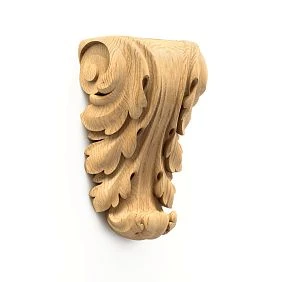
KR-009.1 is not one ready-made box, but a constructor of characteristics
The article number indicates which ornament and overall form are considered. It does not automatically indicate which product will be manufactured or shipped. Two lines labeled KR-009.1 may differ in all commercially significant parameters.
The buyer chooses:
-
One of six sizes.
-
Beech or oak.
-
Sanding quality "Standard" or "Prestige".
-
Preparation of wood for enamel or tinting.
-
Quantity.
-
Current method of production and delivery.
Only after selecting these parameters does a specific line price appear. Therefore, the question "how much does KR-009.1 cost" without specifications is like asking "how much does a door cost" without size, material, and finish. The answer would be incomplete.




Quick model passport
| Parameter | Available selection | What changes for the buyer |
|---|---|---|
| Article number | KR-009.1 | The ornament and model remain the same |
| Size | 6 options | The scale, dimensions, and price change |
| Species | Beech or oak | The wood grain pattern, finishing scenario, and price change |
| Sanding | "Standard" or "Prestige" | The volume of manual preparation before coating changes |
| Preparation | For enamel or tinting | The principle of selecting lamellas for the future finish changes |
| Quantity | From one sample to a series | The order amount and requirements for batch uniformity change |
| Finish | Is not a ready-made paint finish | The buyer arranges enamel, tinting, and the finishing system separately |
| Load | Is not determined by a single decor card | A calculation of the wall, shelf, fasteners, and installation scheme is needed |
| Receiving | According to the card and delivery terms | The status is checked for the selected combination |
The table shows the main thing: "Prestige" does not mean a ready-made paint finish, oak does not mean automatic tinting, and the same article number does not mean the same price.
Our factory also produces:
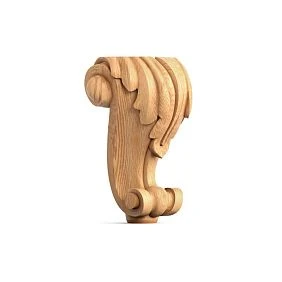
Why one ornament yields dozens of order options
Six sizes are multiplied by two materials, two levels of sanding, and two types of preparation:
6 × 2 × 2 × 2 = 48 potential combinations.
This does not mean that at any given moment all forty-eight lines are available in equal quantities or lead times. The figure explains something else: the buyer is dealing with a multi-parameter product. An error in one switch changes the order.
For example, two items might look like this:
-
KR-009.1, 103 × 65 × 38 × 20 × 44 mm, beech, "Standard", for enamel — 2 pcs.;
-
KR-009.1, 103 × 65 × 38 × 20 × 44 mm, oak, "Prestige", for tinting — 2 pcs.
The size and ornament match. But the first pair is designed for an opaque coating and assumes that the buyer is ready to participate in the final surface preparation. The second pair preserves the visible character of the oak and is purchased with deeper manual finish sanding.
Get Consultation
Why you cannot tell the manager only the article number
The phrase "give me four KR-009.1" does not fully define the product. Four fields remain empty in the order:
-
what size;
-
which wood species;
-
what grinding quality;
-
what preparation for coating.
The correct wording is as follows:
KR-009.1, size 135 × 85 × 50 × 26 × 57 mm, oak, "Prestige", for tinting — 4 pcs.
Even if the order is placed independently through the website, it is useful to write down such a line separately and check it against the cart.
Six sizes: the table is needed for an accurate line, not for repeating the general choice of the shelf
KR-009.1 is produced in six proportionally increasing variants.
| Option | Size A × B × C × D × E, mm |
|---|---|
| 1 | 87 × 55 × 32 × 17 × 37 |
| 2 | 103 × 65 × 38 × 20 × 44 |
| 3 | 119 × 75 × 44 × 23 × 50 |
| 4 | 135 × 85 × 50 × 26 × 57 |
| 5 | 151 × 95 × 55 × 29 × 64 |
| 6 | 183 × 115 × 67 × 35 × 77 |
There is no need to guess the purpose of each number by its position in the line. The letters A, B, C, D, and E are read from the card drawing. One of the values may describe height, another — overhang, a third — thickness or a section of the carved profile. Without an image with designations, one cannot honestly assign their function.
Why the full set of dimensions is more than just one height
When choosing, the buyer sometimes only looks at the first number: 87, 103, 119, 135, 151, or 183 mm. But two brackets with a suitable height may differ in reach, base thickness, and contact area.
The entire series A × B × C × D × E is checked, because the following depend on it:
-
visual scale of the ornament;
-
space under the shelf;
-
position of the bracket on the wall or furniture;
-
distance to adjacent parts;
-
ability to place the fastener;
-
protrusion relative to the facade;
-
compliance with the prepared niche;
-
symmetry map of multiple supports.
The enlarged version is not just a stretched image
When KR-009.1 transitions from 87 to 183 mm in the first dimension, not only the overall height changes. The other dimensions and the visible wood area increase. The carving begins to be perceived differently:
-
the small version reads as a local detail;
-
the medium one — as an independent accent under a shelf or on furniture;
-
the large one — as a noticeable architectural element.
On a narrow shelf, a large bracket may look heavier than the board itself. On a wide composition, the smallest one can get lost. But the article does not assign a size based on shelf depth without a drawing, load, and project. Here, the size is needed to correctly form a specific product line.
How to verify the size without guessing
It is useful to print the outline to scale or make a rectangular paper template based on the two main dimensions specified in the drawing. The template is applied:
-
under the shelf;
-
to the furniture side panel;
-
to the wall panel;
-
to the place next to the trim;
-
to the symmetrical point of the second support.
It does not show the thread and thickness, but allows you to see the scale. Then the remaining values are checked against the drawing: depth, base thickness, and junction zones.
Why you cannot mix sizes in one pair
Two brackets under one shelf should look like a set. Even adjacent sizes of the same series differ not only in millimeters, but also in the proportion of the ornament. If you place a 119 mm option on the left and a 135 mm on the right, the error will be noticeable in the bottom line, overhang, and thread mass.
Mixing sizes is only acceptable as part of a pre-drawn composition: for example, large elements at the edges of a furniture portal and smaller ones inside. For a regular pair under one shelf, choose one line.
Where the price difference for KR-009.1 comes from
The price changes not because the seller evaluates the same item differently. The composition of the order itself changes.
The final result is affected by:
-
size;
-
volume of wood;
-
wood species;
-
complexity of surface preparation;
-
level of manual final sanding;
-
preparation of lamellas for the future type of coating;
-
quantity;
-
availability or manufacturing;
-
associated materials;
-
Delivery.
Size
A large modification contains more material and has a larger area of carved relief that needs to be processed. This affects production operations and cost.
Beech or oak
The two wood species differ in pattern, structure, and price of a specific product modification. It is impossible to promise a universal percentage difference in advance. The current amount is compared in the product card by switching the material at the same size and sanding quality.
"Standard" or "Prestige"
"Prestige" includes more detailed manual processing of complex areas. The buyer pays not for the word in the name, but for reducing the amount of independent finishing before the topcoat.
For enamel or for tinting
This characteristic refers not to the applied coating, but to the preparation of the wooden blank for the future finish. Different requirements for visual selection of wood are imposed for opaque enamel and semi-transparent finishes.
Quantity
Two supports cost twice as much as one only when the selected line fully matches and there are no other expenses. The full estimate includes fasteners, materials, finishing, and delivery.
Why you cannot compare two prices without fixing the parameters
The buyer opens the table, sees two amounts, and decides that the difference is explained only by the wood species. But the size and quality of sanding could have changed at the same time. A correct comparison is built on the principle of "change one parameter at a time."
To understand the surcharge for oak:
-
Keep the same size.
-
Keep the same quality of sanding.
-
Keep the same type of preparation.
-
Change only beech to oak.
To understand the surcharge for "Prestige":
-
Keep the same size.
-
Keep the same wood species.
-
They leave the same preparation.
-
They only change "Standard" to "Prestige".
This way the buyer sees which characteristic changes the price, rather than comparing two different configurations as a whole.
Beech under enamel: when the wood must work under color
Beech is reasonably considered when the brackets will be covered with opaque enamel and the natural grain should not remain the main visual motif.
Under dense color, the buyer primarily evaluates:
-
precision of the ornament;
-
chosen size;
-
smoothness after preparation;
-
consistency of the pair or series;
-
quality of primer and enamel application;
-
absence of random differences in the relief.
What does 'under enamel' mean
Preparation for enamel does not mean that the bracket is already painted. The buyer receives a wooden part designed for further opaque finishing.
After receipt, the following may be required:
-
trial fitting;
-
local refinement;
-
dust removal;
-
Priming;
-
interlayer sanding;
-
application of enamel;
-
finish according to the selected system.
The exact sequence depends on the materials and technology of the finisher.
Why, with enamel, you don't necessarily have to pay for the visible oak grain
If the coating completely covers the texture and color of the wood, the aesthetic advantage of the oak grain won't work the same as under a tint. Therefore, beech often becomes a sensible choice for white, gray, blue, green, or other opaque finishes.
But you can't derive the rule "beech is always cheaper." The price depends on the specific size, sanding, preparation, and the current price list. Two completely identical configurations are compared, changing only the wood species.
Where beech under enamel is especially appropriate
-
White classic shelf.
-
Painted furniture portal.
-
Sideboard or display cabinet in the color of the facades.
-
Decorative support under the countertop, where the entire frame is covered with enamel.
-
Wall composition combined with moldings and doors.
-
Commercial interior with a single brand color.
-
A series of identical brackets, where color stability is more important than the natural grain.
Oak for tinting: when the buyer pays for visible wood
Oak is not chosen for the mere word "oak" in the specification. Its meaning is revealed when the finish leaves the texture visible.
Under tinting, oil, varnish, or another translucent system, the following are visible:
-
natural grain;
-
pores;
-
fiber differences;
-
lamella direction;
-
depth of the carved relief;
-
light transitions on protrusions and recesses.
What "under tinting" means
The blank for tinting is prepared for a scenario where the wood remains visually open. This is not a finished shade or an applied stain. Color appears only after the chosen finishing system.
The buyer still needs to:
-
approve the sample;
-
check how the composition lays on the oak;
-
evaluate the end cuts and carved relief;
-
agree on the degree of gloss;
-
process all identical parts with the same technology.
Why oak brackets are better ordered in one batch
Natural wood does not have to be identical like a plastic casting. Even within one batch, natural variations in grain are possible. When ordering at different times, the risk of visual discrepancy increases.
For a pair under one shelf, it is important to get two pieces together. For two identical shelves — four. For a furniture series — the entire calculated quantity plus a justified reserve.
Buying "one now, the second after fitting in a few months" is acceptable as a test scenario, but does not guarantee an absolute match of shade after tinting.
Oak is suitable for tinting when
-
the shelf is made of oak;
-
oak facades are nearby;
-
the bracket must support the wooden tabletop;
-
the interior is based on natural materials;
-
the carving should be readable through light and dark areas of the stain;
-
a transparent or semi-transparent finish is planned;
-
the client is ready to accept the natural variability of wood.
Why a test coat is done on the actual material
The same composition looks different on beech, oak, and on the manufacturer's printed sample. The KR-009.1 relief adds another variable: in recesses the composition may appear darker, on protrusions — lighter.
A test coat helps answer specific questions:
-
hasn't the oak become too red or gray;
-
hasn't the thread been clogged with a dense compound;
-
is the texture sufficiently revealed;
-
does the bracket match the shelf;
-
is a second coat needed;
-
what degree of gloss is suitable;
-
is additional surface finishing required.
Beech or oak: comparison not by prestige, but by the future finish
| Question | Beech for enamel | Oak for tinting |
|---|---|---|
| Should the texture be visible | No, it is covered by an opaque color | Yes, the pattern remains part of the result |
| Main visual factor | Relief, color, and quality of painting | Relief, texture, shade, and depth of coating |
| Is it necessary to match the natural pattern | Not a main criterion under dense enamel | Matters for pairs and series |
| Is a test coat needed | Yes | Especially needed |
| Is it reasonable to order the entire series at once | Yes | Yes, especially for visible wood |
| Can one option always be considered cheaper | No, the actual configuration is checked | No, the actual configuration is checked |
| What it is suitable for | Painted furniture and interior decor | Visible oak composition |
This table describes two clear scenarios but does not prohibit other combinations. Beech can be tinted, and oak can be painted with enamel if such options are available in the product card and justified by the project. The commercial choice is based not on prohibition, but on what the buyer is willing to pay for and what will remain visible after finishing.
"Standard" and "Prestige": the difference is not in the pattern, but in the degree of surface readiness
Both options retain the same article number, geometry, and selected wood species. The quality of sanding changes.
According to the logic of the product card:
-
The "Standard" includes machine sanding and manual finish sanding, but allows slight roughness and fuzz;
-
The "Prestige" receives more detailed manual sanding and is better prepared for subsequent finishing.
Neither option means a ready decorative coating. "Prestige" is not white enamel, not stain, not oil, and not varnish. It is a deeper preparation of the wooden surface.
What the buyer pays for in "Prestige"
The KR-009.1 has carved recesses, transitions, edges, and small areas that are difficult to reach with equal quality using machine tools. More detailed manual work reduces the number of operations that a craftsman would have to perform before priming or tinting.
The buyer pays for:
-
additional attention to the complex relief;
-
reduction of noticeable fuzz;
-
more even perception of transitions;
-
reduction of time for your own workshop;
-
less risk of missing a hard-to-reach spot before the finish;
-
more convenient start for responsible finishing.
This does not cancel incoming inspection. Any wooden part is inspected under side light and checked by hand before coating.
What remains on the buyer's side even with 'Prestige'
-
Size verification.
-
Fitting to a shelf or furniture.
-
Preparation of mounting areas.
-
Dust removal.
-
Primer selection.
-
Test coating.
-
Interlayer treatment according to technology.
-
Applying the finish.
-
Inspection after installation.
«Prestige» reduces the amount of finishing work on the workpiece, but does not turn it into a fully finished painted product.
When «Standard» is the rational choice
«Standard» is suitable not for a buyer who wants to choose the shortest lead time at any cost, but for a project where there are resources for further work.
It is reasonable to consider it if:
-
the customer has a joinery workshop;
-
the finisher knows how to work with carved wood;
-
manual finishing is already included in the estimate;
-
the brackets are coated with opaque enamel;
-
the batch is large and the technological section processes all parts identically;
-
the deadlines allow preparation to be done without rushing;
-
the foreman wants to control the final smoothness independently;
-
minor roughness and lint will be removed before priming.
Can I buy the "Standard" if enamel will be applied anyway?
Yes, you can, if the buyer understands that enamel does not automatically hide a poorly prepared surface. On the contrary, an even covering layer can emphasize lint, scratches, and sharp transitions.
The phrase "we'll paint over it anyway" is dangerous. Before painting, you will need to:
-
find roughness;
-
remove lint;
-
carefully treat the thread;
-
do not round off sharp ornamental elements;
-
do not change the profile;
-
remove dust;
-
apply a compatible primer.
If these operations are already part of the workshop's work, the "Standard" may be economically justified. If there is no one to perform them, the low price of the line may result in additional costs for third-party finishing.
When the surcharge for "Prestige" saves not only time
"Prestige" makes sense when the cost of the buyer's manual labor is higher than the difference between the options, or when the quality of the visible surface is especially important.
Typical situations:
-
oak remains under a transparent finish;
-
brackets are at eye level;
-
dark tinting is used, which emphasizes scratches;
-
the buyer does not have their own carpentry area;
-
the order consists of two or four parts, and manual finishing of each separately is inconvenient;
-
installation is scheduled close in time;
-
the finisher accepts parts only with a high degree of preliminary readiness;
-
the complex ornament must retain sharp edges.
"Prestige" does not guarantee the absence of any preparatory operations
Wood reacts to wet compounds. After primer or water-based stain, the grain may rise again. Therefore, interlayer treatment depends on the chosen system, not just on the initial sanding.
A commercially honest wording sounds like this: "Prestige" reduces the volume of primary manual finishing and makes the workpiece more prepared for finishing, but does not eliminate the coating application technology.
Comparison of "Standard" and "Prestige" in real scenarios
| Scenario | "Standard" | "Prestige" |
|---|---|---|
| Has its own painting section | Allows finishing according to our own technology | Reduces the preparation stage |
| Bracket for dense enamel | Possible after quality manual inspection | Convenient if a more finished surface is needed |
| Oak under a transparent finish | Requires especially careful finishing | More often justified by visible texture |
| Slight pair for a finished interior | May require finding a specialist | Reduces the amount of third-party work |
| Large series for production | The solution depends on the cost of one's own labor | Saves operations but increases the price of parts |
| Urgent installation | Risk of delay in preparation | More convenient starting point |
| The buyer thinks the option is already painted | Not painted | Also not painted |
After the table, the decision becomes simpler. You need to compare not only the price of the product, but also the cost of a master's hour, deadlines, complexity of the relief, and requirements for the visible surface.
One, two, or four: the quantity is determined by the task, not by the photo
KR-009.1 is sold individually. The photo may show one item, but for a shelf, a buyer often needs a pair. For two identical shelves — four identical brackets. For a furniture portal, the number of parts depends on the repeating composition.
The main rule:
Quantity of KR-009.1 = number of installation points according to the approved scheme.
One small shelf
Two brackets are considered preliminarily:
-
left;
-
right.
But the word "preliminarily" is fundamental here. The permissible scheme depends on the length and weight of the shelf, the expected load, the wall material, the fasteners, and the distance between supports. The decorative card does not give grounds to promise that two parts are enough for any shelf.
In the commercial list, record:
KR-009.1, selected configuration — 2 pcs.
Two identical shelves
If each shelf gets two supports:
2 shelves × 2 brackets = 4 pcs.
It's better to order all four in one line. You can't choose beech for the top shelf and accidentally oak for the bottom one if the composition should be identical. The same applies to "Standard" and "Prestige".
Three shelves in a vertical composition
With two supports for each:
3 × 2 = 6 pcs.
Here the difference in the batch is especially noticeable. Six brackets form a repeating row, so any mismatch in size, color, or degree of preparation will be more visible than in a single pair.
Symmetrical furniture portal
Suppose two brackets are planned on each side of a wide furniture composition:
-
two on the left;
-
two on the right.
Total — 4 pcs. They may not support individual shelves, but work as a repeating decorative motif. However, the mounting method and function must be specified by the project.
One sample before the series
Buying a single part is useful if you need to check:
-
the actual scale;
-
depth of the carving;
-
surface quality;
-
a test enamel;
-
the tint shade;
-
the combination with the shelf;
-
the ease of finishing;
-
the visibility of the texture.
After the sample is approved, the main batch is produced. However, if maximum uniformity of the oak is important, a long gap between the test and the series is undesirable. It is rational to clarify in advance whether the required quantity of the selected configuration can be reserved.
Order sheet: a line that cannot be shortened
| Scenario | Preliminary quantity | How to record |
|---|---|---|
| One small shelf | 2 pcs. | Size, wood species, sanding, preparation — 2 pcs. |
| Two identical shelves | 4 pcs. | One configuration — 4 pcs. |
| Three identical shelves | 6 pcs. | One configuration — 6 pcs. |
| Symmetrical furniture composition | By scheme | Quantity of each repeating element |
| Prototype | 1 pc. | One precise configuration for fitting |
| Series after prototype | As per project | Same configuration, checked before payment |
The statement must separate the 'quantity for composition' from the 'load-bearing capacity calculation'. The former can be calculated from the layout drawing. The latter requires structural data.
Why you cannot promise load based on a single item
The word 'bracket' creates the feeling that it's enough to choose a nice support, screw it to the wall, and put a shelf on it. In reality, the system consists of several elements:
-
walls;
-
cladding;
-
embedded part, if needed;
-
fasteners;
-
the KR-009.1 itself;
-
shelf board;
-
method of connecting the shelf to the bracket;
-
distance between supports;
-
front overhang;
-
intended contents.
The weak link may not be the wooden part, but a loose wall, short fasteners, or a thin shelf. Therefore, it is impossible to honestly write: "the pair will hold so many kilograms" without testing a specific assembly.
What to convey to the craftsman or designer
-
full drawing of the selected KR-009.1;
-
shelf dimensions;
-
shelf material;
-
its own weight;
-
expected contents;
-
wall material;
-
finish thickness;
-
location of hidden utilities;
-
number of supports;
-
the distance between them;
-
Mounting method.
After that, the specialist determines whether the selected model is suitable for a structural role or should be used only as a decorative element together with a hidden load-bearing system.
How to calculate the order cost without an outdated price
Fixing a single amount in an article is incorrect: the price depends on the selected combination and the current price list.
Formula:
**Quantity KR-009.1
× current price of the selected size, species, sanding, and preparation
-
Fasteners
-
Mounting materials
-
finishing materials
-
Delivery
= total order cost.**
Example logic for one shelf
The buyer needs 2 pcs. in the configuration:
-
size 119 × 75 × 44 × 23 × 50 mm;
-
beech;
-
"Standard";
-
Under enamel.
Estimate:
**2 × price of this line
-
wall-type fastener
-
primer and enamel
-
Consumables
-
delivery.**
Example for two oak shelves
Need 4 pcs.:
-
one selected size;
-
oak;
-
"Prestige";
-
Under tinting.
Estimate:
**4 × price of the oak "Prestige" of the selected size
-
Fasteners
-
test composition and main finishing system
-
delivery.**
Why the price of brackets is not the full price of the finished shelf
The project may include:
-
shelf board;
-
its cutting;
-
edges;
-
polishing;
-
finish;
-
hidden reinforcements;
-
fasteners;
-
installer services;
-
wall preparation;
-
delivery;
-
lifting;
-
protective packaging.
The query "wooden brackets price" is useful for comparing the supports themselves, but does not replace the estimate of the finished structure.
Four ready-made commercial scenarios
Scenario 1. Beech pair under white enamel
The customer needs one decorative shelf in the bedroom. The shelf and brackets will be painted white. There is no own carpentry workshop, and the craftsman charges for each hour of preparation.
Rational configuration:
-
size according to the drawing and scale;
-
beech;
-
"Prestige";
-
under enamel;
-
2 pcs.
Why not oak? Its visible grain will be covered. Why "Prestige"? To reduce complex manual finishing of the pair before painting.
Scenario 2. Beech series "Standard" for furniture production
The workshop produces two sideboards, each with four identical brackets. There is an own sanding and painting area.
Configuration:
-
one approved size;
-
beech;
-
"Standard";
-
under enamel;
-
8 pcs. plus a justified reserve.
Here the customer deliberately chooses more affordable preparation, because subsequent manual work is already included in production.
Scenario 3. Oak pair for light tinting
The shelf is made of oak, the natural texture must remain visible.
Configuration:
-
size according to the project;
-
oak;
-
"Prestige";
-
for tinting;
-
2 pcs.
The pair is ordered simultaneously. Before the main finishing, a test stain is done on a compatible sample or test area.
Scenario 4. One sample before restaurant decoration
A series of decorative shelves has been developed for the hall. 24 brackets are planned, but the designer has not yet approved the shade and scale.
First order:
-
1 KR-009.1 in the proposed configuration.
After fitting, check:
-
size from distance;
-
combination with furniture;
-
surface;
-
tinting;
-
lighting;
-
rhythm of several supports.
Then the main part is formatted in one line.
Why it's better to order identical brackets together
One common order helps to coordinate:
-
size;
-
wood species;
-
sanding;
-
preparation;
-
quantity;
-
deadline;
-
finishing technology;
-
delivery.
Simultaneous purchase is especially important for oak under tinting. The natural pattern doesn't have to be absolutely identical, but a single batch simplifies sorting and pairing.
How to distribute brackets after receiving
For four or more parts, it's useful to lay them out side by side under the same lighting and form pairs:
-
closest in pattern;
-
close in tone;
-
perceived identically after trial wetting or test coating;
-
suitable for the upper and lower shelves.
Marking is applied in the invisible area in a way that does not interfere with subsequent finishing.
Why store the configuration number
After a year, replacement or expansion of the composition may be needed. The phrase “we had KR-009.1” is insufficient. You need to save:
-
exact size;
-
material;
-
sanding;
-
preparation;
-
order date;
-
quantity;
-
applied coating;
-
color sample.
This does not guarantee a complete visual match of the new wood, but allows reproducing the original parameters.
When KR-009.1 is suitable, and when it's better to open the entire bracket section
The model has a recognizable carved ornament and six scales. This makes it flexible, but not universal.
KR-009.1 is worth considering if:
-
a classic carved motif is needed;
-
the buyer wants to choose beech or oak;
-
preparation for enamel or tinting is required;
Bookshelf in the study
Books create real load. Decorative choice cannot be separated from the calculation of the mounting. KR-009.1 is selected by appearance and dimensions, and the allowable scheme is determined by the wall, fasteners, and shelf.
If the bracket is located below eye level, the lower thread is especially noticeable. "Prestige" can reduce the preparation of visible recesses before dark tinting.
Sideboard or display cabinet
Brackets can support a protruding upper part, a shelf, or work as side decor. For a furniture series, it's important to order all elements at once.
On a painted sideboard, beech under enamel helps unify the brackets with the facades. On an oak display case, the open texture requires matching the wood species and tinting.
Kitchen shelf
Here, the surface is regularly illuminated by work light, and the relief collects dust and kitchen contaminants. The finish must account for the room's conditions and the possibility of maintenance. The article does not prescribe a specific varnish or enamel without a manufacturer's system, but reminds: the decorative blank needs a full protective coating.
Fireplace Area
KR-009.1 can be used in the decorative design of a shelf or portal. Before ordering, the distance to the heat source, the base material, and project requirements are checked. Suitability for a hot zone cannot be promised solely based on the wood and ornament.
Console or countertop
The bracket can function as a visible side support, but the load and fastening require a separate calculation. For a pair at the edges of the console, mirror placement and an identical level of finish are especially important.
Commercial interior
In a cafe, store, hotel, or salon, the quantity can number in the dozens. Here, the choice of "Standard" or "Prestige" becomes a production calculation:
- how many hours finishing will take;
- who performs the painting;
- what percentage of reserve is needed;
- whether the entire batch can be processed simultaneously;
- how to organize labeling and storage;
- What delivery time fits into the schedule?
Size and ornament in different styles
KR-009.1 belongs to carved classic models, but color and surroundings change the perception.
Light enamel
White or milky finish softens the pattern. Shadows remain in the recesses, but the wood texture does not distract from the silhouette.
Dark enamel
Graphite, deep green, or blue color makes the relief more cohesive. Side lighting emphasizes the protrusions.
Light oak tinting
The ornament is perceived more easily, and the natural pattern connects the bracket to the shelf.
Dark tinting
The recesses become more expressive. The surface requires especially careful preparation: scratches and fuzz may show more prominently.
Contrast with the wall
A bracket painted differently from the wall becomes an independent figure. Two elements under one shelf create a noticeable rhythm.
Tone on tone
If the bracket, shelf, and wall are similar in color, the shape is read through shadow. This option allows the use of carving without excessive decorativeness.
What to put in the basket along with KR-009.1
The bracket is only one part of the finished result. Even four correctly chosen elements will not become a complete system without a shelf, fastening, and finishing.
What to add Why is this needed For which scenario What to check Shelf board or furniture part Forms the working surface Shelf, sideboard, console Size, material, thickness, weight Fastening Connects the bracket to the wall or furniture Any installation Base, length, diameter, placement Hidden reinforcement Takes the load if provided by the design Heavy shelf, tabletop Constructor calculation Primer Prepares wood for finishing Enamel or other system Compatibility with coating Enamel Creates an opaque color Beech or oak for opaque finishing Test coating, number of layers Tinting composition Changes the shade while preserving texture Oak or beech for transparent scenario Color on a real sample Finish coating Protects the surface Visible and functional decor Room conditions Abrasive materials Needed for finishing and intercoat processing Especially "Standard" Grit size and thread access Delivery Combines the set into one delivery Any order Address, deadlines, batch composition For a complete project, you can Buy materials for installation and finishing after the master has determined the base and technology. You cannot choose glue or fasteners just by the word "wooden": the composition must suit both the wood, the wall, and the finish.
Unified room finishing: connection of brackets with other wood
KR-009.1 rarely exists alone in an interior. Nearby may be:
- shelf;
- Doors;
- Baseboards;
- Furniture facades;
- wall panels;
- plinth;
- staircase;
- countertop.
If brackets, shelf, doors, and floor trim should look like part of one joinery composition, you can simultaneously select buy wooden skirting board from a suitable wood species or with a matching finish.
This does not mean that all parts must be from the same species. Three strategies are possible.
Single opaque color
Beech brackets, wooden baseboard, and door elements are painted with one enamel. As a result, attention shifts from the natural grain to architectural lines.
One visible wood species
Oak KR-009.1, shelf and plinth are tinted in a close system. Test samples are needed for each part: even one species can perceive the composition differently due to cutting and preparation.
Deliberate contrast
A light shelf and dark brackets create a graphic composition. The contrast is repeated in the plinth, doors, or furniture to avoid looking random.
Preparation before painting: first try on, then apply the finish
A beautifully sanded bracket still cannot be painted immediately without checking the fit.
Before finishing, a dry fit is performed:
- apply the pair to the location;
- check the height;
- check symmetry;
- mark the mounting points;
- check if trimming is needed;
- check the shelf;
- assess the distance to the edges;
- make sure the thread does not interfere with adjacent parts.
If after painting it turns out that material needs to be removed from the base, the damaged area will have to be restored.
Why drilling and fitting is better done before finishing
Drilling creates chips, and the tool can leave marks. Trimming exposes raw wood. Preliminary preparation allows:
- complete the geometry;
- process the ends;
- remove dust;
- Apply primer evenly;
- Do not repair the coating in a visible spot.
What to check under side lighting
Position the lamp so that the light goes along the surface. In such lighting, the following are visible:
- nap;
- scratches;
- waves;
- unfilled recesses;
- traces of machine processing;
- dust;
- edge damage.
For 'Standard', this check determines the amount of manual finishing. For 'Prestige', it confirms readiness for the next stage.
Mistakes that turn the same article number into a different order
Mistake 1: Specify only KR-009.1
Without size, wood species, sanding, and preparation, the order is not fully defined.
Mistake 2: Comparing prices of different sizes
The difference is mistakenly attributed to oak or 'Prestige', although the dimension changed at the same time.
Mistake 3: Considering oak mandatory for expensive interiors
If everything is covered with enamel, the visible oak texture does not work.
Mistake 4: Considering beech a material only for painting
Available combinations should be checked in the product card; wood species and finish are separate parameters.
Mistake 5. Thinking that "Prestige" is already tinted
This is the quality of polishing, not a decorative coating.
Mistake 6. Buying "Standard" without a craftsman
The savings will disappear if you later have to urgently find a specialist to finish the thread.
Mistake 7. Taking "Prestige" without evaluating your own production
A workshop with well-established preparation can use "Standard" rationally.
Mistake 8. Ordering one bracket for a regular paired composition
On site, it will turn out that a second identical element is needed.
Mistake 9. Buying a pair at different times
For oak under tinting, the risk of a noticeable difference in grain and shade increases.
Error 10. Mixing "Standard" and "Prestige" in the same row
After finishing, parts may differ in the amount of preparatory work and surface perception.
Error 11. Mixing preparation for enamel and for tinting
The same color in the name of the future coating does not make the blanks identical.
Error 12. Reading A × B × C × D × E without a drawing
The buyer assigns incorrect meanings to the letters and chooses unsuitable geometry.
Error 13. Assigning load based on a photo
Without the wall, fasteners, and shelf, the number in kilograms will be made up.
Error 14. Painting before fitting
Any subsequent trimming damages the finish.
Error 15. Not counting delivery and consumables
The price of one part is mistakenly taken as the cost of the finished shelf.
Error 16. Buying random stock
Reserve should be linked to a batch, test stain, or risk of damage, not to uncertainty in calculations.
Error 17. Not saving the order configuration
Repeating a purchase by a single item number a year later will be difficult.
Error 18. Expecting an identical grain pattern in natural wood
Oak and beech have natural variability.
Error 19. Using aggressive sanding on threads
You can round off the ornament and change its shape.
Error 20. Select fasteners after painting
It is better to determine mounting holes and adjoining areas in advance.
Ready line before payment
Before placing an order, fill in the template:
Article: KR-009.1
Size A × B × C × D × E: __________ mm
Wood type: beech / oak
Sanding quality: "Standard" / "Prestige"
Preparation: for enamel / for tinting
Quantity: __________ pcs.
Purpose: shelf / furniture / decorative composition
Finish: __________
Mounting base: __________
Delivery: __________If at least one line remains empty, the cart should be checked again.
How to order KR-009.1 on STAVROS without accidental parameter substitution
Purchase starts with the product card, but does not end with choosing the article number.
Step 1. Open the required model
Check that the title indicates KR-009.1, not a bracket similar in pattern or number.
Step 2. Select the size
Match the full series A × B × C × D × E with the drawing and project. Do not limit yourself to the first number.
Step 3. Select the wood species
Beech is considered for covering finishes and other agreed scenarios. Oak — when the texture should remain visible. The final decision is linked to the future coating.
Step 4. Determine the sanding
"Standard" is chosen when you have your own finishing area. "Prestige" — when you need to reduce manual preparation of complex relief.
Step 5. Specify the preparation
Under enamel — for an opaque coating. Under tinting — for a scenario where the appearance of the wood matters.
Step 6. Enter the exact quantity
Not "a couple of packs," but the number of individual pieces: 2, 4, 6, or another value according to the list.
Step 7. Check the active row
All parameters in the cart must match. If at least one switch returns to its default value, the line is corrected.
Step 8. Add components
Fasteners, finishing materials, and the shelf are calculated separately. Their absence in the cart does not mean they are included in the bracket price.
Step 9. Check delivery
For orders in Saint Petersburg, Moscow, or another region, current delivery conditions are reviewed. A customer looking for where to buy a wall shelf bracket in St. Petersburg still needs to check not the overall stock of the SKU, but the availability of the specific size, wood species, and finish.
Step 10. Save the specification
A screenshot or text line will help verify the delivery and reorder later.
After verification, you can return to the product page and buy the KR-009.1 bracket as a fully defined configuration.
FAQ: Questions about the KR-009.1 configuration
Why does one SKU have different prices?
Because under the SKU, different sizes, wood species, sanding qualities, and preparation options for coating are combined. You need to compare two rows where only one parameter differs.
How many sizes does KR-009.1 have?
Six: 87 × 55 × 32 × 17 × 37 mm; 103 × 65 × 38 × 20 × 44 mm; 119 × 75 × 44 × 23 × 50 mm; 135 × 85 × 50 × 26 × 57 mm; 151 × 95 × 55 × 29 × 64 mm; 183 × 115 × 67 × 35 × 77 mm.
How do I understand what A, B, C, D, and E mean?
The designations should be read according to the card's drawing. From a single row of numbers, you cannot reliably determine which value refers to height, projection, or thickness.
Which size should I choose?
The one that matches the project location in all dimensions. To choose, you need a drawing, shelf or furniture dimensions, and free space around.
Can I choose a size based only on shelf depth?
No. Depth is just one parameter. You need to check the entire geometry, base, fasteners, and visual scale.
Which is better: beech or oak?
There is no better material out of context. Beech is rational for many projects under opaque enamel, oak for visible texture and translucent finishes.
Is beech always cheaper than oak?
This should not be promised without checking. The price depends on size, sanding, preparation, and the current product line.
Does it make sense to buy oak for enamel?
It does, if it is justified by the project and available in the product card. But dense enamel will hide a significant part of the grain, which is often why oak is chosen.
Can beech be tinted?
The possibility of specific preparation should be checked in the product card. The final appearance must always be evaluated against a sample.
What does preparation for enamel mean?
This is the preparation of a wooden blank for a future opaque coating. Enamel does not automatically become part of the product and is applied separately.
What does preparation for tinting mean?
It is designed for a finish where the wood texture remains visible. There is no ready-made shade on the bracket yet.
Is "Prestige" already painted?
No. "Prestige" indicates more detailed hand sanding, not a finished finish.
How does "Standard" differ from "Prestige"?
"Standard" allows for a larger amount of subsequent hand finishing. "Prestige" is more prepared for finishing due to more detailed processing of complex areas.
Can I paint "Standard" without additional sanding?
First, the surface needs to be inspected. If there is lint, roughness, or traces of processing, they are removed before primer and enamel.
When is "Standard" more advantageous?
When the buyer has their own workshop, a technological area, and a pre-calculated cost of manual finishing.
When is it better to order "Prestige"?
When the wood remains visible, the bracket is at eye level, there is no own carpentry area, or deadlines do not allow time for lengthy relief preparation.
How many brackets are needed for one shelf?
Often a pair is considered, but the final quantity is determined by structural calculation. Length, load, wall, and fasteners may require a different scheme.
How many should I order for two identical shelves?
With two supports per shelf — 4 pieces. All four must match in full configuration.
Can I order one sample?
Yes, such a scenario is useful for checking scale, surface, and trial finishing before a large batch.
Is a reserve needed?
Reserve is added after precise calculation. It is justified for a serial project, complex finishing, or possible replacement, but should not hide an error in quantity.
Should oak brackets be ordered in one batch?
Preferably. This makes it easier to distribute pairs by pattern proximity and process the entire series with one finishing system.
Will two oak items be absolutely identical?
No, natural wood has natural variations. The goal is to get a matched pair, not to expect printed identity.
Is fastening included in the cost?
The composition of the package should be checked in the product card. For project calculation, fastening is better counted as a separate line.
What fasteners are needed?
It depends on the wall or furniture material, facing thickness, load, and installation scheme. Universal fastening cannot be assigned without this data.
What load does KR-009.1 support?
It is impossible to honestly name a number for one decorative card. The load-bearing capacity is determined by the entire system: the wall, fasteners, shelf, number of supports, and the distance between them.
Can KR-009.1 be used only as decor?
Yes, if the project provides for a decorative role, and the structural load is taken by another system.
Do I need to try on the brackets before painting?
Yes. Trying on reveals size mismatches, the need for trimming, and the position of fastening zones before applying the finish.
How to check the sanding?
Inspect the surface under side light and run your hand over accessible areas. Pay special attention to recesses, transitions, and edges.
Why is dark tinting more demanding?
It can more strongly emphasize scratches, lint, and uneven surface preparation. Therefore, a test coat is mandatory.
Can the pair be painted separately?
It is possible, but the risk of differences in shade and gloss is higher. It is better to process identical parts in one session and with one system.
How to care for the finished bracket?
Care depends on the finish coating. The relief is cleaned gently, without agents that could damage the enamel, oil, or varnish.
Will KR-009.1 suit a kitchen?
It may suit if the dimensions, installation, and protective coating match the conditions. Humidity, contamination, and the ability to maintain the thread must be considered.
Will it suit a bathroom?
The decision depends on the entire system: wood, primer, finish, glue, fasteners, and ventilation. The name of the species alone is not enough.
Can the model be used on a building facade?
Only with confirmed technology for exterior use. The interior card does not automatically grant permission for outdoor use.
What to do if no size fits?
Do not modify the ready-made ornament on the object without a project, but choose another model in the brackets category.
Where to buy a carved wooden bracket with delivery?
KR-009.1 is presented in the STAVROS card. Before placing an order, you need to select the full configuration and check the current delivery terms across Russia.
How to find out the final cost of a pair?
Multiply the current price of the selected line by 2 and add fasteners, mounting materials, finishing, and delivery.
How to find out the cost of four identical parts?
Multiply the price of one fully selected modification by 4, then add the remaining items of the project.
What to save after purchase?
Article number, size, wood species, sanding, preparation, quantity, order date, and data of the applied coating.
Do not buy an article number — buy the exact configuration
KR-009.1 is valuable not only for its expressive carved pattern, but also for the ability to choose one model in six scales, from beech or oak, as "Standard" or "Prestige", under opaque enamel or visible tinting. The same variability creates a risk: the buyer sees the same ornament and does not notice that another line is already in the cart.
Before payment, five values must be recorded:
- Full size A × B × C × D × E.
- Wood species.
- Quality of sanding.
- Preparation for coating.
- quantity.
Beech under enamel suits a project where color covers the natural grain. Oak under tinting is justified when the texture is part of the design. "Standard" is reasonable if you have your own finishing area. "Prestige" reduces manual preparation but is not a ready-made coating. Two brackets are needed as a pair only after checking the entire structure, and four are ordered for two identical shelves with the appropriate scheme.
STAVROS allows you to assemble an order not from random similar parts, but from repeatable variants of one article. In the product card, you can select a specific size, material, and surface quality, check the current price, and order the required quantity. Such precision is more important than the general question "where to buy a bracket": it helps you get exactly the pair or series that the craftsman can install and finish without unexpected substitution of characteristics.