Article Contents:
- Chair frame STU-003: what the individual product card confirms
- The wooden base of the chair and the finished chair: these are different order items
- Wooden chair frame: where the responsibility of three contractors lies
- Carved chair frame: why overall dimensions are not enough for upholstery
- Chair frame for upholstery: in what sequence to perform the finishing
- What must be agreed between STAVROS and the upholstery workshop before paying for the frame
- Upholstery passport STU-003: what data needs to be obtained separately
- Final chair seating: what to agree on before choosing the filling
- Who purchases fabric, filler, and related materials
- Beech or oak: how to calculate the budget for a carved chair STU-003
- Upholstered chair with carved legs: how not to cover the decor with fabric
- Chair glides: when to order FUR-021
- Frame route between manufacturer, finisher, and upholsterer: how not to lose responsibility
- Transfer act between workshops: a short document that prevents expensive disputes
- How to protect the thread during upholstery
- Wood finish before upholstery: surface control map
- Wood finish after upholstery: when it is possible and why the risk is higher
- What to agree on fabric before the frame even goes into production
- What to agree on decorative trim of the soft part
- How to check the proportions of the soft part before final fabric
- When STU-003 is better to see physically first or request additional design material
- How to order two or more STU-003 in one batch
- Control after upholstery: when the chair can really be considered finished
- The Price of a Mistake: Why Approval Before Ordering Is Cheaper Than Rework
- Technological Sequence of STU-003 by Stages
- Final Specification of Order STU-003 Before Payment
- What to Do If an Upholsterer Suggests Changing the Design After Receiving the Frame
- When a Separate Upholstery Workshop Is a Strong Scheme, and When One Contractor Is Better
- What to Ask the STAVROS Manager Specifically Because the Upholstery Will Be Outsourced
- Checkpoint 24 Hours Before Handover to the Upholstery Workshop
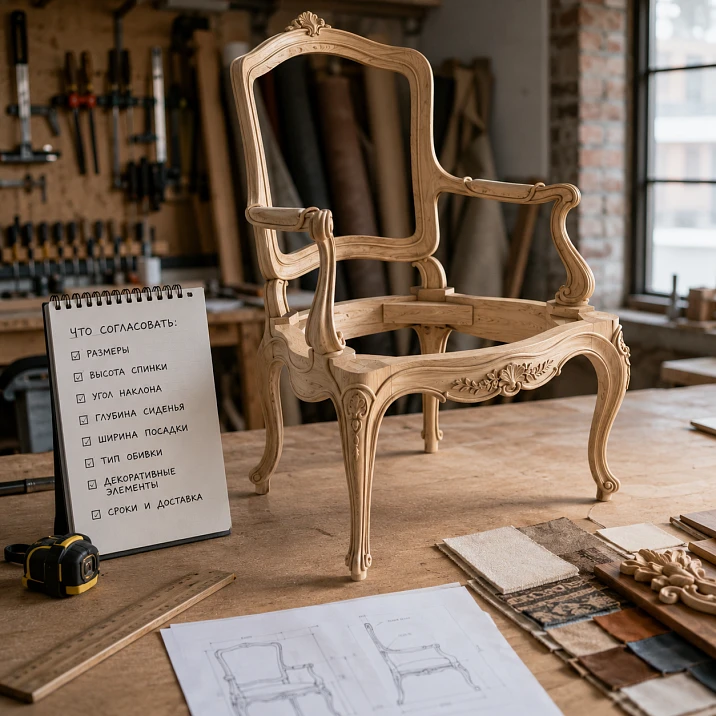
The buyer found a carved STU-003 chair frame, chose fabric, and agreed with an upholstery workshop. It seems the project is already divided into clear parts: STAVROS will make the wooden base, the finisher will prepare the visible wood, and the upholsterer will make the soft seat, backrest, and armrests. But it is precisely between these parts that questions most often remain, for which no one is automatically responsible.
Who determines the thickness of the padding? When to paint the carving — before upholstery or after? Which margins can be covered with fabric? Is the seat base included in the purchased frame? Who accepts the product after transport and records damage to the rigid box? Can upholstery be started before checking the geometry? Answers must be obtained before payment, because after painting, drilling, or attaching fabric, the original condition of the item will already be changed.
The goal of this article is not to teach upholstering a chair remotely. It helps to correctly purchase a specific wooden base and hand it over to a professional workshop without a gap between agreements.
STU-003 chair frame: what the individual product card confirms
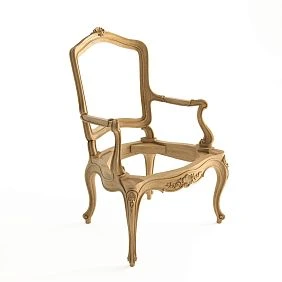
STU-003 is not a set of scattered legs and stretchers. The card describes an assembled carved cabriolet chair frame in the Louis XV style. The overall size A × B × C is 676 × 1010 × 688 mm. Beech and oak are available, with a sanding quality of "Prestige". For the shown beech configuration, the preparation "Under enamel" is specified.
The structure is supplied assembled. Its parts are joined with tongue-and-groove connections and additionally glued. Margins for subsequent upholstery are provided on the seat, backrest, and armrests. A rigid box is used for transport. A drawing is available on the page.
As of 08/28/2026, the card showed:
-
beech — RUB 162,120;
-
oak — RUB 201,370;
-
difference between wood types — RUB 39,250;
-
both items — made to order;
-
displayed average production time — 5–10 days.
Price, availability of a production slot, and lead time may change. They are confirmed in the invoice. The selected item should be ordered via the link buy chair frame STU-003.




The wooden chair base and the finished chair are different order items
The key mistake is to mentally equate the frame price with the price of the finished chair. The card confirms the wooden structure with upholstery margins, but does not publish the full list of soft part materials. It does not specify fabric, filler, furniture webbing, springs, decorative piping, nails, cord, glue, and upholsterer's work as guaranteed included.
This does not mean that a certain element is definitely absent. It means that based on published information, it cannot be considered included. Before payment, the buyer requests the delivery specification and passes it to the upholsterer. The specification must list all parts that will be received in a rigid box.
A professional workshop, after studying the drawing, compiles its own list:
-
method of forming the seat base;
-
composition and thickness of soft layers;
-
method of attaching materials to upholstery fields;
-
consumption of main and finishing fabric;
-
need for piping, braid, or furniture nails;
-
sequence of wood staining and fabric installation;
-
protection of carved parts during work;
-
price and upholstery time;
-
workshop warranty conditions for the completed work.
Only two agreed lists — from the frame maker and the upholsterer — give a real understanding of the set.
Our factory also produces:
Wooden chair frame: where the responsibility of three contractors lies
Three parties may be involved in the project. The manufacturer is responsible for the ordered frame within the agreed configuration and quality. The finisher is responsible for the preparation, color, and coating of visible wood. The upholstery workshop is responsible for the soft layers, tension, and attachment of fabric within the scope of its contract.
A problem arises when an intermediate operation is not assigned to anyone. For example, the upholsterer expects an already painted frame, while the finisher believes the fabric should be installed before patination. Or both workshops assume the other party will install the glides. The verbal phrase "we'll do it turnkey" does not resolve a dispute if the estimate does not include a list of works.
Before ordering, a responsibility table is compiled:
| Operation | Who performs | What is passed to the next contractor |
|---|---|---|
| Manufacturing STU-003 | Frame manufacturer | Assembled frame per agreed specification |
| Incoming inspection | Buyer or authorized workshop | Act, photos, and list of remarks |
| Final wood finishing | Assigned finisher | Dried coating suitable for protection and upholstery |
| Formation of soft elements | Upholsterer | Base, fillers, and shape according to the agreed design |
| Attachment of fabric and trim | Upholsterer | Finished soft part without thread damage |
| Final inspection | Customer | Check of stability, appearance, and completeness |
If design has not been completed yet, you can order development of a furniture design project, but the specific scope of the service and its applicability to the chair must be confirmed in advance.
Get Consultation
Carved chair frame: why overall dimensions are insufficient for upholstery
The size 676 × 1010 × 688 mm describes the product as a whole. It cannot be automatically used as fabric width, foam blank size, or seat area. The chair has a curved back, open armrests, and areas of complex shape. The pattern follows the working field, not the external rectangle of the product.
The upholsterer must receive the frame or an accurate working drawing and take their own measurements. Measured separately:
-
visible width and depth of the seat;
-
contour of the backrest upholstery field;
-
curvature of the backrest;
-
length and shape of sections on the armrests;
-
fabric attachment points;
-
zones that must remain exposed after upholstery;
-
allowances for tension and folding under;
-
direction of the fabric pattern;
-
matching the repeat on paired sections;
-
Thickness of soft layers after compression.
You cannot buy fabric using the formula "chair width multiplied by height." For fabric with a large pattern repeat, consumption increases due to pattern matching. For pile material, all parts are oriented in a consistent direction. For leather, the shape and usable area of each hide are taken into account. The exact consumption is specified by the upholsterer after laying out the patterns.
Chair frame for upholstery: in what sequence to perform finishing
Carved sections STU-003 must receive an agreed final finish, while upholstery fields must remain suitable for work. There is no universal sequence for any enamel, patina, fabric, and glue. It is approved jointly by the finisher and the upholsterer.
It is practically important to answer five questions:
-
which surfaces are fully painted;
-
which areas are prohibited from being filled with a thick layer of coating;
-
where the fabric will be attached;
-
how long the coating should dry and gain strength;
-
how to protect the finished carving when stretching the fabric.
If upholstery is done first, aerosol painting and patination can contaminate the material. If the frame is painted first and immediately handed over to the upholsterer, tools, staples, or protective film can damage the coating that has not yet gained strength. Therefore, the schedule indicates not only the painting date but also the permitted date for further work.
Before choosing a system, it is useful to check the quality of the wood under enamel or tinting. For the shown beech option, the card directly states "For enamel." The possibility of transparent finishing for a specific oak version and the category of re-gluing must be confirmed in the order, not inferred from the wood species name alone.
What must be agreed upon between STAVROS and the upholstery workshop before paying for the frame
The most expensive mistake in project STU‑003 is not choosing beech instead of oak, nor an extra meter of fabric. More dangerous is the situation where each contractor assumes that the critical operation is part of another's work.
Therefore, before payment, a unified package of initial data must be assembled, which is simultaneously visible to the frame seller, finisher, and upholsterer.
1. Exact delivery configuration
The card confirms the assembled wooden frame with upholstery margins but does not publish the full upholstery passport.
Consequently, before payment, an answer must be obtained:
-
what exactly is in the box;
-
which elements belong to the frame itself;
-
which components are supplied separately;
-
what is not included in the order and must be purchased by the upholsterer.
Especially, the following cannot be automatically considered included:
-
the base of the soft seat;
-
furniture tape;
-
springs;
-
filling;
-
wadding;
-
fabric;
-
piping;
-
decorative nails;
-
staples;
-
glue;
-
fastening of the soft part.
If any of these elements is actually included in a specific configuration, this must be confirmed by the specification, not by assumption.
2. Drawing specifically STU-003
The overall dimension of 676×1010×688 mm is needed for logistics and understanding the scale of the chair, but it does not provide the dimensions of the soft elements.
The upholsterer needs the drawing to see:
-
working contours of the seat;
-
shape of the backrest;
-
armrests;
-
places of wood carving;
-
points that cannot be covered with fabric;
-
areas where fastening is possible.
Even after receiving the drawing, the workshop may require a physical frame for final marking. This is normal practice: a complex curved part is rarely translated into an accurate textile pattern based only on one frontal dimension.
3. Where the wood finish ends and the soft part begins
On STU-003, the upholstery must not accidentally "creep" over the carving.
The boundary must be defined in advance:
-
seat;
-
backrest;
-
armrest cushions;
-
open tsarga;
-
carved legs;
-
wooden backrest elements.
For each section, the upholsterer must understand what the surface is:
-
will remain fully visible;
-
will be partially covered by fabric;
-
will be under the piping;
-
will become a mounting area.
4. What finish does the wood get
In the shown beech configuration, the card indicates the preparation "Under enamel". For oak, a specific transparent finish cannot be automatically promised just from the species name.
The order records:
-
enamel;
-
tinting;
-
lacquer;
-
oil;
-
patina;
-
combined system.
And separately — who performs it.
5. When the frame can be handed over to the upholsterer after finishing
The painting date and the date of transfer to the upholstery workshop are not the same thing.
The coating should not just "be dry to the touch," but have sufficient strength for:
-
protective packaging;
-
holding by hands;
-
contact with templates;
-
fabric tension;
-
working with tools near the carving.
The specific timeframe depends on the covering system and is determined by the finisher.
6. Who is responsible for damage between workshops
If after transportation between the finisher and the upholsterer there appears:
-
chip;
-
scratch;
-
crack;
-
dent;
-
thread damage,
it is necessary to understand at which stage it occurred.
For this purpose, each transfer is accompanied by:
-
photo;
-
date;
-
a brief condition report;
-
signature of the receiving party.
This is especially important for the expensive oak version costing over 200 thousand rubles.
Upholstery passport STU-003: what data needs to be obtained separately
A product card does not have to be an upholsterer's technical card. But if the workshop was chosen separately, the buyer needs their own upholstery passport for the project.
It is created not by the frame seller, but jointly with the workshop.
What to include in the passport
Seat
-
working contour;
-
Base type;
-
rigidity;
-
composition of soft layers;
-
final height of the soft part;
-
method of fabric attachment;
-
piping/nails/braid.
Backrest
-
front soft part;
-
back side;
-
filling thickness;
-
shape along concave geometry;
-
fabric direction;
-
pattern symmetry.
Armrests
-
shape of rolls;
-
thickness;
-
fabric start and end points;
-
connection with carved wooden part.
Fabric
-
article number;
-
batch;
-
roll width;
-
pattern repeat;
-
pile direction;
-
allowance for pattern repeat;
-
direction on each element.
Why fabric consumption cannot be derived from 676×1010×688 mm
These dimensions describe the chair as a whole.
Fabric consumption depends on:
-
roll width;
-
pattern piece size;
-
allowances;
-
of the pattern;
-
of the pile;
-
the need to match the motif;
-
number of repeats.
Two chairs of the same size may require different amounts of the same fabric solely due to a large pattern repeat.
Why the thickness of the padding cannot be assigned by an article
The thickness of the soft part affects:
-
fit;
-
final height;
-
the visible portion of the side rail;
-
the position of the armrest relative to the body;
-
the proportions of the backrest.
But the STU-003 card does not publish a ready-made filling system.
Therefore, the article does not assign "50 mm foam rubber" or any other universal figure. It is chosen by the upholsterer after assessing the frame and the target seating position.
Final chair seating: what to agree on before choosing the filling
STU-003 has overall dimensions, but the final chair after upholstery will be perceived differently.
The soft part changes:
-
seat height;
-
depth;
-
visual thickness of the seat;
-
backrest profile;
-
position of hands on the armrests.
Target seating
Before upholstery begins, the customer must describe what the chair should be like:
-
firmer;
-
medium;
-
soft;
-
formal;
-
everyday;
-
accent;
-
designed for long sitting.
These are not marketing words. They affect the upholstery construction.
Why softness cannot be added "later"
After the upholsterer:
-
formed the base;
-
glued the padding;
-
stretched the fabric;
-
closed the edges,
changing the height or firmness means partial rework.
Example of a boundary scenario
The client wants a very thick soft seat because it makes the chair look "more expensive."
But the extra volume may:
-
cover part of the carved apron;
-
visually raise the seat;
-
change the attitude towards armrests.
Therefore, the shape of the soft part should be looked at on the side sketch before final upholstery.
Who purchases fabric, filler, and related materials
Three common schemes look the same only in words.
Scheme A. The upholstery workshop purchases everything
Advantages:
-
one responsibility for compatibility;
-
the master calculates the consumption himself;
-
less risk of buying the wrong fabric width or base material.
The buyer needs to receive:
-
list of materials;
-
price;
-
brand;
-
quantity;
-
remainder after work.
Scheme B. The client buys the fabric, the workshop provides the rest
This is a common option.
Then, before paying for the fabric, the workshop must confirm in writing:
-
article number;
-
the required quantity;
-
the working width;
-
pattern direction;
-
reserve.
You cannot order "approximately 5 meters" on the advice of a fabric store.
Scheme C. The client purchases everything
The most risky option.
If the customer chooses independently:
-
belts;
-
filling;
-
wadding;
-
fabric;
-
nails,
you need to make sure that the workshop agrees to work with these specific materials and takes responsibility for the result.
Full estimate STU-003: how to compare beech and oak without distortion
Frame price:
-
beech — RUB 162,120;
-
oak — 201,370 RUB
The difference:
39,250 RUB
But this difference is only the first line of the full estimate.
The correct budget formula
Final cost of the finished chair =
frame
-
packaging/delivery
-
additional transport between workshops
-
wood finishing
-
soft base
-
fillers
-
Fabric
-
decorative upholstery finishing
-
upholsterer's work
-
glides/hardware, if needed
-
agreed reserve.
Why you can't compare two workshops just by the total figure
One estimate may include:
-
fabric;
-
filling;
-
piping;
-
delivery.
Another — only the work.
Therefore, identical lines are compared, not the total amount.
Comparison table
| Article | Option 1 | Option 2 |
|---|---|---|
| Frame | ___ | ___ |
| Delivery | ___ | ___ |
| Wood finishing | ___ | ___ |
| Seat base | ___ | ___ |
| Filler | ___ | ___ |
| Fabric | ___ | ___ |
| Decorative trim | ___ | ___ |
| Upholstery | ___ | ___ |
| Glides/hardware | ___ | ___ |
| TOTAL | ___ | ___ |
Only after such a table does the surcharge of 39,250 RUB for oak compare with the overall value of the project.
Beech or oak: how to calculate the budget for the carved chair STU-003
The difference between the published frame prices is 39,250 RUB. But the comparison cannot end with this figure. The final budget includes not only the wood:
total = frame + delivery + acceptance + wood finishing + upholstery materials + fabric + upholsterer's work + hardware + reserve for agreed changes.
For beech under opaque enamel, the decorative result is largely determined by color, coating smoothness, and patination. For oak under a transparent or semi-transparent system, the value may lie in the visible texture, but the appropriate finish must be confirmed. Expensive fabric does not automatically require oak, and oak does not guarantee compatibility with any transparent coating.
Request two parallel estimates. In the first, beech with a specific enamel system. In the second, oak with a specific agreed coating. Each must have identical upholstery items so that the comparison is not distorted. If one contractor counts only fabric, while another includes filler, piping, and delivery, the two final figures are incomparable.
Upholstered chair with carved legs: how not to cover the decor with fabric
STU-003 is built as a single decorative composition: S-shaped legs, aprons, armrests, and backrest are connected by a common pattern. The upholstery should support this architecture, not accidentally overlap the carved boundaries.
Before cutting, photographs of the frame are taken from the front, side, and back. On copies, the line of the future fabric is marked. The transition between the upholstered part and exposed wood is checked especially carefully. A too-high bolster can cover the armrest profile. A thick seat changes the visible portion of the apron. A wide decorative piping can conflict with the fine carved relief.
On the sample, not only the fabric color but also the scale is agreed. A large pattern on a small backrest may lose the central motif after stretching. Solid fabric emphasizes the silhouette but makes uneven tension more noticeable. Contrast piping draws the field boundary and requires particularly precise symmetry.
If the customer is still choosing between a chair base and other types of furniture, it is useful to open the section buy a furniture frame. Comparing STU-003 with a regular chair only by price is incorrect. For example, compare the frame of chair STU-007 can be done to understand a different seating position and purpose, but it is not an interchangeable item.
Wooden chair frame upon delivery: what to check before the workshop opens
The card states that STU-003 is delivered assembled and in a rigid box. With dimensions of 676 × 1010 × 688 mm, the route should be checked in advance: the entrance door, hallway, stair turns, elevator, and workshop door. The box size is not specified in the card, so it cannot be considered equal to the product size.
Before payment, the following are requested:
-
number of cargo units;
-
external dimensions and weight of the packed item;
-
possibility of vertical or horizontal movement;
-
storage requirements;
-
first acceptance address;
-
person authorized to sign carrier documents;
-
procedure for damaged packaging.
If the frame goes directly to the upholsterer, the workshop must be ready to perform acceptance, not just move the crate to the warehouse. Before opening, photograph all sides of the packaging, markings, and visible damage. After opening, take photos of the general view, carved elements, legs, aprons, armrests, backrest, and upholstery fields.
The frame is placed on a flat surface and checked for stability without attempting to fix it with shims or filing. The wood species, dimensions, preparation quality, and completeness are verified against the order. Detected transport damage is recorded before painting and upholstery. Before transferring to a third-party contractor, it is necessary to check the warranty and return conditions for the frame.
Chair foot cap: when to order FUR-021
In the STU-003 card, among related products, a round foot cap FUR-021 with a diameter of 19 mm is shown. This is a reason to consider the part, but not proof of its automatic inclusion or universal compatibility with any floor.
Before buy round glide FUR-021, specify the quantity, attachment method, seat location on each leg, impact on height, color, and contact material. Requirements differ for parquet, stone, carpet, and soft vinyl flooring.
The support plates are installed symmetrically and only after checking the lower platforms. Fasteners cannot be chosen blindly: a part that is too long can damage the leg, while a shifted one can create lateral load on the thin edge. The decision must be confirmed by the manufacturer or furniture maker who sees the drawing.
The frame route between the manufacturer, finisher, and upholsterer: how not to lose responsibility
STU-003 is supplied assembled. This fundamentally changes logistics: it is not a compact set of parts that is transported, but a finished spatial structure of 676×1010×688 mm, placed in a rigid box.
The card does not publish the external dimensions of the packaging. Therefore, the route cannot be calculated based only on the dimensions of the frame itself.
Logistics data must be obtained before payment
-
external dimensions of the box;
-
weight of the cargo unit;
-
number of packages;
-
orientation requirements;
-
stacking acceptability;
-
opening procedure;
-
Address of the first acceptance point.
Why the first delivery point matters
There are at least three schemes.
STAVROS → customer → finisher → upholsterer
Plus — the customer personally accepts the goods.
Minus — two additional transports.
STAVROS → finisher → upholsterer
The buyer is less physically involved, but both workshops must be able to handle acceptance.
STAVROS → upholsterer → finisher → back
Usually more complicated, because the finished covering then needs to be transported again. This route is chosen only when technologically necessary.
Every move is a new risk
Vulnerable for carved frames:
-
protruding elements;
-
armrests;
-
cabriole legs;
-
top of the backrest;
-
carved aprons.
Therefore, in the estimate it is useful to count not only the cost of transportation, but also the number of reloads.
Incoming inspection STU-003: what to record before painting and upholstery
After opening the box, you cannot immediately give the frame to work.
First, its condition is recorded as initial.
Photo capture
Remove:
-
front general view;
-
from behind;
-
both sides;
-
top of the backrest;
-
both front legs;
-
both back legs;
-
aprons;
-
armrests;
-
upholstery fields;
-
marking;
-
packaging.
What to check visually
-
chips;
-
cracks;
-
creases;
-
damage to carving;
-
sanding defects;
-
contamination;
-
traces of impact.
Geometric check
The frame is placed on a flat surface.
Check:
-
stability;
-
absence of obvious skew;
-
symmetry;
-
integrity of connections.
Do not try to "fix" the identified defect before documenting it.
Why you shouldn't sand the issue immediately
After sanding, it is impossible to prove what the area looked like upon receipt.
If a defect is found:
-
photo;
-
description;
-
contact the seller according to their terms;
-
only after approval — further work.
Why this is especially important for a third-party workshop
If the frame is received by an upholsterer, they become the first person to see the frame after transportation.
If the workshop:
-
has opened it;
-
has started sanding;
-
has drilled;
-
has attached material,
and then reports a chip, it is much harder to determine the moment of damage.
Transfer act between workshops: a short document that prevents expensive disputes
For a single chair, you don't need a complex 20-page legal contract, but you do need a clear handover of its condition.
What to fix
frame
-
STU‑003;
-
beech/oak;
-
order number;
-
date.
Condition
-
without remarks;
-
remarks are listed.
Completed works
-
the coloring;
-
tinting;
-
patina;
-
other.
What is prohibited without approval
-
drilling;
-
filing down;
-
changing connections;
-
removing material from the thread;
-
screwing in new fasteners.
Next stage
-
upholstery;
-
installation of thrust bearings;
-
final assembly.
Why prohibit "minor adjustments"
An upholsterer may consider normal operations:
-
making an additional hole;
-
trimming an edge;
-
removing an interfering protrusion.
But STU-003 is an already assembled glued structure with carved decor. Any structural modification must be approved.
What the upholstery workshop cannot change without written approval
This block is especially important when using a separate contractor.
Without confirmation from the manufacturer/customer, one should not:
-
shorten legs;
-
trim aprons;
-
change tenon joints;
-
unglue components;
-
re-drill decorative elements;
-
remove carving for the sake of fabric;
-
expand the upholstery field by mechanical treatment;
-
change the backrest geometry;
-
install unknown fasteners into thin areas.
Why "we always do it this way" is not enough
A craftsman may have extensive experience with regular furniture.
But the specific STU-003 design:
-
carved;
-
assembled;
-
glued;
-
expensive.
Therefore, the standard workshop habit does not replace the approval of a specific product.
How to protect the thread during upholstery
Upholstery requires:
-
tension;
-
turning the chair;
-
working with tools;
-
temporary fixation of materials.
Carved parts should not become a support for tools or clamps during this time.
Before delivery, agree on protection
You need to decide:
-
what the visible wood is wrapped with;
-
can a specific tape be used at the finish;
-
where is a soft pad allowed;
-
which parts of the chair can be safely held.
Why you cannot automatically tape everything with painter's tape
Some coatings:
-
are sensitive to the adhesive layer;
-
have not reached full strength;
-
change gloss after prolonged contact.
Therefore, the finisher tests the protective material.
Fabric attachment zone
The upholsterer must clearly know where fasteners are acceptable and where decorative carving begins.
Wood finish before upholstery: surface control map
For STU-003, it is useful to print a photo or drawing and divide the surfaces by color.
For example:
-
green — fully visible wood;
-
yellow — area next to the fabric;
-
red — working upholstery field.
The colors are conditional — the principle itself matters.
What this solves
The finisher understands where an ideal face finish is needed.
The upholsterer sees where the material should not go.
The customer can check the result before the next stage.
Especially important on armrests
The card directly mentions the edged sections for creating rolls.
The boundary between the soft part and exposed wood here is part of the design.
Wood finish after upholstery: when it's possible and why the risk is higher
Sometimes the project requires local patination or a final decorative effect after the fabric is installed.
This is only acceptable if the finisher and upholsterer have agreed on the technique.
Risks
-
dust settling on the fabric;
-
stain from wood stain;
-
solvent on the edge;
-
damage to the fabric by masking;
-
difficult access to the thread near the soft element.
When such an order is justified
For example, if the final effect should visually connect:
-
edge of the fabric;
-
decorative nails;
-
patinated thread.
But this is already a specialized finishing task.
For a regular scenario, it is safer to finish the wood as much as possible before upholstery and leave only controlled local touch-up.
What to agree on regarding the fabric before the frame even goes into production
Even if the fabric is purchased later, it is better to determine the main properties in advance.
Large repeat
If a central flower or medallion should be on the backrest, the upholsterer needs extra allowance for pattern positioning.
Stripe
You need to decide:
-
whether the stripes run vertically on the backrest;
-
how they transition to the seat;
-
whether symmetry of the armrests is required.
Pile fabric
The direction of the pile affects the shade.
All parts must be oriented according to an agreed scheme.
Leather
Consumption cannot be calculated as fabric in linear meters.
It is necessary to account for the usable area and defects of specific hides.
Solid color material
Easier for cutting, but visual tension requirements are higher: any fold or asymmetry is more noticeable.
What to agree on regarding decorative upholstery of the soft part
STU-003 itself has active carved decor.
Therefore, upholstery finishing should be measured.
Piping
Emphasizes the boundary of the soft field.
Braid
Can cover the fastening line, but adds another ornament.
Decorative nails
Work well in classic styles, but on a carved frame they can overload the composition.
Double piping
Creates a more noticeable graphic border.
Main principle
If the wood is already:
-
carved;
-
patinated;
-
expressive,
the upholstery does not have to add the maximum of decorative techniques at once.
How to check the proportions of the soft part before the final fabric
Before expensive upholstery, you can do a temporary volume test.
It is not necessary to use final materials.
The upholsterer can show:
-
the intended seat height;
-
the volume of the backrest;
-
the shape of the bolsters;
on a technical mock-up.
What the buyer evaluates
-
whether the apron is covered;
-
isn't the seat too thick;
-
hasn't the thread been lost;
-
is the position of the hands comfortable;
-
hasn't the backrest become visually heavy.
This is especially useful if the fabric is expensive or the pattern is difficult to replicate after alterations.
What to send to the upholstery workshop before ordering the chair frame
A good request to the upholsterer contains a specific package, not just a link to a beautiful photo: &l
When STU‑003 is better to see physically first or request additional design material
The card and drawing provide a lot of information, but expensive custom furniture justifies additional verification.
If the chair must fit into an existing interior
It is useful to check the scale next to:
-
the sofa;
-
the coffee table;
-
the desk;
-
the bed.
You can make a floor footprint template 676×688 mm and a vertical mark of 1010 mm on the wall.
This does not show the shape of the chair, but helps to see the occupied volume.
If the fabric has a large pattern
A sketch of the front backrest in scale is needed.
On it, the designer can show where the central motif should be located.
If a complex patina is planned
A joint sample of wood and fabric is needed.
A warm golden patina next to a cold gray fabric can work differently than on screen.
If several identical chairs are ordered
The upholsterer must decide in advance:
-
the same position of the pattern;
-
the same height of the soft part;
-
the same piping;
-
the numbering order of the frames.
For a pair of chairs, the difference in symmetry is especially noticeable.
How to order two or more STU-003 in one batch
If the project includes a pair of armchairs, it is necessary to coordinate the repeatability of not only the wood but also the soft part.
Price of frames
Two beech at the price on the date of check:
2 × 162,120 = 324,240 RUB
Two oak:
2 × 201,370 = 402,740 RUB
Difference between the two pairs:
78,500 RUB
This is only the cost of the frames.
What else to agree on
-
identical preparation of wood;
-
finishing sequence;
-
fabrics from the same batch;
-
mirroring or identical pattern;
-
identical patterns;
-
marking "chair 1 / chair 2";
-
joint acceptance.
Why two chairs cannot be considered simply "one estimate ×2"
For fabric with a large repeat, the consumption for a pair may be calculated differently.
Remnants from one layout may be used on the second chair.
Therefore, fabric and decorative piping should be calculated per set, not mechanically doubled.
Control after upholstery: when the chair can truly be considered finished
After completing the soft work, both the furniture and the integrity of the original frame should be checked.
Appearance
-
symmetry;
-
fabric tension;
-
absence of wrinkles;
-
pattern alignment;
-
neat piping;
-
clean carving without glue and staples.
Wooden elements
Check:
-
new scratches;
-
chips;
-
tool marks;
-
Finish damage;
-
Condition of legs and stretchers.
Seating
The buyer must test the chair in real use.
Not based on photos.
Stability
The chair is placed on a level floor.
If glides are used, check their uniform operation and absence of misalignment.
Documents
The final act must record that the upholstery workshop delivered the finished item without remarks or with listed remarks.
The price of a mistake: why approval before ordering is cheaper than rework
For STU-003, the wooden base itself costs:
-
162,120 RUB in beech;
-
201,370 RUB in oak.
Therefore, even a mistake that doesn't break the frame can be expensive.
Bought fabric before patterns
Risk — not enough material considering the pattern repeat.
Dyed before approving the upholstery field
Risk — part of the expensive finish is hidden, and another part turns out to be unprepared.
The upholsterer started work before incoming inspection
Risk — dispute about the origin of the chip.
Did not check the packaging size
Risk — the crate does not fit into the selected elevator or workshop.
Granted the right to "fit on site"
Risk — irreversible modification of an expensive assembled structure.
The main savings here are not finding the cheapest foam rubber or transportation. It is in not paying for the same operation twice and not redoing an already modified frame.
Unified project map STU-003: which document is passed to all contractors
When multiple workshops are involved in a project, correspondence in messengers quickly becomes a source of contradictions. One contractor relies on a photo, another on an old version of the estimate, a third on a verbal agreement.
Better to make one short project document.
Block 1. Frame
-
STU‑003;
-
676×1010×688 mm;
-
beech or oak;
-
"Prestige";
-
specific surface preparation;
-
current price;
-
order number;
-
drawing.
Block 2. Visible wood
-
color;
-
gloss level;
-
patina;
-
transparent/opaque finish;
-
reference sample;
-
who performs.
Block 3. Soft part
-
target stiffness;
-
seat shape;
-
backrest;
-
bolsters;
-
fabric;
-
piping;
-
decorative elements;
-
approved patterns.
Block 4. Logistics
-
production address;
-
finisher address;
-
upholsterer address;
-
recipient;
-
contact;
-
photo documentation format.
Block 5. Prohibitions
Without written approval, it is not allowed to:
-
to drill;
-
file;
-
change connections;
-
remove thread;
-
redo geometry;
-
install unknown fastener.
Why one document is more useful than ten messages
If a dispute arises, it is visible:
-
which version was approved;
-
who was responsible for the operation;
-
what state it was in during transfer.
For expensive custom furniture, this is much more important than "convenience of correspondence."
Technological sequence STU-003 by stages
Below is not a universal production instruction, but an approval scheme that can be adapted to a specific coating and upholstery.
| Stage | What should be ready before starting | What is recorded after |
|---|---|---|
| Frame order | material, configuration, drawing, price | order confirmation |
| Acceptance | packaging, recipient | photos and comments |
| Wood finishing | visible zones map, coverage system | finish state |
| coverage excerpt | deadline from upholsterer | upholstery permission |
| preliminary upholstery fitting | patterns, soft layers | shape and proportions |
| final upholstery | fabric, piping, pattern direction | finished soft part |
| Final acceptance | checklist | finished chair certificate |
Why you can't change the order without discussion
Some technologies allow a different sequence.
But changing one stage affects the next.
If upholstery is started earlier, the finisher gets less access to the wood.
If painting is moved after the fabric, the risk of contamination increases.
Therefore, what matters is not a single "correct" sequence, but a consistent one.
Final specification of order STU-003 before payment
Before payment, it is useful to compile a single order line with no ambiguity.
Example for beech:
STU-003 / 1 pc. / beech / 676×1010×688 mm / Prestige / Under enamel / price per invoice ___ / term ___ / assembled frame / rigid box / delivery to workshop ___ / recipient ___ / upholstery performed by third-party workshop / completeness confirmed by appendix No. ___ .
For oak:
STU-003 / 1 pc. / oak / 676×1010×688 mm / Prestige / surface preparation ___ / price per invoice ___ / finishing ___ / upholstery workshop ___ / drawing transferred / restrictions on structural changes confirmed.
What should be attached
-
card/invoice;
-
a drawing;
-
configuration specification;
-
photo of finishing standard;
-
upholsterer contact;
-
delivery address;
-
acceptance rules.
Why this is especially important at a price of 162–201 thousand rubles.
The buyer pays for an expensive base, not a finished soft item.
The more precisely the transition from the base to subsequent contractors is fixed, the lower the risk that the final cost will increase due to rework.
What to do if the upholsterer suggests changing the design after receiving the frame
Sometimes the physical frame reveals a problem that was not visible in the drawing.
For example, the craftsman suggests:
-
add a hole;
-
change the support of the soft part;
-
remove a small wooden section;
-
change the fastening.
There is no need to automatically prohibit any changes. But giving verbal permission is also dangerous.
Correct algorithm
-
The master takes a photo.
-
Marks the exact location.
-
Explains why the change is required.
-
Indicates the size/method.
-
The buyer directs the question to the seller/manufacturer or the responsible furniture specialist.
-
The decision is recorded in writing.
-
Only after this is the operation performed.
Why this protects both parties
If the change turns out to be unsuccessful, it's clear who approved it.
If the change is truly necessary, the craftsman doesn't have to work "blindly."
When a separate upholstery workshop is a strong approach, and when it's better to have a single contractor
Splitting the project gives more freedom but requires management.
A separate workshop is beneficial if
-
it has strong specialization in classic upholstery;
-
a rare material is needed;
-
complex piping;
-
handcrafted work;
-
a specific fit;
-
the designer has already worked with this workshop.
One contractor is simpler if
-
the buyer does not want to coordinate stages;
-
unified responsibility is more important;
-
there is no separate finisher;
-
the project is standard.
The main question
Not "who is cheaper", but:
who is responsible for the entire transition from the wooden STU-003 to the finished chair.
If the contractors are different, this function is actually performed by the buyer, designer, or furnishing coordinator.
What to ask the STAVROS manager specifically because the upholstery will be third-party
A regular request "is it in stock and how much does it cost" for STU-003 is insufficient. A third-party workshop will work with the frame further, so it is useful to ask the manager specific questions in advance.
-
Confirm the current material and price.
-
Confirm the current production lead time.
-
Confirm the surface finish for the selected wood species.
-
Send the current drawing specifically for STU-003.
-
Confirm that the frame is supplied assembled.
-
List the scope of delivery.
-
Clarify which soft parts are not included in the product.
-
Confirm the packaging and, before shipping, the external dimensions of the cargo unit.
-
Confirm whether structural modifications by a third-party workshop are allowed and how to coordinate them.
-
Clarify the applicability of FUR-021 to the selected configuration if thrust pads are needed.
-
Confirm the procedure to follow in case of transport damage.
-
Confirm which documents will be provided with the order.
Why it is better to send questions in a single email
The answers become part of the project documentation.
They can be forwarded to the upholsterer and finisher without paraphrasing.
This reduces the risk of the classic mistake: the seller said one thing, the buyer remembered another, and the craftsman heard a third.
What you should not ask the manager to decide on behalf of the upholsterer
The frame seller should not, without a technological project, specify:
-
filler thickness;
-
fabric consumption;
-
soft base construction;
-
type of decorative piping;
-
number of staples.
These parameters relate to the upholstery project.
Checkpoint 24 hours before handover to the upholstery workshop
Before the actual handover, it is useful to review the entire project once more, because at this stage the expensive frame changes responsible parties.
Need to confirm:
-
the covering is sufficiently durable;
-
the workshop is ready to accept the item;
-
the storage place is dry and safe;
-
the fabric and materials have already been identified;
-
the current version of the drawing is with the master;
-
the prohibited changes are known;
-
the incoming condition has been photographed;
-
the address and contact of the recipient have been verified.
If the upholsterer is not ready to start work immediately, the frame should not accidentally stand for weeks in the passage, under tools, or near dusty production.
What is transferred together with the chair
-
a copy of the specification;
-
condition photo;
-
finish sample;
-
fabric/article;
-
agreed soft part scheme;
-
contact of the responsible person.
This turns physical transfer into a clear production stage, not a phrase like "the master will figure it out later."
When it makes sense to buy the STU-003 chair frame
The purchase is justified if:
-
you need exactly the carved silhouette of a cabriolet chair;
-
the dimensions 676 × 1010 × 688 mm fit the room and delivery route;
-
the customer deliberately orders the base, not a finished soft armchair;
-
beech or oak is selected;
-
the exact configuration is received;
-
the upholsterer has studied the card and the drawing;
-
the soft layers and fabric are agreed upon;
-
the sequence of finishing and upholstery is determined;
-
a responsible person for acceptance is appointed;
-
the overall estimate includes all works, materials, and logistics.
For comparison, a specialized section is available Buy chair frame. It helps to check alternatives, but the decision is made based on the card of each individual item.
When ordering the carved frame STU-003 prematurely
The order should be postponed if:
-
the buyer expects to receive a finished chair at the price of the frame;
-
it is unknown what is included in the box;
-
the upholstery workshop has not seen the drawing;
-
the fabric was purchased without calculating the pattern repeat and templates;
-
the contractors have not divided responsibility;
-
a transparent finish is planned, but the wood execution is not confirmed;
-
the external size is mistakenly taken as the size of the soft part;
-
no one accepts the cargo upon delivery;
-
The route is calculated based on the frame size, not the packaging;
-
It is assumed that drilling, filing, or modifying the design will be done without approval;
-
The upholstery price is quoted without a list of materials and operations.
Deferral in these cases is not a refusal to purchase. It is the time needed to turn a beautiful card into an executable order.
Mistakes when ordering a wooden chair frame
-
Consider upholstery included without a specification.
-
Buy fabric based on overall dimensions.
-
Do not coordinate the pattern direction and repeat.
-
Transfer the frame to the upholsterer before incoming inspection.
-
Start painting before fixing transport defects.
-
Install thrust pads without checking the seating surfaces.
-
Cover part of the carved profile with fabric.
-
Paint wood after installing light fabric without protection.
-
Compare beech and oak only by the price of the blank.
-
Do not account for the coating strength gain time.
-
Do not check the dimensions of the rigid box.
-
Allow the workshop to file down the structure without written approval.
-
Consider the total production time as the date of receiving the finished chair.
-
Do not include delivery between the manufacturer, finisher, and upholsterer.
-
Do not assign responsibility for the preservation of the carving.
How to order the STU-003 chair frame without gaps between contractors
First, they download the drawing and pass it to the upholsterer. Then they choose the wood species and the intended finish. The upholsterer describes the soft part, materials, fabric consumption, and attachment method. The finisher confirms the sequence of work and the drying time of the coating. After that, the buyer receives from the seller the configuration, price, production time, and packaging parameters.
Before payment, the following is recorded in one document:
-
STU-003;
-
quantity — one piece or an agreed batch;
-
beech or oak;
-
"Prestige" quality;
-
surface preparation option;
-
price;
-
deadline;
-
completeness;
-
glides, if selected;
-
delivery address;
-
recipient;
-
requirements for documents and acceptance.
After receipt, the frame is inspected and only then passed on for finishing. Each workshop accepts the product based on photos and an act. This makes it possible to determine at which stage damage occurred if it is discovered later.
Before starting work, it is useful to study tips on finishing a wooden frameBefore paying for transportation, it is necessary to verify payment and delivery of the chair frame.
Frequently asked questions about the STU-003 chair frame
What are the dimensions of the STU-003?
The card indicates an overall size of 676 × 1010 × 688 mm. This is not the pattern dimensions nor a confirmed seat area.
What type of wood is the frame made from?
The table lists beech and oak.
Is the frame delivered assembled?
Yes. The card states delivery in assembled form, with tongue-and-groove joints and additional gluing.
Is fabric included in the price?
The published card describes the frame and upholstery fields, but does not confirm the fabric as part of the set. Request the specification.
Is the filling included?
The full list of soft materials is not published on the page. It is agreed with the seller and upholsterer.
Can I order beech under enamel?
In the selected configuration, the card shows beech, "Prestige", "Under enamel". The actual finish is confirmed in the invoice.
Can I keep oak with a clear coating?
Such a solution cannot be approved based on the wood species alone. The veneer option and compatible finishing system need to be confirmed.
How to calculate fabric consumption?
Based on working patterns, taking into account the repeat, pile direction, allowances, and back shape. The overall dimension is not enough.
When to paint the frame?
The sequence is determined by the finisher and upholsterer. The coating must dry and gain the required strength before the next operation.
Are glides needed?
Their necessity depends on the floor and the leg construction. The card recommends FUR-021, but compatibility and quantity are confirmed separately.
How is STU-003 transported?
The card indicates a rigid box. External dimensions and package weight should be requested before ordering transport.
Can the frame be sent directly to the upholsterer?
Such logistics can be arranged if the workshop accepts in writing the responsibilities for inspection, photo documentation, and carrier documents.
How much does a finished chair cost?
The frame price does not equal the final price. Separate estimates are required for delivery, finishing, soft materials, fabric, and labor.
Can the size of STU-003 be changed?
The standard card confirms one size. Possibility of changes and print run conditions are clarified before ordering; you cannot rework the assembled frame yourself.
Where to choose other chair frames?
In a separate section of furniture frames with a filter by product type.
Conclusion: the STU-003 frame is ordered after agreeing on the upholstery, not instead of it
STU-003 is a specific assembled wooden base with a carved silhouette, upholstery fields, and confirmed dimensions. The card provides enough data to choose a model, wood species, and start commercial negotiation. But it does not replace the upholstery project and does not turn the frame price into the cost of a finished chair.
The correct order is as follows: get the drawing and specification, show them to the upholsterer, distribute operations among contractors, choose the finish, calculate the full estimate, check the packaging and route, place the order, accept the frame without changes, and only then start finishing work. Then individual workshops truly work as one production chain, rather than passing unresolved issues to the buyer along with an expensive product. Before payment, it is useful to save one final version of all agreements in PDF or a shared folder: drawing, configuration, finish, fabric, contractor contacts, acceptance rules, and the prohibition of unauthorized structural changes. This becomes the actual passport of the future chair from ordering the wooden base to final upholstery.