Article Contents:
- Oak or beech: the choice starts with the future finish
- Why you shouldn't start with price
- What to decide before choosing
- When it makes more sense to buy beech legs
- The furniture will be painted with enamel
- A calm, uniform surface is needed
- Glue-up grade for enamel
- When beech is not the best choice
- When to choose oak furniture legs
- The texture should remain visible
- The furniture body is made of oak
- What to consider
- What happens after coating
- What the coating changes
- How to make a stain
- Comparison error
- Under enamel: how important is the wood species
- Practical conclusion
- Under tinting: why oak and beech cannot be considered interchangeable
- Grade “for tinting”
- Checking on a sample
- What to do with an uneven result
- When the wood species hardly matters
- If the frame is oak: should the leg be oak
- How to make a decision
- Example
- Turned legs: oak or beech
- How shape interacts with material
- Catalog example: MN-233
- Catalog example: MN-220
- Carved legs: when texture competes with relief
- Patina
- Be careful with the price
- When carved legs are not needed
- Geometric legs: the material is more noticeable than it seems
- Example from the catalog
- How to choose a wood species for a geometric leg
- Finished coating or unfinished leg
- Unfinished
- Coated
- How to choose
- First the specific item code, then the material
- What to check in the product page
- Custom options
- Work procedure
- One set: one wood species and one batch
- How this is recorded
- What to do if the batch has run out
- Set and reserve
- Trial leg before ordering a series
- How to order a sample
- What to record based on the results
- When a sample is not needed
- Examples of STAVROS products made of oak and beech
- How to use examples
- Calculating the purchase for a series
- Example solution
- Procedure
- Where to buy solid wood furniture legs
- Order terms
- What to clarify with the manager
- Furniture makers' questions
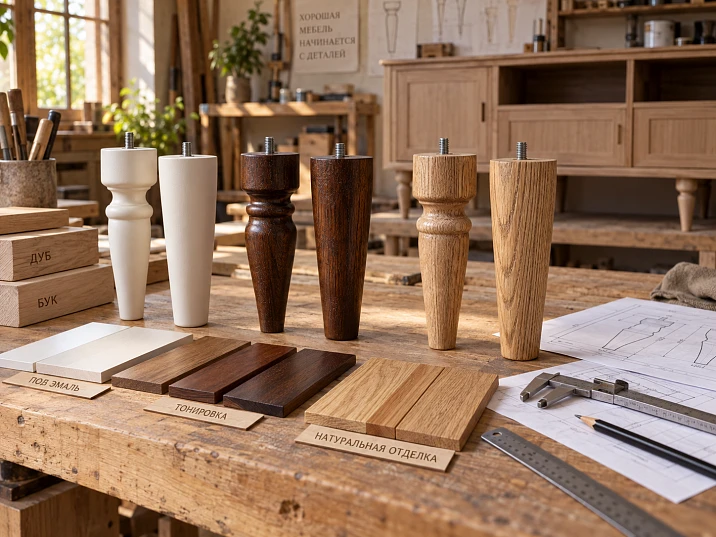
The leg shape has already been chosen, the drawing has been approved, and one question remains that at first glance seems minor: oak or beech. A mistake here costs more than it seems. Oak legs that the craftsman intended to coat with white enamel give up a noticeable part of the price for a texture that will disappear under the paint anyway. And beech legs sent under clear oil next to an oak body give themselves away by shade and grain immediately after the first coat.
The choice between the two species is determined not by price and not by the general reputation of "durable oak" and "delicate beech," but by the future finish. For opaque enamel, beech makes more sense. For tinting, oil, and clear lacquer, where the wood remains visible, oak is more often needed. If the furniture body is oak and the finish is clear, it is better not to change the leg species. Below is described how this is checked in practice, what the STAVROS catalog shows, and why you should compare not raw legs but the result after coating. The general choice of geometry, height, and mounting method is covered in the article about wooden furniture legs for a chest of drawers, nightstand, and console, so these questions are not repeated here.
Oak or beech: the choice begins with the future finish
Don't ask which species is better. Ask what will happen to the leg after the final coat of finish. Formulate four scenarios and determine which one is yours.
First: the leg will be fully painted with enamel. The wood is hidden, only the shape reads. Second: the leg will be tinted, coated with oil or clear lacquer, and the wood grain will remain visible. Third: the furniture body is already made of oak, and the leg must become part of the overall material system. Fourth: the body is under enamel, and the leg must contrast with it or, conversely, blend in.
Each scenario has its own logic of choice. In the first case, what matters is the surface, geometry, sanding, and preparation for coating, while the species plays a secondary role. In the second, the species becomes part of the design: the texture works as decor. In the third, the main thing is matching the body. In the fourth, the project's intent decides.
The manufacturer confirms this logic in the reference block of the product cards. Beech is described as a dense, non-porous wood most often used in products under enamel. Oak is described as a dense, porous wood with pronounced texture, often used in products with a semi-transparent finish that emphasizes the wood grain. The division by finish is the foundation of the entire range.




Why you shouldn't start with price
The price difference between species exists, and it should be checked in the card of the specific product: prices and dimensions depend on the configuration. But saving on the species loses its meaning if the result doesn't match the intent. An oak leg painted white is money paid for a grain no one will see. A beech leg under oil next to an oak table creates a visual dissonance that will have to be corrected.
Our factory also produces:
What to lock in before choosing
Write down four things: the finishing system (enamel, stain, oil, lacquer), the degree of coating transparency, the body wood species, and the expected color. If even one point is unclear, postpone the order and make a sample. The order here is this: the finish determines the species, not the other way around.
Get Consultation
When it makes more sense to buy beech legs
Beech is suitable where the wood remains covered after finishing, not where it needs to be shown. Let's look at two main scenarios.
The furniture will be painted with enamel
If the natural texture is almost completely hidden, the choice shifts from the expressiveness of the grain to other properties: surface, geometry, sanding quality, preparation for the coating. Beech is dense and non-porous, so it takes enamel evenly, without pores showing through, and small profile details read clearly. For turned legs with beads and transitions, this matters: a crisp line is more important than the grain pattern.
The manufacturer provides a preparation sequence for products that are coated with lacquer or enamel. First, dust removal after sanding, then uniform priming, after the primer dries, matting with light sanding for adhesion, then the finish coat in two layers with drying between layers. These four steps should be included in the process sheet if you paint the legs in the workshop.
A calm, uniform surface is needed
Uniformity matters for painted chests of drawers, cabinets, wardrobes, consoles, and colored furniture. When the legs need to look identical, beech's calm structure helps: differences between blanks are smoothed out by the paint. This is especially useful in a series where there are four or more legs per item and dozens of items.
Glue-up grade for enamel
There is a characteristic directly related to the choice of species. The catalog distinguishes two grades of lamella gluing. “Under enamel” means gluing without matching by color and texture: contrasting tonal and textural differences are observed, and such a blank should be chosen for painting with opaque materials. “Under tinting” means gluing with matching by color and texture: tonal and textural differences are possible, but less noticeable, and it is chosen for semi-transparent finishing. This must be recorded in the specification next to the species: beech under enamel is not the same as beech under tinting.
When beech is not the best choice
Beech is not suitable if you want to see an expressive wood pattern and large pores. It is also not suitable when the body is oak, the finish is transparent, and the difference in species will be noticeable. Finally, when tinting, beech requires caution: its dense, non-porous structure absorbs stain unevenly, and you need to check on a sample whether there is blotchiness. If the result is uneven, an equalizing primer or another finishing system will be required.
For painting, the master finds unfinished legs most convenient: the catalog of unfinished solid wood legs allows finishing the entire batch with one system. Details on selecting supports for enamel or tinting are collected in the article about unfinished wooden furniture legs.
When to choose oak furniture legs
Oak is chosen when the wood works as part of the design. There are two main cases here.
The texture must remain visible
Oak is porous, with a pronounced natural texture. It performs best under oil, clear lacquer, tinting and stain, as well as when patinated while preserving the wood grain. Large pores and characteristic fibers give depth that an opaque finish completely hides.
The manufacturer describes the oak color as ranging from light honey to golden brown, and in the product description notes that oak legs are especially appropriate in interiors with elements of natural wood, stone and textiles combined with neutral colors: white, gray, graphite. This is a guideline, not a rule: the actual tone after finishing is determined by the coating system.
The furniture body is made of oak
Then the leg material becomes part of the overall material system of the product. If an oak table or chest of drawers is coated with oil, a beech leg next to it will differ in grain and tone, even if the stain color is matched. Oak to oak gives a unified look.
What to consider
Oak requires attention to the selection of parts. Each leg has its own grain, and after a clear finish the differences are visible. If strict uniformity of the set is needed, compare the legs with each other before finishing and select pairs by tone. For tinting, order the "for tinting" variant, otherwise contrasting lamellas will show through the coating.
Another nuance concerns ordering. The product pages state that, if necessary, the manufacturer can produce products from other wood species, but only to order and subject to a minimum run. Standard legs from the catalog are produced in oak and beech.
What happens after coating
A furniture maker rarely sees a leg in the state in which it arrived. After sanding, primer, stain and lacquer, the material is perceived differently. Therefore, you cannot choose based on a photo of an untreated leg: it shows wood that will not be present in the finished product.
The correct way to compare is this. Take samples of both species, apply the same finish that is planned for the furniture, let them dry and compare under the lighting in which the product will be placed. Only then will you see how the species and the finishing system work together.
What the coating changes
Enamel hides the texture and preserves the shape. Stain reveals the pores and fibers, and different species react differently. Oil gives a soft tone and preserves the feel of wood. Lacquer adds depth and shine, while matte lacquer changes the color only slightly, and gloss increases contrast. Patina emphasizes the relief: dark tone remains in the recesses, light tone on the raised areas.
These effects cannot be predicted from the color name. The same stain tone looks different on beech and oak because the pores and density differ. The color name in a finishing materials catalog describes the composition, not the result on a specific species.
How to make a test sample
Take a sample of each species, preferably a whole leg rather than a cut-off piece: on a turned part, light and shadow depend on the shape. Sand it according to the same scheme you will use in the batch. Apply the chosen system in the same number of coats. Let it dry completely, because the color changes during polymerization. Compare the samples next to the cabinet or with a sample of the cabinet material. Photograph under daylight and artificial light.
The test sample must be kept. It serves as a reference for the entire batch and for repeat orders, and next to it the coating system is recorded: material, number of coats, drying time.
Comparison mistake
A common mistake: comparing two legs of different species coated with different compositions. Then you are comparing the compositions, not the species. Change one parameter at a time.
Under enamel: how important is the species
The balanced answer is this: the species still matters, but not for the appearance. It affects the surface, processing, end grain, sanding, and interaction with the coating.
A dense coat of enamel completely covers the wood, so the decorative value of the oak pattern ceases to be an argument. Paying for texture that will disappear is not advisable. But in practice, the species affects three things.
First: pores. Oak is porous, and under a thin layer of enamel the pores can show through as texture if you don't use a pore filler or a sufficient primer. Beech is non-porous, and it's easier to get a smooth surface.
Second: end grain. End cuts absorb more material than side surfaces, and this varies by species. Check the end grain on a sample: after primer and enamel, it should not differ in tone.
Third: sanding. Dense, uniform wood takes fine sanding more evenly, and the smoothness of the enamel depends on the quality of sanding. The catalog distinguishes two levels: "Standard" is machine sanding at a more attractive price, "Prestige" is detailed hand sanding, after which the products require no additional finishing. For legs to be painted, the sanding level is often more important than the species.
Practical conclusion
For legs under opaque enamel, choose beech of the "under enamel" grade and check the sanding. If the carcass is oak but is painted with enamel, beech will not break the unity: under paint, the species are not visible. If you have a reason to choose oak under enamel, for example project requirements for the species, be prepared for more thorough pore preparation.
This allows you to naturally answer the request for furniture legs for painting: look for unfinished options in beech, check the gluing grade and sanding level in advance, and then paint the entire batch with one system.
For tinting: why oak and beech cannot be considered interchangeable
With transparent and semi-transparent finishes, the pattern remains visible, and the grain works in the overall composition. The same stain color is perceived differently on different species. The reason is the wood structure: oak with large pores and pronounced layers absorbs the coloring compound unevenly, leaving deep dark lines in the pores, while beech is denser and more uniform, and the coloring turns out softer, but spots are possible.
The main advice: what needs to be approved is not the color name, but a real sample. The species plus the specific finishing system produce a result that cannot be derived from a paint catalog.
"For tinting" grade
For semi-transparent finishing, choose the "for tinting" gluing grade: the lamellas are matched by color and texture, and the differences are less noticeable. If you buy the "for enamel" option and cover it with stain, the contrasting lamellas will show through as stripes.
Test on a sample
What to look for in a stain test for tinting:
-
evenness of tone across the surface;
-
behavior of the end grain: whether it darkens more than the side faces;
-
grain pattern appearance: whether it matches the intent;
-
blotchiness, especially on beech;
-
tone after lacquer: it is usually deeper than right after stain.
What to do if the result is uneven
If beech blotches, try a leveling primer, gel stain, or a lighter tone. If oak shows too much contrast, choose a less saturated product. Test solutions on a sample, not on the batch.
When the wood species hardly matters
If the tint is dense, dark, almost opaque, the differences between species diminish. Then the choice is determined by the remaining factors: the grade of the glue-up, the sanding, the price. But this too must be verified with a finish sample, because an "almost opaque" finish in practice often turns out to be more transparent than expected.
If the carcass is oak: should the leg be oak?
The answer "yes" is too simple. It depends on what will be visible.
Visible natural wood: matching the species is significantly more important. If both the carcass and the legs are under oil or clear lacquer, the difference in species, grain pattern, and tone is immediately noticeable. Here, choose oak to match oak and check the finish sample next to the carcass.
Fully opaque enamel: the material may not be visually readable. If the carcass is oak but painted with enamel, a beech leg under the same enamel looks the same. Saving on the species does no harm.
Contrasting design: the leg may intentionally differ. Light beech legs on a dark oak carcass or dark tinted legs on a light carcass create a graphic effect. The contrast must be obvious and deliberate: a slight difference looks like a mistake, while a large one looks like a decision.
How to decide
Ask three questions. Is the wood of the carcass visible? Is the wood of the leg visible? Do I want them to match or contrast? If the answers are "yes, yes, match," choose a single species. If "no, no," the species doesn't matter. If "yes, yes, contrast," make the contrast obvious.
Example
A chest of drawers made of solid oak under oil, with legs that should look like part of the carcass. Choice: oak legs, grade "for tinting," finished with the same oil in the same number of coats. Verification: a leg sample next to a facade sample in daylight.
Another example: an MDF cabinet under white enamel on legs that should look warm and natural. Choice: beech legs under oil as a deliberate contrast with the white carcass. Here the species is determined by the desired effect, not by the carcass.
Turned legs: oak or beech
The turned geometry itself creates beads, necks, transitions, and light-and-shadow. That is why the material and finish are especially noticeable on a complex profile. Section Turned Legs the catalog contains legs of various shapes, and for many of them both wood species options are listed.
How shape interacts with material
A turned leg has many surfaces at different angles to the light: a sphere, a cone, a neck, a bead. Each of them receives the coating in its own way. Under enamel, the shape does the work: shadows at the transitions create the pattern, and the wood species is not visible. Under a transparent finish, the grain pattern is added to the shadow, and on rounded parts it looks different than on a flat surface: on a sphere and a cone the fibers form characteristic arcs.
Hence the practical conclusion: for a complex profile under enamel, choose beech; for a complex profile with visible wood, choose oak, but check with a finish sample on a whole leg, not on a flat sample.
Example from the catalog: MN-233
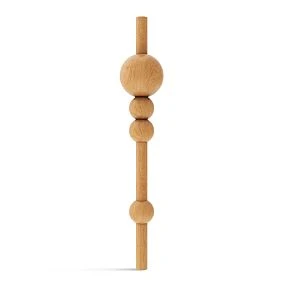
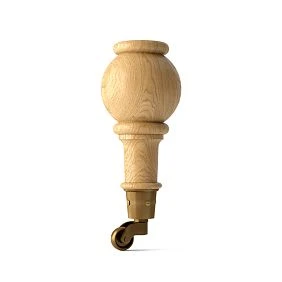
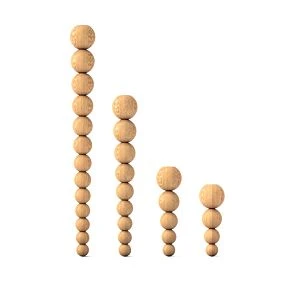
Turned furniture leg MN-233 is available in oak or beech as a choice. According to the description, it is a cone-shaped leg visually resembling a garland of balls with a diameter decreasing from top to bottom. It is intended for legless constructions and designed for small loads. It is mounted vertically or at an angle: the lower ball compensates for the tilt. It is used for coffee tables and bedside nightstands.
The dimensions in the product card are given in four options: 198, 247, 443, and 635 mm in height with a main part diameter of 72 mm and a top part diameter of 36 mm, where the mounting hole is located. For this shape, the choice of wood species is critical: the successive spheres create many transitions of light. Under enamel, the leg reads as a rhythm of balls; under oil, texture is added. For mounting, the recommended hardware: metric stud or M8x60 screw (FUR-001-1, 72 rubles), sets FUR-001 (117 rubles) and FUR-012 (152 rubles), mounting plate 10° (FUR-017 from 330 rubles). Prices at the time of checking.
Example from the catalog: MN-220
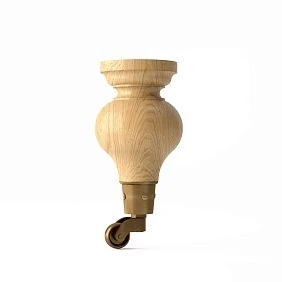
Turned leg MN-220 At the time of checking, it costs from 1,670 rubles. The description calls it a spherical leg 105 mm high for poufs, low cabinets, and small cupboards, and also states that it is made of oak or beech with an unfinished surface so you can choose the shade. Recommended hardware includes a felt glide d=24 mm (FUR-027, 55 rubles). The low spherical shape with a smooth surface works well under enamel, while under a clear finish the sphere will show the grain pattern on its convex surface.
All legs in the catalog, as stated in the FAQ section, withstand a vertical load of at least 100 kg. For MN-233 it is separately noted that it is designed for light loads, so check the load on the specific product page.
Carved legs: when texture competes with relief
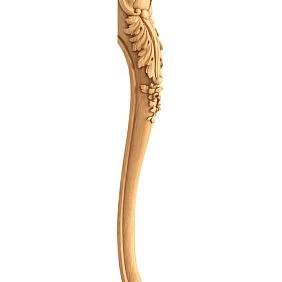
In complex carving, form, light and shadow, texture, and finish all work at once. Section Carved legs for furniture contains supports with relief. Here the species and finish affect perception most strongly, because relief and texture can compete with each other.
If the enamel is opaque, the relief is the main thing. The species is hidden, and the depth of the carving creates shadow. Thick enamel clogs fine details, so apply it in thin layers and test on a sample to see whether the pattern is lost.
If the finish is clear, the relief and the wood grain work together. Oak adds pronounced texture, which on a carved piece can make perception more complex: the grain crosses the relief and creates an additional pattern. For fine carving this is sometimes unnecessary, and beech, with its calmer structure, allows the relief to read more clearly. For large carving with broad flat areas, oak looks advantageous.
Patina
For carved legs under patina, the species matters less than the preparation. The dark composition settles into the recesses, the raised areas are wiped, and the effect depends on the crispness of the carving and the evenness of the base. Test on a sample how the patina behaves on the chosen species.
Be careful with the price
Carved legs vary noticeably in cost. In the product pages for unfinished legs, examples include items from 2,400 rubles (MN-041) and from 2,550 rubles (MN-052) up to 18,440 rubles (MN-035). This means choosing the species is only part of the question: the complexity of the carving affects the price more strongly. Prices are as of the time of checking; before ordering, check the product page.
When carved legs are not needed
If the body is smooth and modern, a carved leg will fall out of style. If the leg is in shadow or hidden, the relief will not be visible. If the finish is dense and the relief is hidden, it is better to take a turned or geometric leg and not pay for carving.
Geometric legs: the material is more noticeable than it seems
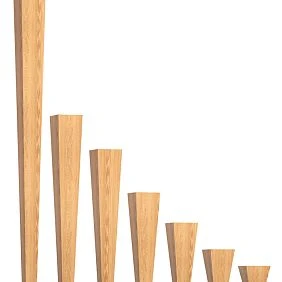
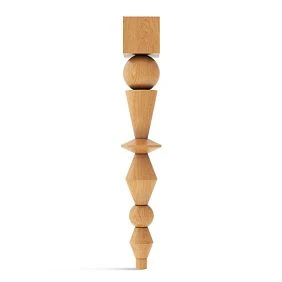
A calm geometric leg has no complex carving that pulls attention. Therefore, with a natural finish, the wood surface becomes one of the main visual factors. The section geometric furniture legs includes supports with facets, bevels, and clear shapes.
Flat facets show wood best of all. The oak pattern on a plane looks like a pattern, and the difference between a selected and unselected batch is immediately visible. Beech on a plane looks calm and uniform, and in a series the differences are almost unnoticeable.
Example from the catalog
Geometric leg MN-186-1 is available in oak and beech. In its product card, glides are recommended: round d=19 mm (FUR-021, 130 rubles) and felt d=24 mm (FUR-027, 55 rubles). Nearby, in the "customers also buy" block, the geometric leg MN-186 is listed from 1,280 rubles. The combination of flat facets and clear edges makes such a leg dependent on surface preparation: any unevenness in sanding is visible. Therefore, the "Prestige" level is justified here.
Modern legs, for example MN-241, are placed in a separate catalog group. Check the materials, dimensions, and finishes of a specific model in its product card.
How to choose a wood species for a geometric leg
For enamel, choose beech: sharp edges hold paint evenly, and the pores do not interfere. For oil or lacquer, choose oak if you want to see the grain, or beech if you want a calm, light surface. When tinting flat faces of oak, the tone will be deeper than on rounded shapes, so test the stain on a flat face specifically.
There is also a feature of the edges. A sharp edge, when coated with enamel or lacquer, often ends up with a thinner layer than the flat surface, and the coating wears off faster at the corners. A slight rounding of the edge before finishing increases the durability of the coating. Check whether the geometry allows such processing.
Finished coating or unfinished leg
The catalog divides supports into two types: unfinished and with a finished coating. The choice depends on who will finish the product and how.
Unfinished
They are chosen when the craftsman wants to match the color of the cabinet, paint the entire piece with one system, tint it themselves, use their own enamel, or create a uniform finish for a batch. This is the main option for a workshop. In the section unfinished solid wood legs the majority of items are collected.
The advantage is obvious: you control the color and the system. The limitation is also clear: you need time and equipment for finishing, as well as a sample before a production run. As noted in the product cards, items from stock are stored unpolished and shipped within three business days, and if the item is not in stock, the average production time is 5–10 business days.
With coating
Choose when you need a ready-made component without additional finishing. Section legs with a ready-made finish includes legs with a pre-applied finish. This saves time but limits color choice: what's in the catalog is what you get. Such legs will only match the cabinet if the color and sheen match, and this should be verified with a sample.
How to choose
If you have your own finishing system and a cabinet in the required tone, choose unfinished ones. If you need one or two legs and finishing them separately doesn't make sense, choose pre-finished ones. If you're producing a series, always choose unfinished: a single system from one batch gives a consistent result.
The manufacturer also states that they paint products when orders total 150,000 rubles or more. For small workshops, this is a threshold worth considering when planning.
First the specific product code, then the material
This is an important limitation. Not every design automatically means you can choose any wood species, any size, and any finish option. The order is: model, available versions, material, size, finish.
Wrong approach: I want an oak leg, so any leg can be made in oak. Correct approach: choose a model, open the product page, check which materials and sizes it's available in, then choose the species and finish.
What to check on the product page
-
Which materials are available: oak, beech, or both.
-
Which sizes are available: for MN-233 there are four height options.
-
What sanding quality: "Standard" or "Prestige".
-
What type of gluing: for enamel or for tinting.
-
What coating, if the item is not unfinished.
-
What hardware is recommended for installation.
-
Availability: "in stock" or production time.
Non-standard versions
If the required wood species or size is not available, the manufacturer states that it produces non-standard items to individual designs, but only accepts batch orders for production, and other wood species are possible to order. For single legs, this is usually not an option. So if your project requires a leg in a wood species that is not listed in the product page, it is easier to choose another model.
Work order
Choose the shape, then open the product page and look at the available materials, not the other way around. If the required wood species is unavailable, look for another shape. This sequence saves weeks.
One set: one wood species and one batch
For four supports of one piece of furniture, you cannot assemble a set randomly: two beech and two oak, different batches, different preparation. This is especially risky with a clear finish, where the differences are immediately visible.
There are two reasons. First: the species. Even with identical finishing, beech and oak produce different grain and tone. Second: the batch. Wood from different batches can differ in color and density, and preparation (sanding, primer) can vary. Even within a single species, different batches show noticeable variation.
How this is recorded
For a furniture series, enter five fields in the parts list: item code, material, size, finish, quantity. Example row: MN-233, oak, 443 mm, oil in two coats, 16 pcs. If you later need to reorder, you can reproduce the composition exactly.
What to do if the batch varies
If legs arrive from different batches and the differences are noticeable, lay them out and group them by tone so that each set gets similar ones. Use the most uneven ones for hidden places or enamel. For new orders, request the entire volume from a single batch and inform the manager in advance.
Set and reserve
For four legs per item, the purchase equals four. Determine the reserve by risk: when tinting oak, the probability that one leg won't match in tone is higher than with enamel on beech. Record the reserve as a separate line rather than dissolving it into the total figure.
Trial leg before ordering a series
For small furniture production, a simple scheme works: one leg, fitting, sanding, chosen finish, approval, the whole set. Skipping any step turns the series into an experiment.
What to check:
-
color after coating under daylight and artificial light;
-
the texture and grain of the wood on the actual shape;
-
surface: quality of sanding, condition of the ends;
-
scale: how the leg looks on the product;
-
geometry: dimensions matching the drawing;
-
compatibility with the body: color, sheen, species;
-
the result after finishing as a whole, including the ends and the lower part.
How to order a sample
The catalog ships all products from a single unit, so you can buy a sample without any minimum order commitment. Order two legs: one for finishing, the second as an unfinished reference for comparison. If the item is "in stock," shipping takes up to three business days; if not, the lead time is 5–10 business days. Keep this in mind when planning: the sample should arrive in advance.
What to record based on the results
SKU, species, glue-up grade, sanding level, finishing system, number of coats, drying time, result, and date. Keep the sample with its tag. Six months later, when you need to repeat it, this will save you a day of work.
When a sample is not needed
For an article and wood species that you have already used and approved, a repeat sample is unnecessary. It is also not needed for a single leg that goes into a one-off piece: the order itself serves as the sample.
Examples of STAVROS products in oak and beech
Abstract reasoning about wood species is more useful when backed by specific items. Below are four models verified against catalog cards.
| Model | Type | Material | What is known from the card |
|---|---|---|---|
| MN-233 | Turned | Oak or beech | Four heights: 198, 247, 443, 635 mm, diameter 72 mm, for tsarg-free constructions and light loads |
| MN-220 | Turned, ball | Oak or beech | From 1,670 rubles, height 105 mm, for poufs and low cabinets |
| MN-186-1 | Geometric | Oak or beech | Recommended glides FUR-021 and FUR-027 |
| MN-241 | Modern | Check in the card | Specifications from the card |
These examples show a pattern. Different shapes depend differently on the wood species. The MN-220 sphere under enamel reads as a clean volume, while under oil it shows the grain on the rounded surface. The rhythm of the MN-233 spheres enhances any finish. The geometry of MN-186-1 requires even sanding for any wood species.
How to use the examples
Compare not by pictures, but by dimensions and purpose. MN-233 at 635 mm suits a tall table or console, while at 198 mm it suits a bench or bedside cabinet. MN-220 at 105 mm high is a low support for a pouf. Before choosing a wood species, make sure the size and load suit your piece.
For installation, see the recommended hardware in the product card: for MN-233 it is an M8x60 stud and mounting kits, for MN-220 and MN-186-1 it is glides. Check that the hole diameter and fasteners are compatible with your construction: fastening is covered in more detail in the general article about legs, and we do not return to it here.
Purchase calculation for a series
The formula is simple: the number of legs per piece multiplied by the number of pieces gives the base purchase. A series of ten cabinets with four legs each requires 40 legs of one model, one wood species, and one batch.
Example solution
The workshop makes ten cabinets. The body is MDF under white enamel, and the legs should be light and calm. Choice: MN-220, beech, grade “for enamel”, sanding level “Prestige”, white enamel finish in two coats over primer. Purchase: 40 legs plus a reserve for the risk of damage during finishing, determined separately. FUR-027 glides for 40 legs, at 55 rubles each that is 2,200 rubles. Calculate the final price of the legs from the product card, because the “from” price depends on the specification.
Second example. Six consoles made of solid oak under oil, the legs should look like part of the body. Choice: MN-233, oak, “for tinting”, height 443 mm. Purchase: 24 legs plus reserve. Here, set aside a more generous reserve, because with a transparent finish, tone matching may reject some parts.
Procedure
-
Choose the model and wood species based on the future finish.
-
Order a sample.
-
Make a color sample and approve the article number.
-
Calculate the purchase and reserve.
-
Order the batch as a single delivery.
-
Verify the batch against the sample upon receipt.
Where to buy solid wood furniture legs
The purchasing logic follows the project: first the shape, then the species and finish, then the sample, then the batch.
-
Wooden furniture legs: general section of supports.
-
unfinished solid wood legs for enamel, tinting, and a unified finish.
-
legs with a ready-made finish, when a ready-made component is needed.
-
Turned Legs, carved legs и geometric legs by shape type.
Order conditions
According to the catalog, items are shipped from a single unit. Delivery is available across Russia and to CIS countries via CDEK and DPD, or by pickup from the warehouse; showrooms are located in St. Petersburg and Moscow, and production is in St. Petersburg. In-stock items are shipped within three business days, while made-to-order production takes on average 5–10 business days. Before ordering, the manufacturer recommends starting with the drawings, which can be downloaded from the website.
What to clarify with the manager
Availability of the required species and height, glue-up grade, sanding level, and the possibility of supplying the entire batch at once. If a species outside the catalog is needed, the minimum order terms. Before ordering, check the current price and availability in the product card.
Furniture makers' questions
Which is better for furniture legs: oak or beech?
There is no universal answer. Beech is better for enamel and a uniform surface, oak for oil, lacquer, and tinting with visible texture. First determine the finish, then the species.
Which legs are best to buy for enamel?
Beech, unfinished, "for enamel" grade, with sanding checked. The species is not visible under an opaque layer, and beech's dense, non-porous structure makes it easier to achieve a smooth surface.
What to choose for stain: oak or beech?
If you need a pronounced grain pattern, choose oak of the "for tinting" grade. Beech gives a calm tone, but it can become blotchy when stained, so check with a test sample. Don't compare color by name: compare samples.
Can beech furniture legs be painted?
Yes, this is the main scenario for beech. Follow the manufacturer's recommended sequence: dust removal, primer, light sanding after drying, then enamel or lacquer in two coats with drying between coats.
Can oak legs be tinted?
Yes, and this is one of the main scenarios for oak. Order the "for tinting" grade and do a test sample before the full run, because the pores and grain pattern affect the final tone.
Should the species of the legs match the furniture body?
If the wood is visible in both places, matching is desirable. If the body and legs are under opaque enamel, the species doesn't matter. If you want contrast, make it obvious.
Which legs are better for clear lacquer?
Most often oak, because lacquer emphasizes the texture. Beech will also work if you need a calm light tone. Check a sample with the same lacquer as on the body.
How can I check the leg color before ordering a set?
Order one leg, coat it with the chosen system, let it dry, and compare it with the body in daylight. Keep the sample as a batch reference.
Should I buy a sample leg before a production run?
For a new SKU, yes. A sample verifies color, texture, surface, and scale. Shipping from one piece lets you do this without committing to a batch.
Where can I buy oak or beech furniture legs?
In the STAVROS catalog in the section unfinished solid wood legs and in the general section Wooden furniture legs. Before ordering, check the current price and availability in the product card.
The specifications of MN-233, MN-220, and MN-186-1, hardware prices, glue grades, sanding levels, and ordering terms were verified against the STAVROS catalog cards at the time of preparation. Calculations are illustrative.