








































































Article Contents:
- What people buy under the name “beech leg”
- Why the future finish is determined before ordering
- When beech is chosen for opaque enamel
- “For enamel” and “for tinting” refer to preparing the workpiece
- Tinting changes the color of beech while preserving its wood grain
- Clear lacquer and oil also change the perception of the surface
- Beech or oak — a short comparison by task
- How the shape of a beech leg relates to the coating
- Turned profile
- Carved relief
- Simple geometry
- Can the stain be checked only on the bottom end of the leg?
- Can one painted leg be replaced while keeping the others?

A beech leg was tinted to match the color of an oak facade. From a distance the shade looks similar, but up close the difference remains: the body shows pronounced pores and wood grain, while the surface on the support looks different. Another layer of stain changes the color but does not turn beech into oak.
For furniture under opaque enamel, the task is different: it is more important to coordinate the shape, surface preparation, color, and gloss. That is why beech furniture legs are chosen together with the future finish and the construction of the body. First, the suitable support is determined, then the beech version is checked and a sample is prepared in the coating system that will be used in production.
Beech can be left under clear lacquer, coated with oil, tinted, or painted with enamel. The decision depends on whether the wood should remain visible. The species determines the base material, while the required height, joint strength, and appearance of the finished furniture must be coordinated separately.
What people buy under the name “beech leg”
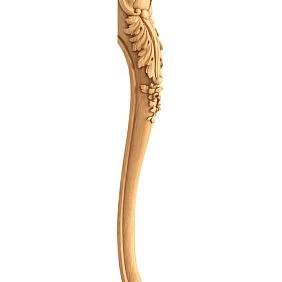
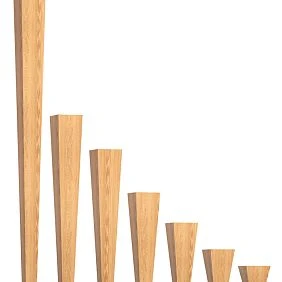
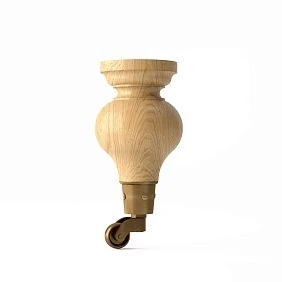
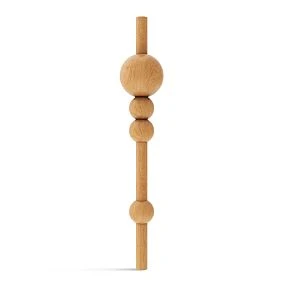
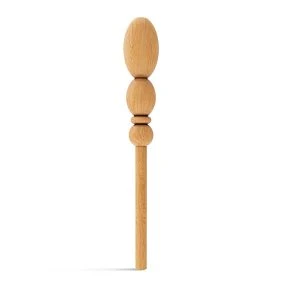
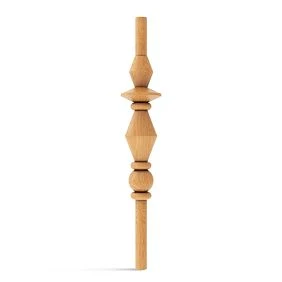
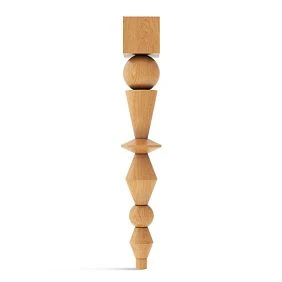
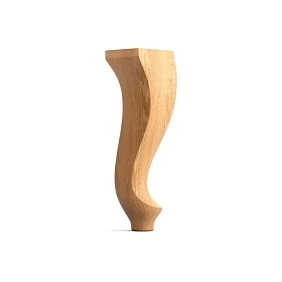
A ready-made beech furniture leg already has a formed geometry: a turned profile, carved relief, or simple facets. The workshop does not need to recreate this shape. However, the degree of preparation for installation is determined by the chosen version: the surface may require finishing, and the fasteners may need to be purchased separately.
The label “solid beech” does not automatically mean that the part is cut from a single solid piece. The blank may be glued from wooden lamellas. It is still a product made of natural wood; the manufacturing method and appearance requirements should be clarified by model and blank variant.
Under a clear finish, the boundaries and differences of the lamellas can become a noticeable part of the pattern. For opaque paint, what matters more is how the surface is prepared and whether the blank matches the chosen technology. Therefore, it is not enough to leave only the word “beech” in the order.
A complete entry links several parameters: item code, size, material, blank preparation, sanding, coating, and fastening. If at least one of them is changed, the result will be a component with different readiness or appearance, even if the model name remains the same.




Why the future finish is determined before ordering
The choice of finish affects which version of the leg will be needed. For white enamel and for clear lacquer, the requirements for wood selection differ. If you first buy a set without clarifying these conditions and then decide to leave the texture open, the result may not match the intent.
Start with the role of the support in the furniture. On a painted chest of drawers, the legs may continue the color of the body; on a cabinet with smooth fronts, they may create an independent wood accent; on an armchair, they may coordinate with the visible frame and upholstery. In each case, the sample is evaluated next to the actual neighboring materials.
Then determine where the finishing is done. A workshop with its own painting preparation can include beech legs in the overall process. If a ready-made component is needed, you have to select the available coating for the specific model and check its compatibility with the body.
The installation sequence also matters. A leg that is painted before installation must be held during coating application and the designated mounting areas must be protected. If the parts are finished when assembled, check access to the upper part of the profile and the ability to evenly treat the inner surfaces. These decisions are best made before the set is put into work.
Our factory also produces:
When beech is chosen for opaque enamel
Beech is a logical candidate for supports that should be perceived as an extension of the painted carcass. It is considered for white, grey and coloured chests of drawers, cabinets, chairs and consoles, where the open wood texture is not the main expressive means.
But the choice of species alone does not guarantee a smooth surface. Machining marks, raised grain in recesses, and insufficient preparation may remain visible after painting. A thick coat of enamel does not replace sanding and can alter the perception of fine texture.
For a uniform color with the facade, coordinate not only the shade according to a sample or color system, but also the degree of gloss. The same paint on a flat door and a convex leg reflects light differently. Therefore, a matching color designation still needs to be verified on parts in their working position.
Pay especially close attention when comparing beech with a carcass made of another material. For example, an enameled beech support and an MDF facade may require different substrate preparation. The goal is to achieve a consistent appearance of the finished furniture, not necessarily to apply the same amount of primer to both materials.
For a glossy finish, inspect the long highlight on the leg: it helps reveal unevenness that is almost invisible on a matte blank. The check is performed after the full finishing cycle. Approval of a primed surface confirms only an intermediate stage if the final gloss has not yet been applied.
If the project requires visible wood texture, opaque painting does not solve this task. In that case, a different blank finish is selected and a transparent or semi-transparent finishing system is checked.
Get Consultation
“For enamel” and “for tinting” designate blank preparation
In the description quality of solid wood products STAVROS distinguishes blanks for enamel and for tinting. For the first option, the lamellas are not matched by color and texture; for the second, they are matched, but tonal differences between items are still possible.
The designation “for enamel” does not mean that the leg has already been primed or painted. It refers to the blank finish. The presence of a finished coating is checked separately in the product card and selected options.
Sanding is another parameter. The “Standard” category includes milling and machine sanding; “Prestige” includes additional detailed hand sanding. The choice of a specific option must correspond to the planned preparation in the workshop.
Suppose a trial leg was additionally sanded before painting, but for the series it was decided to apply primer immediately. Formally, the article number and species match, but the technological path already differs. To reproduce the result, record both the purchased finish and the operations performed after receipt.
Tinting changes the color of beech while preserving its wood grain
Wood stain helps bring the shade of a beech leg closer to other furniture elements. It does not create the pores and fiber arrangement characteristic of another species. The color name "oak" describes the color reference of the finishing material, not the material of the finished leg.
If the carcass is finished with oak veneer and remains under clear lacquer, compare the beech leg with it in person. Two different outcomes are possible: a color-matched set with differing texture, or a deliberately noticeable contrast of materials. Both solutions are acceptable when chosen consciously.
On a turned or carved surface, different areas of the grain emerge at different angles. After tinting, certain spots may read darker than neighboring ones. Do not try to correct any difference with an extra coat: first determine whether it is due to absorption, surface preparation, or simply a shadow from the relief.
For a new color, it is useful to compare several samples on blanks of the same species, and to reproduce the chosen option on a whole leg. Transfer the formula into a process record: composition, application method, preparation, and topcoat. A shade name from a catalog is not enough for reproduction.
Clear lacquer and oil also change the perception of the surface
Under a clear finish, the material becomes part of the design. The original color, grain, areas of lamellas, and the characteristics of the specific part are visible. For such a project, beech legs are selected based on the result of a full finish, not just the appearance of a dry blank.
A colorless coating does not necessarily preserve the appearance of untreated wood. It can enhance the color and contrast of the grain; gloss also affects perception. This distinction is separately explained by coating manufacturer Osmo: transparency and the absence of pigment are different characteristics of a coating.
If you need a light, almost untreated look for beech, make this the specific requirement when selecting a system. Do not assume that any clear oil or lacquer is suitable in advance. Compare a dried sample with the cabinet front, handles, and other exposed wooden parts.
The name “oil” also does not describe a single technology. Formulations differ in application method, the need for additional coats, and the conditions for being ready for use. For the chosen product, use its instructions, not a general schedule carried over from another can.
Beech or oak — a quick comparison by task
Comparing wood species is useful after defining the desired result. Beech usually has a more subdued wood grain, while oak has more pronounced pore and fiber texture. But the final choice is still made based on a sample in the required finish.
| Furniture task | What to consider for beech | What to consider for oak |
|---|---|---|
| A single opaque color for the cabinet body and supports | A suitable candidate; preparation and gloss approval are required | Applicable, but the desired surface appearance should be verified with your own preparation system |
| Light visible wood | Evaluate the natural shade of beech after coating | Evaluate the prominence of the grain and its combination with the facade |
| Match with an open oak carcass | Tinting can bring the color closer, but the pattern will remain different | The same species simplifies coordination, without guaranteeing identical texture |
| Contrasting wooden support under a painted carcass | A subtle wood accent is possible | A more pronounced textural accent is possible |
The strength of a specific leg is not determined by this table. The performance of the support is affected by cross-sections, height, blank, joint, and load conditions. There is no basis to consider any beech model suitable for heavy furniture just because of the species name.
If the task also involves choosing between two materials, it is covered in more detail in the article “Oak or beech furniture legs”Once beech has been selected, the next step is to find a suitable geometry and execution for the agreed finish.
How the shape of a beech leg relates to the finish
Turned profile
У turned furniture legs the surface changes direction around the entire circumference. A bead reflects light differently from a narrow neck, while the underside of a rounded section remains in shadow. That is why a single color on such a support looks different from different sides.
Under enamel, the smoothness of transitions, clarity of the profile, and uniformity of the coating around the axis are assessed. Under tinting, they additionally check how the wood grain runs through the thicker sections. It is useful to rotate the sample during inspection: in furniture, the other side of the leg may be visible.
Carved relief
У carved furniture legs they check the recesses, the edges of the leaves and the transitions of the ornament to the mounting part. At the preparation stage, one must not smooth over the details for which the model was chosen.
Enamel leaves the form open to perception through light and shadow. If primer or paint accumulates in the recesses, fine transitions may become less distinct. With patination, by contrast, the distribution of the composition in the relief becomes part of the coordinated pattern. Both results are checked on a real beech leg.
Simple geometry
geometric furniture legs they are suitable for comparison with laconic fronts of cabinets and chests of drawers if the model allows the required use. The calm shape makes the evenness of the planes, the direction of the grain, and the quality of the edges more noticeable.
An opaque finish does not automatically hide a wave from processing or a rounded corner. Under a transparent finish, additionally compare the texture on the sides facing the viewer. If the turn of the leg is set by the joint, one can no longer choose a beautiful side separately from the mounting scheme.
Dimensions A, B, C, and D are read from the specific product card
The catalog uses different dimension chains. One model lists two parameters, another lists three, and the third may be D. One must not transfer the value of a letter from one leg to another without the diagram.
Examples of finishes for which a bow is provided in the STAVROS product cards:
| Model | Shape | Example of a dimension entry |
|---|---|---|
| MN-145 | Turned | A × B: 150 × 44 mm |
| MN-044 | Carved | A × B × D: 140 × 57 × 36 mm |
| MN-192 | Geometric | A × B: 150 × 60 mm |
The table shows differences in geometry and designations, but does not offer interchangeable supports. For each model, the overall height, maximum and minimum cross-sections, upper mounting part, and lower base are determined separately.
For example, for MN-145 the manufacturer specifies light loads and use in frameless structures; versions longer than 450 mm are recommended for light wall-mounted consoles and coffee tables. Choosing beech within this card does not override the model's limitations.
When comparing, look at the thin sections of the profile, not just the widest roll or carved thickening. The external bulkiness of the part does not indicate how large a surface adjoins the cabinet or where the mounting is located.
What to check for your cabinet
It is more convenient to select a support by furniture type, but the application category serves only as an initial filter. Within it, there remain different heights, shapes, and mounting solutions.
| Furniture | What to check along with the beech support |
|---|---|
| Dresser, wardrobe, or cabinet | The weight of the cabinet with contents, the support areas of the bottom, the position of the fronts, and the overall color |
| Sofa | Frame, load during use, seat height, central supports, and transformation mechanism |
| Chair | Geometry of the front and rear supports, seating height, position of visible wooden parts |
| Table | The base, the apron, the connection to the tabletop, and the legroom |
For a painted chest of drawers, the transition between the lower edge of the body and the upper part of the leg is especially noticeable. In the drawing the color matches, but in reality a shaded gap or a visible mounting plate may appear between the parts. Check this area during a trial assembly.
For upholstered furniture, compare the beech support with the upholstery under working lighting. The wooden part usually occupies a small portion of the overall appearance, but a contrast in shade or sheen next to the fabric can make it far more noticeable than expected from the catalog photo.
The leg height must be included in the furniture calculation
For direct installation, the final height is the sum of the body size from the selected base plane and the height of this plane above the floor. The second value includes the actually installed leg and the effect of the mounting unit.
A hypothetical example: the cabinet from the lower base to the top cover has a height of 560 mm. The leg is 150 mm, the plate adds 4 mm, the glide adds 2 mm, and the mounting recess is located 12 mm above the lower base. The final height will be 560 + 150 + 4 + 2 − 12 = 704 mm. These numbers describe one connection example and do not refer to a specific item from the table.
The clearance under the furniture is checked separately. If the lower rail protrudes downward relative to the base, it will reduce the free distance to the floor. For a sofa or armchair, the seat height of the assembled item is additionally assessed.
Adjusting the final height by trimming already finished beech legs is inconvenient: the end face, the area for the glide, and the finish will change. The correct size is best confirmed before applying the coating.
The material does not replace checking the fastening
A beech support must transfer loads to the intended load-bearing part of the furniture. A thin bottom, an unsuitable plate, or fasteners at the edge of the base do not become reliable just because solid wood was chosen.
Check the top plate: its shape, the actual contact area, the position of the hole, and the available installation depth. Then select furniture hardware for legs — a hanger bolt, threaded insert, plate, or another specified connector.
The pilot hole diameter and installation procedure are taken from the documentation for the specific fastener, taking the wood into account. A metric thread designation is not a universal drilling diameter in beech. The fastener length must also match the available thickness of the part.
Before finishing, perform the specified trial assembly. Clarify which surfaces need protection from the coating, where metal will contact wood, and whether a finished end face is acceptable in this joint. Requirements may differ for a glued joint and for a detachable threaded fastening.
Coordinate the glide together with the leg. It affects contact with the floor and the working height. For angled installation, separately check the compatibility of the support, the mounting part, and the lower contact surface — the wood species itself does not determine an acceptable angle.
Unfinished leg or a ready-made finish
from STAVROS open boundless possibilities for designers, furniture makers, and anyone striving to create unique high-quality furniture. are convenient when the workshop itself coordinates the color and sheen of the entire product. The geometry has already been formed, and finishing is integrated into its own process: surface preparation, testing, primer or tinting, and the necessary final coats.
This option is especially useful for a non-standard cabinet color. There is no need to adjust the front to a randomly matching shade of a ready-made support. However, the workshop must allow time, equipment, and materials for finishing the selected profile.
If you need a component ready for assembly, consider furniture legs with finish. Check the specific item number, size, species, and available finish option. The availability of a painted leg category does not mean that any unpainted product is made in all colors.
The finished coating also needs to be matched to the body. If the leg is planned to be repainted, a separate compatibility check of the old and new systems will be required. Buying a painted part just to subsequently remove the coating can add work instead of the expected reduction in preparation.
When to start with one trial beech leg
A single specimen is useful for a new article number, an unfamiliar profile, a different fastening, or a new color. Order it in the material and preparation variant you are considering for the set. An oak sample will not confirm the tinting result for beech, even if the geometry matches.
First measure the part and check the connection with the intended base. Then perform a finishing test. This order helps avoid spending painting work on a model that does not fit properly.
One leg shows the treatment, color, and performance of an individual connection. To check the overall scale, the height of the assembled furniture, and stability, a full trial set is needed. If the front and rear supports of an armchair differ, testing one model does not resolve the question for the other.
In the section product samples materials can be selected for preliminary comparison, but a swatch or a sample from another product does not replace the specific leg. For the profile and mounting dimensions, the exact profile being checked is required.
Before processing, determine the fate of the first part. It may go into the finished product, remain as a reference, or be used for testing. If several shades were compared on it, additional holes were drilled, or the connection was tested destructively, it cannot be counted in advance as a full-fledged part of the future set.
How to make a trial finish sample that can be repeated
Prepare the leg in the same way as the others will be prepared. If additional sanding is used on the sample, it must appear in the work instruction. Otherwise, with the same paint and the same article number, the surface of the batch may look different.
Record the finishing sequence. For an opaque option, this is the selected system of preparation, priming, and painting; for a transparent one, preparation, tinting if necessary, and an agreed final coating. Compatibility materials for installation and finishing is checked against the documentation for the specific products.
Inspect four characteristic zones of the leg: the wide side surface, the narrow neck or transition, the recesses of the relief, and the lower part near the foot pad. For a simple geometric model, instead of recesses, evaluate the faces and the junctions of planes. One successful front face does not yet show the condition of the entire part.
After the required holding time, place the sample under or next to the body at the required height. Color and gloss are agreed under working lighting. Under a bright lamp in the painting area, surface defects are detected, but such light may differ noticeably from the lighting of the finished furniture.
Record the compositions, color, degree of gloss, application method, and the preparation performed. The number of layers without specifying materials and technology does not allow the result to be reproduced. For patination, add a photo of the distribution of the composition on the relief.
If two shades need to be compared, stripes on one leg are suitable for preliminary selection. Final approval is better done on a fully finished part: a sharp boundary between samples makes it difficult to assess the shape and overall color. The time for complete drying and readiness for assembly is taken from the coating instructions, and is not determined only by the absence of tackiness.
Prepare in advance a device for holding the leg during finishing. It must not cover visible areas or damage the working thread. If the holding point remains without coating, provide for its further treatment or confirm that this zone should remain open according to the connection scheme. This stage also needs to be checked on the sample.
How to coordinate beech legs with handles and other parts
Furniture may simultaneously have beech legs, wooden handles, carved overlays, and a body with a different base. A common finishing system helps coordinate them, but does not eliminate differences in shape and surface preparation.
For opaque enamel, compare color and gloss on a flat surface, a convex area, and fine relief. It is necessary to decide which result is considered common: the same coating material, visual matching, or an intentional difference in gloss between the body and the parts.
When tinting, gather all visible wooden components next to each other. If a handle is darker than a leg, the reason may be a different species, preparation, wood batch, or application method. First determine the cause, then change the technology. Additional darkening of one element can take the entire composition away from the already approved color.
For a repeatable furniture model, keep a shared set of reference samples. A separately approved leg and handle have not necessarily been verified together. The set must clearly indicate the material of each element and the finish version it belongs to.
The set is approved as a whole
If the project calls for four identical legs, after the sample is approved, record four units of the same specification: item code, size, beech, surface preparation, finish, and the corresponding hardware. The name "beech supports" leaves the buyer with too wide a choice.
For a clear finish, lay out the resulting parts before finishing. Compare the shade and grain within a single item, then align the visible sides with the installation position. Do not loosen the threaded connection for the sake of a beautiful grain rotation: the possibility of orientation must be provided by the design.
Four visually identical supports do not necessarily share the load equally. It is affected by the body, contents, floor, and assembly accuracy. Central supports, if provided by the project, are counted additionally and are not excluded from the order for the sake of a uniform appearance.
When producing five chests of drawers with four identical legs, the requirement is 5 × 4 = 20 pieces. If one trial leg remains as a reference, it is counted separately — together with it, 21 parts will be purchased. A reserve for processing or maintenance is also recorded as a separate line item with a purpose, without an automatic percentage markup.
What to record in the production specification
Material must be a standalone field. A single item code can combine several species and sizes; a link to a page without selected parameters does not preserve the order configuration.
| Field | Contents of the record |
|---|---|
| Designation in the project | For example, OP-01 — internal position number |
| Supplier SKU | Full designation of the selected model |
| Material | Beech |
| Size | All parameters according to the specific leg's diagram |
| Preparation of the workpiece | Agreed option for future finishing |
| Surface | Purchased sanding quality and additional workshop preparation |
| Finish | Finish code, e.g. F-03, and a link to the approved sample |
| Installation | Assembly diagram, hardware, position and areas protected from coating |
| Thrust bearing | Model and working height |
| Quantity | Per item and for the entire batch; sample and reserve separately |
| Confirmation | What has been checked on a single part and on a trial item |
| Order source | Card address, saved version, and approval date |
If only the color changes, keep the history of the previous finish and create a new record. Do not silently replace the designation: otherwise the next order may combine legs of the old and new finish under one name.
It is useful to account for hardware as separate lines. This allows you to check whether wooden parts have been ordered without the dowels, plates, or glides required specifically for this construction.
What to check after delivery before painting
First, verify the marking and version against the order. Then compare the legs with each other by the same base surfaces: height, mounting part, and hole positions. The suitability of the set for assembly is checked before primer hides the original condition of the wood.
Inspect the ends, thin areas, and future fastening zones. A difference in the shade of the lamellas and a crack near a hole require different assessments. Set aside any questionable part from the set and coordinate with the supplier before drilling and finishing.
After transport from different temperature conditions, do not start painting just because the packaging has already been removed. The legs and finishing materials must match the conditions for applying the coating. Moisture is also important for wood; it is checked with a suitable tool and method, not by touch. A universal holding time cannot be assigned for any delivery.
The coating does not make beech completely independent of air humidity. In the US Forest Service handbook on wood finishing it is explained that a finish can slow moisture exchange but does not eliminate it completely. Therefore, a layer of varnish does not replace suitable storage and operating conditions.
If the legs are intended for a location with regular wetting, this condition must be agreed separately for the product, the fastening, and the coating. The glide protects the contact area within its intended purpose, but it does not turn the furniture support into a water-resistant structural assembly.
When the choice of beech is worth reconsidering
Beech may not suit the project if the main requirement is to replicate the open grain pattern of an oak carcass. Bringing the color closer with stain will not resolve the difference in texture. In that case, compare another species or agree on the contrast as part of the furniture's appearance.
Another reason to pause is the lack of a suitable version. If the required model is available only in another species, the beech option cannot be assumed to exist by analogy with neighboring SKUs. Availability of production and lead time are confirmed separately.
It is not worth choosing a leg solely for the material if it requires unwanted modification of the carcass, gives the wrong height, or does not suit the purpose. Sometimes another geometry in the same beech solves the task, and sometimes the entire assembly will have to be reconsidered.
If the workshop is not ready to carry out the finishing, an unfinished set may also prove inconvenient. First, compare the available finished component with the cost of your own preparation and finishing.
What to keep for a repeat order
Keep the SKU together with the note "beech", the size version, the blank preparation, and the sanding quality. Before the next purchase, confirm that the required configuration is still available. A single link to the product page may open a different variant by default.
For finishing, keep a signed leg or another approved reference of the same profile and a process record. With a new delivery, perform the necessary control test, especially under a clear coating. A matching color number does not rule out differences in the source wood.
If the supplier of primer, stain, or lacquer changes, note this as a system change. A similar product name does not confirm an identical result. A new sample is approved before treating the entire set.
When updating the furniture design, recheck the installation. Previous beech legs may remain suitable in appearance, but a different lower frame or bottom material will change the fastening conditions.
Additional questions
Can stain be tested only on the bottom end of the leg?
Such a test will show the behavior of the composition on the end surface, but will not reproduce the appearance of the side part. The grain direction differs, and the end is usually perceived under different lighting. To approve the color, test an area that will be visible on the finished furniture, and for a complex profile, a fully finished leg. Also take into account the requirements for the surface under the future glide.
Can one painted leg be replaced while keeping the others?
First, check that the model, working height, and mounting match. Then compare the finish: the old parts may have changed shade or acquired signs of wear. Even a new beech leg with the same color designation does not guarantee an invisible replacement. The decision on local adjustment or updating the entire set is made after a trial comparison.
Where to buy beech furniture legs
Start your selection with the catalog wooden legs for furniture. In the product page of the selected model, check whether a beech option is available, the dimensions, the quality of preparation, and the available finish. A general photo of a wooden support does not replace this information.
To buy beech furniture legs for your own finish, provide the supplier with the full set of parameters. Specify whether you need an unfinished blank for enamel, a version for clear tinting, or a ready-made finish. Add the quantity and list of hardware; if you have doubts about the application, attach a drawing of the mounting assembly.
Compare the cost of a set with the same level of readiness. The calculation includes the wooden parts, required preparation, finishing, fasteners, glides, and delivery. The price of one unfinished leg does not describe all the costs of installing four supports under a finished cabinet. A lower cost for the blank may come with a larger amount of manual preparation.
For regular purchases, check conditions for manufacturers. Coordinate the lead time for the specific beech finish and quantity. The calculation and shipping procedure is described in the section payment and delivery.
Proceed to ordering the set after approving the geometry, the joint, and a complete finished sample. Then the choice of "solid beech legs" becomes an exact production item that can be installed on furniture and repeated in the next production run.