Article Contents:
- One ornament, but two different scales
- An increase of almost 1.7 times changes the composition
- Depth grows along with height and width
- Two sizes cannot be mixed randomly
- Free width after subtracting constraints
- Free height is also limited
- The center of the facade and the center of the free field may not coincide
- Paired doors require common marking
- How to make a compact N-245 template
- How to make a large version template
- Assessment from three distances
- Check when opening
- A photo helps compare without memory
- Narrow cabinet door
- Dresser drawer
- Repeat on a series of identical facades
- Composition with other decorative details
- Small kitchen door
- Tall cabinet door
- Double-door cabinet with large panels
- Sideboard or display cabinet
- Wall panel and boiserie
- Door leaf
- Shadow under side lighting
- Comparison with a molding frame
- Proximity to the handle
- Opening paired doors
- Painting does not remove volume
- First, determine the working area of the handle
- An offset from the molding is needed on all sides
- Symmetry does not always mean geometric center
- A large overlay requires calm hardware
- Beech for a calm painted surface
- Oak for visible texture
- Do not mix wood species in a symmetrical group without intent
- The material of the overlay and the material of the facade do not have to match
- The entire system sets the requirements for painting
- A large size shows the surface more strongly
- A repeating series requires consistent quality
- Wardrobe in bedroom
- Walk-in closet
- Kitchen fronts
- Chest of drawers and cabinet
- Buffet and display case
- The door as an independent vertical plane
- Wall panel
- Don't buy glue just because it says 'wood'
- The drawing is needed not only by the installer
- Other overlays are selected by system, not by a similar curl
- Article number is the main identifier
- Size should be placed next to the article number
- Material and preparation are separate fields
- Purpose does not change the product automatically
- Facade table
- Identical facades — identical rows
- Is a reserve needed
- Order in one batch
- Example of a compact version
- Example of a large version
- What to add to the working line
- Why you can't write "the same, only smaller"
- Axis marking
- Side view control
- The first part as a reference
- Painting before or after installation
- First, fix everything that cannot be changed
- Old holes should not dictate the wrong size
- Finished coating requires a separate installation solution
- The fit should account for opening
- The first facade is approved before the series
- Contrast enhances the compact overlay
- A single color softens the large version
- Matte and glossy surfaces work differently
- Working distance determines readability
- Four identical doors
- Facades of different widths
- Upper and lower tiers
- Reserve for a series project
- Mistake 1. Measured the entire facade
- Mistake 2. Compared only the height
- Mistake 3. Chose the large one because it's more noticeable
- Mistake 4. Chose the compact one to 'make sure it fits'
- Mistake 5. Didn't account for the handle
- Mistake 6. Didn't check the depth
- Mistake 7. Tried on one door from a pair
- Mistake 8. Mixed sizes in one product line
- Mistake 9. Didn't specify beech or oak
- Error 10. You didn't specify "Standard" or "Prestige"
- Error 11. You bought a mounting compound without checking the base
- Error 12. You ordered from a photo without an article number
- N-245 160 mm is worth considering
- N-245 270 mm is worth considering
- When both versions may not be suitable
- First step — N-245 card
- Second step — general category of overlays
- Third step — full carved set
- Fourth step — installation and finishing
- Fifth step — final verification
- Facade map
- Side section
- Photo of the approved template
- Packaging labeling
- Sign-off of the first installation
- Quantity check
- Size check
- Material and sanding check
- Thread inspection
- Storage until installation
- First, furniture is divided into scale groups
- Hierarchy matters more than complete uniformity
- A summary layout shows errors before purchase
- One material ties different sizes together
- Quantities are calculated after groups are approved
- A check from a distance completes the selection
- How do the two sizes of N-245 differ?
- Which size to choose for a furniture facade?
- Can the size be chosen based only on the door height?
- Is the 270 mm overlay just larger or also deeper?
- Will the N-245 160 mm fit a cabinet?
- Will the N-245 270 mm fit a dresser?
- What gap should be left to the molding?
- How to check the distance to the handle?
- Can 160 and 270 mm be used in the same cabinet?
- What materials is the N-245 made of?
- What is the difference between "Standard" and "Prestige"?
- Can the overlay be painted together with the front?
- How to order N-245 for enamel?
- Can oak be left in visible texture?
- Is a drawing needed before ordering?
- How to count the number of overlays?
- Do I need a spare overlay?
- Can N-245 be glued onto an already painted facade?
- What to do if the large N-245 fits but looks cramped?
- What to do if the compact N-245 gets lost on the door?
- Can I order one overlay for a trial fit?
- Do I need to account for the thickness of the adhesive layer?
- Can N-245 be trimmed if it doesn't fit?
- Is N-245 suitable for a wall panel?
- Where to buy decorative overlays for furniture?
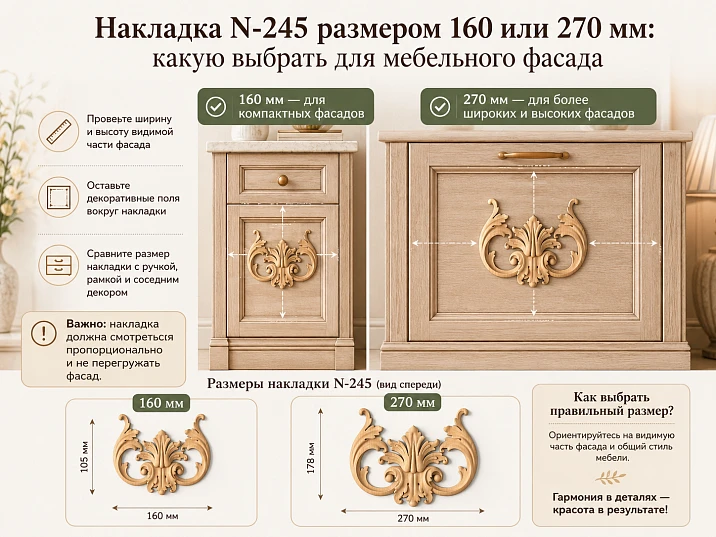
In the photo, both overlays look almost identical: the same carved pattern, the same vertical composition, the same smooth lines. The difference seems to come down to a simple choice between "smaller" and "larger." But on a real facade, N-245 measuring 160 × 127 × 14 mm and N-245 measuring 270 × 215 × 24 mm are perceived as two decorative tools of different scales. The enlarged version is not only 110 mm taller and 88 mm wider — its relief is 10 mm deeper, so it protrudes more from the surface, casts a more noticeable side shadow, and requires much more free space.
This is where a typical mistake occurs. The buyer measures the entire cabinet door, sees that 270 mm formally fits in height, and chooses the large overlay. After a test fit, it turns out that the molding frame has already taken part of the facade, the handle is too close, and there is no calm background left between the carving and the edges. The opposite situation is no less frustrating: the compact N-245 on a tall door gets lost and looks not like the intended center of the composition, but like a randomly glued-on detail.
To buy wooden overlay N-245 without reworking the facade, you need to compare not just two heights. The decision depends on the width and height of the free decorative field, the depth of the carving, the position of the handle, molding, panel, neighboring elements, and the distance from which the furniture is usually viewed. The most reliable way is to make two full-size templates, attach them to the facade, and evaluate the composition from the front, from the side, and when opening the door.
One ornament, but two different scales
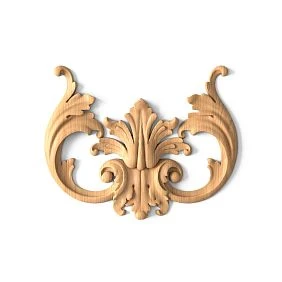
N-245 is available in two confirmed sizes. The ornament retains its overall shape, but its relationship to the facade changes so noticeably that you cannot choose a variant based only on the product card image.
| Parameter | N-245, compact variant | N-245, enlarged variant |
|---|---|---|
| Full size | 160 × 127 × 14 mm | 270 × 215 × 24 mm |
| Height | 160 мм | 270 мм |
| Width | 127 мм | 215 мм |
| Depth | 14 мм | 24 мм |
| Height difference | — | +110 mm |
| Width difference | — | +88 mm |
| Difference in depth | — | +10 mm |
| Material | Beech or oak | Beech or oak |
| Sanding | "Standard" or "Prestige" | "Standard" or "Prestige" |
| Main task of the check | whether it will be lost on the facade | whether it will take up too much space |




An increase of almost 1.7 times changes the composition
The ratio of height 270 mm to 160 mm is approximately 1.69. Almost the same coefficient is obtained in width: 215 mm versus 127 mm. This means that the larger version does not look like a slightly enlarged copy. Its face area is almost three times larger, so it competes more strongly with the handle, frame, and door architecture.
On a small facade, the increase immediately eats up the air. Where calm margins remain around the 160 mm overlay, the 270 mm version may approach the molding and visually "squeeze" the ornament. On a large door, the opposite happens: the small detail is surrounded by too much empty space and ceases to hold the center.
Our factory also produces:



Depth grows along with height and width
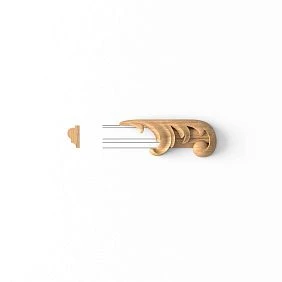
The difference between 14 and 24 mm seems small while the overlay lies on the table. On a vertical facade, the depth affects the side shadow, the visibility of the thread under oblique lighting, and the combination with a protruding handle. The larger N-245 is perceived as more voluminous not only because it occupies more area, but also because it separates more strongly from the plane of the door.
Therefore, in the technical record, one cannot leave "N-245 large". A full line 270 × 215 × 24 mm is needed. For the compact version, all three parameters are also recorded: 160 × 127 × 14 mm.
Get Consultation
Two sizes cannot be mixed randomly
In one furniture project, it is acceptable to use both versions if the difference is subordinated to the system. For example, large overlays are placed on tall cabinet doors, and compact ones on low cabinet doors. But alternating sizes on identical facades is not allowed: the symmetry will be destroyed, and the error will be noticeable even to a person who does not know the article number.
When ordering, each version goes as a separate line. If the project is already approved, you can order N-245 with a size of 160 mm for compact facades and separately specify the quantity of the large variant.
You need to measure not the door, but the free decorative field
The total width of the facade is almost never equal to the area available for decoration. Part of the surface is occupied by the frame, handle, keyhole, panel, edge indents, and technological gaps. Therefore, the question "will a 270 mm overlay fit on a door 700 mm high" is posed incorrectly. First, you need to determine the rectangle within which the decor can be placed without conflict with other details.
Free width after subtracting restrictions
For a preliminary check, you can use a simple scheme:
Free width = facade width − left occupied zone − right occupied zone.
The left and right zones include not only the edges. If there is a handle on the right, its dimensions and the required distance to the carving are also subtracted. If the facade is framed with molding, measurements are taken between the inner borders of the frame, not by the outer dimensions of the door.
Suppose the facade width is 500 mm. The inner field of the frame is 330 mm. On the right, another 70 mm is left for the handle and free grip. For the central overlay, there remains not 500 or even 330 mm, but about 260 mm. Both N-245 formally fit in width, but the large version will leave significantly less air at the edges.
Free height is also limited
Vertically, the space can be reduced by the top and bottom frame rails, a row of handles, a decorative cornice, a plinth line, a central panel, or a neighboring overlay. The formula is similar:
Free height = facade height − top occupied zone − bottom occupied zone.
For an overlay 270 mm high, it is not enough to get free 271 mm. One millimeter of technical remainder does not create a beautiful composition. A visual indent is needed that separates the carving from the frame and allows the ornament to be read as a whole.
The center of the facade and the center of the free field may not coincide
If the handle is located on the side, the decorative field becomes asymmetric. The geometric center of the entire door is no longer necessarily suitable for the overlay. Sometimes N-245 has to be slightly shifted to the side opposite the handle so that balance is maintained between the parts.
Such a shift cannot be determined by eye during installation. It is checked with a template and fixed by the distance from the edge of the facade or the inner border of the frame.
Pair doors require common marking
On a double-door cabinet, you cannot try each door separately. The overlays work as a pair and must have identical offsets from the central gap, outer edges, and top line. Even a slight difference in height disrupts the rhythm.
Before buy overlays for cabinet and dresser, it is useful to lay out all facades on one layout. Then you can see where identical dimensions are needed and where the scale can change according to the logic of the furniture.
Two paper templates give more than ten visualizations
The screen conveys the idea well but poorly shows the real scale. The camera, perspective, and image size change perception. A paper template brings the project back to physical dimensions and allows you to see how N-245 interacts with a specific door.
How to make a template for compact N-245
On thick paper or cardboard, draw a rectangle 160 × 127 mm. Mark the vertical axis and the approximate silhouette of the overlay. For the first comparison, it is not necessary to reproduce every carving line: the overall dimensions, ornament direction, and occupied area matter.
The template is secured with painter's tape, which does not damage the surface. On a painted facade, first test the tape on an inconspicuous area.
How to make a large version template
The second rectangle has dimensions 270 × 215 mm. It is better to cut it from paper of a different color so that photos of the two options do not get mixed up. The template also marks the axes and the top of the part.
If the printer does not support large format, the layout is assembled from several sheets. The main thing is to check the control dimensions with a ruler after gluing.
Evaluation from three distances
The first look is up close, approximately from an arm's length distance. This checks the interaction with the handle, the depth of the panel and the molding. The second is from the usual point of entry into the room. Here it becomes clear whether the compact overlay is lost and whether the large one dominates. The third is from the side, with oblique lighting. It helps to imagine the future shadow from the relief of 14 or 24 mm.
For a wardrobe in the bedroom, it is useful to look at the template from the bed and from the door. For a kitchen facade — from the work area and the entrance. For a dresser — standing and sitting, if the furniture is near an armchair or sofa.
Check when opening
Open the door with the attached template. Make sure the overlay does not come close to the adjacent cabinet, wall, handle of another door, or protruding decor. Paper does not show real depth, so you can add a strip of cardboard 14 or 24 mm thick to the template in the most protruding area.
Such a simple model helps to see what is not visible on a flat layout: the three-dimensional overlay passes near the adjacent surface differently than the drawing on the facade.
A photo helps to compare without memory
Take both options from the same point, at the same focal length and under the same lighting. Compare the photos side by side. Human memory quickly gets used to the current template, so sequential fitting without photos often leads to a subjective decision.
If the project is led by a designer, photos with dimensions become a clear attachment to the approval. After approval, they are saved together with the specification.
When the compact N-245 measuring 160 × 127 × 14 mm works more convincingly
The smaller version is not a "simplified" or less expressive overlay. Its strength lies in its precise scale. On a small facade, it preserves space around the carving, does not interfere with the handle, and allows repeating the ornament on several doors without overload.
Narrow cabinet door
On a narrow door, a width of 127 mm leaves more freedom on the sides. The overlay can be placed inside the frame, maintaining equal margins. The 215 mm version on the same door may come so close to the molding that the pattern ceases to be perceived separately.
For narrow cabinets, it is useful to look at ideas for placing carved overlays on cabinets, and then check the specific N-245 on your own facade.
Dresser drawer
The height of a drawer often limits the decorative field more than its width. A vertical overlay of 160 mm can work in the center of a tall drawer or cabinet door if there is room left for a handle nearby. The larger version can take up almost the entire height and leave too little background.
In the section where collected ideas for decorating dressers with wooden overlays, you can evaluate different ways of distributing decor. But the final decision still depends on the size of your facade.
Repetition on a series of identical facades
When the overlay is repeated on six, eight, or twelve doors, its overall visual weight multiplies. Even a moderately sized element creates a strong rhythm. In such a project, a compact version often gives a calmer result than repeated large ones.
You need to evaluate not just one door, but the entire piece of furniture as a whole. Lay out the templates on the layout or temporarily attach paper mockups to several adjacent facades.
Composition with other decorative details
If the facade already has a molding frame, corner elements, a carved handle, or a separate cartouche, the central overlay does not have to be the main accent. N-245 with a height of 160 mm can tie the composition together without conflicting with the rest of the decor.
In a complex system, it is useful to first select the overlay by size, and then compare it with the profile and depth of adjacent items.
Small kitchen door
In the kitchen, facades are placed more densely, and handles repeat more often. Large decor can complicate maintenance and overload the row of cabinets. The compact N-245 requires less free space and fits more easily between the frame and the handle.
For a new kitchen, you can choose overlays to match the enamel for the kitchen, but the material and finishing method should be agreed upon before installation.
When the large N-245 measuring 270 × 215 × 24 mm is justified
An enlarged overlay is needed not because "bigger is always more noticeable." It is appropriate where the facade or panel can support its area and depth. The large size becomes part of the furniture's architecture, not a small decoration.
Tall cabinet door
On a door from floor to almost ceiling, a 160 mm overlay may seem too small. The 270 mm version better maintains the vertical axis and reads from a distance. It looks especially convincing as a single center of a large free field.
Before ordering, you need to check not only the height of the door, but also the width. A tall but very narrow facade may not accept an overlay 215 mm wide.
A two-door wardrobe with large fields
On wide paired doors, two large N-245 can form a solemn symmetrical composition. It is important to maintain the same distance from the central gap and the top line. If the handles are close to the center, the overlays sometimes have to be shifted outward or the hardware arrangement changed.
Such a solution must be approved on the full layout of the wardrobe, not on a fragment of one door.
Sideboard or display cabinet
A tall sideboard with large lower facades allows for deeper relief. An N-245 measuring 270 × 215 × 24 mm can become the center of the lower part, while the upper glass doors remain lighter.
If the overlay is located next to glass, not only the size but also the shadow is checked: a deep carved element can visually weigh down the boundary between the solid and transparent parts.
Wall panel and boiserie
On a large wall panel, the furniture scale changes to an architectural one. A large N-245 can work inside a molding frame as a central element, especially if the composition is viewed from several meters away.
For this scenario, it is useful to order wooden decor for boiserie and agree in advance on the profile of all protruding parts. The depth of 24 mm must be matched with the molding and the panel thickness.
Door leaf
On a tall interior door, a large overlay can support a vertical composition. But the handle and lock area limits placement. You cannot transfer the scheme from a wardrobe to a door without new marking: the door leaf has a different opening method and a different working area.
Before designing, you can look at placement ideas for N-245 on the door, and then check the indents on the actual panel.
Depth 14 or 24 mm: the third dimension decides more than it seems
The front template shows the area but does not convey the relief. Between the two N-245 options, the difference in depth is 10 mm. It affects the shadow, the combination with the molding, the perception after painting, and safety near moving parts.
Shadow under side lighting
Light from above or from the side emphasizes the protrusions of the carving. An overlay with a depth of 24 mm creates a more contrasting chiaroscuro, so the ornament reads more strongly. On a facade with an active oak texture, this can be an advantage. On a small smooth door, a deep relief sometimes becomes too assertive.
It is better to check under the actual room lighting. A portable lamp helps simulate the evening scenario before installation.
Comparison with the molding frame
If the surrounding molding has a small profile, a large N-245 can protrude significantly more and become an unconditional center. This is acceptable if it is intended. An error occurs when the designer expected an almost single plane, but after installation received a separate volumetric block.
The cross-section should show the facade, molding, overlay, and adhesive layer. Even a schematic side view makes the result clear before purchase.
Proximity to the handle
The handle also has depth. In a frontal view, two parts may not intersect, but when gripping, fingers end up near the threading. The deeper the overlay, the more important it is to leave a comfortable working area.
On the paper template, mark the full outline of the handle and space for the hand. If the hand touches the decorative element, the composition needs to be changed.
Opening paired doors
A deep overlay located close to the inner edge may approach the decor of the adjacent door when opening. The real possibility of collision depends on the hinges, angle, and position of the parts. It cannot be determined from a photo alone.
To check, a depth mockup or temporary three-dimensional sample is used. If in doubt, the position is coordinated with the cabinetmaker before drilling and gluing.
Painting does not remove volume
After enameling, the relief may become visually calmer if the overlay and facade are painted in one color, but the physical depth remains. The shadow will remain. Therefore, one cannot hope that a large version will "dissolve" after painting.
On the contrary, a glossy surface sometimes makes the differences more noticeable due to highlights. The final sample should be evaluated on a small test element or with a visualization with plausible lighting.
The handle, molding, and N-245 should share the facade, not compete for it.
On a furniture facade, there are several focal points. The handle serves a function and is in view daily. The molding creates a boundary. The overlay forms the narrative. When all three elements are too large or placed too close together, the facade looks cramped.
First, determine the working zone of the handle.
Measure not only the handle body but also the space for gripping. A person must open the door without catching their fingers on the threading. The working zone depends on the handle shape and direction of movement.
If the handle is centered on the drawer, a vertical N-245 may not fit without conflict. Then consider shifting, a different orientation of the composition, or omitting the overlay on that facade.
Indentation from the molding is needed on all sides.
An overlay that almost touches the frame in only one place looks accidental. The contour of the threading is complex, so the distance should be measured not from the bounding rectangle but from the most protruding points of the ornament.
A paper silhouette is better than a simple rectangle at the final stage. It can be obtained from a drawing or traced from a scaled image.
Symmetry does not always mean geometric center.
On a paired door, the handle is often shifted toward the middle of the cabinet. To balance it, the overlay is sometimes placed slightly farther from the central gap. This is visual, not mathematical, symmetry.
The solution must be identical for both leaves and fixed with dimensions. The phrase "approximately centered" is insufficient for the installer.
A large overlay requires calm hardware
If N-245 with a size of 270 mm is chosen, the handle does not have to be equally large and decorative. Often it is better when one element dominates and the other supports. On a facade with compact N-245, a more noticeable handle can be allowed if the composition remains balanced.
This is not a strict rule, but a direction for fitting. The choice is verified on actual parts or precise templates.
Beech or oak: the material should continue the logic of the furniture
Both versions of N-245 are available in beech and oak. The wood species affects the surface pattern, perception after finishing, and coordination with other wooden parts. Choosing material only by price or the general word "solid wood" is not acceptable.
Beech for a calm painted surface
Beech is often considered for opaque enamel, when the overlay and facade should become a single colored volume. The calmer wood pattern does not compete with the carving, and attention remains on the shape.
Before painting, compatibility of preparatory materials and the finishing system must be checked. The actual technology depends on the project and selected compositions.
Oak for visible texture
Oak is chosen when the wood pattern needs to be preserved or emphasized. Tinting and transparent coatings make the fibers part of the decorative effect. On the large N-245, the texture is more noticeable due to the larger area.
If the facade is made of a different wood species or veneer, samples are compared side by side. Similar color does not guarantee the same grain pattern.
Do not mix wood species in a symmetrical group without a design intent.
On paired doors, one panel made of beech and another of oak will differ even after similar staining, especially with a transparent finish. For a visible group, choose one species and one preparation system.
If the project is deliberately based on contrast, the difference is recorded in the specification, not left to the discretion of the assembly.
The material of the panel and the material of the facade do not have to match.
A wooden panel can be used on a prepared furniture facade of another type if installation and finishing are coordinated by a specialist. The main thing is not to present universal compatibility as a fact. The substrate, adhesive, primer, and finish are checked as a single system.
For selecting auxiliary compounds, you can buy materials for staining beech or choose products for finishing oak after checking the recommendations of the material manufacturer.
"Standard" or "Prestige": preparation depends on visibility and finish.
Card N-245 offers "Standard" and "Prestige" sanding options. The choice of preparation quality should be linked to the future finish, project requirements, and how closely the viewer will examine the carving.
For painting, the requirements are set by the entire system
Even a well-prepared overlay undergoes inspection before the finish. Edges, carving recesses, relief transitions, and ends are evaluated. If the facade is to be painted in gloss, light will emphasize imperfections more strongly than a matte surface.
The name of the option should not be considered a ready-made technological map. The scope of additional preparation is agreed upon with the finisher.
A larger size shows the surface more prominently
On N-245 with a height of 270 mm, there are more visible areas and longer ornament lines. Any difference in preparation becomes more noticeable. Additionally, a large overlay is often used as a central accent, so the viewer involuntarily examines it longer.
For a responsible project, it is wise to evaluate a sample before ordering the entire batch.
A repeating series requires consistent quality
If identical overlays are installed on several facades, differences in sanding and finish will disrupt the rhythm. All elements of one visible group are ordered with the same wood species and the same preparation option.
In the specification, "default quality" cannot be written. Specify "Standard" or "Prestige" in each product line.
N-245 on different pieces of furniture
One size cannot automatically fit a wardrobe, kitchen, dresser, door, and wall panel. Each surface has its own scale, viewing distance, and set of constraints.
Wardrobe in the bedroom
Tall doors allow for a large ornament, but a bedroom is usually viewed from several points. Check N-245 from the entrance and from the bed. If the wardrobe takes up an entire wall, repeating large overlays may be too active.
The compact version is better suited for a frequent rhythm, while the large one is for rare central accents.
Wardrobe
In a walk-in closet, the distance to the facades is often shorter than in a bedroom. Details are perceived up close. The depth of 24 mm and width of 215 mm may seem more massive than in a spacious visualization.
To complete a walk-in closet, you can order overlays for the walk-in closet, after first checking the passages and door opening.
Kitchen facades
In the kitchen, decor coexists with handles, appliances, and frequent vertical lines. The overlay should support the system, not create a separate story on each door. For small upper cabinets, the compact size is more often considered, while the large one is left for the central hood composition or a tall tall cabinet—only after trying it on.
You can order carved decor for kitchen facades in the same style, but the quantity and scale of each detail are calculated for specific doors.
Chest of drawers and bedside table
On a dresser, the handle occupies the central part of the drawer. The vertical N-245 may be suitable for side doors or on a tall central facade. For a low drawer, both options may not fit — this is a normal result of the check.
Useful to evaluate Decorative overlays for a dresser together with legs, handles, and the countertop line, rather than as a separate object.
Sideboard and display cabinet
A sideboard has several tiers. A large overlay works well on the lower solid doors, a compact one on small side facades. It is not necessary to repeat one size everywhere. It is important that the change in scale matches the furniture's architecture.
Door as an independent vertical plane
The door is viewed at full height, so a large N-245 may be appropriate. But the area of the handle, lock, and overlap requires separate checking. The overlay should not interfere with operation or come into contact with the wall when opening.
Wall panel
On a boiserie, the overlay transforms from a furniture detail into an architectural accent. The 270 mm version can become the center of a large frame. A compact one suits repeated small panels. The layout is best designed for the entire wall at once.
What to buy together with N-245
An overlay rarely exists alone in a project. It needs a prepared base, materials for installation and finishing, and sometimes a coordinated system of other carved elements. At the same time, you cannot automatically consider a specific adhesive, primer, or coating universally suitable: the composition is chosen based on the base and finish.
| What to check or add | Why is this needed | When it is especially useful | Where to go |
| Other decorative overlays | assemble facades of different sizes in one style | Cabinet, kitchen, chest of drawers | wooden overlays for facades — catalog and prices |
| carved decor of other types | complete the composition with a frame, rosette, or another element | large furniture set, wall panel | catalog of carved decor STAVROS |
| Installation and finishing materials | Prepare mounting and finish | painting, tinting, installation on a finished facade | buy mounting glue for wooden overlay |
| Drawing | check the exact contour and depth | tight field, molding frame, complex layout | download drawing N-245 |
| Design project | see the scale on all furniture | series of facades, non-standard composition | order a facade design with N-245 |
| Terms for designers | approve samples and configuration | professional interior design project | ordering conditions for designer overlays |
| Conditions for manufacturers | organize repeatable supply | serial or project furniture | Order N-245 as a batch for furniture production |
Do not buy glue just because it says "wood"
The facade base can be different, and the surface can be painted, primed, veneered, or prepared in another way. The glue is chosen considering both surfaces and future load. The exact technology is confirmed by the installation specialist and the adhesive manufacturer.
The drawing is needed not only by the installer
The designer uses the drawing to build an accurate silhouette and check distances. The furniture maker uses it to coordinate positioning. The finisher uses it to understand access to recesses. One document connects several project stages.
Other overlays are selected by system, not by a similar curl
The adjacent element may have different depth, ornament direction, and scale. A matching motif in a photo does not guarantee a cohesive composition. Compare actual sizes and profiles.
How not to confuse N-245 with similar decor
The category has many carved overlays. A buyer may save a photo, lose the article number, and then order a similar model. To protect the specification, you need to record not only the name but also the full size, material, sanding, and quantity.
The article number is the main identifier
Documents write N-245 without abbreviations or rearrangements. The phrase "central carved overlay" describes a function but does not define the product.
The size should be placed next to the article number
For the compact version: N-245, 160 × 127 × 14 mm. For the large version: N-245, 270 × 215 × 24 mm. The entry "N-245, 270 mm" does not show width and depth.
Material and preparation are separate fields
Beech or oak, "Standard" or "Prestige" are indicated in each line. You cannot assume that a manager will restore the choice from old correspondence or visualizations.
Purpose does not change the product automatically
The same N-245 can be considered for a cabinet, door, or panel. But a statement about specific compatibility is made only after checking dimensions and installation. The article helps choose the scale, not replace a working project.
How many N-245 to order
The quantity is calculated by facades and compositions, not by furniture items. One cabinet may have four identical doors, two drawers, and a central panel — each zone requires a separate calculation.
Facade table
| Room | Furniture | Facade | Size N-245 | Quantity per facade | Total |
| Bedroom | Cabinet | Tall door | 270 × 215 × 24 mm | 1 | 4 |
| Bedroom | Cabinet | side door | 160 × 127 × 14 mm | 1 | 2 |
| Living room | Buffet | bottom door | 270 × 215 × 24 mm | 1 | 2 |
| Hallway | Cabinet | narrow door | 160 × 127 × 14 mm | 1 | 3 |
This calculation shows not only the total, but also the distribution of two sizes.
Identical facades — identical rows
If four doors form one group, they receive overlays of the same version, same wood species, and same preparation. Any difference is recorded as a separate design solution.
Is a reserve needed
Reserve is not added mechanically. First, the batch size, project timeline, possibility of reordering, and risk of damage during finishing are assessed. If reserve is needed, it is recorded as a separate line.
Ordering in one batch
Convenient for a visible group Buy N-245 in one batch, to avoid mixing sizes, materials, and preparation options. Before payment, the quantity is checked against the facade list.
A specification that a designer, manager, and cabinetmaker will understand
The short entry "N-245 large, 4 pcs." carries several risks. The word "large" is not a size, the material is not specified, the preparation quality is absent, and the installation location is unknown.
Example of a compact version
Wooden carved overlay N-245, 160 × 127 × 14 mm, beech, "Prestige" sanding, quantity 8 pcs.; placement on the facade — according to the approved template and drawing.
Example of a large version
Wooden carved overlay N-245, 270 × 215 × 24 mm, oak, "Prestige" sanding, quantity 4 pcs.; placement — according to the approved facade layout, finish — according to the agreed sample.
What to add to the work line
Useful: room number, facade code, orientation, distances to the frame and handle, reference to the drawing, finish sample number, and a note about checking the first part.
Why you can't write "the same, just smaller"
When copying a table, the connection to the previous row is easily lost. Each item must be self-contained and fully understandable without adjacent text.
Installation begins with a dry fit
Before glue and painting, the overlay is applied to the facade or an accurate mockup. Check the top, bottom, axis, distance to the handle and molding. On paired doors, fit both pieces simultaneously.
Axis marking
On the back of the facade or on the protective tape, mark the vertical and horizontal axes. Also find the geometric axis on the overlay according to the drawing. Aligning the axes gives the starting position, after which only an agreed designer shift is allowed.
Side view control
Ask a second person to look at the facade from the side. The installer standing in front of the furniture may not notice how much N-245 protrudes relative to the molding and handle.
First piece as a reference
On a series of facades, first install one overlay and check the result under real lighting. After approval, transfer the coordinates using a template to the remaining doors.
Painting before or after installation
The sequence depends on the project, the base, and the material system. A universal answer cannot be given without this data. The decision is coordinated with the cabinetmaker and finisher before ordering the batch.
How to check N-245 on finished furniture
Working with a finished cabinet or dresser is more difficult than with a new facade. You cannot freely change the door dimensions, move the frame, or relocate the handle without consequences. Therefore, the fitting must account for existing holes, the finish, and the actual operation of the hinges.
First, fix everything that cannot be changed
Unchangeable constraints include the outer size of the facade, the handle position, the inner frame, the hinges, the gap between doors, and the area overlapped by an adjacent part when opening. Only after this is the free field determined.
If the free zone turns out to be smaller than the template, the overlay cannot be "squeezed in" by reducing the margins without re-evaluating the composition. Formal placement and beautiful placement are different tasks.
Old holes should not dictate the wrong size
Sometimes the customer wants to cover traces of old hardware with an overlay. N-245 can cover the damaged area, but this must be checked with an exact contour, not a bounding rectangle. In carved ornamentation, there are recesses through which the defect may remain visible.
If the goal is to hide holes, first take a photo of the facade with a ruler, apply the overlay contour, and check each problem point.
The finished finish requires a separate decision on installation.
The same scheme cannot be automatically applied to a painted or lacquered surface as to an untreated workpiece. Adhesion depends on the coating and the condition of the substrate. Before installation, surface preparation, adhesive compatibility, and the possibility of local damage to the finish must be agreed upon.
Fitting should take into account the opening
On finished furniture, you can check the actual trajectory of the door. Secure a volumetric template, slowly open the front
The first front is approved before the series
If furniture is produced as a set, one trial front helps verify scale, coordinates, and finish. After approval, a template is created for the remaining parts. This is especially useful for the large version with a depth of 24 mm.
Light, color, and distance change the perception of size
Dimensions remain unchanged, but the visual impression depends on the environment. A dark overlay on a light front appears larger due to contrast. A part painted in a single color is perceived as calmer, although it retains the same area and depth.
Contrast enhances a compact overlay
The N-245 with a height of 160 mm may not get lost on a large front if the wood or finish noticeably differs in color. But contrast simultaneously emphasizes every line and requires particularly precise placement.
A single color softens the large version
When the facade and N-245 are painted the same color, the ornament is read through light and shadow. The large version becomes part of the surface architecture. This does not eliminate the need for free margins: a cramped arrangement will remain cramped even after painting.
Matte and glossy surfaces work differently
A matte finish usually softens highlights and makes the relief calmer. Gloss emphasizes transitions and can visually increase the activity of large carvings. The choice of finish applies to the entire finishing system and should be tested on a sample.
Working distance determines readability
In a narrow corridor, the facade is seen up close, so a depth of 24 mm feels stronger. On a wall panel in a spacious living room, the same relief is viewed from several meters away, and a large size may be justified. A decision made without considering distance is often wrong.
N-245 in a serial composition: rhythm matters more than a single detail
When there are many overlays, the viewer perceives not each one individually, but the overall pattern. The distance between elements, repetition of sizes, and symmetry become more important than the beauty of a single N-245.
Four identical doors
On a cabinet with four doors, compact overlays can create an even repetition. Large ones will take up significantly more total area and turn the furniture into an active decorative object. Both solutions are possible, but they need to be seen on a full layout.
Facades of different widths
If the outer doors are narrower than the central ones, one size may look inconsistent. There are two possible approaches: keep N-245 in one size for rhythm, or change the scale by groups. The second approach is more complex and requires a meaningful hierarchy.
Upper and lower tier
In a sideboard or kitchen, facades of different tiers can be linked with the same ornament in two sizes. A large version on the lower doors and a compact one on the upper doors create a clear reduction in scale. In the specification, these are two separate items.
Reserve for a serial project
The manufacturer needs to determine in advance whether a reserve is needed in case of damage during finishing or assembly. The decision depends on the batch size and schedule. Delivery conditions for decor to manufacturers help coordinate the organizational part, but the amount of reserve is determined by the project itself.
Mistakes due to which the N-245 size is chosen incorrectly
Mistake 1. Measured the entire facade
The molding, handle, and inner field were not included in the calculation. Fix: measure the free decorative area.
Error 2. Compared only the height
Width and depth were left unnoticed. Fix: write 160 × 127 × 14 or 270 × 215 × 24 mm in full.
Error 3. Chose a large one because it is more noticeable
Noticeability without free background turns into overload. Fix: make two templates.
Error 4. Chose a compact one to "definitely fit"
On a large facade it may get lost. Fix: evaluate from the working distance.
Error 5. Did not account for the handle
After installation, fingers touch the threads or parts visually collide. Fix: mark the grip working area.
Error 6. Did not check the depth
The overlay protruded more than the molding, although a calm flat surface was expected. Fix: make a side cut.
Error 7. Tried on one door from a pair
After installation, symmetry did not align. Fix: mark the entire furniture block.
Error 8. Mixed sizes in one product line
Supplier does not understand quantity distribution. Fix: separate line for each version.
Error 9. Did not specify beech or oak
Material was chosen by default. Fix: fix the wood species in the specification.
Error 10. Did not specify "Standard" or "Prestige"
Batch preparation turned out inconsistent. Fix: add sanding quality.
Error 11. Bought mounting compound without checking the base
Adhesive was chosen only by the word "wood". Fix: agree on both surfaces and technology.
Error 12. Ordered from a photo without an article number
A similar overlay ended up in the invoice. Fix: check N-245 and size in each cart line.
Who the compact version suits, and who the large one
N-245 160 mm is worth considering
It suits as a candidate for narrow doors, drawers, small frames, repeating decor, and facades where a noticeable handle is located nearby. The word "suits" here means the need for a fitting, not universal compatibility.
N-245 270 mm is worth considering
The large version is appropriate as a candidate for tall doors, large panels, sideboards, door leaves, and wall panels. Sufficient background and coordination of the 24 mm depth are needed.
When both versions may not fit
If the free field is already occupied by a handle and a frame, even the compact N-245 may be redundant. On a very low drawer, the vertical ornament will not fit. In minimalist furniture, complex carving may contradict the overall logic of the project.
An honest refusal of the overlay is better than trying to place it at any cost.
How to place an order for STAVROS
First, open the card and select a specific size row. Then, specify the material, sanding quality, and quantity. Check the current price and availability right before placing the order.
For a compact option, you can find out the price of N-245 made of beech after choosing the configuration. For a project with visible wood texture — order an oak overlay N-245 in the required size and preparation.
If the decor complements several items, first compile a general list. Then add installation and finishing materials, check the drawings and shipping conditions. Calculate delivery of the decor set after specifying the order composition and address.
For a professional project, you can order samples of wooden decor for the project and compare the material with the facade before launching the entire batch.
The first step is card N-245
In the card, one of two sizes is selected, beech or oak, "Standard" or "Prestige". You cannot proceed to payment until the order line matches the approved specification.
The second step is the general category of overlays
The category is needed if N-245 did not pass the fitting or the project requires additional elements. Here you can order carved overlays made of oak and beech and compare them by real parameters, without substituting one article for another.
The third step is a full carved set
If the overlay is part of a complex furniture composition, it makes sense Buy carved wood decor after compiling a single list. This makes it easier to coordinate the material, scale, and purpose of elements.
Fourth step — installation and finishing
Materials are added after checking the base and the chosen finish. You should not buy a random compound just because the packaging mentions wood.
Fifth step — final verification
Before payment, check the article number, size, wood species, sanding, quantity, address, and delivery method. For a large batch, it is useful to keep the invoice, layout, and photos of templates in one folder.
Checklist before payment
| Check | What should be recorded |
| Article number | N-245 |
| Size of the compact version | 160 × 127 × 14 mm |
| Size of the large version | 270 × 215 × 24 mm |
| Selected version | one specific line per item |
| Material | Beech or oak |
| Sanding | "Standard" or "Prestige" |
| Quantity | by facade schedule |
| Installation location | room, furniture, facade code |
| Position | by template or layout |
| Distance to the handle | checked with capture working area |
| distance to molding | checked along thread contour |
| Depth | matched with adjacent decor |
| Installation | technology coordinated with base |
| Finishing | confirmed by sample or material system |
| Delivery | conditions verified before payment |
Practical check before handing over to the installer
Even a correctly ordered N-245 can be installed poorly if the installer receives only a box and a short message saying "centered." Before starting work, a set of clear documents is needed.
Facade map
The map shows the front view, axes, distances to edges, frames, and handles. Each facade gets a code. For paired doors, a single sheet is used so the symmetry is visible as a whole.
Side section
The cross-section shows a depth of 14 or 24 mm relative to the facade and molding. If a moving part passes nearby, the minimum clearance is shown in the cross-section or an additional diagram.
Photo of the approved template
The photo helps the installer understand the visual task. But the photo does not replace dimensions. It works together with the drawing and the table.
Packaging marking
If the project includes both versions, the boxes are marked prominently: "N-245 160 × 127 × 14" and "N-245 270 × 215 × 24." The words "small" and "large" alone are not enough.
Sign-off of the first installation
After installing the first overlay, the designer or client checks the position. Only then does the craftsman transfer the template to the remaining facades. This procedure reduces the risk of a serial error.
Acceptance of overlays before painting and installation
The received batch must be checked before the items reach the finishing shop. After painting or gluing, it is harder to prove where the error occurred, and it is not possible to calmly replace the incorrect item.
Quantity verification
Compact and large N-245 are counted separately. The result is compared with two lines of the specification, not just the total number of boxes.
Dimension verification
The height, width, and depth of several parts from each group are measured. The goal is to ensure that no other size has entered the batch and that the marking matches the contents.
Material and sanding verification
It is checked that beech or oak is selected, and the preparation option matches the invoice. On symmetrical facades, different finishes cannot be mixed without separate approval.
Thread inspection
Before finishing, it is convenient to assess the edges, recesses, and overall contour. Comments are recorded with photos before the items are handed over to the next workers.
Storage before installation
Wooden decor is protected from damage, dirt, and sudden adverse conditions. Specific storage and usage rules must be followed according to the recommendations of STAVROS and the finishing production.
How to distribute two sizes across a furniture set
The most complex task arises not on a single facade, but in an interior where the same ornament must tie together a wardrobe, dresser, nightstands, and a wall panel. The buyer sees two N-245 options and wants to choose one size for the entire room to simplify the order. Such a solution seems neat, but sometimes it disrupts proportions: the same overlay looks large on a nightstand and too small on a tall wardrobe.
First, the furniture is divided into groups by scale
There is no need to compare each facade with all the others. It is enough to identify groups: tall doors, medium doors, drawers, and architectural panels. Within each group, it is desirable to keep one N-245 size. Then the ornament repeats consistently, and the scale changes only where the furniture architecture itself changes.
For example, the large N-245 can be tested on tall wardrobe doors and the central panel of a sideboard. The compact one can be tested on nightstands and side dresser doors. If one of the templates does not fit a group, it does not mean the second one should be forced into use. Perhaps some facades do not need a central overlay at all.
Hierarchy matters more than complete uniformity
An interior looks cohesive not when all details are identical, but when it is clear which furniture is primary and which is supporting. The large N-245 can mark the main wardrobe or sideboard, while the compact version repeats the motif on smaller pieces. The difference in size becomes meaningful and helps read the composition.
If large overlays are placed on every piece, the room may feel overloaded. If only 160 mm is used everywhere, the main wardrobe loses its necessary scale. Therefore, it is useful to perceive the two N-245 options as steps of a single decorative hierarchy.
A summary layout reveals errors before purchase
Photograph the walls of the room or assemble simple frontal layouts of all furniture at the same scale. Place silhouettes of N-245 on them. Such a composite layout shows whether the large ornament repeats too often, whether the connection between items is maintained, and whether there are calm zones for the eye.
For complex configurations, you can order a decor layout for furniture, providing the actual dimensions of the facades and the selected N-245 options. The finished layout must preserve not only the frontal view, but also notes about the depth of 14 or 24 mm.
One material connects different sizes
If both versions are used in the same room, unity is maintained by the same wood species and finish system. Beech on compact overlays and oak on large ones without a separate design concept can create the impression of random assembly. It is much calmer when the size changes, but the material and the nature of the finish remain common.
In the specification, two lines are still created: separately N-245 160 × 127 × 14 mm and separately N-245 270 × 215 × 24 mm. The material, sanding, and finish sample are repeated in both lines.
Quantity is calculated after groups are approved
First, it is determined which facades belong to the large scale, which to the compact one, and which will remain without a central overlay. Then the quantity within each group is counted. This order is more accurate than buying a set "with a reserve" and distributing elements already on site.
If furniture is produced at different times, keep the article number, dimensions, material, sanding quality, and approved finish sample. But for the visible composition, it is preferable order a set of N-245 for facades after completing the overall list, so that the two versions arrive as one coordinated delivery.
Checking from a distance completes the selection
After placing the templates, step back to a point where several items are visible at once. Up close, each overlay may look beautiful on its own, but the overall view will show whether large elements conflict with each other. Then move closer and check the functional zones: handles, opening, moldings, and joints.
The size is chosen correctly when N-245 reads as part of a specific facade while simultaneously supporting the entire furniture set. It is the combination of the overall and the specific that distinguishes a designed layout from a random repetition of a beautiful detail.
Frequently asked questions about the N-245 overlay
How do the two sizes of N-245 differ?
The compact version measures 160 × 127 × 14 mm, the large one — 270 × 215 × 24 mm. The height, width, and depth of the relief differ.
What size should I choose for a furniture facade?
Choose based on the free decorative field after subtracting the frame, handle, indents, and other details. Both options need to be checked with full-size templates.
Can the size be chosen only by the door height?
No. Width and depth matter no less. Additionally, the total door height does not show the actual field inside the molding frame.
Is the 270 mm overlay just larger, or is it also deeper?
It is deeper: 24 mm versus 14 mm for the compact version. Therefore, the larger option creates a more noticeable shadow and protrudes more above the facade.
Will the N-245 160 mm fit a cabinet?
It may fit a narrow door, a small panel, or a repeating composition. The decision is made after trying it on the specific facade.
Will the N-245 270 mm fit a dresser?
Only if the facade is tall and wide enough, and the handle does not conflict with the decor. For a low drawer, a large vertical overlay often feels cramped.
What offset should be left to the molding?
There is no universal number. The offset depends on the scale of the frame, the shape of the ornament, and the overall project. It is chosen based on the silhouette of the overlay, not just the rectangular dimensions.
How to check the distance to the handle?
Mark on the facade not only the handle body but also the space for fingers. Open the door with the template and make sure the hand does not touch the future carving.
Can 160 mm and 270 mm be used in the same cabinet?
Yes, if the sizes are distributed according to the furniture architecture: for example, large ones on tall doors, compact ones on small fronts. Random mixing on identical doors will disrupt the rhythm.
What materials is N-245 made from?
Beech and oak are available in the card. The specific material must be specified in each order line.
What is the difference between "Standard" and "Prestige"?
These are sanding quality options presented in the card. The choice is related to surface requirements and future finishing.
Can the overlay be painted together with the front?
The possibility and sequence depend on the base, preparation, primer, paint, and installation technology. The system must be coordinated with the cabinetmaker and finisher.
How to order N-245 for enamel?
First, select the material and preparation quality, then coordinate the painting system on a sample. Not every wood species and preparation should be considered automatically ready for a specific enamel.
Can oak be left with visible texture?
Yes, oak is often chosen for finishes that preserve the wood grain. The specific composition and color are checked on a sample.
Is a drawing needed before ordering?
A drawing is especially useful with a tight frame, complex contour, proximity to a handle, and serial marking. It helps to build an accurate template.
How to calculate the number of overlays?
Make a list of all facades and indicate the quantity of N-245 on each. Count the compact and large versions as separate lines.
This is not a mandatory manufacturer rule, but for a large series, trial painting, complex installation, and future restoration, a spare is useful. One extra part allows you to test the coating without risking the working composition. For a project of ten or more elements, the customer may plan for a larger reserve if a repeat order later would be difficult. The decision is made consciously and included separately in the specification.
The reserve depends on the project volume, finish, and the possibility of reordering. If a reserve is needed, specify it as a separate item.
Can N-245 be glued onto an already painted facade?
The possibility depends on the coating, surface condition, and the chosen adhesive. A universal permission cannot be given without testing the materials.
What to do if the large N-245 fits but looks cramped?
Choose the compact version, change the handle position, or reconsider the frame. Formal capacity does not mean the correct scale.
What to do if the compact N-245 gets lost on the door?
Compare the large version, change the finish contrast, or reconsider the number of decorative elements. The decision should be evaluated on the entire piece of furniture, not on a fragment.
Can I order one overlay for a trial fit?
The possibility of purchasing a specific quantity and current terms should be checked in the product card or with a manager. For a complex project, a physical sample provides a more accurate assessment than a screen.
Do I need to account for the thickness of the adhesive layer?
Yes. The adhesive layer affects the final protrusion, although its exact value depends on the material and technology. It is considered in the side view.
Can N-245 be trimmed if it does not fit?
Trimming should not be considered acceptable without approval. Changing the contour may disrupt the ornament, symmetry, and edge quality. It is better to choose a suitable size or another model.
Is N-245 suitable for a wall panel?
It can be considered for a panel after checking the scale, depth, and installation. The large version more often matches a large frame, the compact one matches repeating small fields, but there is no universal rule.
Where can I buy decorative overlays for furniture?
You can Buy decorative furniture overlays in the catalog, comparing sizes, shape, material, and depth, and then go to the N-245 product page.
The correct size becomes obvious after actually trying it on.
Choosing between the N-245 with heights of 160 and 270 mm cannot be reduced to the rule "small for a small facade, large for a large one." You need to measure the free space, subtract the frame and the handle's working area, compare depths of 14 and 24 mm, see the overlay from a normal distance, and check the opening. Two paper templates give a more honest answer than an image without scale.
After trying it on, record the full size, beech or oak, "Standard" or "Prestige," quantity, and installation coordinates. If the project includes a cabinet, dresser, kitchen, door, or wall panel, gather all details in one list and only then order decor for furniture and walls.
STAVROS combines the N-245 product page, a catalog of wooden overlays, application examples, drawings, design, installation materials, and delivery terms. This route helps you order not just a beautiful ornament, but a specific size that actually works on your facade.