Article Contents:
- Wooden bracket KR-047: what the product card confirms
- Actual shelf load: collection, board, and operation
- Eighty records: why you can't take the average weight from the internet
- How to weigh a vinyl collection so the calculation doesn't depend on random ten albums
- Why you need to count together with external protective sleeves
- How to record the initial data for the designer
- The collection will grow: you need to count not only today's 80 records
- Mass of the shelf board: don't take it "approximately," but weigh it or get it from the specification
- Why finishing also counts toward actual mass
- Mass control example: how to use numbers without turning them into "allowable load"
- Center of gravity of a vinyl shelf: why the same mass can load a wall differently
- Shelf on wooden brackets: what makes up the design load
- Two or three KR-047: why dividing the weight doesn't give the answer
- A third support is often needed due to shelf deflection, not because "two KR-047s are weak"
- Why "thicker board means you can use two" is also not universal
- Two and three supports on a 1800 mm shelf: what dimensions need to be marked on the drawing
- A post or embedded anchor can change ideal symmetry
- Two KR-047: what information must be confirmed before ordering
- Three KR-047: the third point only provides benefit when correctly integrated into the work
- Dimensions of the carved bracket KR-047: must be selected according to the drawing
- Five sizes of KR-047: how to relate the dimension to the shelf board without inventing load capacity
- Why a large KR-047 may not fit a deep shelf
- Why a small KR-047 cannot be excluded just visually
- The shelf must be fastened to KR-047: separately check the board's fastening
- Shelf for vinyl: edge stops are needed not only for order
- Do not use the edge KR-047 as a stop for records by default
- Wall for a vinyl shelf: concrete, brick, and drywall
- Wall finish layer: tiles, slats, plaster, and panels are not a load-bearing base by themselves
- If KR-047 is installed on a slatted wall
- Hidden wiring and pipes: the third bracket may fall into a prohibited zone
- If the wall base is unknown, ordering KR-047 is better split into design and procurement stages
- Fastener KR-047: what to request if the card does not name it
- Layout of two and three wooden supports under a 1800 mm shelf
- Cost of two and three KR-047
- Full price table for two and three KR-047 across all sizes
- Beech, sanding "Standard"
- Beech, sanding "Prestige"
- Oak, sanding "Standard"
- Oak, sanding "Prestige"
- Estimate for the shelf system: which line items to add besides KR-047
- Decorative bracket and useful shelf depth
- Finishing of the carved bracket before installation
- Uneven vinyl loading: why "80 records along the entire length" is not the only scenario
- Why the third bracket does not eliminate uneven load
- Turntable on the same shelf: it cannot be "added later" without a new calculation
- Access to fasteners after installation: the shelf must be removable without destroying KR-047
- Final specification of the shelf on KR-047: what must be known before payment
- Finished finish complicates rework
- If the board is already sagging under its own weight
- When two KR-047 can be considered for ordering
- When three wooden brackets should be considered
- When buying KR-047 is premature
- Decision tree: two or three KR-047
- What to write to the KR-047 manufacturer before payment
- Acceptance of three KR-047 as one set
- When it is better not to use KR-047 for a vinyl shelf at all
- How to order KR-047 without mistakes
- What sizes are available?
- What wood is KR-047 made from?
- Is the permissible load specified?
- Are two brackets enough for 80 records?
- Are three brackets always more reliable than two?
- How to determine the weight of a collection?
- Do I need to consider the weight of the shelf?
- Can I choose the largest KR-047 as the strongest?
- Will a drywall wall work?
- Is the mounting hardware included in the set?
- What to choose — beech or oak?
- Can oak be coated with clear oil?
- What does 'Prestige' mean?
- When to order brackets?

The vinyl collection no longer fits in a closed cabinet, and the owner decides to make a long open shelf. The designer has already chosen the carved wooden bracket KR-047: it matches the style, is available in beech and oak, and comes in five sizes. They want to add two supports to the cart — it's cheaper, the wall pattern stays more open, and the shelf looks lighter. But eighty records, the board itself, and the playing album create a real load that cannot be assessed from a photo of the bracket. The main problem is in the product card: the allowable load of KR-047 is not published. There is also no universal answer for the spacing of these brackets. Two supports may be sufficient in one project and unacceptable in another. The size of the chosen KR-047, the material and thickness of the shelf, the distance from the wall to the center of gravity, the wall type, anchors, mounting scheme, and the owner's habits all matter. Therefore, the task of the article is not to state a nice number, but to show how to turn the request 'two or three' into a verifiable specification. First, weigh the collection, then determine the working geometry, request the load and drawing, choose the base, and only then place the order.
Wooden bracket KR-047: what the product card confirms
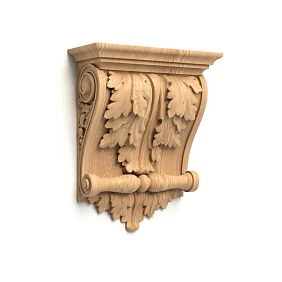
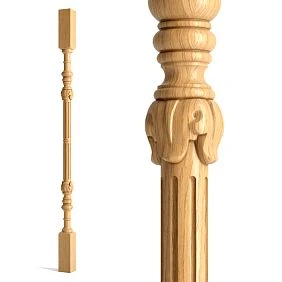
KR-047 is a carved wooden bracket. It is available in five sizes: 186×150×61, 224×180×73, 249×200×81, 286×230×93, and 323×260×105 mm. The buyer can choose beech or oak, as well as the 'Standard' or 'Prestige' sanding. The selected configuration is shown in the card with re-gluing under enamel. As of the check date, all variants were made to order with an average lead time of 5–10 days. The most compact KR-047 in beech with 'Standard' sanding cost 8,690 rubles, the largest oak one in 'Prestige' cost 43,730 rubles. The price is per piece, so the decision on quantity significantly changes the final estimate. The card offers a drawing of the product. It must be downloaded before design: the letter dimensions A, B, and C cannot be automatically assigned as height, depth, and width just by the order of the numbers. The designer must see the shape, contact areas, and the position of the part relative to the shelf. If the model is already selected, buy wooden bracket KR-047 safer after written confirmation of the selected size, material, sanding, finish, and allowable load in the specific assembly.




Actual shelf load: collection, board, and operation
Our factory also produces:

Eighty records: why you can't take the average weight from the internet
The weight of one vinyl record depends on the format, disc thickness, sleeve, inner inserts, and protective outer bag. A reissue on heavy vinyl with a gatefold sleeve can differ noticeably from an old album in thin packaging. Therefore, you cannot multiply eighty by a random figure from a reference book. A practical method is to weigh a sample. Take ten records in the sleeves and protective bags in which they will stand on the shelf. Denote their mass as W10. Then the approximate mass of the collection is calculated as follows: Wcollection = W10 × 8 For example, if ten albums weigh 2.6 kg, eighty will give about 20.8 kg. This is only an illustration of the method, not a standard for any collection. For greater accuracy, weigh all boxes or divide the records into several groups. To the collection, you need to add the mass of the shelf board, dividers, supports, decorative items, and equipment if it also ends up on top. You must not forget the record being played: during use, it is taken out and returned, and the free space gradually fills with new purchases.
Get Consultation
How to weigh a vinyl collection so that the calculation does not depend on random ten albums
The formula W10 × 8 is convenient as a quick first reference, but for an expensive shelf, it is better to check how similar the chosen ten records really are to the entire collection. If the sample accidentally includes only thin old editions, the result will be underestimated; if only heavy double albums, it will be overestimated.
A practical method is to divide the collection into several typical groups. For example, separately take regular single albums, double editions, records in thick protective sleeves, and non-standard boxed sets. In each group, weigh several characteristic copies or the entire group as a whole. Then add up the actual masses.
Even more reliable is to weigh all 80 records by boxes. Place an empty box on the scale, record its mass, then the same box with part of the collection. The difference gives the mass of the vinyl and packaging without the container itself. Repeat for all boxes and add up the results.
Why you need to count together with external protective bags
If records are constantly stored in outer sleeves, inner antistatic covers, and with additional inserts, they should be weighed exactly in that form. The shelf will bear the real collection, not just the mass of the discs.
How to record initial data for the designer
Instead of the phrase "80 records, about 25 kg," it is better to provide a table:
| Group | Quantity | Actual weight |
|---|---|---|
| regular albums | … | … kg |
| double/heavy editions | … | … kg |
| box sets | … | … kg |
| Total | 80 |
Wcollections
|
This way, the designer sees not an averaged assumption, but the measured load of a specific owner.
The collection will grow: you need to count not only today's 80 records
A vinyl shelf is rarely designed exactly for the current volume. If all 80 albums already fill it from edge to edge, the next dozen will end up on other furniture, or the owner will start stacking records on top. This changes the usage scenario.
Before calculating, it is useful to answer two questions:
- how many records are planned to be stored on this shelf in a year or two;
- what part of the length should remain free for convenient browsing of albums.
The collection reserve does not need to be converted into a universal percentage from the article. It is easier for the owner to decide on an actual number: for example, the shelf is designed not only for 80 existing albums, but for 100 or 120. Then the future mass is determined the same way — by the actual average mass of his specific collection or by weighted groups.
If the collection increase is not accounted for now, later you cannot simply add another 20–40 records and assume that the initial choice of two KR-047 brackets automatically remains acceptable. The entire system must be checked: the board, the span, the brackets, the anchors, and the wall.
Mass of the shelf board: do not take it "approximately," but weigh it or obtain it from the specification
Vinyl is only part of the permanent load. A long shelf of 1800 mm can itself have a noticeable mass, especially if it is thick solid wood, a multi-layer construction, or a heavy board material.
There are two correct approaches:
- get the mass of the finished board from the manufacturer;
- weigh the already manufactured shelf before installation.
If the board has not yet been manufactured, the designer can determine its calculated mass based on material and geometry within their calculation. The user does not need to independently take a random wood density from the internet and multiply it by dimensions.
Why finishing also relates to the actual mass
A layer of paint or oil by itself rarely determines the decision on brackets, but the project may include massive front edges, side panels, a metal insert, hidden lighting, or a cable channel. Everything that constantly lies on or is attached to the shelf is part of the original structure.
Control example of mass: how to use the numbers without turning them into "allowable load"
Suppose the owner actually weighed ten characteristic albums and got 2.6 kg. Then the preliminary mass of 80 copies:
2.6 × 8 = 20.8 kg.
Assume the finished board after weighing has a mass of 7.5 kg, and the permanent dividers and stops are 1.5 kg. The initial actual mass:
20.8 + 7.5 + 1.5 = 29.8 kg.
If you simply divide it across two supports, you get 14.9 kg per support; across three, about 9.9 kg. These values cannot be used as the permissible load for KR-047. This is only an arithmetic mean that shows the scale of the task. The actual support reactions depend on the position of the load, the distances between the brackets, the stiffness of the board, and the mounting scheme.
The usefulness of this example lies elsewhere: the designer is no longer given an abstract "80 records," but a measured initial weight of 29.8 kg plus the planned operational reserve, which they must assign according to their own methodology.
Center of gravity of a shelf with vinyl: why the same mass can load the wall differently
For a wall shelf, not only the weight matters, but also the distance of the load from the wall. If the records stand closer to the front edge of a deep board, the lever arm relative to the mounting increases. If the board depth is chosen almost to fit the albums and the collection stands closer to the wall, the geometry is different.
Therefore, the technical specification specifies:
- the full depth of the board;
- the actual depth of the zone occupied by the collection;
- the distance from the wall to the front stop;
- the position of the rear stop;
- whether there are items that will stand in front of the records.
The size of KR-047 cannot be determined by just one height and the overall shelf width. The bracket drawing must show where its horizontal support part is located and how it relates to the actual depth of the board.
Shelf on wooden brackets: what makes up the design load
The design load is not just the sum of kilograms in a static state. In simplified form, the initial mass can be written as: Winitial = Wcollection + Wshelf + Waccessories Next, the designer accounts for the operational margin, uneven placement, and possible dynamic impacts. The margin cannot be arbitrarily assigned in an article: it depends on the materials and the calculation method used. For a wall shelf, the moment relative to the wall is important. The farther the center of mass is from the mounting plane, the stronger the impact on the bracket and anchors. Plates are usually placed closer to the outer edge for easy access. If the shelf is deeper than the collection, placement errors can increase the lever arm. The second factor is the deflection of the board between supports. Even if each bracket and fastener individually withstands the load, a long wooden or panel shelf can noticeably sag in the middle. A third support is often needed not because the bracket is weak, but to reduce the free span. However, only a calculation of the specific board can confirm this.
Two or three supports: what changes in span and load distribution
Two or three KR-047: why dividing the weight does not give the answer
A common mistake looks like this: the collection and shelf weigh 30 kg, so two brackets each get 15 kg, and three get 10 kg each. In reality, the load is rarely distributed perfectly. The outer supports may be at different distances from the ends, the board has its own stiffness, the wall may be uneven, and the plates are not placed strictly symmetrically. If a person pulls out an album from one edge or temporarily places a stack nearby, one zone gets more load. With inaccurate installation, one bracket may contact the shelf earlier. An uneven wall and different anchor tightening also change the joint's behavior. A third support reduces the span but adds new requirements: all three top platforms must be in the same plane. If the middle support is installed higher, the board rocks on it; if lower, it does not engage immediately. Therefore, the number cannot be increased without precise marking and leveling. Before ordering, ask the manufacturer to provide the allowable load of one KR-047 for the selected size, test conditions, and recommended mounting scheme. Then the designer checks the board, fasteners, and wall as a single unit.
A third support is often needed due to shelf deflection, not because "two KR-047s are weak"
This is an important distinction. The system may be limited not by the load-bearing capacity of the wooden bracket itself, but by the stiffness of the 1800-mm board between support points.
With two brackets, the shelf has one main central span. With three, there are two shorter spans. Reducing the span usually reduces board deflection, but how much depends on the material, thickness, geometry, and load pattern. The article does not substitute unknown wood or board properties into the formula.
The designer needs to be given:
- the exact length of 1800 mm or the actual size;
- the board thickness;
- the material;
- the grain direction, if it is solid wood;
- the location of KR-047;
- the distribution of 80 plates along the length;
- the allowable deflection for the project or a visual criterion.
After that, he can determine whether a third support is needed for the board even when two brackets individually have sufficient margin.
Why "thicker board means two is fine" is also not universal
Increasing thickness changes rigidity, but simultaneously increases self-weight and may alter the requirements for attaching the shelf to the brackets. Additionally, a thick board must visually match the selected size KR-047. Therefore, thickness is chosen as part of the system, not as a way to avoid a third bracket at any cost.
Two and three supports on a 1800 mm shelf: which dimensions need to be indicated on the drawing
Before choosing the quantity, it is useful to draw the shelf in plan and elevation. The drawing must include:
- full length of the shelf;
- left and right overhangs beyond the outermost brackets;
- axes of two or three KR-047;
- distances between axes;
- wall mounting zones;
- position of the collection ends;
- end stops.
If three supports are planned, the middle KR-047 does not necessarily have to be placed in the center just because it looks nice. Its position must simultaneously match the board calculation and the available load-bearing wall base.
A stand or embedded part can change the ideal symmetry
On a framed wall, load-bearing elements may not be where the designer wanted to place the brackets. Then there are three options: change the position of the supports, design an additional embedded part, or change the wall structure itself. You cannot move the KR-047 fastener into empty space for visual symmetry.
Two KR-047s: what information must be confirmed before ordering
The decision to "order two" is considered justified only after all the lines are closed:
| Check | What should be known |
|---|---|
| Collection | actual weight of 80 plates + growth plan |
| board | material, length, depth, thickness, weight |
| KR-047 | selected size and confirmed allowable load/conditions |
| span | designed for two supports |
| Wall | material and load-bearing zone |
| Anchors | type and scheme by base |
| shelf → bracket | method of fixing the board |
| Geometry | overhangs and distance between supports |
| Utilities | no conflict at drilling points |
If the "permissible load KR-047" line remains empty, two brackets cannot be recommended based on collection weight alone.
Three KR-047: the third point creates benefit only when properly included in the work
The middle bracket must be in the same upper plane as the outer ones. Let's imagine two errors.
If the middle support is a few millimeters higher, the board first rests on it and may wobble until the outer brackets are pulled in or the shelf deforms.
If the middle one is lower, the shelf under light load may rest mainly on the outer ones, and the third will engage only after deflection. Then the expected uniform distribution is absent.
Therefore, after installing three KR-047 units, the top platforms are checked with a long straightedge or another precise tool using the installer's method. Leveling is not done with random soft shims without a design solution: they can alter contact and loosen over time.
Geometry of KR-047 and the shelf board
Dimensions of the carved bracket KR-047: choose according to the drawing
The five variants differ proportionally, but a larger size cannot automatically be considered more load-bearing. The card has no published load table for each dimension. Increasing the part affects geometry and appearance, but the shelf's capacity is determined by the entire system. First, set the actual board depth and the position of the plates. Then, from the drawing, see which part of KR-047 is under the shelf and how the vertical platform is positioned. The support part must match the design, but the article cannot derive its working depth from the overall size B alone. In a small room, large brackets 323×260×105 mm may visually dominate. The most compact 186×150×61 mm look lighter, but their use under a heavy collection requires the same load confirmation. Medium sizes 224, 249, and 286 mm provide additional proportion options. Before final selection, it is useful to open the section buy carved wooden brackets and compare KR-047 with models of other shapes. But mixing different brackets under one long shelf without calculation and leveling is not advisable. If the buyer is still comparing carved and geometric models, the transition buy a wooden shelf bracket leads to the product section of brackets. From there, one should return to the cards and drawings of specific items: the general category does not confirm the load of an individual product.
Five sizes of KR-047: how to relate the dimension to the shelf board without inventing load capacity
The card gives five A×B×C. For purchasing, it is useful to make a table not of "the more, the stronger", but of "what size physically fits into the project".
| KR-047, mm | What to check in the project |
|---|---|
| 186×150×61 | whether there is enough support geometry for the selected board depth; whether it looks too shallow |
| 224×180×73 | proportion with the board and wall height |
| 249×200×81 | medium option; check contact against the drawing |
| 286×230×93 | whether it conflicts with furniture/outlets below |
| 323×260×105 | whether there is enough space and whether the large carved scale is justified |
Specific values of A, B, and C should be read from the official drawing. Even if the site category labels A as height, B as width, C as depth, the designer should still look at the rear and contact surfaces of the specific model.
Why a large KR-047 may not fit a deep shelf
The overall dimension C is not necessarily equal to the useful horizontal area on which the board actually rests. The carved profile may have a complex shape. Therefore, one cannot say "shelf depth X — take a bracket with C not less than X" without a drawing.
Why the small KR-047 cannot be excluded based on visual inspection alone
A compact model may be aesthetically suitable, but its acceptability under vinyl is determined not by appearance, but by manufacturer data and assembly calculation. If the load is not confirmed, even a beautiful match of proportions does not give the right to order two units.
The shelf must be secured to the KR-047: separately check the board's fastening
Even if the brackets are securely attached to the wall, the board should not be left casually resting on top if the project involves permanent storage of a heavy collection.
The designer determines:
- whether the KR-047 has standard shelf mounting points;
- where they are located;
- which fasteners are suitable for the board material;
- what maximum screw depth is permissible;
- whether the fasteners protrude onto the front surface;
- Is pre-drilling required?
For solid wood, it is important to consider the grain direction and distance from the edge. For panel materials, consider the structure and the acceptability of the specific screw. The article does not prescribe a universal length.
Vinyl shelf: end stops are needed not just for tidiness
Records must stand vertically and not fall off the open end. If the collection does not fill the shelf completely, the end group may lean. Therefore, side panels, stops, or other retaining elements are included in the design in advance.
Their weight is included in the calculation. Their fasteners must not conflict with the points where the shelf is attached to KR-047. If the stop is made as a tall side panel, it also changes the visual load on the carved bracket.
Do not use the end KR-047 as a default stop for records
The carved bracket is located under the shelf and does not necessarily form a safe side wall for the collection. Its decorative protrusions must not accidentally take lateral load from tilted albums unless this is intended by the design.
Beech or oak: the wood species does not replace confirmed load capacity
Oak and beech are dense furniture-grade woods, but the choice of material alone does not answer the question of the permissible load for KR-047. The grain direction, thread geometry, lamination, fastening zones, wall quality, and installation method are important. Beech is often chosen for opaque enamel. Oak is valued for its pronounced texture and is used under translucent finishes. However, the card for the selected KR-047 shows lamination for enamel. If the buyer wants to keep oak under clear oil, they must separately request a version for tinting and not assume it is automatically available. Before ordering, it is worth checking the wood quality and sanding. "Standard" means machine preparation, "Prestige" means more detailed manual sanding. These levels affect the amount of subsequent finishing, but are not load-bearing capacity classes.
Wall base and KR-047 fastener
Wall for a vinyl shelf: concrete, brick, and drywall
Even a sturdy wooden bracket is useless if the fastener does not work in the base. Before drilling, determine what the wall is made of, the thickness of the finishing layer, whether there are voids, and where utilities run. In concrete, choose an anchor based on the base class, hole diameter and depth, distance to the edge, and calculated load. In solid brick, it is important not to hit a weak joint. Hollow brick requires fasteners designed for its structure. Aerated concrete has its own limitations and special solutions. Drywall sheathing itself should not be considered a universal base for a heavy shelf with a collection. A reliable solution is usually associated with an embedded element or a load-bearing frame, but the specific scheme is chosen by a specialist. If the wall is already covered and the location of embedded elements is unknown, this must be determined before purchasing brackets. A finishing panel, plaster, or tile does not replace a load-bearing wall. The anchor length is selected considering all intermediate layers. A universal dowel size cannot be specified without information about the base.
Wall finishing layer: tile, slats, plaster, and panels are not a load-bearing base by themselves
In a finished interior, the bracket may be installed over a decorative slat, wall panel, thick plaster, tile, or another layer. The fastener must pass through this layer and work in the calculated base.
It is necessary to measure the total thickness between the rear plate of KR-047 and the load-bearing wall. If the decorative layer is soft or has a void, the anchor tightening must not deform it or create a misalignment of the bracket.
If KR-047 is installed on a slatted wall
You cannot automatically attach a heavy vinyl shelf only to decorative slats. You need to understand where the wall or embedded element is behind them and how the fastener passes through the finishing. That is why the article KR-039 about styling a shelf on a slatted wall has a different intent: visual proximity does not replace the calculation for a heavy collection.
Hidden wiring and pipes: the third bracket may fall into a prohibited zone
On the facade, three supports look symmetrical. In the wall, the central axis may coincide with the vertical route of an outlet, cable, or pipe.
Before drilling, as-built documentation and appropriate methods for locating utilities are used. If the safe zone does not coincide with the calculated axis, you cannot simply shift the middle bracket by an arbitrary 100–150 mm: the span lengths and load distribution will change, and the project needs to be recalculated.
This is another reason not to buy three KR-047 brackets in advance "just in case." First, the wall layout, then the quantity and points.
If the wall base is unknown, it is better to split the KR-047 order into design and procurement stages.
Sometimes the apartment is already finished, and there is no design documentation. In this case, it is logical to first order a survey or open an agreed inspection zone, determine the base, and only then secure the fasteners.
Decorative KR-047 brackets are produced in 5–10 days. This time can be used for an engineering check of the wall. It is much worse to receive expensive oak brackets and then find out that there is no suitable embedded element at the desired mounting points.
KR-047 fasteners: what to request if the card does not specify them
In the available part of the KR-047 card, there is no specific part number for the standard fasteners and no textual hole layout. Therefore, the buyer should request a drawing of the back side, the diameter and location of mounting points, the requirements for the fastener head, and the acceptable method of concealment. Separate solutions are needed for attaching the bracket to the wall and the shelf to the bracket. If the board simply rests on top, it can shift or tip over. Screws into the shelf are selected based on its thickness and material so as not to penetrate the front surface. Fasteners are selected by an engineer or a competent installer based on the calculated load. The label on the anchor packaging stating the number of kilograms cannot be applied to the entire assembly without considering the wall, embedment depth, force direction, and number of points. If the initial data is insufficient, it is better to order a design project for the shelf with brackets, including not only the appearance but also the support axes, board, wall, and fasteners.
Marking a 1800 mm shelf and practical support layout
Layout of two and three wooden supports under a 1800 mm shelf
In our scenario, the shelf length is 1800 mm. This does not mean that the outer brackets must be placed strictly at the ends. The designer sets the side overhangs, the distance between supports, and the position of the center point. With two supports, there is one large central span. With three, there are two smaller ones. However, the exact distances depend on the rigidity of the board and the manufacturer's recommendations. The same spacing cannot be used for solid oak, thin furniture board, and multilayer panel. Marking begins from the axis of the entire shelf and the level is checked. Then the vertical axes of the brackets, anchor points, and the position of utilities are marked. Before drilling, it is useful to apply full-size paper templates of the back sides. After installing the supports, a single top plane is checked with a long straightedge. If the wall has a noticeable deviation, the carved bracket must not be pulled with an anchor so as to deform the wood. The base is prepared or an approved leveling system is used.
Cost of KR-047 and full estimate for the shelf system
Cost of two and three KR-047
Quantity directly affects the budget. For the 249×200×81 mm option, two beech "Standard" supports cost 22,580 rubles as of the check date, three cost 33,870. For oak "Standard" — 32,200 and 48,300 rubles. In the "Prestige" finish, beech costs 35,440 or 53,160 rubles, oak — 44,260 or 66,390 rubles. This difference should not be a reason to remove a third support if it is required by calculation. On the other hand, buying a third one just "for peace of mind" without checking the base is also wrong: it complicates precise leveling and adds mounting points. The estimate additionally includes the board, anchors, shelf attachment, finishing, packaging, delivery, and labor. If the designer chooses a different KR-047 size, the price must be recalculated according to the product card. For a commercial solution, the total cost of the finished assembly is compared, not just the price of one decorative part.
Full cost table for two and three KR-047 in all sizes
The prices below are taken from a verified product card as of 30.08.2026 and apply only to the brackets themselves. Fasteners, shelf, finishing, delivery, and installation are calculated separately.
Beech, "Standard" sanding
| KR-047 size | 1 pc. | 2 pcs. | 3 pcs. |
|---|---|---|---|
| 186×150×61 | 8 690 ₽ | 17 380 ₽ | 26 070 ₽ |
| 224×180×73 | 10 500 ₽ | 21 000 ₽ | 31 500 ₽ |
| 249×200×81 | 11 290 ₽ | 22 580 ₽ | 33 870 ₽ |
| 286×230×93 | 15 200 ₽ | 30 400 ₽ | 45 600 ₽ |
| 323×260×105 | 19 650 ₽ | 39 300 ₽ | 58 950 ₽ |
Beech, "Prestige" sanding
| KR-047 size | 1 pc. | 2 pcs. | 3 pcs. |
|---|---|---|---|
| 186×150×61 | 14 370 ₽ | 28 740 ₽ | 43 110 ₽ |
| 224×180×73 | 16 560 ₽ | 33 120 ₽ | 49 680 ₽ |
| 249×200×81 | 17 720 ₽ | 35 440 ₽ | 53 160 ₽ |
| 286×230×93 | 24 230 ₽ | 48 460 ₽ | 72 690 ₽ |
| 323×260×105 | 34 670 ₽ | 69 340 ₽ | 104 010 ₽ |
Oak, "Standard" sanding
| KR-047 size | 1 pc. | 2 pcs. | 3 pcs. |
|---|---|---|---|
| 186×150×61 | 11 300 ₽ | 22 600 ₽ | 33 900 ₽ |
| 224×180×73 | 14 510 ₽ | 29 020 ₽ | 43 530 ₽ |
| 249×200×81 | 16 100 ₽ | 32 200 ₽ | 48 300 ₽ |
| 286×230×93 | 21 350 ₽ | 42 700 ₽ | 64 050 ₽ |
| 323×260×105 | 30 580 ₽ | 61 160 ₽ | 91 740 ₽ |
Oak, "Prestige" sanding
| KR-047 size | 1 pc. | 2 pcs. | 3 pcs. |
|---|---|---|---|
| 186×150×61 | 16 220 ₽ | 32 440 ₽ | 48 660 ₽ |
| 224×180×73 | 19 760 ₽ | 39 520 ₽ | 59 280 ₽ |
| 249×200×81 | 22 130 ₽ | 44 260 ₽ | 66 390 ₽ |
| 286×230×93 | 29 480 ₽ | 58 960 ₽ | 88 440 ₽ |
| 323×260×105 | 43 730 ₽ | 87 460 ₽ | 131 190 ₽ |
The table makes the commercial fork clear: the third support adds the cost of one piece of the selected configuration. But this cost should not decide the structural question. If the calculation requires three, saving by using two is false. If the calculation confirms two, the third does not become useful just because the budget allows.
Estimate for the shelf system: which lines to add besides KR-047
To compare two and three brackets fairly, a full estimate is needed:
| Line | Two supports | Three supports |
|---|---|---|
| KR-047 | 2 pcs. | 3 pcs. |
| wall anchors | By scheme | By scheme |
| shelf fastening to supports | By scheme | By scheme |
| shelf board | 1 | 1 |
| limiters | As per project | As per project |
| finish KR-047 | by area/technology | more per 1 bracket |
| Installation | According to the estimate | additional point |
| inspection/embedded parts | If necessary | If necessary |
A third support can increase not only the price of the product. Another mounting zone appears, additional holes, finishing, and time for precise leveling. But if thanks to the third point a different board design is allowed or deflection is reduced, the final estimate may change in the other direction. This should be assessed by the designer and the workshop.
Operation, finishing, and maintainability of a vinyl shelf
Decorative bracket and useful shelf depth
Vinyl records should stand vertically, not slide, and not fall off the edge. The shelf receives not only the calculated depth but also stops or side panels. Do not rely on the bracket's relief as a random support for the collection. The board size is coordinated with the album format and the chosen storage orientation. The total bracket size should not automatically be considered the useful support depth. The drawing must show the actual horizontal contact area. If KR-047 seems too large or its proportion does not match the board, you can compare the wooden bracket KR-039. The comparison is made based on cards and drawings, not on an existing article about wall decoration. The load of the alternative also requires confirmation.
Finishing the carved bracket before installation
Deep relief is more convenient to prime and paint on a workbench, but the final coating must account for mounting points and wall interfaces. Before finishing, all brackets of one shelf are laid out side by side, checking dimensions, wood species, sanding, and absence of damage. For enamel, the surface is dusted, primed, matted after drying, and finish coats are applied according to the chosen system. For a transparent coating, first confirm re-gluing for tinting and make a test swatch. Oak material does not guarantee a uniform grain if the blank is prepared for enamel. Before irreversible treatment, you need to check the warranty before drilling and painting. Practical recommendations are collected on the page study tips on finishing wooden brackets. Specific compatibility of primer, enamel, oil, and adhesive materials is confirmed by the coating manufacturer.
Uneven vinyl loading: why "80 records along the entire length" is not the only scenario
Even if the collection is evenly distributed in its final form, the load changes during use. The owner may pull out twenty albums from the middle section, temporarily place them in a dense group near the right edge, sort new purchases on one side, or free up space for a box. The shelf should be evaluated not only in the "ideal" photo after cleaning.
Before calculation, it is worth listing the real scenarios:
- the entire collection is distributed along the length;
- a significant part is temporarily gathered near one edge;
- part of the shelf is free for browsing albums;
- new records are added without immediate redistribution;
- heavy box sets appear in one section.
The designer must account for such unevenness with their methodology. The user does not need to enter an arbitrary coefficient. Their task is to honestly describe how the shelf will be used.
Why the third bracket does not eliminate uneven load
The middle support reduces spans but does not turn the board into an absolutely rigid beam and does not make the distribution of reactions equal. If a heavy group stands near one edge, the nearest support and the wall section receive different work than with uniform filling.
Player on the same shelf: it cannot be "added later" without a new calculation
Sometimes a long vinyl shelf is simultaneously used as a place for a player, phono preamp, or other equipment. Then the actual mass of the equipment, cables, base, and possible anti-vibration podium is added to the mass of the collection.
Besides mass, another task arises: vibrations and ease of use. A carved wall shelf under heavy storage and a precise platform for a player are not always the same optimal design.
If the player will stand on the same board, in the
Access to fasteners after installation: the shelf must be removable without destruction KR-047
The collection changes, the wall may be repainted, cables may be moved. Therefore, it is useful to know in advance whether the shelf board can be removed from the brackets and each KR-047 can be dismantled separately.
Check:
- is the shelf fastening visible after loading with vinyl;
- can you reach the screw heads;
- does the decorative carving block access to the wall anchors;
- is it necessary to remove the adjacent bracket to dismantle the middle one;
- how to restore wall finish after removal.
Hidden fasteners are beautiful, but the service scenario must be clear before installation. You cannot putty or paint over the joint so that any maintenance requires breaking the carved element.
Final specification of the shelf for KR-047: what should be known before payment
| Parameter | What to fix |
|---|---|
| Collection | 80 records, actual weight, growth plan |
| Shelf | length, depth, thickness, material, weight |
| KR-047 | exact size, beech/oak, Standard/Prestige |
| Quantity | 2 or 3 — only by calculation |
| Junction with the shelf | holes and fasteners confirmed |
| Wall | material, finishing layers, embedded parts |
| Anchors | type, quantity, depth — per project |
| Support axes | marked on the drawing |
| Utilities | Checked before drilling |
| Finishing | enamel or confirmed tinting |
| Service | shelf and brackets are dismantled without destruction |
| Price and timeline | rechecked before payment |
If one of the structural lines remains empty, the order is not ready yet. Four points are especially critical: load KR-047, wall, anchors, and board deflection.
If the shelf board is already manufactured: what to check before choosing KR-047
Sometimes the sequence is reversed: the designer has already ordered a beautiful 1800 mm board, the finishing is done, and the brackets are chosen last. In this case, KR-047 must adapt not to an abstract “vinyl shelf” but to the actual finished part.
Measure and pass to the designer:
- exact board length;
- the depth;
- thickness;
- weight;
- material and construction — solid wood, glued panel, MDF, plywood, multilayer package;
- whether there is a front edge, groove, backlight, metal profile;
- whether there are already holes or embedded inserts;
- which side is considered the face and where fastening from below is allowed.
After that, according to drawing KR-047, they check whether the selected size fits under the board and whether the carved element extends beyond the design line. If the board is too shallow in depth for a large bracket, you cannot simply move KR-047 back or forward without re-checking the load center and fastening.
Finished finish complicates rework
If the board is already coated with oil, varnish, or enamel, a new hole, recess, or reinforcing part may require local restoration of the finish. Therefore, it is better to approve the mounting points on the drawing before the first drilling.
If the board is already sagging under its own weight
This is a separate stop signal. Do not hope that two or three decorative KR-047s will automatically fix an unsuitable structure. The designer must check the material, thickness, and spans. A different board, hidden reinforcement, or a different support scheme may be required.
Trial assembly without vinyl: what it checks and what it does not prove
After installing the brackets and shelf board, the craftsman can check the geometry before loading the collection. Such a trial assembly is useful, but it should not be confused with a test for permissible load.
Without vinyl, they check:
- horizontal level of the board;
- contact with all supports;
- alignment of top platforms;
- absence of visible wobbling;
- access to fasteners;
- quality of finishing at junction points;
- correctness of stops and side panels.
But the fact that an empty shelf stands level says nothing about whether the system will hold 80 records. A load test, if needed, is specified by the designer or manufacturer with a clear methodology and criteria. The user should not conduct an improvised test by stacking random heavy objects on the shelf until it "sags."
Only after the design scheme is confirmed is the collection placed in the intended mode. If albums are to be distributed along the entire length, it is better to maintain this rule in operation as well, rather than constantly concentrating the entire heavy block at one edge.
When to choose two, three supports, or another scheme
When two KR-047 can be considered for ordering
Two brackets can be discussed if the manufacturer has confirmed the load for the selected size, the designer has checked one central span of the board, the wall and anchors are calculated, side overhangs are acceptable, and the collection is actually weighed. Fixation of the shelf to the supports must also be provided. This does not mean that two are necessarily sufficient. The phrase "can be considered" only indicates the availability of initial data for a decision. The project records the distance between supports, edge offsets, and the maximum operational load. If the owner plans to expand the collection, a reserve is built into the calculation in advance. You cannot first order two supports for the current eighty albums and then add several dozen more without verification.
When to consider three wooden brackets
A third support is usually discussed for a long span, insufficient board rigidity, high collection mass, or a requirement to reduce deflection. It may also be needed due to wall layout features. But a third point by itself does not fix a weak base or incorrect fasteners. For three supports, geometric accuracy is especially important. The middle bracket is installed in the same plane as the outer ones, otherwise the load is distributed unpredictably. Marking is checked before drilling all holes. If the calculation requires three KR-047, it is better to order them simultaneously, in the same wood species, size, sanding quality, and lamination option. This reduces the risk of visual differences and mismatched production timelines.
When it is premature to buy KR-047
The order should be postponed if the collection is not weighed, the board mass is unknown, the wall material is assumed, the bracket drawing has not been studied, the manufacturer's load data has not been received, or the installer plans to choose anchors on site. It is also premature to buy oak for clear oil while the card shows lamination for enamel. You cannot order two pieces just because they are cheaper than three, and you cannot take the largest size as supposedly the strongest without a load table. A separate stop signal is hidden wiring or pipes in the mounting area. Before drilling, the wall is checked with appropriate methods and compared with as-built documentation.
Decision tree: two or three KR-047
| Control question | If the answer is "yes" | If the answer is "no" |
|---|---|---|
| Is the actual weight of the collection known? | add board and accessories | weigh first |
| Has the manufacturer confirmed the allowable load of the selected KR-047? | pass to the designer | do not select quantity |
| Is the board designed for one span between two supports? | two can be considered | consider third/change board |
| Is the wall base confirmed at two points? | check geometry | Inspect the wall |
| Are there three valid attachment points for three supports? | three can be considered | do not place the middle one "wherever it fits" |
| Is the wall mounting calculated? | proceed to specification | do not drill |
| Is the shelf fixed to the brackets? | node is complete | add solution |
| Is collection growth planned? | include it in the calculation | count the current confirmed mass |
This table deliberately does not end with the answer "two" or "three" by a single digit. It shows the sequence after which the designer can already name the quantity reasonably.
What to write to the manufacturer KR-047 before payment
The request must be specific. Data for the selected size is needed, not a general phrase "what weight can the bracket support."
Specify:
- article KR-047;
- exact size A×B×C;
- material — beech or oak;
- intended use — wall shelf;
- depth and thickness of the board;
- actual weight of the collection;
- expected number of supports;
- wall material.
Ask to confirm the allowable load and the conditions under which it is determined, and also to send a current drawing with mounting points and fastening recommendations. If the manufacturer does not publish a universal load, that is not a reason to assign it yourself based on the product size.
Accepting three KR-047 as one set
If the project specifies three brackets, they must be accepted together. Check:
- same size;
- one wood species;
- same sanding quality;
- one relabeling option;
- absence of damage;
- visual thread match;
- contact zone plane.
For a clear oak finish, it is useful to pre-assign left, middle, and right KR-047 based on the wood grain. For enamel, the quality of preparation and geometry matter more.
If one bracket has a noticeable deviation of the contact pad, do not try to compensate for it by tightening the anchor. First, the issue is resolved before finishing and drilling the wall.
When it is better not to use KR-047 for a vinyl shelf at all
You should refuse to purchase a specific model if, after research, it turns out that:
- the manufacturer cannot confirm the required data, and the designer is not ready to accept the product in calculations;
- the selected size does not provide the required contact geometry;
- the wall does not have a suitable base at the required points;
- the shelf requires a hidden metal frame, and KR-047 becomes only decorative and conflicts with it;
- the useful depth of the shelf does not match the shape of the bracket;
- the carved decor interferes with the turntable, cables, or adjacent furniture;
- a transparent finish is mandatory, but the available re-veneer is designed for enamel;
- the cost of three required brackets makes a different design more rational.
The right commercial material does not have to lead to KR-047 at any cost. Its task is to prevent buying beautiful decor that later cannot be safely integrated into the shelf system.
Mistakes when ordering wooden brackets for vinyl
- Multiplying the conditional weight of one record by 80 instead of weighing the collection.
- Not taking into account the weight of the shelf and accessories.
- Dividing the total weight equally between supports without calculation.
- Considering oak as an automatic guarantee of load capacity.
- Choosing KR-047 size from a photo without a drawing.
- Taking the overall dimension as the useful depth of the support.
- Using a universal dowel for any wall.
- Attaching a heavy shelf only to a drywall sheet without a confirmed embedded anchor.
- Not fixing the board to the brackets.
- Buying two supports because of the price when the calculation requires three.
- Adding a third support without aligning a single plane.
- Painting the product before acceptance and warranty check.
Final order and acceptance of KR-047
How to order KR-047 without mistakes
First, measure the space and determine the length, depth, and material of the shelf. Weigh ten typical albums or the entire collection. Add the mass of the board and accessories. Account for the expected growth of the collection. Then download the KR-047 drawing and choose the size based on the actual contact geometry. Request the allowable load, mounting points, and application conditions. Provide the data to the designer, who will determine two or three brackets, spacing, and anchors. After approving the layout, choose beech or oak, "Standard" or "Prestige", lamination under enamel or confirmed tinting. List all supports for one shelf in a single specification line. Before payment check the delivery of KR-047 brackets taking into account production time of 5–10 days and time for acceptance before installation.
Frequently asked questions about the wooden bracket KR-047
What sizes are available?
Five options: 186×150×61, 224×180×73, 249×200×81, 286×230×93, and 323×260×105 mm.
What type of wood is KR-047 made from?
The card suggests beech and oak.
Is the allowable load specified?
The specific value is not published in the available specifications. It should be requested before calculating the shelf.
Are two brackets enough for 80 records?
It cannot be determined from the card. Actual weight, shelf, span, wall, fasteners, and confirmed load are needed.
Are three brackets always more reliable than two?
Three reduce spans but require precise alignment and a proper base. The decision is made by calculation.
How to determine the weight of the collection?
Weigh all albums or a representative group of ten and multiply the result by eight.
Do I need to consider the weight of the shelf?
Definitely, along with stops, decor, and other items.
Can I choose the largest KR-047 as the strongest?
No. The card does not publish comparative load capacity of sizes.
Will a drywall wall work?
Only with a calculated load-bearing solution, such as a confirmed embedded plate or attachment to the frame.
Is the mounting hardware included in the kit?
The specific standard configuration is not specified in the available description. The kit needs to be clarified.
What to choose — beech or oak?
The choice is linked to the finish and the project. The wood species does not replace the load calculation.
Can oak be coated with clear oil?
First, confirm the lamination for tinting: the configuration selected by the card shows a version for enamel.
What does "Prestige" mean?
This is more detailed manual sanding, not an increased strength class.
When to order the brackets?
After approval of the shelf drawing, number of supports, wall, and fasteners, but before making holes and final finishing.
Conclusion: the number of KR-047 is determined by the assembly, not by dividing kilograms
Eighty vinyl records turn a decorative shelf into a structure with a noticeable permanent load. The wooden bracket KR-047 matches the style and has a wide size range, but the card does not provide a value that allows an honest choice between two or three supports. The correct commercial algorithm starts with weighing the collection. Then the shelf and accessories are added, the overhang and deflection are checked, the wall is determined, and the load and fasteners are requested. Only the designer links this data to the number of KR-047. If the calculation confirms two supports, a third is not needed for a formal margin. If three are required, saving on one part does not justify the risk of deflection or failure of the assembly. You should buy not conditional "kilograms of bracket," but a fully agreed-upon shelf system.