























Article Contents:
- Wooden handle Bow HL‑004: how to distribute three sizes across facades
- Start not with the handle, but with a facade map
- Check on a 450 mm facade
- Check on a 600 mm facade
- Check on an 800 mm facade
- High door and vertical orientation
- System 1. Centering each handle on its own facade
- System 2. Single axis of handles
- System 3. Alignment to the nearest edge
- Example of a mixed scheme
- Why each facade should have a number
- Oak, if the wood should remain visible
- Beech for covering finish
- When the unpainted HL‑004 is more advantageous
- When the HL‑004M is more convenient
- When a decorative cap FUR‑033 is needed
- Three practical scenarios for distributing Bow handles across the kitchen
- Corner kitchen: where length A becomes less important than C
- Facade template
- Order summary
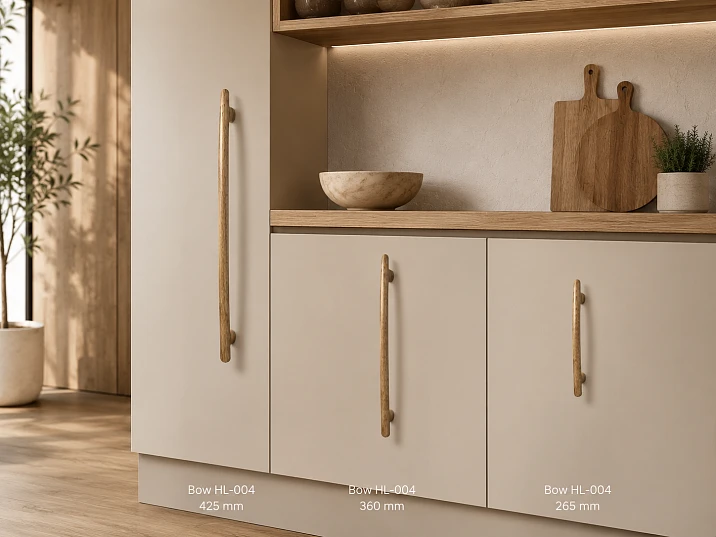
The kitchen is being designed from scratch, the facades are not drilled yet, and the designer wants to maintain one handle style across the entire cabinet set. This is a case where one model in three sizes is more useful than three different models: narrow drawers get a compact Bow, medium facades get a longer one, wide ones get the largest, while the bracket shape, cross-section, and material remain visually consistent.
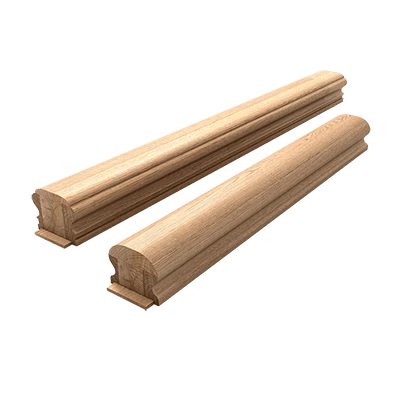
The Bow HL‑004 just happens to have three size variants. The card of the wooden handle Bow HL‑004 shows 265 × 33 × 27 × 192 mm, 360 × 33 × 27 × 288 mm, and 425 × 33 × 27 × 352 mm.
In this article, the first three digits are considered as A × B × C, and D is the mounting dimension D, exactly as labeled in the product table. Until a specific drawing is used by the cabinetmaker for marking, it is safer not to rename D to "center distance" just out of habit: for production, the manufacturer's designation must be passed on without assumptions.
The main mistake when ordering a set occurs not in choosing oak or beech. It occurs earlier: the buyer counts the total number of handles but does not distribute them across the facades. As a result, the cart may contain, for example, twelve identical Bow 360 mm handles, even though the kitchen has three groups of facades and some handles will turn out visually too large or too compact.
The correct sequence is the reverse:
-
make a list of all facades;
-
record their actual width and height;
-
mark the handle orientation;
-
assign one of the three Bow sizes to each facade;
-
check the free field;
-
check adjacent handles, walls, and opening;
-
transfer the installation size D to the list;
-
count the quantity of each modification;
-
choose oak or beech and the finish type;
-
only after this, place the order and pass the drilling to the cabinetmaker.
Direct answer for a project with three types of facades: there is no need to try to make the handle length the same across the entire kitchen. The selection logic should be the same. For example, the narrow group gets 265 mm, the medium — 360 mm, the wide — 425 mm. But the boundaries of "narrow/medium/wide" cannot be assigned universally without the dimensions of the specific cabinet set. They are determined by the facades, adjacent elements, and visual rhythm.
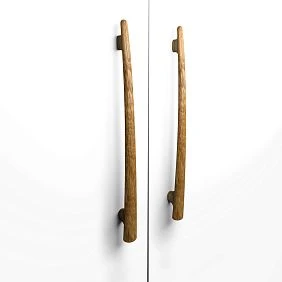
Wooden handle Bow HL-004: how to distribute three sizes across facades
Bow HL-004 is a wooden pull handle without coating. Oak and beech are available in the table, sanding quality is "Prestige", and the mounting kit is included in the price.
| Total length A | Width B | Reach/depth C | Mounting dimension D |
|---|---|---|---|
| 265 мм | 33 мм | 27 мм | 192 мм |
| 360 мм | 33 мм | 27 мм | 288 мм |
| 425 мм | 33 мм | 27 мм | 352 мм |
The three modifications matter not only in length. Each has its own mounting dimension D. This means the cabinetmaker cannot drill all facades with one jig and then decide which Bow to install. The handle size and drilling pattern must be assigned before drilling.
Start not with the handle, but with the facade map
For a kitchen, it is useful to make a table before ordering:
| Facade no. | Width | Height | Type | Bow orientation | Selected A | Mounting D | Quantity |
| F‑01 | ___ | ___ | box/door | horizontally/vertically | ___ | ___ | 1 |
| F‑02 | ___ | ___ | box/door | ___ | ___ | ___ | 1 |
| F‑03 | ___ | ___ | box/door | ___ | ___ | ___ | 1 |
The number of rows equals the number of actual fronts, not the number of front "types." After filling in the rows, you can group them and get a total: how many Bow 265, how many 360, how many 425.
Why one front width is not enough
A handle can be placed horizontally on a drawer, vertically on a tall hinged door, vertically at the edge of a tall cabinet, or horizontally on a wide lower front. Therefore, a 425 mm handle may be appropriate on a tall narrow door in a vertical orientation and at the same time too long for a low horizontal drawer of the same width. Context matters more than a single number.
First the design rhythm, then the quantity
A kitchen unit may have 5 narrow fronts, 7 medium ones, and 3 wide ones. Then the order, if the check shows exactly this binding, will be:
Bow HL-004 265 mm — 5 pcs.
Bow HL-004 360 mm — 7 pcs.
Bow HL-004 425 mm — 3 pcs.
This is an example of a method, not a ready-made rule for any kitchen.
The same logic works not only in the kitchen. A large dresser can have narrow top drawers, medium central ones, and a wide bottom one. Three Bows allow maintaining a single arched profile without forcing a short facade to carry too long a bracket.
If you are just forming your assortment, the general section buy wooden handles for furniture is useful for comparing Bow with other shapes, but within a single project, switching to another model should only be done for a real reason.
Our factory also produces:
Bow HL‑004 265 mm handle with mounting dimension D 192 mm
Bow 265 is the most compact of the three. Its total length A = 265 mm, width B = 33 mm, depth C = 27 mm, mounting dimension D = 192 mm.
It logically becomes the first candidate for more compact facades, but the article should not establish a universal rule like "265 mm is only installed on facades 400–500 mm." A specific kitchen may have a different composition.
Get Consultation
Check on a 450 mm facade
If a 265 mm long handle is centered on a 450 mm wide facade:
(450 − 265) / 2 = 92.5 mm.
On the sides, approximately 92.5 mm of free space remains.
The handle takes up about 59% of the width of such a facade:
265 / 450 × 100 ≈ 58,9%.
This is not a standard for an "ideal proportion," but only a way to compare scale.
On a narrow hinged door
If the Bow 265 is mounted vertically, you need to consider not just the door width as the only parameter, but the height, distance from the top and bottom edges, position relative to the adjacent door, hinge side, grip, and opening angle.
On two adjacent doors, the handles may end up very close to each other. Depth C = 27 mm also becomes important: the two brackets must not collide when opening.
Do not drill D = 192 from memory
In the installation list, write:
Bow HL‑004 / A 265 / D 192.
Before production, the cabinet maker must verify these values against the current product drawing.
This is especially important if the same kitchen has Bow 360 and 425: visually the model is the same, but the mounting D values are different.
When 265 mm can turn out to be too large
If after centering the handle almost touches the edge of the panel, the facade frame, vertical profile, neighboring handle, wall, or refrigerator handle, you need to either change its position or switch to a different model. The Bow HL‑004 has no standard modification shorter than 265 mm.
You cannot "shorten" a wooden bracket yourself and preserve the original mounting structure.
Furniture handle Bow HL‑004 360 mm with mounting dimension D 288 mm
The middle Bow has A = 360 mm, B = 33 mm, C = 27 mm, D = 288 mm.
For a kitchen with three groups of facades, this size often becomes a visual bridge between the compact 265 and the long 425: the shape does not change, but the scale gradually grows.
Check on a 600 mm facade
When centering:
(600 − 360) / 2 = 120 mm.
The handle occupies:
360 / 600 × 100 = 60%.
That gives 120 mm of free space on the left and right.
This is a training example, not a ready-made standard for 600 mm kitchens.
What to check next to the adjacent handle
If two facades 600 mm wide stand side by side and both Bow 360 are oriented horizontally, the distance between the nearest ends of the handles depends not only on the side margins, but also on the gap between the facades.
If the facades meet at a corner, the geometry is more complex: the handle of one cabinet may fall into the trajectory of another.
Therefore, the designer must check not only the frontal pattern, but also the opening in plan.
Why the middle handle does not have to be on all 600 mm facades
On one kitchen, a 600 mm facade can be a tall vertical one, a low drawer, a dishwasher door, a pull-out internal module, or a decorative panel.
For a tall facade, the designer can choose 425 mm vertically. For a compact drawer — 360. One body width does not mean one mandatory handle.
The mounting dimension D 288 must be stored together with A 360
In the specification, you cannot leave a single column "handle 360".
Need at least two:
A = 360 mm — what the designer and client see.
D = 288 mm — what the installation sheet needs.
This reduces the risk that production will take 360 mm as the drilling size.
Wooden bow handle HL‑004 425 mm with mounting dimension D 352 mm
The longest Bow has A = 425 mm, B = 33 mm, C = 27 mm, and D = 352 mm. It is not needed to “make the facade richer,” but so that on a large surface the handle does not look accidentally small and maintains proportional visual weight.
Check on an 800 mm facade
With horizontal centering:
(800 − 425) / 2 = 187.5 mm.
The handle occupies:
425 / 800 × 100 ≈ 53,1%.
That is, Bow 425 on an 800 mm facade occupies a smaller share of the width than Bow 360 on the training facade of 600 mm. This is a useful observation: the same visual rhythm does not mean the same percentage of handle length relative to the width of each facade.
On a real kitchen, a designer can deliberately achieve:
-
about 59% for a narrow group;
-
about 60% for a medium one;
-
about 53% for a wide one.
And still the set will look cohesive, because the Bow shape, material, finish, and positioning principle are preserved.
Wide bottom drawer
On a wide pull-out front, the long Bow is convenient visually and tactilely: the grip area is larger, and the handle better matches the scale of the surface.
But before ordering, you need to check:
-
whether it intersects with the decorative frame;
-
whether it falls into the milling;
-
does it interfere with the adjacent facade;
-
is there enough space for the hand;
-
does the edge of the handle not press against the side wall;
-
is there no other large hardware nearby.
Tall door and vertical orientation
Bow 425 can be considered vertically on a tall hinged door if the project allows it.
Here, the main dimension for the composition becomes the height of the facade. The free field formula is the same:
vertical field = (facade height − 425) / 2
with strict vertical centering.
For example, for a door 900 mm high:
(900 − 425) / 2 = 237.5 mm.
This is again a calculation example, not a recommendation to install Bow 425 on any 900 mm door.
Why orientation should be recorded in the specification
Phrase:
“Bow 425 — 6 pieces”
does not tell the cabinetmaker where and how these six handles are installed.
You need to:
-
F‑11 — Bow 425 — horizontally;
-
F‑12 — Bow 425 — horizontally;
-
F‑21 — Bow 425 — vertically on the left;
-
F‑22 — Bow 425 — vertically on the right.
Especially if the doors are mirrored in terms of opening.
Mounting dimension D 352
In the order table, A 425 and D 352 are written in separate columns.
You don't need to assume that D 352 can automatically be passed as "center-to-center distance" if the production drawing hasn't been verified. For a designer, the designation mounting dimension D is sufficient, and the cabinetmaker should work with the Bow drawing.
How to calculate free spaces around a wooden handle
Free space is the simplest numerical tool that helps compare different sizes of the same handle on facades of different widths.
With horizontal centering:
P = (W − A) / 2,
Where:
-
P — side space;
-
W — facade width;
-
A — total handle length.
Examples from the plan:
| Facade W | Bow A | Field P on each side |
| 450 мм | 265 мм | 92.5 mm |
| 600 мм | 360 мм | 120 мм |
| 800 мм | 425 мм | 187.5 mm |
This table is needed not as a ready-made matrix for any kitchen, but as a method.
Add the percentage of occupied width
For comparison, it is convenient to calculate:
R = A / W × 100%.
We get:
-
265 / 450 ≈ 58,9%;
-
360 / 600 = 60%;
-
425 / 800 ≈ 53,1%.
This shows that the same model can look cohesive even with different facade proportions.
Why striving for the same percentage is not necessary
If you want to make all three handles exactly 60% of the facade width, the "ideal" facades will be:
-
265 / 0.6 ≈ 442 mm;
-
360 / 0.6 = 600 mm;
-
425 / 0.6 ≈ 708 mm.
But a real kitchen is designed not around handles. The width of facades depends on modules, appliances, storage, and architecture.
Therefore, the percentage is a diagnostic indicator, not a governing standard.
The field should be calculated along the axis along which the handle is positioned.
If Bow is installed vertically on the door:
Pvertical = (H − A) / 2.
If the handle is offset toward the edge, the formula changes: the fields become different.
In the specification, you then need to record the specific offset from the chosen base edge.
For a framed facade, we calculate not only the external width.
The facade can have:
-
a wide frame;
-
the panel;
-
milling;
-
overlay decor;
-
ribbed insert.
Bow may physically fit within the outer dimensions, but conflict with the inner frame.
Therefore, the clear installation area is additionally measured.
For example:
external width — 600 mm;
internal quiet zone — 420 mm.
Bow 360 looks comfortable in terms of external width, but within the 420 mm field, there remains:
(420 − 360) / 2 = 30 mm.
This is a completely different visual scale.
How to check without drilling
Make paper templates:
-
265 × 33 mm;
-
360 × 33 mm;
-
425 × 33 mm.
Secure with masking tape on the fronts.
Even without an exact profile, such a mockup shows:
-
scale;
-
side margins;
-
a vertical rhythm;
-
conflict with the panel;
-
distance to the edge.
For final verification of the grip zone and C = 27 mm, a real handle or 3D model is needed.
How to maintain a consistent rhythm of Bow HL-004 handles on facades of different widths
A unified rhythm is not "all handles are the same." It is a repeatable rule.
For a kitchen with three Bow sizes, there are three basic systems.
System 1. Centering each handle on its own facade
Each handle is placed at the geometric center of the facade along the selected axis.
Advantages:
-
the clearest layout;
-
each facade looks self-sufficient;
-
different sizes are perceived naturally;
-
there is no need to maintain a single common line of holes.
Disadvantage:
if the facades are of different heights and the handles are vertical, their centers may not form a single horizontal line.
System 2. Single axis of handles
For example, on all tall fronts, vertical Bow handles have the same offset from the nearest edge.
Advantages:
-
the kitchen reads as a strict system;
-
convenient for a row of tall cabinets;
-
the handles form an architectural line.
Disadvantage:
the free margins relative to the center of the front will be different.
System 3. Alignment to the nearest edge
For doors, you can set the same offset from the opening edge to the edge or axis of the handle.
This is convenient on hinged fronts.
But with three handle lengths, the opposite end will be in different places.
You cannot get everything at once
With different A and D, you cannot simultaneously guarantee:
-
identical side margins;
-
one axis;
-
the same mounting size;
-
the same offset of both ends;
-
the same share of the facade.
Therefore, the designer chooses the priority rule.
How to choose a rule for the kitchen
Set the sequence:
-
which line is most important when looking at the furniture set;
-
where are the largest facades located;
-
is there a row of identical drawers;
-
are there tall cabinets;
-
which handles are horizontal, which are vertical;
-
which facades appear in one visual block.
On lower drawers, centering may work, while on tall cabinets, a single vertical axis applies. This is not a system violation if the rule changes by facade type, not randomly.
Example of a mixed scheme
Bottom row:
-
450 mm → Bow 265, centered;
-
600 mm → Bow 360, centered;
-
800 mm → Bow 425, centered.
Pencil cases:
-
Bow 425 vertically;
-
same indent from the opening edge;
-
same height for the start of the handle.
This results in a single handle model, but two clear placement systems.
How to order Bow HL‑004 wooden handles without confusion in the mounting list
The main document for a large order is not the cart, but the facade list.
Minimum columns:
| Facade no. | Facade size | Orientation | Article number | A | D | Material | Quantity | Finish | Fastening | Plug |
| F‑01 | ___ × ___ | city./vert. | Bow HL‑004 | 265 | 192 | Oak/beech | 1 | Unfinished | kit | Yes/No |
| F‑02 | ___ × ___ | ___ | Bow HL‑004 | 360 | 288 | ___ | 1 | ___ | kit | ___ |
| F‑03 | ___ × ___ | ___ | Bow HL‑004 | 425 | 352 | ___ | 1 | ___ | kit | ___ |
Why should every facade have a number
Without a number, the installer sees three stacks of handles but doesn't understand which size corresponds to which door.
Numbering:
-
eliminates sorting errors;
-
helps with packaging;
-
speeds up drilling;
-
facilitates installation;
-
allows checking the order before painting.
Count three sizes separately
After filling out the tally sheet, make a summary:
265 mm — ___ pcs.
360 mm — ___ pcs.
425 mm — ___ pcs.
The sum must equal the number of facades with handles.
If there are 18 facades in total, but the summary shows 17 handles — the error is found before ordering, not on site.
The material must be in one column
If some handles are oak and some are beech, this must be intentional.
Random mixing is especially noticeable with transparent finishes.
If all handles are painted with an opaque coating, the difference in wood species may be visually less, but you still shouldn't mix materials without reason: they differ in texture and behavior during finishing.
Before drilling, print the final list
The file version must have a date or number.
For example:
Bow_HL004_kitchen_v7_FINAL.pdf
This helps avoid a situation where the workshop drills according to v5, but the designer has already changed two facades in v7.
Beech or oak: which wood to buy furniture handles from
Bow HL‑004 is presented in oak and beech in the current table. However, the specific combination of "size + material + finish" must be checked in the product card before ordering, not assumed based on the general assortment.
Oak, if the wood should remain visible
Oak has a pronounced natural texture. If the kitchen is built around:
-
oak veneer;
-
of the array;
-
open wooden shelves;
-
a natural countertop;
-
semi-transparent tinting,
an oak Bow can become a continuation of the facade material or a contrasting wooden accent.
But matching the tone exactly with already finished veneer from a photo cannot be guaranteed. The result is influenced by:
-
the original shade of the specific wood;
-
oil;
-
stain;
-
lacquer;
-
gloss level;
-
lighting in the room.
Therefore, for an expensive project, a test sample of the coating is needed.
Beech for opaque finish
Beech is a dense wood with a calmer texture. If the handles are to be painted with opaque enamel in the color of the facade, the natural pattern ceases to be the main factor.
In this scenario, beech is often rational.
For example:
-
facades are dark blue;
-
Bow are stained in the same color;
-
The handle should be read by shape, not by wood.
Then the finisher's task is to achieve the same color and gloss on the facade and handle.
Do not mix oak and beech in one visible line without a reason
Let's imagine a row of six identical facades:
-
three Bow oak;
-
three Bow beech;
-
everything is covered with transparent oil.
The difference in texture will be noticeable.
Even if the two species can be brought close in color, the pattern will remain different.
If a project deliberately mixes wood species, that is a separate design decision. For a regular kitchen, it is better to keep one species within one visual block.
Why "Prestige" sanding is important for a handle
The current Bow HL‑004 table shows the quality of "Prestige" sanding.
A handle is an object of constant tactile contact. The user touches it daily:
-
the outer arc;
-
the lower surface;
-
ends;
-
the area near the mounting point.
Therefore, the quality of preparation is especially noticeable to the hand here.
"Prestige" means more thorough manual sanding according to the STAVROS system. But this is not a final protective coating. HL‑004 is still supplied without coating.
Detailed criteria can be checked on the page quality of STAVROS wooden products.
Unpainted Bow HL-004 or finished handle Bow HL-004M
Bow HL-004 and Bow HL-004M are two separate cards.
HL‑004:
-
without coating;
-
oak or beech;
-
"Prestige";
-
three sizes;
-
mounting kit included.
HL‑004M:
-
separate article;
-
the same three size groups;
-
finished coating options in the card;
-
ordered as a finished, finished handle.
This is important for the statement. You cannot write:
Bow HL‑004, white
and expect the cabinetmaker to understand which product is required.
More correctly:
Bow HL‑004 — unfinished, finish is applied in the project.
or
Bow HL‑004M — ready-made coating, specific color.
When the unfinished HL‑004 is more advantageous
The unfinished version is convenient if:
-
the handles need to be painted to match the exact color of the facade;
-
the finisher works with one paint system for the entire kitchen;
-
a custom tint shade is needed;
-
patina required;
-
facades and handles must have one non-standard gloss.
In this case, the section is useful buy unpainted furniture handles, if you need to compare Bow with other models without coating.
When HL‑004M is more convenient
Order painted handle Bow HL‑004M it is logical if:
-
the ready color from the card fits;
-
you don't want to hand over handles to a separate painter;
-
the finishing of facades is already completed;
-
need to get a ready-made element for installation.
But even in this case, the color of the handle should be evaluated next to the real facade.
Why painting of all sizes should be done with one system
If Bow 265, 360, and 425 are in the same set, they should look like one collection.
Unsuccessful scenario:
-
265 was painted on site;
-
360 came ready-made;
-
425 was tinted by another contractor.
Even with the same color name, it can differ:
-
shine;
-
saturation;
-
shade;
-
texture.
If HL‑004 and HL‑004M are mixed, first make samples and confirm that the finish matches.
Materials for self-finishing
If your finisher paints the handles, you can use the section materials for finishing wooden handles for selecting related materials.
It is useful to check the general sequence of preparation and painting with tips on painting wooden handles.
The specific system of primer, enamel, oil, or varnish is chosen according to the project.
Is the mounting included in the set of the wooden handle Bow HL-004
Yes. The current product card directly states: the mounting kit is included in the price.
This means that you do not need to buy standard fasteners again "just in case" until you check the contents of the delivery.
Why this matters for a large order
Let's say there are 24 facades in the kitchen.
If the buyer automatically adds another 24 sets of screws without checking the standard configuration, they will create an unnecessary purchase.
More correctly:
-
order handles;
-
get confirmation of the fastener composition;
-
verify the thickness of the facades;
-
only order other fasteners if there is a real need.
Facade thickness matters
The mere presence of fasteners does not guarantee that the standard screw length fits any non-standard facade.
For example, the facade can be:
-
standard MDF;
-
thick frame;
-
multi-layer;
-
with decorative overlay;
-
thickened in the mounting area.
If the cabinet maker sees that the standard screw is not the right length, they must select a correct equivalent of the same type and thread after checking the handle.
You cannot simply take a "longer screw" and tighten it all the way: it may go deeper into the wooden handle than allowed or damage the threaded part.
Check the fasteners before mass drilling
For a new kitchen, it is useful to make one test door or a technological sample.
Check:
-
D;
-
hole diameter;
-
screw length;
-
handle installation;
-
clamp;
-
no play;
-
position of the heads on the reverse side.
After that, the scheme can be replicated.
When a decorative cap FUR‑033 is needed
Bow HL‑004 shows FUR‑033 among the recommended hardware, but this does not mean that the cap is mandatory on every facade.
FUR‑033 is a decorative metal cap 14 × 14 × 3 mm in nickel color. The card confirms that it is intended for an M4 screw with a semi-circular head and covers the visible screw head.
Where the screw head is located
For a handle that is attached through the facade, the head is usually on the inside of the door or drawer. But the specific design of Bow and the included mounting must be checked against the drawing and the actual handle.
Therefore, buying FUR‑033 automatically is not necessary.
First, the cabinetmaker answers:
-
is the head visible;
-
which screw is used;
-
is it M4;
-
is the head semicircular;
-
is there space for a plug;
-
does it not interfere with the internal fittings.
Only if all conditions match, can you buy a plug for screw FUR-033.
Why the nickel color may be noticeable inside the facade
On a white kitchen, a nickel plug on the inside of the door may look neat.
It will be more noticeable on a dark or wooden facade.
If the interior appearance is important, this issue is best resolved on a sample.
How many plugs to count
The quantity depends on the number of visible compatible screws, not just the number of handles.
If a specific handle has two visible screws and both fit FUR-033, one handle may require two plugs.
But the article should not automatically assign "2 × quantity of Bow" without checking the complete fastening set and its position.
Therefore, the list has a separate column:
FUR-033: yes / no / quantity.
When a plug is not needed
if:
-
the screw head is hidden by the design;
-
a different head type is used;
-
the screw is not M4;
-
the interior view does not require decorative covering;
-
the plug interferes with adjacent hardware,
it does not need to be added for the sake of a "complete set."
General section buy furniture hardware useful after the mounting scheme has already been determined.
When wooden handles Bow HL‑004 are not suitable
A good article should not only explain how to buy Bow, but also show when it is better to refuse it.
The facades are already drilled for a different mounting size
This topic is specifically about a new kitchen.
If holes already exist, the scenario changes. You need to first measure the existing distance and look for a compatible handle, or decide on repairing the facade.
HL-004 has three D values: 192, 288, and 352 mm. You cannot expect one of them to randomly match any old drilling pattern.
There is no clear field on the facade for length A.
The handle may fit by external dimensions, but conflict with:
-
frame;
-
milling;
-
the panel;
-
the decorative overlay;
-
profile edge.
If the clear area is smaller than required, it is better to choose a different handle.
The handle hits the wall.
On the outermost facade near a wall, a long Bow may hit the wall before the door opens to the required angle.
Need to check:
-
distance from the facade to the wall;
-
depth C = 27 mm;
-
the opening trajectory;
-
plinth or wall panel.
Handles collide in the corner of the kitchen
Typical risk of an L-shaped kitchen.
Two doors open towards each other, and long handles may collide.
Solution:
-
change the placement;
-
choose a smaller size;
-
change the opening side;
-
use a different model in the problem area.
But the last option breaks the unified Bow line and must be a conscious choice.
One mounting dimension is required on all fronts
If production has already standardized one jig and is not ready to work with D 192/288/352, using three Bows in one order is inconvenient.
Then you either need to change the production process, or choose a handle with one mounting size.
A ready finish is needed, but HL‑004 was selected.
An unpainted HL‑004 does not become painted after installation.
If there is no painter and a ready finish is needed, look at HL‑004M.
The facade is too narrow for two mounting points.
Even if the arched handle visually appeals, the mounting D must physically fit in the safe zone of the facade.
Narrow frame elements require special care.
A short handle less than 265 mm is needed.
In the standard HL‑004 table, such a modification does not exist.
Do not cut Bow yourself.
In this case, choose a different article.
Three practical scenarios for distributing Bow across the kitchen
Scenario 1. Lower drawers of three widths
Suppose in one row there are facades of 450, 600, and 800 mm. The designer wants the handle to be horizontal and always centered.
Starting scheme:
-
450 mm → Bow 265;
-
600 mm → Bow 360;
-
800 mm → Bow 425.
Calculation of margins:
-
92.5 mm;
-
120 mm;
-
187.5 mm.
After a paper mock-up, it becomes clear that on an 800 mm facade, the Bow 425 looks too compact relative to the long horizontal panel. This is not a calculation error. It is a signal that arithmetic describes the free space but does not make a design decision. The option can be kept if the overall row looks cohesive, or another model can be chosen for the entire kitchen if 425 mm is insufficient in scale.
Scenario 2. Lower drawers plus tall cabinets
The lower row receives:
-
450 → 265 horizontally;
-
600 → 360 horizontally;
-
800 → 425 horizontally.
Tall cabinets 2200 mm high receive Bow 425 vertically.
To prevent vertical handles from "floating," the designer sets not the center of the door height, but a single base mark: for example, the lower end of each Bow is at the same height from the floor. The specific figure is determined by the project.
So one kitchen uses two systems:
-
horizontal handles — centered on the facade;
-
vertical ones — along a common baseline.
The system remains logical because the rule changes based on the type of facades.
Scenario 3. Large dresser with two narrow drawers and one wide drawer
The top row consists of two facades of 450 mm each, the bottom — one facade of 900 mm.
On the top ones, you can check Bow 265.
On the bottom one — Bow 425.
But a new question arises: the bottom handle is single and located on the axis of the entire dresser, while the top two form a pair. To prevent the composition from looking like a "triangle of handles," you need to check:
-
the height of the axes;
-
distance between upper Bow;
-
position of the lower;
-
overall center of the furniture.
That is, the handle size determines only part of the composition.
Corner kitchen: where length A becomes less important than C
On a straight facade, A is more often discussed.
In the corner, C = 27 mm and the opening trajectory come to the forefront.
Imagine an L-shaped kitchen set. Two doors are positioned perpendicularly. One opens outward and passes near the handle of the second.
Even if Bow 265 fits nicely on each facade, during movement one facade may hit the other handle.
The check is performed in plan view:
-
draw closed facades;
-
mark the handle protrusion C = 27 mm;
-
construct the opening arc;
-
add technological gaps and the actual facade thickness;
-
ensure that the trajectories do not intersect.
For a corner, sometimes a smaller Bow, an offset from the center, or different hardware on one problematic facade is better. But such a deviation from the general model needs to be evaluated across the entire kitchen.
Dishwasher facade: why it cannot be automatically equated to a regular 600 mm drawer
The width may be 600 mm, but the function is different.
For a built-in dishwasher:
-
heavy facade;
-
different trajectory;
-
different opening force;
-
the manufacturer's own equipment limitations.
Bow 360 may visually fit, but the final mounting point and suitability of a specific handle must be confirmed by the kitchen manufacturer, taking into account the equipment instructions.
Do not drill into the appliance front just because the adjacent drawer of the same width has already received D 288.
Refrigerator front and tall Bow
At heigh
But 3D does not show the tactile grip and the real wood color.
Therefore, for the final decision:
3D → for geometry and visualization.
Physical sample → for color, tactility, and installation.
What to do if after visualization you want one size for all facades
This is an acceptable result.
For example, the designer compared three Bow models and decided that 360 mm is universal enough for the entire kitchen.
Then you need to re-check:
-
the narrowest facade;
-
the widest;
-
angles;
-
tall doors;
-
appliances.
If all pass, one length can simplify production.
But the decision should be made after comparing three sizes, not from a desire to reduce positions in the order.
What to do if one Bow is not enough in scale for the widest facade
425 mm is the maximum standard length of Bow HL‑004 in the card.
If it looks too small on a very wide facade, there are options:
-
leave 425 as a deliberate accent;
-
use two handles, if the construction and design allow it;
-
choose another model with a longer length;
-
change the opening principle.
Two handles on one facade cannot be assigned just for symmetry: the cabinetmaker must check the force, geometry, and mounting.
Errors when ordering a set of furniture handles
Error 1. Confusing the total length A with the mounting size D
Reason: on the card there are four numbers next to each other, but in conversation usually only "handle 265" is mentioned.
Consequence: production may transfer the incorrect drilling size to the facade.
How to prevent: always store A and D in separate columns in the list.
For Bow:
-
A 265 → D 192;
-
A 360 → D 288;
-
A 425 → D 352.
Error 2. Ordering all handles of one size without a facade map
Reason: wanting to simplify procurement.
Consequence: the unified model is preserved, but the scale on different facades becomes random.
How to prevent: first fill in the facade list, then calculate the three sizes.
Error 3. Assigning sizes only based on the cabinet width
Reason: the kitchen is designed with modules of 450/600/800 mm.
Consequence: facades of different types with the same width receive an inappropriate orientation or scale.
How to prevent: take into account the height, opening type, and clear installation area.
Error 4. Mixing oak and beech in one visible line
Reason: at the time of ordering the required quantity of one species is unavailable or the price differs.
Consequence: under a transparent coating the texture is not uniform.
How to prevent: order one species for one visual block or design the mixing in advance.
Error 5. Drilling the first facade before approving the entire list
Reason: production wants to start work while the handles are still in transit.
Consequence: after changing the Bow size, the drilling no longer fits.
How to prevent: freeze the specification, approve the article number and dimensions, then drill.
Error 6. Treating HL‑004 and HL‑004M as the same modification
Reason: the name Bow and the geometry match.
Consequence: some handles arrive without coating, some finished; color and process diverge.
How to prevent: always write M or the absence of M in the article number.
Error 7. Re-purchasing fasteners already included in the kit
Reason: the cabinetmaker habitually adds screws to each handle.
Consequence: unnecessary purchase and risk of mixing two types of fasteners.
How to prevent: first check the standard kit.
Error 8. Automatically adding FUR‑033 to all handles
Reason: the plug is included in the recommended hardware.
Consequence: some plugs are not used if the screw head does not match.
How to prevent: check the M4 screw with a semi-round head and the visibility of the fastener.
Error 9. Ignore C = 27 mm
Reason: only the length is visible in the front view.
Consequence: the handle hits the wall or the adjacent facade when opening.
How to prevent: check the plan and the door trajectory in 3D.
Error 10. Try to achieve equal side margins on all facades
Reason: symmetry seems to be the main sign of order.
Consequence: handle sizes have to be chosen against scale or functionality.
How to prevent: choose in advance the main rhythm principle — centering, axis, or edge.
Mistake 11. Painting different sizes on different days with different systems
Reason: handles are ordered in batches.
Consequence: Bow of one model differs in shade or gloss.
How to prevent: paint all sizes with one system and according to one approved sample.
Mistake 12. Ordering handles before the final thickness of the facade
Reason: facade widths are already known.
Consequence: standard fasteners may require length adjustment.
How to prevent: have the actual facade thickness before mass installation.
Mistake 13. Using one jig for D 192, 288, and 352
Reason: externally, Bow looks like a single series.
Consequence: the holes do not match the specific modification.
How to prevent: a separate template or an adjustable jig with checking each group.
Error 14. Not specifying vertical orientation
Reason: the order contains only the size.
Consequence: the installer places the handle in the center, although the designer planned it at the edge.
How to prevent: in the specification, write "vertically left/right" and the base offset.
Final specification of wooden handles for the kitchen
After all checks, the order should look not like a line "Bow — 18 pieces", but like a summary specification.
Template for facades
| Facade | Facade size | Type | Orientation | A Bow | D | Species | Finish | Fastening | FUR‑033 |
| F‑01 | ___ × ___ | Drawer | Horizontally | 265 | 192 | Oak | HL-004 without coating | kit | Check |
| F‑02 | ___ × ___ | Drawer | Horizontally | 360 | 288 | Oak | HL-004 without coating | kit | Check |
| F‑03 | ___ × ___ | Door | Vertically | 425 | 352 | Oak | HL-004 without coating | kit | Check |
Order summary
After filling in all lines:
Bow HL-004 265 mm — ___ pcs.
Bow HL-004 360 mm — ___ pcs.
Bow HL-004 425 mm — ___ pcs.
Material:
oak / beech.
Execution:
HL-004 without coating
or
HL-004M with ready coating.
Additional fittings:
FUR‑033 — only after checking compatible visible screws.
Sum check
Let's say in the kitchen:
-
4 fronts get 265;
-
8 fronts — 360;
-
5 fronts — 425.
Then:
4 + 8 + 5 = 17 handles.
The number must match the number of openable fronts where Bow is provided.
If the kitchen has 19 doors and drawers, but two doors open with push‑to‑open without handles, 17 is correct.
That is, you need to compare not with the total number of facades, but with the number of facades with a handle.
Add a reserve only for a specific reason
For a custom kitchen, the exact quantity is usually ordered.
One spare Bow can be useful if:
-
the site is remote;
-
the kitchen is commercial;
-
the finish is non-standard and it will be difficult to match the shade later;
-
the risk of damage during installation is increased.
But it is not necessary to automatically buy a spare handle of each size.
Before payment, do a control pass
Check:
-
all facades are numbered;
-
every Bow has A;
-
everyone has D;
-
orientation is specified;
-
material is the same in the required group;
-
coating is defined;
-
fastener quantity is checked;
-
FUR-033 is assigned only where needed;
-
drilling has not been started based on the old version of the list;
-
the sum of handles matches the actual number of installation points.
After that, you can safely place the order and check the current payment and delivery of furniture handles.
Frequently asked questions about Bow HL‑004 on facades of different widths
What size of Bow HL‑004 should I choose for a 450 mm facade?
In the example, Bow 265 when centered leaves 92.5 mm on each side. But this is not a mandatory choice: you need to check the facade frame, orientation, and neighboring elements.
What size should I choose for a 600 mm facade?
Bow 360 gives 120 mm of free space when centered. Bow 265 will be more compact, Bow 425 — larger. The choice depends on the rhythm of the entire kitchen.
What should I put on an 800 mm facade?
Bow 425 in the example leaves 187.5 mm. But on a very wide drawer, the designer may choose another system if it is necessary to maintain a single mounting principle.
Can I install 425 mm vertically?
Vertical orientation can be considered on a tall door if the handle does not conflict with neighboring facades and the chosen position is comfortable for gripping.
D 192, 288, and 352 — is this exactly the center distance?
In the product table, the parameter is labeled as D. For the article, it is safer to call it the mounting dimension D. Before drilling, the cabinet maker should verify the current drawing.
Is the mounting hardware included in the price of Bow HL‑004?
Yes. The card directly indicates that the mounting kit is included in the price.
Do I need to buy the screws separately?
Not automatically. First, check the standard mounting hardware and the thickness of your facade.
Can I install FUR‑033 on Bow HL‑004?
The Bow card shows FUR‑033 as recommended hardware. FUR‑033 itself is designed for an M4 screw with a semi-circular head. Therefore, before purchasing, you need to confirm the type and visibility of the specific screw.
How many FUR‑033 are needed per handle?
It depends on the number of visible compatible screw heads. You should not automatically count two without checking the Bow mounting.
How does HL-004 differ from HL-004M?
HL-004 is supplied without coating. HL-004M is a separate painted modification with its own finish options.
Can HL-004 be painted to match the facade color?
Yes, it is precisely the lack of coating that makes it convenient for custom finishing. The technique needs to be coordinated with the painter.
Which wood species should be chosen for enamel?
Beech is often rational for opaque enamel. But the specific choice depends on the project.
Which wood species should be chosen for transparent oil?
Oak is often chosen for its pronounced texture. Before serial finishing, make a sample.
Can oak and beech Bow be mixed?
Technically, you can order both species, but in one visible line under a transparent coating, the difference will be noticeable.
Should all handles be made the same size for the sake of unity?
No. Exactly three Bow sizes allow you to keep one model and change the scale to fit the facade.
How then to maintain unity?
Repeat the rule: same shape, one wood species, one finish, consistent positioning.
Can you install 265 on wide facades and 425 on narrow ones?
Physically, different combinations are possible, but they must be explained by orientation and design. Random reverse distribution usually destroys the scale.
How to check handles before ordering the entire batch?
Order or take samples, use a 3D model, and make paper templates of the three sizes on real facades.
Can facades be drilled before the handles arrive?
Only after final approval of the current drawing and list. For an expensive kitchen, it is safer to have a physical sample of at least one handle of each used size.
What to do if the kitchen is already drilled for a different size?
This is a different scenario. You need to measure the finished holes and select a compatible handle, or decide on restoring the facade.
What is the minimum facade required for Bow 265?
The card does not specify a universal minimum width. You need to check the mounting D, the actual attachment area, the facade edges, and the decorative frame.
Can the Bow 360 be shortened to 300 mm?
There is no reason to consider this a correct modification: the handle design and mounting geometry will change. Choose a standard size or a different model.
What to do if one facade fits neither 265 nor 360?
Do not force the system. Consider a different opening method, another handle model, or modifying the facade. One problematic door should not force drilling into the Bow with a violation of its construction.
What about a corner cabinet?
Check the opening of two adjacent facades in plan. The Bow C depth of 27 mm and the handle length must be considered together.
Do you need to account for the dishwasher handle?
Yes. The facade of the appliance can fit into the overall rhythm, but its construction and opening force differ. The Bow position is coordinated with the kitchen manufacturer and the appliance.
Can 425 be installed vertically on tall cabinets, and 360 horizontally on lower drawers?
Yes, that is a logical system if the axes and offsets are designed consistently.
How to count handles on a double hinged cabinet?
One for each opening door, unless the project specifies a different mechanism. The size is assigned to each door individually.
Do I need to buy a spare handle?
Not necessarily. For a complex painted project, one spare may be reasonable if it is difficult to match the color later.
How to avoid sorting errors during installation?
Label the packages: F-01, F-02, F-03, or at least 265/360/425, and a list of facades for each group.
Can A and D be stored only in the designer's file?
It is better to duplicate them in the production sheet. The designer album and the drilling file serve different functions.
Result: one Bow, three sizes, and one logic
Bow HL-004 solves the kitchen task with different facades well precisely because the model does not change, but the scale changes. The customer can use 265, 360, and 425 mm in one set and maintain a unified plastic language.
But for this, you need to abandon the simple order "give me 20 identical handles."
First, a facade map is created. Then, each facade is assigned:
orientation → A → D → wood species → coating → fasteners → additional hardware.
After that, the three groups are summed into the final purchase.
For training facades:
-
450 mm + Bow 265 → 92.5 mm margins each;
-
600 mm + Bow 360 → 120 mm each;
-
800 mm + Bow 425 → 187.5 mm each.
These figures show the method but do not turn into universal rules.
The main technical restriction is not to confuse A and D. 265/360/425 mm are the overall handle lengths, while 192/288/352 are the mounting dimensions D from the card. Drilling must be done according to the current drawing.
HL-004 comes without coating and already includes the mounting kit. If a ready finish is needed, there is a separate HL-004M. FUR-033 is added only after checking the specific M4 screw with a semi-round head and the visibility of its head.
Thus, the request 'buy furniture handles for kitchen' turns into a proper specification, where the cabinetmaker knows exactly which Bow is on each facade, and the customer gets one handle model without