Article Contents:
- STU-005 — a frame by name, but not an empty blank without a seat and backrest
- Confirmed specifications that need to be transferred to the estimate
- Why the color is approved first, and then the entire batch is painted
- What to include in the request to the finisher
- Opaque enamel does not negate material differences
- One color does not make oak chairs identical
- A test coat is more important than the name "walnut"
- Oak is not a mandatory choice for any transparent finish
- Why "Prestige" does not mean the finisher does nothing
- Why finishing a batch may not be considered linearly
- When to finish: before shipping or after receiving
- Why the number of boxes affects acceptance
- Four chairs for the kitchen matching the cabinet fronts
- Six oak chairs for a solid wood table
- Eight chairs for a large dining room
- Twelve chairs for a restaurant
- One chair for a study
- Mistake 1: Multiplying the card price by the quantity and calling the result an estimate
- Mistake 2: Counting STU-005 as an empty frame without a seat
- Mistake 3: Automatically planning soft upholstery
- Mistake 4. Mistaking the primer for the finished paint job
- Mistake 5. Mistaking the preparation for toning for the applied stain
- Mistake 6. Ordering part of the batch in beech and part in oak due to availability
- Mistake 7. Not specifying the level of gloss
- Mistake 8. Painting the batch in several stages without keeping a reference sample
- Mistake 9. Promising absolute identity of the oak grain pattern
- Mistake 10. Not checking the dimensions in the layout
- Mistake 11. Assuming the product dimension is the packaging size
- Mistake 12. Assuming the batch arrives in one box
- Mistake 13. Calculating delivery for twelve items at the rate for one
- Error 14. Not enabling unloading and lifting
- Error 15. Ordering reserve "by eye"
- Error 16. Not determining whether the sample is included in the final quantity
- Error 17. Choosing finishing materials without a unified system
- Error 18. Focusing only on the minimum price of the stone
- Error 19. Ordering chairs one at a time at different times
- Error 20. Not checking the product after delivery before handing it to the finisher
- What is included in STU-005 according to the product card?
- Do I need to buy the seat separately?
- Is upholstery included in the mandatory estimate?
- Why is the card price not equal to the price of the finished chair?
- How to calculate four STU-005?
- How to calculate six chairs for the dining room?
- Can I simply multiply the finish of one chair by twelve?
- What to choose — beech or oak?
- What does "under enamel" mean?
- What does "under tinting" mean?
- What does the "Prestige" sanding quality mean?
- Do I need to order a test color sample?
- Can I order one STU-005 as a sample?
- How to calculate the reserve for a cafe?
- Is STU-005 shipped disassembled?
- Is the box size 484 × 778 × 499 mm?
- Can I order all chairs in one delivery?
- Will STU-005 fit in a small kitchen?
- Can STU-005 be used in a restaurant?
- Where can I compare STU-005 with other frames?
- Where can I check the current price?
- What data should I provide to the manager?
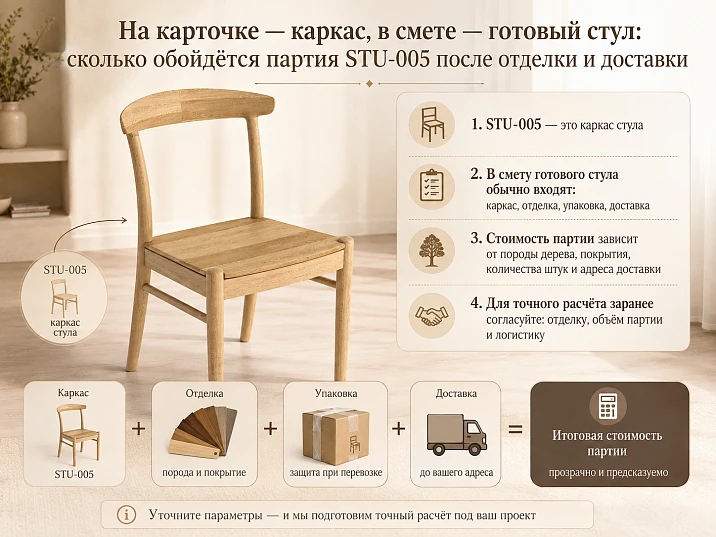
The price of one item in the product card seems clear only until the buyer starts calculating the actual order. For a kitchen, four chairs are needed, for a dining room — six, for a spacious dining area — eight or twelve. A cafe, restaurant, meeting room, or office requires a batch where not only the quantity and price of each frame matter, but also a single wood species, uniform surface preparation, an approved color, finish coating, test samples, packaging, and delivery.
Therefore, a request to buy a chair frame cannot be reduced to multiplying one number by the number of seats. The product card shows the cost of the selected STU-005 option, but a complete estimate only emerges after answering four questions: how many items are ordered, what wood they will be made from, what type of finish the entire set should receive, and how much delivery of the batch to a specific address costs.
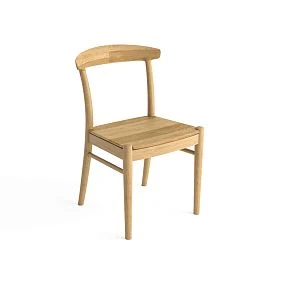
At the same time, STU-005 cannot be described as an empty frame for which the buyer will necessarily have to separately find a seat and backrest. The product already includes a wooden backrest with an anatomical curve, a concave wooden seat, turned legs, and tongue-and-groove joints. Upholstery or a soft cushion is not part of the mandatory formula only because the product is called a frame. They are added only when a separate design or technological solution provides for it.
Before buy the STU-005 chair frame, you need to calculate not an abstract "finished chair," but a specific configuration: STU-005 made of beech or oak, "Prestige" sanding quality, preparation for enamel or tinting, the selected finishing system, and delivery of the entire quantity. Such a calculation shows the real cost of the order and protects against a situation where six frames have already been purchased, but the budget for primer, painting, test samples, and transportation was not planned.
STU-005 — a frame by name, but not an empty blank without a seat and backrest
The product name can be misleading. In furniture manufacturing, a "frame" often means a base that is then supplemented with soft elements, padding, upholstery, or individual parts. STU-005 has a different composition: the product card describes a solid wooden item with form-defining elements necessary for seating.
The backrest has an anatomical curve. The seat is made of wood and has a concave shape. The legs are turned. The joints are assembled using the tongue-and-groove principle. This means that in the calculation, you cannot automatically add a separate rigid seat, a separate wooden backrest, or a set of legs. The buyer selects an already assembled structural base of a specific model.
But the word "frame" is still important. The product is offered as an item for subsequent finishing. Preparation for enamel or tinting is not equal to an applied finish coating. White, gray, green, black, walnut, or any other approved color emerges after a separate finishing stage. It is this stage that turns the selected wooden STU-005 into a chair ready for a specific interior.
The difference is fundamental. The buyer receives not a set of disparate parts and not a ready-painted product in a predetermined color, but a wooden chair frame with a seat and backrest, prepared for the chosen type of finish. Therefore, the final cost includes the product itself and everything required to bring the batch to the approved appearance.




Confirmed characteristics that need to be transferred to the estimate
| Parameter | Confirmed data | How to use in calculation |
|---|---|---|
| Model | STU-005 | Specify the same article number throughout the entire batch specification |
| Size | 484 × 778 × 499 mm | Check the seating arrangement, number of places at the table, and transport volume |
| Material | Beech or oak | Calculate the cost of each option separately |
| Sanding quality | «Prestige» | Consider the surface readiness for further finishing, but do not consider it already painted |
| Preparation | For enamel or tinting | Choose together with the future coating system |
| Backrest | Wooden, with an anatomical curve | Do not add a separate backrest to the mandatory estimate |
| Seat | Wooden, concave | Do not include the mandatory purchase of a separate seat or upholstery |
| Legs | Turned | Do not count the set of legs as a separate item |
| Joints | Tongue and groove | Do not replace the finished structure with a self-assembly of random parts |
| Application | Kitchens, dining rooms, offices, cafes, restaurants, offices | Link the quantity and finish to the operating scenario |
| Packaging | Rigid box | Clarify the number of cargo spaces, volume, and delivery conditions for the batch |
| Order | Cart and quick order | Before payment, record the material, preparation, and quantity |
| Delivery | Across Russia | Calculate separately for the address and batch volume |
The table does not replace the product card. It turns its data into working estimate lines. The size is needed not only by the designer, the material — not only by the finisher, and the rigid box — not only by the carrier. Each parameter affects either the quantity, the price, or the order organization.
After selecting the configuration, the current price should be checked in the product card, because beech and oak may have different prices, and availability and order conditions change. Fixing a single amount in the article would be a mistake: after some time it will no longer match the catalog, whereas the calculation formula will remain valid.
Our factory also produces:
The price in the product card answers only the first question.
The card price shows the cost of one STU-005 in the selected configuration. It does not have to include external finishing work, a third-party painter's labor, test painting, delivery of multiple boxes, or a reserve for a commercial project. Therefore, the phrase "six chairs cost six times more than one" describes only the product part of the order.
The full estimate consists of at least three blocks:
-
the cost of the required quantity of STU-005;
-
the cost of finishing the entire batch;
-
the cost of delivery along a specific route.
For a complex project, additional lines appear: making a color sample, approving several test paints, storage, lifting, carrying in, unloading, additional protection during transport, and reserve items. These costs cannot be included automatically, but they also cannot be ignored. Each line is either confirmed by the contractor or deliberately excluded from the estimate.
The main formula looks like this:
Quantity of STU-005 × current price of the selected option
+ cost of finishing the entire batch
+ delivery cost
= total order cost.
Let us denote:
-
N — number of chairs;
-
P — current price of one STU-005 in the selected material and finish;
-
F(N) — cost of finishing a batch of N items;
-
D(N) — delivery cost for a batch of N items.
Then:
Total = N × P + F(N) + D(N).
The notation F(N) and D(N) highlights an important detail: finishing and delivery cannot always be calculated as a simple multiplication of the cost per item. The painter may separately estimate color setup, intermediate processing, and batch work. The carrier considers the number of boxes, dimensions, weight, distance, and unloading conditions. Therefore, for four, six, and twelve chairs, separate calculations must be obtained.
Get Consultation
One STU-005: sample, single chair, or finish check
Ordering a single item seems the simplest, but it has three different scenarios. The first is that one chair is actually needed for an office, desk, vanity, or separate workstation. The second is that the buyer wants to first see the model in their own space. The third is that a single item becomes a control sample before a large batch.
In each case, the formula is the same:
1 × P + F(1) + D(1) = the total for one item.
But the meaning of the costs differs. For a single chair, the finish is executed as a final result. For a batch sample, the color, gloss level, and technology must be fixed so that subsequent items can be compared with the approved standard. A verbal name like "light oak" or "milk enamel" is not enough. A physical color swatch, a color code for opaque finishes, a finish description, and agreement on how visible the texture should remain are required.
Ordering one STU-005 before a batch is useful when the interior is expensive, there are many seating positions, and the shade must precisely tie the chairs to the table, doors, kitchen, or wall panels. However, a trial sample should not automatically be called mandatory for every customer. This is a management decision: the cost of the sample is compared with the risk of making a mistake on six, twelve, or several dozen chairs.
The fate of the sample is clarified separately. It can be included in the main set, remain in the showroom, be used as a reserve, or become a technological standard. If the sample is included in the final quantity, it cannot be added to the batch a second time.
Four frames for a small kitchen: set price and unified finish
Four chairs are a typical configuration for a small kitchen or a round dining table. The product part is calculated simply:
4 × P.
Full estimate:
4 × P + F(4) + D(4).
At this batch size, it is especially easy to underestimate the finish. The buyer sees four identical items and assumes that choosing a color is enough. In practice, one material, one preparation, one trial color swatch, the same gloss level, and the same layer application order must be agreed upon. If two chairs are painted today and two in a month with a different composition or in a different workshop, a difference may appear even with the same color name.
For a kitchen, it is useful to check not only the estimate but also the layout. The size of one STU-005 is 484 × 778 × 499 mm. The width of 484 mm helps to preliminarily estimate how many chairs will fit along the table, but space between adjacent seats and freedom of movement must be added to it. The depth of 499 mm is the dimension of the item itself, not the full size of the seating area. A person must pull out the chair, sit down, and stand up. Therefore, four frames should not be purchased just because the sum of their widths is less than the table length.
If four chairs are placed one on each side of a square table, the passage around the group becomes the main consideration. If all four are placed along two long sides, the distance between the table legs and the width of the seating space are checked. These calculations do not change the price of STU-005, but they may change the quantity: sometimes, instead of four large chairs in a cramped kitchen, it is better to plan a different arrangement or compare the model with alternatives in the category.
A buyer who is still comparing the geometry and cost of different models may Buy a chair frame after checking the width, height, and depth of each card. The link is needed not for a general overview of furniture, but for practical comparison: whether STU-005 fits your kitchen in size and budget.
Six items for the dining room: you need to count the group, not six separate purchases
Six chairs form not just a random set, but a full dining group. The consistency of the finish is especially important here. Product part:
6 × P.
Full formula:
6 × P + F(6) + D(6).
If you order items one by one at different times, the buyer gets six separate solutions. If you count the batch at once, it becomes possible to coordinate a common sample, distribute natural wood variations, order one production cycle, and arrange unified delivery.
This does not mean that all six wooden surfaces will look like copies. Natural wood has an individual grain pattern. The task of the batch is not to erase differences, but to keep them in a coordinated system: one species, one preparation, one color range, one finish.
For oak, the grain pattern is especially noticeable. Before staining, it is useful to lay out the chairs and determine which surfaces will face the main viewing points. For opaque enamel, the pattern is hidden, but the importance of preparation, uniformity of primer, and consistent gloss level increases.
Six rigid boxes or other actual batch volume affect delivery. The card confirms rigid packaging, but does not give the right to assume that the shipping cost of six items equals six rates of one, or, conversely, is almost the same as shipping one. A separate calculation for the entire order is requested.
Eight and twelve STU-005: the large dining room is already working as a project
With eight or twelve chairs, the scale of the solution changes. The buyer chooses not individual furniture, but a repeating rhythm that occupies a significant part of the room. Any mistake in shade, gloss, or quantity repeats many times and becomes more noticeable.
The formulas remain the same:
8 × P + F(8) + D(8);
12 × P + F(12) + D(12).
But inside F(N), more organizational questions arise. Should the entire batch be painted at once? How many color samples are required? How will the products be labeled? Who accepts quality before shipment? How are edges and turned legs protected? Where will the batch be stored before installation or arrangement?
For a home dining room, twelve identical chairs may not be used constantly. Some are stored in an adjacent room and brought out to the large table on occasion. Then the dimension 484 × 778 × 499 mm is also needed for storage calculations. It cannot be assumed that the chairs stack: this capability is not confirmed in the product card. If compact storage is important, it needs to be discussed before purchase, not after delivery.
In an interior with a large table, the STU-005 material is tied to the tabletop and underframe. Matching wood species does not necessarily mean a complete color match: an oak table and oak chairs may have different tints. But the difference should be intentional. When chairs, table, and floor framing are part of one joinery composition, the finish is better coordinated simultaneously.
To complete the dining area, you can buy wooden skirting board from a suitable wood species or choose a profile for the same opaque enamel. The baseboard is not included in the chair estimate and should not artificially increase it. This is a separate interior item that helps verify the overall wood shade or paint color at the room level.
Batch for a cafe, restaurant, or office: the price per seat is only the beginning
A commercial order differs not only in quantity. Chairs are used more often, moved more intensively, undergo daily cleaning, and must maintain a uniform appearance in a space where visitors see the entire row at once.
A batch can include 12, 20, 40, or more STU-005. The base formula does not change:
N × P + F(N) + D(N).
But the specification includes additional decisions:
-
approved color standard;
-
acceptable range of wood differences;
-
gloss level;
-
coating composition and technology;
-
marking procedure;
-
delivery schedule;
-
reserve items;
-
storage conditions;
-
batch acceptance;
-
possibility of subsequent reorder.
The reserve cannot be set as a universal percentage. For a small cafe, one extra chair may be enough, for a large restaurant — a different quantity, and for an office, a reserve may not be needed at all. The decision depends on the operating mode, availability of reordering, the project, and the budget.
If the reserve is included, the formula is written out openly:
(Base quantity + reserve) × P + F(entire batch) + D(entire batch).
This way, the client sees how many chairs are in use in the hall and how many are stored as stock. Hiding the reserve within the total number is inconvenient: during acceptance and inventory, it becomes unclear why the quantity exceeds the seating plan.
For a commercial project, it is especially useful to first order one control STU-005 or allocate the first unit from the batch for approval. But even here, one cannot promise that subsequent items will be absolutely identical in wood grain. The control sample fixes the technology and color reference, not turning natural material into a printed pattern.
A buyer comparing several models for a project can buy chair frames after checking dimensions, backrest shape, seat type, and finishing conditions. The category helps compare STU-005 with other items, but the final estimate is always based on the selected card.
Beech under enamel: estimate for a light or colored chair
The clearest scenario for beech is opaque painting. The buyer selects preparation for enamel, then agrees on primer, color, gloss level, and finishing technology. But the phrase "beech under enamel" does not mean the item is already white, gray, or painted in the chosen shade.
Preparation for enamel describes the condition and purpose of the wooden blank. The finish comes later. Therefore, the estimate includes not only STU-005 but also the finishing cycle.
For one product, the formula can be written as follows:
Price of beech STU-005 in the selected preparation
+ primer and related materials
+ enamel
+ intermediate processing
+ finisher's work
+ delivery.
For a batch, the list of lines remains the same, but the quantity and cost are calculated as a whole. There is no need to multiply the finishing price of one chair by twelve without getting the workshop's calculation. Some costs are repeated on each product, while others relate to starting a color, preparing equipment, or making a sample.
Why the color is approved first, and then the entire batch is painted
The shade name on the screen does not show how the enamel will look in daylight and artificial lighting, next to the countertop, walls, and textiles. Even a known color code does not answer the question of gloss level, coating thickness, and perception on complex surfaces.
The STU-005 has a curved back, a concave seat, and turned legs. On a flat sample, the color may appear calm, but on curves it can change due to light and shadow. Therefore, it is reasonable to do a test finish on wood with the same preparation or on one piece using the agreed-upon technology.
With four chairs, a mistake is unpleasant. With twelve, it turns into a dominant color block. For this reason, the cost of a sample should be compared not with the price of one can of enamel, but with the risk of redoing the entire batch.
What to include in the request to the finisher
The phrase "paint six chairs white" is too vague. For the calculation, provide:
-
model STU-005;
-
quantity;
-
material — beech;
-
preparation for enamel;
-
sanding quality "Prestige";
-
desired code or physical color sample;
-
required gloss level;
-
operating conditions;
-
pickup location;
-
completion time;
-
need for a test coat;
-
requirements for packaging after painting.
This way, the craftsman assesses the actual geometry, not the conditional area of four flat boards. The complex shape of the backrest and legs affects the labor intensity of coating application and intermediate processing.
Opaque enamel does not negate material differences
If the wood grain is hidden, it may seem that the species no longer matters. This is an incorrect simplification. Beech and oak differ in structure and cost, and the chosen preparation is related to the manufacturing technology. However, the article should not declare beech as the only acceptable material under enamel. In the product card, you need to look at available combinations, and the finisher must confirm the compatibility of the selected wood and coating system.
Beech under enamel is a clear and often economically transparent route, but not a dogma. The buyer chooses it when they want a smooth opaque color and do not plan to make the natural grain the main element of the chair.
Oak under tinting: batch price with visible texture
The second clear scenario is oak with a translucent finish. Here, the buyer pays not only for color, but also for preserving the wood grain. Stain, oil, varnish, or another agreed system changes the shade, emphasizing the fibers instead of completely covering the surface.
The formula includes:
Quantity of oak STU-005 × current price of the selected option
+ test stain
+ selected finishing materials
+ tinting and finishing work
+ delivery of the batch.
It cannot be stated in advance that specific oil, stain, or varnish will be included in the cost. The composition is chosen according to the project. One interior needs a matte natural effect, another a deep walnut tone, and a third a more protected lacquered surface. The name "for tinting" indicates the direction of preparation, not a finished finish system.
One color does not make oak chairs identical
Tinting unifies the batch but does not erase the natural grain. On one seat, the fibers may be calmer, on another more active. On a curved backrest, the texture changes direction and reflects light differently.
Therefore, for a batch, what is agreed upon is not a promise of absolute identity, but a color sample and an acceptable nature of differences. Before finishing, it is useful to lay out the items side by side so that the most visible surfaces look coordinated as a group.
For a home dining room, slight variation often makes a set feel alive. For a restaurant or conference room, requirements may be stricter because chairs stand in long rows. This should be communicated to the finisher before work begins.
A test stain sample is more important than the name "walnut"
The words "walnut," "dark oak," "cognac," or "natural" are not an exact technical specification. The same finish looks different on different wood species and even on different areas of the wood. A test stain sample shows the real result on a prepared surface.
For a single chair, a decision can be made based on a small sample if the craftsman confirms comparability. For a batch, it is safer to have an approved reference sample that is kept until all finishing is complete. Color is compared not only in the workshop but also under the lighting of the future room.
Oak is not a mandatory choice for any transparent finish
Purchasing scenarios should not be turned into prohibitions. Beech does not have to exist only under enamel, and oak only under tinting. The product card and available preparation options determine what can be ordered, and the finisher confirms the technology. The article shows two most understandable calculation paths, but the final configuration is chosen based on the actual order.
"Under enamel" and "under tinting" are not ready-made coatings
This difference affects the budget more than it seems. The buyer sees the preparation line and may assume that color is already included. As a result, the cost of the product is perceived as the price of a finished chair, and the finishing stage appears later as an unexpected surcharge.
Under enamel means preparation for an opaque finish. It does not mean that primer and enamel of the chosen color have already been applied to the surface.
Under tinting means preparation for a semi-transparent finish where the visibility of the texture is planned to be preserved. It does not mean that the wood is already covered with stain, oil, or varnish.
For the estimate, these concepts work as a fork:
| Selected preparation | What the buyer decides next | What cannot be considered automatically included |
| For enamel | Color, primer, enamel, gloss level, application technology | Finished painting, specific color, painter's work |
| For tinting | Shade, test coat, stain/oil/varnish, gloss level | Finished tinting, specific composition, final protection |
Before payment, the order must be formulated so that the word "under" is not lost. For example: "STU-005, beech, 'Prestige', preparation under enamel, 6 pcs." This is a product specification. Separately: "painting according to the approved sample, 6 pcs." This is a finishing specification.
What makes up the cost of finishing a batch
Finishing cannot be evaluated with a single line "paint". Even simple solid enamel includes materials, preparation, and labor. A translucent finish requires tests and control of uniformity.
The estimate may include:
-
dust removal and surface control;
-
local touch-up after transportation;
-
primer;
-
intermediate drying;
-
interlayer treatment;
-
enamel, stain, oil, or varnish;
-
application of multiple layers;
-
work with complex curves;
-
test coating;
-
color and gloss control;
-
packaging after drying;
-
correction of technological defects according to contract terms.
This list does not mean that all operations are always paid separately. One workshop includes the full cycle in the price, another lists materials and labor as separate lines. What matters to the buyer is not the invoice format, but understanding the result: what finish they will get and which stages are already included in the amount.
For selecting primer, oil, brushes, and other items, you can buy materials for wood finishing, but the product category does not replace the technological map. The compounds must be compatible with each other and with the chosen STU-005 preparation. You cannot randomly combine primer from one system, enamel from another, and finish from a third just because they are all intended for wood.
Why "Prestige" does not mean the finisher does nothing
The "Prestige" sanding quality describes the level of surface preparation. This is an important advantage for the subsequent finish, especially on the curved backrest and turned legs. But after transportation, storage, and before applying the coating, the craftsman still inspects each chair, removes dust, and performs local touch-ups if necessary.
You cannot pre-remove preparatory work from the estimate just because of the word "Prestige." And you cannot automatically add lengthy full re-sanding without seeing the product. The scope of work is determined after inspection and agreement on the coating system.
Why batch finishing may be considered non-linear
Imagine a workshop needs to match a color once, set up equipment, and make a test piece, then process six identical chairs. Part of the costs applies to the entire batch, part to each item. Therefore, F(6) does not have to equal 6 × F(1).
This is not a promise of a discount. Serial production may reduce certain preparatory costs, but larger quantities increase area, drying time, inspection, and packaging. Only an actual estimate shows the result.
Rigid box and delivery: product size does not equal shipping estimate
The card indicates that STU-005 is supplied in a rigid box. This is an important detail: the curved backrest, seat, and turned legs receive protection during transport. But the fact of rigid packaging alone does not provide a ready delivery price for a batch.
The product dimension 484 × 778 × 499 mm describes the chair. The transport company calculates the packaged volume, number of cargo units, weight, distance, and additional services. The box size may differ from the product size due to protective padding and gaps. Therefore, for four, six, or twelve STU-005 units, you need to request the actual shipping parameters.
Before paying for a batch, clarify:
-
how many boxes will be formed;
-
whether each STU-005 is packed separately;
-
what are the dimensions and weight of one cargo unit;
-
Can part of the batch be combined?
-
Is the rigid box included in the price of the product?
-
How is the surface protected after final finishing?
-
Who performs the loading?
-
Is unloading included?
-
Is lifting required?
-
How is insurance or declared value arranged?
-
Where and at what point is the condition of the items checked?
You cannot promise that delivering six boxes costs the same as one. You also cannot mechanically multiply the rate for one item by six if the carrier calculates the total volume of the batch. The result D(N) is confirmed by a separate calculation.
When to finish: before shipping or after receipt
There are two routes.
First: STU-005 undergoes finishing near production or at a selected contractor, then the finished batch is sent to the site. The buyer receives the products in the approved color, but the packaging must protect the finish coating.
Second: wooden frames are delivered in a prepared state, and finishing is done in the buyer's region. This makes it easier to control color on site and sometimes more convenient to arrange coating repairs, but the customer needs a reliable local finisher and suitable premises.
It is impossible to declare one route cheaper in advance. In the first case, stricter requirements are imposed on transportation. In the second, logistics between receipt, the workshop, and the site appear. Two complete estimates are compared, not just one delivery cost.
Why the number of boxes affects acceptance
One chair can be inspected immediately. Twelve items require an organized unpacking, labeling, and inspection area. If boxes are opened chaotically, it is difficult to understand which location a detected damage belongs to and who is responsible for subsequent transportation within the site.
For a batch, a checklist is useful:
| Item number | Material | Finishing | Box number | Condition upon receipt | Installation location |
| 1 | Beech/oak | By template | ___ | ___ | ___ |
| 2 | Beech/oak | By template | ___ | ___ | ___ |
| … | … | … | … | … | … |
Such a table is especially useful for a restaurant or office where chairs are distributed across different halls and offices.
Estimate for 1, 4, 6, and 12 items: a table without outdated prices
There is no need to fix today's price in the article. The buyer substitutes the current value from the card of the selected configuration.
| Scenario | Product section | Finishing | Delivery | Final formula |
| 1 item | 1 × P | F(1) | D(1) | P + F(1) + D(1) |
| 4 items | 4 × P | F(4) | D(4) | 4P + F(4) + D(4) |
| 6 items | 6 × P | F(6) | D(6) | 6P + F(6) + D(6) |
| 8 items | 8 × P | F(8) | D(8) | 8P + F(8) + D(8) |
| 12 items | 12 × P | F(12) | D(12) | 12P + F(12) + D(12) |
| Serial order with reserve R | (N + R) × P | F(N + R) | D(N + R) | (N + R)P + F(N + R) + D(N + R) |
Where P is the price of one STU-005 in the selected wood species and preparation. You cannot substitute the price of beech into the calculation for an oak batch or the price of enamel preparation into the specification for tinting if the card shows different options.
The table helps compare scenarios but does not replace the calculation. For a real order, three current documents are needed: the cost of goods, the finisher's quote, and the transport estimate.
What to order together with STU-005
Related items are not needed just to increase the cart. They cover specific stages: finishing, approval of the dining area, and delivery.
| Position | Why it is needed | When to add | What to check |
| STU-005 of the selected material | The base of each finished chair | Always | Article, beech or oak, preparation, quantity |
| Sample finish | Fixes color and gloss | For complex color or batch | On what material it is made and who approves it |
| Primer and enamel | Create an opaque finish | For enamel scenario | System compatibility and color code |
| Stain, oil, or varnish | Create a translucent finish | For tinting scenario | Test application and texture visibility |
| Finisher service | Turns the prepared frame into a chair ready for the interior | If the coating is not done independently | Scope of work, timelines, and acceptance |
| Wooden skirting board | Connects the chair finish with the dining area | For comprehensive room design | Wood species, profile, and overall finish |
| Delivery | Transports one chair or the entire batch | Always, except for self-pickup | Number of boxes, volume, unloading, and lifting |
| Spare chair | Allows quick replacement of the product at a commercial site | Per project decision | Isn't it already included in the main quantity? |
Upholstery fabric, foam rubber, and a separate soft seat do not need to be automatically added to this table. STU-005 already has a concave wooden seat. A soft pad is possible only as a separate project, for which the design, ergonomics, and mounting method are checked in advance.
Frame or ready painted chair: what is the real difference for the buyer
Purchasing STU-005 is suitable for those who want to control the material and color. The buyer is not limited to one factory shade of the finished chair: they choose beech or oak, surface preparation, and a separate finishing system.
But freedom of choice requires an estimate. A ready painted chair has one price and stated configuration. STU-005 allows the product to be integrated into a specific interior, but the finish and delivery are added to the card price.
| Criterion | STU-005 for finishing | Ready chair with fixed coating |
| Material | Selected from confirmed beech and oak options | Set by the manufacturer of the specific model |
| Color | Agreed separately | Already defined |
| Texture | Can be saved with suitable tinting | Depends on the finished product |
| Estimate | Product + finishing + delivery | Usually one product price + delivery |
| Risk of mismatch with the interior | Reduced through a test paint sample | Depends on the accuracy of the photo and sample |
| Organization | Need a finisher or own technology | No additional finish required |
| Possibility of a batch in one color | High with a single cycle | Depends on availability of the required quantity |
It cannot be said that one path is always more profitable. For four standard chairs, a ready-made model is sometimes simpler. For a project with a precise kitchen color, joinery panels, or a branded restaurant shade, STU-005 gives more control.
When STU-005 is better than a random blank
Random wood
Batch price and interior arrangement are directly linked
Wrong quantity cannot be fixed with beautiful finishing. Before payment, measure the table and the room.
The width of STU-005 is 484 mm. For six chairs, the sum of widths is:
484 × 6 = 2904 mm.
But this does not mean that six chairs can be placed along a table 2904 mm long without gaps. Space is required between adjacent seats, clearance from table legs, and the ability to move the chair freely.
For twelve items, the arithmetic sum of widths is:
484 × 12 = 5808 mm.
This figure is also not the table length. Some chairs are placed at the ends, some along the sides. The arrangement depends on the shape of the tabletop and the underframe.
The depth of 499 mm helps estimate the physical footprint of the chair, but a person moves it back when sitting. If a main walkway passes behind the backrest, a functional passage should be left in the plan. Otherwise, the ordered quantity formally fits, but the dining area is inconvenient to use.
Before calculating the batch, make paper rectangles 484 × 499 mm or mark the outlines with painter's tape. Arrange them around the table and check the movement trajectories. Such a simple test sometimes shows that instead of eight items, six are constantly used, and two are needed only as spares. The estimate becomes more accurate.
Practical scenarios: how many items to count and which lines to add
Four chairs for the kitchen in the color of the facades
The customer wants four light-colored chairs that match the painted kitchen facades. The base route is beech, preparation for enamel, one test paint-out based on a real facade sample or approved code, painting of four items, and delivery.
The estimate must include:
-
4 × STU-005 in the selected configuration;
-
test coating;
-
primer and enamel;
-
finishing work for four items;
-
packaging after finish, if it is priced separately;
-
delivery of four boxes or a single shipment.
The main mistake is ordering color based on a photo of the kitchen. The screen does not show the actual level of gloss and shade under room lighting. A facade sample or physical paint-out is more reliable.
Six oak chairs for a solid wood table
The task seems simple: oak to oak. But the tabletop may be coated with warm-toned oil, while unfinished STU-005 may look lighter. So the material matches, but the finish still needs to be agreed upon.
The estimate includes:
-
6 × oak STU-005;
-
test stain on oak;
-
toning compound or transparent system per project;
-
finishing treatment of six items;
-
delivery.
The buyer does not need to achieve a literal match of every grain with the tabletop. The overall tone and degree of contrast need to be agreed upon. Sometimes chairs are intentionally made slightly darker than the table so the group does not blend into one spot.
Eight chairs for a large dining room
With eight items, the question of storage and everyday use arises. If the table is designed for six seats daily, and two chairs are needed for guests, it should be determined in advance where they will stand. One cannot rely on an unconfirmed possibility of folding or stacking STU-005.
The estimate can be divided into:
-
8 items in one material;
-
single finish;
-
one delivery;
-
if necessary, protective covers or storage space — as a separate solution, not related to the product card.
Twelve chairs for a restaurant
For a restaurant, color consistency, clear acceptance, and reserve are important. For example, ten chairs are in use in the hall, two are provided as spare. The order specifies exactly that, not just “12 pcs.” without purpose.
Additionally, they agree on:
-
product marking;
-
finish standard;
-
requirements for coating cleaning;
-
delivery schedule;
-
inspection after transportation;
-
storage of spare chairs.
You cannot promise specific coating durability if the system has not been selected yet. These characteristics are confirmed by the supplier of finishing materials or the finish contractor.
One chair for the office
A single STU-005 can become a standalone piece at a desk. Here a batch is not needed, but the color is especially noticeable because the item does not blend into a row. It is worth matching it with the desk, floor, doors, and bookshelves.
The calculation is simple: one item, one finish, one delivery. However, the finisher's minimum order quantity and the cost of starting a color run can make finishing a single item relatively expensive. This should be found out in advance.
Mistakes that cause the total cost to be revealed after payment
Mistake 1. Multiplying the card price by the quantity and calling the result an estimate
This only calculates the cost of the goods. Finishing and delivery remain outside the budget.
What to do: use the formula N × P + F(N) + D(N).
Mistake 2. Treating STU-005 as an empty frame without a seat
The buyer adds a separate wooden seat to the estimate, although the product card specifies a concave seat as part of the construction.
What to do: transfer the confirmed composition, rather than relying only on the word "frame".
Mistake 3. Automatically planning soft upholstery
The soft seat is not a mandatory part of the order. Adding it without authorization changes the seat height, appearance, and cost.
What to do: include upholstery only under a separate project.
Mistake 4. Mistaking preparation for enamel for finished painting
After delivery, it turns out that the chairs still need to be primed and painted.
What to do: separate the cost of wood and the cost of finishing.
Mistake 5. Mistaking preparation for tinting for applied stain
The buyer expects the selected walnut shade but receives prepared wood.
What to do: agree on a separate color sample and coating system.
Mistake 6. Order part of the batch in beech, part in oak due to availability.
After identical painting or tinting, products may be perceived differently, and the price and technology diverge.
What to do: one wood species and one preparation for a standard set.
Mistake 7. Not fixing the degree of gloss.
The color matches, but some chairs are matte, while others noticeably reflect light.
What to do: include gloss in the reference and specification.
Mistake 8. Painting the batch in several stages without a saved sample.
The additional order differs from the main group.
What to do: store a physical reference, code, and technology description.
Error 9. Promising absolute identity of oak pattern
Natural texture varies, and the buyer perceives normal variability as a defect.
What to do: agree in advance on the color range and surface character.
Error 10. Not checking dimensions in the layout
Six chairs are purchased, but the outermost seats hit the table legs or block the aisle.
What to do: mark rectangles 484 × 499 mm around the real table.
Error 11. Confusing product dimensions with packaging size
The carrier receives incorrect data, and the delivery cost changes.
What to do: request the rigid box parameters and the number of shipping units.
Error 12. Assuming the batch arrives in one box
The number of packages in the card is not set.
What to do: confirm the packaging scheme before paying for transportation.
Error 13. Count delivery of twelve items at the rate of one
Bulk orders may be calculated differently.
What to do: get D(12) rather than multiply D(1) without confirmation.
Error 14. Not including unloading and lifting
The truck arrived, but moving boxes to the premises is not organized.
What to do: separate transportation, unloading, lifting, and carrying in.
Error 15. Ordering reserve by eye
The estimate includes extra items, or, conversely, a commercial facility remains without replacement.
What to do: justify the reserve by the operating mode and availability of reordering.
Error 16. Not determining whether the sample is included in the final quantity
For the batch, one trial chair and twelve main ones were ordered, although only twelve were required in total.
What to do: sign off on the purpose of the sample.
Error 17. Choosing finishing materials without a unified system
The layers turn out to be incompatible.
What to do: coordinate the primer, color layer, and finish as a technological set.
Error 18. Focusing only on the minimum price of the species
A cheaper option may not meet the desired finish, and rework will increase the total.
What to do: compare two complete estimates, not two card prices.
Error 19. Ordering chairs one at a time at different times
Repeat delivery and a new finishing cycle increase costs and the risk of differences.
What to do: count all permanent and guest seats in advance.
Error 20. Not checking the product after delivery before handing it to the finisher
Transport damage is discovered after the coating is applied.
What to do: accept, inspect, and document the condition of each STU-005.
Who STU-005 suits, and who should compare other frames instead
STU-005 is worth considering when the buyer needs a wooden chair with an anatomically curved backrest, a concave seat, and the ability to choose their own finish. The model fits a kitchen, dining room, study, or commercial space if the size 484 × 778 × 499 mm fits the layout.
The order is especially justified when:
-
the color must match the kitchen, joinery panels, or brand palette;
-
a batch of one item is required;
-
the buyer chooses between beech and oak;
-
an opaque enamel or semi-transparent tint is needed;
-
a wooden seat is acceptable without mandatory soft upholstery;
-
there is an opportunity to arrange a professional finish.
It is better to compare other models if STU-005 does not fit in width, depth, backrest height, or seating character. Another frame is also needed when the project initially assumes a soft chair seat, armrests, bar height, or confirmed stackability.
The category allows viewing alternatives before finishing and delivery make a mistake expensive. Choosing a different item is not a rejection of the project, but a normal adjustment after measurement.
How to place an order for STAVROS without missing lines
First, open the product card and select the configuration. Record the material, preparation, and quantity. Do not limit yourself to a price screenshot: transfer the data to the specification.
Next, request a finishing estimate. The contractor needs photos or a link to the model, the number of items, wood, preparation, color, gloss, and deadline. For a batch, attach the requirement for a test stain.
Third calculation — delivery. Provide the address, floor, elevator availability, and unloading requirements. Request the number and parameters of cargo units.
After that, combine the three blocks:
| Block | Document or confirmation | Security question |
| Product | Cart, invoice, or order STU-005 | Are the material, preparation, and quantity correct? |
| Finishing | Estimate and approved sample | What result is included in the price? |
| Delivery | Carrier's or seller's calculation | Are unloading, lifting, and carrying included? |
Only after assembling all three parts can you see how much the finished batch really costs. At the final stage, you can buy the STU-005 chair frame in the exact configuration, rather than returning to the order after discovering missing items.
Frequently asked questions about the full cost of STU-005
What is included in STU-005 according to the product card?
The product includes a wooden backrest with an anatomical curve, a concave wooden seat, turned legs, and mortise-and-tenon joints. This is not a set of four legs or an empty frame without a seating part.
Do I need to buy the seat separately?
No, the wooden concave seat is already specified in the STU-005 description. A separate upholstered seat is added only for special projects.
Is upholstery included in the mandatory estimate?
No. The card does not require mandatory upholstery. If the designer plans a cushion or soft pad, its construction and price are calculated separately.
Why is the card price not equal to the price of the finished chair?
Because the selected preparation for enamel or tinting still requires a finishing coat. Finishing and delivery are added to the product price.
How to calculate four STU-005?
Use the formula: 4 × current price of the selected configuration + finishing cost for four items + delivery of the batch.
How to calculate six dining chairs?
Formula: 6P + F(6) + D(6). Separately check the test coat and placement around the table.
Can I simply multiply the finishing of one chair by twelve?
Only if the finisher has confirmed such a calculation. A batch may have common preparatory costs and a separate cost for each item.
What to choose — beech or oak?
The choice depends on the finish and budget. Beech is convenient to consider under opaque enamel, oak — for preserving expressive texture, but this is not a mandatory rule for all configurations.
What does "under enamel" mean?
This is preparation of a wooden item for opaque painting, not applied enamel. Color and finisher's work are calculated separately.
What does "for tinting" mean?
This is preparation for a semi-transparent finish where wood visibility is preserved. Stain, oil, or varnish are not automatically included.
What does the "Prestige" grinding quality mean?
This is a confirmed level of surface treatment. Before finishing, the finisher still inspects and dusts the products, and the amount of additional preparation is determined by the actual condition.
Do I need to order a test paint-out?
For a complex color or batch, a test paint-out reduces the risk of error. For a single product, the decision depends on the project requirements and the cost of starting the finish.
Can I order one STU-005 as a sample?
Yes, one product can be used to check the model and finish. Determine in advance whether it will then be included in the main batch.
How to calculate the reserve for a cafe?
There is no universal percentage. The reserve depends on the number of seats, operating hours, and the ability to quickly order a replacement.
Is STU-005 supplied disassembled?
The card confirms a rigid box, but does not give grounds to promise disassembled delivery. The packaging format and product readiness are clarified before ordering.
Is the box size 484 × 778 × 499 mm?
Not necessarily. This is the product size. The actual shipping dimensions need to be requested separately.
Can I order all chairs in one delivery?
This option should be calculated when placing the order. The cost depends on the number of boxes, volume, address, and additional services.
Will STU-005 fit a small kitchen?
It will fit if the width of 484 mm and depth of 499 mm leave enough space at the table and in walkways. Make a full-size layout before purchasing.
Can STU-005 be used in a restaurant?
The card indicates cafes and restaurants among usage scenarios. For a specific facility, additionally coordinate the finish, quantity, reserve, and care requirements.
Where can I compare STU-005 with other frames?
In the chair frames section, you can compare the dimensions, materials, and shape of other models before placing a batch order.
Where can I check the current price?
In the STU-005 card after selecting an available configuration. The article intentionally does not fix the amount so that the calculation does not become outdated.
What data should I provide to the manager?
Article number STU-005, material, preparation, quantity, delivery city, and contact details. For a batch, it is useful to immediately indicate whether a reserve and a single delivery are needed.
The price of a batch starts with the card but is finalized after three calculations
STU-005 provides the buyer with a specific wooden structure measuring 484 × 778 × 499 mm: with a curved back, concave seat, turned legs, and tongue-and-groove joints. Therefore, there is no need to add a separate seat, backrest, or mandatory upholstery to the estimate without reason.
But the card price shows only the product part. To get the cost of a chair ready for the interior, you need to choose beech or oak, fix the preparation for enamel or tinting, calculate the finish for the entire batch, and get the delivery cost. For one, four, six, and twelve items, one honest formula works: quantity × current STU-005 price + batch finishing + delivery.
Before payment, check five items: number of seats, dimensions in the actual layout, material, finish sample, and transport calculation. For a commercial project, separately determine the reserve. For a home dining room, decide whether guest chairs are needed permanently or only periodically.
STAVROS allows you to choose one article for the entire group, order it in beech or oak, and link the purchase to professional finishing. This route requires more attention than buying a random ready-made chair, but it gives control over the color, texture, and composition of the batch. It is the full estimate — product, finish, and delivery — that turns the price in the card into a clear budget for a finished dining area.