Article Contents:
- Two wooden halves, one product item, and one opening point
- Why the photo is misleading
- Why the set cannot be called a "pair of handles"
- The two halves fit together
- Fasteners are included in the product item
- What cannot be considered included without separate confirmation
- Marking before finishing
- Sorting by facades
- Why the spare handle should be stored as a whole
- Base quantity table
- Single-door cabinet
- Two-door wardrobe
- Chest of drawers with four drawers
- Kitchen
- Wardrobe with doors and drawers
- One central Duet
- Two symmetrical Duet
- One handle for a pair of doors
- What to compare with the facade
- Template 1:1
- Old holes
- Front panel thickness
- Beech for opaque enamel
- Oak for tinting or transparent coating
- Can oak be painted with enamel
- Can beech be tinted
- Do not mix wood species in one piece of furniture without a design intent
- When to choose HL-018.1
- When to choose HL-018.1M
- What not to do
- Before painting
- During finishing
- After finishing
- Why you can't install first and then paint
- On a pair of hinged doors
- On one tall door
- On a cabinet with drawers
- On the wardrobe in the nursery
- Narrow drawers
- Wide drawers
- Bedside table
- Dresser with doors and drawers
- Front list
- Vertical or horizontal perception
- Same batch
- When reserve is justified
- How to record the reserve
- Why you can't store halves separately
- Not two independent handles
- Not a single button handle
- Not a bracket handle of the usual shape
- Not an L/R set of two SKUs
- Not two handles for the price of one
- Not a ready-painted HL-018.1M
- Not a metal round handle
- Not a universal replacement for size 32 mm
- "The wardrobe has two doors. How many should I put in the basket?"
- "The dresser has four drawers, but the photo shows two parts"
- "I have a wide drawer, I want two handles"
- "Need two cabinets with one drawer each"
- "I want to place the halves on different doors"
- "The handles need to be painted to match the facade color"
- "I don't want to deal with painting"
- "The old handle has 32 mm holes"
- Error 21. Order by the number of people, not facades
- Error 22. Not accounting for built-in kitchen appliances
- Error 23. Placing handles at different heights
- Error 24. Randomly rotating some compositions
- Error 25. Not doing a test paint out
- Error 26. Paint the halves with different mixes
- Error 27. Install before the coating is fully dry
- Error 28. Over-tighten the fasteners
- Error 29. Not saving the specification
- Error 30. Specify only "round handles" in the request
- Acceptance table
- Facade map
- Open the exact product card
- Count the opening points
- Confirm wide drawers
- Select material
- Download the drawing
- Make a template
- Choose the finishing path
- Add a reserve
- Check the fasteners
- Specify caps and materials
- Arrange pickup
- Is one Duet HL-018.1 one half?
- If the cart has a quantity of 1, how many wooden parts will arrive?
- Can halves be installed on two different doors?
- How many Duet are needed for a two-door wardrobe?
- How many should I order for a chest of drawers with four drawers?
- How many handles are needed for a wide drawer?
- Do I need to multiply the number of handles by two?
- Why must the parts remain a pair?
- Can halves be swapped between sets?
- How should handles be marked before painting?
- Is the mounting hardware included?
- Are decorative metal caps included?
- Does the handle come painted?
- What wood species is HL-018.1 available in?
- What to choose for white enamel?
- What should I choose for a clear finish?
- Can I order some handles in beech and some in oak?
- What is the size of Duet HL-018.1?
- Is one of the 32 mm values the center-to-center distance?
- Will Duet fit old holes?
- Do I need to make a template?
- Can I order one handle as a sample?
- Should I order extra as a reserve?
- How many halves will be in an order of 10 handles?
- How many mounting kits should there be for 10 handles?
- Can I order only the left half to replace a damaged one?
- How is HL-018.1 different from HL-018.1M?
- What ready-made colors are available for HL-018.1M?
- Can I paint HL-018.1 myself?
- When should handles be installed — before or after painting the facade?
- Can handles be painted while already on the facade?
- How can I tell if a handle is too large?
- Where can I see alternatives?
- How can I order a set for a wardrobe and a dresser in one batch?
- Do I need to count the two parts separately in the accounting specification?
- How to accept an order after delivery?
- What to do if separate parts arrive without clear pairing?
- Can I use Duet in the kitchen?
- Can I install one Duet on each cabinet door and two on each drawer?
- Project 1. Cabinet with four doors and two drawers
- Project 2. Dresser with three wide drawers
- Project 3. Two bedside tables and one dresser
- Project 4. Kitchen with different opening methods
- Project 5. Series of ten identical dressers
- Packing list
- Transfer to painter
- Transfer to installer
- What to do if one half is damaged during production
- Fitting on a temporary template
- One trial handle for choosing the finish
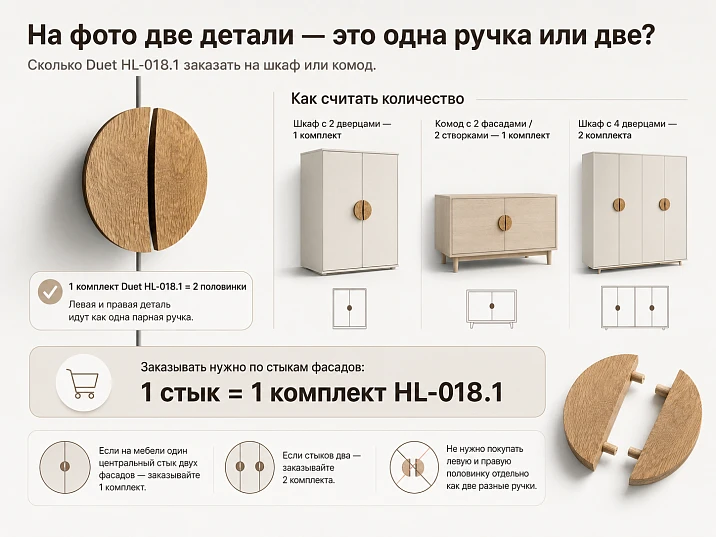
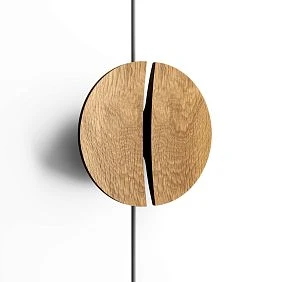
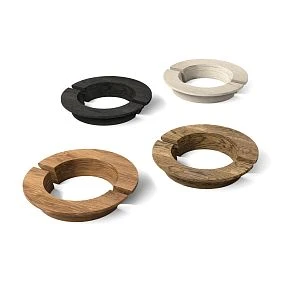
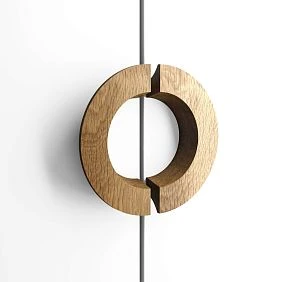
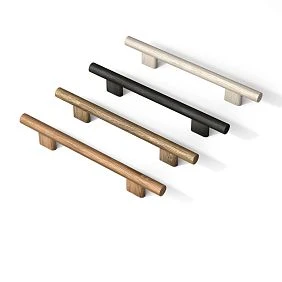
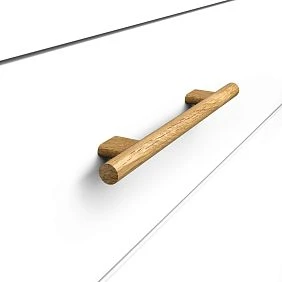
The photo indeed shows two separate wooden parts. The left half mirrors the right, with a neat gap between them, and the overall silhouette resembles a circle divided into two arcs. Therefore, the buyer easily draws the wrong conclusion: the card shows a pair of furniture handles, and the quantity "1" in the cart means only one of them. This leads to two opposite risks. One person orders half as much and waits for the missing halves after delivery. Another multiplies the calculation by two and gets an extra set.
A direct answer must be given immediately: one product unit of Duet HL-018.1 is one finished furniture handle-composition, consisting of two matched wooden halves. The quantity "1" in the cart does not mean one left or one right part. It means one complete Duet for one approved opening point. If a cabinet has two doors and each has a separate handle, order 2 pcs. If a dresser has four drawers and each will have one Duet, order 4 pcs. The two halves within each item are not counted separately.
The handle's design explains why it is visually perceived as unusual. The parts form a single rounded composition but do not merge into a solid disc. A line remains between them, which emphasizes the shape and gives fingers a comfortable grip zone. Both parts are made from the same wooden blank, so the grain pattern is matched. There is no need to assemble one Duet from random halves of different product items: such a rearrangement can disrupt the continuation of the texture and the direction of the wood grain.
Before buy wooden handle Duet HL-018.1, the buyer only needs to decide not the question "one part or two," but four practical tasks: count the opening points, choose beech or oak, determine the future finish, and check the drawing against the facade. The handle is supplied without a final coating, the size of the product item is specified as 130 × 65 × 32 × 32 mm, and the mounting kit is included in the price. Decorative metal plugs, painting materials, and the finishing service itself should not automatically be considered part of the standard item unless separately confirmed in the order.
Two wooden halves, one product item, and one opening point
The word "duet" in the model name works literally here: two parts form one composition. But "two parts" and "two handles" are not the same thing. The halves cannot be considered independent handles just because a gap is visible between them.
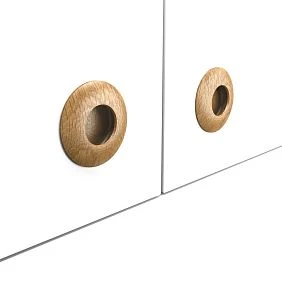
Imagine a two-door cabinet. On each door, the designer placed one round Duet. On the finished facade, the buyer will see four wooden halves: two on the left door and two on the right. However, in the order, this is 2 Duet HL-018.1 handles, not 4 handles. Each product unit already includes two parts.
The same rule applies to a dresser. Four drawers with one composition on each mean 4 product items. On the facades, there will be eight wooden halves, but in the cart, there are four Duets. Counting by visible pieces is dangerous: the product is sold as a complete model, not as a set of separate semicircles.




Why the photograph is misleading
A regular pull handle reads as one body: two supports connected by a common crossbar. A knob looks like a single protrusion. In Duet, the overall image is created by a pair of elements, so the eye first separates the shape and then assembles it into a circle.
There is another reason. In product photography, both parts can lie or be shown in such a way that there is noticeable free space between them. Without the facade, it is unclear that they should work together. The buyer sees two symmetrical parts and mentally assigns a separate price to each.
It is useful to read the card not only by the image, but also by the product name, configuration, and quantity. The article number is one — HL-018.1. The product item is one. A composite structure does not turn it into two independent items.
Our factory also produces:
Why the set cannot be called a "pair of handles"
The phrase "pair of handles" usually means two completely independent handles that can be installed on two doors. In the case of Duet, this creates a new error. The two halves are placed together on one facade and form one handle. Therefore, the correct formulations are:
-
one Duet handle made of two halves;
-
one two-part handle composition;
-
one set HL-018.1 for one opening point;
-
two matched parts of one furniture handle.
The wording "two Duet handles in one set" should not be used when referring to a single product unit.
Get Consultation
What exactly the buyer receives when the quantity is "1"
A product card has practical meaning only when the buyer understands the delivery contents. In the case of HL-018.1, quantity "1" should be read as a complete unit for installation on furniture.
| Parameter | Confirmed information | What this means when ordering |
|---|---|---|
| Model | Duet HL-018.1 | Do not confuse with the coated HL-018.1M |
| Type | Furniture handle-composition, surface-mounted | Installed on the front side of the facade according to the drawing |
| Contents of one item | Two matched wooden halves | In the cart, do not multiply the quantity by two |
| Result | One finished handle | One position serves one intended opening point |
| Size | 130 × 65 × 32 × 32 mm | Values A × B × C × D are checked against the current drawing |
| Material | Beech or oak | One consistent wood species is selected for the entire furniture set |
| Finish | No finish coating | Finishing will be required before final installation |
| Texture | The halves are made from a single wooden blank | The grain pattern of the parts is matched within one handle |
| Mounting | Mounting kit included | The number of mounting kits must match the number of handles |
| Plugs and finishing | Do not count as automatically included | Check as separate order lines |
| Calculation unit | 1 handle, not 1 half | Count by doors, drawers, and other opening panels |
The most important thing in the table is the difference between composition and quantity. The composition of one handle is two halves. The number of handles is the number of product units in the cart. These values do not need to be multiplied.
Two halves come together
The buyer should not separately select the left and right parts. The card does not have the task of assembling a pair from two SKUs, as is the case with mirrored decorative overlays L and R. Here both parts belong to one model and one position.
If the project requires 6 handles, the order must contain 6 complete compositions, that is, 12 wooden halves inside six sets. In the delivery note or specification, it is more convenient to write:
Duet HL-018.1 — 6 pcs, each position consists of two matched halves.
Such a record eliminates disputes upon acceptance.
Fasteners are included in the product position
The mounting kit is included in the price of the handle. This does not cancel the facade check. Before installation, the fasteners must be matched with the thickness of the door or drawer, the location of the holes, and the current drawing.
For an order of 10 handles, 10 mounting kits are expected if the card and specification have not changed. Upon receipt, the fasteners are counted simultaneously with the handles, not postponed until the day of installation.
What cannot be considered included without separate confirmation
Handle HL-018.1 is supplied without a finish coating. This means enamel, varnish, oil, tinting, painter work, and drying are not included in the concept of "one handle" unless added as a separate service or item.
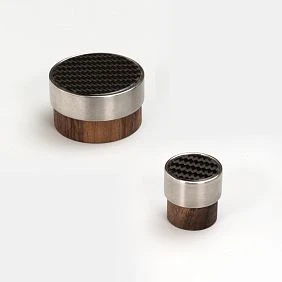
The same applies to decorative metal caps. They may be shown among related products, but proximity in the card does not prove automatic inclusion. If the project requires covering the fasteners with decorative metal, you need to purchase fasteners and caps for furniture handles as separate lines and verify compatibility.
One blank for two parts: why halves cannot be mixed
With Duet, not only the geometry matters, but also the origin of both parts. The halves are produced from a single wooden blank. This preserves the connection of grain, shade, and fiber direction within one handle.
Wood is not printed film. Two adjacent pieces from the same species may differ in:
-
width of annual rings;
-
direction of fibers;
-
contrast of early and late wood;
-
shade;
-
pore arrangement;
-
reaction to staining;
-
appearance after a clear coat.
If you take the left part from one handle and the right part from another, the circle may remain geometrically correct, but visually fall apart. One half will show straight grain, the other—curved; one will be lighter, the other darker. Under opaque enamel, the difference in wood grain will become less noticeable, but swapping still complicates tracking of sets and fasteners.
Marking before finishing
For a large order, it is useful to mark each handle as a single set:
-
D1-L and D1-R;
-
D2-L and D2-R;
-
D3-L and D3-R.
The letter L denotes the left half, R—the right, and the common number keeps the pair together. Marking is placed on the packaging or in a non-visible area according to an agreed technology, without damaging the front surface.
After sanding and painting, the parts are returned to their pair. This discipline is especially important for oak under a transparent or tinted finish.
Sorting by facades
When an order includes a wardrobe, dresser, and nightstands in the same room, handles can be distributed across the furniture before the final finish. A calmer pattern can be left on the central facades, while a more expressive one on the side or large drawers. But within each Duet, the halves are not swapped between sets.
Why the spare handle should be stored as a whole
The reserve is not two random spare halves. It is one complete handle in its own packaging with fasteners. If after a few years one part of an installed Duet is damaged, it is more practical to replace the entire composition to preserve the match of texture and finish.
How to count Duet HL-018.1: not halves, but opening points
The main unit of calculation is the place where the user grips the facade. One door may have one opening point. A wide drawer sometimes gets two symmetrical ones. Two adjacent doors may be styled with a separate handle on each or a shared visual composition per the project. Therefore, the facade layout is approved first, then the product is counted.
Basic formula:
Q = D + Y + T + R
Where:
-
Q — the final number of Duet HL-018.1;
-
D — handles on doors;
-
Y — handles on drawers;
-
T — handles on other opening panels;
-
R — reserve.
The formula looks simple, but the values of D and Y are not always equal to the number of facades. A wide drawer may have two handles. On a narrow pair of doors, the designer may provide a special composition. Therefore, counting should be done according to the approved installation points.
Base quantity table
| Furniture | Installation diagram | How many Duet to order |
| Single-door cabinet | 1 handle per door | 1 pc. |
| Two-door wardrobe | 1 handle per door | 2 pcs. |
| Three-door wardrobe | 1 handle per door | 3 pcs. |
| Chest of drawers with four drawers | 1 handle per drawer | 4 pcs. |
| Chest of drawers with six drawers | 1 handle per drawer | 6 pcs. |
| Wardrobe: 2 doors and 3 drawers | 2 + 3 | 5 pcs. |
| Two cabinets with one door each | 1 × 2 | 2 pcs. |
| Two cabinets with one drawer each | 1 × 2 | 2 pcs. |
| Kitchen with 12 fronts | According to the approved scheme | Up to 12 pcs with one handle per front |
| Wide drawer with two handles | 2 opening points | 2 pcs. |
| Wardrobe and dresser in one set | Sum of all points | Per specification |
The column indicates product units. For example, 5 pcs. for a wardrobe means five complete handles, that is, ten wooden halves that do not need to be added to the cart separately.
Single-door cabinet
For one door, 1 Duet is required. The box must contain one left and one right half forming a handle, plus a mounting kit. The mistake of "ordering 2 because the photo shows two parts" results in an extra complete handle.
Two-door wardrobe
If each door has a separate composition, 2 Duets are needed. Four halves will appear on the facade, but there are two opening points. The visual placement is best checked on a paper template: the round shape should be equally spaced from the central gap of the doors and from the edges.
Chest of drawers with four drawers
With one central handle on each drawer, 4 pcs. are required. For wide drawers, the solution may change. If the designer places two compositions on the facade, the number of handles doubles not because of the two-part Duet construction, but because of two independent grip points.
Kitchen
The number of opening facades does not always equal the number of handles. The top row, bottom drawers, dishwasher, built-in appliances, and pull-out systems may have different schemes. First, you need to order handles for kitchen facades and prepare your own facade list, then count Duets.
Cabinet with doors and drawers
Facades are divided into types:
-
tall hinged doors;
-
lower drawers;
-
mezzanine;
-
internal pull-out elements;
-
decorative blank panels.
Handles are needed only on opening parts where they are provided by the design. The decorative blank panel is not included in the calculation.
Wide drawer: one composition or two
The size of the facade itself does not provide a universal answer. On a wide drawer, one central Duet can look expressive and maintain calm symmetry. Two handles distribute grip points, but visually create a denser rhythm.
The decision depends on:
-
width and height of the facade;
-
the mass of the filled drawer;
-
guide rail construction;
-
the position of the inner frame;
-
facade thicknesses;
-
the overall rhythm of adjacent drawers;
-
ease of grip;
-
the designer's composition.
You cannot derive a rule like “always install two after a certain width.” Such a threshold should be determined by the furniture designer and the project.
One central Duet
Suitable when the facade does not require two-point gripping, and the round composition should be the only accent. Before drilling, check the center and position relative to the panel, layout, or decorative overlay.
Two symmetrical Duets
Used if confirmed by ergonomics and design. In this case, one drawer provides two product units. On a chest of four identical wide drawers, you get 8 Duets, not 4.
One handle for a pair of doors
Duet should not automatically be considered a common handle for two doors just because it consists of two halves. Both parts of one item form one handle on one approved base. If the designer wants to place the halves on different doors at the central joint, such a scheme must be separately confirmed by drawing and mounting. The standard composition of a product item is not permission to split it between two movable facades.
Size 130 × 65 × 32 × 32 mm: four numbers without arbitrary interpretation
The card indicates A × B × C × D = 130 × 65 × 32 × 32 mm. This data is important, but assigning a specific meaning to each number just by order is not allowed. The actual interpretation must be taken from the drawing.
Without a technical scheme, one should not automatically assert:
-
that 130 mm is only the external width of the composition;
-
that 65 mm is the height of one half;
-
that one of the 32 mm values is the center distance;
-
that the second 32 mm is the depth;
-
that all holes are located identically on both parts.
The numbers are confirmed, but their functions are determined by the letters on the drawing.
What to compare with the facade
Need to check not just one dimension, but the entire mounting scenario:
-
outer contour of the composition;
-
position of each half;
-
attachment points;
-
distance to the facade edge;
-
facade thickness;
-
internal obstacles;
-
existing holes;
-
finger grip possibility;
-
opening direction;
-
adjacent decor.
1:1 template
A practical way is to print the current drawing at 1:1 scale. The template should show both halves and mounting points. It is applied to each type of facade.
The template shows:
-
whether the handle conflicts with the panel;
-
whether it extends beyond the edge;
-
whether the same indentation is maintained on paired doors;
-
whether it is convenient to pull the facade;
-
whether the mounting points intersect with the guides;
-
does the handle cover the old holes when replacing.
Only after such a check is the furniture marked out.
Old holes
HL-018.1 cannot be assigned as a replacement for an existing handle just because the card has the number 32 mm. You need to compare the drawing of the old hardware, the actual holes, and the diagram of both halves of the Duet. If the old holes do not match, facade repair or new marking will be required.
Front thickness
The mounting kit is included, but the length and fit are checked on a specific door. Thin facade, massive frame, panel, and MDF have different conditions. The fasteners must not press against internal parts, protrude, or tighten the wood with excessive force.
Beech or oak: the choice begins with the future finish
HL-018.1 is available in beech and oak. The wood species affects not only the price or the name in the cart. It determines the grain, the reaction to a transparent coating, and how the set will combine with the facades.
Beech for opaque enamel
Beech is reasonably considered when the handles are fully painted in the color of the furniture:
-
white;
-
black;
-
graphite;
-
blue;
-
green;
-
beige;
-
another opaque shade of the project.
Under enamel, the natural pattern becomes secondary. The Duet shape, precision of sanding, and uniformity of coating come to the forefront. However, the choice of surface preparation is still coordinated with the painter.
Oak for tinting or transparent coating
Oak is chosen when the wood texture should remain visible. Two halves from a single blank work especially expressively under a transparent finish: the pattern ties the divided form into a cohesive whole.
For a wardrobe or dresser, it is better to order handles in one batch and finish them simultaneously. Natural parts may differ in shade, so the craftsman distributes them across the fronts before the final finish.
Can oak be painted with enamel?
Technically, the choice of finishing system is discussed with the painter. But if the texture is completely covered, the commercial sense of a more expensive or expressive wood species should be assessed in advance. The buyer should not choose oak out of habit and then completely hide it without reason.
Can beech be tinted?
Can be considered after a test finish, but beech does not turn into oak. The grain and surface character will remain different. If the project requires a noticeable oak texture, it is wiser to choose oak from the start.
Do not mix wood species in one piece of furniture without a design intent
If a cabinet requires 6 identical Duet handles, do not order 4 in beech and 2 in oak due to availability or accidental savings. Even under a similar finish, differences may show in texture and absorption of the coating. In the specification, the wood species is indicated for the entire batch.
Without coating or finished HL-018.1M
The buyer has a second commercial path: not to finish HL-018.1 themselves, but to buy a ready-made Duet handle HL-018.1M with coating.
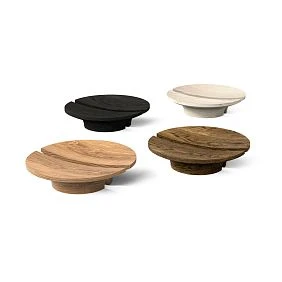
The base geometry of the models is the same: 130 × 65 × 32 × 32 mm. The difference is in the material and readiness for installation. The unfinished HL-018.1 is offered in beech or oak and requires final finishing. The finished HL-018.1M is available in oak with coating options.
| Criterion | Duet HL-018.1 | Duet HL-018.1M |
| Surface condition | Without finish coating | With ready coating |
| Material | Beech or oak | Oak |
| Size | 130 × 65 × 32 × 32 mm | 130 × 65 × 32 × 32 mm |
| Item composition | One handle made of two halves | One handle made of two halves |
| Mounting | Set includes | Checked in the product card and order |
| Work after purchase | Finishing required | Can proceed to installation after inspection |
| Color | Determined by the project and painter | Selected from ready-made options |
| Matching the facade color | Can be painted together with furniture | Need to match the finished color |
| Batch difference risk | Reduced by overall coloring | Need to order the set in one batch |
| Suitable scenario | Custom furniture, restoration, exact color | Fast assembly without a separate painting operation |
When to choose HL-018.1
The unpainted model is suitable if:
-
handles must match the facade in enamel;
-
individual tinting is required;
-
the cabinetmaker finishes the entire set at the same time;
-
need beech;
-
the project provides for its own coating system;
-
the ability to make a test paint-out is important.
In the catalog you can buy unpainted wooden handles for furniture and compare Duet with other forms without finish.
When to choose HL-018.1M
The finished version is convenient when one of the available colors matches the furniture and there is no desire to arrange separate finishing. The current card presents the "Prestige" options in white, black, brown, and transparent finishes. Before ordering, the color is matched against the actual facade, not just the screen.
The customer can order wooden handles with a ready-made coating for the entire furniture set in one batch.
What not to do
Do not mix on one cabinet uncoated HL-018.1, self-painted "approximately white", and ready-made HL-018.1M in white without a trial comparison. The shapes will match, but the shade, gloss, and tactility may differ.
Finishing of a two-part handle: the pair must remain a pair
The painter receives not a loose set of parts, but a set of matched kits. The main task is to process them so that the halves of one handle do not get mixed up.
Before painting
Check:
-
number of complete kits;
-
wood species;
-
surface condition;
-
absence of chips;
-
matching of halves;
-
marking;
-
fasteners;
-
trial assembly on a template.
Each pair is photographed side by side. For oak under a transparent finish, the wood grain is recorded.
During finishing
Both halves of one handle are processed with the same system and in the same sequence. One part cannot be covered with the first batch and the other with a different one if the composition has a risk of shade difference.
Finishing includes operations determined by the master: preparation, priming, applying the finish, interlayer treatment, and drying. The article does not prescribe a universal technology because it depends on the chosen material.
For the kit, you can order materials for painting wooden handlesbut the specific system is selected based on beech or oak and the desired result.
After finishing
The sets are checked again against the markings. The left and right parts are applied to the template, and the color and surface are evaluated. The fasteners should not get lost between the painting area and installation.
Why you can't install first and then paint
Painting on the facade complicates the processing of inner edges, creates a risk of marks around the handle, and makes even coverage difficult. Usually, handles are finished separately, a dry fit is performed, and they are mounted after complete drying. The exact order is confirmed by the craftsman.
Round Duet shape on a cabinet
The query "round furniture handles" often leads to buttons and solid discs. Duet solves the problem differently: the circle is formed by two halves and an inner gap. Therefore, the shape looks larger than a regular button but retains visual lightness.
In this section you can view handles on cabinets in the interior and assess how the face fittings relate to tall doors, panels, and vertical lines.
On a pair of swing doors
Two Duet handles can be placed symmetrically on both sides of the central gap. It is important to maintain the same height and distance from the edges. A paper template helps to see four halves as two compositions, not as a random group of circles.
On one tall door
The handle is placed in the comfortable grip zone, but the specific height is determined by the project and the user. Too small an offset from the edge can lead to a visual conflict, too large — make opening inconvenient.
On a cabinet with drawers
Duet can be repeated on doors and lower drawers, creating a single motif. However, wide drawers sometimes need two grip points. The quantity is calculated according to the actual layout.
On a cabinet in a children's room
The round shape looks soft, but choosing a wooden handle does not exempt you from checking protrusions, fasteners, and finish. The surface must be finished and suitable for regular contact.
Duet on a dresser and nightstand
The dresser allows you to see the rhythm of the handles at once. Four or six round compositions form a horizontal row, so differences in height, rotation, or shade are more noticeable than on a single nightstand.
For ideas, you can choose handles for the dresser and nightstand taking into account the size of the drawers, the facade decor, and the overall shape of the furniture.
Narrow drawers
One Duet centered is usually read as an independent accent. But the template should show whether the handle becomes too large relative to the height of the facade.
Wide drawers
One handle keeps a calm composition, two create a paired rhythm. The choice is related not only to aesthetics but also to the operation of the guides and the weight of the contents.
Bedside table
One handle is enough on a single drawer or door. For two identical nightstands, order 2 full Duets, not 4 due to the halves.
Dresser with doors and drawers
The quantity is counted separately for each type of facade. For example, two doors and four drawers with one handle per element give 6 pieces.
Duet on kitchen facades
The kitchen imposes special requirements on the configuration: there are many handles, they are located close together, and are used daily. An error in quantity or finish is multiplied across the entire set.
Facade list
Before ordering, a table is compiled:
| Facade no. | Type | Size | Number of handles | Model | Material/color |
| 1 | Upper door | As per project | 1 | HL-018.1 | Beech under enamel |
| 2 | Upper door | As per project | 1 | HL-018.1 | Beech under enamel |
| 3 | Lower drawer | As per project | 1 or 2 | HL-018.1 | Beech under enamel |
| 4 | Dishwasher panel | As per project | Clarify | HL-018.1 | Beech under enamel |
After filling, sum the 'Number of handles' column. The number of halves is not used anywhere.
Vertical or horizontal perception
Duet is a round composition, so it does not define a pronounced axis like a long bracket. But the placement of the two halves and the gap still needs to be coordinated on all facades. You cannot accidentally turn some handles differently.
Same batch
For a kitchen, it is especially important to order the entire set at once. If you buy two handles a month later, natural wood and finish may differ. Reserve reduces the risk.
How many to keep in reserve
Reserve is not mandatory for every home cabinet, but it is useful for large furniture and serial projects. Its purpose is to replace a damaged handle without searching for random halves.
When reserve is justified
-
kitchen with a large number of facades;
-
hotel furniture;
-
series of dressers;
-
wardrobe system for several rooms;
-
custom tinting;
-
complex enamel shade;
-
project that will expand;
-
furniture for public space.
How to record a reserve
Do not mix with working quantity:
Duet HL-018.1 for installation — 18 pcs.
Reserve — 2 pcs.
Total to order — 20 pcs.
Each spare item is a complete set of two halves and fasteners.
Why you can't store halves separately
If one part is damaged, the temptation to replace only that part is great. But the new half may differ in texture and shade. A full spare handle allows you to replace the entire composition.
What to buy together with Duet HL-018.1
The right basket depends on the chosen path: an unpainted handle for your own finish or a ready-made HL-018.1M. Related products should not be added mechanically. Each element must serve a specific task — finishing, installation, selecting a different shape, or preparing a design project.
| What to add | Why | When needed | What to check | Commercial transition |
| Duet HL-018.1 | Main handle without coating | Need a custom color | Beech/oak, quantity, drawing | Order Duet handles for wardrobe and dresser |
| Duet HL-018.1M | Ready-made option | One of the available colors fits | Color, batch, size | Ready-made model card |
| Finishing materials | Wood protection and color | HL-018.1 selected | System compatibility | order materials for painting wooden handles |
| Fasteners and plugs | Configuration and decorative covering | If the project requires separate elements | Compatibility and quantity | purchase fasteners and caps for furniture handles |
| Other handles without coating | Shape comparison | Duet does not fit the scale | Dimensions and drawing | buy unpainted wooden handles for furniture |
| Handles with coating | Speed up assembly | No painting stage | Actual facade color | order wooden handles with a ready-made coating |
| General handle catalog | Find another geometry | Need a bracket, button, or profile | Grip type and size | Choose round wooden furniture handles |
| Design project | Confirm the layout | Complex furniture or a series of facades | Diagram, quantity, finish | Order a furniture design project with Duet handles |
If a ready-made HL-018.1M is selected, painting materials may not be needed. If standard fasteners fully fit and decorative caps are not provided, separate hardware is not required. The commercial purpose of the section is to assemble an accurate cart, not to increase the number of lines in the order.
How not to confuse Duet with similar products and scenarios
Not two independent handles
Key difference: the two parts work as a single product composition. They are not distributed across two doors without a separate design solution.
Not a single button handle
Duet may look round, but it consists of two elements and has a different scale. A regular button takes up less space and creates a single protrusion point.
Not a handle-bracket of the usual shape
A classic bracket has a common crossbar. Duet's image is assembled from two arcs. The grip and external rhythm are different.
Not an L/R set of two articles
The buyer does not need to search for a separate left and right card. Both halves are included in HL-018.1.
Not two handles for the price of one
The quantity "1" means one handle, not two independent units for two facades.
Not a ready-painted HL-018.1M
HL-018.1 without a finish coating requires finishing. Beech or oak in the cart does not mean a ready color.
Not a metal round handle
The main material is wood. Metal caps, if needed for the project, are separate hardware.
Not a universal replacement for the 32 mm size
The dimension line must be read from the drawing. You cannot declare a match with old holes without verification.
Practical selection for specific situations
"The cabinet has two doors. How many should I put in the cart?"
If each door will have one full Duet composition, order 2 pcs. Each item will include two matched halves. In total, there will be four wooden parts on the furniture.
"The dresser has four drawers, but the photo shows two parts"
You need 4 pcs if there is one handle per drawer. Not 8. Eight is the number of halves inside four finished handles.
"I have a wide drawer, I want two handles"
Then for one drawer, order 2 Duet. That is four wooden halves forming two separate compositions.
"Need two nightstands with one drawer each"
Base quantity is 2 pcs. Reserve is added separately.
"I want to place the halves on different doors"
This should not be done automatically. The standard position describes one two-part handle. Separation between movable panels requires separate verification of mounting, clearance, and convenience.
"Handles need to be painted to match the facade color"
Choose HL-018.1 without coating, coordinate beech or oak, and finish all sets in one batch. Do not mix halves.
"I don't want to deal with painting"
Consider HL-018.1M with ready coating and compare the actual color with the facade.
"The old handle has 32 mm holes"
Don't do it
Mistake 21. Order by the number of people, not facades
The number of users is not related to the number of handles.
Mistake 22. Not accounting for built-in kitchen appliances
The appliance panel may have a separate opening scheme.
Mistake 23. Placing handles at different heights
The round shape emphasizes misalignment.
Error 24. Randomly rotating part of the compositions
The orientation of the two halves should be repeated according to the project.
Error 25. Not doing a test paint out
Wood and coating may give a different result than on screen.
Error 26. Painting the halves with different batches of paint
A tinted border will appear inside one handle.
Error 27. Install before the coating is completely dry.
Marks will remain on the surface, and edges may get damaged.
Error 28. Over-tighten the fastener.
The wooden part or facade may get damaged.
Error 29. Not saving the specification.
A repeat order turns into guessing the material and finish.
Error 30. Specifying only "round handles" in the request.
Without an article number, it's easy to get a different model.
Who Duet HL-018.1 is especially well suited for
The model is worth considering if the buyer needs:
-
round furniture handles with unusual two-part geometry;
-
a wooden furniture half-round handle assembled into a single composition;
-
the ability to paint the handles together with the facade;
-
a choice between beech and oak;
-
a large decorative accent of 130 mm;
-
a unified motif for the wardrobe, dresser, and kitchen;
-
a mounting kit included with each product item;
-
natural texture matched between the halves.
When it is better to choose a different handle
Duet may not be suitable if:
-
the facade is too small for the 130 mm composition;
-
A narrow long bracket is needed;
-
A single compact button is required;
-
The old holes do not match the drawing;
-
finishing cannot be performed;
-
The two parts conflict with the panel;
-
metal fittings are needed;
-
the user prefers gripping the common crossbar;
-
the project does not allow a visible gap between the halves;
-
the ready colors HL-018.1M are not suitable, and there is no painting stage.
In the general catalog you can Choose round wooden furniture handles or go to brackets, buttons, and profiles of a different geometry.
Order acceptance: count handles and halves simultaneously
If 6 Duet are ordered, acceptance should show:
-
6 product sets;
-
12 wooden halves;
-
6 matched pairs;
-
6 fastening kits;
-
one selected wood species;
-
one surface finish;
-
absence of accidental mixing with HL-018.1M.
Such double counting is useful. The number of halves confirms physical completeness, and the number of pairs indicates the commercial quantity.
Acceptance table
| Check | For order of 6 pcs. |
| Full handles | 6 |
| Left halves | 6 |
| Right halves | 6 |
| Total wooden parts | 12 |
| Fastening kits | 6 |
| Marked pairs | 6 |
If 12 parts arrive but it is impossible to assemble six matched pairs, the order requires clarification. The number of parts formally matches, but the set does not.
Specification for the cabinetmaker and painter
The spoken phrase "Duet, six pieces" is not enough for a large project. The full line looks like this:
Duet HL-018.1, 130 × 65 × 32 × 32 mm, beech/oak, without finish coating, 6 pcs.; each handle consists of two matched halves; fastening — 6 kits; finishing — per card No. ___; reserve — ___ pcs.
For the finished version:
Duet HL-018.1M, 130 × 65 × 32 × 32 mm, oak, color ___, 6 pcs.; reserve — ___ pcs.; check fastening against the card and invoice.
Facade map
| Facade | Quantity | Handles per facade | Total |
| Cabinet door | 2 | 1 | 2 |
| Cabinet drawer | 3 | 1 | 3 |
| Wide dresser drawer | 2 | 2 | 4 |
| Cabinet | 2 | 1 | 2 |
| Working quantity | 11 | ||
| Reserve | 1 | ||
| To order | 12 |
12 are added to the cart, not 24. There will be 24 halves inside.
How to buy Duet HL-018.1 on STAVROS without quantity errors
Open the exact product page
Check the article HL-018.1 and the absence of the letter M. The model with M refers to the coated version.
Count the opening points
Go through the wardrobe, dresser, or kitchen facade by facade. Write down how many full handles are required for each.
Confirm wide drawers
One or two handles — the project's decision. Do not assign the number based only on width.
Choose the material
Beech or oak is specified for the entire batch.
Download the drawing
Match A × B × C × D with the facade and holes. Do not decipher numbers from memory.
Make a template
Print at 1:1 scale and attach to each facade type.
Select finishing path
HL-018.1 — for custom finish. HL-018.1M — ready-made coating.
Add a reserve
For a large batch, list it as a separate line.
Check the fastening
The number of sets must match the number of handles.
Specify plugs and materials
They are added only when necessary.
Arrange the pickup
Before payment, you can calculate the delivery of a set of furniture handles and provide the article number, material, quantity, and contact details in the order.
FAQ: questions about Duet HL-018.1 before ordering
Is one Duet HL-018.1 one half?
No. One product unit is one complete handle made of two matched halves.
If the cart quantity is 1, how many wooden parts will arrive?
Two parts that form one handle-composition.
Can the halves be installed on two different doors?
The standard package is designed as one handle. Separation between doors requires separate design approval.
How many Duet handles are needed for a two-door wardrobe?
Two pieces, if each door is fitted with one handle.
How many should I order for a chest of drawers with four drawers?
Four pieces with one handle per drawer.
How many handles are needed for a wide drawer?
One or two according to the approved scheme. Width alone does not determine the quantity.
Do I need to multiply the number of handles by two?
No. Two halves are already included in each product item.
Why should the parts remain a pair?
They are made from a single wooden blank, so the grain pattern and direction are matched.
Can the halves be swapped between sets?
Not recommended. The geometry may remain, but the texture and shade will no longer match.
How to mark handles before painting?
Assign a number to each pair and mark the left and right parts: D1-L/D1-R, D2-L/D2-R.
Does it include fasteners?
Yes, the mounting kit is included in the price of HL-018.1. Before ordering and upon acceptance, the quantity must be confirmed.
Are decorative metal caps included?
They should not be considered automatically included. Check the product card, invoice, and separate specification.
Does the handle come painted?
HL-018.1 is supplied without a finish coating. For the finished version, see HL-018.1M.
What wood species is HL-018.1 available in?
made of beech and oak.
What to choose for white enamel?
Beech is often considered if the texture is completely covered. The final choice is agreed with the painter.
What should I choose for a transparent finish?
Oak, if a pronounced wood grain is needed.
Can I order some handles in beech and some in oak?
Technically these are different items, but for one piece of furniture without a design concept, mixing wood species should not be done.
What is the size of Duet HL-018.1?
130 × 65 × 32 × 32 mm according to parameters A × B × C × D.
Is one of the 32 mm values the center distance?
It cannot be stated without a current drawing. The letter decoding is taken from the technical diagram.
Will Duet fit the old holes?
Only after matching the drawing with the actual holes. Matching one number is not enough.
Is it necessary to make a template?
For new layout and facade series — yes. The 1:1 template shows scale and mounting points.
Can I order one handle as a sample?
The piece-by-piece product item allows considering a trial order; the current possibility is checked in the product card and cart.
Do I need to take a reserve?
For a kitchen, a series of cabinets, a hotel, and complex finishing, a reserve is useful. It is stored as a complete set.
How many halves will be in an order of 10 handles?
Twenty halves, combined into ten matched pairs.
How many mounting kits should there be for 10 handles?
Ten, if standard configuration is confirmed for each item.
Can I order only the left half to replace a damaged one?
The card describes the full handle, not individual halves. The possibility of non-standard supply needs to be clarified separately; it is more reliable to have a spare full set.
How does HL-018.1 differ from HL-018.1M?
The first is supplied without a finish coating and is available in beech or oak. The second is a finished oak handle with coating options.
What ready-made colors are available for HL-018.1M?
The current card shows white, black, brown, and transparent 'Prestige' options. Availability should be checked before ordering.
Can I paint HL-018.1 myself?
Yes, the model is designed for further finishing, but the coating system is chosen considering the wood species and operating conditions.
When should handles be installed — before or after painting the facade?
Usually after finishing and dry fitting. The exact order is coordinated with the cabinetmaker and painter.
Can handles be painted while already on the facade?
This method complicates even treatment and protection of the furniture. It's better to finish parts separately using an agreed technology.
How to tell if a handle is too large?
Attach the 1:1 template. If the composition conflicts with the panel, edge, or adjacent decor, a different model is needed.
Where can I see alternatives?
In the catalog, you can choose knob handles, pulls, profiles, and other wooden models.
How to order a set for a wardrobe and a dresser in one batch?
Compile a common list of facades, specify one material, one finish, the working quantity, and the reserve.
Do I need to count the two parts separately in the accounting specification?
No. The main product line is Duet HL-018.1 in pieces. In the note, you can indicate that each piece consists of two halves.
How to accept an order after delivery?
Check the number of full pairs, the total number of halves, the material, the surface condition, and the number of fastening kits.
What to do if separate parts arrive without clear pairing?
Do not start painting. Record the packaging and labeling, and contact the manager to confirm the kits.
Can Duet be used in the kitchen?
Yes, after choosing a suitable finish and checking the facades. It is better to order the kitchen set in one batch.
Can one Duet be installed on each cabinet door and two on each drawer?
Yes, if such a scheme is approved by the designer and constructor. The quantity is calculated based on actual points.
Control calculations for real furniture sets
It is better to reinforce the general principle on several projects where the number of facades, handles, and wooden halves differ. Such calculations are useful not only for a private buyer. They help the designer prepare a list, the manager correctly process the order, the warehouse assemble the set, and the painter preserve the pairs.
Project 1. Cabinet with four doors and two drawers
Each door has one Duet, and each drawer also has one. Working quantity:
4 doors + 2 drawers = 6 handles.
6 pieces are added to the cart. Physically, the order contains:
-
6 full product items;
-
12 wooden halves;
-
6 matched pairs;
-
6 mounting kits.
If the project needs one spare Duet, the final cart increases to 7 pcs. The number of halves becomes 14, but that's still seven handles, not fourteen.
Project 2. Dresser with three wide drawers
The designer chose two compositions for each front. Calculation:
3 drawers × 2 handles = 6 Duet.
The error occurs when the buyer sees two halves in one handle and multiplies six by two again. An order of 12 pieces would be double. The correct 6 items already contain 12 wooden parts.
Before payment, it is useful to write in the specification:
Dresser: three wide drawers, two Duet HL-018.1 handles per drawer; working quantity — 6 pieces; reserve — 1 piece; total — 7 pieces.
Project 3. Two bedside tables and one dresser
Each bedside table has one drawer with one handle. The dresser has five drawers, with the top two narrow ones getting one handle each, and the three bottom wide ones getting two handles each.
Calculation:
-
bedside tables: 2 × 1 = 2;
-
upper dresser drawers: 2 × 1 = 2;
-
lower drawers: 3 × 2 = 6;
-
working quantity: 2 + 2 + 6 = 10.
With a reserve of 2 pieces, 12 Duet handles are ordered. Inside there will be 24 halves and 12 pairs. It is better to order all handles from the same wood species and finish them in one cycle, because the bedside tables and the dresser are in the same bedroom.
Project 4. Kitchen with different opening methods
The set has 18 fronts, but Duet is not installed everywhere. Five upper cabinets get one handle each. Four lower doors get one each. Three narrow drawers get one each. Two wide drawers get two each. Four panels open in a different way and are not included in the Duet calculation.
Quantity:
5 + 4 + 3 + (2 × 2) = 16 handles.
The number of fronts is 18, but the number of Duet is 16. This shows why you cannot order handles by simply copying the number of doors and panels from the furniture estimate.
Project 5. Series of ten identical dressers
Each dresser has four drawers, one handle per drawer. Base volume:
10 dressers × 4 handles = 40 Duet.
For serial production, a reserve is determined separately. Suppose 4 spare items are approved. The order will include 44 pieces, 88 wooden halves, 44 matched pairs, and 44 mounting kits.
Before purchasing the entire batch, it is reasonable to get one control handle to check the template, fasteners, finish, and grip comfort. After approving the sample, its parameters are transferred to the production card.
Transfer of Duet between warehouse, painting area, and assembly
A two-part handle has more points where confusion can arise. The warehouse counts product items, the painter sees individual halves, and the assembler puts them back into pairs. If there is no labeling between stages, one handle can easily turn into two unnamed parts.
Packing list
For each batch, the list specifies:
-
item number HL-018.1;
-
wood species;
-
number of complete handles;
-
number of halves for control recount;
-
number of fastener kits;
-
reserve;
-
finishing card number;
-
furniture or destination room.
The entry "24 wooden parts" is insufficient. It does not show whether they should form twelve matching Duet or belong to different models.
Transfer to painter
The painter receives kits by numbers. Fasteners are stored separately but linked to the overall list. Halves are laid out in pairs and not mixed after sanding. If one part has a defect or requires additional processing, its pair remains nearby.
For a clear finish, it is especially useful to take a photo of each handle before coating. After tinting, the photo helps restore the original combination.
Transfer to installer
The installer receives:
-
facade diagram;
-
1:1 template;
-
marked pairs;
-
fasteners;
-
orientation indication;
-
list of spare handles.
On site, he should not have to re-decide which half works with which and how many handles are placed on a wide drawer. These decisions are made before drilling.
What to do if one half is damaged during production
Do not automatically take a random half from the reserve. First, assess the possibility of replacing the entire Duet. This preserves the texture and shade. The damaged pair is marked and removed from the working set, and a spare full handle is placed in its place.
Checking convenience before ordering the entire batch
Commercial calculation cannot be separated from usage. Even if the quantity is calculated correctly, the model must be convenient on a specific facade. For a series of furniture, one Duet is first installed on a prototype.
Check:
-
whether fingers easily enter the grip area;
-
whether you have to touch the facade with your nails;
-
whether it is convenient to open a heavy drawer;
-
does the handle not catch clothing;
-
does it not conflict with the adjacent door;
-
is the gap between the halves maintained;
-
does the composition not shift visually;
-
does the facade withstand the mounting;
-
does the screw not interfere with the internal hardware.
After the test, you can change the position, the number of handles on a wide drawer, or choose a different model. Such a sample is cheaper than fixing dozens of already drilled facades.
Fitting on a temporary template
If drilling into an experienced facade is not possible, a full-size paper or thin rigid template is used. It is secured with painter's tape that does not damage the surface, and the shape is evaluated from a normal distance.
The template does not show the tactility of the wood, but helps decide:
-
whether the scale matches;
-
whether one or two handles are needed;
-
where the axis runs;
-
how Duet looks next to the decor;
-
whether the neighboring compositions are too close together.
One sample handle for finish selection
For a complex color, order one product item and make a test finish on both halves. The full Duet is important precisely because the color is evaluated on the composition, not on a single separate arc. Light falls differently on the left and right parts, and only the assembled pair shows the final look.
One handle, two parts, one clear calculation
Duet HL-018.1 looks like two pieces, but is sold and calculated as one furniture handle. Inside each product item there are two matched halves made from a single wooden blank, and a mounting kit. Therefore, the number in the cart corresponds to the number of full compositions, not the number of semicircles.
To avoid mistakes, first count the opening points. Two doors with one handle on each — 2 pcs. Four drawers with one Duet on each — 4 pcs. A wide drawer with two handles — 2 pcs. Only after that add a reserve.
The second step is to select the product condition. HL-018.1 made of beech or oak is supplied without a finish coating and is suitable for custom finishing. HL-018.1M made of oak is offered with ready-made color options. The third step is to verify the size 130 × 65 × 32 × 32 mm against the current drawing, without declaring one of the values as a center distance without a diagram.
On the STAVROS website, you can order the Duet as a full product item, select finishing materials, fasteners, and alternative wooden handles. This configuration is more reliable than a random count based on a photo: the customer receives not a scattering of halves, but an agreed set of handles for a specific wardrobe, dresser, or kitchen.