Article Contents:
- What exactly is NPU-401.1 and why it cannot simply be called an overlay
- How upgrading a ready-made frame differs from assembling the CPU-9-2 kit from scratch
- First, determine the role of the new insert: the center of the field or part of the molding line
- Central accent inside an empty field
- Connecting element within the molding system itself
- Frame axis
- Console axis
- Axis of the entire smooth zone between the rails
- The insert is pre-painted in the same color
- The insert is installed and painted locally on site
- After installation, the entire inner field of the frame is repainted
- Regular apartment entrance
- Evening light
- Console with real objects
- Side view
- Decorate only the main frame above the console
- Repeat the insert in all identical frames
- Leave the entire series without inserts
- Mistake: considering one insert a mandatory improvement for an empty field
- Mistake: copying CPU-9-2 literally
- Mistake: confusing MLDPU-004 and MLD-004-MG
- Mistake: placing the insert in the geometric center, ignoring the console
- Mistake: not accounting for the 14 mm relief
- Step 1. Determine exactly where the NPU-401.1 should be installed
- Step 2. Establish the exact part number of the existing molding
- Step 3. Make a template 47 × 123 mm
- Step 4. Check the three axes
- Step 5. Check the scale
- Step 6. Simulate 14 mm of relief
- Step 7. Compare one and two templates
- Step 8. Evaluate installation on finished paint
- Step 9. Answer the main question
- Step 10. Only after this, place the order
- Scenario 1. The frame is good, but inside is truly empty
- Scenario 2. A high frame demands a paired rhythm
- Scenario 3. The problem is not the emptiness, but the frame itself
- Can NPU-401.1 be used in horizontal orientation?
- Do you need to buy two NPU-401.1 just because CPU-9-2 has two?
- Can an insert be added if there is already a switch or socket inside the frame?
- What to do if the color of the existing frame is discontinued or unknown?
- Will NPU-401.1 fit a molding wider than 15 mm?
- Can NPU-401.1 be glued on top of wallpaper inside the frame?
- Does NPU-401.1 make sense if the frame is very close to slat panels?
- What should be done first during modernization: buy the insert or paint the console/wall?
- Can NPU-401.1 be placed not in the center, but above the console with an offset?
- When is it better to choose another item from the molding decor category?
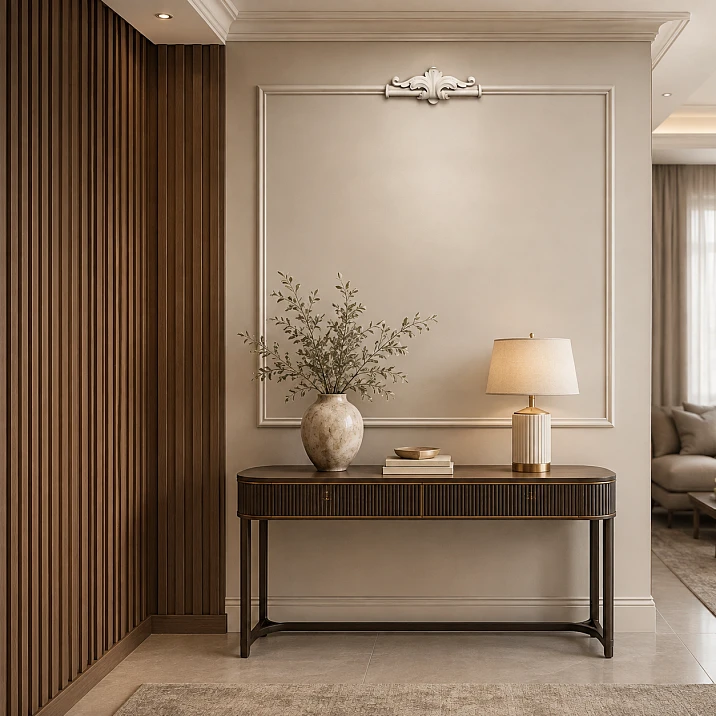
The molding frame is already installed, painted, and generally looks neat. A console stands beneath it, and an active slat wall runs nearby, but after finishing the renovation, it became noticeable that the smooth field inside the frame seems too empty. In such a situation, it makes sense to look not at a whole new frame, but at a small additional accent — the central decorative insert NPU-401.1 made of polyurethane.
NPU-401.1 has a compact size of 47 × 123 × 14 mm, and the current price of one piece is 870 ₽. STAVROS classifies it as decor for moldings, and in ready-made sets CPU-9-2 and CPU-10-2 it is categorized as a central insert. In the CPU-9-2 card, NPU-401.1 is also listed as an element compatible with the MLDPU-004 system. This is more important than the general description "polyurethane stucco": the piece has a specific role in the frame composition.
But it does not follow that any ready-made frame can automatically be supplemented with one NPU-401.1. In STAVROS system sets, inserts are placed along a predetermined axis and work together with other elements. In an existing frame, you need to separately check its geometry, the free field, the position relative to the console, the visual connection with the molding, and the possibility of installation on an already painted wall.
The short answer is this: you can buy just one NPU-401.1 without reworking the frame if the insert is installed in the free field inside the existing contour, it does not need to be cut into the already installed molding, the axis of the composition aligns with the logic of the frame and console, and the 14 mm relief does not create a visual or physical conflict. If achieving a beautiful result requires cutting the molding, changing the frame's proportions, moving its boundaries, or adding paired system elements, then this is no longer a simple modernization with one piece.
If the check passes, buy the central decorative insert NPU-401.1 made of polyurethane it can be used precisely as a point accent to a finished interior. If it doesn't pass, it's better to stop before purchasing and decide whether another part or a new frame system is needed.
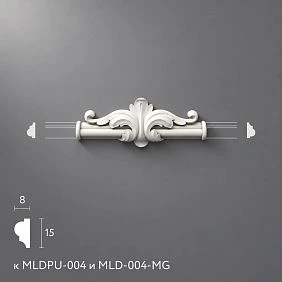
What exactly is NPU-401.1 and why it cannot be simply called an overlay
In this topic, terminology affects the decision. NPU-401.1 is not a standalone general-purpose decorative overlay in the same sense as large furniture or wall NPUs. In ready-made STAVROS wall kits, it serves as the central decorative insert in a molding composition.
Current data for the individual product card:
| Parameter | NPU-401.1 |
|---|---|
| Type in the system | central decorative insert for molding composition |
| Material | Polyurethane |
| Size A × B × C | 47 × 123 × 14 mm |
| Price | 870 ₽/pcs. |
| Category | Decor for moldings |
| Related profile | STAVROS lists NPU-401.1 as a kit for MLDPU-004 |
The CPU-9-2 uses two such inserts. There, they function as part of a pre-designed vertical composition, not as a randomly added detail. In a separate, already finished frame, the task is different: the customer wants not to replicate the CPU-9-2 literally, but to understand whether one insert can become a new center of an existing panel without dismantling the molding.
That is why the article should not promise: "since the NPU-401.1 comes with the molding, it can be added to any frame." First, you need to understand what function it will perform specifically here. If it is an independent accent in a free field, a careful modernization is possible. If you want to integrate it directly into the molding line as a connecting node, the geometry of the existing frame becomes critical.




How modernizing a finished frame differs from assembling the CPU-9-2 kit from scratch
This is an important difference. A ready-made kit is designed as a system: panel dimensions, positions of central inserts, corner elements, and the molding perimeter are coordinated in advance. In the CPU-9-2, the NPU-401.1 is used in quantities of two; the elements are positioned symmetrically along the panel axis.
When the frame is already hanging on the wall, you do not have the freedom to start the composition from scratch. The following are already fixed:
-
frame width and height;
-
position relative to the floor and ceiling;
-
distance to slat panels;
-
console position;
-
wall and molding color;
-
profile of the existing molding;
-
possible sockets, switches, sconces, mirror or picture nearby;
-
direction of light.
Therefore, the existing frame dictates the conditions for the new piece, not the other way around. The NPU-401.1 must adapt to the finished architecture.
This gives two fundamentally different scenarios.
Scenario A — the insert is mounted on a free surface within the frame. In this case, cutting or dismantling the molding is usually not required. You only need to check the position, base, and appearance.
Scenario B — the insert must become part of the molding line itself. Then it may require breaking the existing profile, trimming, matching the ornament, filling the joints, and repainting. This is no longer a "buy one insert without rework."
For the buyer, the key question is therefore not "is the NPU-401.1 compatible with moldings in general," but rather how you want to incorporate it into your specific finished frame.
Our factory also produces:

First, determine the role of the new insert: center of the field or part of the molding line
Before the template and measurements, it is useful to choose one of the two application methods.
Get Consultation
Central accent inside an empty field
The NPU-401.1 is installed on the wall inside the frame, without touching the molding. It works as a small ornamental center. This is the safest scenario for an already finished renovation: the frame does not need to be sawed, trimmed, or moved.
This option is especially logical above a console. The console already sets the horizontal axis of the furniture, and the frame forms an architectural boundary. The insert can become a point that gathers the empty space between them.
Connecting element within the molding system itself
In ready-made complete compositions, NPU-401.1 can work as a system insert next to the profile. If you want to literally repeat this logic, the already installed molding must allow for correct joining.
Here questions arise:
-
whether the profile fits geometrically;
-
whether the existing strip needs to be cut;
-
how the transition from the 8-millimeter profile to the 14-millimeter insert will look;
-
whether the paint can be restored after trimming;
-
whether the symmetry of the entire frame will be disrupted.
If the solution requires dismantling at least one side of the frame, that is a different budget and a different level of risk.
For the topic of this article, the first option is a priority: add one central insert as an independent accent within the finished frame without changing the outline.
A paper template 47 × 123 mm should appear on the wall before ordering.
The price of NPU-401.1 is low, so there may be a desire to simply buy one piece and "attach it later." But it is precisely with small elements that mistakes in scale are most often made. On a card, 47 × 123 mm seems like a noticeable size, but on a frame 900–1200 mm wide, such an insert may look very delicate.
Before ordering, cut out a paper rectangle 47 × 123 mm. In CPU-9-2, the element is described as vertically elongated: 123 mm forms the main vertical, 47 mm is the narrower transverse side. For fitting, the template should be made in exactly this orientation.
The template is not needed to assess the relief—paper does not show it. It solves four other tasks:
-
gives the real scale;
-
shows whether a single insert is readable against the background of a large frame;
-
allows checking the axis relative to the console;
-
shows whether a second element is needed for balance.
It is better to make two identical templates. First, attach one. Then temporarily add a second one above or below and compare. This way you will see whether the single insert really looks complete or whether the system itself asks for a paired rhythm, as in CPU-9-2.
Important point: the second template is only a comparison tool, not a recommendation to automatically buy two pieces. The purpose of the article is precisely to avoid transferring a ready-made set to another interior without checking.
Where the NPU-401.1 axis should run: along the frame, along the console, or along the entire wall
This is the central compositional question. In a finished interior, several axes can exist at once, and they do not always coincide.
Frame axis
The most obvious option is to center the insert along the inner field of the molding frame. If the frame itself is installed neatly and looks like an independent architectural object, this is the safest reference.
Console axis
If the console under the frame is the main object of the zone, its center may be more important than the center of the frame. For example, the frame is slightly shifted due to slatted panels or a door, and the console stands according to a different logic. Then strict centering of the insert along the frame sometimes amplifies an already existing asymmetry.
Axis of the entire smooth zone between the slats
A slatted wall can form the outer boundaries of the composition. If the smooth field between two slatted sections has its own clear width, it is worth checking this axis as well.
The correct solution is not determined by a formula. You need to draw three vertical lines with painter's tape or a laser and see which one visually dominates.
Usually, the rule works: if the frame is already perceived as an independent panel, NPU-401.1 submits to it; if the frame only thinly outlines the furniture zone, the console axis may be stronger.
Do not place the insert exactly in the middle just because "symmetry dictates it" if the finished composition itself is asymmetrical.
How to understand if there is enough free space around 47 × 123 mm
NPU-401.1 has a small area, but that is exactly why the space around it is especially important. A small ornament can easily get lost in too large a field and just as easily be "squeezed" near the molding.
Check four directions:
-
distance to the upper molding;
-
distance to the lower molding;
-
margins on the left and right;
-
distance to the console, mirror, sconce, or other objects inside the frame.
There is no universal rule like "leave at least 100 mm." Such a number would be made up. A proportional test is needed.
Practical method: after installing the paper template, photograph the entire frame, then reduce the photo on the screen. If the insert disappears, then one NPU-401.1 may be too weak for the frame's scale. If, on the contrary, the template visually sticks to the top or bottom profile, the field is too tight.
A narrow tall frame often perceives a vertically elongated insert better. A wide horizontal frame may require different decor, because NPU-401.1 does not assemble the transverse axis.
It is this test that helps avoid the erroneous conclusion 'if it physically fits, then it is suitable.'
Thickness 14 mm: how the relief will change an already finished painted composition
Size C = 14 mm affects not the area, but the depth of the relief. For a finished wall, this is significant.
If the existing molding is thin, for example MLDPU-004 with profile A 15 mm and C 8 mm, the central insert will protrude more noticeably. In a system composition, such a hierarchy of reliefs is normal: the decorative accent should be more plastic than the linear profile. But in an already finished minimalist frame, the difference may be unexpectedly strong.
You can check 14 mm without purchasing. Place cardboard, foam material, or another flat layer of similar thickness under the paper template. Look from the side and at the main viewing angle.
It is especially important to evaluate the relief under side lighting. In hallways, the following are often used:
-
wall sconce;
-
linear lighting;
-
track lighting;
-
light from an adjacent room.
The protruding element will cast a shadow and therefore appear larger than its flat dimensions. Sometimes it is the shadow that makes one small insert sufficient. In other cases, it makes the inconsistency with a very thin frame more noticeable.
Compatibility with MLDPU-004: what is confirmed and what cannot be assumed
STAVROS explicitly lists NPU-401.1 as a component of the kit for MLDPU-004, and the separate NPU-401.1 card shows MLDPU-004 among related products. This means the manufacturer intends the two products to be linked.
The MLDPU-004 itself measures 15 × 8 × 2600 mm and is made of polyurethane. This is a confirmed profile that can be used as a reference when comparing with an existing frame.
But there is a fundamental caveat here. In the finished CPU-9-2 kit, the molding perimeter is formed by MLD-004-MG made of primed MDF, not MLDPU-004 made of polyurethane. MLD-004-MG also has a nominal cross-section of 15 × 8 mm and a length of 2600 mm. Identical dimensions do not mean that the two materials should be considered interchangeable in all mounting details.
For an already finished frame, this means the following:
-
if you have exactly MLDPU-004 — the link with NPU-401.1 is confirmed most directly;
-
if you have MLD-004-MG — NPU-401.1 is already used with it in CPU-9-2;
-
if you have a different molding — it cannot be automatically called "compatible" just because of similar width;
-
if the insert is mounted separately inside the field and does not join ends with the profile, geometric compatibility with the molding itself becomes less critical, but compositional compatibility still remains.
If the existing profile is unknown, first measure it and photograph the cross-section. This is easier than buying an insert based on assumption.
Three levels of compatibility with an existing frame: geometry, style, and installation
The word "fits" in this context is too general. For an already installed frame, it is better to check three levels of compatibility separately. They may give different answers.
Geometric compatibility answers whether the NPU-401.1 fits in the chosen location and does not require physically altering the contour. If the insert is mounted on a free wall inside the frame, this test is relatively simple: the 47 × 123 mm template should have enough space around it. If the part must touch the molding, you need to compare the actual cross-section and contact points.
Stylistic compatibility concerns the pattern and plasticity. Two items can physically coexist perfectly and still look foreign to each other. A smooth modern profile without ornament perceives a small carved insert differently than a classic multi-level molding. This is where the connection of NPU-401.1 with the MLDPU-004 system is useful as a reference: the manufacturer shows what type of frame architecture the part is originally integrated into.
Installation compatibility answers the most practical question: can the insert be added without destroying the finished finish. Even a perfectly style-matching element loses its meaning if you have to open up a large area of expensive decorative plaster, remove molding, or redo electrical work for it.
It is convenient to check these levels sequentially:
-
Geometry: does the template fit and have a normal margin?
-
Style: does the relief of NPU-401.1 look like a continuation of the frame's language, not a random appliqué?
-
Installation: can the part be installed with acceptable intervention in the finished finish?
Only three positive answers give a confident "you can buy one insert without redoing the frame".
If the geometry is good but the style is questionable, first look at other items in the category. If the style and geometry are good, but installation requires cutting the molding, that's already a remodel project. If installation is simple but the insert is lost in scale, a cheap purchase still doesn't become a good one.
This division is especially useful for an existing frame of unknown part number. It's not necessary to prove that it is "officially compatible" with NPU-401.1 as part of a specific factory kit. It's enough to honestly check three independent levels and not mix them into one vague word.
Can NPU-401.1 be added without cutting an already installed molding?
Yes, if you use it as a separate central accent inside the frame and don't try to make it a connector between two molding segments.
This is the cleanest retrofit scenario. The molding contour remains untouched. The new piece is glued onto a prepared painted wall inside it. After that, the frame is perceived as a complete "contour + center" system.
Before purchasing, you need to check:
-
is there a flat surface for the insert;
-
does a crack, seam, or wall defect pass through the chosen spot;
-
is there no need to cover an existing hole or damage with the insert — that's a bad reason for choosing;
-
is there enough space for precise positioning;
-
can the paint be locally restored after installation.
However, if the design concept requires the NPU-401.1 to literally break through the top or bottom line of the molding, trimming is unavoidable. Then the article must honestly state: this is not an option "without modifying the frame."
When a single NPU-401.1 is sufficient, despite the fact that CPU-9-2 uses two
This is one of the most important questions in the article. The manufacturer shows the NPU-401.1 in the finished CPU-9-2 as a pair, so the user might think that one insert is "wrong." This is too straightforward a conclusion.
CPU-9-2 is a vertical composition with its own architecture. Two inserts there support the given symmetry and rhythm. But your finished frame above the console can be much lower, wider, or simpler.
A single NPU-401.1 is justified if:
-
the frame has one obvious compositional center;
-
the field is not divided into upper and lower zones;
-
the console creates a single central axis;
-
there are no other decorative inserts nearby that require pairing;
-
the single piece reads as a deliberate accent, not as "half of a set."
Two inserts should be considered if:
-
the frame is tall and visually splits into two fields;
-
one element is lost in scale;
-
a mirror, sconce, or another object creates an intermediate axis;
-
you want to repeat a systemic rhythm close to CPU-9-2.
But the article should not automatically push the buyer toward two pieces. Its task is to help understand whether just one piece is needed in a specific existing frame.
What changes with a slat wall next to the frame
The slats here form an independent active background. They already create a strong vertical rhythm and a series of shadow lines. It is against such a background that an empty molding frame can sometimes start to seem too calm, even though it is executed correctly on its own.
NPU-401.1 can help for two reasons.
First, it adds a local sculptural point. The slat wall works linearly, while the insert works ornamentally. These languages differ, so one small center can balance the texture without needing to complicate the entire molding contour.
Secondly, the vertical proportion of 47 × 123 mm supports the direction of the slats, but does so differently: not by repeating the lamellas, but by a central relief.
However, next to a very active slat wall, there is also the opposite risk. If the frame already has corner elements, a mirror, a sconce, and a decorative console, a new insert may become redundant. Therefore, before purchasing, you should look not at the frame in close-up, but at the entire hallway from the entry point.
If the slat finish continues in other zones of the project, you can separately buy slat panels for walls for interior finishing in the profile category, but for this article, the slats remain precisely the context of the finished interior, not the main product. If after upgrading the frame, the lamella finish is planned to continue on the adjacent wall, the same catalog is logically used to Buy slatted panels for wall finishing already for a specific second zone, without mixing this choice with the decision on NPU-401.1.
How the console affects the position of the insert more than it seems
The console under the frame creates a second level of architecture. Even if it is small, its tabletop provides a strong horizontal line, and its legs or supports provide verticals.
If NPU-401.1 is placed too high, an empty gap appears between the console and the insert. If too low, the decor begins to visually "sit" on the furniture.
You need to check not the absolute height from the floor, but the relationships:
-
top of the console → lower edge of the frame;
-
top of console → center of insert;
-
center of insert → top edge of frame.
There are no universal millimeters here. But there is a simple way to check: stick on a paper template, step back to the usual hallway distance, and take a photo. Then shift it up by 50–100 mm and down by the same distance. These options will give more information than calculating by the "golden ratio" without context.
It is important that the insert does not depend on a random object on the console. If tomorrow the vase or lamp is removed, the composition should remain stable.
Should the mirror, sconces, or painting inside the frame be taken into account?
Yes. And this is one of the cases where NPU-401.1 may not be needed at all.
If there is already a mirror hanging inside the frame, it becomes the main object. The central decorative insert may conflict with its axis or end up too close to the edge of the frame.
If two sconces are installed, they form their own symmetry. Then NPU-401.1 can work between them as a small central accent — but only if there is a clean field left.
If a painting is planned inside the frame, it is better to place the painting itself first. A small insert next to an independent artistic object often looks random.
Therefore, before ordering, ask a simple question: should NPU-401.1 become the main center of the field or merely support an existing object? If the latter, its role may turn out to be too weak or unnecessary.
Installation on an already painted wall: what to check before purchasing
A ready-made frame means the finish is already applied. This is a convenient but demanding scenario: any mistake becomes more noticeable.
Before installation, check the surface condition. The base must be solid, without peeling paint or dust. If the coating adheres poorly, the adhesive may hold the insert together with the paint layer rather than the wall.
The NPU-401.1 card shows mounting adhesive among related products. On the MLDPU-004 STAVROS page, adhesive mounting and preparation of products for painting are described. However, the specific adhesive and preparation should be chosen based on the actual wall coating.
Practical procedure for a finished interior:
-
make precise markings;
-
check the template several times;
-
protect the adjacent molding and wall;
-
prepare the contact surface without damaging a large area of the finish;
-
perform a compatibility test of the finish and adhesive in an inconspicuous spot if there are doubts;
-
only after this, mount the part.
The main risk here is not in the weight of the small insert, but in not ruining the already finished decorative assembly.
Will the entire frame need to be repainted after installing the NPU-401.1?
Not necessarily. If the insert is installed within the field and does not require trimming the molding, it is often possible to limit yourself to finishing the part itself and careful local work in the installation area.
There are three scenarios.
The insert is painted in advance in the same color
This is suitable if the existing color is exactly known and the coating can be reproduced. The risk is a difference in shade or gloss level between the old wall and the fresh part.
The insert is installed and painted locally on site
This is convenient for an exact color match, but the surrounding surface needs to be well protected.
After installation, the entire inner field of the frame is repainted
The most "monolithic" visual option. It does not require reworking the frame itself, but it already goes beyond purely local installation. However, the problem of shade differences disappears.
If the installation required cutting the molding, filling the joints, and restoring the profile, local painting of a single insert will almost certainly not suffice. This is another sign that the project has shifted from "buy an extra element" mode to "rework the composition" mode.
What exactly to buy if the existing frame is to be kept
The commercial outcome should be simple. If the frame remains unchanged and after the template one NPU-401.1 truly solves the problem of the empty center, the base cart is minimal:
-
1 × NPU-401.1 = 870 ₽;
-
suitable mounting material — based on the actual substrate and finishing method.
If it turns out that the existing profile is not visually suitable at all or requires systemic integration, then a second route emerges: buying polyurethane molding decor and compare other elements in the category.
If the project is to be rebuilt around a profile related to NPU-401.1, you can separately buy MLDPU-004 polyurethane molding. But buying a new molding just because NPU-401.1 exists is not necessary. First, you need to prove that the current frame truly fails.
For a broader project, a logical transition remains You can buy ready-made stucco matching the Baroque style. Calculate the quantity: linear meters of cornices and moldings, number of rosettes, pilasters, consoles, corner elements. Add a ten to fifteen percent allowance for trimming. — only after the role of a specific insert becomes clear.
Scale of the insert relative to the finished frame: when 47 × 123 mm are read confidently, and when they get lost
The NPU-401.1 has no task of filling a large area. It is a small systemic accent. But even an accent should be noticeable from a real distance. Therefore, it is useful to compare its dimensions not with an abstract wall, but with the inner field of a specific frame.
Suppose the clean width inside the molding contour is 600 mm, and the height is 900 mm. With vertical orientation, the NPU-401.1 occupies approximately in width:
47 / 600 × 100 ≈ 7.8% of the inner width.
By height:
123 / 900 × 100 ≈ 13.7% of the inner height.
This is already a noticeable but delicate center.
Now take a tall frame with an inner field of 1000 × 1800 mm. The same 47 × 123 mm occupy about 4.7% of the width and 6.8% of the height. On such an area, a single insert can look almost like a jewelry point. This is not necessarily bad, but requires a more careful check of viewing distance and lighting.
For a quick assessment, you can use the table:
| Inner field of the frame | How to typically perceive one NPU-401.1 |
| about 500 × 700 mm | noticeable central accent, tightness needs to be checked |
| about 600–800 × 800–1200 mm | most understandable range for a single insert |
| about 900–1100 × 1400–1800 mm | delicate accent, needs a test from a distance |
| significantly larger than 1100 × 1800 mm | a single insert may get lost; check paired or other layout |
This is not a manufacturer's standard or a universal proportion guideline. The table is intended as a diagnostic tool. The actual frame may be perceived differently due to color, molding thickness, console, slats, and lighting.
The main point here is different: a small item cannot be judged only by its absolute size. The same 47 × 123 mm can be too active in a compact frame and almost unnoticeable in a large vertical panel. It is the scale relative to the inner field that helps understand whether a single NPU-401.1 will produce a standalone result or the purchase will turn out to be visually weak.
Can you first glue the insert temporarily and live with it for a few days
Full adhesive installation is the final step. Before that, you can do a safe visual "fitting," but you need to understand the boundary between a mockup and real attachment.
For a few days of evaluation, a paper or light cardboard template secured in a way that won't damage the existing surface is enough. Do not temporarily glue the real polyurethane NPU-401.1 with strong mounting adhesive "for a trial": removing it without damaging the paint or the part can be difficult.
Why is a long fitting needed at all? In the hallway, the composition is perceived differently in the morning, in the evening, with the sconce on, with items on the console, with the adjacent door open. What seems perfect in five minutes may start to irritate after two days.
It is useful to check four modes:
Normal entry into the apartment
Look at the frame not deliberately, but the way you see it every day. The insert should read naturally, not require an explanation of why it is there.
Evening light
The imitation of the 14-millimeter protrusion will show the shadow. If it becomes too active next to slat panels, it is better to find out before installation.
Console with real objects
Place regular keys, a lamp, a vase, or a tray. The central decor should not work only in a "sterile" staged scene.
Side view
When entering the hallway, the frame is often visible at an angle. NPU-401.1 may look more expressive in this perspective due to the relief.
After two or three days, the answer usually becomes clearer. If the template stops being noticed as a foreign object and the composition seems complete, one insert has a good chance of working. If you constantly want to move it, add a second one, or change the frame, it's better to postpone the purchase.
Such a test is especially reasonable for an already finished renovation. Here the task is not "finish quickly" but not to spoil what has already been done well.
When one NPU-401.1 really looks more expensive than a complete frame redo
There are situations where minimal refinement looks more professional than major intervention.
The first is that the frame already has good proportions and a neat profile, but it lacks only one focal point. Reassembling it to enhance the decor would be excessive.
The second is an active slat wall nearby. If you add new moldings, corners, and additional inserts to the existing frame, it will start competing with the slats. One NPU-401.1, on the contrary, provides a small plastic pause.
The third is that the interior is already finished and minimal construction intervention is important. One element for 870 ₽ can be tried on, installed, and if necessary, locally finished without dismantling a large area.
The fourth is that the console itself is decorative. If the furniture has expressive legs, a stone countertop, or complex hardware, a heavy frame on top can become redundant. A small central insert will support the classic theme without doubling it.
It is in these cases that "buying one extra piece" looks not like a budget compromise, but a precise design solution.
When it's better not to buy NPU-401.1
Refusing to buy is a normal result of the check.
You should not add NPU-401.1 if:
-
the frame is too large, and one insert visually disappears;
-
the frame is too small, and the 47 × 123 mm dimension ends up cramped;
-
there is already a mirror, painting, or sconce inside that fully resolves the center;
-
the existing profile has a completely different style;
-
installing it would require cutting a good ready-made molding, even though the task was only to slightly complement the frame;
-
The color and finish of the wall are so complex that local touch-ups will almost certainly be noticeable;
-
Next to the slat wall, there is already enough texture;
-
After the template, the composition looks better without the insert.
The last point is the most important. An empty field inside the frame is not necessarily a mistake. Sometimes it is precisely this that gives the slat wall and the console enough breathing room.
When instead of a single insert, a full reassembly should be considered
Sometimes the NPU-401.1 test detects not the problem of "missing center," but a problem with the frame itself.
For example:
-
The frame is too narrow relative to the console;
-
The frame is offset and its axis aligns neither with the furniture nor with the smooth field;
-
The molding chosen is too weak in scale;
-
The height of the frame does not match the furniture;
-
The inner field works poorly regardless of the decor.
In such cases, a small insert becomes cosmetic for a systemic error. It may distract a little, but it won't fix the proportions.
If after trying it on you see that you want to move the frame itself, change its width, or add corner elements, it's better to admit this before purchasing. Then it makes sense to consider systemic decor and ready-made solutions, rather than trying to preserve every existing strip at any cost.
Take the "passport" of the finished frame: what dimensions are needed before buying a single insert
The main advantage of an already finished frame is that it doesn't need to be designed from scratch. The main drawback is that all measurement errors become expensive because the molding is already glued and painted. Therefore, before ordering NPU-401.1, it's useful to take a short "passport" of the existing composition.
Write down not only the outer width and height of the frame. For a small central insert, the inner clear field is more important — the distance between the inner edges of the molding. That's where the new accent will live.
Minimum set of measurements:
| What to measure | Why is this needed |
| Internal frame width | understand the scale of NPU-401.1 relative to the field |
| inner height of the frame | check whether a single vertical insert will get lost |
| center of the inner field | get the base axis for the template |
| distance from the bottom edge of the frame to the console | assess the connection between the decor and the furniture |
| console width | compare its axis with the frame axis |
| distance from the frame to the edge of the slat panels | understand how close the active texture is |
| profile of the existing molding | check visual and, if needed, system compatibility |
| presence of objects within the field | exclude conflict with mirror, sconce, switch, or painting |
Such a "passport" allows not to build the solution on a single impression of "empty frame." For example, two frames of the same external size may have different internal fields due to profile width. And two identical frames are perceived differently above consoles of 800 and 1400 mm width.
It is especially useful to write down dimensions directly on a photo of the wall. No professional drawing is needed: a frontal shot with captions is enough. If later you have to choose between one NPU-401.1, two inserts, or other decor, the initial data will already be in front of your eyes.
The important conclusion here is commercial: 870 ₽ is a small amount, but a cheap product does not cancel precise measurement. An error can lead not only to an unnecessary part but also to damage to the finished finish when trying to find a place for it after purchase.
How to compare the price of spot refinement with a full reassembly of the frame
The topic is especially strong precisely because the buyer already has a finished frame. What is needed is not another "from scratch" project, but an understanding of how economically reasonable it is to limit oneself to one insert.
If the existing molding stays in place, the base product part of the solution is 1 × NPU-401.1 = 870 ₽ plus mounting material and possible local painting.
For comparison, take
What to do if nearby there is not one frame, but a series of two or three panels
In hallways and corridors, molding frames often come in a series. For example, one frame is above the console, the second is near the door, the third is on the opposite wall. Then the solution "add one NPU-401.1" cannot be made by considering only one rectangle.
Here three different strategies emerge.
Decorate only the main frame above the console
This is the most logical option if the console is truly the compositional center of the hallway. NPU-401.1 emphasizes exactly the main frame, while the others remain calm. The result is hierarchy, not mechanical repetition.
Repeat the insert in all identical frames
This works when all panels are equal in role, identical in size, and placed in the same visual field. But then the commercial outcome is no longer "buy one NPU-401.1," but buying as many elements as frames actually participate in the rhythm. Such a task goes beyond the original intent and requires a separate check of quantity.
Leave the entire series without inserts
Sometimes a single decorated frame breaks the strict rhythm of the corridor. Especially if the other panels are empty and identical. In this case, it is better to either design the system as a whole or not add a single detail at all.
Before ordering, make a very simple mockup: photograph the entire series and add a paper insert only in the frame above the console. If the eye immediately reads it as the main one, the solution works. If the question "why only here?" arises, a single modernization may be debatable.
This scenario is fundamentally different from checking the size. Here NPU-401.1 physically fits perfectly, but the compositional repetition of neighboring frames changes the purchase decision.
Light and shadow: why 14 mm of relief can completely change the impression in the evening
In diffuse daylight, the paper template shows the scale but says almost nothing about the plasticity. The NPU-401.1 has a size of C = 14 mm, so once installed, it will start casting its own shadow. In a hallway with artificial light, this could become the main visual effect.
Imagine two scenarios.
In the first, a sconce or track light is positioned to the side. The shadow from the insert stretches across the wall, the relief becomes more noticeable, and the small 47 × 123 mm detail visually enlarges. In such a case, a single NPU-401.1 may be more than sufficient.
In the second, the light falls almost frontally and softly. The shadow is minimal, and the same insert looks much calmer. Then, on a tall frame, it might get lost.
Before purchasing, you can do a simple but useful check: place a material about 14 mm thick under the paper template and turn on the hallway's actual lighting in the evening. Look at:
-
how far the shadow falls;
-
whether the element starts to look too bulky relative to the molding;
-
whether the shadow conflicts with the vertical shadows of the slat wall;
-
whether a feeling of a "glued-on detail" appears instead of an integrated ornamental center.
Pay special attention to the direction of the slats. If they cast frequent vertical shadows, and the NPU-401.1 adds another strong vertical almost at the edge of the frame, the composition can become restless. In a central position, the same relief, on the contrary, gathers the field.
Light testing is one of the best ways to understand whether one small insert is enough without adding new moldings and corner pieces.
If inside the frame there is wallpaper, decorative plaster, or complex paint
The 'frame is already ready' scenario does not always mean a plain painted wall. Inside the panel there may be wallpaper, textured plaster, microcement, decorative paint, or another finish. This changes the solution more than the 47 × 123 mm dimension.
On a smooth, durable painted surface, a small insert is easier to position and, if necessary, locally touch up the finish. With wallpaper, the question is not only about the adhesive but also about the strength of the wallpaper itself. If the decorative element is glued to a weak covering, the entire system holds not to the wall base but to the wallpaper layer.
Textured plaster creates another problem: the back surface of the insert may rest unevenly. With decorative paint, there is a risk of a noticeable local difference after repairs around the piece.
Therefore, before ordering, you need to determine not formally 'the wall is painted,' but what exactly is the mounting base.
Working options:
-
durable matte paint on a stable base — usually the most straightforward scenario;
-
complex covering — first check compatibility and preparation method;
-
wallpaper — do not automatically consider it an acceptable base;
-
textured surface — assess the actual contact plane;
-
unknown old coating — first conduct a local strength test.
If reliable installation requires removing a large area of finish and then restoring it around the insert, a simple upgrade ceases to be simple. This is another criterion for temporarily declining the purchase of NPU-401.1.
How to secure the mockup before ordering to avoid deciding from memory
A small insert is especially sensitive to misalignment. A difference of a few centimeters can turn a neat center into a random spot. Therefore, once you have found a good position for the template, it is useful to secure it immediately rather than rely on memory.
Minimal securing kit:
-
front-facing photo of the entire frame and console;
-
photo from a farther point in the hallway showing the slat panels;
-
close-up shot of the template inside the frame;
-
distance from the template center to the top and bottom edges of the inner field;
-
distance from the vertical axis of the template to the side borders of the frame;
-
height mark of the center from the floor or from the console tabletop;
-
photo in the evening with the main light turned on.
If you remove the template after this, the position can still be restored without new guessing.
Fixation is especially useful when the decision is discussed with a designer or another family member. Instead of the phrase "I roughly wanted it here," you can show two or three specific versions.
Another good technique is to make a comparative collage: without insert / one insert / two inserts. Even a simple collage on a phone helps to see which solution really looks complete.
Such a test reduces the risk of impulsive purchase almost to zero. If the version with one NPU-401.1 convincingly wins, the product already has a specific place and function. If there is almost no difference, 870 ₽ is better left in the budget until a clearer decision.
Mistakes when trying to buy NPU-401.1 additionally into an already finished frame
Mistake: considering one insert as a mandatory improvement of an empty field
Why it occurs: the frame seems too simple next to the slats.
Consequence: extra ornament appears, although the problem was not the lack of decor, but proportions or lighting.
Check: compare the photo with and without the template from a normal viewing angle.
How to avoid: allow the option to "leave the frame as is".
Mistake: copy CPU-9-2 literally
Why it occurs: the manufacturer shows NPU-401.1 in the finished system.
Consequence: two inserts and a foreign rhythm are mechanically transferred to another frame.
Check: determine the existing frame's own architecture.
How to avoid: use CPU-9-2 as an example of the product's role, not as a mandatory scheme.
Mistake: confuse MLDPU-004 and MLD-004-MG
Why it occurs: the profiles have the same nominal size 15 × 8 × 2600 mm.
Consequence: materials and assembly logic are considered identical without verification.
Check: determine the article number and material of the existing molding.
How to avoid: do not conclude full interchangeability based only on dimensions.
Error: placing the insert in the geometric center, ignoring the console.
Why it occurs: the center of the frame is easy to measure.
Consequence: the new part increases the inconsistency between the furniture and the panel.
Check: compare the axis of the frame, console, and smooth field.
How to avoid: choose the dominant architectural axis.
Error: not accounting for the 14 mm relief.
Why it occurs: the template is made only from paper.
Consequence: a real detail protrudes unexpectedly strongly and casts an active shadow.
Check: add depth imitation to the template.
How to avoid: evaluate the side view and in evening light.
Practical algorithm before ordering
Step 1. Determine exactly where the NPU-401.1 should be placed.
In the free field inside the frame or in the molding line itself. If in the line, the project may already require rework.
Step 2. Set the exact article number of the existing molding.
If it is MLDPU-004 or MLD-004-MG, you have a confirmed connection with STAVROS systems. If the profile is different, evaluate it separately.
Step 3. Make a template 47 × 123 mm.
Place it vertically, as shown in the system composition CPU-9-2.
Step 4. Check three axes.
Frame, console, smooth field between rails.
Step 5. Check the scale
Photograph the composition from a typical hallway distance.
Step 6. Simulate 14 mm of relief
Look at the shadow and overhang from the side.
Step 7. Compare one and two templates
Not for automatically buying a pair, but to understand whether one element looks finished.
Step 8. Evaluate the installation using the finished paint
Check the strength of the base and the method of local finishing.
Step 9. Answer the main question
Can the NPU-401.1 be installed without cutting, moving, or dismantling the frame?
Step 10. Only after this, place the order
If the answer is "yes" and the composition has improved, buying one insert makes sense. If not, don't try to mask a systemic problem with a small detail.
Three scenarios with different commercial outcomes
Scenario 1. The frame is good, but the inside is truly empty
The molding is even, the proportions are correct, and the console is aligned on the axis. The slatted wall on the right adds an active texture, but there is nothing inside the frame. The paper NPU-401.1 reads well in the center, and the second template already looks redundant.
Result: buy 1 × NPU-401.1 = 870 ₽. No need to redo the frame.
Scenario 2. A tall frame calls for a paired rhythm
The field is strongly elongated upward. One template seems lost, while two elements—top and bottom—pull the vertical together.
Result: the single-insert scenario is not confirmed. You need to design the paired composition separately and only then buy the parts.
Scenario 3. The problem is not in the emptiness, but in the frame itself
The frame is offset relative to the console and too narrow. Adding a template makes the error more noticeable.
Result: do not buy NPU-401.1. First decide whether the entire frame needs to be redone.
These scenarios differ in the final purchase, not in changing some numbers to others — that's exactly why they are useful.
Decision tree: buy only NPU-401.1 or redo the frame
| Check | If yes | If no |
| Does the frame itself have correct proportions? | move on | do not mask the problem by inserting |
| Is there a free field inside measuring 47 × 123 mm with normal air? | move on | Do not buy NPU-401.1 for this frame |
| Does one insert read as a finished center? | move on | Check for paired or other decor |
| Is there no need to cut existing molding for installation? | You can keep the frame | This is already a system rework |
| Does the 14 mm relief not conflict with light and neighboring objects? | Proceed to installation | Decline or change the decision |
| Does the finished paint allow for neat local installation? | buy 1 NPU-401.1 | first decide on the finishing |
This table condenses the article into a practical purchase and helps avoid turning a small refinement into an expensive intervention during the work.
Bottom line: one NPU-401.1 can complement a finished frame if you are adding a center, not rebuilding the system
The central decorative insert NPU-401.1, measuring 47 × 123 × 14 mm and priced at 870 ₽, is suitable for a scenario of point modernization of an already finished molding frame, but only under clear conditions.
The frame itself must be well-proportioned. Inside it, there should remain a calm field. The insert must have a clear axis relative to the frame and console. Its 14 mm relief should look appropriate next to the existing profile. And most importantly, the installation should not require cutting or moving already installed molding.
In such a case, the correct cart can indeed consist of just one NPU-401.1 for 870 ₽ plus suitable mounting material. This is the scenario of "buying an additional decorative center without redoing the frame." After the template, axis, relief, and base have been checked, you can order NPU-401.1 47 × 123 × 14 mm already for a specifically marked location, rather than buying the part hoping to adjust the position after delivery.
If, after the template, it becomes clear that the molding needs to be changed, a second insert added, the frame shifted, or its proportions rebuilt, the article should stop the impulsive purchase. Then the problem is no longer the absence of one small detail, but the architecture of the entire composition.
The main rule is simple: NPU-401.1 makes sense to buy additionally for a ready-made frame when it completes an already good system, rather than trying to fix a bad one.
FAQ
Can NPU-401.1 be used in a horizontal orientation?
In CPU-9-2, the manufacturer describes the insert as a vertically elongated element with a size of 123 mm vertically. If the project involves rotation, it is better to check the drawing and the ornament itself in advance: not every system element works equally naturally after being rotated 90 degrees.
Do I need to buy two NPU-401.1 just because there are two in CPU-9-2?
No. CPU-9-2 is a separate ready-made composition. For an existing frame, the quantity is determined by its own architecture. One element is acceptable if it looks like an independent, complete center.
Can an insert be added if there is already a switch or socket inside the frame?
Only if they do not conflict with the axis and do not create cramped conditions. Technical devices cannot be moved or covered for the sake of a decorative insert without a separate design solution.
What to do if the color of the existing frame has been discontinued or is unknown?
Do not rely on spot painting "by eye." First, make a test paint. If the shade differs noticeably, it is often neater to repaint the entire inner field of the frame or abandon the insert.
Will the NPU-401.1 fit a molding wider than 15 mm?
Width alone is not enough for a conclusion. The manufacturer links the NPU-401.1 to the MLDPU-004, but for a different profile, you need to check the relief, style, mating, and installation method. If the insert stands separately inside the field, direct geometric mating is less critical.
Can the NPU-401.1 be glued on top of wallpaper inside the frame?
This depends on the strength of the wallpaper itself and its adhesion to the wall. Paper or vinyl covering cannot be automatically considered a reliable mounting base. For a specific covering, you need to select a preparation method.
Does the NPU-401.1 make sense if the frame is very close to slat panels?
Yes, but this is exactly where the layout is especially important. The slat surface already provides an active texture, and a small center can either successfully tie the two systems together or become an unnecessary third rhythm.
What should be done first during modernization: buy the insert or paint the console/wall?
First, it is better to approve the overall composition and make a template. The final color of the furniture and wall can change the visibility of the relief, so purchasing before deciding on the finish is sometimes premature.
Can the NPU-401.1 be placed not in the center, but above the console with an offset?
It is possible only with a deliberately asymmetric composition. Random offset due to lack of space usually looks like a mistake. A separate visual reason is needed: a sconce, a mirror, the edge of a slat panel, or another dominant axis.
When is it better to choose another element from the decor category for moldings?
When the NPU-401.1 is too small, too elongated vertically, stylistically unsuitable for the existing profile, or requires an inconvenient position. Then it is more reasonable to compare other system elements rather than fitting the frame to one specific insert.