Article Contents:
- MLD-059 17×10 mm: what needs to be locked in before calculating the batch
- Why 120 fronts are first counted as one series, not as four orders of 30
- First count the parts of each frame, then the linear meters
- Worked example: how 120 fronts turn into 272.8 linear meters
- Why you can't round MLD-059 separately for every 30 fronts
- A shared cutting map for 120 fronts matters more than the formula “meters / 2.4”
- Usable offcut, production reserve, and operational reserve are three different things
- Useful remainder
- Production reserve
- Operational reserve
- Issue only against a bill of materials
- Return of usable remnants
- Control of damaged planks
- What is the size of MLD-059?
- Can you simply multiply the facade perimeter by 120?
- Why does the example of 272.8 m yield a minimum of 114 strips?
- Why do four phases yield 116 strips with simple rounding?
- Do you always need to buy all 120 facades in one batch?
- Can the reserve of the first stage be used in the second?
- How does the useful remainder differ from the reserve?
- Do short remainders need to be stored?
- What should be done if only the end of the plank is damaged?
- Can oak from different deliveries be mixed?
- How to place an additional order?
- Where can I find other furniture moldings?
- Should the price be recorded in the production card?
- What is the main checkpoint before payment?
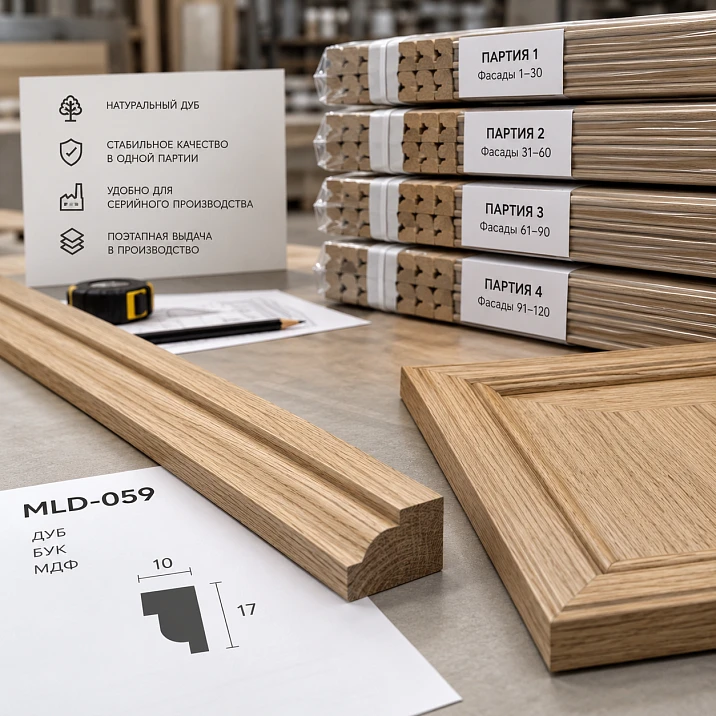
Production needs to manufacture 120 furniture fronts with the same decorative profile MLD-059 from oak. It is convenient to launch the work in four batches of 30 fronts each, but this does not mean that the molding should be purchased in four independent lots. If each batch is calculated anew, the linear meters are rounded separately to whole strips, the reserve is added separately, and usable leftovers are not returned to the overall accounting, procurement loses control over the material even before the first half of the series is completed.
For a serial project, the correct logic is the opposite: first the entire series of 120 fronts is calculated, then a single parts list is formed, a cutting map is built for the commercial length of oak MLD-059 2400 mm, the total production and operational reserve is determined, and only after that is the already purchased material divided into four production issues. A production batch answers the question "what should be sent to the workshop now," while a purchasing lot answers "how much material does the project need overall."
The main practical result: after such a calculation, MLD-059 stops being the line "approximately this many meters of molding are needed." The project gains a verifiable chain: SKU → material → cross-section → commercial length → parts list → cutting map → whole strips → production reserve → operational reserve → marking → issue by batches → return of usable leftovers → inventory → reorder if necessary.
MLD-059 17×10 mm: what needs to be fixed before calculating the lot
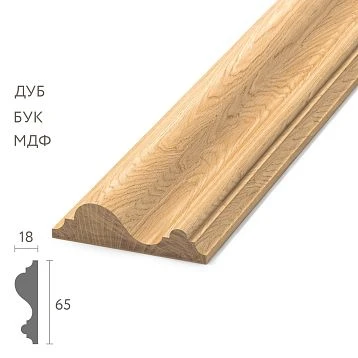
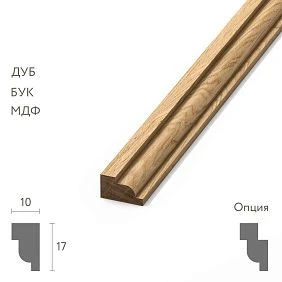
The article examines a specific molding MLD-059. Current versions have one cross-section — 17×10 mm, but the commercial length depends on the material. MDF is supplied in 2600 mm lengths, beech and oak — 2400 mm. For the selected scenario, an oak profile 17×10×2400 mm is used. It is the 2400 mm length that must be used in calculating the number of whole strips and the cutting map.
| MLD-059 version | Section | Product length | What to specify in the request |
|---|---|---|---|
| MDF | 17×10 mm | 2600 мм | MLD-059 / MDF / 17×10×2600 |
| Beech | 17×10 mm | 2400 мм | MLD-059 / beech / 17×10×2400 |
| Oak | 17×10 mm | 2400 мм | MLD-059 / oak / 17×10×2400 |
The article "MLD-059" alone is not enough for a production specification. It identifies the profile, but does not define the material, length, finish, or quantity. A complete order line should look approximately like this: MLD-059 / oak / 17×10×2400 mm / finish according to the approved sample / ___ whole strips. If the project has not yet approved the finish, this field must not be silently omitted: the status "finish not approved" must also be visible in the documents.
The MDF card separately specifies preparation for enamel. If the project changes the material and decides buy an MDF molding, the calculation must be rebuilt for a length of 2600 mm, rather than simply replacing the word "oak" with "MDF" in the finished list. The commercial length changes the cutting plan, the number of whole strips, and the leftovers.




Why 120 facades are first counted as one series, not as four orders of 30
Four batches of 30 facades are a convenient way to organize production, quality control, and installation. But this organizational division should not automatically carry over into purchasing. If the geometry of the facades has already been approved, the profile is the same, the material is the same, and the finish is the same, the project has a total requirement for MLD-059. That is exactly what needs to be calculated before launching the first batch.
The scheme "30 facades → buy molding → manufacture → count the next 30 again" creates four independent rounding points. Each batch has its own partial strips, its own "just in case" reserve, and its own leftovers. If the shop does not return the leftovers from the first batch to the common pool, the second batch starts work as if there is no usable material. By the fourth batch, the warehouse may simultaneously contain several short leftovers, several reserve strips of unknown purpose, and a new additional order, even though part of the requirement could have been covered by material already purchased.
The working sequence is different:
- approve 120 facades and divide them into standard sizes;
- obtain the finished dimensions of all frame elements;
- compile a general parts list;
- build a cutting plan for a 2400 mm trim strip;
- count whole trim strips according to the cutting map;
- determine the reserve separately;
- lock the overall order;
- split the physical material into four production issues.
This approach is especially useful when wholesale purchase of building materials includes not only the decorative profile, but also other items that arrive at production on different schedules. Internal queues must not break the single specification of a specific SKU.
Our factory also produces:





First, the parts of each frame are counted, then the linear meters
Linear meterage is a derived quantity. The primary document for furniture production should be a list of parts. For a rectangular frame, this is usually two vertical and two horizontal parts, but their finished dimensions cannot be invented from the facade's overall dimensions: they depend on the approved design, the joining method, the profile position, and technological allowances. Therefore, the purchaser must receive the dimensions from the designer or process engineer already in the measurement base used for cutting.
The minimum list contains the facade type, quantity, vertical length, horizontal length, and the number of parts of each size. If a series has left/right versions, different angles, sections with handles, or other structural variations, they must be separated into different rows. Parts may be combined only when they are truly interchangeable.
| Facade type | Number of facades | Vertical | Horizontal | Verticals | Horizontals |
|---|---|---|---|---|---|
| А | 40 | According to working drawing | According to working drawing | 80 | 80 |
| Б | 40 | According to working drawing | According to working drawing | 80 | 80 |
| В | 40 | According to working drawing | According to working drawing | 80 | 80 |
For 120 facades with four frame elements, the result is 480 finished parts. But the number “480” says nothing yet about the number of strips: the parts have different lengths, and from one 2400 mm strip several elements of different types can be obtained. That is precisely why the purchasing calculation cannot be reduced to the perimeter of one facade multiplied by the quantity and mechanically increased by a universal ten or fifteen percent.
Get Consultation
Worked example: how 120 facades turn into 272.8 linear meters
To show the mechanics of the calculation, let us take a conditional training example. These are not the dimensions of specific STAVROS furniture and not a standard for MLD-059. Suppose that, after design development, the following finished part lengths are approved for three facade types: type A — verticals 680 mm and horizontals 380 mm; type B — 700 and 430 mm; type C — 740 and 480 mm. In a series of 40 facades of each type.
| Type | Facades | 2 verticals per facade | 2 horizontals per facade | Net footage of type |
|---|---|---|---|---|
| А | 40 | 80 × 680 mm = 54.4 m | 80 × 380 mm = 30.4 m | 84.8 m |
| Б | 40 | 80 × 700 mm = 56.0 m | 80 × 430 mm = 34.4 m | 90.4 m |
| В | 40 | 80 × 740 mm = 59.2 m | 80 × 480 mm = 38.4 m | 97.6 m |
| TOTAL | 120 | 480 parts | 272.8 m | |
If you simply divide 272.8 m by the commercial length of oak MLD-059 2.4 m, you get 113.67. After rounding up — 114 whole planks. But 114 is only a theoretical lower control. It answers the question of how many planks contain at least the required net meterage. It does not prove that 480 parts can physically be cut from 114 planks.
The actual cutting plan must account for the combination of lengths, cut width, end trimming, technological allowances, rejection of specific sections, and processing rules. Therefore, the purchase quantity may turn out to be greater than 114. The usefulness of this number lies elsewhere: if the cutting plan suddenly requires, for example, 145 planks, the process engineer sees a major gap from the theoretical minimum and can check what explains it. If someone proposes ordering 110 planks, the calculation immediately shows physical impossibility: they contain only 264 m of source length, that is, less than the net requirement of 272.8 m.
Why MLD-059 cannot be rounded separately for every 30 facades
In the training example, each queue contains ten facades of types A, B, and C. Its net requirement is a quarter of the total meterage: 272.8 / 4 = 68.2 m. Divide by 2.4 m and we get 28.42 planks. For one queue, the purchaser rounds this up to 29 planks. If this is done four times, the result is 116 planks.
| Control scheme | Net area | Division by 2.4 m | Rounding |
|---|---|---|---|
| Entire series | 272.8 m | 113,67 | 114 planks |
| One queue | 68.2 m | 28,42 | 29 planks |
| Four queues separately | 4 × 68.2 m | 4 × 28,42 | 116 planks |
Even at the level of simple arithmetic, four independent roundings add two planks, that is, 4.8 m of source material. After a full cutting layout, the difference can change in either direction: sometimes additional planks are indeed needed due to the combination of lengths, sometimes the overall cutting layout allows leftovers to be used much more efficiently. But the principle remains: rounding must be done after combining the parts into a common cutting task, not before it.
In the same way, you cannot automatically add the same reserve percentage four times. The reserve is needed not to "hedge each table," but to cover the specific risks of the entire series. If the reserve is calculated for the project, the first queue does not get the right to use it up completely just because it starts first.
A common cutting map for 120 facades is more important than the formula "meters / 2.4"
The cutting map converts a list of 480 parts into a list of source strips. In it, the process engineer distributes the parts across MLD-059 2400 mm bars so as to account for real technological constraints. What matters to the purchaser is not each cut, but the outcome of the map: how many whole strips are required, what volume of remnants is expected, which remnants have a purpose, and where the reserve is allocated.
In practice, it is convenient to first group the parts by length and type. In our training example, these are 80 parts 740 mm long, 80 — 700 mm, 80 — 680 mm, 80 — 480 mm, 80 — 430 mm, and 80 — 380 mm. After that, the cutting system or process engineer combines them within the strips. Mixing different types of fronts in one source strip is permissible if the material, profile, and finish are the same: the origin of a part from a specific bar does not change its SKU.
A universal “ideal cutting plan” cannot be published in advance. The kerf width, minimum trimming, requirements for defective areas, and tolerances depend on the production process. In the article, one can verify the arithmetic of the linear meters, but production cutting must be based on the actual equipment settings and the workshop’s work instructions.
This is exactly where the difference between the request buy furniture molding and real serial procurement becomes apparent. Finding the right profile is only the first step. For 120 fronts, procurement value arises when the product card is linked to working drawings, the cutting plan, and the material accounting system.
Useful remnant, production reserve, and operational reserve are three different entities
Weak accounting lumps everything under a single line, “stock.” For serial furniture production, this is inconvenient: material with different purposes begins to be used without control. It is better to separate three categories.
Useful remainder
This is a segment that has already been formed after cutting and has sufficient actual length and quality for a specific future part. For example, after trimming and measuring, a usable section of 780 mm remains, and in the next queue there is a 740 mm part with sufficient technological allowance. Such a segment cannot be written off as waste. It must be measured, marked, and returned to the available bank.
Production reserve
This is material deliberately not included in the main cutting plan and left for processing errors, damage, rejection, or the need to remanufacture a part. The size of such a reserve should be tied to real production risks, not to the habit of always adding the same percentage.
Operational reserve
This is material that is retained after a production run is completed for possible repair or replacement during operation. For oak, such a reserve is especially useful as material tied to the original purchase batch and the approved finishing system. It must not disappear in the workshop just because the last production queue required one more strip.
The separation makes it possible at any time to answer three different questions: what can already be used in the next cutting plan, what is insuring the current series, and what must remain after the project is completed.
How to create a shared bank of usable offcuts MLD-059
An offcut bank is not a box of scraps. It is an accounting of usable offcuts that still have a production purpose. Each such offcut must be identifiable. Minimum labeling: SKU, material, actual usable length, purchase batch or receipt date, finishing status, and, if necessary, the intended part.
| Offcut ID | SKU | Material | Usable length | Status | Possible purpose |
|---|---|---|---|---|---|
| R-001 | MLD-059 | Oak | 780 мм | Checked | part up to 780 mm taking into account technological requirements |
| R-002 | MLD-059 | Oak | 455 мм | Checked | short horizontal after cutting plan confirmation |
| R-003 | MLD-059 | Oak | 610 мм | quarantine | first check the end for damage |
Actual length matters more than nominal. If a segment is labeled "780", but 15 mm at the end is damaged, the technician must either change the usable length or quarantine the remainder until trimming. You cannot pass a piece to the next queue from memory alone: "it's about eight hundred millimeters."
For a large batch, the remnant bank can be kept in the same system where the issue of main strips is recorded. This simplifies prioritization: before opening a new whole strip, suitable remnants are checked first. If their size, material, and quality match the part, they are returned to cutting. If they do not match, they continue to be stored for a different length or are written off according to an approved rule.
Why the remnant of the first queue should be available to the second
The point of a unified calculation is lost if the material is physically divided into four zones and exchange between them is prohibited. Suppose after the first queue, several quality segments of 700–800 mm remain. The second queue contains verticals of similar length. If section A considers its remnants a "closed history," section B opens new strips and creates new remnants. The project pays twice for the same inefficiency.
The correct cycle between queues looks like this: finish cutting → collect remnants → measure → assess condition → mark → enter into the ledger → return to the common bank → plan the cutting of the next queue taking the bank into account. Only after this is it determined how many new whole strips need to be issued.
At the same time, a remnant should not automatically be considered suitable. If the profile is damaged, has questionable geometry, or the finish has already been done differently, it cannot be used just to save money. The common bank is a control tool, not a requirement to use every piece at any cost.
This order is especially useful for companies that regularly perform purchase of construction materials in bulk for several production stages. Individual sections gain autonomy over the schedule, but do not lose the overall material balance of the project.
How to divide a common order into four production queues
After calculating the entire series, the material can be physically distributed across stages. Conventionally: queue A — facades 1–30, B — 31–60, C — 61–90, D — 91–120. But the number of strips in each issue does not have to be exactly a quarter of the total quantity. If the cutting map of the first queue uses more short parts and is well covered by remnants, it may need fewer new strips. Another queue with long parts will require more.
Therefore, dividing the total order by 4 is suitable only for preliminary warehouse planning, but not for actual issuance. The workshop should receive a kit according to the specific cutting map of the queue, taking into account the already accumulated remnant bank. The issuance sheet shows how many whole strips were transferred, which remnants were added from the bank, and which reserve remains blocked.
| Queue | Fronts | New whole strips | Remnants from the bank | Reserve |
|---|---|---|---|---|
| А | 1–30 | According to the cutting map | none at start | not issued automatically |
| Б | 31–60 | according to the map taking into account return A | suitable remnants A | according to the agreed request |
| В | 61–90 | according to the current balance | remnants of A and B | according to the agreed request |
| Г | 91–120 | according to the final map | the entire available bank | part may go into operational stock |
This order preserves production flexibility. The queue may shift in timing or change sequence, but the overall procurement balance will not be disrupted. For supply, one order MLD-059 remains, and for the workshop — four controlled issues.
A procurement batch and a production queue are not the same thing
A procurement batch describes how much of a specific item is purchased from a supplier and under what terms. A production queue describes what portion of already purchased material is released into work at a specific moment. Confusing these concepts creates a false need to buy the profile four times.
The procurement specification records MLD-059, oak, 17×10×2400 mm, the number of whole planks, finishing or finishing status, deadlines, delivery, and bundling terms. The production list additionally includes queue numbers, facade codes, a cutting map, resulting remnants, and the responsible section.
This separation is also useful when comparing offers. If one building materials supplier wholesale calculates the entire volume, while another gives a price only for the first phase, so the final cost cannot be compared without bringing it to a single specification. The same article number does not yet mean the same item in a commercial proposal: the number of whole strips, delivery, lead times, finishing, and shipment structure may differ.
How to label MLD-059 by production phases
Labeling is needed not for the beauty of the label, but for an unambiguous link between the physical material and the accounting record. If the warehouse contains oak MLD-059, beech MLD-059, and other profiles of similar cross-section, the label “molding for facades” does not protect against mix-ups. The code must contain at least the SKU, material, phase, and the number of the location or bundle.
For example: MLD059-OAK-A-01. Here MLD059 is the article number, OAK is the internal designation for oak, A is the production phase, and 01 is the warehouse location number. The company chooses the code format itself; what matters is not the specific abbreviation, but consistency. A separate status can be used for the reserve: MLD059-OAK-RESERVE.
If finishing is done in batches, the coating status or the number of the approved sample should be added to the labeling. An unfinished profile and a tinted profile are not interchangeable remnants, even if their geometry matches. The warehouse must see this before issuing, not after discovering the difference on the finished facade.
At large sites, where delivery of finishing materials is delivered in several transports, it is useful to link the receipt number to the internal code as well. Then, in the event of a claim or reprocessing, the origin of a specific bundle can be traced.
Why the reserve cannot be issued as ordinary material in the first phase
A reserve makes sense only while it remains reserved. If in the first stage the shop received the main volume plus the entire stock and used up strips without a separate status, then by the third or fourth phase the project formally still “has a reserve” in the table, but physically it is already gone.
Practical control is simple: the reserve is stored as a separate group, has its own labeling, and is issued only for a recorded reason. For example, damage to two original strips has been confirmed, a part is being remanufactured after a milling defect, or the approved facade has changed. The reason for issuance is entered into the movement ledger. After that, it is clear not only how much reserve remains, but also where it went.
It is not necessary to completely prohibit the use of the reserve until the last queue. A ban by itself can halt production. It is more correct to establish an access rule: who authorizes the issue, which document initiates it, and how the remaining balance is recalculated after issue. If the reserve begins to decrease rapidly already in the first third of the project, this is a signal to check the process, not to silently continue writing it off.
How to determine the reserve without a universal “plus 10%”
For MLD-059, it is impossible to name a single percentage that will be correct for any furniture project. The risks differ. A series of repeating rectangular frames on well-adjusted equipment and a project with many non-standard sizes, complex tinting, and manual fitting require different safety stock.
It is better to build the reserve from causes:
- cutting: is there a confirmed map and how densely are the strips used;
- processing: what is the probability of remanufacturing parts based on the actual statistics of the section;
- material: is visual sorting of oak required for face parts;
- logistics: is there a risk of damage during movements between the warehouse and the shop;
- finishing: is rework possible due to non-compliance with the approved sample;
- service: is it necessary to leave material after project handover.
In a working calculation, these risks are not necessarily converted into a percentage, but into a specific number of whole strips. For example, the cutting map after all technological adjustments requires a conditional 121 strips. Production decides to keep four more whole strips as a production reserve and three as an operational reserve. Then the purchasing line amounts to 128 strips. This is an example of the methodology, not a STAVROS norm or a recommendation for any project. In another production facility, the reserve will be different.
This approach is better than an automatic markup: the purchaser knows what each additional strip is responsible for and can revise the reserve when conditions change.
Oak MLD-059: why one purchase does not mean absolutely identical texture
Natural oak is variable. Even material from a single delivery does not turn into artificially identical strips: the grain pattern, shade, and pronouncedness of the texture may differ. Therefore, the task of a single purchasing batch is not to promise impossible absolute identity, but to reduce the number of uncontrolled variables.
If the facades will have a transparent or tinting finish, it is reasonable to approve a physical sample before starting the series. For a preliminary comparison of profiles, you can compare molding samples before ordering, and for the serial finish, keep a separate reference specifically for the selected combination of wood and coating. The reference does not make the wood identical, but it sets the range of acceptable results.
When a large batch arrives, it is useful not to mix bundles blindly. If visual consistency is critical, the material is first sorted according to the method adopted at the production facility, then assigned to groups of facades. The reserve must maintain a connection with the original series. If a reorder is unavoidable, the supplier is directly informed that the new oak MLD-059 must continue the previously completed project.
Before agreeing on appearance requirements, you can additionally study the section Materials and quality of STAVROS products. But the final acceptance criteria for a specific furniture series must still be recorded in the project documentation, not implied.
What to do if the entire volume is purchased but production is stretched over several weeks
A single purchase does not mean that the entire batch must be at the machine at the same time. If weeks pass between queues, warehouse accounting and preserving the geometry of the material become critical. It is better not to invent universal temperature or humidity figures without confirmation from the supplier; for the project, real storage requirements must be used and conditions capable of damaging the profile must be excluded.
In practice, this means: do not place MLD-059 in the aisle, do not lean long strips in such a way that they receive constant random load, protect the packaging from water and contamination, and do not mix open and closed bundles without marking. If the packaging is opened, the status must be visible in the ledger.
Issue only against the ledger
The warehouse transfers to the workshop not “several bundles,” but a specific number of strips and, if necessary, marked remnants. The recipient confirms the quantity. After cutting is completed, the return is processed in the same way.
Return of usable remnants
Remnants are returned not to the common bin, but with actual dimensions and status. This prevents repeated measurements and allows them to be immediately included in the next map.
Control of damaged strips
A damaged strip must not disappear from the balance. It is transferred to quarantine until a decision is made: write it off completely, cut off the damaged section, or use the undamaged part.
When it is more reasonable not to split MLD-059 into four separate purchases
A full purchase is justified when the project is already stable: all 120 facades are approved, their dimensions are finalized, MLD-059 has indeed been definitively selected, the material is the same, the finishing system is agreed upon, the cutting map is prepared, and there is a suitable storage location. In this situation, splitting the order into four purchases creates more risk points than benefits.
A single purchase makes quantity control easier, simplifies linking the reserve to the original batch, and allows the overall cutting to be planned in advance. For oak, it also reduces the likelihood that each queue will be assembled from a random independent delivery. This does not guarantee identical texture, but it makes the origin of the material more transparent.
If the purchaser is looking where buy wooden furniture molding for a serial order, the request to the supplier must immediately specify the entire project volume and the desired issue/delivery schedule. Then the commercial proposal is based on the real scale, not on the first batch of 30 facades.
When a premature full purchase, on the contrary, is risky
The word “wholesale” does not automatically make an early purchase profitable. If the facades are still changing, part of the furniture is in design, the profile is not approved by a physical sample, or the customer is choosing between MLD-059 and another geometry, buying the entire volume prematurely is unwise. The savings on one delivery can easily turn into a warehouse of unsellable profile after the project changes.
A full purchase is better postponed if:
- there is no final list of facades;
- the finished dimensions of the parts are not confirmed by the technologist;
- the species or finishing system has not been selected;
- there is a significant probability of a profile change;
- there are no conditions for safe storage of long strips;
- an experienced first batch is needed to verify the technology.
If the question is still about choosing the geometry, it is more useful to first compare MLD-059 and MLD-060, and only after deciding, turn the model into a wholesale specification. This article addresses a different task: the MLD-059 profile has already been chosen, and it needs to be properly taken through serial production.
How to maintain the MLD-059 movement ledger
The movement ledger links the warehouse and production. It should show not only the receipt and consumption of whole strips, but also the return of usable remnants, the use of reserve, and write-offs. Then, after the second stage, it is possible to know exactly what remains for the third, instead of recalculating all the bundles manually again.
| Date | Operation | Queue | Whole strips | Usable remnants | Reserve | Responsible |
|---|---|---|---|---|---|---|
| ___ | receipt of the purchased batch | — | ___ | 0 | ___ | ___ |
| ___ | release to work | А | ___ | ___ | without changes | ___ |
| ___ | return after cutting | А | ___ | ___ | without changes | ___ |
| ___ | reserve release | Б | ___ | ___ | − ___ | ___ |
The system can be paper-based, spreadsheet-based, or integrated into an ERP; the form is secondary. The main thing is that the remaining balance can be reconstructed from the records. If each area keeps its own table with different material names, the overall balance quickly stops reconciling.
How to account for damaged planks without unnecessary write-offs
Damage does not always mean the loss of the entire 2400 mm length. If the defect is localized at the end, the undamaged part may be suitable for short parts. But the decision is made by the process engineer according to the cutting map, not by the warehouse worker by eye. Until a decision is made, the plank is moved to a separate status.
The damage card records the SKU, material, receipt number, defect location, estimated and then confirmed usable length. After trimming, the offcut is either returned to the bank or written off. If the damage affects the profile geometry over a significant length, trying to "stretch" the material to save money can lead to more defects in the finished facades.
Such accounting also helps to understand the origin of systematic losses. If damage repeats during unloading or internal movement, the problem needs to be fixed in logistics, not by endlessly increasing the reserve.
Intermediate inventory after each queue
Before launching the next thirty facades, it is useful to record the material balance. The inventory must answer at least six questions: how many whole strips remain, how many usable remnants are available, how much material is in quarantine, how much reserve is untouched, how many parts have already been manufactured, and whether there is a deviation from the planned consumption.
If the first batch consumed noticeably more material than the map forecast, you cannot simply reduce the remainder of the following batches. You need to find the cause: incorrect dimensions, a changed cutting plan, a larger allowance, damage, processing defects, or an unrecorded issue. The earlier the deviation is found, the higher the chance of correcting the process before the main material runs out.
After inventory, the batch B map is built on the actual balance, not on the original plan from a month ago. The same is repeated before C and D. This turns the reserve from a static line into a managed resource.
How to place a reorder for MLD-059 if the material still ran out
A bad reorder looks like this: “We need another eight meters of the same molding.” It lacks the material, the length of the original strip, the finish, and the link to the previous batch. For oak with visible grain, this is especially risky.
Working wording: MLD-059 / oak / 17×10×2400 mm / ___ whole strips / finish ___ / reorder for project ___ / previous delivery ___. If the finishing is done at the buyer's production site, instead of a nonexistent factory designation, indicate the actual status: unfinished, for subsequent processing according to an approved sample, etc.
Before reordering, first check the remnant bank, quarantine strips, and operational reserve. You must not automatically open the service stock, but you need to see it in the balance so the decision is informed. If the reorder is caused by a project change, it is better to keep it as a separate line, without masking it as “overconsumption.”
To place the order, you can go to the card and order MLD-059 with the exact specification. Before payment, you should recheck the current availability, price, and production time.
Buying furniture moulding wholesale: what to send the supplier for a quote
The request "how much does MLD-059 cost for 120 fronts" is not enough, because the supplier cannot see your cutting plan and does not know how many full strips you get after the technical calculation. The more precise the initial request, the lower the risk of receiving a quote that cannot be compared with the project.
The request should include:
- item code MLD-059;
- material — oak;
- cross-section 17×10 mm;
- commercial length 2400 mm;
- number of whole planks;
- the main volume and the reserve separately, if they have already been determined;
- finishing status;
- the desired readiness or shipment schedule;
- delivery address;
- labelling requirements, if they are agreed in advance.
If the cutting plan is not yet ready at the time of the request, this must be stated directly. In that case, the request may contain the net linear meters and an approximate number of strips, but the commercial solution should not be considered final. When the task is — Buy wooden molding for a series, the buyer must distinguish between a preliminary budget and an order for payment.
For a broad project where multiple options are being selected simultaneously, Wood and MDF moldings, it is still better to break down the specification by SKU. The general phrase “moldings and skirting boards for furniture” is convenient for discussion, but not for shipment.
How to compare commercial offers for MLD-059
The most common mistake is comparing only the price per linear meter. For a serial order, this is not enough. One calculation may include 125 whole strips, another — 128; one assumes a single shipment, another — four; in some cases delivery is paid separately, in others not. If the offers are not brought to the same basis, the lower “RUB/m” line may turn out to be the more expensive final option.
| Parameter | What to compare | Why this is important |
|---|---|---|
| SKU | MLD-059 | eliminates substitution with a similar profile |
| Material | Oak | beech and MDF are different versions |
| Size | 17×10×2400 mm | length affects cutting |
| Quantity | the same number of whole strips | otherwise the final amount is not comparable |
| Finishing | identical status | affects the scope of work |
| Logistics | delivery, number of shipments, timelines | forms the real cost of the project |
That is why requests like building materials at wholesale prices are useful only as a starting point for the search. For real procurement, price makes sense after the supply item is fixed. The more precise the specification, the fewer "cheap"
How to receive a large batch of MLD-059 at the warehouse before the first phase is launched
A unified calculation loses its meaning if acceptance comes down to checking the number of packages. Before the material is transferred to production, the physical receipt must be linked to the procurement specification. The receiver must confirm that it is indeed MLD-059 that has arrived, that the material matches the ordered oak, that the cross-section and commercial length match, and that the number of whole planks matches the documents.
It is better to carry out the check from the commercial line to the actual group: MLD-059 → oak → 17×10×2400 mm → number of places → number of planks → condition → marking. The total linear meterage here is secondary. Even if the total length is formally close to the ordered one, a delivery with a different plank length or a different material is not equivalent, because it will change the cutting map.
| Acceptance step | What to Check | What to do in case of discrepancy |
|---|---|---|
| 1 | item MLD-059 | do not mix with a similar profile, flag the disputed group |
| 2 | material — oak | beech or MDF cannot be accepted as a substitute without new approval |
| 3 | cross-section 17×10 mm | stop release to production until clarification |
| 4 | Length 2400 mm | do not recalculate automatically as equivalent linear meters |
| 5 | Number of whole planks | document the shortage or surplus |
| 6 | visible condition | damaged — to quarantine, not to the main warehouse stock |
| 7 | batch marking | assign an internal code before placing in storage |
If the batch is large, there is no need to open and sort through all the material without an accepted procedure. The scope of inspection is determined by agreements, packaging, and internal quality rules. But any damaged or ambiguous group found must remain separate until a decision is made. Otherwise, disputed planks dissolve into the general stock, and the problem only surfaces in the workshop.
After acceptance, a starting balance is formed: accepted suitable whole planks, accepted into quarantine, recorded damaged, allocated to reserve. Queue A starts from this figure. If the purchase is part of a broader supply and the company compared wholesale building material suppliers, MLD-059 still requires a separate act of the actual condition of the specific SKU.
What to do if the first queue used more MLD-059 than planned
Overspending in the first queue is not a reason to immediately order new planks. First, you need to understand where the deviation occurred. If, according to the map, roughly 30 planks were issued for work, but completing the same 30 facades required 32, the project lost two planks relative to the plan. But the cause may be different, which means the solution will be different.
Working algorithm:
- stop automatic issuance from reserve; otherwise the actual deviation will become invisible;
- verify the cutting map against the actual parts; dimensions may have been changed after calculation;
- check the defect and damage log; two additional strips may have gone for rework;
- recalculate the bank of usable remnants; some material may be available for subsequent queues;
- determine whether the cause is one-time or systemic; an operator error and an incorrect technological allowance require different actions;
- recalculate the remaining 90 facades; the original plan can no longer be considered automatically correct;
- only after that decide whether an additional order is needed.
If the cause is systemic — for example, the actual allowance turned out to be greater than planned — the map of all remaining queues is adjusted. Then it is better to place the additional order in advance, while the main material is still available. If the cause is one-time and after returning the remnants the balance of subsequent queues reconciles, an additional purchase may not be needed.
Such an audit is more useful than the usual solution of “writing off from stock.” The reserve covers the risk, but at the same time it must show that the risk has materialized. If the stock is constantly used without analyzing the cause, the next series will repeat the same mistake, already on a different item.
What to do if the dimensions of some facades changed after purchase
Changing the project after payment is one of the most unpleasant scenarios, because the goods have already been purchased, and the original cutting map no longer matches production. But even here, you cannot immediately consider all previous work useless. You need to recalculate only the affected part and check how the new lengths interact with the already purchased strips and accumulated remnants.
First, the list of changed facades is recorded and the old lines are removed from future queues. Then the new part lengths are added and optimization of the remaining material is rerun. If the new part is longer than the previous one, short remnants may lose their purpose; if it is shorter, on the contrary, part of the stock will become more useful. Therefore, adjusting the quantity in pieces should happen after recalculation, not based on the difference in perimeters.
For example, if ten type B facades change to a new size, you cannot calculate only “new perimeter minus old perimeter” and buy the resulting meters. The new parts may be grouped differently within 2400 mm strips. The net linear meters will increase by two meters, while the need for whole strips may increase by one, two, or not change at all if the map uses free remnants efficiently. The opposite situation is also possible: the linear meters decrease, but an inconvenient new length worsens the cutting layout.
If the change occurs before the queue starts, its output is reassembled completely. If some parts have already been manufactured, the finished elements are separated from the material not yet cut, and only the remaining requirement is calculated. This approach makes it possible not to “reset” the project and at the same time not to pretend that the old specification is still current.
It is precisely in such situations that unified accounting shows its value: the company sees what has already been purchased, what has been issued, what remains whole, which offcuts are available, and how much reserve has not been used. Without this, changes almost inevitably turn into an urgent repeat purchase “by eye.”
15 typical mistakes when buying MLD-059 wholesale
1. Dividing the project into four independent orders. The mistake appears because the purchasing and production schedules coincide. The consequence is repeated roundings, separate reserves, and different deliveries. Prevention is a single calculation of 120 facades before the first purchase.
2. Counting only linear meters. 272.8 m in the training example is the checksum of the parts, not a ready order line. You need to order whole strips after the cutting map.
3. Dividing the linear meters by 2400 and considering the result final. The formula gives a theoretical minimum, but does not take into account the combination of lengths, the saw kerf, end trimming, and production constraints.
4. Add the same reserve to each queue. This way the same safety stock appears four times. The reserve is first calculated for the project, then its issuance is controlled.
5. Write off all offcuts. A quality remnant can cover a part for the next queue. It must be measured and returned to the bank.
6. Call any remnant a reserve. A useful cut piece has already appeared in cutting, the production reserve has not yet been consumed, and the operational stock is intended for future repairs. These are different categories.
7. Issue the first queue's reserve together with the main material. Without a separate status, the shop consumes it like ordinary strips, and the stock disappears before the series is completed.
8. Do not label the queues. Bundles get mixed, and the warehouse cannot see which strips were planned for a specific stage and which belong to the reserve.
9. Mix oak, beech, and MDF under one SKU. MLD-059 has the same cross-section, but different materials and, for MDF versus solid wood, different commercial lengths. The full SKU string is mandatory.
10. Treat 2400 and 2600 mm as one length. A material substitution changes the source plank and requires recalculating the cutting plan.
11. Reorder “a few more meters.” Without the material, length, and link to the previous delivery, the new order is ambiguous.
12. Do not record the finishing system. For visible oak, the same profile with a different finish is no longer an interchangeable material.
13. Do not conduct inventory between queues. The next map is built from the planned rather than actual remnant. The error accumulates.
14. Buy the entire series before approving the facades. The wholesale price does not compensate for the risk of changes in dimensions or profile.
15. Promise absolute uniformity of natural oak. Wood is variable. You need to manage by batches, sorting, finish sample, and reserve, rather than making an unrealistic promise.
Checklist before paying for batch MLD-059
| Check | Status |
|---|---|
| Item MLD-059 is confirmed | □ |
| material — oak | □ |
| Cross-section 17×10 mm confirmed | □ |
| Commercial length 2400 mm confirmed | □ |
| All 120 facades approved | □ |
| Facade types and quantity of each type are known | □ |
| Full parts list received | □ |
| Cutting map built | □ |
| Number of whole planks calculated | □ |
| Production reserve allocated separately | □ |
| Operational reserve allocated separately | □ |
| Procedure for accounting for useful remnants approved | □ |
| Four production stages defined | □ |
| Marking system agreed | □ |
| Storage location prepared | □ |
| Procedure for issuing reserve defined | □ |
| Intermediate inventory planned | □ |
| Finishing or its status recorded | □ |
| Delivery terms verified | □ |
| Reorder format determined in advance | □ |
If several critical lines remain empty, payment for a large batch may be premature. The checklist is needed not for bureaucracy, but to separate a ready order from a preliminary intention to buy material.
Where to buy MLD-059 molding wholesale for furniture production
When the SKU and material have already been selected, it is more convenient to go directly to the product page: buy wooden molding MLD-059 17×10 mm. For a project with 120 facades, the request is better placed not in linear meters, but in whole strips indicating oak and a length of 2400 mm. If MLD-059 needs to be compared with other wooden profiles, the catalog is used, rather than a random substitution of the item after calculation.
For a buyer who starts searching with general queries construction materials wholesale, building material suppliers or building materials wholesale from the manufacturer, the main transition to an exact order is one: the general category must turn into a specific specification. In this case — MLD-059 / oak / 17×10×2400 / quantity according to the cutting map / reserve separately.
Wholesale purchasing becomes manageable not at the moment when a low price is found, but when the warehouse, the technologist, the buyer, and the workshop all understand equally what exactly has been purchased and how this material will move through four production queues.
Frequently asked questions about MLD-059 for the furniture facade series
What is the size of MLD-059?
The cross-section of the current standard MLD-059 versions is 17×10 mm. For MDF, the commercial length is 2600 mm; for beech and oak, it is 2400 mm. In this article, the calculation is based on oak 17×10×2400 mm.
Can you simply multiply the facade perimeter by 120?
This way you can get the net linear meters if the part dimensions have already been determined correctly, but this is not enough for ordering. Next, cutting into whole strips is required, taking into account technological conditions.
Why do 272.8 m in the example yield a minimum of 114 strips?
272.8 / 2.4 = 113.67. A whole strip cannot be bought as 0.67, so the control minimum is rounded up to 114. The actual purchase quantity may be higher after the cutting map is built.
Why do four queues yield 116 strips with simple rounding?
Each training queue contains 68.2 m. That is 28.42 strips, that is, after separate rounding, 29. Four times 29 gives 116. This is exactly how extra rounding occurs even before the actual cutting.
Should all 120 facades always be purchased in one batch?
No. Full purchasing is reasonable only after the dimensions, material, profile, finish, and proper storage are approved. If the project is still changing, early wholesale purchasing increases the risk.
Can the reserve of the first stage be used in the second?
Yes, if the project management system allows it and there is a recorded reason for the issue. But the reserve must not turn into free warehouse stock without a status.
How does a useful remainder differ from a reserve?
A useful remainder has already appeared after cutting and has a specific actual length. A reserve is kept whole in advance or allocated separately to cover future risks.
Should short remainders be stored?
Only if they can cover real parts and their quality is confirmed. Storing every offcut without a purpose is pointless; the remainder bank must have a minimum usefulness threshold set by production.
What should be done if only the end of the plank is damaged?
Do not automatically write off the whole strip. The plank is moved to quarantine, the actually usable length is determined, and the cutting map is checked to see whether the undamaged part can be used.
Can oak from different receipts be mixed?
The technical solution depends on the project requirements. With visible wood grain, different batches are better accounted for separately and visually coordinated, since natural wood is variable.
How to place an additional order?
Specify MLD-059, oak, 17×10×2400 mm, the number of whole strips, the finishing status, and the link to the original project or delivery. Wording like “another eight meters of the same” is not enough.
Where can I find other furniture moldings?
If the profile has not yet been finally selected, you can open the category and buy furniture molding after comparing the geometry, material, and length of the available options. If MLD-059 has already been approved, there is no need to return to a broad selection without reason.
Should the price be recorded in the production card?
The production card usually does not need the price for cutting, but the procurement specification and budget should store the actual cost of the specific order. Before payment, the price and availability should be rechecked in the product card.
What is the main checkpoint before payment?
The number of whole strips should come from the approved parts list and cutting map, not from an approximate meterage. If this link is missing, the order is not yet ready for serial production.
Final ordering logic for MLD-059 for 120 facades
For a series of 120 furniture fronts, the purchase of oak MLD-059 should begin not with the question "how many meters to buy," but with a complete bill of materials. After that, the net linear meters become known, then a cutting plan is built based on the 2400 mm bar, the number of whole lengths is determined, and production and operational reserves are allocated separately. Only after this does the final purchasing line appear.
Four batches of 30 fronts each remain a production tool. They help plan workload, finishing, and control, but should not generate four separate purchases. After each batch, usable remnants return to the common bank, the reserve remains under a separate status, and the next issue is calculated based on the actual balance.
If this system is set up before payment, the purchaser can buy MLD-059 wholesale without losing control over the material: the workshop receives exactly the volume needed now, the warehouse understands the origin of each group, usable remnants are not written off automatically, and reorders are placed as a continuation of a specific specification. For serial furniture, this is the difference between "ordering molding" and managing one purchasing batch throughout the entire production process.