Article Contents:
- MLD-053 43×18 mm: what needs to be fixed before calculating the batch
- Why the same 43×18 mm cross-section does not make MDF and oak interchangeable
- Why you cannot leave only “MLD-053” in the specification
- First split the 48 cabinets by finish, then calculate the linear footage
- Why you cannot first calculate the total meterage and choose the material later
- How to calculate MLD-053 for one standard cabinet
- Two commercial lengths — two cutting maps
- Why long verticals should be placed earlier in the cutting map than short parts
- Control calculation for 32 MDF cabinets and 16 oak cabinets
- MDF remnants cannot be automatically transferred to the oak group
- How to organize two banks of usable remnants MLD-053
- Why one SKU is especially dangerous for the warehouse
- How to label full planks and transport units
- How to account for MLD-053 packaging standards and not invent the number of items per unit
- Receiving starts not with the total quantity, but with separation by materials
- A shared machine does not mean a shared warehouse position
- How to split a batch by cabinets, floors, or rooms
- How to assemble one cabinet without disrupting overall accounting
- Why oak planks need to be distributed before final cutting
- MDF reserve and oak reserve are calculated separately
- Why the reserve does not need to be distributed across all 48 cabinets
- How to account for damage during acceptance
- A damaged plank does not always equal full waste
- How to maintain the MLD-053 warehouse ledger
- When it makes sense to buy MLD-053 in one large batch
- When premature full purchase is risky
- What to send to the supplier for batch calculation
- 15 mistakes when buying MLD-053 wholesale
- Purchaser's checklist before payment
- Where to buy MLD-053 wholesale for serial furniture
- Frequently asked questions
- Can MLD-053 be ordered as one line if the MDF and oak cross-section is the same?
- Why can't MDF 2600 mm and oak 2400 mm be considered one cutting map?
- If the total linear meters are sufficient, why count whole planks?
- Can MDF leftovers be used instead of oak if the length matches?
- Should production and operational reserves be stored separately?
- How to tell that a short leftover is still useful?
- What to do if part of an oak plank is damaged?
- Should the norm “up to 7 pcs. of solid wood” be trusted as the quantity in each package?
- How to place an additional order for oak MLD-053?
- What is more important on a warehouse tag: the SKU or the material?
- Can MDF and oak be combined in one vehicle?
- When should you not buy the entire volume at once?
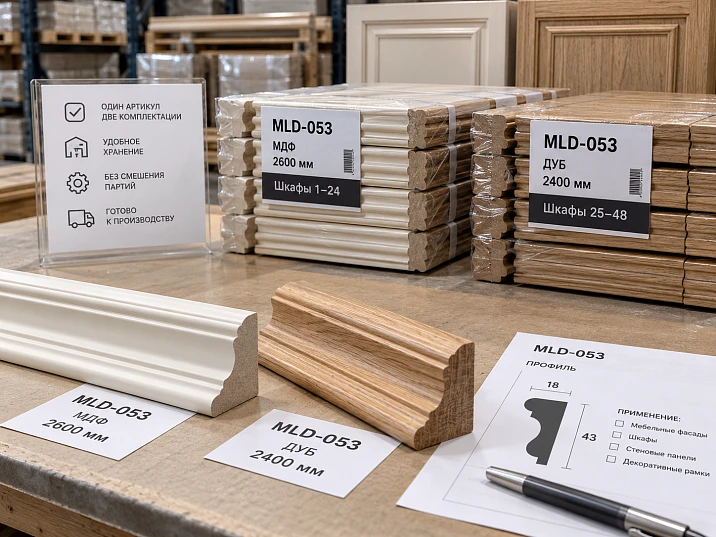
The project has approved one decorative profile — MLD-053 43×18 mm. It is necessary to manufacture 48 cabinets of identical geometry, but with two finish options: 32 cabinets are painted with opaque enamel, so MDF 2600 mm long is selected for them; another 16 cabinets must retain the natural wood texture, so oak 2400 mm long is used for them. At the design project level, this is the same molding. At the purchasing, warehouse, and production level, these are two different product items that cannot be reduced to the line “MLD-053 — 144 pcs.” or “MLD-053 — 300 linear m.”
The reason is simple: the same SKU describes the profile, but does not replace information about the material, commercial length, finish, purpose, and belonging to a specific part of the project. If these attributes disappear from the purchasing line, the warehouse sees dozens of strips with one name, although MDF 2600 mm and oak 2400 mm are cut differently, reserved differently, and cannot mutually compensate for a shortage. The loss of one oak part cannot be covered by a spare MDF strip, even if their cross-section is the same.
The working scheme for such a batch: first divide the 48 cabinets by material execution, then for each group create a separate parts map and cutting map, convert the parts into whole commercial strips of their own length, form separate reserves, mark the delivery by material and purpose, and keep two independent balances of one SKU in the warehouse. Only after this can both groups be combined into one commercial purchase and one delivery.
The training model below is used: 32 cabinets belong to the MDF group, 16 to the oak group. For the calculation example, one cabinet is conventionally assumed to have one rectangular decorative frame made of two verticals of 1900 mm and two horizontals of 480 mm. These dimensions are needed only to demonstrate the cutting logic; in a real project they are replaced by the dimensions from the working statement. The molding itself and its commercial lengths are taken from the specific MLD-053 card.
MLD-053 43×18 mm: what must be fixed before calculating the batch
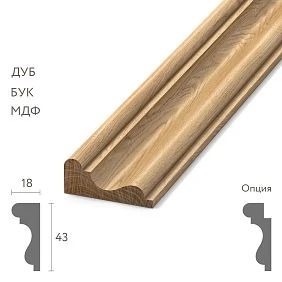
The article examines a specific wooden molding MLD-053 43×18 mm. The current product card shows three variants with the same cross-section: MDF 2600 mm long, beech 2400 mm long, and oak 2400 mm long. For the current scenario, beech is not involved in the calculation: the task is precisely to order MDF and oak at the same time and not turn one SKU into a single unnamed warehouse mass.
| Execution | Section | Product length | Working purchasing line |
|---|---|---|---|
| MDF | 43×18 mm | 2600 мм | MLD-053 / MDF / 43×18×2600 / group A |
| Beech | 43×18 mm | 2400 мм | MLD-053 / beech / 43×18×2400 / purpose ___ |
| Oak | 43×18 mm | 2400 мм | MLD-053 / oak / 43×18×2400 / group B |
The product card also specifies “Prestige” sanding. For MDF, preparation for enamel is displayed separately. This is useful for the buyer because it allows the question of the profile geometry not to be mixed with the question of its subsequent finishing. In the request, the material and preparation must go next to the SKU. The format “MLD-053, 43×18, 80 pcs.” is insufficient: it does not show which exactly 80 strips are needed and what length the products should be.
If the profile has not yet been definitively selected, this article should not be used as a comparison of MLD-053 and other moldings. There is a separate material for choosing a profile. MLD-053 or MLD-057 — which profile to choose. Here the initial condition is different: MLD-053 has already been approved, the debate about width and relief is over, and the supply task is to correctly break down one SKU into different physical versions.




Why the same 43×18 mm cross-section does not make MDF and oak interchangeable
The size 43×18 mm describes the cross-section of the profile. It is important for fitting the frame to the facade and for the visual pattern, but it does not define the entire stock-keeping unit. MDF and oak differ in at least material and commercial length. In the project under consideration, the purpose also differs: MDF is used for cabinets under opaque paint, while oak is used for facades where the wood grain must remain visible.
This means that two elements can be geometrically identical and still belong to different warehouse groups. In the warehouse, the logic of “if the profile is the same, take any available strip” must not be applied. Such a substitution destroys the finishing concept, and in serial production it also distorts the stock balance: the paper records show MLD-053 in stock, but the required oak version is in fact already gone.
The difference in commercial length makes the problem worse. MDF 2600 mm and oak 2400 mm produce different remnants after the same cut. If the cutting map is calculated for 2600 mm, it cannot be automatically applied to 2400 mm. Even when all individual parts are shorter than both commercial lengths, the combinations of parts within a single strip will differ. Therefore, “same profile” and “same cutting map” are not the same thing.
It is useful for the buyer to keep a simple rule: the article number answers the question “what shape?”, the material — “made of what?”, the length — “which stock-keeping unit?”, the finish and purpose — “for which furniture group?”. Only the entire line as a whole is suitable for a request, warehouse label, and reorder.
Our factory also produces:




Why “MLD-053” alone cannot be left in the specification
A short specification seems convenient until the first mistake. Imagine that procurement sent the supplier the line “MLD-053 — 96 pcs.” The invoice has been paid, the required total volume has arrived at the warehouse, and a week later production discovered that the ratio of materials does not match the project. Formally, the number of strips is correct. In practice, part of the furniture is stopped: oak cannot be replaced with MDF, and long MDF does not become oak after painting.
The problem also occurs without a supplier error. If only the SKU is received into stock, the system shows, for example, 30 units of MLD-053. The storekeeper does not see that 24 of them are MDF 2600, and six are oak 2400. When the workshop requests "four more MLD-053," the probability of a picking error no longer depends on the system, but on the attentiveness of the specific person.
It is more correct to maintain two items at once:
| Working item code | Description | Purpose |
|---|---|---|
| MLD053-MDF-2600 | MLD-053 / MDF / 43×18×2600 | group A cabinets, opaque finish |
| MLD053-OAK-2400 | MLD-053 / oak / 43×18×2400 | group B cabinets, visible wood grain |
The working code can be anything as long as it is unambiguous and reads the same in purchasing, in the warehouse, and in the workshop. What matters is not Latin characters or the dash format, but preserving the material specification in every document. If the enterprise uses an ERP or its own warehouse code system, it is better to create separate child items rather than trying to keep the material in a comment to a common SKU.
Get Consultation
First we divide the 48 cabinets by finish, then we calculate the linear footage
In the training model, the 48 cabinets have the same frame geometry but differ in the molding material. 32 cabinets belong to group A and receive MLD-053 made of MDF 2600 mm. 16 cabinets belong to group B and receive MLD-053 made of oak 2400 mm. This division must appear before calculating the footage, not after it.
| Group | Number of cabinets | MLD-053 design | Finishing logic |
|---|---|---|---|
| А | 32 | MDF 43×18×2600 | Opaque coating |
| Б | 16 | oak 43×18×2400 | preserving the visible texture |
If you first add up all the frames and get the total linear meters, you get one nice-looking number, but it will not answer a single procurement question. From the total linear meters, you cannot tell how many 2600 mm strips are needed and how many 2400 mm strips, what share of the reserve belongs to MDF and what share to oak, or which leftovers can be carried over to the next batch.
The same logic applies at sites where the split is not 32/16 but by floors, buildings, facade types, or finishing method. The material must be assigned to a group before linear meters are derived from the design dimensions. Otherwise, the overall calculation will have to be broken back down, and with complex facades some of the information will already be lost.
For large-scale wholesale purchasing of building materials this is especially important: the more repeating products there are, the more expensive a single classification error becomes. An error on one cabinet means redoing one set. An error in the base procurement line means a potential mix-up of the entire batch.
Why can't we first calculate the total linear meters and choose the material later
Suppose the designer passed only "MLD-053 — 228.48 linear m" to procurement. The figure looks precise because it was calculated from specific parts. But it does not say which part of the length refers to MDF and which to oak. If you then try to allocate the material by percentages — for example, two-thirds MDF and one-third oak — you can get the correct total linear meters and the wrong number of whole planks.
The reason is the commercial length. MDF is sold in planks of 2600 mm, oak — 2400 mm. With the same net linear meters, the number of commercial units will differ. And after adding cutting constraints, the discrepancy can become even larger. A linear meter is a unit of design requirement, but not always a unit of order.
The material also affects the type of remainder. After cutting, MDF may leave a piece of 220 mm, while after a similar combination from an oak plank — only 20 mm. Both remainders formally fall within the difference between purchased and used linear meters, but their production value is completely different. Therefore, a reasonable sequence looks like this: furniture group → material → list of parts → commercial length → cutting → whole planks → reserve.
That is why when requesting a price from finishing materials suppliers it is better to send a separate specification right away. The supplier should calculate specific commercial items, not guess how the customer intends to distribute one total linear meter among materials.
How to calculate MLD-053 for one standard cabinet
For demonstration, let's take one cabinet with one rectangular decorative frame. A conditional parts map: two verticals of 1900 mm each and two horizontals of 480 mm each. The net molding length per cabinet is 4760 mm, or 4.76 m. This is not the recommended frame size for MLD-053 and not a product characteristic, but only a calculation model that helps to see the difference between the length of a part and the length of a commercial plank.
| Frame part | Finished length | Quantity per cabinet | Net requirement |
|---|---|---|---|
| Left vertical | 1900 мм | 1 | 1900 мм |
| Right vertical | 1900 мм | 1 | 1900 мм |
| Top horizontal | 480 мм | 1 | 480 мм |
| Bottom horizontal | 480 мм | 1 | 480 мм |
| TOTAL | — | 4 parts | 4760 мм |
For 32 group A cabinets, the net requirement will be 32 × 4.76 = 152.32 m. For 16 group B cabinets — 16 × 4.76 = 76.16 m. In total, the project uses 228.48 m of profile, but these figures cannot be combined further: MDF and oak must be converted into whole strips separately.
At this step, it is useful to separate the clean bill of materials from the cutting map. The clean bill of materials answers only the question of which parts the furniture needs. The cutting map answers a different question: how to place these parts inside real 2600 and 2400 mm strips. On a small project, these documents are often mixed together, but for a series of dozens of cabinets it is better to separate them.
Two product lengths — two cutting maps
For 2600 mm MDF, a convenient combination in the training example is one 1900 mm vertical plus one 480 mm horizontal. 2380 mm is used, leaving 220 mm. It is impossible to get two 1900 mm verticals from one strip, so one frame requires at least two strips: the first yields a vertical and a horizontal, the second yields the second vertical and the second horizontal.
For 2400 mm oak, the combination looks the same on the surface: 1900 + 480 = 2380 mm. But the remainder is no longer 220 mm, but 20 mm. The geometry of the frame has not changed, but the nature of the waste has changed radically. That is exactly why a single “MLD-053 remainder” column cannot be used.
| Material | Plank length | Cut combination | Used | Remainder from the strip |
|---|---|---|---|---|
| MDF | 2600 мм | 1900 + 480 | 2380 мм | 220 мм |
| Oak | 2400 мм | 1900 + 480 | 2380 мм | 20 мм |
In this specific model, both groups require two whole strips per cabinet. For 32 MDF cabinets, this is 64 strips of 2600 mm, i.e. 166.4 m of purchased length before a separate reserve. For 16 oak cabinets — 32 strips of 2400 mm, i.e. 76.8 m. The net requirement was 152.32 and 76.16 m, respectively. The difference arises not from “incorrect math,” but from discrete product lengths and cutting constraints.
If the buyer divided the net MDF length of 152.32 m by 2.6 m, he would get 58.58 and round up to 59 strips. Arithmetically, 59 × 2.6 = 153.4 m — more than the net requirement. But it is impossible to assemble 64 verticals of 1900 mm from 59 strips: each such vertical requires a separate strip. This is a clear example of a situation where "there are enough meters," but there are still not enough parts.
Why long verticals must be placed in the cutting map before short parts
In serial cutting, the long part is the limiting one. A short horizontal of 480 mm can be obtained from many remnants, while a vertical of 1900 mm requires a continuous section of the corresponding length. If short elements are cut from new strips first, part of the long-length material will be fragmented and later will no longer be able to yield a vertical.
Therefore, the map is built from the longest and most critical parts to the shorter ones. For each MLD-053 variant, sections for verticals are reserved first, then horizontals are placed in the remnants, and only then is what remains analyzed. This is not an abstract principle of economy: it directly affects the number of whole strips in the order.
In a real project, verticals may have several sizes. Then they are sorted in descending order of length. The longest are laid out first, then the medium ones, then the short ones. If the orientation of the profile, the direction of the grain, or the binding to a specific facade matters for the parts, these attributes also become constraints of the map. With a visible oak texture, one cannot assume that any geometrically suitable remnant automatically fits any frame.
For the buyer, the conclusion is simple: the number of strips is determined not only by the sum of millimeters, but also by the structure of the parts. Therefore, the request "buy furniture molding" must become a specification after the parts map, not before it.
Control calculation for 32 MDF cabinets and 16 oak cabinets
Let us summarize the training example in one table. It shows why total meterage is useful for budget and control, but does not replace the calculation of whole strips.
| Indicator | MDF 2600 | Oak 2400 |
|---|---|---|
| Cabinets | 32 | 16 |
| Net length per cabinet | 4.76 m | 4.76 m |
| Net group requirement | 152.32 m | 76.16 m |
| Theoretical minimum by length | 59 bars | 32 bars |
| Minimum by the displayed parts map | 64 bars | 32 bars |
| Purchased length up to reserve | 166.40 m | 76.80 m |
| Remainder after the 1900+480 layout | 220 mm from each plank | 20 mm from each plank |
The difference is especially noticeable with MDF. The clean meterage suggests 59 planks, but the part structure requires 64. The five missing planks appear because the 1900 mm verticals cannot be "assembled" from the free meters scattered across short offcuts. For oak, the clean meterage and the cutting map in this model coincidentally matched at 32 planks, but this is not a universal rule: change the horizontal dimensions, the number of frames, or the part layout, and the result will be different.
It is useful to perform this check before sending the request to Wholesale building material suppliers. The commercial calculation should already include a verified requirement in whole product units. Otherwise, the supplier will quote a price for the quantity specified by the customer, but cannot be responsible for whether the project can physically be assembled from it.
The MDF remainder cannot be automatically transferred to the oak group
In the warehouse, there is a temptation to combine all short MLD-053 parts into one box: the profile is the same, after all. For the project under consideration, this is a mistake. A 600 mm MDF remnant may be suitable for a short part of a painted cabinet, but it does not replace an oak part of the same length. Conversely, an oak remnant should not disappear into general linear stock just because it bears the same SKU.
Therefore, a useful remnant is identified by at least five attributes: SKU, material, actual length, project affiliation, and usage status. For oak, it is reasonable to add the receipt or batch number if the material is intended for clear/tinted finishing and visual consistency is critical.
The marking of a short remnant may look like this: MLD053 / MDF / 610 mm / cabinets A / suitable for horizontal. For oak: MLD053 / OAK / 540 mm / group B / batch 02 / reserved. If a remnant is too short for approved parts, it is transferred to waste or to a separate fund for other tasks — but it does not remain "virtually useful" merely for the sake of a nice utilization percentage.
How to organize two banks of useful MLD-053 remnants
For a series of 48 cabinets, it is better to keep not one list of offcuts but two banks: MLD053-MDF and MLD053-OAK. A remnant bank is not a physical box as such, but an accounting principle. Material may be stored on different racks, but each suitable piece must have a record that makes clear what exactly can be obtained from it.
Minimum fields of the register: return date, material, actual length, end quality, purpose, source of the remnant, availability. If the profile has already been primed, tinted, or coated with lacquer, the finish status becomes mandatory. Unfinished oak and already tinted oak cannot be considered one warehouse group just because the geometry is the same.
| Remainder code | Material | Length | Status | Possible application |
|---|---|---|---|---|
| MDF-014 | MDF | 610 мм | without finishing | horizontal up to 610 mm |
| MDF-015 | MDF | 420 мм | without finishing | short insert, if present in the map |
| OAK-006 | Oak | 540 мм | approved batch | short oak part |
| OAK-007 | Oak | 260 мм | not allocated | only after checking the map |
Before a new cutting session, the master checks the remnants bank, not just the number of whole planks on the rack. If a suitable part already exists, there is no need to open a new plank. This saves material without mixing: each bank lives within its own procurement position.
Why one SKU is especially dangerous for the warehouse
The problem with MLD-053 in this scenario is not the complexity of the profile, but the similarity of the designations. On boxes, tags, and invoices, the SKU is usually the most visible item. If a warehouse employee is working in a hurry, they read “MLD-053” and may not notice the material line. The larger the batch and the more participants in the chain, the more dangerous such visual sameness becomes.
Therefore, the material must be the second identifier immediately after the SKU. Not "MLD-053, batch 4," but "MLD-053 / MDF" or "MLD-053 / OAK." The product length comes next. In practice, it is useful to distinguish these groups not only by text but also by location: separate cells, separate racking zones, or at least different shelves. Colored labels are acceptable as an additional cue, but they must not replace text marking.
If the warehouse system can work with barcodes, child items are better barcoded separately. Then, when issuing oak, scanning an MDF strip will produce an error before the material even leaves for the workshop. If there is no digital system, the paper ledger must contain the same attributes. Control does not have to be technologically complex; it has to be unambiguous.
This same rule is useful when working through wholesale suppliers of building materials: the customer should not expect the internal classification of the object to be reconstructed from a single SKU. The separation is better fixed in the specification before shipment, and not after the truck has already arrived.
How to label full strips and transport units
The marking must answer questions without relying on the foreman's memory: what it is, what it is made of, what length, for which group, and where to store it. For the project under consideration, the following format can be used:
MLD053-MDF-2600 / GROUP-A / PLACE-03
And separately:
MLD053-OAK-2400 / GROUP-B / PLACE-02
In Russian-language warehouse practice, this can be written out in full: "MLD-053 / MDF / 2600 / group A / location 03." English abbreviations are not mandatory. The main thing is that the same format is used by the supplier, the receiver, and production.
A separate status is introduced for reserve: "RESERVE — DO NOT ISSUE WITHOUT APPROVAL." If the material is allocated by building or floor, the destination is added after the group. For example: "MLD-053 / oak / 2400 / building B / floor 2 / reserve." Such a line is longer than a regular SKU, but it is cheaper than a mix-up, especially when MDF, beech, oak, and other profiles are stored at the site at the same time.
The marking must be applied to the transport unit and, if the packaging is partially opened, identification must be preserved inside. It must not be allowed that after the outer strapping is removed, ten strips turn back into an unnamed "molding." If individual marking of each strip is excessive, a labeled cassette, section, or container is sufficient, from which the material is not moved without a record.
How to account for MLD-053 packaging standards and not invent the number of items per place
The MLD-053 card specifies a rigid packaging framework, as well as ordering standards: up to 7 pcs. for solid wood, up to 10 pcs. for MDF. These data cannot be automatically turned into the statement “every transport place always contains seven oak or ten MDF planks.” The wording of the card describes the ordering and packaging rules, but the actual shipment of a specific batch must be confirmed by a packing list.
For a large delivery, the buyer requests from the supplier the actual number of places and the composition of each place. If 64 MDF planks and 32 oak planks are packed in several frameworks before reserve, the documents must show how many items went into each framework, not just the overall total. This will make it possible to accept the batch by physical units and not look for a shortage after opening.
A good packing list contains at least:
- transport place number;
- MLD-053 item number;
- the material;
- commercial length;
- number of planks;
- belonging to a group or body;
- mark “main batch” or “reserve”;
- external dimensions of the place and, if necessary, weight for logistics.
Such a document is especially useful when delivery of finishing materials arrives in a single vehicle but contains several materials. A combined delivery should not merge different warehouse items into one.
Acceptance begins not with the total quantity, but with separation by material
96 MLD-053 planks arrived at the site — the total number may match. But proper acceptance first checks the structure of the batch. How many units are MDF? How many are oak? Does the commercial length match? Is there a reserve, if one was ordered? Only after that is the overall total added up.
Working sequence for acceptance:
- verify the number of transport units against the packing list;
- for each unit, check the SKU and material;
- check the length: 2600 mm for MDF and 2400 mm for oak in the current specification;
- recount the number of planks inside the unit;
- inspect the packaging and accessible ends for damage;
- record damaged items separately;
- assign a warehouse cell to the location before removing the marking;
- only after that close the receipt in the accounting system.
If the invoice shows the correct total quantity of MLD-053, but MDF arrived instead of part of the oak, the receipt cannot be considered correct. The overall SKU matched, but the physical item did not. This is a typical reason why, for mixed batches, checking "by SKU and quantity" is insufficient.
The acceptance report must preserve the material in each line. The wording "MLD-053 — 2 pcs damaged" is too weak: it is not clear which reserve was reduced or whether production can continue. The entry "MLD-053 / oak / 2400 — 2 pcs damaged, location 04" immediately shows the risk for a specific group.
A shared vehicle does not mean a shared warehouse position
Logistics often seeks to consolidate shipments: it is cheaper to bring MDF and oak in one vehicle than to make two separate deliveries. This is a normal decision if the consolidation occurs only at the transport level. Inside the vehicle, the locations must remain marked, and after unloading they must go to their own zones.
Materials must not be mixed into one cassette just because it is "still MLD-053." If physical co-location is unavoidable, the packing list must clearly show the boundary between the groups. For example, locations 01–07 — MDF, 08–11 — oak, 12 — MDF reserve, 13 — oak reserve. The numbering may be different, but the logic must be unambiguous.
This makes it possible to simultaneously gain the advantages of a large wholesale purchase of building materials and maintain the accuracy of production assembly. Savings on delivery should not come at the cost of losses from mis-sorting.
How to split a batch by building, floor, or room
In the training example, groups A and B already differ by material. On a real site, a second level may be added: buildings or floors. For example, some MDF cabinets are installed in building A, and some in building B. Then the working position remains MLD053-MDF-2600, but the warehouse destination is split within it.
A convenient hierarchy looks like this: SKU → material → length → site → building → floor/room → status. Not all levels are mandatory for every project. If all the oak goes to one building, there is no point in adding extra detail. But if the same batch is delivered to several zones, the destination point must appear before internal delivery.
Bad scheme: “MLD-053 oak — 32 pcs., distribute across the site.” Good: “MLD-053 / oak / 2400 — 18 pcs. building B, 12 pcs. building C, 2 pcs. centralized reserve.” This does not mean that these exact quantities are needed for the current training model; the example shows the distribution structure.
When working through building materials at wholesale prices the purchase price usually applies to the entire batch, but internal logistics must know where each part of it goes. Financial consolidation and warehouse separation do not contradict each other.
How to assemble one cabinet without disrupting overall accounting
In production, there are two extremes. The first is to issue whole strips to the workshop without linking them to cabinets. This is convenient for the storekeeper, but it is difficult to control leftovers and mix-ups. The second is to pre-sort each strip to a specific cabinet and add an individual reserve to each set. This creates too much packaging and inflates stock.
A two-level model is optimal. The warehouse issues material by group and shift task, while the workshop forms a set of parts for a specific cabinet according to the cutting map. For example, for cabinet A-021, a record is created: “MLD-053 / MDF / frame set / parts 1900×2 + 480×2”. For the oak group, the same geometry, but material OAK.
After cutting, the parts of a specific cabinet are marked as a set, and usable leftovers do not automatically remain in this set. They are returned to the group’s leftover bank. Thus, the cabinet receives exactly its parts, and material that can still be used remains a shared production resource.
If cabinet geometries differ, kitting is built not “per cabinet” but per standard size. For example, F1, F2, F3. This reduces the number of unique records and allows serial cutting without losing material identity.
Why oak strips need to be distributed before final cutting
Natural wood varies in grain and shade. Even material of the same species and from the same delivery cannot be described as absolutely identical. Therefore, for facades where the texture remains visible, it is useful to evaluate oak strips before final serial cutting and distribute them across adjacent facades or sets taking appearance into account.
This is not a promise of a perfect match and not sorting “by eye” without criteria. The goal is to avoid a random situation where sharply different elements in grain end up in one visible set, although the warehouse could have distributed the material more consistently. If the customer has approved a specific finish sample, this sample must accompany the process through to completion.
For oak intended for tinting, it is useful to preserve the link between the part and the original batch until finishing is complete. With a repeat order after some time, the new material may differ. Therefore, the operational reserve of oak has greater value than an unnamed “general MLD-053 stock”.
If it is necessary to first compare different materials and profiles, that is a separate task. In the current article, the material has already been approved. For preliminary selection, one can order a set of wooden molding samples, but after project approval, the procurement list must be based on the specific execution.
MDF reserve and oak reserve are calculated separately
The line “total reserve MLD-053 — 10 planks” looks compact, but it guarantees nothing. If eight spare planks turn out to be MDF, and the problem arises in the oak group, formally the reserve exists, but in production it is useless. Therefore, the stock is always tied to the material execution.
The production reserve compensates for damage, erroneous cuts, and other losses during manufacturing. The operational reserve remains after project completion for future repair or replacement. These two types of stock can be stored in one zone, but accounted for separately. The production reserve is available to the workshop according to the project rules. The operational reserve must not be spent on current operations without a decision by the responsible person.
The size of the reserve cannot be assigned only by a universal percentage. It depends on the repeatability of parts, the complexity of cutting, the quality of the initial dimensions, the stability of the project, and the possibility of quick reordering. For a training model, several scenarios can be checked: reserve in whole planks, reserve for one frame, or reserve for a certain number of critical long parts. But any percentage must be converted into physical planks and verified by the cutting map.
For example, if it is necessary to ensure the ability to fully restore one MDF frame from four parts 1900/1900/480/480, according to the shown map, two whole planks of 2600 mm will be required. A single “percentage” reserve with a length of 4.76 m does not guarantee this if it exists only as the sum of short leftovers.
Why the reserve does not need to be distributed across all 48 cabinets
Trying to make each set autonomous leads to an inflated order. If one spare plank is placed with each cabinet, the result will be 48 additional stock units — a huge reserve that is not tied to real risks. A large series benefits from a centralized stock: one spare plank can cover a problem in any cabinet of its material group.
A centralized reserve works only with strict labeling. The MDF reserve is stored separately from the oak one. Issuance is recorded: date, reason, cabinet or area, quantity, balance after issuance. If a spare plank is opened and part is used, the remaining usable length goes into the leftovers bank, rather than continuing to be counted as a “whole reserve.”
At the end of the project, an inventory is taken. Part of the production reserve may be transferred to the operational reserve if the condition of the material and storage conditions allow it. With natural oak, such a transition is especially useful: a future replacement may be easier from material from the same original purchase than from a new arrival years later.
How to account for damage during acceptance
A damaged plank must be recorded with full identification. The entry “molding — 1 pc. damaged” is useless. The correct entry: “MLD-053 / MDF / 2600 / place 05 / end damage 140 mm” or “MLD-053 / oak / 2400 / place 09 / crack in the middle part.” From such a description it is already clear whether part of the material can be saved.
If the packaging is externally damaged, you should not immediately mix usable material with the rest of the batch. First, the place is photographed and recorded in a report, then the specific planks are checked. If the defect is local, the cutting map will show whether the undamaged section can be used. If the defect passes through the zone required for a long vertical, the plank may be unsuitable for its main task, even if most of its length is visually intact.
For oak, additionally assess whether the visible surface in the area of the future part has been damaged. Cutting 100 mm from the end is sometimes enough, but a deep defect in the middle of the plank divides it into two short sections. Such sections can be counted as remnants only after actual measurement.
A damaged plank does not always equal complete waste
Imagine an MDF plank 2600 mm with damage to the first 120 mm. After a control cut, about 2480 mm of usable length remains. For the training combination 1900 + 480 = 2380 mm, such a remnant can still yield a full set of “vertical + horizontal.” Writing off the entire plank as a loss would be excessive.
But the opposite example is also possible. If on an oak plank 2400 mm a section in the middle is damaged, you cannot simply add the two undamaged parts together and consider that “there are enough usable meters.” A 1900 mm vertical requires a continuous piece. Two remnants of 1100 and 1150 mm have a total of 2250 mm, but a vertical cannot be made from them.
Therefore, the decision to write off is made not only by the storekeeper and not only by the accounting footage. It is made according to the parts map. Damaged material must undergo reclassification: suitable as a whole plank after trimming, suitable as a short remnant, suitable only for another task, waste.
How to maintain the MLD-053 warehouse ledger
A convenient ledger should simultaneously show receipts, movement, balances, and reservations for two variants. It does not have to be complex. Even a table with two main rows is already better than a general MLD-053 counter.
| Position | Receipt of whole planks | Issued | Returned whole | Usable remnants | Production reserve | Operational reserve |
|---|---|---|---|---|---|---|
| MLD-053 / MDF / 2600 | ___ | ___ | ___ | ___ | ___ | ___ |
| MLD-053 / oak / 2400 | ___ | ___ | ___ | ___ | ___ | ___ |
It is useful to add a separate register of short parts with actual millimeters to the remnants table. Otherwise, the column "remnants — 12.4 m" is misleading: it is unknown whether at least one long vertical can be obtained from these 12.4 m. For linear stock, the length structure is more important than a single total figure.
Before each large issue to the shop, a quick reconciliation is performed: how many whole strips remain, which usable remnants are already available, how much reserve has not been touched. This makes it possible to see overspending earlier,
If the cause of the shortage is overspending or defects, it is recorded separately. Otherwise, the new material will dissolve into the batch, and the actual consumption rate will remain unknown. For serial production, it is useful to understand why a theoretically sufficient order required replenishment: dimensions changed, the defect rate increased, the cutting map worked incorrectly, or the reserve was used for unintended purposes.
When it makes sense to buy MLD-053 in one large batch
A large purchase is justified if the project is already stable. The geometry of the cabinets, the quantity, the material of each group, the type of finish, and the production schedule have been approved; there is suitable storage space; it is clear how the MDF and oak will be labeled. In that case, one commercial batch makes it possible to supply the entire project in advance and avoid depending on repeat orders in the middle of the series.
This approach is especially useful for oak intended for visible finishing: keeping the material from a single initial purchase simplifies visual management of the series and the reserve. This does not eliminate the natural variability of wood, but it reduces the number of independent deliveries that later have to be coordinated with one another.
It is also easier for procurement to compare offers: instead of an abstract “how much does a meter cost,” suppliers receive an identical specification made up of whole planks. For construction materials wholesale from the manufacturer this is a fairer basis for comparison, because the physical composition of the order is taken into account.
When a premature full purchase is risky
The word “wholesale” does not mean that the entire possible volume must be bought immediately. If the cabinet dimensions are still changing, some fronts have not been approved, the oak finish has not been agreed upon, or the customer is considering replacing the profile, a large purchase locks in too many uncertainties. In that case, it is better to stabilize the project first and then calculate the batch.
A full purchase is also risky without suitable storage. Long planks require organized placement, protection from mechanical damage, and clear addressing. If the material is moved between temporary zones for months, the benefit of an early purchase may disappear because of losses and mix-ups.
Another signal is the unknown actual geometry of the project. If decorative frames depend on measurements taken after the furniture is installed, the finished lengths cannot be considered final in advance. Then it is more reasonable to separate the confirmed part of the order from the variable part. Professional delivery of finishing materials must correspond to the project's stage of readiness, not just the desire to get a wholesale price.
What to send to the supplier for a batch calculation
The query "buy wooden furniture molding» turns into a useful commercial request only after being made specific. The supplier does not need the entire internal production file, but does need the parameters that affect the product and shipment.
- MLD-053 item number;
- cross-section 43×18 mm;
- material for each item;
- commercial length 2600 or 2400 mm;
- number of whole strips for each item;
- project or site;
- required preparation/finishing, if included in the order;
- need for separate labeling;
- reserve allocation;
- delivery address and terms;
- need for a packing list.
If the buyer contacts several wholesale building material suppliers, everyone receives the same version of the specification. Then identical product units are compared, not commercial offers with different internal interpretations of the linear meter.
For a project with two materials, the request can be made in two lines: MLD-053 / MDF / 43×18×2600 / ___ pcs.; MLD-053 / oak / 43×18×2400 / ___ pcs. If separate marking by cases is needed, it is added in the next column. The earlier this is recorded, the less manual sorting after delivery.
15 mistakes when buying MLD-053 wholesale
- Ordering with a single quantity without material. Reason — the SKU seems sufficient. Consequence — it is impossible to verify the batch structure. Solution — separate lines for MDF and oak.
- Combine 2400 and 2600 mm. Reason — same cross-section. Consequence — incorrect cutting map. Solution — the product length is always present in the item.
- Count only the total linear meters. Cause — estimating habit. Consequence — there are enough meters, but no long parts. Solution — calculate whole planks using the map.
- Choose the material after calculating the cutting layout. Cause — the desire to get one number first. Consequence — the entire batch has to be recalculated. Solution — divide the furniture by materials in advance.
- Use one cutting map for MDF and oak. Cause — identical parts. Consequence — the 2600/2400 mm difference is ignored. Solution — two maps.
- Mix leftovers. Cause — one SKU. Consequence — fictitious available stock. Solution — two leftover banks.
- Mix the reserve. Cause — stock is tracked as a single total. Consequence — the reserve of one material does not cover the other. Solution — separate reserves for MDF and oak.
- Do not indicate the material on the large label. Cause — relying on the storekeeper's attentiveness. Consequence — wrong sorting during issue. Solution — material immediately after the SKU.
- Do not separate cases and zones. Cause — a shared delivery is perceived as a single warehouse stock. Consequence — extra movements and opening of packaging. Solution — address labeling.
- Issue oak as unnamed linear stock. Cause — geometric sameness. Consequence — loss of connection with the batch and the approved finish. Solution — preserve identification until cutting.
- Do not request the packing list. Cause — hope for a total count. Consequence — shortage is detected late. Solution — the contents of each place are known before acceptance.
- Accept the shipment only by the total quantity of MLD-053. Cause — quick closing of the invoice. Consequence — the material may be distributed incorrectly. Solution — first reconcile by execution.
- Reorder only by SKU. Reason — the team is already familiar with the original project. Consequence — the supplier is not obligated to guess the required version. Solution — repeat the full product line.
- Do not record finishing status. Reason — finishing is considered a task of another workshop. Consequence — unprocessed and already prepared parts are mixed in one stock balance. Solution — finishing status in accounting.
- Issue the reserve to the first team as regular material. Reason — the reserve is stored nearby. Consequence — the last cabinets are left without a safety stock. Solution — separate status and issue upon approval.
Purchaser's checklist before payment
| Check | What should be recorded | Status |
|---|---|---|
| SKU | MLD-053 | □ |
| Cross-section | 43×18 mm | □ |
| Material | MDF and oak as separate lines | □ |
| Length | MDF 2600, oak 2400 | □ |
| Furniture groups | number of cabinets of each variant | □ |
| Parts map | finished dimensions and quantity | □ |
| Cutting maps | separately for 2600 and 2400 | □ |
| Whole planks | calculated by cutting plan, not just by meters | □ |
| Useful leftovers | two banks with actual lengths | □ |
| Reserve | MDF and oak separately | □ |
| Labeling | SKU + material + length + purpose | □ |
| Packing list | contents of each package | □ |
| Acceptance | verification by execution, not just by SKU | □ |
| Reorder | full product line format approved | □ |
If at least one of the critical points is unknown, it is better to resolve it before payment. This especially applies to the material, length, and number of whole strips. They cannot be "clarified at the warehouse" without risk, because they determine what must physically arrive.
Where to buy MLD-053 wholesale for serial furniture
When the specification is ready, the specific version can be arranged via the product card buy wooden molding MLD-053 43×18 mm. For a broader selection of profiles, use the category Buy wooden molding. In this article, the choice has already been made: the task is not to compare models, but to correctly order and account for two versions of MLD-053.
If the project purchases not only molding but also other items, general queries such as buy finishing materials wholesale, wholesale sale of construction materials or materials in bulk it is logical to direct to the STAVROS homepage, not to the MLD-053 product card. The product card is responsible for a specific SKU, the category for moldings, and the homepage for a broader procurement task.
Before ordering, check the current availability, price, production time, and delivery terms in the product card. For a large batch, it makes sense to agree on the actual packing list and marking in advance, especially if MDF and oak are shipped in the same delivery.
Frequently Asked Questions
Can MLD-053 be ordered as a single line if the cross-section for MDF and oak is the same?
For a preliminary budget, possibly, but for ordering, receiving, and warehousing it is better to use separate lines. The material and commercial length differ, so one combined item hides important parameters.
Why can't MDF 2600 mm and oak 2400 mm be counted as one cutting map?
Because identical parts leave different remnants and may require a different number of whole strips. The cutting map is built within the actual commercial length.
If the total linear meters are sufficient, why count whole strips?
Linear meters do not account for the continuity of long parts. In the training example, MDF by total length requires 59 strips, but 64 verticals of 1900 mm force the use of at least 64 strips.
Can MDF remnants be used instead of oak if the length matches?
No. These are different material specifications with different purposes. Remnants are tracked separately by material.
Should production and operational reserves be stored separately?
It is advisable to at least account for them separately. The production reserve is used for current errors and damage, while the operational reserve is kept after project completion for future repairs.
How can you tell that a short offcut is still useful?
Compare its actual length with the parts map. An offcut of 600 mm by itself is not “useful” if the project has no part that can be made from it with the required quality.
What should be done if part of an oak plank is damaged?
Record the location of the defect and measure the continuous usable sections. Then check them against the cutting map. Sometimes after trimming, the plank remains usable; sometimes it breaks down into only short offcuts.
Should the standard “up to 7 pcs. of solid wood” be trusted as the quantity in each package?
No. For a specific large shipment, it is better to request the actual packing list and the contents of each transport unit.
How should an additional order for oak MLD-053 be placed?
Provide the full line: MLD-053 / oak / 43×18×2400 / quantity / project / body, and if it matters for the visible finish, note the link to the previous delivery.
What is more important on a warehouse tag: the item code or the material?
Both parameters. The article number must come first, the material immediately after it. In this scenario, the label "MLD-053" alone is insufficient.
Can MDF and oak be combined in one machine?
Yes, if the transport units remain separately identified and after unloading go to their own warehouse zones. Shared delivery does not mean shared warehouse stock.
When should you not buy the entire volume at once?
When the dimensions, material, finish, or the profile itself are not approved, and also when there is no proper storage space. First the project needs to be stabilized, then the wholesale batch can be fixed.
Bottom line: one MLD-053 in a project must be managed as at least two physical positions
For the 48 cabinets from the training scenario, the profile is the same — MLD-053 43×18 mm — but purchasing splits into two manageable groups: MDF 2600 mm for 32 painted cabinets and oak 2400 mm for 16 cabinets with visible wood grain. These groups must not be combined at the level of cutting, reservation, remnants, or reordering.
The correct chain looks like this: cabinets are divided by material → two parts lists are created → two cutting maps are built → the number of whole strips is determined → MDF and oak reserves are calculated separately → transport units are labeled by material and purpose → receiving checks the physical execution → the shop returns usable remnants to its own bank → reordering repeats the full product line.
This way one article number remains convenient for design, but does not turn into a source of mis-sorting in the warehouse. This is exactly what the MLD-053 wholesale order must solve: not just to obtain the required number of meters, but to turn the project requirement into a physically verifiable delivery that can be received, stored, issued to production, and if necessary supplemented without errors.