Article Contents:
- MLD-020: which finishes cannot be combined in a single purchasing line
- Why the SKU stays the same but the purchasing items are different
- What it means that “one MLD-020 is already at least three items”
- Why the mistake may go unnoticed on raw moulding
- What a strong line should look like
- “For enamel” does not mean “already painted”
- "For enamel" does not mean "suitable for any clear finish"
- When the enamel option is economically logical
- For which finishes this logic is especially important
- Why oak for tinting and beech for tinting are different items
- Why "for tinting" still requires a control sample
- The most expensive error scenario
- Why labeling is cheaper than rework
- Why you can't start with the species
- Why you shouldn't start with color alone
- Why code E‑01 or T‑01 is more important than a long verbal description
- How to use the matrix when revising a project
- When oak is truly needed
- When beech under enamel can be logical
- Why one color code should not combine beech and oak
- Example of a long vertical 2480 mm
- Why you can't simply replace MDF with oak after calculation
- When MDF is especially convenient
- Why the total of 200 is still useful
- Classic misallocation with the correct total quantity
- Why an internal code does not replace the official SKU
- Why the balance of one group cannot be automatically transferred to another
- Reverse scenario: tinting → enamel
- What to do in the specification after a decision change
- Why photos are not enough
- What should be on the sample label
- Why the sample must be stored after delivery
- A control sample for enamel is also useful
- Why identical oak length does not help distinguish the finish
- What to do if the label is incomplete
- Why it is better to identify mixed grades before cutting
- Why material and finish must be on the same label
- Color sticker — auxiliary layer only
- Why packs cannot be merged after acceptance
- Why you can't order “all the oak later”
- How to account for the actual remaining stock of the first batch
- When one batch can combine several zones
- Why a quarter profile cannot be stacked together with a regular one
- What the technical specification should look like
- Why the 100 pcs. threshold affects wholesale logic
- How to label a processed group
- Example of oak T-01
- Why the remaining stock "for enamel" cannot be counted in T-01
- Why MDF 2600 requires a separate card even with the same finished parts
- Scenario 1: oak for tinting has not yet been finished
- Scenario 2: the material has already been tinted
- Scenario 3: a batch "for enamel" is being switched to a semi-transparent finish
- Why the old revision should not disappear from history
- What to do with the already purchased remaining stock of the old version
- Why changing the color without changing the finish type also requires a revision
- How to avoid using two versions in parallel
- Why a shared oak reserve is risky
- Why the reserve must also be stored by lengths
- Damaged tinted part
- How to process a reorder
- Why it is better to start a reorder with an inventory count
- Repeat order after a few months
- When the operational reserve should be separated from the installation reserve
- 15 typical mistakes when ordering MLD-020 wholesale
- Checklist before payment
- Practical example of fully allocating 200 planks
- Reverse check from batch to project
- Where the difference between enamel and tinting is analyzed separately
- How general B2B requests are included in the order
- Practical calculation of the quarter-selection service for a wholesale batch
- Why the threshold of 100 pcs. cannot be interpreted as "you must always buy 100 processed"
- Why the quarter's parameters matter more than the word "quarter" itself
- Mixed acceptance of 200 planks: the overall total is correct, the specification is erroneous
- Why you cannot simply swap the labels T-01 and T-02
- What to record in the discrepancy report
- Decision tree: can leftover "for enamel" be used in the tinting zone
- Decision tree: can two MLD-020 groups be combined into one cutting map
- The actual consumption of the first batch should adjust the second
- Why "17 meters remaining" is not enough
- What to hand over to operations after the project is completed
- Why transparent finishing requires stricter archive discipline
- Transferring a batch to the painting or tinting shop must preserve the original finish code
- How to transfer to finishing
- Why return from the shop is a separate acceptance point
- Control samples should not accidentally consume the main volume of the batch
- When leftovers are suitable for samples
- The economic effect of proper separation manifests not in reducing the number of lines, but in reducing rework
- Final MLD-020 ordering algorithm
- Can I order all the oak in one batch and then decide what to tint?
- Can MLD-020 for enamel be tinted later?
- Can MLD-020 for tinting be painted with enamel later?
- Why can't MDF be counted in the same card as oak?
- Do I need to keep an enamel reference sample?
- What should I write in the additional order?
- How do you calculate the reserve?
- Can leftover T-01 be used in T-02?
- When should the order be stopped?
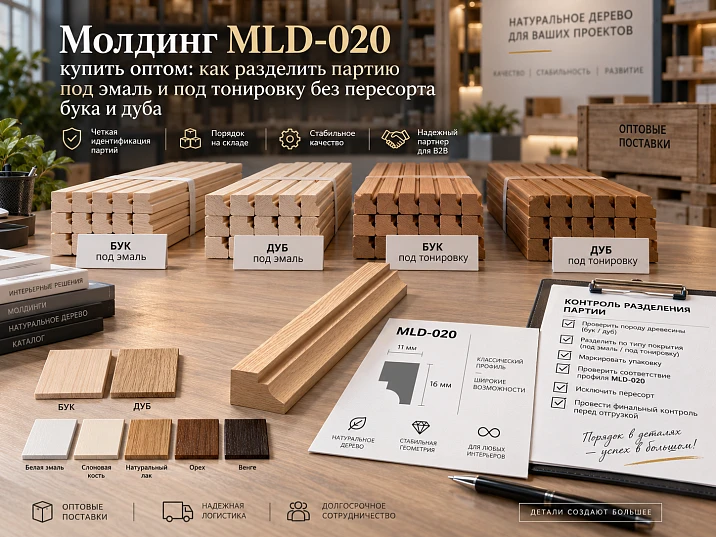
On a large project, a single MLD-020 may be used in several zones at once. In the hallway, the profile is finished with opaque white enamel. In the library, the same oak item must retain a visible wood texture. In the office, a different shade of semi-transparent tint is required. Some furniture is made from MDF for opaque painting. If everything is ordered as one line, "MLD-020 — 300 m," the error will be discovered too late — after cutting, sanding, or applying the finish.
Therefore, buying MLD-020 moulding wholesale should not be done by a single SKU and linear meterage, but by the full product configuration:
SKU → material → commercial length → lamination type → future finish → zone → quantity → cutting → marking → warehouse group → reserve → reorder.
Main principle:
MLD-020 “for enamel” and MLD-020 “for tinting” are not the same purchasing item, even if the SKU, species, 16×11 mm cross-section, and length match.
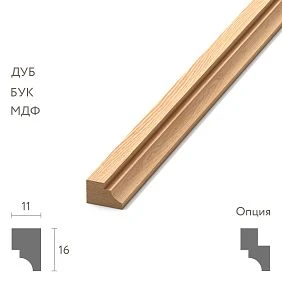
MLD-020: which variants cannot be combined into one purchasing line
The current STAVROS product card confirms a 16 × 11 mm cross-section for MLD-020. Materials and lengths vary:
| Article | Material | Section | Product length | Typical finish branch |
|---|---|---|---|---|
| MLD‑020 | MDF | 16×11 mm | 2600 мм | For enamel |
| MLD‑020 | Beech | 16×11 mm | 2400 мм | For enamel / for tinting |
| MLD‑020 | Oak | 16×11 mm | 2400 мм | For enamel / for tinting |
Sanding quality — “Prestige.” For made-to-order products, the card indicates an average production time of 5–10 days. In commercial logic, MDF is a separate material branch and has a length of 2600 mm; beech and oak are 2400 mm each.
Already at this level, one MLD-020 cannot be stored on a single line. Minimum:
- MLD-020 / MDF / 2600;
- MLD-020 / beech / 2400;
- MLD-020 / oak / 2400.
After adding the lamination type and the future finish, there are more positions.




Why the SKU stays the same, but the purchasing positions differ
The article number describes the profile. Purchasing must additionally describe the material and the future finishing method. For opaque enamel, the appearance of individual lamellas after finishing ceases to be the main visual parameter. For tinting, oil, or another semi-transparent coating, the wood texture remains visible, so the initial blank must correspond to a different logic for selecting lamellas.
Our factory also produces:

What it means that “one MLD-020 is already at least three positions”
This is not marketing fragmentation. The difference in material affects length and cutting, and the difference in lamination affects the suitability of the blank for a future transparent or opaque finish.
Get Consultation
Why the line “MLD-020 oak — 300 m” is insufficient
Such an entry answers only three questions: article number, species, total meterage. It does not answer:
- whether the wood will be visible after finishing;
- whether re-gluing is needed for enamel or for tinting;
- which 300 m belong to which room;
- which batches should have different control samples;
- which finish belongs to which volume;
- whether there is rebate processing;
- whether leftovers can be combined between zones.
Suppose, out of 300 m of oak:
- 160 m — for white opaque enamel;
- 90 m — for tinting T‑01;
- 50 m — for clear finish T‑02.
These are three separate purchasing groups. If they arrive as a single unlabeled batch "MLD-020 oak," the warehouse will no longer be able to guarantee the correct distribution of the source blanks by finish.
Why the error may go unnoticed on raw moulding
In the warehouse, both bundles look like the same oak profile, 2400 mm long. The difference in purpose will become apparent after applying stain, oil, clear lacquer, or another semi-transparent coating, when the combination of lamellas and the natural variations of the wood become part of the final appearance.
What a strong line should look like
MLD-020 / oak / 16×11×2400 / for tinting / T-01 / library / quantity ___.
And separately:
MLD-020 / oak / 16×11×2400 / for enamel / E-01 / hallway / quantity ___.
What the "for enamel" specification means in practice
At STAVROS, the wording "for enamel" refers to the quality of the glued-up wooden blank intended for an opaque paint coating. The lamellas may be glued without special color and texture matching, because the future opaque finish will visually conceal these differences.
This is an important definition, but it is easy to misunderstand.
"For enamel" does not mean "already painted"
Such a moulding should not automatically be considered a finished white product. It is necessary to understand separately:
- whether a primer has been applied;
- what finishing system is provided;
- who performs the painting;
- which color and gloss level are approved;
- what technological process is adopted at the site.
"For enamel" does not mean "suitable for any transparent finish"
If, after purchase, the project changes its decision from opaque enamel to stain or oil, the already purchased batch cannot automatically be considered suitable. For a semi-transparent finish, the initial logic for selecting lamellas is different.
When the enamel option is economically logical
If the finished layer completely covers the color and grain of the wood, there is no point in paying for more careful selection of lamellas only to then cover it with an opaque coating. But this decision must be known before ordering.
What the "for tinting" specification means
In the tinting option, lamellas are selected more carefully by color and texture, because after a semi-transparent finish the natural grain remains visible. This does not mean absolute identity of all wooden parts — natural wood retains variability. But the initial blank is formed for a different visual result.
For which finishes is this logic especially important
- stain;
- tinting oil;
- clear oil;
- clear or semi-transparent lacquer;
- other systems that preserve the visible wood texture.
Why oak for tinting and beech for tinting are different items
The same type of lamination does not make different species interchangeable. Oak and beech have different texture, color base, and reaction to the finish. If a project is approved on oak, beech cannot be substituted just because it is also "for tinting."
Why "for tinting" still requires a control sample
Selecting the lamellas improves control over the result, but does not set a specific shade. The outcome is determined by the finishing system and the physical sample. Therefore, code T-01 must be linked to a real approved sample.
Why the error is discovered too late
A mix-up between "for enamel" and "for tinting" is dangerous because in the warehouse the blanks may appear normal. The problem becomes obvious after:
- staining;
- oil application;
- clear lacquer;
- semi-transparent patinating system;
- installation next to already approved wooden trim.
If by this point the profile has already been cut into dozens of parts, it is impossible to return the batch to its original state.
The most expensive error scenario
MLD-020 oak for enamel is mistakenly sent to the library for a clear finish. The profile has already been cut for frames, the corners have been trimmed, and some parts have been glued. After tinting, it becomes apparent that the lamellas within a single part vary greatly in tone. The correction affects not only the cost of the molding, but also disassembly, re-finishing, and timelines.
Why labeling is cheaper than rework
The line on the label “FOR TINTING / T-01 / LIBRARY” takes seconds during acceptance, but prevents the use of a similar blank in the wrong finish.
First, the project is divided by the type of future finish
The quantity of MLD-020 should be calculated after the zones have been divided according to the principle of future finishing. Otherwise, a single total footage mixes incompatible requirements.
Example:
- zone A — white opaque enamel;
- zone B — dark oak for tinting;
- zone C — natural oak for a clear coat;
- zone D — MDF for painting;
- zone E — beech for opaque enamel.
Only after that can you determine how much MLD-020 belongs to each group.
Why you shouldn't start with the wood species
The phrase “the project has 200 m of oak MLD-020” does not explain the future appearance. Part of the oak may be for enamel, part for a semi-transparent finish. This means that within a single wood species, separate items are still needed.
Why you shouldn't start with color alone
"White" can be MDF under enamel, beech under enamel, and oak under enamel. The final color looks similar, but the procurement configuration and material length differ.
The matrix "zone → material → re-gluing → finish" becomes the core of the specification
| Zone | Material | Re-gluing | Finish | Code |
|---|---|---|---|---|
| Corridor | Beech | For enamel | White enamel | E‑01 |
| Office | Oak | For tinting | Dark oak | T‑01 |
| Library | Oak | For tinting | Natural clear | T‑02 |
| Numbers | MDF | For enamel | Opaque coating | E‑02 |
This matrix must appear before the final order to the supplier. It answers four critical questions:
- what material is needed;
- how the blank should be prepared;
- what finish is planned;
- where the batch will physically go.
Why the code E‑01 or T‑01 matters more than a long verbal description
The code links the project, the physical sample, the packaging, the warehouse, the cutting, and the reorder. Within a project, T‑01 always means one approved system, not a “similar dark oak.”
How to use the matrix when revising a project
If a cabinet is switched from T‑01 to opaque enamel, the specific row changes. The other zones are not recalculated automatically. This reduces the risk of accidentally changing the library or the numbers.
Beech and oak cannot be chosen based only on the future color
If the molding is fully covered with opaque enamel, the natural texture of the original species ceases to be the main visual argument after finishing. But this does not mean that the material can be changed automatically.
The species affects:
- the original wood;
- behavior during processing;
- the technology of the specific project;
- cost;
- compatibility with adjacent wooden elements;
- the possibility of further transparent finishing if the concept changes.
When oak is truly needed
If the texture remains visible, oak becomes part of the design. In this case, the material and finish are approved together. You cannot first buy beech and then decide to “make it look like oak” with tinting alone.
When beech under enamel can be logical
If the project requires solid wood, but the final color is opaque, beech can be a separate acceptable material. However, this decision must be in the specification, not made by the warehouse based on availability.
Why one color code should not combine beech and oak
Even if both are coated with the same O‑01 enamel, the material remains a separate field. Otherwise, when returning leftovers, the warehouse stops understanding which profile was used where.
MDF MLD-020 — a separate procurement branch
MDF differs in several parameters at once:
- the material;
- commercial length 2600 mm;
- typical logic of opaque finishing;
- cutting map;
- storage and issue conditions as a separate product group.
It cannot be considered simply a “cheaper version of the same oak.” For the project, it is a standalone execution.
Example of a long vertical 2480 mm
From MLD‑020 MDF 2600 mm, such a part is potentially obtained as a single piece:
2600 − 2480 = 120 mm before accounting for the cut.
A solid part of 2480 mm cannot be obtained from 2400 mm stock. This means the material affects not only the finish, but also the number of joints and the structural feasibility of a specific part.
Why you cannot simply replace MDF with oak after calculation
If the original parts list contains dozens of parts 2450–2550 mm long, replacing 2600 with 2400 destroys the entire cutting plan. You need to re-determine:
- joint locations;
- the number of source strips;
- waste;
- the feasibility of pre-cutting;
- the architectural acceptability of butt joints.
When MDF is especially convenient
If the profile is fully opaque-painted and the project allows MDF, a length of 2600 mm can be convenient for long frame verticals and wall sections. But this advantage must be evaluated against the actual parts list.
200 MLD-020 strips can be four different purchasing groups
Suppose a project needs 200 MLD-020 strips. A weak entry:
MLD-020 — 200 pcs.
Actual structure:
- 80 MDF for enamel;
- 60 beech for enamel;
- 40 oak for tinting T-01;
- 20 oak for clear finish T-02.
| Internal code | Material | Length | Re-gluing | Finish | Quantity |
|---|---|---|---|---|---|
| M20-MDF-E | MDF | 2600 | For enamel | E‑02 | 80 |
| M20-BEECH-E | Beech | 2400 | For enamel | E‑01 | 60 |
| M20-OAK-T1 | Oak | 2400 | For tinting | T‑01 | 40 |
| M20-OAK-T2 | Oak | 2400 | For tinting | T‑02 | 20 |
Why the total of 200 is still useful
It is needed for budgeting, production planning, and verifying the total quantity. But receiving and the warehouse must verify the four lines separately.
Classic mispick with the correct total quantity
The order should have 40 oak T‑01 and 20 oak T‑02. In reality, 35 and 25 arrived. The total oak portion is 60, as ordered. If you receive only by total quantity, the error will not be detected.
Why the internal code does not replace the official SKU
M20‑OAK‑T1 is a project code. The full line must always retain MLD‑020 so the item can be unambiguously matched to the manufacturer's card and reordered.
One oak MLD-020 can simultaneously exist “for enamel” and “for tinting”
The word “oak” does not answer the question about the type of future finish.
For example:
MLD‑020 / oak / 2400 / for enamel / E‑03.
and nearby:
MLD‑020 / oak / 2400 / for tinting / T‑01.
These are different executions.
Why the remaining stock of one group cannot be automatically transferred to another
Mathematically, a 1200 mm segment fits both zones. But the batch intended for enamel was not prepared with a visible texture in mind. If T-01 implies a semi-transparent finish, using the remaining stock intended for enamel requires a separate check.
Reverse scenario: tinting → enamel
A blank intended for tinting usually has a stricter selection of lamellas, so from a purchasing standpoint it may turn out to be excessively high-quality for opaque painting. But if the material has already undergone any finishing treatment, one cannot automatically assume that it can simply be repainted: the composition of the existing coating and the technology of further finishing must be taken into account.
What to do in the specification after changing the decision
Issue a new revision. Old codes must not continue to be used in parallel with the new ones.
The control sample for tinting must be tied to a specific group
For each transparent or semi-transparent finish, it is useful to have a physical approved sample.
Not:
“dark oak like in the study.”
But:
T-01 / MLD-020 / oak / office / sample No.___ / approval date ___.
Why photos are not enough
The photo depends on lighting, camera, screen, and color correction. It helps recall the context but does not replace a physical comparison of wood and finish.
What should be on the sample label
- SKU MLD‑020;
- the material;
- re-sawing for tinting;
- finish code;
- area;
- date;
- order or batch number, if already available.
Why the sample must be kept after delivery
After a few months, repairs, a new section of wall panel, additional furniture, or a repeat order may be needed. The phrase “the same natural oak” is too vague. A saved T-01 allows a new production batch to be compared with a real reference.
A control sample for enamel is also useful
Although re-sawing for enamel is not focused on matching texture, the final surface still has color, gloss, and finish quality. For an expensive project, it is useful to keep E-01 as a reference for the finished result, especially if painting is done in several stages.
Acceptance should check execution, not only MLD-020 and quantity
Weak acceptance:
“MLD‑020 — 200 pcs., 200 arrived”.
Strong:
- M20‑MDF‑E — 80;
- M20‑BEECH‑E — 60;
- M20‑OAK‑T1 — 40;
- M20‑OAK‑T2 — 20.
The receiver checks:
- SKU;
- the material;
- length 2600 or 2400;
- gluing type;
- future finish code;
- quantity;
- purpose;
- packaging integrity.
Why the same oak length does not help distinguish the finish
Both "under enamel" and "under tinting" can have a length of 2400 mm. Therefore, checking only the ruler and the species does not confirm the required group.
What to do if the label is incomplete
It is better to temporarily place the pack in a quarantine group until the finish is confirmed. It must not be sent to production on the principle of "it's oak, we'll sort it out later."
Why it is better to identify mixed sorting before cutting
An intact plank can still be returned, relabeled, or correctly allocated. After cutting, the blank turns into a set of parts for a specific zone, and correction becomes more expensive.
Warehouse labeling must show the future finish in large, unambiguous form
Bad:
MLD‑020 oak.
Good:
MLD‑020 / OAK / 2400 / UNDER TINTING / T‑01 / CABINET.
And separately:
MLD‑020 / OAK / 2400 / FOR ENAMEL / E‑01 / CORRIDOR.
Why material and finish must be on the same label
If you write only “T‑01”, a new employee may not know that it is oak. If you write only “oak”, the type of future finishing is lost. The full line works without the team’s verbal memory.
Color sticker — only an auxiliary layer
You can use different label colors for enamel and tinting. But text marking remains the main one: a colored mark may come off, and the legend may be forgotten.
Why packs must not be combined after acceptance
Even if the article, length, and species match, the purpose of the future finish is different. Physical mixing destroys the meaning of the control re-gluing and complicates reordering.
Staged delivery must preserve a single master specification
A large project may receive MLD‑020 in three batches:
Batch 1 — MDF for enamel.
Queue 2 — oak for tinting.
Queue 3 — special zones and remaining volume.
But the master specification remains shared.
| Code | Project requirement | Ordered | Received | Issued | Remainder |
|---|---|---|---|---|---|
| M20-MDF-E | 80 | 80 | 80 | ___ | ___ |
| M20-BEECH-E | 60 | ___ | ___ | ___ | ___ |
| M20-OAK-T1 | 40 | ___ | ___ | ___ | ___ |
| M20-OAK-T2 | 20 | ___ | ___ | ___ | ___ |
Why you can't order “all the oak later”
Within the oak part, there are already at least T‑01, T‑02, and possibly E‑03. If the decision is postponed until the material arrives, the warehouse will effectively get the right to distribute the blanks between transparent and opaque zones itself.
How to account for the actual remaining balance of the first queue
The remaining M20‑MDF‑E does not reduce the requirement for M20‑OAK‑T1. Even if the parts are geometrically identical. The material and finish are different.
When one queue can combine several zones
If two zones use the same material, the same re-gluing, and the same finish, they can be ordered as a single batch while preserving the internal distribution by room.
Selecting a quarter creates another procurement coordinate MLD-020
According to the current product page for MLD-020, additional processing is available — quarter selection per technical specification when ordering 100 pcs or more. At the time of checking, the service cost is stated as 185 ₽ per piece. Before ordering, the price and terms need to be rechecked.
After such processing, the original SKU remains MLD-020, but the functional geometry of the product changes. Therefore:
MLD-020 / oak / for tinting / standard profile
и
MLD-020 / oak / for tinting / with quarter groove
— different purchasing items.
Why a profile with a quarter groove cannot be stored together with a regular one
After additional processing, the strip is intended for a specific technical assembly. If the warehouse issues it for a regular frame, the geometry of the part no longer matches the project.
What the technical specification should look like
Not:
"make a quarter groove on 100 moldings".
But:
- MLD‑020;
- the material;
- length;
- quantity;
- gluing type;
- the future finish;
- quarter groove parameters;
- purpose/area;
- technical specification version.
Why the 100 pcs threshold affects wholesale logic
If a special assembly requires 72 processed planks, the project needs to determine whether there are other zones where the same processing applies, or discuss an acceptable order format with the manufacturer. You cannot automatically "top up to 100" with random standard planks: the service relates to a specific processing geometry.
How to label a processed group
For example:
M20‑OAK‑T1‑CH / 2400 / FOR TINTING / WITH REBATE / ZONE B.
The letter "CH" is an internal project code, but the full specification must always retain the actual rebate parameters.
The cutting map is built separately by materials and finishing groups
First division:
- MDF 2600;
- beech 2400;
- oak 2400.
Second division within the array:
- under enamel;
- for tinting T‑01;
- for tinting T‑02;
- a quarter past;
- a quarter to.
Only within a fully matching group can the remnants be freely optimized.
Oak example T-01
Required:
- 40 verticals of 1850 mm;
- 80 horizontals of 620 mm;
- 40 short parts of 420 mm.
Net length:
40×1.85 + 80×0.62 + 40×0.42 = 74 + 49.6 + 16.8 = 140.4 m.
Simple division:
140,4 / 2,4 = 58,5.
The mathematical minimum is 59 planks. But the long 1850 mm ones require separate distribution, and the actual quantity depends on whether the 550 mm remnants can be used for 420 mm parts and how the 620 mm horizontals are grouped.
Why the "for enamel" remnant cannot be counted in T-01
Suppose that after the corridor, 20 pieces of oak for enamel coating, 650 mm each, remain. For the T-01 horizontals, the length fits perfectly. But the future clear finish makes the suitability of such a blank a separate question. Mathematically, the remainder fits; technologically, not necessarily.
Why MDF 2600 requires a separate map even with the same finished parts
Combinations 1850 + 620, 1600 + 800, and others fit differently into 2600 and 2400. A single conversion coefficient cannot be used.
Changing the finish after purchase requires a new revision of the specification
One of the most dangerous situations is when the finish is changed after MLD-020 has already been ordered or even cut.
For example:
Revision 1: M20-OAK-T1 — oak for tinting T-01.
After the revision, the designer decides to make the study with opaque enamel:
Revision 2: M20-OAK-E2 — oak for enamel E-02.
You cannot simply rename the old line. You need to check the actual condition of the material.
Scenario 1: oak for tinting has not yet been finished
If the blanks have only been purchased and are stored raw/prepared, a more careful selection of lamellas by itself does not interfere with the opaque enamel. However, the procurement system must officially change the designation so that the material is not simultaneously listed as reserve T-01 and as part of the new enamel group.
Scenario 2: the material is already tinted
It cannot be automatically assumed that the selected enamel can be applied over it. The compatibility of the existing coating, surface preparation, and repainting technology must be checked. Procurement records the new revision, and the responsible specialist confirms the finishing technology.
Scenario 3: a batch "for enamel" is switched to a semi-transparent finish
This is the most risky substitution. A blank for enamel was not formed with visible consistency of the lamellas in mind. Before mass tinting, it is necessary to:
- select several actual planks from this batch;
- perform a control finish using the new system;
- compare the result with the visual requirements of the project;
- decide whether the batch is acceptable for the new area;
- only after that issue a new revision of the order/cutting plan.
One cannot assume that "oak is oak" and that any blank is equally suitable for a transparent system.
Why the old revision should not disappear from history
If some rooms have already been completed according to T-01, the old version is needed for operation and future repairs. The working table may look like this:
| Code | Revision | Zone | Status | In effect |
|---|---|---|---|---|
| M20-OAK-T1 | R01 | Rooms 201–206 | Installed | History |
| M20-OAK-E2 | R02 | Rooms 207–220 | Active | New order |
What to do with the already purchased remaining stock of the old version
First check whether it is possible to:
- use it in other T-01 zones;
- keep as an operational reserve;
- transfer to a new enamel group after documented verification;
- use in another cabinet with the same finish;
- return/redistribute under the contract.
Write off or repaint the material without inventory — the latter option.
Why a color change without a finish type change also requires a revision
Oak for T-01 tinting and oak for T-02 tinting use the same relamination logic, but the physical reference samples are different. If a project changes only the shade, the warehouse must still separate the old and new finishes. The remaining T-01 stock is not automatically considered a reserve for T-02.
How to avoid using two versions in parallel
The new revision must specify the transition date/queue and the list of rooms. Otherwise, the installer may take the old pack because SKU MLD-020 and the oak material match.
Reserve and reorder are calculated separately for each MLD-020 variant
Bad line:
“MLD‑020 reserve — 30 slats.”
Such an entry does not show what exactly these 30 slats can replace.
It should be separated correctly:
- MDF / for enamel E‑02;
- beech / for enamel E‑01;
- oak / for tinting T‑01;
- oak / for tinting T‑02;
- variant with a rebate;
- standard profile without a rebate.
Why a common oak reserve is dangerous
The warehouse may hold 15 oak MLD‑020. Of these, 10 are for enamel, 5 for T‑01 tinting. Repairing the library requires 8 T‑01 planks. The total balance "oak — 15" looks sufficient, but the actual suitable reserve is only 5.
Why the reserve must also be tracked by lengths
Repairing a 2180 mm vertical requires a long offcut or a full 2400 plank. Ten 600 mm pieces do not replace one such part. It is useful to consider:
| Group | Whole 2400/2600 | 1800+ | 800–1799 | 300–799 |
|---|---|---|---|---|
| M20-OAK-T1 | ___ | ___ | ___ | ___ |
| M20‑OAK‑E1 | ___ | ___ | ___ | ___ |
| M20‑MDF‑E2 | ___ | ___ | ___ | ___ |
Damaged tinted part
If one T‑01 element is damaged, you cannot automatically take any oak plank. You need to check:
- the correct lamination group;
- the material;
- the physical finish reference;
- whether the available plank belongs to a different reserve;
- is the length sufficient.
How to place a reorder
Bad:
MLD‑020 oak — 10 more pcs.
Good:
MLD‑020 / oak / 16×11×2400 / for tinting / T‑01 / office / 10 pcs.
If a rebate is needed:
MLD‑020 / oak / 16×11×2400 / for tinting / T‑01 / with rebate per spec R03 / 10 pcs.
Why it's better to start a reorder with an inventory count
Before reordering, check:
- full planks of the required finish;
- long usable offcuts;
- parts already issued but not installed;
- operational reserve that cannot be used without a decision;
- damaged material;
- remaining stock at the contractor not returned to the central warehouse.
Only after this is a new cutting plan built for the remaining requirement.
Repeat order after several months
For a transparent finish, it is better to compare the new control sample again with the saved T-01. Natural wood and a new batch may look different. You cannot promise a photographic match just because the finish code is the same.
When the operational reserve needs to be separated from the installation reserve
The installation reserve is used up before handover. The operational reserve remains after handover. If they are not separated by statuses, the last T-01 planks can easily go into the current rework, and in a year there will be nothing left to repair the library with.
Mistakes, a checklist for when not to buy MLD-020, and the final algorithm
15 typical mistakes when ordering MLD-020 wholesale
1. Ordering all MLD-020 as one line item. Reason — there is one SKU. Consequence — MDF, beech, oak, and different laminations get mixed together. How to prevent it: split at least by material, length, lamination, and finish.
2. Specifying the material but not the future finish. Reason — it seems that “oak 2400” is already enough. Consequence — a batch intended for enamel ends up in a transparent finish. Prevention — mandatory fields “for enamel” / “for tinting” and the finish code.
3. Treating “for enamel” as already finished coating. Reason — the wording is read as a surface condition rather than a type of lamination. Consequence — the molding arrives at a different stage of readiness than the site expected. Prevention — record the lamination separately and the finishing system separately.
4. Mixing oak for enamel and oak for tinting. Reason — the species, SKU, and length are the same. Consequence — the visual defect only appears after a semi-transparent finish. Prevention — separate storage bins and labeling.
5. Mixing beech and oak. Reason — the same cross-section 16×11 mm and length 2400. Consequence — the project gets a different species and a different texture. Prevention — material in large print on the pack.
6. Mixing MDF 2600 and solid wood 2400. Cause — a single SKU MLD‑020. Consequence — long parts designed for 2600 mm cannot be made as one piece from 2400 solid wood. Prevention — separate cutting maps.
7. Switching from enamel to clear finish after purchase without checking the batch. Cause — the desire to use already purchased oak. Consequence — lamellas acceptable under an opaque finish become visually problematic after tinting. Prevention — a control test coat on the actual batch.
8. Not keeping a physical sample of T‑01. Cause — relying on a photo and color name. Consequence — six months later it is impossible to confidently verify a repeat batch. Prevention — a signed reference standard.
9. Labeling bundles with the article number only. Cause — MLD‑020 is considered a sufficient identifier. Consequence — one zone receives the wrong execution. Prevention — material + lamination + finish + zone.
10. Using remnants intended for enamel in a tinting zone just because the length fits. Cause — the cutting program sees geometry but not visual preparation. Consequence — saving on one part creates color variation. Prevention — a remnant inherits the full product group.
11. Keeping a single shared reserve for the entire SKU. Cause — wanting to see one number. Consequence — the warehouse has “30 MLD‑020” but not the required T‑01. Prevention — reserve each group separately.
12. Mixing standard MLD‑020 and a profile with a quarter rebate. Cause — the original SKU is the same. Consequence — a machined strip ends up in a regular frame or vice versa. Prevention — a separate code with quarter rebate parameters.
13. Placing a reorder without the lamination type. Cause — an employee writes “10 more oak MLD‑020.” Consequence — the supplier receives an ambiguous order. Prevention — copy the full original line.
14. Using an old revision of the specification. Cause — local tables live separately. Consequence — a new queue receives the old finish or old processing. Prevention — one active master version with revision history.
15. Ordering solid wood before the final decision on finish. Cause — wanting to save time. Consequence — after choosing a semi-transparent finish, it turns out the purchased batch was oriented toward enamel. Prevention — first material + texture visibility + coating type, then bulk order.
Checklist before payment
| Check | Status |
|---|---|
| SKU MLD‑020 confirmed | ___ |
| Section 16×11 mm verified | ___ |
| MDF / beech / oak separated | ___ |
| 2600 or 2400 mm specified in each line | ___ |
| Lamination type specified | ___ |
| Opaque / semi-transparent finish confirmed | ___ |
| Finish code assigned | ___ |
| Physical reference of T-groups saved | ___ |
| Application areas listed | ___ |
| Quantity of each group calculated | ___ |
| Cutting map built by materials | ___ |
| Remnants do not mix enamel and tint | ___ |
| Quarter sampling is separated from the standard profile | ___ |
| Quarter parameters are in the technical specification | ___ |
| Processing order threshold verified | ___ |
| Reserve calculated for each group | ___ |
| Installation and operational reserves are separated | ___ |
| Warehouse marking approved | ___ |
| Delivery queues reflected in the master specification | ___ |
| Reorder format approved | ___ |
| Current revision specified | ___ |
Practical example of full distribution of 200 planks
Let's return to the example:
- 80 M20‑MDF‑E;
- 60 M20‑BUK‑E;
- 40 M20‑OAK‑T1;
- 20 M20‑OAK‑T2.
Suppose part of T‑01 is needed in the office, and part on the furniture. Geometrically, they can be combined into a single cutting map if the material, lamination, and finish fully match. But the purpose remains:
| Group | Planks | Purpose | Available | Reserve |
|---|---|---|---|---|
| M20-MDF-E | 80 | Numbers | As per actual | Separately |
| M20-BEECH-E | 60 | Corridor | As per actual | Separately |
| M20-OAK-T1 | 40 | Office + furniture | As per actual | T‑01 |
| M20-OAK-T2 | 20 | Library | As per actual | T‑02 |
If acceptance showed 45 T‑01 and 15 T‑02, the total oak is 60, as ordered. But the structure is incorrect: T‑01 +5, T‑02 −5. The delivery cannot be considered fully correct based on the total sum.
Reverse check from bundle to project
If you need to first select a molding from a wider range, use wooden trim catalog. For the general purchase of several profile types, the article is useful linear products wholesale.
Where the difference between enamel and tinting is analyzed separately
If you need specifically the basic breakdown of the two re-gluing options, it is already covered in detail in the material about wooden molding MLD‑027. The new MLD‑020 page does not repeat this intent, but uses the distinction as the basis for the wholesale specification.
How general B2B requests are included in the order
If the project is purchased as building materials Moscow wholesale, via finishing material suppliers, building material suppliers, Construction material suppliers Moscow or Wholesale building material suppliers, MLD‑020 still remains broken down by material, re-gluing, and finish.
The same rule applies to wholesale building material suppliers, building materials supplier wholesale, wholesale purchase of building materials, wholesale purchase of building materials, building materials at wholesale prices, construction materials wholesale, building materials wholesale from the manufacturer, delivery of finishing materials, finishing materials wholesale moscow и materials in bulk. The general agreement must not erase the distinction between M20‑MDF‑E, M20‑BUK‑E, M20‑OAK‑T1, and M20‑OAK‑T2.
Practical calculation of the quarter-groove service for a wholesale batch
Additional processing starts affecting the budget even before the cost of the molding itself. According to the MLD‑020 card, the quarter-groove service is provided for orders of 100 pcs or more; at the time of checking, 185 ₽ per piece is indicated.
If exactly 100 planks are processed:
100 × 185 = 18 500 ₽.
This is a separate processing cost that cannot be dissolved into the overall MLD‑020 price if part of the batch remains standard.
Suppose the total order is 180 oak planks T-01:
- 120 pcs. are needed with a quarter;
- 60 pcs. — standard profile.
Cost of quarter selection for 120 planks:
120 × 185 = 22,200 ₽ at the service price at the time of check.
Working lines:
M20-DUB-T1-CH — 120 pcs.
M20-DUB-T1 — 60 pcs.
If, after acceptance, the warehouse combines them into one line “MLD-020 oak T-01 — 180,” the processing cost has already been paid, but the functional identity of the 120 special blanks is lost.
Why the threshold of 100 pcs. cannot be interpreted as “you should always buy 100 processed”
The threshold relates to the service conditions, not to the project requirement. If 86 processed parts are needed, the solution must be agreed with the manufacturer: whether the service can be performed in the required volume, whether 100 source units must be ordered, or whether processing can be combined with another zone of the same technical specification. The article must not automatically create 14 extra strips without confirmation of the order conditions.
Why the quarter parameters matter more than the word “quarter” itself
Two quarter samples may differ in geometry. Therefore, the internal code “Q” is useful only as a short label. The technical specification must retain the specific dimensions and processing orientation. Otherwise, a batch “with quarter” is still ambiguous.
Mixed acceptance of 200 strips: the overall total is correct, the specification is erroneous
Let us return to the project of 200 strips.
By order:
- 80 M20‑MDF‑E;
- 60 M20‑BUK‑E;
- 40 M20‑OAK‑T1;
- 20 M20‑OAK‑T2.
The machine delivers exactly 200 strips. If the warehouse checks only the total quantity, the delivery appears perfect.
After line-by-line inspection:
| Group | Should be | In fact | Deviation |
|---|---|---|---|
| M20-MDF-E | 80 | 80 | 0 |
| M20-BEECH-E | 60 | 60 | 0 |
| M20-OAK-T1 | 40 | 32 | −8 |
| M20-OAK-T2 | 20 | 28 | +8 |
The total is still 200. But cabinet group T-01 is short by eight strips, and library T-02 received eight extra.
Why you cannot simply swap the labels T-01 and T-02
Codes are tied to physical reference samples and purpose. If batches are indeed prepared identically for tinting, there may be a temptation to redistribute them between finishes. But first you need to check whether the specific preparation and future finishing allow such use. Especially if a control selection of lamellas for specific zones has already been made.
What to record in the discrepancy report
Not "8 extra oak moldings," but:
M20-OAK-T1: shortage of 8.
M20-OAK-T2: surplus of 8.
This way the supplier and the site discuss real positions, not generic oak.
Decision tree: can the "for enamel" remainder be used in a tinting zone
Step 1. Is the remainder still without finish?
No → first check the existing coating and the compatibility of the new finishing system. A transition is not a simple change of labeling.
Yes → moving on.
Step 2. Was the blank ordered for enamel?
Yes → matching slats by color and texture was not a primary requirement. This means a control test coat is needed for a transparent finish.
Step 3. Does the control test coat visually pass the T‑01 reference?
No → it cannot be used in T‑01. The remainder stays in the enamel group.
Yes → the transition is possible only after a documented group change and elimination of double counting.
Step 4. Is the remainder length suitable for the specific part?
No → even a visually suitable strip does not cover the geometry shortfall.
Yes → the remainder can be assigned to a specific T‑01 part and written off from the enamel reserve.
This sequence does not claim that any material "for enamel" can be converted into a tinting material. It shows which checks are needed before making a decision.
Decision tree: can two MLD-020 groups be combined into one cutting map
Does the material match?
No → the maps remain separate.
Does the commercial length match?
No → the maps remain separate.
Does the splicing type match?
No → leftovers are not considered freely interchangeable.
Does the future finish match?
No → after the finish is assigned, the groups are separate.
Does the additional processing, including the rebate, match?
No → separate items.
Only if all answers are “yes” can the parts be combined into a single production pool. The application zone is still retained for logistics.
The actual consumption of the first batch must adjust the second
Suppose the first batch of MDF for enamel is calculated for 80 strips. After installation:
- 68 strips were used completely;
- 6 remained intact;
- 4 produced long remnants of 1200–1800 mm;
- 2 were damaged and written off.
If the second phase requires another 50 strips according to the net calculation, you cannot automatically order 50. First, future parts are matched against the six intact pieces and four long remnants.
Suppose the six intact pieces are definitely suitable, and the four long remnants cover eight medium parts that would otherwise have required another four strips. Then the new procurement requirement may be reduced by approximately ten original items — but the specific number is determined by the new cutting map.
Why “17 meters remaining” is not enough
These 17 m could be six intact 2600 pieces and several useful offcuts — a strong reserve. Or forty short offcuts of 300–500 mm — a completely different resource. A structure of lengths is needed.
What to hand over to operations after the facility is commissioned
If MLD‑020 is used in several finishes, the operations service should receive:
- a list of groups M20‑MDF‑E, M20‑BEECH‑E, M20‑OAK‑T1, M20‑OAK‑T2;
- physical samples T-01 and T-02;
- samples of the finished enamel E-01/E-02;
- remaining stock of whole planks;
- remaining lengths;
- list of application zones;
- information on the presence of a quarter;
- current version of the specification;
- last order data.
Then a damaged molding in the library is not replaced with the first available oak plank from the warehouse. First, T-02 is identified and the corresponding reserve is checked.
Why transparent finishing requires stricter archival discipline
White opaque enamel during repair is usually easier to identify by color code and gloss. For tinted oak, both the wood base and the actual sample matter. Therefore, the physical reference T-01/T-02 should be stored especially carefully.
Transferring a batch to the painting or tinting shop must preserve the original finish code
Even ideal warehouse labeling can be lost at the next stage if the bundles are unpacked, the moldings laid out on tables, and only the future color is written on them. For MLD‑020, this is not enough.
For example, the following are sent to finishing at the same time:
- M20‑BUK‑E / E‑01;
- M20‑DUB‑E / E‑01;
- M20‑DUB‑T1 / T‑01;
- M20‑DUB‑T2 / T‑02.
If the paint shop leaves only the labels “white” and “dark oak,” the link to the original material and the re-gluing will disappear. After painting with opaque enamel, it will become even harder to distinguish beech from oak by the surface, and some errors will remain hidden until installation.
How to transfer to finishing
The issue sheet must contain:
- internal code;
- SKU MLD‑020;
- the material;
- length;
- gluing type;
- finish code;
- quantity;
- zone;
- the status “with quarter” if present.
After finishing, the same report is returned with the actual quantity of finished parts and remnants.
Why return from the workshop is a separate receiving point
The warehouse issued 40 planks T-01. The workshop returned 38 finished, one plank with a finishing defect, and one remnant after test color samples. If you simply record "received 40", the master specification will not show the actual completeness.
More useful:
- 38 — finished;
- 1 — rework;
- 1 — used for control samples/tests;
- remnant by length — ___.
Then the reorder is based on the actual shortage, not on the originally issued forty planks.
Control color samples should not accidentally consume the main batch volume
On a large project, several designers and contractors may request additional samples. If each time 300–500 mm is cut from a whole oak plank T-01 without accounting, hidden consumption will appear by the end of approvals.
Suppose 12 additional color samples of 400 mm each are made:
12 × 0.4 = 4.8 m.
This is equivalent to two whole oak planks of 2400 mm of clean linear meterage, and given an unfavorable distribution of offcuts, consumption may be even higher.
Therefore, samples are best planned as a separate line item:
M20‑OAK‑T1 / samples — ___ whole planks or pre-allocated short offcuts.
When offcuts are suitable for color samples
If only a color and texture test is needed, a short offcut from the same group can be ideal. It is important that it truly belongs to the same species and type of lamination. Using a sample from a batch intended for enamel to approve T‑01 is pointless: it may give a false impression of the visual range of the lamellas.
The economic effect of proper separation manifests not in reducing the number of line items, but in reducing rework
At first glance, four groups instead of one complicate the order. But each line item removes a specific risk:
- MDF 2600 is not mixed with solid wood 2400;
- beech does not get lost inside oak;
- the enamel batch does not go under a clear finish;
- T-01 is not mixed with T-02;
- a profile with a rebate does not fit into a standard frame.
This is especially important with hundreds of strips: one systemic error is repeated across dozens of rooms. Additional fields in the specification are cheaper than re-manufacturing, finishing, and installing already-cut moulding.
Final ordering algorithm for MLD-020
CONFIRM MLD-020 → CHECK 16×11 MM → SEPARATE MDF 2600 AND SOLID WOOD 2400 → SEPARATE BEECH AND OAK → APPROVE WHERE THE FINISH IS OPAQUE AND WHERE THE TEXTURE REMAINS VISIBLE → CHOOSE LAMINATION FOR ENAMEL OR FOR TINTING → ASSIGN CODES E-01/T-01/T-02 → SAVE PHYSICAL REFERENCES → ASSEMBLE ZONES AND QUANTITIES → CHECK WHETHER A REBATE IS NEEDED → ISSUE THE SPECIFICATION FOR PROCESSING → BUILD SEPARATE CUTTING MAPS → CALCULATE WHOLE STRIPS → CREATE A RESERVE FOR EACH GROUP → LABEL THE BATCHES → ACCEPT DELIVERY LINE BY LINE → STORE GROUPS SEPARATELY → WHEN THE FINISH CHANGES, ISSUE A NEW REVISION → REORDER ONLY BY THE FULL ORIGINAL LINE.
Can the entire oak be ordered in one batch and then decide what to tint?
Risky. Within the oak part there may be different types of lamination and different references. It is better to separate the purpose before mass ordering.
Can MLD-020 for enamel be tinted later?
Automatically — no. First, you need to do a trial finish on real workpieces and evaluate the suitability of the visual result.
Can MLD-020 be painted with enamel after tinting?
If the workpiece is still without a finish, this is usually less risky from the point of view of visual lamella matching, but the change still needs to be formalized in a new revision. If the coating has already been applied, the compatibility of subsequent painting is checked technologically.
Why can't MDF be counted in the same map as oak?
Because a length of 2600 versus 2400 mm changes the cutting combinations and the ability to obtain long parts as one piece.
Is it necessary to keep an enamel reference sample?
For an expensive project — it is useful. It fixes the color and gloss of the finished surface, although it does not solve the task of lamella matching like a tinting reference sample.
What should be written in the reorder?
SKU, material, cross-section and length, gluing type, finish code, zone, quarter if present, and quantity.
How to calculate the reserve?
Separately for each version and taking into account the lengths of future parts. The general MLD‑020 reserve is insufficient.
Can the remainder of T-01 be used in T-02?
Only after confirming that the new finish and the visual reference allow it. By default, different codes are considered different reserves.
When should the order be stopped?
If the material has been selected but the type of future coating has not yet been approved, or the project is wavering between a clear and an opaque system. This is exactly the moment when early purchasing creates maximum risk.
After such preparation, buying MLD-020 moulding wholesale means ordering not depersonalized hundreds of identical strips, but a managed system of versions: MDF 2600, beech 2400, oak for enamel, oak for tinting T-01/T-02, standard profile or profile with a quarter — with separate cutting maps, warehouse groups, references, reserves, and reproducible reorders.