Article Contents:
- What is the semi-circular wooden molding MLD-027
- Why the semi-circular shape works differently than a flat batten
- Where MLD-027 is used: from wall frames to furniture fronts
- Wall frames without heavy stucco
- Boiserie and panel compositions
- Panels, doors, and furniture fronts
- Framing mirrors and decorative inserts
- Ceiling compositions: where the profile is appropriate and where it is not
- When to choose 14 × 8 mm
- When to choose 20 × 11 mm
- How to check the scale before purchasing
- Oak for a pronounced natural texture
- Beech for smooth painting and universal furniture work
- MDF for a smooth opaque finish
- When to choose the option for enamel
- When to choose the tinting option
- For DIY repairs
- For custom furniture
- For ready-made furniture you want to refresh
- For wall panels in a new interior
- Ready-made corner vs. manual miter cut: comparison
- Example calculation for wall composition
- How much extra to add
- Why you can't just count the number of frames
- Semi-circular molding and flat wooden batten
- Semi-circular and quarter-round profile
- Molding and wooden baguette
- Molding and ceiling cornice
- Straight MLD-027 and corner MLD-027U
- Need to decorate the empty wall behind the sofa
- Need to make paneled facades from smooth doors
- Need to frame the mirror
- Need to assemble the boiserie up to the ceiling
- Need to update the door without replacing the panel
- Need to design a commercial interior
- Living Room
- Bedroom
- Entrance Hall and Foyer
- Office and Library
- Kitchen and dining room
- Children's room
- Preparation for enamel
- Preparation for tinting
- Care after installation
- Choosing a profile only by photo
- Do not consider the length of the plank
- Order material without connection to finishing
- Consider 'under enamel' as a finished painted product
- Do not check corner compatibility
- Mix materials without a technological solution
- Ignore furniture and door gaps
- Make too many frames
- Save on margin
- Try to hide a serious unevenness with molding
- What is a semicircular wooden molding?
- How is MLD-027 different from a regular wooden batten?
- Which size to choose — 14 × 8 or 20 × 11 mm?
- What lengths are available for MLD-027?
- What is better for molding — oak, beech, or MDF?
- What does "under enamel" mean?
- What does "under tinting" mean?
- Can MLD-027 be used for furniture?
- Is the semicircular profile suitable for a mirror frame?
- Are ready-made corner pieces necessary?
- Can MLD-027 be used on the ceiling?
- How to calculate the amount of molding for a wall?
- What extra should be added before purchasing?
- Can molding be joined lengthwise?
- Should molding be painted before or after installation?
- How to know if a corner piece fits the straight profile?
- Can oak molding be combined with an MDF panel?
- What to check before finalizing the order?
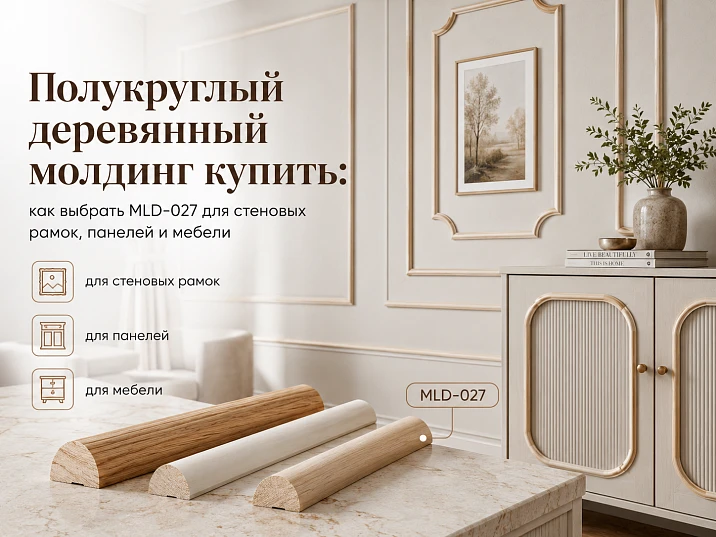
Solution buy semi-circular wooden molding It usually appears not at the beginning of a project, but at the moment when a flat wall, furniture facade or panel already looks too simple. A thin relief line is needed that will gather the surface, mark a frame, emphasize a panel or neatly outline a mirror, but not turn the interior into heavy classical decor. It is for such tasks that MLD-027 is suitable — a compact profile with a soft rounded cross-section that can be used on walls, panels, door leaves and furniture.
The main feature of this molding is not rich carving or complex ornament, but the precise geometry of a semicircle. Due to the convex shape, light glides smoothly over the surface, the line reads more voluminous than a regular flat batten, and the transition between the background and the frame is soft. The profile does not draw attention to itself, so it is convenient to use it both in calm neoclassicism and in modern interiors where relief is required without excessive decor.
However, you cannot choose MLD-027 based only on a photo. The result is influenced by the cross-section size, material, plank length, preparation option for finishing, scale of frames, and method of corner design. A profile of 14 × 8 mm and a profile of 20 × 11 mm solve different tasks. Oak, beech, and MDF behave differently under enamel and translucent tinting. A ready-made corner element can significantly simplify the composition, but is not suitable for every project. Therefore, before ordering, it is useful to understand in advance what kind of line you need to get, how it will combine with the base, and how many linear meters will be required.
In the STAVROS catalog, MLD-027 is presented as an independent linear element for interior and furniture finishing. The buyer can select the cross-section, material, and length for a specific task, and then supplement the straight profile with compatible corner pieces. This approach is more convenient than randomly selecting a construction batten: the product has a specific shape, repeatable geometry, and a clear system of compatible elements.
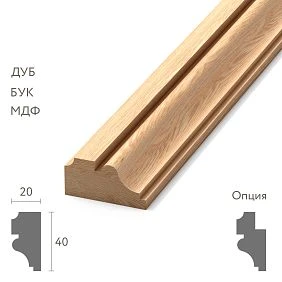
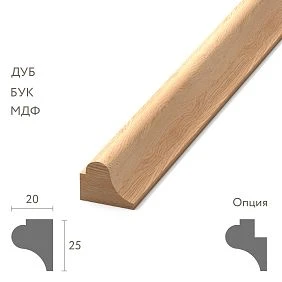
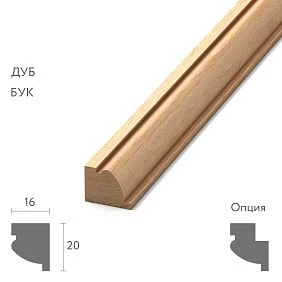
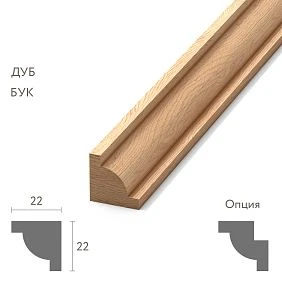
What is a semi-circular wooden molding MLD-027
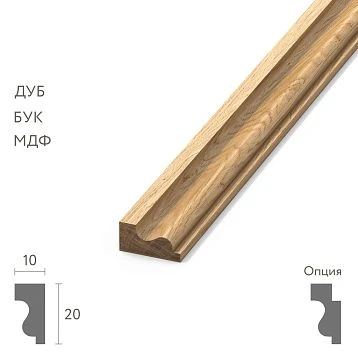
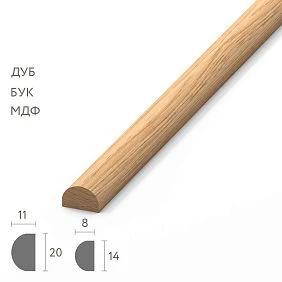
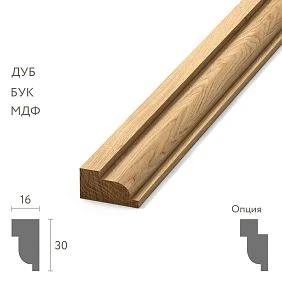
A semi-circular molding is a narrow profile plank with a convex front part and a flat mounting side. After installation, it creates an even three-dimensional line on the surface. Unlike a flat batten, which is perceived as an applied strip, the semi-circular profile works with light and shadow: the middle remains more illuminated, and a soft shadow appears along the edges. Thanks to this, even a thin frame looks finished and noticeable, without requiring complex carving.
MLD-027 is produced in two cross-sections — 14 × 8 and 20 × 11 mm. The first is suitable for small furniture facades, narrow piers, compact mirrors, and multi-layer frames where a delicate contour is needed. The second provides a more confident relief and reads better on large wall panels, tall doors, wide facades, and large rectangular compositions. The difference of a few millimeters seems small only on a sample. On a wall several meters long, the larger profile forms a noticeably stronger line.
The profile can be used independently, assembling rectangular or square frames, or combined with compatible corner elements. Straight segments are responsible for geometry, while corners set the character of the composition. A clean 45-degree miter cut gives a strict modern result. A ready-made corner piece makes the frame more plastic and decorative. Therefore, MLD-027 does not limit the buyer to one style: the same basic plank can look restrained or elegant depending on the finish and configuration.
It is also important to understand the purpose of the product. This is a decorative profile, not a load-bearing batten, not a baseboard, and not a ceiling cornice. It helps to decorate a surface, emphasize its boundaries, visually divide the plane, and assemble details into a single system. The molding should not bear structural load, hold a heavy panel, or replace fasteners. Its strength lies precisely in its neat geometry and the ability to repeat the same contour on several walls or facades.
| Characteristic | Confirmed options | What this gives the buyer |
|---|---|---|
| Model | MLD-027 | You can select compatible elements specifically for this series |
| Profile type | Semicircular decorative molding | Soft volumetric line instead of a flat overlay strip |
| Cross-section | 14 × 8 mm and 20 × 11 mm | Choice between delicate and more pronounced relief |
| Length | 1000 and 2400 mm for beech and oak; 2600 mm for MDF | You can choose a short format for small details or a long one for wall frames |
| Materials | Beech, oak, MDF | Selection for opaque painting, natural texture, and project budget |
| Preparation for finishing | For enamel and for tinting — depending on the selected material and option | No need to overpay for texture matching if the profile will be covered with enamel anyway |
| Compatible decor | Corner elements MLD-027U-1 and MLD-027U-2 | You can assemble a frame with decorative corners instead of a regular 45-degree joint |
| Purpose | Walls, panels, furniture, doors, mirror and decorative frames | One profile can be repeated in several interior zones |
Before ordering, you need to check not only the name MLD-027, but also the full combination of parameters: cross-section, length, material and preparation for future finishing. Not every length is available in all materials. Solid wood is represented by short and standard long planks, while MDF comes in a length of 2600 mm. This affects cutting, the number of joints, and ease of transportation.




Why a semicircular shape works differently than a flat slat
A flat decorative batten creates a step: its front surface lies parallel to the wall, while the side edges form a sharp transition. This element works well for strict geometry, slatted layouts, and modern panels where graphic quality matters. A semi-round molding acts softer. It has no wide flat platform, so the eye perceives not a separate applied strip, but a continuous rounded line.
This difference is especially noticeable when the wall and molding are painted in a single color. The flat batten remains visually rectangular, while MLD-027 reveals itself through light and shadow. In a light interior, it adds depth without contrasting color. In dark enamel, the profile gains a more collected, almost graphic look, but retains soft edges. With a clear finish, the wood grain pattern is added to the relief, curving along the convex surface and making the line lively.
The semi-round shape is also convenient where the frame needs to sit next to fabric panels, veneered inserts, mirrors, or smooth furniture fronts. It does not look like a rigid structural barrier and more easily connects materials with different textures. At the same time, the profile is pronounced enough to define a boundary and hide a slight difference between adjacent planes if the project involves an applied design scheme.
Once the shape and purpose are clear, you can proceed to the product card and buy the semi-round wooden molding MLD-027, choosing the exact cross-section, material, and length. It is better to do this after a sketch: even a simple drawing with dimensions shows how many frames will be on the surface, where joints will appear, and whether ready-made corner trim is needed.
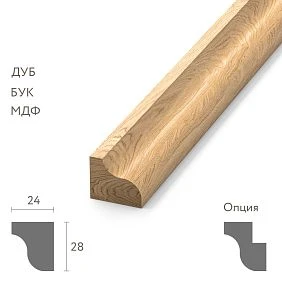
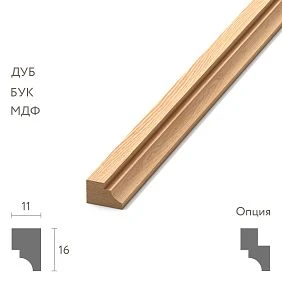
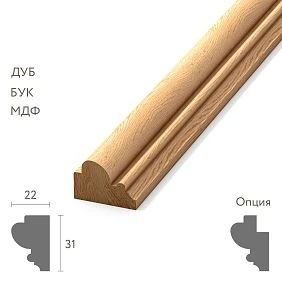
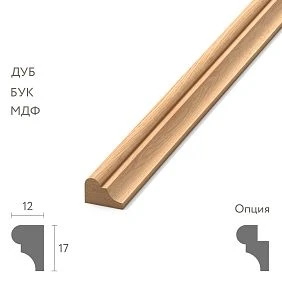
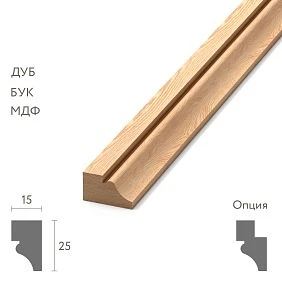
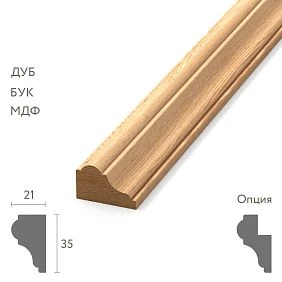
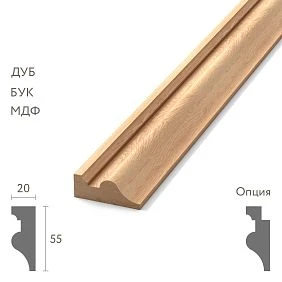
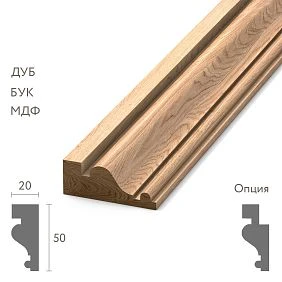
Our factory also produces:
Where MLD-027 is used: from wall frames to furniture fronts
The versatility of MLD-027 does not mean it can be used identically anywhere in the interior. The profile reveals itself best where there is a flat surface and a clear geometric task: to outline a field, separate an insert, repeat the shape of a facade, or connect several surfaces with a single line. The more precisely this task is defined, the easier it is to choose the size and material.
Get Consultation
Wall frames without heavy stucco
The most obvious scenario is rectangular frames on a painted wall. They can be arranged symmetrically, aligned with the axis of furniture, repeated to match the width of doorways, or used to divide a long wall into several equal fields. The semi-round profile suits this solution because it creates sufficient shadow without looking massive. It helps fill an empty plane while maintaining a calm backdrop for furniture, light, and art.
In a small room, frames with wide inner margins and moderate frequency work better. If there are too many narrow rectangles, even a thin molding creates fragmentation. On a long living room wall, you can use large vertical fields oriented to the room's height. In the bedroom, frames are often linked to the width of the headboard and nightstands. In the hallway, the profile helps to decorate free areas between doors, but here it is especially important to check that the relief does not end up in an area of constant contact.
MLD-027 can be painted the color of the wall to create a calm architectural relief. Contrasting finish is appropriate less often and requires precise composition: a dark line on a light background highlights even small layout errors. A monochrome solution forgives fewer geometric inaccuracies than it seems, but looks more cohesive and combines more easily with furniture.
Boiserie and panel compositions
In boiserie, the molding acts as a frame for the inner field. It can run along the perimeter of the panel, define a panel, or create an additional frame within a wider outline. The semi-circular profile is especially useful when the entire structure is painted with a single enamel: its convexity remains readable without carved ornamentation or contrast insert.
For a classic panel, MLD-027 can be combined with wider vertical and horizontal elements. Then it works not as a single border, but as a thin inner line. In a modern interpretation of boiserie, the profile is installed directly on a smooth wall or sheet base, forming minimalist rectangles. The result depends not so much on the amount of decor, but on the proportions of the fields, the distance to the floor, ceiling, and adjacent frames.
When designing panels, it is important to decide whether the molding will run continuously across the entire wall or whether each frame will be a separate element. A continuous horizontal line visually expands the room. Separate vertical fields emphasize height. If the wall has sockets, switches, sconces, or ventilation grilles, their position must be considered before calculating the material, otherwise the profile will have to be unexpectedly broken or the composition rearranged.
Panels, doors, and furniture fronts
On a furniture front, a semi-circular molding helps turn a smooth surface into a framed one. It can frame a central field, a glass insert, a mirror, a fabric panel, or a decorative overlay. On a door leaf, MLD-027 allows you to repeat the pattern of wall frames and connect the door with the overall room finish.
For furniture, scale is especially important. A cross-section of 20 × 11 mm, expressive on a wall, may be too large on a narrow door or drawer. A profile of 14 × 8 mm is better suited for small fronts, multi-tiered frames, and items with limited area. But a thin strip can get lost on a tall cabinet front or wide door. Therefore, before purchasing, it is useful to outline the future contour with painter's tape or apply a sample to the surface.
Operation must also be considered. On a front, the molding protrudes above the surface, so it cannot be placed where it will interfere with opening, come into contact with an adjacent door, or fall under a handle. On drawers, check that the profile does not end up in the grip area. If the furniture is already assembled, measure not only the front field but also the gaps between parts.
Framing of mirrors and decorative inserts
A semicircular profile can form an outer or inner frame around a mirror. In the first case, it marks the boundary of the entire composition. In the second, it works as a thin edge between the mirror surface and a wider base. The rounded shape pairs well with the reflective surface: light on the convex molding supports the mirror's shine but does not compete with it through complex patterns.
However, the molding itself does not replace the structural mirror frame and does not hold the glass. The method of attaching the mirror, edge safety, and load-bearing base are designed separately. MLD-027 is used as a decorative part. This distinction is important: the buyer must understand in advance that the mirror kit includes not only the profile but also the base, fasteners, or adhesive system chosen by a specialist based on the weight and format of the glass.
Similarly, the profile works around textile, veneered, painted, and wallpaper inserts. It covers the edge, makes the transition neater, and helps repeat the material in several places. For example, the same semicircular frame can be used on a wall panel and on cabinet fronts. The interior becomes cohesive not through identical colors of all objects, but through repeated geometry.
Ceiling compositions: where the profile is appropriate and where it is not
The query 'wooden ceiling molding' often combines different products. The narrow MLD-027 can be used on the ceiling plane as a decorative line, for example, to frame a central field, a coffered grid, or an area around a light fixture. But it does not replace a ceiling cornice, which covers the wall-to-ceiling joint and has a different cross-section.
If the task is to specifically finish the joint of two planes, a profile designed for such an abutment is needed. MLD-027 works best on a single plane where its mounting side fully adheres to the base. On the ceiling, the quality of preparation, reliability of fixation, and low weight of the entire composition are especially important. Therefore, the material and installation method are chosen together with a craftsman, not just based on appearance.
Which size to choose: 14 × 8 or 20 × 11 mm
The choice of size determines not only the visibility of the line but also the overall character of the project. The thin profile 14 × 8 mm creates a neat outline and is suitable for small frames. The larger 20 × 11 mm provides a more pronounced shadow and better maintains scale on a large wall. Neither option can be called universally better: the decision depends on the surface area, viewing distance, and number of decorative lines.
| Criterion | MLD-027 14 × 8 mm | MLD-027 20 × 11 mm |
|---|---|---|
| Visual effect | Delicate thin line | More noticeable volume and shadow |
| Surface size | Compact fronts, narrow partitions, small mirrors | Large wall panels, doors, wide fronts |
| Number of frames | Suitable for complex grids and multiple contours | Better for large single fields and sparse rhythm |
| Viewing distance | Reads well up close | Maintains expressiveness from a distance |
| Style | Minimalist neoclassicism, light frame furniture | Expressive panels, large neoclassicism, accent facades |
| Risk of error | May get lost on a large surface | May overwhelm a small facade |
When to choose 14 × 8 mm
The thin option is appropriate when the surface is viewed from close range. This includes dresser doors, cabinet facades, small display case doors, a hallway mirror, a headboard, or a narrow wall section. It works well for double frames: the outer contour can be made larger, while MLD-027 14 × 8 mm is used inside. This layering adds depth without requiring massive decor.
Another scenario is a frequent rhythm. If many small rectangles are planned on the wall, a large molding would take up too much of the surface area. A thin profile leaves more free space and makes the composition lighter. However, the distances between frames must be consistent: a compact profile emphasizes the precision of the layout.
When to choose 20 × 11 mm
A larger option is needed where the line must be clearly readable from a distance. This includes a high living room wall, a large panel behind a sofa, a door leaf, a wide furniture facade, or a large mirror. The increased width and height create a more noticeable relief. With a monochrome finish, it does not blend into the background even in diffused lighting.
The 20 × 11 mm section is convenient for single frames as well. When there are only two or three large fields on the wall, a too thin contour may look random. A more pronounced profile creates a finished border. At the same time, the semicircular shape maintains softness and does not turn the line into a heavy baguette.
How to check the scale before purchasing
The most reliable way is to apply a sample. If there is none, you can cut strips of thick cardboard of the required width and temporarily attach them to the wall. The cardboard will not convey the convexity, but will show the area the frame will occupy. To assess the relief, it is useful to make a small mockup from an available profile of a similar section or order short meter-long solid wood strips for a test fragment.
You need to look at the mockup from the point from which the surface will be perceived daily. A furniture facade is evaluated from a distance of one to two meters, a living room wall from the center of the room or from the sofa, a panel in the hallway along the movement route. A size that seems large in your hands may turn out to be calm on a large plane.
Oak, beech or MDF: the material must match the finish
The material cannot be chosen separately from the future coating. The same semicircular profile can look like a natural wooden line, like a smooth painted relief, or like part of a furniture facade completely covered with enamel. Therefore, the question 'what is better — oak, beech or MDF' without context has no exact answer. The best option is the one that matches the appearance, base, processing method, and budget of a specific project.
Oak for pronounced natural texture
Oak is chosen when the wood grain should remain part of the design. Its porous, expressive structure is well read under translucent tinting, oil, varnish, or other coating that does not hide the fibers. On the convex surface of MLD-027, the texture becomes especially noticeable: the illuminated central part and the shaded edges reveal the pattern differently.
Such a molding is appropriate next to oak facades, veneered panels, wooden doors, and natural parquet, if the shades and finishing method are coordinated. But matching the wood species does not guarantee an automatic color match. Different batches of wood, stains, and varnishes can give different tones. For a responsible project, it is advisable to make a test sample on the same material and check it under the actual room lighting.
Covering oak with a dense opaque enamel is possible, but the economic sense of such a choice should be assessed in advance. If the natural texture is completely hidden, the buyer pays for a material whose advantage will not be visible. Oak under enamel is chosen when other properties of solid wood are important or a uniform material with adjacent wooden parts is required. In most ordinary painted frames, it is more rational to consider beech or MDF.
Beech for smooth painting and universal furniture work
Beech has a dense, relatively calm structure. It is well suited for projects where natural solid wood is required, but the surface is planned to be painted with enamel. After proper preparation, the semi-circular shape looks even, and the wood grain does not conflict with the opaque coating. Therefore, beech is often chosen for furniture, doors, and wall frames that are intended to become a single colored relief.
The beech profile is also convenient for combined projects. For example, the furniture frame can be made of solid wood, the front of panel material, and the decorative frame of beech under a common enamel. Externally, the parts are unified by the coating, but the molding retains the properties of wooden millwork and can be processed with carpentry tools.
Under a translucent finish, beech looks calmer than oak. This is not a flaw, but a different character. When a project requires a uniform light wood surface without pronounced pores, beech may be more appropriate. But the specific shade should still be checked on a sample: natural material is never completely uniform.
MDF for even opaque finish
MDF is a rational choice for frames that will be painted with opaque enamel together with the wall, panel, or furniture front. The material has no decorative wood texture to preserve, so it allows focusing on the profile geometry and the quality of the final coating. The length of 2600 mm is convenient for large wall frames: fewer joints, easier to maintain a continuous vertical or horizontal line.
MDF is especially logical in panel systems where the base is also made of MDF and all parts are painted as a single unit. The materials respond similarly to finishing, and the craftsman can prepare a common surface without needing to visually match the wood grain. However, the ends, cut areas, and joints require proper preparation, otherwise they may show after painting.
MDF is not chosen for transparent tinting: it has no natural solid wood grain. If the goal is to show oak or beech texture, a corresponding wooden profile is needed. Attempting to imitate natural wood with random coloring rarely yields a convincing result, especially on a convex part that is clearly visible under side light.
| Material | Best scenario | Preferred finish | What to Check |
|---|---|---|---|
| Oak | Frames and furniture where the natural wood grain is important | Semi-transparent tinting, varnish, texture-preserving coatings | Matching shade with adjacent wooden parts |
| Beech | Furniture fronts, doors, painted solid wood frames | Enamel or calm semi-transparent finish | Surface preparation and selected veneer grade |
| MDF | Solid-color wall panels and furniture for opaque painting | Enamel after proper preparation | Edge treatment, joints, and compatibility with the base |
If the buyer wants to compare MLD-027 with other profiles, it is useful to open the category and decide which one Buy wooden molding for a specific surface. You need to compare not only the profile pattern, but also its width, height, available lengths, and ability to combine with the already selected decor.
Under enamel or under tint: what product preparation means
The terms "under enamel" and "under tint" refer not to the finished color, but to the selection of lamellas in the wooden blank. In the under enamel option, wood parts may differ noticeably in tone and pattern because the opaque coating will still cover these differences. In the under tint option, lamellas are selected more carefully by color and texture, since after a semi-transparent finish, the natural pattern will remain visible.
A buyer sometimes perceives "under enamel" as an already primed or painted white profile. This is a mistake. Before ordering, you need to check the actual condition of the selected item and the scope of subsequent preparation. The blank may need to be dusted, primed, sanded between layers, and only then coated with a final enamel. The specific technology depends on the material, coating composition, and surface requirements.
The under tint option also does not mean a ready-made tint. It prepares the base for a semi-transparent coating, but the color, intensity, and finish are chosen by the buyer or craftsman. On oak and beech, the same stain can look different. Therefore, a sample should be made on the species from which the molding is ordered.
When to choose the under enamel option
It is suitable for monochrome wall frames, painted panels, doors, and furniture fronts. The main goal is to achieve an even color and preserve the relief. If the molding, base, and adjacent parts are painted with the same composition, the composition looks cohesive. On a convex surface, chiaroscuro appears, not wood tone variation.
Enamel allows linking elements from different materials. For example, an MDF panel and a beech molding can become visually unified after preparation and painting. But the craftsman must account for differences in substrates, otherwise joints or pores may show. It is better to coordinate the choice of material under enamel with a finishing technologist, especially if furniture-grade surface quality is required.
When to choose the under tint option
It is needed when natural texture is part of the design. An oak profile can be matched with a door, veneer, furniture countertop, or parquet. A beech profile can be used in a calmer wooden composition. A semi-transparent coating emphasizes the shape and preserves the natural variations of the material.
A tinted molding works especially well on a contrasting background. For example, a wooden frame on a painted wall panel creates a clear boundary between materials. But in such a scheme, any joining error is more noticeable: corners, ends, and transitions must be processed carefully because opaque putty can stand out against a transparent coating.
How plank length affects cutting and number of joints
The MLD-027 card features meter-long and 2400 mm planks made of beech and oak, as well as MDF with a length of 2600 mm. The choice of length is not only about delivery convenience. It affects the number of joints, waste volume, and the ability to make a frame side from a single piece.
A meter-long plank is convenient for small furniture fronts, test fragments, compact mirrors, and projects where long material is difficult to transport. If each frame side is shorter than a meter, cutting can be planned with almost no waste. But for a tall wall panel, meter-long pieces will require additional joints, which are hard to make invisible on a continuous convex line.
A length of 2400 mm is suitable for most vertical and horizontal elements in an interior. From one plank, you can get several parts for furniture or one long side of a wall frame. However, the standard room height and the actual element length do not always match. If the vertical must be higher than 2400 mm, a joint is designed, the frame proportion is changed, or MDF with a length of 2600 mm is considered.
MDF 2600 mm is convenient for tall panels for painting. The extra 200 mm sometimes allows making the vertical side without a joint. But the material is chosen not only for length. If the project requires visible wood texture, switching to MDF to reduce the number of joints will ruin the concept. Then it is better to reconsider the geometry or agree on a method for joining the solid wood.
Choosing MLD-027 for different customer tasks
For DIY repairs
A person without carpentry experience should start with a simple rectangular frame, a solid finish, and a limited number of corners. The 14 × 8 mm profile is easier to fit into a small room, but it requires careful cutting. The 20 × 11 mm profile is more comfortable to hold during processing, but its scale needs to be checked in advance.
A DIY project should first be assembled on the floor or on a base sheet. This way, you can see if the corners align, if opposite sides are equal, and if the frame matches the markings. For the first project, it is reasonable to order material with a reserve not only for normal trimming but also for one or two test corners.
For custom furniture
In a furniture project, the profile is chosen together with the facade thickness, frame width, handle position, and gaps between doors. The semi-circular molding should look like part of the facade, not a randomly glued-on detail. The designer or engineer sets the offsets, the craftsman checks the fixing and finishing technology, and the customer approves the material and color.
For painted facades, beech or MDF are often suitable. For natural wood facades, oak or beech under a clear coating are used. If corner elements are used on the furniture, their size and pattern must be included in the drawing before the facade is made, otherwise the frame may not fit into the designated field.
For ready-made furniture that you want to update
MLD-027 can transform the smooth facades of a dresser, cabinet, or wardrobe, but first you need to check the condition of the base. Film, lamination, old varnish, and other coatings affect adhesion differently. Sometimes proper preparation takes longer than installing the decor. If the facade has a pronounced texture or routing, the flat mounting side of the molding may not fit tightly.
It is important to check the operation of the doors after adding the relief. The molding should not touch the adjacent facade, body, countertop, or handle. It is better to mark the frame with the door both closed and open, especially on corner modules.
For wall panels in a new interior
Here the buyer has more freedom. The position of the frames can be linked to the room's architecture, furniture, and lighting even before installation. At the project stage, the height of the bottom line, the width of the piers, the offsets from the architraves and baseboards, and the placement of sconces are determined. After that, the profile, material, and length are chosen.
If the entire panel will be painted, MDF 2600 mm helps reduce the number of joints. If natural wood is desired, solid wood is used, and it is decided in advance how to connect long sections. In a commercial interior, the intensity of contact and the possibility of local coating repair are additionally considered.
When corner elements MLD-027U are needed
A rectangular frame can be assembled in two ways. The first is to cut two straight moldings at 45 degrees and join them at the corner. The second is to use a separate decorative corner to which the straight sections are attached. Both options are workable but give different visual results and impose different requirements for installation.
A 45-degree miter creates a strict continuous frame. It is suitable for modern interiors, calm neoclassicism, furniture facades, and compositions where the decorative line should remain neutral. The main difficulty is precision. Even a slight deviation in angle, an uneven wall, or different side lengths leads to a gap. Under opaque enamel, a minor defect can be prepared and covered, but with transparent tinting, the repair area is more noticeable.
Ready-made corner elements MLD-027U-1 and MLD-027U-2 change the character of the frame. The corner becomes an independent decorative detail, and the transition between vertical and horizontal becomes more expressive. This solution is suitable for wall panels, doors, mirrors, and furniture where not just a contour is needed, but a composition with plastic corners.
Using a ready-made corner does not eliminate the need for precise marking and fitting of straight sections. It is necessary to select the size of the corner piece, determine the connection points, check the profile match, and maintain equal distances at all corners. However, the craftsman does not have to form a decorative turn from only two miter cuts. This is especially useful for a series of identical frames: ready-made elements help repeat the shape.
The MLD-027U-1 card presents options in beech and oak, several sizes, and preparation for enamel or tinting. Before assembly, you need to compare not only the series name but also the actual geometry of the selected corner with the straight profile. For a project with decorative turns, you can buy a corner element for molding MLD-027, after first checking the size, material, and number of parts.
Ready-made corner or manual miter: comparison
| Criterion | Miter at 45° | Ready-made corner element |
|---|---|---|
| Appearance | Strict continuous contour | More decorative and flexible corner |
| Style | Modern, minimalist, calm neoclassicism | Neoclassicism, classic, accent panels and furniture |
| Tool requirements | Need precise corner cutting | Need to fit straight sections to a finished part |
| Repeatability of a series of frames | Depends on the accuracy of each cut | The shape of the corners is repeated using finished parts |
| Consumption | Need allowance for miter cuts and possible errors | Straight profile and number of corners are calculated separately |
| Finishing | The joint needs to be carefully prepared | Need to coordinate the material and corner covering with the molding |
How to calculate the amount of molding before purchasing
Calculation by total length does not yet show the actual cutting. For example, you need a side 1.55 m long. You cannot get it without a joint from a 1 m plank. From a 2.4 m plank you get one long piece and a 0.85 m remainder, which can be used on the short side of another frame. Therefore, before ordering, it is useful to create a cutting map: list all parts by length and distribute them across planks.
Example calculation for a wall composition
Imagine a wall with three identical frames measuring 800 × 1500 mm. Perimeter of one frame: 0.8 × 2 + 1.5 × 2 = 4.6 m. For three frames you need 13.8 m. If the composition is assembled with 45-degree miter cuts, add a reserve to the calculation. At 10% you get 15.18 m.
If you choose a 2400 mm long piece, simply dividing 15.18 by 2.4 gives 6.325, meaning at least seven planks. But the final quantity depends on the cutting. Vertical pieces 1.5 m long will leave 0.9 m remnants, which are suitable for horizontals 0.8 m. With good planning, seven planks may be enough. In case of errors or the need for rejection, it is reasonable to allow for an extra plank.
If four ready-made corners are used for each frame, you will need 12 corner pieces. But then the straight profile is calculated not by the outer perimeter of the decorative composition, but by the distances between the points of attachment to the corners. The size of the corner pieces reduces the length of the straight segments. Therefore, first choose a specific corner, then draw a diagram, and only then calculate the straight molding.
What stock to add
For a simple frame with an experienced craftsman, 7–10% is often enough. For a complex layout, a large number of short parts, self-installation, or transparent finishing, it is better to allocate 10–15%. The reserve is needed not for uncontrolled purchase of material, but for specific risks: test cut, edge damage, pattern mismatch, angle correction, local replacement.
With transparent tinting, additional material is useful for selecting parts by pattern. On a long visible line, adjacent segments with sharply different textures may look random. With enamel, this issue is less critical, but the risk of cut or installation defects remains.
Why you can't count only the number of frames
Two compositions with the same number of rectangles may require different amounts of material. Narrow tall frames have a larger perimeter than compact square fields of the same area. A double contour almost doubles the length of the profile. Decorative corners reduce straight sections but add individual items. Therefore, the correct calculation is always based on the drawing.
What to buy with MLD-027
The profile is only one part of the finished frame. Depending on the project, corner elements, central decor, base, finishing materials, and mounting compounds may be needed. However, you don't need to buy everything at once. The set is formed based on the task: a strict frame requires fewer decorative parts, while a complex panel requires more.
If you want to compare different corners, overlays, and connecting elements, you can select decor and corner elements for moldings. It is important to check whether the selection on the back side of a specific decor matches the cross-section of the straight profile and whether the size of the part fits the scale of the frame.
| What to add to the purchase | Why this is needed | For which scenario | What to Check |
|---|---|---|---|
| Corner elements MLD-027U | Form decorative turns and repeatable corners | Wall panels, doors, furniture, mirror frames | Size, material, finish, and compatibility with straight profile |
| Decorative overlays | Add a central or side accent | Classic and neoclassical compositions | Scale, symmetry, and style compliance of the frame |
| Mounting compound | Fixes the profile on the prepared base | Walls, panels, doors, and furniture | Compatibility with molding material, base, and finish |
| Primer and finish coat | Protect the material and form the final color | Enamel, semi-transparent tint, varnish | Technology for the selected material and a test sample |
| Material for a test piece | Allows checking size, angle, and color before main installation | Self-work and complex finishing | So the sample matches the main order in material and cross-section |
It is especially important not to forget about consumables when calculating the budget. The cost of the molding itself is not the entire project. Delivery of long planks, packaging, base preparation, cutting, finishing, and the craftsman's work are accounted for separately. If there are many frames, the labor intensity of precise marking and repeating corners can be significant.
How not to confuse a semi-circular molding with similar products
In the molding catalog, slats, glazing beads, baguettes, quarter-round profiles, platbands, and cornices may be located nearby. In photos, narrow products sometimes seem interchangeable, but their cross-section and purpose differ. The error becomes apparent only during installation: the part does not fit the base, looks too flat, does not match the corner element, or does not solve the required task.
Semi-circular molding and flat wooden slat
A flat slat has a wide, even front surface and rectangular side edges. It creates a strict strip, suitable for slatted panels, layouts, and graphic compositions. MLD-027 has a convex front part. Its task is to form a soft, relief contour. If the project is based on straight flat lamellas, a semi-circular profile will change the surface character. If chiaroscuro and a smooth frame are needed, a regular slat will look too technical.
Semi-circular and quarter-round profile
A quarter-round is usually designed to adjoin another plane: one side can be perceived as vertical, the other as horizontal. A semi-circular molding symmetrically protrudes above the flat base. In a frame, this gives a uniform convex line. Before purchasing, you need to look at the cross-section drawing, not just rely on the name "rounded."
Molding and wooden baguette
A baguette is usually wider and more expressive, often having a complex profile or carved pattern. It is suitable for a standalone frame, a large mirror, a painting, or an accent panel. MLD-027 is significantly more compact and works as a thin layout. Attempting to replace a baguette with a narrow molding may result in too weak a framing. The reverse replacement will overload a small frame and eat up the inner field.
Molding and ceiling cornice
A ceiling cornice decorates the transition between the wall and ceiling, so its mounting planes and proportions are designed for the corner of the room. MLD-027 is installed on a single plane. It can be used in ceiling layouts, but should not be automatically chosen as a replacement for a cornice. For each junction, a profile of the appropriate cross-section is needed.
Straight MLD-027 and corner MLD-027U
Straight molding is sold in linear segments and forms the sides of the frame. The corner piece is a separate decorative element. It does not replace the entire contour and is not calculated by linear meters. The kit includes the required number of straight strips and corners. When ordering, both items should be checked, otherwise the frame will remain unfinished.
Practical selection for specific situations
Need to decorate an empty wall behind the sofa
First, determine not the size of the molding, but the composition. Frames can be tied to the width of the sofa, the location of sconces, and the height of the backrest. If the wall is large and the furniture is viewed from a distance, 20 × 11 mm is often suitable. For a light grid of several fields, you can choose 14 × 8 mm. A monochromatic paint in the color of the wall will maintain calmness, and ready-made corners will add decorativeness.
A mistake is to make the frame exactly along the contour of the sofa without considering free space. After replacing furniture, the composition will lose its meaning. It is better to tie the geometry to the architecture of the wall: axes, piers, doors, and the overall height of the room.
Need to make paneled facades from smooth doors
On facades, check the indentation from the edge, the location of handles, and gaps. For small doors, it is safer to start with 14 × 8 mm. If the facades are tall and wide, 20 × 11 mm may look more proportional. For a general opaque paint, choose beech or MDF depending on the construction and workshop technology.
Frames on all doors must match in indentation, even if the width of the facades differs. Sometimes it is more correct to maintain the same outer indentation rather than the same size of the inner field. The decision is made based on the facade layout.
Need to frame a mirror
For a small mirror in the hallway, a thin profile is suitable. For a large mirror panel, a more pronounced one. First, design safe mirror mounting and the base, then the decorative frame. If the molding is painted in the color of the wall, the mirror looks built-in. A wooden tinted line separates the reflective surface from the background more strongly.
Corner elements are appropriate if the mirror becomes a decorative center. For a strict modern interior, a clean 45-degree cut is better. In both cases, you need to check that the molding does not overlap the useful part of the mirror and that there is no risk of contact with the raw edge of the glass.
You need to assemble the boiserie up to the ceiling
High verticals require long slats and precise marking. MDF 2600 mm can reduce the number of joints under enamel. For natural wood, a 2400 mm solid array is used, and it is decided in advance how to finish the vertical. Sometimes it is reasonable not to bring the frame to the ceiling, leaving the top field and preserving a solid segment.
A cross-section of 20 × 11 mm better maintains the scale of a high panel. A thin 14 × 8 mm can be used as an internal additional contour. Combining two levels creates depth but increases footage and labor intensity.
You need to update the door without replacing the leaf
The door must have a smooth, stable surface. The frame is linked to the position of the handle, lock, and panels on adjacent doors. On a standard leaf, one or two rectangular contours are often appropriate. Too many small fields make the door visually heavy.
When opening, the profile should not touch the casing or wall. If the door goes close to the wall, measure the actual gap. It is better to perform finishing after trial assembly and checking the movement of the leaf.
Need to design a commercial interior
In a restaurant, salon, showroom, or hotel, molding helps repeat the brand geometry on walls, counters, and furniture. But here the load is higher: surfaces are touched more often, cleaning is more intensive, and local repair is more likely. It is better to place frames away from impact zones of carts, chairs, and luggage.
For a commercial project, repeatability is especially important. The dimensions of all frames are fixed in layouts, the material is ordered as one system, and the finish is tested in advance. A reserve is left not only for installation but also for future repairs.
How MLD-027 behaves in different rooms
Living room
In the living room, the profile is more often used on an accent wall, around the TV area, behind the sofa, or in the spaces between windows. Here you can work with a large scale. The frames are linked to the furniture but do not literally repeat its contour. Light from sconces and windows emphasizes the rounded cross-section, so before final marking, it is useful to see how shadows fall at different times of the day.
Bedroom
In the bedroom, molding helps to design the headboard and create calm symmetry. A thin option is suitable for a soft, unobtrusive relief. A larger one is for a wide panel behind the bed. The frames should not conflict with outlets, switches, and pendant lights. If the bed may change in width, it is better to anchor the composition to the wall rather than to the current furniture.
Entryway and Hall
Here, decorative lines are perceived in motion and are often close to a person. A semi-circular profile reads well even with side lighting. However, the lower frames are subject to impacts and dirt. The material, coating, and placement height are chosen considering usage. On narrow wall sections, a 14 × 8 mm profile usually looks lighter.
Study and library
Tinted oak MLD-027 can connect wall panels with shelving and a desk. If the furniture already has pronounced profiling, the frames on the wall are made simpler. In a painted study, molding helps create an architectural background without excessive ornament.
Kitchen and dining room
On kitchen fronts, the profile is used only after checking the furniture technology, distances, and the coating's resistance to regular cleaning. On the walls of the dining room, frames can be linked to a sideboard, mirror, or dining group. Decorative molding should not be installed in areas of direct exposure to water, steam, or strong heat without a solution from a materials and finishing specialist.
Children's room
In a children's room, it is better to choose calm geometry, reliable fixation, and a coating designed for maintenance. Frames are placed so that the protruding profile is not at the level of constant impacts from toys or furniture. A solid-color MLD-027 can support the room's color scheme without complex carving.
Installation begins with the base, not with the glue
A beautiful profile will not automatically fix an uneven wall. If the base has waves, a straight molding may adhere unevenly, and the shadow will emphasize the defect. Before installation, check the flatness, the strength of the old coating, cleanliness, and the surface's ability to hold the chosen compound.
Marking is done using a level and templates. For a series of identical frames, it is convenient to make one rigid template or use control dimensions from common axes. Measuring each frame separately from the adjacent one is risky: small deviations accumulate and become noticeable across the entire wall.
The profile is laid out in positions before fixing. Parts are labeled, corners are temporarily joined, and diagonals are checked. If a rectangle has equal diagonals, its geometry is correct. On furniture, additionally check the operation of fronts and the placement of hardware.
Glue or another method of fastening is selected based on the material of the molding and the base. No composition labeled "mounting" can be considered universal. It must hold wood or MDF, be compatible with paint, not damage the base, and leave no visible marks. On critical projects, the technology is determined by the craftsman.
After fixing, the joints and abutments are treated. Under enamel, a visually seamless line can be achieved if the materials and compositions are correctly selected. Under a transparent finish, intervention should be minimal and neat. Therefore, oak tinted frames require particularly precise trimming.
Preparation for enamel
The surface is cleaned of dust, primed with a suitable composition, and sanded between technological layers. Ends and cuts may absorb material differently than the face, so they receive special attention. The final enamel is applied after checking the joints under side lighting.
Preparation for tinting
All corrections must preserve the natural grain. Putty, glue, and sanding marks may show through after stain. A test finish is done on a scrap from the same batch. Only then can the color and uniformity of the coating be assessed.
Care after installation
The care method depends on the final coating. Usually, a soft dry or slightly damp cloth without abrasives is sufficient. A convex profile collects less dust than complex carvings, but the upper part of the line still requires regular cleaning. Excessive wetting and aggressive agents can damage the finish.
Mistakes when choosing and buying a semicircular molding
Choosing a profile only by photo
In a large photo, a cross-section of 14 × 8 mm may look almost as expressive as 20 × 11 mm. In the interior, the difference becomes obvious. The photo does not show the actual scale of the wall, viewing distance, or lighting conditions. Therefore, the size is checked against a drawing, sample, or at least a paper mockup.
Do not consider the length of the plank
The buyer can correctly calculate the total footage but end up with too many joints. For example, meter-long planks are convenient for furniture but not for tall wall frames. Before ordering, plan the cutting and check which sides can be made whole.
Ordering material without considering the finish
Oak under dense enamel may be unjustified, while MDF won't provide a natural wood texture. Beech and oak under tinting look different. First determine the final appearance, then the material and preparation method.
Considering 'under enamel' as a finished painted product
This is a characteristic of the blank, not the finish. The profile still needs preparation and coating. If the budget is calculated only based on the linear meter price, the costs for priming, painting, and the craftsman's work will come as a surprise.
Not checking corner compatibility
The name MLD-027U indicates a connection to the series, but the project still requires verification of size and geometry. The corner piece occupies part of the contour and changes the length of straight segments. You cannot first cut the frame and then try to insert the corners.
Mixing materials without a technological solution
Wooden profile on an MDF panel or MDF molding on another base can work successfully, but the preparation and painting must account for the properties of each material. Otherwise, seams will show, and the coating will look uneven.
Ignore gaps between furniture and doors
The overlay profile increases the thickness of the facade. It may catch on an adjacent door, wall, casing, or handle. The check is performed on the actual moving product before fixing and painting.
Making too many frames
Molding itself does not guarantee harmony. A frequent grid on a small wall creates visual noise. First, determine the large fields related to the architecture, and only then decide if an additional inner contour is needed.
Saving on reserve
An order based strictly on the mathematical perimeter does not account for angled cuts, wood selection, or errors. Re-purchasing a single strip may lead to batch differences or additional delivery costs. A reasonable reserve reduces the risk of installation stoppage.
Trying to hide a serious unevenness with molding
MLD-027 can cover a small decorative transition, but not level a wall. On a wavy base, a straight line will only emphasize the problem. The surface is prepared before installation.
Who MLD-027 suits and when it's better to choose a different profile
The semicircular MLD-027 suits a buyer who needs a soft relief line without complex carving. It is suitable for wall frames, panels, furniture, doors, mirrors, and panels. Two sizes allow working with both compact and large surfaces. Three materials offer a choice between natural texture and smooth enamel.
The profile is especially useful for those who want to repeat one motif in different parts of the interior. The same cross-section can be used on the wall and furniture, on the door and mirror, on the panel and facade. Repetition creates a connection between elements without the need to buy complex thematic decor.
MLD-027 is suitable for a DIY project if the craftsman has a tool for precise cutting, experience in marking, and an understanding of finishing. Ready-made corner pieces can simplify the decorative part but do not replace careful fitting.
A different profile should be chosen if a wide baguette, carved ornament, ceiling cornice, baseboard, or structural batten is needed. MLD-027 is not designed for a load-bearing function and does not cover a large joint. If the surface has significant unevenness, the base issue should be resolved first. If the project requires a very noticeable architectural framing at a great height, a wider molding may be more proportional.
You should not choose a semi-circular profile when the design is based solely on flat rectangular slats. A rounded line will change the character of the composition. In a strict slatted interior, a flat plank may be more precise. The choice is determined not by the fashion for moldings, but by the specific geometry.
How to buy MLD-027 on STAVROS and not make a mistake in the configuration
It is convenient to start the purchase with the card of the straight molding. First, choose the cross-section 14 × 8 or 20 × 11 mm. Then the material: beech, oak, or MDF. After that, check the available length for the material and the preparation option for finishing. Only the full combination of parameters determines the required item.
The next step is calculation. The drawing must indicate all straight segments, the number of frames and corners. The total footage is converted into planks taking into account cutting, not simple division. Corner elements are counted separately. If decor is planned, its placement is fixed before ordering straight parts.
Before placing an order, it is useful to check:
- exact profile cross-section;
- material and length of each plank;
- the option for enamel or tinting;
- number of straight segments and stock;
- quantity and sizes of corner elements;
- delivery method for long-length goods;
- status and availability of the selected item;
- installation technology and future finishing.
If the molding is selected to match existing furniture, door, or wooden panel, it is helpful to provide the manager with dimensions, photos, and a description of the desired finish. For a complex wall composition, it is better to have a layout with all frames marked. This reduces the risk of buying a profile with the correct name but an unsuitable scale.
Ordering through STAVROS is convenient because the straight MLD-027 can be connected with compatible corner elements and compared with other wooden moldings in the catalog. The buyer receives not a random strip without a system, but a profile with a specific cross-section, materials, and dimensions. The final result still depends on the project and installation, but the initial details can be selected deliberately.
Frequently asked questions
What is a semi-circular wooden molding?
This is a narrow decorative strip with a convex front surface and a flat mounting side. After installation, it creates a soft, three-dimensional line. This profile is used for wall frames, panels, furniture, doors, and mirror framing.
How is MLD-027 different from a regular wooden strip?
A regular batten usually has a flat rectangular shape and creates a graphic stripe. MLD-027 has a rounded cross-section, so it forms a smooth light-and-shadow transition and is perceived as a decorative molding rather than a technical strip.
Which size to choose — 14 × 8 or 20 × 11 mm?
14 × 8 mm is suitable for small facades, narrow piers, compact frames, and complex grids. 20 × 11 mm reads better on large walls, doors, wide facades, and large panels. It is advisable to check the scale with a sample or mockup.
What lengths are available for MLD-027?
For beech and oak, strips are available in lengths of 1000 and 2400 mm. For MDF — 2600 mm. Before ordering, check the specific combination of material, cross-section, and length in the product card.
What is better for molding — oak, beech, or MDF?
Oak is chosen for expressive natural texture and translucent finishes. Beech is suitable for solid wood under enamel and a calm wood surface. MDF is rational for solid painted frames and long wall elements.
What does "under enamel" mean?
This is a version of a wooden blank where the lamellas are not matched by uniform color and grain, since differences will be covered by an opaque coating. This is not a ready-made paint: the profile still needs to be prepared and coated with enamel.
What does "for tinting" mean?
Slats are selected more carefully by tone and texture, because after a translucent finish, the wood grain will remain visible. The final color is still determined by the chosen coating and test painting.
Can MLD-027 be used for furniture?
Yes, the profile is suitable for frames on facades, panels, glass and decorative inserts. You need to check the field size, gaps between doors, handle position, and compatibility of the attachment method with the facade surface.
Is the semi-circular profile suitable for a mirror frame?
It is suitable as a decorative frame, but does not replace the load-bearing structure and mirror attachment. First, design a safe base, then add the molding as an outer or inner contour.
Are ready-made corner pieces needed?
Not always. For a strict frame, a precise 45-degree cut is sufficient. Ready-made MLD-027U are needed if you want more decorative corners, repeat the same shape on several frames, or move away from a simple rectangular joint.
Can MLD-027 be used on the ceiling?
Yes, as a decorative line on one plane: for a frame, grid, or field framing. But a narrow molding does not replace a ceiling cornice for the wall-ceiling joint. For ceiling installation, reliable fixation is especially important.
How to calculate the amount of molding for a wall?
Add up the perimeters of all frames, add a margin, and convert the footage into the number of slats considering their length and cutting plan. If ready-made corners are used, first select their size and reduce the straight sections by the length of the corner pieces.
What margin should be added before purchasing?
For simple work, a margin of about 7–10% is usually added. For complex layouts, DIY installation, many corners, or transparent finishes — 10–15%. The exact margin depends on the cutting plan and the craftsman's experience.
Can molding be joined along its length?
Technically yes, but the joint on a convex line may be noticeable. For open long sections, it's better to choose a slat that allows completing the side in one piece. If a joint is unavoidable, its location and treatment method should be planned in advance.
Should molding be painted before or after installation?
This depends on the project. Monochrome wall panels are often painted after assembly to achieve a seamless surface. Natural details are sometimes more conveniently pre-treated, leaving bonding areas according to the craftsman's technique. The decision depends on the material, substrate, and finish.
How to know if a corner piece fits a straight profile?
Check the series, drawing, dimensions, groove shape, and connection points. A similar name alone is not enough. For MLD-027, choose elements stated as compatible and verify their specific dimensions against the project.
Can oak molding be combined with an MDF panel?
It is possible if it is provided for by the finish and installation technology. Under a common enamel, materials may look uniform, but their preparation differs. With a transparent finish, oak will remain an independent visual element.
What to check before final ordering?
Cross-section, material, length, preparation for finishing, number of slats, cutting, allowance, number of corners, installation method, and delivery. For furniture, additionally check gaps and facade movement; for walls, check the base plane and electrical layout.
Semicircular MLD-027 as a precise line for walls and furniture
MLD-027 is suitable for projects where the decorative relief should be noticeable but not heavy. The semicircular shape creates soft chiaroscuro, two cross-sections allow scale control, and the choice between oak, beech, and MDF ties the profile to the future finish. Straight slats can be assembled into a strict frame or supplemented with ready-made corner elements.
A good result starts not with buying the maximum amount of decor, but with a precise sketch. You need to determine the frame dimensions, check their connection with furniture and architecture, choose the material for enamel or tinting, calculate the cutting, and provide an allowance. Then the molding does not look like a random overlay but becomes part of the wall, panel, door, or facade.
In the STAVROS catalog, you can select MLD-027 of the required size and material, compare it with other profiles, and complement it with compatible decor. Before ordering, it is worth double-checking the parameters in the cards and, for complex compositions, discussing the set with a manager. This approach helps move from an idea to a finished frame without mismatches in cross-section, length, and finish.