Article Contents:
- MLD-015: what exactly is purchased in a wholesale order
- One hundred identical strips according to the specification are not one hundred visually identical strips
- Why a single frame may look good, but a pair — worse
- Covering finish
- Transparent or semi-transparent finish
- Why the article should not turn into a guide to tinting
- One K-02 group for four fronts
- Two paired groups
- Kit codes turn a natural batch into a manageable system
- Why you can't first cut the entire batch into identical parts
- First the kit, then the cutting
- Why the control kit should be reviewed after the trial coating
- What to record on the reference sample
- Visual groups are a design distribution, not a new wood grade
- Absolute wood matching cannot be guaranteed
- Why beech and oak cannot be compared by raw stock alone
- Example: two-door wardrobe
- Example: four bookcase fronts
- The whole set of four is one ensemble
- Two visual pairs
- Symmetrical wall frames follow the same logic
- When separate matching is not needed
- Matching does not mean one frame is cut from a single plank
- Why the line "MLD-015 oak — 480 m" is insufficient
- Two verticals
- One vertical + three horizontals
- Practical cutting plan for four fronts
- Long parts are reserved before short ones
- Parts from a single plank are convenient, but do not have to be in one frame
- How to work with usable offcuts
- Can an offcut be transferred to another set
- How to label cut parts
- Marking must survive the finishing process
- Who is responsible for kitting
- Paired fronts under side lighting should be inspected especially carefully
- Mirrored fronts require a separate solution, but the two topics should not be mixed
- There is no need to "smear" the contrast across the entire furniture
- A significantly different plank is not automatically a defect
- Acceptance of the MLD-015 batch must separate commercial parameters from visual kitting
- The optimal point for visual grouping is after acceptance and before mass cutting
- Re-gluing "for enamel" is a separate flow
- If the project changes enamel to a semi-transparent finish, the old purchasing logic must be reconsidered
- An already purchased batch cannot be reclassified without authorization
- The reserve is best calculated not only in meters
- Why one long plank is more valuable than many short leftovers
- How to store the repair reserve
- A reorder after three months should begin with the passport of the original set
- New material does not guarantee an absolute visual match
- How to evaluate the set after finishing
- Why a photograph is a poor substitute for physical acceptance
- How to work with multiple production batches
- How to avoid double reserving
- Step 2
- Step 3
- Step 4
- Step 5
- How to evaluate verticals and horizontals together
- Corners are especially sensitive to abrupt pattern transitions
- What to do if one frame is lighter than another, but within each everything is consistent
- Can material be grouped by tone before applying the finish
- How to work with enamel: don't complicate what isn't visible
- How to work with semi-transparent finish
- Lamella selection by the manufacturer and facade assembly are different levels
- Example of calculating parts for 50 wardrobes
- Why grouping should not break the cutting economy
- How to work with four doors when one pair must be central
- How to account for multiple identical libraries in one room
- How to tell when a visual group is too large
- A control set should define a range, not a single "ideal" sample
- How to document a visual solution without pseudo-standards
- A real defect or a mismatch with the order
- Natural difference between intact planks
- How to store photo documentation of sets
- How to transfer a set between the workshop and installation
- How to accept finished paired facades
- Acceptance on the stand and in a real interior can produce different results
- How to calculate the reserve for a critical central pair
- What to do with the reserve after the project is completed
- Why reordering one door is more difficult than reordering one meter
- How to formulate a reorder for natural wood
- The kitting matrix helps maintain the logic between the warehouse and installation
- How to tell that visual kitting is actually working
- Post-installation inspection should account not only for material but also for light
- 1. Ordering only the total linear meters
- 2. Mixing beech and oak
- 3. Not determining the finish before ordering
- 4. Cutting everything in bulk first, then matching by tone
- 5. Distributing paired fronts as random parts
- 6. Treating the natural variability of wood as a defect in itself
- 7. Promising an absolute match of the pattern
- 8. Not making a control set
- 9. Not keeping a reference finish sample
- 10. Not labeling parts after cutting
- 11. Treat short offcuts as a full-fledged repair reserve
- 12. Do not reserve long parts
- 13. Mixing different finishes
- 14. After ordering for enamel, switching to a semi-transparent finish without authorization
- 15. Placing a reorder without material and finish

When MLD-015 is used under opaque enamel, the purchasing task mainly comes down to geometry, quantity, and cutting layout. But if the wood remains visually exposed — under a clear or semi-transparent finish — another variable appears: the natural tone and grain pattern of the solid wood.
For a single front, this is usually not a problem. For two adjacent cabinet doors, a pair of display cabinets, symmetrical panels by the fireplace, or four identical library fronts, random distribution of parts can produce an unexpected result: the left frame gets a calm, uniform pattern, while the right one is noticeably more contrasting; one door will appear lighter, the other darker. Formally, the SKU is the same, the profile is the same, the length is the same, and the material is the same. Visually, the paired composition falls apart.
Therefore, buying MLD-015 molding wholesale for serial fronts and symmetrical frames requires more than just the right quantity. If the solid wood texture remains part of the design, it is useful to distribute the physical strips into specific visual sets before mass cutting.
The main principle of the article:
first the visual set → then cutting within it → then marking the finished parts.
Not the other way around:
first cut hundreds of identical verticals and horizontals, and then randomly distribute them across paired fronts.
This does not mean that natural wood needs to be turned into printed decor and that impossible absolute uniformity should be pursued. The natural variability of solid wood is normal. The task of set matching is different: to avoid random strong contrast within a single paired or group composition, if the project does not provide for such contrast.
Work sequence:
material → actual finish → control set → visual grouping of strips → set code → parts list → cutting 2400 mm → marking → front set assembly → reserve → reorder.
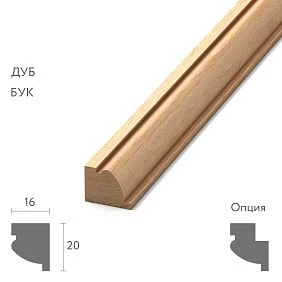
MLD-015: what exactly is purchased in a wholesale order
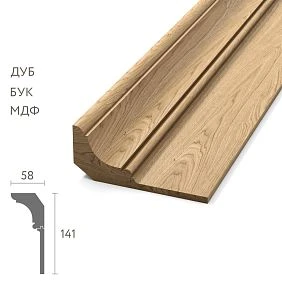
According to the current product page, STAVROS MLD-015 is available in solid beech and oak.
| Material | Section | Product length |
|---|---|---|
| Beech | 20×16 mm | 2400 мм |
| Oak | 20×16 mm | 2400 мм |
Product card: MLD-015 on STAVROS.
The sanding quality is “Prestige.” In the beech configuration selected on the product page, gluing “for enamel” is specified. The product page also separately explains the difference between gluing for enamel and for tinting.
For the article, this is the important fact: MLD-015 does not have the problem of different standard lengths between beech and oak — both materials come in 2400 mm. Therefore, the central purchasing variable here is not 2400/2600, but the natural appearance of the solid wood after the selected finish.
This allows forming an independent B2B task:
how to distribute a large natural batch across paired and symmetrical items so that adjacent frames are perceived as a single composition.




One hundred identical planks according to the specification are not one hundred visually identical planks
For industrial decor, dimensions must be repeatable.
Natural wood, however, retains its natural variability.
Two MLD-015 planks of the same species and the same size may differ:
-
shade;
-
in the prominence of the grain;
-
by grain;
-
in the character of the lamellas;
-
in the contrast after tinting.
This does not mean that one of them is bad.
And it does not mean that such a batch cannot be used in symmetrical furniture.
It is only necessary to take into account the visual character of the material where two or four frames are simultaneously in the field of view.
Our factory also produces:




Why a single frame can look good, but a pair — worse
Let's imagine two doors of the same cabinet.
The left frame is assembled from parts with a relatively calm pattern.
The right one — from more contrasting ones.
If you look at each one separately, both look fine.
If you place them next to each other, the eye begins to compare them as a pair.
That is why the unit of visual matching becomes not a single strip, but a paired composition.
Get Consultation
First you need to determine whether the wood will be visible at all
Before complicating the warehouse with visual groups, you need to understand the finish.
Cladding finish
If the final opaque coating completely hides the wood grain, deep sorting by tone is usually not needed.
In this case, what matters more is:
-
surface quality;
-
geometry;
-
cutting;
-
finish;
-
Quantity.
The STAVROS card explains that "under enamel" gluing is produced without mandatory selection of lamellas by color and texture and is intended for opaque painting.
Transparent or semi-transparent finish
If the wood remains visible, tone and grain become part of the result.
For this task, the manufacturer offers "under tinting" gluing, where lamellas are selected more carefully by color and texture. At the same time, tonal and textural differences are possible — and this is fundamentally important for an honest article.
That is, even the "under tinting" version does not turn natural wood into a completely uniform artificial decor.
Why the article should not turn into a tinting reference guide
The finish here is needed as a condition.
After selection:
visible wood grain
the central question is different:
which physical planks to assign to one pair of fronts and how to preserve this association after cutting?
There is no need to repeat the entire painting or tinting process in detail.
For a wholesale buyer, it is more important to:
-
choose the correct version of the blank;
-
make a sample;
-
understand the actual appearance after coating;
-
approve the principle of matching.
What counts as a pair
A pair is not just any two items with the same SKU.
A pair arises where elements are read simultaneously and the design implies symmetry or a visual connection.
For example:
-
the left and right doors of a cabinet;
-
two glass display cases;
-
two panels on either side of a fireplace;
-
two frames near a doorway;
-
two fronts of a sideboard;
-
two identical furniture sections.
If two frames are in different rooms and are never compared, strict pairing may be unnecessary.
So a pair is determined by the architecture, not by the warehouse.
What counts as a visual group
There are not always only two elements.
Imagine a library of four identical doors.
Two design approaches are possible.
One group K-02 for four fronts
All four doors should be perceived as a single ensemble.
Then MLD-015 is selected for all four at once.
Two paired groups
Doors 1–2 — K-02A.
Doors 3–4 — K-02B.
This allows slightly more variation between the two pairs.
The designer decides which approach is correct on the control sample.
The main thing is to decide before cutting.
Set codes turn a natural batch into a manageable system
Simple designations can be introduced:
K-01 — two-door wardrobe.
K-02 — four library doors.
K-03 — two wall panels.
K-04 — two display cabinets.
This way MLD-015 stops being an unnamed square footage.
Each physical plank, after visual selection, is assigned:
K-01.
K-02.
Or it remains in:
the general pool.
This is not a new product grade or a manufacturer's claim.
This is an internal project logic of assembly.
Why you can't first cut the entire batch into identical parts
Production logic often says:
first we'll cut 200 verticals, then 200 horizontals.
For opaque enamel, this can be very convenient.
For visible wood, a risk appears: after mass cutting, the original connection between the planks disappears.
As a result, the kit assembler receives:
-
200 verticals;
-
200 horizontals;
-
identical sizes;
-
one SKU;
-
one material.
And begins assembling frames from the nearest parts.
This is how paired fronts get random combinations.
Therefore, for the scenario under consideration, a different sequence is stronger:
visual group of slats → cutting the set → marking the parts.
First the set, then the cutting
Let's imagine K-01 — two doors.
For a pair you need:
-
4 verticals;
-
4 horizontals.
Before cutting, the physical slats MLD-015 are selected, which, after a trial finish or an approved principle, are perceived together as acceptable.
Only after that does the technician build a cutting map within this group.
This does not mean:
each frame must be made strictly from a single slat.
Optimization remains.
But it happens within the approved visual pool.
The control kit must be assembled before mass production
Before launching hundreds of frames, it is useful to assemble a real pair.
For example:
-
two cabinet doors;
-
MLD-015 in the selected wood species;
-
approved finish;
-
real lighting;
-
real handles and adjacent materials.
Check:
-
overall tone;
-
character of the texture;
-
profile scale 20×16;
-
perception of the pair;
-
viewing angle;
-
Side light.
After this, it is not an "ideal wood color" that is asserted, but the acceptable nature of differences within a pair.
This is much more realistic.
Why the control set should be viewed after a trial coating
Untreated wood and wood after tinting are perceived differently.
The finish can:
-
enhance the contrast;
-
make the tone more saturated;
-
emphasize the pores;
-
change the visual relationship of adjacent planks.
Therefore, sorting only by untreated blanks can give a false sense of matching.
Practical approach:
-
obtain representative samples;
-
apply a real or technologically equivalent finish;
-
evaluate them as a pair;
-
approve the principle.
After that, the mass batch is assembled according to a clear logic.
What to record on the reference sample
Bad entry:
the oak is beautiful, it works.
Stronger:
MLD-015 / oak / K-01 / finish T-01 / assembly principle approved.
Can be preserved:
-
physical fragment;
-
photo of the pair;
-
finish sample;
-
color/finish system code;
-
designer's comment.
A photograph is useful, but it should not be the only reference: screens and lighting distort the perception of tone.
Visual groups are a project-based distribution, not a new wood grade
It is very important not to create a pseudo-classification.
There is no need to declare:
group A — premium grade;
group B — second grade,
if the manufacturer does not have such a classification.
Working groups may be called:
-
K-01;
-
Group 1;
-
Pair 07;
-
Library set.
They only mean:
these planks are selected for combined use.
This is project logistics, not a characteristic of product quality.
Absolute wood matching cannot be guaranteed
Natural oak or beech does not have to look like printed film.
Even carefully selected elements retain natural differences.
Therefore, the correct goal is:
not absolute identity, but consistency of adjacent elements within the approved aesthetic.
If a project requires a perfectly uniform color with no readable natural pattern, perhaps the task itself is closer to opaque finishing.
But that is already a design decision, not an article decision.
Oak and beech are supplied separately
Even if after finishing two samples appear close in tone, beech and oak remain different materials.
A common pool cannot be created:
MLD-015 / natural wood.
Correct:
MLD-015 / oak / 20×16×2400.
MLD-015 / beech / 20×16×2400.
If the finish differs, its code is added.
For example:
MLD-015 / oak / T-01.
MLD-015 / beech / B-01.
The remaining beech stock must not automatically cover the oak shortage.
This rule seems obvious, but in serial furniture production, after finishing and assembly, small parts easily lose their original identity.
Why beech and oak cannot be compared only by the raw blank
Raw wood provides only part of the information.
After finishing, the two species may be perceived differently.
For example, oak retains a pronounced pore pattern, while beech produces a calmer surface.
But the article should not turn this into a universal aesthetic ranking.
What matters more is this:
the material should be approved together with the actual finish and the actual adjacency of parts.
A couple of frames after tinting are stronger than any abstract photo of individual planks.
Example: a two-door wardrobe
The wardrobe has two identical doors.
Each has a frame made of MLD-015:
-
2 verticals;
-
2 horizontals.
For the pair:
-
4 verticals;
-
4 horizontals.
If the project uses visible wood, these eight parts are best considered as one set:
K-01.
Not as:
8 random parts from a common oak pool.
This does not mean that all eight must be cut from two perfectly matching planks.
The task is simpler:
before cutting, select a group of source planks that yields a coordinated pair of fronts in the actual finish.
Example: four library fronts
Now four doors.
There are two options.
The entire set of four is one ensemble
Then K-02 includes all four fronts.
The assembler looks not at pairs, but at the entire group.
Two visual pairs
For example:
-
left pair — K-02A;
-
right — K-02B.
This may be more logical if the furniture itself is built symmetrically relative to the center.
Which option to choose — design decision.
The main thing is not to make it after the entire batch has already been cut.
Symmetric wall frames work by the same logic
MLD-015 can be used not only on furniture.
Let's imagine two wall frames on the sides of the fireplace.
They:
-
of the same size;
-
are in the same field of view;
-
have the same material and finish.
If the wood grain is visible, the viewer compares them just like two cabinet doors.
Therefore, it also makes sense to combine these frames into a visual set.
For example:
K-03 — left and right frames of the fireplace wall.
When separate matching is not needed
The method should not complicate a project where it adds nothing.
If MLD-015 is fully covered with opaque enamel and the coating technology truly hides the natural grain, visual grouping by tone is usually unnecessary.
In this scenario, what matters more is:
-
correct material;
-
surface quality;
-
sizes;
-
cutting;
-
polishing;
-
finish;
-
Quantity.
In other words, the very idea of matching depends on whether the wood is visible after finishing.
First visual grouping, then the cutting map
This is the central rule for the natural series.
Bad sequence:
-
calculate the total linear footage;
-
optimize the cutting layout;
-
cut the entire batch;
-
paint;
-
try to match frames by tone.
Stronger:
-
approve the actual finish;
-
identify pairs and groups;
-
visually distribute the source planks;
-
assign kit codes;
-
build the cutting layout within each kit;
-
mark the finished parts.
Thus, technological optimization does not disrupt the visual logic.
Kitting does not mean that one frame is cut from a single plank
This is an important limitation.
One might mistakenly conclude:
for the frame to look seamless, all four sides must be from the same plank.
Such a rule is too rigid and can significantly worsen the cutting layout.
If dimensions allow, one plank can yield several parts.
Several planks from the same visual set can be combined with each other.
The main thing is not to lose the association with K-01 or K-02.
That is, a balance is maintained:
visual consistency + economical cutting layout.
Working list of sets
Example:
| Set | Detail | Length | Quantity | Material |
|---|---|---|---|---|
| K-01 | Vertical | As per project | 4 | Oak |
| K-01 | Horizontal | As per project | 4 | Oak |
| K-02 | Vertical | As per project | 8 | Oak |
| K-02 | Horizontal | As per project | 8 | Oak |
| K-03 | Vertical | As per project | 4 | Beech |
| K-03 | Horizontal | As per project | 4 | Beech |
After that, a cutting map of 2400 mm is built.
The total linear meters remain the checksum.
But it no longer controls kitting.
Why the line "MLD-015 oak — 480 m" is insufficient
She does not show:
-
how many frames;
-
which pairs;
-
which groups;
-
which parts should be next to each other;
-
how the finish is distributed;
-
which leftovers can be transferred to another set.
480 m are useful for the budget.
But they do not allow assembling visually coordinated fronts.
Practical cutting of a two-door wardrobe
Let's take a conventional K-01.
For one door:
-
2 verticals of 900 mm each;
-
2 horizontals of 450 mm each.
For the pair:
-
4×900;
-
4×450.
Total finished parts:
4×900 + 4×450 = 3600 + 1800 = 5400 mm.
Original length of one strip:
2400 mm.
Now let's check the combinations.
Two verticals
900 + 900 = 1800 mm.
600 mm remains before cut allowance.
Potentially, the remainder can yield one horizontal piece of 450 mm.
Then:
900 + 900 + 450 = 2250 mm.
150 mm remains before cut allowance.
One vertical + three horizontal pieces
900 + 450×3 = 2250 mm.
The same nominal remainder.
This means one strip can potentially yield:
-
two vertical pieces + one horizontal piece;
-
or one vertical piece + three horizontal pieces.
Which scheme is better depends on the total number of parts and the technological allowance.
But both K-01 strips remain within a single visual set.
Practical cutting plan for four fronts
Let's assume K-02:
-
8 verticals of 850 mm each;
-
8 horizontals of 400 mm each.
Checking:
850×2 + 400 = 2100 mm.
Remainder 300 mm.
Or:
850 + 400×3 = 2050 mm.
Remainder 350 mm.
An economical layout can be built.
But the technologist must take into account:
-
cut;
-
trimming;
-
the quality of the end faces.
The article does not set a universal allowance value.
A dense cutting layout is always verified in production.
Long parts are reserved before short ones
If a batch contains verticals of almost 2400 mm, they constrain the layout.
For example:
-
vertical 2280 mm;
-
horizontal 420 mm.
A long vertical almost completely occupies the strip.
A short horizontal can be obtained from another strip or from the remainder.
Therefore, the order is:
longest critical parts → medium → short.
This rule does not conflict with visual assembly.
First, K-01 receives its source strips.
Then, within K-01, long parts are protected from free cutting.
Parts from one strip are convenient, but do not have to be one frame
If two parts come from one MLD-015 strip, it is often convenient to direct them into one set.
But this is not a universal law.
For example, one plank can yield:
-
vertical K-01;
-
horizontal K-01;
-
short remainder.
This is convenient.
But if the cutting layout of the series works better when one strip covers two adjacent frames of the same group, that is also acceptable.
What matters is not the “magical link between one strip and one frame,” but the consistency of the visual pool.
How to work with usable remnants
The remnant must preserve:
-
SKU;
-
material;
-
finishing;
-
length;
-
the visual set, if it is still relevant.
For example:
MLD-015 / oak / T-01 / K-01 / 620 mm.
If K-01 is already complete, the remnant can be transferred to the general T-01 pool after a visual check.
If it is still needed for repairing the same pair, it is reasonable to keep it within the set.
Can a remnant be transferred to another set?
Yes, if this does not violate the approved logic.
Checked:
-
material;
-
finish;
-
length;
-
visual matching;
-
status of the original set.
For example, the remaining T-01 oak from K-01 may be suitable for K-04.
But visual groups should not be turned into dogma:
this piece is permanently tied to K-01.
Kitting is a managed tool, not a ban on rational use of material.
How to label cut parts
For example:
K-07 / L / V1
Where:
-
K-07 — set;
-
L — left frame;
-
B1 — vertical.
Or:
K-01 / right door / top.
Any system can be used.
There is one criterion:
after finishing and moving the part, it should be clear which set it belongs to.
Marking must survive finishing
If the mark is applied where there will subsequently be:
-
cut;
-
polishing;
-
tinting;
-
packaging,
it may disappear.
Therefore, it is better to use:
-
tags;
-
removable labels;
-
packaging labeling;
-
picking list.
There is no need to leave a permanent mark on a visible surface.
But the identity of the part itself must be preserved.
Who is responsible for picking
If responsibility is not assigned, the visual logic quickly dissolves.
One of the working options:
-
the designer approves the reference;
-
the technologist formulates the rules;
-
the picker distributes the strips;
-
the cutter cuts according to the list;
-
the finisher preserves the marking;
-
the installer assembles ready-made kits.
This is not the only scheme.
But the solution “let the carpenter select on site” scales poorly to hundreds of fronts.
Paired fronts under side light need to be inspected especially carefully
The difference in tone may be more noticeable with:
-
a side window;
-
a directional sconce;
-
display lighting;
-
reflection on glossy surfaces.
Therefore, it is better to check control sample K-01 where the actual furniture will be placed, or in a scenario with similar lighting.
Especially if two doors are located next to each other and are illuminated by a single line.
Mirrored fronts require a separate solution, but the two topics should not be mixed.
A mirrored pair has two independent questions.
First:
should the tone and grain of the wood be perceived as identical?
Second:
is the profile itself oriented the same way?
In the article about MLD-015, the main question is the visual matching of solid wood.
The orientation of the profile itself must be determined separately based on the drawing and the reference sample, especially if the fronts are left/right.
The question of texture must not be replaced by the question of geometry.
That is, for a mirrored pair, one can have:
K-05L — left frame;
K-05R — right frame.
At the same time, both belong to the same visual set K-05.
There is no need to "spread" the contrast across the entire furniture
Bad strategy:
if there are several darker or more contrasting parts, we'll place one in each frame so that it looks even.
This is how random contrast turns into an artificially repeated pattern.
It is better to evaluate each set as a whole.
For example, one frame may be slightly darker than the other, but within the pair it looks logical.
Or a more contrasting strip may better suit a separate panel that is not compared with its neighbor.
The picker's task is not to distribute a "defect" but to find a logical purpose for natural material.
A plank that differs significantly is not automatically a defect
Natural wood is variable.
If one plank differs noticeably in tone or pattern, first ask:
is there a zone in the project where such a character of material is acceptable or even desirable?
For example:
-
separate panel;
-
a single front;
-
a side decorative frame;
-
a hidden internal area.
Only if the material does not meet the ordered quality or specification requirements does the question of a claim arise.
A visual difference in itself does not equal a defect.
Acceptance of the MLD-015 batch must separate commercial parameters from visual matching
The first stage is standard goods acceptance.
Check:
-
MLD-015;
-
beech or oak;
-
20×16×2400 mm;
-
quantity;
-
sanding quality;
-
the ordered splicing quality;
-
condition.
The second stage is project-based matching.
There they evaluate:
-
texture;
-
the tone after the test finish;
-
pairs;
-
groups;
-
purpose.
There is no need to mix the two processes.
A batch may be fully correct in terms of goods parameters and still require proper distribution across symmetrical facades.
The optimal point for visual grouping is after acceptance and before mass cutting
Before acceptance, the material is not physically in front of you.
After mass cutting, the original relationship between the strips is already partially lost.
Therefore, the most convenient point is:
goods accepted → material inspected → groups determined → only then cutting.
If tinting is planned, approved samples and a technological selection can be used.
It is not necessary to coat every strip completely.
It is important to have enough information to avoid distributing the material randomly.
Regluing "for enamel" is a separate flow
On the current card, the selected beech version MLD-015 is indicated with regluing "for enamel".
If the final coating is opaque, deep sorting by visible texture is usually unnecessary.
Therefore, such a batch can follow a simpler scheme:
material → cutting → marking → finishing.
Production should not be artificially complicated:
selecting a hidden texture that the enamel will completely cover.
This does not add value.
If the project changes enamel to a semi-transparent finish, the old procurement logic must be reconsidered
STAVROS clearly separates regluing:
-
under enamel;
-
Under tinting.
If a project initially ordered a blank for opaque painting and then decided to show the wood, the original batch cannot automatically be considered equivalent to a tinted finish.
You need to:
-
check the specific batch;
-
approve the appearance;
-
check with the manufacturer or technologist whether the change is permissible;
-
revise the reference sample.
This is especially important for large paired compositions, where natural differences become more noticeable.
You cannot arbitrarily reclassify an already purchased batch
A bad decision on site:
the wood is beautiful, let's use clear lacquer instead of enamel.
The problem is not that this is always technically impossible.
The problem is that the purchasing category and the design result were different.
If the blank was selected for enamel, its lamellas may not have been matched for visible texture.
Therefore, the transition to a semi-transparent finish requires a new approval.
A repair reserve of natural wood is best planned for already in the initial batch.
After a few months or years, the following may be required:
-
one new door;
-
one vertical;
-
one frame;
-
repair of the panel.
New oak or beech of the same model may naturally differ from the original batch.
Therefore, for critical visible areas, it is reasonable to provide a repair reserve in advance.
Not because a repeat order will necessarily be "different."
But because the preserved material from the original batch increases the chance of a visually matched repair.
Reserve is better calculated not only in meters
For example, the project requires two-door wardrobes.
Instead of:
MLD-015 — 5% reserve,
you can provide:
-
one full K-01 frame;
-
several long verticals;
-
several whole strips from the original batch.
Such a reserve is more functional.
Five percent of short leftovers can yield many meters, but may not allow manufacturing one long vertical.
Why a whole long strip is more valuable than many short leftovers
From a whole MLD-015 2400 mm, you can get:
-
vertical;
-
several horizontal pieces;
-
a repair part;
-
a new combination for another frame.
A short 400 mm piece covers only a limited set of tasks.
Therefore, it is advisable to separate the operational reserve:
whole planks and useful offcuts.
Do not consider them the same stock.
How to store the repair reserve
Option for large labeling:
MLD-015 / OAK / T-01 / PROJECT RESERVE.
If the reserve is assigned to a specific paired composition:
MLD-015 / OAK / T-01 / RESERVE K-01.
For beech — a separate group.
If the finish differs, each finish is stored separately.
A reorder after three months should begin with the passport of the original set
Bad request:
MLD-015 oak.
Stronger:
MLD-015 / oak / 20×16×2400 / finish T-01 / repair K-01.
If preserved:
-
a physical sample;
-
photo;
-
finish reference sample;
-
remainder of the original batch,
they are used for matching.
A new material does not guarantee an absolute visual match
This is an important limitation for the buyer.
Even if ordered:
-
the same MLD-015;
-
the same oak;
-
the same size;
-
a similar finish,
Natural wood may vary.
Therefore, one cannot promise:
after three years, the new plank will be absolutely identical to the old one.
Expert recommendation:
in critical visual areas, keep a reasonable repair reserve from the original batch in advance.
How to evaluate the set after completion
Inspection should look not at an individual plank, but at the composition.
For K-01:
-
two doors next to each other;
-
normal viewing distance;
-
real lighting;
-
handles;
-
adjacent furniture.
Questions:
-
whether one frame visually dominates;
-
whether there is a random sharp tonal jump;
-
does the pattern read harmoniously;
-
does one door look like it's "from a different batch";
-
does the result match the reference.
This is not a laboratory color comparison.
This is a visual acceptance of a specific item.
Why a photograph is a poor substitute for physical acceptance
The camera changes:
-
white balance;
-
exposure;
-
contrast;
-
shade.
The screen does too.
Therefore, photos are useful for documentation, but they should not be the only criterion for the tonal match of natural wood.
Especially in a questionable pair.
The final decision is best made on a physical set under agreed lighting.
How to work with multiple production batches
A large project can order MLD-015 in batches.
For example:
-
batch 1 — lobby;
-
batch 2 — libraries;
-
batch 3 — room wardrobes.
If visually related elements are in the same area, it is preferable not to split them between batches unnecessarily.
For example, two paired panels are best assembled from a single available batch of material.
If this is not possible, the new batch is compared with the reference sample.
How to avoid double reservation
Let's imagine the project decided to keep:
-
10 solid oak planks T-01;
-
6 beech B-01.
If the purchase is made in three deliveries, there is no need to automatically add this reserve to each one.
The master specification keeps a separate balance:
needed → already ordered → in stock → used → remaining.
This way the reserve remains project-level and is not multiplied by the number of deliveries.
How to calculate a commercial proposal
The price per meter is insufficient.
For a serial batch, the following are important:
-
material;
-
regluing;
-
polishing;
-
number of whole slats;
-
finish;
-
reserve;
-
cutting losses;
-
additional assembly operations
Step 2
Lay out by finished lengths.
Step 3
Assemble trial groups on a table or stand.
Step 4
Assign new codes K-01, K-02, K-03.
Step 5
After that, issue for assembly.
Thus, even late grouping is better than random distribution.
How to evaluate verticals and horizontals together
Sometimes the assembler selects only two long verticals and forgets the horizontals.
As a result, the verticals of the pair look consistent, while the top elements give a different tone.
Therefore, the frame is evaluated as a whole.
For K-01:
-
all 4 verticals of the pair;
-
all 4 horizontals;
-
the actual finish.
If one short horizontal stands out noticeably, it can be reassigned to another set.
Corners are especially sensitive to a sharp transition in the pattern
MLD-015 has a distinctive profile, and the corner cut joins the vertical with the horizontal.
Even with natural wood, a transition that is too contrasting can look random.
There is no need to require the annual rings to continue through the corner — there is no universal basis for this.
But it is useful to visually assess the four corners of the reference frame.
Goal:
the frame is perceived as a single product.
What to do if one frame is lighter than another, but within each one everything is consistent
This is already a matter of pairing level.
If two doors stand next to each other and should be almost identical, a strong difference between the entire left and entire right frame may be undesirable.
If the composition allows for natural variation, this may be fine.
Therefore, the reference should answer not only:
how to assemble one frame,
But also:
how similar two adjacent frames should be.
Can material be grouped by tone before applying the finish
It can be used as a preliminary step, but the final decision is best verified on a finish sample.
Untreated oak may appear similar.
After tinting, individual areas read with more contrast.
Therefore, preliminary sorting saves time, but does not replace the approved finish.
How to work with enamel: do not overcomplicate what is not visible
If MLD-015 is going under opaque enamel and the project does not leave the wood visible, sorting by tone loses its meaning.
Then you can focus on:
-
surface quality;
-
geometry;
-
cutting;
-
marking;
-
completeness.
This is a good example of when the visual grouping method is not needed.
An expert article should help not only add control, but also remove unnecessary work.
How to work with semi-transparent finish
If the finish preserves the wood grain, matching becomes relevant.
It is necessary to clarify in advance that the appropriate quality of the blank has been ordered.
The STAVROS card directly explains: for a tinted finish, lamellas are selected more carefully by color and texture, but tonal and textural differences are still possible.
Consequently, project grouping remains useful even after the correct choice of laminated quality.
Selection of lamellas by the manufacturer and matching of facades are different levels
The manufacturer determines the quality of the blank.
The project determines which finished profiles end up next to each other.
Even well-prepared strips for tinting can be accidentally distributed so that two adjacent frames will be noticeably different.
Therefore:
re-gluing for tinting ≠ automatic pairing of all strips.
This is an important limitation.
How to calculate a large series of two-door wardrobes
For example:
-
50 wardrobes;
-
2 doors in each;
-
2 verticals and 2 horizontals per door.
Total fronts:
50 × 2 = 100.
Total frames:
100.
Total parts:
100 × 4 = 400.
But visual sets:
50 K-01-like pairs.
It is these 50 sets that are the unit of wood distribution.
Not 400 independent parts.
Example of calculating parts for 50 cabinets
For example:
-
vertical 900 mm;
-
horizontal 450 mm.
Per cabinet:
-
4 verticals = 3600 mm;
-
4 horizontals = 1800 mm.
Total net footage:
5400 mm = 5.4 m per cabinet.
For 50:
270 m of net parts.
But the purchase quantity is calculated based on 2400 mm cutting.
If the working scheme is:
900 + 900 + 450 = 2250 mm,
one strip covers two verticals and one horizontal.
The remaining horizontals are distributed by other combinations.
After building the full map, you get the number of whole planks.
270 m of pure material — just a reference value.
Why grouping should not break the economics of cutting
If K-01 is strictly limited to two or three planks, you can end up with a lot of waste.
Better to allocate a visual pool for K-01, for example four suitable planks, and optimize all eight parts within it.
The remainder after completing K-01 can be returned to the common pool if:
-
the length is useful;
-
the material is the same;
-
the finish is the same;
-
the next set is visually compatible.
This way the system remains flexible.
How to work with four doors if one pair must be central
Let's imagine a library:
-
two central doors;
-
two side doors.
The designer may require stricter symmetry of the center.
Then:
K-02C — central pair;
K-02S — side pair.
This is not a new wood species.
This is a priority of visual matching.
Central elements are evaluated together.
Side ones — separately.
How to account for multiple identical bookcases in one room
If a room has two bookcases facing each other, you need to decide:
-
each is a standalone set;
-
or all eight doors should read as a single ensemble.
The wider the visual group, the harder the matching.
Therefore, you should not automatically combine the entire object.
The group should correspond to actual perception.
How to tell that a visual group is too large
If the assembler has to set aside dozens of usable planks because they do not match one huge group, the criterion may be too strict.
A useful question:
does a person see all these elements at the same time, and should they really compare them as a single whole?
If not, the group can be split.
This reduces waste without compromising the design.
The reference set should define a range, not a single “perfect” sample.
If the reference is a single perfect pair, production may begin rejecting all natural variations.
It is better to establish a principle:
-
which differences are acceptable;
-
which look like a random contrast;
-
where stricter pairing is required.
If necessary, several acceptable samples can be kept.
This way, the natural material is assessed more fairly.
How to document a visual solution without pseudo-standards
In the specification, you can write:
K-01: assemble adjacent frames from an approved group of oak T-01; avoid sharp tonal contrast within a pair; an exact match of the grain pattern is not required.
This is much better than:
the oak must be identical.
The first requirement is achievable.
The second is too vague and may create a conflict during acceptance.
How to handle defects and natural variation separately
There are two different situations.
An actual defect or non-compliance with the order
Resolved according to quality and warranty rules.
Natural variation of defect-free planks
Resolved by replacement/assembly.
Replacement/assembly must not be used to mask a real defect.
And any natural difference must not be declared a defect.
Separating these two scenarios reduces unnecessary disputes.
How to store photo documentation of sets
For K-01, you can take photos of:
-
left frame;
-
right;
-
both side by side;
-
under real lighting.
The photo is stored together with:
-
code;
-
finish;
-
material;
-
date or revision.
This helps with repeat production.
But the photo remains a supporting document, not an exact color reference.
How to transfer the set between the workshop and installation
If the frames are produced in the workshop but installed on site, the packaging must preserve pairing.
For example:
K-01 / left door.
K-01 / right door.
Do not send both frames in one common box:
MLD-015, fronts.
Otherwise, all the work on matching is lost at the final stage.
How to receive finished paired fronts
Pair acceptance should check:
-
geometry;
-
angles;
-
finishing;
-
tone;
-
drawing;
-
compliance with the reference;
-
Completeness.
If the two frames differ, first you need to determine:
-
whether this is acceptable natural variation;
-
or accidental mixing of sets.
Only then make a decision about rework.
Acceptance on a display stand and in a real interior can produce different effects
On a neutral display stand, the pair looks calm.
In an interior, one frame ends up closer to the window and looks lighter.
This is not necessarily a problem with the material.
Therefore, questionable sets are best evaluated in their real placement or under a similar lighting scheme.
This way, you won't have to redo a correct pair because of lighting differences.
How to calculate the reserve for a critical central pair
If the library has two central doors, the most prominent ones, you can provide:
-
a spare whole plank;
-
a pair of long verticals;
-
or a material from the same visual pool.
There is no need to create a huge reserve for all parts.
The reserve should match the risk and importance.
What to do with the reserve after the project is completed
After installation, part of the stock may remain.
It is useful to separate:
-
operational reserve;
-
free stock balance;
-
short pieces with no practical purpose.
You cannot consider every scrap to be part of the repair fund.
If a piece does not allow you to make even one needed part, it does not improve repairability.
Why reordering one door is more difficult than reordering one meter
After a year, the right frame K-01 is damaged.
It's not just about:
5.4 m of oak molding.
We need to restore:
-
MLD-015;
-
oak;
-
finish T-01;
-
dimensions of the parts;
-
visual match with the remaining left door.
If there is a reserve from the original batch, the task is easier.
If not, the new material is evaluated next to the old frame.
How to phrase a reorder for natural wood
Bad request:
MLD-015 — 3 pieces.
Stronger:
MLD-015 / oak / 20×16×2400 / finish T-01 / repair of paired frame K-01 / 3 whole planks.
If the order is intended for a semi-transparent finish, the corresponding requirement for the blank is specified.
This way the supplier sees the actual task.
The assembly matrix helps maintain the logic between the warehouse and installation
For a large project, it is useful to have a separate table where each visual group is linked to a material and finish.
Set Object Material Finish Parts Status K-01 Two-door wardrobe Oak T-01 4 verticals + 4 horizontals Approved K-02 library 4 doors Oak T-01 8 verticals + 8 horizontals Approved K-03 paired wall frames Beech B-01 According to the list Approved Such a matrix solves several practical tasks at once.
The warehouse understands which planks cannot be handed over to another set without verification. The workshop sees which parts must remain as one group after cutting. The finisher preserves the marking. The installer receives not just a set of identical profiles, but a specific ensemble.
If set K-01 is closed and a useful piece remains after it, the status of the remainder can be changed:
K-01 → common pool T-01.
That is, the system does not block the material forever, but only preserves its meaning for as long as it is needed.
How to tell that visual set assembly is actually working
After the first 5–10 sets, you need to evaluate not only consumption, but also the result.
Check:
-
whether there is sharp contrast within pairs;
-
whether the selection has to be redone too often;
-
how many usable planks remain unassigned;
-
are the criteria too strict;
-
is economical cutting maintained;
-
is the marking clear for the workshop and installation.
If half of the material is set aside as "unsuitable," even though the project allows for natural variation, the system is probably overly strict.
If pairs regularly look randomly mismatched in tone, the control is too weak.
A working balance is needed: sufficient visual consistency without trying to destroy the natural character of the solid wood.
Post-installation inspection should account not only for the material, but also for the light
Two correctly matched frames may appear different if one is closer to the window and the other is in shadow.
Therefore, a disputed pair cannot be assessed only from a photograph or a brief glance under a single lighting condition.
It is useful to look at it:
-
under primary daylight;
-
under the design lighting turned on;
-
from the usual user distance.
If the difference appears only because of the light, reworking the material will not solve the problem.
This protects the project from false claims and unnecessary consumption of natural wood.
Fifteen mistakes when buying MLD-015 wholesale
1. Ordering only the total linear meterage
Why it happens: meters are convenient for the budget.
Consequence: it is unclear which parts belong to one pair of fronts.
How to prevent it: count the visual sets K-01, K-02, K-03 and build the cutting plan within them.
2. Mixing beech and oak
Why it happens: the cross-section and length are the same.
Consequence: the remainder of one species is mistakenly considered a reserve of another.
How to prevent: separate product and warehouse lines.
3. Not determining the finish before ordering
Why it happens: the finish is put off "for later."
Consequence: a batch calculated for opaque enamel suddenly has to show the wood.
How to prevent: decide before purchasing whether the texture will be visible.
4. First cutting everything in bulk, then matching by tone
Why it happens: production strives to speed up cutting.
Consequence: the connection between the original planks is lost, and assembly becomes more difficult.
How to prevent: visual grouping before mass cutting.
5. Distributing paired fronts as random parts
Why it happens: all parts are identical in size.
Consequence: one door may visually differ from the adjacent one.
How to prevent: use kit K-01 for the entire pair.
6. Treating the natural variability of wood as a defect in itself
Why it happens: printed uniformity is expected from a natural material.
Consequence: serviceable material is unjustifiably rejected.
How to prevent: approve the acceptable nature of differences in advance.
7. Promising an absolute match of the pattern
Why it happens: there is a desire to guarantee symmetry.
Consequence: an impossible expectation is created.
How to prevent it: talk about consistency, not identity.
8. Do not make a control set
Why it happens: individual strips look good.
Consequence: the problem is visible only after installing two fronts next to each other.
How to prevent it: assemble a real pair in the real finish.
9. Do not keep a finish reference sample
Why it happens: they believe the color code is sufficient.
Consequence: the next batch is assessed from memory or a photograph.
How to prevent: physical sample plus photo documentation.
10. Not labeling parts after cutting
Why it happens: the dimensions are identical.
Consequence: K-01 gets mixed up with K-02 during finishing or in the warehouse.
How to prevent: kit code on the packaging and in the bill of materials.
11. Treating short leftovers as a full-fledged repair reserve
Why it happens: the warehouse sees a large total linear footage.
Consequence: when replacing a long vertical, it turns out there is no suitable blank.
How to prevent: account for whole planks and usable leftovers separately.
12. Not reserving long parts
Why it happens: short elements are easier to cut first.
Consequence: full 2400 mm pieces go to horizontals, while long verticals require reordering.
How to prevent: protect critical lengths first.
13. Mixing different finishes
Why it happens: the material and SKU match.
Consequence: the remaining T-01 goes to T-02.
How to prevent: the finish is included in each group code.
14. After ordering "for enamel," switching to a semi-transparent finish without authorization
Why it happens: the client liked the unfinished wood on site.
Consequence: the appearance of the batch may not meet expectations for visible grain.
How to prevent: re-approve the material and the quality of the lamination.
15. Place a reorder without material and finish
Why it happens: the SKU is already known.
Consequence: the new batch does not match the pair being repaired.
How to prevent: specify MLD-015 + species + 20×16×2400 + finish + set.
Checklist before wholesale ordering MLD-015
Before payment, you need to determine:
-
exact SKU MLD-015;
-
beech or oak;
-
size 20×16×2400 mm;
-
finish type;
-
whether the wood will be visible;
-
the required quality of the lamination;
-
number of paired fronts;
-
number of groups of four or more elements;
-
codes K-01, K-02, K-03;
-
lengths of the verticals;
-
lengths of horizontal members;
-
longest critical parts;
-
control set;
-
finish standard;
-
principle of acceptable visual difference;
-
moment of visual grouping;
-
cutting map;
-
marking of parts;
-
packaging by sets;
-
responsible for kitting;
-
reserve of full planks;
-
repair reserve;
-
rules for transferring leftovers between sets;
-
reorder format;
-
saving the project passport.
If only the string is known:
MLD-015 oak — 480 m,
the procurement task is not yet closed.
Final logic of the MLD-015 wholesale order
For the natural series, the order should be as follows:
MLD-015 20×16×2400
→ BEECH OR OAK
→ COVERING OR VISIBLE FINISH
→ RELAMINATION REQUIREMENT
→ CONTROL COATING SAMPLE
→ DETERMINATION OF PAIRS AND VISUAL GROUPS
→ KIT CODE
→ VISUAL DISTRIBUTION OF SOURCE BOARDS
→ LIST OF VERTICALS AND HORIZONTALS
→ RESERVE OF LONG PARTS
→ CUTTING MAP 2400 MM
→ MARKING OF FINISHED PARTS
→ FINISHING WITH CODE PRESERVATION
→ ASSEMBLY OF PAIRED FACADES
→ VISUAL ACCEPTANCE OF THE KIT
→ REPAIR RESERVE
→ PROJECT PASSPORT
→ ADD-ON ORDER BY MATERIAL, FINISH AND SET
This approach allows Buy wooden molding to order in a large batch and avoid turning the natural variability of oak or beech into random color variation between adjacent fronts.
For MLD-015, the main question of wholesale purchasing is not:
how many meters of molding are needed in total?
But:
which elements the user will see as one pair or group, whether the wood will be visible after finishing, which physical strips are best assigned to this set before cutting, and how to preserve their belonging until final installation?
If these questions are resolved in advance, the natural material remains natural — with lively texture and acceptable variability — but the series stops depending on the random distribution of parts from the warehouse.
-