Article Contents:
- One MN-244 is one carved support, not a ready-made underframe
- Why the photo is misleading
- What the quantity "1" in the cart means
- Where the boundary between a support and an underframe lies
- Quick reference table for the first check
- A height of 740 mm is not yet the height of the finished table
- Why you cannot assign meanings to B, C, D, and E on your own
- Typical paired composition
- The quantity formula starts with the project
- Why the phrase "two or more" requires caution
- The second support is only the beginning of the configuration
- Composition of the full order
- The cost of the base is calculated after fixing the composition
- The slab material changes the task
- Which countertop parameters to record before choosing the distance
- Overhangs cannot be assigned just for a beautiful photo
- Why tie MN-244 together
- What can serve as a connection
- Where a connection cannot be made without a drawing
- The distance is measured not by the 'beautiful center'
- Preliminary layout formula
- Why identical overhangs do not always mean the correct scheme
- Long conference table
- Stone slab
- Kitchen island with storage
- Reception desk
- Table with complex shape
- Dining table
- Executive table
- Kitchen island
- Meeting room
- Reception
- When beech makes more sense
- When the oak reveals the task better
- Why the base material should match the tabletop
- "Prestige" — surface preparation, not finished finish
- Not a list of random products, but a set of design tasks
- Are support pads needed
- Do you need a spare copy
- When a project on separate carved supports is justified
- When a ready-made base is more reasonable
- Ordinary four-point support logic doesn't work here
- Height doesn't make products interchangeable
- Carved shape is not just decoration
- What drawings are needed
- Dry assembly before finishing
- What cannot be solved with mounting foam or random glue
- Both supports are checked together
- Mistake 2. Buying two supports without a tabletop in the project
- Mistake 3. Considering a heavy support a guarantee of a stable table
- Error 4. Assigning distance based on interior image
- Error 5. Ordering frame separately without drawing MN-244
- Error 6. Mistaking 'Prestige' for finished coating
- Error 7. Buying oak and covering it with opaque enamel without reason
- Error 8. Ordering supports at different times
- Error 9. Not checking the height of the finished table
- Error 10. Not accounting for delivery access
- Error 11. Making a non-disassemblable structure in the workshop
- Error 12. Drilling carved support without approved joint
- Error 13. Considering two supports sufficient for any length
- Error 14. Do not agree on user position
- Error 15. Leave mounting hardware "at the assembler's discretion"
- MN-244 is suitable
- Better to choose another solution
- Block 1. Carved supports
- Block 2. Tabletop
- Block 3. Support structure
- Block 4. Finish
- Block 5. Logistics and installation
- Step 1. Fix the purpose
- Step 2. Approve the countertop
- Step 3. Download drawing MN-244
- Step 4. Draw the plan and section
- Step 5. Determine the quantity
- Step 6. Develop the power connection
- Step 7. Calculate the final height
- Step 8. Choose beech or oak
- Step 9. Make a test color sample
- Step 10. Check delivery
- Step 11. Create one specification
- Step 12. Only after this place the order
- Material replacement is not a cosmetic edit
- Increasing the length changes the span
- Changing the room also affects the base
- First one structure, then a series
- What to record in the protocol
- Why the first pair cannot be considered a consumable
- The quantity is counted by tables and additional supports
- Marking preserves pairing
- One color standard for the entire batch
- Series logistics requires its own scheme
- Green zone
- Yellow zone
- Red zone
- One support cannot be replaced without re-verification
- Changing the number of supports affects the entire frame
- New finishing requires a new sample
- Can a table be assembled on one MN-244?
- How many MN-244 units should be ordered for a rectangular table?
- MN-244 — leg or under-table base?
- Is the tabletop included in the price of MN-244?
- Is the connecting frame included?
- What are the dimensions of MN-244?
- Can a stone tabletop be placed on MN-244?
- Will MN-244 be suitable for a kitchen island?
- Will the support be suitable for a reception desk?
- What to choose — beech or oak?
- Does "Prestige" mean a ready-made finish?
- Can I order one support as a sample?
- Do I need to order a spare MN-244?
- How to determine the distance between two supports?
- Can the tabletop be attached directly to MN-244?
- Are stretchers needed?
- Can I use a ready-made frame from the catalog?
- How to calculate the height of a finished table?
- Do I need to paint the supports before assembly?
- Why is it better to order both supports together?
- What to check upon receipt?
- How to prepare for delivery?
- Where can I see other options?
- What should I write to the manager before the calculation?
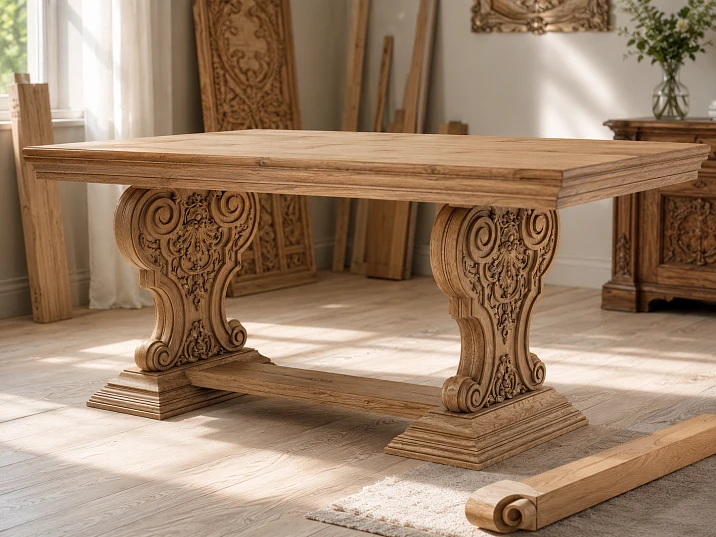
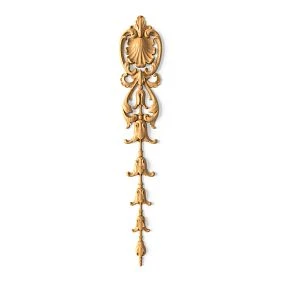
The large carved support, 740 mm high, creates a deceptive impression of a finished structure. In the photo, MN-244 looks monumental: a wide top, expressive volutes and acanthus leaves, and a massive pedestal at the bottom. It seems that all you need to do is choose a tabletop, place it on top, and the table is ready. This is exactly where the most expensive ordering mistake occurs. One product item MN-244 means one wooden support, not a fully assembled underframe, not a ready-made frame, and not a table with all connections.
A buyer who wants buy carved support MN-244, should count not only the number of decorative elements. It is necessary to determine in advance the material and dimensions of the tabletop, the number of supports, their position, the connecting structure, the upper mounting points, the finishing treatment, the assembly method on site, and delivery conditions. The card directly indicates: the table structure uses two or more supports, and for greater stability it is recommended to connect them with additional structural elements.
Hence the main practical answer. For a typical rectangular composition, the starting point is two MN-244 units, but the word "two" cannot be turned into a universal norm for any tabletop. A long conference table, a heavy stone slab, a complex kitchen island shape, or non-standard operational loads may require a different scheme. The full order is formed not by multiplying the price of one support by two, but by the design of the entire load-bearing system.
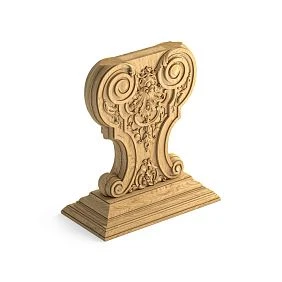
One MN-244 is one carved leg, not a ready-made underframe




Why the photograph is misleading
MN-244 is not like a typical furniture leg with a small cross-section. Its architectural form occupies significant volume, and the lower pedestal visually creates the impression of an independent base. The upper composition is assembled from profile rods, volutes, and acanthus leaves. The lower part looks heavy and stable. The eye perceives the element almost as half of a finished underframe, and sometimes as the central base for the entire tabletop.
However, visual massiveness does not change the product's essence. A separate carved support is placed in the cart. It does not have an automatically matched second support, cross connection, longitudinal frame, tabletop, or coordinated mounting point. Even when one element seems wide enough, the ability of the future table to resist tipping, rocking, and deflection is determined by the entire structure.
Our factory also produces:
What does the quantity "1" in the cart mean
The quantity "1" means one physical element MN-244 of the selected material and surface preparation option. It does not mean:
-
a pair of supports;
-
a base for a rectangular table;
-
assembled power frame;
-
tabletop;
-
fastening kit for a specific tabletop;
-
finished painting;
-
calculated stability of the future table;
-
installation at the site.
This difference seems obvious after explanation, but before payment it is easy to miss. In the product card, the buyer sees a large item, chooses beech or oak, looks at the price of one position, and mentally completes the finished table. The correct sequence is the reverse: first determine the table structure, then the quantity of MN-244, and only then place the order.
Get Consultation
Where the boundary between support and underframe lies
A separate support takes part of the load and sets the decorative image. The underframe is a more complete system, which already provides for the mutual position of elements, connections between them, and the geometry of the base. The frame performs a power function: it holds the supports in a given position, distributes the load, and helps the structure maintain rigidity.
Therefore, MN-244 cannot automatically be called a ready-made underframe. For a buyer who needs a pre-developed base, it is useful to compare individual carved elements with the possibility Buy wooden furniture. This is not an offer to replace MN-244 with any model from the category. The comparison helps to understand the difference between an author's project on separate supports and a structure with already specified geometry.
Confirmed characteristics of MN-244 without guesses
Brief table for the first check
| Parameter | Confirmed value | What does this change in the order |
|---|---|---|
| Article number | MN-244 | The specification requires an exact article number |
| Item type | One carved wooden support | Quantity is calculated according to the table design |
| Dimensions A × B × C × D × E | 740 × 650 × 337 × 442 × 77 mm | All five parameters are verified against the current drawing |
| Material | Beech or oak | Determines the finishing scenario and combination with other wooden parts |
| Sanding quality | «Prestige» | Surface is prepared with detailed machine and hand sanding |
| Preparation of the selected configuration | For enamel | This is not a finished paint color or a specification of a specific color |
| Application in the structure | Two or more supports | One MN-244 does not form a complete table |
| Additional recommendation | Connect the supports with structural elements | A separate design of the connecting structure is required |
| Tabletop | Not included automatically | Material, shape, dimensions, and weight are specified separately |
| Mounting | Determined by the project | Universal fasteners cannot be assigned without assembly drawings |
The table deliberately does not decode each letter parameter as width, depth, or mounting footprint. This requires an actual drawing. The external dimension line helps assess the scale but does not replace checking contours, cross-sections, and junction points.
A height of 740 mm is not yet equal to the height of the finished table
Parameter A is 740 mm, and the card positions MN-244 as a support with a height of 740 mm. But the final table height depends not only on this value. The calculation includes the thickness of the tabletop, the design of the upper connection, possible intermediate plates or frame elements, as well as the actual floor level.
A simple formula for a preliminary check looks like this:
H_table = H_support + H_upper_assembly + T_tabletop
Where:
-
H_table — final height of the work surface;
-
H_support — height of the selected support;
-
H_upper_assembly — thickness of the structure between the support and the tabletop, if provided;
-
T_tabletop — thickness of the slab.
If the upper tie is located between MN-244 and the tabletop, you cannot simply add 740 mm and the slab thickness without looking at the cross-section. That is why the base drawing should appear before the final order.
Why you cannot assign meanings to B, C, D, and E on your own
The five numbers on the card are not a ready-made assembly diagram. Matching one parameter with the width of a proposed drawer side or the thickness of a metal part does not prove compatibility. The letter designations must be read together with drawing MN-244.
Before designing, it is useful to look at drawing MN-244, 740 × 650 mm and get answers from the designer to four questions:
-
Where does the support plane of the tabletop pass?
-
Which surfaces allow fastening?
-
Which zone must not be weakened by drilling?
-
Where should the connecting structure run to avoid conflicting with the threads?
Until these answers are obtained, the dimension line remains a means of selection and layout, but not a drilling instruction.
Two supports are a starting point, not a universal answer
Typical paired composition
For a rectangular table MN-244, it is naturally perceived as an end architectural support. Two identical parts are placed along the long axis of the tabletop, set back from the ends. Free space appears between them for those seated, and the carved elements themselves form expressive end accents.
This scheme is suitable as a starting composition for:
-
dining table;
-
executive desk;
-
kitchen island;
-
conference table;
-
reception desk;
-
large console structure.
But in each case, the slab length, its mass, user positions, edge overhang, and operational load change. Therefore, two MN-244 units represent a compositional idea, not a ready-made engineering solution.
The quantity formula starts with the project.
The simplest notation looks like this:
Q = Qedge + Qadditional
Where:
-
Q — total number of MN-244 units;
-
Qedge — number of main supports, most often two in a paired configuration;
-
Qadditional — supports added by the project due to length, shape, or load.
For a short rectangular tabletop, the project may settle on two supports. For an extended structure, a third may appear. For a complex stand with a turn, a different arrangement may be needed. The formula does not automatically produce a quantity: it forces a separation of the base composition from additional requirements.
Why the phrase "two or more" requires caution
If the card says "two or more," it means that a single support is not considered a complete table configuration. But from this phrase, one cannot conclude that two MN-244 units are suitable for any length or any tabletop material.
The number increases not for decorative symmetry, but for constructive reasons:
-
the span between supports grows;
-
the mass of the slab increases;
-
the load distribution changes;
-
there is a risk of deflection of the tabletop or frame;
-
complex geometry requires an additional support point;
-
users apply load not only to the center;
-
the reception desk receives equipment, cable channels, and internal modules.
The exact solution is made by the designer. The article helps prepare the initial data, but does not replace the calculation of the load-bearing system.
Why you can't just multiply the price of MN-244 by two
The second support is just the beginning of the configuration
When the buyer realizes that a pair is needed, a new simplified logic emerges: "So, I take two pieces — and the issue is closed." In reality, two items only solve the quantity of decorative supports. The full order includes several independent groups.
The first group is the MN-244 pair itself. The second is the tabletop. The third is the structural connections between the supports. The fourth is the mounting nodes to the slab. The fifth is the finishing. The sixth is packaging, delivery, and assembly on site. Missing any group can halt the installation.
Full order composition
| Order part | What to specify | Why it cannot be left "for later" |
| MN-244 | Quantity, beech or oak, quality, surface preparation | The supports must be coordinated with each other |
| Tabletop | Material, length, width, thickness, shape, weight | The entire load-bearing scheme depends on it |
| Power connection | Material, cross-section, position, connection method | Without connection, individual supports do not form a rigid base |
| Top node | Support plane, fasteners, embedded parts, permissible drilling zones | An error may damage the support or the tabletop |
| Floor protection | Feet, shims, or other design solution | Determined by the floor construction and covering |
| Finishing | Color, opaque or transparent system, sample | Two large parts should look like a single set |
| Installation | Assembly order, access, tools, responsibility | Large parts are easier to coordinate before delivery |
| Logistics | Passage dimensions, floor, elevator, assembly location | Monumental parts require a real delivery plan |
Not all items are necessarily sold as a single set in one card. The buyer's task is to combine them into one specification and ensure that every project participant sees the same version.
The cost of the base is calculated after the composition is fixed
A correct financial model looks like this:
Cbase = Csupport + Cconnections + Cfastening + Cfinishing + Cdelivery + Cassembly
The price of one MN-244 helps to estimate only the first part. Even the cost of a pair does not show the budget of the finished base. The difference is especially noticeable with a heavy tabletop, a custom metal frame, complex painting, or installation in a commercial space.
The article intentionally does not include current prices: they may change. Before placing an order, it is better check the price of the carved support MN-244 in the card of the selected material and separately request a calculation of the remaining components.
The tabletop determines more than it seems
The slab material changes the task
The card allows the use of MN-244 with heavy tabletops made of wood, stone, and metal. This is a valuable characteristic, but it cannot be read as permission to install any slab on two supports without calculation.
A wooden tabletop has its own structure, grain direction, thickness, and requirements for compensating seasonal changes. A stone slab requires uniform support and control of local stresses. A metal structure can be visually thin but may need hidden reinforcement. Composite solutions also differ in rigidity and fastening method.
Therefore, the phrase "compatible with heavy tabletops" means the potential for use in a corresponding project. It does not cancel the development of the frame.
Which tabletop parameters to record before choosing the distance
For the project, at minimum:
-
length;
-
width;
-
thickness;
-
material;
-
approximate weight;
-
contour shape;
-
presence of overhangs;
-
location of cutouts;
-
expected load;
-
table purpose;
-
points where people will lean on the edge.
The customer can buy a tabletop for wooden supports in a separate category, but the mere fact that products are on the same site does not automatically confirm compatibility. MN-244 and a specific tabletop need to be combined in a project.
Overhangs cannot be assigned just for a beautiful photo
The end overhang affects seating and the table's appearance, but also creates a lever. The farther the tabletop edge extends beyond the support, the stronger the structure reacts to load at the edge. If a person leans on the end, the force is transmitted differently than with evenly placed dishes.
Therefore, the distance from the edge of the slab to MN-244 is determined not by aesthetics alone. You need to simultaneously check:
-
stability;
-
seating comfort;
-
opening of kitchen island cabinets;
-
passages around the table;
-
visual balance;
-
possibility of installing connecting elements;
-
absence of conflict with the knees of those sitting.
There is no universal overhang in millimeters for all projects.
A power connection turns two supports into a base
Why connect MN-244 to each other
Two separate supports can take vertical load, but a table works not only vertically. It is pushed, a chair is pulled by the edge, people lean on the tabletop, and heavy objects are moved across it. Horizontal forces and moments arise that tend to change the relative position of the supports.
The connecting element solves several tasks:
-
maintains the distance between MN-244;
-
prevents the supports from turning;
-
reduces swaying;
-
distributes part of the load;
-
creates a base for attaching the tabletop;
-
helps maintain geometry during transportation and use.
The card recommends additional structural elements precisely for this reason. Their shape, material, and cross-section cannot be assigned based on a general description.
What can serve as a connection
The project may use wooden aprons, a hidden metal frame, longitudinal beams, a frame under the tabletop, or a combined system. The list does not mean that any of the options is compatible with MN-244 without modification. It shows the range of structural approaches.
When choosing, evaluate:
-
tabletop weight;
-
span;
-
height of the connection placement;
-
visibility of the structure;
-
method of connection to supports;
-
access to fasteners;
-
impact on seating;
-
compatibility with carved relief;
-
transportation conditions.
A buyer who needs a ready-made engineering base will find it useful buy a table frame or compare ready-made frames with a custom system on MN-244. The link leads to another category of structures, not to an automatically compatible component.
Where communication cannot be carried out without a drawing
MN-244 has a complex three-dimensional shape. The upper carved composition and the lower pedestal should not be perceived as random places for drilling. You cannot choose a connection point just because it looks flat in a photo.
Before manufacturing the frame, verify:
-
current DWG;
-
actual terrain;
-
available wood thickness;
-
direction of force;
-
fastener position;
-
ability to hide the connection;
-
assembly technology;
-
permissibility of a demountable joint.
If the designer does not see the drawing, it is too early to order a metal frame or a wooden apron.
How to determine the distance between two MN-244
The distance is measured not "by the beautiful center"
The position of the supports depends on the contours of the tabletop and the MN-244 itself. For a sketch, axes are used, but for verification, real dimensions are needed. Two supports can be beautifully spaced by centers and at the same time conflict with mounting points, island cabinets, or the power frame.
It is convenient to keep four dimensions:
-
distance between support axes;
-
clear space between the nearest protruding contours;
-
end overhang of the tabletop;
-
distance from the support to the longitudinal edge of the slab.
Each dimension serves its own purpose. The center-to-center distance is convenient for the designer. The clear opening shows space for legs or equipment. The overhang affects stability and appearance. The side offset helps assess the table's silhouette.
Preliminary layout formula
For a rectangular tabletop, we can write:
L = Sл + X1 + M + X2 + Sп
Where:
-
L — tabletop length;
-
Sл and Sп — left and right end overhangs;
-
X1 and X2 — design zones occupied by supports along the length direction;
-
M is the clear distance between supports.
The formula does not specify what each number should be. It helps verify that all parts actually fit within the given length. The values of X1 and X2 are taken from the drawing and the orientation of MN-244, not assigned based on a photo.
Why identical overhangs do not always mean the correct layout
Symmetry suits most rectangular tables, but a kitchen island may have cabinets on one side and seating on the other. A reception desk often includes a work area, internal shelves, and cable channels. A conference table may receive equipment in the central part. In such projects, the geometric symmetry of decorative supports must align with the functional content.
The solution is fixed on the plan and section. After that, it is possible to coordinate the distance between two MN-244 within the design project and structural detailing.
When two MN-244 may not be enough
Long conference table
With a long tabletop, the span between the outermost supports increases. Even if the MN-244 themselves are rated for high loads, the tabletop or the connecting structure may sag between them. A third support, an additional frame, or reinforcement is chosen by calculation.
You cannot use the length of a neighboring project as a ready-made standard. Two countertops of the same length but different thickness and material behave differently.
Stone slab
Stone is heavy and sensitive to uneven support. The support must be part of a system that distributes the load and does not create dangerous local zones. For a stone countertop, the following are especially important:
-
support map;
-
frame rigidity;
-
flatness tolerances;
-
transportation scheme;
-
installation sequence;
-
accessibility to fasteners.
The phrase "two MN-244 for a stone countertop" without a project is too short for a safe order.
Kitchen island with filling
An island is not just a countertop. Inside there can be cabinets, appliances, utilities, a sink, outlets, and storage systems. Carved supports must match the body and not interfere with the opening of facades. Sometimes the internal furniture frame takes on the load-bearing function, while MN-244 works as a visible part of the overall system. In another scheme, the supports participate more actively in the load-bearing work.
Before purchasing, you need an island plan, a section, and a list of equipment.
Reception desk
The reception desk receives uneven loads: equipment is placed on the staff side, visitors lean on the outer edge, and cables run inside. Two MN-244 units can form an expressive facade composition, but the internal frame must account for the working part of the desk. Sometimes more supports or a separate hidden frame are required.
Table of complex shape
An oval, trapezoidal, L-shaped, or asymmetrical tabletop requires an analysis of the center of gravity and load zones. You cannot arrange MN-244 units according to the rules of a regular rectangle. The quantity and orientation are determined by the plan.
MN-244 for different scenarios: one product, different specifications
Dining table
For a dining table, seating comfort, distance between supports, and end overhangs are important. The carved relief should not conflict with the knees of those seated. The height of the finished table is checked together with the tabletop and the top connection. If the chairs have armrests, their position relative to the edge is additionally assessed.
A typical request includes a pair of MN-244 units, a tabletop, a load-bearing connection, mounting points, and finishing. But the dimensions of all elements depend on the number of seats.
Executive table
In the MN-244 office, the architectural scale is set. The tabletop can be deeper than usual, and inside there may be a cable channel, socket blocks, and cabinets. The designer must see the equipment before developing the connections. Otherwise, the longitudinal beam will end up where the cables are or restrict access to service elements.
Kitchen island
For the island, not only loads matter, but also the humidity regime, cleaning, and interaction with facades and the tabletop. Wooden supports are finished with a system consistent with the room's conditions. If the island is painted with an opaque enamel, both MN-244 units are ordered in one batch and a common test paint-out is done.
Meeting room
A conference table is often longer than a dining table. In the center, there may be a hatch for connecting equipment. The power frame must bypass communications and simultaneously support a large slab. Here, the logic of "the card recommends two — so two will be enough" is especially dangerous. The project may require a third support point or a reinforced frame.
Reception
In the reception area, MN-244 can work as a front decorative element visible to visitors. The internal frame and work tabletop remain a separate system. The order is formed considering the external facade, internal equipment, and installation route.
Beech or oak: choice within the full project
When beech is more logical
Beech is often chosen for opaque finishes. The even color of the enamel unites the carved relief with other table elements, furniture, and interior decor. If the project involves white, graphite, deep blue, or another opaque color, beech becomes a clear base.
But the phrase "beech under enamel" does not mean that the finished color is already included in the card. You need to specify separately:
-
color sample;
-
gloss level;
-
the material system;
-
what surfaces are finished;
-
who performs the work;
-
how connection zones are protected.
For purchasing consumables, you can order materials for painting beech, but the specific system is selected for the project.
When oak reveals the task better
Oak is chosen when the composition should show natural texture. This is especially appropriate next to a wooden countertop, oak panels, doors, or other carved decor. The shade is coordinated with a test sample because the wood has natural variations.
You cannot order two supports at different times and expect a perfect match without coordination. For a paired composition, it is reasonable to order MN-244 in beech or oak in one batch, specifying a single finishing scenario.
Why the wood species of the supports should be coordinated with the countertop
The wood species does not have to literally match. Beech supports can be painted and combined with stone. Oak ones can be tinted next to a wooden slab. What matters more is deciding in advance which material remains visible and which is covered with enamel.
An uncoordinated order leads to a typical problem: the countertop is already approved in natural oak, but the supports are purchased in the "under enamel" category without a requirement for texture matching. Or vice versa: a more expensive oak is ordered, but then the entire relief is covered with dense paint, even though the project does not use its grain.
"Prestige" — surface preparation, not a finished finish
For MN-244, the quality of "Prestige" sanding is confirmed. It includes machine and detailed manual processing of hard-to-reach areas. The relief is prepared for the application of paint and varnish materials, but sanding does not replace primer, painting, tinting, oil, or varnish.
Before ordering, it is useful find out what "Prestige" sanding means and separately specify the finish.
What to buy together with MN-244
Not a random list of products, but a set of project tasks
The accompanying purchase should cover a specific stage. The countertop covers the work surface. The frame or individual structural elements provide rigidity. Finishing materials provide color and wood protection. The design project covers layout. Delivery ensures safe movement of large parts.
| What to add to the order | What it is for | What to check before payment | Relevant page |
| Second MN-244 | Form a basic paired composition | Same material, batch, and finish | Buy two MN-244 for a table |
| Tabletop | Get a work surface | Material, dimensions, weight, thickness, overhangs | choose a tabletop for the table |
| Support frame | Connect the legs and distribute the load | Compatibility with MN-244 is confirmed by the project | Select a support base for the tabletop |
| Finishing materials | Paint or tint the legs | Material compatibility and test color sample | Purchase materials for finishing carved supports |
| Project | Determine the quantity, distance, and nodes | Transfer data regarding the tabletop and the room | Order a table project with MN-244 supports |
| Delivery | Transport large wooden parts | Address, floor, elevator, passages, delivery into the premises | Order MN-244 with Contact us to confirm shipping to your destination. |
The table does not guarantee that a ready-made frame from the category will fit MN-244 without modifications. It shows which solutions need to be considered and agreed upon.
Are support pads needed
Protecting the floor and the lower part of the support is important, but a specific support pad is not specified in the SEO scheme as a confirmed compatible item. Therefore, random hardware cannot be automatically added. The designer must determine the contact area, floor material, fixing method, and the permissibility of drilling the base.
Is a spare copy needed
For a paired composition, a spare large support is not added mechanically. The decision depends on the project scale, deadlines, the possibility of re-manufacturing, and the requirements of a commercial facility. It is much more important to order both main MN-244 units in one batch, check them before finishing, and agree on the color on a common sample.
MN-244 or a ready-made table base
When a project with separate carved supports is justified
MN-244 is chosen when an expressive architectural composition is needed, and the base is designed specifically for the tabletop. The buyer gets freedom:
-
choose the distance between supports;
-
create a hidden structural system;
-
link the shape to the interior;
-
use a non-standard tabletop;
-
integrate the supports into a kitchen island or reception desk;
-
choose your own finish.
The price of this freedom is the need for design.
When a ready-made base is more sensible
A ready-made underframe is more rational if the priority is a pre-designed structure with specific geometry. This does not mean that any underframe fits any tabletop. But the amount of individual design is usually less than when assembling a base from independent decorative supports.
| Criterion | MN-244 as part of an individual project | Ready-made table base |
| Decorative freedom | High | Limited by the chosen model |
| Geometry | Developed for the project | Defined by the product's construction |
| Structural connections | Designed separately | Usually included in the underframe system |
| Order complexity | Higher | Below |
| Non-standard tabletop | Possible after calculation | Checked by underframe parameters |
| Installation | Requires coordinated nodes | Depends on the finished model |
| Suitable for those who want | Author's monumental table | A more ready-made base |
Useful for a buyer who does not plan individual engineering development to choose a ready-made underframe for the tabletop.
How not to confuse MN-244 with a regular leg
The usual four-support logic doesn't work here
For many tables, the buyer takes four separate legs and attaches them to the corners of the frame. MN-244 is designed for a different composition. It is a wide architectural support that usually participates in an end or paired scheme. There's no need to multiply it by four out of habit.
If the project requires traditional separate elements, it's better to first open the section where you can Buy wooden table legs, and compare models by design.
Height doesn't make products interchangeable
Two supports can have the same height, but completely different cross-sections, top platform shape, load direction, and method of integration into the frame. Therefore, a request for a "carved support 740 mm" is insufficient to replace MN-244 with another model.
Compare:
-
all dimensions;
-
a drawing;
-
support shape;
-
material;
-
location of carving;
-
connection method;
-
finishing;
-
role in the structure.
Carved shape is not just decoration
The relief determines where accessible zones for connections remain and how the frame will look. A rail run through a decorative pattern can ruin the composition. A hidden frame may require a different installation level. Therefore, the designer and engineer must work with a single drawing.
For comparison of artistic solutions, you can buy carved furniture legs, but MN-244 remains a separate large model with its own scenario.
Installation begins not with drilling, but with an assembly project
What drawings are needed
The minimum package includes:
-
Tabletop plan with dimensions.
-
Front view with MN-244 position.
-
Side view.
-
Longitudinal section through supports and connection.
-
Cross section.
-
Support attachment unit to the power system.
-
Tabletop attachment unit.
-
Disassembly diagram for transportation.
-
Parts marking.
-
Assembly order on site.
Without these documents, the installer is forced to make decisions on site. For a large carved part, this is a risk of damage and uncoordinated rework.
Dry assembly before finishing
Before painting or tinting, it is useful to check the connections on a dry assembly. The goal is to ensure that:
-
both supports are in the same plane;
-
the distance matches the project;
-
the frame assembles without stress;
-
the fasteners are accessible;
-
the tabletop rests according to the intended scheme;
-
the threads do not conflict with the beams;
-
the structure can be disassembled for transport.
After final finishing, fixing holes and trimming parts is much more difficult.
What cannot be solved with mounting foam or random glue
The power connection is not replaced by a decorative adhesive joint. MN-244 is involved in the base of a heavy table, so mounting materials are selected by design. The gap cannot be compensated with a thick layer of random compound or by gluing the support to the tabletop without a confirmed joint.
Category where collected materials for mounting wooden furniture, useful for assembly, but the specific product must match the materials and the nature of the joint.
Finishing the MN-244 pair without color mismatch
Both supports are checked together
Paired elements are in the same field of view. Differences in shade, gloss, or degree of relief emphasis are more noticeable than on distant parts. Therefore, both
Error 2. Buying two supports without a tabletop in the project
Without slab data, the distance and connections cannot be assigned. Fix: attach the tabletop drawing.
Error 3. Considering a heavy support a guarantee of a stable table
Stability depends on the entire system. Fix: calculate the frame, overhangs, and fasteners.
Error 4. Set the distance based on an interior image
Perspective distorts sizes. Fix: work with the plan and section.
Error 5. Order the frame separately without drawing MN-244
A ready-made frame may conflict with the terrain. Fix: send the DWG to the frame designer.
Error 6. Mistake 'Prestige' for a finished coating
This is surface preparation quality. Fix: specify the finish separately.
Error 7. Buy oak and cover it with opaque enamel without a reason
The project may not use the texture. Fix: choose the visual concept in advance.
Error 8. Order supports at different times
Batches may differ in wood and preparation. Fix: arrange a pair at the same time.
Error 9. Not checking the height of the finished table
740 mm plus the tabletop and top assembly can give an unwanted mark. Fix: calculate the full cut.
Error 10. Not accounting for clearance
Large parts do not fit the route. Fix: measure doors and elevator.
Error 11. Making a non-disassemblable structure in the workshop
The base cannot be brought in. Fix: develop assembly on site.
Error 12. Drilling a carved support without an agreed joint
You can weaken the part or damage the ornament. Fix: work according to the drawing.
Error 13. Considering two supports sufficient for any length
A large span requires calculation. Fix: check the deflection of the tabletop and frame.
Error 14. Not coordinating the position of users
The support interferes with legs or chairs. Fix: mark seating positions on the plan.
Error 15. Leaving mounting hardware "at the assembler's discretion"
The site may lack the necessary embedded parts and access. Fix: include the components in the specification.
Who MN-244 suits, and who should choose a different base
MN-244 is suitable for
-
a buyer who wants a monumental classic table;
-
a project with a custom-designed tabletop;
-
a kitchen island with architectural decor;
-
executive meeting room;
-
reception desk with an expressive facade;
-
interior where carved supports remain visible;
-
client ready to approve the frame and installation;
-
project where two supports are ordered as one batch.
It is better to choose a different solution
-
when a maximally simple table without custom design is needed;
-
when tabletop dimensions are unknown;
-
when it is impossible to manufacture a connecting frame;
-
when the room does not allow bringing in large elements;
-
when a visually lightweight structure is needed;
-
when the budget is calculated only for two supports and does not account for other work;
-
when the installer plans to attach parts without a drawing;
-
when the customer expects a ready-made underframe from a single product item.
In the latter case, it is more reasonable to look at ready-made frames and underframes rather than trying to turn MN-244 into something it is not.
Full specification of order MN-244
Block 1. Carved supports
The entry must be unambiguous:
Carved support MN-244 — ___ pcs.
Size A × B × C × D × E — 740 × 650 × 337 × 442 × 77 mm.
Material — beech / oak.
Sanding quality — "Prestige".
Surface preparation — according to the selected card line.
Finish — specify separately.
Batch completeness — for one table.
For a typical paired scheme, indicate 2 pcs. in the quantity, but only after project confirmation.
Block 2. Tabletop
Need to record:
-
article or drawing;
-
material;
-
length;
-
width;
-
thickness;
-
shape;
-
mass;
-
finishing;
-
narrowings;
-
position of cable channels;
-
permissible mounting zones.
Block 3. Power structure
The specification records:
-
frame type;
-
material;
-
sections;
-
distance between MN-244;
-
height of tie placement;
-
method of attachment to supports;
-
method of tabletop attachment;
-
possibility of disassembly;
-
part markings;
-
person responsible for the calculation.
Block 4. Finishing
Required:
-
color code or physical color sample;
-
gloss level;
-
covering or transparent system;
-
test coating;
-
performer;
-
protection scheme for installation zones;
-
procedure for repairing the covering after assembly.
Block 5. Logistics and installation
They record:
-
address;
-
floor;
-
availability of an elevator;
-
dimensions of passages;
-
assembly location;
-
room readiness date;
-
responsible installer;
-
sequence of bringing in;
-
packaging requirements;
-
need for storage before assembly.
Ready sequence of actions before purchase
Step 1. Fix the purpose
Dining table, island, conference table, and reception desk have different loads and internal structure.
Step 2. Approve the tabletop
Without the stove, it is impossible to position the supports precisely.
Step 3. Download drawing MN-244
All five dimensions and relief are checked against DWG.
Step 4. Draw the plan and section
Supports, overhangs, seating areas, and connections appear on them.
Step 5. Determine the quantity
Two supports is the base scenario; a larger number is assigned by the project.
Step 6. Develop the structural connection
The material and joints are chosen by the designer.
Step 7. Calculate the final height
The support, top joint, and tabletop are added together.
Step 8. Choose beech or oak
The decision is made together with the finishing.
Step 9. Make a test stain
Especially for paired parts and complex relief.
Step 10. Check delivery
The delivery route is measured before payment.
Step 11. Create a single specification
All participants receive one document.
Step 12. Only after this place the order
When the composition is determined, you can Buy two MN-244 for a table and order the remaining elements without a gap between the decorative idea and the construction.
How to buy on STAVROS without cannibalization and random selection
The buyer does not need to limit themselves to one card. Card MN-244 is responsible for a specific model. The general catalog helps buy furniture legs and compare different types of supports. The section of unpainted models allows Buy wooden furniture legs For self-finishing. The category of table supports addresses the broad request "buy table legs", while under-tables and frames show more ready-made structural solutions.
For MN-244, the design route is especially important:
-
Support card.
-
Drawing and dimension check.
-
Tabletop.
-
Structural frame.
-
finishing.
-
Delivery.
-
assembly.
Thus, internal pages do not compete but help the buyer move from product selection to a complete request.
If the tabletop has changed, order MN-244 is recalculated.
Material replacement is not a cosmetic edit.
The project may start with a wooden tabletop and end with a stone one. Visually, the customer sees the same shape and the same size, so they tend to leave the base unchanged. Structurally, this is already a different task. The mass, support characteristics, plane requirements, permissible attachment zones, and slab behavior under local load all change.
After changing the material, re-check:
-
quantity of MN-244;
-
distance between supports;
-
the power frame diagram;
-
support area;
-
upper mounting points;
-
possibility of disassembly;
-
sequence of bringing in;
-
permissibility of installing the tabletop in the room.
There is no need to automatically cancel the approved decision. New initial data should be returned to the designer and confirmation obtained that the previous scheme remains suitable.
Increasing the length changes the span
The customer may add several tens of centimeters to the tabletop for an additional seating place. For the interior, the difference looks small. For the structure, the span increases, overhangs and load position change. Sometimes two supports remain sufficient after reinforcing the frame. Sometimes a third support point appears. The article does not set a boundary because it depends on the material and cross-section of the entire system.
It is useful to create a table of changes:
| What has changed | What to double-check | Who confirms |
| Tabletop length | Span, overhangs, number of supports | Construction set |
| Width | Stability, side clearances, seating | Constructor and designer |
| Thickness | Final height, fasteners | Construction set |
| Material | Mass, support map, nodes | Countertop manufacturer and constructor |
| Shape | Center of gravity, MN-244 arrangement | Construction set |
| Cutouts | Slab weakening, frame position | Countertop manufacturer |
| Purpose | Operational loads | Client and designer |
Such a log prevents old dimensions from unnoticedly transitioning into the new furniture variant.
Changes to the room also affect the base
The table could have been designed for a free dining area and then moved to a conference room with a narrow passage. The product dimensions did not change, but restrictions on delivery and assembly appeared. A non-detachable joint, convenient in the workshop, may not fit through the door. Then the structure needs to be divided into transport modules without losing rigidity after assembly.
Before final ordering, it is useful to compare the room plan with the actual layout:
-
door opening;
-
radiators;
-
with sockets;
-
floor hatches;
-
with lamps above the table;
-
with movement routes;
-
with the position of chairs;
-
with a place for assembly tools.
A monumental support requires space not only after installation, but also during assembly.
Trial assembly shows what is not visible in a beautiful sketch
First one structure, then a series
For a single table, dry assembly serves as the final check. For a series of tables, it becomes a mandatory control stage. You cannot immediately drill and finish all supports using an unverified jig. The first pair of MN-244, the first frame, and one tabletop must show that the project assembles without force and matches the interior design intent.
During trial assembly, the following are checked:
-
actual height;
-
horizontality of the surface;
-
parallelism of supports;
-
identical end overhang;
-
absence of rocking;
-
access to fasteners;
-
possibility of tightening connections;
-
position of the thread relative to the side rails;
-
seating comfort;
-
disassembly without damaging the coating.
If the design passes the check, the dimensions are transferred to the working jig and serial documentation.
What to record in the protocol
A photo of the finished table is not enough. A short protocol with numbers and decisions is needed:
-
Actual distance between axes MN-244.
-
Clear span between supports.
-
Height of the top surface.
-
Dimensions of end and side overhangs.
-
Position of the frame relative to the thread.
-
Fastener part numbers per the project.
-
tightening sequence.
-
Comments on finishing.
-
Result of stability check per the adopted design methodology.
-
Confirmation of transition to series production.
The protocol does not replace the calculation but prevents discrepancies between the approved sample and subsequent products.
Why the first pair cannot be considered consumable material.
An experimental build does not mean that MN-244 is allowed to be drilled thoughtlessly in different places. The first pair remains a commercial part of the project. All test holes and nodes must be provided in advance by the drawing. If a technological model for testing is needed, its status is agreed upon separately.
It is more beneficial for the buyer to spend time on a prepared sample than to fix several already painted supports.
How to control the order of several tables with MN-244
The quantity is counted by tables and additional supports
For a series, the formula is used:
Qtotal = Ntables × Qper table + Qadditional
Where:
-
Qtotal — total quantity of MN-244;
-
Ntables — number of identical tables;
-
Qper table — quantity of supports per table confirmed by the project;
-
Qadditional — additional elements, if their necessity is justified by the contract and the project technology.
For example, for four identical tables with two supports each, the base quantity is eight MN-244. But that's arithmetic after the design is approved, not proof that two supports per table are sufficient.
Marking preserves pairing
Even identical supports from the same batch are easier to distribute into sets before finishing. The marking can include the table number and side: "Table 1 — left", "Table 1 — right". It helps avoid mixing up parts after a test coat, dry assembly, or joint fitting.
The marking is applied in a way that does not damage the visible surface and remains hidden after installation.
One color standard for the entire batch
For opaque painting, a color and gloss sample is approved. For transparent finishing, the acceptable range of natural wood variations is additionally agreed upon. Lighting in the workshop and at the site differs, so the control sample must accompany the batch until acceptance.
Two common mistakes in a series:
-
the first pair is painted according to the sample, and the rest — "from memory";
-
supports and tabletops are finished by different contractors without a shared standard.
Both mistakes are noticeable in a large room where tables stand next to each other.
Series logistics requires its own scheme
Several MN-244 units take up significant space. The packaging is numbered, and the unloading order is linked to the installation sequence. The supports of the first table should not end up deep inside the vehicle under the parts of the last one. For a commercial project, it is useful to determine in advance:
-
temporary storage space;
-
protection from construction dust;
-
temperature conditions;
-
a person responsible for acceptance;
-
the procedure for handing over to installers;
-
a ban on unpacking without recording the condition.
Conditions for delivery of carved furniture supports are agreed upon based on the actual batch volume, not just the number of line items.
Readiness matrix: can the order already be placed
Green zone
The order is ready when the following conditions are met simultaneously:
-
countertop approved;
-
quantity MN-244 confirmed;
-
distance between supports marked on the drawing;
-
power connection calculated;
-
mounting points developed;
-
final height checked;
-
material and finish selected;
-
Dry assembly planned;
-
the delivery route has been measured;
-
the specification has been signed by the responsible parties.
In this situation, card MN-244 becomes a point of purchase, not a source of missing design solutions.
Yellow zone
The order can be preliminarily calculated, but it is too early to launch it into final assembly when:
-
the overall size of the countertop is known, but not its weight;
-
a pair of supports has been chosen, but the frame has not been developed;
-
the color has been approved, but there is no test swatch;
-
the address is clear, but the passageways have not been measured;
-
there is a sketch, but the connection nodes are missing.
The yellow zone does not mean rejecting the product. It shows which issues need to be resolved before paying for the entire system.
Red zone
An order cannot be considered complete if the buyer only knows the article number and the quantity "2". The following phrasings are especially dangerous:
-
"we'll pick the fasteners on site";
-
"we'll set the distance according to the countertop";
-
"the mason will decide himself how to support the slab";
-
"we'll choose the enamel after assembly";
-
"if it wobbles, we'll add a crossbar";
-
"we'll somehow carry it through the door."
Each phrase shifts the design task to the most expensive and inconvenient stage.
What the buyer receives when the order is assembled correctly
A full specification does not complicate the purchase, it removes uncertainty. The buyer sees in advance how many carved supports are required, which tabletop works with them, who is responsible for the power system, and in what form the parts will arrive at the site.
For the designer, this means preserving proportions and ornament. For the engineer, clear input data. For the finisher, a single sample. For the installer, accessible nodes and assembly sequence. For the client, a budget that accounts for more than just the cost of two beautiful parts.
MN-244 is revealed precisely in such a project. Its large form is not masked by random aprons, the supports are not placed at different distances, the tabletop does not look like it was placed on top, and the entire structure reads as a single piece of furniture.
Changing one item after approval destroys the set
One support cannot be replaced without re-verification
Sometimes after confirming an order, there is a desire to replace just one MN-244: switch beech to oak, choose a different preparation option, postpone the production of the second part to a later date. Formally, the article number remains the same, but the paired composition loses its unified initial conditions.
They re-check:
-
the material of both supports;
-
surface preparation quality;
-
belonging to the same version of the drawing;
-
location of mounting zones;
-
color and character of the finish;
-
compliance with the frame;
-
marking of the set.
If one part is already drilled or finished, the new one must match not only the product card but also the actually manufactured specimen.
Changing the number of supports affects the entire frame
Adding a third MN-244 is not just a new line in the invoice. The distances between elements, the load transfer scheme, the position of transverse and longitudinal ties, mounting points, and the external rhythm of the table all change. Sometimes the tabletop or internal frame needs to be reworked.
The same applies to removing a support. You cannot exclude the central element just because it visually seems redundant. If a third point appeared in the calculation, its function must be understood and preserved.
A new finish requires a new sample
Even a slight change in gloss level affects the perception of large carvings. A matte surface softens highlights, while a glossy one emphasizes every facet and possible unevenness. When switching from opaque enamel to a transparent system, the requirements for wood selection change.
A previously approved sample ceases to be the reference if the following have changed:
-
wood species;
-
primer;
-
toning compound;
-
enamel;
-
lacquer;
-
gloss level;
-
application technology.
The corrected specification must reach the supplier, finisher, and installer simultaneously. An oral message to one participant is not considered a project change.
Checklist before invoice payment
Before paying, it is useful to read the invoice not as an accounting document, but as a description of the future table. It or the attached specification should provide clear answers:
-
How many physical MN-244 units are being paid for?
-
What wood species will each support be made from?
-
Which dimensional line is selected?
-
What surface preparation is specified?
-
Is finishing included?
-
Where is the tabletop described?
-
Who develops the structural connections?
-
Where is the distance between supports fixed?
-
Which document defines the fastening units?
-
Who is responsible for assembly?
-
In what form is the structure transported?
-
What are the conditions for bringing in and storage?
If the invoice contains only "MN-244 — 2 pcs.", it confirms the purchase of a pair of carved supports, but does not confirm the full table set. Other solutions must exist in the project documentation or a separate request.
It is especially useful to compare the invoice with the component list line by line. The invoice may reflect only sold items, while the project additionally includes a frame manufactured by a third-party contractor, embedded parts, fasteners, and installation work. This is normal if the boundaries of responsibility are recorded. What is dangerous is the opposite: assuming that missing lines are automatically included in the price of MN-244.
Next to each part, a responsible person is assigned: STAVROS supplies the agreed supports, the tabletop manufacturer is responsible for the slab, the designer for the structural scheme, the finisher for the coating, and the installer for assembly according to the drawing. Then the question "who should have provided for the connection" does not arise after delivery.
FAQ: answers before ordering MN-244
Can I assemble a table on a single MN-244?
No, the card indicates the use of two or more supports. One MN-244 item is a single separate element, not a finished table base.
How many MN-244 units should I order for a rectangular table?
A pair is usually the starting point, but the final quantity is determined by the project. The length, weight, shape of the tabletop, and frame layout may require more than two supports.
Is MN-244 a leg or an underframe?
It is a carved support. An underframe is a more complete system in which supports are connected and arranged according to a specified geometry.
Is the tabletop included in the price of MN-244?
There is no reason to consider the tabletop part of a single item. It is selected and calculated separately.
Is the connecting frame included?
The card recommends connecting the supports with additional structural elements, but a finished custom frame should not be considered automatically included. Its composition is agreed upon separately.
What dimensions does MN-244 have?
The dimension line A × B × C × D × E is 740 × 650 × 337 × 442 × 77 mm. The purpose of each letter parameter is checked against the current drawing.
Can a stone countertop be installed on MN-244?
The card allows heavy countertops made of various materials, including stone. However, the number of supports, the support map, and the structural frame must be calculated for the specific slab.
Is MN-244 suitable for a kitchen island?
Yes, such use is specified in the description. The island body, facades, equipment, utilities, and load-bearing scheme need to be coordinated.
Is the support suitable for a reception desk?
Yes, MN-244 can be used in commercial spaces and reception desks. The internal working frame is designed separately.
What to choose — beech or oak?
Beech is convenient for covering enamel, oak for finishes that preserve texture. The choice depends on the approved appearance of the table.
Does "Prestige" mean ready-made paint?
No. "Prestige" refers to the quality of surface sanding. The finish coating needs to be specified separately.
Can I order one support as a sample?
Technically, the possibility of purchase and current availability are checked in the product card or with a manager. But for a paired table, a sample does not replace ordering two matched elements from the same batch.
Do I need to order a spare MN-244?
There is no automatic spare for a large support. The decision depends on the project, timelines, and site requirements.
How do I determine the distance between two supports?
Based on the tabletop plan, MN-244 dimensions, required overhangs, mounting points, and frame calculation. There is no universal distance.
Can I attach the tabletop directly to MN-244?
Only if such a joint is provided by the project and confirmed by a drawing. Drilling cannot be assigned based on a photo.
Are tsargs needed?
A connecting structure is needed, but it can be wooden, metal, or combined. The specific type is determined by the designer.
Can I use a ready-made frame from the catalog?
It can be considered as an alternative or a basis for comparison. Automatic compatibility with MN-244 must be confirmed by dimensions and joints.
How to calculate the height of a finished table?
Add the height of the support, the thickness of the top connecting joint, and the thickness of the tabletop. All values are taken from the section view.
Do the supports need to be painted before assembly?
The order depends on the joints. Usually, a dry assembly and a trial fitting before finishing are useful, and mounting areas are protected according to the finishing map.
Why is it better to order both supports together?
This makes it easier to match the wood, sanding, dimensions, and finish of paired elements. Separate orders increase the risk of visual differences.
What to check upon receipt?
Article, quantity, material, dimensions, surface, absence of damage, belonging to the same batch, and compliance with the specification.
How to prepare for delivery?
Measure the doors, elevator, stair landings, and assembly area. Decide in advance in what form the frame and tabletop will arrive.
Where can I see other options?
You can compare models in the sections for furniture legs, unfinished legs, carved legs, table legs, and ready-made underframes.
What should I write to the manager before getting a quote?
Specify the quantity of MN-244, material, tabletop, table purpose, distance per the project, type of power connection, finish, address, and delivery conditions.
First assemble the table specification, then order MN-244 from STAVROS.
MN-244 should be chosen not as a single striking detail, but as part of a pre-planned structure. One item means one carved support. For a table, two or more are used, and the number is not determined solely by length or photos. First, fix the tabletop, calculate the placement of supports, develop the power connection, check the final height, choose beech or oak, agree on the finish and assembly route.
There is one critical limitation: the massive shape of MN-244 does not turn it into a ready-made underframe. Stability is created by the entire assembly—supports, frame, fasteners, and tabletop. Therefore, the next step before payment is to provide STAVROS with a unified specification and project drawings, and then order all agreed elements as one system. This approach preserves the expressiveness of the carved composition and does not leave the installer with the task of assembling a heavy table from unrelated solutions.