Article Contents:
- One MN-186 card actually contains six different purposes
- Why the identical silhouette is misleading
- What the top section means
- Size F cannot be ignored
- Example with a bedside table
- Same height, but different proportion
- Example with a coffee table
- Example with a dining table
- Example with a tall kitchen countertop
- Bedside table
- TV cabinet
- Shoe rack and hallway furniture
- When 250 mm is better than 160 mm
- Bench or a small piece for the hallway
- Low table
- Countertop 20, 30, or 50 mm
- Square, round, or rectangular table
- Bedside table without a cabinet
- Armrest level as a practical reference point
- Coffee table in the bedroom or study
- Small console surface
- Why 450 mm cannot be "stretched" to a dining table with a cabinet
- Dining table
- Desk
- Kitchen table
- Makeup table
- Why 890 mm is not yet a universal bar counter
- High kitchen table
- Display and trade table
- Semi-bar table at kitchen island
- Heavy facade and short legs
- Smooth facade and high legs
- Narrow tall body
- Wide low body
- Beech for opaque enamel
- Oak for tinting
- Can oak be painted or beech tinted
- One batch — one material and one color standard
- Handles matching the supports
- When four supports may be enough
- Fifth support under the cabinet
- Six legs for a long table
- Legs for bar and high tables
- Formula for the cost of a set
- One FUR-001 per leg
- Why the mounting unit is included in the height
- When other fasteners are needed
- The foot cap adds thickness
- Why a similar number is more dangerous than a similar shape
- How to write MN-186 in a cost estimate
- Bedroom
- Living Room
- Entry Hall
- Kitchen and dining room
- Office
- Cafe, showroom, or store
- Furniture design from scratch
- Mistake 1. Ordering by photo without height
- Mistake 2. Assuming 740 mm is the finished table height
- Mistake 3. Using 850 mm with a regular dining chair without checking
- Mistake 4. Placing 350 mm under a finished tall cabinet
- Mistake 5. Replacing 160 mm with 250 mm for cleaning convenience
- Mistake 6. Not considering the top cross-section of 70 × 70 or 80 × 80 mm
- Mistake 7. Specifying only the article number without the material
- Mistake 8. Counting the mounting hardware as part of the leg
- Mistake 9. Buying one FUR-001 for four legs
- Error 10. Forget the glides
- Error 11. Install different glides
- Error 12. Not providing central support for a wide cabinet
- Error 13. Add a fifth MN-186 automatically
- Error 14. Confuse MN-186 and MN-186-1
- Error 15. Mistake MN-186-2 for the tall version of the main leg
- Error 16. Order four legs at different times
- Error 17. Paint without a test swatch
- Error 18. Assume oak is mandatory for staining, and beech only for enamel
- Error 19. Design a high table without aprons and ties
- Error 20. Failed to check delivery of high supports
- How many heights does the main MN-186 have?
- Which MN-186 is suitable for a bedside table?
- Can I place MN-186 350 mm on a cabinet?
- Which version is suitable for a coffee table?
- Will 740 mm work for a dining table?
- Is 850 mm a bar height?
- What is the difference between 160 mm and 250 mm with the same final cabinet height?
- What is the top section of MN-186?
- What is size F?
- Can MN-186 be ordered in beech?
- Is there an MN-186 in oak?
- Is the mounting hardware included in the price of the leg?
- How many FUR-001 are needed for four legs?
- Is FUR-027 needed?
- Does a wide cabinet always need a fifth leg?
- Can four MN-186 850 mm be used without a tsarga?
- Can MN-186 be shortened after purchase?
- How not to confuse MN-186 with MN-186-1?
- Is MN-186-2 a version of the 2100 mm main leg?
- Where can I see all options for furniture legs?
- How do I calculate the final cost?
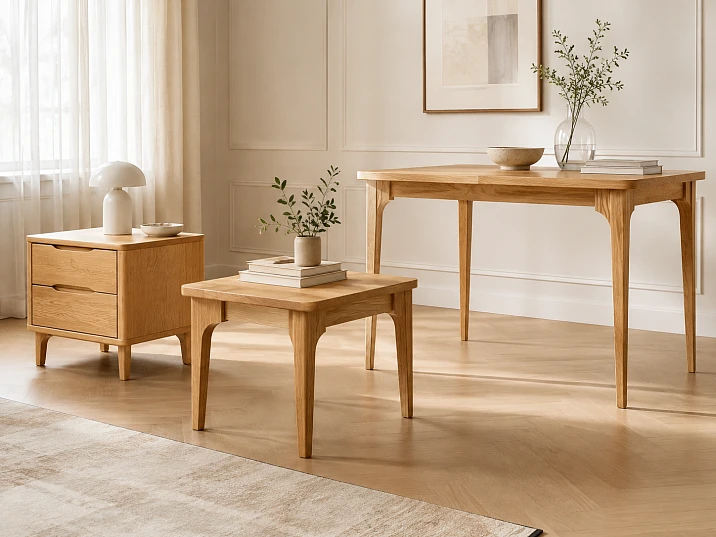
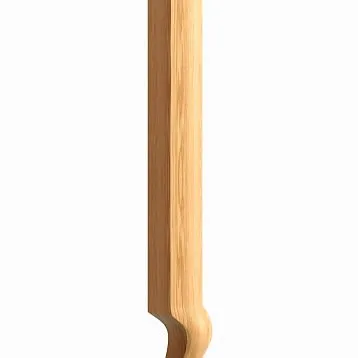
In the photo, all MN-186 variants look related: strict geometry, calm tapering, a clean wooden shape without carved ornament. Because of this, it is easy to think that you are looking at the same furniture leg that only slightly changes in height. In practice, the difference between 160, 350, and 850 mm changes not a detail, but the entire future piece of furniture. The first version lifts a cabinet or small chest of drawers above the floor, medium sizes form a coffee or side table, and tall supports already belong to a dining, writing, or enlarged kitchen table.
Therefore, the request to buy furniture legs for a cabinet cannot be fulfilled by choosing the most beautiful photo. First, you need to calculate what height the finished body should be, where the tabletop will be, how high the bottom edge will rise, and whether the selected support will fit on the mounting plate. Only after that does it become clear whether an MN-186 with a height of 160 mm is needed, a more expressive version of 250 mm, or a leg from the dining group altogether.
The model has six confirmed heights: 160, 250, 350, 450, 740, and 850 mm. These are not decorative variations of one small detail, but a sequential size range for different tasks. If a bedside cabinet body with a height of 390 mm is placed on an MN-186 160 mm, the furniture will be approximately 550 mm without considering the mounting assembly. If the same cabinet is raised on 350 mm legs, the top will be at approximately 740 mm — a familiar bedside item will turn into a tall console structure with completely different proportions.
Before buy furniture leg MN-186You need to link three numbers: the height of the support, the height of the body or the thickness of the tabletop, and the size of the mounting unit. This article does not repeat the general overview of furniture legs. It consistently breaks down all six sizes of one item, shows what furniture results from each choice, how to calculate a set of four, five, or six supports, and what to add to the order so that beautiful wooden parts do not remain without fastening and floor protection.
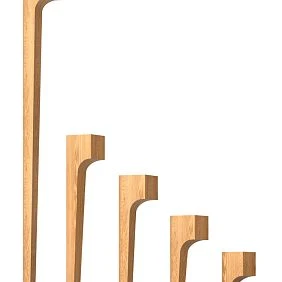
One MN-186 card actually contains six different purposes
The buyer sees a single item number and a general silhouette, but the furniture maker reads the card differently. For them, each size line is a separate design position. A height of 160 mm cannot automatically replace 250 mm, and 450 mm cannot be ordered instead of 740 mm just because the shape matches. The final furniture level, the lateral load lever, the scale of the body, and the requirements for the internal structural scheme all change.
MN-186 belongs to geometric wooden supports. The card allows you to choose beech or oak. Fasteners are selected separately: the leg itself should not be perceived as a ready-made mounting kit. For ordering, not only height A matters, but also the top section B × C, as well as size F, indicated in the drawing of the specific line.
| Height of MN-186 | Top section B × C | Size F per drawing | Most understandable purpose | What to calculate before ordering |
|---|---|---|---|---|
| 160 мм | 70 × 70 mm | 60 мм | Nightstand, TV stand, shoe cabinet, small dresser | Body height, floor clearance, mounting location |
| 250 мм | 80 × 80 mm | 60 мм | Low body on pronounced legs, accent cabinet, bench, low table | Proportion of body and support, stability, central support |
| 350 мм | 80 × 80 mm | 60 мм | Low coffee or side table | Tabletop thickness, final 370–400 mm, mounting positions |
| 450 мм | 80 × 80 mm | 60 мм | Higher coffee, side, or sofa table | Level relative to sofa and armchair seat |
| 740 мм | 80 × 80 mm | 80 мм | Dining, writing, work, or kitchen table | Tabletop thickness, apron or underframe, final level |
| 850 мм | 80 × 80 mm | 80 мм | High kitchen, semi-bar, display, or work table | Full height, seat position selection, stability of the tall structure |
The table shows why the word "MN-186" without a size is insufficient for specification. The position must contain the article number, height, material, and the selected surface preparation option. For a batch, the quantity and a uniform finish are also recorded. The entry "legs MN-186 — 4 pcs." leaves too much uncertainty: it is impossible to understand from it whether supports are being ordered for a cabinet, a coffee table, or a high table.
After selecting a row, you can find out the price of MN-186 in beech and oak in the product card. There is no need to record the changing price in the article: the cost depends on the specific height, material, and available preparation. The working estimate is based on the current card, not on an old screenshot.




Why the same silhouette is misleading
A person perceives the shape as a whole and underestimates the scale. On screen, a leg 160 mm high can look almost as slender as the 740 mm version, because the photos are adjusted to fit the card. In a room, the difference of 580 mm becomes decisive. A low support reads as a base of the body; a tall one turns into an independent table architecture.
There is also a second misconception. The buyer thinks: "I'll take a taller leg and make the body lower." Sometimes this is indeed possible, but the furniture changes character. A cabinet with a body of 390 mm and legs of 160 mm looks stable and assembled. A body of 300 mm on legs of 250 mm gives the same total height of 550 mm, but visually becomes lighter, and the supports become more noticeable. There is no error here if the proportion is chosen deliberately. The error begins when the height of the legs is changed after the finished body, without recalculating the center of gravity, fastening, and drawer positions.
Our factory also produces:
What the top section means
B × C shows the dimensions of the top mounting part of the leg. For MN-186 with a height of 160 mm, a section of 70 × 70 mm is confirmed; for the other five options, it is 80 × 80 mm. This number needs to be transferred to the bottom plane of the body or the tabletop. If the mounting platform is narrower, intersects with a guide, falls on an edge, or is near a cutout, the leg may not fit even with the correct height.
It cannot be assumed that the top platform equals the finished mounting zone with any margin. The selected hardware, holes, grain direction, base thickness, and tool access must be considered. The exact offsets are determined by the cabinetmaker based on the construction drawing.
Get Consultation
Size F cannot be ignored
In the card for the four smaller variants, F is specified as 60 mm; for heights 740 and 850 mm, F is 80 mm. You should not invent a universal household name for this parameter if it is not confirmed by the drawing. What practically matters is different: when transferring the product to production, the dimensions line must be copied in full, not just leaving height A. The cabinetmaker must see the specific configuration to which the leg shape is tied.
The formula that separates a beautiful leg from correctly calculated furniture
The main calculation is simple:
Final furniture height = height of MN-186 + height of the body or tabletop thickness + size of the mounting assembly.
If the leg is attached directly to the bottom plane of the body, the full body is added to its height. If it is a table, the tabletop thickness and all elements between it and the support are added: mounting plate, under-table, apron, insert part. If the floor glide adds noticeable height, it is also taken into account.
The formula is not needed for academic precision, but to answer a practical question: where will the top surface end up after assembly? Without it, you could buy excellent wooden supports and end up with a nightstand higher than the mattress, a coffee table at dining table level, or a kitchen surface that doesn't suit the chosen chair.
Example with a bedside table
Body — 390 mm. Legs — 160 mm. The additional mounting assembly does not protrude beyond the calculated plane.
390 + 160 = 550 mm.
The resulting 550 mm is compared not with an abstract "normal bedside table height," but with a specific bed. The base, mattress, and mattress topper are taken into account. The top of the bedside table can be at the level of the top of the mattress, lower, or slightly higher — this depends on the user's habits and the design. The main thing is that the solution is visible in numbers in advance.
Same height, but different proportion
Body — 300 mm. Legs — 250 mm.
300 + 250 = 550 mm.
The sum matches, but the piece looks different. The body becomes more compact, a large airy gap appears underneath, and the geometric supports read as a full-fledged part of the design. Such a bedside table suits an interior where lightness and visible floor are important. But its fasteners and stability need to be calculated as a tall support scheme, not as a regular low plinth.
Example with a coffee table
Tabletop — 30 mm. MN-186 — 350 mm.
350 + 30 = 380 mm without accounting for additional parts.
For a low sofa area, this can be a convenient level. If you choose 450 mm with the same tabletop, you get:
450 + 30 = 480 mm.
The 100 mm difference is noticeable: the second table is closer to the armrest height and can work as a side table. Therefore, the request to buy legs for a coffee table needs to be clarified through the desired final height, not just through the furniture name.
Example with a dining table
Tabletop — 30 mm. MN-186 — 740 mm.
740 + 30 = 770 mm without accounting for the protruding mounting assembly.
So, the entry "table 740 mm" is incorrect: 740 mm is only the leg. The finished surface will be higher. If there is a thick frame or an additional plate under the tabletop, the total will increase even more. At the same time, the free space for knees decreases, because not only the upper but also the lower mark of the apron is important.
Example with a high kitchen surface
Tabletop — 40 mm. MN-186 — 850 mm.
850 + 40 = 890 mm without accounting for the under-table structure.
This is a tall kitchen or work table, but not automatically a full bar counter. For bar seating, you need to separately match the finished height with the chair and the room design. A selection where you can buy legs for a tall and bar table, are used for comparison, and the purpose of a specific MN-186 is confirmed by a full calculation.
After checking the formula, you can order a set of MN-186 legs of the required height, specifying in the order not only the quantity, but also the size line. This protects against the most unpleasant mistake: getting four beautiful supports of the correct article number, but not the right height.
MN-186 with a height of 160 mm: cabinet, chest of drawers, and case furniture above the floor
The 160 mm version is the most understandable for case furniture. It lifts the cabinet above the floor, leaves a gap for cleaning, and makes the base visually lighter, but does not turn the legs into the main vertical accent. The top section of 70 × 70 mm is more compact than other options, so it is especially important to match it with the bottom panel of the body and corner areas.
Such supports are considered for a bedside table, TV stand, shoe cabinet, small chest of drawers, low cabinet, or a unit in the hallway. However, the word "for a cabinet" does not give a ready-made solution. First, determine the height of the drawer or body itself. If it is already tall, adding 160 mm may raise the furniture above a comfortable level.
Bedside table
The main reference is the mattress. The cabinet is needed not to match a catalog standard, but for real hand movement: to put down a phone, place a glass, turn on the light. A body of 390 mm on 160 mm legs gives about 550 mm. A body of 450 mm gives about 610 mm. Both options can be suitable for different beds.
You cannot choose legs after manufacturing the cabinet if the final height has not been verified. Before ordering, place a box or a stack of books next to the bed at the calculated level and assess the position of the top surface. Such a trial detects an error faster than a visualization without scale.
TV cabinet
For a TV cabinet, not only the screen height matters. Cables may run under the cabinet, outlets or a robot vacuum may be located there. A clearance of 160 mm creates noticeable free space, but the actual passage will be smaller if the lower part of the leg widens, there is a central support, or the cabinet has an overhang.
A wide TV cabinet may require internal support. Four MN-186 legs at the corners do not guarantee that a long bottom will not sag. The solution depends on length, material, thickness, partitions, and load. The central support does not have to be a fifth decorative MN-186: a hidden element under the cabinet may have a different design if it is provided for in the project.
Shoe rack and hallway furniture
In the hallway, the clearance helps remove sand and moisture, but wooden legs should not constantly stand in water. The floor protector protects the lower end and the floor, but does not turn solid wood into a moisture-resistant building material. If wet cleaning is intensive, the finish and care rules need to be agreed upon.
For a finished cabinet, it is more convenient to first open the selection and buy wooden legs for the cabinet after comparing not only the height, but also the mounting plate. MN-186 160 mm is suitable when the geometric silhouette supports the facade and the final height of the furniture remains convenient.
MN-186 250 mm high: low cabinet on expressive legs
A 250 mm leg changes the balance. It no longer hides under the cabinet and is not perceived as a small lift above the floor. Almost a quarter meter of wood becomes a noticeable part of the facade. Therefore, this option is especially sensitive to proportion: a heavy tall cabinet may look unstable, while a small low drawer may look light and modern.
Suitable scenarios include a low-profile cabinet, accent furniture in the hallway, a small bench, a lightweight dresser, a bedside table, or a low console. With a 300 mm body, the total without protruding fasteners will be 550 mm. This is the same height as a 390 mm body on 160 mm legs, but the visual result is different.
When 250 mm is better than 160 mm
The 250 mm version is appropriate if you need to:
-
show the geometry of the legs rather than hide it under the body;
-
leave a large gap and a visible section of the floor;
-
make the low cabinet visually lighter;
-
support the vertical lines of handles or front panel layouts;
-
separate the body from a high baseboard or decorative wall panel.
After the list, it is important to check the flip side. The higher the leg relative to the body, the more noticeable any misalignment becomes, and the more carefully the mounting must be designed. You cannot simply replace 160 mm with 250 mm in a finished cabinet without recalculating stability.
Bench or small piece for the hallway
The seat height consists of the leg, frame, base, and soft layer. MN-186 250 mm can only be used as part of such a calculation. It cannot be declared a ready-made "banquette leg" without data on seat thickness and frame construction. If the upper part adds 180–220 mm, the result changes significantly.
Low table
With a 30 mm tabletop, you get approximately 280 mm. This is a very low surface, not suitable for every sofa group. It can work as a podium coffee table or stand, but it will not replace a regular coffee table about 380–480 mm high, which is achieved with the 350 and 450 mm versions.
MN-186 350 mm high: a low coffee table without accidental seating
The 350 mm version moves MN-186 from the cabinet group into small-format dining geometry. With a 30 mm thick tabletop, the finished surface will be at approximately 380 mm. This is no longer a floor stand, but not yet a tall side table. This size is especially convenient next to a low sofa, deep armchair, or lounge area, where a person picks up a cup, book, or remote without raising their hand too high.
However, the phrase "coffee table" does not specify a single height. Sofas differ in seating, armrests in level, and tabletops in thickness. Therefore, MN-186 350 mm is chosen after measuring the room. Sit on the sofa and note the comfortable palm height. Then subtract the tabletop thickness and protruding elements of the underframe. Compare the resulting value with 350 mm.
Tabletop 20, 30, or 50 mm
On the same leg, you can get different items:
-
350 + 20 = 370 mm;
-
350 + 30 = 380 mm;
-
350 + 50 = 400 mm.
Thirty millimeters of difference are clearly noticeable next to low upholstered furniture. A thick tabletop simultaneously raises the top mark and visually weighs down the item. If an additional frame is used, its size is also added. Therefore, legs cannot be ordered separately from the top drawing.
Square, round, or rectangular table
The shape of the tabletop affects the placement of supports. For a square item, four MN-186 legs usually read as an extension of the corners. For a round table, you have to determine the support square inside the circle so that the legs do not protrude beyond the edge and are not too close to the center. For a long rectangular table, you need to assess the deflection of the tabletop and possible fifth or sixth support.
The number of supports is not determined by the word "coffee." A small square can get by with four, a long surface may require a different frame. The acceptable scheme is confirmed by the designer, taking into account the material and load.
Bedside table without a cabinet
MN-186 350 mm can be combined with a small tabletop to create an open bedside table. With a thickness of 30 mm, the total of 380 mm may be lower than a standard bed. This is not a mistake if the user wants a low surface, but the result needs to be compared with the mattress in advance. For a higher level closer to 480 mm, it is more logical to consider the 450 mm version.
A selection where you can to buy legs for a coffee table, helps compare MN-186 with other supports by height and shape. The point of switching is not to replace the selected item with a random model, but to check: whether 350 mm really suits your sofa area.
MN-186 450 mm high: side, coffee, and sofa table
At a height of 450 mm, the same geometric shape becomes noticeably more vertical. With a 30 mm tabletop, the total is about 480 mm. Such an item can stand by an armrest, next to a chair, by a bed, or between two seating positions. Unlike a low coffee table, it more often serves one person and takes up less space.
Armrest level as a practical reference
A side table is convenient to use when its top is near the armrest or slightly below. Then a cup can be placed with a sideways motion. If the surface is significantly higher, the arm rises; if lower, you have to lean over. The measurement is taken on the actual furniture, not from a photo of the interior.
Suppose the chair armrest is at a height of 500 mm. MN-186 450 mm plus a 30 mm tabletop gives 480 mm. A difference of 20 mm can be comfortable. If you add a thick frame of 40 mm, the top rises to 520 mm. The same item will then be above the armrest. Hence the conclusion: the mounting assembly cannot be left out of the formula.
Coffee table in the bedroom or study
A height of about 470–500 mm works well next to a chair, but is not always suitable for the center of a sofa group. In the center, a large table can block the view and look too tall. Against a wall or next to a chair, the same height feels natural. The placement changes the meaning of the size.
Small console surface
A table on four legs at 450 mm can be used as a stand for decor, flowers, or a table lamp. But it does not become a full console for work. If a table for sitting at is needed, you move to a height of 740 mm and recalculate the legroom.
Why 450 mm cannot be "stretched" to a dining table with a body
Theoretically, you can add a tall box or thick under-table to 450 mm legs and get a top at 740–760 mm. In practice, this will be a different structure: a massive lower part, little knee space, and a different center of gravity. You cannot assume that any height is achieved by arbitrarily increasing the body. MN-186 450 mm is logical where the upper part remains relatively compact.
MN-186 with a height of 740 mm: a full-fledged table starts with calculating the tabletop
A height of 740 mm applies to dining, writing, working, and kitchen tables. But this is the height of the leg, not the finished surface. With a 30 mm tabletop, the result will be about 770 mm. If there is a frame, mounting plate, or apron between the leg and the tabletop, the top may be even higher.
To order wooden table legs without error, you need to check four levels:
-
floor;
-
lower edge of the apron or under-table;
-
top of the tabletop;
-
seat height of the chair.
These marks are related. The top may look familiar, but a thick apron will take away space for knees. Or the table may be comfortable for one chair and too high for another.
Dining table
For a dining group, the connection with chairs is important. You should not focus only on the overall height. Measure the seat, the thickness of the tabletop, and the lower edge of the under-table. A person should be able to freely place their legs, and elbows should naturally rest on the surface.
If a 740 mm leg is connected to a 30 mm tabletop without any noticeable additional lift, the result is 770 mm. This may be acceptable for a tall dining group, but the specific seating must be checked with a chair. With a 50 mm tabletop, it will be 790 mm. The 20 mm difference already changes the feel.
Desk
For a writing desk, in addition to height, drawers, cable trays, and cross braces must be considered. They take up space under the tabletop. The upper section of MN-186, 80 × 80 mm, needs to be positioned so that the fasteners do not conflict with the slides and internal blocks.
If a cabinet is planned under the table, the four supports may be distributed asymmetrically, or part of the load will transfer to the cabinet body. In such a project, you cannot simply order four identical legs at the corners. First, draw a load diagram.
Kitchen table
In the kitchen, wet cleaning, moving chairs, and possible lateral loads are important. The bottom end is protected with a floor glide, and the wood finish is selected with maintenance in mind. However, a floor glide does not eliminate the need to wipe up water and does not replace a suitable coating.
Vanity table
MN-186 740 mm can be used for a vanity or console table if the final height suits the stool and mirror. Here, a narrower body is often needed, so it is especially important whether the upper section of 80 × 80 mm fits in depth. On a narrow tabletop, the leg may end up too close to the edge.
MN-186 with a height of 850 mm: high kitchen and semi-bar level
The 850 mm version raises the surface into a separate functional zone. With a 40 mm tabletop, it comes to about 890 mm. This is the level of increased working height, a high kitchen table, a display surface, or a semi-bar solution. But the term "semi-bar" itself does not replace the seating calculation.
Why 890 mm is not yet a universal bar counter
Bar counters come in different heights, and chairs have different seat heights. If the tabletop on MN-186 850 mm ends up at 890–920 mm, it needs a matching chair. A regular dining chair may be too low, a classic tall bar stool may be too high. Before purchasing, compare the actual "table—seat" pair.
High kitchen table
For a tall person, an increased work surface may be more convenient than a standard one. But if different family members use the table, a height of 850 mm legs plus tabletop may be inconvenient for some users. The decision is made based on the scenario: constant standing work, quick breakfasts, cutting surface, or seating on high chairs.
Display and trade table
In a showroom or store, a high table helps place samples closer to eye level. Here, not only height but also stability is calculated, especially if visitors lean on the edge. The MN-186 card does not provide a universal allowable load, so the underframe and connections are designed separately.
Semi-bar table at the kitchen island
If the table adjoins the island, matching the top marks is important. Measure the finished kitchen including the countertop, not the nominal cabinet size. Then calculate MN-186 850 mm plus the selected top. Even a difference of 10–20 mm will be noticeable on a long joint.
Comparison of all six heights on one conditional piece of furniture
To see the difference without abstractions, let's take two types of tops: a 300 mm cabinet and a 30 mm countertop. These are not recommendations, but a demonstration of scale.
| MN-186 | With a 300 mm cabinet | With a 30 mm countertop | How the result is perceived |
| 160 мм | 460 мм | 190 мм | Low cabinet or very low stand |
| 250 мм | 550 мм | 280 мм | Accent cabinet or podium table |
| 350 мм | 650 мм | 380 мм | Tall cabinet or low coffee table |
| 450 мм | 750 мм | 480 мм | Console body or side table |
| 740 мм | 1040 мм | 770 мм | The body turns into a tall cabinet; the tabletop becomes a full-fledged table |
| 850 мм | 1150 мм | 880 мм | Very tall body; the tabletop is a high work surface |
The table shows why one body cannot be transferred between all versions. MN-186 740 and 850 mm are intended for tabletops or specially designed structures, not for a regular cabinet 300–400 mm high. Similarly, 160 mm does not create a full table without a huge upper block that would change the entire furniture architecture.
Proportion of body and legs: the same sum does not produce the same item
Height is not the only criterion. What matters is what share goes to the body and what to the supports. Consider the total of 550 mm:
-
body 390 mm + MN-186 160 mm;
-
body 300 mm + MN-186 250 mm.
The first item looks more massive and calm. The second is light, elevated, with expressive verticals. Functionally, both can be a bedside table, but they suit different facades and rooms.
Heavy facade and short legs
If the body has large panels, a massive tabletop, or dark finish, the short 160 mm version supports a sense of stability. The legs remain noticeable but do not compete with the facade.
Smooth facade and high legs
A minimalist drawer without ornament pairs well with 250 mm: the geometric support becomes the main pattern. Air remains under the body, and the furniture visually takes up less floor space.
Narrow tall body
The narrower and taller the item, the more carefully the legs should be increased. A tall cabinet on 250 mm supports may require wall mounting and a different structural scheme. MN-186 cannot be chosen as a decorative addition without assessing the stability of the entire item.
Wide low body
A long cabinet on four legs can look impressive, but the bottom between the corners experiences stress. Internal partitions, back panel, material, and central support become more important than visual symmetry. The article cannot give a universal width threshold: it depends on the construction.
Beech or oak: the material is chosen together with the future finish
MN-186 is available in beech and oak. Both options retain the same geometry, but the surface and grain character differ. The choice of material should be tied to the facade, countertop, handles, and the planned finish.
Beech for opaque enamel
Beech is often considered for light, colored, or dark enamel, when the wood grain should not become the main focus. A smooth, opaque color helps connect the legs to the cabinet facade. However, the "beech-enamel" combination is not a mandatory rule. The available preparation and technology are checked in the product card and coordinated with the finisher.
Oak for tinting
Oak is chosen when you want to preserve an expressive texture. Staining, oil, or varnish can highlight the grain and connect the supports to the countertop. However, the phrase "oak for staining" does not mean a finished coating. The composition, shade, gloss level, and test sample are calculated separately.
Can oak be painted or beech be stained?
There is no categorical prohibition from the dimensional line itself. The decision depends on the available preparation and finishing system. The article shows the most understandable scenarios but does not replace technological consultation. Before ordering, you can choose unpainted furniture legs and compare material options, sanding, and future coating.
One batch — one material and one color standard
For four or six legs, it is better to immediately fix one wood species and one finish. Natural wood does not become absolutely identical, but a single batch and a common finishing cycle help avoid accidental inconsistency. If two legs are purchased later, the shade and grain may differ.
Handles matching the supports
On the MN-186 cabinet, it does not work separately. Geometric legs can be connected to the facade through wooden handles matching the legs. It is not necessary to choose an identical pattern; it is more important to match the wood species, shade, and degree of gloss. If the legs are painted with enamel, the handles can repeat the color or create a deliberate contrast.
Four, five, or six legs: the number is determined by the construction, not by habit
Four corners suggest an obvious answer — four legs. For a small table or a compact cabinet, this can indeed be a working scheme. But wide furniture, a long tabletop, heavy contents, and a weak bottom may require additional support. Therefore, the number of MN-186 cannot be determined only from a photo of the front.
The basic formula is simple:
The number of decorative MN-186 equals the number of visible supports specified in the drawing.
Next, check whether a hidden central or intermediate support is needed. It can be a fifth MN-186, two additional supports, or a part of another structure. The main thing is that all support points are in the same calculated plane and jointly bear the load.
When four supports may be sufficient
Four MN-186 are considered if:
-
the body or tabletop has calculated rigidity;
-
there is no large unsupported span between the corners;
-
Internal partitions transfer the load to the supports;
-
Furniture does not receive heavy concentrated filling;
-
The attachment of each leg is connected to a structural part;
-
The structure is checked before finishing.
This list is not a guarantee. It shows what questions to ask the furniture maker. Without dimensions, material, and load, it cannot be promised that four legs will always be enough.
Fifth support under a cabinet
For a long TV cabinet or dresser, central support reduces the span of the bottom panel. But a fifth decorative leg may be visible from the front and disrupt the rhythm. Therefore, it is often shifted inward or a separate hidden element is used. It is important that the central support actually touches the floor and does not turn out shorter than the corner ones after installing the glides.
Six legs for a long table
Six identical MN-186 can be used on a long rectangular table when two additional supports are included in the underframe. However, their placement should not interfere with those sitting. A middle pair placed without checking may end up exactly where a person's legs or a chair are needed.
Legs for a bar and high table
The higher the structure, the more noticeable the lateral sway. Six supports by themselves do not solve the problem if there are no proper connections between them. A tall table on MN-186 at 850 mm requires designing a frame, aprons, or other underframe. You cannot compensate for the lack of connections by simply increasing the number of legs.
Set cost formula
For ordering, it is convenient to use variables:
-
N — number of MN-186;
-
P — current price of one leg of the selected height and material;
-
K — fasteners per support;
-
Q — floor glide per support;
-
F — batch finishing;
-
D — delivery.
Total = N × P + N × K + N × Q + F + D.
If the hidden central support has a different article number, its cost is added as a separate line. This formula is more honest than writing "leg set" because it shows exactly what is included in the order.
Mounting FUR-001: a separate component, not part of the wood
As necessary hardware for furniture legs, FUR-001 is displayed on product pages. It is a set with an M8 × 60 stud and a metal insert M8 × 13. One product unit serves one threaded connection, so for four legs with this mounting method, four sets are usually counted.
Before buy the FUR-001 mounting kit, need to check:
-
whether MN-186 is provided for this component in the selected configuration;
-
what the mounting part of the body or underframe is made of;
-
whether its thickness is sufficient for the insert;
-
where the edge, joint, groove, or fastener of an adjacent part runs;
-
whether the stud conflicts with a drawer, guide, or tabletop;
-
whether direct mounting suits the furniture geometry.
FUR-001 cannot be considered a universal solution to install MN-186 on any panel. The set creates a threaded connection, but its retention depends on the base. The minimum part thickness, allowable load, and edge distances are determined by the project.
One FUR-001 per leg
If all four MN-186 are attached the same way:
4 legs = 4 sets of FUR-001.
For six supports — six. If the central support has a different joint, FUR-001 is counted only for MN-186. Do not automatically multiply the fasteners by the total number of floor points.
Why the mounting joint is included in the height
The threaded insert is usually in the material, but the structure may include a plate, embedded part, or intermediate block. If these elements create additional lift, it is added to the formula. Even 5–10 mm matter when the table must align with an adjacent surface.
When different fasteners are needed
If the base is thin, a tilt is required, a mounting plate is provided, or the leg fits into a complex frame, the furniture maker may choose a different system. In this section, you can Buy hardware for furniture legs compare studs, threaded inserts, plates, and floor glides, but the final choice is tied to the drawing.
FUR-027: the lower floor glide does not secure the leg, but protects contact with the floor
The felt floor glide FUR-027 with a diameter of 24 mm belongs to the lower part of the support. It does not replace FUR-001 and does not reinforce the upper connection. Its task is to soften the contact of the wood with the flooring and reduce the risk of scratches when moving furniture carefully.
For four legs, usually four glides are needed, if they fit the size of the bottom plate and are provided on each support. For six — six. Before buy felt glide FUR-027, you need to check the bottom end of MN-186 and the final height.
The glide adds thickness
Even a thin bottom element affects the support surface. All legs in one group must receive identical glides. If felt is placed on corner supports, and the central hidden leg o
What to buy together with MN-186
The full order is assembled for each support from top to bottom: mounting, leg, glide. For unfinished wood, a finish is added; for the series, unified delivery and, if necessary, a color sample.
| What to add | Quantity | Why | What to check |
| MN-186 of the selected height | 4, 5, 6 or per drawing | Forms the support scheme and furniture height | A, B × C, F, beech or oak |
| FUR-001 | By the number of legs with this mounting | Connects the support to the prepared base | Thickness of the part, fit of the insert, M8 × 60 |
| FUR-027 | By the number of equipped bottom ends | Protects the floor and the lower part of the leg | Diameter 24 mm, same thickness on all supports |
| Hidden central support | By calculation | Supports a long bottom or tabletop | Height in the same plane as MN-186 |
| Finishing materials | According to technology | Create enamel, tinting, or protective finish | Compatibility of primer, color, and finish |
| Wooden handles | Along the facades | Connect the legs to the body | Breed, color, shine, and sizes |
| Delivery | For the entire order | Allows obtaining one consistent batch | Quantity, length of high legs, packaging, and address |
For self-finishing, you can buy materials for finishing the legs, however, the set of compounds must be technologically compatible. You should not choose primer, enamel, oil, and varnish as independent products only by label color.
MN-186, MN-186-1, and MN-186-2: the suffix changes the product
A mistake in one character can lead to ordering a different geometry. The main MN-186 has six variants: 160, 250, 350, 450, 740, and 850 mm. MN-186-1 is a separate card with dimensions 423, 523, 773, and 813 mm. MN-186-2 is a long support with a height of 2100 mm for a different type of structure.
You cannot shorten the specification to "186" or remove the suffix after verbal discussion. In the order, write the full designation:
-
MN-186 — the selected height from six;
-
MN-186-1 — a specific line in its separate card;
-
MN-186-2 — a separate support of 2100 mm.
Why a similar number is more dangerous than a similar shape
A purchasing employee may decide that "-1" and "-2" denote length variants of the main leg. This is incorrect: these are different products. Even if one of the heights seems close, the drawing and proportions do not match automatically.
How to write MN-186 in the estimate
A good line looks like this:
MN-186, A 740 mm, B × C 80 × 80 mm, F 80 mm, oak, selected preparation, 4 pcs.
For 160 mm:
MN-186, A 160 mm, B × C 70 × 70 mm, F 60 mm, beech, selected preparation, 4 pcs.
Such a record reduces the risk that the supplier, designer, and furniture maker understand the article differently.
Practical selection by rooms and tasks
Bedroom
For a bedside table, 160 or 250 mm is often considered. The first version suits a taller body, the second — a low drawer with an expressive gap. For an open table with a top, you can compare 350 and 450 mm. The main check is the mattress level and hand comfort.
Living room
A TV stand at 160 mm looks elevated but maintains a stable proportion. A coffee table is chosen between 350 and 450 mm based on the sofa. A height of 250 mm suits a low podium table if such seating is planned in the interior.
Hallway
A shoe rack or small dresser can use 160 mm. The 250 mm version suits a low body and makes the legs noticeable. Moisture, sand, baseboard, and cleaning possibilities are taken into account.
Kitchen and dining room
MN-186 740 mm is considered for a regular table, 850 mm — for increased height. The final decision is made after calculating the tabletop and choosing chairs. The name "kitchen table" cannot be used as the only parameter.
Cabinet
For a desk, a height of 740 mm is logical, but drawers and aprons should not reduce legroom. A side table next to an armchair can use 450 mm. Unified geometry allows linking the work and auxiliary items.
Cafe, showroom, or store
For standard tables, 740 mm is considered, for display tables — 850 mm. Commercial interiors require stability calculations, repeatable finishes, and margin. You cannot promise load capacity without a project.
Furniture project from scratch
When the body, tabletop, and supports are developed simultaneously, it is convenient order a furniture project with MN-186 legs. A design project does not replace an engineering calculation, but it helps to agree in advance on scale, heights, finish, and connection with other wooden parts.
Mistakes that make the same MN-186 become the "wrong leg"
Mistake 1. Ordering from a photo without height
The correct article number goes into the cart, but the wrong line.
Fix: write down A, B × C, and F.
Mistake 2. Assuming 740 mm is the finished table height
The countertop raises the surface higher.
Fix: add all layers of the structure.
Mistake 3. Use 850 mm with a regular dining chair without checking
The seating may turn out to be uncomfortable.
Fix: match the top and the seat.
Mistake 4. Set 350 mm under a ready-made tall cabinet
The item turns into an uncomfortable console.
Fix: recalculate the body before purchasing.
Mistake 5. Replace 160 mm with 250 mm for cleaning
Not only the clearance changes, but also stability, proportion, and facade height.
Fix: check the entire item.
Error 6. Do not take into account the top section 70 × 70 or 80 × 80 mm
The leg does not fit on the mounting plate.
Fix: draw the full outline on the drawing.
Error 7. Specify only the article number without the material
Part of the batch may be ordered in a different version.
Fix: specify beech or oak.
Error 8. Consider fasteners as part of the leg
After delivery, there is nothing to assemble the furniture with.
Fix: separate line for FUR-001 or another component.
Error 9. Buy one FUR-001 for four legs
One product unit is not a set for the entire item.
Fix: count by the number of connections.
Error 10. Forget the glides
Wood directly contacts the floor.
Fix: check FUR-027 for each support.
Error 11. Install different glides
The support plane is disrupted.
Fix: one group — one type and thickness.
Error 12. Not providing central support for a wide cabinet
The bottom may sag regardless of the strength of the corner legs.
Fix: calculate the span and partitions.
Error 13. Add a fifth MN-186 automatically
It may interfere with the facade or look random.
Fix: select a hidden support according to the project.
Error 14. Confuse MN-186 and MN-186-1
This results in different geometry and a different size range.
Fix: full designation in the order.
Error 15. Mistake MN-186-2 for the tall version of the main leg
Instead of 850 mm, a separate 2100 mm support is selected.
Fix: do not remove the suffix.
Error 16. Order four legs at different times
Material and shade may vary.
Fix: complete set in one batch.
Error 17. Paint without a test sample
Color on a geometric shape looks different than on a flat sample.
Fix: check the finish on the same wood species.
Error 18. Consider oak mandatory for tinting, and beech only for enamel
The buyer artificially limits available options.
Fix: check the product card and technology.
Error 19. Designing a high table without aprons and ties
Legs may wobble under lateral impact.
Fix: calculate the underframe.
Error 20. Not checking delivery of tall supports
Quantity and packaging are determined after payment.
Fix: in advance order delivery of furniture legs taking into account height and batch.
Who MN-186 suits, and who better to open another selection
MN-186 suits a buyer who needs a unified calm geometry for several types of furniture. One line allows making a cabinet, coffee table, and full table related in shape, changing only height and proportions.
It is worth considering MN-186 when:
-
a modern geometric silhouette is needed;
-
beech or oak is planned;
-
individual finishing is important;
-
the height of the furniture is calculated in advance;
-
fasteners and underframe are designed separately;
-
a set of four or more identical supports is required.
Better buy wooden furniture supports, if a carved classic shape, a round turned leg, an angled mounting, a different height, or a confirmed specialized joint is needed. Choosing another model does not mean that MN-186 is bad; it just needs to match the task.
Checklist before payment
Before placing an order, record:
-
type of furniture;
-
desired finished height;
-
height of the body or thickness of the tabletop;
-
mounting unit and its size;
-
selected MN-186: 160, 250, 350, 450, 740 or 850 mm;
-
B × C and F from the same row;
-
beech or oak;
-
preparation for future finishing;
-
number of visible legs;
-
need for a hidden support;
-
fasteners for each leg;
-
floor protectors;
-
single color sample;
-
delivery of the entire batch.
To control the material and processing, you can check the quality of sanding and re-gluing before final finishing. After acceptance, the legs are inspected, dimensions are checked, and only then are they sent for assembly or painting.
How to place an order for MN-186 at STAVROS
Open the card of the main MN-186 and select the required height. Then specify the material, quantity, and available preparation option. Do not transfer MN-186-1 or MN-186-2 dimensions to the order.
After selecting the product, add the fasteners. If the project uses FUR-001, the number of kits matches the number of corresponding connections. Bottom support pads are counted separately. For long furniture, add hidden support as a separate line.
The next stage is finishing. Agree on the color, transparency, gloss level, and sample. For a set of legs, it is better to process all parts in one cycle.
The final step is delivery. High versions of 740 and 850 mm take up more space than short supports, so batch parameters must be communicated in advance.
Batch control after delivery and before final assembly
Even a precise specification does not cancel acceptance. The set is unpacked before painting and each leg is checked against the order. At this stage, it is easier to detect a mix-up in height, material, or article number than after applying enamel and installing on the finished body.
First, the parts are laid out side by side on a flat surface. The quantity, marking, overall height, top cross-section, and size line are checked. For four identical supports, repeatability is especially important: one leg of a different height or with a different foot will disrupt the support plane of the furniture. If the order includes different sizes of MN-186 for several items, the sets are immediately separated and labeled: for example, "nightstand — 160 mm," "coffee table — 350 mm," "dining table — 740 mm."
Before finishing, a dry fit is done against the template of the mounting area. It is not necessary to immediately screw the fasteners into the finished body. It is enough to check that the cross-section of 70 × 70 or 80 × 80 mm fits in the designated zone, the axis matches the drawing, and the threaded insert or other mating element does not cross the edge, joint, or internal hardware. On a table, the position of the aprons is separately controlled; on a nightstand, the drawer guides and partitions.
A test coating is done on the same wood species and with the same preparation as the main batch. The color is evaluated not only on the flat side but also on the edges of the geometric leg: light falls on them at different angles, so one shade appears lighter or darker. After approving the sample, the coating composition and gloss level are fixed.
Before final assembly, the feet are installed uniformly. If some of the lower elements are thicker, the furniture may wobble even with precise legs. The central hidden support is checked together with the corner ones: it should engage in work, not hang above the floor or lift the middle of the body.
If a discrepancy is found, there is no need to try to file down one leg yourself or compensate for the difference with a random shim. Such a correction changes the geometry, finish, and load distribution. First, the order and drawing are checked, then the solution is agreed with the manufacturer or furniture maker. Acceptance before painting preserves the ability to correct the set without reworking the finished furniture.
Frequently asked questions about MN-186
How many heights does the main MN-186 have?
Six: 160, 250, 350, 450, 740, and 850 mm. MN-186-1 and MN-186-2 are not included in this table.
Which MN-186 is suitable for a nightstand?
More often, 160 and 250 mm are compared. The choice depends on the height of the body and the mattress.
Can the MN-186 350 mm be placed on a nightstand?
Only after calculating the final height and stability. A regular body on such a support may become too tall.
Which version is suitable for a coffee table?
For a low table, 350 mm is usually considered; for a taller side table, 450 mm. The thickness of the tabletop is added separately.
Will 740 mm work for a dining table?
Yes, as the initial leg height. The finished table will be higher by the thickness of the tabletop and mounting elements.
Is 850 mm a bar height?
Not automatically. With a finished tabletop, it will be about 880–920 mm depending on the design; the seating position needs to be matched with the chair.
What is the difference between 160 mm and 250 mm at the same final nightstand height?
By proportion. 160 mm pairs with a taller body, 250 mm makes the legs visually more active and requires a lower body.
What is the top cross-section of MN-186?
For the 160 mm version, it is 70 × 70 mm; for the 250–850 mm variants, it is 80 × 80 mm.
What is size F?
This is a drawing parameter for a specific line: 60 mm for heights 160–450 mm and 80 mm for 740–850 mm. It should be transferred to the specification without renaming it independently.
Can MN-186 be ordered in beech?
Yes. Beech is one of the confirmed materials in the main card.
Is there an MN-186 in oak?
Yes. Oak is also available; the current price and preparation are checked in the card.
Is the mounting hardware included in the leg price?
Fasteners are selected separately. In the order, you need to add a suitable set for each support.
How many FUR-001 are needed for four legs?
Four, if each leg is attached through one FUR-001.
Is FUR-027 needed?
It is needed if it fits the bottom end and is chosen to protect the floor. For four identical legs, four floor glides are usually counted.
Is a fifth leg always needed for a wide cabinet?
No. The need depends on the length, bottom material, partitions, and load. Sometimes a hidden support of a different design is used.
Can four MN-186 850 mm be used without a crossbar?
Such a solution cannot be recommended without calculation. A tall structure must resist lateral swaying.
Can MN-186 be shortened after purchase?
Self-shortening changes the geometry, size F, bottom end, and uniformity of the set. It's better to order a confirmed height.
How not to confuse MN-186 with MN-186-1?
Check the full name of the card and the size chart. The suffix "-1" denotes a separate product.
Is MN-186-2 a version of the 2100 mm main leg?
This is a separate card and a separate design. It cannot be included in the six heights of MN-186.
Where can I see all variants of furniture legs?
In the general category, you can compare geometric, turned, and carved supports, materials, and purposes.
How to calculate the total cost?
Multiply the current price of the selected MN-186 by the quantity, add fasteners, floor glides, finishing, hidden supports, and delivery.
The six heights should be read as six furniture solutions
MN-186 is valuable not because one leg supposedly fits everything, but because a single geometry is consistently repeated across six heights. 160 mm raises a cabinet or dresser, 250 mm makes a low cabinet expressive, 350 and 450 mm form different levels of a coffee table, 740 mm applies to a full table, and 850 mm to a tall kitchen or semi-bar surface.
Before purchasing, you cannot look only at the article number. Match A, B × C and F, add the cabinet or tabletop, account for the mounting unit and the floor glide. Then calculate the number of supports and decide whether hidden support is needed. Separately note beech or oak and the future finish.
The company STAVROS allows order a set of MN-186 legs of the required height and to assemble fasteners, floor glides, handles, and finishing materials for it. Such an order starts not with a photo, but with a calculation of the finished furniture. That is why a cabinet remains a cabinet, a coffee table gets a convenient level, and a tall table does not turn into a random structure.